Principles of Training
Frequency Basic health related fitness  3-4 x per week The greater the aerobic component of the event, the more frequent the training Non endurance athletes  frequency 3x per week Most endurance athletes frequency 4-6 x per week Dangers of over training. Injury boredom, poor technique burnout. Dangers of under training. Loss of motivation, poor or no improvement
Intensity How hard should I be training. Why do we need to train at the correct intensity? Correct intensity provides sustained improvements in performance due to physiological adaptations. Too much and we risk injury and burn out To little and the gains are small if at all By manipulating frequency and intensity we can overload the system thereby making improvements. Intensity is measured by Heart rate. Perceived exertion rate PER, Repetition max. RM, Subjective measures of feelings
Duration The length of time we train. The time of stimulation. By manipulating duration and intensity we can overload the systems and make adaptations. As fitness increases, duration needs to increase if you wish to improve. Because without it adaptations/ improvements will slow down or cease. This means the athlete needs to devote more time to training.
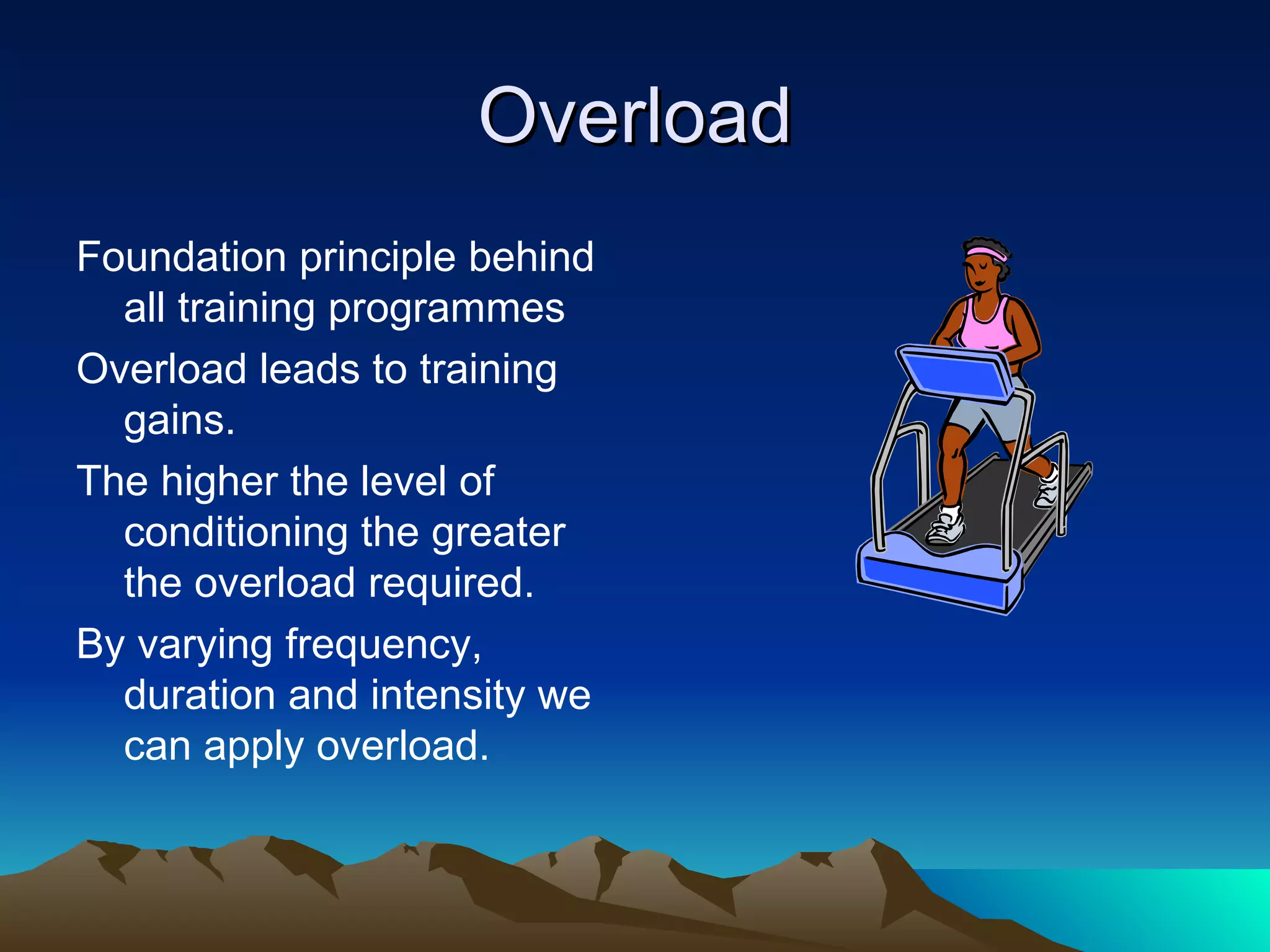
Overload Foundation principle behind all training programmes Overload leads to training gains. The higher the level of conditioning the greater the overload required. By varying frequency, duration and intensity we can apply overload.
Specificity You get what you train for You should train the : energy systems  muscles groups Specific to the sport/activity being played
Adaptation The body will adapt in response to: Frequency of training Intensity of training Duration of training Specificity of training Adaptations tend to occur early on training. As time progresses, gains made tend to become smaller this is known as the law of diminishing returns. You need to increase the level of overload as the level of improvement/ conditioning increases Physiological adaptations.. Increases heart volume, increase lung volume, more slow twitch muscle fibres, increased blood volume, increased RBC’s
Regularity Regularity is closely linked to frequency of training.  Adaptations will only be achieved if training is regular There has to be consistent and regular exercising of muscles and energy systems if you want to improve.
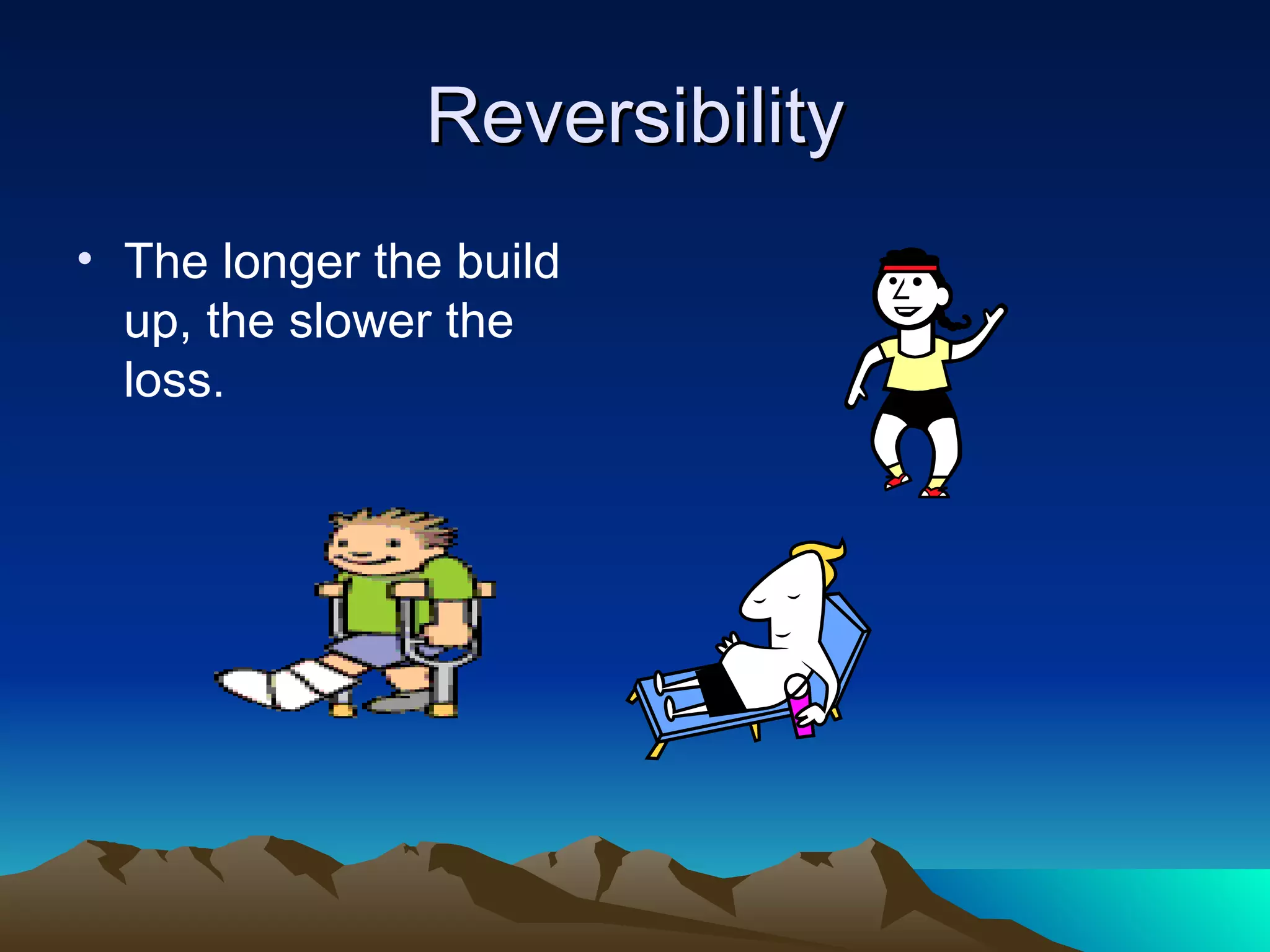
Reversibility The longer the build up, the slower the loss.
Generalisation before specialisation Core Fitness components: Cardio – respiratory endurance Strength Flexibility Is important before skill specialisation. This allows for greater quality and quantity of practice
Variety Variety is the spice of life. Advantages. Improved motivation Prevent boredom Help overcome plateaus in training How to add variety to training Circuit training Running in new locations or with people Playing different games at training
Group and Individual Training Advantages of training in a group Friendly competition within group, Motivation of a group Support with a group Information goes out to the whole group Team bonding Advantages of training as individuals You can receive specialised training depending on your skill/ fitness profile You can train “where you are at” You can work towards individual goals
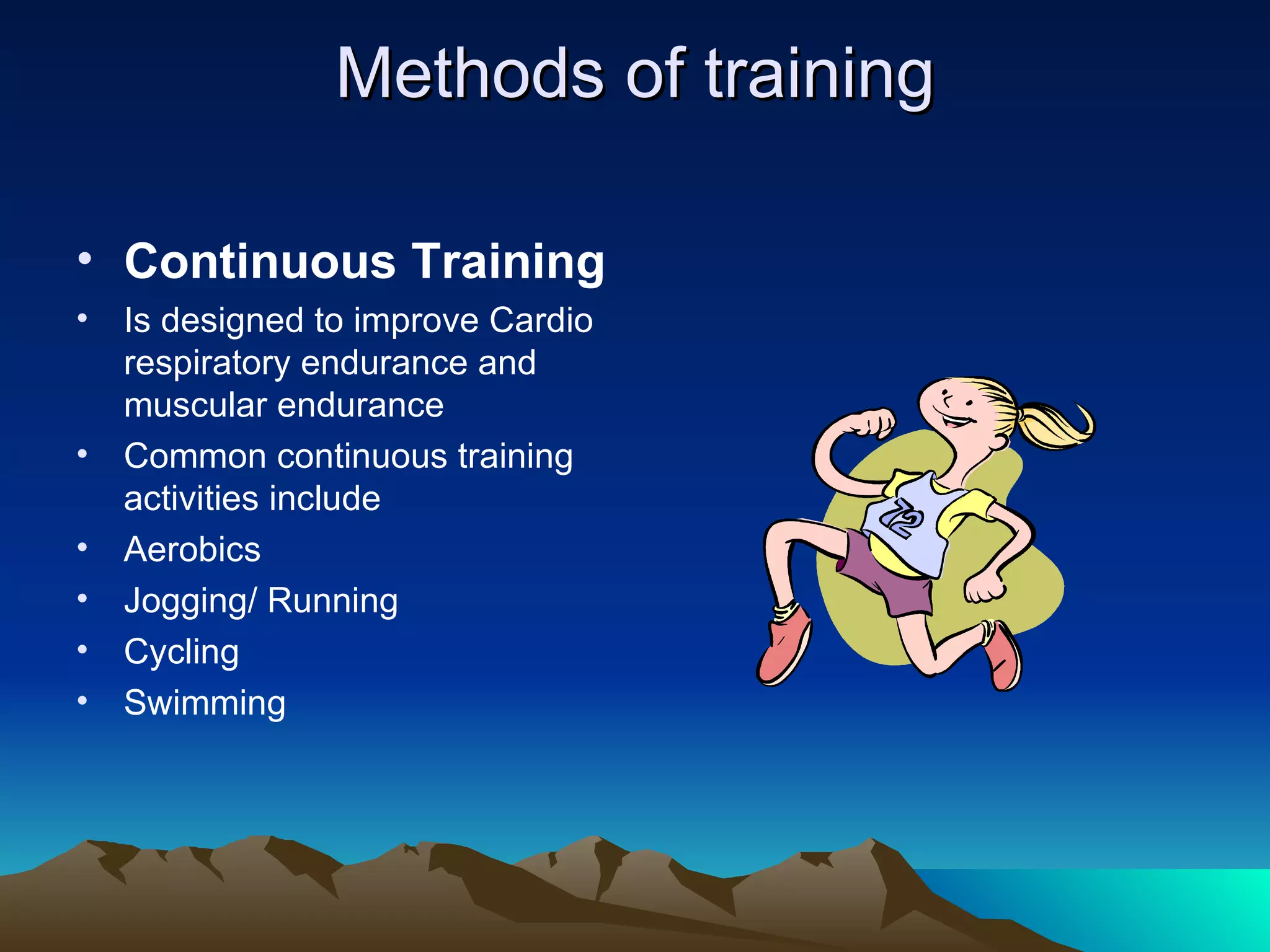
Methods of training Continuous Training   Is designed to improve Cardio respiratory endurance and muscular endurance Common continuous training activities include Aerobics Jogging/ Running Cycling  Swimming
Continuous Training Application of Frequency Health related fitness Training Frequency  3x per week Sports related fitness  5-6 x per week If training competitively in an aerobic activity the frequency of the training increases as the aerobic component increases.
Continuous Training Application of Duration Minimum length of time required to gain an aerobic benefit is 20 minutes. Ideal starting point for beginners who want a basic health related fitness. Sport related fitness sessions up to an hour may be required. Beyond an hour benefits begin to decrease.
Continuous training Intensity Aerobic capacity is developed by exercising with your heart rate at about 70% of maximum An effective method for establishing your training threshold is to use the Karvonen Formula Training Heart Rate [THR] = RHR + 0.6 [MHR – RHR] Training Heart Rate [THR] = RHR + 0.85 [MHR – RHR]
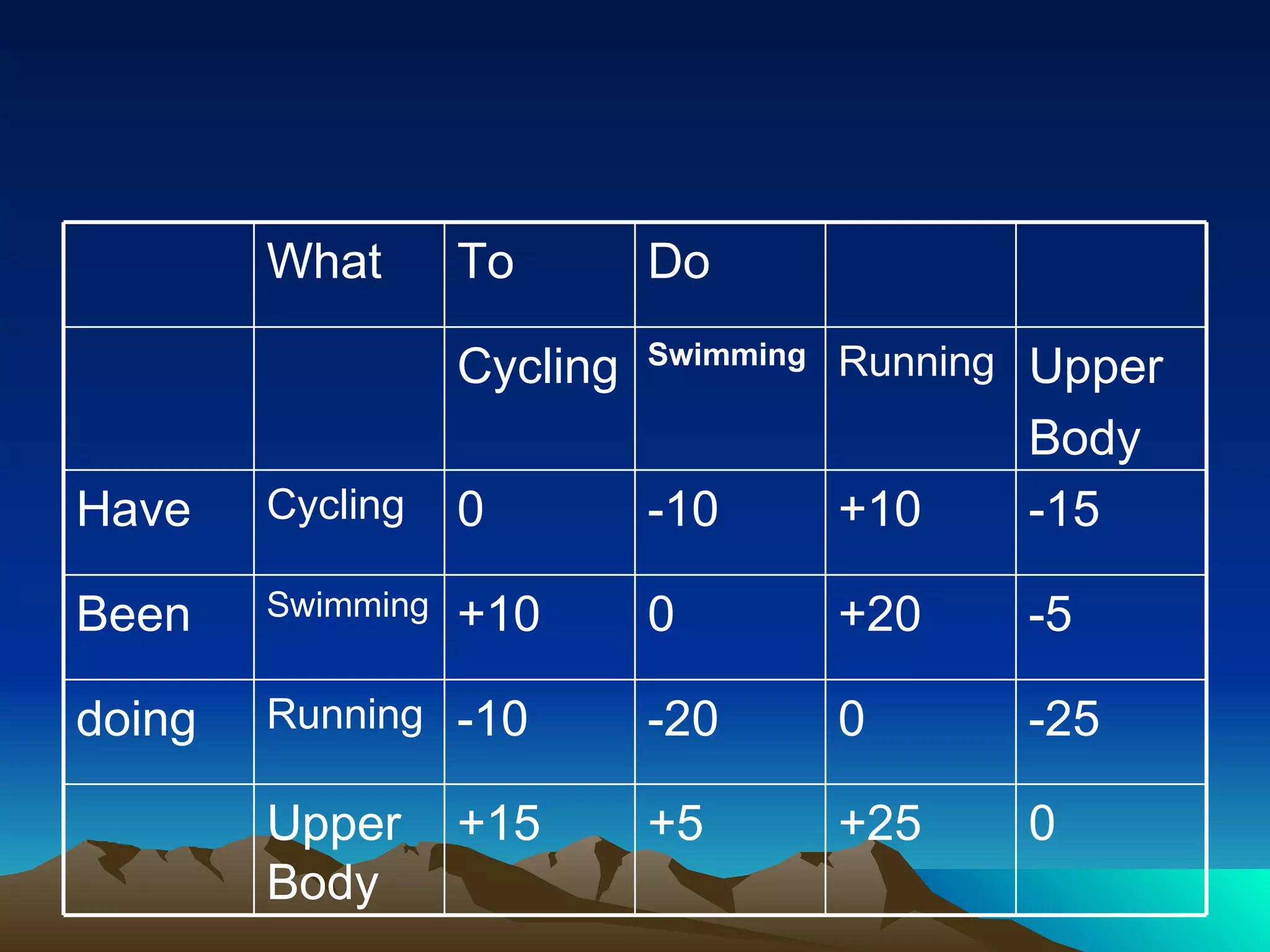
0 +25 +5  +15 Upper Body -25 0 -20 -10 Running doing -5 +20 0 +10 Swimming Been -15 +10  -10 0 Cycling Have Upper Body Running Swimming Cycling Do To  What
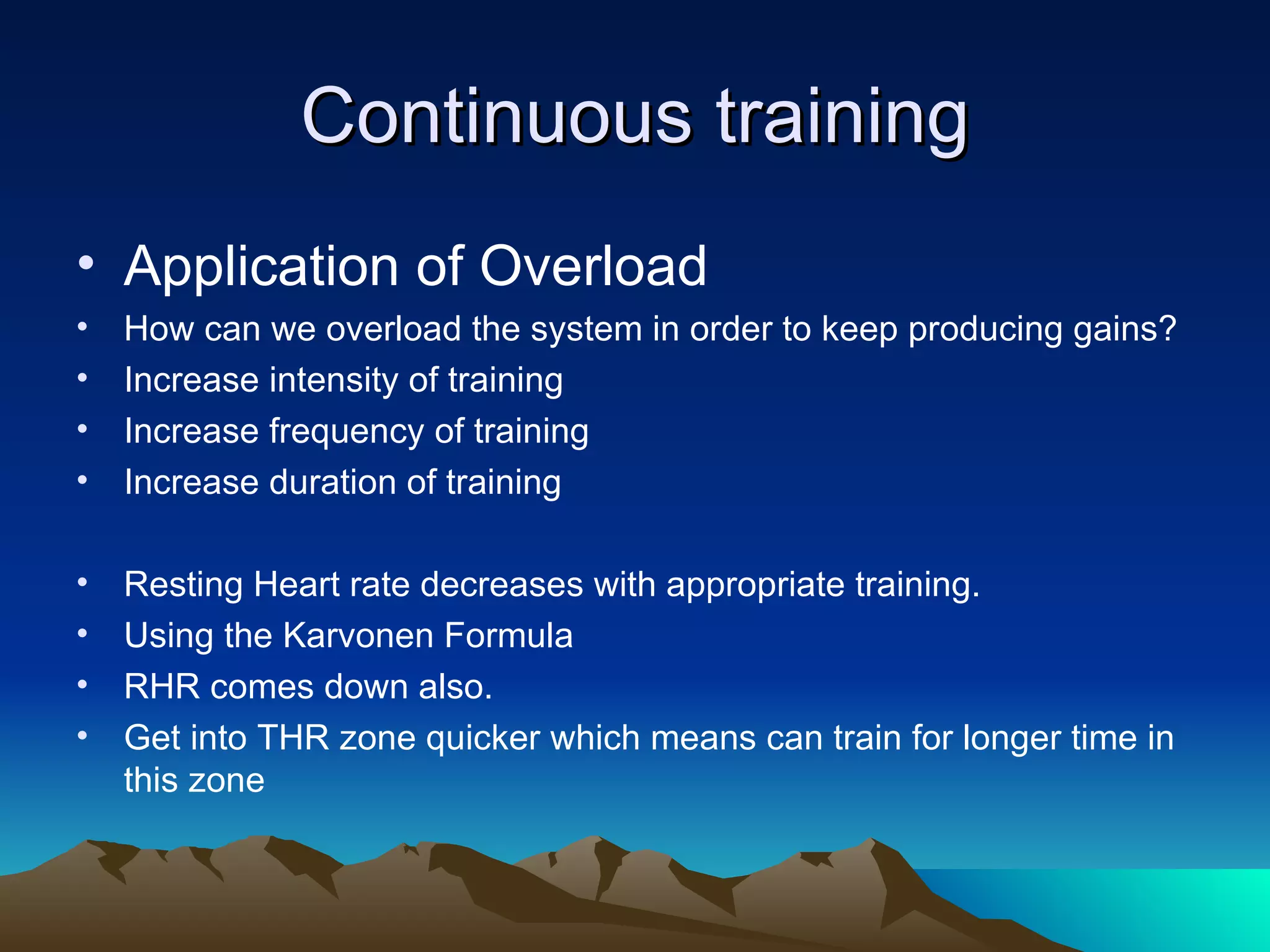
Continuous training Application of Overload How can we overload the system in order to keep producing gains? Increase intensity of training Increase frequency of training Increase duration of training Resting Heart rate decreases with appropriate training. Using the Karvonen Formula RHR comes down also.  Get into THR zone quicker which means can train for longer time in this zone
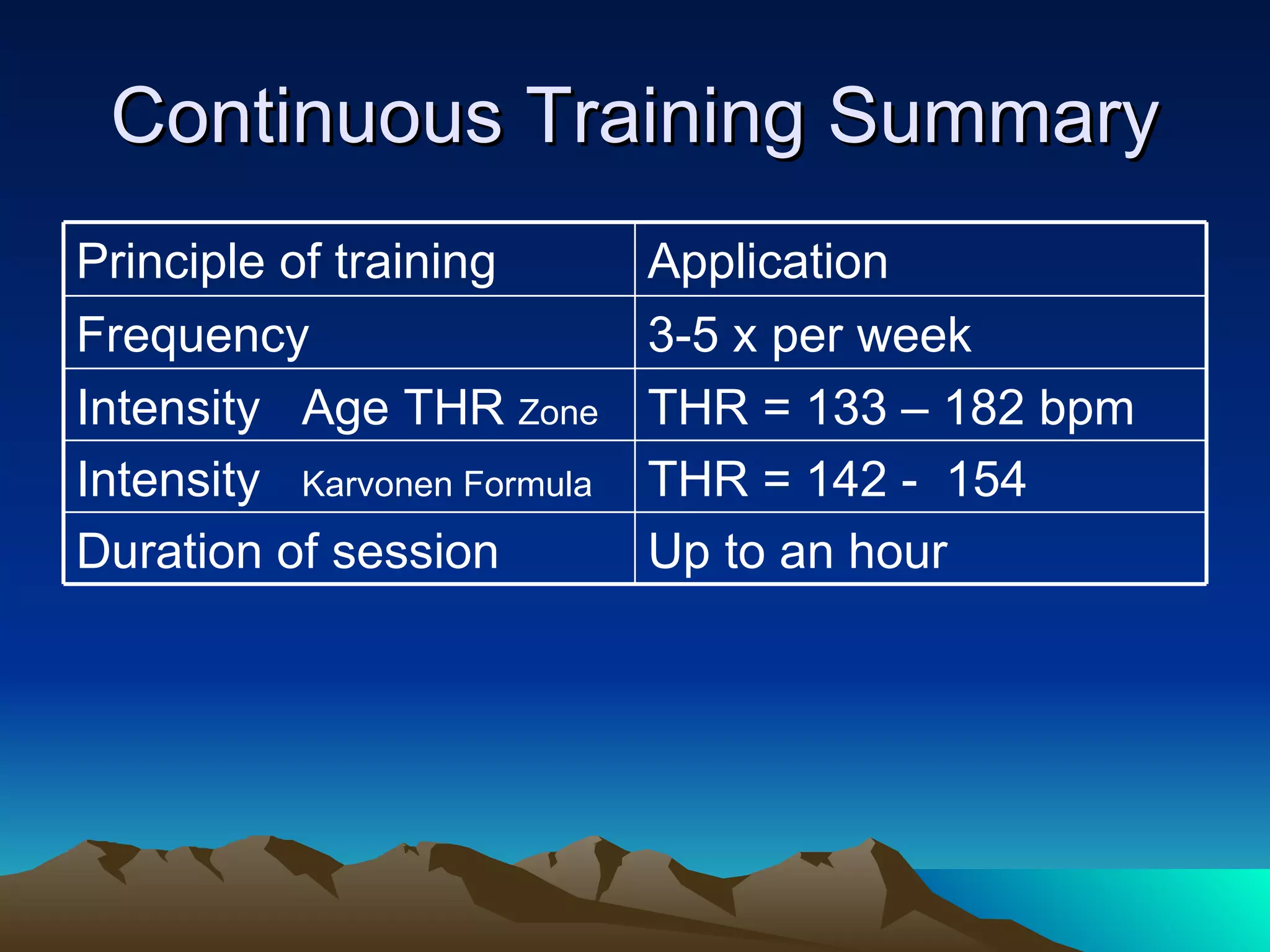
Continuous Training Summary Up to an hour Duration of session THR = 142 -  154  Intensity  Karvonen Formula THR = 133 – 182 bpm Intensity  Age THR  Zone 3-5 x per week Frequency Application Principle of training
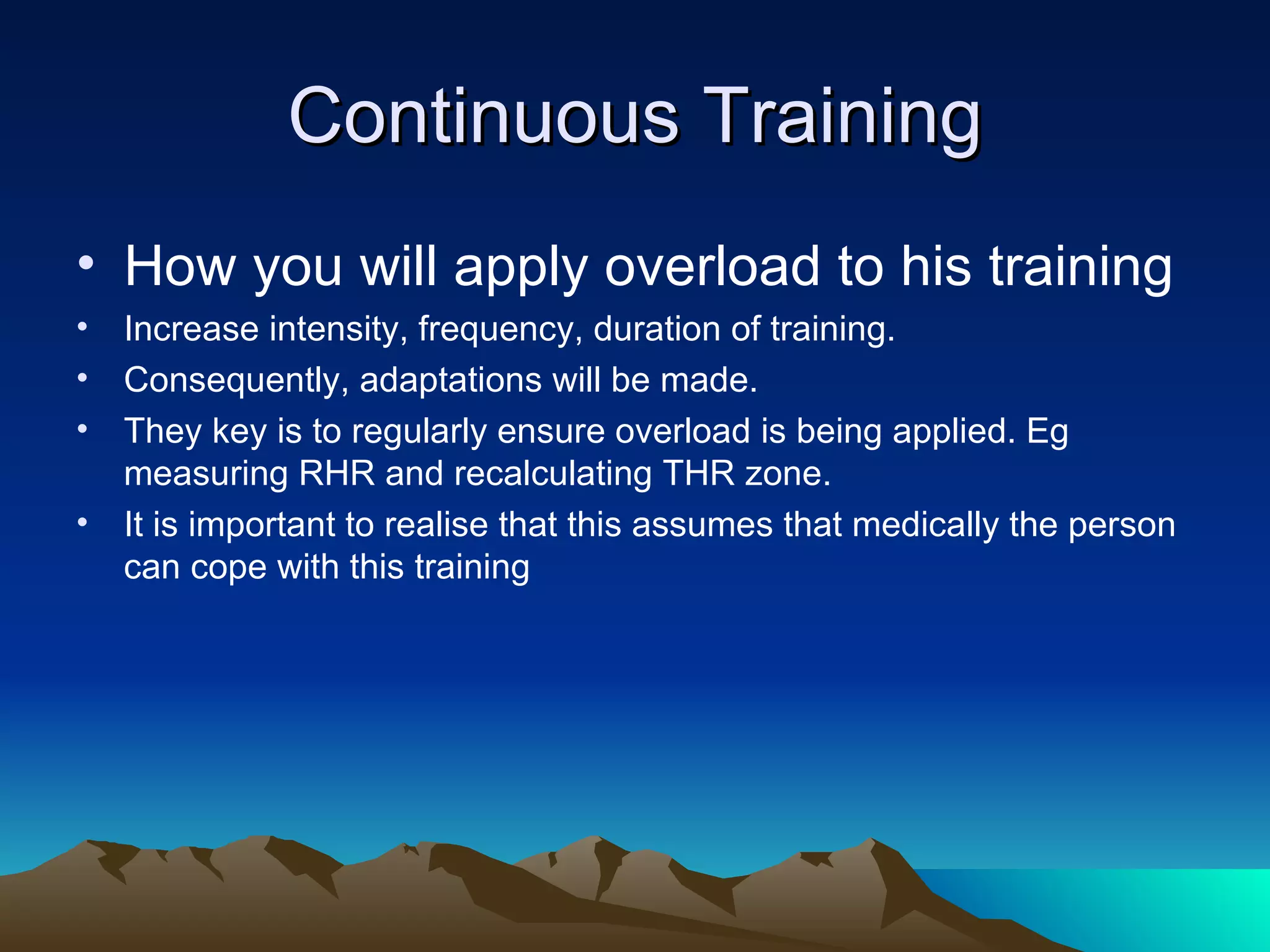
Continuous Training How you will apply overload to his training Increase intensity, frequency, duration of training. Consequently, adaptations will be made. They key is to regularly ensure overload is being applied. Eg measuring RHR and recalculating THR zone. It is important to realise that this assumes that medically the person can cope with this training
Weight Training Weight Training develops   the following   components of fitness   Muscular strength Muscular endurance Muscular power Terminology used in a weight training programme Repetition Max  : The max amount of weight that can be lifted x the number of times [ no more no less] Repetitions [Reps]  The number of times the exercise is done Sets:   The number  of times each set of exercise is done
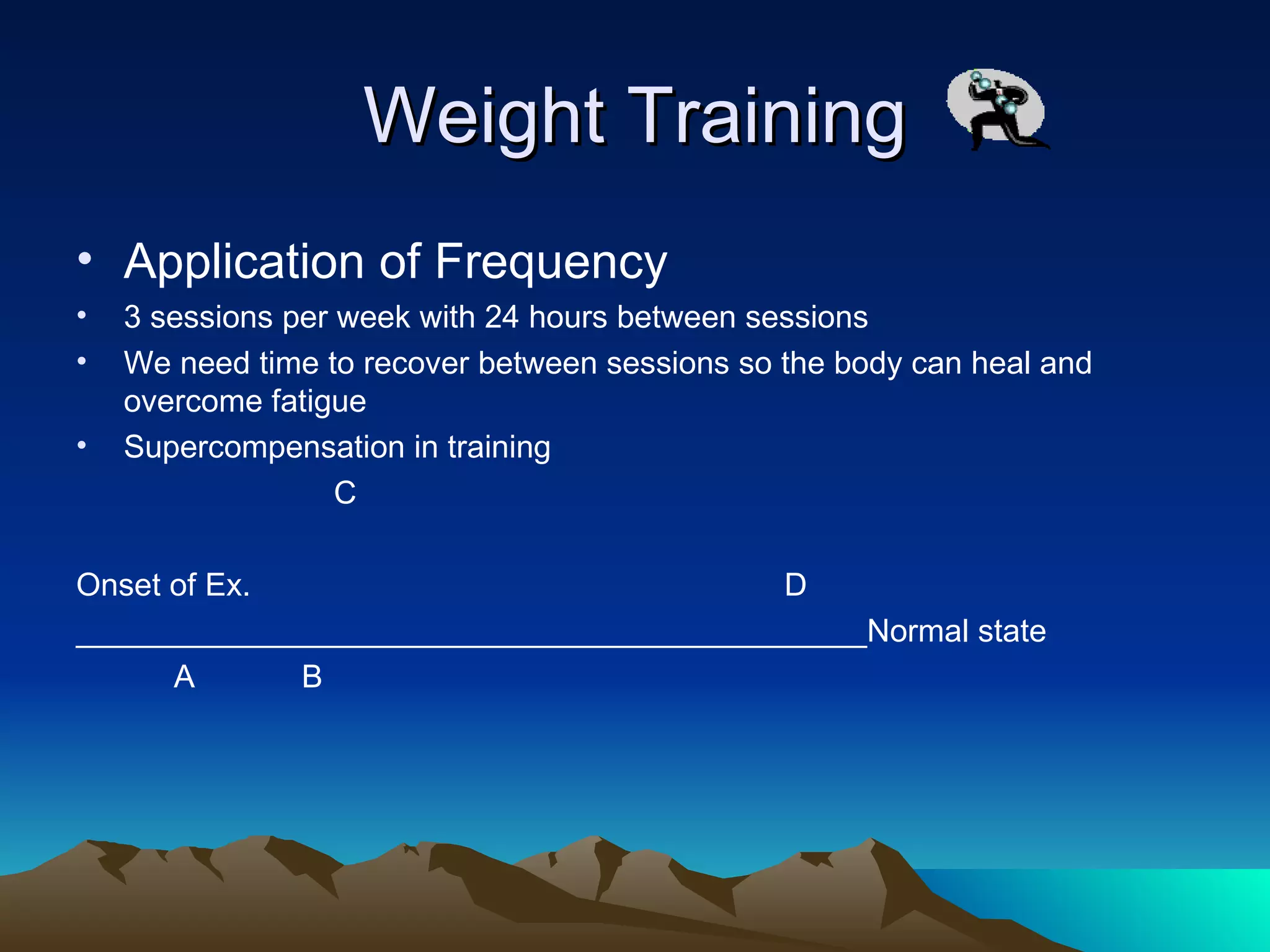
Weight Training Application of Frequency 3 sessions per week with 24 hours between sessions We need time to recover between sessions so the body can heal and overcome fatigue Supercompensation in training C Onset of Ex.  D _____________________________________________Normal state A  B
Weight Training Following the onset of exercise, we go through four phases. A:  Fatigue -  Decrease in performance as we fire B:  Recovery as we rest immediately following a session of training Supercompensation  as the body adapts to training De training – reversibility if training does not occur Best time to train is during C Supercompensation Supercompensation phase lasts between 24-48hours depending on intensity of training We are ready to train when we feel ready  PER Ratio can be of benefit
Weight Training Application of Intensity Four Types Of Muscle contractions A. Isotonic  Tradition weight training B. Isometric  Contractions against immoveable force C. Isokinetic Tends to use highly specialised machines D. Eccentric  Slowly lowering weights [ controlling]
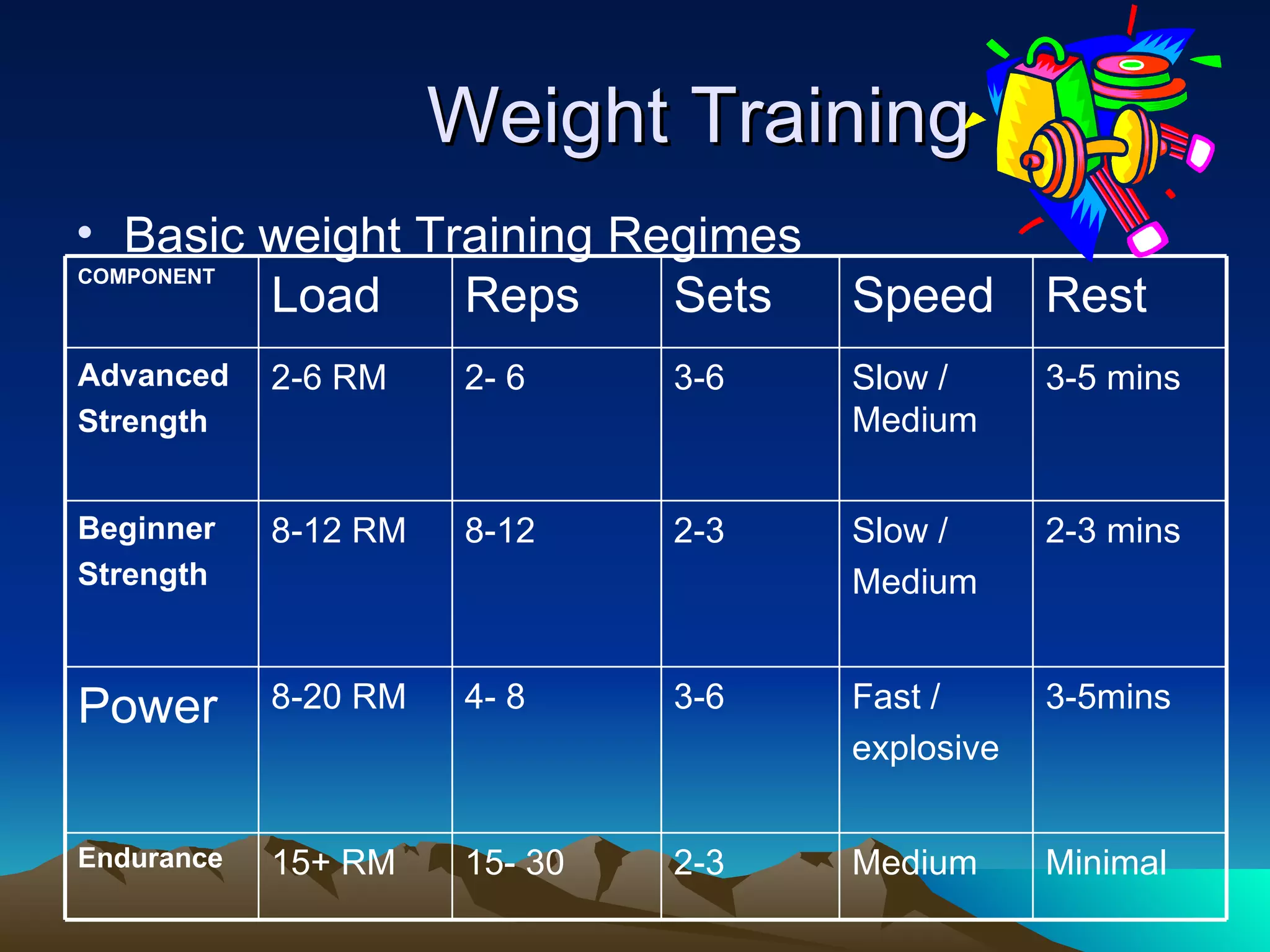
Weight Training Basic weight Training Regimes Minimal Medium 2-3 15- 30 15+ RM Endurance 3-5mins Fast / explosive 3-6 4- 8 8-20 RM Power 2-3 mins Slow / Medium 2-3 8-12 8-12 RM Beginner Strength 3-5 mins Slow / Medium 3-6 2- 6 2-6 RM Advanced Strength Rest Speed Sets  Reps Load COMPONENT
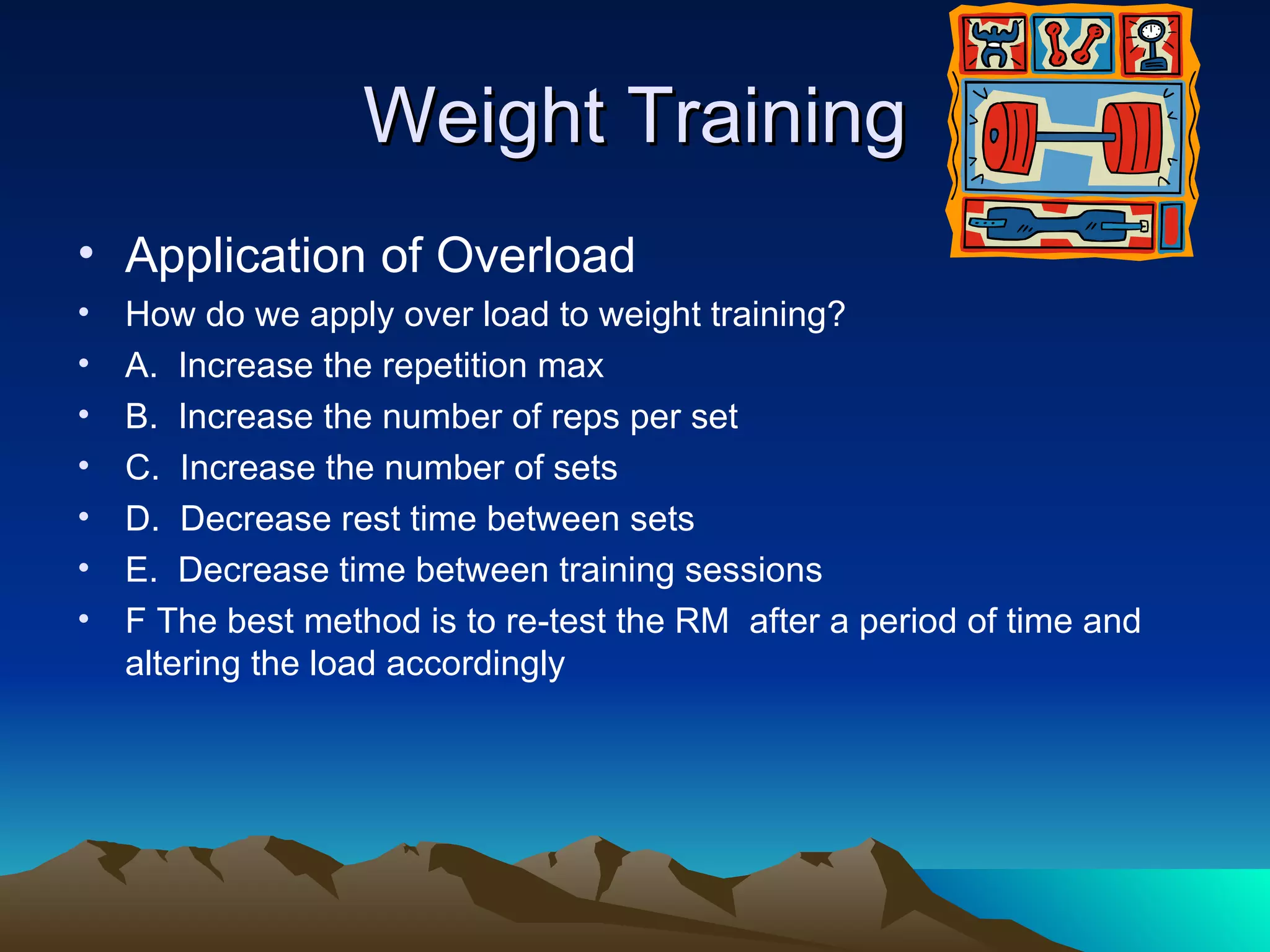
Weight Training Application of Overload How do we apply over load to weight training? A.  Increase the repetition max B.  Increase the number of reps per set C.  Increase the number of sets D.  Decrease rest time between sets E.  Decrease time between training sessions F The best method is to re-test the RM  after a period of time and altering the load accordingly
Weight Training Application of specificity  EG. Volleyball player Use exercises that mimic the sporting actions of the sports we play. Eg. squat jumps in volleyball How would you increase a vertical jump. Identify main muscle groups Quadriceps, hamstrings, gluteals , gastrocnemius/ soleus Exercises you would perform would be: Squats, toe raises, leg extensions The exercises would be performed  fast/ explosive because you are training for power Having selected the exercises there are two essential rules to follow before starting: 1. Make sure you understand the correct technique Never put two exercises together that stress the same muscle group
Circuit Training What health and skill components can circuit training develop? A.  Muscular strength  B. Muscular power C. Muscular Endurance  D. Aerobic Endurance E. Agility  F. Skill / Technique Basic circuits can be designed for general fitness, or sport specific fitness and skills. There Are two general circuit types. A .  Fixed load.  You do a set number of  a set exercise before moving on.  Eg. 10 chin ups B. Individual load  You do as many of a certain exercise as possible within a time period. In both programmes. You need to consider : 1.  A separate flexibility programme 2.  Never exercise the same muscle group in succession
Circuit Training Application of Frequency Designed to be primarily cardiorespiratory in nature  3-5 days/ week Application of Intensity What factors will determine how intense the training will be? A, Purpose .. what you are training for B. Individual fitness level C.  Exercises selected Having determined these we can use duration and overload to set intensity. We measure intensity in a circuit by using THR [ Target heart rate] And PER  [perceived exertion rate]
Circuit Training Application of Duration A. Set Duration.  This depends on the individual and the training  objectives but 20-60 seconds is usual. .  B . Rest Duration  This can be increased or decreased to meet intensity required. General fitness  0-10  seconds Strength/ power  30-60 seconds  Elderly/ Unfit  20-60 seconds We can manipulate these factors to provide overload
Circuit training Application of Overload Factors that can be manipulated in order to apply overload 1. Rest duration 2. Exercise duration 3. Intensity of session It is time to overload an athlete when; A  They feel ready to move on  B  When testing shows they have improved
Circuit Training Application of Specificity Train energy systems Muscle groups specific to a sport
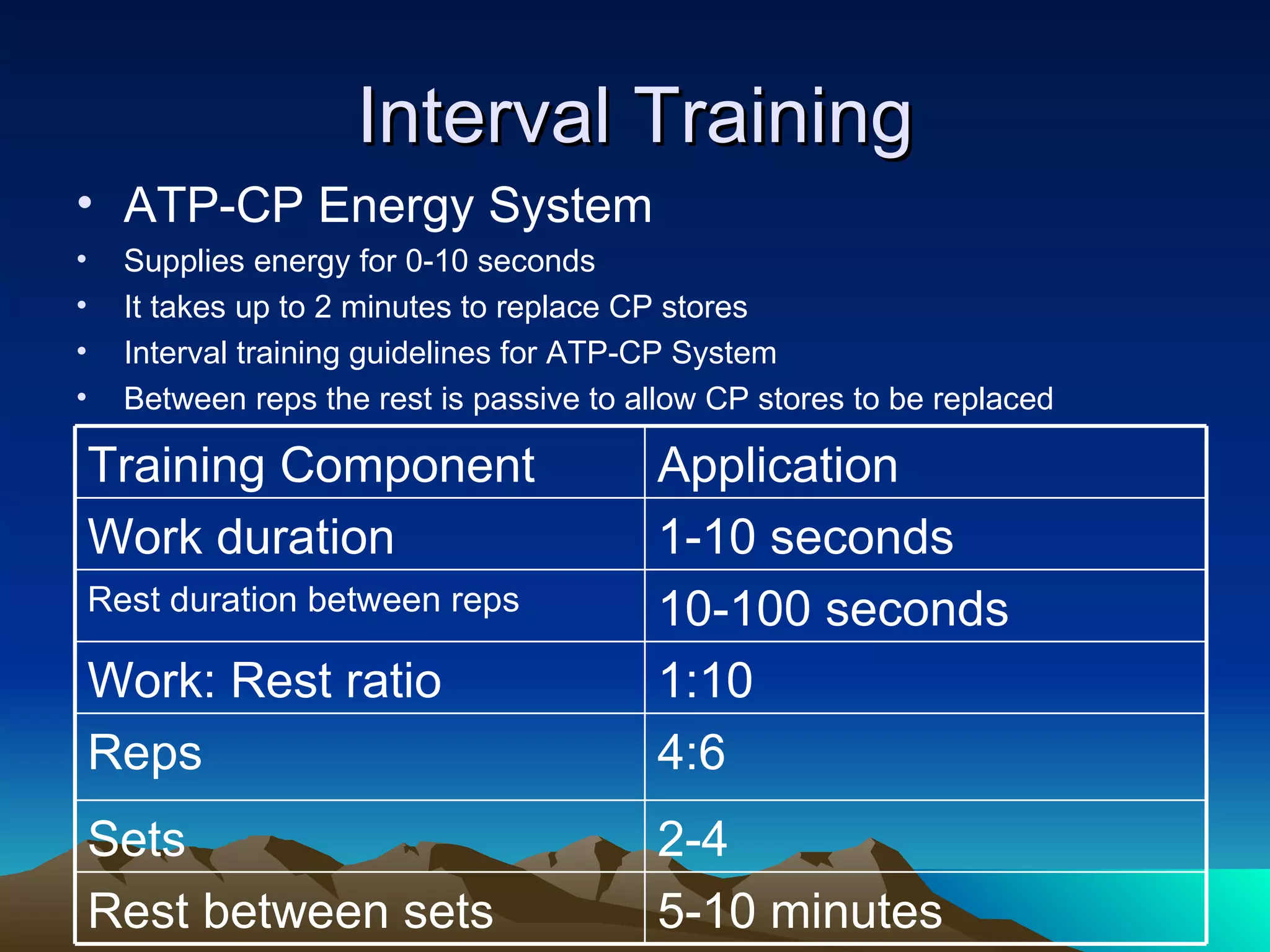
Interval Training ATP-CP Energy System Supplies energy for 0-10 seconds It takes up to 2 minutes to replace CP stores Interval training guidelines for ATP-CP System Between reps the rest is passive to allow CP stores to be replaced 5-10 minutes Rest between sets 2-4 Sets 4:6 Reps 1:10 Work: Rest ratio 10-100 seconds Rest duration between reps 1-10 seconds Work duration Application Training Component
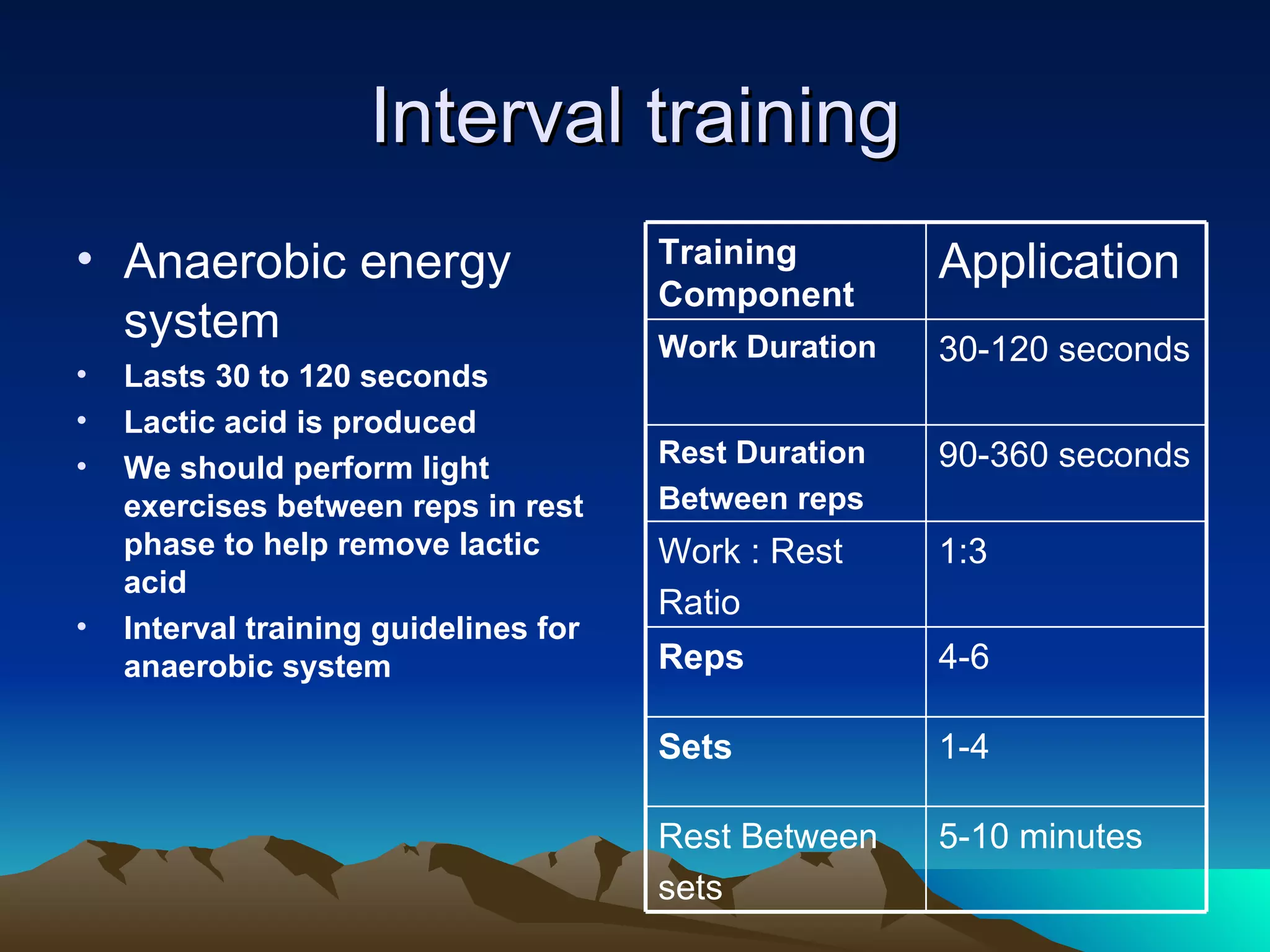
Interval training Anaerobic energy system Lasts 30 to 120 seconds Lactic acid is produced We should perform light exercises between reps in rest phase to help remove lactic acid Interval training guidelines for anaerobic system 5-10 minutes Rest Between sets 1-4 Sets 4-6 Reps 1:3 Work : Rest Ratio 90-360 seconds Rest Duration  Between reps 30-120 seconds Work Duration Application Training Component
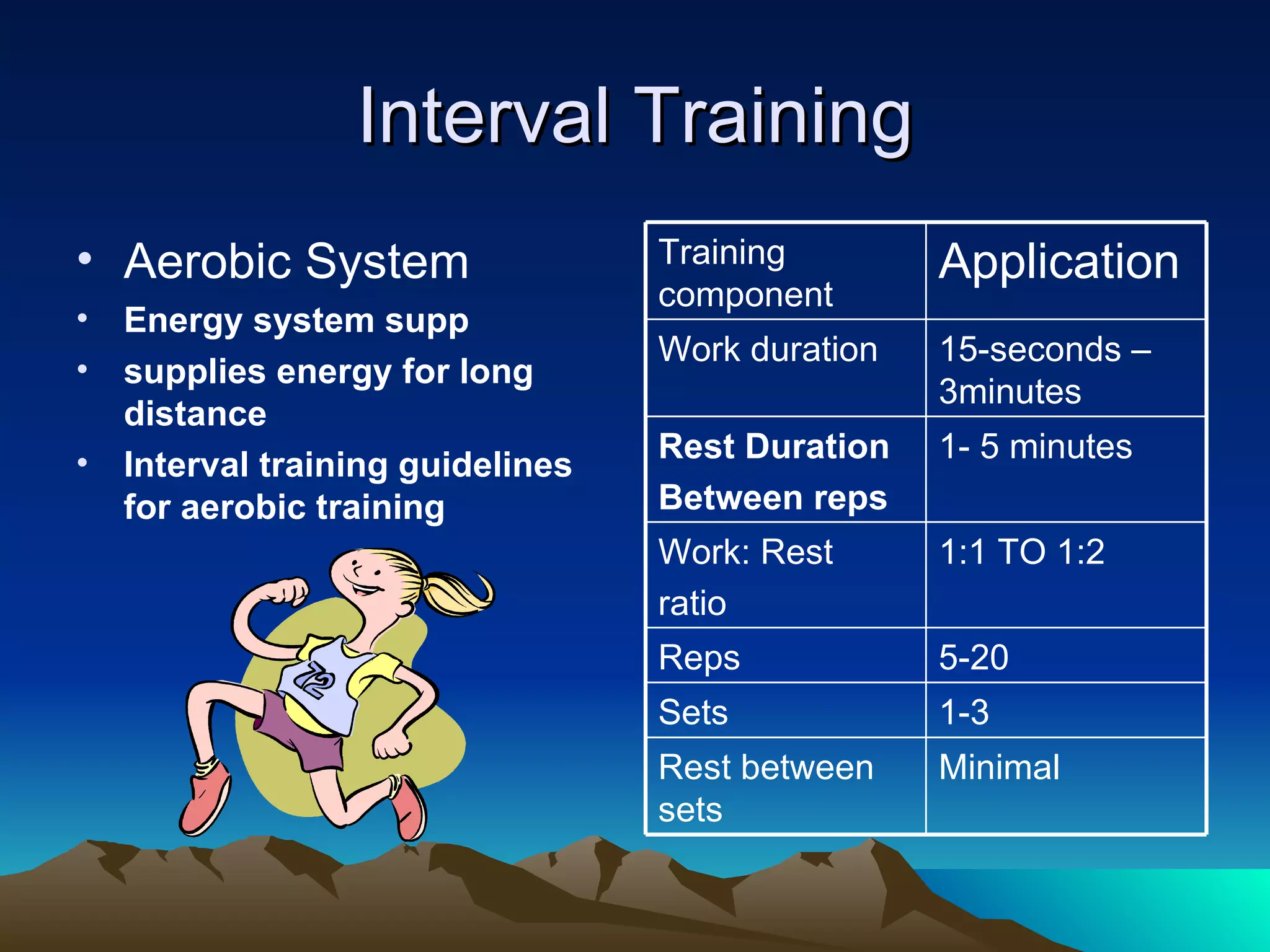
Interval Training Aerobic System Energy system supp supplies energy for long distance  Interval training guidelines for aerobic training Minimal Rest between sets 1-3 Sets 5-20 Reps 1:1 TO 1:2 Work: Rest ratio 1- 5 minutes Rest Duration Between reps 15-seconds – 3minutes Work duration Application Training component
Interval Training Application of Overload How can we overload these energy systems. 1. Decrease the rest between reps 2.Increase the number of reps 3. Increase sets 4. Increase work-time We apply overload to the athlete A. Athlete feels ready B. We can use PER [perceived exertion rate] C. We notice a decreased resting heart rate [RHR]

Principles Of Training

  • 1.
  • 2.
    Frequency Basic healthrelated fitness 3-4 x per week The greater the aerobic component of the event, the more frequent the training Non endurance athletes frequency 3x per week Most endurance athletes frequency 4-6 x per week Dangers of over training. Injury boredom, poor technique burnout. Dangers of under training. Loss of motivation, poor or no improvement
  • 3.
    Intensity How hardshould I be training. Why do we need to train at the correct intensity? Correct intensity provides sustained improvements in performance due to physiological adaptations. Too much and we risk injury and burn out To little and the gains are small if at all By manipulating frequency and intensity we can overload the system thereby making improvements. Intensity is measured by Heart rate. Perceived exertion rate PER, Repetition max. RM, Subjective measures of feelings
  • 4.
    Duration The lengthof time we train. The time of stimulation. By manipulating duration and intensity we can overload the systems and make adaptations. As fitness increases, duration needs to increase if you wish to improve. Because without it adaptations/ improvements will slow down or cease. This means the athlete needs to devote more time to training.
  • 5.
    Overload Foundation principlebehind all training programmes Overload leads to training gains. The higher the level of conditioning the greater the overload required. By varying frequency, duration and intensity we can apply overload.
  • 6.
    Specificity You getwhat you train for You should train the : energy systems muscles groups Specific to the sport/activity being played
  • 7.
    Adaptation The bodywill adapt in response to: Frequency of training Intensity of training Duration of training Specificity of training Adaptations tend to occur early on training. As time progresses, gains made tend to become smaller this is known as the law of diminishing returns. You need to increase the level of overload as the level of improvement/ conditioning increases Physiological adaptations.. Increases heart volume, increase lung volume, more slow twitch muscle fibres, increased blood volume, increased RBC’s
  • 8.
    Regularity Regularity isclosely linked to frequency of training. Adaptations will only be achieved if training is regular There has to be consistent and regular exercising of muscles and energy systems if you want to improve.
  • 9.
    Reversibility The longerthe build up, the slower the loss.
  • 10.
    Generalisation before specialisationCore Fitness components: Cardio – respiratory endurance Strength Flexibility Is important before skill specialisation. This allows for greater quality and quantity of practice
  • 11.
    Variety Variety isthe spice of life. Advantages. Improved motivation Prevent boredom Help overcome plateaus in training How to add variety to training Circuit training Running in new locations or with people Playing different games at training
  • 12.
    Group and IndividualTraining Advantages of training in a group Friendly competition within group, Motivation of a group Support with a group Information goes out to the whole group Team bonding Advantages of training as individuals You can receive specialised training depending on your skill/ fitness profile You can train “where you are at” You can work towards individual goals
  • 13.
    Methods of trainingContinuous Training Is designed to improve Cardio respiratory endurance and muscular endurance Common continuous training activities include Aerobics Jogging/ Running Cycling Swimming
  • 14.
    Continuous Training Applicationof Frequency Health related fitness Training Frequency 3x per week Sports related fitness 5-6 x per week If training competitively in an aerobic activity the frequency of the training increases as the aerobic component increases.
  • 15.
    Continuous Training Applicationof Duration Minimum length of time required to gain an aerobic benefit is 20 minutes. Ideal starting point for beginners who want a basic health related fitness. Sport related fitness sessions up to an hour may be required. Beyond an hour benefits begin to decrease.
  • 16.
    Continuous training IntensityAerobic capacity is developed by exercising with your heart rate at about 70% of maximum An effective method for establishing your training threshold is to use the Karvonen Formula Training Heart Rate [THR] = RHR + 0.6 [MHR – RHR] Training Heart Rate [THR] = RHR + 0.85 [MHR – RHR]
  • 17.
    0 +25 +5 +15 Upper Body -25 0 -20 -10 Running doing -5 +20 0 +10 Swimming Been -15 +10 -10 0 Cycling Have Upper Body Running Swimming Cycling Do To What
  • 18.
    Continuous training Applicationof Overload How can we overload the system in order to keep producing gains? Increase intensity of training Increase frequency of training Increase duration of training Resting Heart rate decreases with appropriate training. Using the Karvonen Formula RHR comes down also. Get into THR zone quicker which means can train for longer time in this zone
  • 19.
    Continuous Training SummaryUp to an hour Duration of session THR = 142 - 154 Intensity Karvonen Formula THR = 133 – 182 bpm Intensity Age THR Zone 3-5 x per week Frequency Application Principle of training
  • 20.
    Continuous Training Howyou will apply overload to his training Increase intensity, frequency, duration of training. Consequently, adaptations will be made. They key is to regularly ensure overload is being applied. Eg measuring RHR and recalculating THR zone. It is important to realise that this assumes that medically the person can cope with this training
  • 21.
    Weight Training WeightTraining develops the following components of fitness Muscular strength Muscular endurance Muscular power Terminology used in a weight training programme Repetition Max : The max amount of weight that can be lifted x the number of times [ no more no less] Repetitions [Reps] The number of times the exercise is done Sets: The number of times each set of exercise is done
  • 22.
    Weight Training Applicationof Frequency 3 sessions per week with 24 hours between sessions We need time to recover between sessions so the body can heal and overcome fatigue Supercompensation in training C Onset of Ex. D _____________________________________________Normal state A B
  • 23.
    Weight Training Followingthe onset of exercise, we go through four phases. A: Fatigue - Decrease in performance as we fire B: Recovery as we rest immediately following a session of training Supercompensation as the body adapts to training De training – reversibility if training does not occur Best time to train is during C Supercompensation Supercompensation phase lasts between 24-48hours depending on intensity of training We are ready to train when we feel ready PER Ratio can be of benefit
  • 24.
    Weight Training Applicationof Intensity Four Types Of Muscle contractions A. Isotonic Tradition weight training B. Isometric Contractions against immoveable force C. Isokinetic Tends to use highly specialised machines D. Eccentric Slowly lowering weights [ controlling]
  • 25.
    Weight Training Basicweight Training Regimes Minimal Medium 2-3 15- 30 15+ RM Endurance 3-5mins Fast / explosive 3-6 4- 8 8-20 RM Power 2-3 mins Slow / Medium 2-3 8-12 8-12 RM Beginner Strength 3-5 mins Slow / Medium 3-6 2- 6 2-6 RM Advanced Strength Rest Speed Sets Reps Load COMPONENT
  • 26.
    Weight Training Applicationof Overload How do we apply over load to weight training? A. Increase the repetition max B. Increase the number of reps per set C. Increase the number of sets D. Decrease rest time between sets E. Decrease time between training sessions F The best method is to re-test the RM after a period of time and altering the load accordingly
  • 27.
    Weight Training Applicationof specificity EG. Volleyball player Use exercises that mimic the sporting actions of the sports we play. Eg. squat jumps in volleyball How would you increase a vertical jump. Identify main muscle groups Quadriceps, hamstrings, gluteals , gastrocnemius/ soleus Exercises you would perform would be: Squats, toe raises, leg extensions The exercises would be performed fast/ explosive because you are training for power Having selected the exercises there are two essential rules to follow before starting: 1. Make sure you understand the correct technique Never put two exercises together that stress the same muscle group
  • 28.
    Circuit Training Whathealth and skill components can circuit training develop? A. Muscular strength B. Muscular power C. Muscular Endurance D. Aerobic Endurance E. Agility F. Skill / Technique Basic circuits can be designed for general fitness, or sport specific fitness and skills. There Are two general circuit types. A . Fixed load. You do a set number of a set exercise before moving on. Eg. 10 chin ups B. Individual load You do as many of a certain exercise as possible within a time period. In both programmes. You need to consider : 1. A separate flexibility programme 2. Never exercise the same muscle group in succession
  • 29.
    Circuit Training Applicationof Frequency Designed to be primarily cardiorespiratory in nature 3-5 days/ week Application of Intensity What factors will determine how intense the training will be? A, Purpose .. what you are training for B. Individual fitness level C. Exercises selected Having determined these we can use duration and overload to set intensity. We measure intensity in a circuit by using THR [ Target heart rate] And PER [perceived exertion rate]
  • 30.
    Circuit Training Applicationof Duration A. Set Duration. This depends on the individual and the training objectives but 20-60 seconds is usual. . B . Rest Duration This can be increased or decreased to meet intensity required. General fitness 0-10 seconds Strength/ power 30-60 seconds Elderly/ Unfit 20-60 seconds We can manipulate these factors to provide overload
  • 31.
    Circuit training Applicationof Overload Factors that can be manipulated in order to apply overload 1. Rest duration 2. Exercise duration 3. Intensity of session It is time to overload an athlete when; A They feel ready to move on B When testing shows they have improved
  • 32.
    Circuit Training Applicationof Specificity Train energy systems Muscle groups specific to a sport
  • 33.
    Interval Training ATP-CPEnergy System Supplies energy for 0-10 seconds It takes up to 2 minutes to replace CP stores Interval training guidelines for ATP-CP System Between reps the rest is passive to allow CP stores to be replaced 5-10 minutes Rest between sets 2-4 Sets 4:6 Reps 1:10 Work: Rest ratio 10-100 seconds Rest duration between reps 1-10 seconds Work duration Application Training Component
  • 34.
    Interval training Anaerobicenergy system Lasts 30 to 120 seconds Lactic acid is produced We should perform light exercises between reps in rest phase to help remove lactic acid Interval training guidelines for anaerobic system 5-10 minutes Rest Between sets 1-4 Sets 4-6 Reps 1:3 Work : Rest Ratio 90-360 seconds Rest Duration Between reps 30-120 seconds Work Duration Application Training Component
  • 35.
    Interval Training AerobicSystem Energy system supp supplies energy for long distance Interval training guidelines for aerobic training Minimal Rest between sets 1-3 Sets 5-20 Reps 1:1 TO 1:2 Work: Rest ratio 1- 5 minutes Rest Duration Between reps 15-seconds – 3minutes Work duration Application Training component
  • 36.
    Interval Training Applicationof Overload How can we overload these energy systems. 1. Decrease the rest between reps 2.Increase the number of reps 3. Increase sets 4. Increase work-time We apply overload to the athlete A. Athlete feels ready B. We can use PER [perceived exertion rate] C. We notice a decreased resting heart rate [RHR]