Implementing a New Curriculum
   for Information Literacy:
                    lessons from LSE
Jane Secker, Maria Bell & Katy Wrathall
                    @jsecker @bellmari @SmilyLibrarian


  IFLA Satellite Meeting ‘The Road to Information Literacy’ August 2012
   Introducing the New Curriculum for Information
    Literacy (ANCIL)
    ◦ Discussion and thoughts
   Strategies for implementing ANCIL
   The ANCIL audit at LSE
    ◦ How might it be useful in your institution?
   Developing the new curriculum
    ◦ Arcadia Fellowship with Emma Coonan at Cambridge
    ◦ Academic advisor: Prof. John Naughton
   Research remit: Develop a new, revolutionary
    curriculum for information literacy in a digital age
    ◦ Understand the needs of undergraduates entering higher
      education over the coming 5 years
    ◦ Map the current landscape of information literacy
    ◦ Develop a practical curriculum and supporting resources
   Multiple outputs from the research
Modified Delphi study
  ◦ means of obtaining expert future forecasting
  ◦ consulted widely in the fields of information and education
Literature review
  ◦ theoretical overview of the field
  ◦ revealed conflicts in terminology, pedagogic approach, values
Expert workshop
  ◦ method, findings and preliminary curriculum presented
    curriculum refined in light of feedback
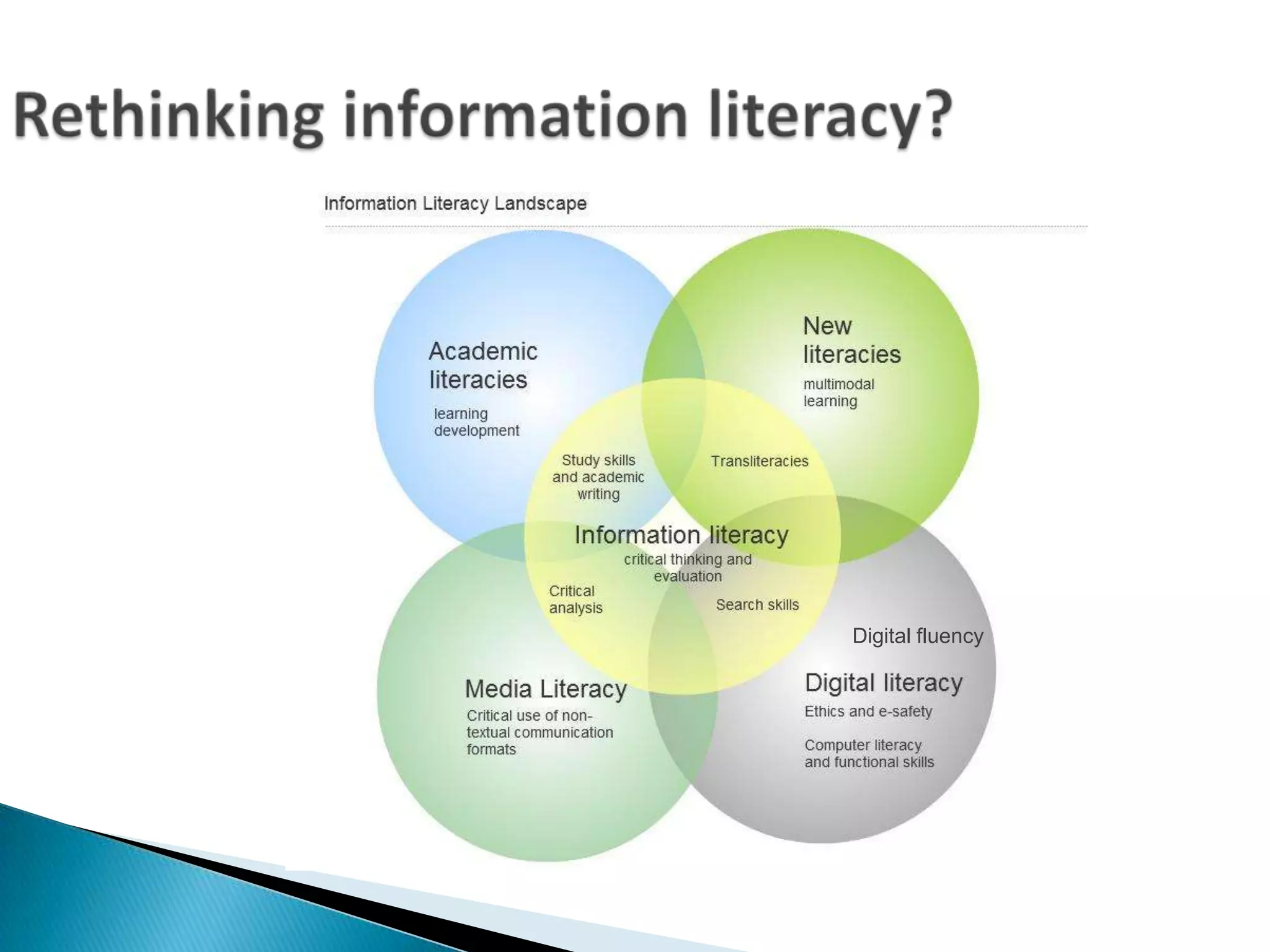
Digital fluency
Information literacy is a continuum of skills,
behaviours, approaches and values that is so
deeply entwined with the uses of information
 as to be a fundamental element of learning,
           scholarship and research.

     It is the defining characteristic of the
discerning scholar, the informed and judicious
     citizen, and the autonomous learner.

  ANCIL definition of information literacy (2011)
   What is a curriculum?
    ◦ What does it mean to have a curriculum (as
      opposed to a model or competency framework) for
      Information Literacy?

   How might a curriculum impact on
    ◦ your provision to students?
    ◦ your understanding of your own role?
    ◦ your interaction with other professions in your
      institution (and beyond)?
Implementing ANCIL


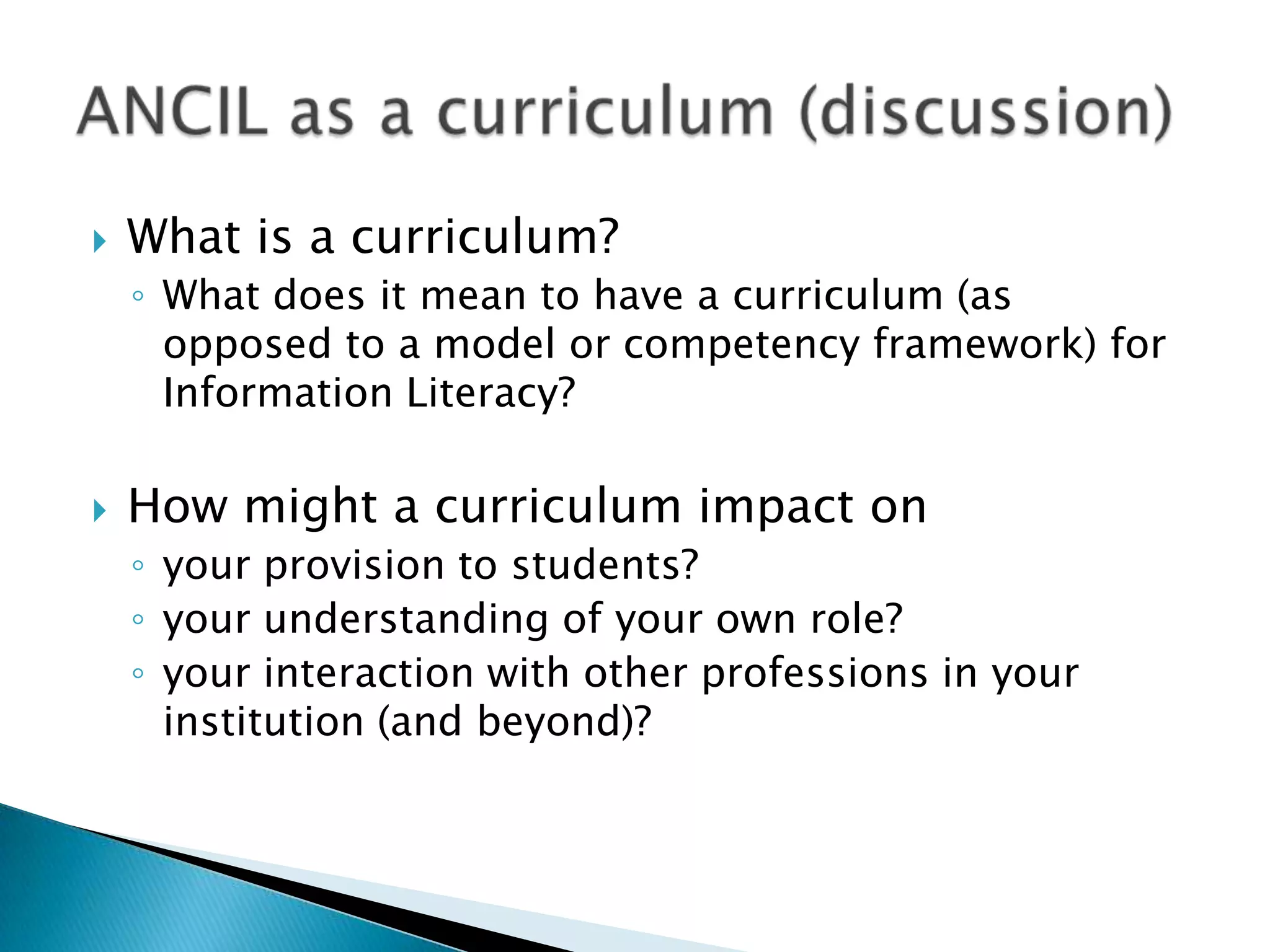
                                 Next steps
Image © Katy Wrathall
Implementing ANCIL


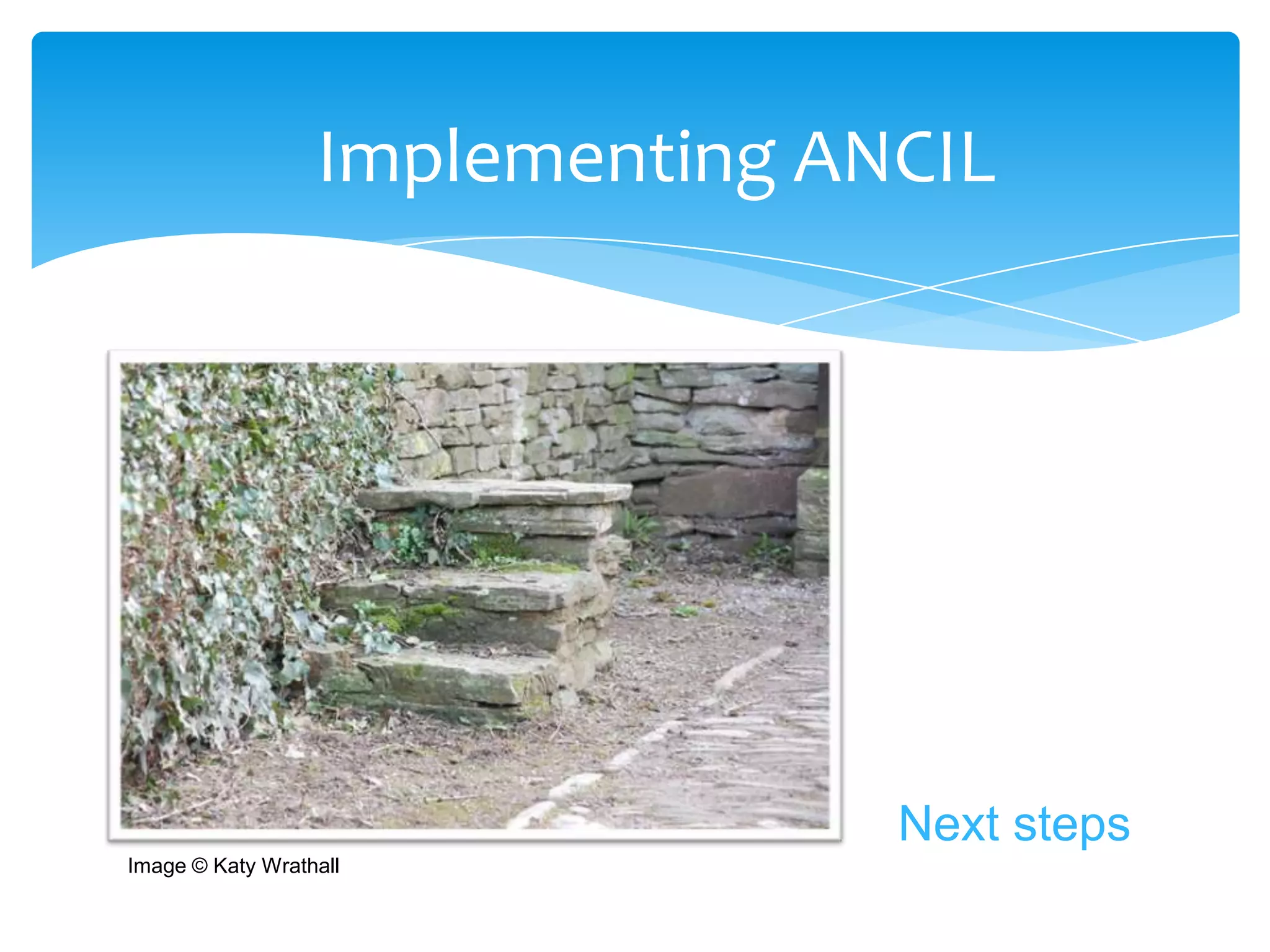
Mapping the
landscape
Implementing ANCIL

 Reaction and Reflection


 Image © Katy Wrathall
Implementing ANCIL


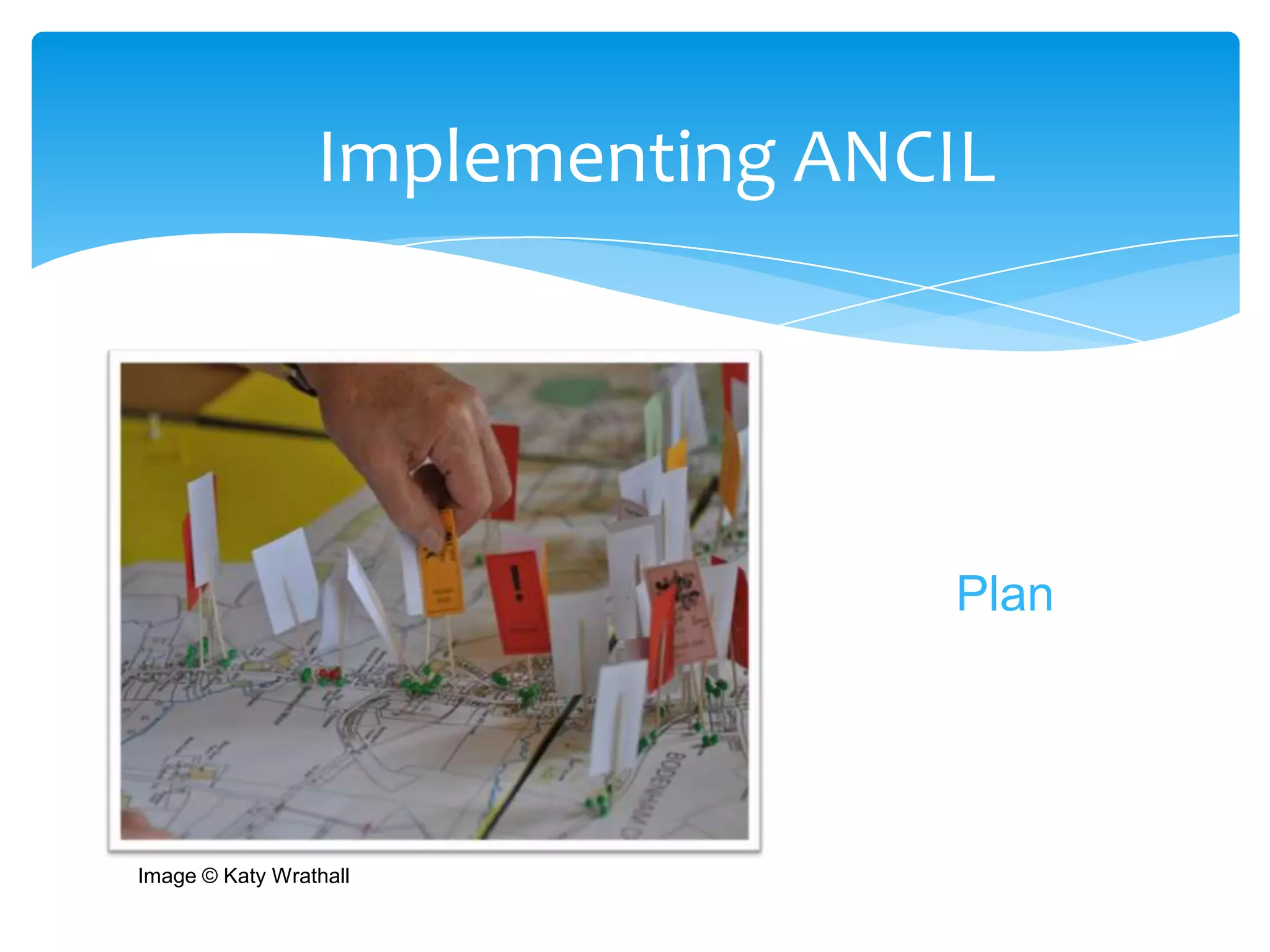
                                 Plan


Image © Katy Wrathall
Implementing ANCIL


               Lessons
                Learnt
   LSE is a specialist social science institution
    teaching wide range of subjects
   Highly ranked in terms of research excellence
   Cosmopolitan student body, relatively small
    undergraduate population
   Compulsory core course for undergraduates
    (LSE100)
   Traditional teaching and assessment: lectures
    & seminars and end of year exams
   LSE use Moodle
   To inform Library / CLT teaching provision
   To highlight good practice and any gaps in provision
   Put information literacy on the agenda at LSE
   Planning various reports for different audiences:
    ◦ Report for Library and CLT
    ◦ Report for LSE100 Course team
    ◦ Short paper for Teaching, Learning and Assessment
      Committee?
   Interviews with key members of staff to explore
    provision in central support departments,
   Interviews with Deans of UG and PG Studies
   Interviews / online survey with academic staff
   Questionnaire for Academic Support Librarians

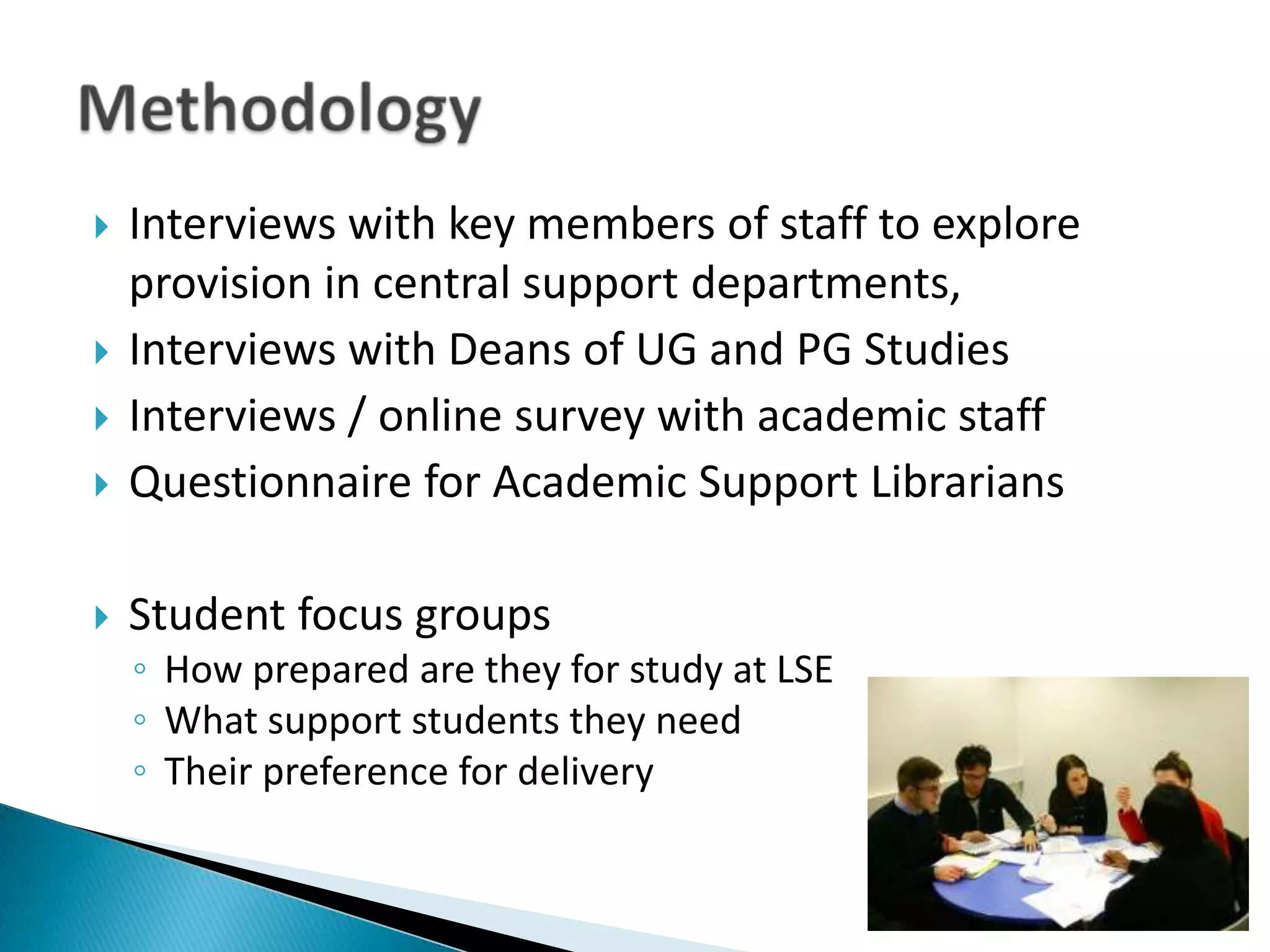
   Student focus groups
    ◦ How prepared are they for study at LSE
    ◦ What support students they need
    ◦ Their preference for delivery
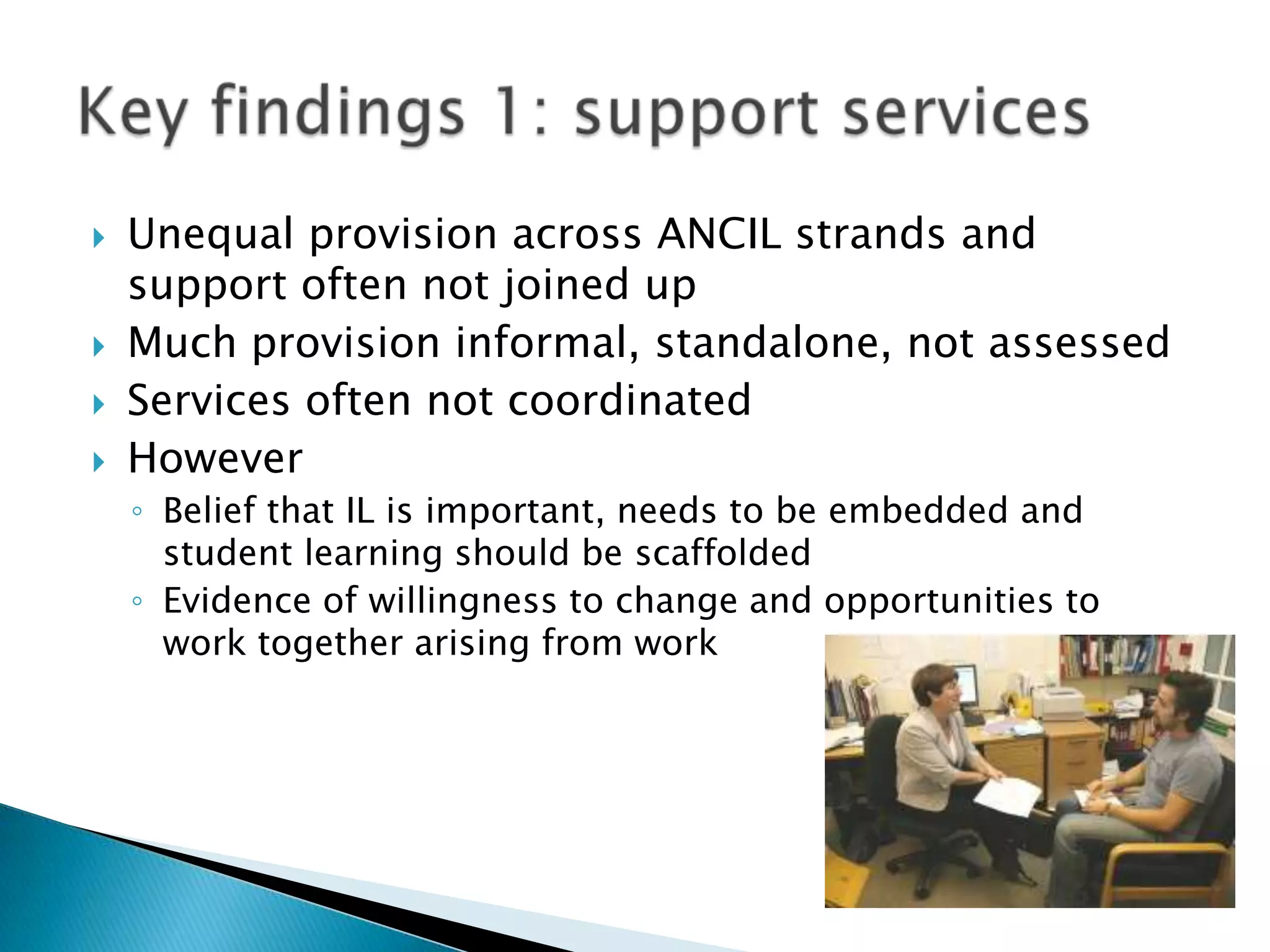
   Unequal provision across ANCIL strands and
    support often not joined up
   Much provision informal, standalone, not assessed
   Services often not coordinated
   However
    ◦ Belief that IL is important, needs to be embedded and
      student learning should be scaffolded
    ◦ Evidence of willingness to change and opportunities to
      work together arising from work
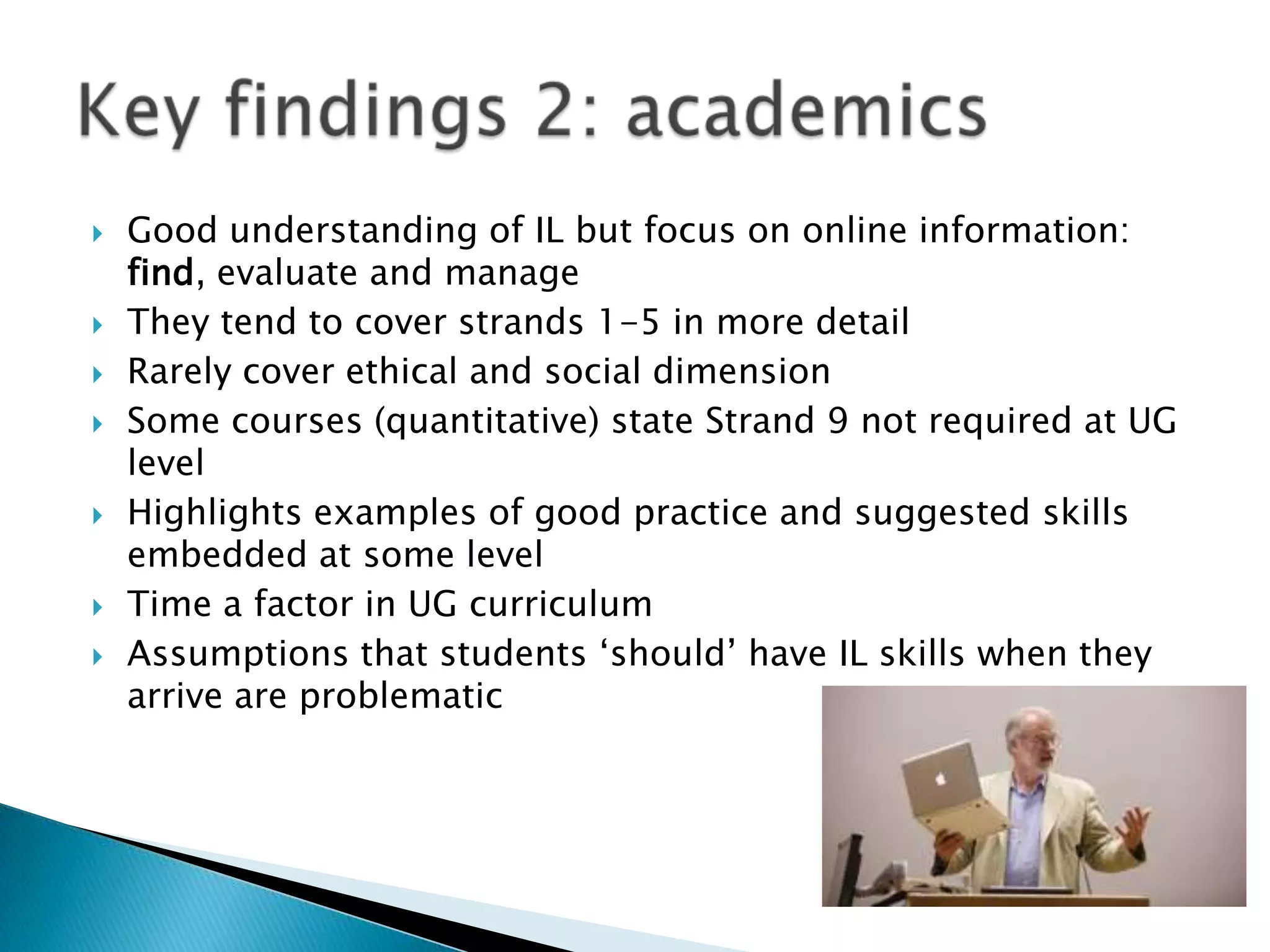
   Good understanding of IL but focus on online information:
    find, evaluate and manage
   They tend to cover strands 1-5 in more detail
   Rarely cover ethical and social dimension
   Some courses (quantitative) state Strand 9 not required at UG
    level
   Highlights examples of good practice and suggested skills
    embedded at some level
   Time a factor in UG curriculum
   Assumptions that students ‘should’ have IL skills when they
    arrive are problematic
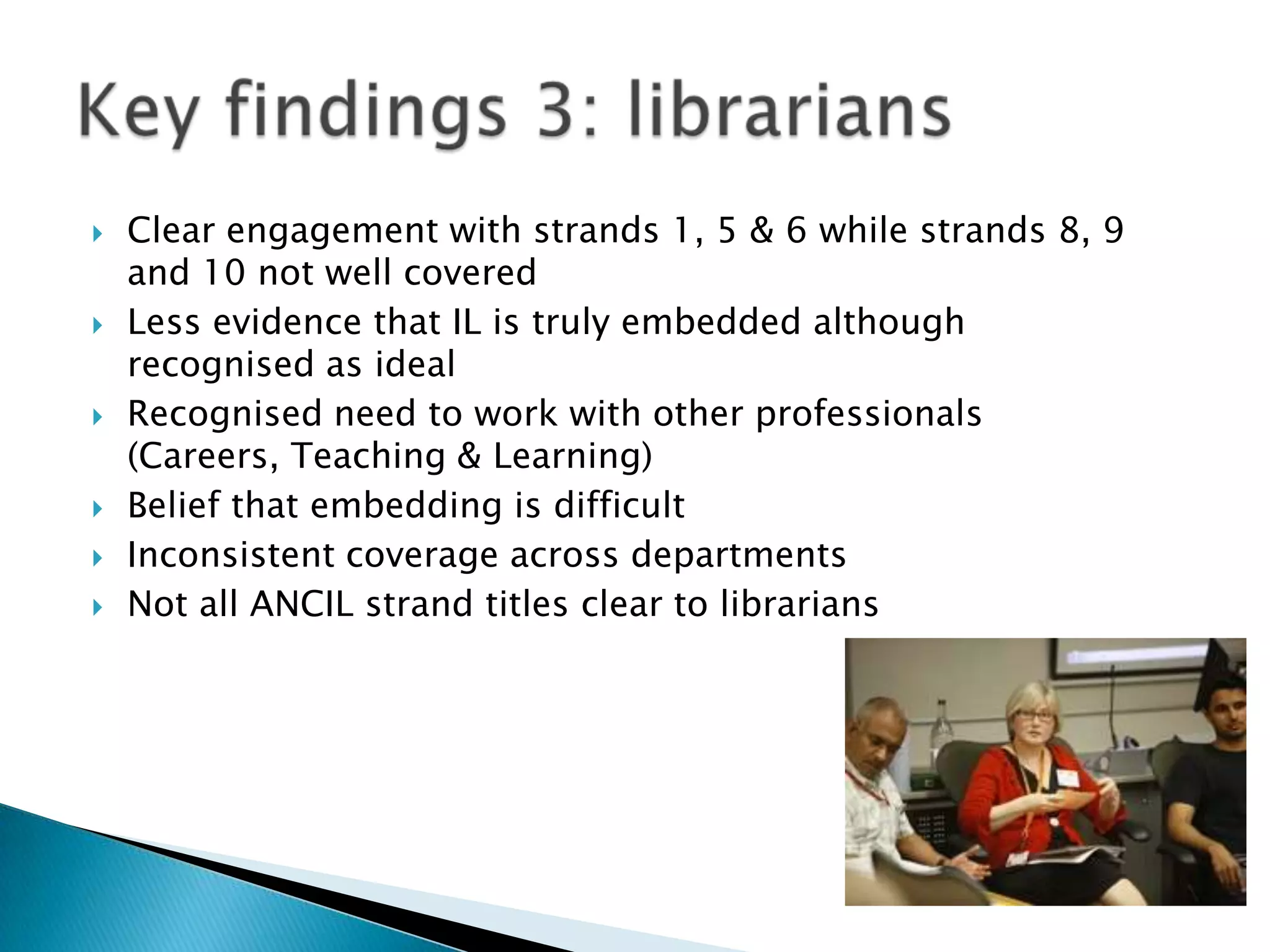
   Clear engagement with strands 1, 5 & 6 while strands 8, 9
    and 10 not well covered
   Less evidence that IL is truly embedded although
    recognised as ideal
   Recognised need to work with other professionals
    (Careers, Teaching & Learning)
   Belief that embedding is difficult
   Inconsistent coverage across departments
   Not all ANCIL strand titles clear to librarians
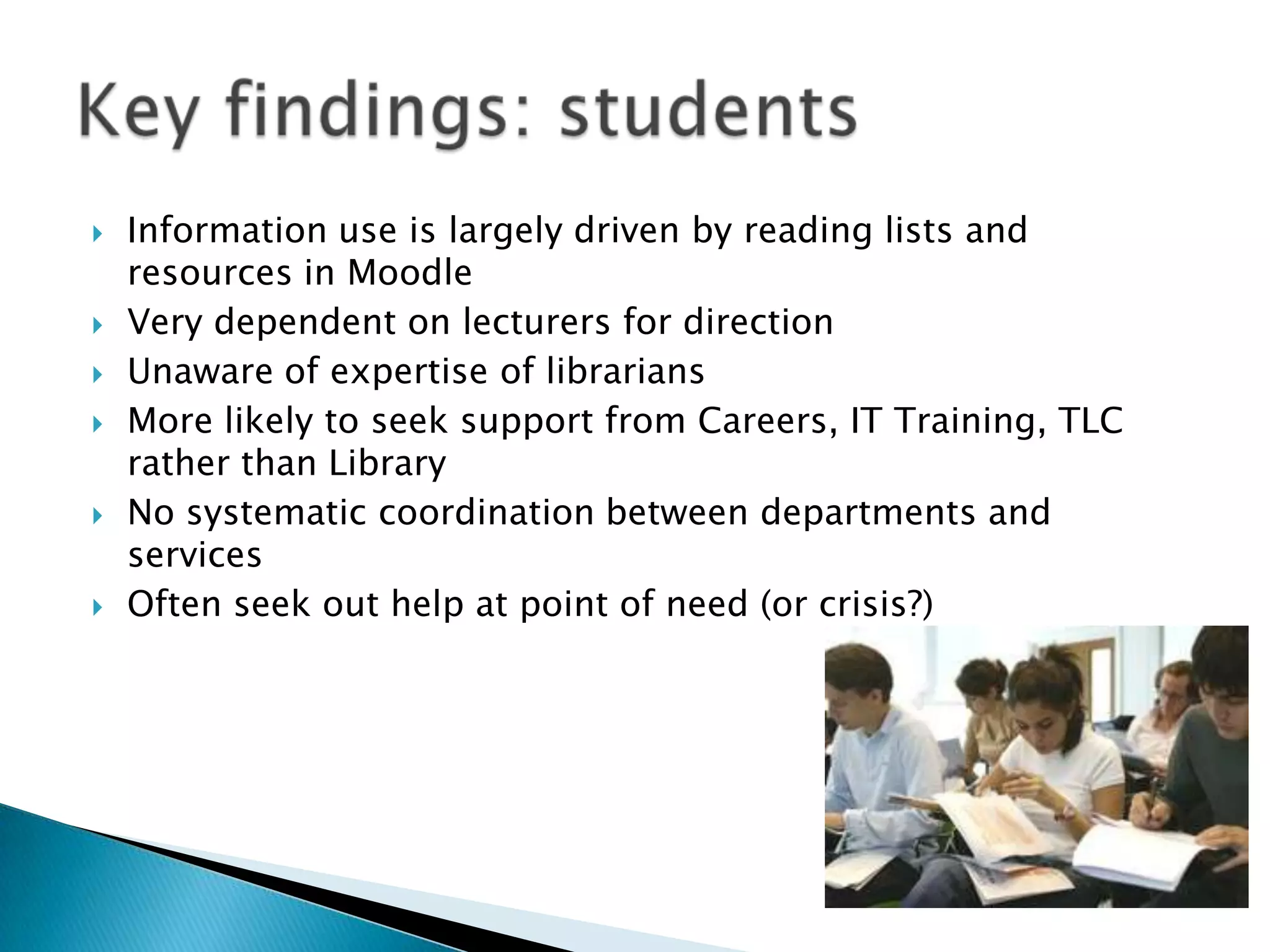
   Information use is largely driven by reading lists and
    resources in Moodle
   Very dependent on lecturers for direction
   Unaware of expertise of librarians
   More likely to seek support from Careers, IT Training, TLC
    rather than Library
   No systematic coordination between departments and
    services
   Often seek out help at point of need (or crisis?)
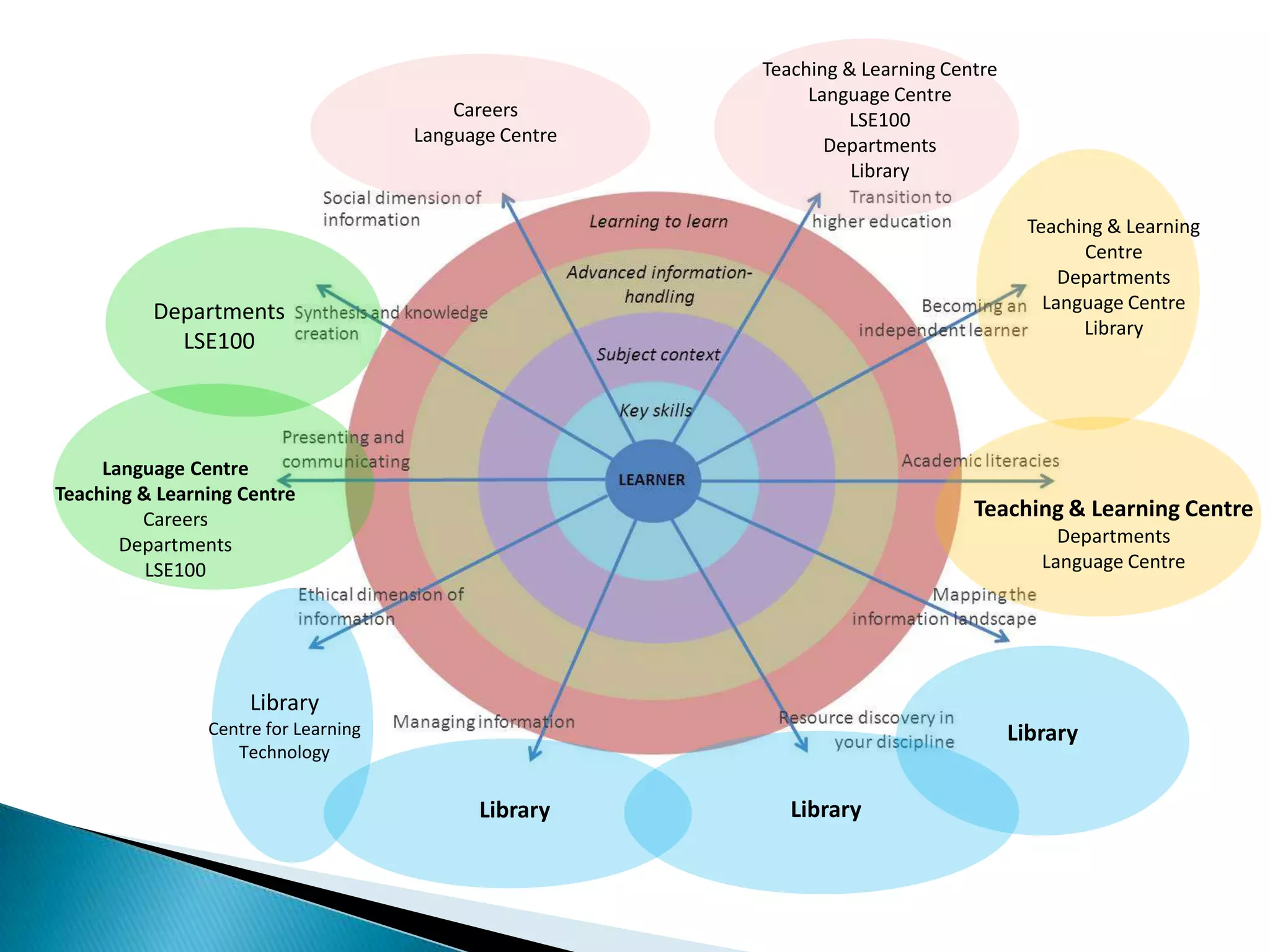
Teaching & Learning Centre
                                                             Language Centre
                                          Careers                LSE100
                                      Language Centre          Departments
                                                                  Library

                                                                                      Teaching & Learning
                                                                                            Centre
                                                                                          Departments
          Departments                                                                   Language Centre
                                                                                            Library
            LSE100


     Language Centre
Teaching & Learning Centre
         Careers                                                               Teaching & Learning Centre
       Departments                                                                        Departments
          LSE100                                                                        Language Centre


                     Library
                Centre for Learning                                                  Library
                   Technology


                                            Library        Library
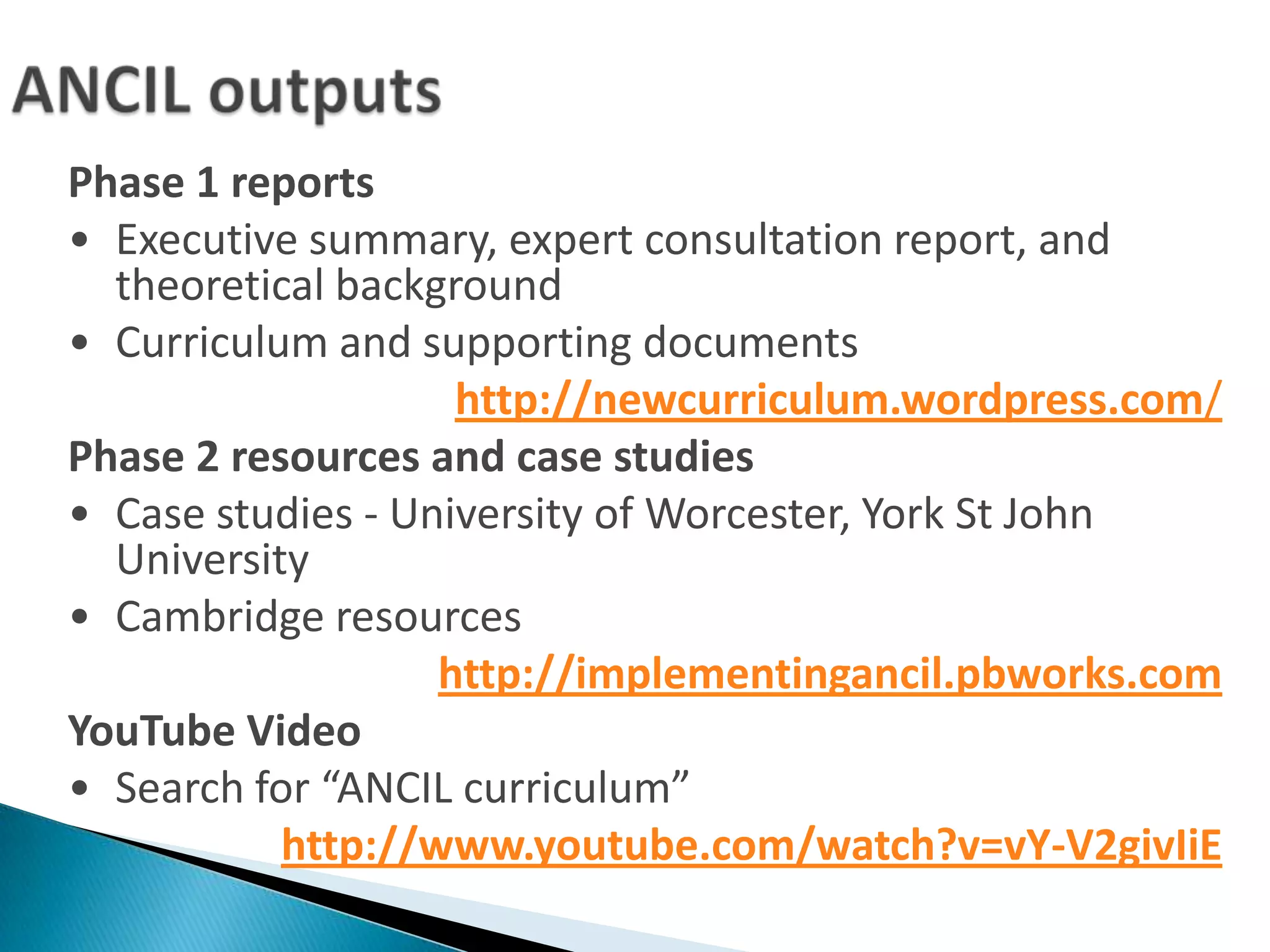
Phase 1 reports
• Executive summary, expert consultation report, and
  theoretical background
• Curriculum and supporting documents
                    http://newcurriculum.wordpress.com/
Phase 2 resources and case studies
• Case studies - University of Worcester, York St John
  University
• Cambridge resources
                   http://implementingancil.pbworks.com
YouTube Video
• Search for “ANCIL curriculum”
           http://www.youtube.com/watch?v=vY-V2givIiE
LSE Library: http://www2.lse.ac.uk/library/
Maria m.bell@lse.ac.uk

LSE Centre for Learning Technology: http://clt.lse.ac.uk/
Jane j.secker@lse.ac.uk

York St John University Library Services:
http://library.yorksj.ac.uk/index.php
Katy k.wrathall@yorksj.ac.uk
                             Thanks to Darren Moon, LSE ANCIL
                             Audit project team

Secker, Bell and Wrathall - implementing ANCIL

  • 1.
    Implementing a NewCurriculum for Information Literacy: lessons from LSE Jane Secker, Maria Bell & Katy Wrathall @jsecker @bellmari @SmilyLibrarian IFLA Satellite Meeting ‘The Road to Information Literacy’ August 2012
  • 2.
    Introducing the New Curriculum for Information Literacy (ANCIL) ◦ Discussion and thoughts  Strategies for implementing ANCIL  The ANCIL audit at LSE ◦ How might it be useful in your institution?
  • 3.
    Developing the new curriculum ◦ Arcadia Fellowship with Emma Coonan at Cambridge ◦ Academic advisor: Prof. John Naughton  Research remit: Develop a new, revolutionary curriculum for information literacy in a digital age ◦ Understand the needs of undergraduates entering higher education over the coming 5 years ◦ Map the current landscape of information literacy ◦ Develop a practical curriculum and supporting resources  Multiple outputs from the research
  • 4.
    Modified Delphi study ◦ means of obtaining expert future forecasting ◦ consulted widely in the fields of information and education Literature review ◦ theoretical overview of the field ◦ revealed conflicts in terminology, pedagogic approach, values Expert workshop ◦ method, findings and preliminary curriculum presented curriculum refined in light of feedback
  • 5.
  • 7.
    Information literacy isa continuum of skills, behaviours, approaches and values that is so deeply entwined with the uses of information as to be a fundamental element of learning, scholarship and research. It is the defining characteristic of the discerning scholar, the informed and judicious citizen, and the autonomous learner. ANCIL definition of information literacy (2011)
  • 9.
    What is a curriculum? ◦ What does it mean to have a curriculum (as opposed to a model or competency framework) for Information Literacy?  How might a curriculum impact on ◦ your provision to students? ◦ your understanding of your own role? ◦ your interaction with other professions in your institution (and beyond)?
  • 10.
    Implementing ANCIL Next steps Image © Katy Wrathall
  • 11.
  • 12.
    Implementing ANCIL Reactionand Reflection Image © Katy Wrathall
  • 13.
    Implementing ANCIL Plan Image © Katy Wrathall
  • 14.
    Implementing ANCIL Lessons Learnt
  • 15.
    LSE is a specialist social science institution teaching wide range of subjects  Highly ranked in terms of research excellence  Cosmopolitan student body, relatively small undergraduate population  Compulsory core course for undergraduates (LSE100)  Traditional teaching and assessment: lectures & seminars and end of year exams  LSE use Moodle
  • 16.
    To inform Library / CLT teaching provision  To highlight good practice and any gaps in provision  Put information literacy on the agenda at LSE  Planning various reports for different audiences: ◦ Report for Library and CLT ◦ Report for LSE100 Course team ◦ Short paper for Teaching, Learning and Assessment Committee?
  • 17.
    Interviews with key members of staff to explore provision in central support departments,  Interviews with Deans of UG and PG Studies  Interviews / online survey with academic staff  Questionnaire for Academic Support Librarians  Student focus groups ◦ How prepared are they for study at LSE ◦ What support students they need ◦ Their preference for delivery
  • 18.
    Unequal provision across ANCIL strands and support often not joined up  Much provision informal, standalone, not assessed  Services often not coordinated  However ◦ Belief that IL is important, needs to be embedded and student learning should be scaffolded ◦ Evidence of willingness to change and opportunities to work together arising from work
  • 19.
    Good understanding of IL but focus on online information: find, evaluate and manage  They tend to cover strands 1-5 in more detail  Rarely cover ethical and social dimension  Some courses (quantitative) state Strand 9 not required at UG level  Highlights examples of good practice and suggested skills embedded at some level  Time a factor in UG curriculum  Assumptions that students ‘should’ have IL skills when they arrive are problematic
  • 20.
    Clear engagement with strands 1, 5 & 6 while strands 8, 9 and 10 not well covered  Less evidence that IL is truly embedded although recognised as ideal  Recognised need to work with other professionals (Careers, Teaching & Learning)  Belief that embedding is difficult  Inconsistent coverage across departments  Not all ANCIL strand titles clear to librarians
  • 21.
    Information use is largely driven by reading lists and resources in Moodle  Very dependent on lecturers for direction  Unaware of expertise of librarians  More likely to seek support from Careers, IT Training, TLC rather than Library  No systematic coordination between departments and services  Often seek out help at point of need (or crisis?)
  • 22.
    Teaching & LearningCentre Language Centre Careers LSE100 Language Centre Departments Library Teaching & Learning Centre Departments Departments Language Centre Library LSE100 Language Centre Teaching & Learning Centre Careers Teaching & Learning Centre Departments Departments LSE100 Language Centre Library Centre for Learning Library Technology Library Library
  • 24.
    Phase 1 reports •Executive summary, expert consultation report, and theoretical background • Curriculum and supporting documents http://newcurriculum.wordpress.com/ Phase 2 resources and case studies • Case studies - University of Worcester, York St John University • Cambridge resources http://implementingancil.pbworks.com YouTube Video • Search for “ANCIL curriculum” http://www.youtube.com/watch?v=vY-V2givIiE
  • 25.
    LSE Library: http://www2.lse.ac.uk/library/ Mariam.bell@lse.ac.uk LSE Centre for Learning Technology: http://clt.lse.ac.uk/ Jane j.secker@lse.ac.uk York St John University Library Services: http://library.yorksj.ac.uk/index.php Katy k.wrathall@yorksj.ac.uk Thanks to Darren Moon, LSE ANCIL Audit project team

Editor's Notes

  • #7 EmmaThe 2011 Demos report argues that helping young people navigate hugely variable Internet sources should be achieved not by tighter controls but by ensuring they can make informed judgements (4).The move towards independent learning is again key not just to our practices but in our thinking – we should think less about the internet causing harm (passive learning model) and instead focus on what young people bring to the technologies – helping them equip and empower themselves with an understanding of how to apply critical judgement.The Guardian’s high-provile digital literacy campaign for radical change to how ICT is taught and thought about in schools, JISC’s portfolio of projects around the digital library, data management, digital repositories, and Vitae’s events for the ‘Digital Researcher’ – all show that this concept of digital literacy or fluency is becoming of national importance (at last!). In this environment we have a chance to rehabilitate IL.
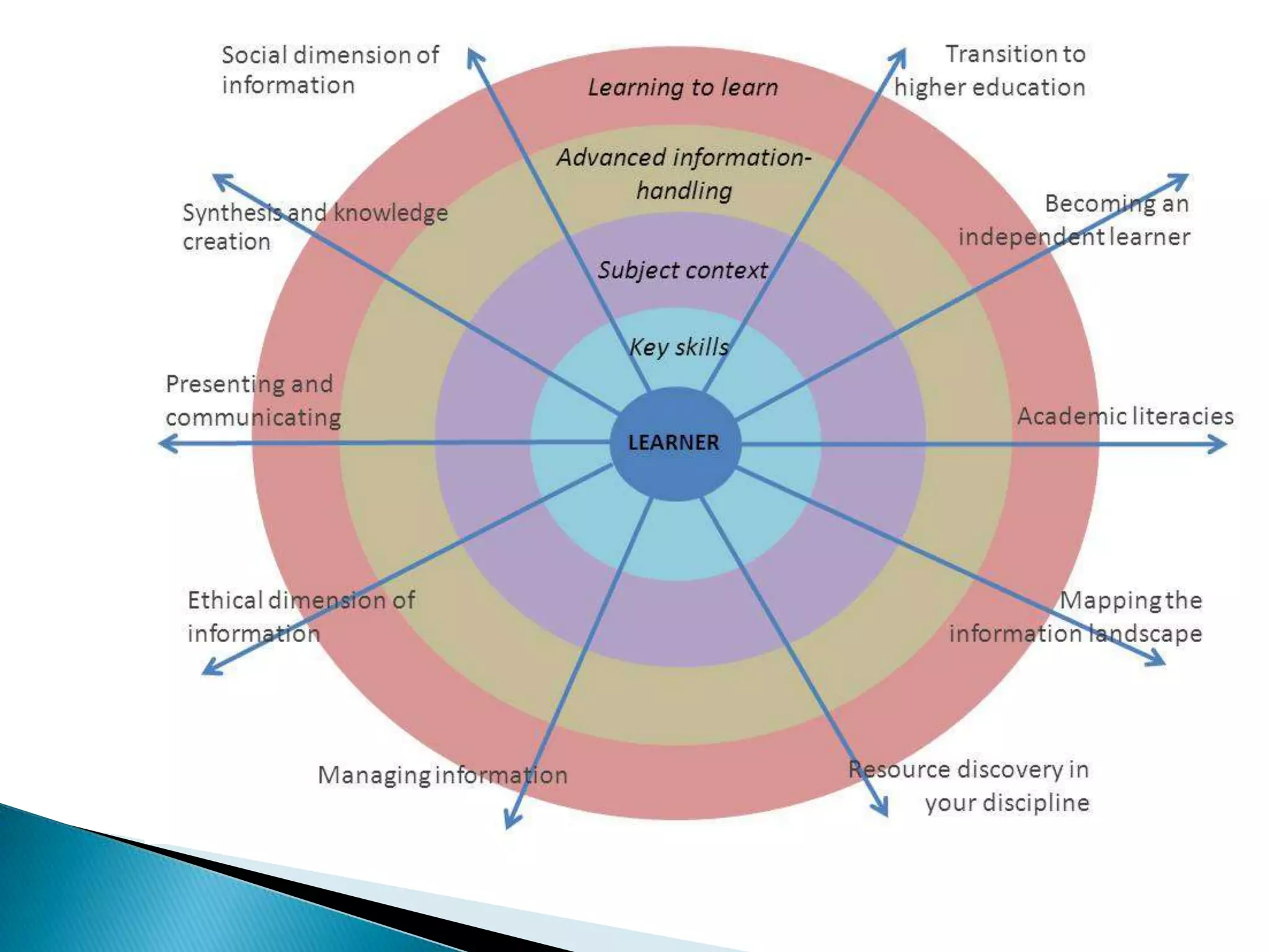
  • #8 JaneInfluenced by UNESCOHolistic ModularEmbedded FlexibleActive and assessedTransitional : Transferable : TransformationalJaneholistic: supporting the whole process of researching and writing rather than just teaching traditional library skills modular: ongoing classes to meet the developing needs of students during their whole academic career, not just one-shot sessions embedded and flexible: can be implemented and taught not only by librarians but by study skills advisors, learning developers, supervisors and lecturers (depending on the needs and structure of the institution) active and assessed: containing a significant element of active and reflective learning, including peer assessment elements, in order to help students develop into informed and autonomous learnersTransitionalTransferableTransformationalTransition occurs in learners, who enter university from a wide variety of backgrounds, but often need to make the transition from school to higher education. They also have to make the transition from dependent to autonomous learning.The curriculum content needs to be transferable, forming a part of education, not simply ‘library training.’ Information literacy fosters and develops appropriatebehaviour, approaches, cognitive functions and skills surrounding the use of information. In essence information literacy equips students with the capacity to generate their own strategies for dealing with new information contexts, for example when they leave higher education and enter the workplace.Finally, information literacy should be transformational for the learner, changing their attitude, behaviour, outlook and even their world-view. Therefore this curriculum has the potential to change lives and make a real difference to society.
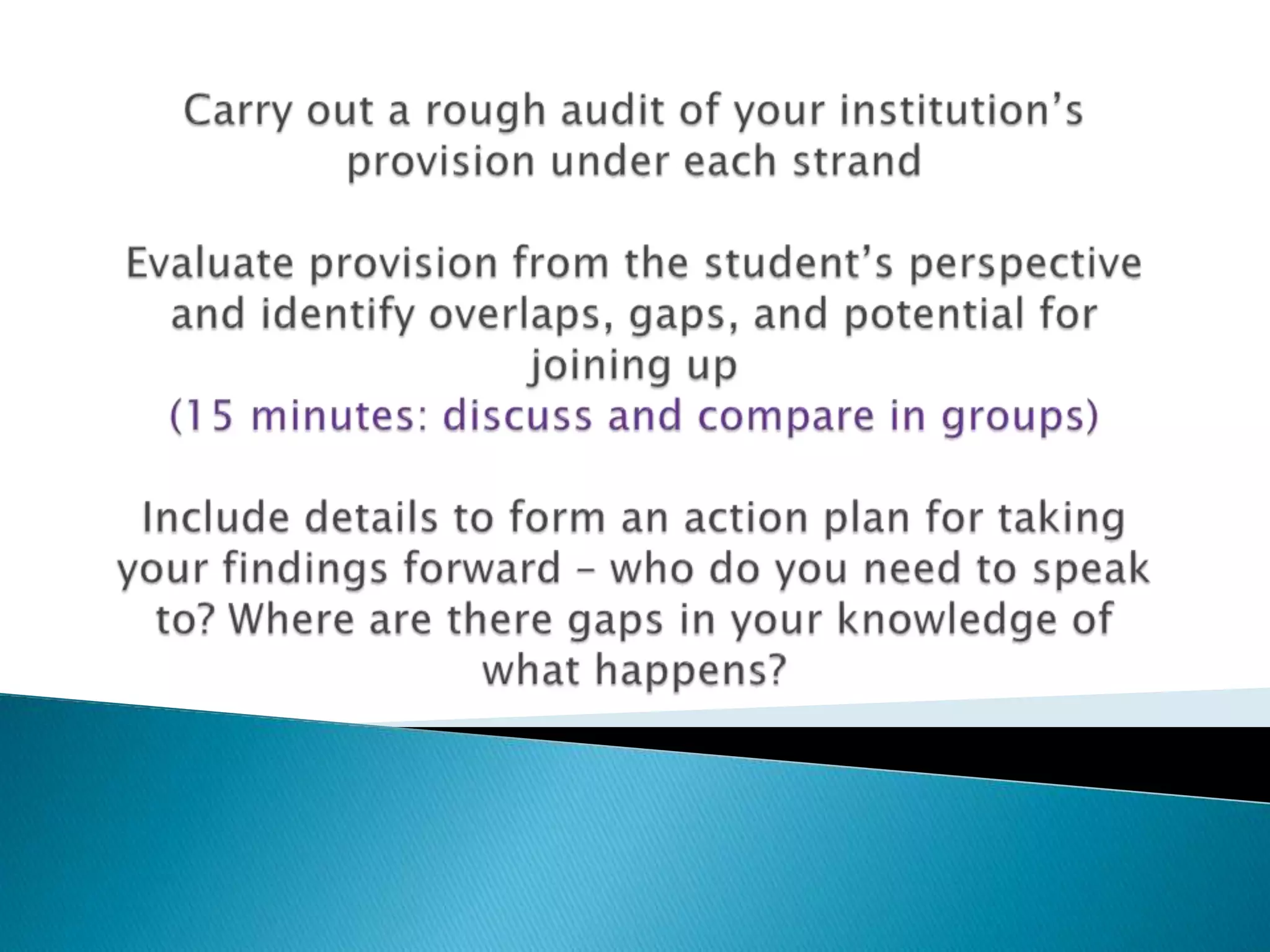
  • #11 Katy – now curriculum is defined what next?How best to take it forward in an HE institution?Logical next step is using ANCIL to audit existing provision across the institution (mounting block analogy)
  • #12 KatyUsing strands to inform the questionsAncillary questions to identify any issuesQuestionnaire v interview
  • #13 KatyStrands alone initiate reaction, often lack of recognition of own provisionExpansion of strands then prompts reflection, often interviewees realise they do deliver the strands in some wayLeads to reflection on collaborative holistic approach
  • #14 KatyResults identified who could lead, enthusiasts and cynics (need both), how to get institutional buy-in, where there were gaps in understanding and provision and what resources might be neededAction plan can be createdLike any campaign, keep moving and do not lose the impetus
  • #15 You need to identify the important players before you auditAllow time – 3 weeks in a 10 week project is not enough – but make sure you maintain the impetusFind the right format and right reward reward to encourage participation
  • #16 LSE has around 9000 students in total, 4500 are undergraduates. The rest are postgraduate and come from over 140 countries. Largest departments Economics and Accounting and Finance but strong qualitative departments: Anthropology, Political Science, Sociology, International Relations, Philosophy, Social Policy, Geography, International History etc. 16 Nobel Prize winners from LSE – the first being George Bernard Shaw who was one of the founders of the school34 past or present world leaders have studied ot taught at LSE.
  • #19 Unequal provision across ANCIL strands and support often not joined upMuch provision informal, standalone, not assessedServices often not working togetherHowever Belief that IL is important, needs to be embedded and student learning scaffoldedEvidence of willingness to change and opportunities to work together arising from work
  • #20 Good understanding of IL but focus on online information: find, evaluate and manageThey tend to cover strands 1-5 in more detailRarely cover ethical and social dimensionSome courses (quantitative) state Strand 9 not required at UG levelHighlights examples of good practice and suggested skills embedded at some levelTime a factor in UG curriculum
  • #21 Clear engagement with strands 1, 6 & 7Strands 8, 9 and 10 not well coveredLittle evidence that IL is embedded although recognised as idealRecognised need to work with other professionals (Careers, Teaching & Learning)Belief that embedding is difficult, might be met with resistance from faculty, organisational problems, timetables all seen as reasons why it might not happenInconsistent coverage across departmentsNot all ANCIL strand titles clear