Toward a New Sub-component Test
Method for the Trailing Edge Region of
Wind Turbine Blades
Kim Branner, Peter Berring & Philipp Ulrich Haselbach
Department of Wind Energy, Technical University of Denmark
Email: kibr@dtu.dk
DTU Wind Energy, Technical University of Denmark
Outline
• Background & motivation
• Proposed subcomponent test method
• Comparison of simulations for full-scale test and
subcomponent test
• Conclusions and ongoing work
DTU Wind Energy, Technical University of Denmark
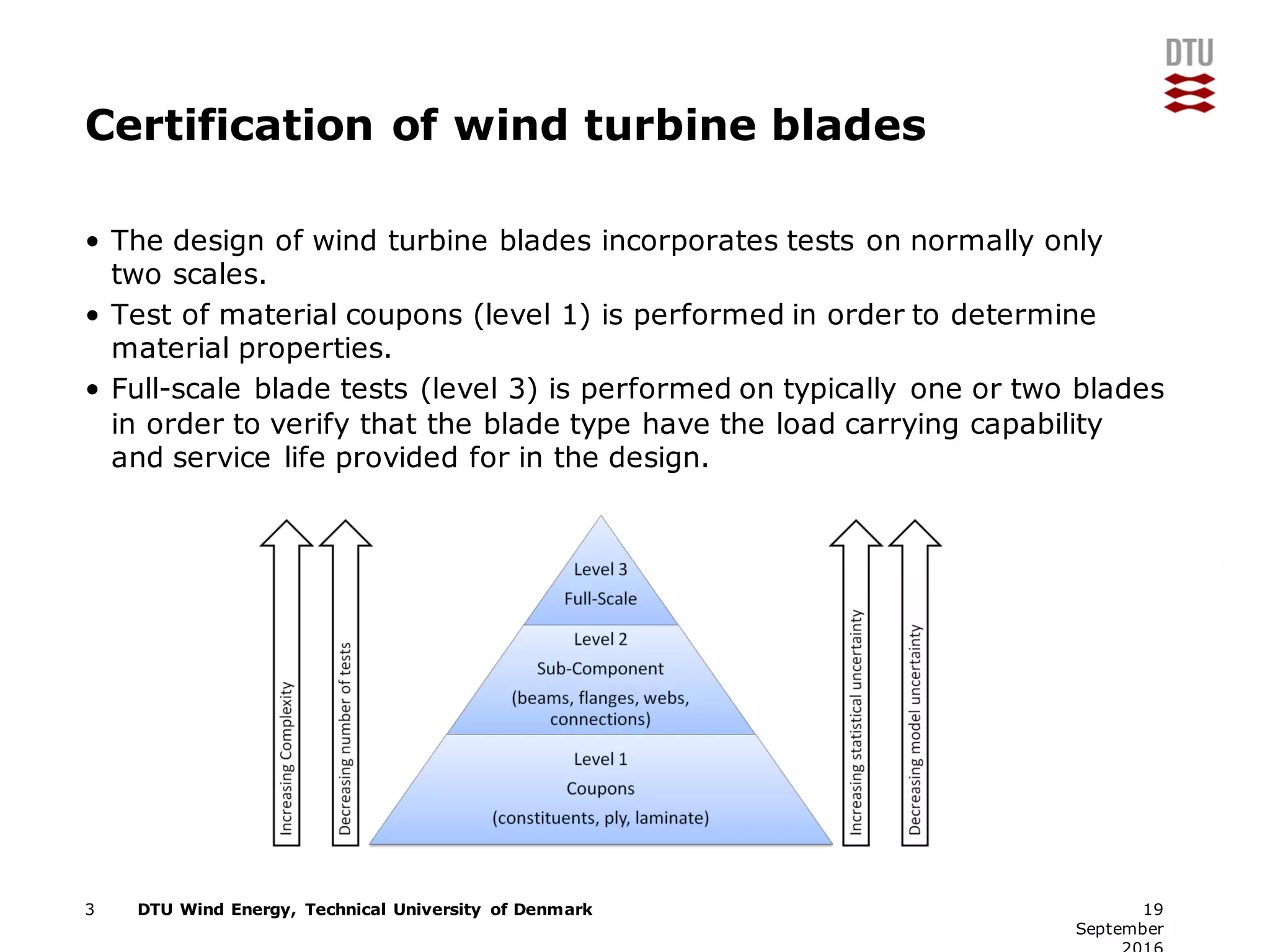
Certification of wind turbine blades
• The design of wind turbine blades incorporates tests on normally only
two scales.
• Test of material coupons (level 1) is performed in order to determine
material properties.
• Full-scale blade tests (level 3) is performed on typically one or two blades
in order to verify that the blade type have the load carrying capability
and service life provided for in the design.
3 19
September
DTU Wind Energy, Technical University of Denmark
New blade standard allows for
subcomponent testing
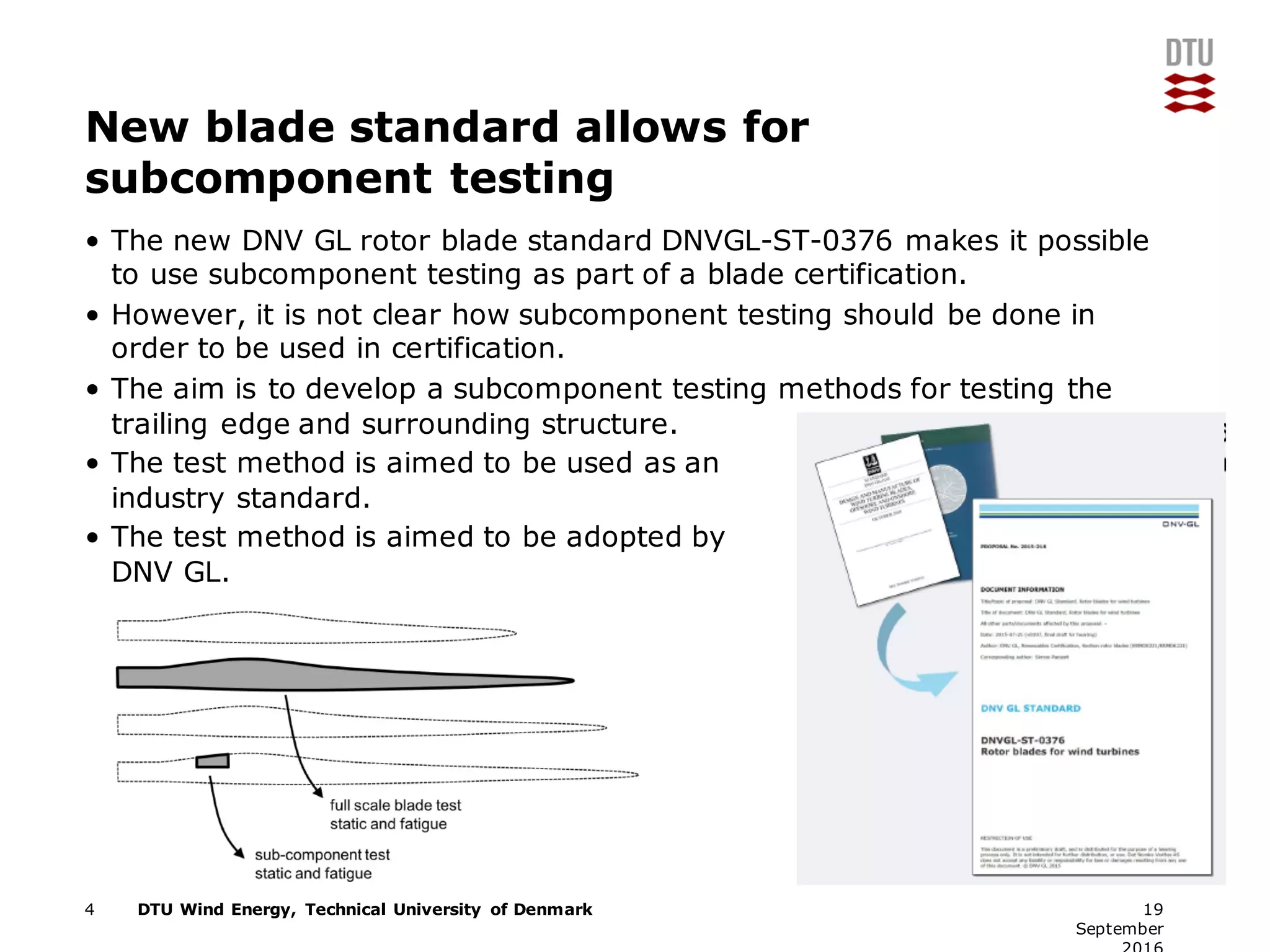
• The new DNV GL rotor blade standard DNVGL-ST-0376 makes it possible
to use subcomponent testing as part of a blade certification.
• However, it is not clear how subcomponent testing should be done in
order to be used in certification.
• The aim is to develop a subcomponent testing methods for testing the
trailing edge and surrounding structure.
• The test method is aimed to be used as an
industry standard.
• The test method is aimed to be adopted by
DNV GL.
4 19
September
DTU Wind Energy, Technical University of Denmark
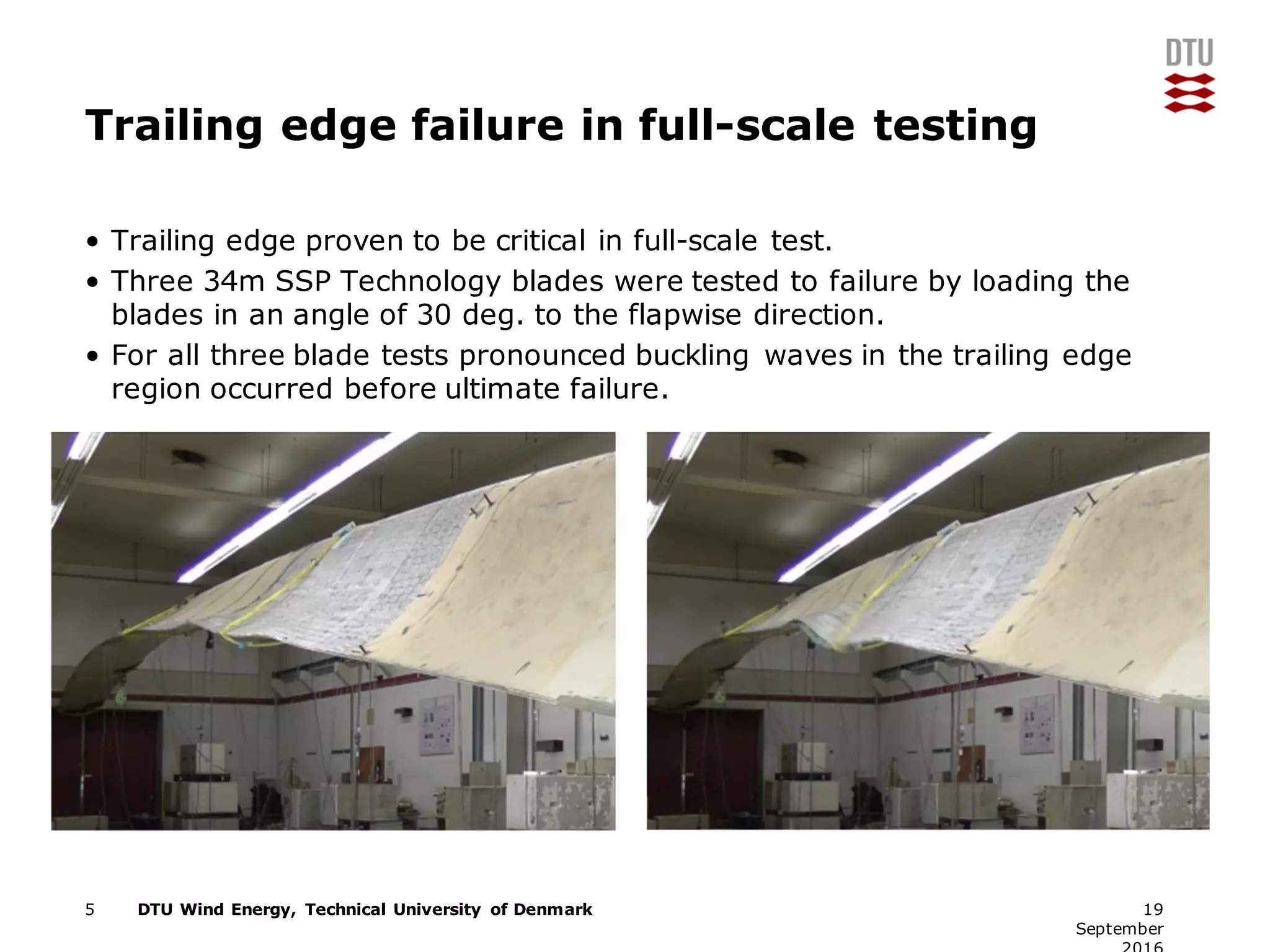
Trailing edge failure in full-scale testing
• Trailing edge proven to be critical in full-scale test.
• Three 34m SSP Technology blades were tested to failure by loading the
blades in an angle of 30 deg. to the flapwise direction.
• For all three blade tests pronounced buckling waves in the trailing edge
region occurred before ultimate failure.
5 19
September
DTU Wind Energy, Technical University of Denmark
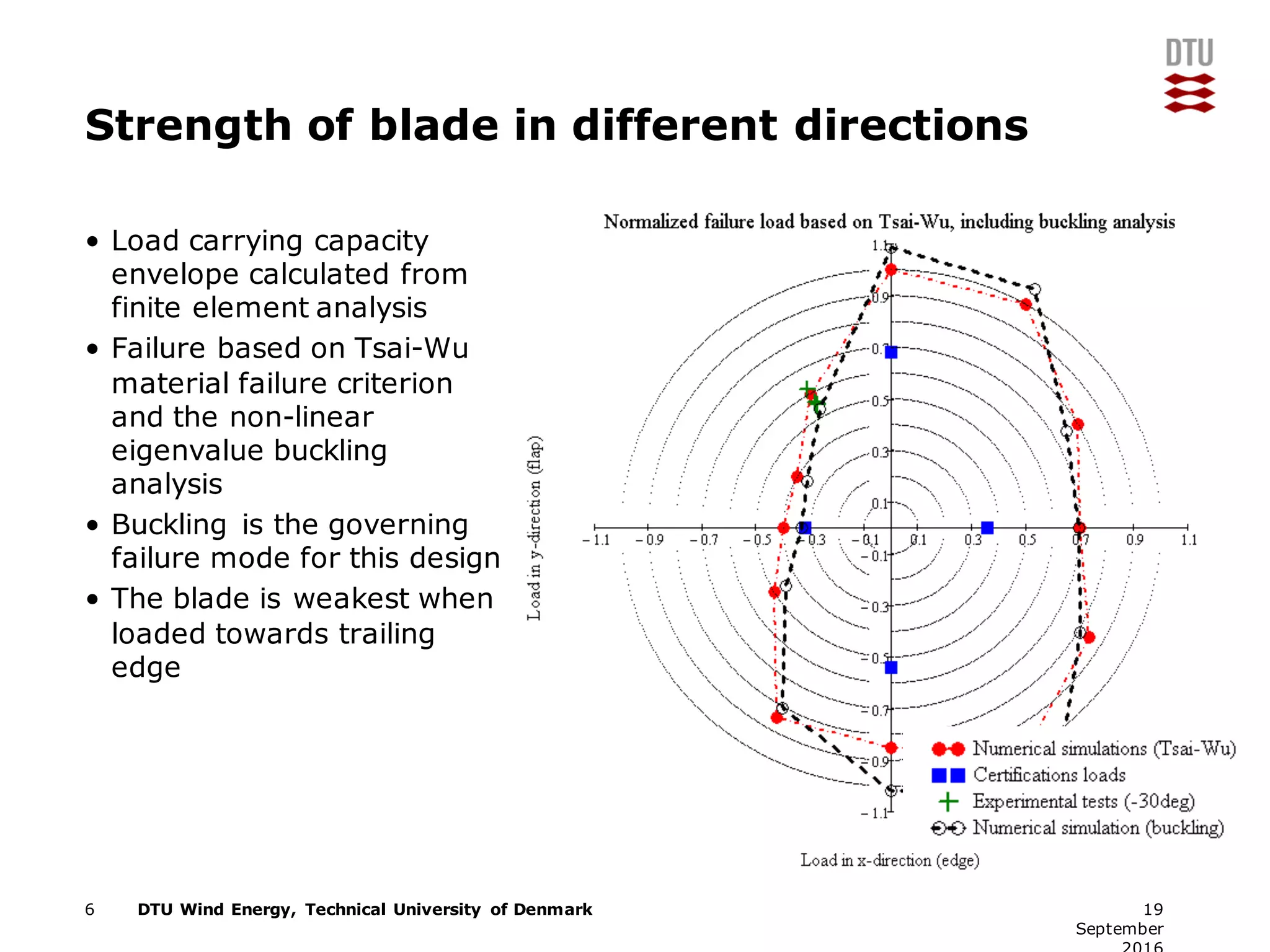
Strength of blade in different directions
6 19
September
• Load carrying capacity
envelope calculated from
finite element analysis
• Failure based on Tsai-Wu
material failure criterion
and the non-linear
eigenvalue buckling
analysis
• Buckling is the governing
failure mode for this design
• The blade is weakest when
loaded towards trailing
edge
DTU Wind Energy, Technical University of Denmark
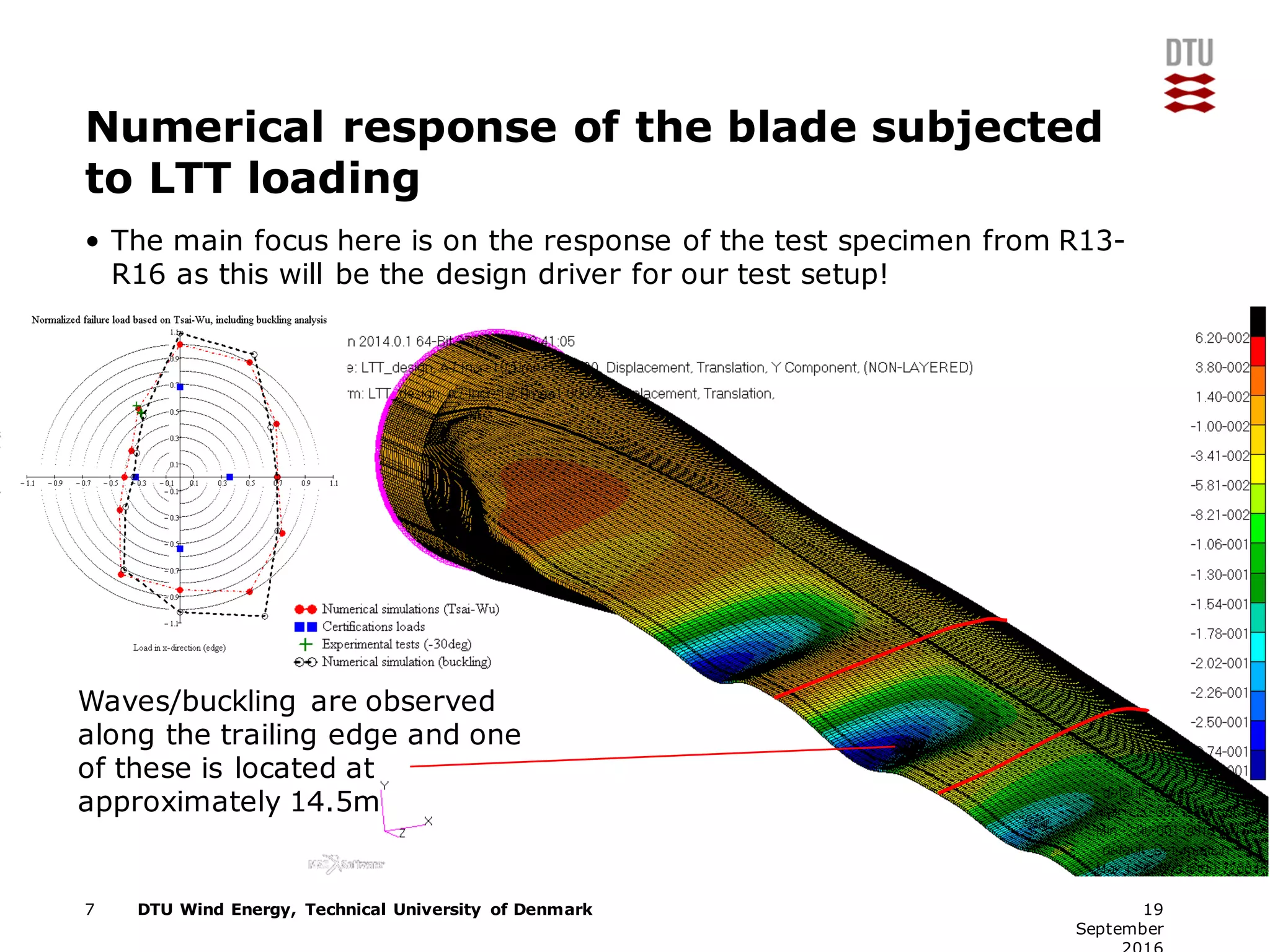
Numerical response of the blade subjected
to LTT loading
• The main focus here is on the response of the test specimen from R13-
R16 as this will be the design driver for our test setup!
7 19
September
Waves/buckling are observed
along the trailing edge and one
of these is located at
approximately 14.5m
DTU Wind Energy, Technical University of Denmark
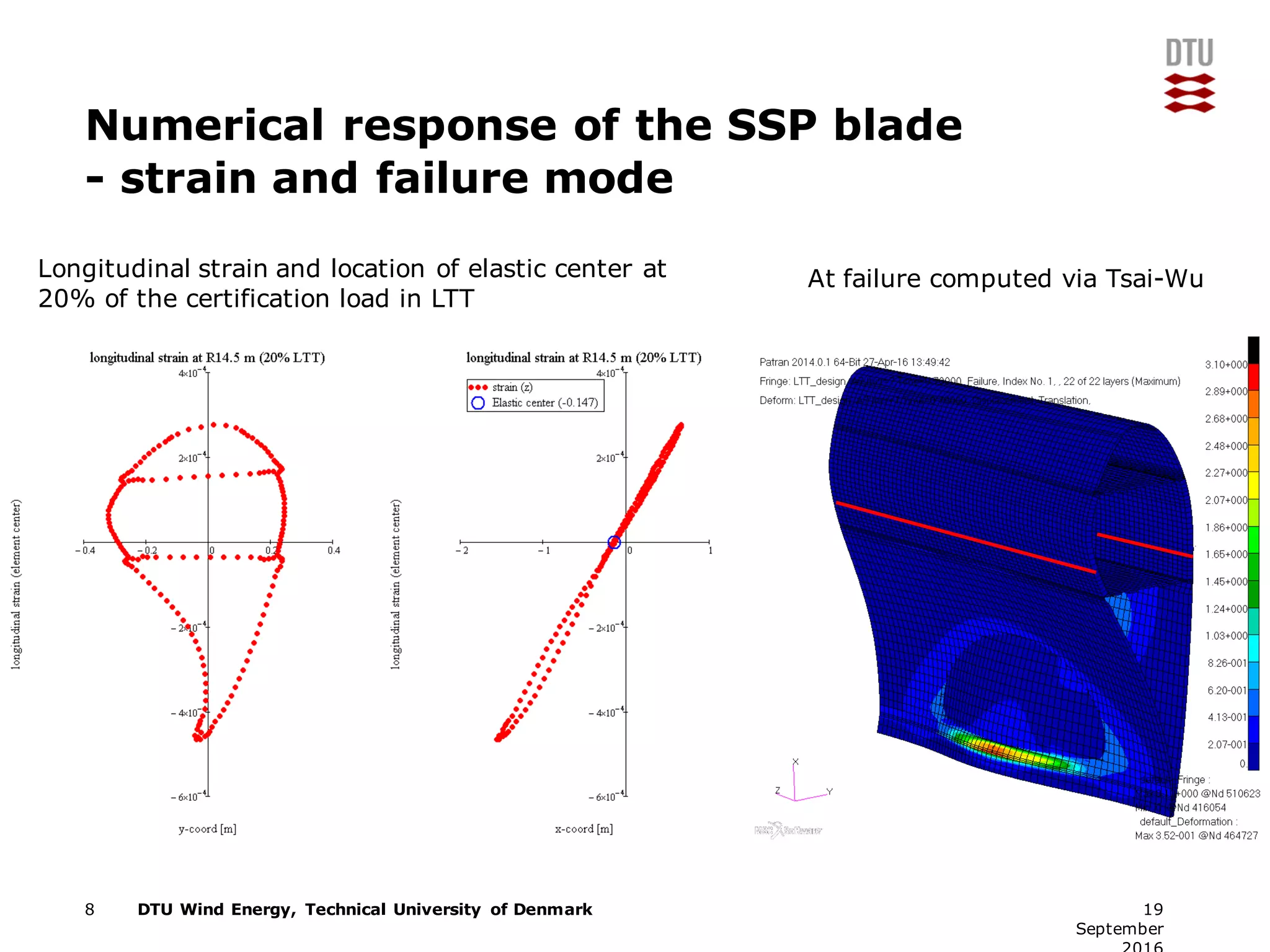
Numerical response of the SSP blade
- strain and failure mode
8 19
September
At failure computed via Tsai-WuLongitudinal strain and location of elastic center at
20% of the certification load in LTT
DTU Wind Energy, Technical University of Denmark
Subcomponent test – experimental setup
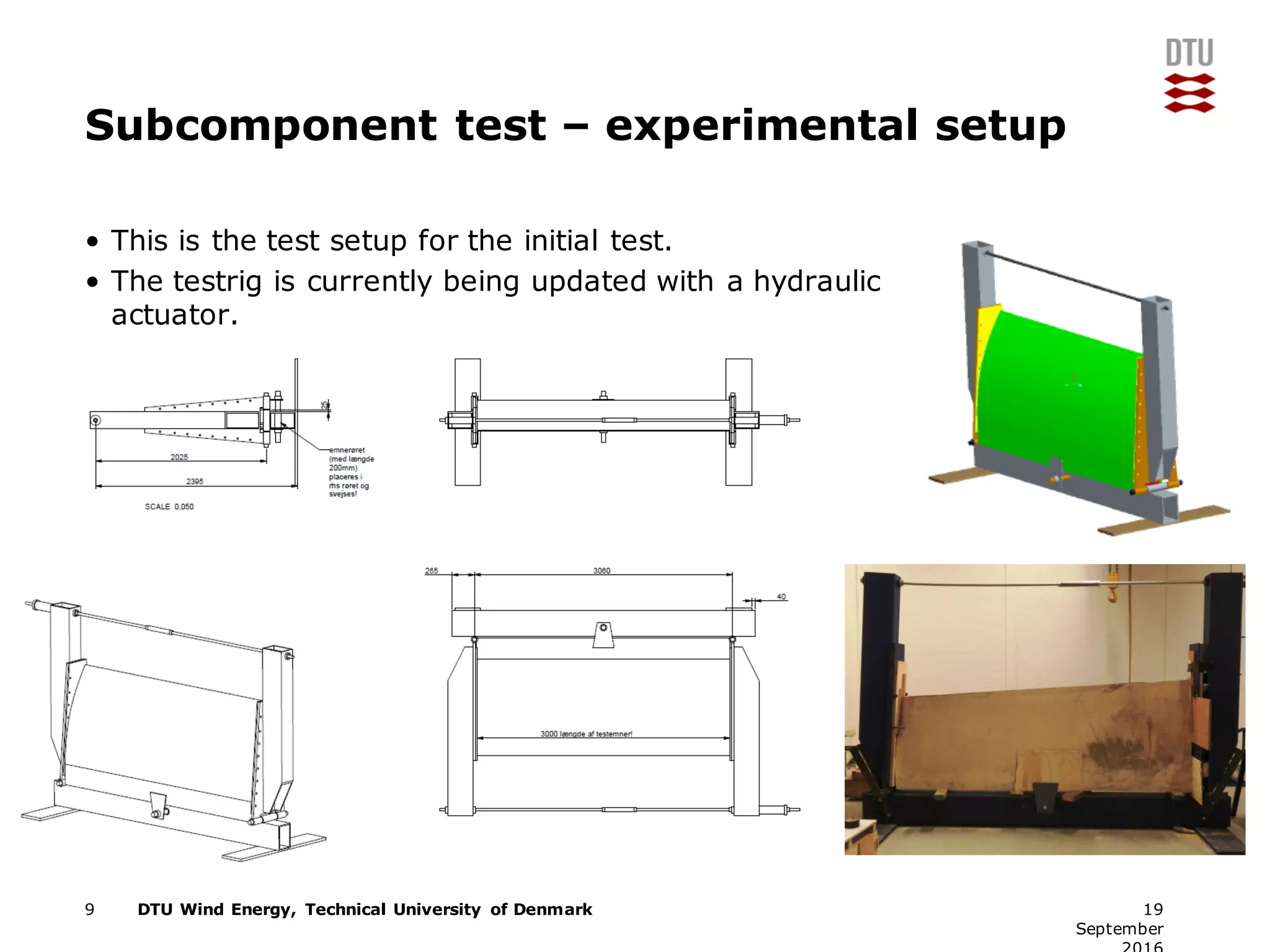
• This is the test setup for the initial test.
• The testrig is currently being updated with a hydraulic
actuator.
9 19
September
DTU Wind Energy, Technical University of Denmark
Numerical modelling approach for the test
specimen
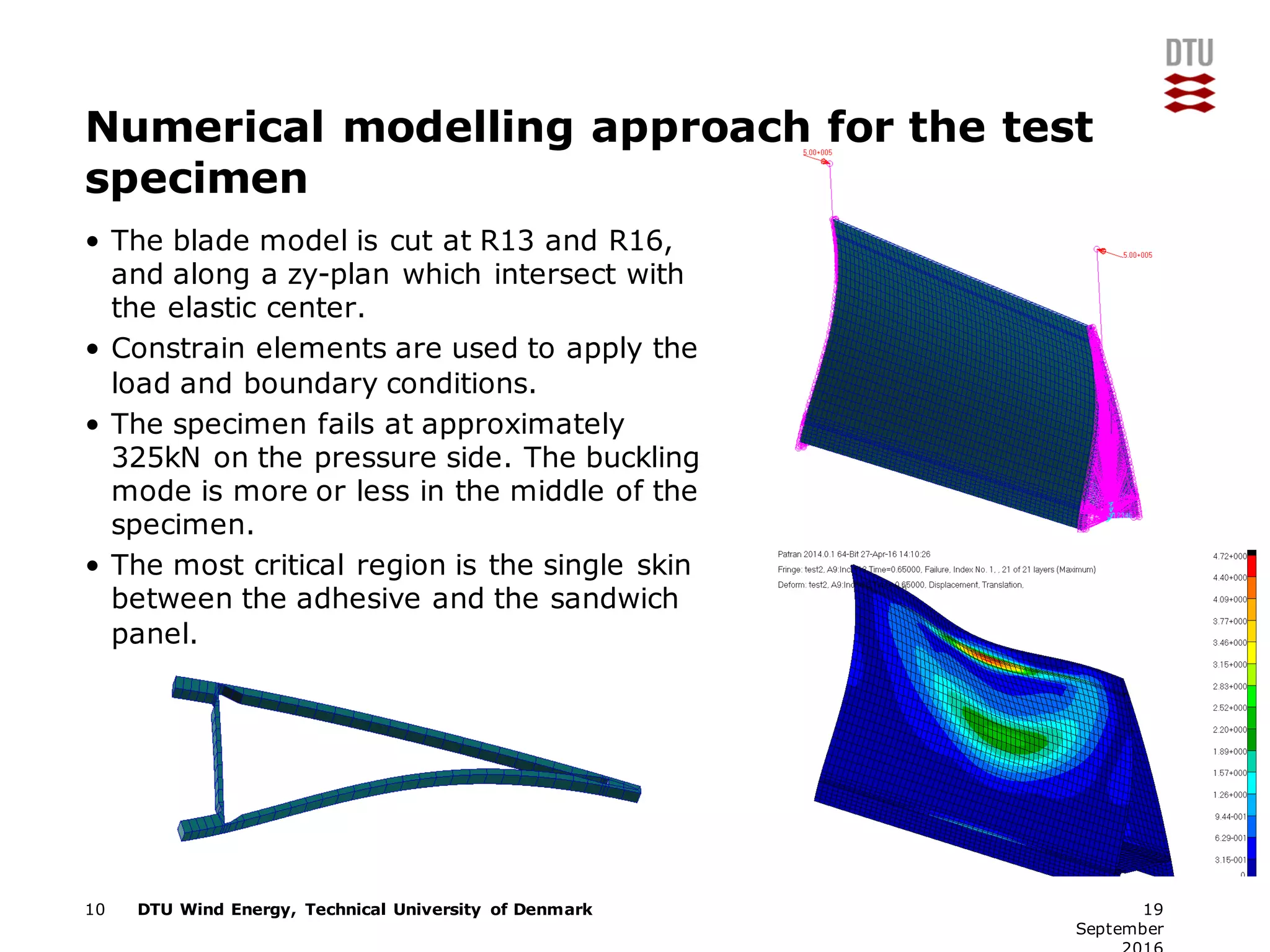
• The blade model is cut at R13 and R16,
and along a zy-plan which intersect with
the elastic center.
• Constrain elements are used to apply the
load and boundary conditions.
• The specimen fails at approximately
325kN on the pressure side. The buckling
mode is more or less in the middle of the
specimen.
• The most critical region is the single skin
between the adhesive and the sandwich
panel.
10 19
September
DTU Wind Energy, Technical University of Denmark
Comparison between subcomponent testing
and full-scale test (LTT) – strain response
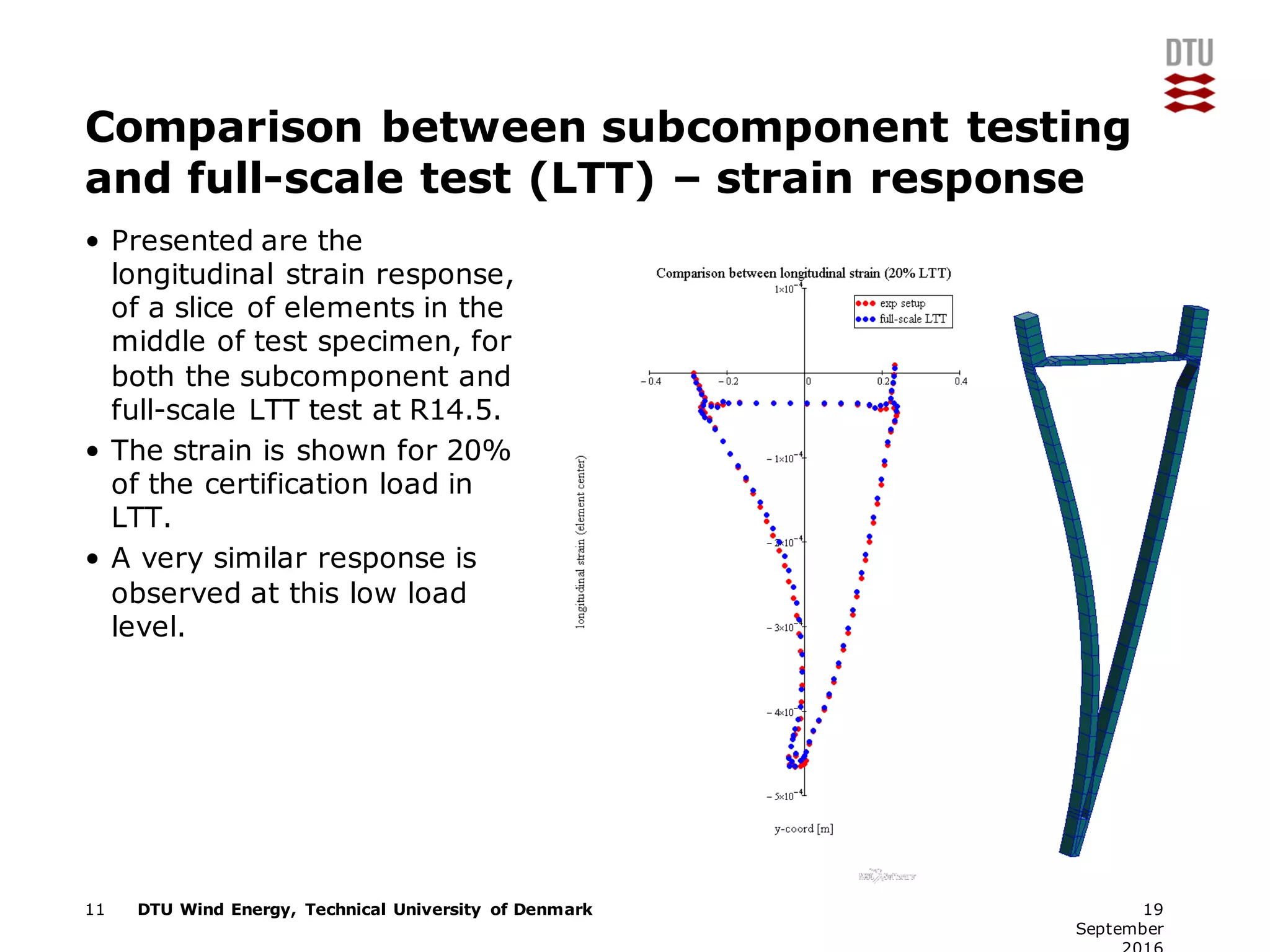
• Presented are the
longitudinal strain response,
of a slice of elements in the
middle of test specimen, for
both the subcomponent and
full-scale LTT test at R14.5.
• The strain is shown for 20%
of the certification load in
LTT.
• A very similar response is
observed at this low load
level.
11 19
September
DTU Wind Energy, Technical University of Denmark
Comparison between subcomponent testing
and full-scale test (LTT) – strain response
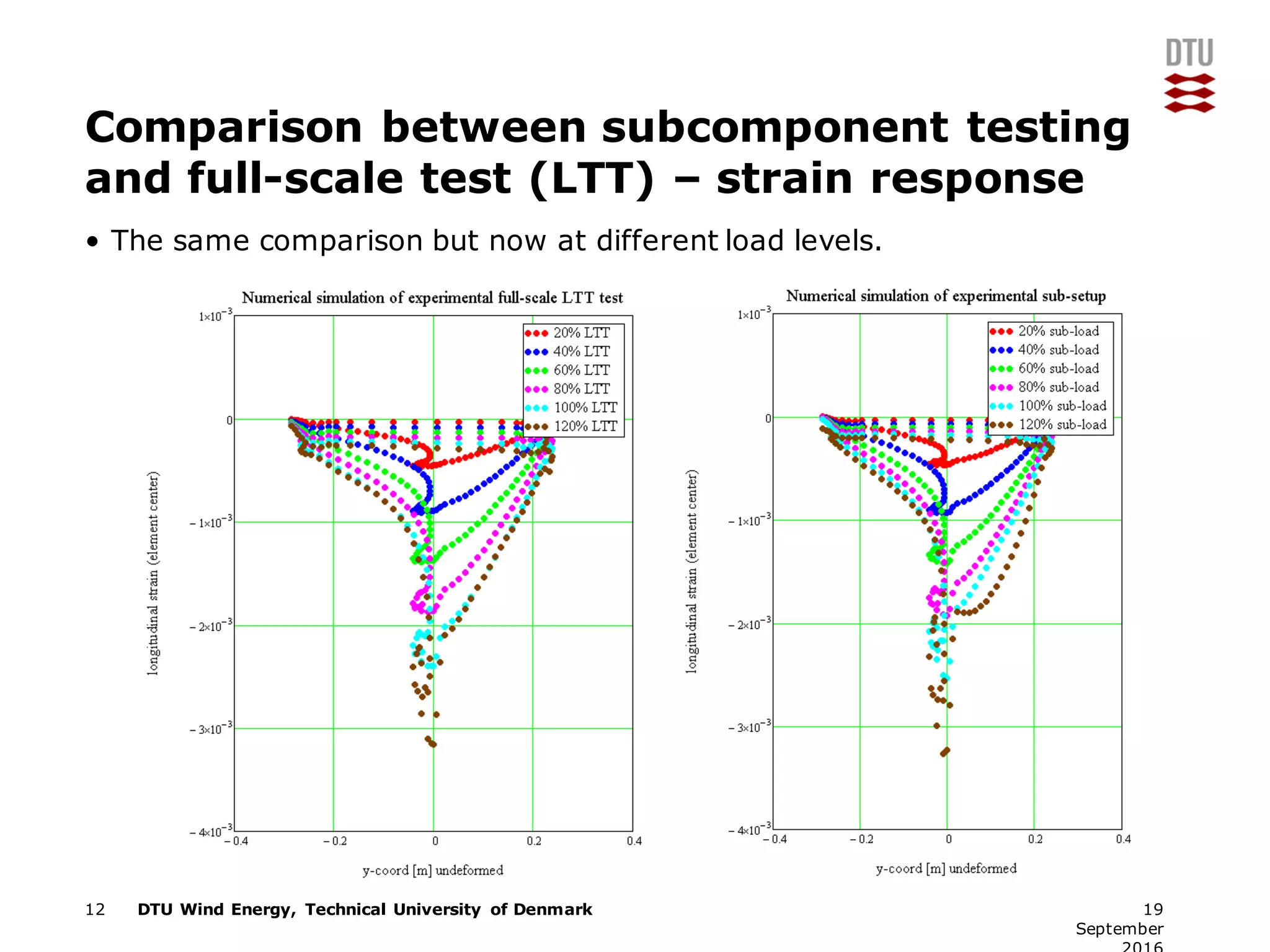
• The same comparison but now at different load levels.
12 19
September
DTU Wind Energy, Technical University of Denmark
Comparison between subcomponent testing
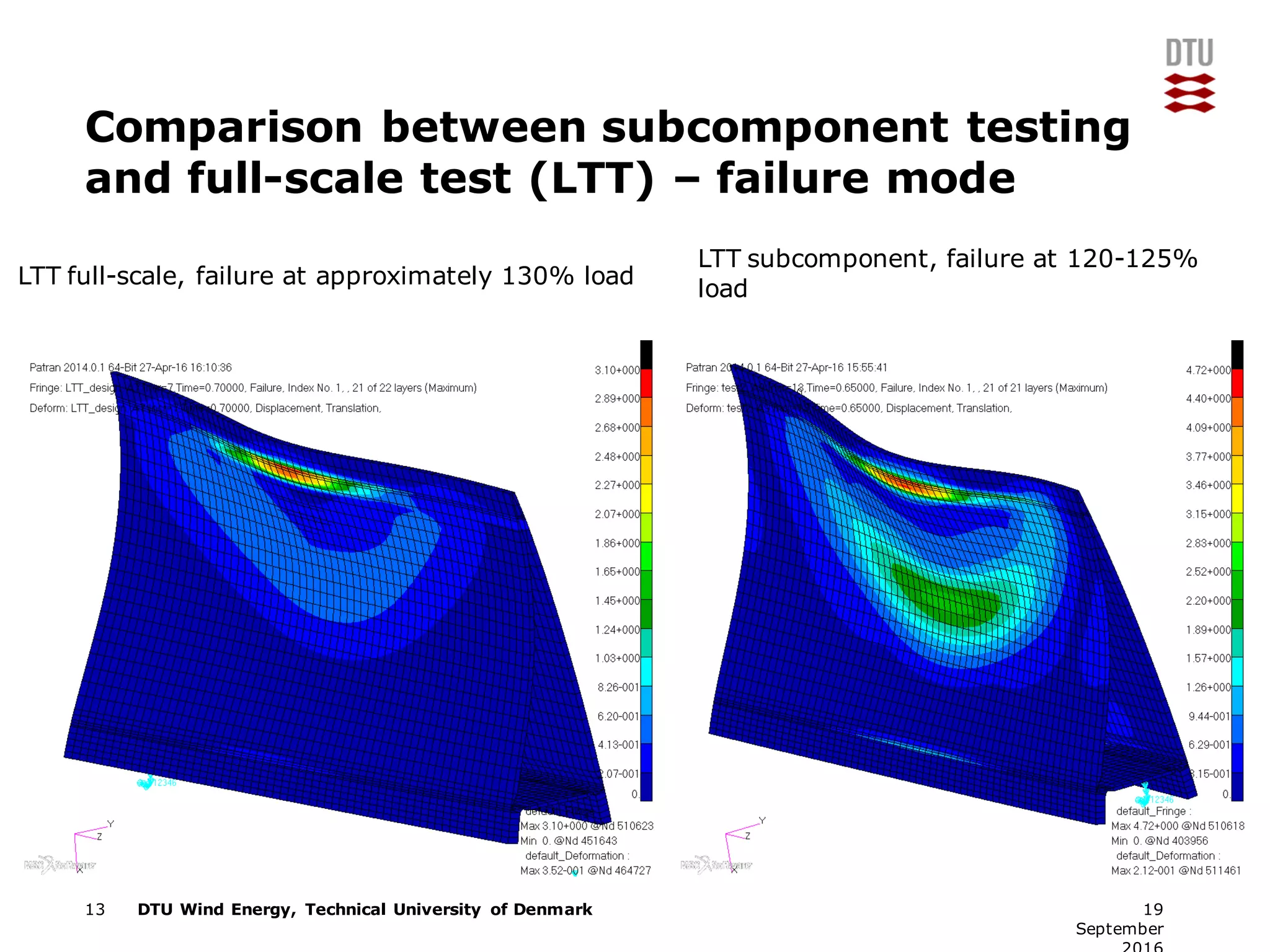
and full-scale test (LTT) – failure mode
13 19
September
LTT full-scale, failure at approximately 130% load
LTT subcomponent, failure at 120-125%
load
DTU Wind Energy, Technical University of Denmark
Comparison between subcomponent testing
and full-scale test (LTT) – failure mode
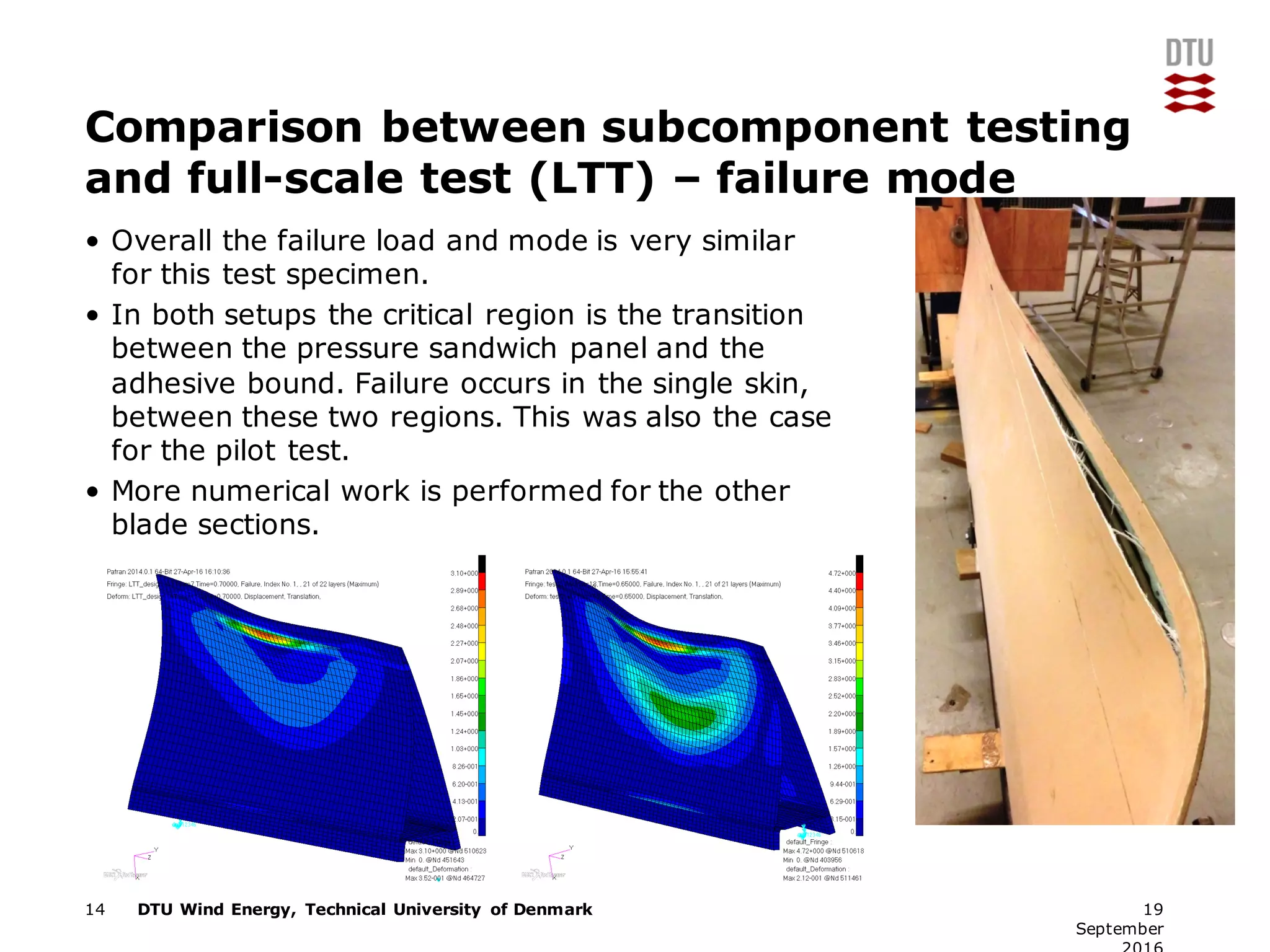
• Overall the failure load and mode is very similar
for this test specimen.
• In both setups the critical region is the transition
between the pressure sandwich panel and the
adhesive bound. Failure occurs in the single skin,
between these two regions. This was also the case
for the pilot test.
• More numerical work is performed for the other
blade sections.
14 19
September
DTU Wind Energy, Technical University of Denmark
Towards a sub-component test method
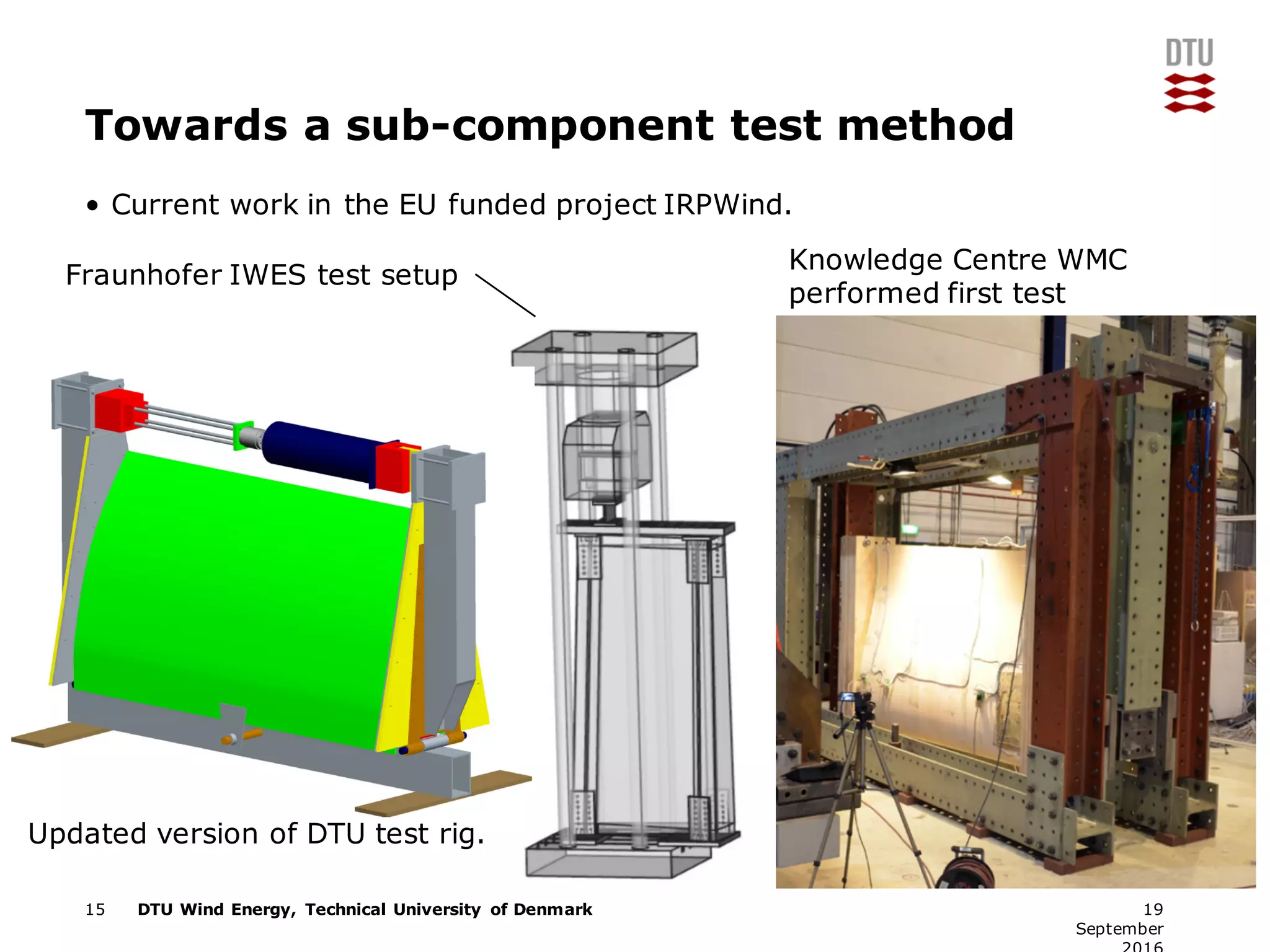
• Current work in the EU funded project IRPWind.
15 19
September
Updated version of DTU test rig.
Fraunhofer IWES test setup
Knowledge Centre WMC
performed first test
DTU Wind Energy, Technical University of Denmark
Conclusions and ongoing work
• Finite element simulations show that the proposed
static subcomponent test method is promising in
obtaining a test of the compressive strength of the
trailing edge region under a simplified loading.
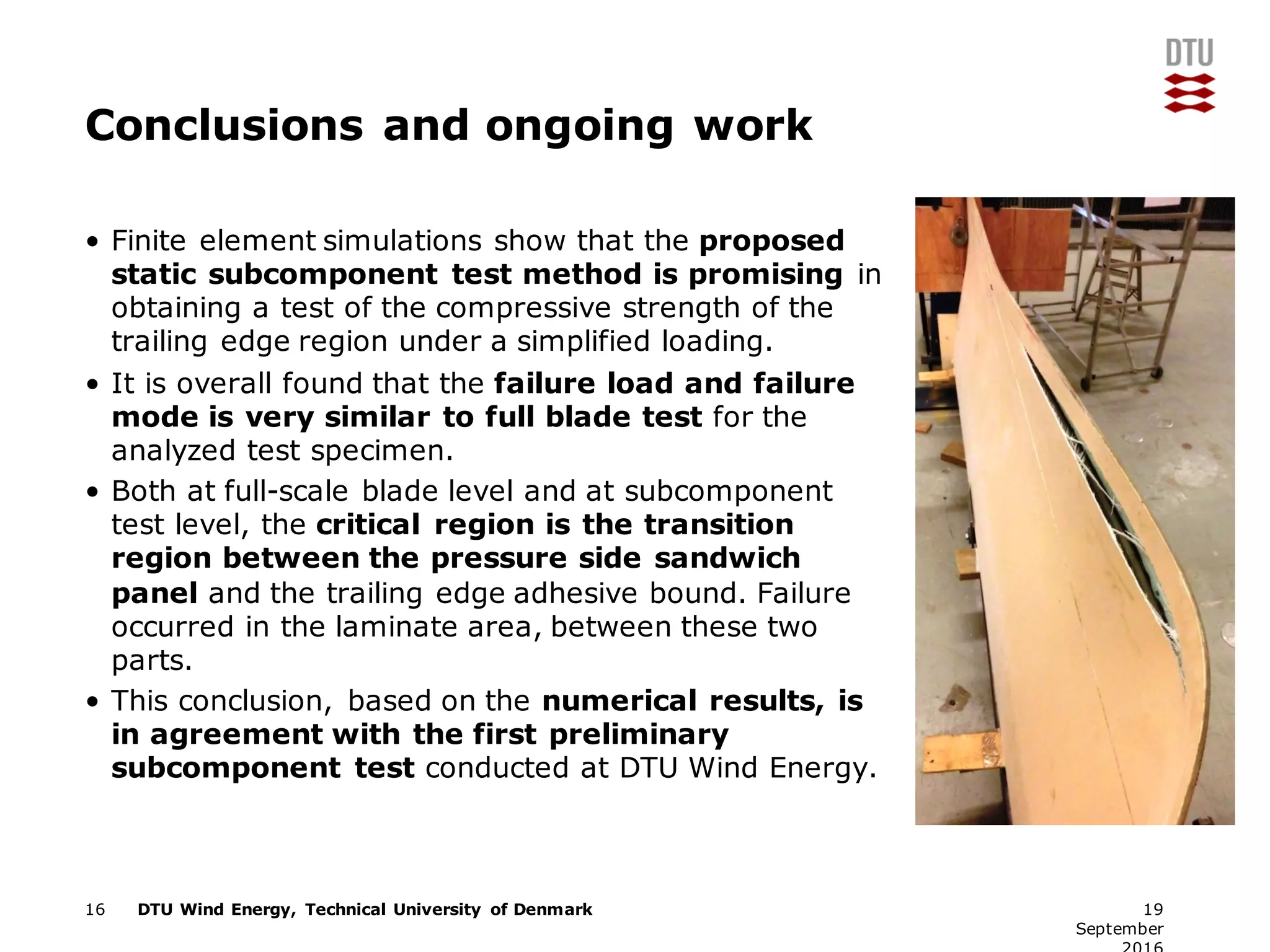
• It is overall found that the failure load and failure
mode is very similar to full blade test for the
analyzed test specimen.
• Both at full-scale blade level and at subcomponent
test level, the critical region is the transition
region between the pressure side sandwich
panel and the trailing edge adhesive bound. Failure
occurred in the laminate area, between these two
parts.
• This conclusion, based on the numerical results, is
in agreement with the first preliminary
subcomponent test conducted at DTU Wind Energy.
16 19
September
The work is funded by:
European Community’s Seventh Framework Programmed under
funding scheme: Combination of CP & CSA with grant agreement
No. 609795 (IRPWIND)
Danish Energy Agency through the Energy Technology Development
and Demonstration Program (EUDP 2010), grant no. 64011-0006.
The supported project is named Experimental Blade Research Phase
2 (EBR2)
Special thanks to SSP Technology A/S for providing blades for
testing as part of the EBR2 project
Kim Branner
kibr@dtu.dk
Any questions?

Toward a New Sub-component Test Method for the Trailing Edge Region of Wind Turbine Blades

  • 1.
    Toward a NewSub-component Test Method for the Trailing Edge Region of Wind Turbine Blades Kim Branner, Peter Berring & Philipp Ulrich Haselbach Department of Wind Energy, Technical University of Denmark Email: kibr@dtu.dk
  • 2.
    DTU Wind Energy,Technical University of Denmark Outline • Background & motivation • Proposed subcomponent test method • Comparison of simulations for full-scale test and subcomponent test • Conclusions and ongoing work
  • 3.
    DTU Wind Energy,Technical University of Denmark Certification of wind turbine blades • The design of wind turbine blades incorporates tests on normally only two scales. • Test of material coupons (level 1) is performed in order to determine material properties. • Full-scale blade tests (level 3) is performed on typically one or two blades in order to verify that the blade type have the load carrying capability and service life provided for in the design. 3 19 September
  • 4.
    DTU Wind Energy,Technical University of Denmark New blade standard allows for subcomponent testing • The new DNV GL rotor blade standard DNVGL-ST-0376 makes it possible to use subcomponent testing as part of a blade certification. • However, it is not clear how subcomponent testing should be done in order to be used in certification. • The aim is to develop a subcomponent testing methods for testing the trailing edge and surrounding structure. • The test method is aimed to be used as an industry standard. • The test method is aimed to be adopted by DNV GL. 4 19 September
  • 5.
    DTU Wind Energy,Technical University of Denmark Trailing edge failure in full-scale testing • Trailing edge proven to be critical in full-scale test. • Three 34m SSP Technology blades were tested to failure by loading the blades in an angle of 30 deg. to the flapwise direction. • For all three blade tests pronounced buckling waves in the trailing edge region occurred before ultimate failure. 5 19 September
  • 6.
    DTU Wind Energy,Technical University of Denmark Strength of blade in different directions 6 19 September • Load carrying capacity envelope calculated from finite element analysis • Failure based on Tsai-Wu material failure criterion and the non-linear eigenvalue buckling analysis • Buckling is the governing failure mode for this design • The blade is weakest when loaded towards trailing edge
  • 7.
    DTU Wind Energy,Technical University of Denmark Numerical response of the blade subjected to LTT loading • The main focus here is on the response of the test specimen from R13- R16 as this will be the design driver for our test setup! 7 19 September Waves/buckling are observed along the trailing edge and one of these is located at approximately 14.5m
  • 8.
    DTU Wind Energy,Technical University of Denmark Numerical response of the SSP blade - strain and failure mode 8 19 September At failure computed via Tsai-WuLongitudinal strain and location of elastic center at 20% of the certification load in LTT
  • 9.
    DTU Wind Energy,Technical University of Denmark Subcomponent test – experimental setup • This is the test setup for the initial test. • The testrig is currently being updated with a hydraulic actuator. 9 19 September
  • 10.
    DTU Wind Energy,Technical University of Denmark Numerical modelling approach for the test specimen • The blade model is cut at R13 and R16, and along a zy-plan which intersect with the elastic center. • Constrain elements are used to apply the load and boundary conditions. • The specimen fails at approximately 325kN on the pressure side. The buckling mode is more or less in the middle of the specimen. • The most critical region is the single skin between the adhesive and the sandwich panel. 10 19 September
  • 11.
    DTU Wind Energy,Technical University of Denmark Comparison between subcomponent testing and full-scale test (LTT) – strain response • Presented are the longitudinal strain response, of a slice of elements in the middle of test specimen, for both the subcomponent and full-scale LTT test at R14.5. • The strain is shown for 20% of the certification load in LTT. • A very similar response is observed at this low load level. 11 19 September
  • 12.
    DTU Wind Energy,Technical University of Denmark Comparison between subcomponent testing and full-scale test (LTT) – strain response • The same comparison but now at different load levels. 12 19 September
  • 13.
    DTU Wind Energy,Technical University of Denmark Comparison between subcomponent testing and full-scale test (LTT) – failure mode 13 19 September LTT full-scale, failure at approximately 130% load LTT subcomponent, failure at 120-125% load
  • 14.
    DTU Wind Energy,Technical University of Denmark Comparison between subcomponent testing and full-scale test (LTT) – failure mode • Overall the failure load and mode is very similar for this test specimen. • In both setups the critical region is the transition between the pressure sandwich panel and the adhesive bound. Failure occurs in the single skin, between these two regions. This was also the case for the pilot test. • More numerical work is performed for the other blade sections. 14 19 September
  • 15.
    DTU Wind Energy,Technical University of Denmark Towards a sub-component test method • Current work in the EU funded project IRPWind. 15 19 September Updated version of DTU test rig. Fraunhofer IWES test setup Knowledge Centre WMC performed first test
  • 16.
    DTU Wind Energy,Technical University of Denmark Conclusions and ongoing work • Finite element simulations show that the proposed static subcomponent test method is promising in obtaining a test of the compressive strength of the trailing edge region under a simplified loading. • It is overall found that the failure load and failure mode is very similar to full blade test for the analyzed test specimen. • Both at full-scale blade level and at subcomponent test level, the critical region is the transition region between the pressure side sandwich panel and the trailing edge adhesive bound. Failure occurred in the laminate area, between these two parts. • This conclusion, based on the numerical results, is in agreement with the first preliminary subcomponent test conducted at DTU Wind Energy. 16 19 September
  • 17.
    The work isfunded by: European Community’s Seventh Framework Programmed under funding scheme: Combination of CP & CSA with grant agreement No. 609795 (IRPWIND) Danish Energy Agency through the Energy Technology Development and Demonstration Program (EUDP 2010), grant no. 64011-0006. The supported project is named Experimental Blade Research Phase 2 (EBR2) Special thanks to SSP Technology A/S for providing blades for testing as part of the EBR2 project Kim Branner kibr@dtu.dk Any questions?