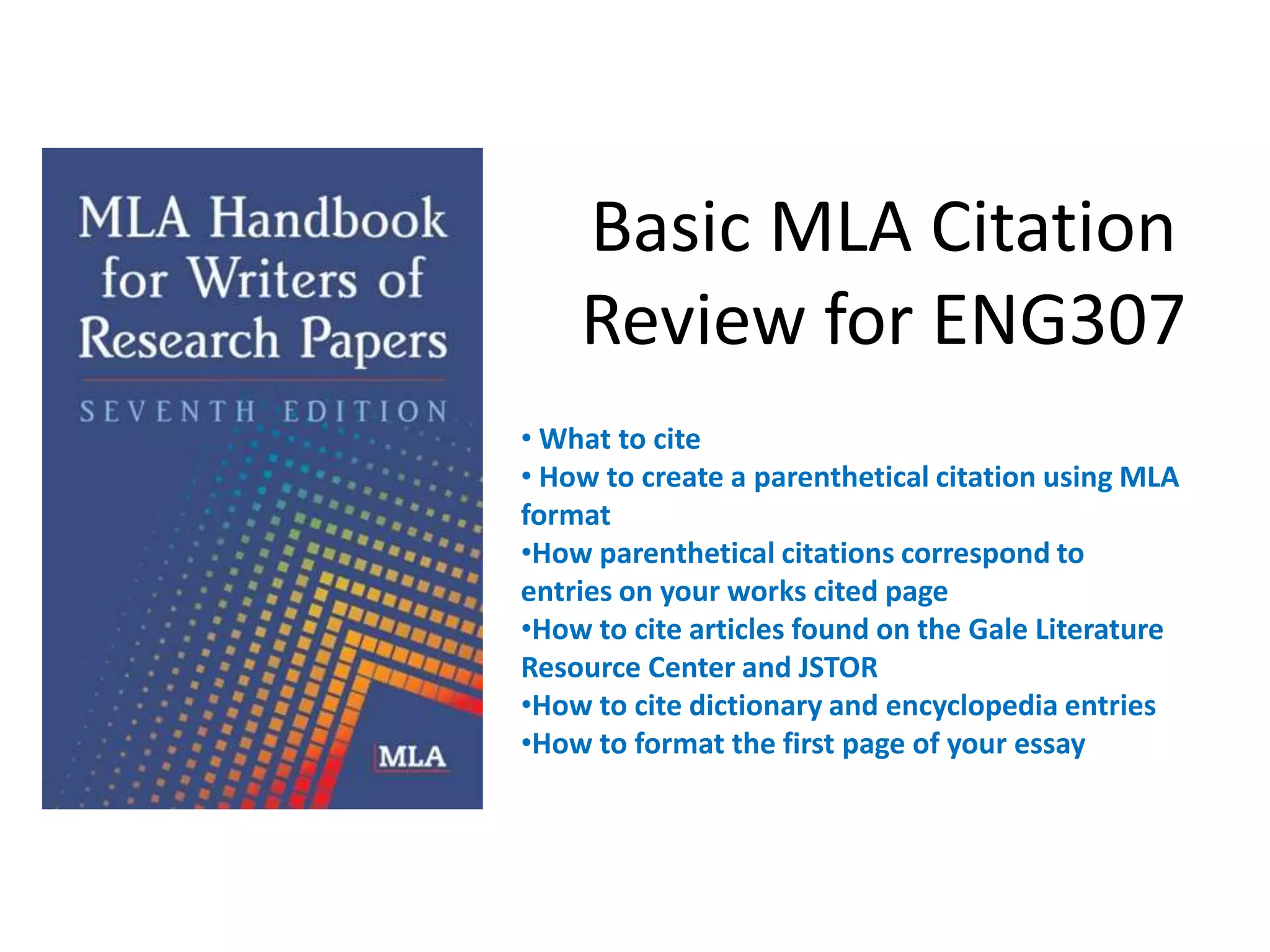
Basic MLA Citation
    Review for ENG307
• What to cite
• How to create a parenthetical citation using MLA
format
•How parenthetical citations correspond to
entries on your works cited page
•How to cite articles found on the Gale Literature
Resource Center and JSTOR
•How to cite dictionary and encyclopedia entries
•How to format the first page of your essay
You must cite…
• When you use a “direct quotation” from a
  secondary source*
• When you put information from a secondary
  source into your own words
  (paraphrase/summary)—this includes
  biographical information about your authors
• When you use direct quotations from
  primary sources (in this case, the novels
  themselves)
*Secondary sources include such texts as literary criticism, biographies, reviews,
etc. They can be found in print sources such as books and print magazines. More
likely, you will use online databases such as JSTOR and the Gale Literature Resource
Center Database to find such sources.
Example of Summary and
        Use of Parenthetical Citation
Look at the next two slides.

• One provides the original source material (an
  article by critic Paula Eckard about the author Anne
  Tyler).
• One provides a brief summary of that source
  material as used in a student’s essay.
Original Passage
    This excerpt is from Paula Gallant Eckard’s article “Family and Community in Anne Tyler’s Dinner at
    the Homesick Restaurant.” This article appeared in the Southern Literary Journal in the spring of
    1990 and the passage below is taken from page 34.


            Tyler demonstrates how the past is inextricably linked to the present and how
    family and community, as a natural extension of the family, are centers for the ironies of
    life—love and rejection, growth and entrapment, stability and conflict. Tyler resists the
    temptation to indict parents, particularly mothers, for the transgressions of the past
    and for the ultimate shaping of offspring. Maternal ambivalence is a not uncommon
    thread in the fabric of human experience. However, as Tyler knows, it is just one factor
    in the development of the individual. Family and community also exert important
    influences that shape, direct, and complicate human existence. Tyler portrays this
    process in the Tull family, and in the end she renders a contemporary and enduring
    message about the nature of family, one that speaks with some measure of truth about
    all of our lives.
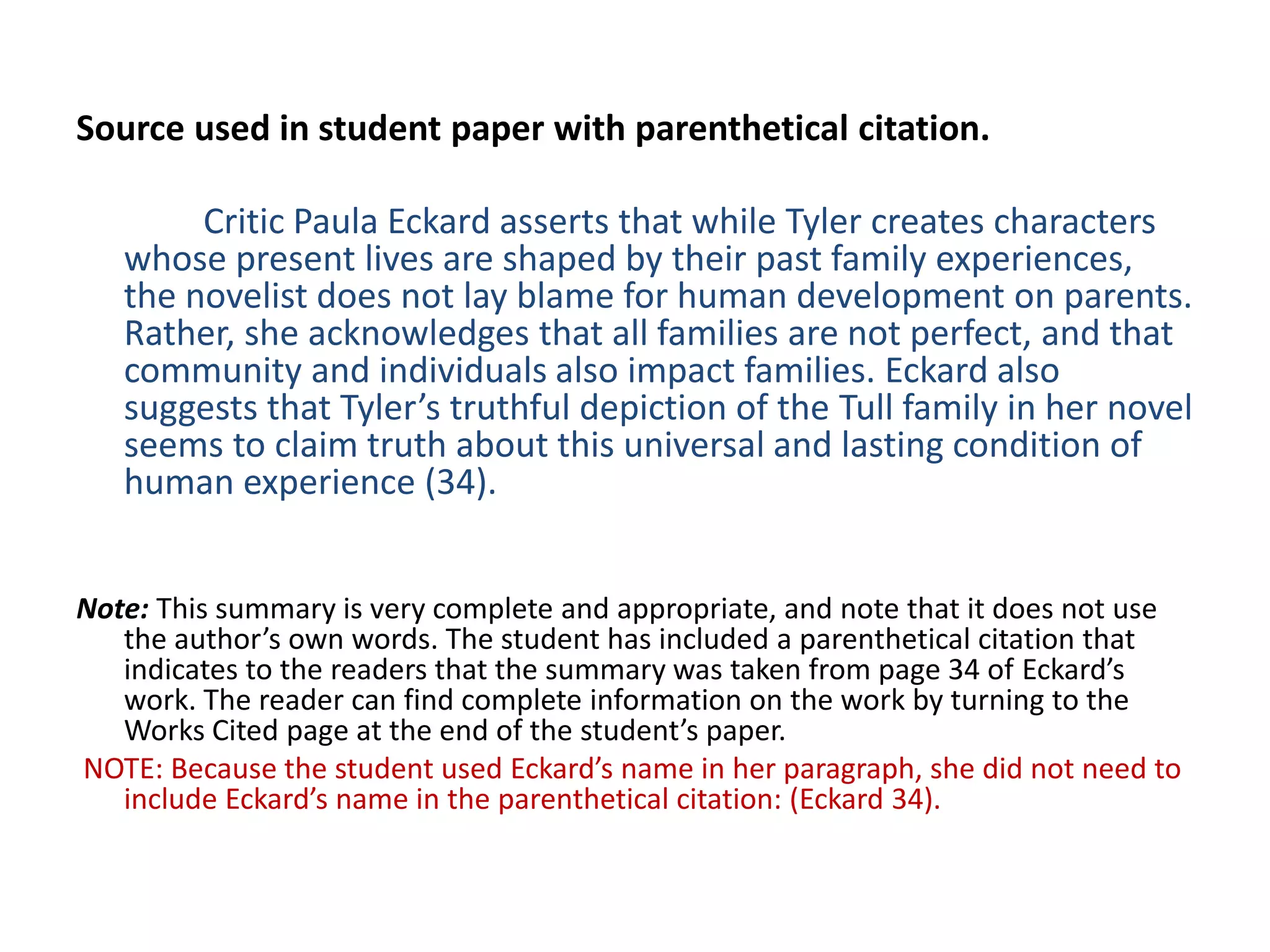
Source used in student paper with parenthetical citation.

        Critic Paula Eckard asserts that while Tyler creates characters
   whose present lives are shaped by their past family experiences,
   the novelist does not lay blame for human development on parents.
   Rather, she acknowledges that all families are not perfect, and that
   community and individuals also impact families. Eckard also
   suggests that Tyler’s truthful depiction of the Tull family in her novel
   seems to claim truth about this universal and lasting condition of
   human experience (34).


Note: This summary is very complete and appropriate, and note that it does not use
   the author’s own words. The student has included a parenthetical citation that
   indicates to the readers that the summary was taken from page 34 of Eckard’s
   work. The reader can find complete information on the work by turning to the
   Works Cited page at the end of the student’s paper.
NOTE: Because the student used Eckard’s name in her paragraph, she did not need to
   include Eckard’s name in the parenthetical citation: (Eckard 34).
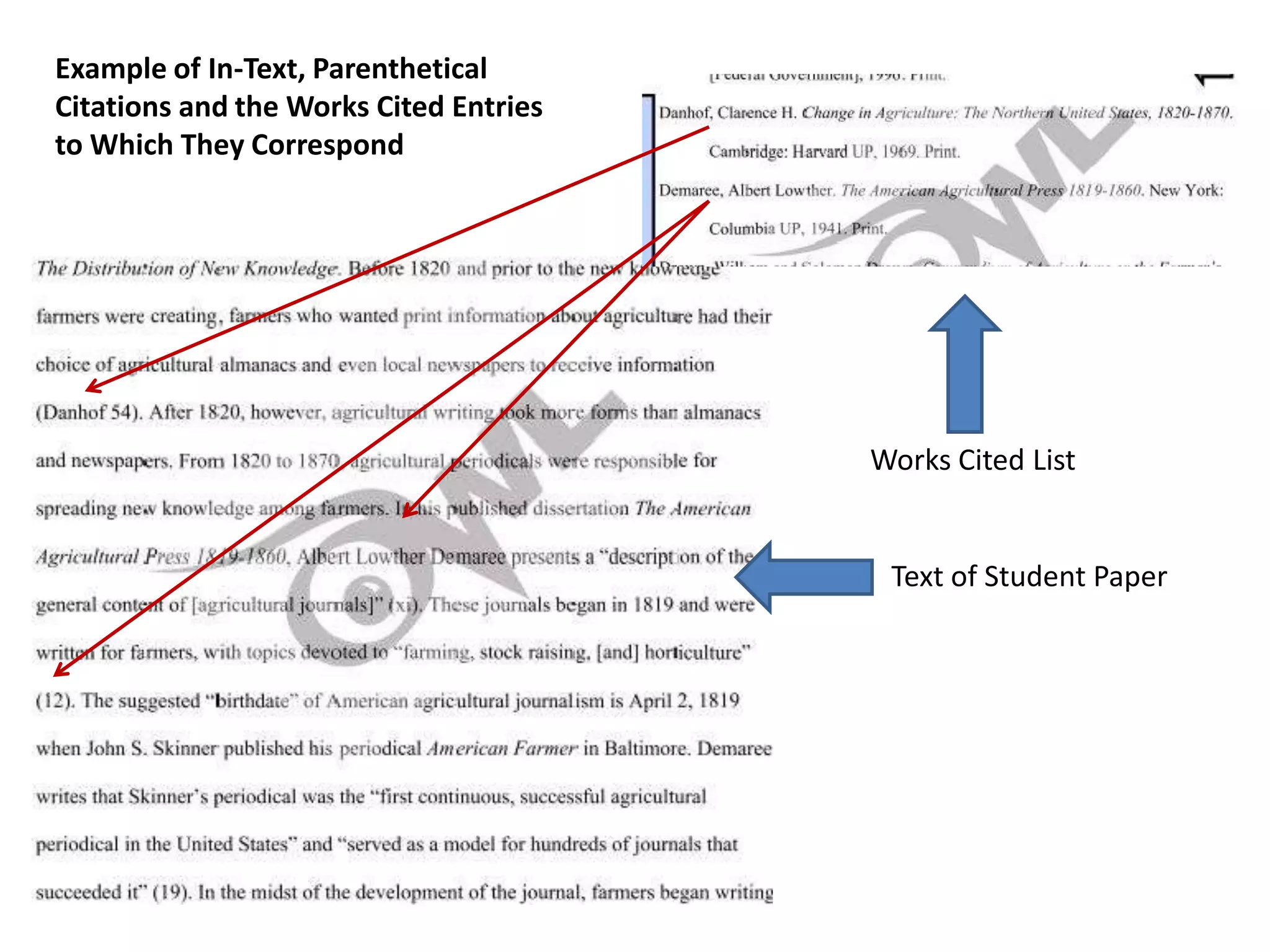
Example of In-Text, Parenthetical
Citations and the Works Cited Entries
to Which They Correspond


                                        Works Cited List


                                         Text of Student Paper
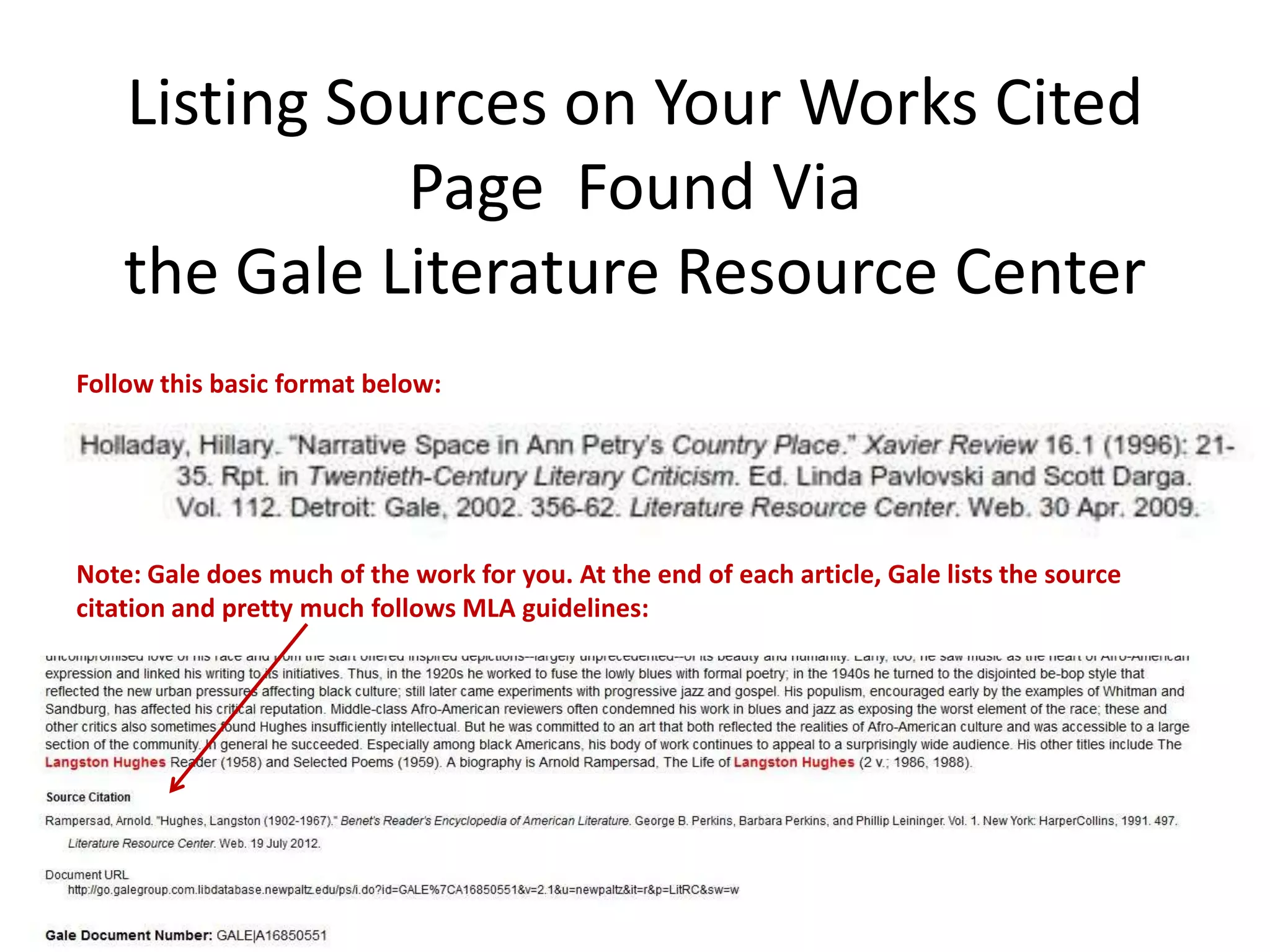
Listing Sources on Your Works Cited
              Page Found Via
    the Gale Literature Resource Center
Follow this basic format below:


Note: Gale does much of the work for you. At the end of each article, Gale lists the source
citation and pretty much follows MLA guidelines:
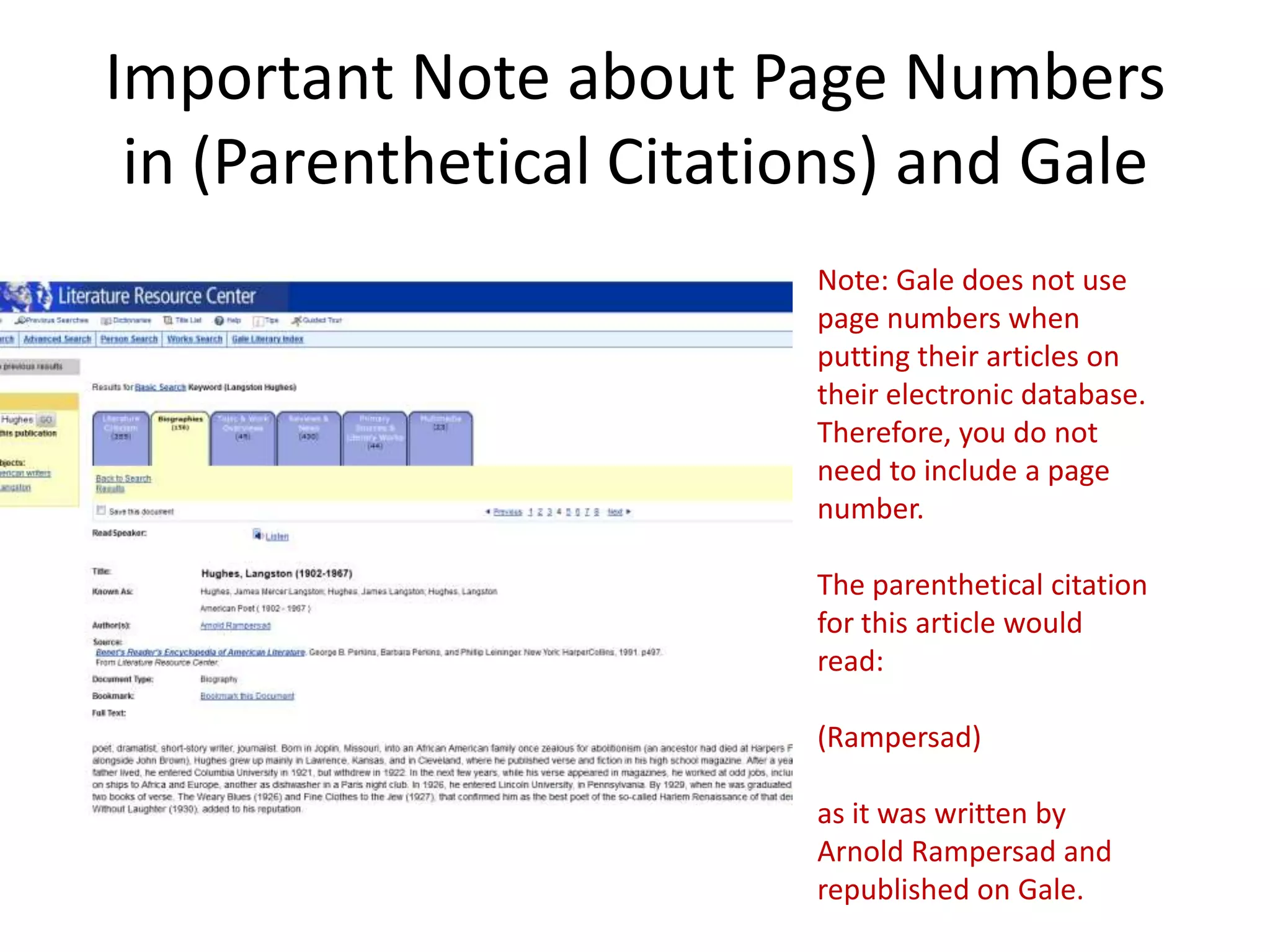
Important Note about Page Numbers
 in (Parenthetical Citations) and Gale
                         Note: Gale does not use
                         page numbers when
                         putting their articles on
                         their electronic database.
                         Therefore, you do not
                         need to include a page
                         number.

                         The parenthetical citation
                         for this article would
                         read:

                         (Rampersad)

                         as it was written by
                         Arnold Rampersad and
                         republished on Gale.
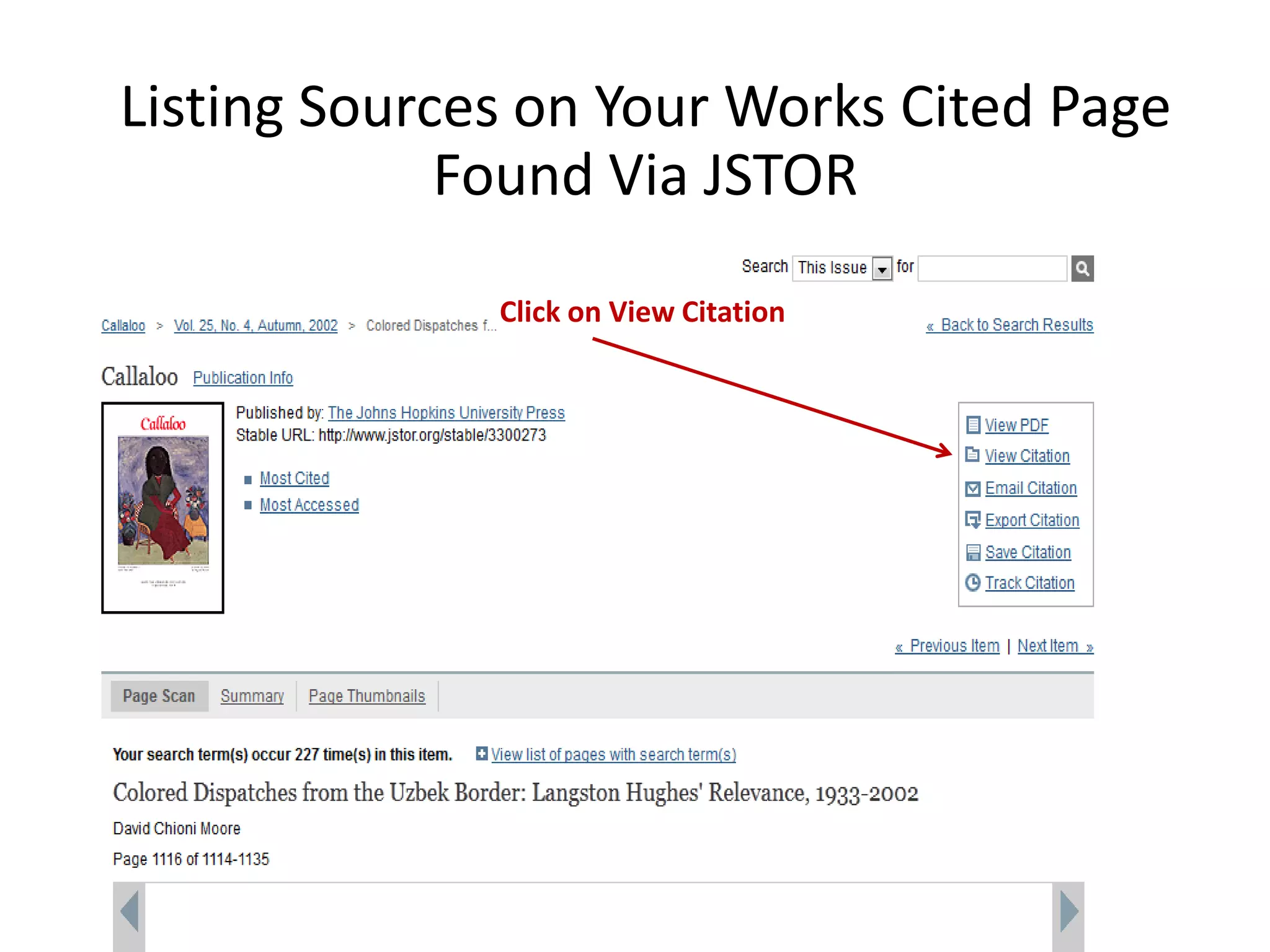
Listing Sources on Your Works Cited Page
             Found Via JSTOR

              Click on View Citation
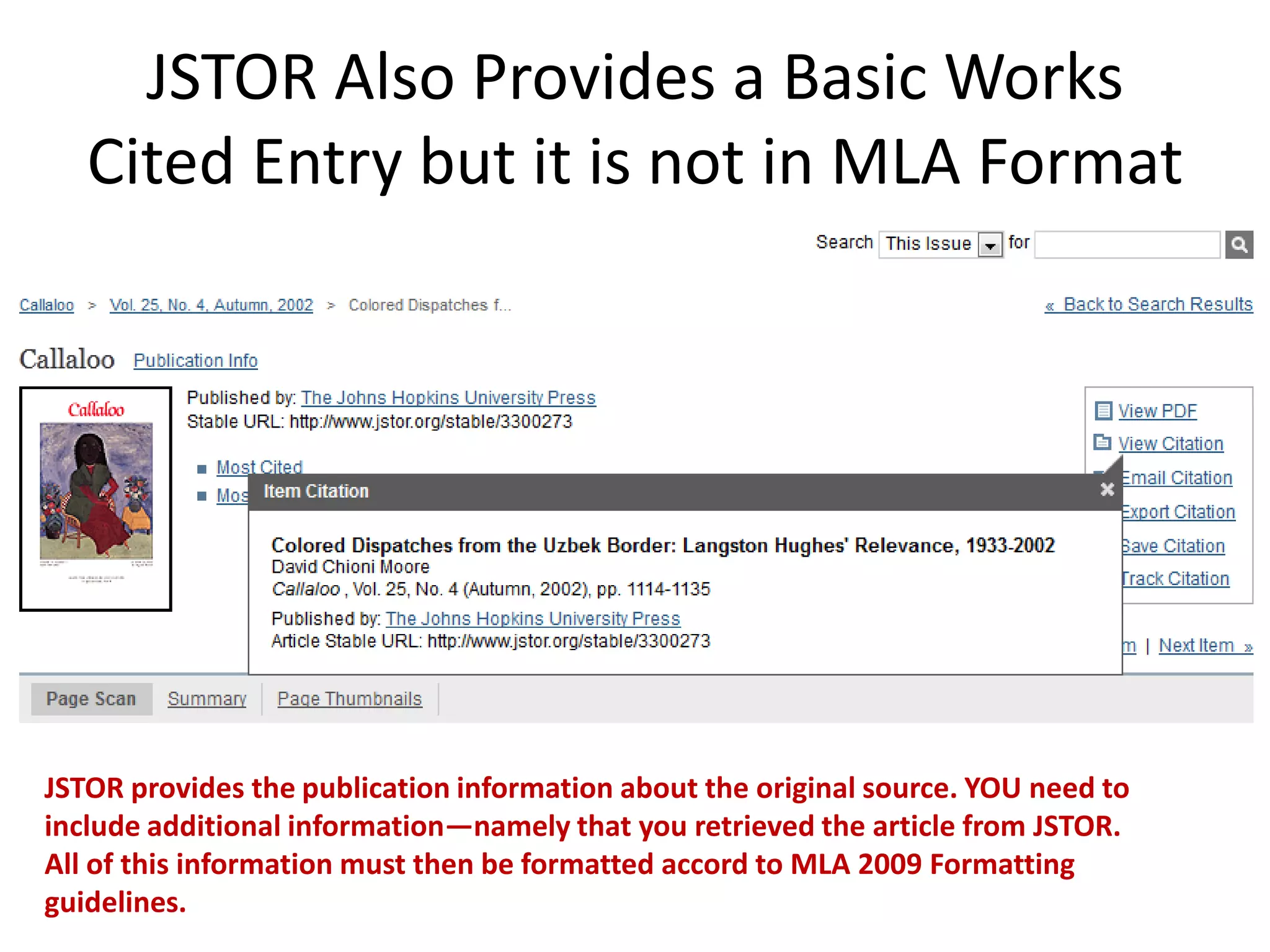
JSTOR Also Provides a Basic Works
   Cited Entry but it is not in MLA Format


JSTOR provides the publication information about the original source. YOU need to
include additional information—namely that you retrieved the article from JSTOR.
All of this information must then be formatted accord to MLA 2009 Formatting
guidelines.
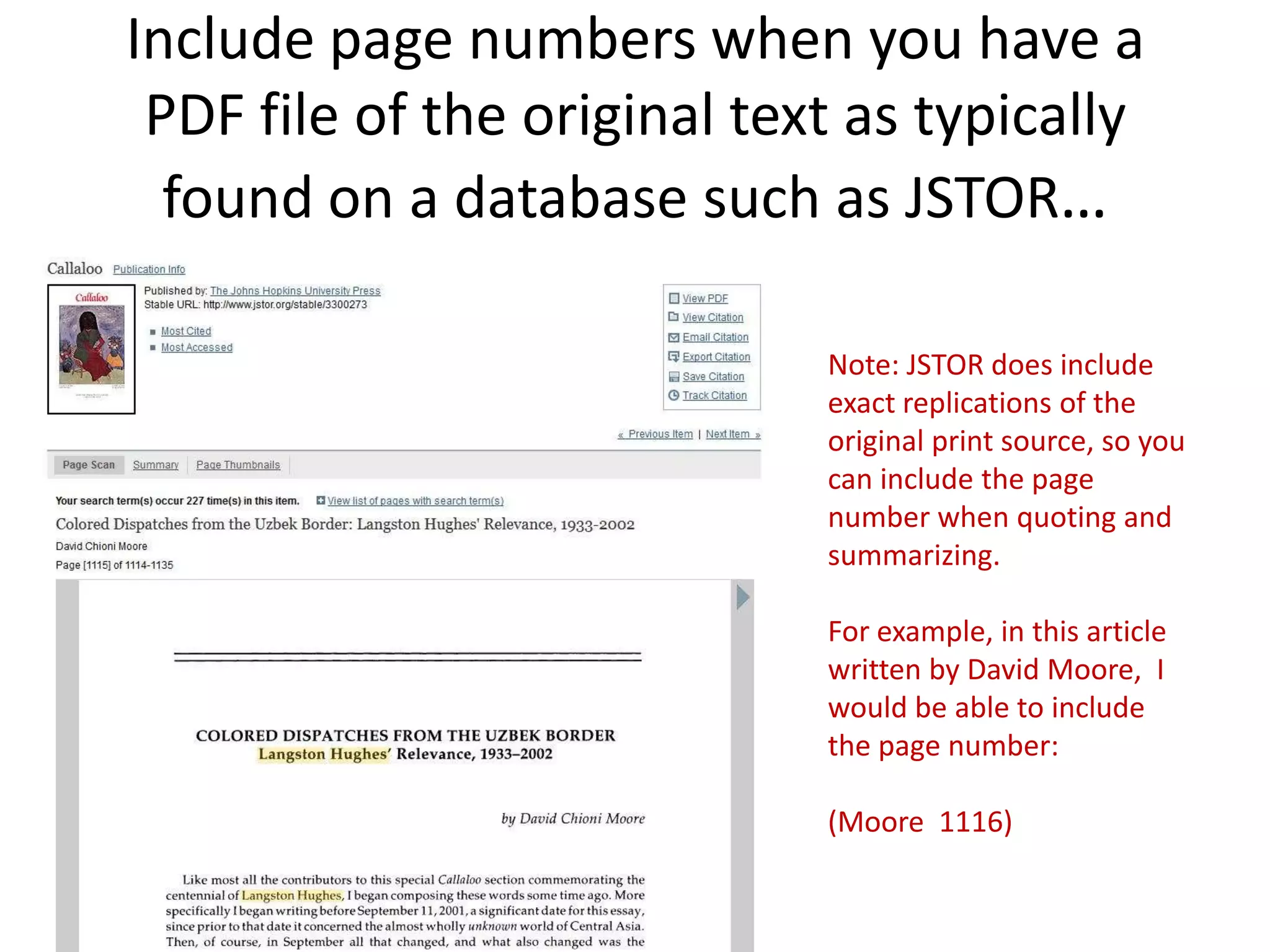
Include page numbers when you have a
 PDF file of the original text as typically
  found on a database such as JSTOR…

                             Note: JSTOR does include
                             exact replications of the
                             original print source, so you
                             can include the page
                             number when quoting and
                             summarizing.

                             For example, in this article
                             written by David Moore, I
                             would be able to include
                             the page number:

                             (Moore 1116)
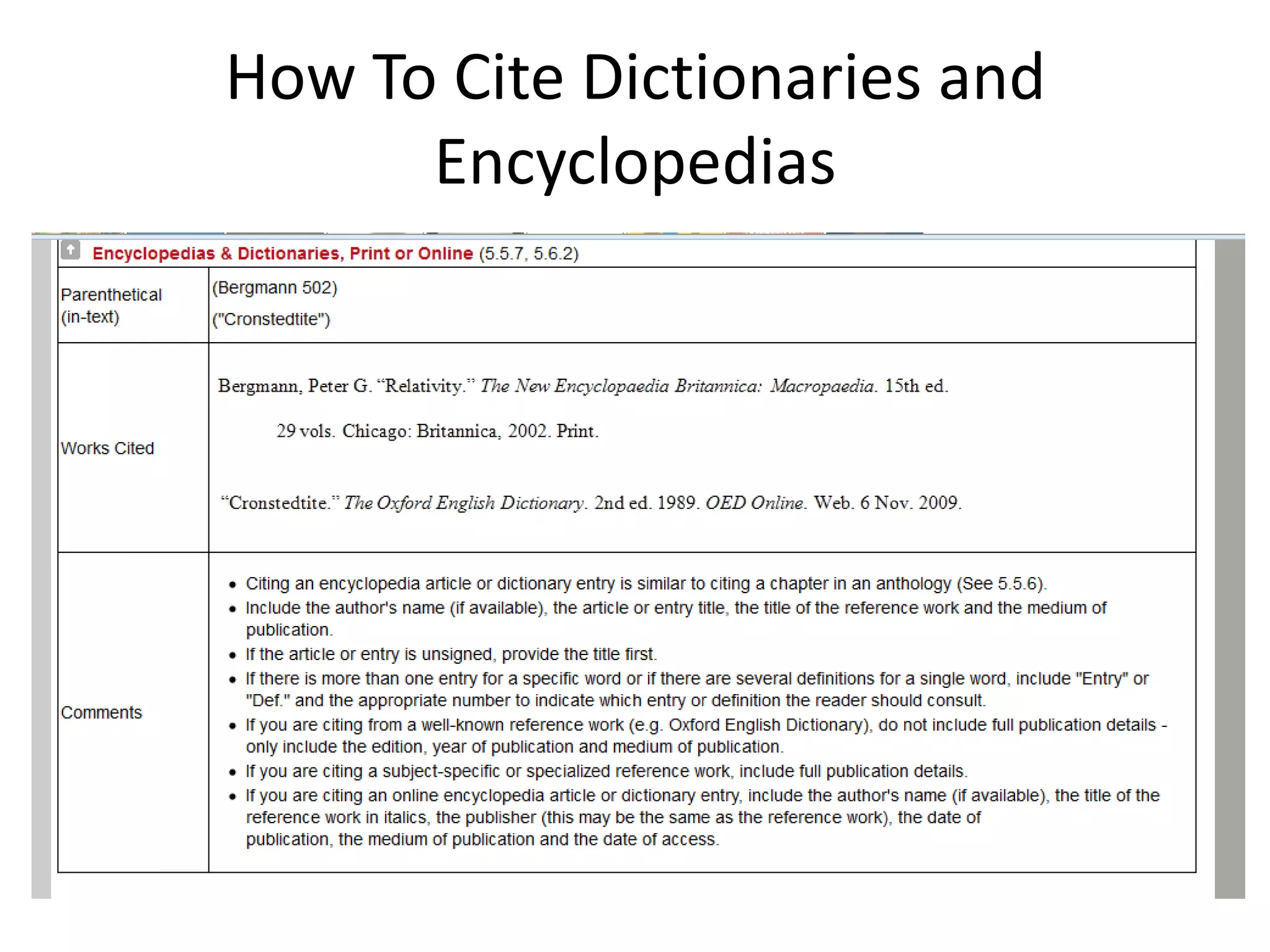
How To Cite Dictionaries and
      Encyclopedias
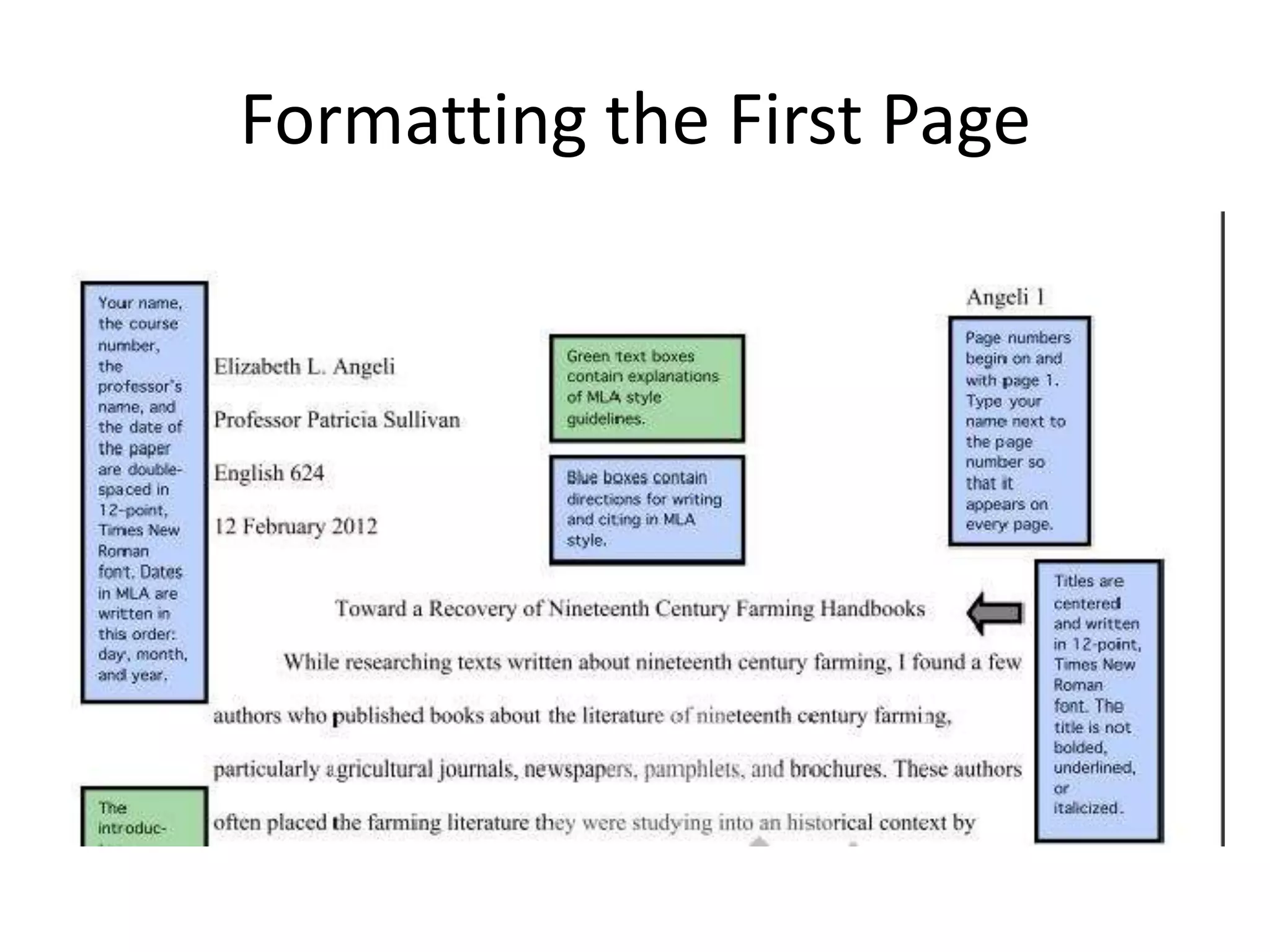
Formatting the First Page

Basic mla citation review eng307

  • 1.
    Basic MLA Citation Review for ENG307 • What to cite • How to create a parenthetical citation using MLA format •How parenthetical citations correspond to entries on your works cited page •How to cite articles found on the Gale Literature Resource Center and JSTOR •How to cite dictionary and encyclopedia entries •How to format the first page of your essay
  • 2.
    You must cite… •When you use a “direct quotation” from a secondary source* • When you put information from a secondary source into your own words (paraphrase/summary)—this includes biographical information about your authors • When you use direct quotations from primary sources (in this case, the novels themselves) *Secondary sources include such texts as literary criticism, biographies, reviews, etc. They can be found in print sources such as books and print magazines. More likely, you will use online databases such as JSTOR and the Gale Literature Resource Center Database to find such sources.
  • 3.
    Example of Summaryand Use of Parenthetical Citation Look at the next two slides. • One provides the original source material (an article by critic Paula Eckard about the author Anne Tyler). • One provides a brief summary of that source material as used in a student’s essay.
  • 4.
    Original Passage This excerpt is from Paula Gallant Eckard’s article “Family and Community in Anne Tyler’s Dinner at the Homesick Restaurant.” This article appeared in the Southern Literary Journal in the spring of 1990 and the passage below is taken from page 34. Tyler demonstrates how the past is inextricably linked to the present and how family and community, as a natural extension of the family, are centers for the ironies of life—love and rejection, growth and entrapment, stability and conflict. Tyler resists the temptation to indict parents, particularly mothers, for the transgressions of the past and for the ultimate shaping of offspring. Maternal ambivalence is a not uncommon thread in the fabric of human experience. However, as Tyler knows, it is just one factor in the development of the individual. Family and community also exert important influences that shape, direct, and complicate human existence. Tyler portrays this process in the Tull family, and in the end she renders a contemporary and enduring message about the nature of family, one that speaks with some measure of truth about all of our lives.
  • 5.
    Source used instudent paper with parenthetical citation. Critic Paula Eckard asserts that while Tyler creates characters whose present lives are shaped by their past family experiences, the novelist does not lay blame for human development on parents. Rather, she acknowledges that all families are not perfect, and that community and individuals also impact families. Eckard also suggests that Tyler’s truthful depiction of the Tull family in her novel seems to claim truth about this universal and lasting condition of human experience (34). Note: This summary is very complete and appropriate, and note that it does not use the author’s own words. The student has included a parenthetical citation that indicates to the readers that the summary was taken from page 34 of Eckard’s work. The reader can find complete information on the work by turning to the Works Cited page at the end of the student’s paper. NOTE: Because the student used Eckard’s name in her paragraph, she did not need to include Eckard’s name in the parenthetical citation: (Eckard 34).
  • 6.
    Example of In-Text,Parenthetical Citations and the Works Cited Entries to Which They Correspond Works Cited List Text of Student Paper
  • 7.
    Listing Sources onYour Works Cited Page Found Via the Gale Literature Resource Center Follow this basic format below: Note: Gale does much of the work for you. At the end of each article, Gale lists the source citation and pretty much follows MLA guidelines:
  • 8.
    Important Note aboutPage Numbers in (Parenthetical Citations) and Gale Note: Gale does not use page numbers when putting their articles on their electronic database. Therefore, you do not need to include a page number. The parenthetical citation for this article would read: (Rampersad) as it was written by Arnold Rampersad and republished on Gale.
  • 9.
    Listing Sources onYour Works Cited Page Found Via JSTOR Click on View Citation
  • 10.
    JSTOR Also Providesa Basic Works Cited Entry but it is not in MLA Format JSTOR provides the publication information about the original source. YOU need to include additional information—namely that you retrieved the article from JSTOR. All of this information must then be formatted accord to MLA 2009 Formatting guidelines.
  • 11.
    Include page numberswhen you have a PDF file of the original text as typically found on a database such as JSTOR… Note: JSTOR does include exact replications of the original print source, so you can include the page number when quoting and summarizing. For example, in this article written by David Moore, I would be able to include the page number: (Moore 1116)
  • 12.
    How To CiteDictionaries and Encyclopedias
  • 13.