1


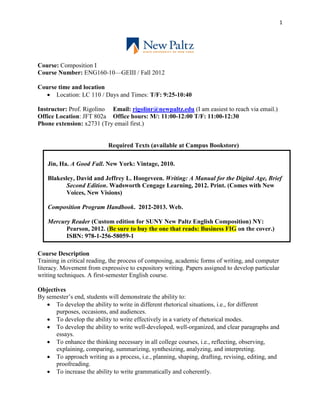
Course: Composition I
Course Number: ENG160-10—GEIII / Fall 2012

Course time and location
   ď‚· Location: LC 110 / Days and Times: T/F: 9:25-10:40

Instructor: Prof. Rigolino Email: rigolinr@newpaltz.edu (I am easiest to reach via email.)
Office Location: JFT 802a Office hours: M/: 11:00-12:00 T/F: 11:00-12:30
Phone extension: x2731 (Try email first.)


                            Required Texts (available at Campus Bookstore)

   Jin, Ha. A Good Fall. New York: Vintage, 2010.

   Blakesley, David and Jeffrey L. Hoogeveen. Writing: A Manual for the Digital Age, Brief
          Second Edition. Wadsworth Cengage Learning, 2012. Print. (Comes with New
          Voices, New Visions)

   Composition Program Handbook. 2012-2013. Web.
                                  Course Description
   Mercury Reader (Custom edition for SUNY New Paltz English Composition) NY:
         Pearson, 2012. (Be sure to buy the one that reads: Business FIG on the cover.)
         ISBN: 978-1-256-58059-1

Course Description
Training in critical reading, the process of composing, academic forms of writing, and computer
literacy. Movement from expressive to expository writing. Papers assigned to develop particular
writing techniques. A first-semester English course.

Objectives
By semester’s end, students will demonstrate the ability to:
   ď‚· To develop the ability to write in different rhetorical situations, i.e., for different
      purposes, occasions, and audiences.
   ď‚· To develop the ability to write effectively in a variety of rhetorical modes.
   ď‚· To develop the ability to write well-developed, well-organized, and clear paragraphs and
      essays.
   ď‚· To enhance the thinking necessary in all college courses, i.e., reflecting, observing,
      explaining, comparing, summarizing, synthesizing, analyzing, and interpreting.
   ď‚· To approach writing as a process, i.e., planning, shaping, drafting, revising, editing, and
      proofreading.
   ď‚· To increase the ability to write grammatically and coherently.
2


      To critique one’s own writing and the writing of others.
   ď‚·   To evaluate courses of information using criteria such as currency, authority, objectivity,
       accuracy, specificity, and relevance.
   ď‚·   To use information ethically and legally (i.e., to avoid plagiarism).
   ď‚·   To develop oral presentation skills.
   ď‚·   To develop computer information literacy.
   ď‚·   To demonstrate basic knowledge of library skills.

 Course Overview:
Composition I develops students’ abilities to write grammatical and coherent sentences and to
develop ideas fully an in an organized fashion. The course will develop students’ abilities to
produce distinctive pieces of writing based upon individual thinking and experience. It also will
stress and lead students through the composing process as they develop better understanding of
their own writing processes . . . (Composition Program Handbook 11).

NOTE: THERE ARE NO WITHDRAWALS OR INCOMPLETES FOR COMPOSITION I AND II. THIS IS A
COLLEGE POLICY.


                                     ATTENDANCE REQUIREMENT

Class attendance and participation are expected. For absences less than three and failure to
participate in class, I will deduct points from your class work grade (see last item in list above).
For absences in excess of three, please read below.


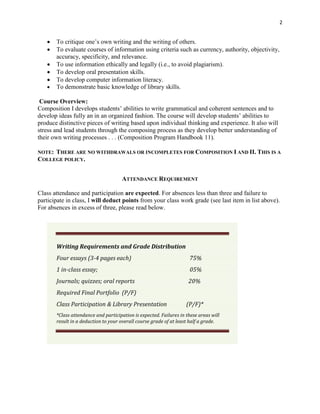
       Writing Requirements and Grade Distribution
       Four essays (3-4 pages each)                                  75%
       1 in-class essay;                                             05%
       Journals; quizzes; oral reports                               20%
       Required Final Portfolio (P/F)
       Class Participation & Library Presentation                   (P/F)*
       *Class attendance and participation is expected. Failures in these areas will
       result in a deduction to your overall course grade of at least half a grade.


           ď‚·
3


                                       Procedures

1. Students are expected to engage in all levels of the writing process: prewriting, drafting,
   revising, editing, and proofreading. Students will receive ample time to work on their
   writing and will receive feedback from both the instructor and their peers.

2. Essays 1 & 2 may be revised once after the initial grade has been recorded. In most
   cases, editing and proofreading alone will not count as a revision. Revision is more
   substantial, sometimes requiring the addition of text, deletion of text, and reorganization
   of text. If a student chooses to revise an essay, the revision must be submitted within
   one week of the day it is returned to him or her. The original grade will be averaged in
   with the second grade; however, there is no guarantee that the revision will receive a
   higher grade.

3. Students receive a grade and feedback on each assignment before the next assignment is
   due so that students can learn from the comments. Students are reminded that they can
   come visit me in my office hours to discuss their writing at any time during the semester.

                                        Portfolios

Students will be required to submit portfolios of their work in order to receive passing
grades in the course. Keep all of your work. Do not throw anything you write away.
You will need to assess all of your work for possible inclusion in the portfolio. To be
eligible to submit portfolios, students must demonstrate competency in grammar and usage
through an editing exercise and must be passing the course with a D or better.


                          Composition I: Portfolio Checklist

   Assessment sheet (student, instructor, and reader’s name; oral component met).
ď‚·   Table of contents.
ď‚·   A self-assessment of your writing regarding this semester; this may be formatted as a
    letter to the reader of the portfolio (also called: cover or reflective letter).
ď‚·   Diagnostic essay (not graded; clean copy).
ď‚·   Two essays written and revised outside of class with all drafts; attach an unmarked clean
    copy on top of the drafts. This must include one argument or analysis essay with
    MLA documentation and Works Cited page.
ď‚·   Midterm exam or second-timed writing (not graded; clean copy).
ď‚·   Common final exam (not graded; clean copy).


Portfolios will be graded as passing if they are deemed a level 4 on the placement and
proficiency scale. Portfolios that do not contain the required work will not be graded.
Students who do not fulfill the portfolio requirement will receive a grade of R (Repeat) for
the course, which does not affect the student’s Grade Point Average or financial aid. The
4


   student must repeat the course and successfully complete all assignments before a grade will
   be determined.

                               Statement on Academic Integrity

“Students are expected to maintain the highest standards of honesty in their academic work.
Cheating, forgery, and plagiarism are serious offences, and students found guilty of any form of
academic dishonesty are subject to disciplinary action” (Faculty Handbook 33).

Plagiarism is the unacknowledged (intentionally or unintentionally) use of summary, paraphrase,
direct quotation, language, statistics, or ideas from other sources, including Internet sources.
You must cite according to the Modern Language Association (MLA) format found in Writing:
A Manual for the Digital Age, Brief Second Edition. If you plagiarize all or part of a writing
assignment, you will be reported to the Department of English Chair and/or the Academic Dean.

                         Statement on Americans with Disabilities Act

“Students with disabilities are entitled to the right to accommodation under Section 504 of the
Rehabilitation Ace and ADA of 1990. ADA students are responsible for self-identifying to the
Disability Resource Center, who will inform me of your needs of accommodation related to the
structure of the course” (Faculty Handbook 30).


                                   Schedule of Assignments

Please note: This schedule is tentative and will change based on the needs of the class.

MR = Mercury Reader
WDA = Writing for a Digital Age


                                                                         Date Assignment is
                                                                         DUE
WEEK 1          T 8/28        Diagnostic Essay
                F 8/31        Introduction to course / Essay 1
                              Assigned / Oral Report Groups
                              Assigned
WEEK 2          T 9/4         Chapters 1-4 and 6 & 7 in WDA              Journal #1 Due
                F 9/7         Chapters 1-4 and 6 & 7 in WDA              Journal #2 Due
WEEK 3          T 9/11        Peer Critiques of Essay #1                 Rough Draft Essay #1
                F 9/14                                                   Final Copy: Essay #1
WEEK 4          T 9/18        No Class
                F 9/21        WDA Chapters 8-11                          Essay #2 Proposal Due
WEEK 5          T 9/25        Oral Report Group 1                        Oral Report Group 1
                F 9/28        Library Session                            Journal #3 Due
WEEK 6          T 10/2        Oral Report Group 2                        Oral Report Group 2
                F 10/5        WDA Chapters 8-11                          Journal #4 Due
WEEK 7          T 10/9        MON. CLASSES MEET/ No Class
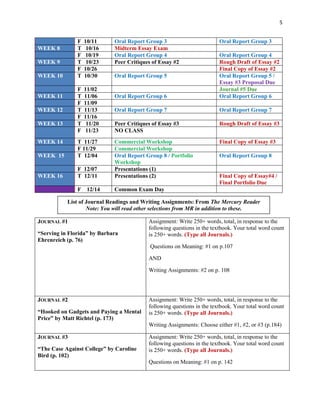
5


               F   10/11     Oral Report Group 3                        Oral Report Group 3
WEEK 8         T    10/16    Midterm Essay Exam
               F   10/19     Oral Report Group 4                        Oral Report Group 4
WEEK 9         T    10/23    Peer Critiques of Essay #2                 Rough Draft of Essay #2
               F   10/26                                                Final Copy of Essay #2
WEEK 10        T   10/30     Oral Report Group 5                        Oral Report Group 5 /
                                                                        Essay #3 Proposal Due
               F   11/02                                                Journal #5 Due
WEEK 11        T   11/06     Oral Report Group 6                        Oral Report Group 6
               F   11/09
WEEK 12        T   11/13     Oral Report Group 7                        Oral Report Group 7
               F   11/16
WEEK 13        T    11/20    Peer Critiques of Essay #3                 Rough Draft of Essay #3
               F   11/23     NO CLASS
WEEK 14        T 11/27       Commercial Workshop                        Final Copy of Essay #3
               F 11/29       Commercial Workshop
WEEK 15        T 12/04       Oral Report Group 8 / Portfolio            Oral Report Group 8
                             Workshop
               F 12/07       Presentations (1)
WEEK 16        T 12/11       Presentations (2)                          Final Copy of Essay#4 /
                                                                        Final Portfolio Due
               F    12/14    Common Exam Day

           List of Journal Readings and Writing Assignments: From The Mercury Reader
                   Note: You will read other selections from MR in addition to these.

JOURNAL #1                                Assignment: Write 250+ words, total, in response to the
                                          following questions in the textbook. Your total word count
“Serving in Florida” by Barbara           is 250+ words. (Type all Journals.)
Ehrenreich (p. 76)
                                           Questions on Meaning: #1 on p.107

                                          AND

                                          Writing Assignments: #2 on p. 108


JOURNAL #2                                Assignment: Write 250+ words, total, in response to the
                                          following questions in the textbook. Your total word count
“Hooked on Gadgets and Paying a Mental    is 250+ words. (Type all Journals.)
Price” by Matt Richtel (p. 173)
                                          Writing Assignments: Choose either #1, #2, or #3 (p.184)

JOURNAL #3                                Assignment: Write 250+ words, total, in response to the
                                          following questions in the textbook. Your total word count
“The Case Against College” by Caroline    is 250+ words. (Type all Journals.)
Bird (p. 102)
                                          Questions on Meaning: #1 on p. 142
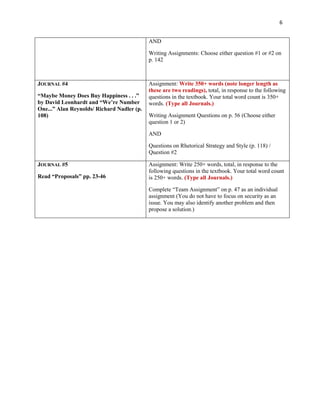
6


                                            AND

                                            Writing Assignments: Choose either question #1 or #2 on
                                            p. 142


JOURNAL #4                                  Assignment: Write 350+ words (note longer length as
                                            these are two readings), total, in response to the following
“Maybe Money Does Buy Happiness . . .”      questions in the textbook. Your total word count is 350+
by David Leonhardt and “We’re Number        words. (Type all Journals.)
One...” Alan Reynolds/ Richard Nadler (p.
108)                                        Writing Assignment Questions on p. 56 (Choose either
                                            question 1 or 2)

                                            AND

                                            Questions on Rhetorical Strategy and Style (p. 118) /
                                            Question #2

JOURNAL #5                                  Assignment: Write 250+ words, total, in response to the
                                            following questions in the textbook. Your total word count
Read “Proposals” pp. 23-46                  is 250+ words. (Type all Journals.)

                                            Complete “Team Assignment” on p. 47 as an individual
                                            assignment (You do not have to focus on security as an
                                            issue. You may also identify another problem and then
                                            propose a solution.)

Eng160 fig revisedfall2012

  • 1.
    1 Course: Composition I CourseNumber: ENG160-10—GEIII / Fall 2012 Course time and location  Location: LC 110 / Days and Times: T/F: 9:25-10:40 Instructor: Prof. Rigolino Email: rigolinr@newpaltz.edu (I am easiest to reach via email.) Office Location: JFT 802a Office hours: M/: 11:00-12:00 T/F: 11:00-12:30 Phone extension: x2731 (Try email first.) Required Texts (available at Campus Bookstore) Jin, Ha. A Good Fall. New York: Vintage, 2010. Blakesley, David and Jeffrey L. Hoogeveen. Writing: A Manual for the Digital Age, Brief Second Edition. Wadsworth Cengage Learning, 2012. Print. (Comes with New Voices, New Visions) Composition Program Handbook. 2012-2013. Web. Course Description Mercury Reader (Custom edition for SUNY New Paltz English Composition) NY: Pearson, 2012. (Be sure to buy the one that reads: Business FIG on the cover.) ISBN: 978-1-256-58059-1 Course Description Training in critical reading, the process of composing, academic forms of writing, and computer literacy. Movement from expressive to expository writing. Papers assigned to develop particular writing techniques. A first-semester English course. Objectives By semester’s end, students will demonstrate the ability to:  To develop the ability to write in different rhetorical situations, i.e., for different purposes, occasions, and audiences.  To develop the ability to write effectively in a variety of rhetorical modes.  To develop the ability to write well-developed, well-organized, and clear paragraphs and essays.  To enhance the thinking necessary in all college courses, i.e., reflecting, observing, explaining, comparing, summarizing, synthesizing, analyzing, and interpreting.  To approach writing as a process, i.e., planning, shaping, drafting, revising, editing, and proofreading.  To increase the ability to write grammatically and coherently.
  • 2.
    2  To critique one’s own writing and the writing of others.  To evaluate courses of information using criteria such as currency, authority, objectivity, accuracy, specificity, and relevance.  To use information ethically and legally (i.e., to avoid plagiarism).  To develop oral presentation skills.  To develop computer information literacy.  To demonstrate basic knowledge of library skills. Course Overview: Composition I develops students’ abilities to write grammatical and coherent sentences and to develop ideas fully an in an organized fashion. The course will develop students’ abilities to produce distinctive pieces of writing based upon individual thinking and experience. It also will stress and lead students through the composing process as they develop better understanding of their own writing processes . . . (Composition Program Handbook 11). NOTE: THERE ARE NO WITHDRAWALS OR INCOMPLETES FOR COMPOSITION I AND II. THIS IS A COLLEGE POLICY. ATTENDANCE REQUIREMENT Class attendance and participation are expected. For absences less than three and failure to participate in class, I will deduct points from your class work grade (see last item in list above). For absences in excess of three, please read below. Writing Requirements and Grade Distribution Four essays (3-4 pages each) 75% 1 in-class essay; 05% Journals; quizzes; oral reports 20% Required Final Portfolio (P/F) Class Participation & Library Presentation (P/F)* *Class attendance and participation is expected. Failures in these areas will result in a deduction to your overall course grade of at least half a grade. 
  • 3.
    3 Procedures 1. Students are expected to engage in all levels of the writing process: prewriting, drafting, revising, editing, and proofreading. Students will receive ample time to work on their writing and will receive feedback from both the instructor and their peers. 2. Essays 1 & 2 may be revised once after the initial grade has been recorded. In most cases, editing and proofreading alone will not count as a revision. Revision is more substantial, sometimes requiring the addition of text, deletion of text, and reorganization of text. If a student chooses to revise an essay, the revision must be submitted within one week of the day it is returned to him or her. The original grade will be averaged in with the second grade; however, there is no guarantee that the revision will receive a higher grade. 3. Students receive a grade and feedback on each assignment before the next assignment is due so that students can learn from the comments. Students are reminded that they can come visit me in my office hours to discuss their writing at any time during the semester. Portfolios Students will be required to submit portfolios of their work in order to receive passing grades in the course. Keep all of your work. Do not throw anything you write away. You will need to assess all of your work for possible inclusion in the portfolio. To be eligible to submit portfolios, students must demonstrate competency in grammar and usage through an editing exercise and must be passing the course with a D or better. Composition I: Portfolio Checklist  Assessment sheet (student, instructor, and reader’s name; oral component met).  Table of contents.  A self-assessment of your writing regarding this semester; this may be formatted as a letter to the reader of the portfolio (also called: cover or reflective letter).  Diagnostic essay (not graded; clean copy).  Two essays written and revised outside of class with all drafts; attach an unmarked clean copy on top of the drafts. This must include one argument or analysis essay with MLA documentation and Works Cited page.  Midterm exam or second-timed writing (not graded; clean copy).  Common final exam (not graded; clean copy). Portfolios will be graded as passing if they are deemed a level 4 on the placement and proficiency scale. Portfolios that do not contain the required work will not be graded. Students who do not fulfill the portfolio requirement will receive a grade of R (Repeat) for the course, which does not affect the student’s Grade Point Average or financial aid. The
  • 4.
    4 student must repeat the course and successfully complete all assignments before a grade will be determined. Statement on Academic Integrity “Students are expected to maintain the highest standards of honesty in their academic work. Cheating, forgery, and plagiarism are serious offences, and students found guilty of any form of academic dishonesty are subject to disciplinary action” (Faculty Handbook 33). Plagiarism is the unacknowledged (intentionally or unintentionally) use of summary, paraphrase, direct quotation, language, statistics, or ideas from other sources, including Internet sources. You must cite according to the Modern Language Association (MLA) format found in Writing: A Manual for the Digital Age, Brief Second Edition. If you plagiarize all or part of a writing assignment, you will be reported to the Department of English Chair and/or the Academic Dean. Statement on Americans with Disabilities Act “Students with disabilities are entitled to the right to accommodation under Section 504 of the Rehabilitation Ace and ADA of 1990. ADA students are responsible for self-identifying to the Disability Resource Center, who will inform me of your needs of accommodation related to the structure of the course” (Faculty Handbook 30). Schedule of Assignments Please note: This schedule is tentative and will change based on the needs of the class. MR = Mercury Reader WDA = Writing for a Digital Age Date Assignment is DUE WEEK 1 T 8/28 Diagnostic Essay F 8/31 Introduction to course / Essay 1 Assigned / Oral Report Groups Assigned WEEK 2 T 9/4 Chapters 1-4 and 6 & 7 in WDA Journal #1 Due F 9/7 Chapters 1-4 and 6 & 7 in WDA Journal #2 Due WEEK 3 T 9/11 Peer Critiques of Essay #1 Rough Draft Essay #1 F 9/14 Final Copy: Essay #1 WEEK 4 T 9/18 No Class F 9/21 WDA Chapters 8-11 Essay #2 Proposal Due WEEK 5 T 9/25 Oral Report Group 1 Oral Report Group 1 F 9/28 Library Session Journal #3 Due WEEK 6 T 10/2 Oral Report Group 2 Oral Report Group 2 F 10/5 WDA Chapters 8-11 Journal #4 Due WEEK 7 T 10/9 MON. CLASSES MEET/ No Class
  • 5.
    5 F 10/11 Oral Report Group 3 Oral Report Group 3 WEEK 8 T 10/16 Midterm Essay Exam F 10/19 Oral Report Group 4 Oral Report Group 4 WEEK 9 T 10/23 Peer Critiques of Essay #2 Rough Draft of Essay #2 F 10/26 Final Copy of Essay #2 WEEK 10 T 10/30 Oral Report Group 5 Oral Report Group 5 / Essay #3 Proposal Due F 11/02 Journal #5 Due WEEK 11 T 11/06 Oral Report Group 6 Oral Report Group 6 F 11/09 WEEK 12 T 11/13 Oral Report Group 7 Oral Report Group 7 F 11/16 WEEK 13 T 11/20 Peer Critiques of Essay #3 Rough Draft of Essay #3 F 11/23 NO CLASS WEEK 14 T 11/27 Commercial Workshop Final Copy of Essay #3 F 11/29 Commercial Workshop WEEK 15 T 12/04 Oral Report Group 8 / Portfolio Oral Report Group 8 Workshop F 12/07 Presentations (1) WEEK 16 T 12/11 Presentations (2) Final Copy of Essay#4 / Final Portfolio Due F 12/14 Common Exam Day List of Journal Readings and Writing Assignments: From The Mercury Reader Note: You will read other selections from MR in addition to these. JOURNAL #1 Assignment: Write 250+ words, total, in response to the following questions in the textbook. Your total word count “Serving in Florida” by Barbara is 250+ words. (Type all Journals.) Ehrenreich (p. 76) Questions on Meaning: #1 on p.107 AND Writing Assignments: #2 on p. 108 JOURNAL #2 Assignment: Write 250+ words, total, in response to the following questions in the textbook. Your total word count “Hooked on Gadgets and Paying a Mental is 250+ words. (Type all Journals.) Price” by Matt Richtel (p. 173) Writing Assignments: Choose either #1, #2, or #3 (p.184) JOURNAL #3 Assignment: Write 250+ words, total, in response to the following questions in the textbook. Your total word count “The Case Against College” by Caroline is 250+ words. (Type all Journals.) Bird (p. 102) Questions on Meaning: #1 on p. 142
  • 6.
    6 AND Writing Assignments: Choose either question #1 or #2 on p. 142 JOURNAL #4 Assignment: Write 350+ words (note longer length as these are two readings), total, in response to the following “Maybe Money Does Buy Happiness . . .” questions in the textbook. Your total word count is 350+ by David Leonhardt and “We’re Number words. (Type all Journals.) One...” Alan Reynolds/ Richard Nadler (p. 108) Writing Assignment Questions on p. 56 (Choose either question 1 or 2) AND Questions on Rhetorical Strategy and Style (p. 118) / Question #2 JOURNAL #5 Assignment: Write 250+ words, total, in response to the following questions in the textbook. Your total word count Read “Proposals” pp. 23-46 is 250+ words. (Type all Journals.) Complete “Team Assignment” on p. 47 as an individual assignment (You do not have to focus on security as an issue. You may also identify another problem and then propose a solution.)