MLA Format:
Basic Things to Know
When you report on research,
you must explain where you
got your information, so that
your reader can check to see if
you are right.
On the last page of your paper,
you list all your sources of
information. In APA format, this
page is titled “References.”
In MLA format, this is called your
“Works Cited” page.
Then, in the body of
your paper, you
provide in-text
citations.
Sometimes, the in-text
citation is in parentheses
following a quotation or
a paraphrase of
information from the
source:
Here is an in-text citation that gives the
last name of the author of a book, and the
page number of the quotation.
The author’s last name, Danhof, begins
the entry for the book on the “Works
Cited” page.
An article from the Internet usually has no
page numbers, so in that case you cite
only the author’s last name.
If you have already mentioned the
author’s name in the body of the text, no
further in-text citation is needed:
The important thing is to
make it easy for your reader
to find the source on the
“Works Cited” list.
The in-text citations show
the reader where to look for
the source on your “Works
Cited” list.
For this reason, your in-text
citation must begin with the
same words that begin your
entry on the “Works Cited”
list.
Now we will look at some basic
models for the entries on your
“Works Cited” list.
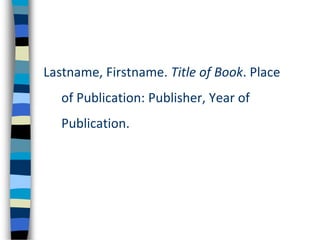
Here is the model for a
book:
Lastname, Firstname. Title of Book. Place
of Publication: Publisher, Year of
Publication.
Here is the title
page:
N
Turn the page and look at the
other side of the title page:
Company
date
Where is the Random House Publishing
Corporation? Google is your friend!
Tan, Amy. The Hundred Secret
Senses. New York: Random
House, 1995.
Here is the model for an article
or essay from a collection. You
would use this model to cite a
reading from a published
textbook like Sourcework:
Last name, First name. "Title of Essay."
Title of Collection. Ed. Editor's
Name(s). Place of Publication:
Publisher, Year. Page range of entry.
Ma, Yo-Yo. “Paths of Globalization
from Berbers to Bach."
Sourcework: Academic Writing
From Sources. Ed. Nancy El
Dollahite Julie Haun. Boston:
Heinle/Cengage Learning, 2013.
182-184.
Tips to remember:
*Copy the punctuation exactly.
*If information is missing, leave
it out and go on to the next
thing.
Here is the model for
periodical (a newspaper
or magazine):
Author(s). "Title of Article." Title of Periodical
Day Month Year: pages.
"Mohandas Karamchand Gandhi.”
Time 30 June 1947:1.
(Note that there is no author given,
so the title of the article comes
first.)
Notice that:
*All dates are in MLA format.
*If you don’t know the author, you omit it
and go to the title.
*If there is no date, put “n.d.” for “no date.”
Here is the model for a
page on a Web site:
Author’s Name (if available). “Title of Web
Page.” Name of the Main Web Site in
Italics, Publisher, publication date, (if
available), URL. Date of access.
Now, let’s try it:
The title of this page, or article, is
“Violence Drives Immigration from
Central America.” The author’s
name is Sarah Bermeo. Sarah is her
first name, and Bermeo is her last,
or family name. When you list her on
your “Works Cited” page, the family
name comes first.
Follow MLA rules for capitalizing
titles, even though they were not
followed on the website you are
citing.
Bermeo, Sarah. “Violence Drives Immigration from
Central America.” Name of the Main Web Site in
Italics, Publisher, publication date, (if available),
URL. Date of access.
Now, you need to find the name of
the main website:
Remember that pages of a website
are like the pages in a book.
The name of the main website is
like the title of a book.
.
To find the main website, erase
the URL back to the first single / :
https://www.brookings.edu/blog/f
uture-
development/2018/06/26/violenc
e-drives-immigration-from-central-
america/
Domain
name
https://www.brookings.edu/
Bermeo, Sarah. “Violence Drives
Immigration from Central America.”
Brookings, Publisher, publication date, (if
available), URL. Date of access.
Next, you need to find
publisher of the main
Internet site: That is, the
person responsible for
putting it up on the Internet.
Finding this can be tricky.
Often, you can find out who
holds the copyright.
The sponsor may have the
same name as the main
Internet site, or it may be
different.
Bermeo, Sarah. “Violence Drives
Immigration from Central America.”
Brookings, Brookings Institution ,
publication date, (if available), URL. Date
of access.
Next, you need to find the date
that the page your are citing
was created.
To do this, go back to your
original long URL:
https://www.brookings.edu/blog/f
uture-
development/2018/06/26/violenc
e-drives-immigration-from-central-
america/
Remember to use MLA format
for your date:
26 June 2018
Bermeo, Sarah. “Violence Drives
Immigration from Central America.
Brookings, Brookings Institution, 26 June
2018, URL. Date of access.
The date may not be there. If it
is not, use “n.d,” which
stands for “no date.”
Finally, copy the URL (no
https:) and enter your date
of access (the date when you
found the source online).
Bermeo, Sarah. “Violence Drives
Immigration from Central America.
Brookings, Brookings Institution, 26 June
2018, www.brookings.edu/blog/future-
development/2018/06/26/violence-
drives-immigration-from-central-
america. 3 December 2019.
When do you need to cite?
*any direct quotation
*Any idea that you got from
another author.
*Any figures or statistics.
If you paraphrase
another author,
provide a citation!
If you use another author’s
exact words,
use quotation marks and
provide a citation!

Mla slide show dec 2019

  • 1.
  • 2.
    When you reporton research, you must explain where you got your information, so that
  • 3.
    your reader cancheck to see if you are right.
  • 4.
    On the lastpage of your paper, you list all your sources of information. In APA format, this page is titled “References.” In MLA format, this is called your “Works Cited” page.
  • 6.
    Then, in thebody of your paper, you provide in-text citations.
  • 7.
    Sometimes, the in-text citationis in parentheses following a quotation or a paraphrase of information from the source:
  • 8.
    Here is anin-text citation that gives the last name of the author of a book, and the page number of the quotation.
  • 9.
    The author’s lastname, Danhof, begins the entry for the book on the “Works Cited” page.
  • 11.
    An article fromthe Internet usually has no page numbers, so in that case you cite only the author’s last name.
  • 12.
    If you havealready mentioned the author’s name in the body of the text, no further in-text citation is needed:
  • 14.
    The important thingis to make it easy for your reader to find the source on the “Works Cited” list.
  • 16.
    The in-text citationsshow the reader where to look for the source on your “Works Cited” list.
  • 17.
    For this reason,your in-text citation must begin with the same words that begin your entry on the “Works Cited” list.
  • 18.
    Now we willlook at some basic models for the entries on your “Works Cited” list.
  • 19.
    Here is themodel for a book:
  • 20.
    Lastname, Firstname. Titleof Book. Place of Publication: Publisher, Year of Publication.
  • 22.
    Here is thetitle page: N
  • 23.
    Turn the pageand look at the other side of the title page:
  • 24.
  • 25.
    Where is theRandom House Publishing Corporation? Google is your friend!
  • 27.
    Tan, Amy. TheHundred Secret Senses. New York: Random House, 1995.
  • 28.
    Here is themodel for an article or essay from a collection. You would use this model to cite a reading from a published textbook like Sourcework:
  • 29.
    Last name, Firstname. "Title of Essay." Title of Collection. Ed. Editor's Name(s). Place of Publication: Publisher, Year. Page range of entry.
  • 30.
    Ma, Yo-Yo. “Pathsof Globalization from Berbers to Bach." Sourcework: Academic Writing From Sources. Ed. Nancy El Dollahite Julie Haun. Boston: Heinle/Cengage Learning, 2013. 182-184.
  • 31.
    Tips to remember: *Copythe punctuation exactly. *If information is missing, leave it out and go on to the next thing.
  • 32.
    Here is themodel for periodical (a newspaper or magazine):
  • 33.
    Author(s). "Title ofArticle." Title of Periodical Day Month Year: pages.
  • 35.
    "Mohandas Karamchand Gandhi.” Time30 June 1947:1. (Note that there is no author given, so the title of the article comes first.)
  • 36.
    Notice that: *All datesare in MLA format. *If you don’t know the author, you omit it and go to the title. *If there is no date, put “n.d.” for “no date.”
  • 37.
    Here is themodel for a page on a Web site:
  • 38.
    Author’s Name (ifavailable). “Title of Web Page.” Name of the Main Web Site in Italics, Publisher, publication date, (if available), URL. Date of access.
  • 39.
  • 41.
    The title ofthis page, or article, is “Violence Drives Immigration from Central America.” The author’s name is Sarah Bermeo. Sarah is her first name, and Bermeo is her last, or family name. When you list her on your “Works Cited” page, the family name comes first.
  • 42.
    Follow MLA rulesfor capitalizing titles, even though they were not followed on the website you are citing.
  • 43.
    Bermeo, Sarah. “ViolenceDrives Immigration from Central America.” Name of the Main Web Site in Italics, Publisher, publication date, (if available), URL. Date of access.
  • 44.
    Now, you needto find the name of the main website: Remember that pages of a website are like the pages in a book. The name of the main website is like the title of a book.
  • 45.
  • 46.
    To find themain website, erase the URL back to the first single / :
  • 47.
  • 48.
  • 49.
  • 51.
    Bermeo, Sarah. “ViolenceDrives Immigration from Central America.” Brookings, Publisher, publication date, (if available), URL. Date of access.
  • 52.
    Next, you needto find publisher of the main Internet site: That is, the person responsible for putting it up on the Internet.
  • 53.
    Finding this canbe tricky. Often, you can find out who holds the copyright.
  • 54.
    The sponsor mayhave the same name as the main Internet site, or it may be different.
  • 56.
    Bermeo, Sarah. “ViolenceDrives Immigration from Central America.” Brookings, Brookings Institution , publication date, (if available), URL. Date of access.
  • 57.
    Next, you needto find the date that the page your are citing was created. To do this, go back to your original long URL:
  • 58.
  • 60.
    Remember to useMLA format for your date: 26 June 2018
  • 61.
    Bermeo, Sarah. “ViolenceDrives Immigration from Central America. Brookings, Brookings Institution, 26 June 2018, URL. Date of access.
  • 62.
    The date maynot be there. If it is not, use “n.d,” which stands for “no date.”
  • 63.
    Finally, copy theURL (no https:) and enter your date of access (the date when you found the source online).
  • 64.
    Bermeo, Sarah. “ViolenceDrives Immigration from Central America. Brookings, Brookings Institution, 26 June 2018, www.brookings.edu/blog/future- development/2018/06/26/violence- drives-immigration-from-central- america. 3 December 2019.
  • 65.
    When do youneed to cite? *any direct quotation
  • 66.
    *Any idea thatyou got from another author. *Any figures or statistics.
  • 67.
    If you paraphrase anotherauthor, provide a citation!
  • 68.
    If you useanother author’s exact words, use quotation marks and provide a citation!