MLA Citations
   Woo hoo!
MLA…WHAT?
• Hopefully you all are a little familiar with MLA
  citation format and remember how to use it from
  ENG 101.
• MLA stands for Modern Language Association,
  and it is the format we most often write in when
  we are writing in the disciplines that are part of
  the Humanities.
• There are other citation formats as well like
  Chicago (sometimes used in History) or APA
  (American Psychological Association…used in the
  Social Sciences)
Why cite?
• MLA citation is really all about one
  thing…giving credit to the original
  author of a text or an idea. People’s
  intellectual property is legally theirs;
  it belongs to them. Therefore, it is
  our responsibility as writers to give
  credit for ideas that are not our own.
Plagiarism
• Also, there are consequences for using others’
  ideas without proper citation…or plagiarizing.
  Plagiarizing can be many things from copying an
  essay from the internet, down to not fully
  paraphrasing a sentence from a source. Each
  level of plagiarism has different consequences,
  but all plagiarism can be avoided with proper
  citation. If you are interested in YC’s definition
  of plagiarism, check out our syllabus, or the
  Student Code of Conduct. The library also has a
  couple of videos on plagiarism and citation called
  “Diagnosis: Plagiarism” which you will find under
  the “Resources for Students” tab on Blackboard.
MLA Requirements
• When using MLA format, you need to
  be sure to cite in two places:
• 1. In-text using parenthetical
  citations.
• 2. At the end of your paper on a
  works cited page.
Parenthetical Citations
• In-text citations are like the key to a map while the works
  cited page is the map. You want your reader to be able to
  easily match the two up. That is why the first thing that
  appears in the citation on the works cited page is the thing
  goes in the parenthetical citation. More often than not that
  thing is the author’s last name. Sometimes it is the title of
  the book or article if the author is unknown.
• You also want your reader to be able to find the specific
  information in the book that you cited, so we also include
  the page number in the parenthetical citation, only if it is
  available.
Works Cited page
• The Works Cited page is where the reader
  of your paper can find all the information
  he or she would need to go and find your
  source on the shelves in the library, or on
  the World Wide Web. Incidentally, works
  cited pages in articles you read are great
  places to find other articles and books on
  your subject. This is relevant for all of
  the essays you will write in this course.
Titles…
• MLA also has rules for formatting. This includes
  how you format titles.
• If you are including the title of a long work- like a
  novel, a newspaper, a collection of essays or
  stories, or a magazine – then the title should be in
  italics or underlined.
• If you are including the title of a short work– like
  a single poem, short story or article– then the
  title should be in quotation marks.
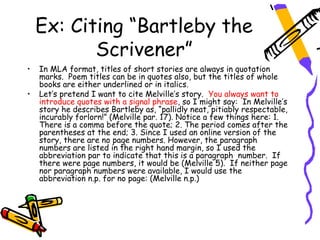
Ex: Citing “Bartleby the
           Scrivener”
•   In MLA format, titles of short stories are always in quotation
    marks. Poem titles can be in quotes also, but the titles of whole
    books are either underlined or in italics.
•   Let’s pretend I want to cite Melville’s story. You always want to
    introduce quotes with a signal phrase, so I might say: In Melville’s
    story he describes Bartleby as, “pallidly neat, pitiably respectable,
    incurably forlorn!” (Melville par. 17). Notice a few things here: 1.
    There is a comma before the quote; 2. The period comes after the
    parentheses at the end; 3. Since I used an online version of the
    story, there are no page numbers. However, the paragraph
    numbers are listed in the right hand margin, so I used the
    abbreviation par to indicate that this is a paragraph number. If
    there were page numbers, it would be (Melville 5). If neither page
    nor paragraph numbers were available, I would use the
    abbreviation n.p. for no page: (Melville n.p.)
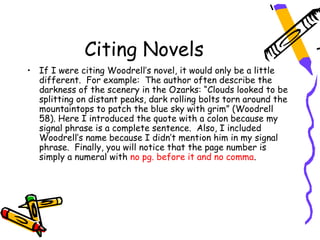
Citing Novels
• If I were citing Woodrell’s novel, it would only be a little
  different. For example: The author often describe the
  darkness of the scenery in the Ozarks: “Clouds looked to be
  splitting on distant peaks, dark rolling bolts torn around the
  mountaintops to patch the blue sky with grim” (Woodrell
  58). Here I introduced the quote with a colon because my
  signal phrase is a complete sentence. Also, I included
  Woodrell’s name because I didn’t mention him in my signal
  phrase. Finally, you will notice that the page number is
  simply a numeral with no pg. before it and no comma.
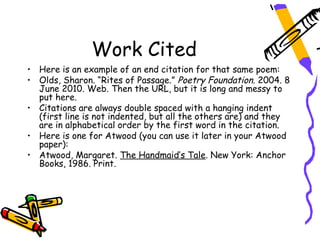
Work Cited
• Here is an example of an end citation for that same poem:
• Olds, Sharon. “Rites of Passage.” Poetry Foundation. 2004. 8
  June 2010. Web. Then the URL, but it is long and messy to
  put here.
• Citations are always double spaced with a hanging indent
  (first line is not indented, but all the others are) and they
  are in alphabetical order by the first word in the citation.
• Here is one for Atwood (you can use it later in your Atwood
  paper):
• Atwood, Margaret. The Handmaid’s Tale. New York: Anchor
  Books, 1986. Print.
Resources for Citation
• Feel free to use a citation generator, like
  www.citationmachine.net, to help you with citation.
   However, you always want to check to see that
  you’ve done it right. To do that, you can use a
  style guide (like the Little, Brown Handbook) or a
  website like the OWL at Purdue (
  http://owl.english.purdue.edu/owl/section/2/11/).
  There are links to these sites on Blackboard
  under “Resources for Students.”
When do I cite?
• You need to cite anytime you use material from
  the text. If it isn’t your idea…cite it.
• Paraphrases must be cited and you also must
  completely change the wording and the sentence
  structure of the original material. Paraphrases
  are a sticky wicket and they are a place where
  many people get in trouble with plagiarism.
• You don’t need to use parenthetical citation for
  general summary, as long as it is clear to the
  reader which text you are summarizing.
Other MLA stuff
• MLA formatting also has requirements for page numbers
  and headings. I will provide you with a video about
  formatting assignments.
• MLA headings appear in the upper left hand corner of your
  paper and contain: Your name, your assignment and class,
  your teacher’s last name, and the date, each on a separate
  line. Your heading should be double spaced.
• Page numbers go on the upper right hand side of the page
  and should have your last name along with the page number
  (Darrow 1, Darrow 2, etc.).
• If you did purchase the Little, Brown Handbook for this
  course, there are resources for MLA citation beginning on
  pg. 667.

MLA Citations

  • 1.
  • 2.
    MLA…WHAT? • Hopefully youall are a little familiar with MLA citation format and remember how to use it from ENG 101. • MLA stands for Modern Language Association, and it is the format we most often write in when we are writing in the disciplines that are part of the Humanities. • There are other citation formats as well like Chicago (sometimes used in History) or APA (American Psychological Association…used in the Social Sciences)
  • 3.
    Why cite? • MLAcitation is really all about one thing…giving credit to the original author of a text or an idea. People’s intellectual property is legally theirs; it belongs to them. Therefore, it is our responsibility as writers to give credit for ideas that are not our own.
  • 4.
    Plagiarism • Also, thereare consequences for using others’ ideas without proper citation…or plagiarizing. Plagiarizing can be many things from copying an essay from the internet, down to not fully paraphrasing a sentence from a source. Each level of plagiarism has different consequences, but all plagiarism can be avoided with proper citation. If you are interested in YC’s definition of plagiarism, check out our syllabus, or the Student Code of Conduct. The library also has a couple of videos on plagiarism and citation called “Diagnosis: Plagiarism” which you will find under the “Resources for Students” tab on Blackboard.
  • 5.
    MLA Requirements • Whenusing MLA format, you need to be sure to cite in two places: • 1. In-text using parenthetical citations. • 2. At the end of your paper on a works cited page.
  • 6.
    Parenthetical Citations • In-textcitations are like the key to a map while the works cited page is the map. You want your reader to be able to easily match the two up. That is why the first thing that appears in the citation on the works cited page is the thing goes in the parenthetical citation. More often than not that thing is the author’s last name. Sometimes it is the title of the book or article if the author is unknown. • You also want your reader to be able to find the specific information in the book that you cited, so we also include the page number in the parenthetical citation, only if it is available.
  • 7.
    Works Cited page •The Works Cited page is where the reader of your paper can find all the information he or she would need to go and find your source on the shelves in the library, or on the World Wide Web. Incidentally, works cited pages in articles you read are great places to find other articles and books on your subject. This is relevant for all of the essays you will write in this course.
  • 8.
    Titles… • MLA alsohas rules for formatting. This includes how you format titles. • If you are including the title of a long work- like a novel, a newspaper, a collection of essays or stories, or a magazine – then the title should be in italics or underlined. • If you are including the title of a short work– like a single poem, short story or article– then the title should be in quotation marks.
  • 9.
    Ex: Citing “Bartlebythe Scrivener” • In MLA format, titles of short stories are always in quotation marks. Poem titles can be in quotes also, but the titles of whole books are either underlined or in italics. • Let’s pretend I want to cite Melville’s story. You always want to introduce quotes with a signal phrase, so I might say: In Melville’s story he describes Bartleby as, “pallidly neat, pitiably respectable, incurably forlorn!” (Melville par. 17). Notice a few things here: 1. There is a comma before the quote; 2. The period comes after the parentheses at the end; 3. Since I used an online version of the story, there are no page numbers. However, the paragraph numbers are listed in the right hand margin, so I used the abbreviation par to indicate that this is a paragraph number. If there were page numbers, it would be (Melville 5). If neither page nor paragraph numbers were available, I would use the abbreviation n.p. for no page: (Melville n.p.)
  • 10.
    Citing Novels • IfI were citing Woodrell’s novel, it would only be a little different. For example: The author often describe the darkness of the scenery in the Ozarks: “Clouds looked to be splitting on distant peaks, dark rolling bolts torn around the mountaintops to patch the blue sky with grim” (Woodrell 58). Here I introduced the quote with a colon because my signal phrase is a complete sentence. Also, I included Woodrell’s name because I didn’t mention him in my signal phrase. Finally, you will notice that the page number is simply a numeral with no pg. before it and no comma.
  • 11.
    Work Cited • Hereis an example of an end citation for that same poem: • Olds, Sharon. “Rites of Passage.” Poetry Foundation. 2004. 8 June 2010. Web. Then the URL, but it is long and messy to put here. • Citations are always double spaced with a hanging indent (first line is not indented, but all the others are) and they are in alphabetical order by the first word in the citation. • Here is one for Atwood (you can use it later in your Atwood paper): • Atwood, Margaret. The Handmaid’s Tale. New York: Anchor Books, 1986. Print.
  • 12.
    Resources for Citation •Feel free to use a citation generator, like www.citationmachine.net, to help you with citation. However, you always want to check to see that you’ve done it right. To do that, you can use a style guide (like the Little, Brown Handbook) or a website like the OWL at Purdue ( http://owl.english.purdue.edu/owl/section/2/11/). There are links to these sites on Blackboard under “Resources for Students.”
  • 13.
    When do Icite? • You need to cite anytime you use material from the text. If it isn’t your idea…cite it. • Paraphrases must be cited and you also must completely change the wording and the sentence structure of the original material. Paraphrases are a sticky wicket and they are a place where many people get in trouble with plagiarism. • You don’t need to use parenthetical citation for general summary, as long as it is clear to the reader which text you are summarizing.
  • 14.
    Other MLA stuff •MLA formatting also has requirements for page numbers and headings. I will provide you with a video about formatting assignments. • MLA headings appear in the upper left hand corner of your paper and contain: Your name, your assignment and class, your teacher’s last name, and the date, each on a separate line. Your heading should be double spaced. • Page numbers go on the upper right hand side of the page and should have your last name along with the page number (Darrow 1, Darrow 2, etc.). • If you did purchase the Little, Brown Handbook for this course, there are resources for MLA citation beginning on pg. 667.