The marketing process overview document outlines the key steps in developing a marketing strategy and plan. It discusses:
1) Conducting a situational analysis to understand customer needs and the competitive environment. This includes tools like SWOT, PEST, and 5C analyses.
2) Developing a marketing strategy by segmenting the market into accessible, identifiable, and substantial segments. Common bases for segmentation include geographic, demographic, psychographic, and behavioral factors.
3) Deciding on the marketing mix of product, price, place, and promotion to target specific segments.
4) Implementing and controlling the marketing plan as the environment changes.
In this document
Powered by AI
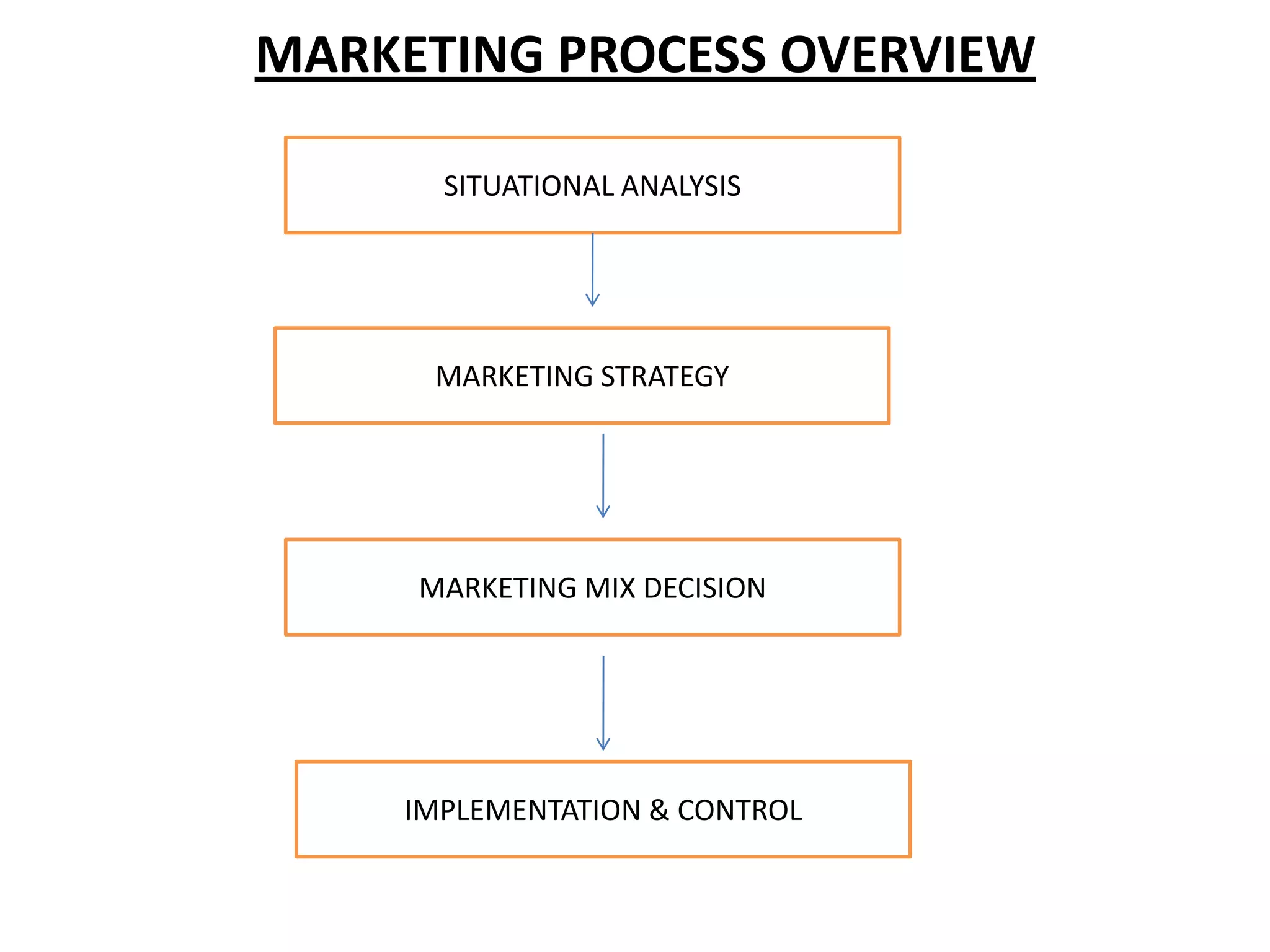
Introduces the marketing process including situational analysis, strategy, marketing mix, and execution.
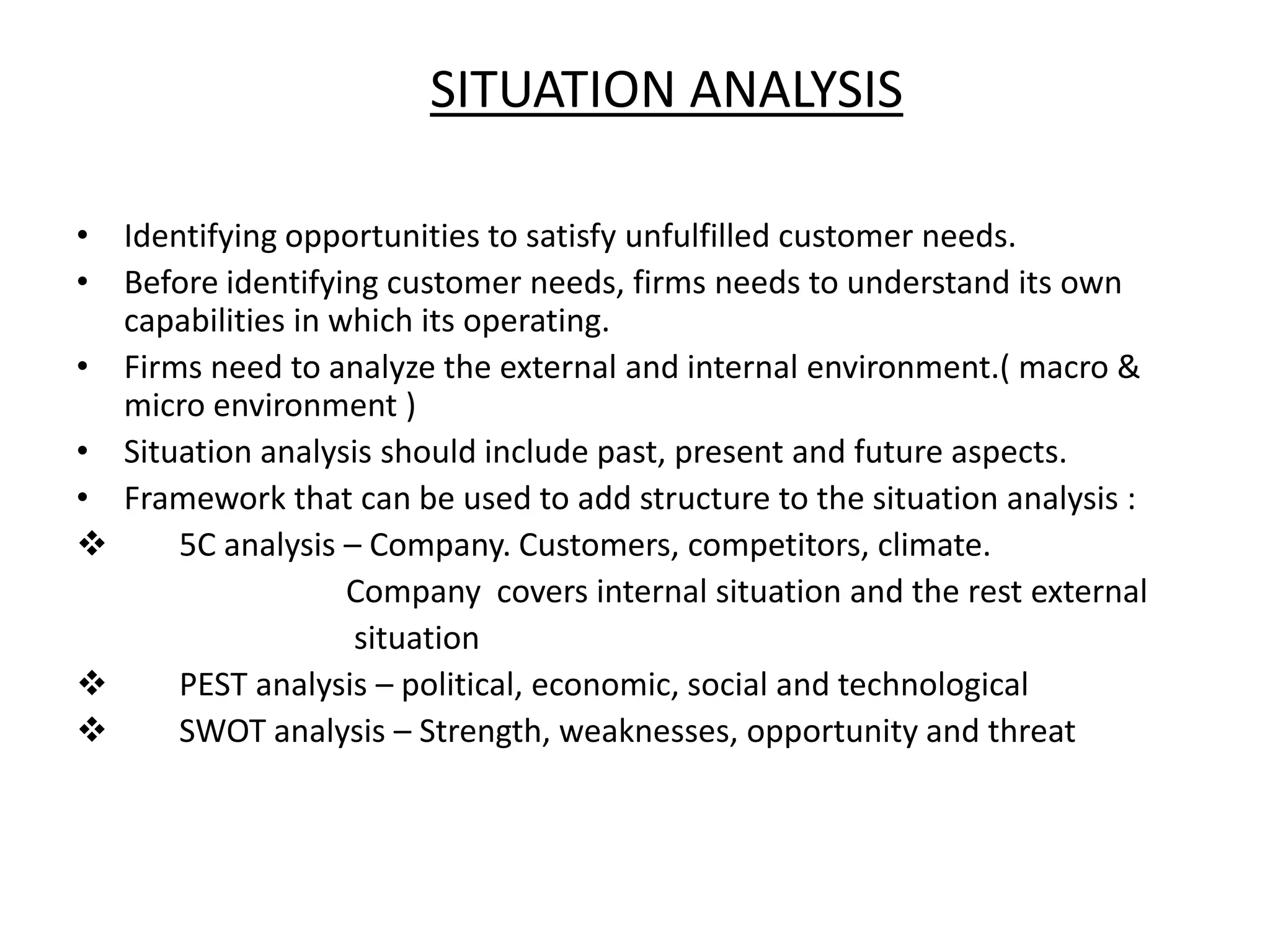
Identifies customer needs, assesses internal capabilities, analyzes macro & micro environments using 5C, PEST, and SWOT frameworks.
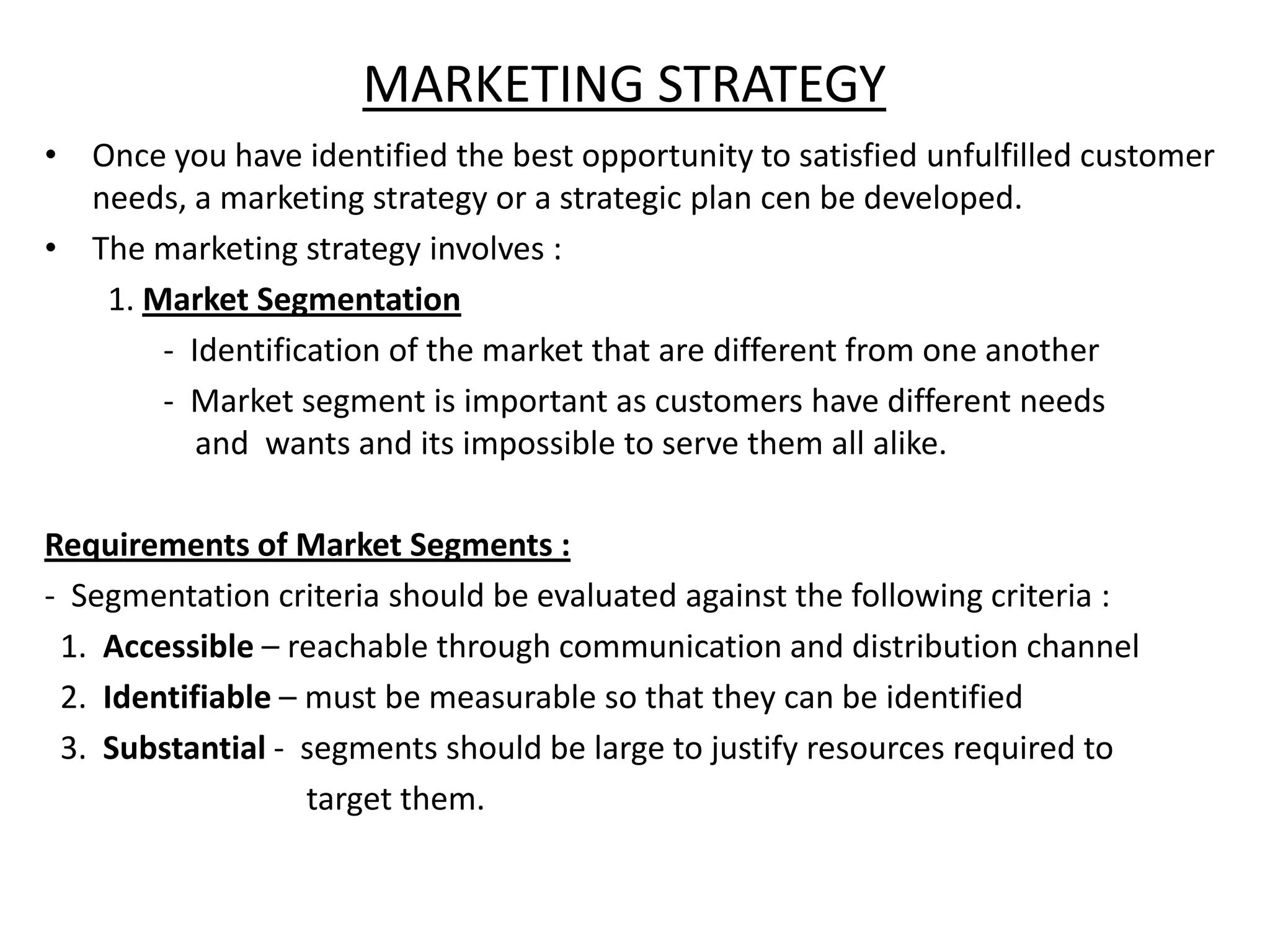
Focuses on determining customer needs and market segmentation, emphasizing the importance of tailored marketing strategies.
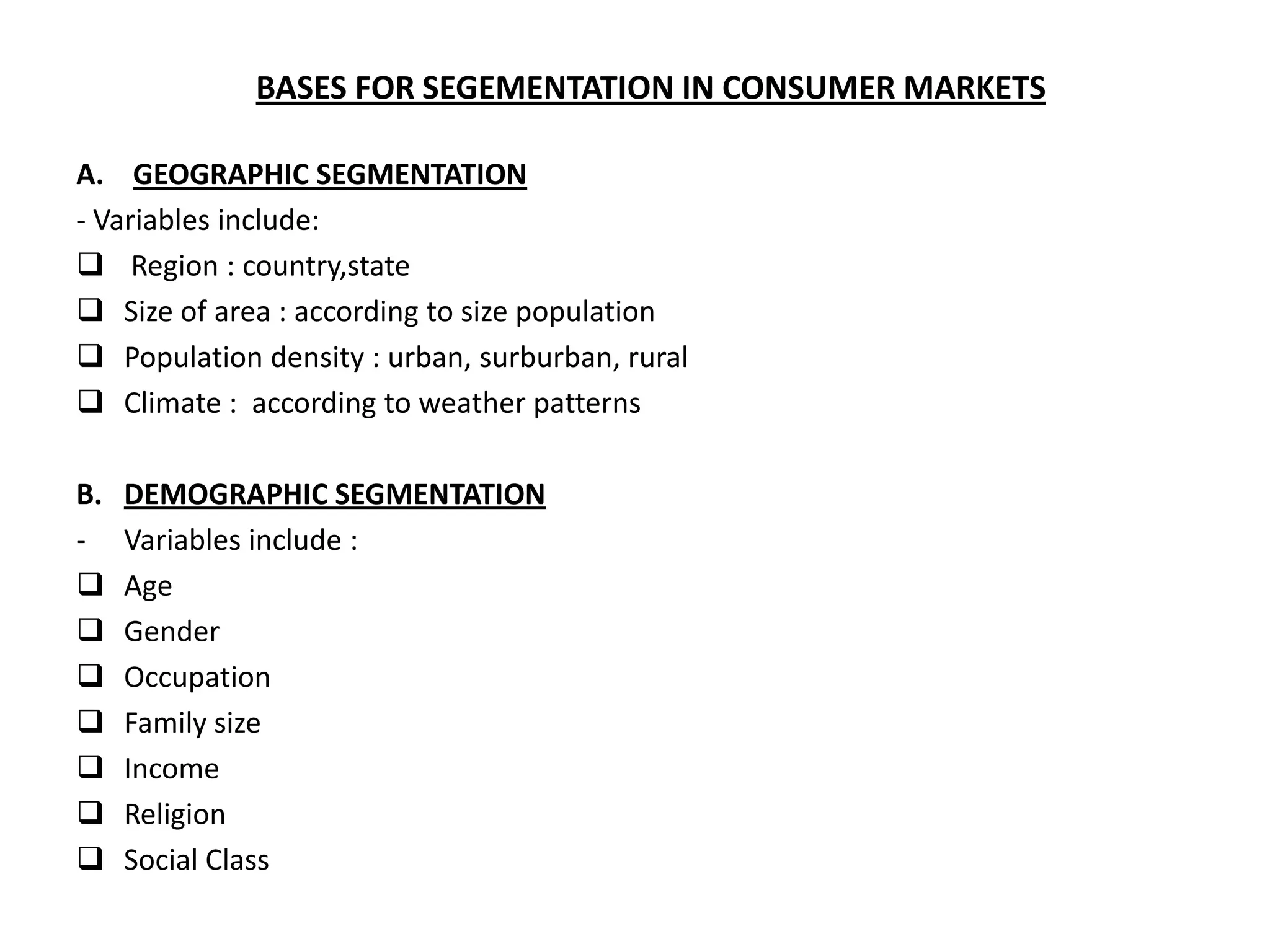
Presents geographic and demographic variables for segmenting consumer markets, highlighting factors such as age and income.
Discusses psychographic and behavioral segmentation, focusing on lifestyle, consumer behavior, and buying patterns.
Explains segmentation for industrial markets based on location, company type, and behavioral characteristics.
Highlights criteria for assessing market segment attractiveness, including size, competition, and potential sales.
Outlines five strategies for targeting markets, from concentrated approaches to full market coverage.
Describes the four controllable elements of the marketing mix: Product, Price, Place, and Promotion, along with implementation and control.
MARKETING PROCESS OVERVIEW
SITUATIONAL ANALYSIS
MARKETING STRATEGY
MARKETING MIX DECISION
IMPLEMENTATION & CONTROL
2.
SITUATION ANALYSIS
• Identifyingopportunities to satisfy unfulfilled customer needs.
• Before identifying customer needs, firms needs to understand its own
capabilities in which its operating.
• Firms need to analyze the external and internal environment.( macro &
micro environment )
• Situation analysis should include past, present and future aspects.
• Framework that can be used to add structure to the situation analysis :
5C analysis – Company. Customers, competitors, climate.
Company covers internal situation and the rest external
situation
PEST analysis – political, economic, social and technological
SWOT analysis – Strength, weaknesses, opportunity and threat
3.
MARKETING STRATEGY
• Onceyou have identified the best opportunity to satisfied unfulfilled customer
needs, a marketing strategy or a strategic plan cen be developed.
• The marketing strategy involves :
1. Market Segmentation
- Identification of the market that are different from one another
- Market segment is important as customers have different needs
and wants and its impossible to serve them all alike.
Requirements of Market Segments :
- Segmentation criteria should be evaluated against the following criteria :
1. Accessible – reachable through communication and distribution channel
2. Identifiable – must be measurable so that they can be identified
3. Substantial - segments should be large to justify resources required to
target them.
4.
BASES FOR SEGEMENTATIONIN CONSUMER MARKETS
A. GEOGRAPHIC SEGMENTATION
- Variables include:
Region : country,state
Size of area : according to size population
Population density : urban, surburban, rural
Climate : according to weather patterns
B. DEMOGRAPHIC SEGMENTATION
- Variables include :
Age
Gender
Occupation
Family size
Income
Religion
Social Class
5.
BASES FOR SEGEMENTATIONIN CONSUMER MARKETS
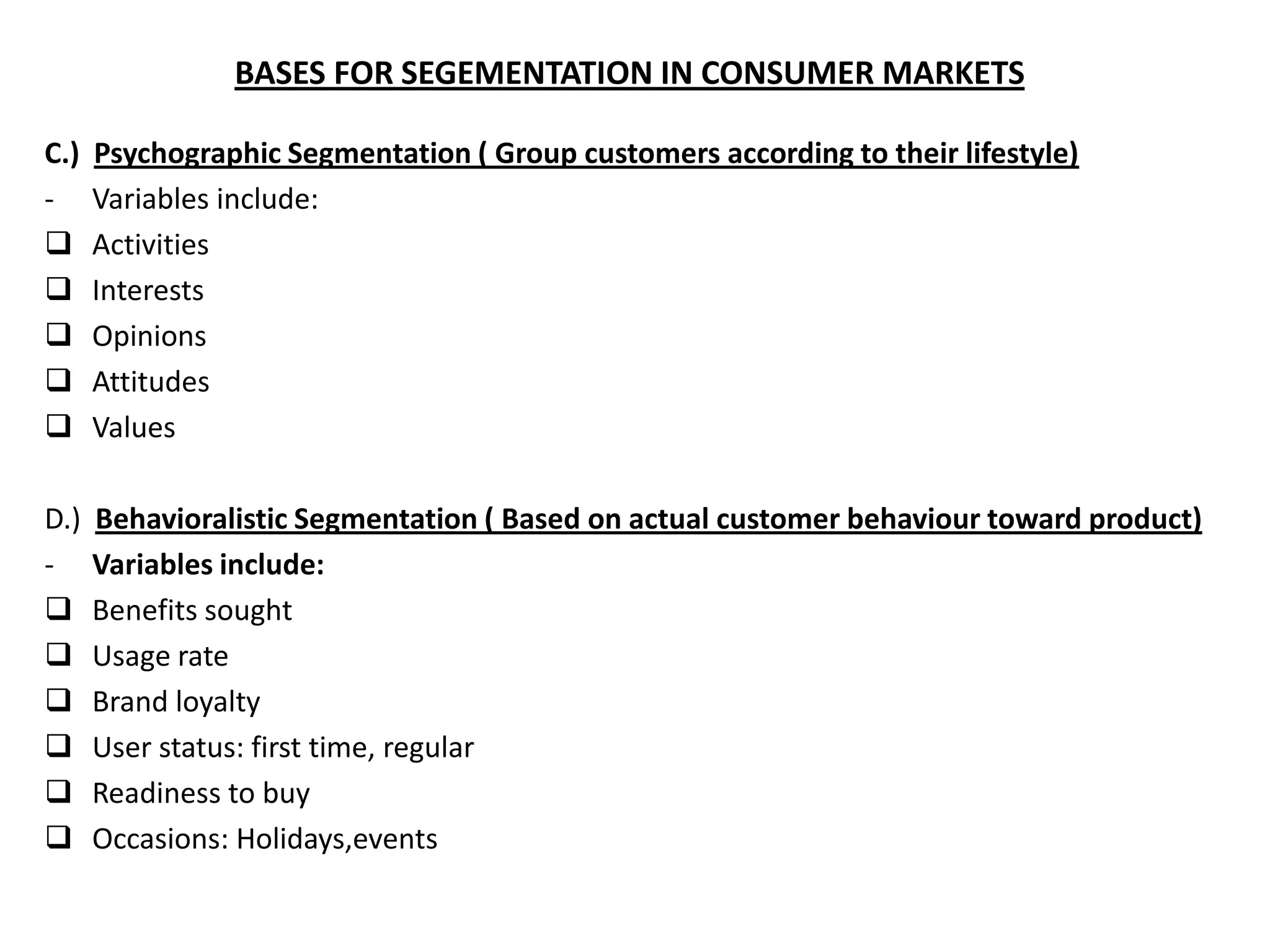
C.) Psychographic Segmentation ( Group customers according to their lifestyle)
- Variables include:
Activities
Interests
Opinions
Attitudes
Values
D.) Behavioralistic Segmentation ( Based on actual customer behaviour toward product)
- Variables include:
Benefits sought
Usage rate
Brand loyalty
User status: first time, regular
Readiness to buy
Occasions: Holidays,events
6.
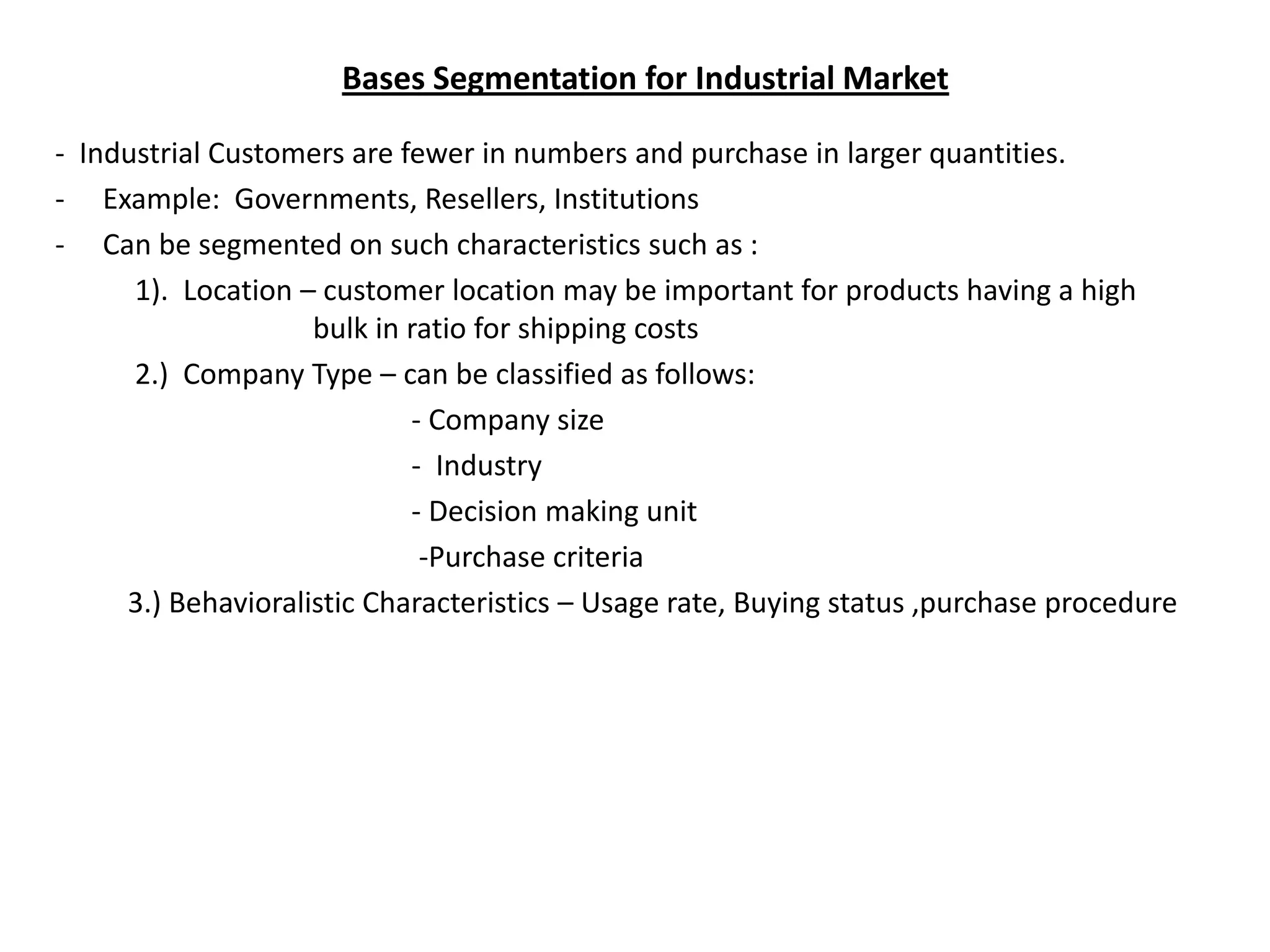
Bases Segmentation forIndustrial Market
- Industrial Customers are fewer in numbers and purchase in larger quantities.
- Example: Governments, Resellers, Institutions
- Can be segmented on such characteristics such as :
1). Location – customer location may be important for products having a high
bulk in ratio for shipping costs
2.) Company Type – can be classified as follows:
- Company size
- Industry
- Decision making unit
-Purchase criteria
3.) Behavioralistic Characteristics – Usage rate, Buying status ,purchase procedure
7.
ATTRACTIVENESS OF AMARKET SEGMENTS
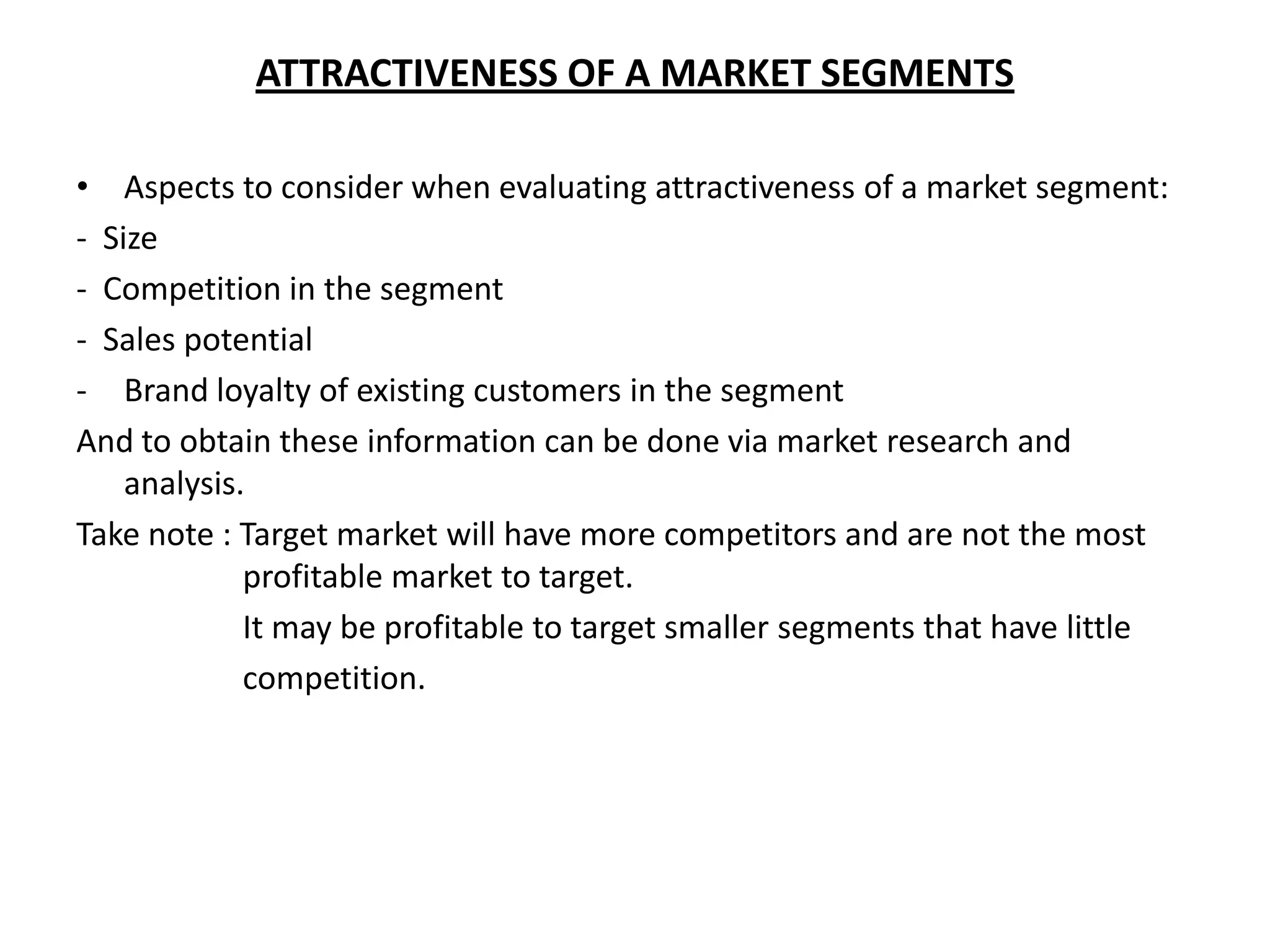
• Aspects to consider when evaluating attractiveness of a market segment:
- Size
- Competition in the segment
- Sales potential
- Brand loyalty of existing customers in the segment
And to obtain these information can be done via market research and
analysis.
Take note : Target market will have more competitors and are not the most
profitable market to target.
It may be profitable to target smaller segments that have little
competition.
8.
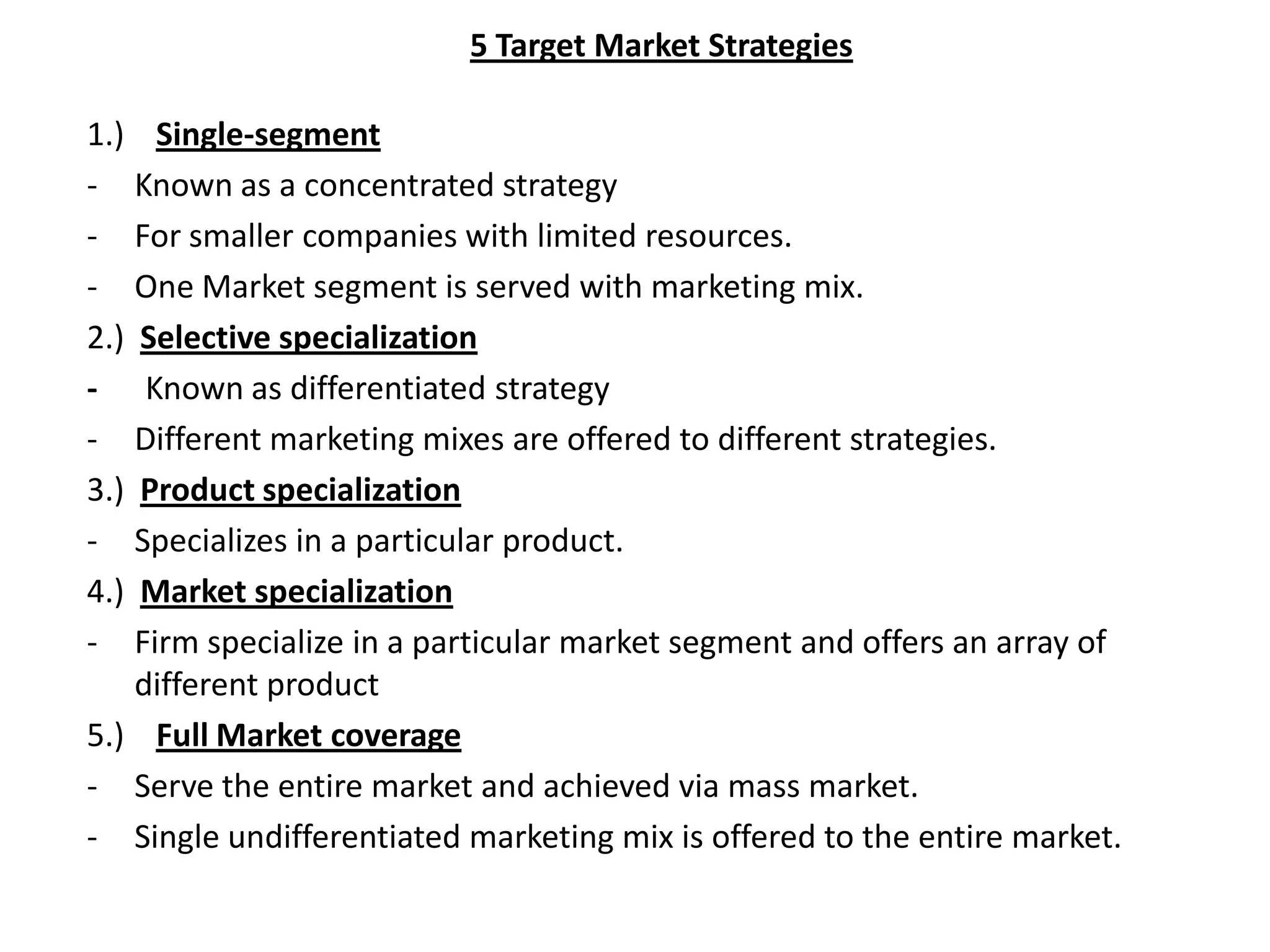
5 Target MarketStrategies
1.) Single-segment
- Known as a concentrated strategy
- For smaller companies with limited resources.
- One Market segment is served with marketing mix.
2.) Selective specialization
- Known as differentiated strategy
- Different marketing mixes are offered to different strategies.
3.) Product specialization
- Specializes in a particular product.
4.) Market specialization
- Firm specialize in a particular market segment and offers an array of
different product
5.) Full Market coverage
- Serve the entire market and achieved via mass market.
- Single undifferentiated marketing mix is offered to the entire market.
9.
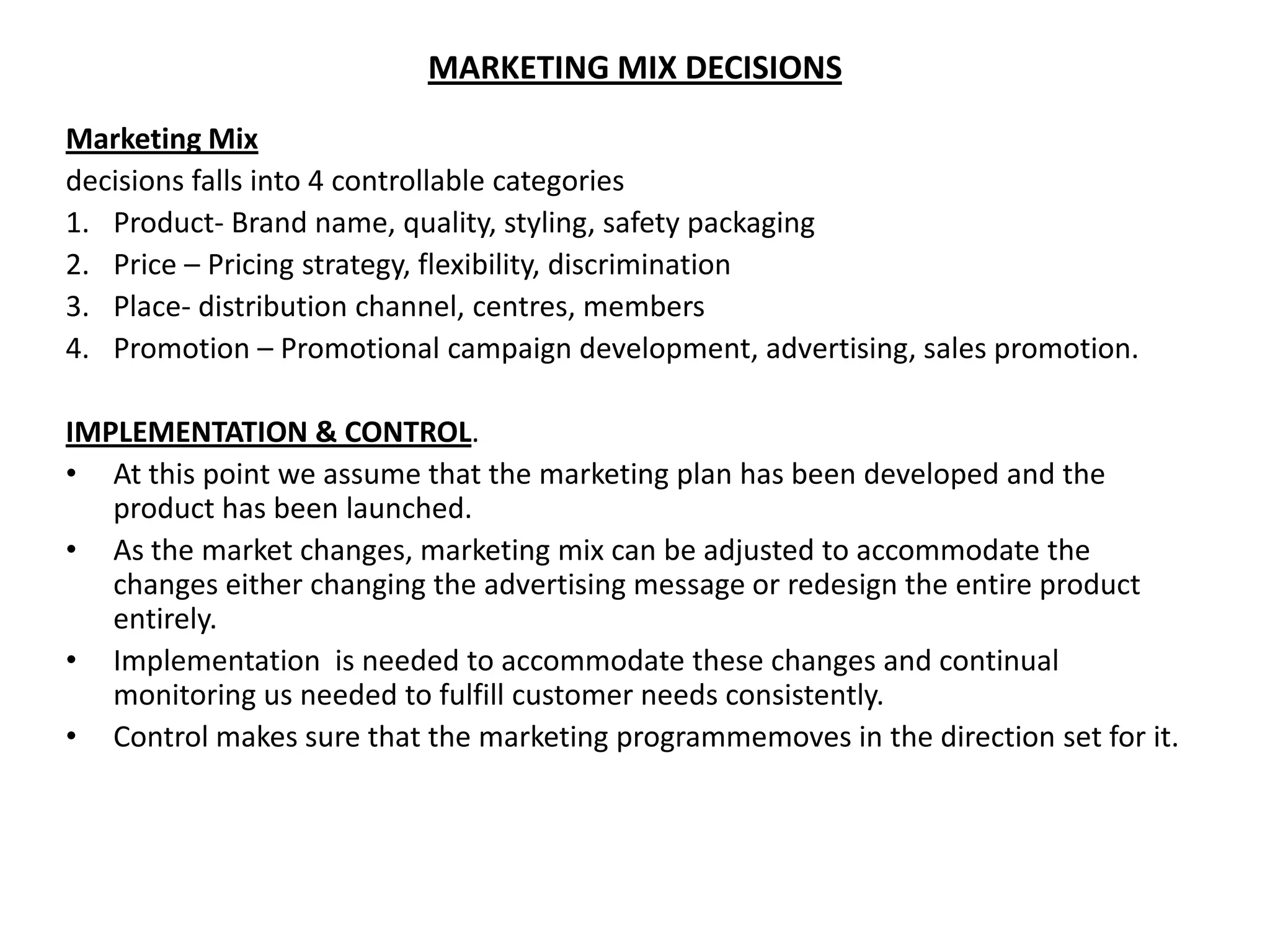
MARKETING MIX DECISIONS
MarketingMix
decisions falls into 4 controllable categories
1. Product- Brand name, quality, styling, safety packaging
2. Price – Pricing strategy, flexibility, discrimination
3. Place- distribution channel, centres, members
4. Promotion – Promotional campaign development, advertising, sales promotion.
IMPLEMENTATION & CONTROL.
• At this point we assume that the marketing plan has been developed and the
product has been launched.
• As the market changes, marketing mix can be adjusted to accommodate the
changes either changing the advertising message or redesign the entire product
entirely.
• Implementation is needed to accommodate these changes and continual
monitoring us needed to fulfill customer needs consistently.
• Control makes sure that the marketing programmemoves in the direction set for it.