DESIGN & ENGINEERING
BE-102
Naseel Ibnu Azeez.M.P
Asst. Professor,
Dept. of Mechanical Engineering,
MEA-Engineering College,
Perinthalmanna.
Email: naseel@live.com
DESIGN ENGINEERING
Engineering design is a systematic, intelligent process in which engineers generate, evaluate,
and specify solutions for devices, systems, or processes whose form(s) and function(s)
achieve clients’ objectives and users’ needs while satisfying a specified set of constraints.
OR
In other words, engineering design is a thoughtful process for generating plans or schemes for
devices, systems, or processes that attain given objectives while adhering to specified
constraints.
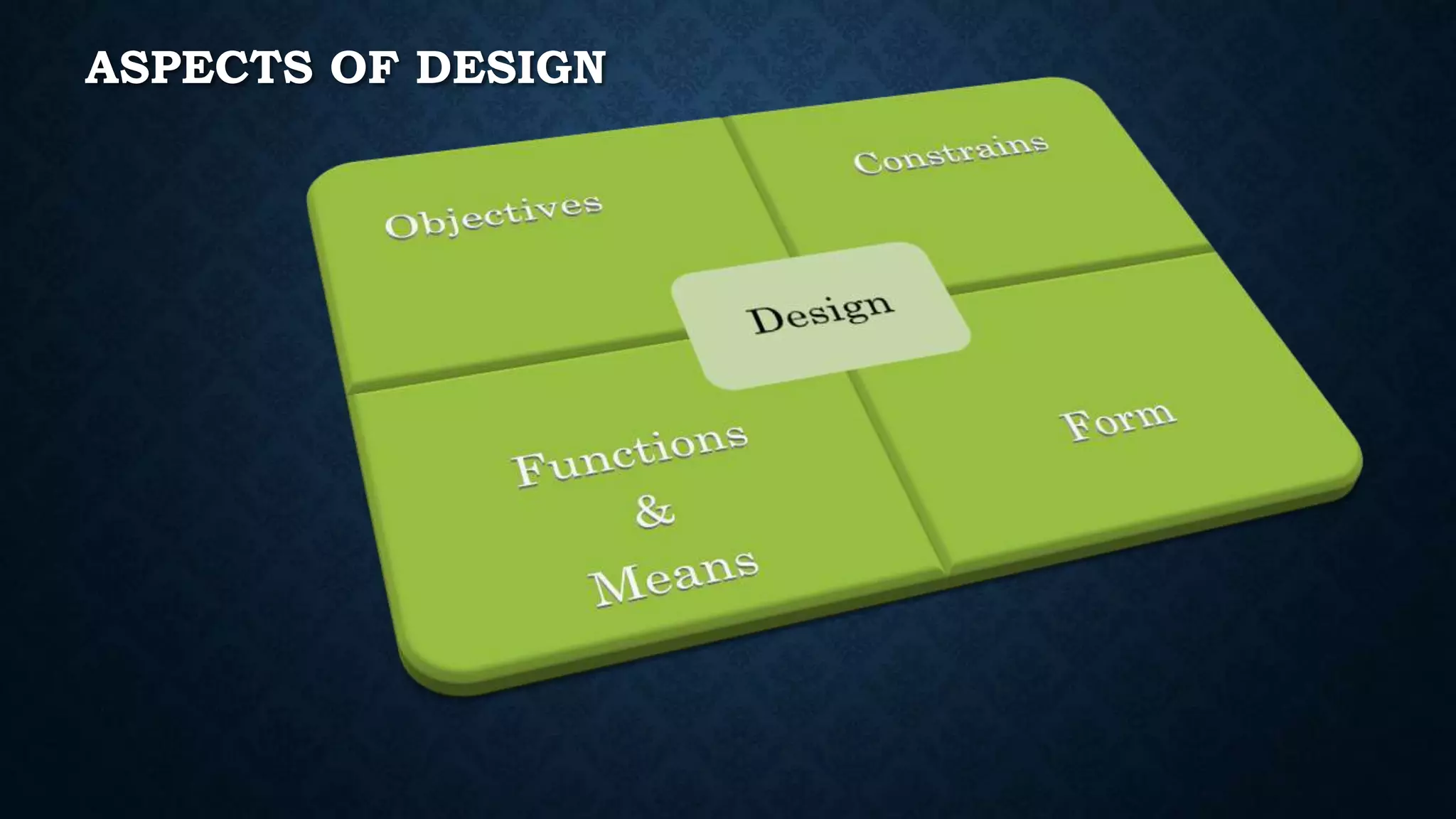
ASPECTS OF DESIGN
DESIGN OBJECTIVES
A feature or behaviour that we whish the design to have or exhibit
• It defining the requirements of a design
• Objectives, or design goals, are the desired attributes of the design, what the design will "be"
and what qualities it will have.
• Objectives allow exploration of the design space to select amongst alternatives that are at
least acceptable or satisfice
OBJECTIVES OF DESIGNING A PORTABLE
LADDER
Ladder should be compact and portable
It should be stable on smooth surfaces
Should stand safely without a support
Can be used for house hold requirements
Should be reasonably stiff and comfortable
for users
Must be safe and durable
Should be relatively economical
Should be reduce space requirements while
packing by means of detachable parts
The ladder should be marketable
Useful for electrical and maintenance work
Objectives are normally expressed as adjectives that capture what the design should be, as opposed to what
the design should do. For example, saying that a ladder should be portable or lightweight expresses an
attribute that the client wants the ladder to have.
These features and behaviours, expressed in the natural languages of the client and of potential users, make
the object “look good” in the eyes of the client or user.
OBJECTIVE TREE
Objectives are depended and interconnected hence
it can be arranged in an hierarchy with parent
node followed by second stage objectives
Objective tree to design a juice container
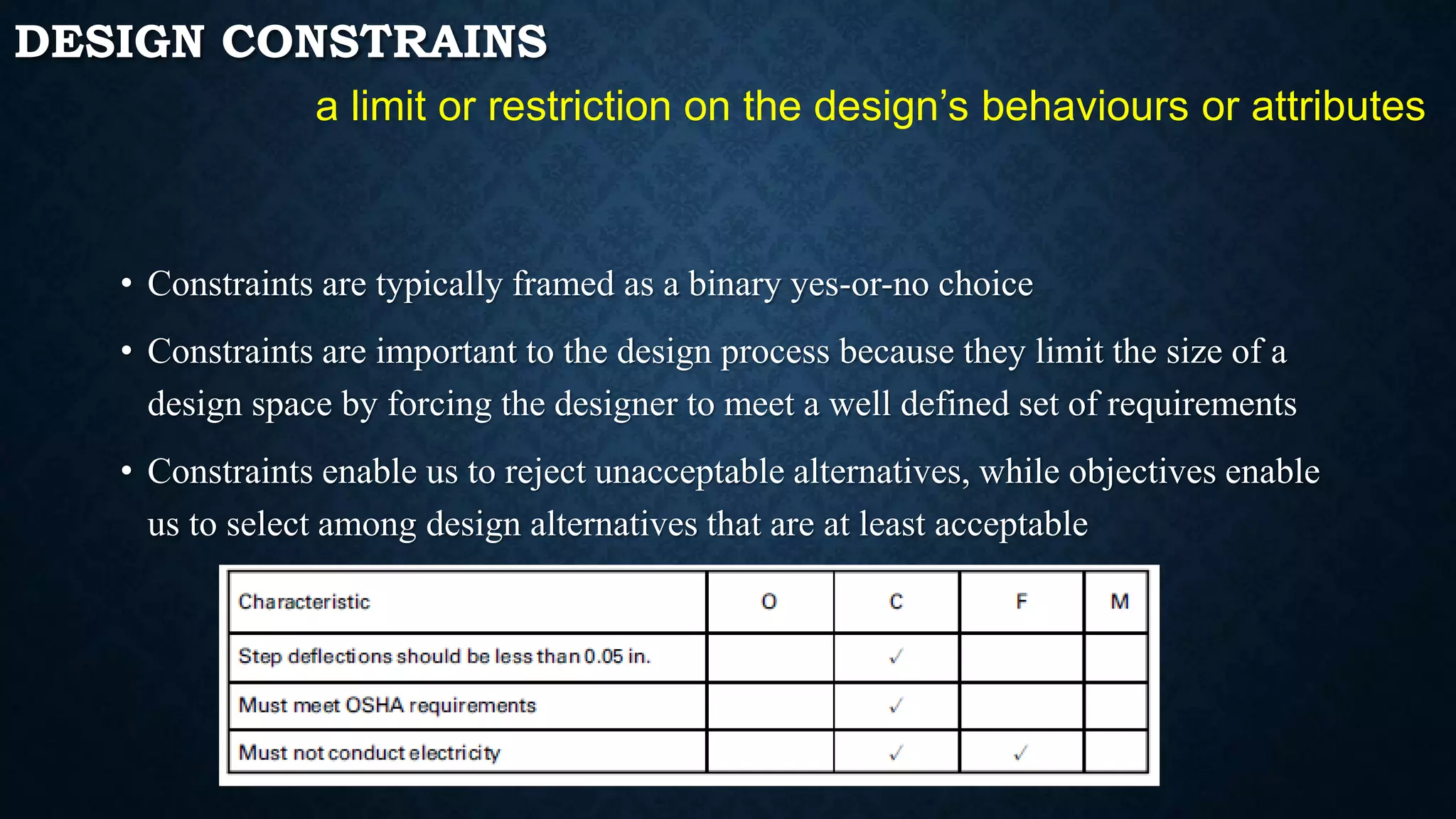
DESIGN CONSTRAINS
• Constraints are typically framed as a binary yes-or-no choice
• Constraints are important to the design process because they limit the size of a
design space by forcing the designer to meet a well defined set of requirements
• Constraints enable us to reject unacceptable alternatives, while objectives enable
us to select among design alternatives that are at least acceptable
a limit or restriction on the design’s behaviours or attributes
Constrains establish the Design
Space
Designed for babies
constrained to support load
up to 15 kg Designed for adults
constrained to support up
to 150 kg
Constrains are fixed under the consideration of factor of safety (FOS), Standardisation, Customer
requirements, Cost, Market etc.
Develop a accounting software which
executable on Microsoft Windows with
hardware support of 2GB RAM, 32 bit &
1.7 GHz Clock speed
Design a 1-BHK apartment within 50 m2
Design a DC motor which able to runs at
100 rpm along 1kg loading
Design a resistor which offer a resistance
of 100 Ω and capacitor which produce a
capacitance of 50 𝜇𝐹
OBJECTIVE-CONSTRAIN TREE
DESIGN FUNCTIONS
Those things a designed device or system is supposed to do
• Functions are the behaviours that expected from the design
• A design should perform certain functions for convert given input to required output
• Functions are often expressed as verb-object pairs.
• They describe what the design (or, more likely, an object within the design) will "do" or
accomplish, with an emphasis on input-output transformations
• The statement of a function typically couples an action verb to a noun or object:
Eg: lift a book, support a shelf, transmit a current, measure a temperature, or
switch on a light
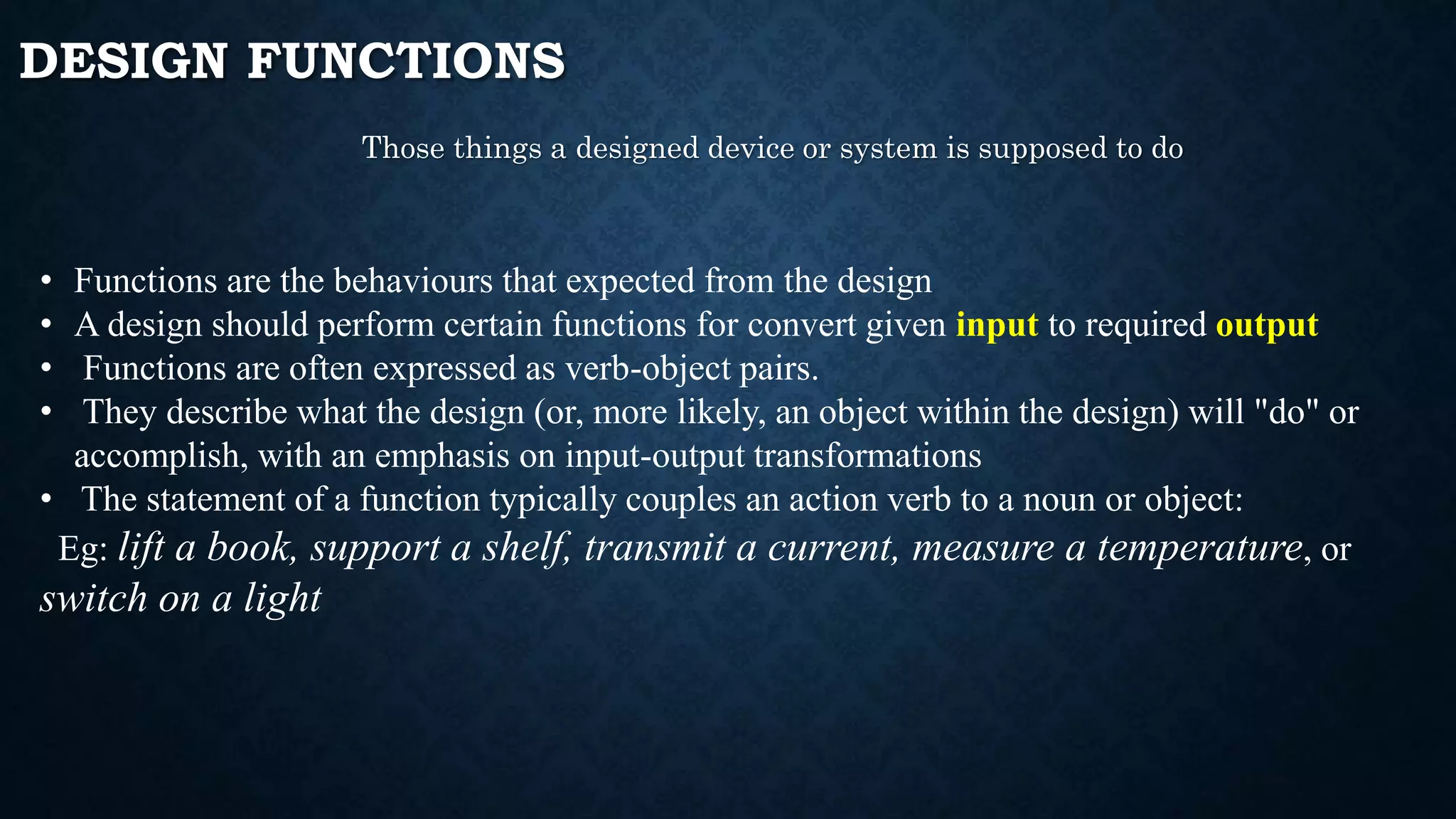
Measure weight of objects
up to 120 kg
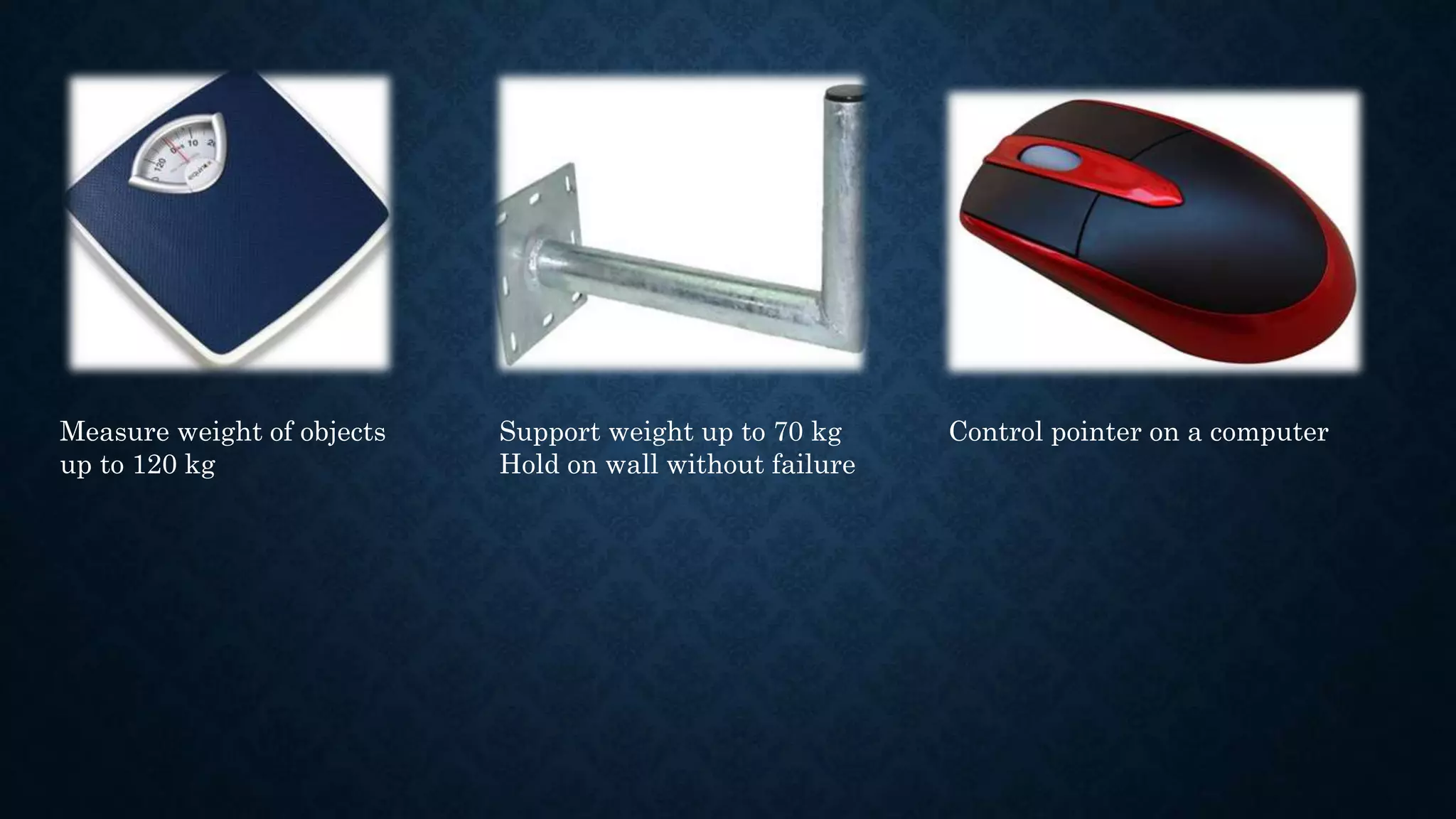
Support weight up to 70 kg
Hold on wall without failure
Control pointer on a computer
Function
s
Primary
Functions
Secondary Functions
Desirable Undesirable
Project Images
(Primary/Basic Function)
Converting Energy
(Secondary function)
Generation of Light
(Desirable)
Generation of Heat
(Undesirable)
Secondary functions are prerequisites
DESIGN MEANS
It is the way in which a design executes a desired function
Eg:
The function of a bicycle brake is stop the wheel
when applying the brake lever by means of frictional
force between rim and brake pad
The function of a hydraulic lift is to elevate
heavy weight by means of pascals law
The function of a speaker is to produce sound by
means of electro magnetic induction
FUNCTION-MEAN TREE
Design Functions
Design Means
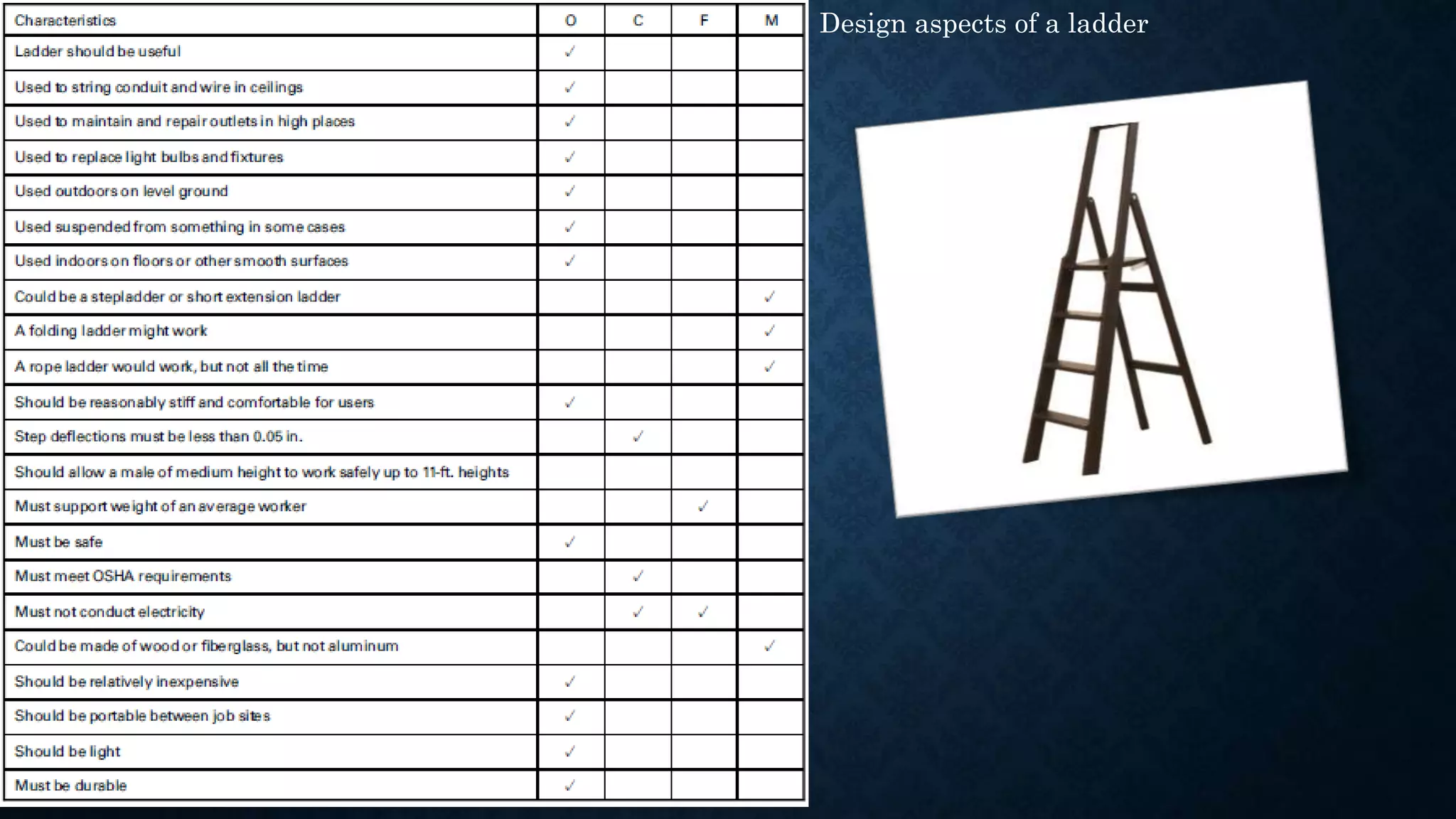
Design aspects of a ladder
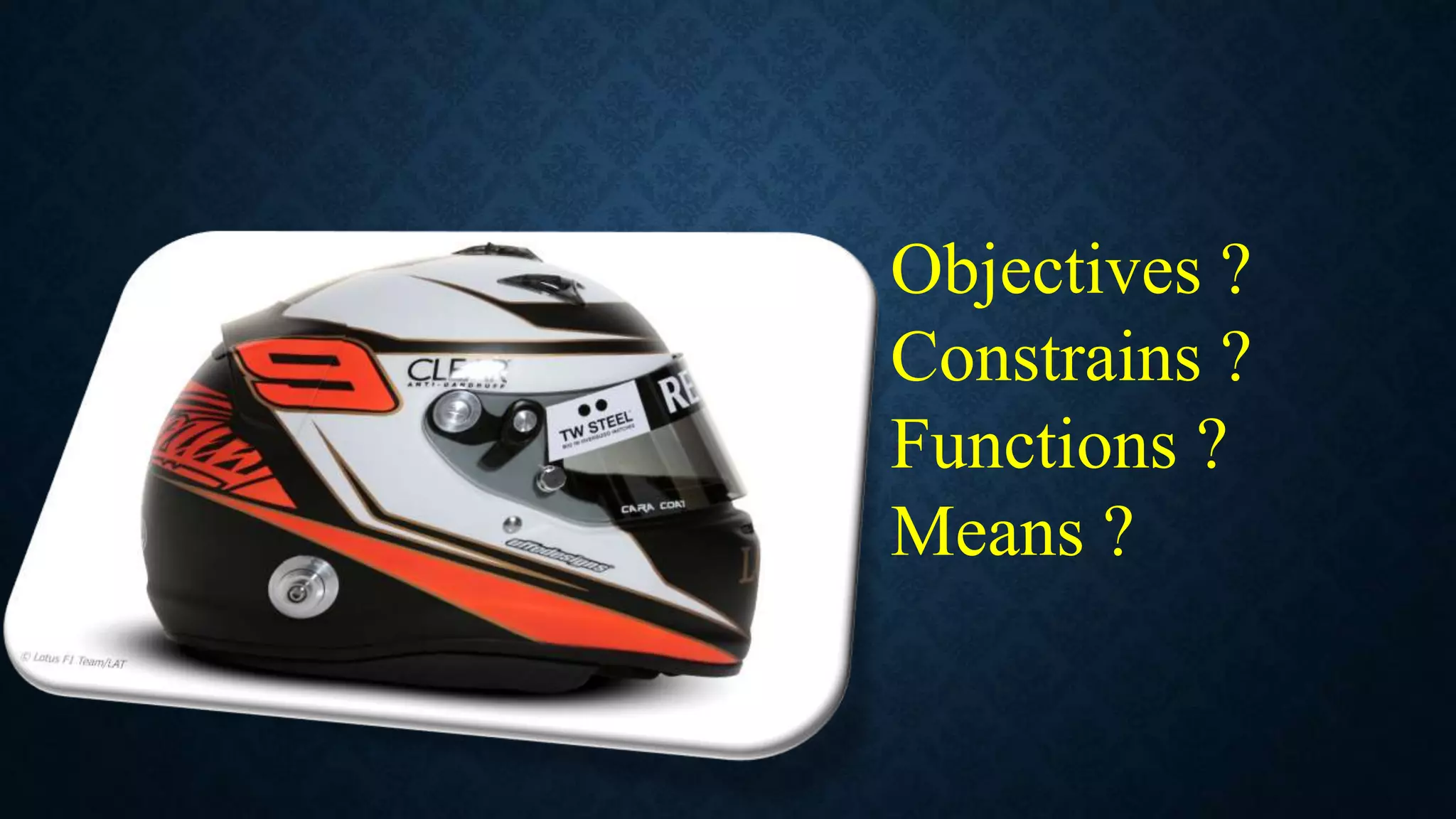
Objectives ?
Constrains ?
Functions ?
Means ?
Objectives ?
Constrains ?
Functions ?
Means ?
Objectives ?
Constrains ?
Functions ?
Means ?
DESIGN FORM
• Form is the shape of a design
• The design procedure starts from its form
• This has not much to do with the function
• Most of the time Form determines the aesthetics and ergonomics of
a product
• For the same function the shape could be different.
Designs with same Functions but
different Form
Form determines the Aesthetics
Form determines Ergonomics
ASPECTS OF DESIGN
STRENGTH DESIGN
quality or state of being physically strong
In strength based designs ‘STRENGTH’ has higher priority than any other desig
considerations…..
STRENGTH BASED DESIGNS
• Strength is the quality or state of being physically strong
• In Design theories strength usually deals with capacity to bear load
• In general strength of a design is the capacity to full fill its functions
• A designed member usually undergoes varieties of loading conditions as per the
requirements, hence to sustain these designs the member has to be strong enough
• The importance of strength become crucial in designs which deals with high loading
conditions
• In order to prevent failure, the strength of a member has to be greater than the induced stress
on that member
• Strength of a design depends up on the material properties, size, geometry, design
refinement, design pattern etc.
Strength priority designs
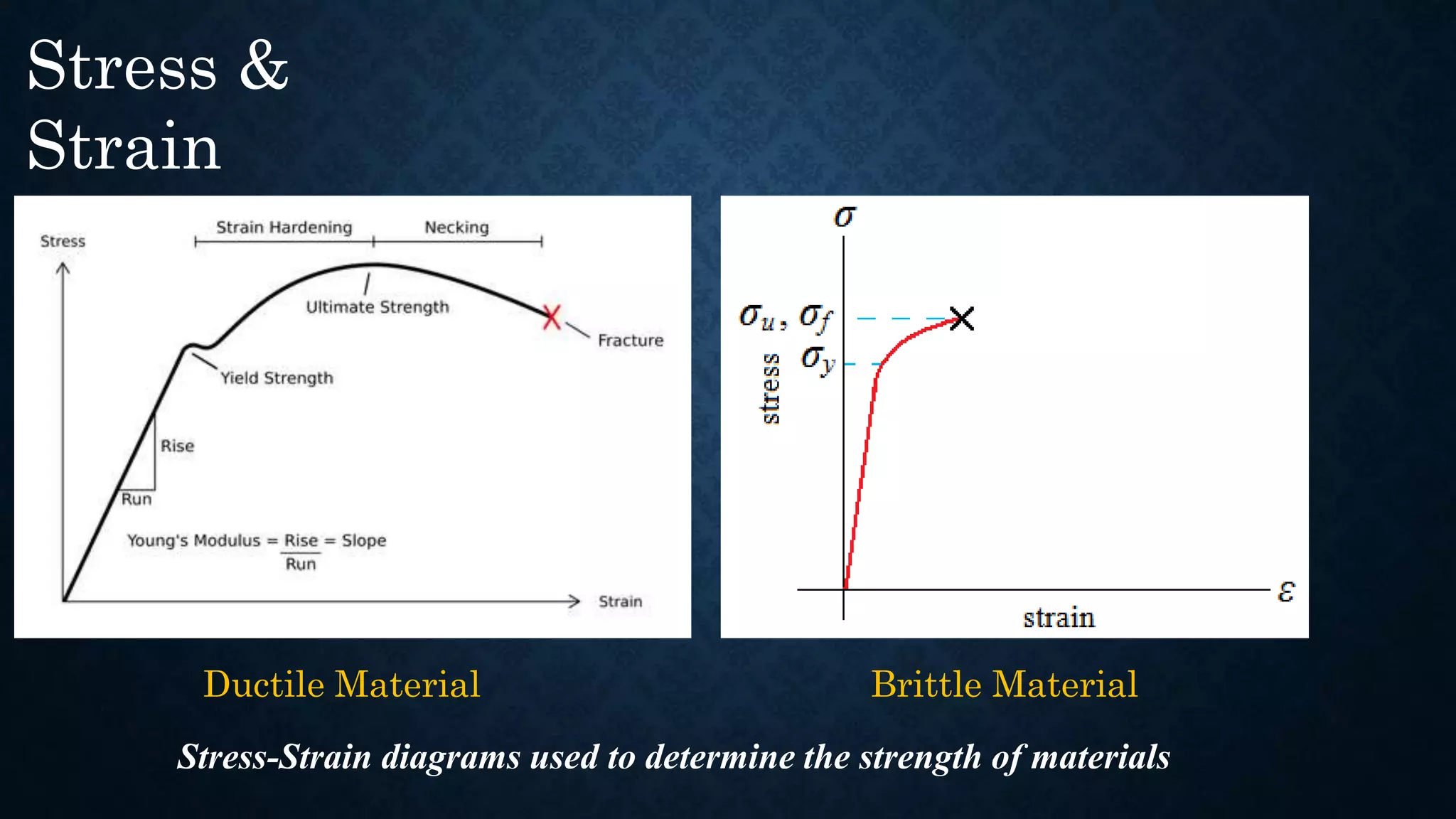
Stress &
Strain
Ductile Material Brittle Material
Stress-Strain diagrams used to determine the strength of materials
Factor of Safety (FOS)
Structural capacity of a system beyond the expected loads or actual loads
𝑭𝑶𝑺 =
𝑴𝒂𝒕𝒆𝒓𝒊𝒂𝒍 𝑺𝒕𝒓𝒆𝒏𝒈𝒕𝒉
𝑫𝒆𝒔𝒊𝒈𝒏 𝑳𝒐𝒂𝒅
By this definition, a structure with a FOS =1 will support only the design load and no more
Any additional load will cause the structure to fail. A structure with a FOS=2 will fail at twice the design load
Design load being the maximum load the part should ever see in service
Hence FOS fixed based on the safety requirements
DOWNLOAD SLIDES
www.slideshare.net/naseelazeeniya
Aspects of Engineering Design:Objective, Constraints, Functions & Means

Aspects of Engineering Design:Objective, Constraints, Functions & Means

  • 1.
    DESIGN & ENGINEERING BE-102 NaseelIbnu Azeez.M.P Asst. Professor, Dept. of Mechanical Engineering, MEA-Engineering College, Perinthalmanna. Email: naseel@live.com
  • 2.
    DESIGN ENGINEERING Engineering designis a systematic, intelligent process in which engineers generate, evaluate, and specify solutions for devices, systems, or processes whose form(s) and function(s) achieve clients’ objectives and users’ needs while satisfying a specified set of constraints. OR In other words, engineering design is a thoughtful process for generating plans or schemes for devices, systems, or processes that attain given objectives while adhering to specified constraints.
  • 3.
  • 4.
    DESIGN OBJECTIVES A featureor behaviour that we whish the design to have or exhibit • It defining the requirements of a design • Objectives, or design goals, are the desired attributes of the design, what the design will "be" and what qualities it will have. • Objectives allow exploration of the design space to select amongst alternatives that are at least acceptable or satisfice
  • 5.
    OBJECTIVES OF DESIGNINGA PORTABLE LADDER Ladder should be compact and portable It should be stable on smooth surfaces Should stand safely without a support Can be used for house hold requirements Should be reasonably stiff and comfortable for users Must be safe and durable Should be relatively economical Should be reduce space requirements while packing by means of detachable parts The ladder should be marketable Useful for electrical and maintenance work
  • 6.
    Objectives are normallyexpressed as adjectives that capture what the design should be, as opposed to what the design should do. For example, saying that a ladder should be portable or lightweight expresses an attribute that the client wants the ladder to have. These features and behaviours, expressed in the natural languages of the client and of potential users, make the object “look good” in the eyes of the client or user.
  • 7.
    OBJECTIVE TREE Objectives aredepended and interconnected hence it can be arranged in an hierarchy with parent node followed by second stage objectives
  • 8.
    Objective tree todesign a juice container
  • 9.
    DESIGN CONSTRAINS • Constraintsare typically framed as a binary yes-or-no choice • Constraints are important to the design process because they limit the size of a design space by forcing the designer to meet a well defined set of requirements • Constraints enable us to reject unacceptable alternatives, while objectives enable us to select among design alternatives that are at least acceptable a limit or restriction on the design’s behaviours or attributes
  • 10.
    Constrains establish theDesign Space Designed for babies constrained to support load up to 15 kg Designed for adults constrained to support up to 150 kg Constrains are fixed under the consideration of factor of safety (FOS), Standardisation, Customer requirements, Cost, Market etc. Develop a accounting software which executable on Microsoft Windows with hardware support of 2GB RAM, 32 bit & 1.7 GHz Clock speed Design a 1-BHK apartment within 50 m2 Design a DC motor which able to runs at 100 rpm along 1kg loading Design a resistor which offer a resistance of 100 Ω and capacitor which produce a capacitance of 50 𝜇𝐹
  • 11.
  • 12.
    DESIGN FUNCTIONS Those thingsa designed device or system is supposed to do • Functions are the behaviours that expected from the design • A design should perform certain functions for convert given input to required output • Functions are often expressed as verb-object pairs. • They describe what the design (or, more likely, an object within the design) will "do" or accomplish, with an emphasis on input-output transformations • The statement of a function typically couples an action verb to a noun or object: Eg: lift a book, support a shelf, transmit a current, measure a temperature, or switch on a light
  • 13.
    Measure weight ofobjects up to 120 kg Support weight up to 70 kg Hold on wall without failure Control pointer on a computer
  • 14.
  • 15.
    Project Images (Primary/Basic Function) ConvertingEnergy (Secondary function) Generation of Light (Desirable) Generation of Heat (Undesirable) Secondary functions are prerequisites
  • 16.
    DESIGN MEANS It isthe way in which a design executes a desired function Eg: The function of a bicycle brake is stop the wheel when applying the brake lever by means of frictional force between rim and brake pad
  • 17.
    The function ofa hydraulic lift is to elevate heavy weight by means of pascals law The function of a speaker is to produce sound by means of electro magnetic induction
  • 18.
  • 19.
  • 20.
  • 21.
  • 22.
  • 23.
    DESIGN FORM • Formis the shape of a design • The design procedure starts from its form • This has not much to do with the function • Most of the time Form determines the aesthetics and ergonomics of a product • For the same function the shape could be different.
  • 24.
    Designs with sameFunctions but different Form
  • 25.
  • 26.
  • 27.
  • 28.
    STRENGTH DESIGN quality orstate of being physically strong In strength based designs ‘STRENGTH’ has higher priority than any other desig considerations…..
  • 29.
    STRENGTH BASED DESIGNS •Strength is the quality or state of being physically strong • In Design theories strength usually deals with capacity to bear load • In general strength of a design is the capacity to full fill its functions • A designed member usually undergoes varieties of loading conditions as per the requirements, hence to sustain these designs the member has to be strong enough • The importance of strength become crucial in designs which deals with high loading conditions • In order to prevent failure, the strength of a member has to be greater than the induced stress on that member • Strength of a design depends up on the material properties, size, geometry, design refinement, design pattern etc.
  • 30.
  • 31.
    Stress & Strain Ductile MaterialBrittle Material Stress-Strain diagrams used to determine the strength of materials
  • 32.
    Factor of Safety(FOS) Structural capacity of a system beyond the expected loads or actual loads 𝑭𝑶𝑺 = 𝑴𝒂𝒕𝒆𝒓𝒊𝒂𝒍 𝑺𝒕𝒓𝒆𝒏𝒈𝒕𝒉 𝑫𝒆𝒔𝒊𝒈𝒏 𝑳𝒐𝒂𝒅 By this definition, a structure with a FOS =1 will support only the design load and no more Any additional load will cause the structure to fail. A structure with a FOS=2 will fail at twice the design load Design load being the maximum load the part should ever see in service Hence FOS fixed based on the safety requirements
  • 33.