ThOU shalt blog Martin Weller & Tony Hirst
Overview Why blog? Steps to blogging What tools? First a health warning:   http:// www.youtube.com/watch?v =12yD8JyaVvY
Why blog:  There is a whole world out there You need to establish a base camp <http://xkcd.com/c256.html>
The economics of reputation If you ain’t connected, you’re dead
Engagement with your subject area  < http://www.flickr.com/photos/54785872@N00/306718042/  peikko06>
Increased reflection  http://www.flickr.com/photos/pichl/420032874/  bohem2020
Personal status (and cash!)  http://www.flickr.com/photos/storm_gal/256182095/  storm_gal
Organisational status  http:// www.youtube.com/watch?v =YbjsuEuSZb4
Link to teaching
Practise what we preach
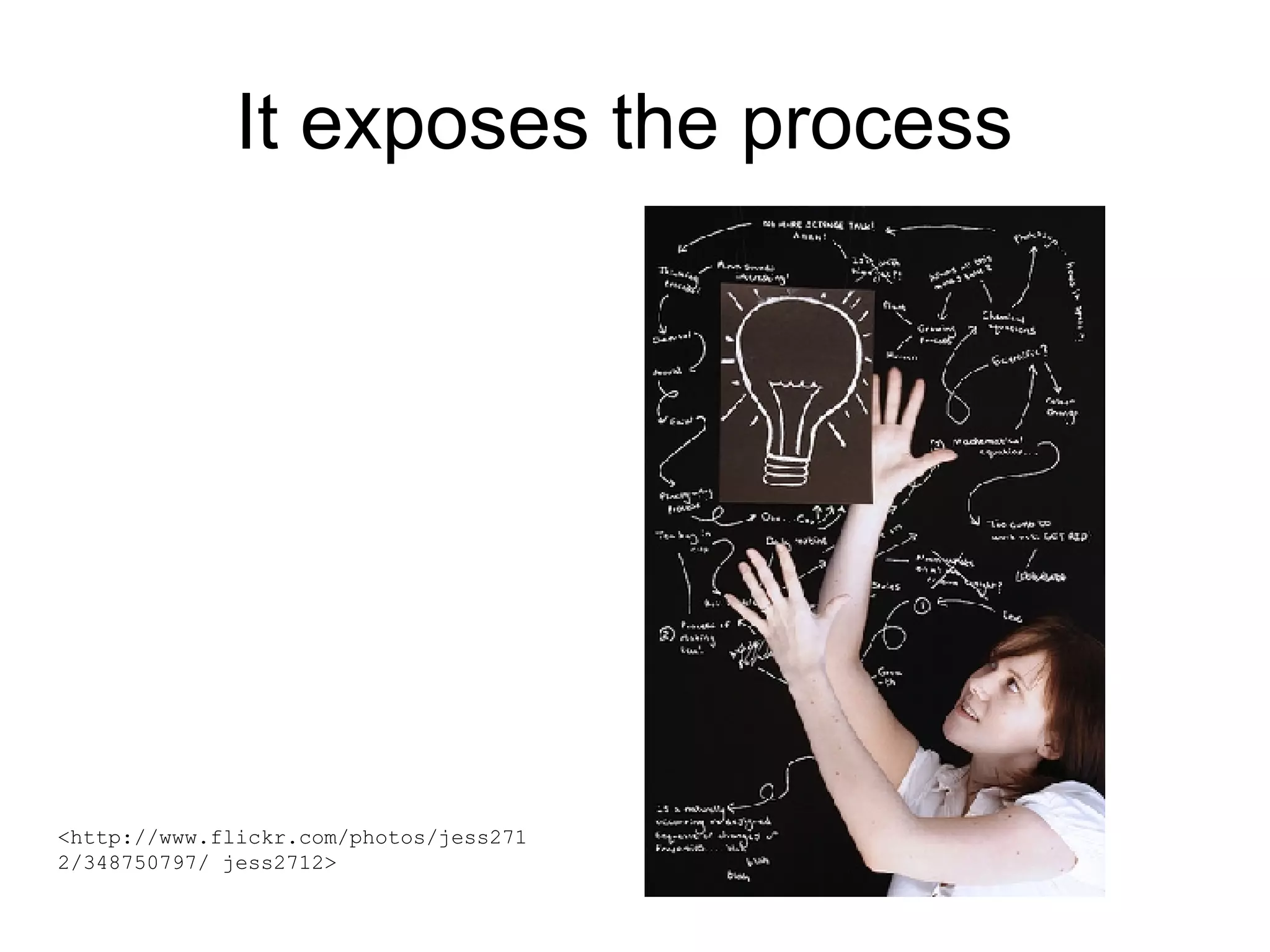
It exposes the process  <http://www.flickr.com/photos/jess2712/348750797/ jess2712>
It provides a useful tool for engaging with other technologies  <http://www.eboy.com>
Time saving Direct people to your blog Provides means of recording Provides easy dissemination point Gives you good access to a community
Some new addictions Blogging  Checking Technorati Checking stats Adding widgets Promoting Talking about blogging
Getting the voice right Have a central focus Add value I don’t care about your cats Post regularly It’s for you as much as the audience
A continuum of OUness
Do we need an OU blog code? If you already have a personal blog or website which indicates in any way that you work at the OU you should tell your manager.  If you want to start blogging, and your blog/website will say that you work for the OU you should tell your manager.  If your blog makes it clear that you work for the OU, it should include a simple and visible disclaimer such as “these are my personal views and not those of the OU”.  Unless there are specific concerns about the nature of your job, you are free to talk about your Open University work on your blog. Consult your manager if in any doubt.   Don’t reveal confidential information. This might include aspects of OU policy or details of internal OU discussions. Again, consult your manager if you are unclear about what might be confidential.  It's easy to whinge on a blog, just like it is in email: think twice before doing so.  Anything you might regret putting on a postcard that might randomly get spotted by anyone in the world, including your departmental management and senior staff at the OU, is something you'll certainly regret putting on your blog.  Blog posts never disappear. Even if you delete them, some 'crawler' or 'cache' software tool probably has them in a repository somewhere for later retrieval.  You should not use your blogs to attack or abuse colleagues.  You should respect the privacy and the feelings of others. Remember that if you break the law on your blog (for example by posting something defamatory), you will be personally responsible.  Political commentary ought to be a legitimate blogging activity , just as a letter to a newspaper signed with your academic affiliation would be legitimate. In this case, you probably want to think a little more clearly before 'letting loose'.  If you think something on your blog or website gives rise to concerns about a conflict of interest and in particular concerns about impartiality or confidentiality this must be discussed with your manager.  If someone offers to pay you for blogging this could constitute a conflict of interest and you must consult your manager.  Putting ads (like Google AdSense-supplied ads) on an Open University-hosted blog is probably not a great idea, and may even be illegal (it would be a little like Nike ads appearing on the BBC).  If someone from the media or press contacts you about posts on your blog that relate to the OU you may want to consider talking to your manager before responding - and you should be aware that the press may 'overly simplify' what you have actually said. The Communications Group/Communications Manager for the project must be consulted.  http://openlearn-wiki.open.ac.uk/index.php/Blog_guidelines &quot;
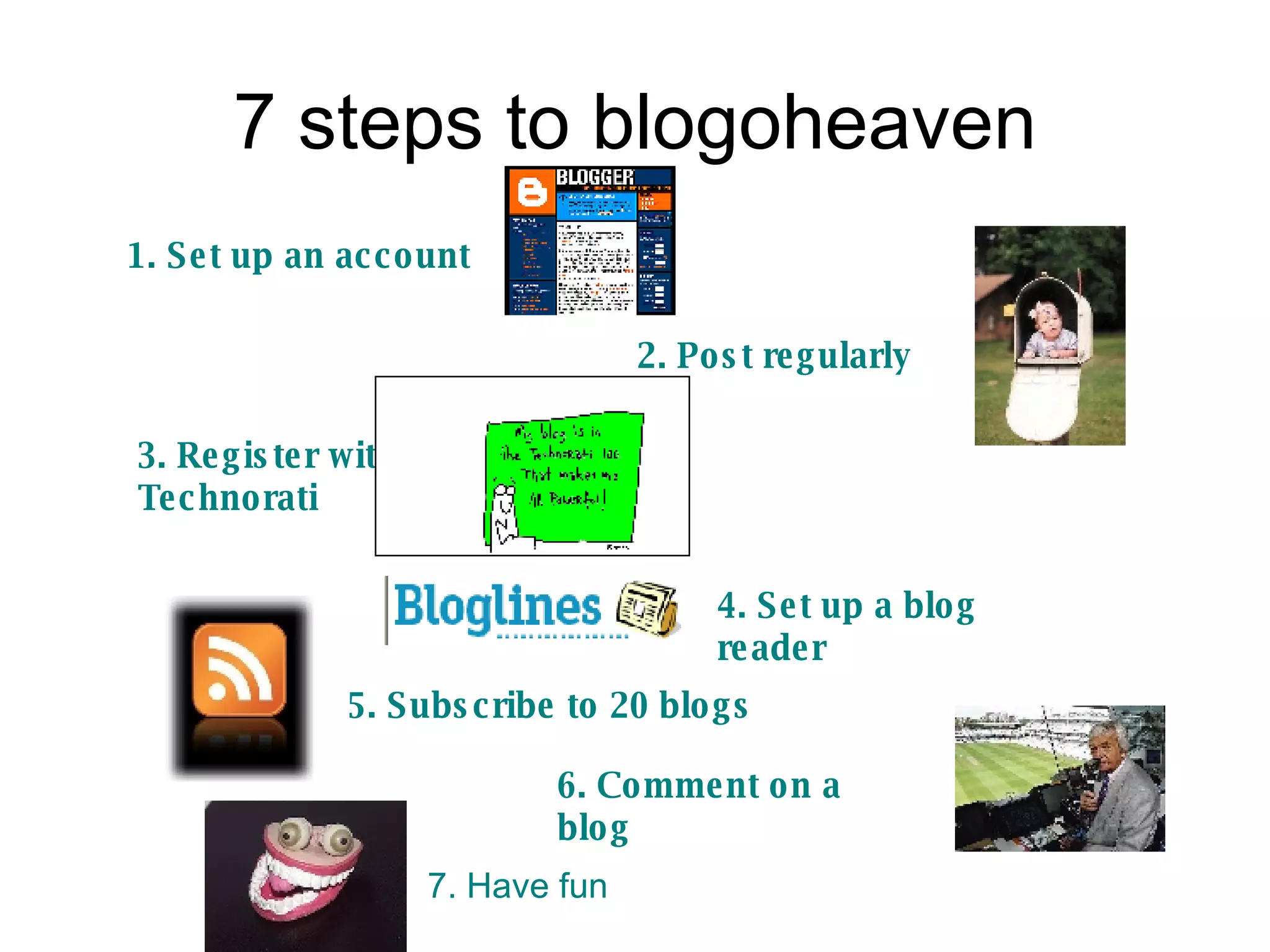
7 steps to blogoheaven 1. Set up an account 2. Post regularly 3. Register with Technorati 4. Set up a blog reader 5. Subscribe to 20 blogs 6. Comment on a blog 7. Have fun
OU bloggers Me –  http:// edtechie.net Tony Hirst -  http:// ouseful.info John Naughton -  http:// memex.naughtons.org / Ray Corrigan -  http://b2fxxx.blogspot.com/ Marc Eisenstadt  http:// kmi.open.ac.uk /people/marc/ James Aczel  http://h809.blogspot.com/ Doug Clow  http:// dougclow.wordpress.com Patrick McAndrew -  http:// ochre.wordpress.com Laura Dewis and Stuart Brown -  http:// conclave.open.ac.uk/openair Alex Little -  http:// kmi.open.ac.uk/people/alex Steve Godwin -  http:// openlearn.blogspot.com/index.html Niall Sclater -  http:// sclater.com/blog / Juliette White -  http:// www.jvvw.com/index.php Graphics blog -  http://blogs.open.ac.uk/LTS/csn47/ Guy Carberry  http:// conclave.open.ac.uk/guycarberry / Library -  http:// libraryissues.blogspot.com/index.html Mikele Pasin -  http:// kmi.open.ac.uk/people/mikele/blog Peter Scott -  http:// sixfields.open.ac.uk/peterblog/index.html Andrew Brasher -  http:// conclave.open.ac.uk/brasherblog /
Some discussion points Should there be an OU blogging code of practice? “ If you accept the premise that change, knowledge (and complexity) are accelerating, then it seems almost professionally neglectful not to be establishing a wide and deep network to help deal with it” (Scott Leslie) Should we be recognising blogs as academic publications? Are blogs here to stay? What should the OU be doing?

Th Ou Shalt Blog

  • 1.
    ThOU shalt blogMartin Weller & Tony Hirst
  • 2.
    Overview Why blog?Steps to blogging What tools? First a health warning: http:// www.youtube.com/watch?v =12yD8JyaVvY
  • 3.
    Why blog: There is a whole world out there You need to establish a base camp <http://xkcd.com/c256.html>
  • 4.
    The economics ofreputation If you ain’t connected, you’re dead
  • 5.
    Engagement with yoursubject area < http://www.flickr.com/photos/54785872@N00/306718042/ peikko06>
  • 6.
    Increased reflection http://www.flickr.com/photos/pichl/420032874/ bohem2020
  • 7.
    Personal status (andcash!) http://www.flickr.com/photos/storm_gal/256182095/ storm_gal
  • 8.
    Organisational status http:// www.youtube.com/watch?v =YbjsuEuSZb4
  • 9.
  • 10.
  • 11.
    It exposes theprocess <http://www.flickr.com/photos/jess2712/348750797/ jess2712>
  • 12.
    It provides auseful tool for engaging with other technologies <http://www.eboy.com>
  • 13.
    Time saving Directpeople to your blog Provides means of recording Provides easy dissemination point Gives you good access to a community
  • 14.
    Some new addictionsBlogging Checking Technorati Checking stats Adding widgets Promoting Talking about blogging
  • 15.
    Getting the voiceright Have a central focus Add value I don’t care about your cats Post regularly It’s for you as much as the audience
  • 16.
  • 17.
    Do we needan OU blog code? If you already have a personal blog or website which indicates in any way that you work at the OU you should tell your manager. If you want to start blogging, and your blog/website will say that you work for the OU you should tell your manager. If your blog makes it clear that you work for the OU, it should include a simple and visible disclaimer such as “these are my personal views and not those of the OU”. Unless there are specific concerns about the nature of your job, you are free to talk about your Open University work on your blog. Consult your manager if in any doubt. Don’t reveal confidential information. This might include aspects of OU policy or details of internal OU discussions. Again, consult your manager if you are unclear about what might be confidential. It's easy to whinge on a blog, just like it is in email: think twice before doing so. Anything you might regret putting on a postcard that might randomly get spotted by anyone in the world, including your departmental management and senior staff at the OU, is something you'll certainly regret putting on your blog. Blog posts never disappear. Even if you delete them, some 'crawler' or 'cache' software tool probably has them in a repository somewhere for later retrieval. You should not use your blogs to attack or abuse colleagues. You should respect the privacy and the feelings of others. Remember that if you break the law on your blog (for example by posting something defamatory), you will be personally responsible. Political commentary ought to be a legitimate blogging activity , just as a letter to a newspaper signed with your academic affiliation would be legitimate. In this case, you probably want to think a little more clearly before 'letting loose'. If you think something on your blog or website gives rise to concerns about a conflict of interest and in particular concerns about impartiality or confidentiality this must be discussed with your manager. If someone offers to pay you for blogging this could constitute a conflict of interest and you must consult your manager. Putting ads (like Google AdSense-supplied ads) on an Open University-hosted blog is probably not a great idea, and may even be illegal (it would be a little like Nike ads appearing on the BBC). If someone from the media or press contacts you about posts on your blog that relate to the OU you may want to consider talking to your manager before responding - and you should be aware that the press may 'overly simplify' what you have actually said. The Communications Group/Communications Manager for the project must be consulted. http://openlearn-wiki.open.ac.uk/index.php/Blog_guidelines &quot;
  • 18.
    7 steps toblogoheaven 1. Set up an account 2. Post regularly 3. Register with Technorati 4. Set up a blog reader 5. Subscribe to 20 blogs 6. Comment on a blog 7. Have fun
  • 19.
    OU bloggers Me– http:// edtechie.net Tony Hirst - http:// ouseful.info John Naughton - http:// memex.naughtons.org / Ray Corrigan - http://b2fxxx.blogspot.com/ Marc Eisenstadt http:// kmi.open.ac.uk /people/marc/ James Aczel http://h809.blogspot.com/ Doug Clow http:// dougclow.wordpress.com Patrick McAndrew - http:// ochre.wordpress.com Laura Dewis and Stuart Brown - http:// conclave.open.ac.uk/openair Alex Little - http:// kmi.open.ac.uk/people/alex Steve Godwin - http:// openlearn.blogspot.com/index.html Niall Sclater - http:// sclater.com/blog / Juliette White - http:// www.jvvw.com/index.php Graphics blog - http://blogs.open.ac.uk/LTS/csn47/ Guy Carberry http:// conclave.open.ac.uk/guycarberry / Library - http:// libraryissues.blogspot.com/index.html Mikele Pasin - http:// kmi.open.ac.uk/people/mikele/blog Peter Scott - http:// sixfields.open.ac.uk/peterblog/index.html Andrew Brasher - http:// conclave.open.ac.uk/brasherblog /
  • 20.
    Some discussion pointsShould there be an OU blogging code of practice? “ If you accept the premise that change, knowledge (and complexity) are accelerating, then it seems almost professionally neglectful not to be establishing a wide and deep network to help deal with it” (Scott Leslie) Should we be recognising blogs as academic publications? Are blogs here to stay? What should the OU be doing?