BEST PRACTICE MODEL
      A critical analysis
Group Members


Kehkashan         Maryam Saleem
Ibrahim           Osama
Ijlal             Ovais
Isbah             Rafay
Layla             Saad Mujeeb
Mahrukh           Saad Afridi
Manoj             Sarfaraz
Maryam Haqqui     Usman
Definition of Best Practice


No authoritative definition agreed upon by academics or
 practitioners
 • Leads to lack of conceptual clarity
Several definitions that have emerged that encompass
 many of the underlying factors of HRM best practice:
Johnson (2000) details:
  “best practice or high performance work practices are
     described as HR methods and systems that have
 universal, additive, and positive effects on organizational
                        performance”
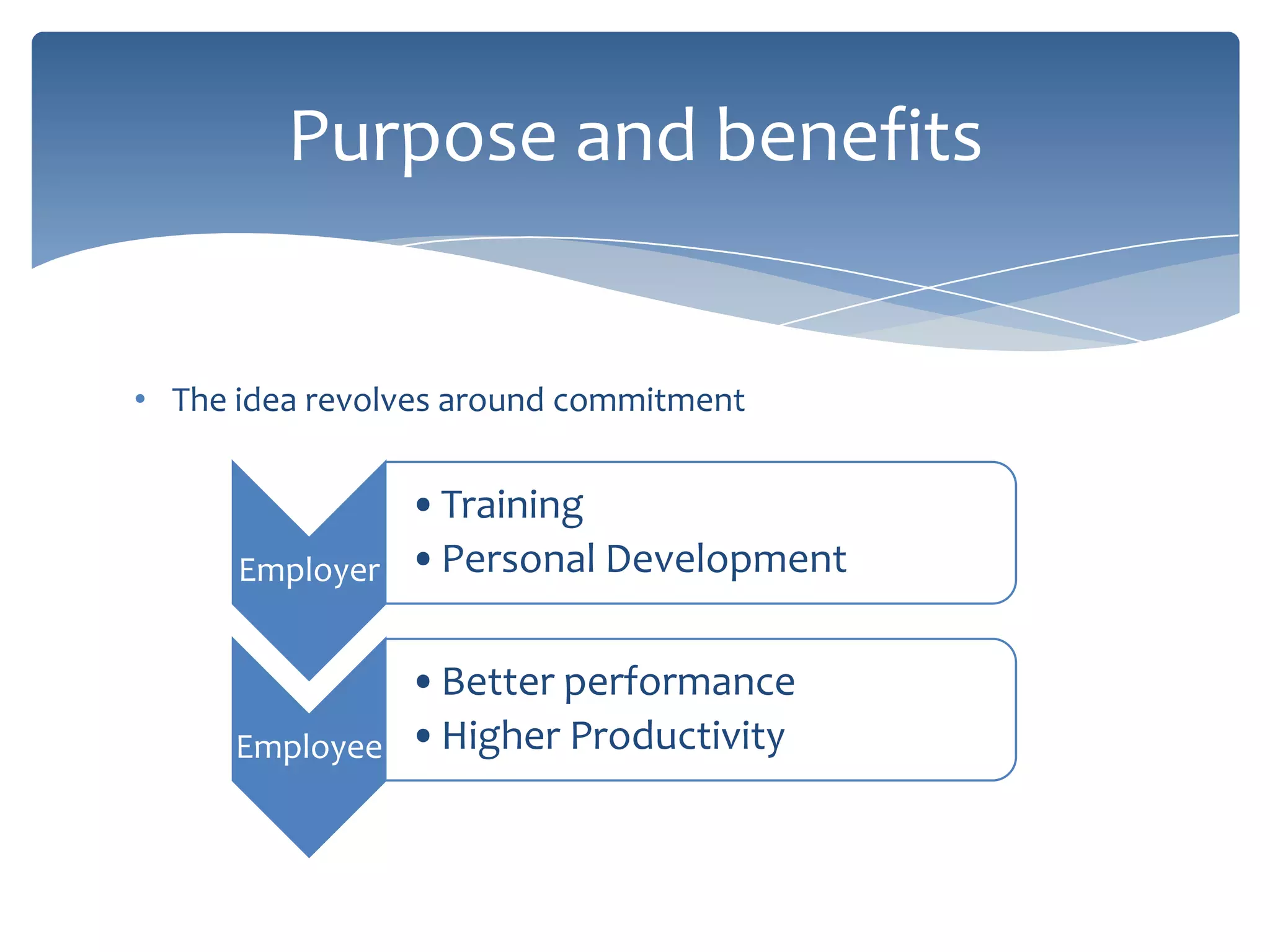
Purpose and benefits


• The idea revolves around commitment


               •Training
      Employer •Personal Development


               •Better performance
      Employee •Higher Productivity
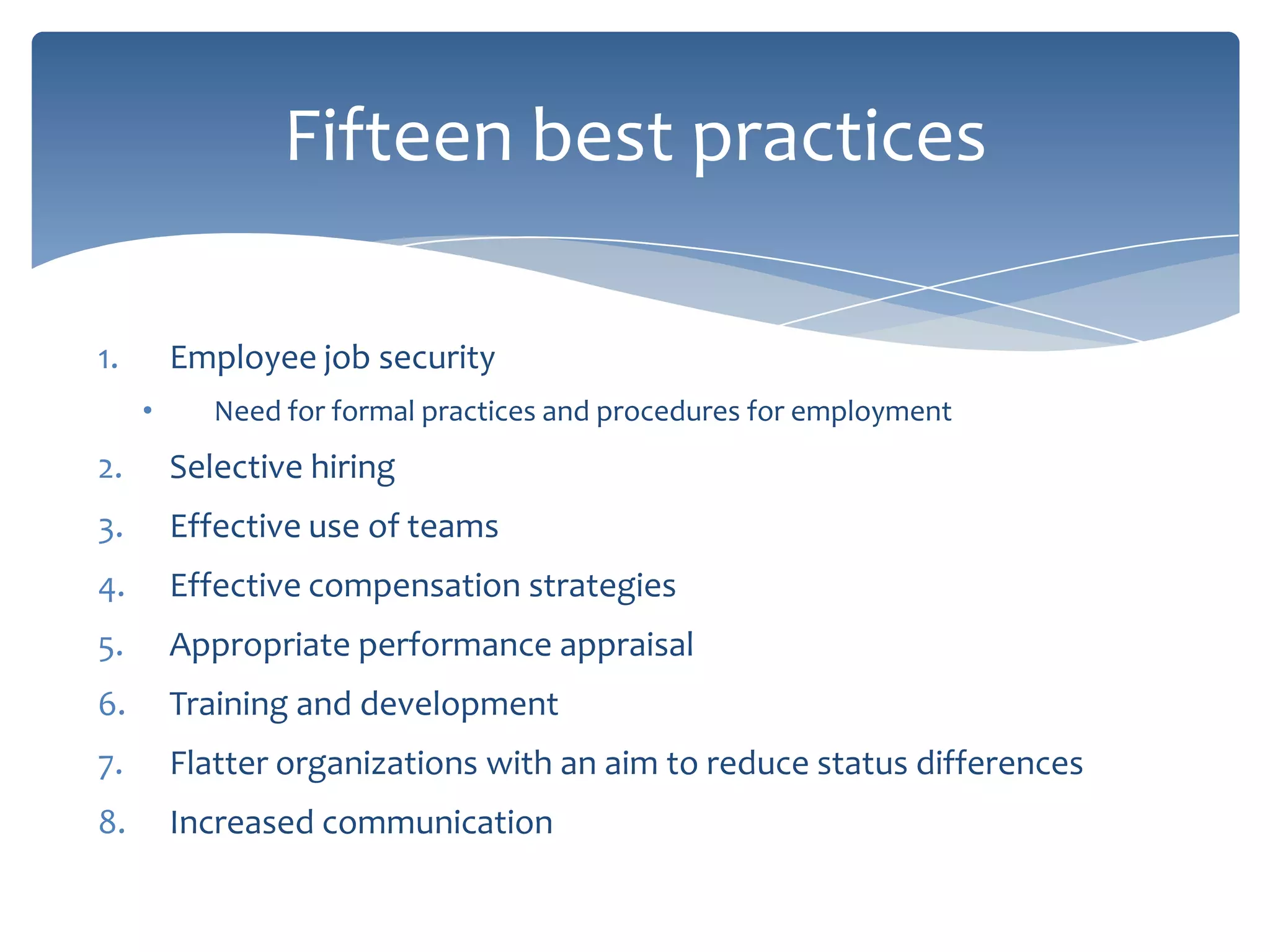
Fifteen best practices

1.       Employee job security
     •      Need for formal practices and procedures for employment
2.       Selective hiring
3.       Effective use of teams
4.       Effective compensation strategies
5.       Appropriate performance appraisal
6.       Training and development
7.       Flatter organizations with an aim to reduce status differences
8.       Increased communication
Fifteen best practices

9. Grievance procedures

10. Promotional criteria

11. Employee ownership of the organization
  •    Company stocks as compensation

12. Empowerment of employees

13. Ensuring upward channeling of employee suggestions

14. Job rotation

15. Career progression
Performance Monitoring:
           Benchmarking


A comparison with selected performance indicators
 from different organizations typically in the same
 industry, or with comparable organizations that are
 considered to be the best in class.

 Red Flags:
  • Some organizations benchmark firms only from the
    same industry
  • Some benchmark only competitors
 What if firms in your industry or your competitors are
 worse than you?

 So why not benchmarking a company that is well
 known for being a good model sometimes referred to
 as Best Practices, Exemplary Practices, and Business
 Excellence.
Advantages


 Calibration
 Enables learning from others’ successes and
 mistakes.
 Creation of an environment of active learning
 Tool to motivate people to change
 Helps in setting direction and priorities
 Helps in initiating focused programs that move the
 company from its current position
Adopting the Benchmarking Process

    Decide the composition of the audit team
    Identify the function’s main customers
    Review the HR function’s mission statement
    Review the function’s role in formulating and implementing the
     organization’s strategy
    Review the HR function’s role in developing relevant HR policies and
     practices
    Review the delivery of current HR policy and practices
    Make internal comparisons to establish ‘best’ practice
    Review the outcome of analysis
     • Performance gaps need to be identified and the policy implications
        need to be discussed with the customer.
    Implement the agreed improvements and measure the progress against
     pre-set targets
High commitment adoption barriers

Contingent on strategy?
Sometimes argued that a high commitment approach is
  best suited to specific market positions, namely a high
  quality and/or high product variety strategy that benefits
  from skilled workers and/or organizational flexibility
However, research in other industries has tended to show
  that the benefits of the HCWS are not conditional on
  strategy (Pfeffer, 1998)
High commitment adoption barriers


Satisficing
  • Companies who are successful without implementing high
    commitment model are not prepared to invest in a risky
    change.
Limited awareness
Managerial Interests
  • Too costly personally
  • Requires skills that they do not have or are not their forte
  • Maybe they just don’t “buy into” the idea of a more
    committed culture and less autocratic management style
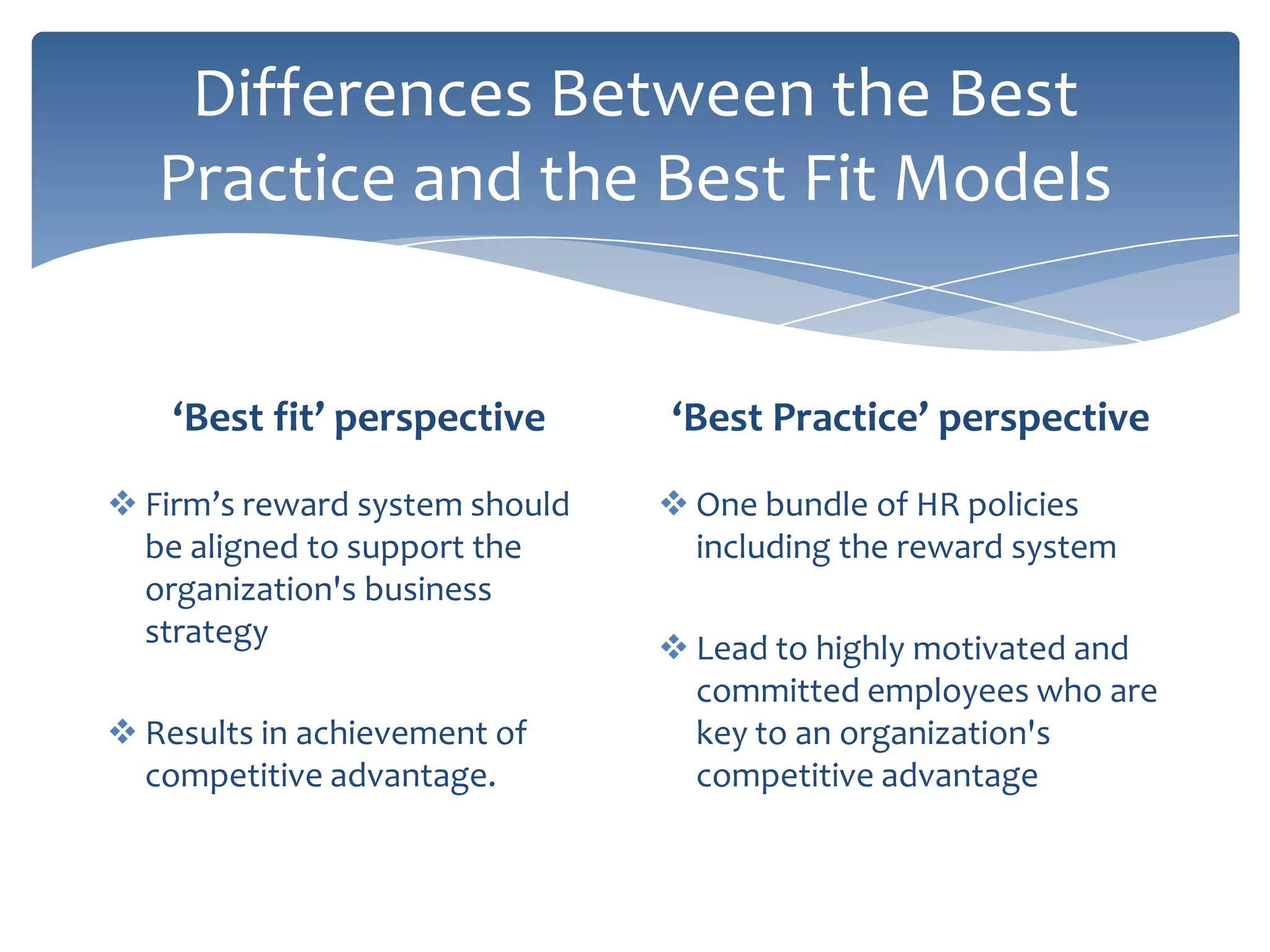
Differences Between the Best
   Practice and the Best Fit Models


    ‘Best fit’ perspective      ‘Best Practice’ perspective

 Firm’s reward system should    One bundle of HR policies
  be aligned to support the       including the reward system
  organization's business
  strategy                       Lead to highly motivated and
                                  committed employees who are
 Results in achievement of       key to an organization's
  competitive advantage.          competitive advantage
‘Best Fit’ and ‘Best Practice’ applied
            to reward systems

 Basic argument - Whether the rewards system are linked to the organizational
  strategy or not?

 Lawler (1995, p. 14) states that all organizational systems must start with
  business strategy because

     “…it specifies what the company wants to accomplish, how it wants to
      behave, and the kinds of performance and performance levels it must
                         demonstrate to be effective.”

 Business strategy, driving individual and organizational behaviors, is the
  touchstone for the development of the reward strategy.
‘Best Fit’ and ‘Best Practice’ applied
            to reward systems

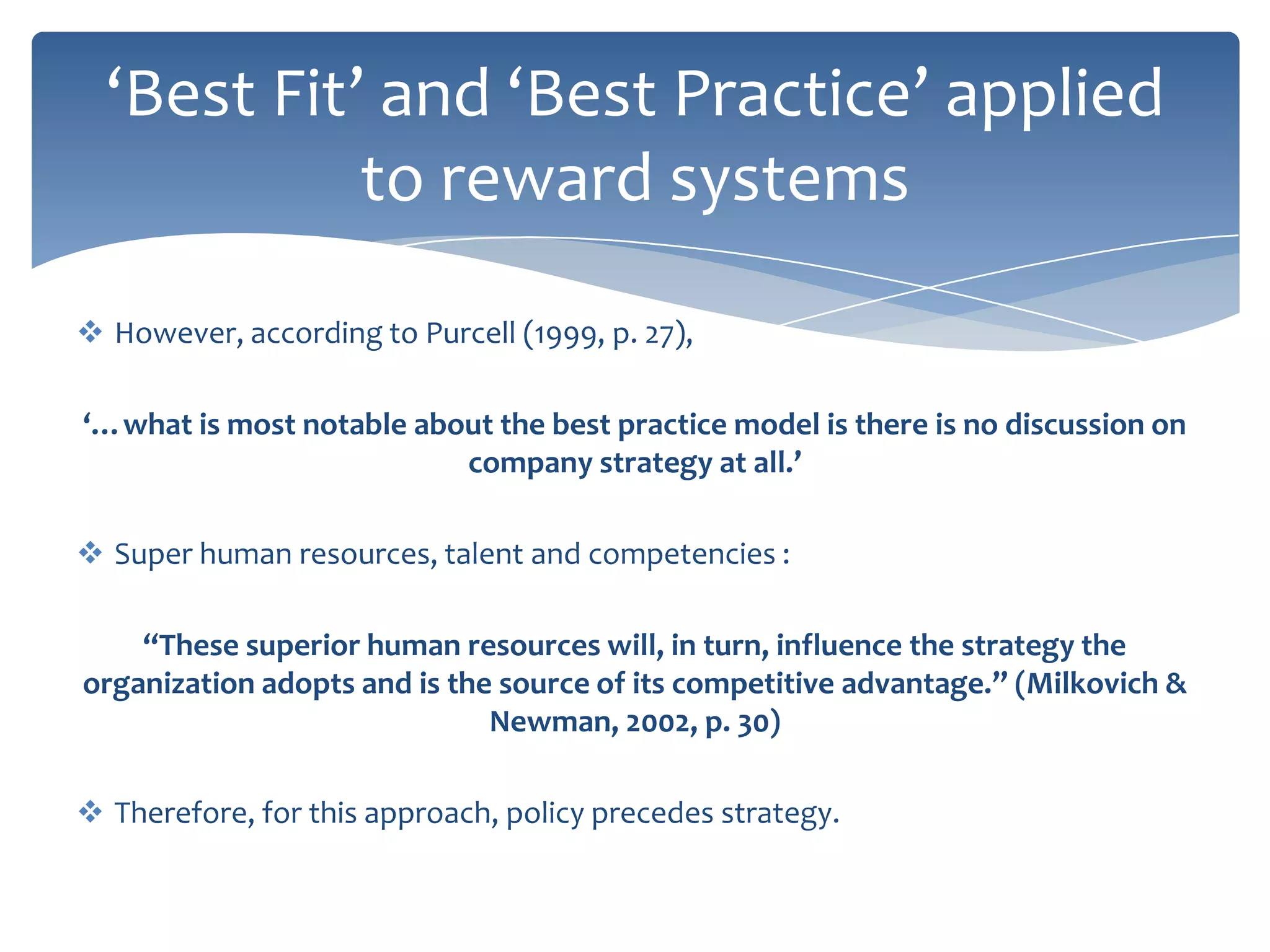
 However, according to Purcell (1999, p. 27),

‘…what is most notable about the best practice model is there is no discussion on
                          company strategy at all.’

 Super human resources, talent and competencies :

    “These superior human resources will, in turn, influence the strategy the
organization adopts and is the source of its competitive advantage.” (Milkovich &
                              Newman, 2002, p. 30)

 Therefore, for this approach, policy precedes strategy.
Criticism

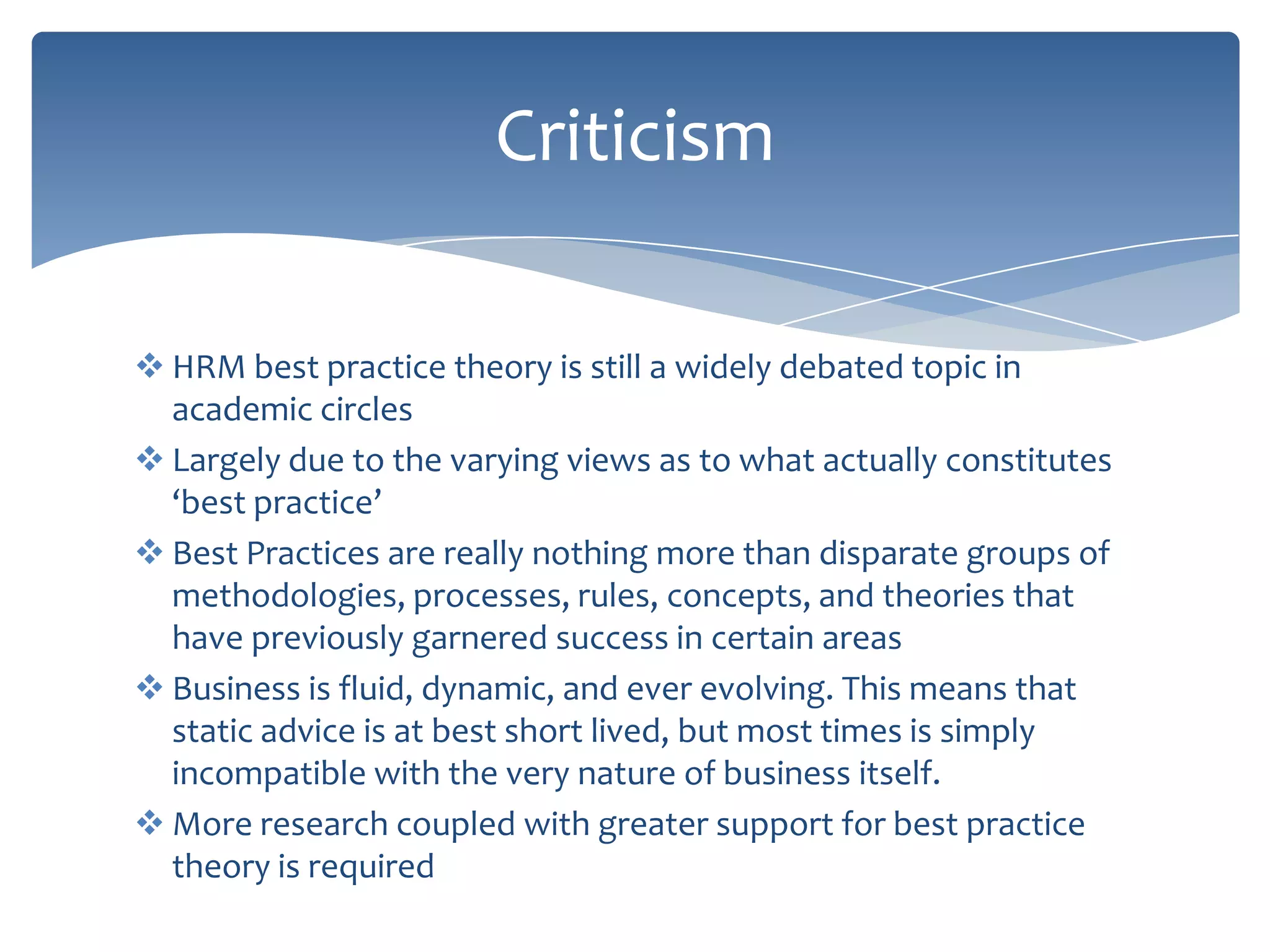
 HRM best practice theory is still a widely debated topic in
  academic circles
 Largely due to the varying views as to what actually constitutes
  ‘best practice’
 Best Practices are really nothing more than disparate groups of
  methodologies, processes, rules, concepts, and theories that
  have previously garnered success in certain areas
 Business is fluid, dynamic, and ever evolving. This means that
  static advice is at best short lived, but most times is simply
  incompatible with the very nature of business itself.
 More research coupled with greater support for best practice
  theory is required
Premise of the Cases


Pfeffer argued that there are seven best practices for
achieving competitive advantage
These practices revolved around putting people first
and included:
Providing employment security, selective
hiring, extensive training, sharing information, self-
managed teams, high pay based on company
performance and the reduction of status differentials
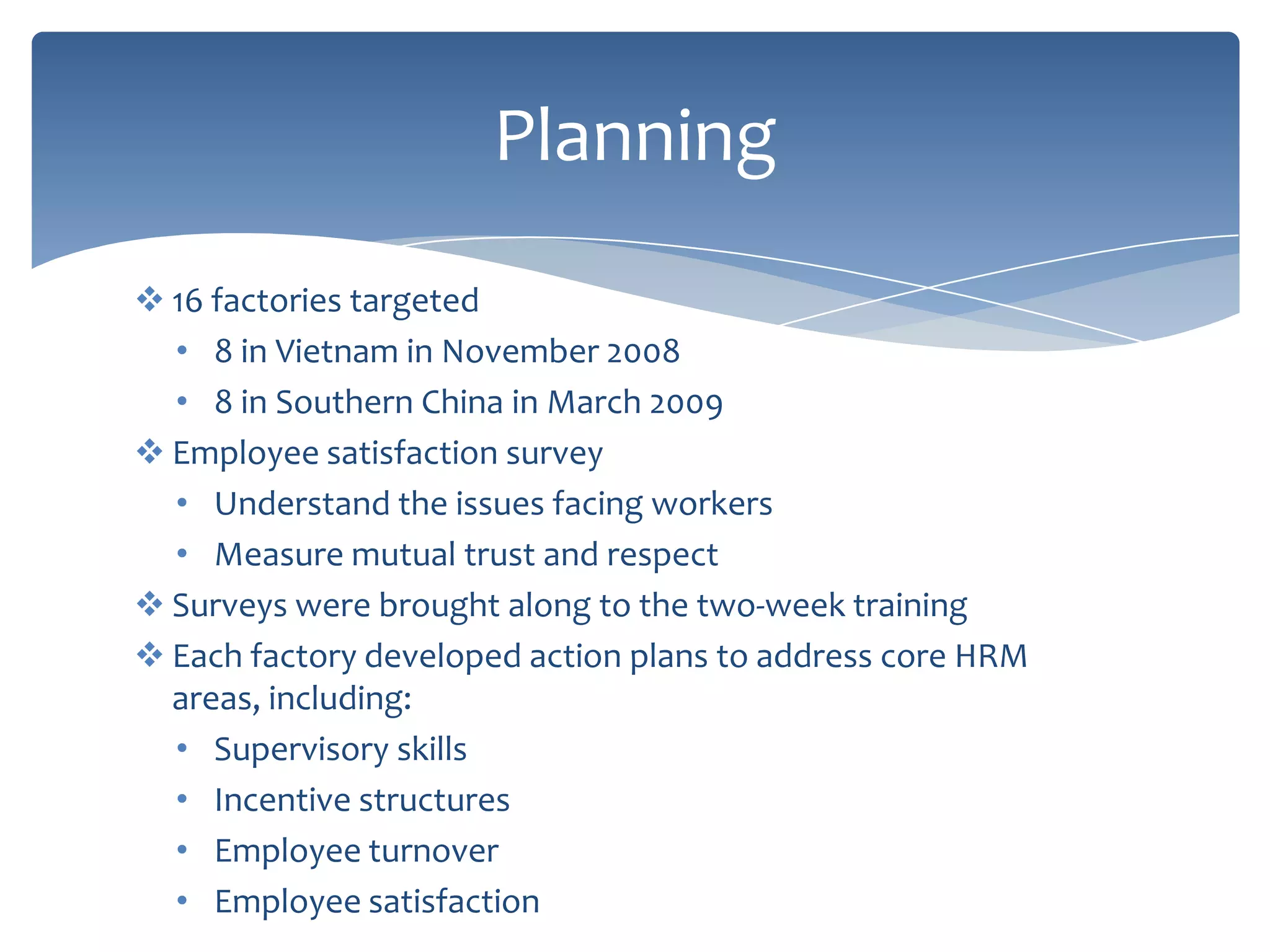
Planning
 16 factories targeted
  • 8 in Vietnam in November 2008
  • 8 in Southern China in March 2009
 Employee satisfaction survey
  • Understand the issues facing workers
  • Measure mutual trust and respect
 Surveys were brought along to the two-week training
 Each factory developed action plans to address core HRM
  areas, including:
  • Supervisory skills
  • Incentive structures
  • Employee turnover
  • Employee satisfaction
Implementation

 Implementation of specific action plans with six-month
  deliverables
 Reduction of the number of workers reporting dissatisfaction
  with the behavior and attitude of their direct supervisor from 15
  % to 5 %
 Targeted training for supervisors including:
  •   Management, trust and respect
  •   Leadership
  •   Company policies
  •   Grievance systems
 Increasing the technical skill level among workers on the shop
  floor
Plans also included:
 • Reassessing skill levels
 • Sharing information with leadership
 • Using findings to increase and improve training

Each step in the process had clear
 goals, responsibilities, timelines and methods for tracking
 the progress

The real measure of success - HRM training's ability to
 drive systemic and lasting improvement in working
 conditions
Background


Among the 100 “Best Companies to Work For”

Reputation of being one of the most employee-
  friendly companies in the world

In 2000, FedEx employee turnover rate was 6%, well
  below the industry average of 20%
Employee Retention


  “In our competitive market place, employee loyalty
tends to be low. If employees don’t like their jobs they
 simply walk across the street and find a new one. It’s
important to keep your people happy and to create an
        environment where they want to stay.”

                      -Mc Mahan, HR manager at Fedex
History of employee commitment


 Since inception in 1971, its management focused on
  providing a suitable work environment that encouraged
  employees to come up with innovative solutions
 During severe financial difficulties during the first couple of
  years, the employees were prepared to sell their personal
  belongings
 They were also prepared to use their own credit cards to
  purchase fuel to deliver the packages to the customers
 Continued working even when they didn’t receive their
  salary on time
Best Practices at FedEx

People Service Profit (PSP) philosophy:
  • Adopted by the founder of FedEx
  • If FedEx took proper care of its employees, they would
    provide efficient service to the customers
  • This in turn would benefit the company by generating more
    profits
Survey-Feedback-Action (SFA) Program:
  • Helped management take decisions regarding promotions
  • Online survey system in the US in 1992
  • Each April, every employee is asked to participate in the
    online survey
  • Managers hold feedback sessions
Best Practices at FedEx


Leadership Evaluation and Awareness Process (LEAP)
 • Encourage non-managerial cadre employees to move to
   the managerial level within the company

Employee Communication Program
   • SFA program
   • Guaranteed Fair Treatment Procedure
   • Open Door Policy
   • Grievance system
Best Practices at FedEx


Job Change Applicant Tracking System (JCATS)
  • Online computer job posting system that allows hourly
    employees to post for any available job

Recognition and Reward Program
  • Awards such as the ‘Bravo Zulu’ and the ‘Golden Falcon
    Award’
Conclusion

Best practice model

  • 1.
    BEST PRACTICE MODEL A critical analysis
  • 2.
    Group Members Kehkashan Maryam Saleem Ibrahim Osama Ijlal Ovais Isbah Rafay Layla Saad Mujeeb Mahrukh Saad Afridi Manoj Sarfaraz Maryam Haqqui Usman
  • 3.
    Definition of BestPractice No authoritative definition agreed upon by academics or practitioners • Leads to lack of conceptual clarity Several definitions that have emerged that encompass many of the underlying factors of HRM best practice: Johnson (2000) details: “best practice or high performance work practices are described as HR methods and systems that have universal, additive, and positive effects on organizational performance”
  • 4.
    Purpose and benefits •The idea revolves around commitment •Training Employer •Personal Development •Better performance Employee •Higher Productivity
  • 5.
    Fifteen best practices 1. Employee job security • Need for formal practices and procedures for employment 2. Selective hiring 3. Effective use of teams 4. Effective compensation strategies 5. Appropriate performance appraisal 6. Training and development 7. Flatter organizations with an aim to reduce status differences 8. Increased communication
  • 6.
    Fifteen best practices 9.Grievance procedures 10. Promotional criteria 11. Employee ownership of the organization • Company stocks as compensation 12. Empowerment of employees 13. Ensuring upward channeling of employee suggestions 14. Job rotation 15. Career progression
  • 7.
    Performance Monitoring: Benchmarking A comparison with selected performance indicators from different organizations typically in the same industry, or with comparable organizations that are considered to be the best in class.  Red Flags: • Some organizations benchmark firms only from the same industry • Some benchmark only competitors
  • 8.
     What iffirms in your industry or your competitors are worse than you?  So why not benchmarking a company that is well known for being a good model sometimes referred to as Best Practices, Exemplary Practices, and Business Excellence.
  • 9.
    Advantages  Calibration  Enableslearning from others’ successes and mistakes.  Creation of an environment of active learning  Tool to motivate people to change  Helps in setting direction and priorities  Helps in initiating focused programs that move the company from its current position
  • 10.
    Adopting the BenchmarkingProcess  Decide the composition of the audit team  Identify the function’s main customers  Review the HR function’s mission statement  Review the function’s role in formulating and implementing the organization’s strategy  Review the HR function’s role in developing relevant HR policies and practices  Review the delivery of current HR policy and practices  Make internal comparisons to establish ‘best’ practice  Review the outcome of analysis • Performance gaps need to be identified and the policy implications need to be discussed with the customer.  Implement the agreed improvements and measure the progress against pre-set targets
  • 11.
    High commitment adoptionbarriers Contingent on strategy? Sometimes argued that a high commitment approach is best suited to specific market positions, namely a high quality and/or high product variety strategy that benefits from skilled workers and/or organizational flexibility However, research in other industries has tended to show that the benefits of the HCWS are not conditional on strategy (Pfeffer, 1998)
  • 12.
    High commitment adoptionbarriers Satisficing • Companies who are successful without implementing high commitment model are not prepared to invest in a risky change. Limited awareness Managerial Interests • Too costly personally • Requires skills that they do not have or are not their forte • Maybe they just don’t “buy into” the idea of a more committed culture and less autocratic management style
  • 13.
    Differences Between theBest Practice and the Best Fit Models ‘Best fit’ perspective ‘Best Practice’ perspective  Firm’s reward system should  One bundle of HR policies be aligned to support the including the reward system organization's business strategy  Lead to highly motivated and committed employees who are  Results in achievement of key to an organization's competitive advantage. competitive advantage
  • 14.
    ‘Best Fit’ and‘Best Practice’ applied to reward systems  Basic argument - Whether the rewards system are linked to the organizational strategy or not?  Lawler (1995, p. 14) states that all organizational systems must start with business strategy because “…it specifies what the company wants to accomplish, how it wants to behave, and the kinds of performance and performance levels it must demonstrate to be effective.”  Business strategy, driving individual and organizational behaviors, is the touchstone for the development of the reward strategy.
  • 15.
    ‘Best Fit’ and‘Best Practice’ applied to reward systems  However, according to Purcell (1999, p. 27), ‘…what is most notable about the best practice model is there is no discussion on company strategy at all.’  Super human resources, talent and competencies : “These superior human resources will, in turn, influence the strategy the organization adopts and is the source of its competitive advantage.” (Milkovich & Newman, 2002, p. 30)  Therefore, for this approach, policy precedes strategy.
  • 16.
    Criticism  HRM bestpractice theory is still a widely debated topic in academic circles  Largely due to the varying views as to what actually constitutes ‘best practice’  Best Practices are really nothing more than disparate groups of methodologies, processes, rules, concepts, and theories that have previously garnered success in certain areas  Business is fluid, dynamic, and ever evolving. This means that static advice is at best short lived, but most times is simply incompatible with the very nature of business itself.  More research coupled with greater support for best practice theory is required
  • 17.
    Premise of theCases Pfeffer argued that there are seven best practices for achieving competitive advantage These practices revolved around putting people first and included: Providing employment security, selective hiring, extensive training, sharing information, self- managed teams, high pay based on company performance and the reduction of status differentials
  • 19.
    Planning  16 factoriestargeted • 8 in Vietnam in November 2008 • 8 in Southern China in March 2009  Employee satisfaction survey • Understand the issues facing workers • Measure mutual trust and respect  Surveys were brought along to the two-week training  Each factory developed action plans to address core HRM areas, including: • Supervisory skills • Incentive structures • Employee turnover • Employee satisfaction
  • 20.
    Implementation  Implementation ofspecific action plans with six-month deliverables  Reduction of the number of workers reporting dissatisfaction with the behavior and attitude of their direct supervisor from 15 % to 5 %  Targeted training for supervisors including: • Management, trust and respect • Leadership • Company policies • Grievance systems  Increasing the technical skill level among workers on the shop floor
  • 21.
    Plans also included: • Reassessing skill levels • Sharing information with leadership • Using findings to increase and improve training Each step in the process had clear goals, responsibilities, timelines and methods for tracking the progress The real measure of success - HRM training's ability to drive systemic and lasting improvement in working conditions
  • 24.
    Background Among the 100“Best Companies to Work For” Reputation of being one of the most employee- friendly companies in the world In 2000, FedEx employee turnover rate was 6%, well below the industry average of 20%
  • 25.
    Employee Retention “In our competitive market place, employee loyalty tends to be low. If employees don’t like their jobs they simply walk across the street and find a new one. It’s important to keep your people happy and to create an environment where they want to stay.” -Mc Mahan, HR manager at Fedex
  • 26.
    History of employeecommitment Since inception in 1971, its management focused on providing a suitable work environment that encouraged employees to come up with innovative solutions During severe financial difficulties during the first couple of years, the employees were prepared to sell their personal belongings They were also prepared to use their own credit cards to purchase fuel to deliver the packages to the customers Continued working even when they didn’t receive their salary on time
  • 27.
    Best Practices atFedEx People Service Profit (PSP) philosophy: • Adopted by the founder of FedEx • If FedEx took proper care of its employees, they would provide efficient service to the customers • This in turn would benefit the company by generating more profits Survey-Feedback-Action (SFA) Program: • Helped management take decisions regarding promotions • Online survey system in the US in 1992 • Each April, every employee is asked to participate in the online survey • Managers hold feedback sessions
  • 28.
    Best Practices atFedEx Leadership Evaluation and Awareness Process (LEAP) • Encourage non-managerial cadre employees to move to the managerial level within the company Employee Communication Program • SFA program • Guaranteed Fair Treatment Procedure • Open Door Policy • Grievance system
  • 29.
    Best Practices atFedEx Job Change Applicant Tracking System (JCATS) • Online computer job posting system that allows hourly employees to post for any available job Recognition and Reward Program • Awards such as the ‘Bravo Zulu’ and the ‘Golden Falcon Award’
  • 30.

Editor's Notes

  • #4 This definition relates to the fact that the more best practices that the organization employs, each will add to the previous, thus compounding the resulting performance of the organizationEach of these best practices must complement each other, as if this is not the case the other will ultimately negate any advantage that could possibly result from its inception
  • #5 In simple terms, each best practice technique is aimed at developing the employee, increasing their commitment, with the resulting intention to improve the organizational performance, and ultimately create a sustainable competitive advantage.