BUILDING A HIGH PERFORMANCE
WORKFORCE - TRENDS AND PRACTICE
“Winning the talent revolution”
Presented by Jose F. Laurel
April 26,2012
TABLE OF CONTENTS
“Building a high performance workforce”
•  HUMAN CAPITAL TRENDS THAT DRIVE EMPLOYEE ENGAGMENT
AND PERFORMANCE
•  A LOOK AT BEST PRACTICES OF HIGH PERFORMANCE
COMPANIES
•  THE CORPORATE CULTURE OF HIGH PERFORMANCE COMPANIES
•  STRATEGIES YOU CAN IMPLEMENT TODAY TO BUILD A HIGH
PERFORMING WORKFORCE
HUMAN CAPITAL TRENDS THAT DRIVE
EMPLOYEE ENGAGMENT AND PERFORMANCE
HUMAN CAPITAL TRENDS THAT DRIVE EMPLOYEE
ENGAGMENT
Employee engagement can be defined as:
(An individual’s degree of positive or negative emotional attachment to their
organization, their job and their colleagues).
•  This definition of employee engagement is a generally accepted
standard for three reasons:
1.  It is measurable through a number of drivers of engagement;
2.  This definition provides management with a cause and effect
understanding they can successfully influence;
3.  This definition will improve business performance when embraced as a
responsibility of leadership and management.
Source: Scarlett Surveys
HUMAN CAPITAL TRENDS THAT DRIVE EMPLOYEE
ENGAGMENT
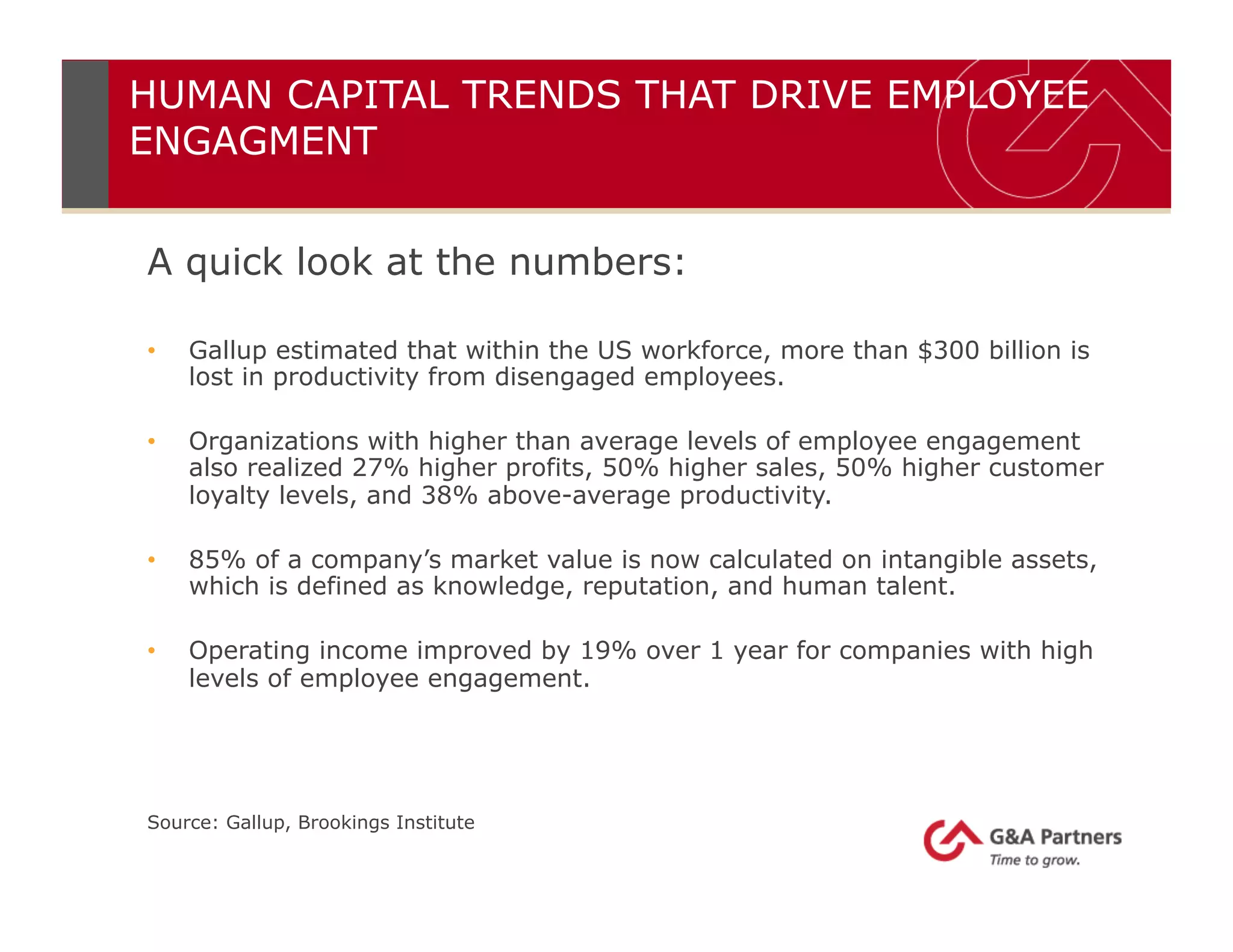
A quick look at the numbers:
•  Gallup estimated that within the US workforce, more than $300 billion is
lost in productivity from disengaged employees.
•  Organizations with higher than average levels of employee engagement
also realized 27% higher profits, 50% higher sales, 50% higher customer
loyalty levels, and 38% above-average productivity.
•  85% of a company’s market value is now calculated on intangible assets,
which is defined as knowledge, reputation, and human talent.
•  Operating income improved by 19% over 1 year for companies with high
levels of employee engagement.
Source: Gallup, Brookings Institute
HUMAN CAPITAL TRENDS THAT DRIVE EMPLOYEE
ENGAGMENT AND PERFORMANCE
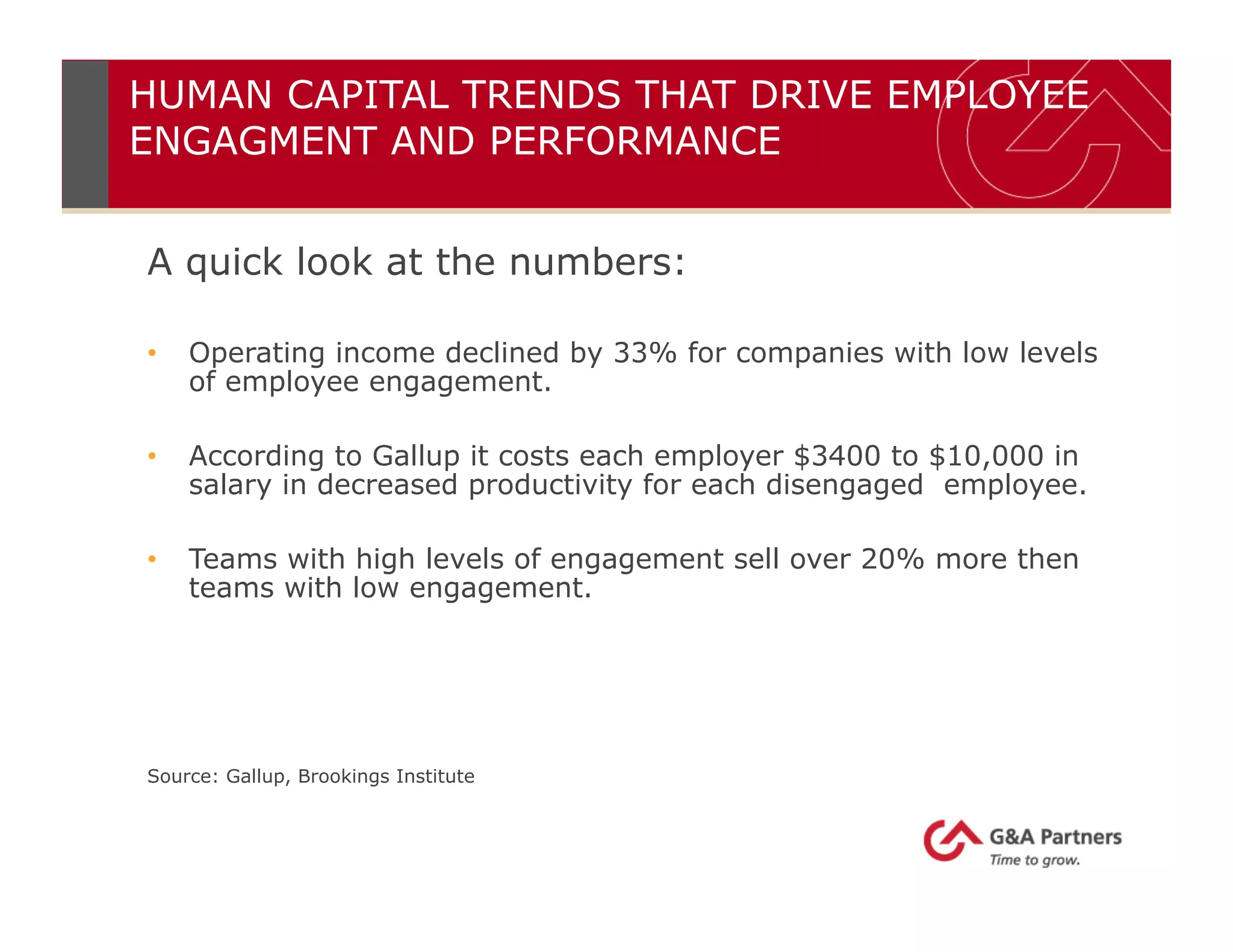
A quick look at the numbers:
•  Operating income declined by 33% for companies with low levels
of employee engagement.
•  According to Gallup it costs each employer $3400 to $10,000 in
salary in decreased productivity for each disengaged employee.
•  Teams with high levels of engagement sell over 20% more then
teams with low engagement.
Source: Gallup, Brookings Institute
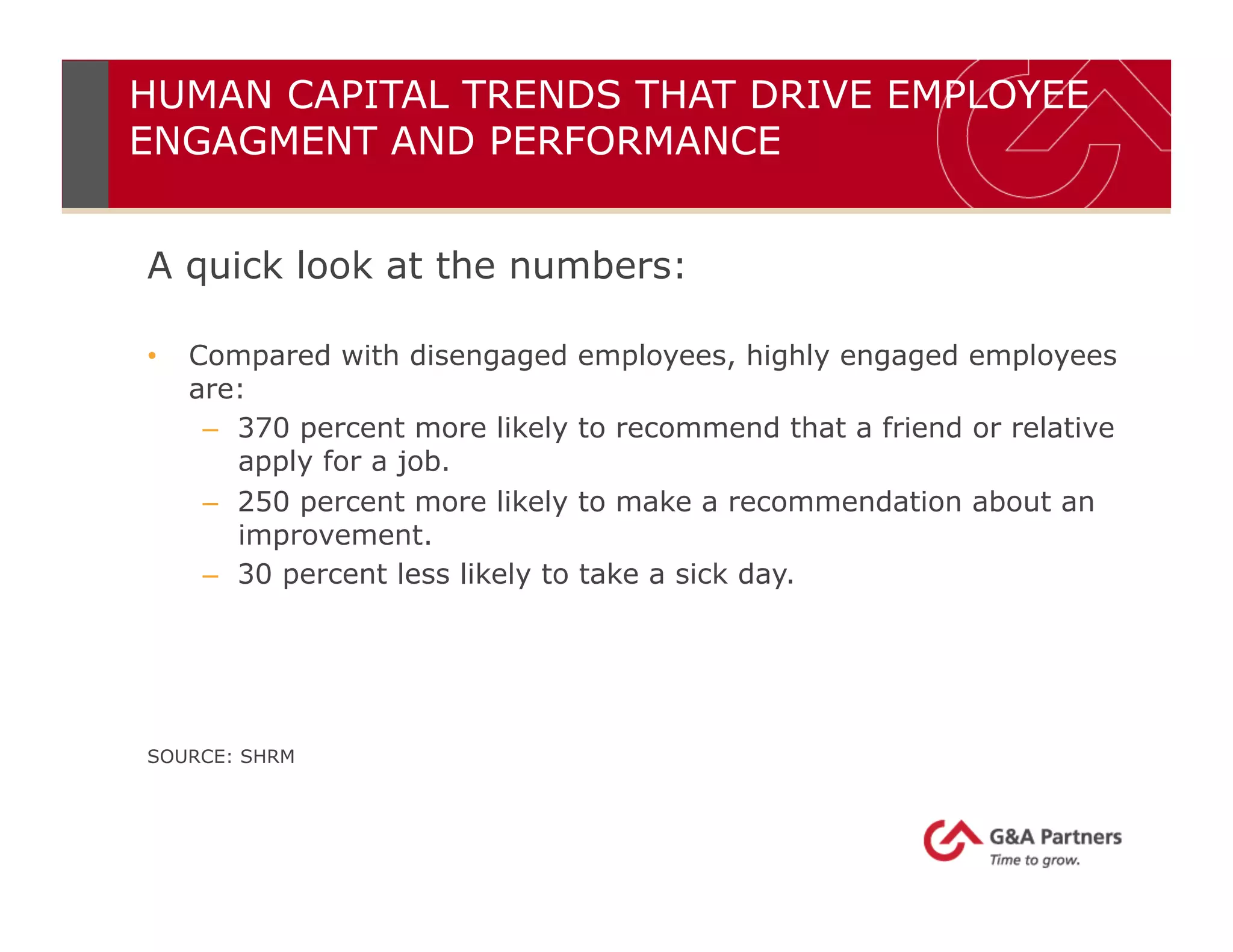
A quick look at the numbers:
•  Compared with disengaged employees, highly engaged employees
are:
–  370 percent more likely to recommend that a friend or relative
apply for a job.
–  250 percent more likely to make a recommendation about an
improvement.
–  30 percent less likely to take a sick day.
SOURCE: SHRM
HUMAN CAPITAL TRENDS THAT DRIVE EMPLOYEE
ENGAGMENT AND PERFORMANCE
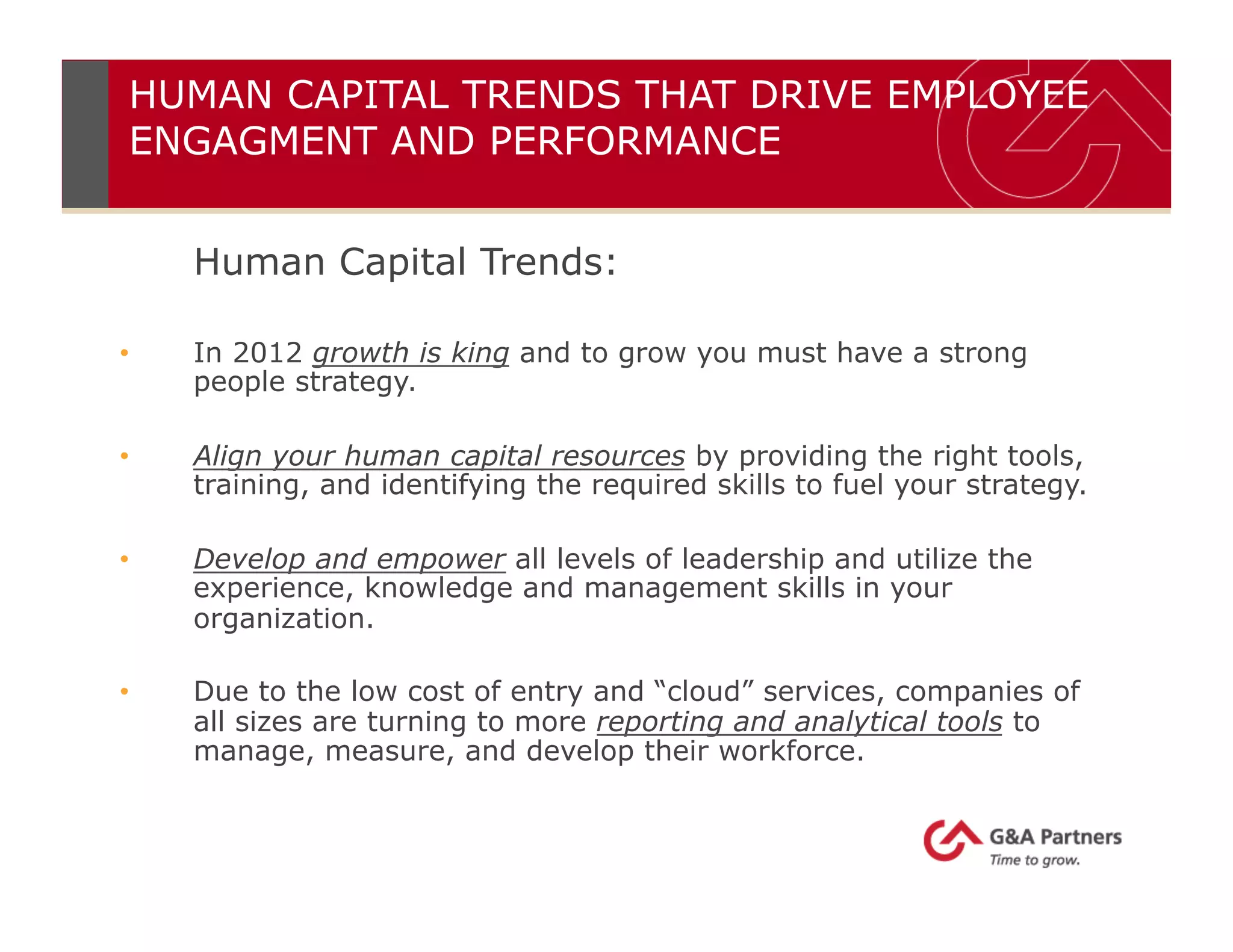
Human Capital Trends:
•  In 2012 growth is king and to grow you must have a strong
people strategy.
•  Align your human capital resources by providing the right tools,
training, and identifying the required skills to fuel your strategy.
•  Develop and empower all levels of leadership and utilize the
experience, knowledge and management skills in your
organization.
•  Due to the low cost of entry and “cloud” services, companies of
all sizes are turning to more reporting and analytical tools to
manage, measure, and develop their workforce.
HUMAN CAPITAL TRENDS THAT DRIVE EMPLOYEE
ENGAGMENT AND PERFORMANCE
HUMAN CAPITAL TRENDS THAT DRIVE EMPLOYEE
ENGAGMENT
Human Capital Trends:
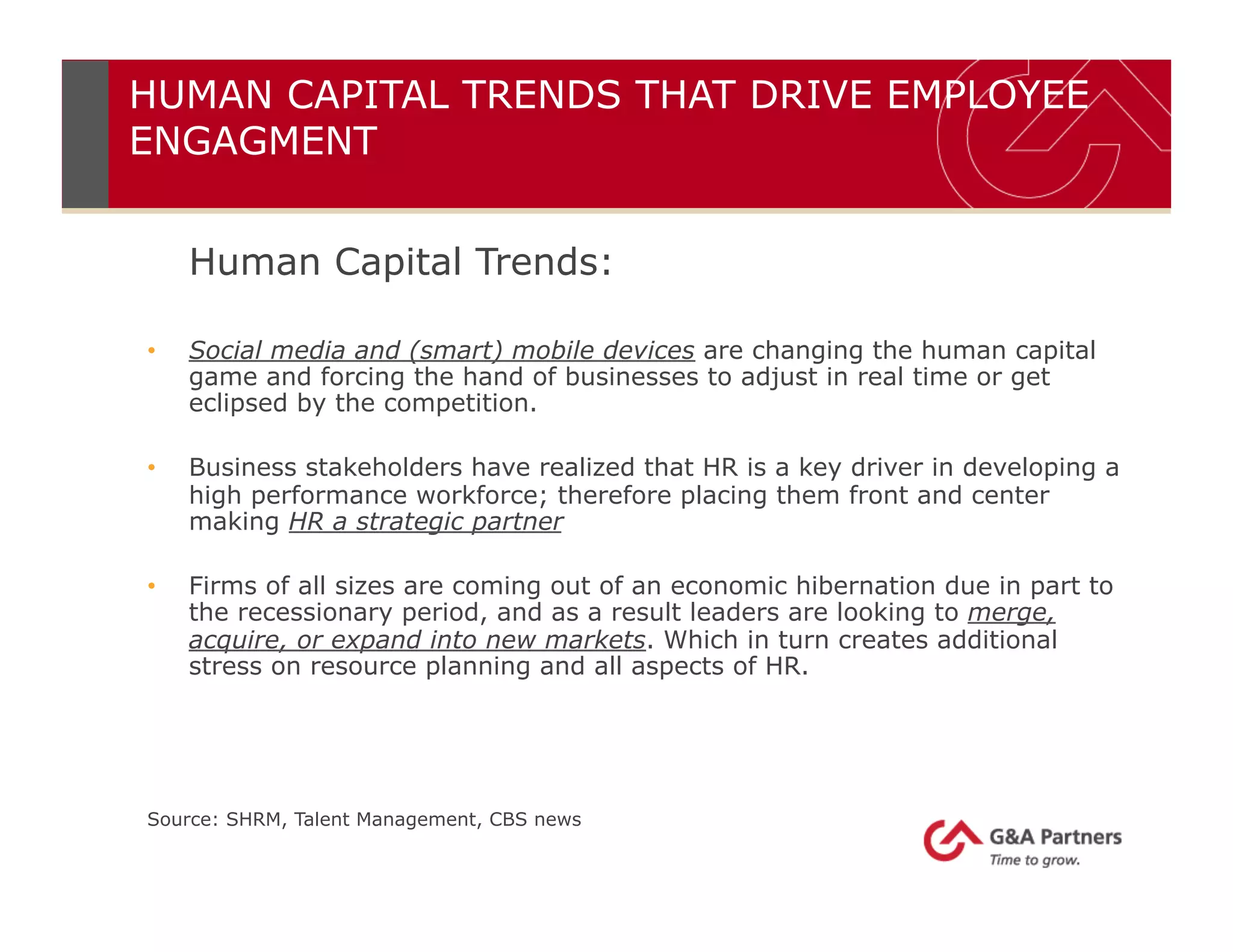
•  Social media and (smart) mobile devices are changing the human capital
game and forcing the hand of businesses to adjust in real time or get
eclipsed by the competition.
•  Business stakeholders have realized that HR is a key driver in developing a
high performance workforce; therefore placing them front and center
making HR a strategic partner
•  Firms of all sizes are coming out of an economic hibernation due in part to
the recessionary period, and as a result leaders are looking to merge,
acquire, or expand into new markets. Which in turn creates additional
stress on resource planning and all aspects of HR.
Source: SHRM, Talent Management, CBS news
A LOOK AT BEST PRACTICES OF HIGH
PERFORMING COMPANIES
A LOOK AT BEST PRACTICES OF HIGH PERFORMING
COMPANIES
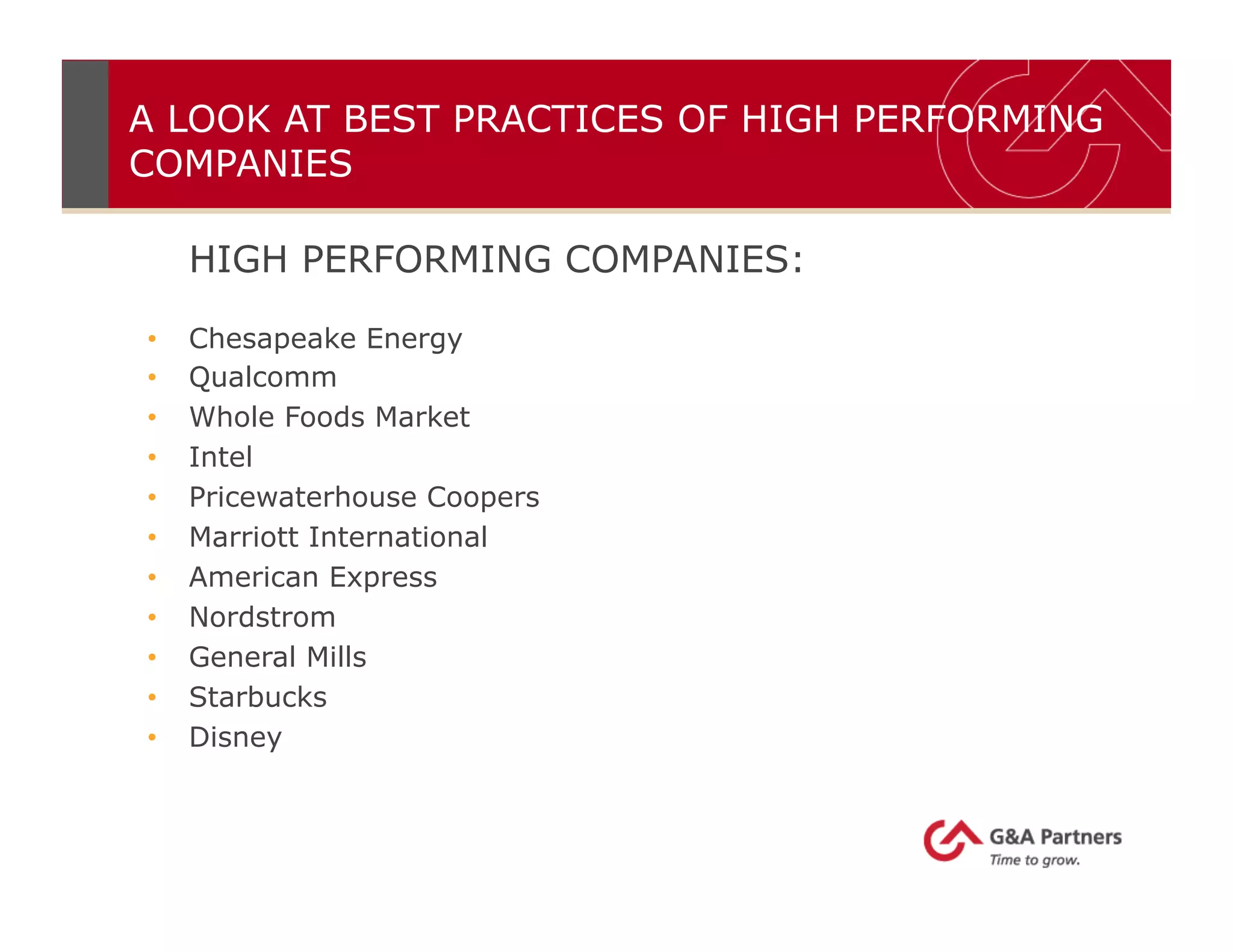
HIGH PERFORMING COMPANIES:
•  Chesapeake Energy
•  Qualcomm
•  Whole Foods Market
•  Intel
•  Pricewaterhouse Coopers
•  Marriott International
•  American Express
•  Nordstrom
•  General Mills
•  Starbucks
•  Disney
A LOOK AT BEST PRACTICES OF HIGH PERFORMING
COMPANIES
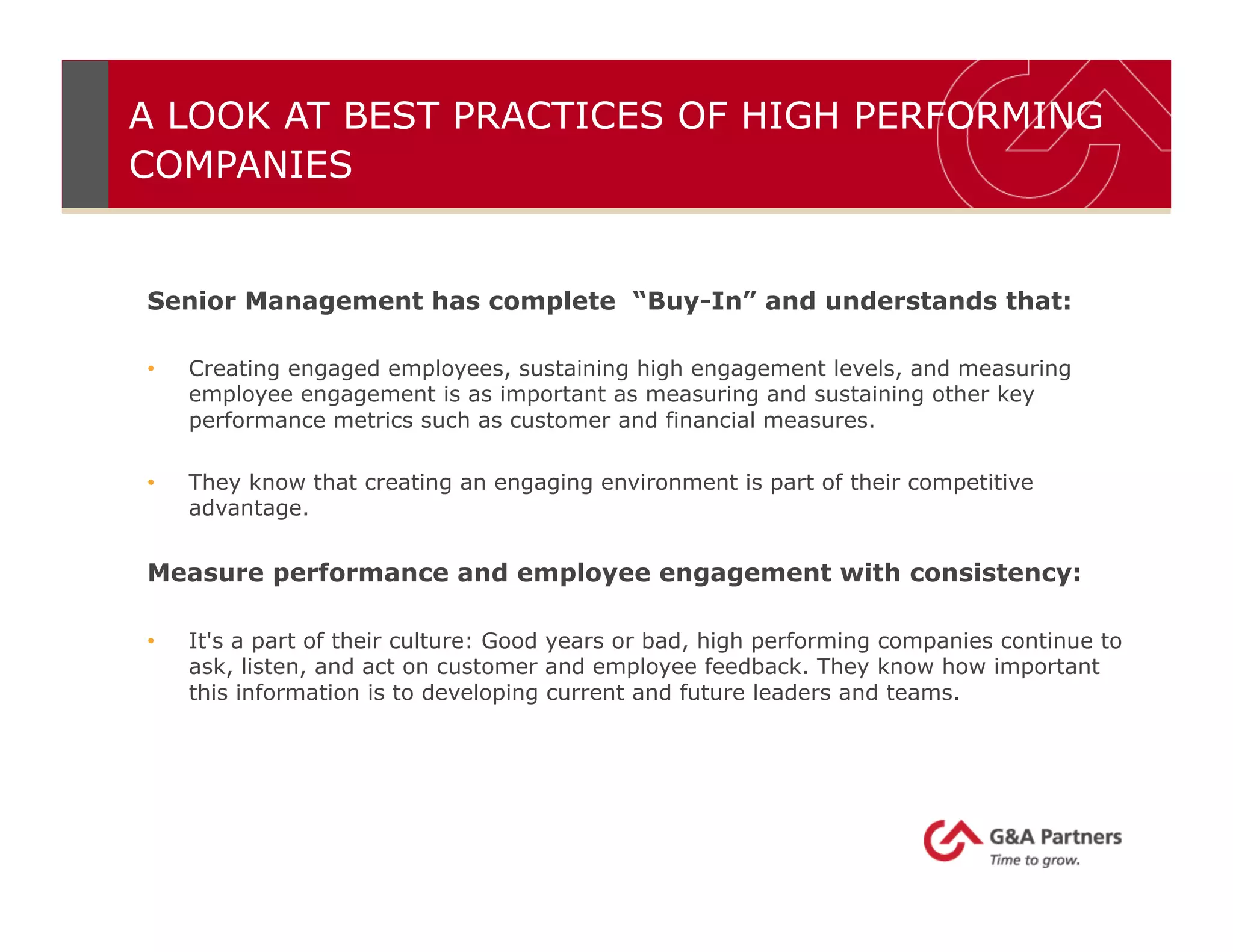
Senior Management has complete “Buy-In” and understands that:
•  Creating engaged employees, sustaining high engagement levels, and measuring
employee engagement is as important as measuring and sustaining other key
performance metrics such as customer and financial measures.
•  They know that creating an engaging environment is part of their competitive
advantage.
Measure performance and employee engagement with consistency:
•  It's a part of their culture: Good years or bad, high performing companies continue to
ask, listen, and act on customer and employee feedback. They know how important
this information is to developing current and future leaders and teams.
A LOOK AT BEST PRACTICES OF HIGH PERFORMING
COMPANIES
Drive for accountability:
•  This can be accomplished through reporting mechanisms or through established
performance standards. Managers, teams and leadership are accountable for the
results and follow up action.
•  While generating and reviewing employee data is critical to driving accountability,
what is even more critical is the follow-up process. The follow up process should
mirror other organizational processes and programs.
Get people involved and owning the strategic direction:
•  Once the teams and key players are in place management must provide support and
the required resources, (training, equipment, directive) to facilitate execution. This
also means be a cheerleader for the strategic good and making sure everyone is on
board and has ownership.
Source: TNS employee survey
A LOOK AT BEST PRACTICES OF HIGH PERFORMING
COMPANIES
Make HR a strategic partner:
•  Workforce issues are critical as companies struggle to emerge from a global
recession, yet many companies are failing to make human resources a priority when
implementing a business best practice.
•  High performing companies make certain that HR is involved with every business unit
when it comes to managing talent, leadership development, employee engagement,
and workforce planning.
•  Leaders of high performing companies dig deeper when it comes to human resource
issues. They focus on flexibility, not on cutbacks, and are always willing to use HR as
a strategic partner
Source: Talent Management
A LOOK AT BEST PRACTICES OF HIGH PERFORMING
COMPANIES
Understand and manage multiple generations:
•  This is the first time in American history that we have had four different
generations working side-by-side in the workplace.
•  At work, generational differences can affect everything, including
recruiting, building teams, dealing with change, motivating, managing,
maintaining and increasing productivity.
•  High performing companies understand that each generation is critical to
the overall success.
•  They learn how to communicate with the different generations and
eliminate many confrontations and misunderstandings in the workplace.
Source: FDU Magazine
A LOOK AT BEST PRACTICES OF HIGH PERFORMING
COMPANIES
Understand and manage multiple generations:
•  Traditionalists (born 1922-1943) – “No news is good news.”
•  Baby Boomers (born 1946-1964) – “Feedback once a year and lots of
documentation.”
•  Generation X (born 1965-1980) – “Sorry to interrupt but how am I
doing?”
•  Millennials (born 1980-2000) “Feedback whenever I want it at the push of
a button.”
THE CORPORATE CULTURE OF HIGH
PERFORMANCE COMPANIES
Defining corporate culture:
•  A blend of the values, beliefs, taboos, symbols,
rituals and myths all companies develop over
time
•  The philosophy, values, behavior, dress codes,
etc., that together constitute the unique style
and policies of a company
Source: Entrepreneur magazine
THE CORPORATE CULTURE OF HIGH
PERFORMANCE COMPANIES
A look at the numbers:
•  68% - leaders who believe their culture is a source of
competitive advantage
•  76% - believe it is changeable
•  65% - believe they need to change
•  81% - believe that an organization that lacks a high
performance culture is domed to mediocrity
•  But fewer than 10% succeed in building one
Source: Bain & Co
THE CORPORATE CULTURE OF HIGH
PERFORMANCE COMPANIES
The distinguishing profile of winning cultures:
•  Emotion packed vision – a simple compelling vision that resonates with
everyone, easy to understand, and goes beyond making money. For
instance with Disney, “To make people happy”.
•  A true believer – everyone believes in the vision of the business and that it
will bring certain success. People must believe that they are involved in
something bigger other than self interest.
•  Peer respect – the high performing companies seldom rely on fear to
motivate employees. The urge to earn and maintain the respect of one
another is what governs the behavior of employees and management.
THE CORPORATE CULTURE OF HIGH
PERFORMANCE COMPANIES
The distinguishing profile of winning cultures:
•  Long term relationships – employees in high performing companies believe
and expect that long term relationships are the path to success. Short
term experiences, making enemies of colleagues and similar behaviors do
not make sense in a high performance culture.
•  Attract high performing people – high performing companies attract
exceptional people. This group of people possess a can do attitude and a
heightened sense of commitment that drive superb execution. And the
results fall directly to the bottom line.
•  Management systems – high performing companies view management
systems as an integrated solution to facilitate and support strategy
execution. The system should be rooted on three principles: precise
expectations, measurement and frequent feedback.
•  Source: R.L Osborne, Scott S. Cowen , Case Western
THE CORPORATE CULTURE OF HIGH
PERFORMANCE COMPANIES
STRATEGIES YOU CAN IMPLEMENT TODAY TO
BUILD A HIGH PERFORMING WORKFORCE
STRATEGIES YOU CAN IMPLEMENT TODAY TO
BUILD A HIGH PERFORMING WORKFORCE
•  Companies that are underperforming must first do some self
examination and be prepared for the “reality shock” that the
shortfall is a result of their own actions.
1.  A good place to start is by conducting a strategic audit. This
first step is important to determine if you have strategic
roadblocks that may potentially be holding you back from
execution.
2.  Review the company’s current strategy for compatibility with
environmental trends, customer patterns, and the competition.
3.  Only when the current strategy has been validated or modified
can you seriously take measures to get better.
STRATEGIES YOU CAN IMPLEMENT TODAY TO
BUILD A HIGH PERFORMING WORKFORCE
•  The strategic audit helps to identify the corporate road map. It
is simply the direction the company is headed. To get a “snap
shot” of who your company is you must check your corporate
profile.
1.  The corporate profile is how your company is perceived by your
employees, customers and management.
2.  This profile is comprised of characteristics we previously
touched on, such as corporate culture, management systems
and people. A simple survey of all stakeholders will provide a
quick glimpse of your corporate profile.
Source: R.L. Osborne, S.S. Cowen, Case Western
STRATEGIES YOU CAN IMPLEMENT TODAY TO
BUILD A HIGH PERFORMING WORKFORCE
•  An often forgotten step and yet one of the most critical to
building a high performance organization is the HR Analysis.
1.  The HR analysis allows a company to strategically assess its
most valuable resource. It will expose weaknesses and provide
insight into such areas as: hiring practices, employee on
boarding, training and development, performance metrics,
succession planning, employee engagement, compliance issues
and other related matters.
2.  Conducting an HR analysis will ultimately help a company align
its corporate strategy with its people management. This step
will serve to eliminate obstacles that often get in the way of
“building a high performance workforce”.
SUMMARY
“Building the high performance workforce”
•  HUMAN CAPITAL TRENDS THAT DRIVE EMPLOYEE ENGAGMENT
AND PERFORMANCE
•  A LOOK AT BEST PRACTICES OF HIGH PERFORMING COMPANIES
•  THE CORPORATE CULTURE OF HIGH PERFORMANCE COMPANIES
•  STRATEGIES YOU CAN IMPLEMENT TODAY TO BUILD A HIGH
PERFORMING WORKFORCE
Thank You
G&A Partners is a Houston-based HR and administrative
services company that manages human resources, benefits,
payroll, accounting and risk management for growing
businesses. G&A maintains offices in Houston, Dallas, San
Antonio, Austin, College Station, Corpus Christi, Arizona and
Utah. For more information about the company, visit
www.gnapartners.com or call 713.784.1181
Please send questions to info@gnapartners.com

Building the High Performance Workforce (Part 1)

  • 1.
    BUILDING A HIGHPERFORMANCE WORKFORCE - TRENDS AND PRACTICE “Winning the talent revolution” Presented by Jose F. Laurel April 26,2012
  • 2.
    TABLE OF CONTENTS “Buildinga high performance workforce” •  HUMAN CAPITAL TRENDS THAT DRIVE EMPLOYEE ENGAGMENT AND PERFORMANCE •  A LOOK AT BEST PRACTICES OF HIGH PERFORMANCE COMPANIES •  THE CORPORATE CULTURE OF HIGH PERFORMANCE COMPANIES •  STRATEGIES YOU CAN IMPLEMENT TODAY TO BUILD A HIGH PERFORMING WORKFORCE
  • 3.
    HUMAN CAPITAL TRENDSTHAT DRIVE EMPLOYEE ENGAGMENT AND PERFORMANCE
  • 4.
    HUMAN CAPITAL TRENDSTHAT DRIVE EMPLOYEE ENGAGMENT Employee engagement can be defined as: (An individual’s degree of positive or negative emotional attachment to their organization, their job and their colleagues). •  This definition of employee engagement is a generally accepted standard for three reasons: 1.  It is measurable through a number of drivers of engagement; 2.  This definition provides management with a cause and effect understanding they can successfully influence; 3.  This definition will improve business performance when embraced as a responsibility of leadership and management. Source: Scarlett Surveys
  • 5.
    HUMAN CAPITAL TRENDSTHAT DRIVE EMPLOYEE ENGAGMENT A quick look at the numbers: •  Gallup estimated that within the US workforce, more than $300 billion is lost in productivity from disengaged employees. •  Organizations with higher than average levels of employee engagement also realized 27% higher profits, 50% higher sales, 50% higher customer loyalty levels, and 38% above-average productivity. •  85% of a company’s market value is now calculated on intangible assets, which is defined as knowledge, reputation, and human talent. •  Operating income improved by 19% over 1 year for companies with high levels of employee engagement. Source: Gallup, Brookings Institute
  • 6.
    HUMAN CAPITAL TRENDSTHAT DRIVE EMPLOYEE ENGAGMENT AND PERFORMANCE A quick look at the numbers: •  Operating income declined by 33% for companies with low levels of employee engagement. •  According to Gallup it costs each employer $3400 to $10,000 in salary in decreased productivity for each disengaged employee. •  Teams with high levels of engagement sell over 20% more then teams with low engagement. Source: Gallup, Brookings Institute
  • 7.
    A quick lookat the numbers: •  Compared with disengaged employees, highly engaged employees are: –  370 percent more likely to recommend that a friend or relative apply for a job. –  250 percent more likely to make a recommendation about an improvement. –  30 percent less likely to take a sick day. SOURCE: SHRM HUMAN CAPITAL TRENDS THAT DRIVE EMPLOYEE ENGAGMENT AND PERFORMANCE
  • 8.
    Human Capital Trends: • In 2012 growth is king and to grow you must have a strong people strategy. •  Align your human capital resources by providing the right tools, training, and identifying the required skills to fuel your strategy. •  Develop and empower all levels of leadership and utilize the experience, knowledge and management skills in your organization. •  Due to the low cost of entry and “cloud” services, companies of all sizes are turning to more reporting and analytical tools to manage, measure, and develop their workforce. HUMAN CAPITAL TRENDS THAT DRIVE EMPLOYEE ENGAGMENT AND PERFORMANCE
  • 9.
    HUMAN CAPITAL TRENDSTHAT DRIVE EMPLOYEE ENGAGMENT Human Capital Trends: •  Social media and (smart) mobile devices are changing the human capital game and forcing the hand of businesses to adjust in real time or get eclipsed by the competition. •  Business stakeholders have realized that HR is a key driver in developing a high performance workforce; therefore placing them front and center making HR a strategic partner •  Firms of all sizes are coming out of an economic hibernation due in part to the recessionary period, and as a result leaders are looking to merge, acquire, or expand into new markets. Which in turn creates additional stress on resource planning and all aspects of HR. Source: SHRM, Talent Management, CBS news
  • 10.
    A LOOK ATBEST PRACTICES OF HIGH PERFORMING COMPANIES
  • 11.
    A LOOK ATBEST PRACTICES OF HIGH PERFORMING COMPANIES HIGH PERFORMING COMPANIES: •  Chesapeake Energy •  Qualcomm •  Whole Foods Market •  Intel •  Pricewaterhouse Coopers •  Marriott International •  American Express •  Nordstrom •  General Mills •  Starbucks •  Disney
  • 12.
    A LOOK ATBEST PRACTICES OF HIGH PERFORMING COMPANIES Senior Management has complete “Buy-In” and understands that: •  Creating engaged employees, sustaining high engagement levels, and measuring employee engagement is as important as measuring and sustaining other key performance metrics such as customer and financial measures. •  They know that creating an engaging environment is part of their competitive advantage. Measure performance and employee engagement with consistency: •  It's a part of their culture: Good years or bad, high performing companies continue to ask, listen, and act on customer and employee feedback. They know how important this information is to developing current and future leaders and teams.
  • 13.
    A LOOK ATBEST PRACTICES OF HIGH PERFORMING COMPANIES Drive for accountability: •  This can be accomplished through reporting mechanisms or through established performance standards. Managers, teams and leadership are accountable for the results and follow up action. •  While generating and reviewing employee data is critical to driving accountability, what is even more critical is the follow-up process. The follow up process should mirror other organizational processes and programs. Get people involved and owning the strategic direction: •  Once the teams and key players are in place management must provide support and the required resources, (training, equipment, directive) to facilitate execution. This also means be a cheerleader for the strategic good and making sure everyone is on board and has ownership. Source: TNS employee survey
  • 14.
    A LOOK ATBEST PRACTICES OF HIGH PERFORMING COMPANIES Make HR a strategic partner: •  Workforce issues are critical as companies struggle to emerge from a global recession, yet many companies are failing to make human resources a priority when implementing a business best practice. •  High performing companies make certain that HR is involved with every business unit when it comes to managing talent, leadership development, employee engagement, and workforce planning. •  Leaders of high performing companies dig deeper when it comes to human resource issues. They focus on flexibility, not on cutbacks, and are always willing to use HR as a strategic partner Source: Talent Management
  • 15.
    A LOOK ATBEST PRACTICES OF HIGH PERFORMING COMPANIES Understand and manage multiple generations: •  This is the first time in American history that we have had four different generations working side-by-side in the workplace. •  At work, generational differences can affect everything, including recruiting, building teams, dealing with change, motivating, managing, maintaining and increasing productivity. •  High performing companies understand that each generation is critical to the overall success. •  They learn how to communicate with the different generations and eliminate many confrontations and misunderstandings in the workplace. Source: FDU Magazine
  • 16.
    A LOOK ATBEST PRACTICES OF HIGH PERFORMING COMPANIES Understand and manage multiple generations: •  Traditionalists (born 1922-1943) – “No news is good news.” •  Baby Boomers (born 1946-1964) – “Feedback once a year and lots of documentation.” •  Generation X (born 1965-1980) – “Sorry to interrupt but how am I doing?” •  Millennials (born 1980-2000) “Feedback whenever I want it at the push of a button.”
  • 17.
    THE CORPORATE CULTUREOF HIGH PERFORMANCE COMPANIES
  • 18.
    Defining corporate culture: • A blend of the values, beliefs, taboos, symbols, rituals and myths all companies develop over time •  The philosophy, values, behavior, dress codes, etc., that together constitute the unique style and policies of a company Source: Entrepreneur magazine THE CORPORATE CULTURE OF HIGH PERFORMANCE COMPANIES
  • 19.
    A look atthe numbers: •  68% - leaders who believe their culture is a source of competitive advantage •  76% - believe it is changeable •  65% - believe they need to change •  81% - believe that an organization that lacks a high performance culture is domed to mediocrity •  But fewer than 10% succeed in building one Source: Bain & Co THE CORPORATE CULTURE OF HIGH PERFORMANCE COMPANIES
  • 20.
    The distinguishing profileof winning cultures: •  Emotion packed vision – a simple compelling vision that resonates with everyone, easy to understand, and goes beyond making money. For instance with Disney, “To make people happy”. •  A true believer – everyone believes in the vision of the business and that it will bring certain success. People must believe that they are involved in something bigger other than self interest. •  Peer respect – the high performing companies seldom rely on fear to motivate employees. The urge to earn and maintain the respect of one another is what governs the behavior of employees and management. THE CORPORATE CULTURE OF HIGH PERFORMANCE COMPANIES
  • 21.
    The distinguishing profileof winning cultures: •  Long term relationships – employees in high performing companies believe and expect that long term relationships are the path to success. Short term experiences, making enemies of colleagues and similar behaviors do not make sense in a high performance culture. •  Attract high performing people – high performing companies attract exceptional people. This group of people possess a can do attitude and a heightened sense of commitment that drive superb execution. And the results fall directly to the bottom line. •  Management systems – high performing companies view management systems as an integrated solution to facilitate and support strategy execution. The system should be rooted on three principles: precise expectations, measurement and frequent feedback. •  Source: R.L Osborne, Scott S. Cowen , Case Western THE CORPORATE CULTURE OF HIGH PERFORMANCE COMPANIES
  • 22.
    STRATEGIES YOU CANIMPLEMENT TODAY TO BUILD A HIGH PERFORMING WORKFORCE
  • 23.
    STRATEGIES YOU CANIMPLEMENT TODAY TO BUILD A HIGH PERFORMING WORKFORCE •  Companies that are underperforming must first do some self examination and be prepared for the “reality shock” that the shortfall is a result of their own actions. 1.  A good place to start is by conducting a strategic audit. This first step is important to determine if you have strategic roadblocks that may potentially be holding you back from execution. 2.  Review the company’s current strategy for compatibility with environmental trends, customer patterns, and the competition. 3.  Only when the current strategy has been validated or modified can you seriously take measures to get better.
  • 24.
    STRATEGIES YOU CANIMPLEMENT TODAY TO BUILD A HIGH PERFORMING WORKFORCE •  The strategic audit helps to identify the corporate road map. It is simply the direction the company is headed. To get a “snap shot” of who your company is you must check your corporate profile. 1.  The corporate profile is how your company is perceived by your employees, customers and management. 2.  This profile is comprised of characteristics we previously touched on, such as corporate culture, management systems and people. A simple survey of all stakeholders will provide a quick glimpse of your corporate profile. Source: R.L. Osborne, S.S. Cowen, Case Western
  • 25.
    STRATEGIES YOU CANIMPLEMENT TODAY TO BUILD A HIGH PERFORMING WORKFORCE •  An often forgotten step and yet one of the most critical to building a high performance organization is the HR Analysis. 1.  The HR analysis allows a company to strategically assess its most valuable resource. It will expose weaknesses and provide insight into such areas as: hiring practices, employee on boarding, training and development, performance metrics, succession planning, employee engagement, compliance issues and other related matters. 2.  Conducting an HR analysis will ultimately help a company align its corporate strategy with its people management. This step will serve to eliminate obstacles that often get in the way of “building a high performance workforce”.
  • 26.
    SUMMARY “Building the highperformance workforce” •  HUMAN CAPITAL TRENDS THAT DRIVE EMPLOYEE ENGAGMENT AND PERFORMANCE •  A LOOK AT BEST PRACTICES OF HIGH PERFORMING COMPANIES •  THE CORPORATE CULTURE OF HIGH PERFORMANCE COMPANIES •  STRATEGIES YOU CAN IMPLEMENT TODAY TO BUILD A HIGH PERFORMING WORKFORCE
  • 27.
    Thank You G&A Partnersis a Houston-based HR and administrative services company that manages human resources, benefits, payroll, accounting and risk management for growing businesses. G&A maintains offices in Houston, Dallas, San Antonio, Austin, College Station, Corpus Christi, Arizona and Utah. For more information about the company, visit www.gnapartners.com or call 713.784.1181 Please send questions to info@gnapartners.com