I See Your Lips Moving, But I Don’t Understand You –
         The Multi-Generational Classroom

                         Michelle Post, Ph.D.
Did You Know?


            Video Link: http://www.youtube.com/watch?v=XVQ1ULfQawk


3/22/2013                        Michelle Post, Ph.D.
3/22/2013   Michelle Post, Ph.D.
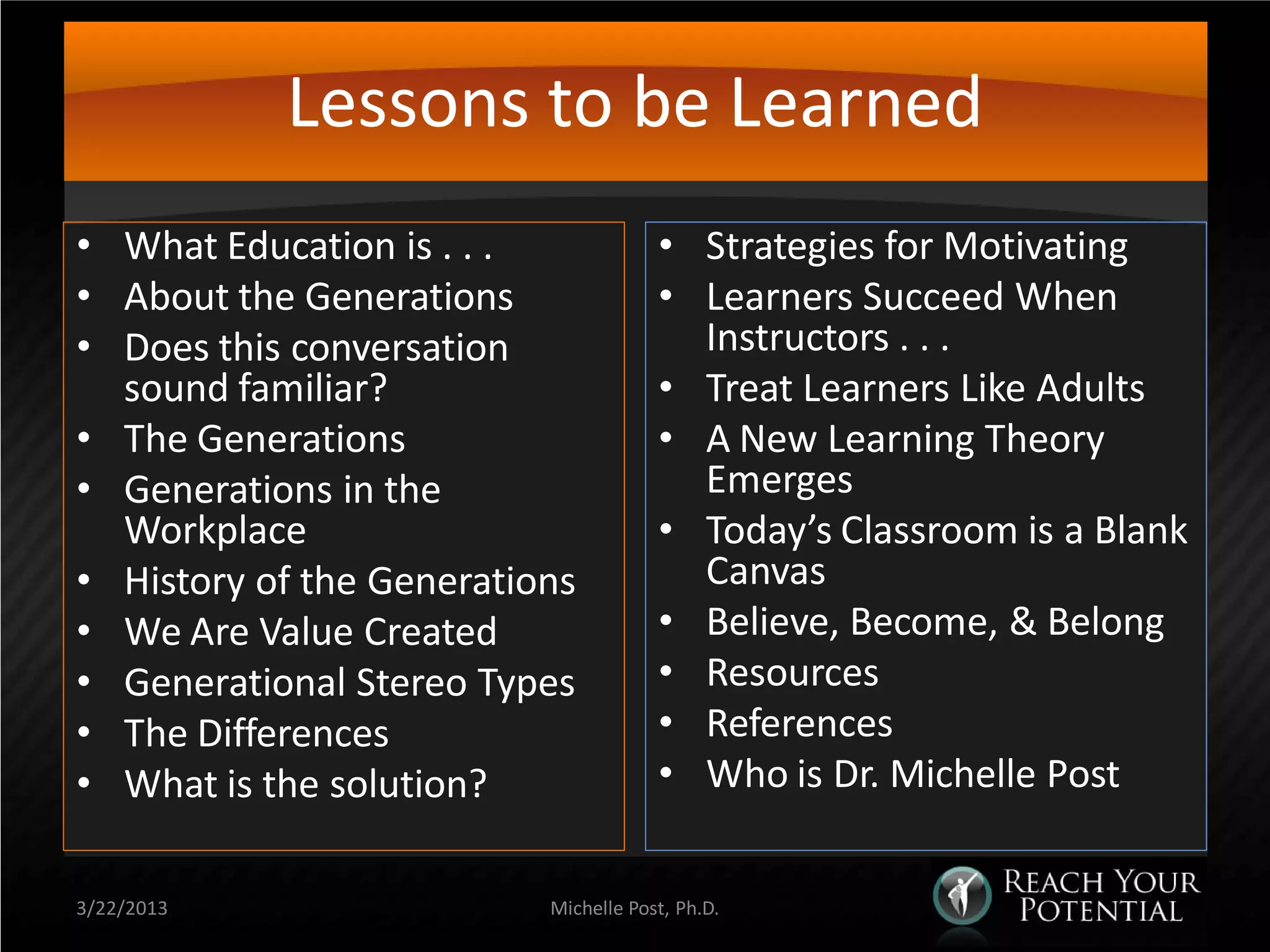
Lessons to be Learned
• What Education is . . .             • Strategies for Motivating
• About the Generations               • Learners Succeed When
• Does this conversation                Instructors . . .
  sound familiar?                     • Treat Learners Like Adults
• The Generations                     • A New Learning Theory
• Generations in the                    Emerges
  Workplace                           • Today’s Classroom is a Blank
• History of the Generations            Canvas
• We Are Value Created                • Believe, Become, & Belong
• Generational Stereo Types           • Resources
• The Differences                     • References
• What is the solution?               • Who is Dr. Michelle Post


3/22/2013                 Michelle Post, Ph.D.
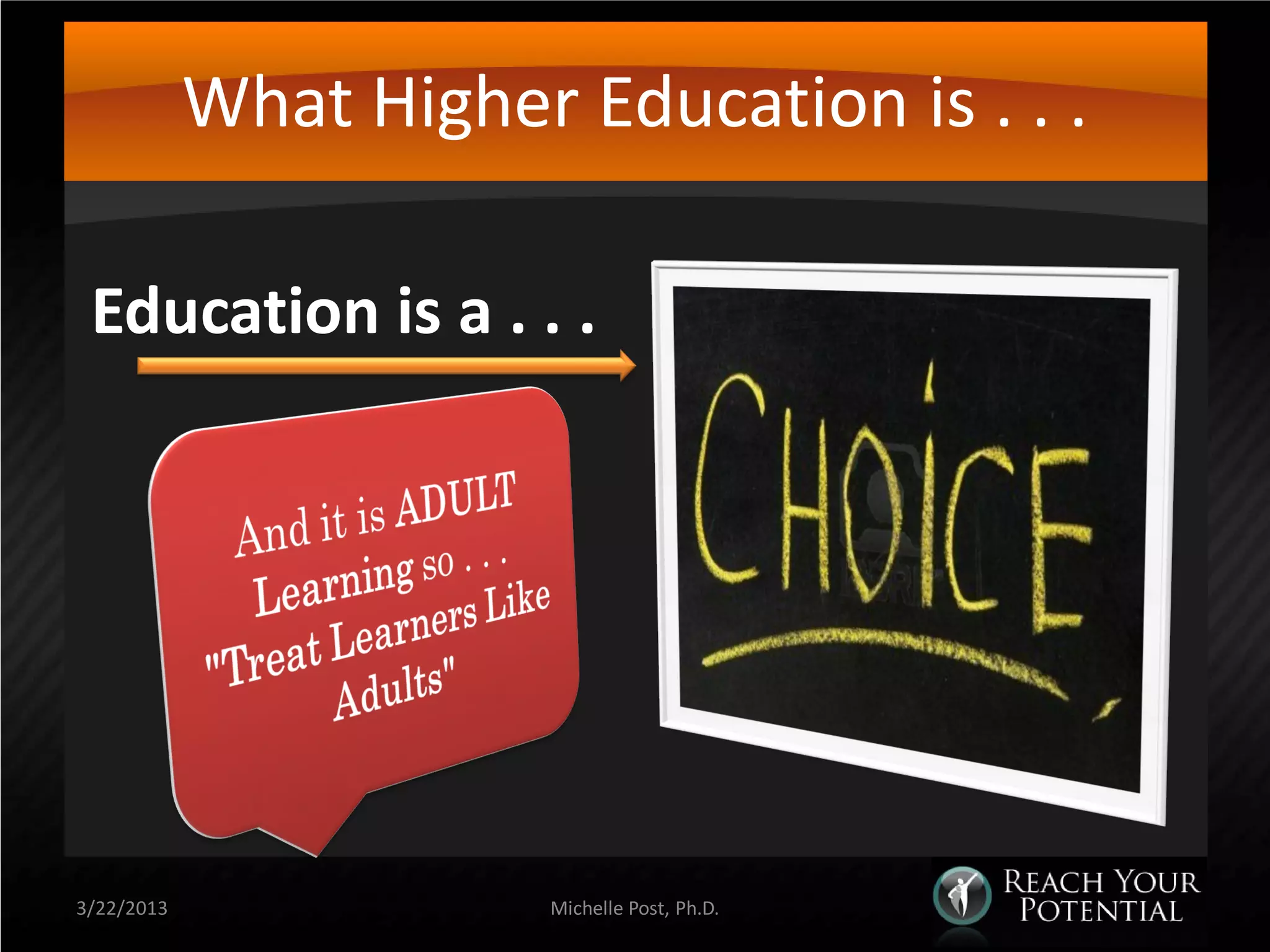
What Higher Education is . . .

 Education is a . . .


3/22/2013               Michelle Post, Ph.D.
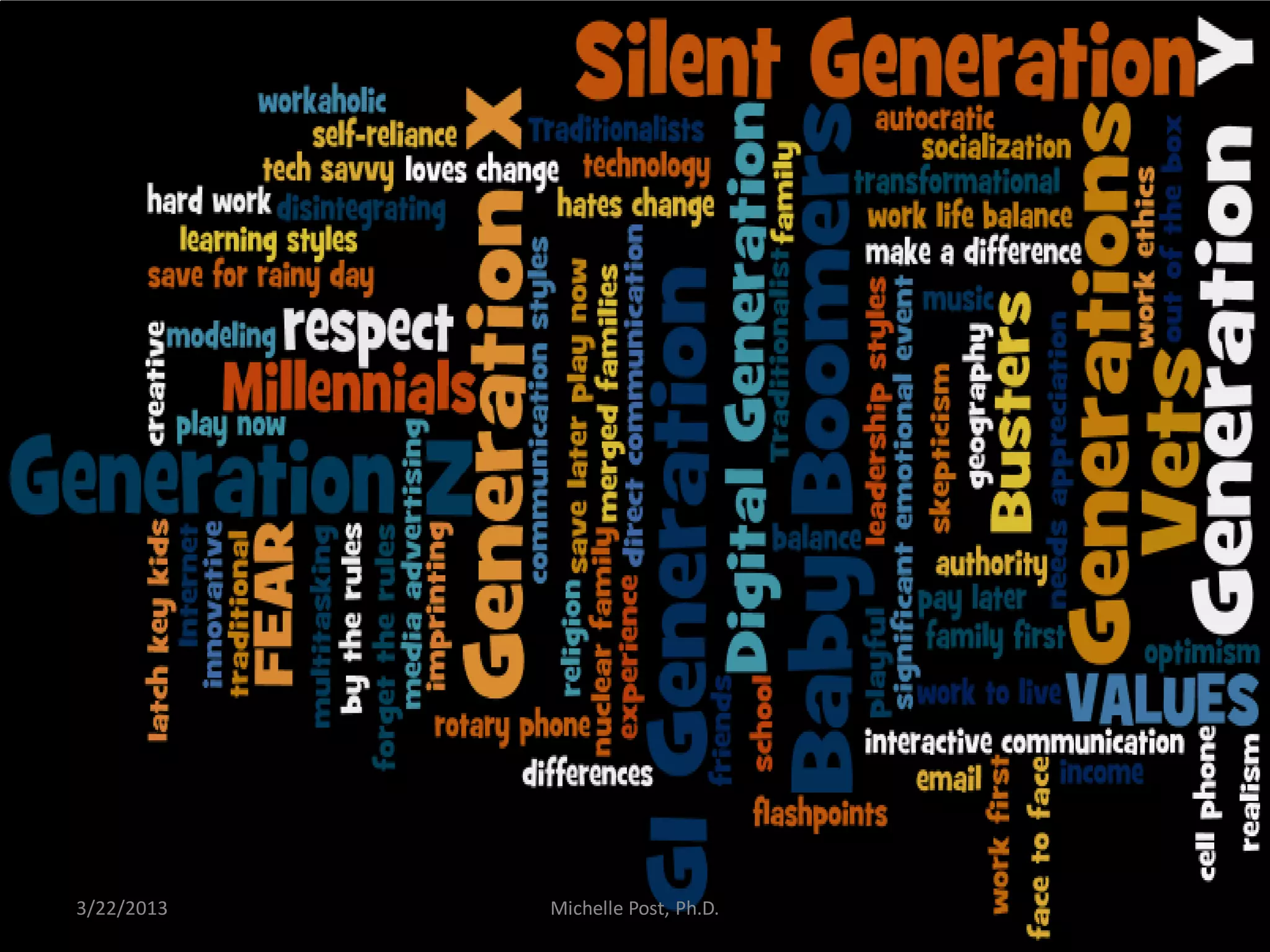
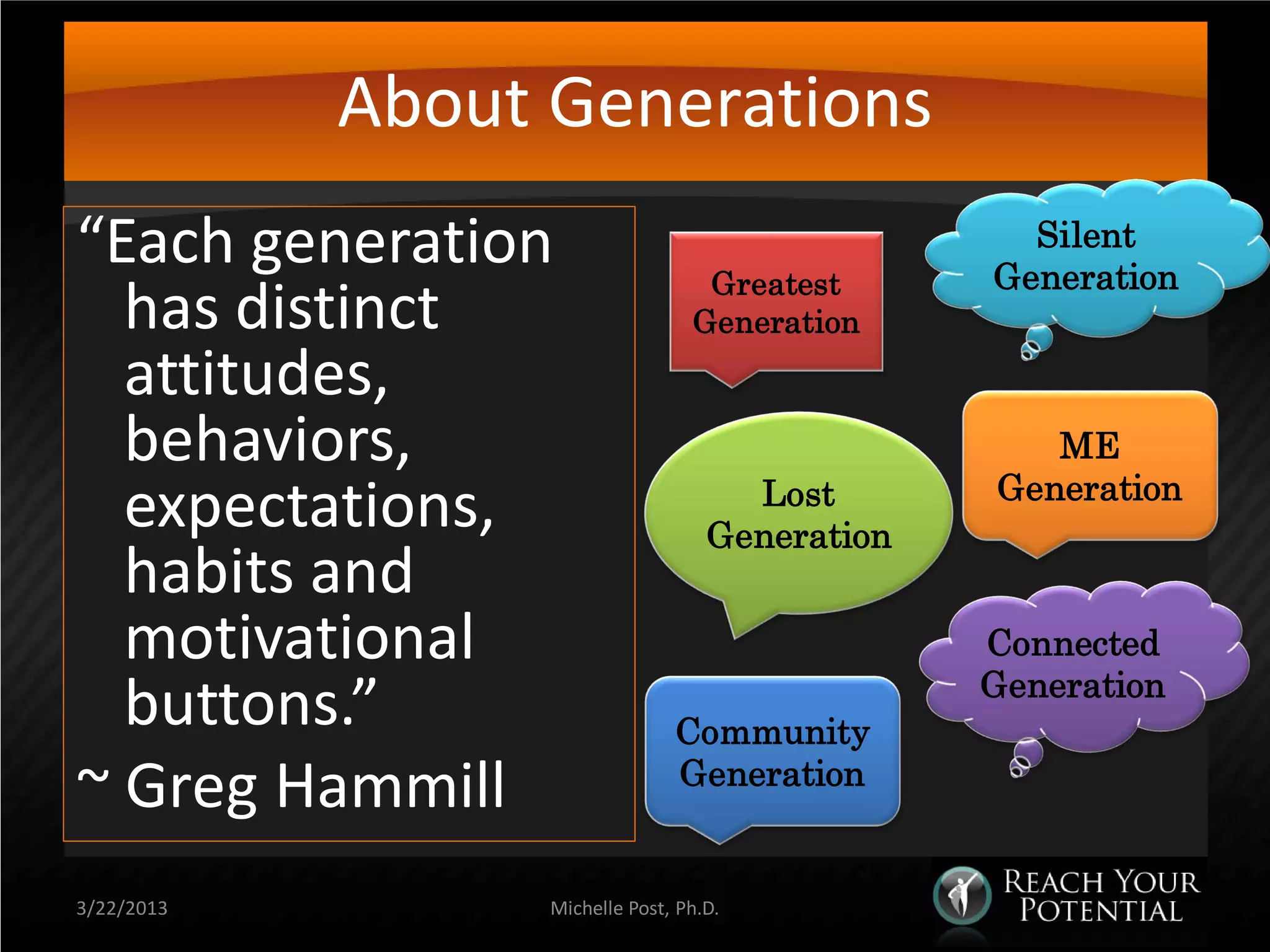
About Generations
“Each generation                   Greatest
                                                   Silent
                                                 Generation
  has distinct                    Generation
  attitudes,
  behaviors,                                        ME
                                                 Generation
  expectations,                       Lost
                                    Generation
  habits and
  motivational                                   Connected
                                                 Generation
  buttons.”                     Community
~ Greg Hammill                  Generation


3/22/2013         Michelle Post, Ph.D.
Does this Conversation Sound
                      Familiar?


                     Link Baby Boomer vs. Gen-Y:
            http://www.youtube.com/watch?v=V2k3Mx07B9I

3/22/2013                    Michelle Post, Ph.D.
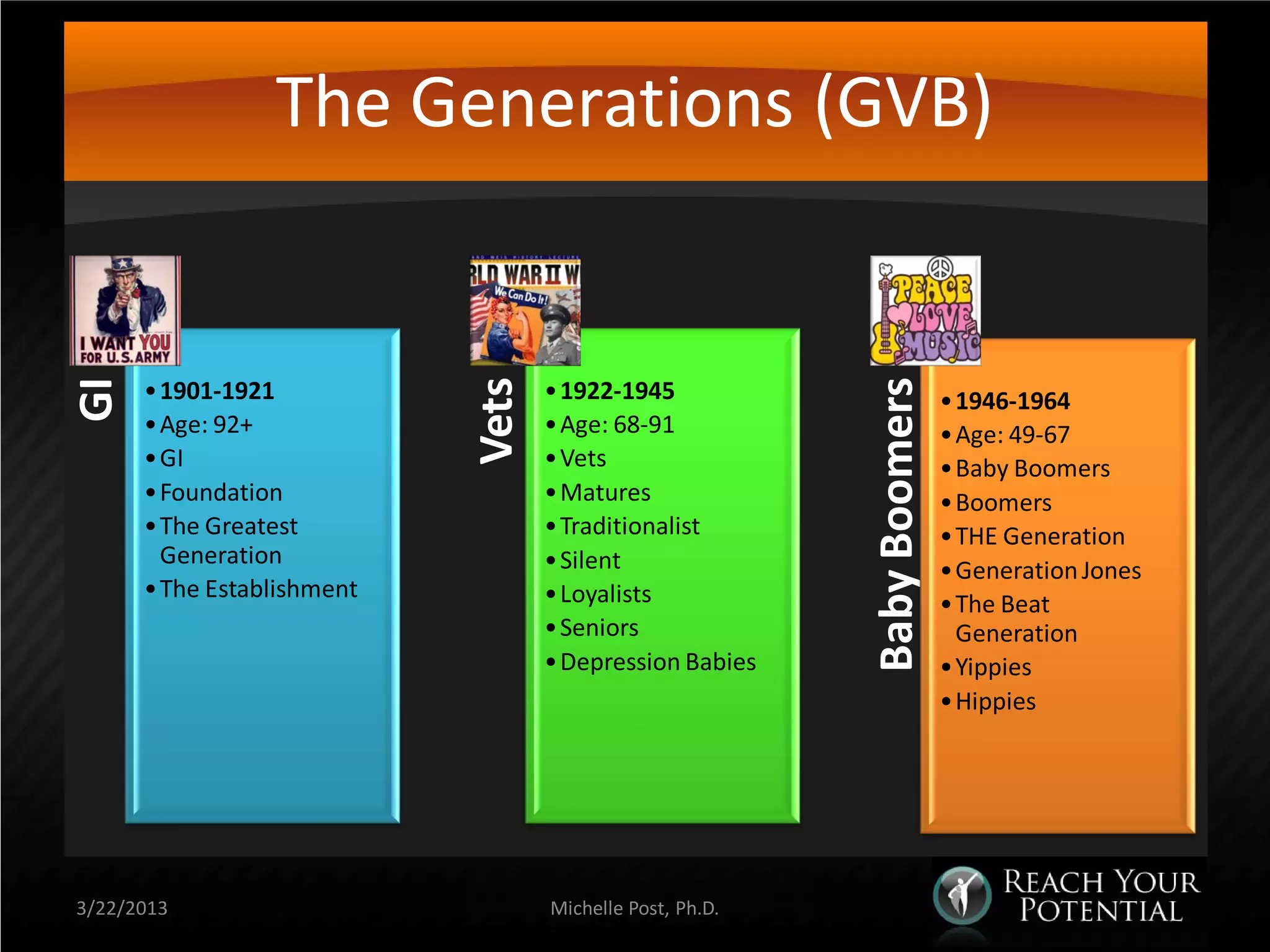
The Generations (GVB)


      •1901-1921                  •1922-1945


                           Vets


                                                         Baby Boomers
GI


                                                                        •1946-1964
      •Age: 92+                   •Age: 68-91                           •Age: 49-67
      •GI                         •Vets                                 •Baby Boomers
      •Foundation                 •Matures                              •Boomers
      •The Greatest               •Traditionalist                       •THE Generation
       Generation                 •Silent                               •Generation Jones
      •The Establishment          •Loyalists                            •The Beat
                                  •Seniors                               Generation
                                  •Depression Babies                    •Yippies
                                                                        •Hippies


3/22/2013                         Michelle Post, Ph.D.
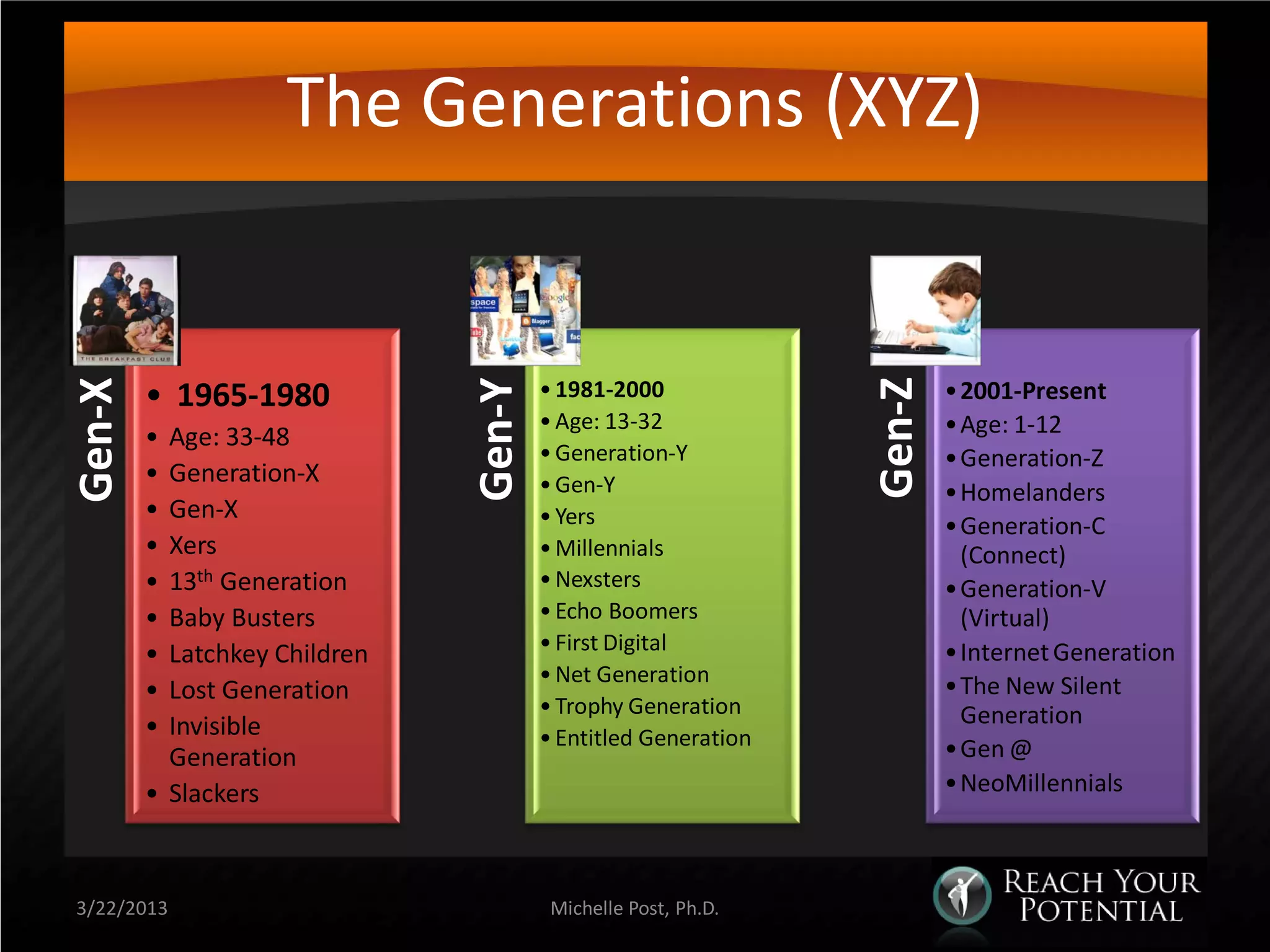
The Generations (XYZ)


        • 1965-1980                   • 1981-2000                     •2001-Present


                                                              Gen-Z
Gen-X


                              Gen-Y
                                      • Age: 13-32                    •Age: 1-12
        • Age: 33-48
                                      • Generation-Y                  •Generation-Z
        • Generation-X                • Gen-Y                         •Homelanders
        • Gen-X                       • Yers                          •Generation-C
        • Xers                        • Millennials                    (Connect)
        • 13th Generation             • Nexsters                      •Generation-V
        • Baby Busters                • Echo Boomers                   (Virtual)
        • Latchkey Children           • First Digital                 •Internet Generation
                                      • Net Generation                •The New Silent
        • Lost Generation
                                      • Trophy Generation              Generation
        • Invisible                   • Entitled Generation
          Generation                                                  •Gen @
        • Slackers                                                    •NeoMillennials


 3/22/2013                             Michelle Post, Ph.D.
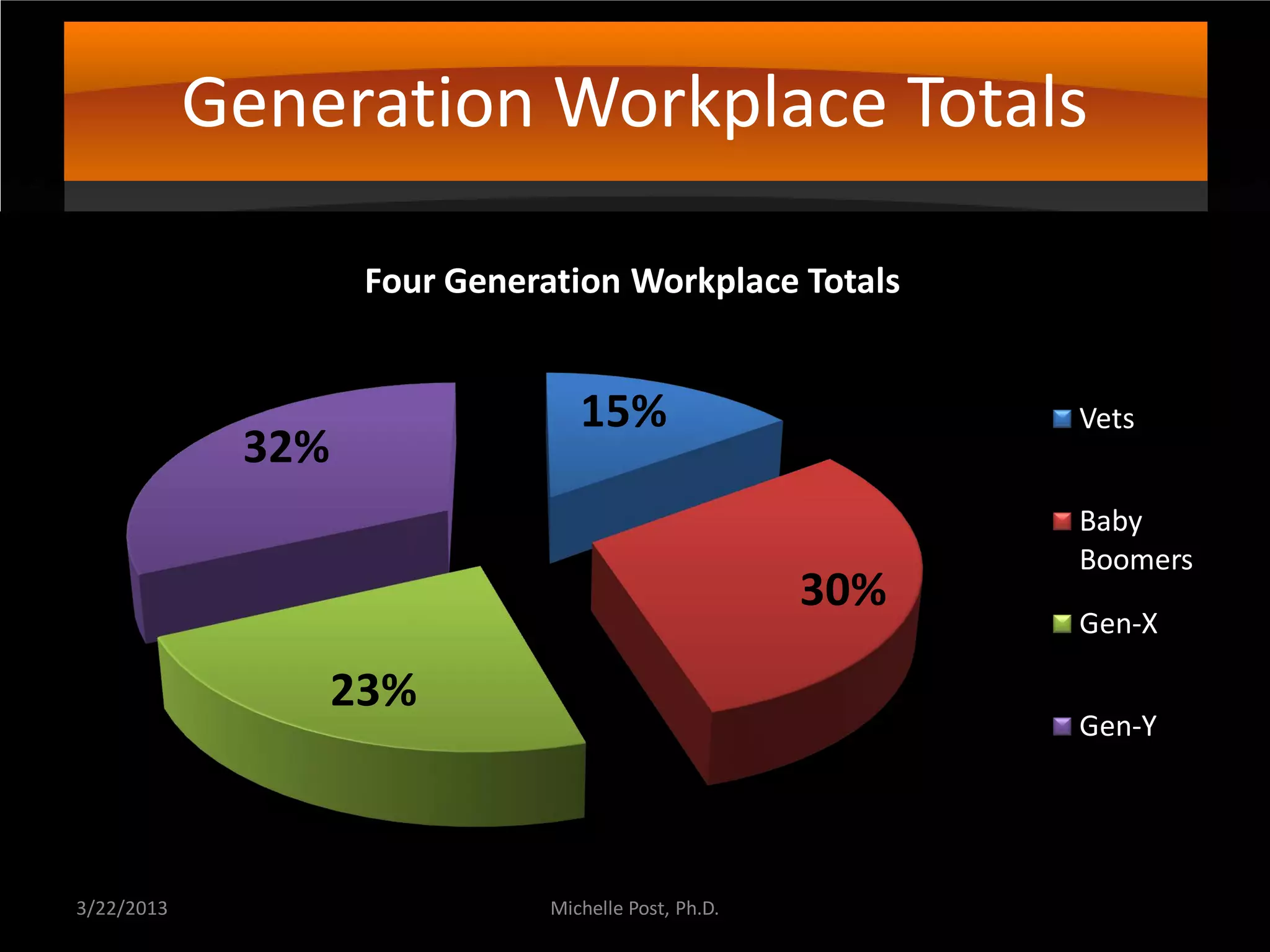
Generation Workplace Totals

                    Four Generation Workplace Totals


                                  15%                       Vets
             32%
                                                            Baby
                                                            Boomers
                                                      30%
                                                            Gen-X

                   23%
                                                            Gen-Y


3/22/2013                      Michelle Post, Ph.D.
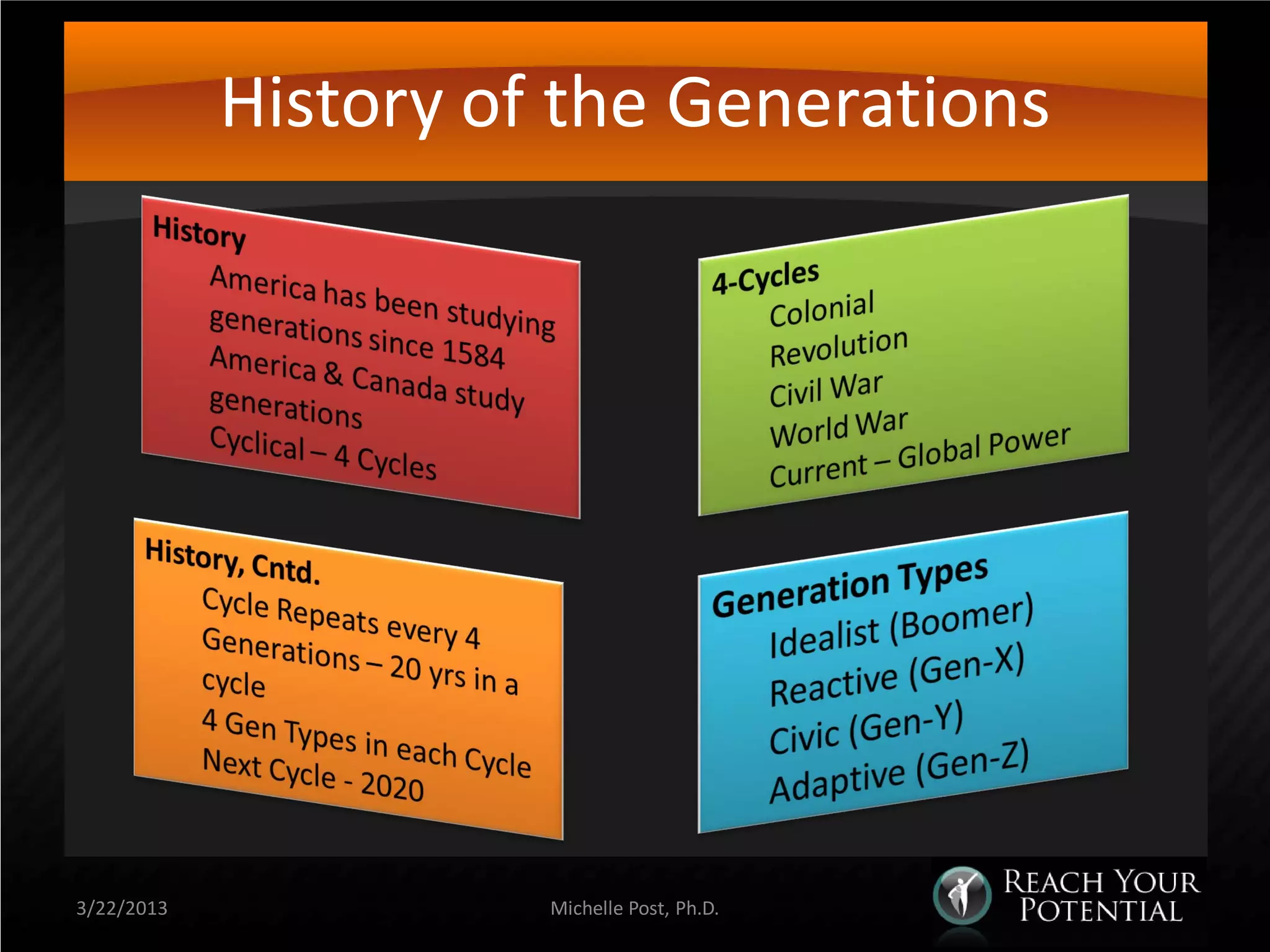
History of the Generations


3/22/2013             Michelle Post, Ph.D.
We are Value Created
  Value System         Impactors Affecting Values
                       1. Family
  • Culture            2. Friends
  • Age                3. Religion             S.E.E.
  • Gender Roles       4. Technology
                       5. School
  • Ethnicity          6. Media-Advertising
                       7. Music
            90%        8. Income               100%
                       9. Geography


3/22/2013          Michelle Post, Ph.D.
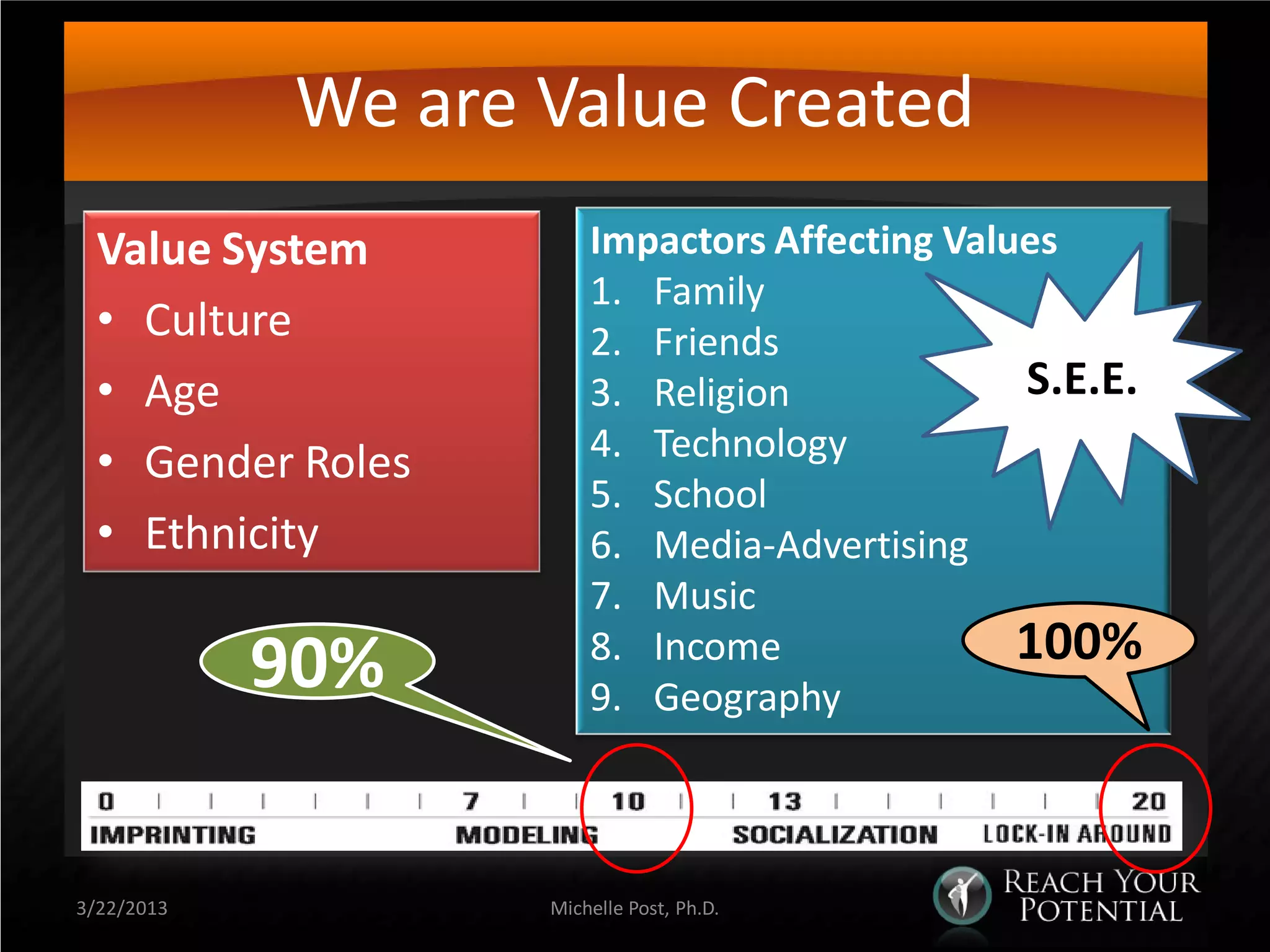
We Are Value Created Explained
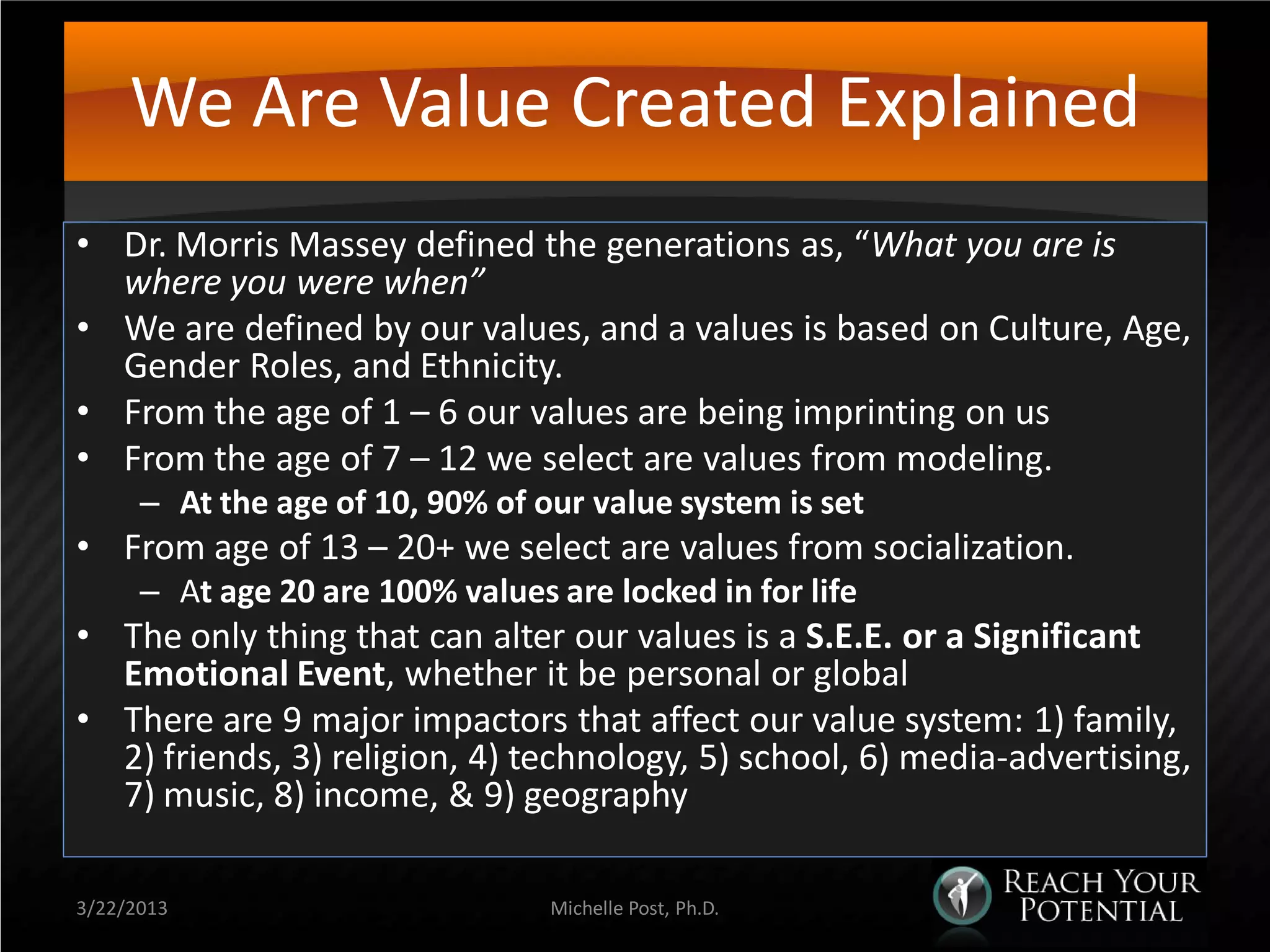
• Dr. Morris Massey defined the generations as, “What you are is
  where you were when”
• We are defined by our values, and a values is based on Culture, Age,
  Gender Roles, and Ethnicity.
• From the age of 1 – 6 our values are being imprinting on us
• From the age of 7 – 12 we select are values from modeling.
      – At the age of 10, 90% of our value system is set
• From age of 13 – 20+ we select are values from socialization.
      – At age 20 are 100% values are locked in for life
• The only thing that can alter our values is a S.E.E. or a Significant
  Emotional Event, whether it be personal or global
• There are 9 major impactors that affect our value system: 1) family,
  2) friends, 3) religion, 4) technology, 5) school, 6) media-advertising,
  7) music, 8) income, & 9) geography

3/22/2013                         Michelle Post, Ph.D.
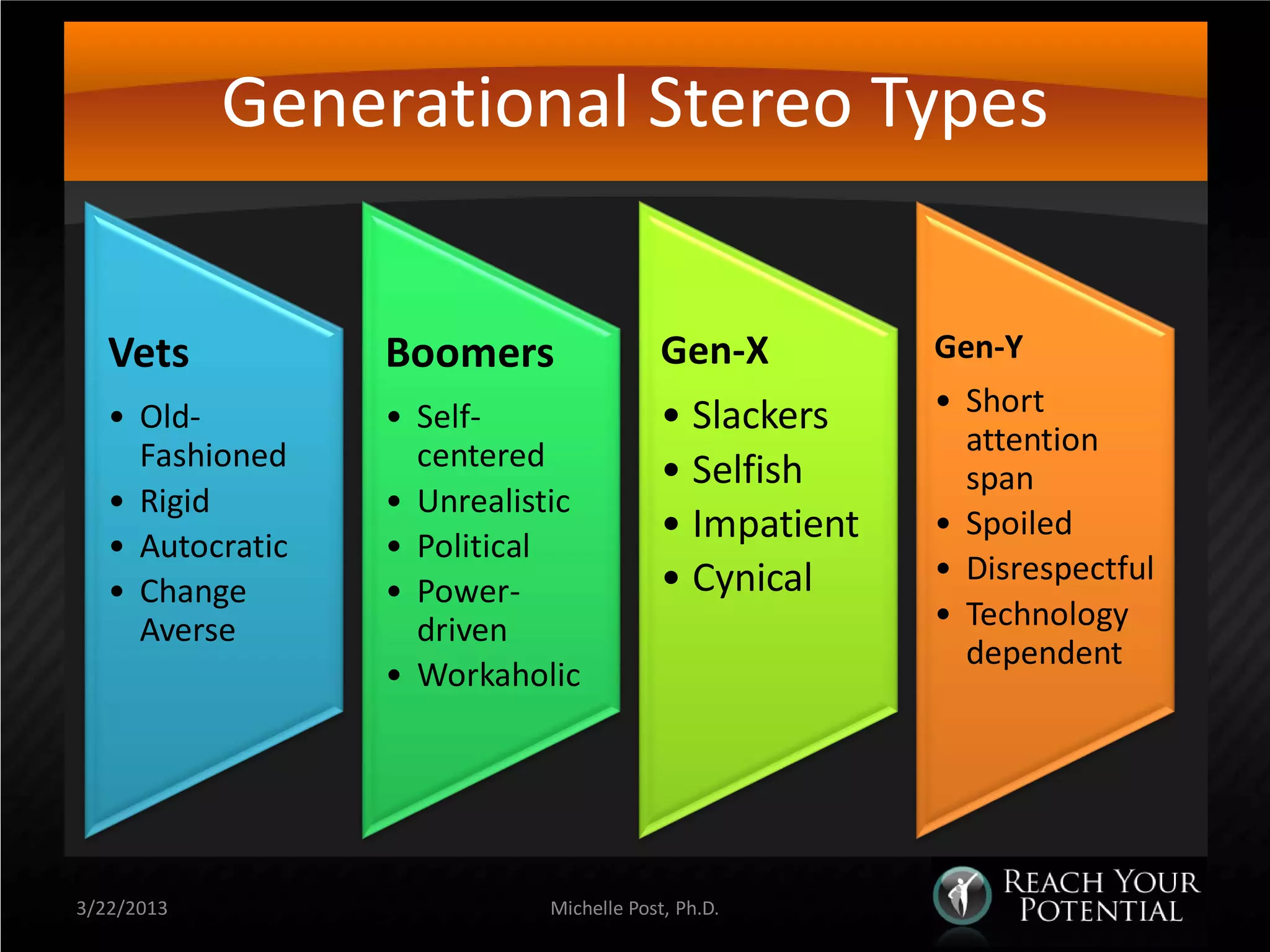
Generational Stereo Types


   Vets           Boomers                Gen-X         Gen-Y
   • Old-         • Self-                • Slackers    • Short
     Fashioned      centered                             attention
                                         • Selfish       span
   • Rigid        • Unrealistic
   • Autocratic   • Political
                                         • Impatient   • Spoiled
                                         • Cynical     • Disrespectful
   • Change       • Power-
     Averse         driven                             • Technology
                                                         dependent
                  • Workaholic


3/22/2013                   Michelle Post, Ph.D.
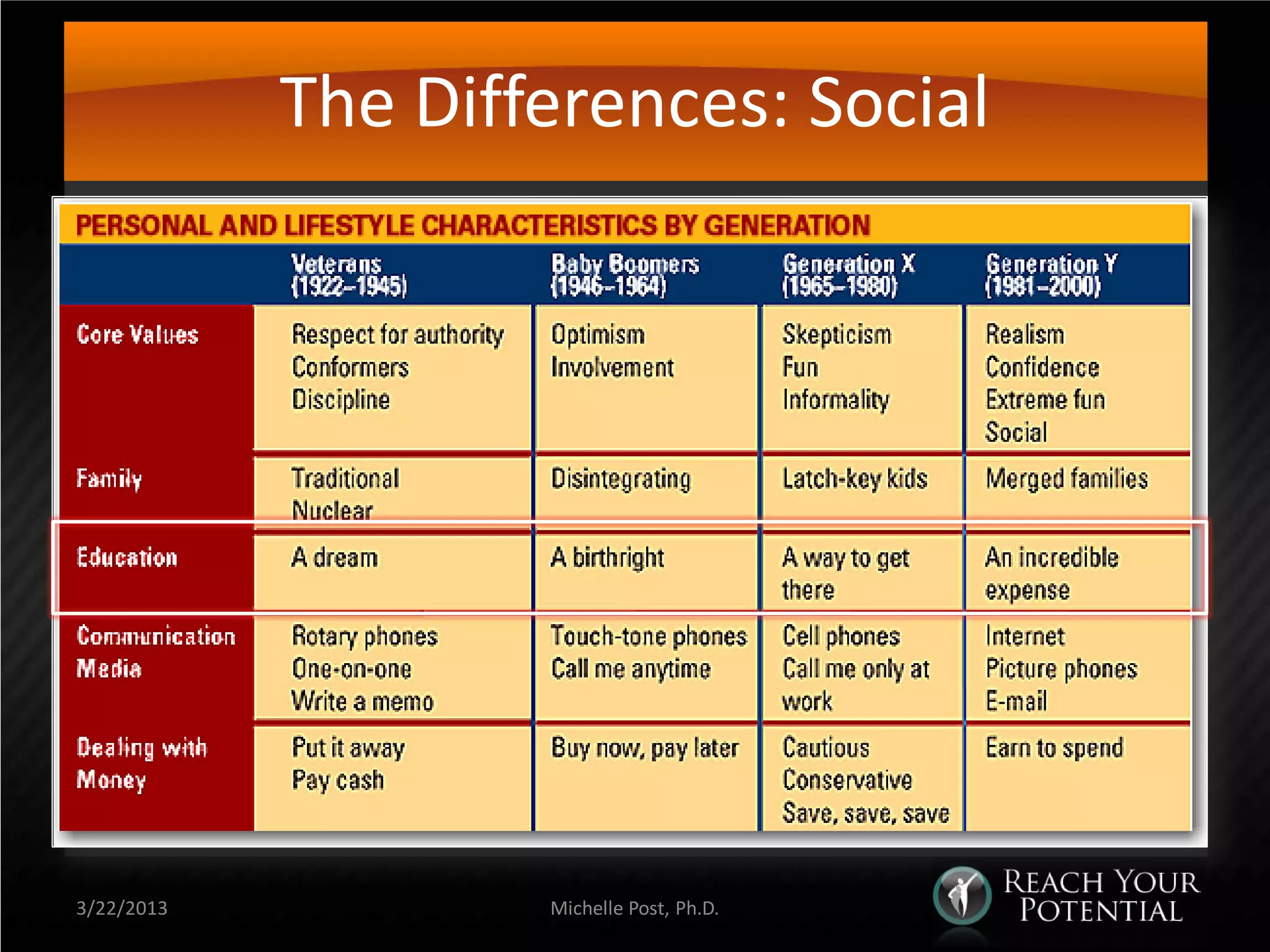
The Differences: Social


3/22/2013           Michelle Post, Ph.D.
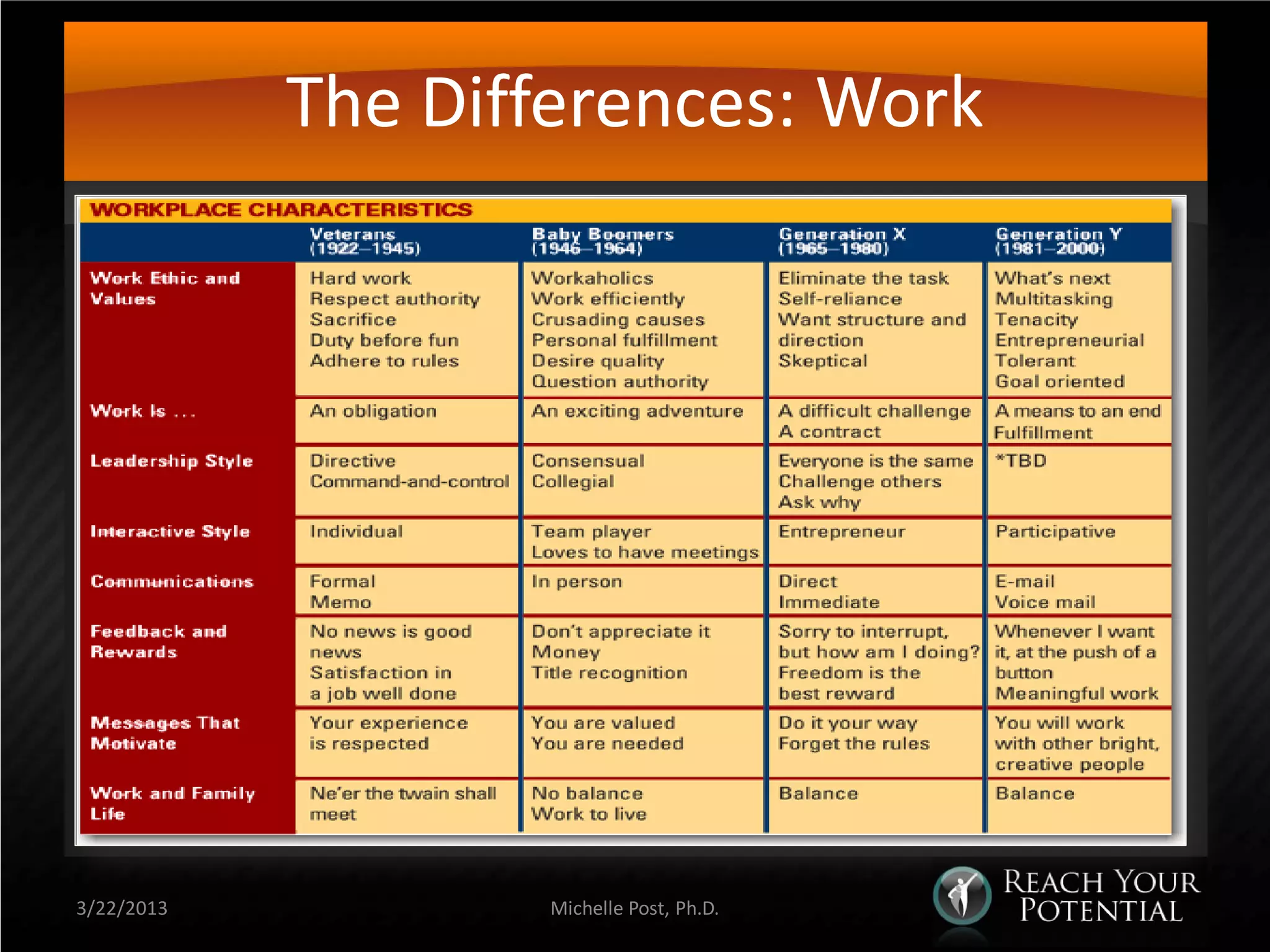
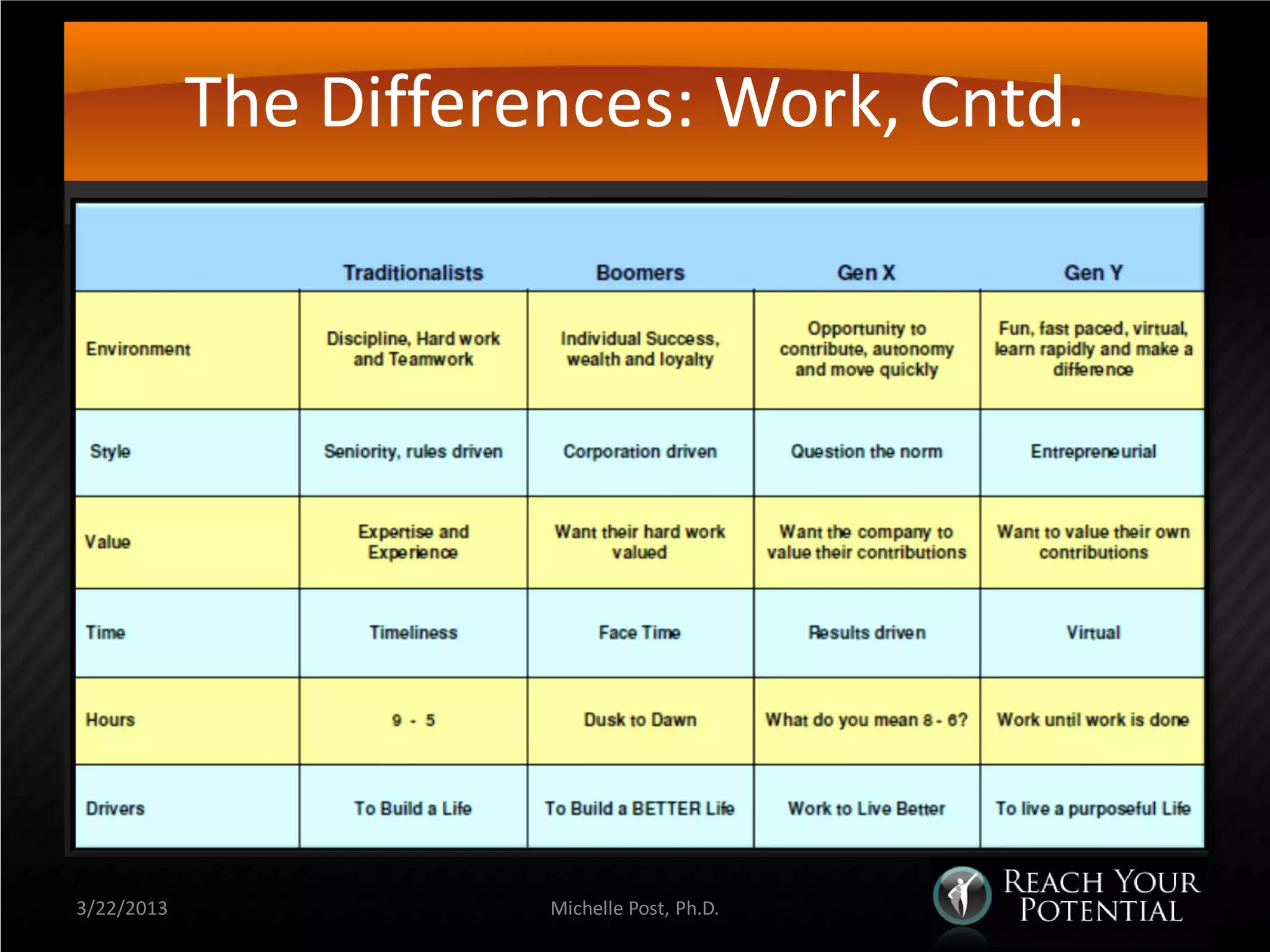
The Differences: Work


3/22/2013          Michelle Post, Ph.D.
The Differences: Work, Cntd.


3/22/2013              Michelle Post, Ph.D.
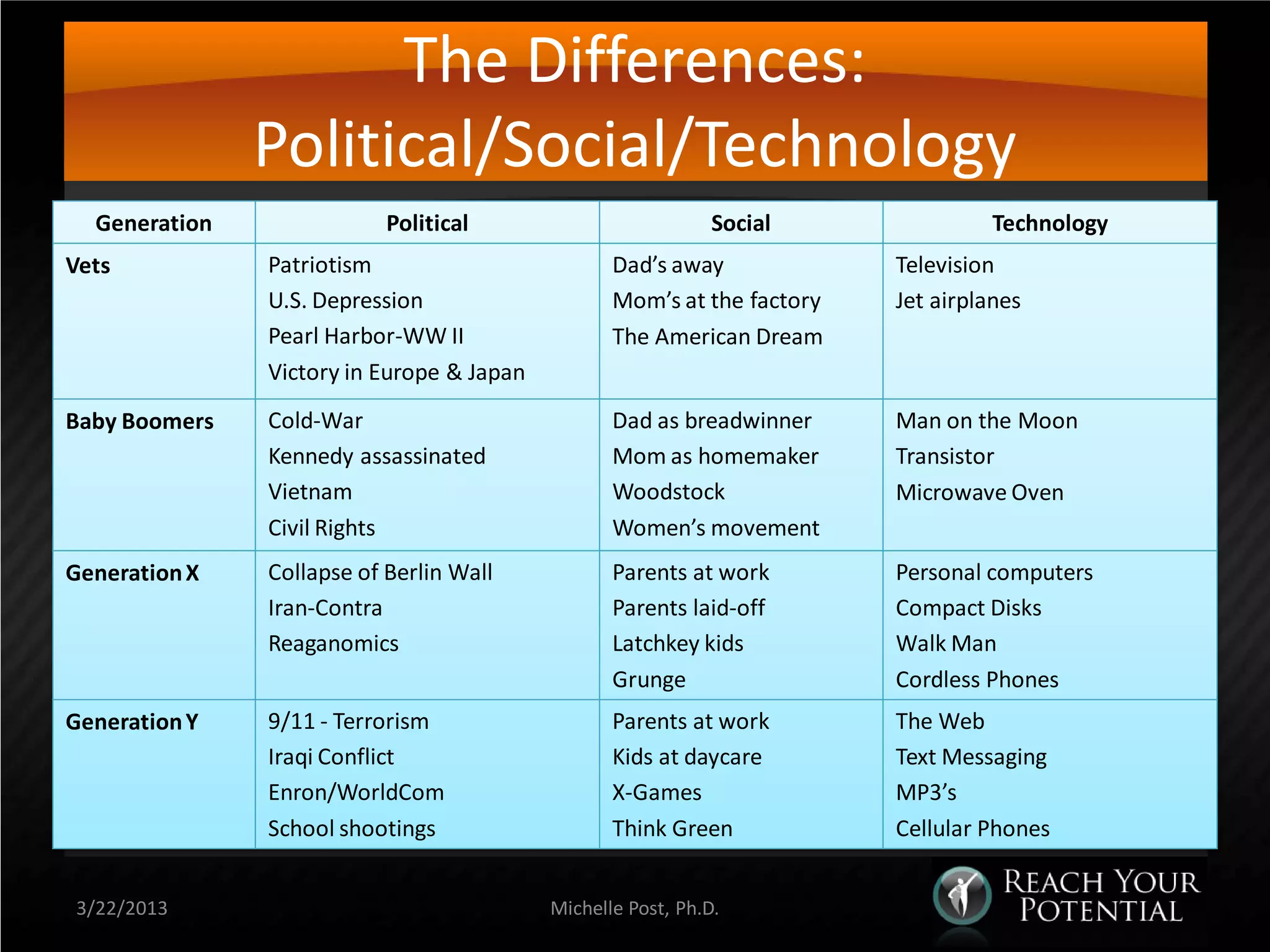
The Differences:
               Political/Social/Technology
  Generation               Political                          Social               Technology
Vets           Patriotism                         Dad’s away             Television
               U.S. Depression                    Mom’s at the factory   Jet airplanes
               Pearl Harbor-WW II                 The American Dream
               Victory in Europe & Japan
Baby Boomers   Cold-War                           Dad as breadwinner     Man on the Moon
               Kennedy assassinated               Mom as homemaker       Transistor
               Vietnam                            Woodstock              Microwave Oven
               Civil Rights                       Women’s movement
Generation X   Collapse of Berlin Wall            Parents at work        Personal computers
               Iran-Contra                        Parents laid-off       Compact Disks
               Reaganomics                        Latchkey kids          Walk Man
                                                  Grunge                 Cordless Phones
Generation Y   9/11 - Terrorism                   Parents at work        The Web
               Iraqi Conflict                     Kids at daycare        Text Messaging
               Enron/WorldCom                     X-Games                MP3’s
               School shootings                   Think Green            Cellular Phones


3/22/2013                                  Michelle Post, Ph.D.
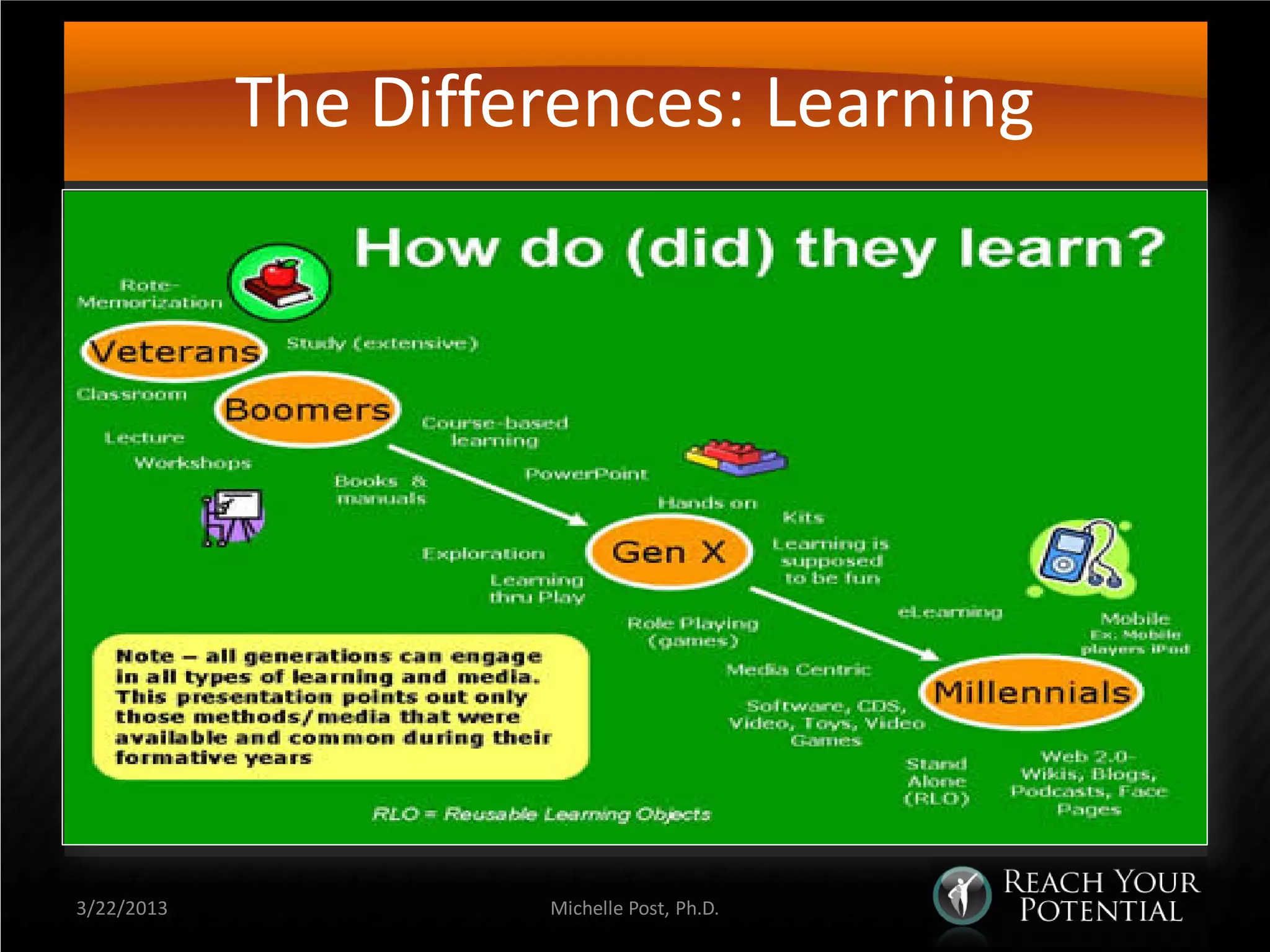
The Differences: Learning


3/22/2013            Michelle Post, Ph.D.
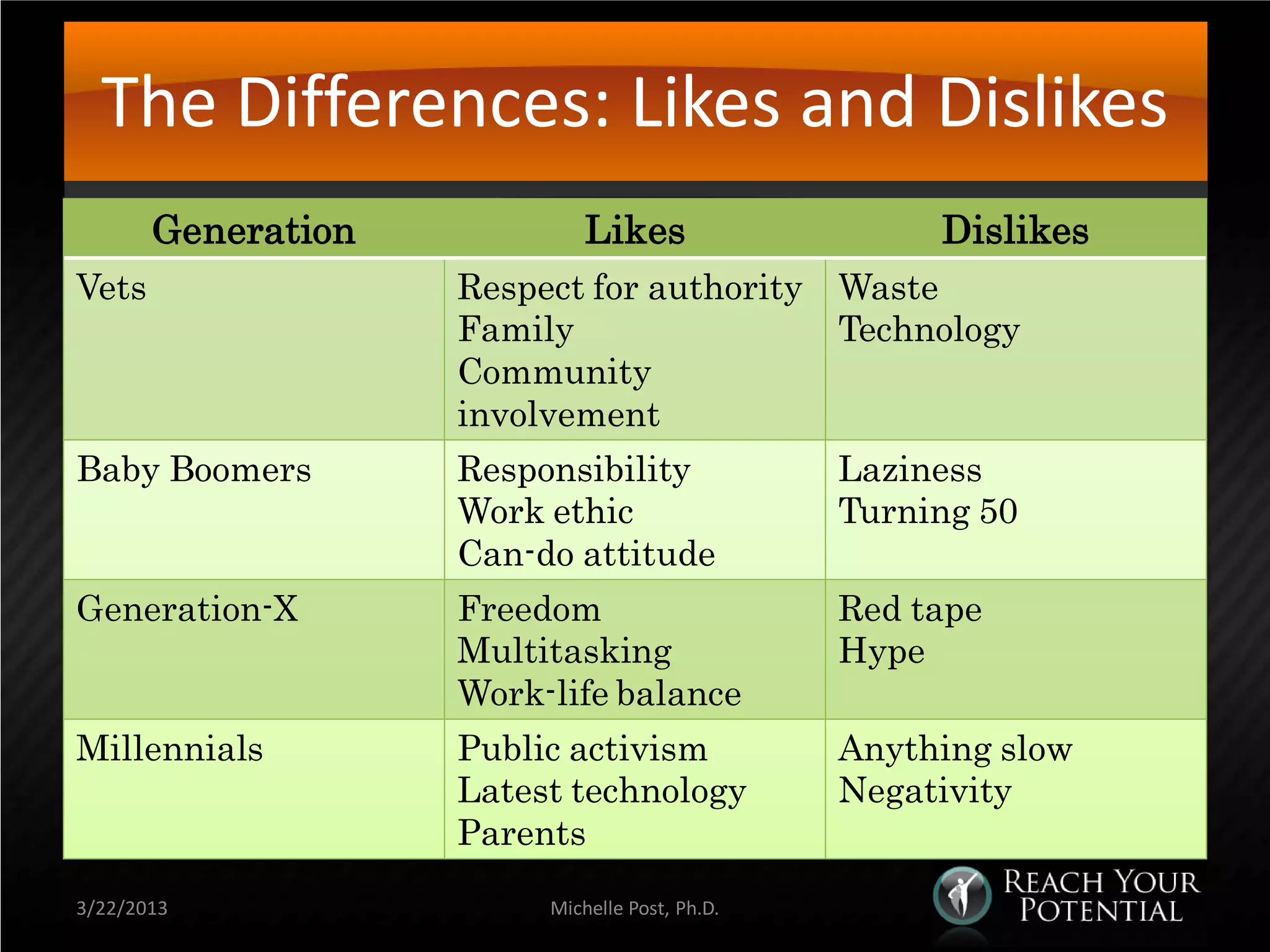
The Differences: Likes and Dislikes
       Generation            Likes                   Dislikes
Vets                Respect for authority Waste
                    Family                Technology
                    Community
                    involvement
Baby Boomers        Responsibility              Laziness
                    Work ethic                  Turning 50
                    Can-do attitude
Generation-X        Freedom                     Red tape
                    Multitasking                Hype
                    Work-life balance
Millennials         Public activism             Anything slow
                    Latest technology           Negativity
                    Parents
3/22/2013                Michelle Post, Ph.D.
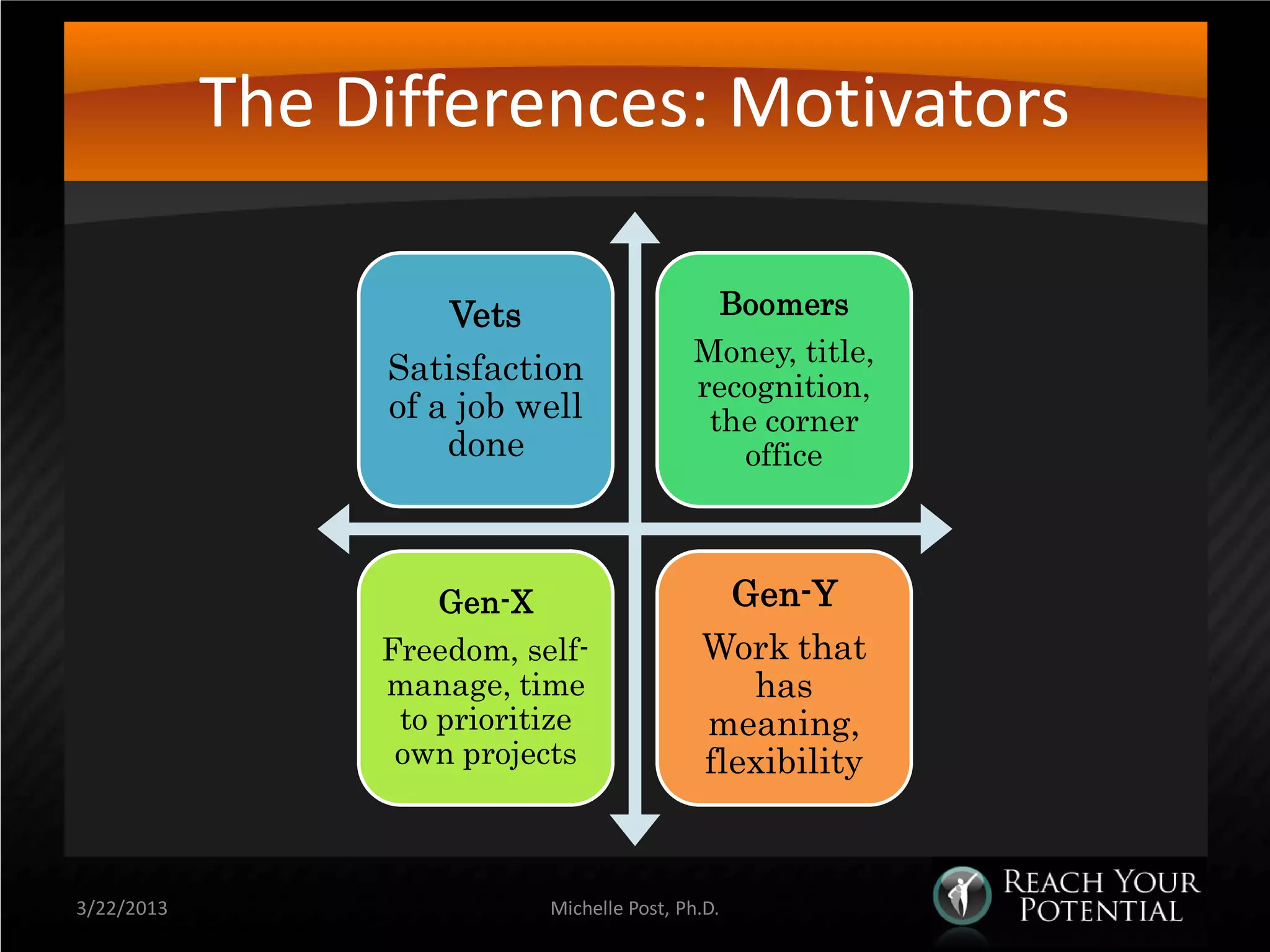
The Differences: Motivators

                     Vets                     Boomers
                                            Money, title,
                 Satisfaction               recognition,
                 of a job well               the corner
                     done                      office


                     Gen-X                     Gen-Y
                 Freedom, self-              Work that
                 manage, time                   has
                  to prioritize              meaning,
                  own projects               flexibility


3/22/2013                   Michelle Post, Ph.D.
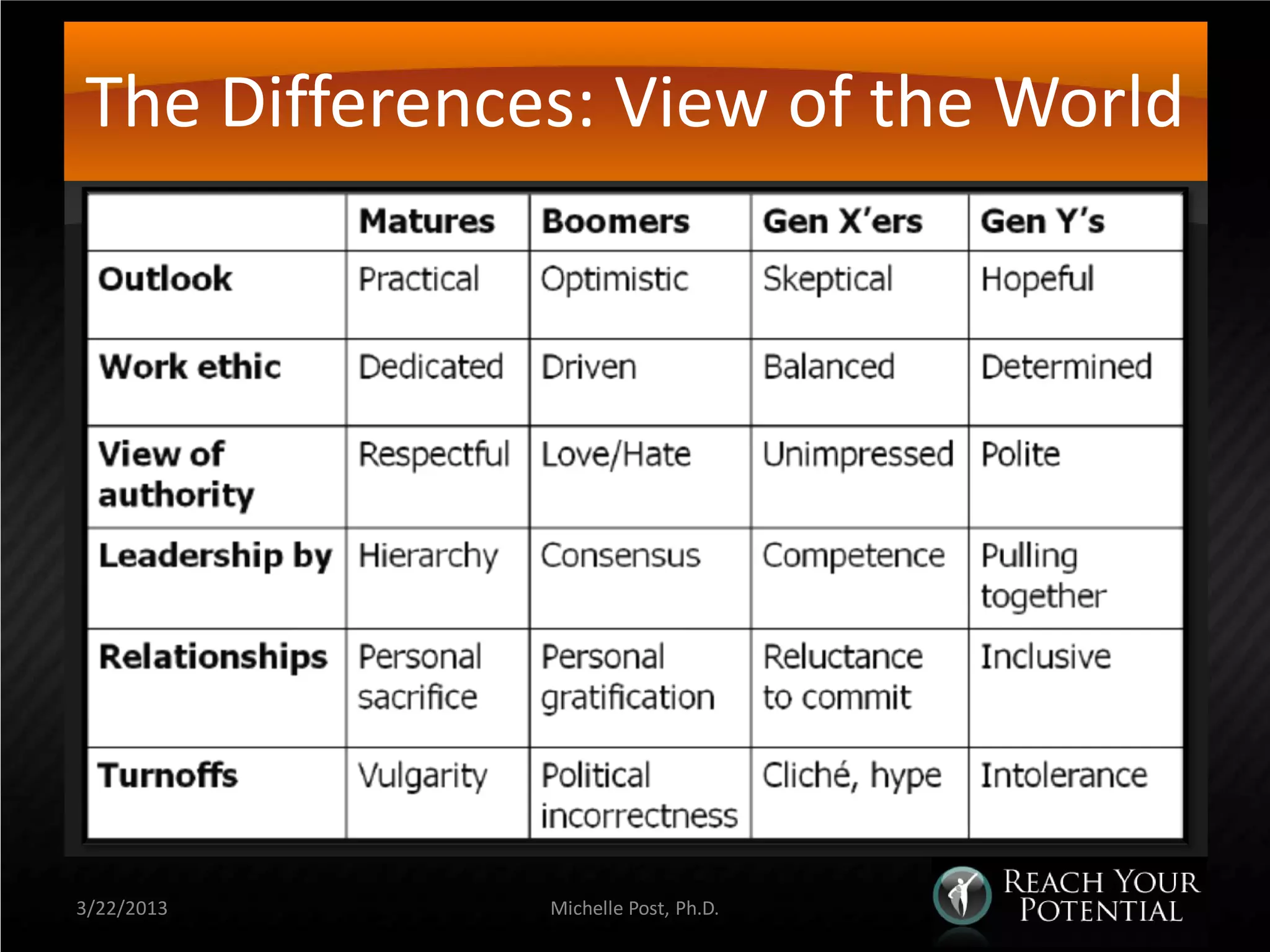
The Differences: View of the World


3/22/2013     Michelle Post, Ph.D.
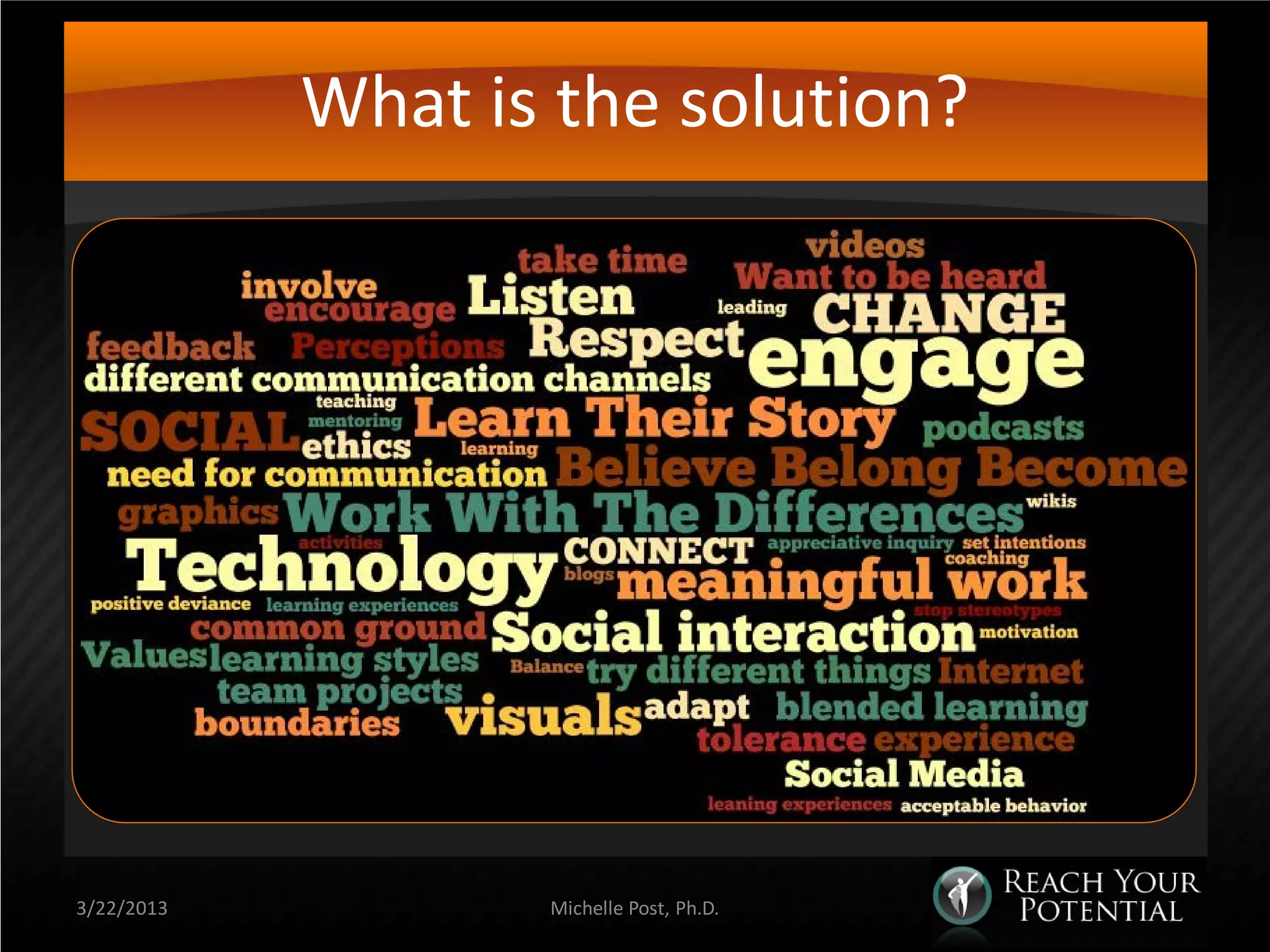
What is the solution?


3/22/2013          Michelle Post, Ph.D.
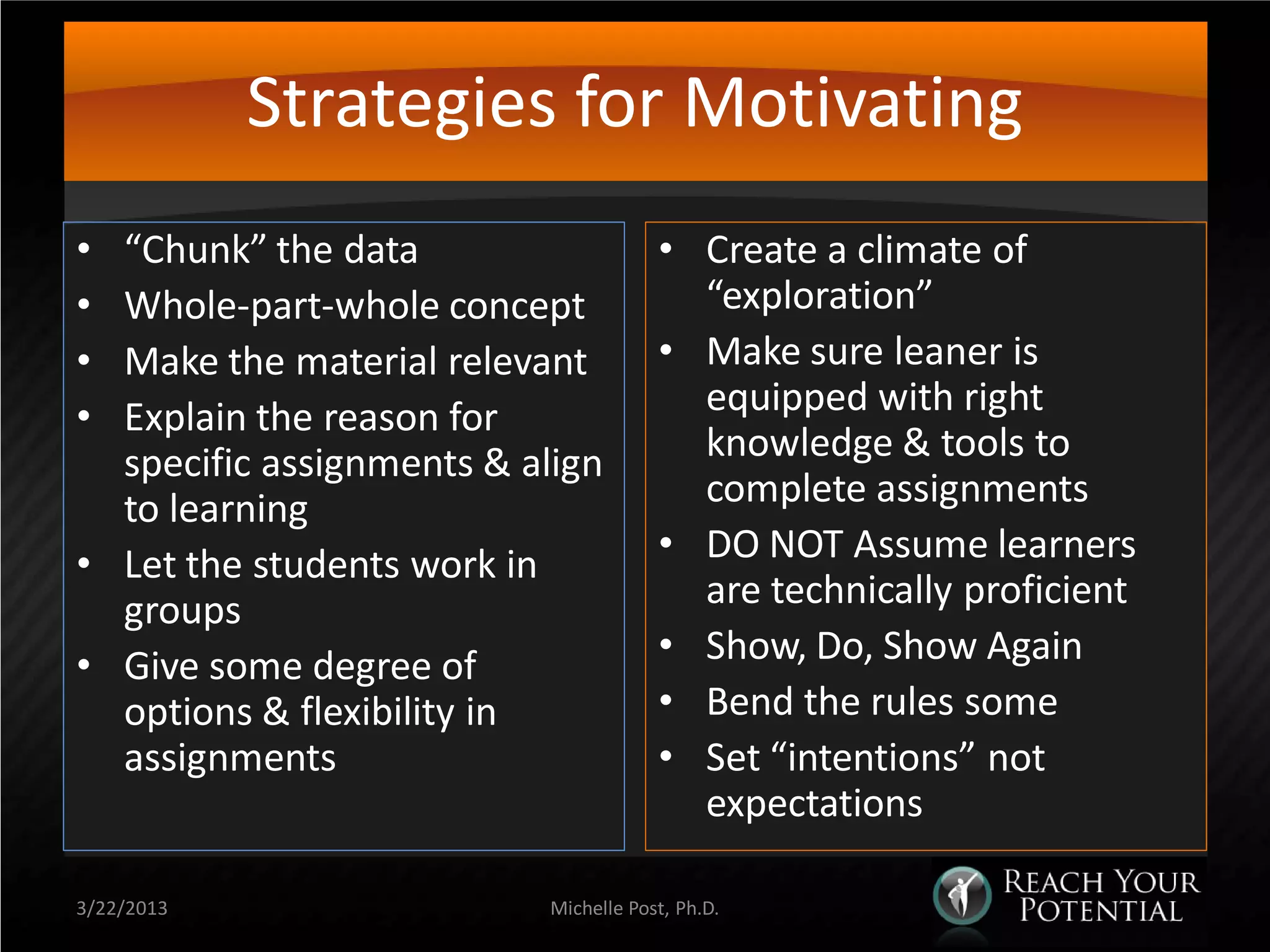
Strategies for Motivating
• “Chunk” the data                    • Create a climate of
• Whole-part-whole concept              “exploration”
• Make the material relevant          • Make sure leaner is
• Explain the reason for                equipped with right
  specific assignments & align          knowledge & tools to
  to learning                           complete assignments
• Let the students work in            • DO NOT Assume learners
  groups                                are technically proficient
• Give some degree of                 • Show, Do, Show Again
  options & flexibility in            • Bend the rules some
  assignments                         • Set “intentions” not
                                        expectations

3/22/2013                 Michelle Post, Ph.D.
Learners Succeed When Instructors . . .
• Create a relaxed and safe                    • Match teaching method to
  atmosphere.                                    content.
• Accommodate different                        • Build on students' experience.
  learning styles.                             • Encourage self-motivated
• Present information using                      learning.
  both visual and auditory                     • Include team learning projects.
  methods.                                     • Avoid setting up competition.
• Talk with students, not at                   • Support theory with real-life
  them.                                          examples.
• Recognize student uniqueness.                • Make class sessions
• Validate cultural differences.                 interactive.
• Let students influence course                • Provide frequent positive
  coverage                                       feedback

Blog: http://www.adultstudent.com/eds/articles/teaching.html
3/22/2013                          Michelle Post, Ph.D.
Treat Learners Like Adults
Adults are people . . .              • Relate new knowledge
• With years of experience             against personal
                                       experiences
• A wealth of information
                                     • Need breaks
• Established values, beliefs
  & opinions                         • Deep need to be self-
                                       directing
• Personal style has
  changed                            • Whose individual
                                       differences among people
• Learning style has                   increase with age
  changed
                                     • Have a problem-centered
• Have pride                           orientation to learning

3/22/2013                Michelle Post, Ph.D.
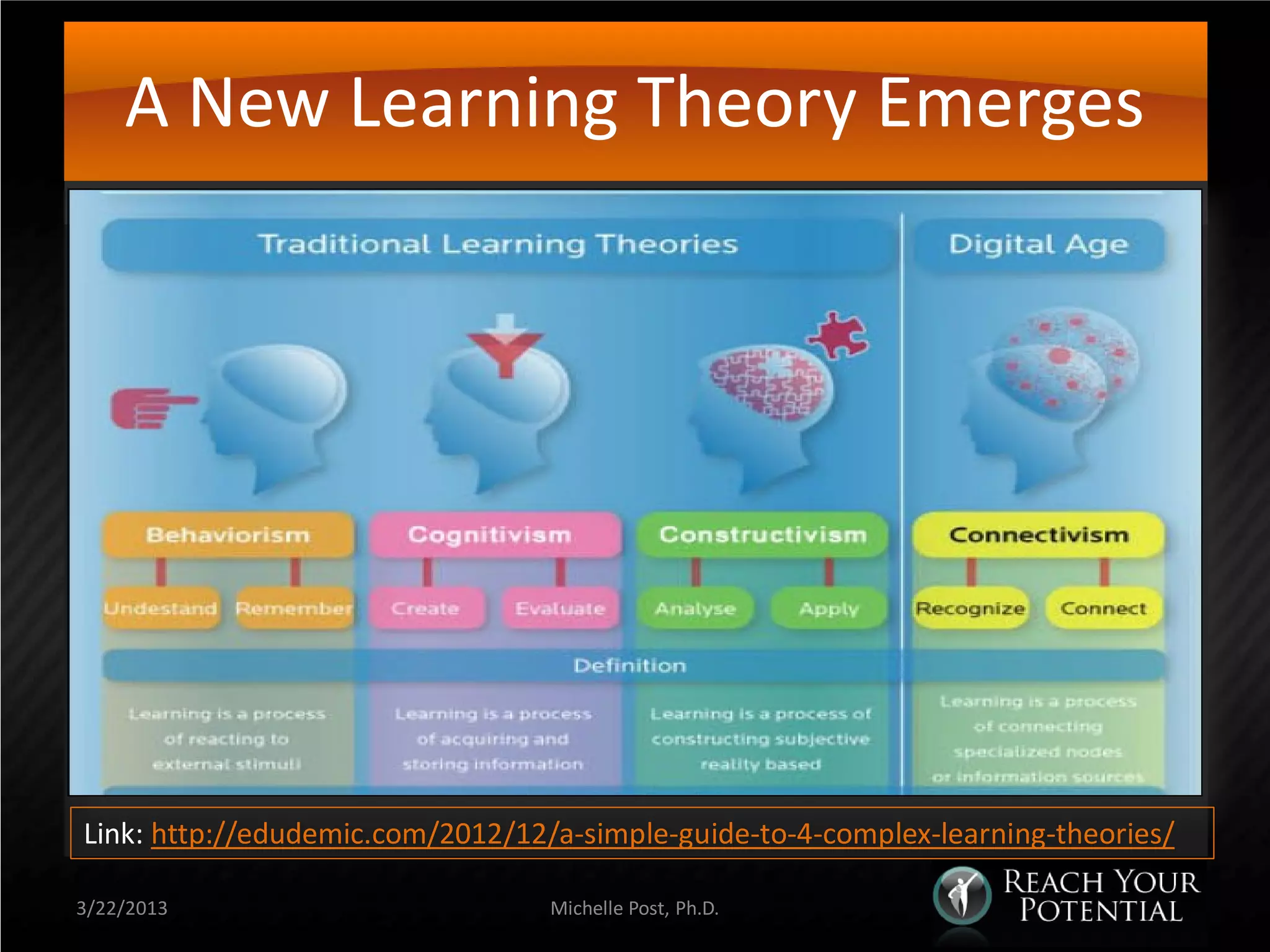
A New Learning Theory Emerges


Link: http://edudemic.com/2012/12/a-simple-guide-to-4-complex-learning-theories/

3/22/2013                         Michelle Post, Ph.D.
Today’s Classroom is a Blank Canvas
• “Today’s classroom is literally a blank canvas of unlimited possibilities, it
  just takes creativity and imagination to make learning fun & relevant.” Dr.
  Michelle Post

Just a Few Inspirational Presentations on the Possibilities . . .
• Using E-Learning - http://www.slideshare.net/zaid/using-elearning-to-
   facilitate-21st-century-learning-1847954
• Social Media for Research - http://www.slideshare.net/zaid/social-media-
   for-research-17192868
• Embracing OER & MOOCs to Transform Education -
   http://www.slideshare.net/zaid/embracing-oer-moocs-to-transform-
   education
• 16 Learning Trends We Simply Can’t Ignore -
   http://www.slideshare.net/zaid/16-learning-trends-we-simply-cant-ignore
• DNA of a 21st Century Educator - http://www.slideshare.net/zaid/dna-of-a-
   21st-century-educator-v3

3/22/2013                         Michelle Post, Ph.D.
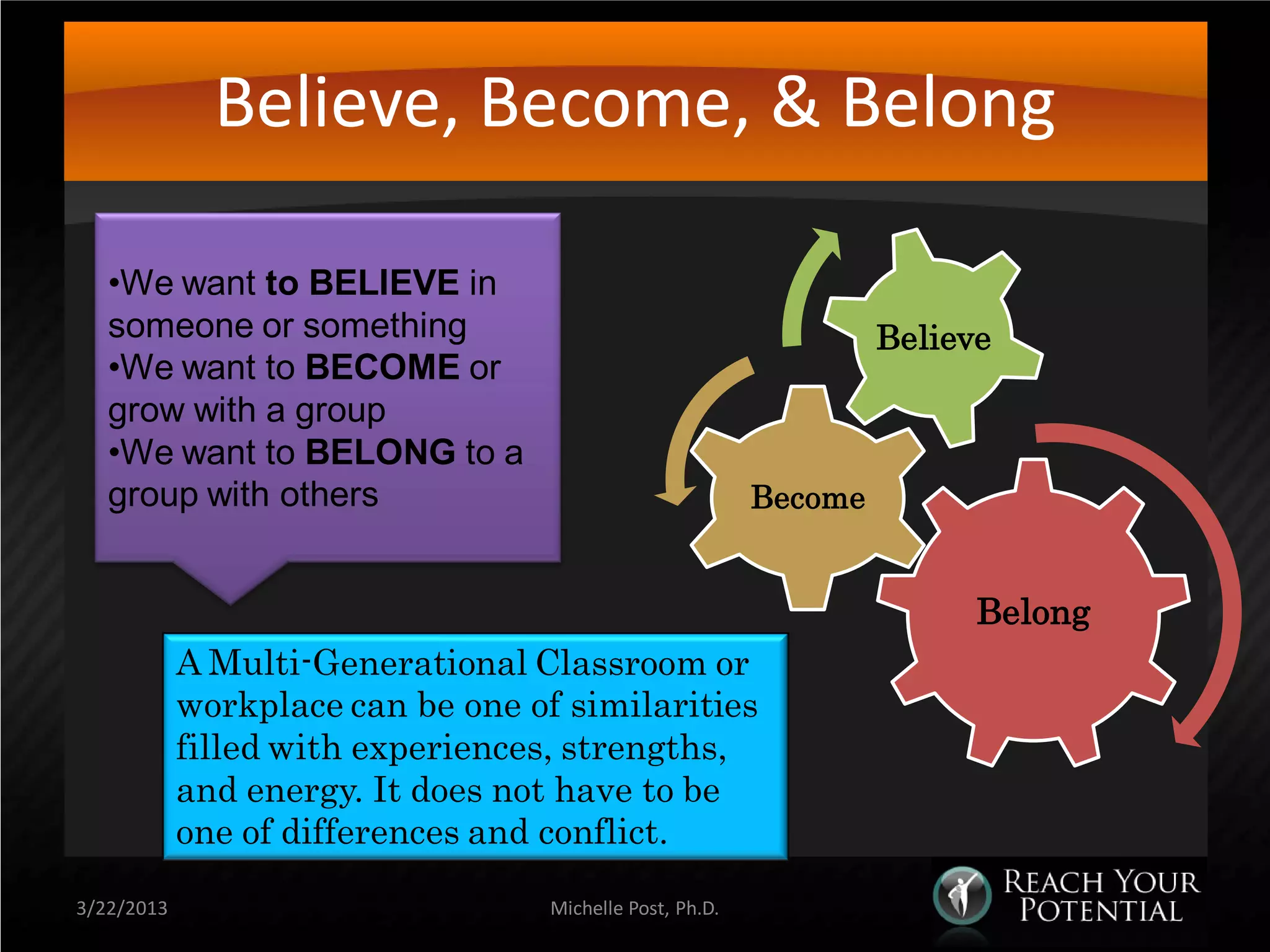
Believe, Become, & Belong

   •We want to BELIEVE in
   someone or something                                            Believe
   •We want to BECOME or
   grow with a group
   •We want to BELONG to a
   group with others                                      Become


                                                                         Belong
            A Multi-Generational Classroom or
            workplace can be one of similarities
            filled with experiences, strengths,
            and energy. It does not have to be
            one of differences and conflict.

3/22/2013                          Michelle Post, Ph.D.
RESOURCES, RESOURCES, & MORE
   RESOURCES

3/22/2013      Michelle Post, Ph.D.
Suggested Reading
• Amazon’s Top 38 Books on Generations:
  http://amzn.to/10uCKuF
• Howe, N., & Strauss, W. (1992). Generations: The History of
  America's Future, 1584 to 2069
• Zemke, R., Raines, C., & Filipczak, B. (1999). Generations at
  Work: Managing the Clash of Veterans, Boomers, Xers, and
  Nexters in Your Workplace
• Lancaster, L. C., & Stillman, D. (2003). When Generations
  Collide: Who They Are. Why They Clash. How to Solve the
  Generational Puzzle at Work
• Lipkin, N., & Perrymore, A. J. (2009). Y in the Workplace:
  Managing the "Me First" Generation
• Meister, J. C., & Willyerd, K. (2010). The 20/20 Workplace

3/22/2013                  Michelle Post, Ph.D.
Suggested Videos for Additional
                  Learning Together
• What you are is where you were when, again! By Morris Massey. [See if
  your library carries it]
      – What you are is where you were when [Shorter Older Version] -
        http://www.youtube.com/watch?v=xlM2hwsalk8
      – Just Get It - http://www.youtube.com/watch?v=EZFLiQ8XkBE
• Did You Know, Shift Happens, V6 -
  http://www.youtube.com/watch?v=XVQ1ULfQawk
• Brain Rules, by John Medina - http://brainrules.net/brain-rules-video
• Drive: The Surprising Truth About What Motivates Us, by Daniel Pink -
  http://www.youtube.com/watch?v=u6XAPnuFjJc
• Top 10 Issues in Business Today, by Connie Podesta -
  http://www.youtube.com/watch?v=FLhuFKCiX0A
• Tale of Two Brains: How Men & Women Think Differently, by Mark
  Gungor - http://www.youtube.com/watch?v=3XjUFYxSxDk
• Quick view of the top three generations -
  http://www.youtube.com/watch?v=mJBzQ0aL37Y

3/22/2013                           Michelle Post, Ph.D.
Suggested Generational Videos
• To the Greatest Generation:
  http://www.youtube.com/watch?v=tuVDzNXffi0&featu
  re=related
• Hilarious Baby Boomer Video:
  http://www.youtube.com/watch?v=_N_SqLljunQ&feat
  ure=related
• Generation X - http://www.youtube.com/watch?v=W-
  LA9JPIsLo
• Managing Millennials:
  http://www.youtube.com/watch?v=at7i8xh19pw
• Gen Y vs Boomer:
  http://www.youtube.com/watch?v=JugpV3jg0Cg

3/22/2013            Michelle Post, Ph.D.
Suggested Web Resources
 Generational FAQs -
  http://www.generationaldiversity.com/faq.html
 American Generations:
  http://www.timepage.org/time.html
 Generations: Harnessing the potential of the
  multigenerational workforce. Retrieved from
  http://visionpoint.com/white-papers/generations/
 Baby Boomers:
  http://www.time.com/time/generations/
 Center for Generational Studies: http://gentrends.com/
 Generations: http://www.generations.com/

3/22/2013              Michelle Post, Ph.D.
Suggested Web Resources, Cntd.
 Generations in the Classroom: Reaching and Teaching
  Non-Traditional Students: http://bit.ly/101hZ67
 Generations at Work:
  http://www.generationsatwork.com/articles/millenials.
  htm
 The Center for Generational Kinetics -
  http://www.genhq.com/whatthegen
 Instructing Multi-generational Students -
  http://bit.ly/YxbCay
 How to Train Multi-Generational Classes Online:
  http://www.slideshare.net/GoToTraining/how-to-train-
  multi-generational-classes-online2

3/22/2013              Michelle Post, Ph.D.
REFERENCES


3/22/2013       Michelle Post, Ph.D.
References
 Auburn Mountain. (n.d.). Generations. Retrieved from
   http://www.auburnmountain.org/articles/id/106/generations-and-
   their-distinct-characteristics.aspx [Slide 8 & 9]
 Borden, J. (2012, August). Always learning [Lecture]. [Slide 19]
 Catalyst. (2012, May). Generations in the workplace in the United
   States and Canada. Retrieved from
   http://www.catalyst.org/publication/434/generations-in-the-
   workplace-in-the-united-states-canada [Slide 10]
 Hammill, G. (2005). Mixing and manage four generations of
   employees. Retrieved from
   http://www.fdu.edu/newspubs/magazine/05ws/generations.htm
   [Slide 6, 15 & 16]

3/22/2013                   Michelle Post, Ph.D.
References, Cntd.
Lepi, K. (2012, December 24). A simple guide to 4 complex learning
  theories. Retrieved from http://edudemic.com/2012/12/a-
  simple-guide-to-4-complex-learning-theories/ [Slide 27]
Massey, M. (2005). What you are is where you were when, again!
  Enterprise Media. [Slide 12 & 13]
Maxwell, J. C. (2007). The Maxwell Leadership Bible (2nd ed.).
  Nashville, TN: Thomas Nelson. [Slide 29]
McMahon, T., & Jewett, G. (2012, February 2). Generations in the
  Classroom: Reaching and Teaching Non-Traditional Students.
  Retrieved from http://bit.ly/1671muT [Slide 25 & 26]
NetworkNews.org. (n.d.). Generations at a glance. Retrieved from
  http://bit.ly/Y5tg8Q [Slide 18]

3/22/2013                   Michelle Post, Ph.D.
References, Cntd.
Oblinger, D., & Oblinger, J. (2012). Is it age or IT: First steps toward
   understanding the net generation. Retrieved from
   http://bit.ly/YxbCay [Slide 20]
Rose, D. S. (2012, May 8). Did You Know?/Shift Happens (Version 6,
   2012) [Video clip]. Retrieved from
   http://www.youtube.com/watch?v=XVQ1ULfQawk [Slide 2]
Siebert, A., Ph.D. (n.d.). Teaching adult students the way they learn.
   Retrieved from
   http://www.adultstudent.com/eds/articles/teaching.html [Slide 24]
Sollah Interactive. (n.d.). Generations: Harnessing the potential of the
   multigenerational workforce. Retrieved from
   http://visionpoint.com/white-papers/generations/ [Slide 14]

3/22/2013                     Michelle Post, Ph.D.
References, Cntd.
 Span, S. H. (2012, August 17). Four generations in the workplace:
   Bridging the generation gap. What are they thinking? Retrieved
   from http://bit.ly/14dgFUx [Slide 17, 21, & 22]
 The Generations of American History. (n.d.). Retrieved from
   http://www.timepage.org/time.html [Slide 11]
 The O’Shea Report. (2011, February 9). The O'Shea Report:
   Generations at Work- The difference between Baby Boomers
   [Video clip]. Retrieved from
   http://www.youtube.com/watch?v=V2k3Mx07B9I&list=PL1445946
   7369BDDDC&index=4 [Slide 7]
 Zemke, R., Raines, C., & Filipczak, B. (2000). Generations at work:
   Managing the clash of Veterans, Boomers, Xers, Nexters in your
   workplace. AMACOM. [Slide 8 & 9]

3/22/2013                    Michelle Post, Ph.D.
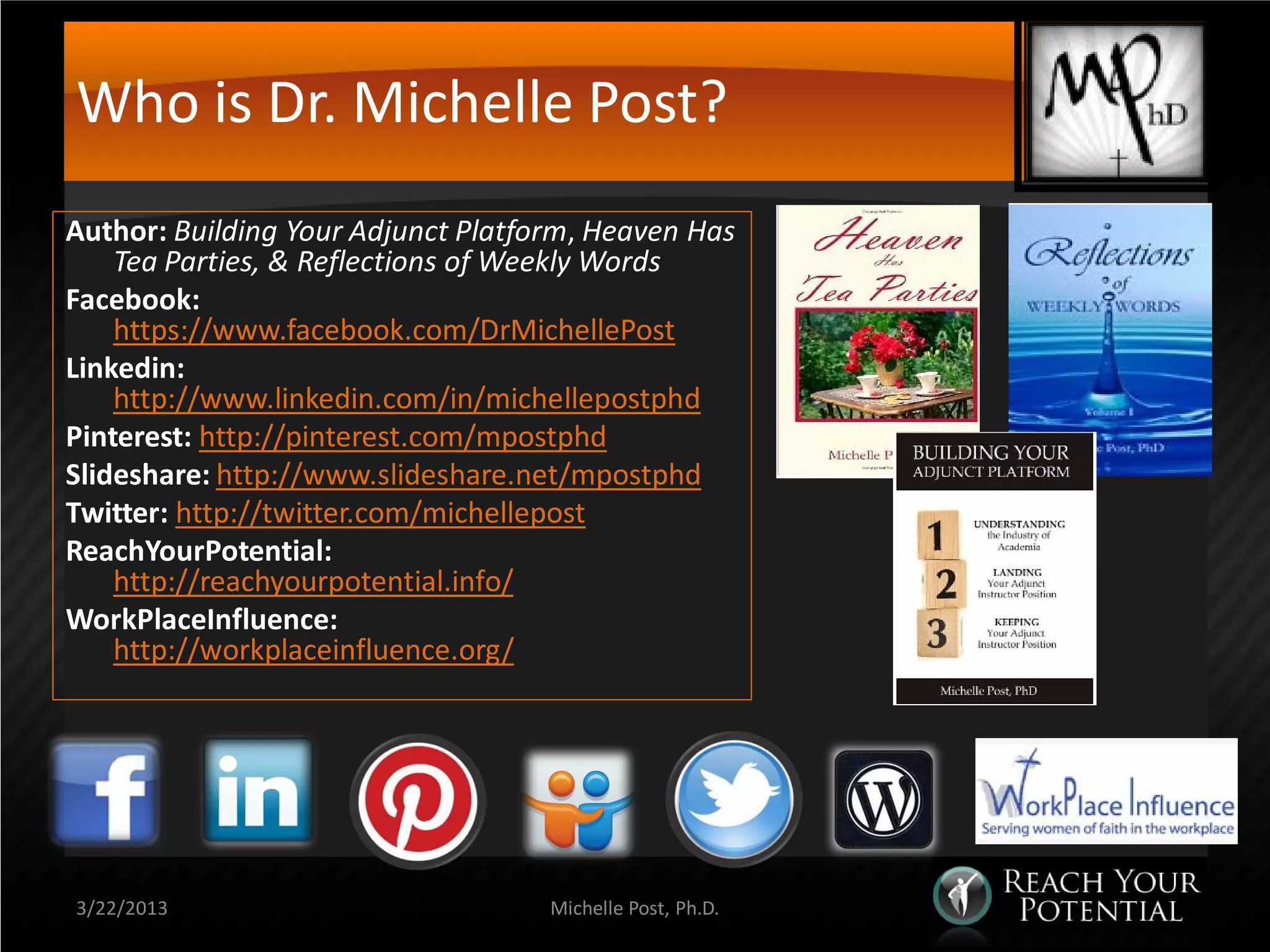
Who is Dr. Michelle Post?
Author: Building Your Adjunct Platform, Heaven Has
    Tea Parties, & Reflections of Weekly Words
Facebook:
    https://www.facebook.com/DrMichellePost
Linkedin:
    http://www.linkedin.com/in/michellepostphd
Pinterest: http://pinterest.com/mpostphd
Slideshare: http://www.slideshare.net/mpostphd
Twitter: http://twitter.com/michellepost
ReachYourPotential:
    http://reachyourpotential.info/
WorkPlaceInfluence:
    http://workplaceinfluence.org/


3/22/2013                           Michelle Post, Ph.D.

Multi-Generations in the Classroom

  • 1.
    I See YourLips Moving, But I Don’t Understand You – The Multi-Generational Classroom Michelle Post, Ph.D.
  • 2.
    Did You Know? Video Link: http://www.youtube.com/watch?v=XVQ1ULfQawk 3/22/2013 Michelle Post, Ph.D.
  • 3.
    3/22/2013 Michelle Post, Ph.D.
  • 4.
    Lessons to beLearned • What Education is . . . • Strategies for Motivating • About the Generations • Learners Succeed When • Does this conversation Instructors . . . sound familiar? • Treat Learners Like Adults • The Generations • A New Learning Theory • Generations in the Emerges Workplace • Today’s Classroom is a Blank • History of the Generations Canvas • We Are Value Created • Believe, Become, & Belong • Generational Stereo Types • Resources • The Differences • References • What is the solution? • Who is Dr. Michelle Post 3/22/2013 Michelle Post, Ph.D.
  • 5.
    What Higher Educationis . . . Education is a . . . 3/22/2013 Michelle Post, Ph.D.
  • 6.
    About Generations “Each generation Greatest Silent Generation has distinct Generation attitudes, behaviors, ME Generation expectations, Lost Generation habits and motivational Connected Generation buttons.” Community ~ Greg Hammill Generation 3/22/2013 Michelle Post, Ph.D.
  • 7.
    Does this ConversationSound Familiar? Link Baby Boomer vs. Gen-Y: http://www.youtube.com/watch?v=V2k3Mx07B9I 3/22/2013 Michelle Post, Ph.D.
  • 8.
    The Generations (GVB) •1901-1921 •1922-1945 Vets Baby Boomers GI •1946-1964 •Age: 92+ •Age: 68-91 •Age: 49-67 •GI •Vets •Baby Boomers •Foundation •Matures •Boomers •The Greatest •Traditionalist •THE Generation Generation •Silent •Generation Jones •The Establishment •Loyalists •The Beat •Seniors Generation •Depression Babies •Yippies •Hippies 3/22/2013 Michelle Post, Ph.D.
  • 9.
    The Generations (XYZ) • 1965-1980 • 1981-2000 •2001-Present Gen-Z Gen-X Gen-Y • Age: 13-32 •Age: 1-12 • Age: 33-48 • Generation-Y •Generation-Z • Generation-X • Gen-Y •Homelanders • Gen-X • Yers •Generation-C • Xers • Millennials (Connect) • 13th Generation • Nexsters •Generation-V • Baby Busters • Echo Boomers (Virtual) • Latchkey Children • First Digital •Internet Generation • Net Generation •The New Silent • Lost Generation • Trophy Generation Generation • Invisible • Entitled Generation Generation •Gen @ • Slackers •NeoMillennials 3/22/2013 Michelle Post, Ph.D.
  • 10.
    Generation Workplace Totals Four Generation Workplace Totals 15% Vets 32% Baby Boomers 30% Gen-X 23% Gen-Y 3/22/2013 Michelle Post, Ph.D.
  • 11.
    History of theGenerations 3/22/2013 Michelle Post, Ph.D.
  • 12.
    We are ValueCreated Value System Impactors Affecting Values 1. Family • Culture 2. Friends • Age 3. Religion S.E.E. • Gender Roles 4. Technology 5. School • Ethnicity 6. Media-Advertising 7. Music 90% 8. Income 100% 9. Geography 3/22/2013 Michelle Post, Ph.D.
  • 13.
    We Are ValueCreated Explained • Dr. Morris Massey defined the generations as, “What you are is where you were when” • We are defined by our values, and a values is based on Culture, Age, Gender Roles, and Ethnicity. • From the age of 1 – 6 our values are being imprinting on us • From the age of 7 – 12 we select are values from modeling. – At the age of 10, 90% of our value system is set • From age of 13 – 20+ we select are values from socialization. – At age 20 are 100% values are locked in for life • The only thing that can alter our values is a S.E.E. or a Significant Emotional Event, whether it be personal or global • There are 9 major impactors that affect our value system: 1) family, 2) friends, 3) religion, 4) technology, 5) school, 6) media-advertising, 7) music, 8) income, & 9) geography 3/22/2013 Michelle Post, Ph.D.
  • 14.
    Generational Stereo Types Vets Boomers Gen-X Gen-Y • Old- • Self- • Slackers • Short Fashioned centered attention • Selfish span • Rigid • Unrealistic • Autocratic • Political • Impatient • Spoiled • Cynical • Disrespectful • Change • Power- Averse driven • Technology dependent • Workaholic 3/22/2013 Michelle Post, Ph.D.
  • 15.
    The Differences: Social 3/22/2013 Michelle Post, Ph.D.
  • 16.
    The Differences: Work 3/22/2013 Michelle Post, Ph.D.
  • 17.
    The Differences: Work,Cntd. 3/22/2013 Michelle Post, Ph.D.
  • 18.
    The Differences: Political/Social/Technology Generation Political Social Technology Vets Patriotism Dad’s away Television U.S. Depression Mom’s at the factory Jet airplanes Pearl Harbor-WW II The American Dream Victory in Europe & Japan Baby Boomers Cold-War Dad as breadwinner Man on the Moon Kennedy assassinated Mom as homemaker Transistor Vietnam Woodstock Microwave Oven Civil Rights Women’s movement Generation X Collapse of Berlin Wall Parents at work Personal computers Iran-Contra Parents laid-off Compact Disks Reaganomics Latchkey kids Walk Man Grunge Cordless Phones Generation Y 9/11 - Terrorism Parents at work The Web Iraqi Conflict Kids at daycare Text Messaging Enron/WorldCom X-Games MP3’s School shootings Think Green Cellular Phones 3/22/2013 Michelle Post, Ph.D.
  • 19.
  • 20.
    The Differences: Likesand Dislikes Generation Likes Dislikes Vets Respect for authority Waste Family Technology Community involvement Baby Boomers Responsibility Laziness Work ethic Turning 50 Can-do attitude Generation-X Freedom Red tape Multitasking Hype Work-life balance Millennials Public activism Anything slow Latest technology Negativity Parents 3/22/2013 Michelle Post, Ph.D.
  • 21.
    The Differences: Motivators Vets Boomers Money, title, Satisfaction recognition, of a job well the corner done office Gen-X Gen-Y Freedom, self- Work that manage, time has to prioritize meaning, own projects flexibility 3/22/2013 Michelle Post, Ph.D.
  • 22.
    The Differences: Viewof the World 3/22/2013 Michelle Post, Ph.D.
  • 23.
    What is thesolution? 3/22/2013 Michelle Post, Ph.D.
  • 24.
    Strategies for Motivating •“Chunk” the data • Create a climate of • Whole-part-whole concept “exploration” • Make the material relevant • Make sure leaner is • Explain the reason for equipped with right specific assignments & align knowledge & tools to to learning complete assignments • Let the students work in • DO NOT Assume learners groups are technically proficient • Give some degree of • Show, Do, Show Again options & flexibility in • Bend the rules some assignments • Set “intentions” not expectations 3/22/2013 Michelle Post, Ph.D.
  • 25.
    Learners Succeed WhenInstructors . . . • Create a relaxed and safe • Match teaching method to atmosphere. content. • Accommodate different • Build on students' experience. learning styles. • Encourage self-motivated • Present information using learning. both visual and auditory • Include team learning projects. methods. • Avoid setting up competition. • Talk with students, not at • Support theory with real-life them. examples. • Recognize student uniqueness. • Make class sessions • Validate cultural differences. interactive. • Let students influence course • Provide frequent positive coverage feedback Blog: http://www.adultstudent.com/eds/articles/teaching.html 3/22/2013 Michelle Post, Ph.D.
  • 26.
    Treat Learners LikeAdults Adults are people . . . • Relate new knowledge • With years of experience against personal experiences • A wealth of information • Need breaks • Established values, beliefs & opinions • Deep need to be self- directing • Personal style has changed • Whose individual differences among people • Learning style has increase with age changed • Have a problem-centered • Have pride orientation to learning 3/22/2013 Michelle Post, Ph.D.
  • 27.
    A New LearningTheory Emerges Link: http://edudemic.com/2012/12/a-simple-guide-to-4-complex-learning-theories/ 3/22/2013 Michelle Post, Ph.D.
  • 28.
    Today’s Classroom isa Blank Canvas • “Today’s classroom is literally a blank canvas of unlimited possibilities, it just takes creativity and imagination to make learning fun & relevant.” Dr. Michelle Post Just a Few Inspirational Presentations on the Possibilities . . . • Using E-Learning - http://www.slideshare.net/zaid/using-elearning-to- facilitate-21st-century-learning-1847954 • Social Media for Research - http://www.slideshare.net/zaid/social-media- for-research-17192868 • Embracing OER & MOOCs to Transform Education - http://www.slideshare.net/zaid/embracing-oer-moocs-to-transform- education • 16 Learning Trends We Simply Can’t Ignore - http://www.slideshare.net/zaid/16-learning-trends-we-simply-cant-ignore • DNA of a 21st Century Educator - http://www.slideshare.net/zaid/dna-of-a- 21st-century-educator-v3 3/22/2013 Michelle Post, Ph.D.
  • 29.
    Believe, Become, &Belong •We want to BELIEVE in someone or something Believe •We want to BECOME or grow with a group •We want to BELONG to a group with others Become Belong A Multi-Generational Classroom or workplace can be one of similarities filled with experiences, strengths, and energy. It does not have to be one of differences and conflict. 3/22/2013 Michelle Post, Ph.D.
  • 30.
    RESOURCES, RESOURCES, &MORE RESOURCES 3/22/2013 Michelle Post, Ph.D.
  • 31.
    Suggested Reading • Amazon’sTop 38 Books on Generations: http://amzn.to/10uCKuF • Howe, N., & Strauss, W. (1992). Generations: The History of America's Future, 1584 to 2069 • Zemke, R., Raines, C., & Filipczak, B. (1999). Generations at Work: Managing the Clash of Veterans, Boomers, Xers, and Nexters in Your Workplace • Lancaster, L. C., & Stillman, D. (2003). When Generations Collide: Who They Are. Why They Clash. How to Solve the Generational Puzzle at Work • Lipkin, N., & Perrymore, A. J. (2009). Y in the Workplace: Managing the "Me First" Generation • Meister, J. C., & Willyerd, K. (2010). The 20/20 Workplace 3/22/2013 Michelle Post, Ph.D.
  • 32.
    Suggested Videos forAdditional Learning Together • What you are is where you were when, again! By Morris Massey. [See if your library carries it] – What you are is where you were when [Shorter Older Version] - http://www.youtube.com/watch?v=xlM2hwsalk8 – Just Get It - http://www.youtube.com/watch?v=EZFLiQ8XkBE • Did You Know, Shift Happens, V6 - http://www.youtube.com/watch?v=XVQ1ULfQawk • Brain Rules, by John Medina - http://brainrules.net/brain-rules-video • Drive: The Surprising Truth About What Motivates Us, by Daniel Pink - http://www.youtube.com/watch?v=u6XAPnuFjJc • Top 10 Issues in Business Today, by Connie Podesta - http://www.youtube.com/watch?v=FLhuFKCiX0A • Tale of Two Brains: How Men & Women Think Differently, by Mark Gungor - http://www.youtube.com/watch?v=3XjUFYxSxDk • Quick view of the top three generations - http://www.youtube.com/watch?v=mJBzQ0aL37Y 3/22/2013 Michelle Post, Ph.D.
  • 33.
    Suggested Generational Videos •To the Greatest Generation: http://www.youtube.com/watch?v=tuVDzNXffi0&featu re=related • Hilarious Baby Boomer Video: http://www.youtube.com/watch?v=_N_SqLljunQ&feat ure=related • Generation X - http://www.youtube.com/watch?v=W- LA9JPIsLo • Managing Millennials: http://www.youtube.com/watch?v=at7i8xh19pw • Gen Y vs Boomer: http://www.youtube.com/watch?v=JugpV3jg0Cg 3/22/2013 Michelle Post, Ph.D.
  • 34.
    Suggested Web Resources Generational FAQs - http://www.generationaldiversity.com/faq.html  American Generations: http://www.timepage.org/time.html  Generations: Harnessing the potential of the multigenerational workforce. Retrieved from http://visionpoint.com/white-papers/generations/  Baby Boomers: http://www.time.com/time/generations/  Center for Generational Studies: http://gentrends.com/  Generations: http://www.generations.com/ 3/22/2013 Michelle Post, Ph.D.
  • 35.
    Suggested Web Resources,Cntd.  Generations in the Classroom: Reaching and Teaching Non-Traditional Students: http://bit.ly/101hZ67  Generations at Work: http://www.generationsatwork.com/articles/millenials. htm  The Center for Generational Kinetics - http://www.genhq.com/whatthegen  Instructing Multi-generational Students - http://bit.ly/YxbCay  How to Train Multi-Generational Classes Online: http://www.slideshare.net/GoToTraining/how-to-train- multi-generational-classes-online2 3/22/2013 Michelle Post, Ph.D.
  • 36.
    REFERENCES 3/22/2013 Michelle Post, Ph.D.
  • 37.
    References Auburn Mountain.(n.d.). Generations. Retrieved from http://www.auburnmountain.org/articles/id/106/generations-and- their-distinct-characteristics.aspx [Slide 8 & 9] Borden, J. (2012, August). Always learning [Lecture]. [Slide 19] Catalyst. (2012, May). Generations in the workplace in the United States and Canada. Retrieved from http://www.catalyst.org/publication/434/generations-in-the- workplace-in-the-united-states-canada [Slide 10] Hammill, G. (2005). Mixing and manage four generations of employees. Retrieved from http://www.fdu.edu/newspubs/magazine/05ws/generations.htm [Slide 6, 15 & 16] 3/22/2013 Michelle Post, Ph.D.
  • 38.
    References, Cntd. Lepi, K.(2012, December 24). A simple guide to 4 complex learning theories. Retrieved from http://edudemic.com/2012/12/a- simple-guide-to-4-complex-learning-theories/ [Slide 27] Massey, M. (2005). What you are is where you were when, again! Enterprise Media. [Slide 12 & 13] Maxwell, J. C. (2007). The Maxwell Leadership Bible (2nd ed.). Nashville, TN: Thomas Nelson. [Slide 29] McMahon, T., & Jewett, G. (2012, February 2). Generations in the Classroom: Reaching and Teaching Non-Traditional Students. Retrieved from http://bit.ly/1671muT [Slide 25 & 26] NetworkNews.org. (n.d.). Generations at a glance. Retrieved from http://bit.ly/Y5tg8Q [Slide 18] 3/22/2013 Michelle Post, Ph.D.
  • 39.
    References, Cntd. Oblinger, D.,& Oblinger, J. (2012). Is it age or IT: First steps toward understanding the net generation. Retrieved from http://bit.ly/YxbCay [Slide 20] Rose, D. S. (2012, May 8). Did You Know?/Shift Happens (Version 6, 2012) [Video clip]. Retrieved from http://www.youtube.com/watch?v=XVQ1ULfQawk [Slide 2] Siebert, A., Ph.D. (n.d.). Teaching adult students the way they learn. Retrieved from http://www.adultstudent.com/eds/articles/teaching.html [Slide 24] Sollah Interactive. (n.d.). Generations: Harnessing the potential of the multigenerational workforce. Retrieved from http://visionpoint.com/white-papers/generations/ [Slide 14] 3/22/2013 Michelle Post, Ph.D.
  • 40.
    References, Cntd. Span,S. H. (2012, August 17). Four generations in the workplace: Bridging the generation gap. What are they thinking? Retrieved from http://bit.ly/14dgFUx [Slide 17, 21, & 22] The Generations of American History. (n.d.). Retrieved from http://www.timepage.org/time.html [Slide 11] The O’Shea Report. (2011, February 9). The O'Shea Report: Generations at Work- The difference between Baby Boomers [Video clip]. Retrieved from http://www.youtube.com/watch?v=V2k3Mx07B9I&list=PL1445946 7369BDDDC&index=4 [Slide 7] Zemke, R., Raines, C., & Filipczak, B. (2000). Generations at work: Managing the clash of Veterans, Boomers, Xers, Nexters in your workplace. AMACOM. [Slide 8 & 9] 3/22/2013 Michelle Post, Ph.D.
  • 41.
    Who is Dr.Michelle Post? Author: Building Your Adjunct Platform, Heaven Has Tea Parties, & Reflections of Weekly Words Facebook: https://www.facebook.com/DrMichellePost Linkedin: http://www.linkedin.com/in/michellepostphd Pinterest: http://pinterest.com/mpostphd Slideshare: http://www.slideshare.net/mpostphd Twitter: http://twitter.com/michellepost ReachYourPotential: http://reachyourpotential.info/ WorkPlaceInfluence: http://workplaceinfluence.org/ 3/22/2013 Michelle Post, Ph.D.