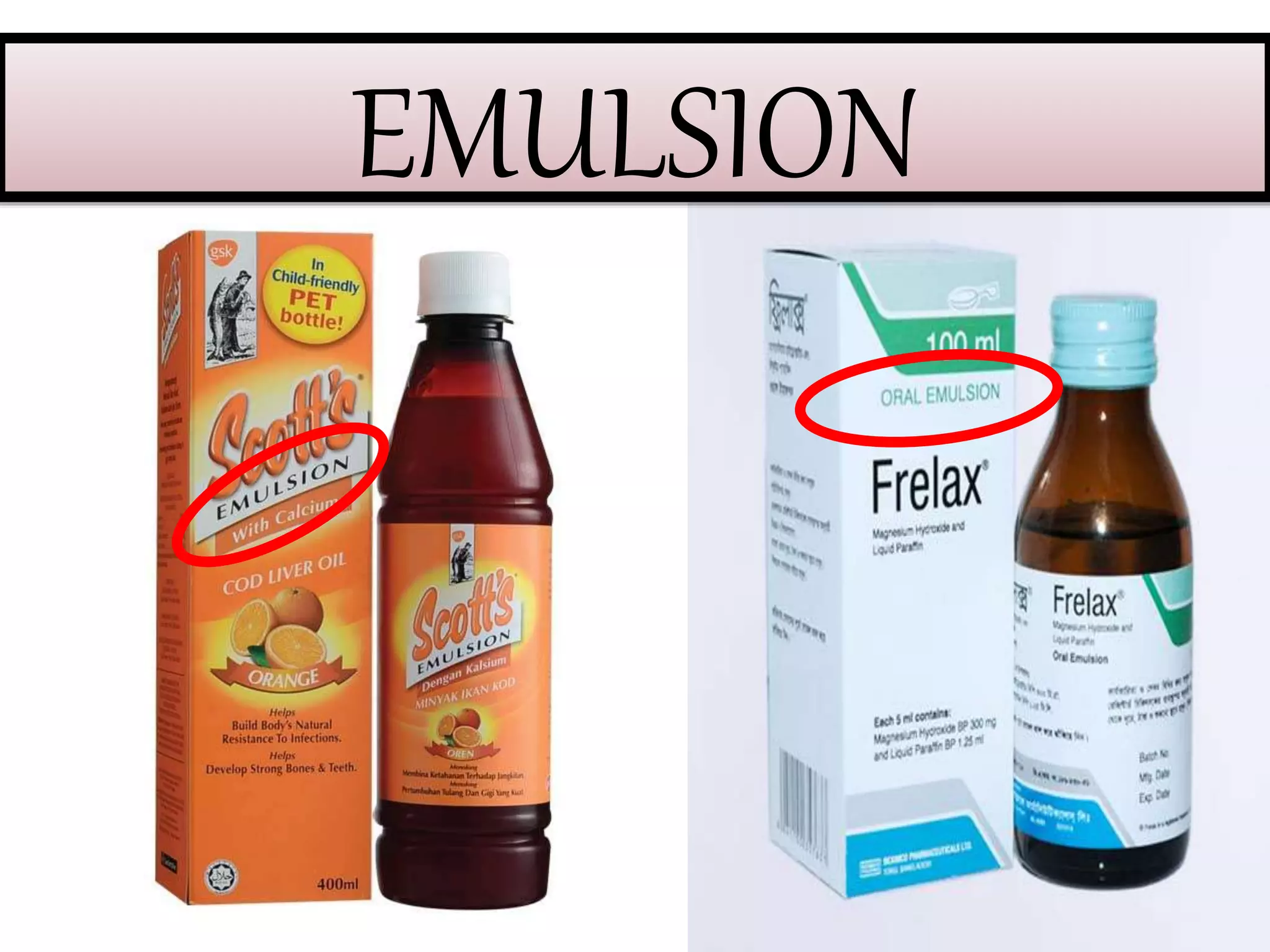
EMULSION
PRESENTED BY:
 AREEBA SHAHID
 FARAH NAZ
 BUSHRA DAR
 MARINA MURAD
 JAWARIA NIAZ KHAN
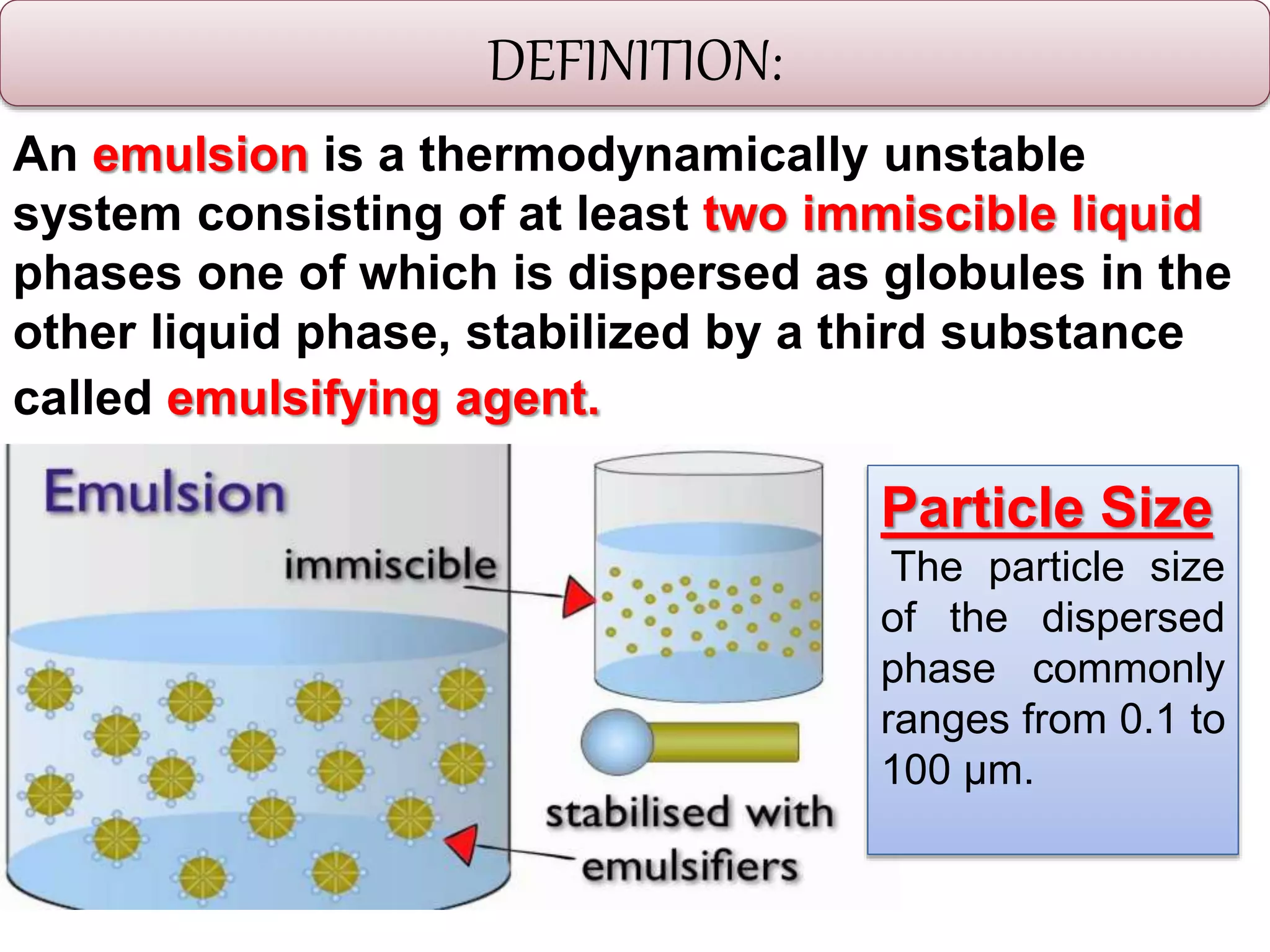
DEFINITION:
An emulsion is a thermodynamically unstable
system consisting of at least two immiscible liquid
phases one of which is dispersed as globules in the
other liquid phase, stabilized by a third substance
called emulsifying agent.
Particle Size
The particle size
of the dispersed
phase commonly
ranges from 0.1 to
100 μm.
 The dispersed liquid is known as the Internal , Discontinuous Or
dispersed phase.
 The droplet phase is called the dispersed phase or internal phase.
 Whereas the dispersion medium is known as the External or
Continuous phase
 The liquid in which droplets are dispersed is called the external or
continuous phase.
Internal Phase & External Phase:
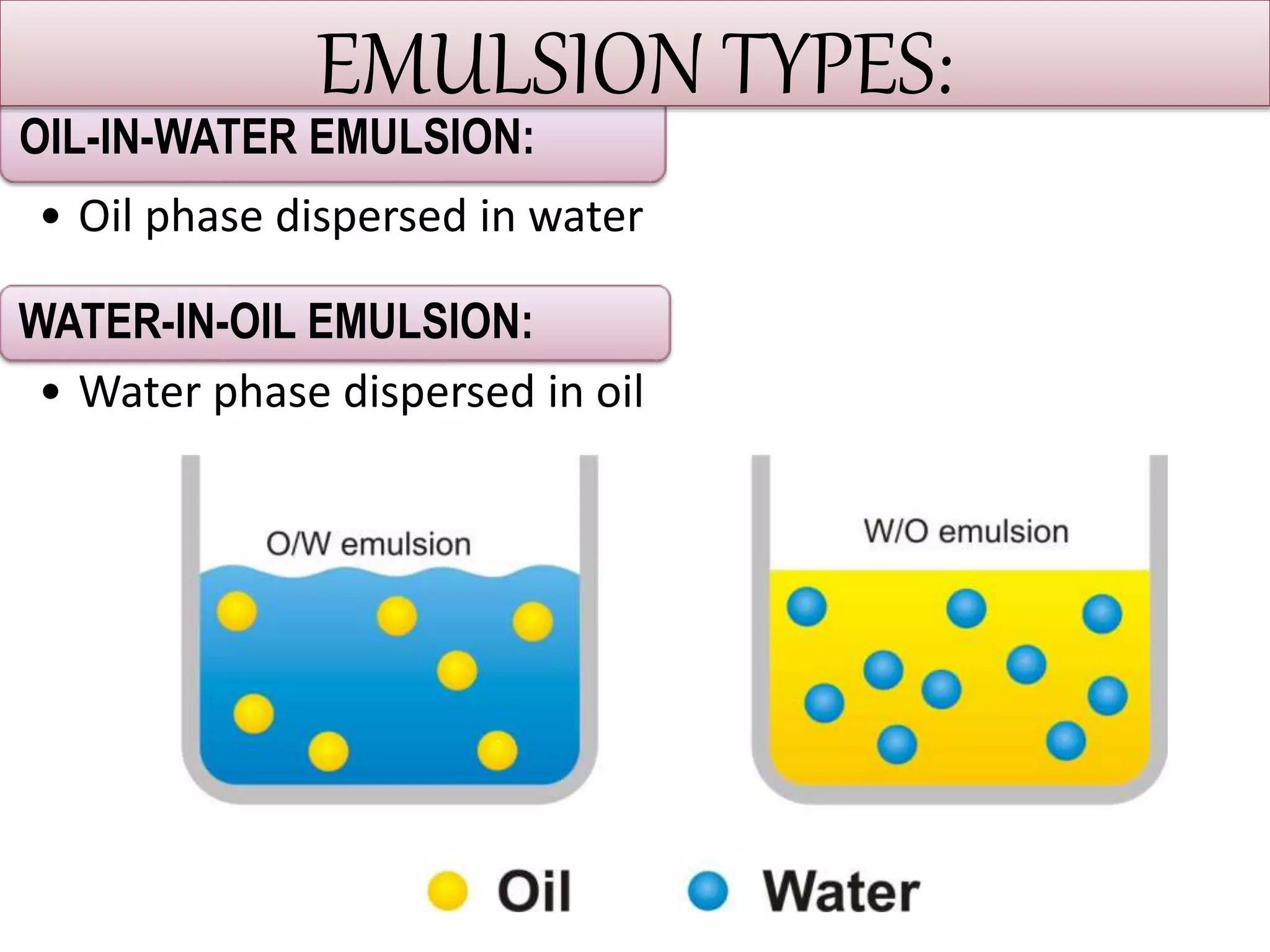
OIL-IN-WATER EMULSION:
• Oil phase dispersed in water
WATER-IN-OIL EMULSION:
• Water phase dispersed in oil
EMULSION TYPES:
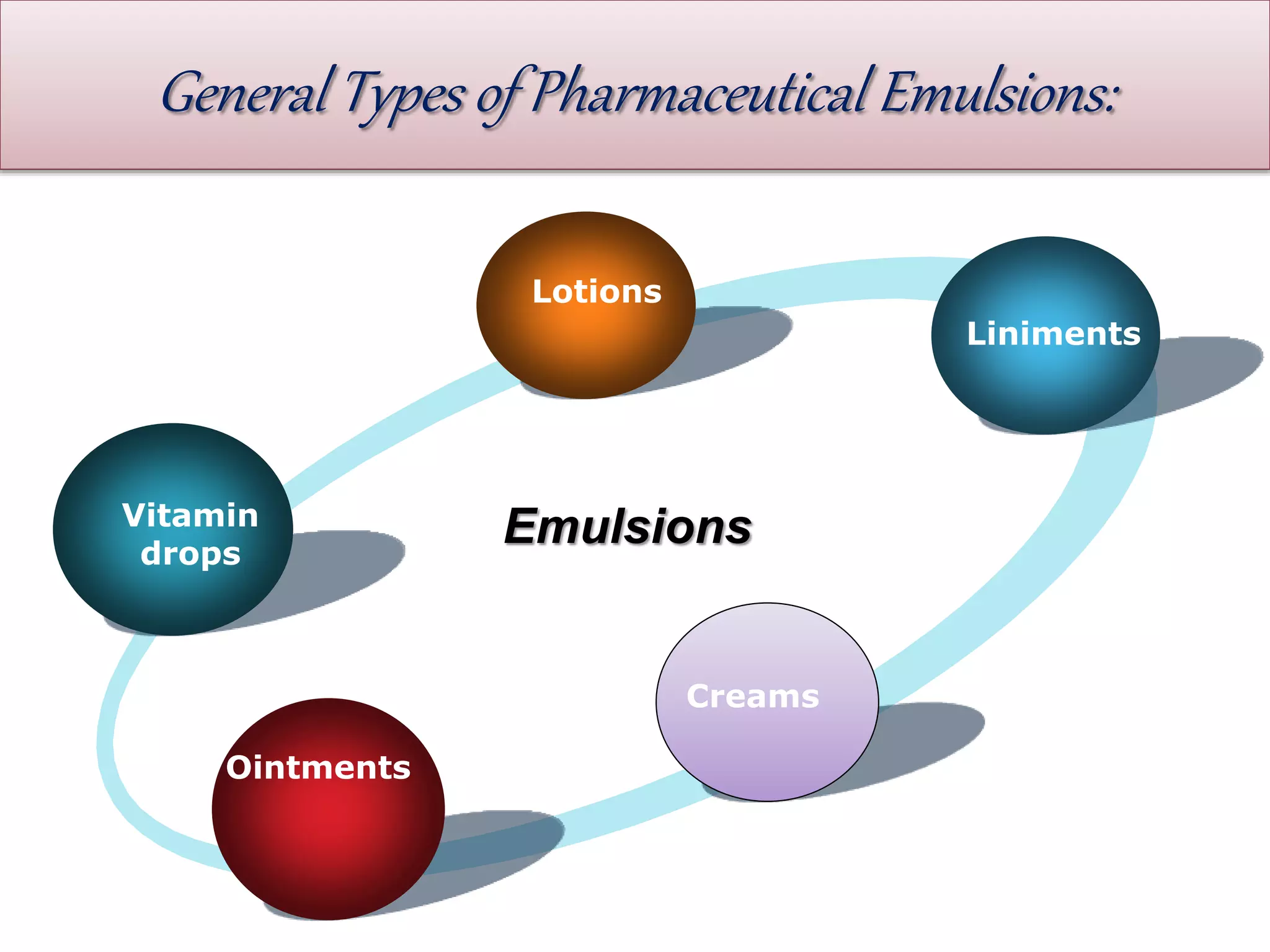
General Types of Pharmaceutical Emulsions:
Vitamin
drops
Lotions
Liniments
Creams
Ointments
Emulsions
1) Dilution Test:
based on the solubility of external phase of
emulsion.
- o/w emulsion can be diluted with water.
- w/o emulsion cannot be diluted with oil.
Methods to determine type of emulsion:
Few drops
of emulsion
Few drops
of water Water distribute
uniformly
Water separate
out as layer
O/W emulsion
W/O emulsion
Methods to determine type of emulsion:
Electrode
Bulb
Emulsion
= Bulb glows with O/W
= Bulb doesn’t glow with W/O
2)Conductivity Test:
Water is good conductor of electricity
whereas oil is non-conductor.
3)Dye-Solubility Test:
 Water-soluble dye will dissolve in the aqueous
phase.
 Oil-soluble dye will dissolve in the oil phase.
4)Fluorescence test:
Oils give fluorescence under UV light, while water
doesn’t. Therefore, O/W emulsion shows spotty
pattern while W/O emulsion fluoresces.
Methods to determine type of emulsion:
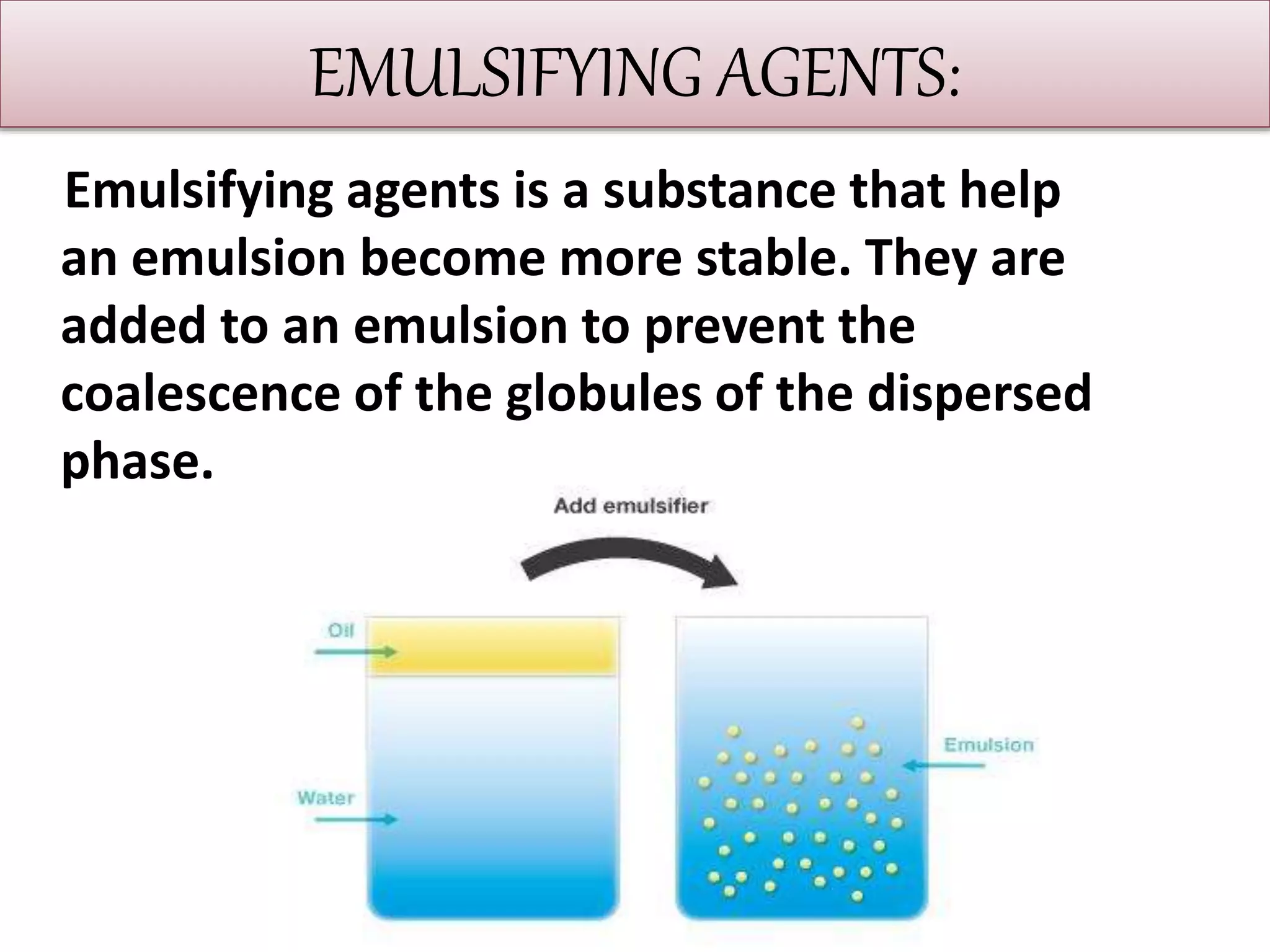
EMULSIFYING AGENTS:
Emulsifying agents is a substance that help
an emulsion become more stable. They are
added to an emulsion to prevent the
coalescence of the globules of the dispersed
phase.
Types of emulsifying agents:
1) Surface active agent: adsorbed at oil/water
interface to form monomolecular film to reduce
the interfacial tension
2) Hydrophilic colloids: forming a
multimolecular film around the dispersed droplet
3) Finely divided solid particles: they are
adsorbed at the interface between two
immiscible liquid phases to form a film of
particles around the dispersed globules.
1
Synthetic
Surface active agents
( Monomolecular
films)
2
Semi synthetic and
natural
Hydrophilic colloids
( Multi-molecular films)
3
Finely divided solid
particles
( Particulate film)
Types of emulsifying agents:
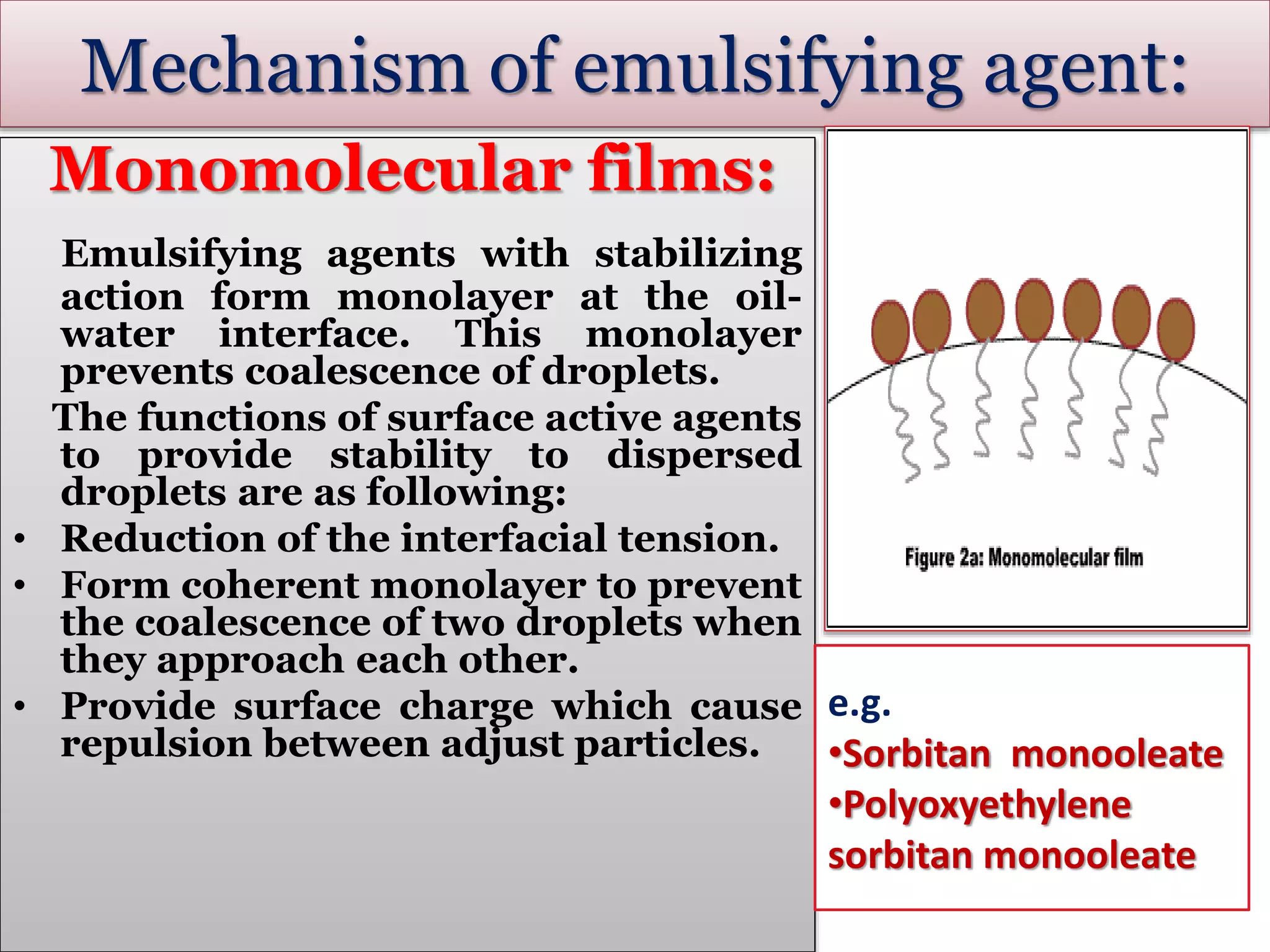
Monomolecular films:
Emulsifying agents with stabilizing
action form monolayer at the oil-
water interface. This monolayer
prevents coalescence of droplets.
The functions of surface active agents
to provide stability to dispersed
droplets are as following:
• Reduction of the interfacial tension.
• Form coherent monolayer to prevent
the coalescence of two droplets when
they approach each other.
• Provide surface charge which cause
repulsion between adjust particles.
Mechanism of emulsifying agent:
e.g.
•Sorbitan monooleate
•Polyoxyethylene
sorbitan monooleate
Mechanism of emulsifying agent:
Multi molecular films:
Multi molecular films around the
droplets of dispersed phase are formed
by hydrophilic colloids. They act as
coats around the droplets making them
highly resistant to coalescence.
Hydrophilic colloids form multi
molecular adsorption at the oil/ water
interface. They have low effect on the
surface tension.
Their main function as emulsion
stabilizers is by making coherent multi-
molecular film. This film is strong and
resists the coalescence. They have, also,
an auxiliary effect by increasing the
viscosity of dispersion medium.
e.g.
•Acacia
•Gelatin
Solid particle films:
Small solid particles like that
are wetted to some degree by
both oil and water can act as
emulsifying agents. This results
from their being concentrated
at the interface, where they
produce a particulate film
around the dispersed droplets
to avoid coalescence
Particles that are wetted
preferentially by water from
o/w emulsion, whereas those
wetted more by oil form w/o
emulsion.
Mechanism of emulsifying agent:
e.g.
Bentonite
Veegum
Selection of Emulsifying Agents
using HLB method
A system was developed by William C. Griffin to assist
making systemic decisions about the amounts and types
of surfactants needed in stable products. The system is
called the HLB (hydrophile-lipophile balance) system.
HLB RANGE USE
0-3 Antifoaming agents
4-6 W/O emulsifying agent
7-9 Wetting agents
8-18 O/W emulsifying agent
13-15 Detergents
10-18 Solubilizing agents
Emulsifier with low HLB
• An emulsifier having a low HLB number indicates
that the number of hydrophilic groups present in
the molecule is less and it has a lipophillic
character .
For example, spans generally have low HLB number
and they are also oil soluble. Because of their oil
soluble character, spans cause the oil phase to
predominate and form a w/o emulsion.
Emulsifier with high HLB
• A higher HLB number indicate that the emulsifier
has a large number of hydrophilic groups on the
molecule and therefore is more hydrophilic in
character .
Tweens have higher HLB numbers and they are also
water soluble. Because of their water soluble
character, tweens will cause the water phase to
predominate and form an o/w emulsion.
HLB values of some common
emulsifying agents
Emulsifying Agent HLB Value
Acacia: 8
Polysorbate 20neewT(20:) 16.7
Polysorbate 60neewT( :60:) 14.9
Polysorbate 80neewT(80:) 15
Oleic acid: 4.3
Sorbitan monolaurate (Span 20:) 8.6
Sorbitan monolaurate (Span 60:) 4.7
Sorbitan monolaurate (Span 80:) 4.3
To mask the taste
pharmaceutical application of emulsion:
O/W emulsion facilitates the absorption of
water-insoluble compounds comparing to their oily
solution preparations (e.g. vitamins)
Emulsion can be used for external
application in cosmetic and
therapeutic uses.
Emulsion

Emulsion

  • 1.
  • 2.
    PRESENTED BY:  AREEBASHAHID  FARAH NAZ  BUSHRA DAR  MARINA MURAD  JAWARIA NIAZ KHAN
  • 3.
    DEFINITION: An emulsion isa thermodynamically unstable system consisting of at least two immiscible liquid phases one of which is dispersed as globules in the other liquid phase, stabilized by a third substance called emulsifying agent. Particle Size The particle size of the dispersed phase commonly ranges from 0.1 to 100 μm.
  • 4.
     The dispersedliquid is known as the Internal , Discontinuous Or dispersed phase.  The droplet phase is called the dispersed phase or internal phase.  Whereas the dispersion medium is known as the External or Continuous phase  The liquid in which droplets are dispersed is called the external or continuous phase. Internal Phase & External Phase:
  • 5.
    Internal Phase &External Phase:
  • 6.
    OIL-IN-WATER EMULSION: • Oilphase dispersed in water WATER-IN-OIL EMULSION: • Water phase dispersed in oil EMULSION TYPES:
  • 7.
    General Types ofPharmaceutical Emulsions: Vitamin drops Lotions Liniments Creams Ointments Emulsions
  • 8.
    1) Dilution Test: basedon the solubility of external phase of emulsion. - o/w emulsion can be diluted with water. - w/o emulsion cannot be diluted with oil. Methods to determine type of emulsion: Few drops of emulsion Few drops of water Water distribute uniformly Water separate out as layer O/W emulsion W/O emulsion
  • 9.
    Methods to determinetype of emulsion: Electrode Bulb Emulsion = Bulb glows with O/W = Bulb doesn’t glow with W/O 2)Conductivity Test: Water is good conductor of electricity whereas oil is non-conductor.
  • 10.
    3)Dye-Solubility Test:  Water-solubledye will dissolve in the aqueous phase.  Oil-soluble dye will dissolve in the oil phase. 4)Fluorescence test: Oils give fluorescence under UV light, while water doesn’t. Therefore, O/W emulsion shows spotty pattern while W/O emulsion fluoresces. Methods to determine type of emulsion:
  • 11.
    EMULSIFYING AGENTS: Emulsifying agentsis a substance that help an emulsion become more stable. They are added to an emulsion to prevent the coalescence of the globules of the dispersed phase.
  • 12.
    Types of emulsifyingagents: 1) Surface active agent: adsorbed at oil/water interface to form monomolecular film to reduce the interfacial tension 2) Hydrophilic colloids: forming a multimolecular film around the dispersed droplet 3) Finely divided solid particles: they are adsorbed at the interface between two immiscible liquid phases to form a film of particles around the dispersed globules.
  • 13.
    1 Synthetic Surface active agents (Monomolecular films) 2 Semi synthetic and natural Hydrophilic colloids ( Multi-molecular films) 3 Finely divided solid particles ( Particulate film) Types of emulsifying agents:
  • 14.
    Monomolecular films: Emulsifying agentswith stabilizing action form monolayer at the oil- water interface. This monolayer prevents coalescence of droplets. The functions of surface active agents to provide stability to dispersed droplets are as following: • Reduction of the interfacial tension. • Form coherent monolayer to prevent the coalescence of two droplets when they approach each other. • Provide surface charge which cause repulsion between adjust particles. Mechanism of emulsifying agent: e.g. •Sorbitan monooleate •Polyoxyethylene sorbitan monooleate
  • 15.
    Mechanism of emulsifyingagent: Multi molecular films: Multi molecular films around the droplets of dispersed phase are formed by hydrophilic colloids. They act as coats around the droplets making them highly resistant to coalescence. Hydrophilic colloids form multi molecular adsorption at the oil/ water interface. They have low effect on the surface tension. Their main function as emulsion stabilizers is by making coherent multi- molecular film. This film is strong and resists the coalescence. They have, also, an auxiliary effect by increasing the viscosity of dispersion medium. e.g. •Acacia •Gelatin
  • 16.
    Solid particle films: Smallsolid particles like that are wetted to some degree by both oil and water can act as emulsifying agents. This results from their being concentrated at the interface, where they produce a particulate film around the dispersed droplets to avoid coalescence Particles that are wetted preferentially by water from o/w emulsion, whereas those wetted more by oil form w/o emulsion. Mechanism of emulsifying agent: e.g. Bentonite Veegum
  • 17.
    Selection of EmulsifyingAgents using HLB method A system was developed by William C. Griffin to assist making systemic decisions about the amounts and types of surfactants needed in stable products. The system is called the HLB (hydrophile-lipophile balance) system. HLB RANGE USE 0-3 Antifoaming agents 4-6 W/O emulsifying agent 7-9 Wetting agents 8-18 O/W emulsifying agent 13-15 Detergents 10-18 Solubilizing agents
  • 18.
    Emulsifier with lowHLB • An emulsifier having a low HLB number indicates that the number of hydrophilic groups present in the molecule is less and it has a lipophillic character . For example, spans generally have low HLB number and they are also oil soluble. Because of their oil soluble character, spans cause the oil phase to predominate and form a w/o emulsion.
  • 19.
    Emulsifier with highHLB • A higher HLB number indicate that the emulsifier has a large number of hydrophilic groups on the molecule and therefore is more hydrophilic in character . Tweens have higher HLB numbers and they are also water soluble. Because of their water soluble character, tweens will cause the water phase to predominate and form an o/w emulsion.
  • 20.
    HLB values ofsome common emulsifying agents Emulsifying Agent HLB Value Acacia: 8 Polysorbate 20neewT(20:) 16.7 Polysorbate 60neewT( :60:) 14.9 Polysorbate 80neewT(80:) 15 Oleic acid: 4.3 Sorbitan monolaurate (Span 20:) 8.6 Sorbitan monolaurate (Span 60:) 4.7 Sorbitan monolaurate (Span 80:) 4.3
  • 21.
    To mask thetaste pharmaceutical application of emulsion: O/W emulsion facilitates the absorption of water-insoluble compounds comparing to their oily solution preparations (e.g. vitamins) Emulsion can be used for external application in cosmetic and therapeutic uses.