
Green Computing
Awareness in India
What Is Green Computing?
• Green Use
• Green Disposal
• Green Design
• Green Manufacturing
Need for Green Computing
Why?????
 Computer energy is often wasteful
Leaving the computer on when not in use
 Printing is often wasteful
How many of you print out your emails or meeting agendas
 Pollution
Due to manufacturing, packaging, disposal technique
 Toxicity
Due to toxic chemicals involved in the manufacturing.
Recent Trends In Green Computing
Paradigm
 Government initiatives have been enforced in the
European Union, Japan and a few U.S. states.
 Some states, like Texas, require tech companies to
offer free recycling programs.
 Companies like Yahoo! plan to become “carbon
neutral” in the near future.
 A Canadian company, Userful Inc. has come up with
a solution of multi-sharing that turns 1 computer
into 10.This reduces CO2 emissions by up to 15 tons
per year per system and reduce electronic waste by
up to 80%.
 Companies including Hewlett-Packard Co., Dell Inc.,
IBM Corp., Sun Microsystems Inc., Advanced Micro
Devices Inc., Xerox Corp. have started using less
toxic material in products.
Prospective of Green
Computing in India
 India growing at 9% annually and expected to
double its energy consumption by 2030, must act
sooner than later .
 Major companies in India are taking initiatives to
appear greener and thus reducing their carbon
footprint.
Wipro Info tech became the first Indian
company to launch environment-friendly range
of products named as Wipro Green Ware .
Infosys framed an Eco club for its employees
to reduce its carbon emission.
Decided to plant one tree for every new
employee.
 Leading vendors like Hewlett-Packard, Dell
and Acer are adopting green computing by
rolling out energy efficient computers made
from recyclable materials.
 View sonic in partnership with a range of
ISO 14001 certified recyclers offer
customers several options and incentives to
recycle used products
Survey Analysis
Survey parameters:
 Awareness in Green Computing
 Major problems in Computing paradigm
 Steps for green awareness in field of education
and work-places
 Possible barriers
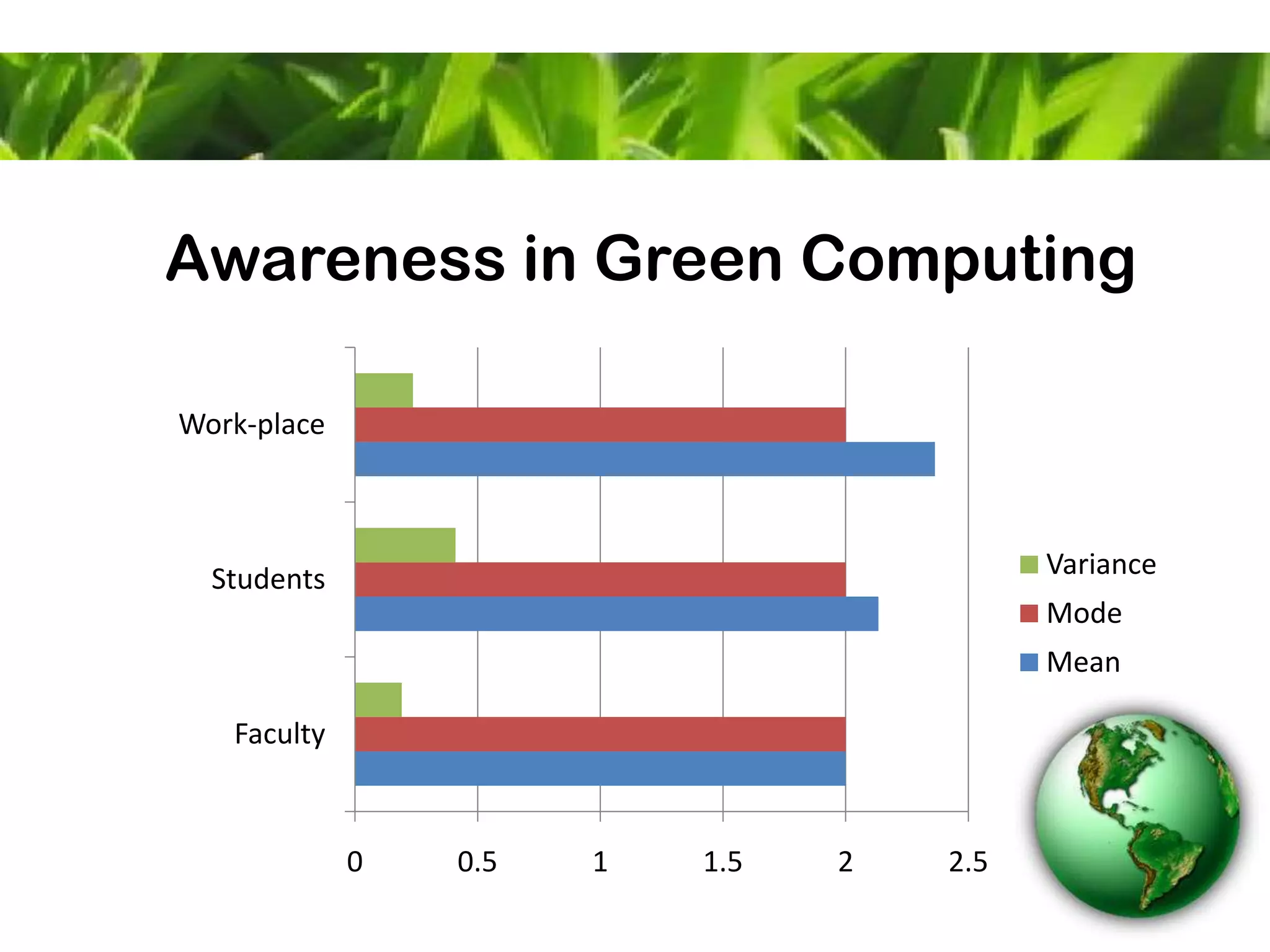
0 0.5 1 1.5 2 2.5
Faculty
Students
Work-place
Variance
Mode
Mean
Awareness in Green Computing
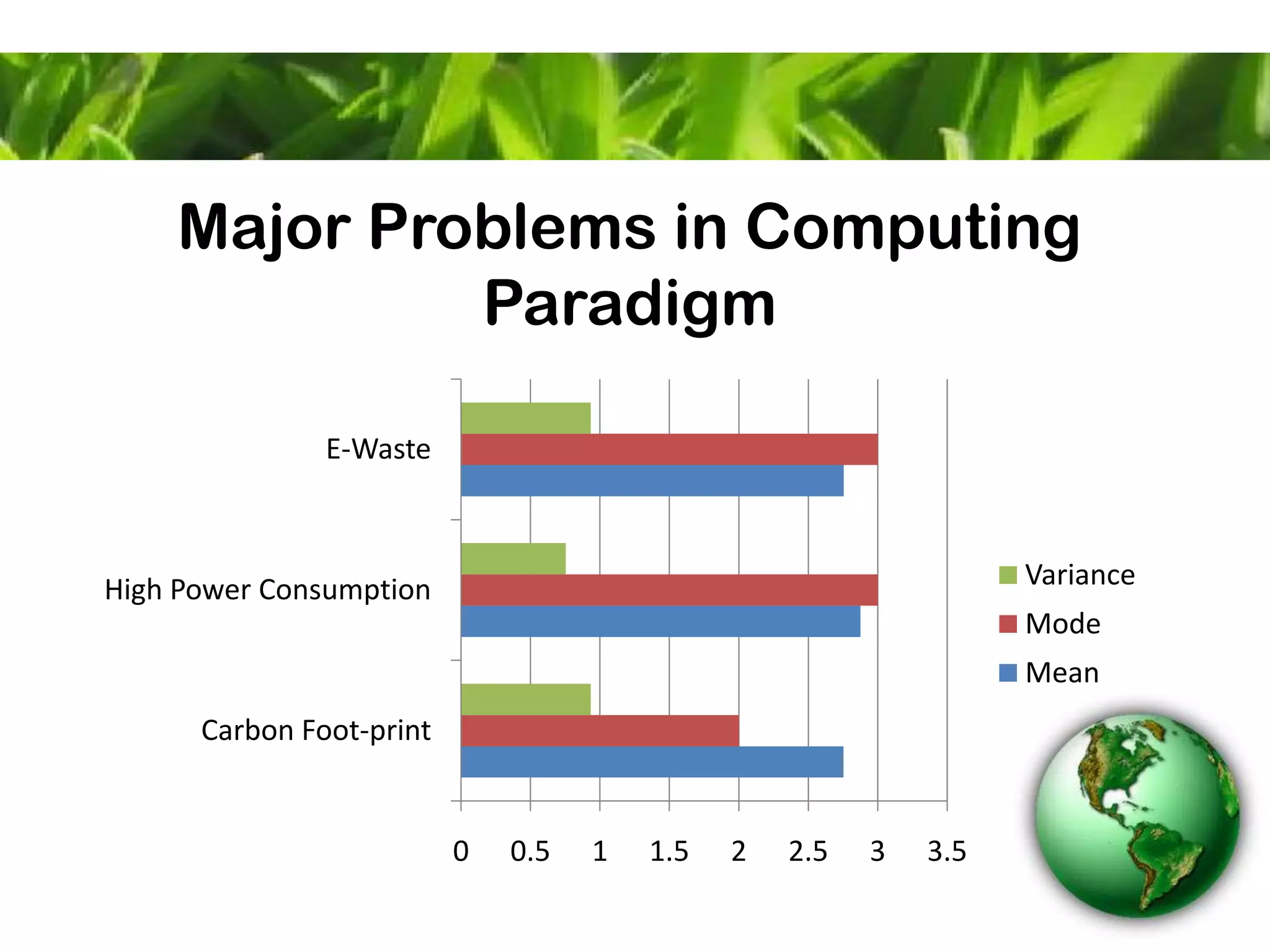
0 0.5 1 1.5 2 2.5 3 3.5
Carbon Foot-print
High Power Consumption
E-Waste
Variance
Mode
Mean
Major Problems in Computing
Paradigm
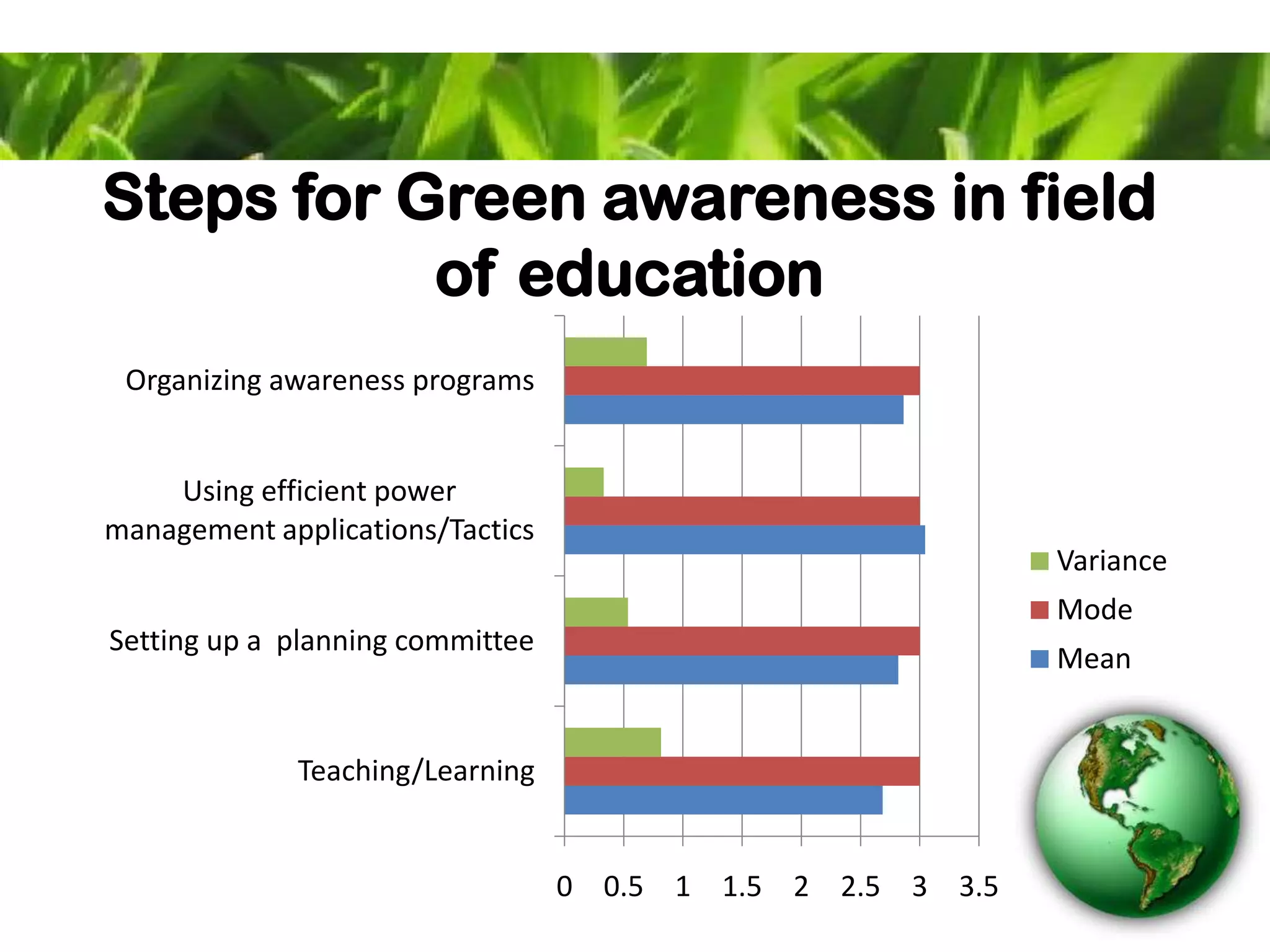
Steps for Green awareness in field
of education
0 0.5 1 1.5 2 2.5 3 3.5
Teaching/Learning
Setting up a planning committee
Using efficient power
management applications/Tactics
Organizing awareness programs
Variance
Mode
Mean
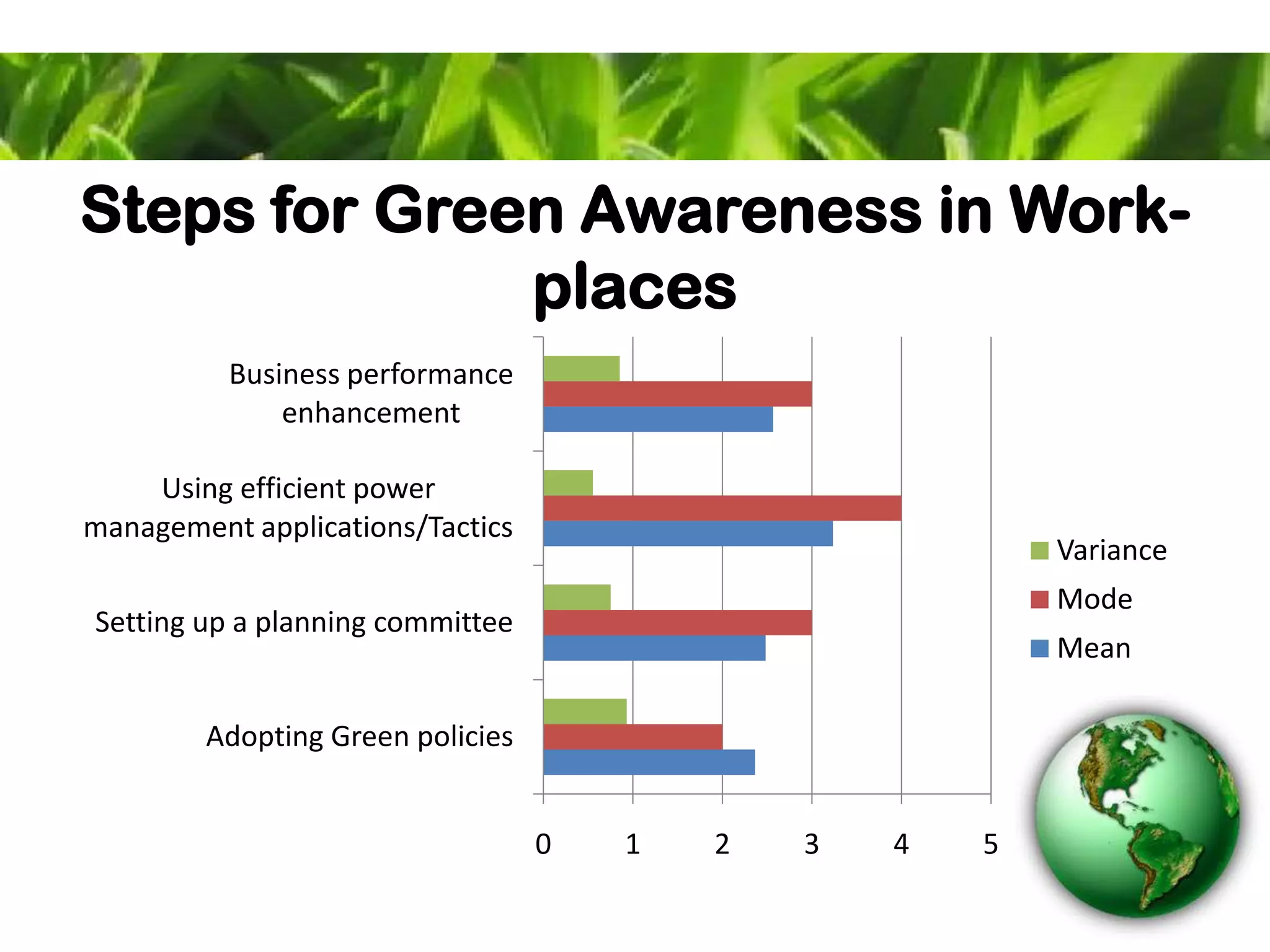
Steps for Green Awareness in Work-
places
0 1 2 3 4 5
Adopting Green policies
Setting up a planning committee
Using efficient power
management applications/Tactics
Business performance
enhancement
Variance
Mode
Mean
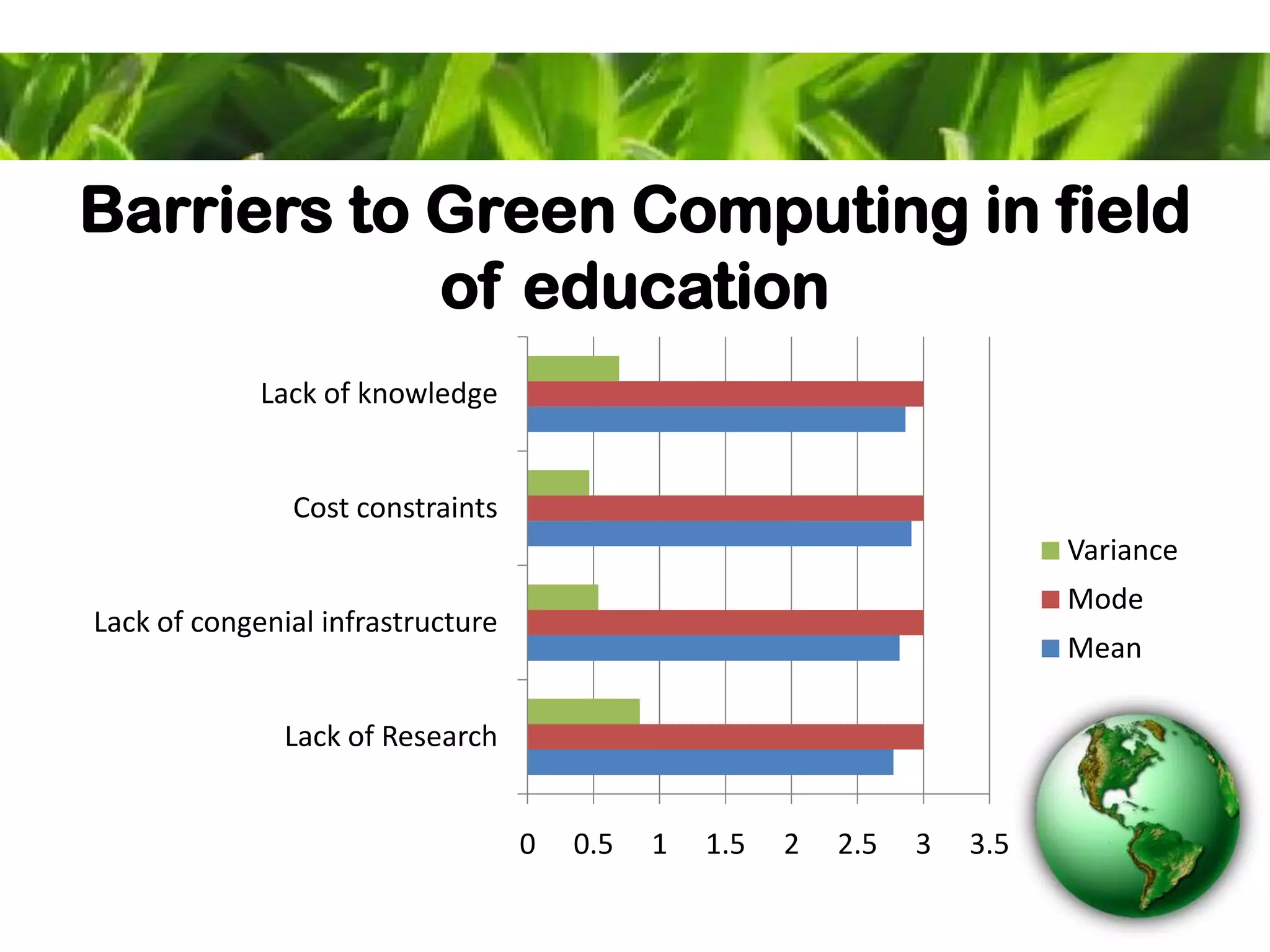
Barriers to Green Computing in field
of education
0 0.5 1 1.5 2 2.5 3 3.5
Lack of Research
Lack of congenial infrastructure
Cost constraints
Lack of knowledge
Variance
Mode
Mean
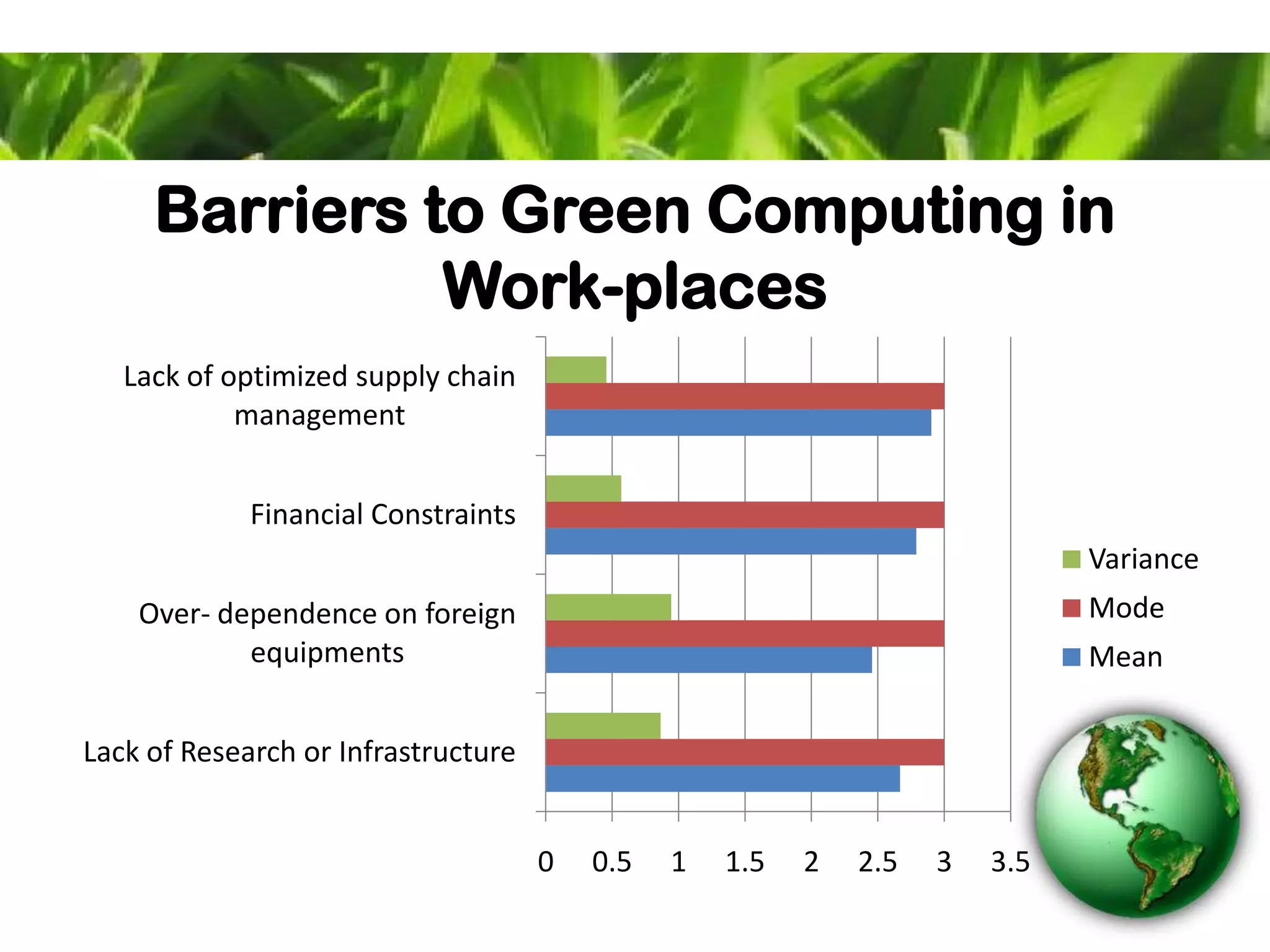
Barriers to Green Computing in
Work-places
0 0.5 1 1.5 2 2.5 3 3.5
Lack of Research or Infrastructure
Over- dependence on foreign
equipments
Financial Constraints
Lack of optimized supply chain
management
Variance
Mode
Mean
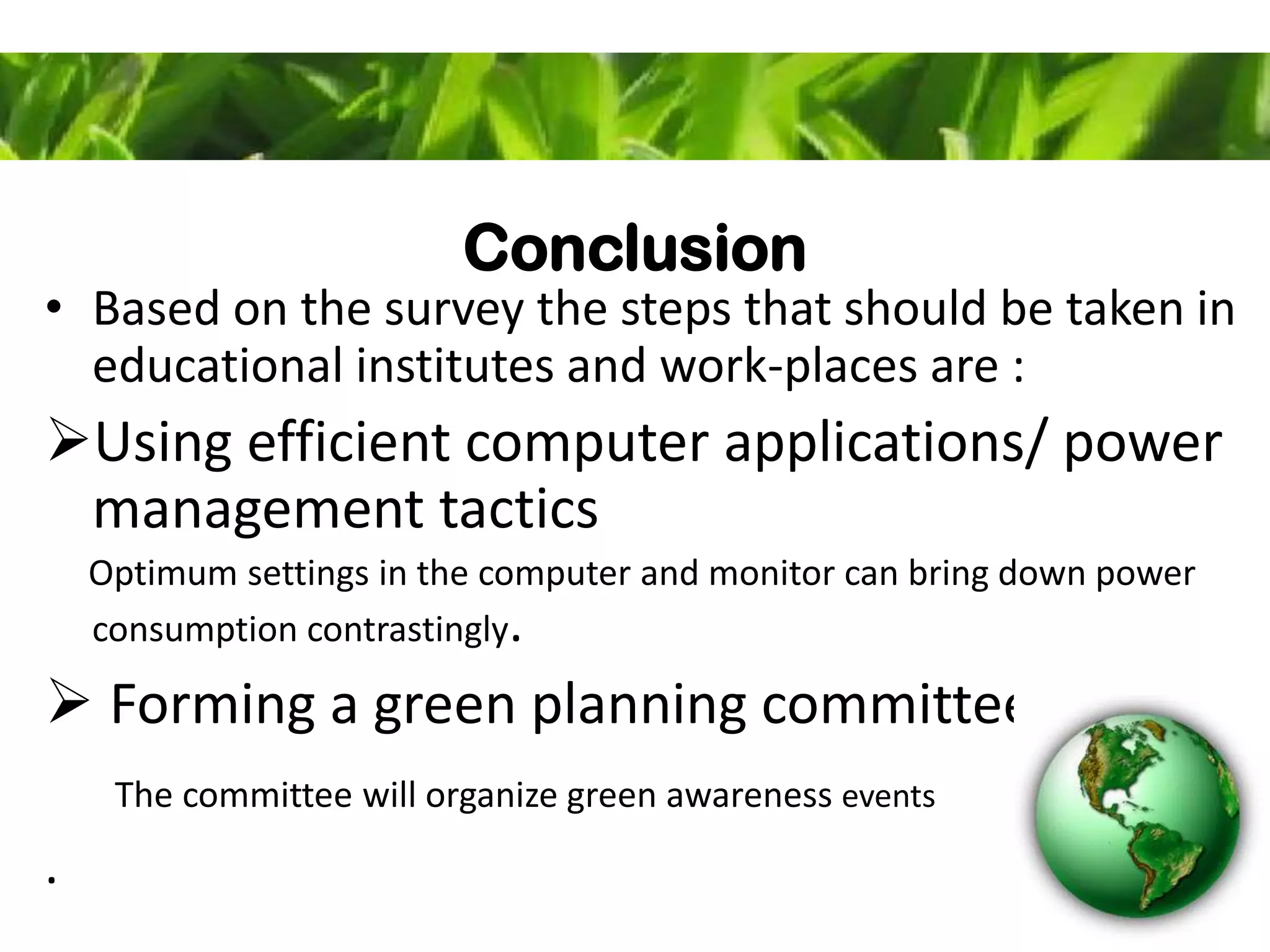
Conclusion
• Based on the survey the steps that should be taken in
educational institutes and work-places are :
Using efficient computer applications/ power
management tactics
Optimum settings in the computer and monitor can bring down power
consumption contrastingly.
 Forming a green planning committee
The committee will organize green awareness events
.
References
Green Computing - a new Horizon of Energy Efficiency and
Electronic waste minimization: a Global Perspective, Shalabh
Agarwal and Asoke Nath (2011).
 Green computing and D-Link, white paper February 2009
Nancy Weil, IDG News, The Realities of Green Computing,
(http://www.pcworld.com/businesscenter/article/135509/the_re
alities_of_green_computing.html)
Green: The new color in Information Technology
(www.slideshare.com)
Green computing

Green computing

  • 1.
  • 2.
    What Is GreenComputing? • Green Use • Green Disposal • Green Design • Green Manufacturing
  • 3.
    Need for GreenComputing Why?????  Computer energy is often wasteful Leaving the computer on when not in use  Printing is often wasteful How many of you print out your emails or meeting agendas  Pollution Due to manufacturing, packaging, disposal technique  Toxicity Due to toxic chemicals involved in the manufacturing.
  • 4.
    Recent Trends InGreen Computing Paradigm  Government initiatives have been enforced in the European Union, Japan and a few U.S. states.  Some states, like Texas, require tech companies to offer free recycling programs.  Companies like Yahoo! plan to become “carbon neutral” in the near future.
  • 5.
     A Canadiancompany, Userful Inc. has come up with a solution of multi-sharing that turns 1 computer into 10.This reduces CO2 emissions by up to 15 tons per year per system and reduce electronic waste by up to 80%.  Companies including Hewlett-Packard Co., Dell Inc., IBM Corp., Sun Microsystems Inc., Advanced Micro Devices Inc., Xerox Corp. have started using less toxic material in products.
  • 6.
    Prospective of Green Computingin India  India growing at 9% annually and expected to double its energy consumption by 2030, must act sooner than later .  Major companies in India are taking initiatives to appear greener and thus reducing their carbon footprint.
  • 7.
    Wipro Info techbecame the first Indian company to launch environment-friendly range of products named as Wipro Green Ware . Infosys framed an Eco club for its employees to reduce its carbon emission. Decided to plant one tree for every new employee.
  • 8.
     Leading vendorslike Hewlett-Packard, Dell and Acer are adopting green computing by rolling out energy efficient computers made from recyclable materials.  View sonic in partnership with a range of ISO 14001 certified recyclers offer customers several options and incentives to recycle used products
  • 9.
    Survey Analysis Survey parameters: Awareness in Green Computing  Major problems in Computing paradigm  Steps for green awareness in field of education and work-places  Possible barriers
  • 10.
    0 0.5 11.5 2 2.5 Faculty Students Work-place Variance Mode Mean Awareness in Green Computing
  • 11.
    0 0.5 11.5 2 2.5 3 3.5 Carbon Foot-print High Power Consumption E-Waste Variance Mode Mean Major Problems in Computing Paradigm
  • 12.
    Steps for Greenawareness in field of education 0 0.5 1 1.5 2 2.5 3 3.5 Teaching/Learning Setting up a planning committee Using efficient power management applications/Tactics Organizing awareness programs Variance Mode Mean
  • 13.
    Steps for GreenAwareness in Work- places 0 1 2 3 4 5 Adopting Green policies Setting up a planning committee Using efficient power management applications/Tactics Business performance enhancement Variance Mode Mean
  • 14.
    Barriers to GreenComputing in field of education 0 0.5 1 1.5 2 2.5 3 3.5 Lack of Research Lack of congenial infrastructure Cost constraints Lack of knowledge Variance Mode Mean
  • 15.
    Barriers to GreenComputing in Work-places 0 0.5 1 1.5 2 2.5 3 3.5 Lack of Research or Infrastructure Over- dependence on foreign equipments Financial Constraints Lack of optimized supply chain management Variance Mode Mean
  • 16.
    Conclusion • Based onthe survey the steps that should be taken in educational institutes and work-places are : Using efficient computer applications/ power management tactics Optimum settings in the computer and monitor can bring down power consumption contrastingly.  Forming a green planning committee The committee will organize green awareness events .
  • 17.
    References Green Computing -a new Horizon of Energy Efficiency and Electronic waste minimization: a Global Perspective, Shalabh Agarwal and Asoke Nath (2011).  Green computing and D-Link, white paper February 2009 Nancy Weil, IDG News, The Realities of Green Computing, (http://www.pcworld.com/businesscenter/article/135509/the_re alities_of_green_computing.html) Green: The new color in Information Technology (www.slideshare.com)