Thank You
Kingsoft Office
published by www.Kingsoftstore.com @Kingsoft_Office
kingsoftstore
INTRODUCTION
 Green computing or green IT, refers to environmentally
sustainable computing or IT.
 It is "the study and practice of Designing,
Manufacturing, Using, and Disposing of computers,
servers, and associated subsystems efficiently and
effectively with minimal or no impact on the environment.
 It is an environmental friendly IT where the main
objective is to reduce the hazardous materials and
maximize the energy efficiency .
Why is Green Computing
required?
•Computer consumes a lot of energy.
•Printing often unnecessary stuff is waste
•Reduce pollution.
•Reduce the power consumption
•reduce the global warming
•Toxicity.
.
•It originated in 1992 at the U.S Environmental Protection
Agency that launched Energy Star program.
•Shortly after that the term “Green Computing” was
coined.
•Shortly after that the Swedish also launched the TCO
Certification.
HISTORY
Green Use
Green Disposal
Green Design
Green Manufacturing
Road to Green Computing
CPU uses 120 Watts
CRT uses 150 Watts
Energy use comes from
o electrical current to run the CPU, motherboard,
memory
orunning the fan and spinning the disk(s)
omonitor (CRTs consume more power than any
other computer component)
oprinters
Energy Consumption
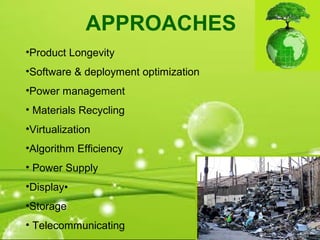
•Product Longevity
•Software & deployment optimization
•Power management
• Materials Recycling
•Virtualization
•Algorithm Efficiency
• Power Supply
•Display
•Storage
• Telecommunicating
APPROACHES
Carbon Free Computing
 Solar Computing
RoHS Computing
Virtualization
Methods to implement Green
Computing
•Turn off the computer when not in use, even if just
for an hour
•Turn off the monitor when not in use (as opposed
to running a screen saver)
•Use power saver mode
•Use LCDs instead of CRTs as they are more
power efficient
•Use hardware/software with the Energy Star label
•Choose Intel & VIA Processors in comparison to
AMD Processors.
Reducing the energy consumption
Green with Yahoo!
Greener Firefox Surfing
Other Green Surfing Efforts
•Environmentally Sound Purchase
Systems
•Sustainable Green Computing Plan
•Reduce Paper Consumption
•Conserve Energy
•Recycling
Steps For Green Computing
 Energy saving
Environmentally Friendly
Cost-effective ( pays over time )
Save more money per year
Can give you a tax right off
ADVANTAGES
High start up cost
Not readily available
Still in experimental stages
Sacrifice performance for battery life
Not for everyone
DISADVANTAGES
The plan towards green IT should include new
electronic products and services with optimum
efficiency and all possible options towards
energy savings. That is enterprise wise
companies are laying emphasis on moving
towards Eco Friendly Components in Computers,
the use of eco-friendly sustainable components
will become the norm rather than the exception in
future.
Future of Green Computing
The greenest computer will not miraculously fall
from the sky one day, it’ll be the product of years
of improvements. The features of a green
computer of tomorrow would be like: efficiency,
manufacturing & materials, recyclability, service
model, self-powering, and other trends.
CONCLUSION
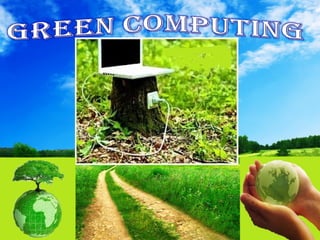
GREEN COMPUTING

GREEN COMPUTING

  • 1.
    Thank You Kingsoft Office publishedby www.Kingsoftstore.com @Kingsoft_Office kingsoftstore
  • 3.
    INTRODUCTION  Green computingor green IT, refers to environmentally sustainable computing or IT.  It is "the study and practice of Designing, Manufacturing, Using, and Disposing of computers, servers, and associated subsystems efficiently and effectively with minimal or no impact on the environment.  It is an environmental friendly IT where the main objective is to reduce the hazardous materials and maximize the energy efficiency .
  • 4.
    Why is GreenComputing required? •Computer consumes a lot of energy. •Printing often unnecessary stuff is waste •Reduce pollution. •Reduce the power consumption •reduce the global warming •Toxicity. .
  • 5.
    •It originated in1992 at the U.S Environmental Protection Agency that launched Energy Star program. •Shortly after that the term “Green Computing” was coined. •Shortly after that the Swedish also launched the TCO Certification. HISTORY
  • 6.
    Green Use Green Disposal GreenDesign Green Manufacturing Road to Green Computing
  • 7.
    CPU uses 120Watts CRT uses 150 Watts Energy use comes from o electrical current to run the CPU, motherboard, memory orunning the fan and spinning the disk(s) omonitor (CRTs consume more power than any other computer component) oprinters Energy Consumption
  • 8.
    •Product Longevity •Software &deployment optimization •Power management • Materials Recycling •Virtualization •Algorithm Efficiency • Power Supply •Display •Storage • Telecommunicating APPROACHES
  • 9.
    Carbon Free Computing Solar Computing RoHS Computing Virtualization Methods to implement Green Computing
  • 10.
    •Turn off thecomputer when not in use, even if just for an hour •Turn off the monitor when not in use (as opposed to running a screen saver) •Use power saver mode •Use LCDs instead of CRTs as they are more power efficient •Use hardware/software with the Energy Star label •Choose Intel & VIA Processors in comparison to AMD Processors. Reducing the energy consumption
  • 12.
    Green with Yahoo! GreenerFirefox Surfing Other Green Surfing Efforts
  • 13.
    •Environmentally Sound Purchase Systems •SustainableGreen Computing Plan •Reduce Paper Consumption •Conserve Energy •Recycling Steps For Green Computing
  • 14.
     Energy saving EnvironmentallyFriendly Cost-effective ( pays over time ) Save more money per year Can give you a tax right off ADVANTAGES
  • 15.
    High start upcost Not readily available Still in experimental stages Sacrifice performance for battery life Not for everyone DISADVANTAGES
  • 16.
    The plan towardsgreen IT should include new electronic products and services with optimum efficiency and all possible options towards energy savings. That is enterprise wise companies are laying emphasis on moving towards Eco Friendly Components in Computers, the use of eco-friendly sustainable components will become the norm rather than the exception in future. Future of Green Computing
  • 17.
    The greenest computerwill not miraculously fall from the sky one day, it’ll be the product of years of improvements. The features of a green computer of tomorrow would be like: efficiency, manufacturing & materials, recyclability, service model, self-powering, and other trends. CONCLUSION