KCC Art 211 Ch 4 Principles Of Design

Loading...

Flash Player 9 (or above) is needed to view presentations.
We have detected that you do not have it on your computer. To install it, go here.

0 comments

Post a comment

    Post a comment
    Embed Video
    Edit your comment Cancel

    7 Favorites

    KCC Art 211 Ch 4 Principles Of Design - Presentation Transcript

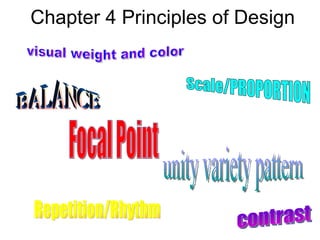
    1. Chapter 4 Principles of Design visual weight and color Focal Point contrast Repetition/Rhythm Scale/PROPORTION BALANCE unity variety pattern
    2. Unity/Harmony and Variety
      • Unity - the appearance of oneness. The design works as a whole.
      • Variety – provides diversity bringing movement/life to unity.
      • Pattern – a repetitive ordering of design elements
    3. Unity and pattern create harmony
    4. Balance
      • Symmetrical balance – both sides of a composition are matching.
      • Asymmetrical balance – both sides are not equal or matching.
      • Radial balance – circular design with overall symmetrical balance.
    5. Symmetrical designs – both sides of a composition are matching. Formal, stable, rigid, and permanence are suggested
    6. Asymmetrical Designs - both sides are not equal or matching. Chaotic, unstable, loose and suggested.
    7. Radial balance - circular design with overall symmetrical balance.
    8. Visual Weight
      • Large form is heavier, more attractive or gets more attention than a small form. This lets 2 small forms balance 1 larger form.
      • Form gathers weight as it gets lower on the picture plane. Smaller forms near an edge can balance a larger form near the center
      • Complex forms are heavier than simplified forms. Small complex forms can balance a larger simple form.
    9. Large form is heavier, more attractive or gets more attention than a small form. This lets 2 small forms balance 1 larger form. Visual weight with emphasis on large vs. small
    10. Visual Weight and Color
      • Warm colors are heavier than cool colors
      • Warm colors come forward, cool colors recede into the background
      • Intense colors are heavier than pale colors
      • Intense color comes forward, pale colors look farther way
    11. Emphasis
      • Emphasis – position, contrast, color and size can all be used to draw attention or put emphasis on a specific area or figure creating a focal point
    12. Focal point – draws the eye into the art work first What is the focal point in this picture?
    13. Focal Point Where is it?
    14. Focal point is obvious in this picture or is it? What do you think? What about visual weight?
    15. Directional Emphasis
      • Directional emphasis or eye tracks – paths that lead the eye through and around the art work by actual or implied lines.
      • Horizontal lines
      • Vertical lines
      • Diagonal lines
      • Circular lines
    16. Contrast
      • Contrast –
      • dissimilar elements or
      • dramatic effects can
      • be produced with light
      • against dark, large
      • against small, bright
      • against dull and rough
      • against smooth.
      Light against Dark contrast
    17. Contrast What gives this picture contrast? Obviously, light and dark but what else?
    18. Repetition and Rhythm
      • Repetition – gives a composition unity, continuity, flow and emphasis
      • Rhythm – a regular occurrence of elements with related variations
    19. Does this picture have rhythm and repetition? Why or why not?
    20. Scale and Proportion
      • Scale – relative size of one object to another object in one work of art
      • Proportion – size relationships of the parts to the whole work of art
    21. proportion
    22. Scale
    23. Visual Art Analysis Guide
      • Artist/title
      • Subject form –
      • Still life – inanimate objects
      • Landscape – view of scenery, trees, sky, mountains, etc.
      • Portrait – a person’s likeness
      • Narrative – tells a story
      • Genre – everyday life such as a room
      • Figure – depicting human figures
      • Non-objective – no influence of real or natural forms
      • Degree of Abstraction –
        • Realistic – resembling reality, looks real
        • Impressionistic – immediate visual impression
        • Expressionistic – expressions of emotion
        • Stylized – to modify natural forms, make representation of
        • Non-objective – no influence of real or natural forms
        • Trompe l’oeil – painted with photographic realism to “fool the eye”
        • Abstractionism – no attempt to represent forms realistically
      • Dominant Shape Motif – predominate shape in a composition.
      • Triangle – pg 86 Pieta by Michelangelo
      • upside down pg 349 Oath of the Horath by Jacques-Louis David
      • Rectangle – pg 89 Large Reclining Nude by Matisse
      • Square – pg 76 Portrait of the Hung- Chih Emperor
      • Circle – pg 83 Madonna of the Chair by Raphael
      • Eye tracks – where the eye is lead. Generally starts at the focal point then your eye is lead around the painting. There can be several “eye tracks” in any painting.
        • Center
        • Upper left quadrant
        • Lower left quadrant
        • Upper right quadrant
        • Lower right quadrant
      • Location of Focal Point –
      • Focus by –
      • Anomaly – different object in the group
      • Isolation – one object away from the group
      • Placement – object is focal point by placement of other objects in group
      • Direction – directing the eye with objects to the focal point
      • Format Shape – is the shape of the work of art
        • Rectangle – horizontal or vertical
        • Square
        • Circle
        • Triangle
        • Other
      • Content Analysis – What is the work of art trying to convey to the viewer?
      • Decoration
      • Communication
      • Persuasion
      • Expression
      • Celebration
      • Using your book find one work of art that conveys one or more of these words. Briefly describe in a few sentences why it “says” this to you. Due at the beginning of the next class. Give artist, title and page number.

    + Kelly ParkerKelly Parker, 2 years ago

    custom

    1211 views, 7 favs, 0 embeds more stats

    More info about this document

    © All Rights Reserved

    Go to text version

    • Total Views 1211
      • 1211 on SlideShare
      • 0 from embeds
    • Comments 0
    • Favorites 7
    • Downloads 0
    Most viewed embeds

    more

    All embeds

    less

    Flagged as inappropriate Flag as inappropriate
    Flag as inappropriate

    Select your reason for flagging this presentation as inappropriate. If needed, use the feedback form to let us know more details.

    Cancel
    File a copyright complaint
    Having problems? Go to our helpdesk?

    Categories