Aerial Apparatus
Driver/Operator Handbook
2nd Edition
Chapter 5 — Driving Aerial
Apparatus
Learning Objective 1
Describe the driving regulations of the
first apparatus driver/operator.
5–2
Aerial Apparatus Driver/Operator
• Governed by federal laws, state or
provincial motor vehicle codes, city
ordinances, NFPA®
standards, and
departmental policies
• Subject to any statute, rule, regulation,
or ordinance that governs any vehicle
operator
Driver/Operator
Driving Regulations
5–3
Aerial Apparatus Driver/Operator
• Obey all traffic signals and rules when
returning to quarters.
• Use courteous and professional driving
style while driving in public.
• Most driving regulations pertain to dry,
clear roads during daylight conditions.
Driver/Operator Guidelines
5–4
Aerial Apparatus Driver/Operator
• Adjust speed to compensate for
conditions that make normal emergency
vehicle operation more hazardous.
• Stop emergency vehicles for school
buses that are flashing signal lights.
Driver/Operator Guidelines
5–5
Aerial Apparatus Driver/Operator
Discuss starting and driving fire service
apparatus.
Learning Objective 2
5–6
Aerial Apparatus Driver/Operator
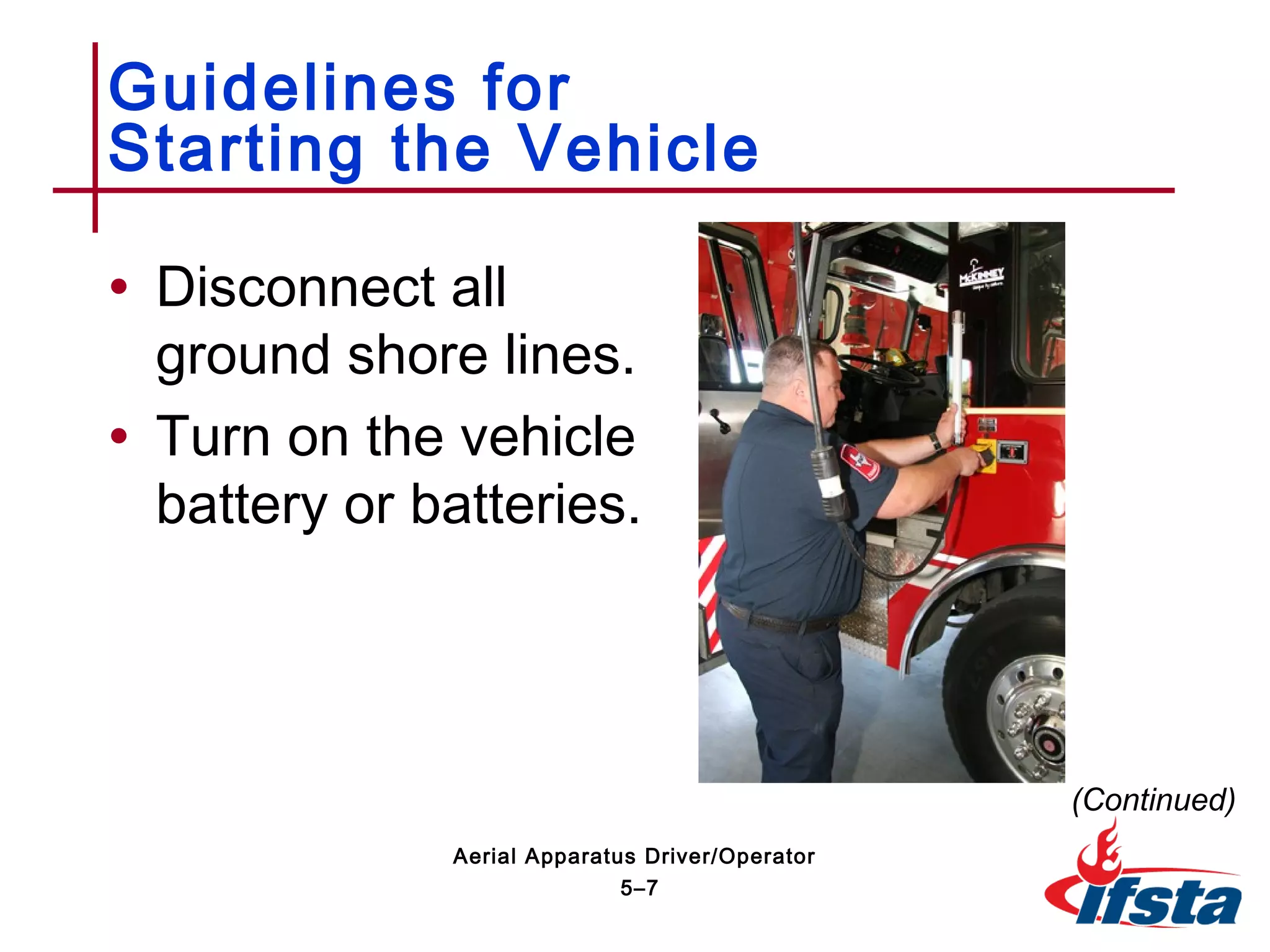
• Disconnect all
ground shore lines.
• Turn on the vehicle
battery or batteries.
Guidelines for
Starting the Vehicle
(Continued)
5–7
Aerial Apparatus Driver/Operator
• (Manual shift transmission) Start engine
with transmission in Neutral (N) and
vehicle’s parking brake set.
– Turn on ignition switches.
– Press down on clutch pedal.
– Operate starter control.
Guidelines for
Starting the Vehicle
(Continued)
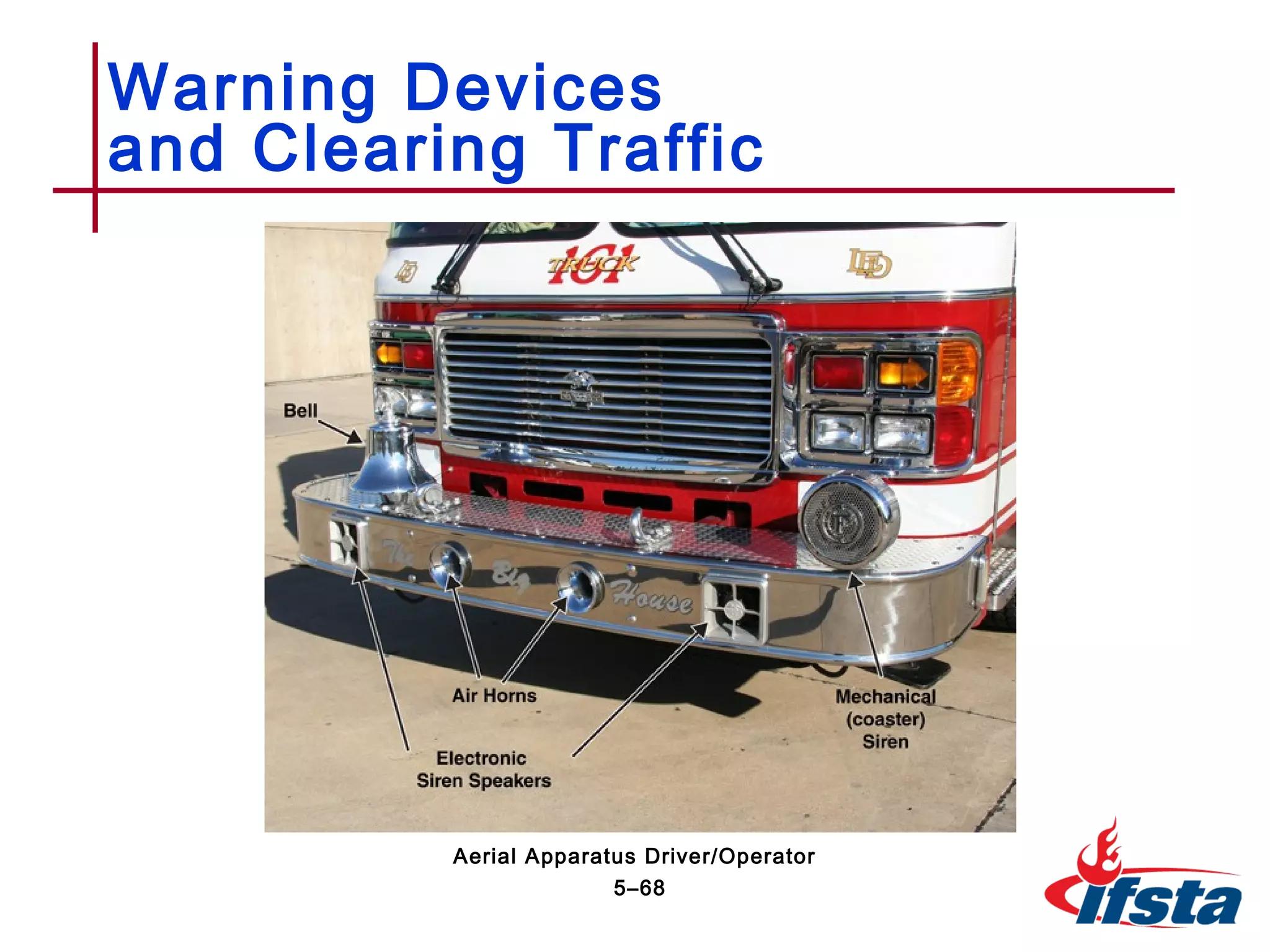
5–8
Aerial Apparatus Driver/Operator
• (Automatic transmission) Start engine
with transmission in Neutral (N) or Park
(P) with parking brake set.
– Turn on ignition switches.
– Start apparatus engine using starter
controls.
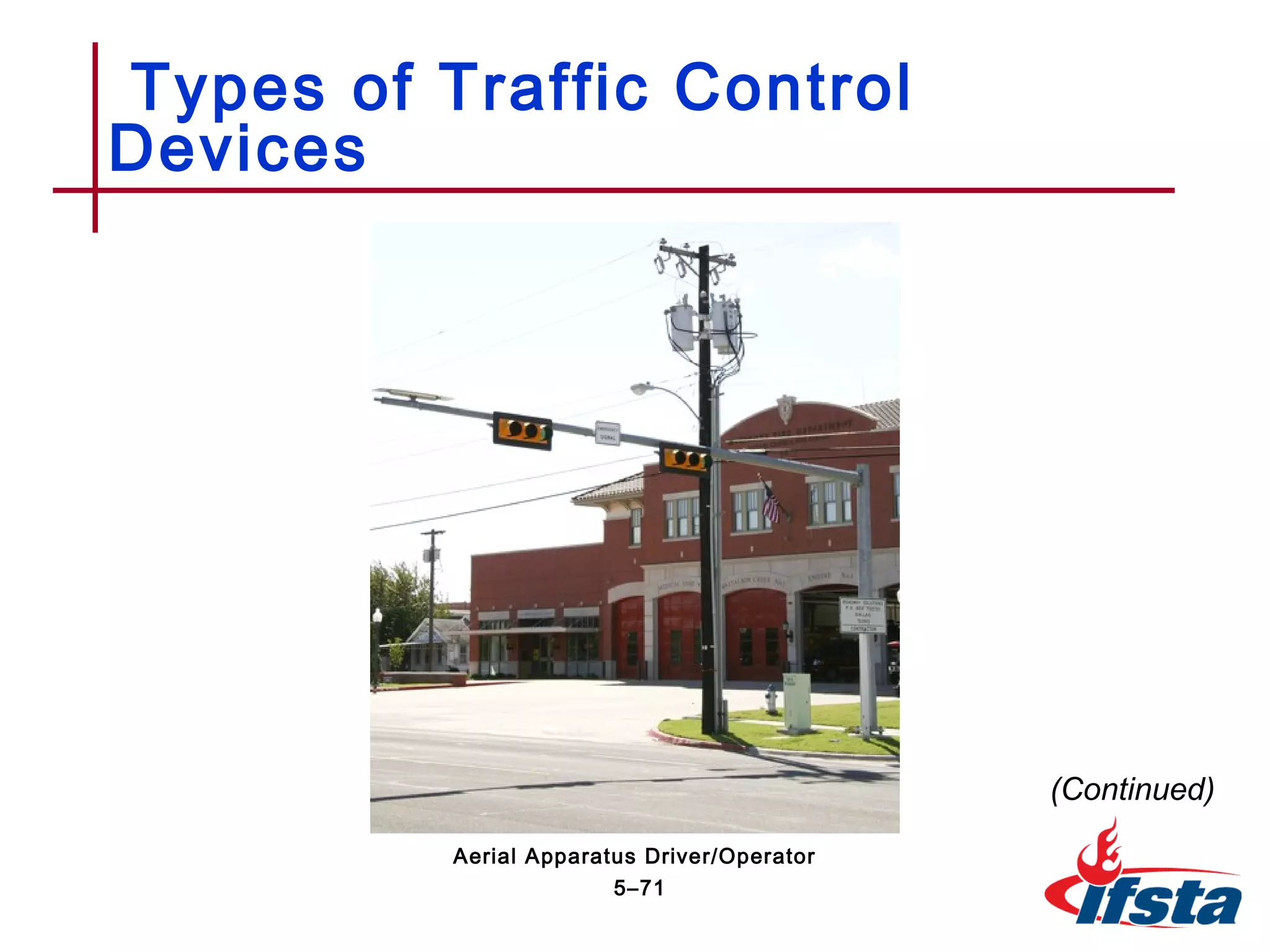
Guidelines for
Starting the Vehicle
(Continued)
5–9
Aerial Apparatus Driver/Operator
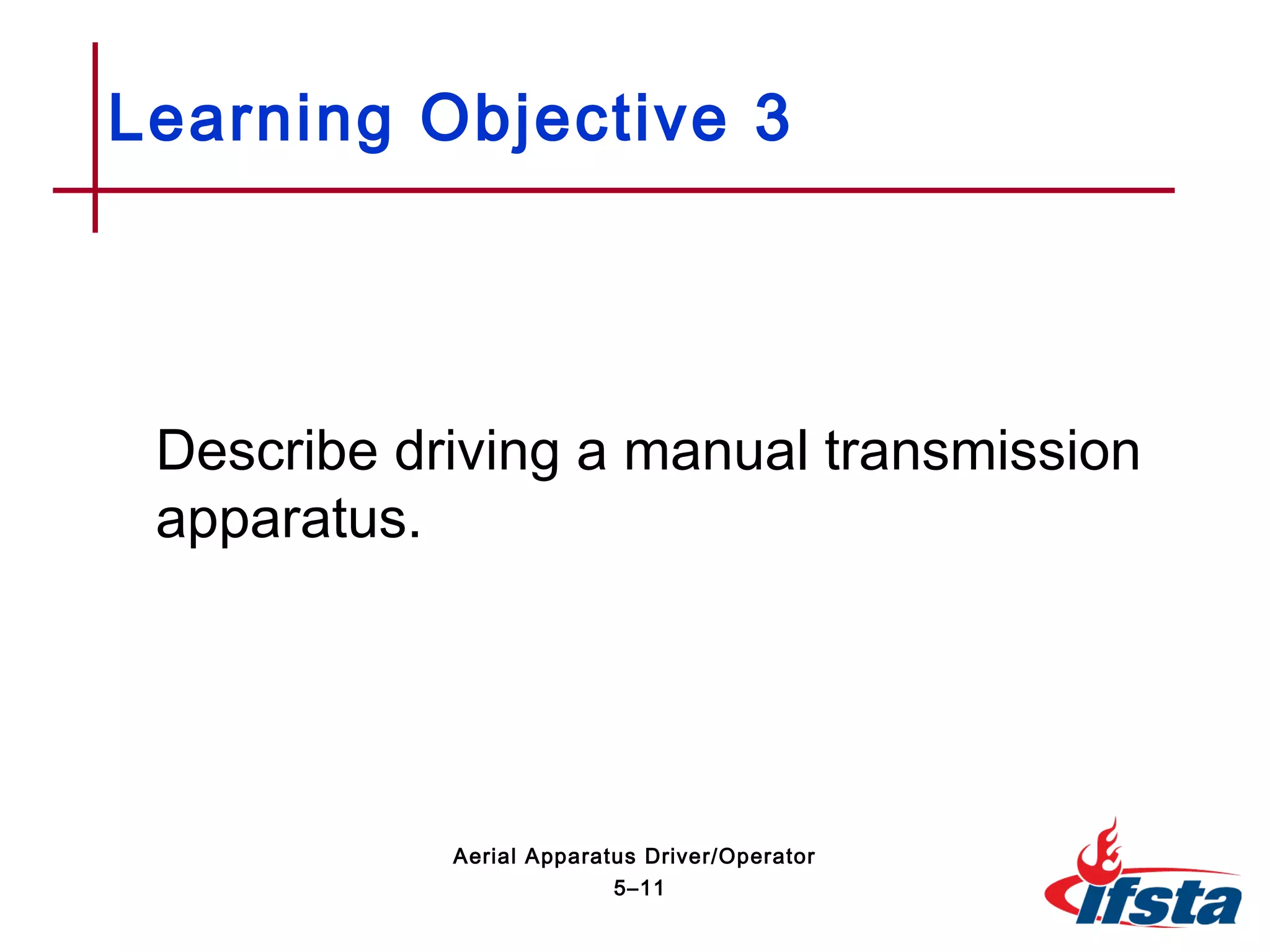
• Make sure engine
instruments move
into normal operating
ranges on gauges.
• Adjust seat first and
then mirrors and
steering column.
Guidelines for
Starting the Vehicle
5–10
Aerial Apparatus Driver/Operator
Describe driving a manual transmission
apparatus.
Learning Objective 3
5–11
Aerial Apparatus Driver/Operator
• Depress service brake pedal with right
foot and release parking brake.
• Place gear shifter into low gear.
• Release clutch slowly when starting
from standstill.
Driving Manual Transmission
(Continued)
5–12
Aerial Apparatus Driver/Operator
• Keep in low gear until proper speed or
rpms are reached for shifting.
• Keep transmission in low gear until
apparatus is clear of station and
driver/operator has an unobstructed
view of street and traffic conditions.
Driving Manual Transmission
5–13
Aerial Apparatus Driver/Operator
• Never attempt to start apparatus
moving while it is in high gear.
• Abrupt operation of clutch may cause
engine to stall.
• Avoid vehicle roll back before engaging
clutch.
• When shifting gears, clutch should be
fully disengaged.
Operating the Clutch
5–14
Aerial Apparatus Driver/Operator
• Climbing a hill
• Entering intersections on sharp curves
• Turning corners
• Over rough and rugged train
• Starting down hill
Using Lower Gears
5–15
Aerial Apparatus Driver/Operator
Describe driving an automatic
transmission apparatus.
Learning Objective 4
5–16
Aerial Apparatus Driver/Operator
• Depress interlock on shifter and move it
to appropriate gear selection.
• Pressure placed upon accelerator
influences automatic shifting.
• Manually select particular gear when
operating at slow speed or driving up or
down a steep hill.
Driving Automatic Transmission
5–17
Aerial Apparatus Driver/Operator
Discuss nonemergency traveling in a
fire apparatus.
Learning Objective 5
5–18
Aerial Apparatus Driver/Operator
• Attempt to maintain engine rpm control
through correct throttling.
• Accelerate vehicle gradually once
apparatus is moving.
• Operate engine within its power curve.
Guidelines for Traveling
(Nonemergency)
(Continued)
5–19
Aerial Apparatus Driver/Operator
• Do not try to reach rated speed in low
gears.
• Avoid overthrottling which results in
lugging the engine.
• Stay in highest gear that allows
apparatus to keep up with traffic.
Guidelines for Traveling
(Nonemergency)
(Continued)
5–20
Aerial Apparatus Driver/Operator
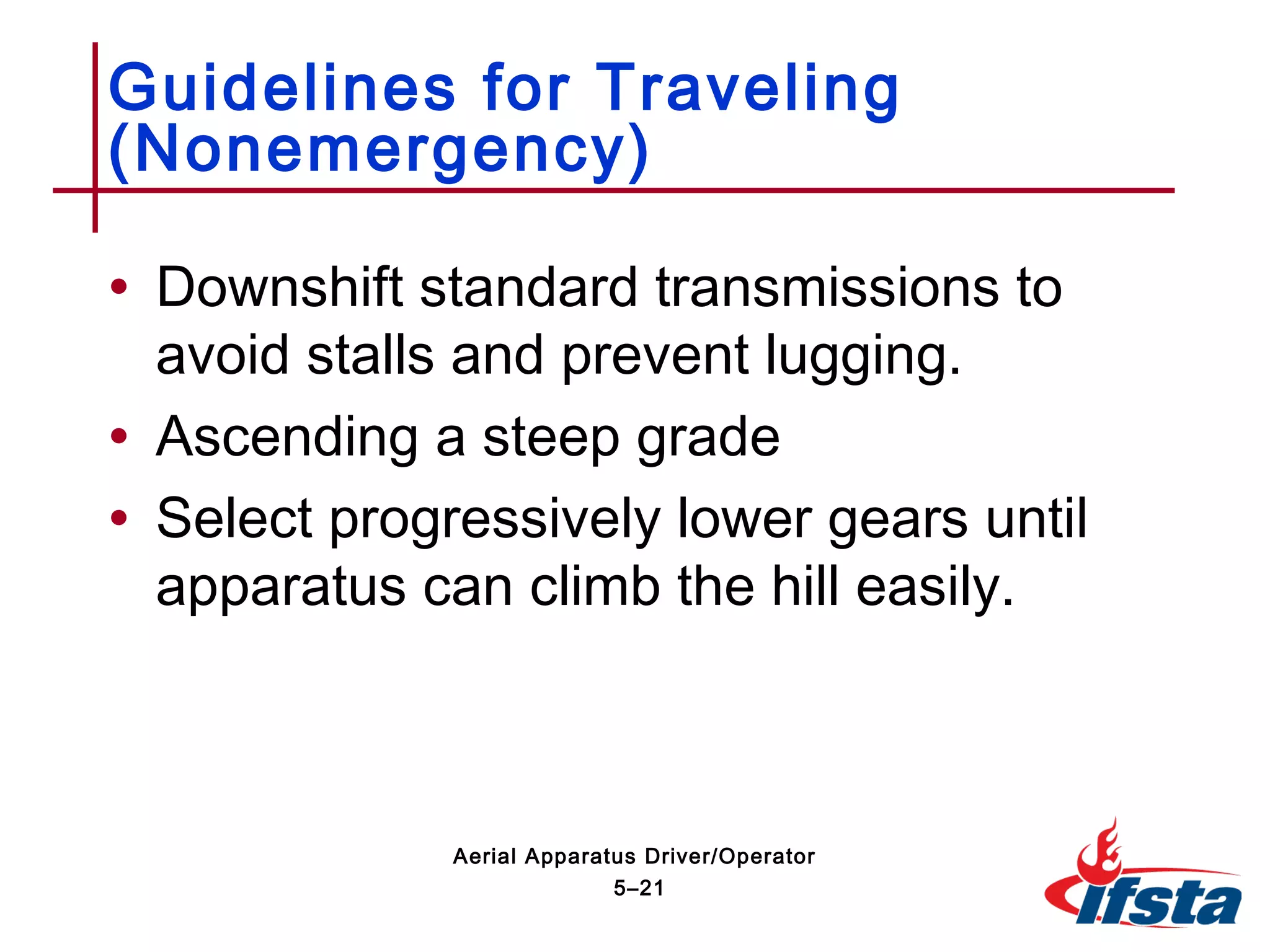
• Downshift standard transmissions to
avoid stalls and prevent lugging.
• Ascending a steep grade
• Select progressively lower gears until
apparatus can climb the hill easily.
Guidelines for Traveling
(Nonemergency)
5–21
Aerial Apparatus Driver/Operator
• Avoid allowing engine to overspeed.
• Choose a gear that allows engine to
operate at 200 or 300 rpm lower than
maximum recommended rpm.
Maximum Engine RPM
5–22
Aerial Apparatus Driver/Operator
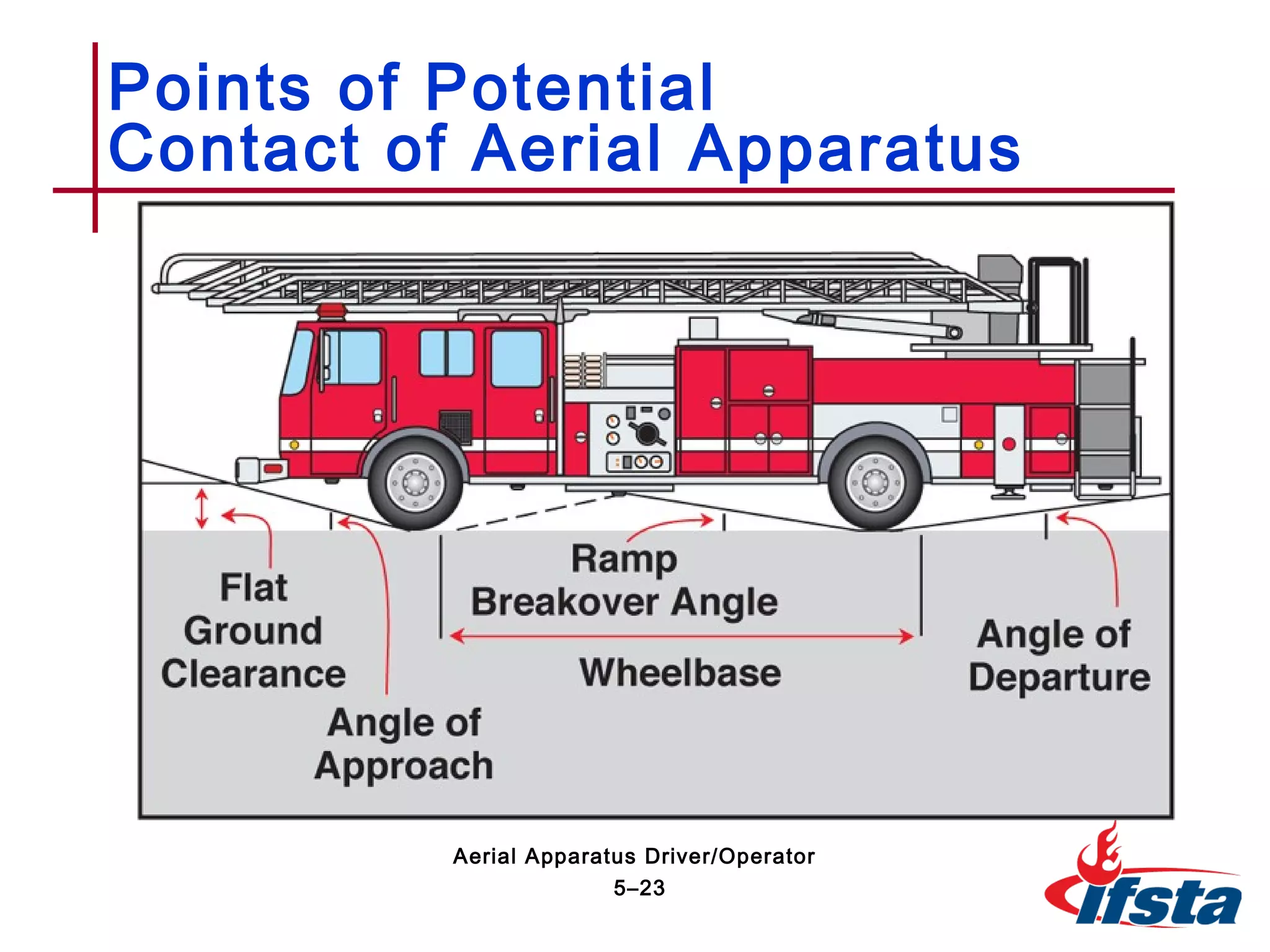
Points of Potential
Contact of Aerial Apparatus
5–23
Aerial Apparatus Driver/Operator
Discuss stopping, idling, and shutting
down the apparatus.
Learning Objective 6
5–24
Aerial Apparatus Driver/Operator
• Perform smoothly so apparatus will
come to an even stop.
• Before braking
– Consider weight
– Consider condition of brakes, tires, and
road surface
Stopping the Apparatus
5–25
Aerial Apparatus Driver/Operator
• Fitted on some apparatus
• Assist in braking
• Provide slowing action
• Save wear on service brake
components
• Engine manages on hills and slippery
roads easier
Retarding Devices
5–26
Aerial Apparatus Driver/Operator
DISCUSSION QUESTION
Is it SOP in your department to shut
down the engine rather than leave it
idling for long periods of time? Why
or why not?
5–27
Aerial Apparatus Driver/Operator
• Long idling periods
• If necessary to idle – Set apparatus to
idle at 900 to 1,100 rpm
Engine Idling
5–28
Aerial Apparatus Driver/Operator
• Never deactivate engine while
apparatus is in motion.
• Never deactivate immediately after a full
load operation or when engine is
overheated.
• Idle for 3 to 5 minutes before shutting
down.
Engine Shutdown
5–29
Aerial Apparatus Driver/Operator
• Immediate increase of engine
temperature
• Oil film “burning” on hot surfaces
• Damage to heads and exhaust
manifolds
• Possible damage to turbocharger
Shutting Down
Without Cooldown Period
5–30
Aerial Apparatus Driver/Operator
• Place transmission in Park (P) or
Neutral (N).
• Set parking brake.
• Allow engine to idle and cool down.
• Shut off engine.
• Turn battery switch(es) off.
• Reconnect ground shore lines.
Engine Shutdown Procedures
5–31
Aerial Apparatus Driver/Operator
Start, idle, and shut down a fire service
apparatus.
Objective 7 is measured in Skill Sheet 5-1.
Learning Objective 7
5–32
Aerial Apparatus Driver/Operator
Drive a fire service apparatus.
Objective 8 is measured in Skill Sheet 5-2.
Learning Objective 8
5–33
Aerial Apparatus Driver/Operator
Discuss braking and reaction times.
Learning Objective 9
5–34
Aerial Apparatus Driver/Operator
Identify factors that influence the
driver/operator’s ability to stop the
apparatus.
Learning Objective 10
5–35
Aerial Apparatus Driver/Operator
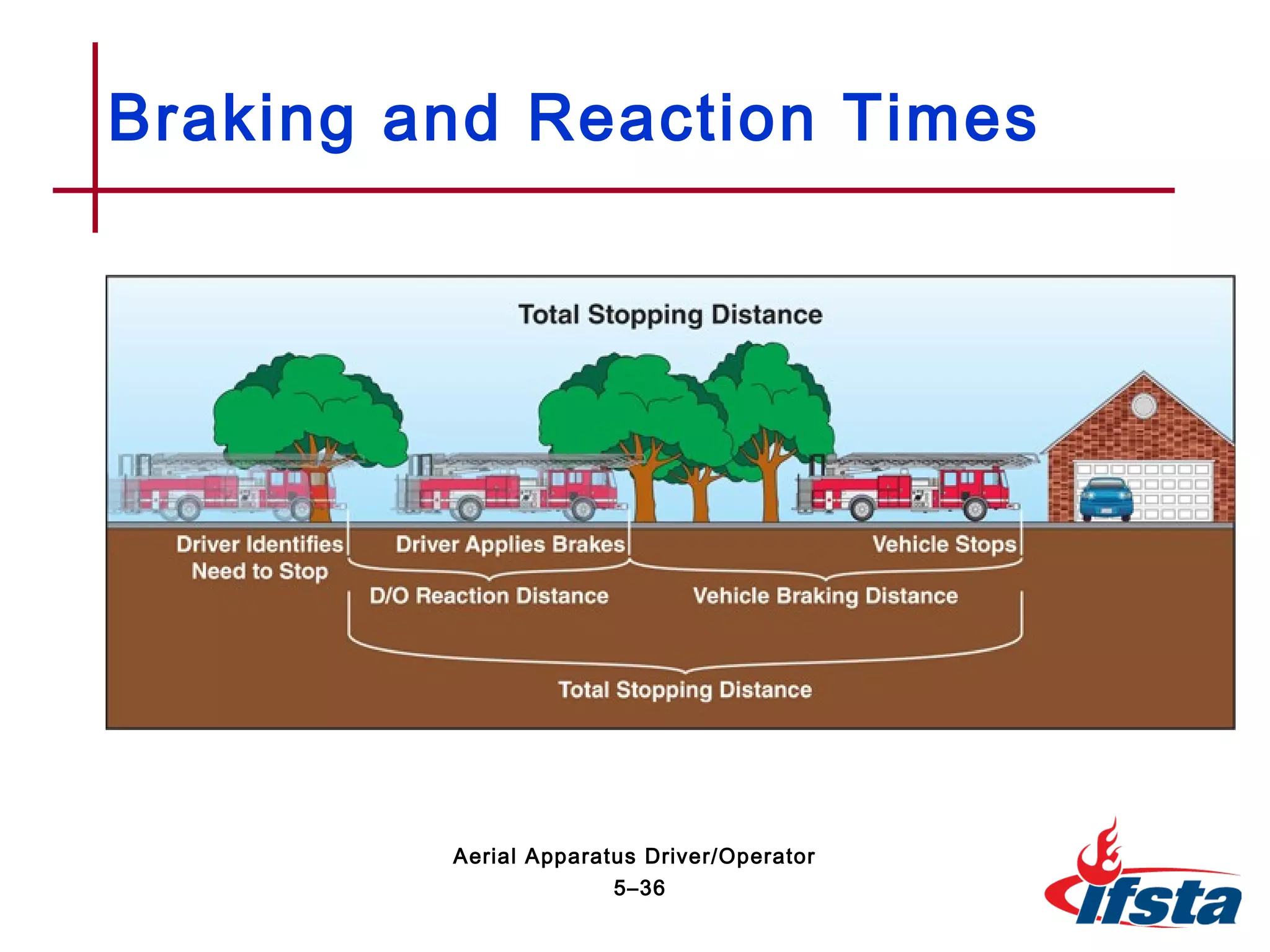
Braking and Reaction Times
5–36
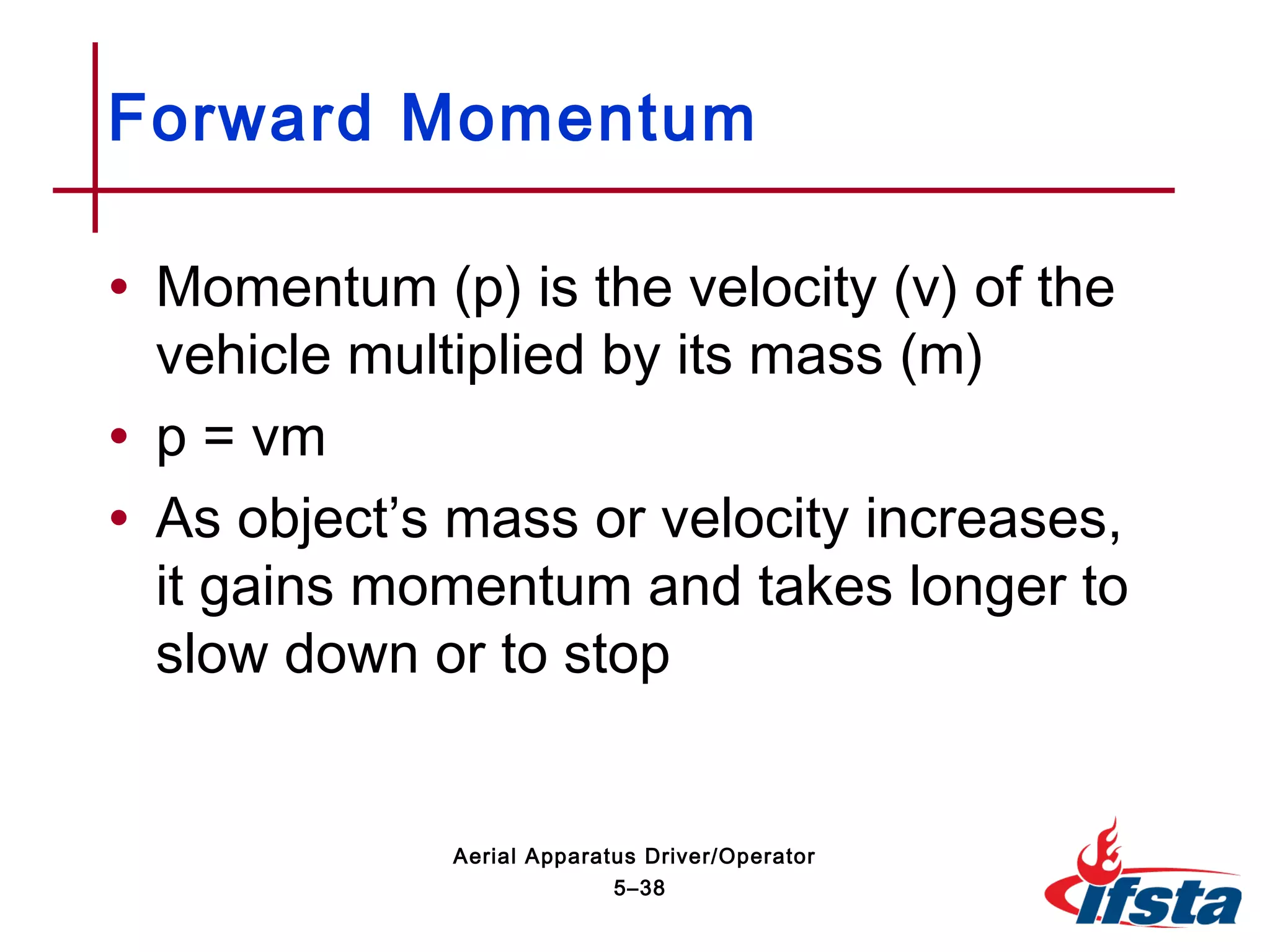
Aerial Apparatus Driver/Operator
• Condition and slope of driving surface
• Speed of travel
• Weight of vehicle
• Type and condition of vehicle’s tires
and braking system
Factors Influencing
Ability to Stop
5–37
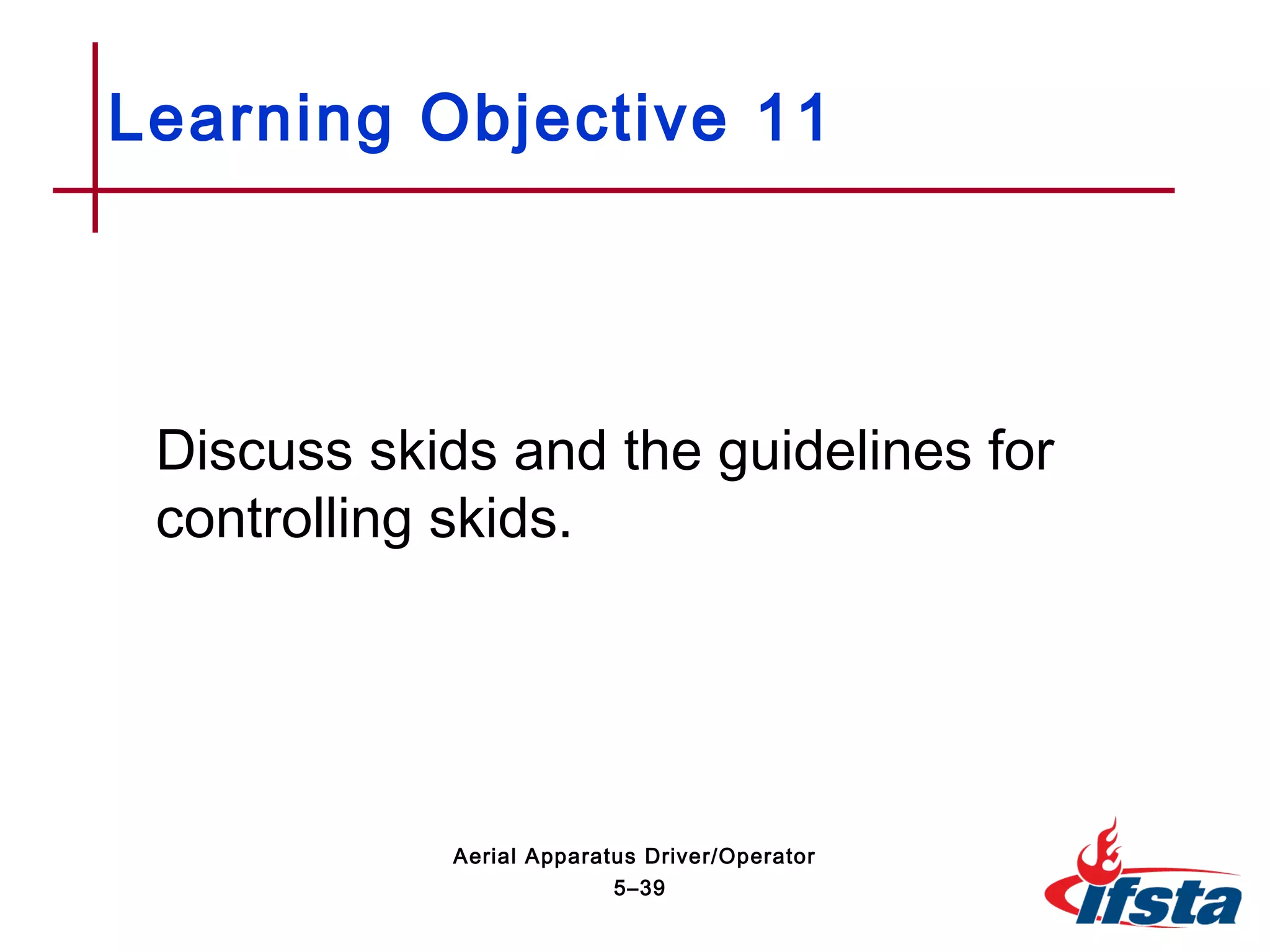
Aerial Apparatus Driver/Operator
• Momentum (p) is the velocity (v) of the
vehicle multiplied by its mass (m)
• p = vm
• As object’s mass or velocity increases,
it gains momentum and takes longer to
slow down or to stop
Forward Momentum
5–38
Aerial Apparatus Driver/Operator
Discuss skids and the guidelines for
controlling skids.
Learning Objective 11
5–39
Aerial Apparatus Driver/Operator
• Driving too fast for road conditions
• Weight shifts of heavy apparatus
• Failing to anticipate obstacles
• Improper use of auxiliary braking
devices
• Improper tire maintenance
Common Causes of Skids
5–40
Aerial Apparatus Driver/Operator
• Minimizes chance of skid
• Works using digital technology
• Removes need to pump brake pedal
• Causes momentary delay
(approximately 0.4 seconds)
Antilock Braking System (ABS)
5–41
Aerial Apparatus Driver/Operator
• Release the brakes, allowing wheels to
rotate freely.
• Turn steering wheel so front wheels
face direction of skid.
• Standard transmission, do not engage
clutch.
• Once skid is controllable, gradually
apply power to wheels.
Correcting Skids
5–42
Aerial Apparatus Driver/Operator
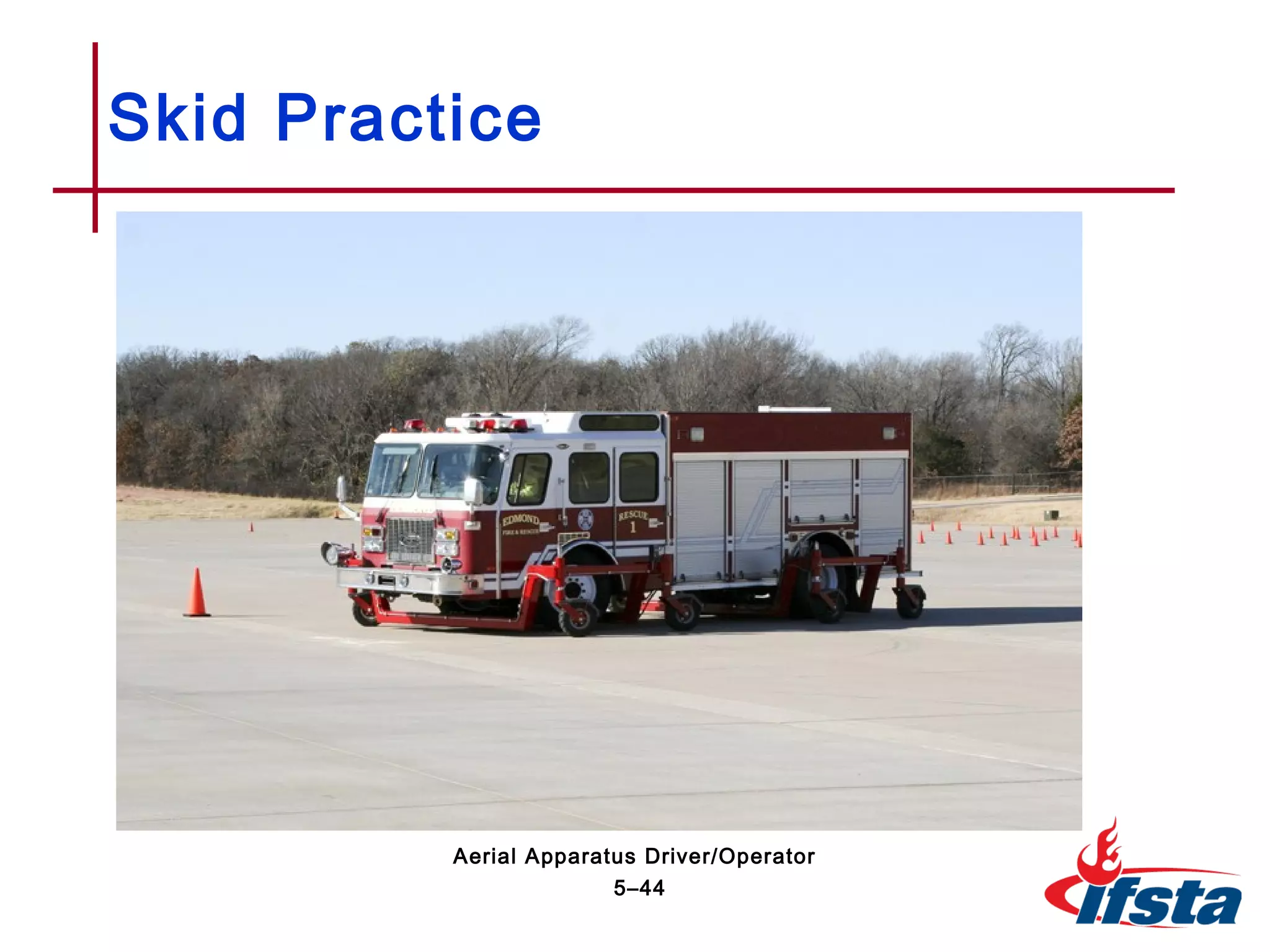
• May be gained at facilities having skid
pads
• May be gained through use of new
system that mounts to apparatus
• Should always be performed at slow
speeds
Skid Practice
(Continued)
5–43
Aerial Apparatus Driver/Operator
Skid Practice
5–44
Aerial Apparatus Driver/Operator
Discuss the characteristics of auxiliary
braking systems.
Learning Objective 12
5–45
Aerial Apparatus Driver/Operator
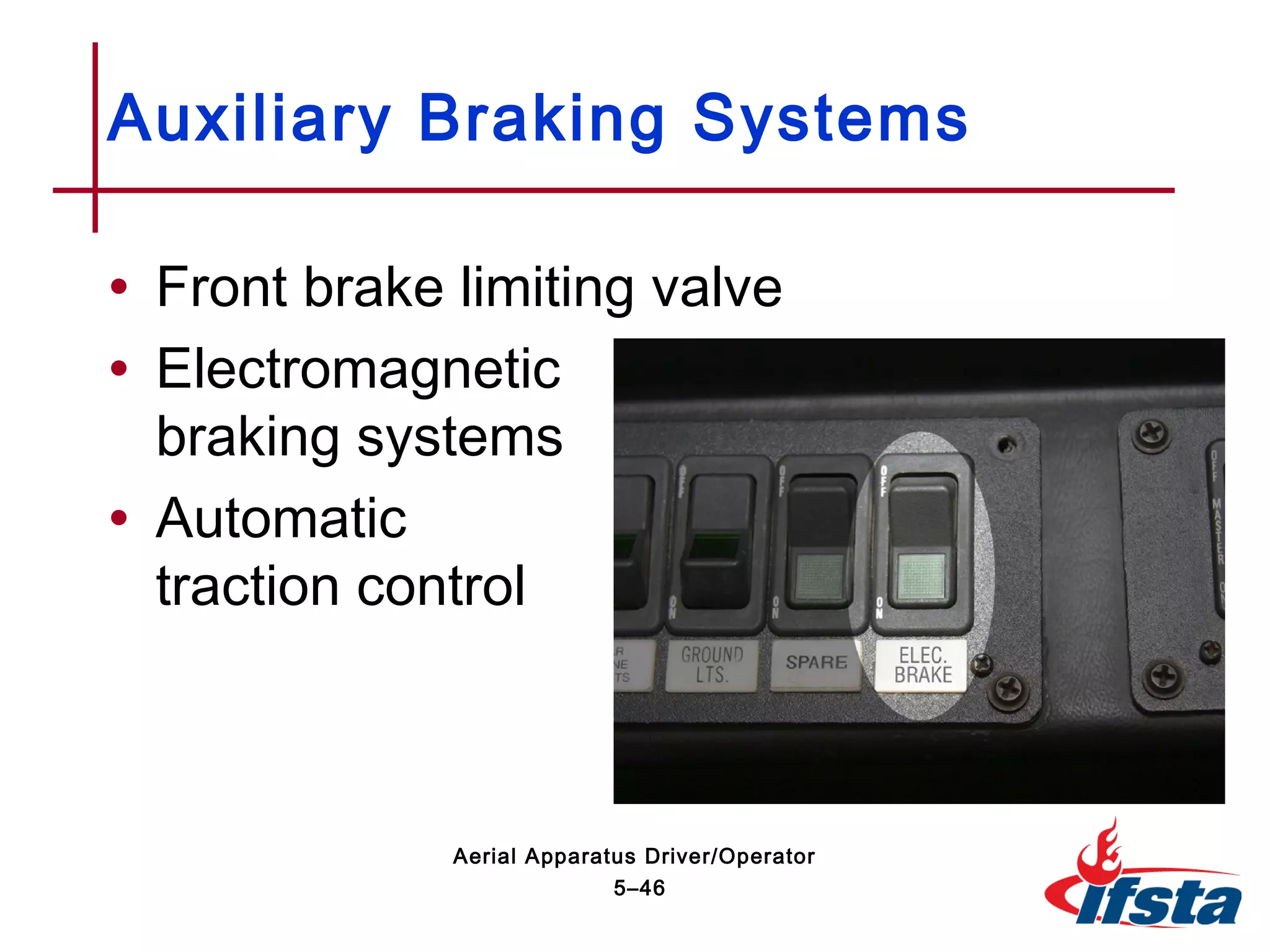
• Front brake limiting valve
• Electromagnetic
braking systems
• Automatic
traction control
Auxiliary Braking Systems
5–46
Aerial Apparatus Driver/Operator
Describe weight transfer.
Learning Objective 13
5–47
Aerial Apparatus Driver/Operator
• Law of inertia: “objects in motion tend to
remain in motion; objects at rest tend to
remain at rest unless acted upon by an
outside force”
• Takes place whenever a vehicle
undergoes a change in speed or
direction
Weight Transfer
(Continued)
5–48
Aerial Apparatus Driver/Operator
• Can contribute to skidding or possible
rollover
• Improperly baffled water tanks
• Driver/operator
– Use only as much steering as needed
– Steer smoothly and fluidly
– Maintain slow speed to prevent severe
weight transfer
Weight Transfer
5–49
Aerial Apparatus Driver/Operator
Discuss the use of private vehicles.
Learning Objective 14
5–50
Aerial Apparatus Driver/Operator
• Most states and province require
private vehicles to pull to the right, stop,
and remain at a standstill until
emergency traffic has passed.
• Driver/operators must be aware that not
everyone hears warning devices and
many do not know how to plan an
immediate reaction.
Private Vehicles
5–51
Aerial Apparatus Driver/Operator
Discuss collisions at intersections.
Learning Objective 15
5–52
Aerial Apparatus Driver/Operator
• Most likely place for collisions involving
emergency vehicles
• Driver/operators
– Slow down for intersections
– STOP when faced with a red light or stop
sign
– Anticipate worst possible situation
Collisions at Intersections
(Continued)
5–53
Aerial Apparatus Driver/Operator
• No signals
• Red traffic signal or stop sign
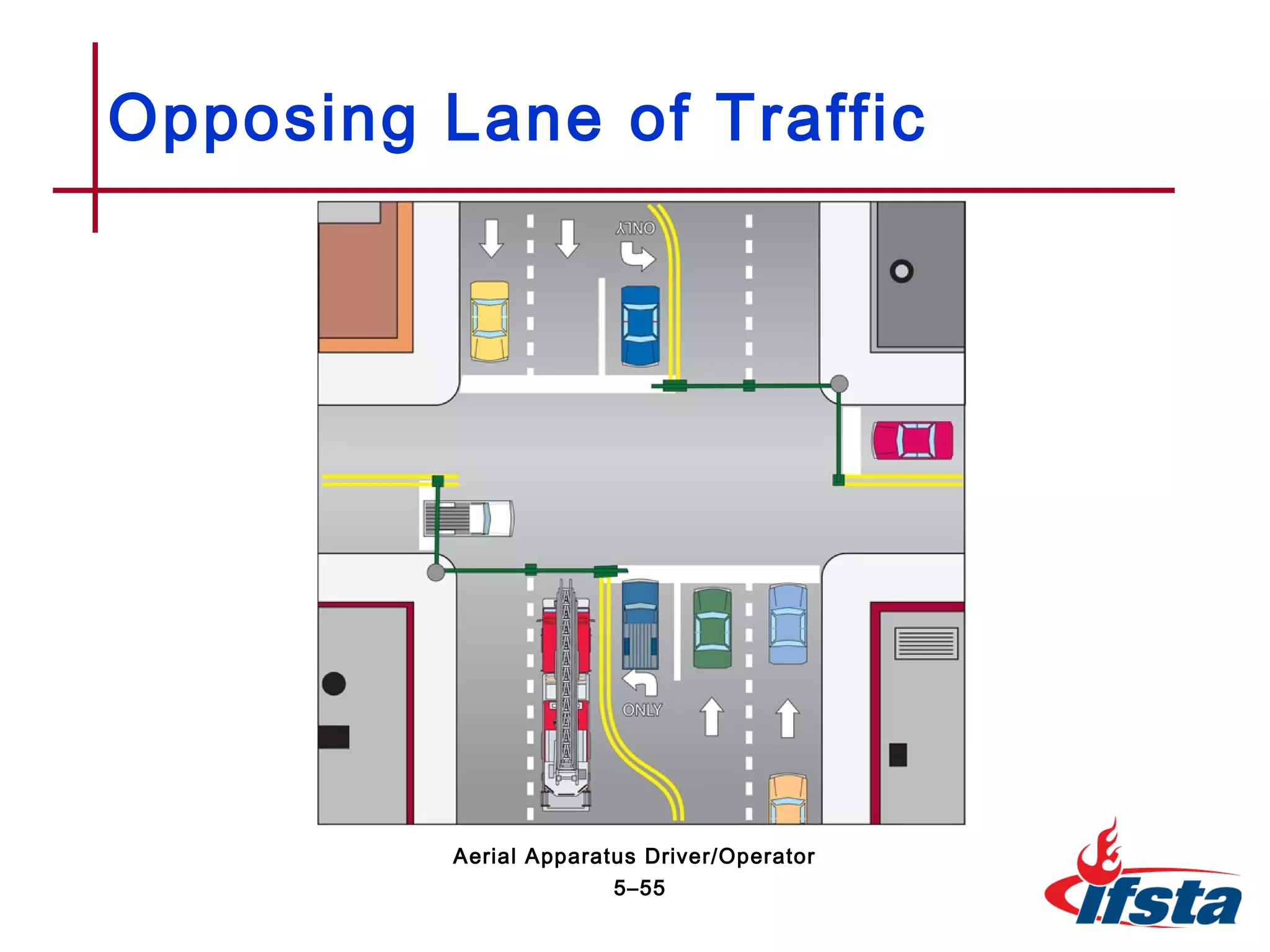
• Driving into opposing lane of traffic
Collisions at Intersections
5–54
Aerial Apparatus Driver/Operator
Opposing Lane of Traffic
5–55
Aerial Apparatus Driver/Operator
Identify safe passing procedures.
Learning Objective 16
5–56
Aerial Apparatus Driver/Operator
• Always travel in innermost lane on
multilane roads.
• Avoid passing vehicles on right sides.
• Be certain that opposing lanes of traffic
are clear of oncoming traffic.
• Avoid passing other emergency
vehicles.
Passing Other Vehicles
5–57
Aerial Apparatus Driver/Operator
Discuss driving in adverse weather.
Learning Objective 17
5–58
Aerial Apparatus Driver/Operator
• Recognize dangers of rain, snow, ice,
and mud
• Adjust speed
• Decrease speed gradually
• Slow down while approaching curves
• Keep off low or soft shoulders
Driving in Adverse Weather
(Continued)
5–59
Aerial Apparatus Driver/Operator
• Avoid sudden turns
• Recognize slippery areas
• Increase following distance dramatically
Driving in Adverse Weather
5–60
Aerial Apparatus Driver/Operator
• Reduce stopping distance and
considerably increase traction
• Consist of short lengths of chain on a
rotating hub
• Hubs swing down into place
• Lose effectiveness in snow deeper than
3 to 6 inches (76 mm to 152 mm)
Snow Tires or Chains
5–61
Aerial Apparatus Driver/Operator
Describe warning devices and discuss
clearing traffic.
Learning Objective 18
5–62
Aerial Apparatus Driver/Operator
DISCUSSION QUESTION
What is the surest way to catch a
driver’s attention?
5–63
Aerial Apparatus Driver/Operator
• Civilian drivers respond better to
sounds that frequently change pitch.
• Audible devices can be “outrun” by
apparatus at speeds above 50 mph (80
km/h).
• Warning devices are of no value if not
used.
Warning Devices
and Clearing Traffic
(Continued)
5–64
Aerial Apparatus Driver/Operator
• Should be limited to true emergency
response situations
• Turn off on limited-access highways
and turnpikes
• Emergency vehicles responding on
same route should travel at least 300 to
500 feet (90 m to 150 m) apart.
Warning Devices
and Clearing Traffic
(Continued)
5–65
Aerial Apparatus Driver/Operator
DISCUSSION QUESTION
Why is it important for multiple
emergency vehicles to maintain an
appropriate distance from one
another?
5–66
Aerial Apparatus Driver/Operator
• Headlights should be turned on while
responding.
• May be advisable to turn off some
warning lights on apparatus once in
position
Warning Devices
and Clearing Traffic
(Continued)
5–67
Aerial Apparatus Driver/Operator
Warning Devices
and Clearing Traffic
5–68
Aerial Apparatus Driver/Operator
Identify traffic control devices.
Learning Objective 19
5–69
Aerial Apparatus Driver/Operator
• Types of systems
• Not substitutes for using proper
defensive driving techniques
Traffic Control Devices
5–70
Aerial Apparatus Driver/Operator
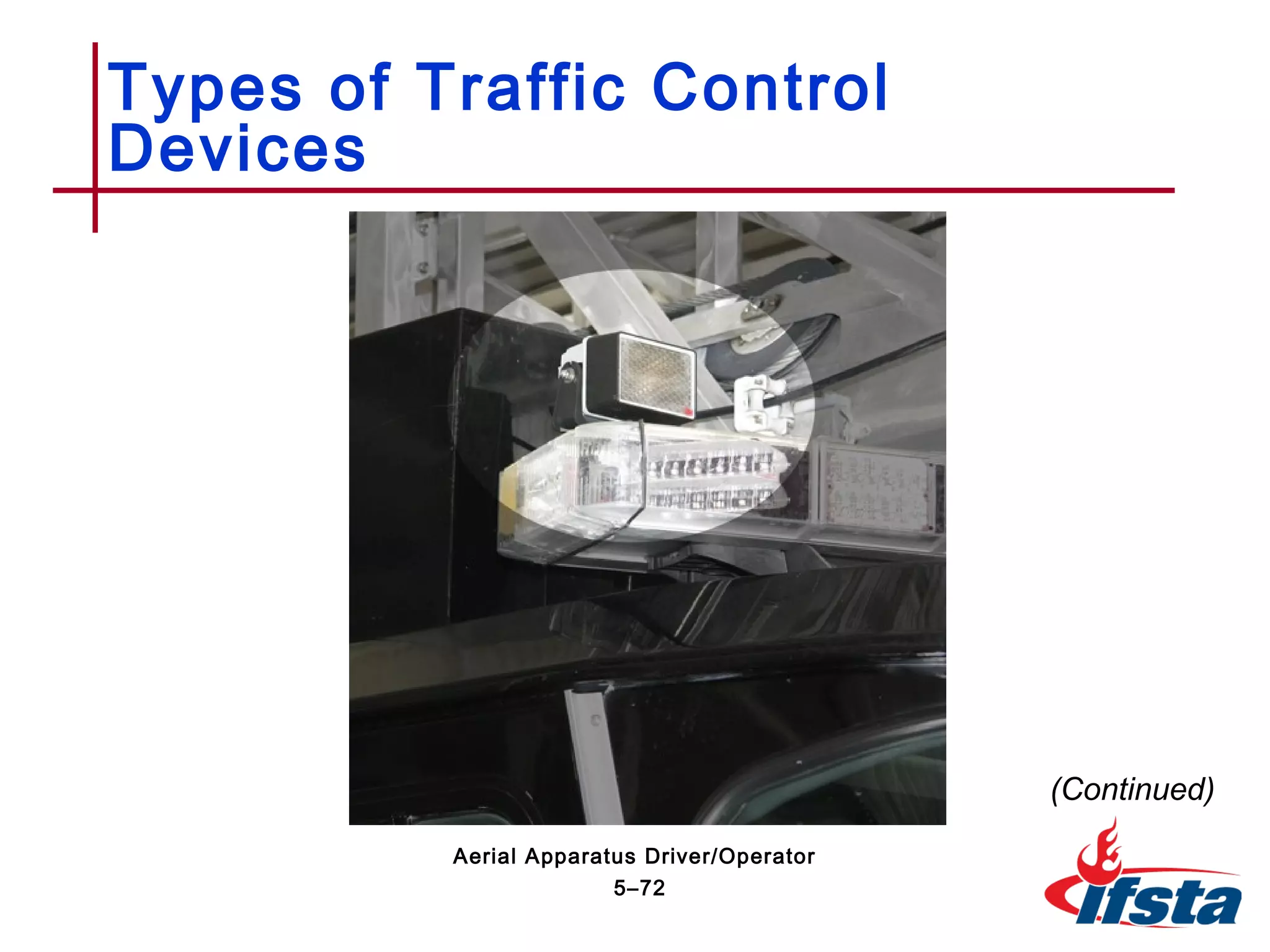
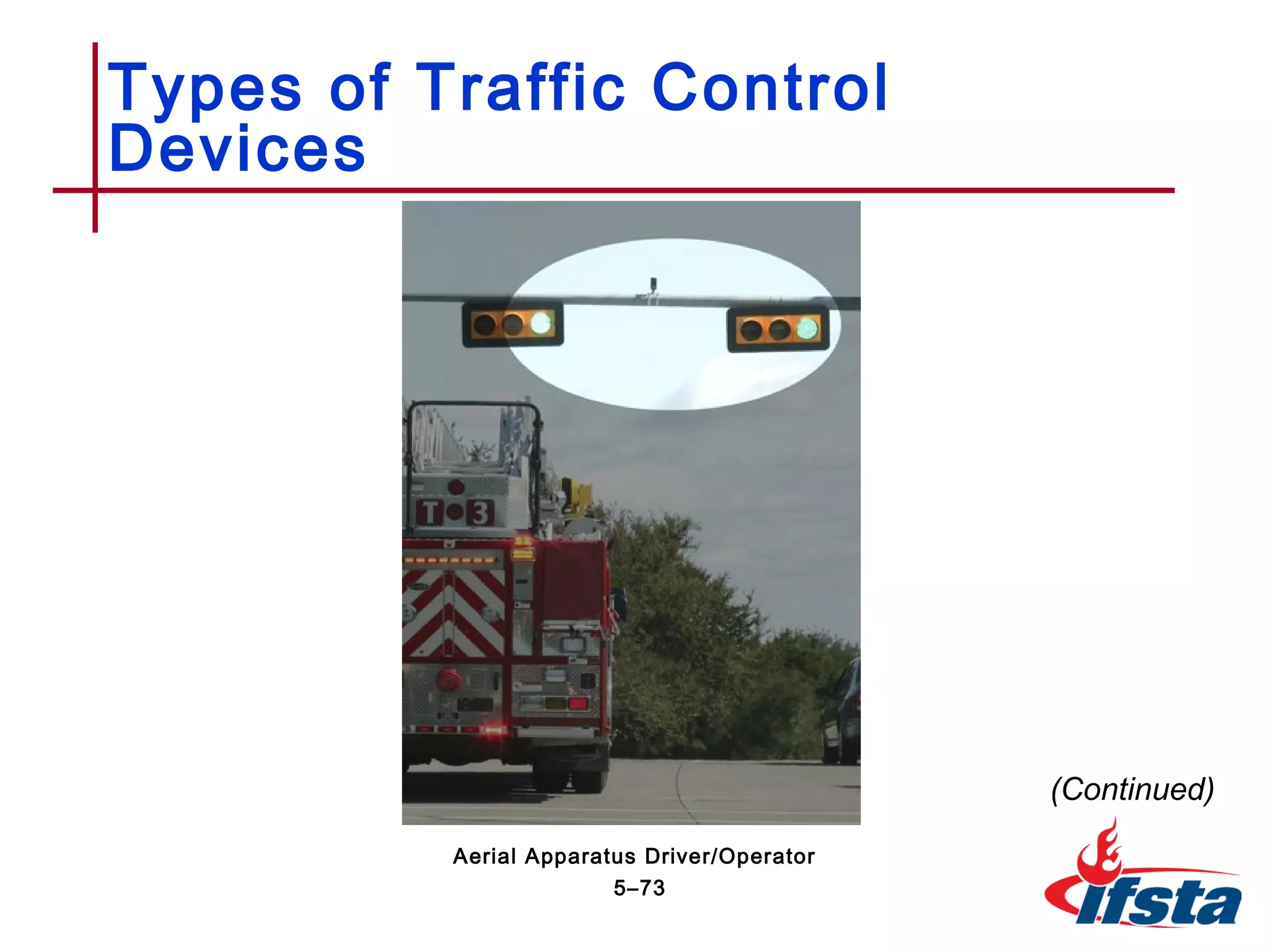
Types of Traffic Control
Devices
(Continued)
5–71
Aerial Apparatus Driver/Operator
Types of Traffic Control
Devices
(Continued)
5–72
Aerial Apparatus Driver/Operator
Types of Traffic Control
Devices
(Continued)
5–73
Aerial Apparatus Driver/Operator
Discuss the tiller operator.
Learning Objective 20
5–74
Aerial Apparatus Driver/Operator
• Must be qualified
• Must be familiar with duties assigned to
all truck company personnel
• Driving assignments
Tiller Operator
5–75
Aerial Apparatus Driver/Operator
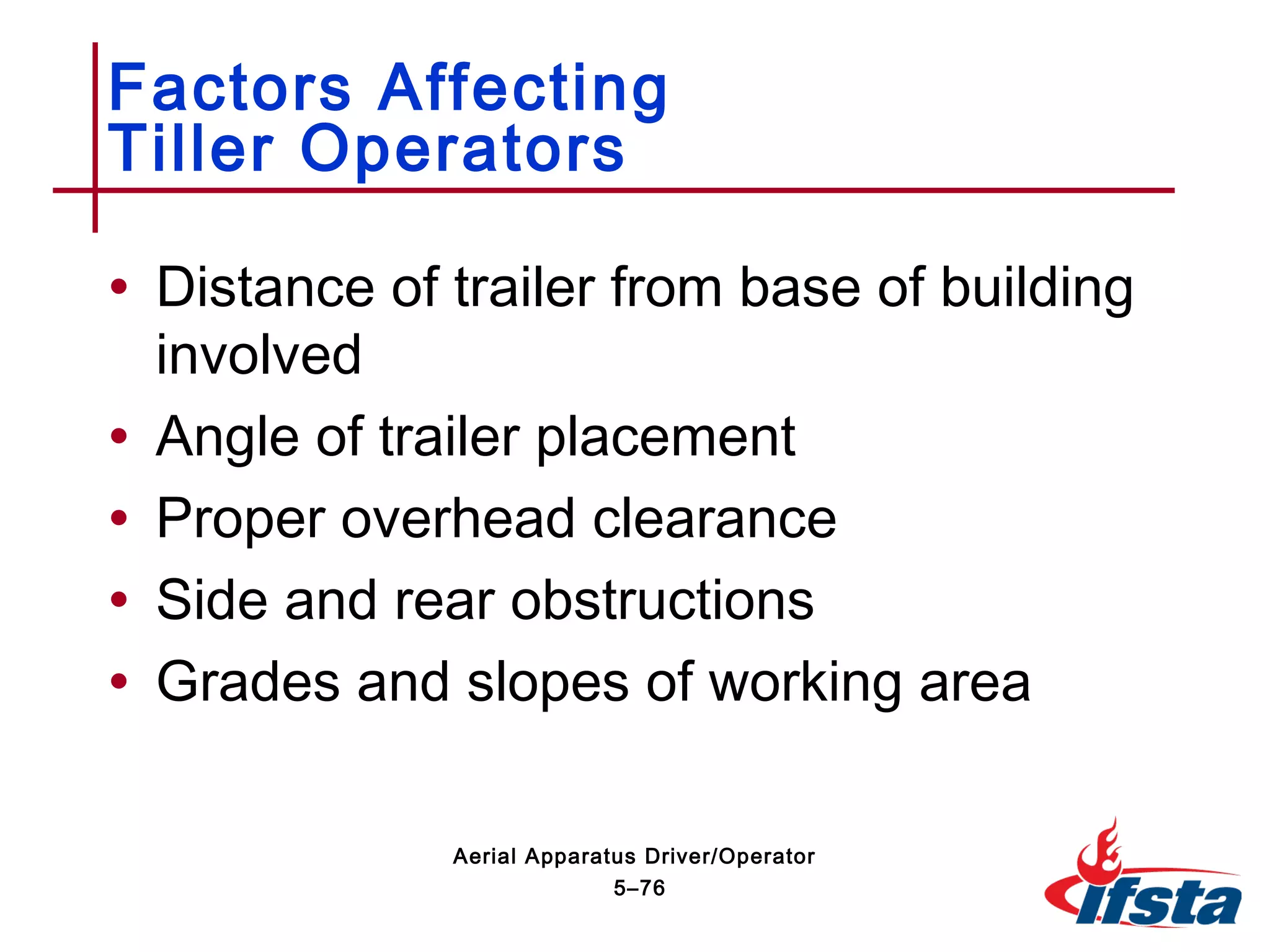
• Distance of trailer from base of building
involved
• Angle of trailer placement
• Proper overhead clearance
• Side and rear obstructions
• Grades and slopes of working area
Factors Affecting
Tiller Operators
5–76
Aerial Apparatus Driver/Operator
Describe tiller operator training.
Learning Objective 21
5–77
Aerial Apparatus Driver/Operator
• Use good signal practices.
• ALWAYS trail in-line on a straightaway.
• Bring trailer quickly into line after
completion of turn.
• Observe trailer overhang on turns.
Operator Training
(Continued)
5–78
Aerial Apparatus Driver/Operator
• Operate tiller section in a smooth and
safe manner.
• Avoid overtillering.
• Keep both hands on the wheel and give
undivided attention to the job.
Operator Training
5–79
Aerial Apparatus Driver/Operator
• Perform several checks before giving
signal to proceed
• Center trailer in doorway when leaving
Leaving the Fire Station
5–80
Aerial Apparatus Driver/Operator
• Keep trailer wheels parallel with frame
of trailer and in direct line with tractor.
• When turning keep trailer in line with
tractor as much as possible.
Traveling Forward
(Continued)
5–81
Aerial Apparatus Driver/Operator
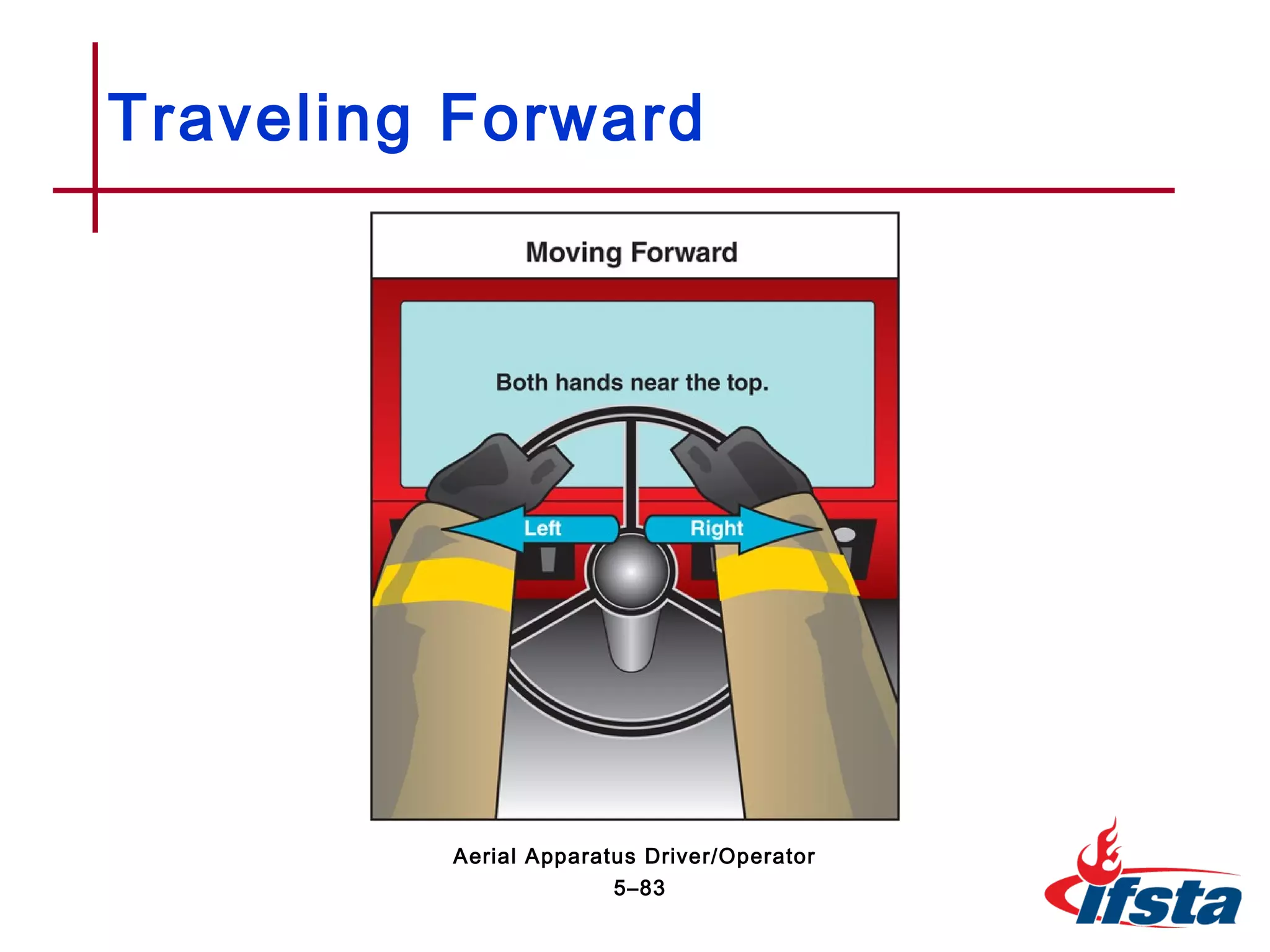
DISCUSSION QUESTION
Where on the tiller steering wheel
should the hands be placed when
moving forward?
5–82
Aerial Apparatus Driver/Operator
Traveling Forward
5–83
Aerial Apparatus Driver/Operator
• Be alert to conditions on other streets.
• Anticipate hazardous situations.
• Pay attention to trucks, buses, and
other large vehicles.
• Keep outlook for any overhanging
obstructions.
Tiller Operator
Driving Guidelines
5–84
Aerial Apparatus Driver/Operator
• Exercise caution and maintain a
constant awareness of vehicles on each
side and to rear of apparatus.
• Methods of negotiating turns
Turning at Intersections
5–85
Aerial Apparatus Driver/Operator
• Requires opposite maneuvers of those
used to steer front wheels
• Requires communication between
driver and tiller operator
• Must be performed smoothly and slowly
• Pay attention to position of tractor as
well as clearance on both sides and
rear
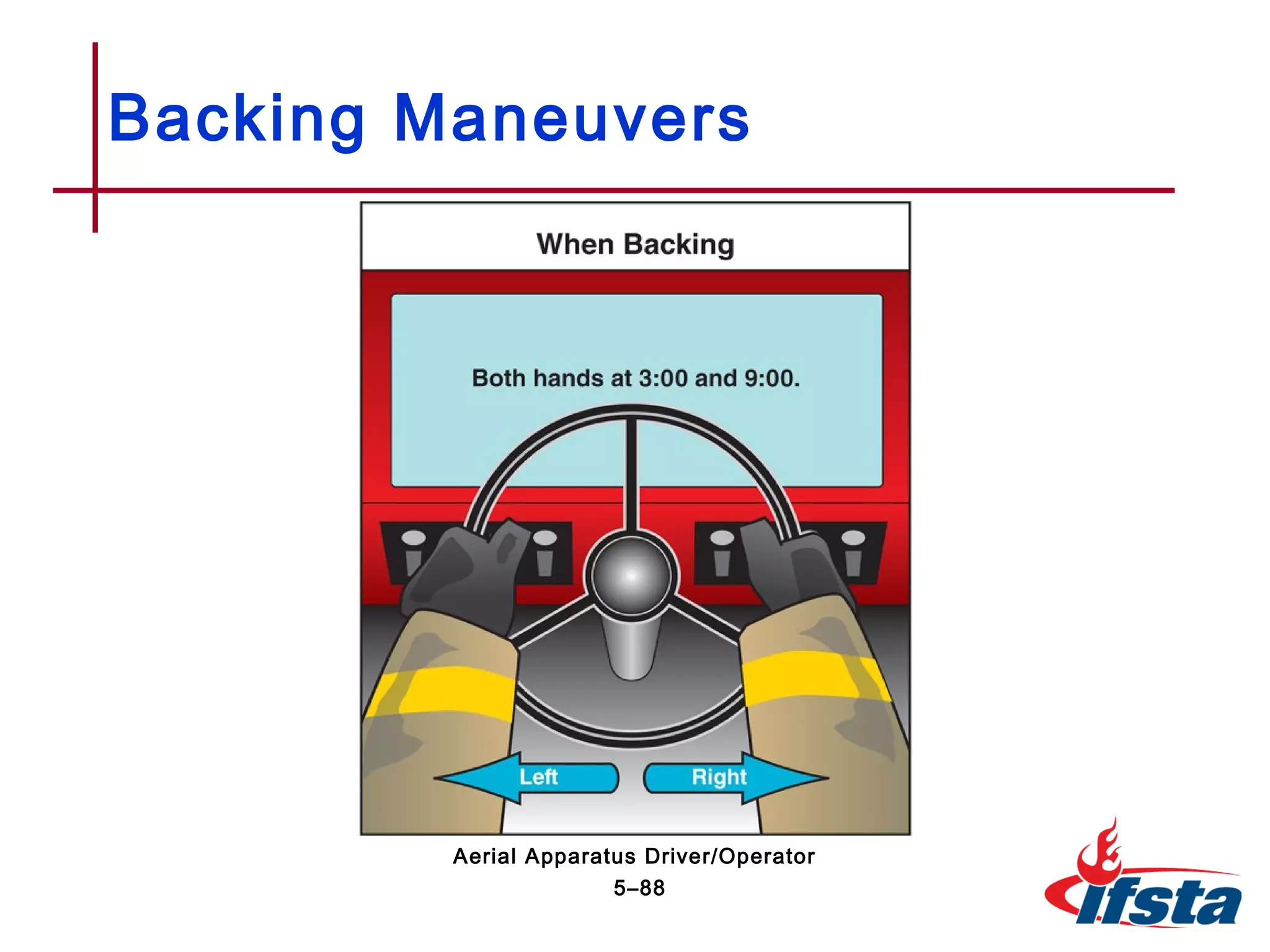
Backing Maneuvers
(Continued)
5–86
Aerial Apparatus Driver/Operator
DISCUSSION QUESTION
Where on the tiller steering wheel
should the hands be placed when
backing?
5–87
Aerial Apparatus Driver/Operator
Backing Maneuvers
5–88
Aerial Apparatus Driver/Operator
Describe the driving exercises and
evaluation methods of the
driver/operator.
Learning Objective 22
5–89
Aerial Apparatus Driver/Operator
• Driving regulations, laws, and fire
department SOPs for emergency and
nonemergency operations
• Pump operations and aerial ladder
operations
• Hydraulic calculations
Written Test Questions
5–90
Aerial Apparatus Driver/Operator
• NFPA®
Code of Federal Regulations
(CFR)
• NFPA®
1002
Practical Driving
Exercise Sources
5–91
Aerial Apparatus Driver/Operator
DISCUSSION QUESTION
What practical driving exercises are
used for testing in your jurisdiction?
5–92
Aerial Apparatus Driver/Operator
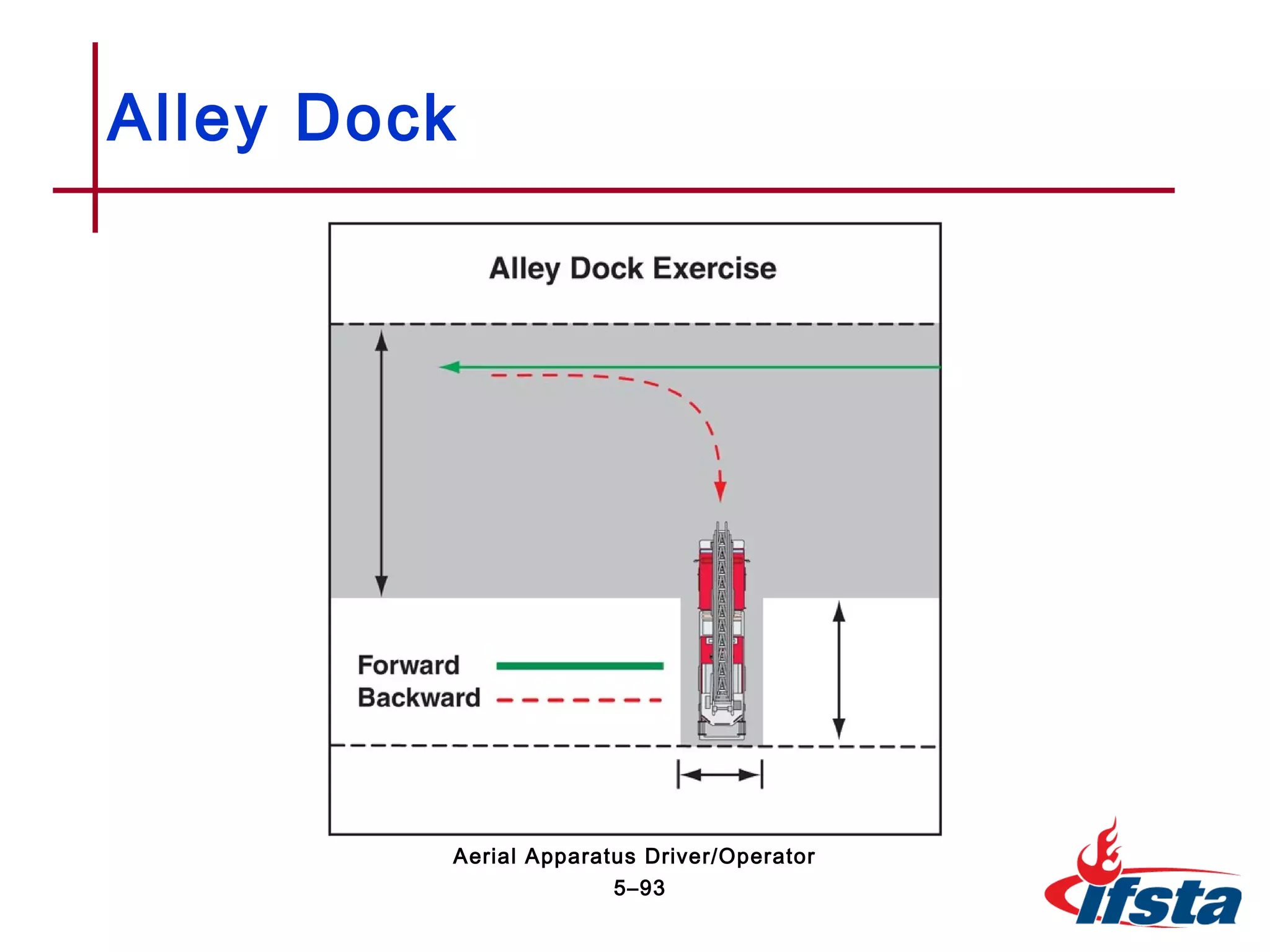
Alley Dock
5–93
Aerial Apparatus Driver/Operator
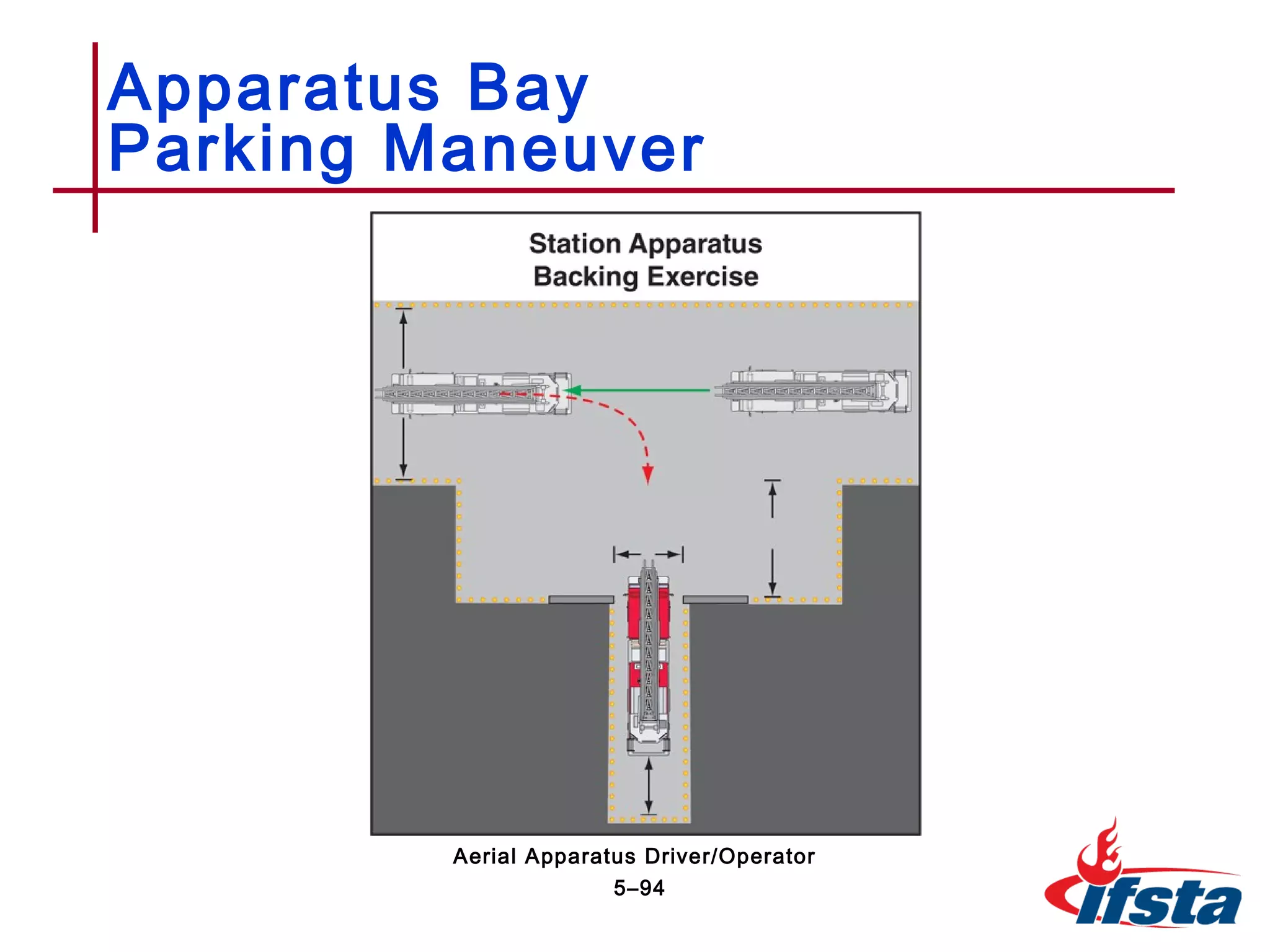
Apparatus Bay
Parking Maneuver
5–94
Aerial Apparatus Driver/Operator
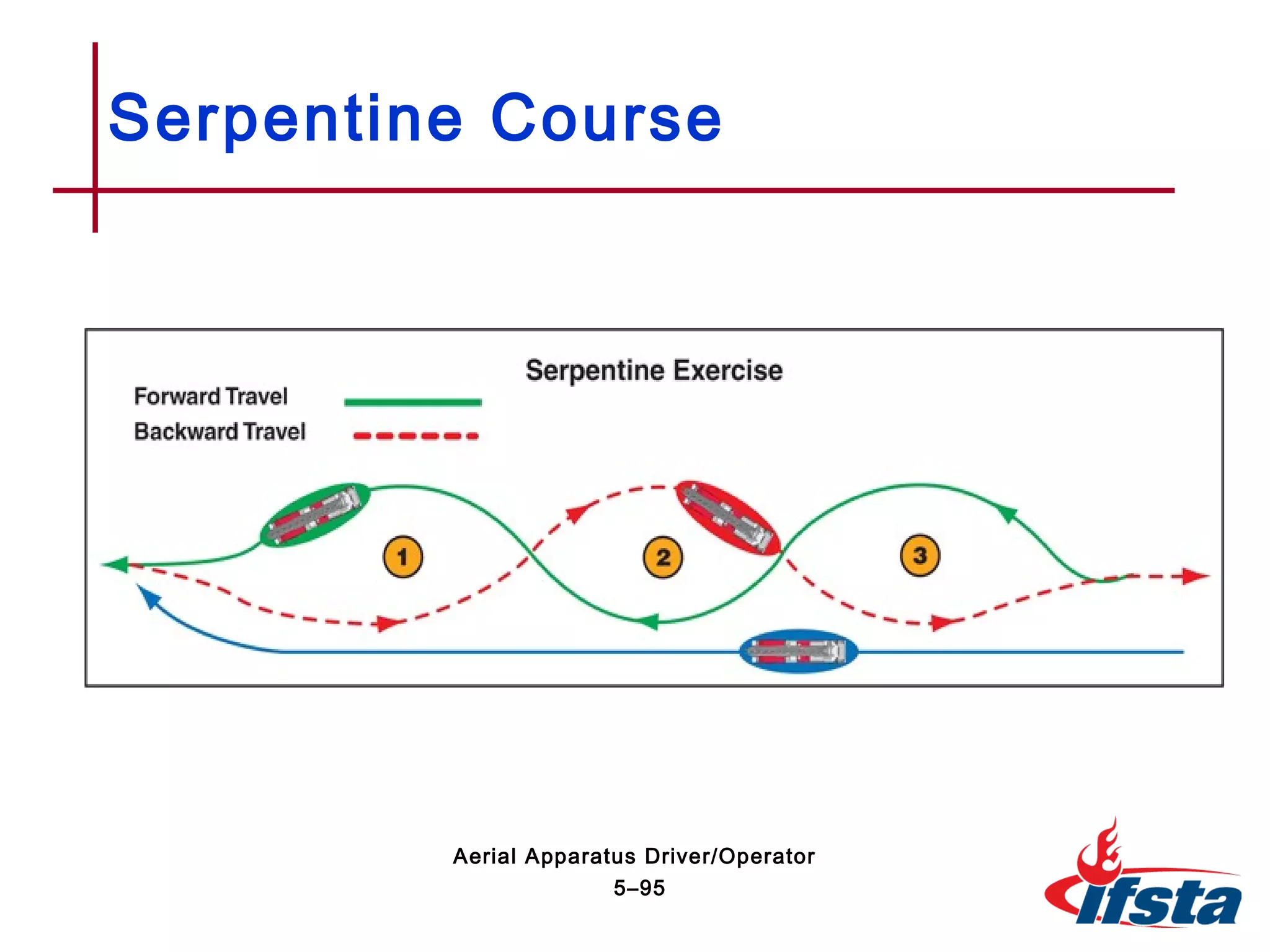
Serpentine Course
5–95
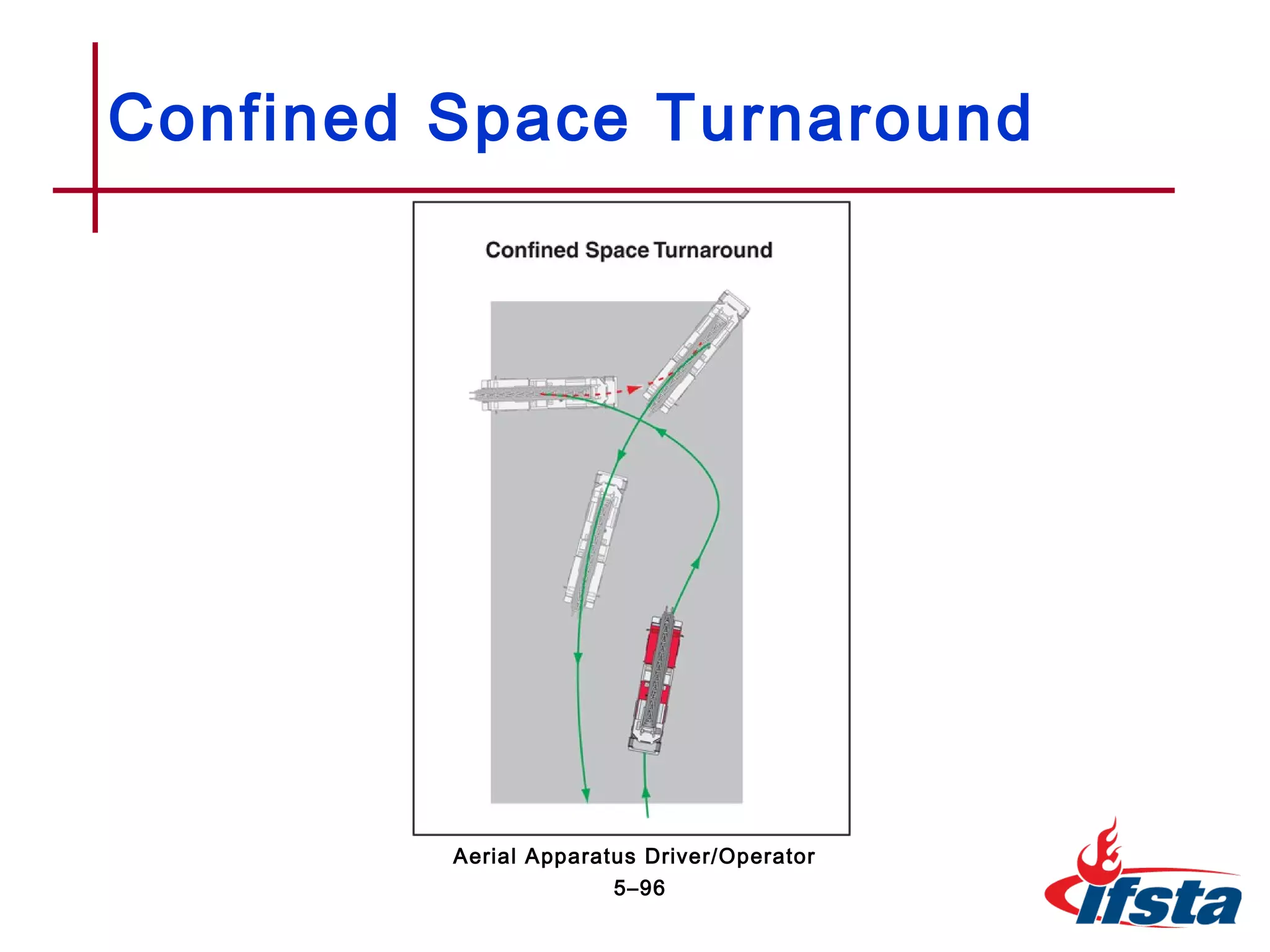
Aerial Apparatus Driver/Operator
Confined Space Turnaround
5–96
Aerial Apparatus Driver/Operator
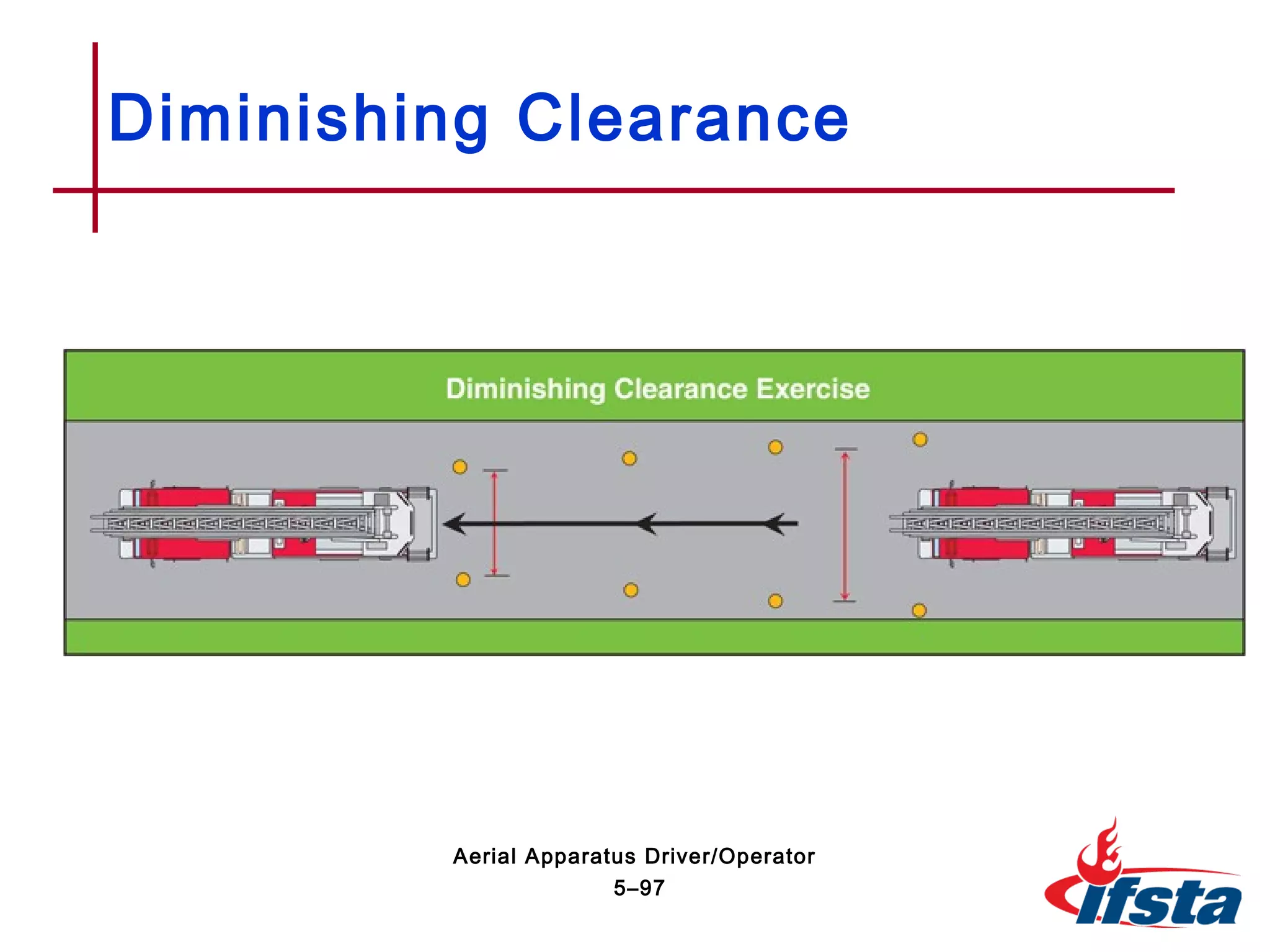
Diminishing Clearance
5–97
Aerial Apparatus Driver/Operator
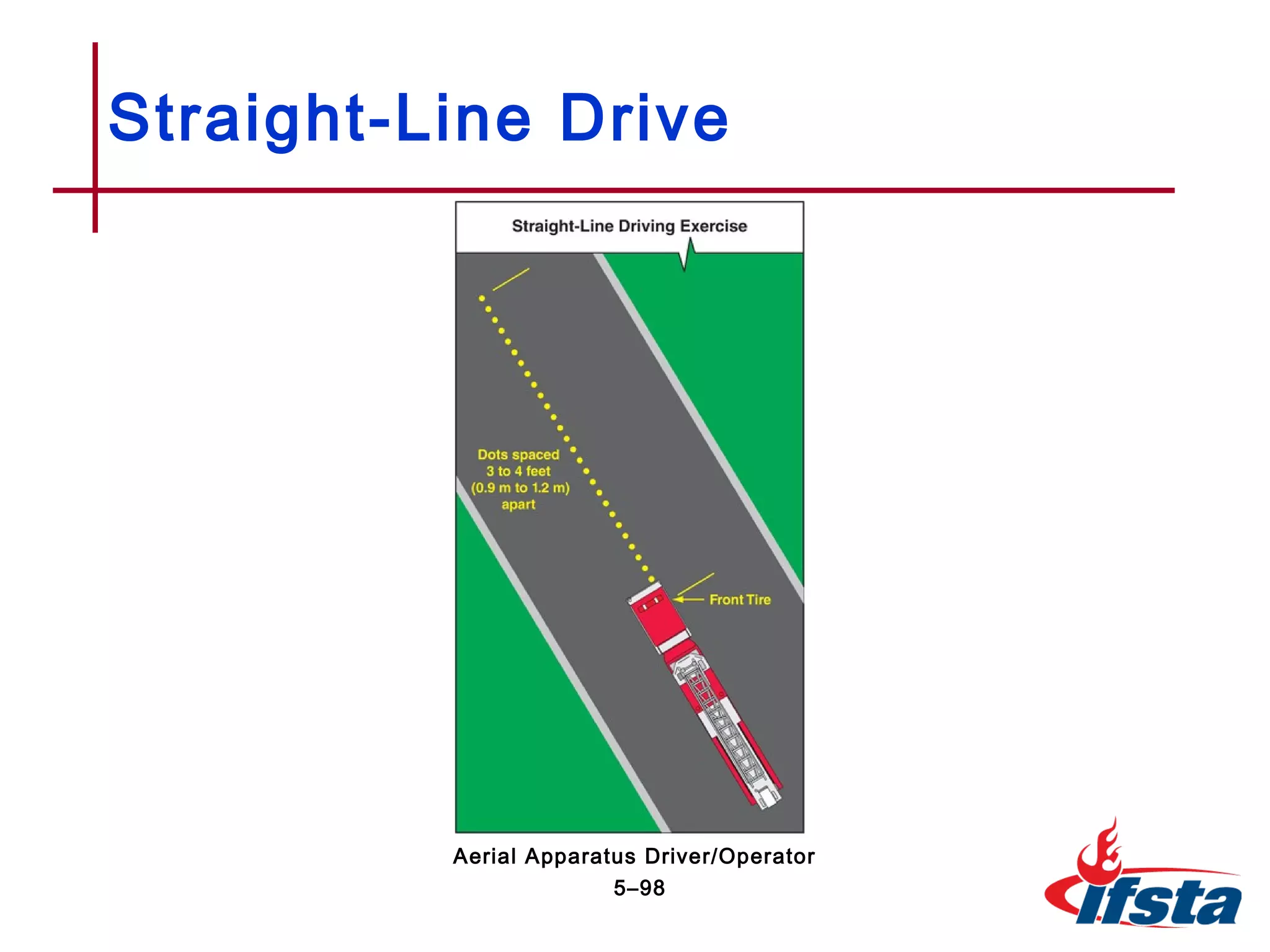
Straight-Line Drive
5–98
Aerial Apparatus Driver/Operator
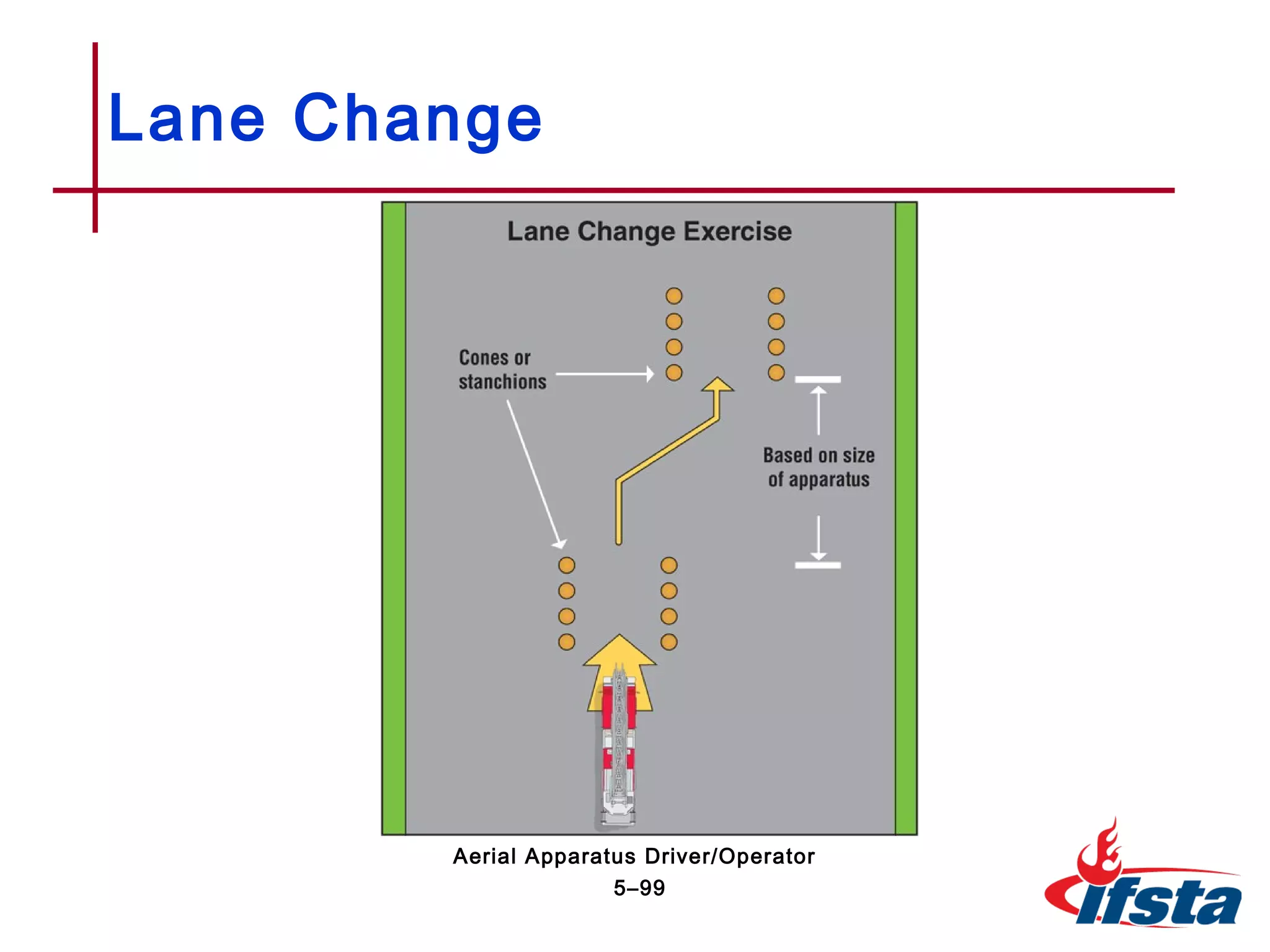
Lane Change
5–99
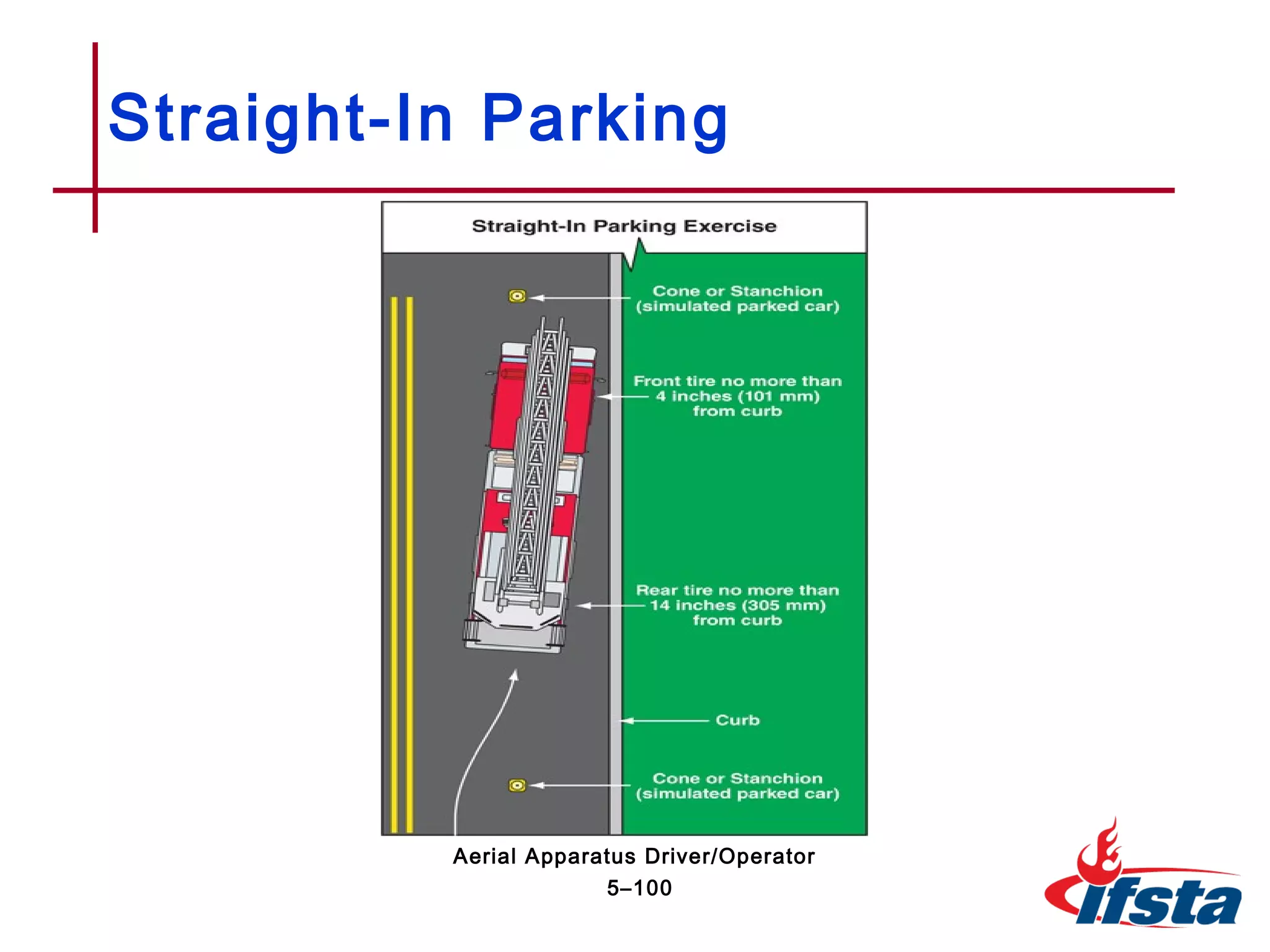
Aerial Apparatus Driver/Operator
Straight-In Parking
5–100
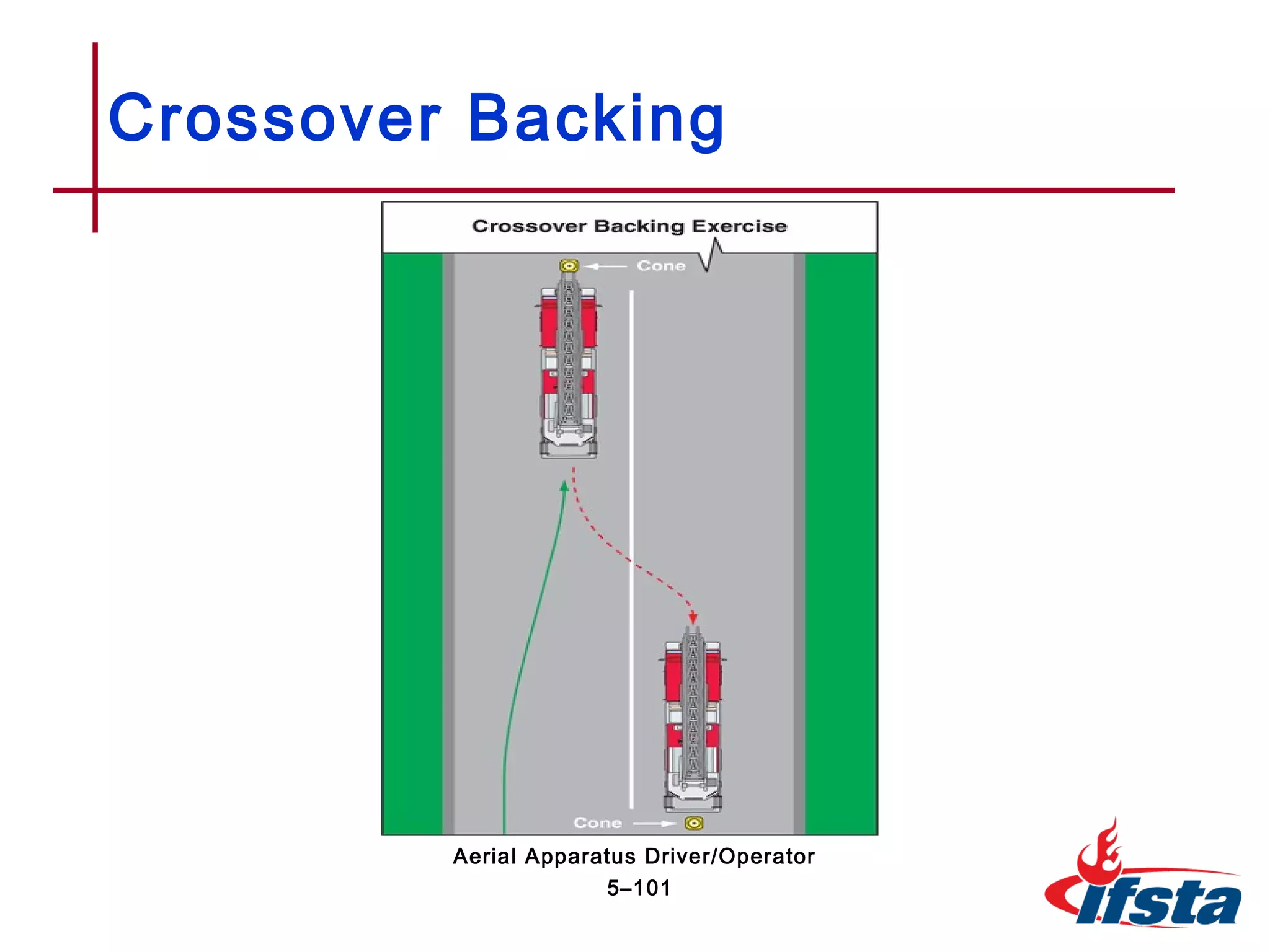
Aerial Apparatus Driver/Operator
Crossover Backing
5–101
Aerial Apparatus Driver/Operator
Identify the minimum road tests
necessary to certify the driver/operator.
Learning Objective 23
5–102
Aerial Apparatus Driver/Operator
• Road tests that lead to certification
should include the applicable elements
from NFPA®
1002.
Road Tests
5–103
Aerial Apparatus Driver/Operator
Perform various driving exercises.
Objective 24 is measured in Skill Sheet 5-3.
Learning Objective 24
5–104
Aerial Apparatus Driver/Operator
Perform various road test in an aerial
apparatus.
Objective 25 is measured in Skill Sheet 5-4.
Learning Objective 25
5–105
Aerial Apparatus Driver/Operator
Summary
• Driver/operator candidates should be
able to demonstrate good driving habits
and competent performance, as well as
a professional attitude.
• In addition, they must be familiar with
state and provincial laws, local
ordinances, and all departmental SOPs
on emergency vehicle operation. (Continued)
5–106
Aerial Apparatus Driver/Operator
• Driver/operator candidates must
practice with their assigned apparatus
under controlled conditions until the
required level of skill is achieved.
Summary
5–107
Aerial Apparatus Driver/Operator
Review Questions
1. What is the first step to starting
an aerial apparatus?
2. What guidelines should be
observed by a driver/operator while
operating the clutch in a manual
transmission vehicle?
(Continued)
5–108
Aerial Apparatus Driver/Operator
Review Questions
3. Why do some fire agencies
recommend using the automatic
shifter?
4. What should be taken into
consideration before braking?
5. What is the procedure for shutting
down an aerial apparatus?
(Continued)
5–109
Aerial Apparatus Driver/Operator
6. How should a driver/operator react
when an apparatus that is not
equipped with an antilock braking
system goes into a skid?
7. What is weight transfer?
Review Questions
5–110
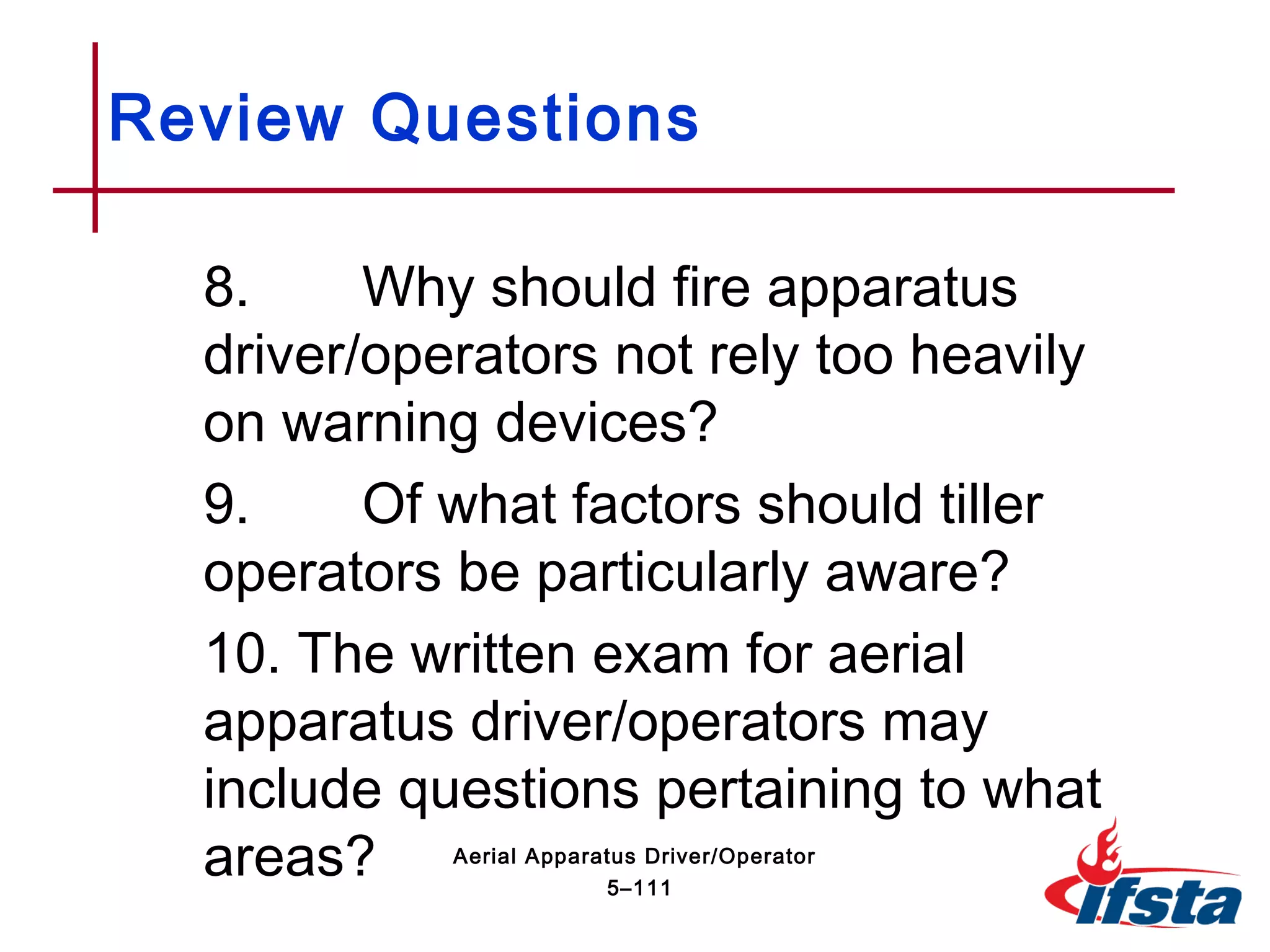
Aerial Apparatus Driver/Operator
8. Why should fire apparatus
driver/operators not rely too heavily
on warning devices?
9. Of what factors should tiller
operators be particularly aware?
10. The written exam for aerial
apparatus driver/operators may
include questions pertaining to what
areas?
Review Questions
5–111
Aerial Apparatus Driver/Operator

ADO-A Chapter 05

  • 1.
    Aerial Apparatus Driver/Operator Handbook 2ndEdition Chapter 5 — Driving Aerial Apparatus
  • 2.
    Learning Objective 1 Describethe driving regulations of the first apparatus driver/operator. 5–2 Aerial Apparatus Driver/Operator
  • 3.
    • Governed byfederal laws, state or provincial motor vehicle codes, city ordinances, NFPA® standards, and departmental policies • Subject to any statute, rule, regulation, or ordinance that governs any vehicle operator Driver/Operator Driving Regulations 5–3 Aerial Apparatus Driver/Operator
  • 4.
    • Obey alltraffic signals and rules when returning to quarters. • Use courteous and professional driving style while driving in public. • Most driving regulations pertain to dry, clear roads during daylight conditions. Driver/Operator Guidelines 5–4 Aerial Apparatus Driver/Operator
  • 5.
    • Adjust speedto compensate for conditions that make normal emergency vehicle operation more hazardous. • Stop emergency vehicles for school buses that are flashing signal lights. Driver/Operator Guidelines 5–5 Aerial Apparatus Driver/Operator
  • 6.
    Discuss starting anddriving fire service apparatus. Learning Objective 2 5–6 Aerial Apparatus Driver/Operator
  • 7.
    • Disconnect all groundshore lines. • Turn on the vehicle battery or batteries. Guidelines for Starting the Vehicle (Continued) 5–7 Aerial Apparatus Driver/Operator
  • 8.
    • (Manual shifttransmission) Start engine with transmission in Neutral (N) and vehicle’s parking brake set. – Turn on ignition switches. – Press down on clutch pedal. – Operate starter control. Guidelines for Starting the Vehicle (Continued) 5–8 Aerial Apparatus Driver/Operator
  • 9.
    • (Automatic transmission)Start engine with transmission in Neutral (N) or Park (P) with parking brake set. – Turn on ignition switches. – Start apparatus engine using starter controls. Guidelines for Starting the Vehicle (Continued) 5–9 Aerial Apparatus Driver/Operator
  • 10.
    • Make sureengine instruments move into normal operating ranges on gauges. • Adjust seat first and then mirrors and steering column. Guidelines for Starting the Vehicle 5–10 Aerial Apparatus Driver/Operator
  • 11.
    Describe driving amanual transmission apparatus. Learning Objective 3 5–11 Aerial Apparatus Driver/Operator
  • 12.
    • Depress servicebrake pedal with right foot and release parking brake. • Place gear shifter into low gear. • Release clutch slowly when starting from standstill. Driving Manual Transmission (Continued) 5–12 Aerial Apparatus Driver/Operator
  • 13.
    • Keep inlow gear until proper speed or rpms are reached for shifting. • Keep transmission in low gear until apparatus is clear of station and driver/operator has an unobstructed view of street and traffic conditions. Driving Manual Transmission 5–13 Aerial Apparatus Driver/Operator
  • 14.
    • Never attemptto start apparatus moving while it is in high gear. • Abrupt operation of clutch may cause engine to stall. • Avoid vehicle roll back before engaging clutch. • When shifting gears, clutch should be fully disengaged. Operating the Clutch 5–14 Aerial Apparatus Driver/Operator
  • 15.
    • Climbing ahill • Entering intersections on sharp curves • Turning corners • Over rough and rugged train • Starting down hill Using Lower Gears 5–15 Aerial Apparatus Driver/Operator
  • 16.
    Describe driving anautomatic transmission apparatus. Learning Objective 4 5–16 Aerial Apparatus Driver/Operator
  • 17.
    • Depress interlockon shifter and move it to appropriate gear selection. • Pressure placed upon accelerator influences automatic shifting. • Manually select particular gear when operating at slow speed or driving up or down a steep hill. Driving Automatic Transmission 5–17 Aerial Apparatus Driver/Operator
  • 18.
    Discuss nonemergency travelingin a fire apparatus. Learning Objective 5 5–18 Aerial Apparatus Driver/Operator
  • 19.
    • Attempt tomaintain engine rpm control through correct throttling. • Accelerate vehicle gradually once apparatus is moving. • Operate engine within its power curve. Guidelines for Traveling (Nonemergency) (Continued) 5–19 Aerial Apparatus Driver/Operator
  • 20.
    • Do nottry to reach rated speed in low gears. • Avoid overthrottling which results in lugging the engine. • Stay in highest gear that allows apparatus to keep up with traffic. Guidelines for Traveling (Nonemergency) (Continued) 5–20 Aerial Apparatus Driver/Operator
  • 21.
    • Downshift standardtransmissions to avoid stalls and prevent lugging. • Ascending a steep grade • Select progressively lower gears until apparatus can climb the hill easily. Guidelines for Traveling (Nonemergency) 5–21 Aerial Apparatus Driver/Operator
  • 22.
    • Avoid allowingengine to overspeed. • Choose a gear that allows engine to operate at 200 or 300 rpm lower than maximum recommended rpm. Maximum Engine RPM 5–22 Aerial Apparatus Driver/Operator
  • 23.
    Points of Potential Contactof Aerial Apparatus 5–23 Aerial Apparatus Driver/Operator
  • 24.
    Discuss stopping, idling,and shutting down the apparatus. Learning Objective 6 5–24 Aerial Apparatus Driver/Operator
  • 25.
    • Perform smoothlyso apparatus will come to an even stop. • Before braking – Consider weight – Consider condition of brakes, tires, and road surface Stopping the Apparatus 5–25 Aerial Apparatus Driver/Operator
  • 26.
    • Fitted onsome apparatus • Assist in braking • Provide slowing action • Save wear on service brake components • Engine manages on hills and slippery roads easier Retarding Devices 5–26 Aerial Apparatus Driver/Operator
  • 27.
    DISCUSSION QUESTION Is itSOP in your department to shut down the engine rather than leave it idling for long periods of time? Why or why not? 5–27 Aerial Apparatus Driver/Operator
  • 28.
    • Long idlingperiods • If necessary to idle – Set apparatus to idle at 900 to 1,100 rpm Engine Idling 5–28 Aerial Apparatus Driver/Operator
  • 29.
    • Never deactivateengine while apparatus is in motion. • Never deactivate immediately after a full load operation or when engine is overheated. • Idle for 3 to 5 minutes before shutting down. Engine Shutdown 5–29 Aerial Apparatus Driver/Operator
  • 30.
    • Immediate increaseof engine temperature • Oil film “burning” on hot surfaces • Damage to heads and exhaust manifolds • Possible damage to turbocharger Shutting Down Without Cooldown Period 5–30 Aerial Apparatus Driver/Operator
  • 31.
    • Place transmissionin Park (P) or Neutral (N). • Set parking brake. • Allow engine to idle and cool down. • Shut off engine. • Turn battery switch(es) off. • Reconnect ground shore lines. Engine Shutdown Procedures 5–31 Aerial Apparatus Driver/Operator
  • 32.
    Start, idle, andshut down a fire service apparatus. Objective 7 is measured in Skill Sheet 5-1. Learning Objective 7 5–32 Aerial Apparatus Driver/Operator
  • 33.
    Drive a fireservice apparatus. Objective 8 is measured in Skill Sheet 5-2. Learning Objective 8 5–33 Aerial Apparatus Driver/Operator
  • 34.
    Discuss braking andreaction times. Learning Objective 9 5–34 Aerial Apparatus Driver/Operator
  • 35.
    Identify factors thatinfluence the driver/operator’s ability to stop the apparatus. Learning Objective 10 5–35 Aerial Apparatus Driver/Operator
  • 36.
    Braking and ReactionTimes 5–36 Aerial Apparatus Driver/Operator
  • 37.
    • Condition andslope of driving surface • Speed of travel • Weight of vehicle • Type and condition of vehicle’s tires and braking system Factors Influencing Ability to Stop 5–37 Aerial Apparatus Driver/Operator
  • 38.
    • Momentum (p)is the velocity (v) of the vehicle multiplied by its mass (m) • p = vm • As object’s mass or velocity increases, it gains momentum and takes longer to slow down or to stop Forward Momentum 5–38 Aerial Apparatus Driver/Operator
  • 39.
    Discuss skids andthe guidelines for controlling skids. Learning Objective 11 5–39 Aerial Apparatus Driver/Operator
  • 40.
    • Driving toofast for road conditions • Weight shifts of heavy apparatus • Failing to anticipate obstacles • Improper use of auxiliary braking devices • Improper tire maintenance Common Causes of Skids 5–40 Aerial Apparatus Driver/Operator
  • 41.
    • Minimizes chanceof skid • Works using digital technology • Removes need to pump brake pedal • Causes momentary delay (approximately 0.4 seconds) Antilock Braking System (ABS) 5–41 Aerial Apparatus Driver/Operator
  • 42.
    • Release thebrakes, allowing wheels to rotate freely. • Turn steering wheel so front wheels face direction of skid. • Standard transmission, do not engage clutch. • Once skid is controllable, gradually apply power to wheels. Correcting Skids 5–42 Aerial Apparatus Driver/Operator
  • 43.
    • May begained at facilities having skid pads • May be gained through use of new system that mounts to apparatus • Should always be performed at slow speeds Skid Practice (Continued) 5–43 Aerial Apparatus Driver/Operator
  • 44.
  • 45.
    Discuss the characteristicsof auxiliary braking systems. Learning Objective 12 5–45 Aerial Apparatus Driver/Operator
  • 46.
    • Front brakelimiting valve • Electromagnetic braking systems • Automatic traction control Auxiliary Braking Systems 5–46 Aerial Apparatus Driver/Operator
  • 47.
    Describe weight transfer. LearningObjective 13 5–47 Aerial Apparatus Driver/Operator
  • 48.
    • Law ofinertia: “objects in motion tend to remain in motion; objects at rest tend to remain at rest unless acted upon by an outside force” • Takes place whenever a vehicle undergoes a change in speed or direction Weight Transfer (Continued) 5–48 Aerial Apparatus Driver/Operator
  • 49.
    • Can contributeto skidding or possible rollover • Improperly baffled water tanks • Driver/operator – Use only as much steering as needed – Steer smoothly and fluidly – Maintain slow speed to prevent severe weight transfer Weight Transfer 5–49 Aerial Apparatus Driver/Operator
  • 50.
    Discuss the useof private vehicles. Learning Objective 14 5–50 Aerial Apparatus Driver/Operator
  • 51.
    • Most statesand province require private vehicles to pull to the right, stop, and remain at a standstill until emergency traffic has passed. • Driver/operators must be aware that not everyone hears warning devices and many do not know how to plan an immediate reaction. Private Vehicles 5–51 Aerial Apparatus Driver/Operator
  • 52.
    Discuss collisions atintersections. Learning Objective 15 5–52 Aerial Apparatus Driver/Operator
  • 53.
    • Most likelyplace for collisions involving emergency vehicles • Driver/operators – Slow down for intersections – STOP when faced with a red light or stop sign – Anticipate worst possible situation Collisions at Intersections (Continued) 5–53 Aerial Apparatus Driver/Operator
  • 54.
    • No signals •Red traffic signal or stop sign • Driving into opposing lane of traffic Collisions at Intersections 5–54 Aerial Apparatus Driver/Operator
  • 55.
    Opposing Lane ofTraffic 5–55 Aerial Apparatus Driver/Operator
  • 56.
    Identify safe passingprocedures. Learning Objective 16 5–56 Aerial Apparatus Driver/Operator
  • 57.
    • Always travelin innermost lane on multilane roads. • Avoid passing vehicles on right sides. • Be certain that opposing lanes of traffic are clear of oncoming traffic. • Avoid passing other emergency vehicles. Passing Other Vehicles 5–57 Aerial Apparatus Driver/Operator
  • 58.
    Discuss driving inadverse weather. Learning Objective 17 5–58 Aerial Apparatus Driver/Operator
  • 59.
    • Recognize dangersof rain, snow, ice, and mud • Adjust speed • Decrease speed gradually • Slow down while approaching curves • Keep off low or soft shoulders Driving in Adverse Weather (Continued) 5–59 Aerial Apparatus Driver/Operator
  • 60.
    • Avoid suddenturns • Recognize slippery areas • Increase following distance dramatically Driving in Adverse Weather 5–60 Aerial Apparatus Driver/Operator
  • 61.
    • Reduce stoppingdistance and considerably increase traction • Consist of short lengths of chain on a rotating hub • Hubs swing down into place • Lose effectiveness in snow deeper than 3 to 6 inches (76 mm to 152 mm) Snow Tires or Chains 5–61 Aerial Apparatus Driver/Operator
  • 62.
    Describe warning devicesand discuss clearing traffic. Learning Objective 18 5–62 Aerial Apparatus Driver/Operator
  • 63.
    DISCUSSION QUESTION What isthe surest way to catch a driver’s attention? 5–63 Aerial Apparatus Driver/Operator
  • 64.
    • Civilian driversrespond better to sounds that frequently change pitch. • Audible devices can be “outrun” by apparatus at speeds above 50 mph (80 km/h). • Warning devices are of no value if not used. Warning Devices and Clearing Traffic (Continued) 5–64 Aerial Apparatus Driver/Operator
  • 65.
    • Should belimited to true emergency response situations • Turn off on limited-access highways and turnpikes • Emergency vehicles responding on same route should travel at least 300 to 500 feet (90 m to 150 m) apart. Warning Devices and Clearing Traffic (Continued) 5–65 Aerial Apparatus Driver/Operator
  • 66.
    DISCUSSION QUESTION Why isit important for multiple emergency vehicles to maintain an appropriate distance from one another? 5–66 Aerial Apparatus Driver/Operator
  • 67.
    • Headlights shouldbe turned on while responding. • May be advisable to turn off some warning lights on apparatus once in position Warning Devices and Clearing Traffic (Continued) 5–67 Aerial Apparatus Driver/Operator
  • 68.
    Warning Devices and ClearingTraffic 5–68 Aerial Apparatus Driver/Operator
  • 69.
    Identify traffic controldevices. Learning Objective 19 5–69 Aerial Apparatus Driver/Operator
  • 70.
    • Types ofsystems • Not substitutes for using proper defensive driving techniques Traffic Control Devices 5–70 Aerial Apparatus Driver/Operator
  • 71.
    Types of TrafficControl Devices (Continued) 5–71 Aerial Apparatus Driver/Operator
  • 72.
    Types of TrafficControl Devices (Continued) 5–72 Aerial Apparatus Driver/Operator
  • 73.
    Types of TrafficControl Devices (Continued) 5–73 Aerial Apparatus Driver/Operator
  • 74.
    Discuss the tilleroperator. Learning Objective 20 5–74 Aerial Apparatus Driver/Operator
  • 75.
    • Must bequalified • Must be familiar with duties assigned to all truck company personnel • Driving assignments Tiller Operator 5–75 Aerial Apparatus Driver/Operator
  • 76.
    • Distance oftrailer from base of building involved • Angle of trailer placement • Proper overhead clearance • Side and rear obstructions • Grades and slopes of working area Factors Affecting Tiller Operators 5–76 Aerial Apparatus Driver/Operator
  • 77.
    Describe tiller operatortraining. Learning Objective 21 5–77 Aerial Apparatus Driver/Operator
  • 78.
    • Use goodsignal practices. • ALWAYS trail in-line on a straightaway. • Bring trailer quickly into line after completion of turn. • Observe trailer overhang on turns. Operator Training (Continued) 5–78 Aerial Apparatus Driver/Operator
  • 79.
    • Operate tillersection in a smooth and safe manner. • Avoid overtillering. • Keep both hands on the wheel and give undivided attention to the job. Operator Training 5–79 Aerial Apparatus Driver/Operator
  • 80.
    • Perform severalchecks before giving signal to proceed • Center trailer in doorway when leaving Leaving the Fire Station 5–80 Aerial Apparatus Driver/Operator
  • 81.
    • Keep trailerwheels parallel with frame of trailer and in direct line with tractor. • When turning keep trailer in line with tractor as much as possible. Traveling Forward (Continued) 5–81 Aerial Apparatus Driver/Operator
  • 82.
    DISCUSSION QUESTION Where onthe tiller steering wheel should the hands be placed when moving forward? 5–82 Aerial Apparatus Driver/Operator
  • 83.
  • 84.
    • Be alertto conditions on other streets. • Anticipate hazardous situations. • Pay attention to trucks, buses, and other large vehicles. • Keep outlook for any overhanging obstructions. Tiller Operator Driving Guidelines 5–84 Aerial Apparatus Driver/Operator
  • 85.
    • Exercise cautionand maintain a constant awareness of vehicles on each side and to rear of apparatus. • Methods of negotiating turns Turning at Intersections 5–85 Aerial Apparatus Driver/Operator
  • 86.
    • Requires oppositemaneuvers of those used to steer front wheels • Requires communication between driver and tiller operator • Must be performed smoothly and slowly • Pay attention to position of tractor as well as clearance on both sides and rear Backing Maneuvers (Continued) 5–86 Aerial Apparatus Driver/Operator
  • 87.
    DISCUSSION QUESTION Where onthe tiller steering wheel should the hands be placed when backing? 5–87 Aerial Apparatus Driver/Operator
  • 88.
  • 89.
    Describe the drivingexercises and evaluation methods of the driver/operator. Learning Objective 22 5–89 Aerial Apparatus Driver/Operator
  • 90.
    • Driving regulations,laws, and fire department SOPs for emergency and nonemergency operations • Pump operations and aerial ladder operations • Hydraulic calculations Written Test Questions 5–90 Aerial Apparatus Driver/Operator
  • 91.
    • NFPA® Code ofFederal Regulations (CFR) • NFPA® 1002 Practical Driving Exercise Sources 5–91 Aerial Apparatus Driver/Operator
  • 92.
    DISCUSSION QUESTION What practicaldriving exercises are used for testing in your jurisdiction? 5–92 Aerial Apparatus Driver/Operator
  • 93.
  • 94.
  • 95.
  • 96.
    Confined Space Turnaround 5–96 AerialApparatus Driver/Operator
  • 97.
  • 98.
  • 99.
  • 100.
  • 101.
  • 102.
    Identify the minimumroad tests necessary to certify the driver/operator. Learning Objective 23 5–102 Aerial Apparatus Driver/Operator
  • 103.
    • Road teststhat lead to certification should include the applicable elements from NFPA® 1002. Road Tests 5–103 Aerial Apparatus Driver/Operator
  • 104.
    Perform various drivingexercises. Objective 24 is measured in Skill Sheet 5-3. Learning Objective 24 5–104 Aerial Apparatus Driver/Operator
  • 105.
    Perform various roadtest in an aerial apparatus. Objective 25 is measured in Skill Sheet 5-4. Learning Objective 25 5–105 Aerial Apparatus Driver/Operator
  • 106.
    Summary • Driver/operator candidatesshould be able to demonstrate good driving habits and competent performance, as well as a professional attitude. • In addition, they must be familiar with state and provincial laws, local ordinances, and all departmental SOPs on emergency vehicle operation. (Continued) 5–106 Aerial Apparatus Driver/Operator
  • 107.
    • Driver/operator candidatesmust practice with their assigned apparatus under controlled conditions until the required level of skill is achieved. Summary 5–107 Aerial Apparatus Driver/Operator
  • 108.
    Review Questions 1. Whatis the first step to starting an aerial apparatus? 2. What guidelines should be observed by a driver/operator while operating the clutch in a manual transmission vehicle? (Continued) 5–108 Aerial Apparatus Driver/Operator
  • 109.
    Review Questions 3. Whydo some fire agencies recommend using the automatic shifter? 4. What should be taken into consideration before braking? 5. What is the procedure for shutting down an aerial apparatus? (Continued) 5–109 Aerial Apparatus Driver/Operator
  • 110.
    6. How shoulda driver/operator react when an apparatus that is not equipped with an antilock braking system goes into a skid? 7. What is weight transfer? Review Questions 5–110 Aerial Apparatus Driver/Operator
  • 111.
    8. Why shouldfire apparatus driver/operators not rely too heavily on warning devices? 9. Of what factors should tiller operators be particularly aware? 10. The written exam for aerial apparatus driver/operators may include questions pertaining to what areas? Review Questions 5–111 Aerial Apparatus Driver/Operator