Quantitative Risk Analysis in
           Budgeting and Cost Analysis


                              John C. Goodpasture
                              Square Peg Consulting


                              John.g@sqpegconsulting.com


Square Peg Consulting
Copyright 2001, all rights reserved
Budgets are estimates

             There are no facts about the
            future, only estimates
             Simple budget estimates do not
            account for risk
             Risk is handled by estimating the
            impact of uncertainties on future
            cash flows (uses of funds and
            sources of funds)

Square Peg Consulting
Copyright 2001, all rights reserved
Terms in risk-managed budgeting

       Discounting – takes into account the risks of
         receiving or paying funds in the future
       Expected Value – takes into account the
         uncertainty of estimate
       Net Present Value – cash value at time zero
         (now)
       Internal Rate of Return – discount required
         for NPV = 0
       Economic Value Add (EVA) – profit-based
         calculation of discounted value

Square Peg Consulting
Copyright 2001, all rights reserved
Capital budgeting*
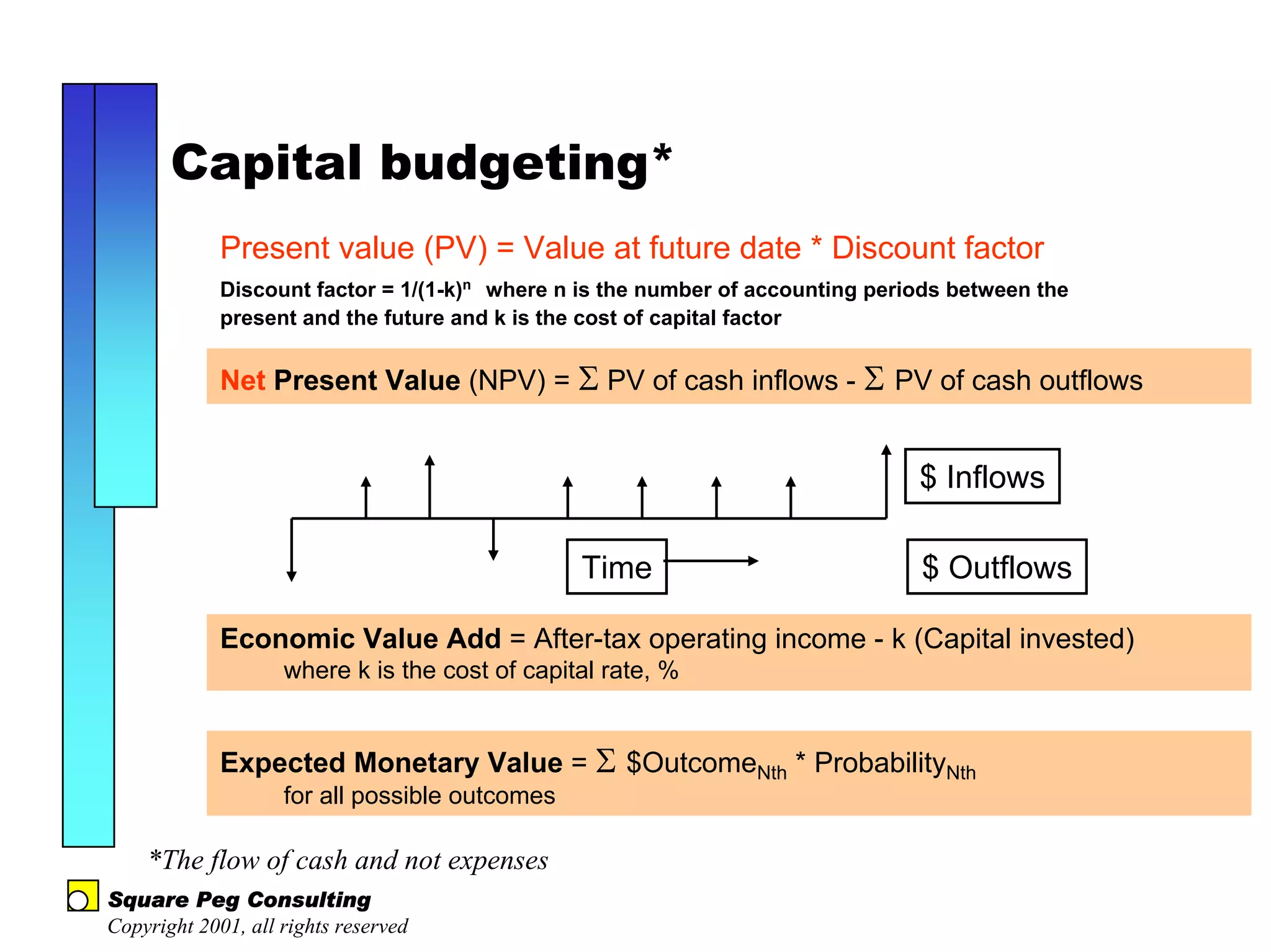
             Present value (PV) = Value at future date * Discount factor
             Discount factor = 1/(1-k)n where n is the number of accounting periods between the
             present and the future and k is the cost of capital factor


             Net Present Value (NPV) = Σ PV of cash inflows - Σ PV of cash outflows


                                                                                $ Inflows

                                                Time                            $ Outflows

             Economic Value Add = After-tax operating income - k (Capital invested)
                    where k is the cost of capital rate, %


             Expected Monetary Value = Σ $OutcomeNth * ProbabilityNth
                    for all possible outcomes

    *The flow of cash and not expenses
Square Peg Consulting
Copyright 2001, all rights reserved
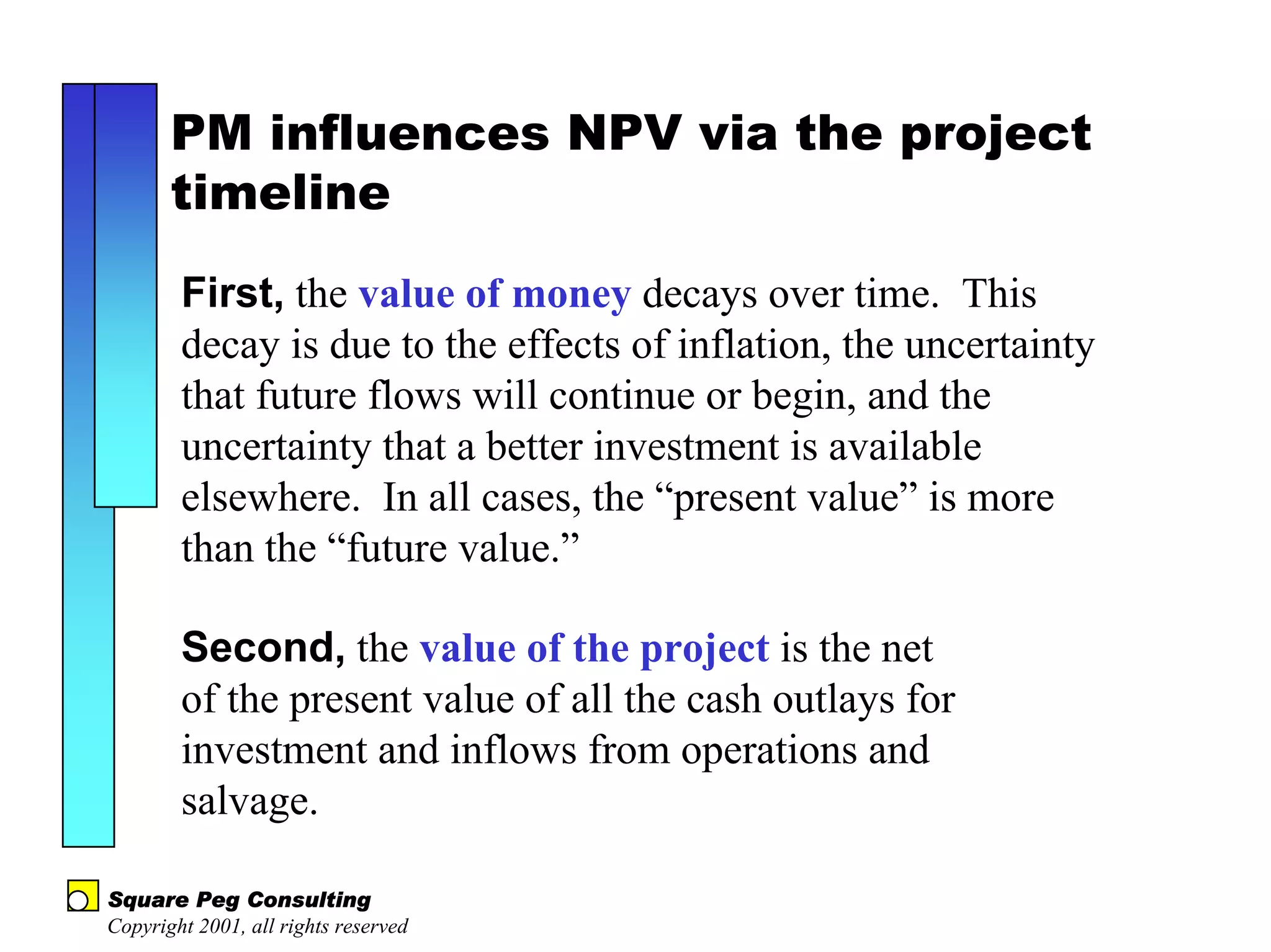
PM influences NPV via the project
       timeline
        First, the value of money decays over time. This
        decay is due to the effects of inflation, the uncertainty
        that future flows will continue or begin, and the
        uncertainty that a better investment is available
        elsewhere. In all cases, the “present value” is more
        than the “future value.”

        Second, the value of the project is the net
        of the present value of all the cash outlays for
        investment and inflows from operations and
        salvage.

Square Peg Consulting
Copyright 2001, all rights reserved
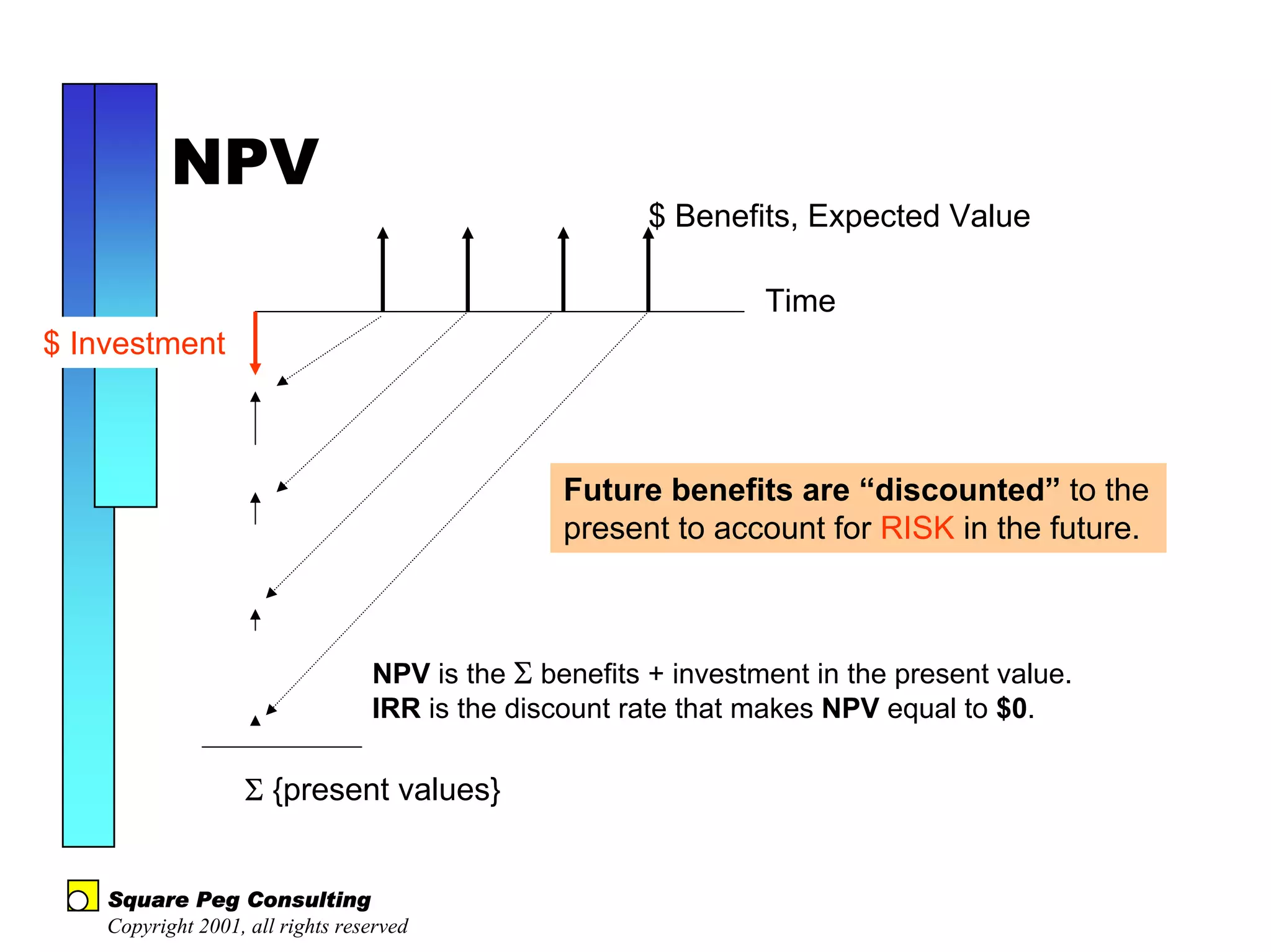
NPV
                                                        $ Benefits, Expected Value

                                                                 Time
$ Investment


                                                 Future benefits are “discounted” to the
                                                 present to account for RISK in the future.


                                  NPV is the Σ benefits + investment in the present value.
                                  IRR is the discount rate that makes NPV equal to $0.

                    Σ {present values}


    Square Peg Consulting
    Copyright 2001, all rights reserved
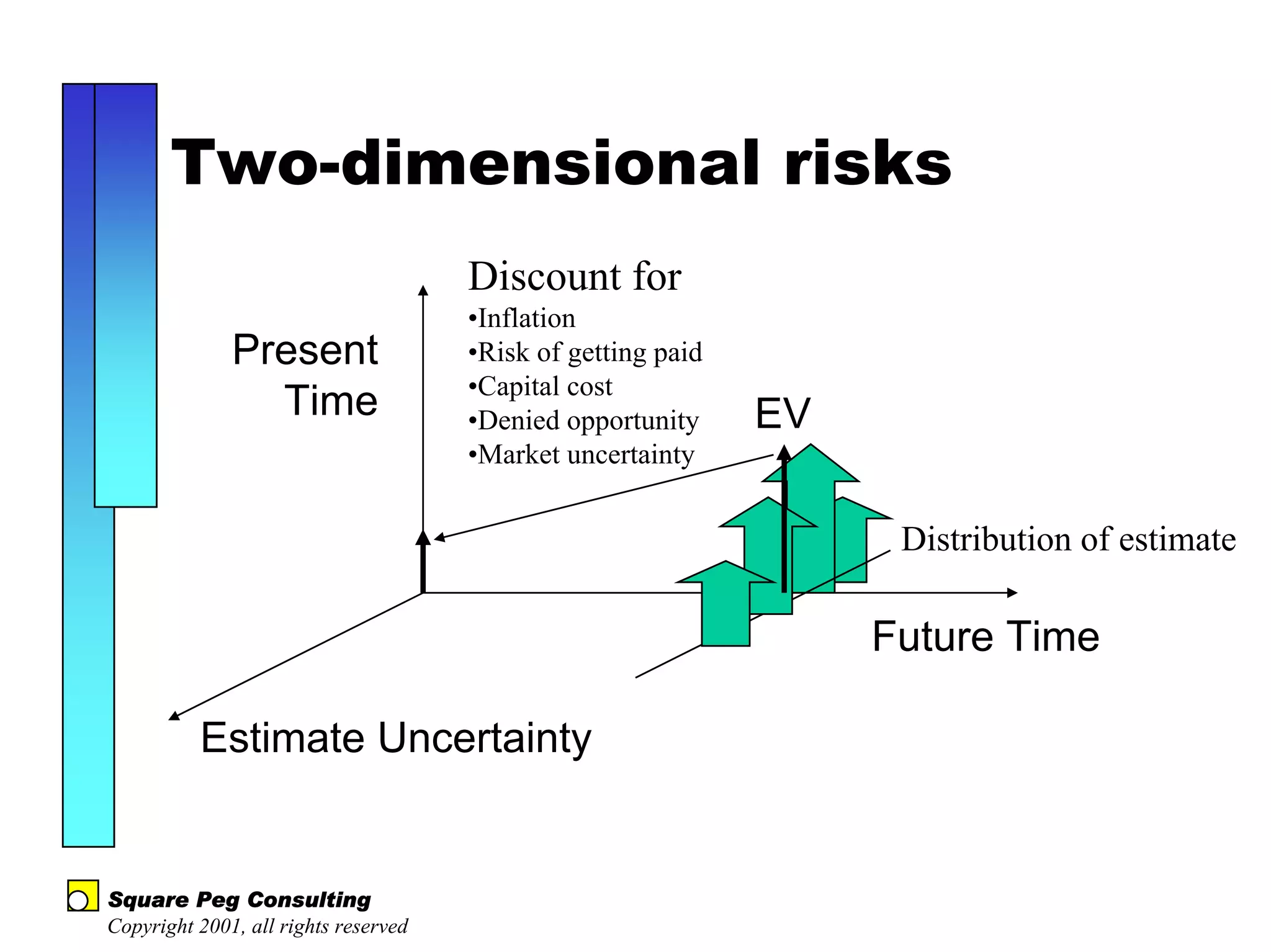
Two-dimensional risks
                                      Discount for
                                      •Inflation
              Present                 •Risk of getting paid
                                      •Capital cost
                Time                  •Denied opportunity     EV
                                      •Market uncertainty


                                                                    Distribution of estimate

                                                                   Future Time

          Estimate Uncertainty


Square Peg Consulting
Copyright 2001, all rights reserved
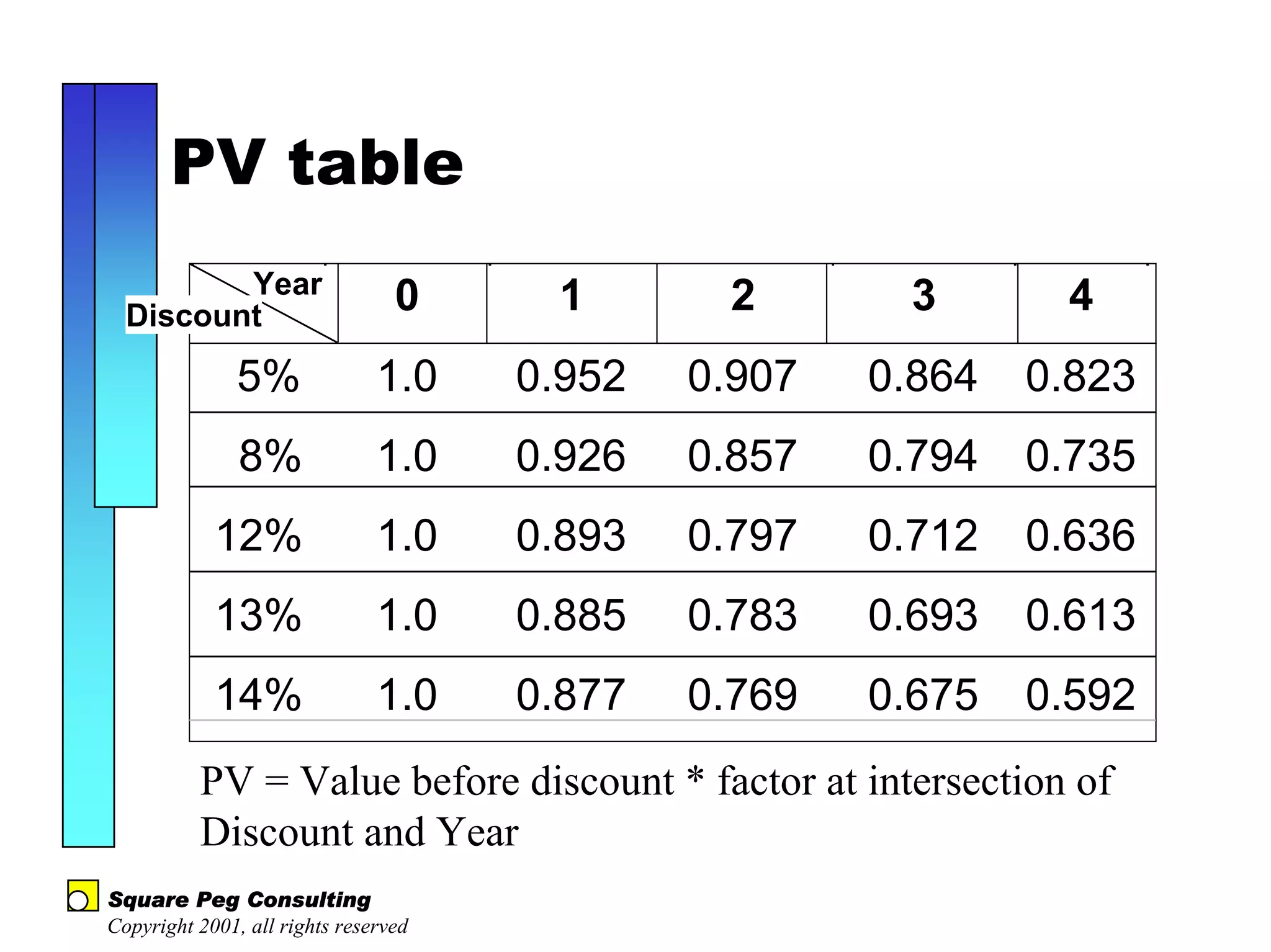
PV table
         Year                    0     1       2       3       4
  Discount

               5%              1.0    0.952   0.907   0.864   0.823
               8%              1.0    0.926   0.857   0.794   0.735
            12%                1.0    0.893   0.797   0.712   0.636
            13%                1.0    0.885   0.783   0.693   0.613
            14%                1.0    0.877   0.769   0.675   0.592
          PV = Value before discount * factor at intersection of
          Discount and Year
Square Peg Consulting
Copyright 2001, all rights reserved
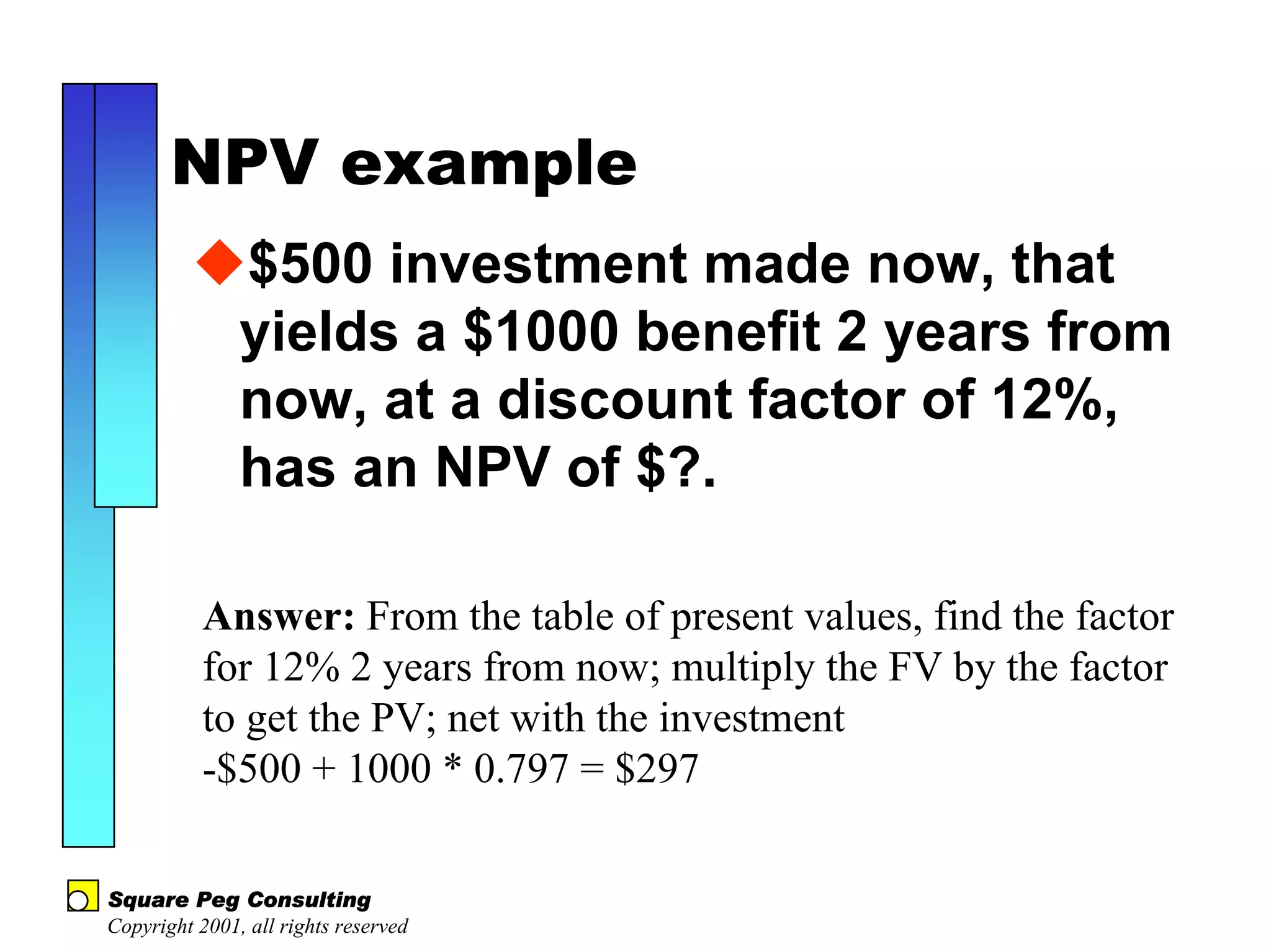
NPV example
               $500 investment made now, that
               yields a $1000 benefit 2 years from
               now, at a discount factor of 12%,
               has an NPV of $?.

           Answer: From the table of present values, find the factor
           for 12% 2 years from now; multiply the FV by the factor
           to get the PV; net with the investment
           -$500 + 1000 * 0.797 = $297

Square Peg Consulting
Copyright 2001, all rights reserved
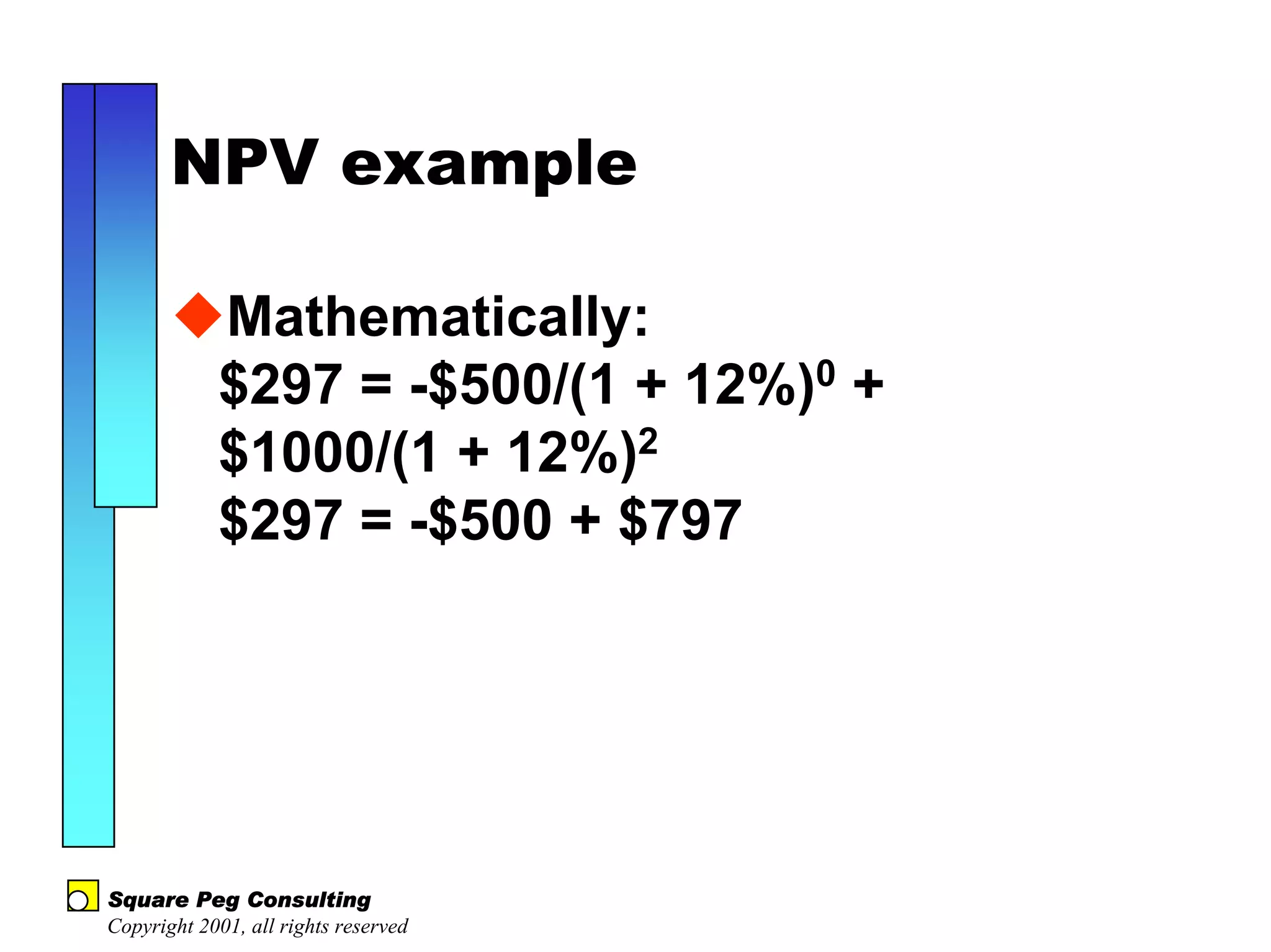
NPV example

            Mathematically:
            $297 = -$500/(1 + 12%)0 +
            $1000/(1 + 12%)2
            $297 = -$500 + $797


Square Peg Consulting
Copyright 2001, all rights reserved
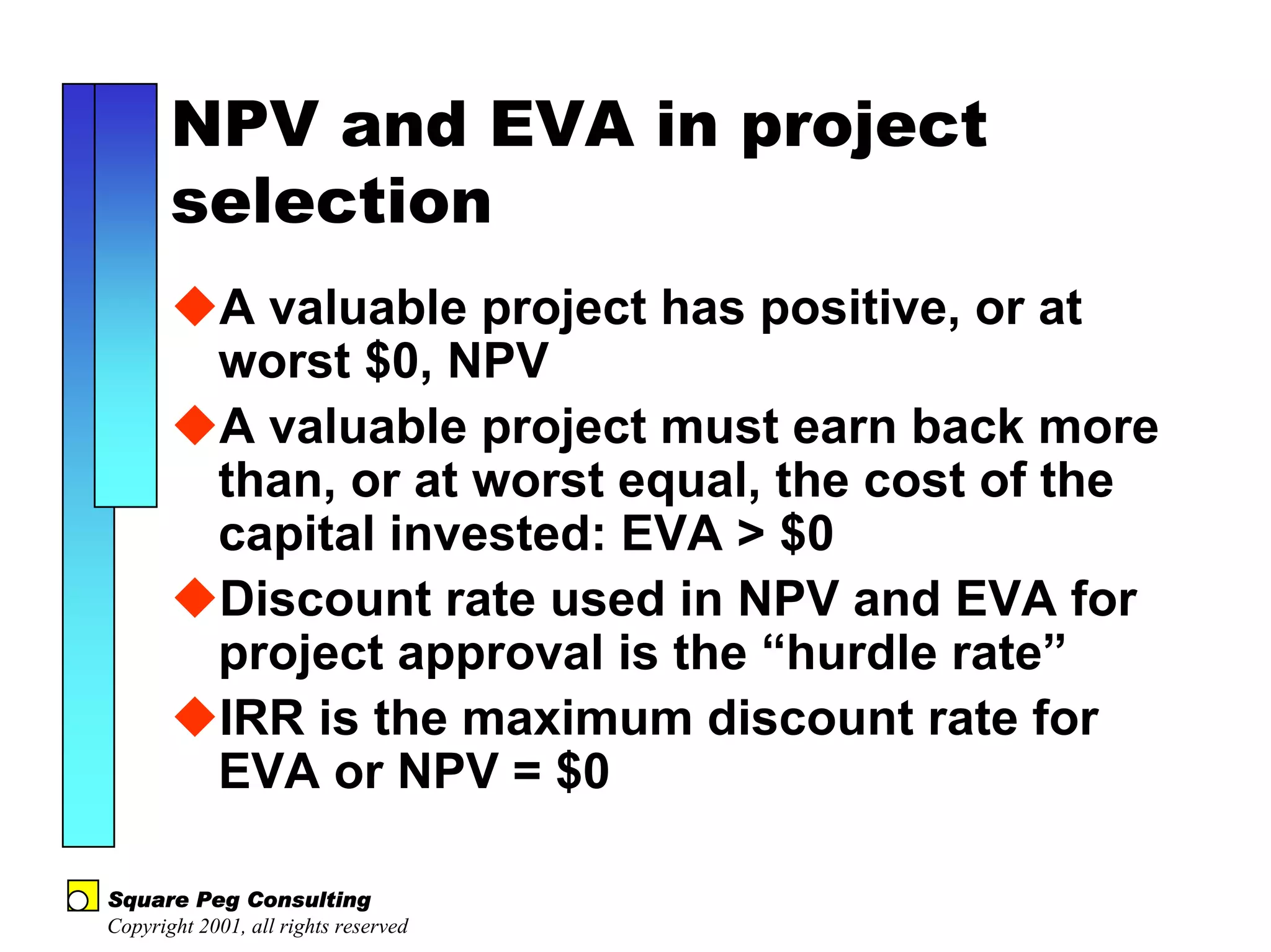
NPV and EVA in project
       selection
            A valuable project has positive, or at
            worst $0, NPV
            A valuable project must earn back more
            than, or at worst equal, the cost of the
            capital invested: EVA > $0
            Discount rate used in NPV and EVA for
            project approval is the “hurdle rate”
            IRR is the maximum discount rate for
            EVA or NPV = $0

Square Peg Consulting
Copyright 2001, all rights reserved
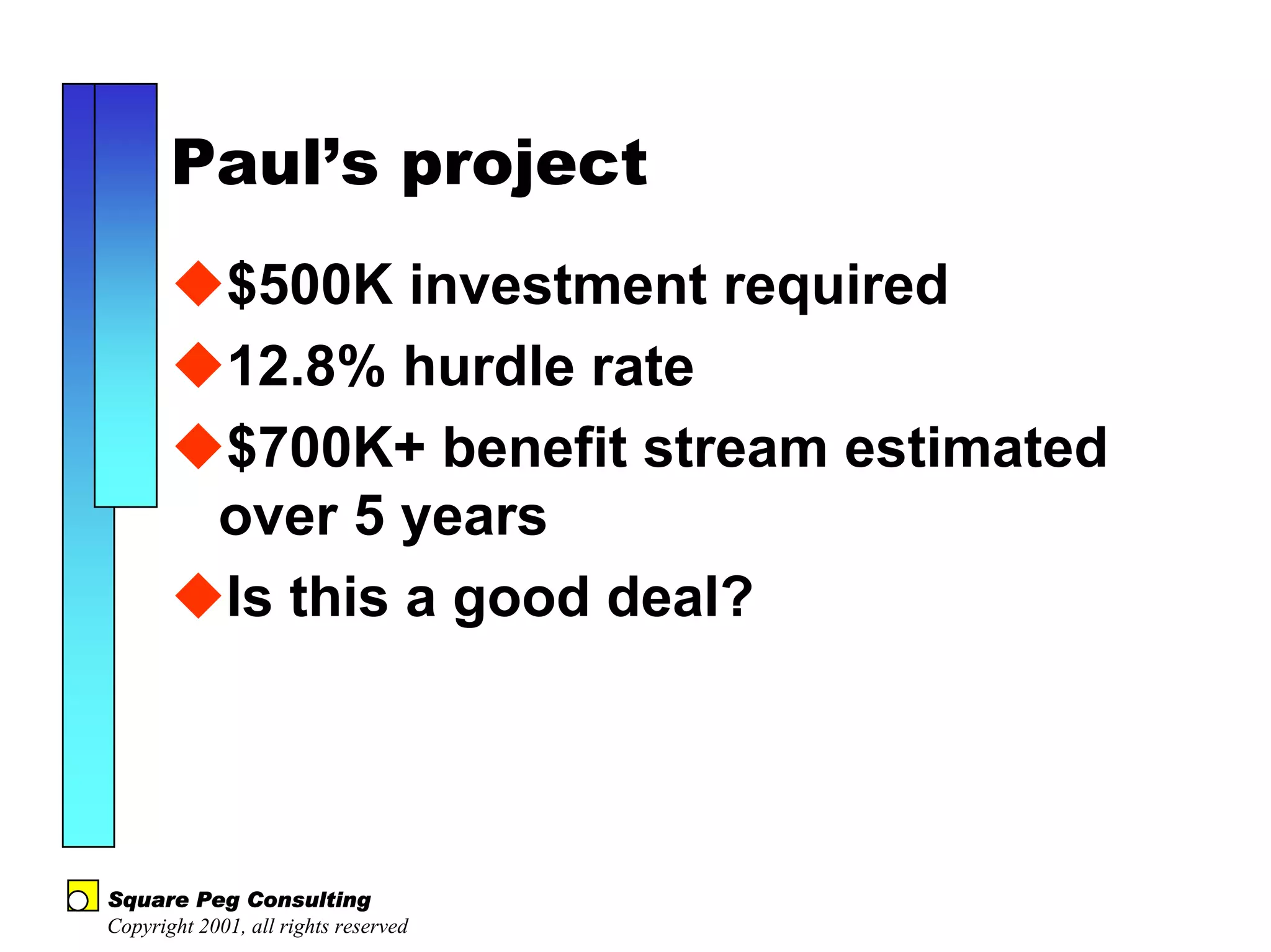
Paul’s project
            $500K investment required
            12.8% hurdle rate
            $700K+ benefit stream estimated
            over 5 years
            Is this a good deal?


Square Peg Consulting
Copyright 2001, all rights reserved
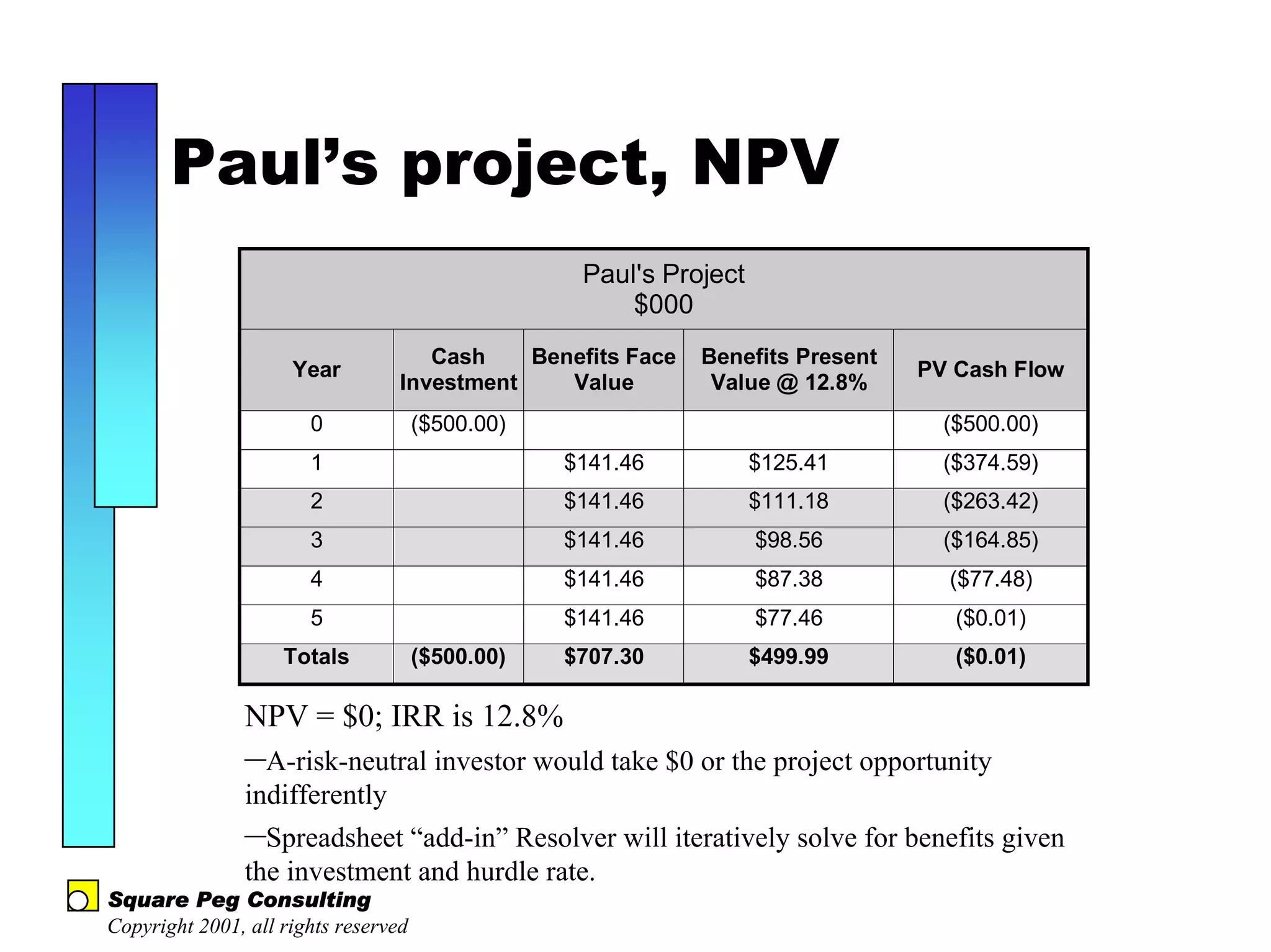
Paul’s project, NPV
                                                   Paul's Project
                                                       $000
                                     Cash    Benefits Face   Benefits Present
                     Year                                                       PV Cash Flow
                                  Investment    Value         Value @ 12.8%
                       0              ($500.00)                                   ($500.00)
                       1                          $141.46           $125.41       ($374.59)
                       2                          $141.46           $111.18       ($263.42)
                       3                          $141.46           $98.56        ($164.85)
                       4                          $141.46           $87.38        ($77.48)
                       5                          $141.46           $77.46         ($0.01)
                    Totals            ($500.00)   $707.30           $499.99        ($0.01)

                NPV = $0; IRR is 12.8%
                –A-risk-neutral investor would take $0 or the project opportunity
                indifferently
                –Spreadsheet “add-in” Resolver will iteratively solve for benefits given
                the investment and hurdle rate.
Square Peg Consulting
Copyright 2001, all rights reserved
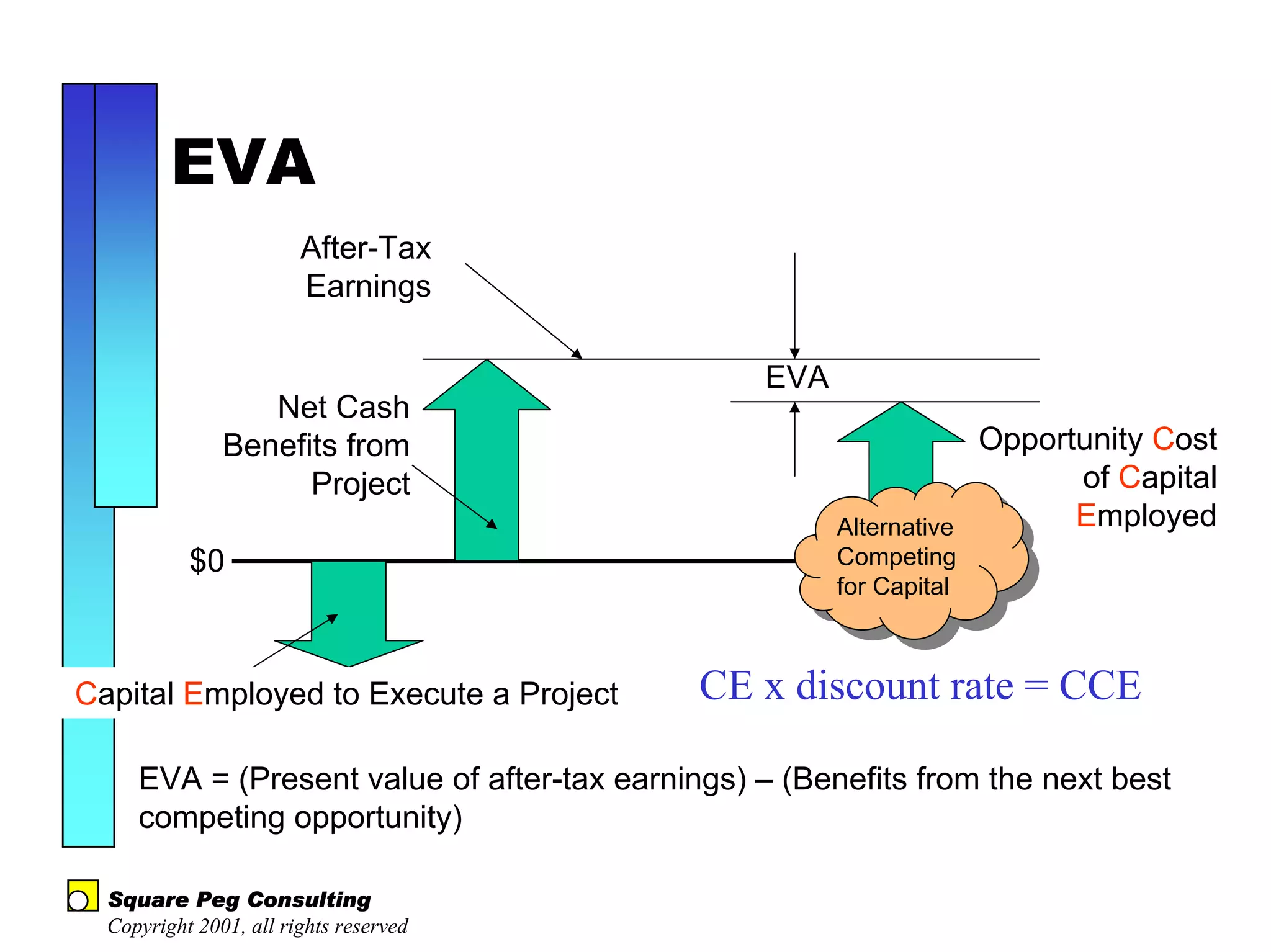
EVA
                        After-Tax
                        Earnings

                                                 EVA
                  Net Cash
               Benefits from                                          Opportunity Cost
                     Project                                                of Capital
                                                       Alternative          Employed
                                                        Alternative
           $0                                          Competing
                                                        Competing
                                                       for Capital
                                                        for Capital


Capital Employed to Execute a Project        CE x discount rate = CCE

     EVA = (Present value of after-tax earnings) – (Benefits from the next best
     competing opportunity)

  Square Peg Consulting
  Copyright 2001, all rights reserved
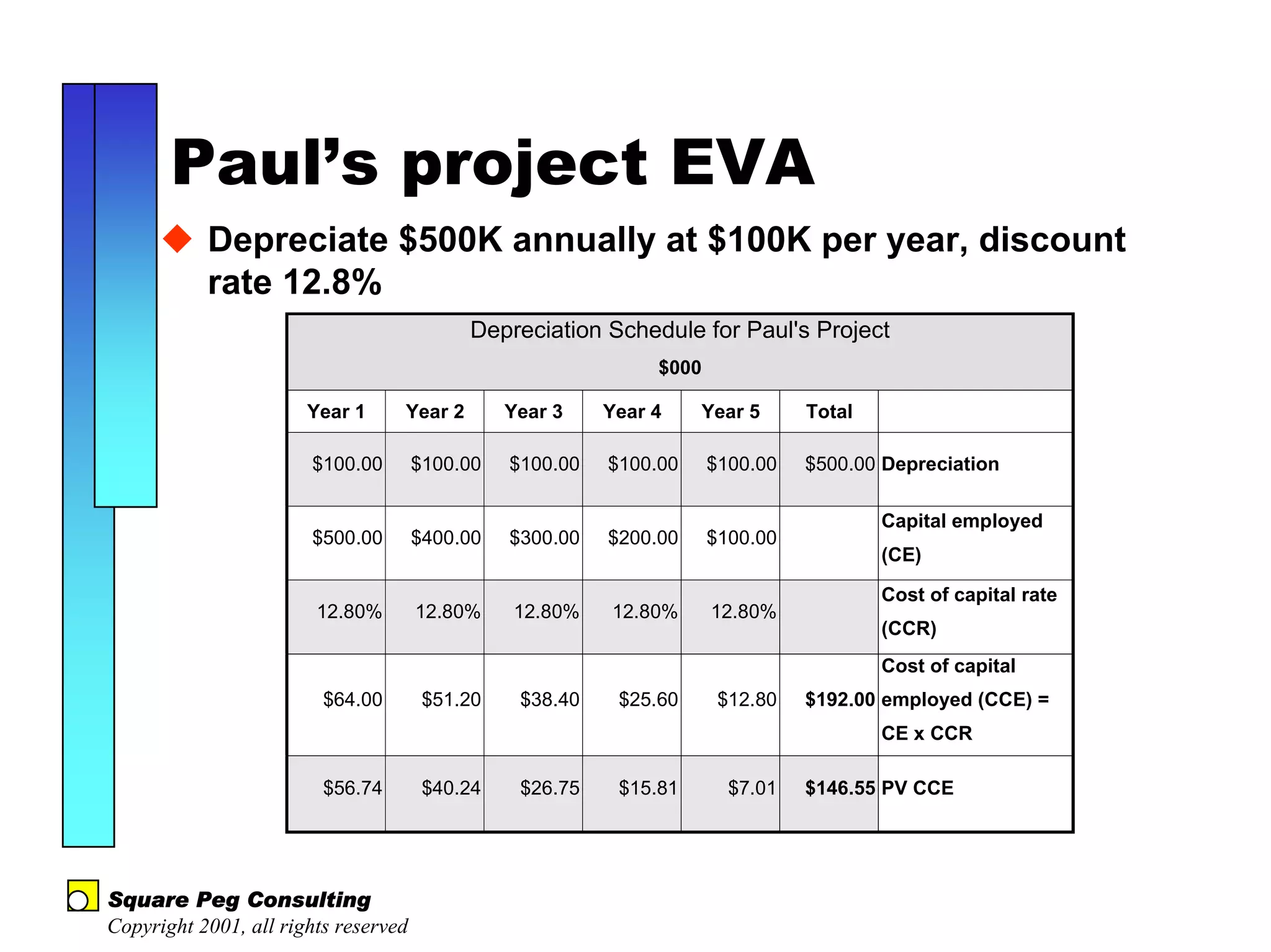
Paul’s project EVA
           Depreciate $500K annually at $100K per year, discount
           rate 12.8%
                                           Depreciation Schedule for Paul's Project
                                                               $000

                       Year 1     Year 2        Year 3    Year 4    Year 5      Total

                       $100.00        $100.00   $100.00   $100.00     $100.00   $500.00 Depreciation

                                                                                        Capital employed
                       $500.00        $400.00   $300.00   $200.00     $100.00
                                                                                        (CE)

                                                                                        Cost of capital rate
                        12.80%        12.80%    12.80%    12.80%      12.80%
                                                                                        (CCR)
                                                                                        Cost of capital
                         $64.00        $51.20    $38.40    $25.60      $12.80   $192.00 employed (CCE) =
                                                                                        CE x CCR

                         $56.74        $40.24    $26.75    $15.81       $7.01   $146.55 PV CCE


Square Peg Consulting
Copyright 2001, all rights reserved
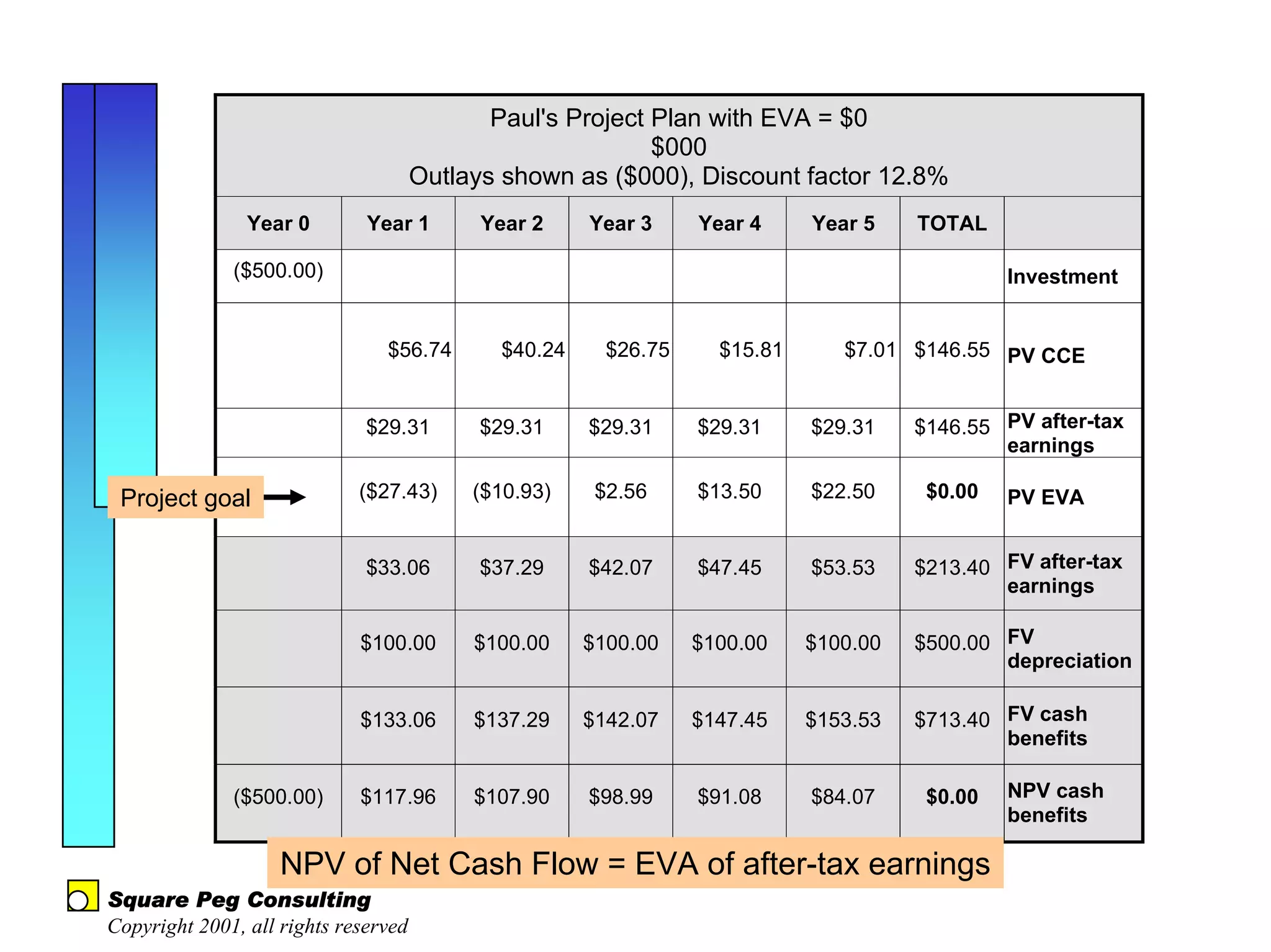
Paul's Project Plan with EVA = $0
                                                            $000
                                      Outlays shown as ($000), Discount factor 12.8%
                Year 0        Year 1        Year 2     Year 3     Year 4     Year 5    TOTAL

              ($500.00)                                                                         Investment


                                $56.74        $40.24     $26.75     $15.81      $7.01 $146.55 PV CCE


                              $29.31        $29.31     $29.31     $29.31     $29.31    $146.55 PV after-tax
                                                                                               earnings

 Project goal                ($27.43)      ($10.93)     $2.56     $13.50     $22.50     $0.00   PV EVA


                              $33.06        $37.29     $42.07     $47.45     $53.53    $213.40 FV after-tax
                                                                                               earnings

                             $100.00       $100.00     $100.00    $100.00    $100.00   $500.00 FV
                                                                                               depreciation

                             $133.06       $137.29     $142.07    $147.45    $153.53   $713.40 FV cash
                                                                                               benefits

              ($500.00)      $117.96       $107.90     $98.99     $91.08     $84.07     $0.00   NPV cash
                                                                                                benefits

                    NPV of Net Cash Flow = EVA of after-tax earnings
Square Peg Consulting
Copyright 2001, all rights reserved
Present value of EVA of cash
            earnings and NPV of cash flow are
            equal!


Square Peg Consulting
Copyright 2001, all rights reserved
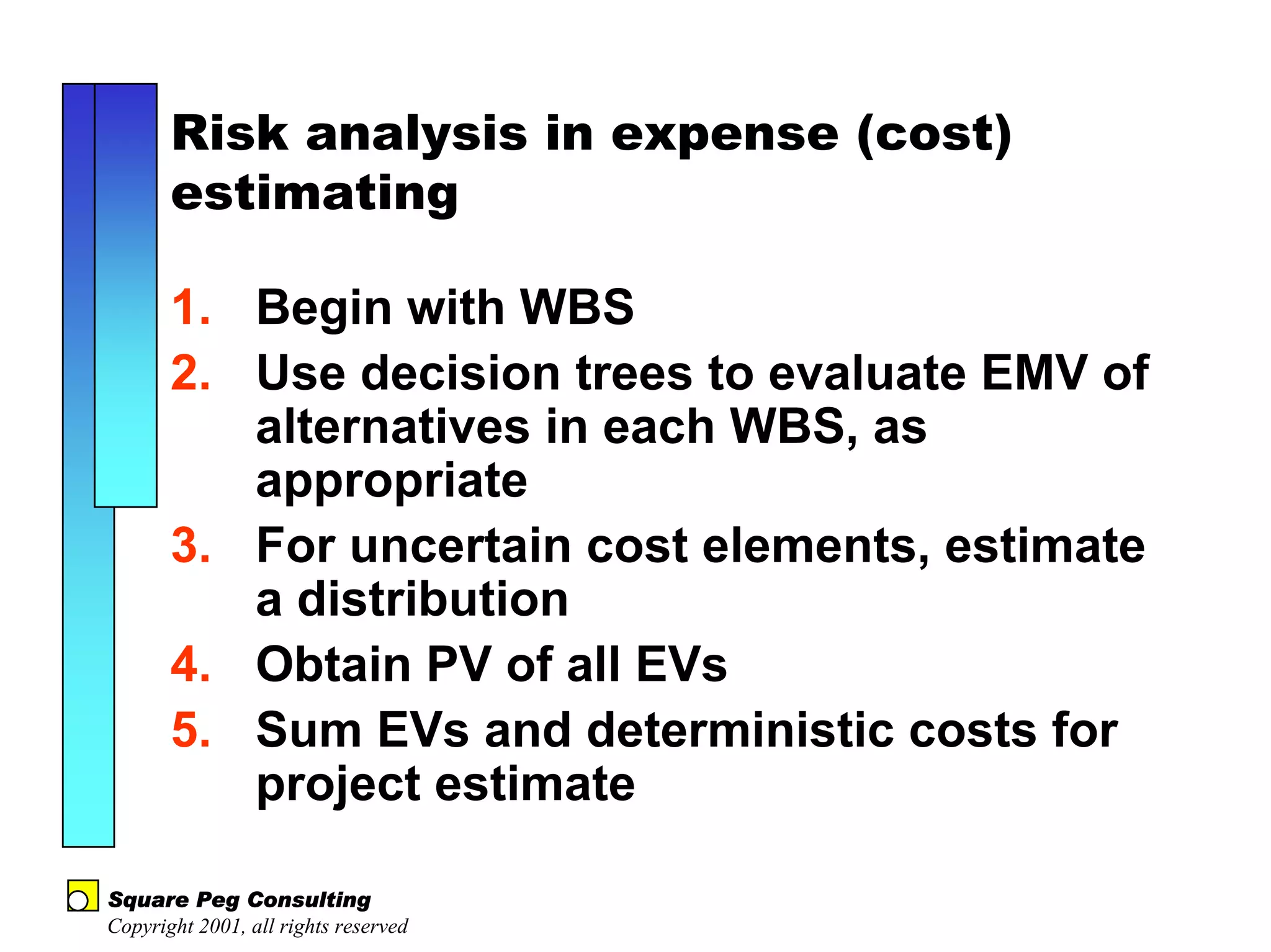
Risk analysis in expense (cost)
       estimating

       1. Begin with WBS
       2. Use decision trees to evaluate EMV of
          alternatives in each WBS, as
          appropriate
       3. For uncertain cost elements, estimate
          a distribution
       4. Obtain PV of all EVs
       5. Sum EVs and deterministic costs for
          project estimate

Square Peg Consulting
Copyright 2001, all rights reserved
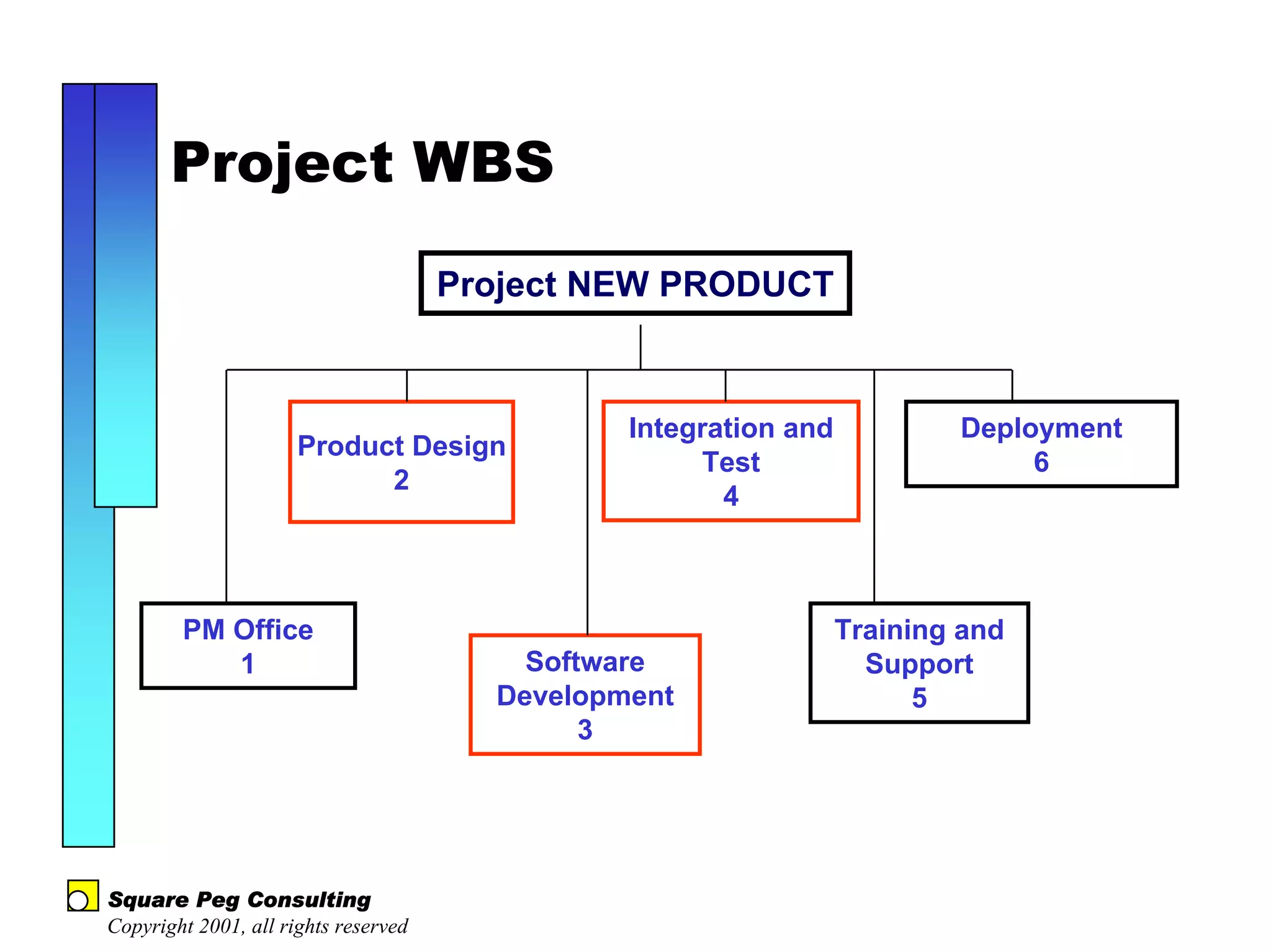
Project WBS

                                      Project NEW PRODUCT


                                                Integration and           Deployment
                      Product Design
                                                     Test                      6
                            2
                                                       4


        PM Office                                                 Training and
           1                              Software                  Support
                                        Development                     5
                                              3


Square Peg Consulting
Copyright 2001, all rights reserved
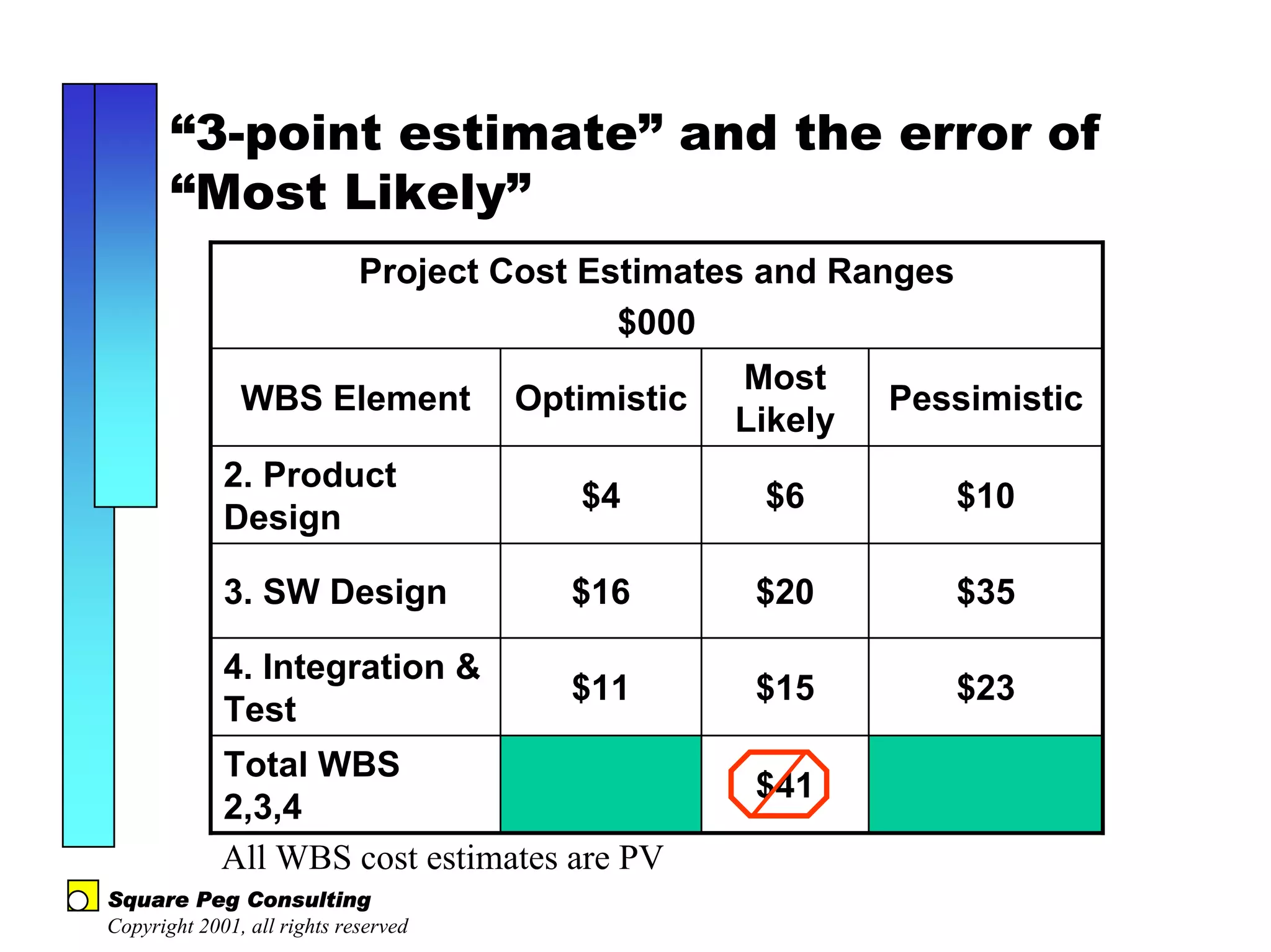
“3-point estimate” and the error of
       “Most Likely”
                             Project Cost Estimates and Ranges
                                            $000
                                                   Most
               WBS Element            Optimistic            Pessimistic
                                                   Likely
             2. Product
                                         $4         $6           $10
             Design

             3. SW Design                $16        $20          $35

             4. Integration &
                                         $11        $15          $23
             Test
             Total WBS
                                                    $41
             2,3,4
             All WBS cost estimates are PV
Square Peg Consulting
Copyright 2001, all rights reserved
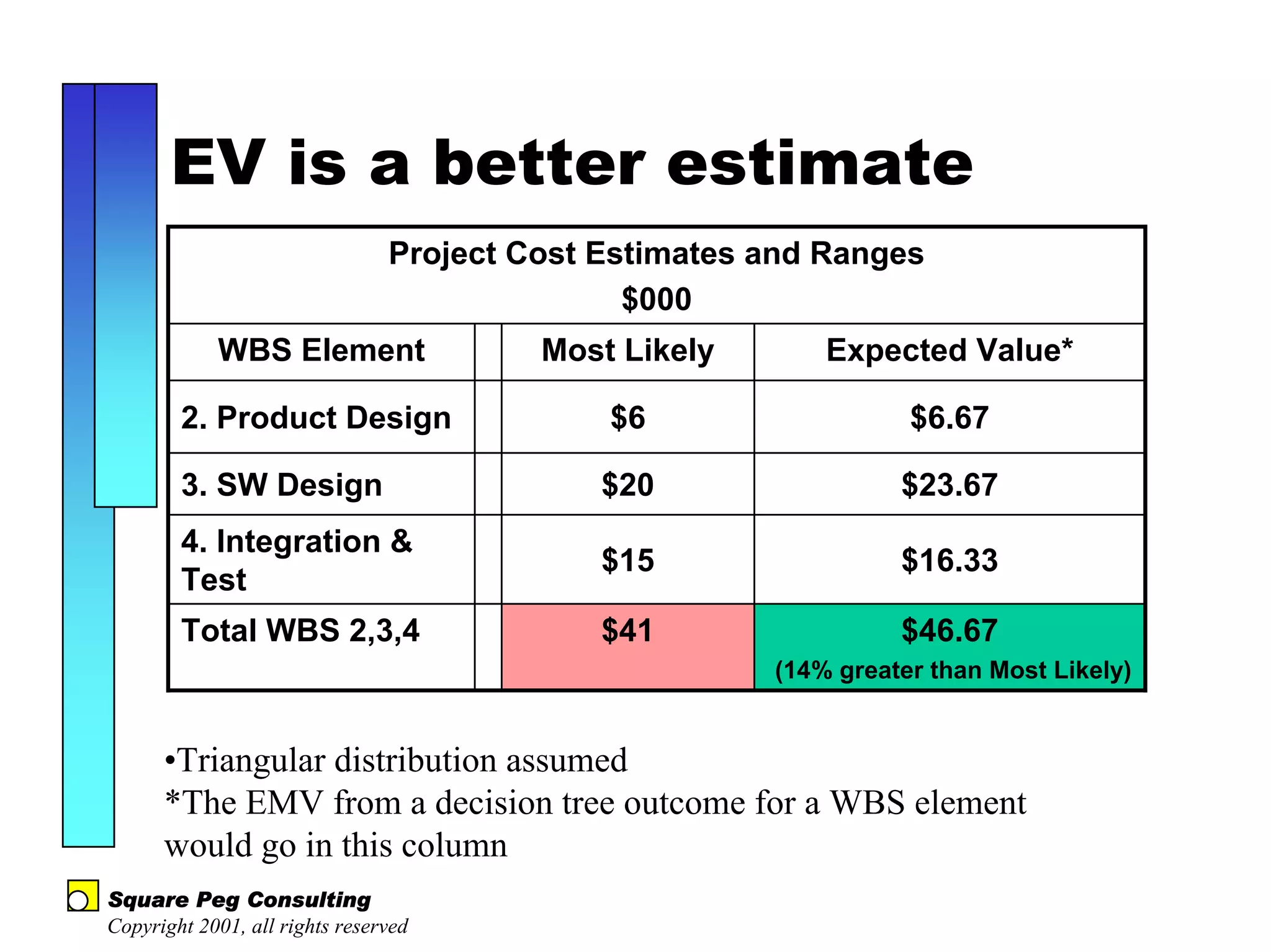
EV is a better estimate
                                Project Cost Estimates and Ranges
                                               $000
            WBS Element                  Most Likely       Expected Value*

        2. Product Design                    $6                   $6.67

        3. SW Design                         $20                 $23.67
        4. Integration &
                                             $15                 $16.33
        Test
        Total WBS 2,3,4                      $41                 $46.67
                                                       (14% greater than Most Likely)


      •Triangular distribution assumed
      *The EMV from a decision tree outcome for a WBS element
      would go in this column
Square Peg Consulting
Copyright 2001, all rights reserved
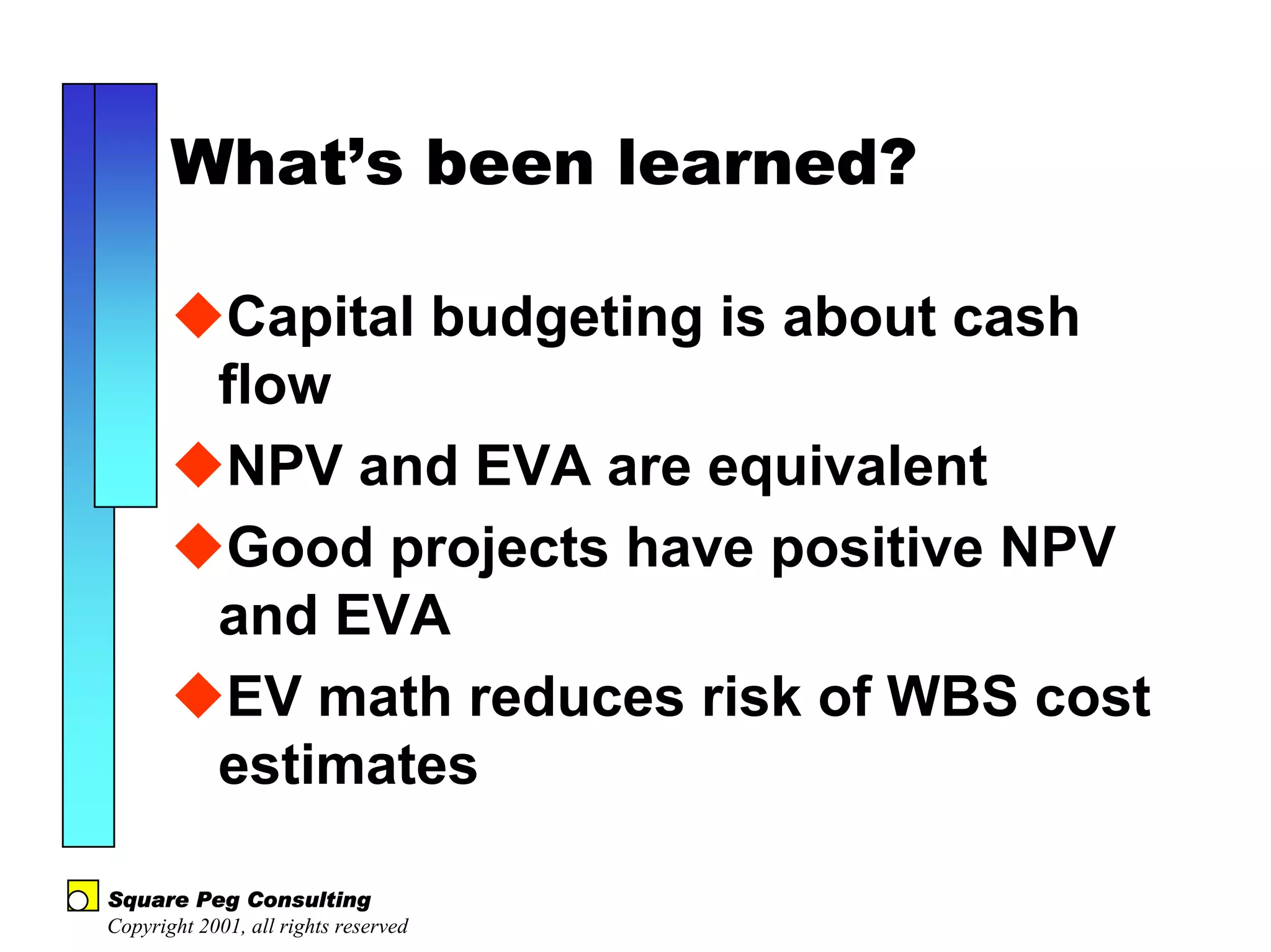
What’s been learned?

            Capital budgeting is about cash
            flow
            NPV and EVA are equivalent
            Good projects have positive NPV
            and EVA
            EV math reduces risk of WBS cost
            estimates

Square Peg Consulting
Copyright 2001, all rights reserved

Quantitative Risk in Cost and Budget

  • 1.
    Quantitative Risk Analysisin Budgeting and Cost Analysis John C. Goodpasture Square Peg Consulting John.g@sqpegconsulting.com Square Peg Consulting Copyright 2001, all rights reserved
  • 2.
    Budgets are estimates There are no facts about the future, only estimates Simple budget estimates do not account for risk Risk is handled by estimating the impact of uncertainties on future cash flows (uses of funds and sources of funds) Square Peg Consulting Copyright 2001, all rights reserved
  • 3.
    Terms in risk-managedbudgeting Discounting – takes into account the risks of receiving or paying funds in the future Expected Value – takes into account the uncertainty of estimate Net Present Value – cash value at time zero (now) Internal Rate of Return – discount required for NPV = 0 Economic Value Add (EVA) – profit-based calculation of discounted value Square Peg Consulting Copyright 2001, all rights reserved
  • 4.
    Capital budgeting* Present value (PV) = Value at future date * Discount factor Discount factor = 1/(1-k)n where n is the number of accounting periods between the present and the future and k is the cost of capital factor Net Present Value (NPV) = Σ PV of cash inflows - Σ PV of cash outflows $ Inflows Time $ Outflows Economic Value Add = After-tax operating income - k (Capital invested) where k is the cost of capital rate, % Expected Monetary Value = Σ $OutcomeNth * ProbabilityNth for all possible outcomes *The flow of cash and not expenses Square Peg Consulting Copyright 2001, all rights reserved
  • 5.
    PM influences NPVvia the project timeline First, the value of money decays over time. This decay is due to the effects of inflation, the uncertainty that future flows will continue or begin, and the uncertainty that a better investment is available elsewhere. In all cases, the “present value” is more than the “future value.” Second, the value of the project is the net of the present value of all the cash outlays for investment and inflows from operations and salvage. Square Peg Consulting Copyright 2001, all rights reserved
  • 6.
    NPV $ Benefits, Expected Value Time $ Investment Future benefits are “discounted” to the present to account for RISK in the future. NPV is the Σ benefits + investment in the present value. IRR is the discount rate that makes NPV equal to $0. Σ {present values} Square Peg Consulting Copyright 2001, all rights reserved
  • 7.
    Two-dimensional risks Discount for •Inflation Present •Risk of getting paid •Capital cost Time •Denied opportunity EV •Market uncertainty Distribution of estimate Future Time Estimate Uncertainty Square Peg Consulting Copyright 2001, all rights reserved
  • 8.
    PV table Year 0 1 2 3 4 Discount 5% 1.0 0.952 0.907 0.864 0.823 8% 1.0 0.926 0.857 0.794 0.735 12% 1.0 0.893 0.797 0.712 0.636 13% 1.0 0.885 0.783 0.693 0.613 14% 1.0 0.877 0.769 0.675 0.592 PV = Value before discount * factor at intersection of Discount and Year Square Peg Consulting Copyright 2001, all rights reserved
  • 9.
    NPV example $500 investment made now, that yields a $1000 benefit 2 years from now, at a discount factor of 12%, has an NPV of $?. Answer: From the table of present values, find the factor for 12% 2 years from now; multiply the FV by the factor to get the PV; net with the investment -$500 + 1000 * 0.797 = $297 Square Peg Consulting Copyright 2001, all rights reserved
  • 10.
    NPV example Mathematically: $297 = -$500/(1 + 12%)0 + $1000/(1 + 12%)2 $297 = -$500 + $797 Square Peg Consulting Copyright 2001, all rights reserved
  • 11.
    NPV and EVAin project selection A valuable project has positive, or at worst $0, NPV A valuable project must earn back more than, or at worst equal, the cost of the capital invested: EVA > $0 Discount rate used in NPV and EVA for project approval is the “hurdle rate” IRR is the maximum discount rate for EVA or NPV = $0 Square Peg Consulting Copyright 2001, all rights reserved
  • 12.
    Paul’s project $500K investment required 12.8% hurdle rate $700K+ benefit stream estimated over 5 years Is this a good deal? Square Peg Consulting Copyright 2001, all rights reserved
  • 13.
    Paul’s project, NPV Paul's Project $000 Cash Benefits Face Benefits Present Year PV Cash Flow Investment Value Value @ 12.8% 0 ($500.00) ($500.00) 1 $141.46 $125.41 ($374.59) 2 $141.46 $111.18 ($263.42) 3 $141.46 $98.56 ($164.85) 4 $141.46 $87.38 ($77.48) 5 $141.46 $77.46 ($0.01) Totals ($500.00) $707.30 $499.99 ($0.01) NPV = $0; IRR is 12.8% –A-risk-neutral investor would take $0 or the project opportunity indifferently –Spreadsheet “add-in” Resolver will iteratively solve for benefits given the investment and hurdle rate. Square Peg Consulting Copyright 2001, all rights reserved
  • 14.
    EVA After-Tax Earnings EVA Net Cash Benefits from Opportunity Cost Project of Capital Alternative Employed Alternative $0 Competing Competing for Capital for Capital Capital Employed to Execute a Project CE x discount rate = CCE EVA = (Present value of after-tax earnings) – (Benefits from the next best competing opportunity) Square Peg Consulting Copyright 2001, all rights reserved
  • 15.
    Paul’s project EVA Depreciate $500K annually at $100K per year, discount rate 12.8% Depreciation Schedule for Paul's Project $000 Year 1 Year 2 Year 3 Year 4 Year 5 Total $100.00 $100.00 $100.00 $100.00 $100.00 $500.00 Depreciation Capital employed $500.00 $400.00 $300.00 $200.00 $100.00 (CE) Cost of capital rate 12.80% 12.80% 12.80% 12.80% 12.80% (CCR) Cost of capital $64.00 $51.20 $38.40 $25.60 $12.80 $192.00 employed (CCE) = CE x CCR $56.74 $40.24 $26.75 $15.81 $7.01 $146.55 PV CCE Square Peg Consulting Copyright 2001, all rights reserved
  • 16.
    Paul's Project Planwith EVA = $0 $000 Outlays shown as ($000), Discount factor 12.8% Year 0 Year 1 Year 2 Year 3 Year 4 Year 5 TOTAL ($500.00) Investment $56.74 $40.24 $26.75 $15.81 $7.01 $146.55 PV CCE $29.31 $29.31 $29.31 $29.31 $29.31 $146.55 PV after-tax earnings Project goal ($27.43) ($10.93) $2.56 $13.50 $22.50 $0.00 PV EVA $33.06 $37.29 $42.07 $47.45 $53.53 $213.40 FV after-tax earnings $100.00 $100.00 $100.00 $100.00 $100.00 $500.00 FV depreciation $133.06 $137.29 $142.07 $147.45 $153.53 $713.40 FV cash benefits ($500.00) $117.96 $107.90 $98.99 $91.08 $84.07 $0.00 NPV cash benefits NPV of Net Cash Flow = EVA of after-tax earnings Square Peg Consulting Copyright 2001, all rights reserved
  • 17.
    Present value ofEVA of cash earnings and NPV of cash flow are equal! Square Peg Consulting Copyright 2001, all rights reserved
  • 18.
    Risk analysis inexpense (cost) estimating 1. Begin with WBS 2. Use decision trees to evaluate EMV of alternatives in each WBS, as appropriate 3. For uncertain cost elements, estimate a distribution 4. Obtain PV of all EVs 5. Sum EVs and deterministic costs for project estimate Square Peg Consulting Copyright 2001, all rights reserved
  • 19.
    Project WBS Project NEW PRODUCT Integration and Deployment Product Design Test 6 2 4 PM Office Training and 1 Software Support Development 5 3 Square Peg Consulting Copyright 2001, all rights reserved
  • 20.
    “3-point estimate” andthe error of “Most Likely” Project Cost Estimates and Ranges $000 Most WBS Element Optimistic Pessimistic Likely 2. Product $4 $6 $10 Design 3. SW Design $16 $20 $35 4. Integration & $11 $15 $23 Test Total WBS $41 2,3,4 All WBS cost estimates are PV Square Peg Consulting Copyright 2001, all rights reserved
  • 21.
    EV is abetter estimate Project Cost Estimates and Ranges $000 WBS Element Most Likely Expected Value* 2. Product Design $6 $6.67 3. SW Design $20 $23.67 4. Integration & $15 $16.33 Test Total WBS 2,3,4 $41 $46.67 (14% greater than Most Likely) •Triangular distribution assumed *The EMV from a decision tree outcome for a WBS element would go in this column Square Peg Consulting Copyright 2001, all rights reserved
  • 22.
    What’s been learned? Capital budgeting is about cash flow NPV and EVA are equivalent Good projects have positive NPV and EVA EV math reduces risk of WBS cost estimates Square Peg Consulting Copyright 2001, all rights reserved