Walther's Social Information Processing Theory proposes that even without nonverbal cues, users of computer-mediated communication (CMC) like email and instant messaging can develop strong relationships over time. The theory argues that CMC users rely on the content and timing of messages to understand each other and form impressions, rather than facial expressions and body language. Walther believes relationships formed exclusively through CMC can become as intimate as those developed in person, given enough anticipated future interaction between parties.
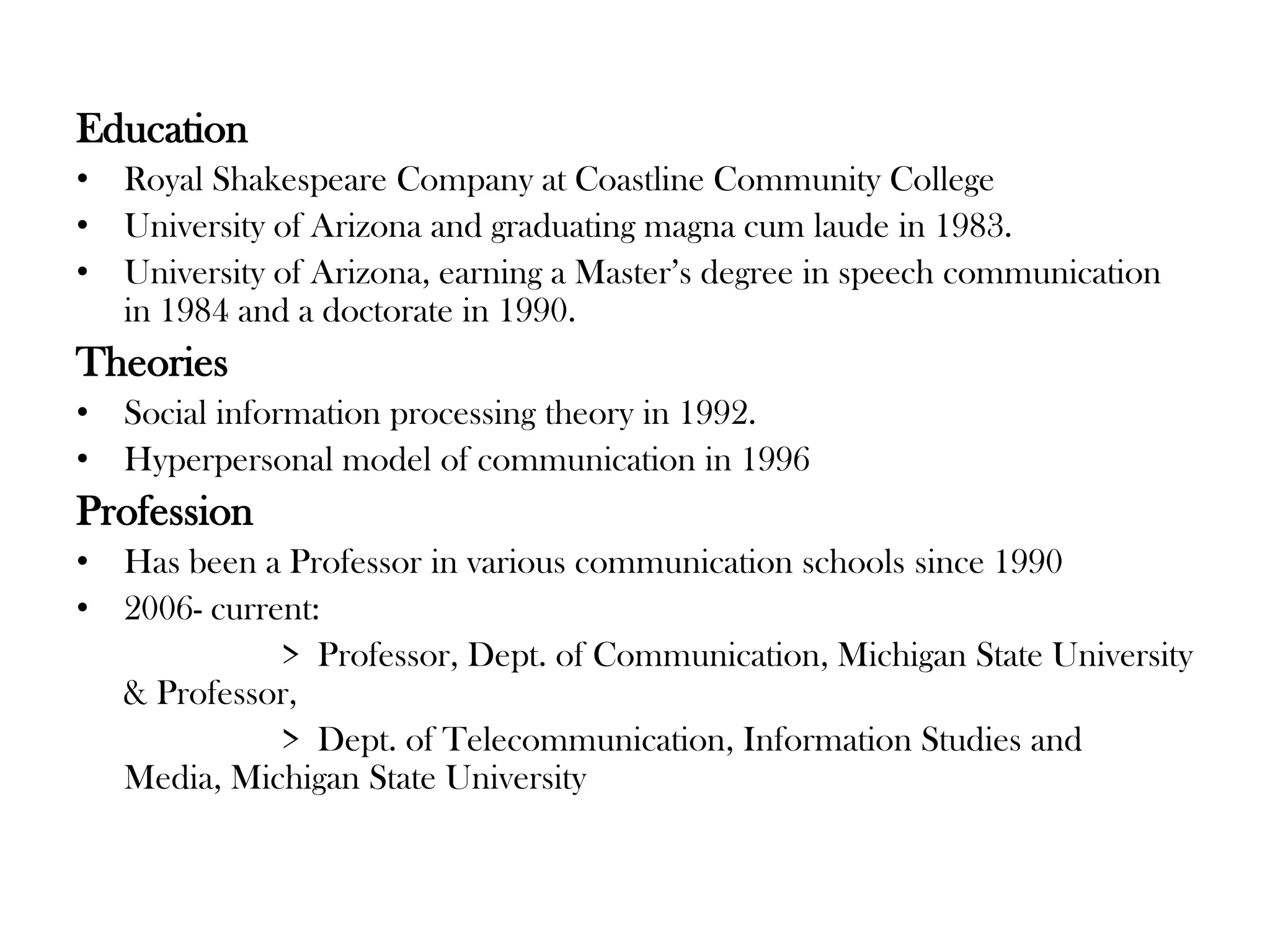
Education
• Royal ShakespeareCompany at Coastline Community College
• University of Arizona and graduating magna cum laude in 1983.
• University of Arizona, earning a Master’s degree in speech communication
in 1984 and a doctorate in 1990.
Theories
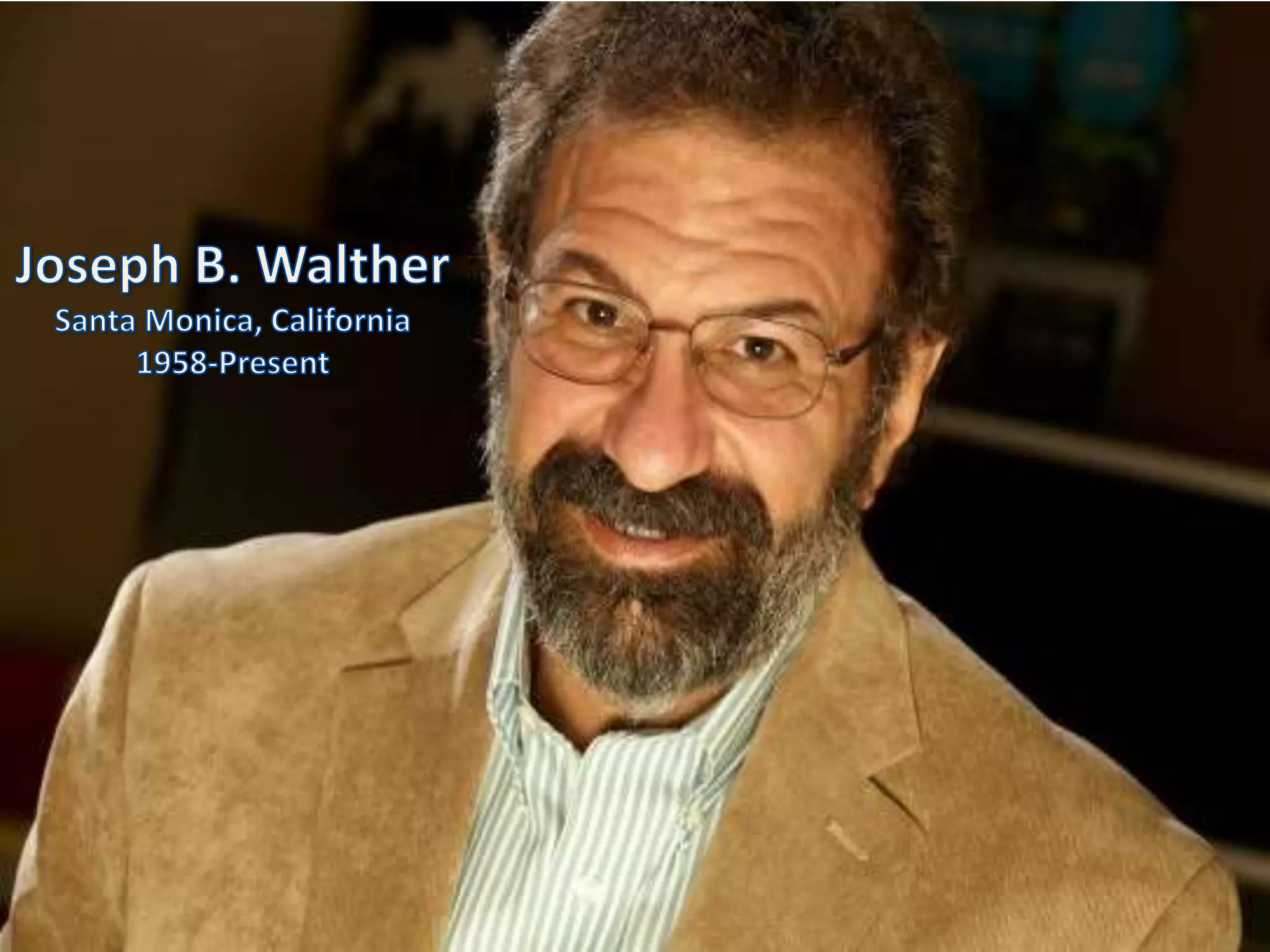
• Social information processing theory in 1992.
• Hyperpersonal model of communication in 1996
Profession
• Has been a Professor in various communication schools since 1990
• 2006- current:
> Professor, Dept. of Communication, Michigan State University
& Professor,
> Dept. of Telecommunication, Information Studies and
Media, Michigan State University
Summary
• SIP isall about Computer-MediatedCommunication (CMC).
e.g. e-mail ; Instant Messaging and other
types of text-based non-verbal
communication.
• This theory indicates that CMC users can
adapt this restricted medium and use it
effectively to develop close relationships.
6.
Before
• The theory’s[SIP ‘s] general consensus was
that CMC was not a good medium to develop
relationships
• There existed these 3 theories:
– Social presence theory: CMC deprives users of the
sense that another actual person is involved
– Media richness theory: CMC’s bandwidth is too
narrow to convey rich relational messages.
– Cues filtered out: Interpretation of CMC that
regards lack of none-verbal cues as a fatal flaw for
using the medium for relationship development.
7.
The Argument
• Evenwithout the rich none-verbal present in
face-to-face communication, given enough
time CMC users can develop relationships just
as strong as those done through face-to-face
– If you were handed a glass of water you could
choose to either gulp it straight from the glass, or
through a straw one sip at a time.
– The amount of time it takes to develop the
relationship.
8.
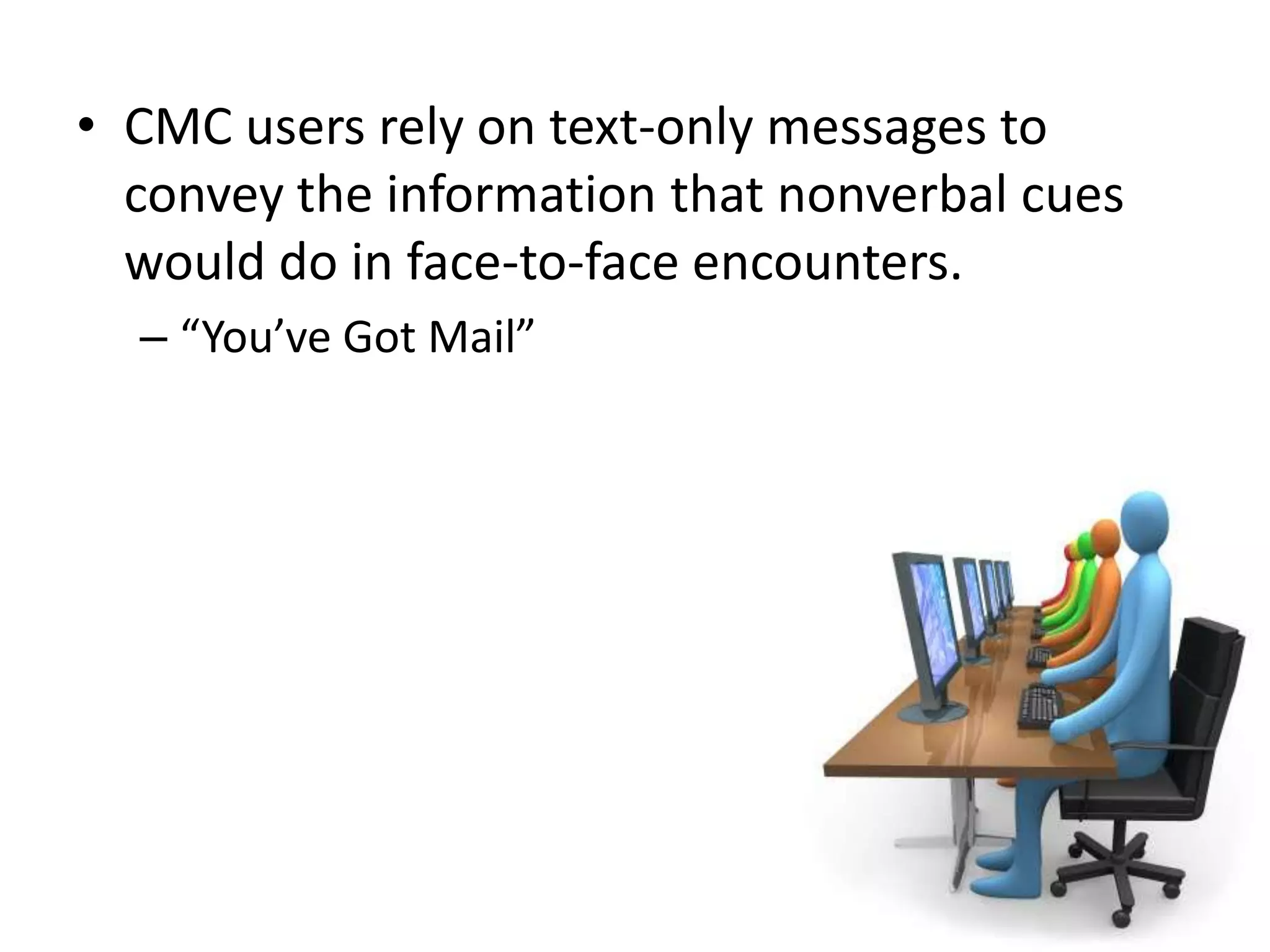
• CMC usersrely on text-only messages to
convey the information that nonverbal cues
would do in face-to-face encounters.
– “You’ve Got Mail”
9.
Differences
• Online communication
oCMC users form
impressions by the
content of the message
o The response time of
the message
o Delayed response
o Prompt response
o Relationship Stage
o Tone the sender wants to
convey
• Face-to-Face
o Facial Expressions
o Tone of Voice
o Body position
o Interpersonal
distance
o Gestures
o Touch
10.
The experiment
28 pairsof students split into face-toface and CMC users, with no prior
relationship with one another.
Asked to discuss moral dilemmas, and one
person in each of the pairs was a confederate
with a goal to either be friendly or unfriendly.
Confederates in the CMC group were able to convey
friendliness or unfriendliness just as successfully as the
ones in face-to-face.
11.
Walther’s belief’s
• Anymessage spoken in
person will take at least
four times longer to say
through CMC.
• Two other temporal factors
could contribute to
intimacy on the internet:
anticipated future
interaction and chronemics.
12.
More about that
•Chronemics: The study of people’s systematic
handling of time in their interaction with
others.
• Anticipated future interaction: A way of
extending psychological time; the likelihood of
future interaction motivates CMC users to
develop a relationship.
– If you know you’ll be interacting with
someone, you’re more likely to disclose more
information about yourself.
Looking at theTheory
SIP Theory is consistent with
oSocial Penetration Theory
oUncertainty Reduction Theory
17.
Looking at theTheory
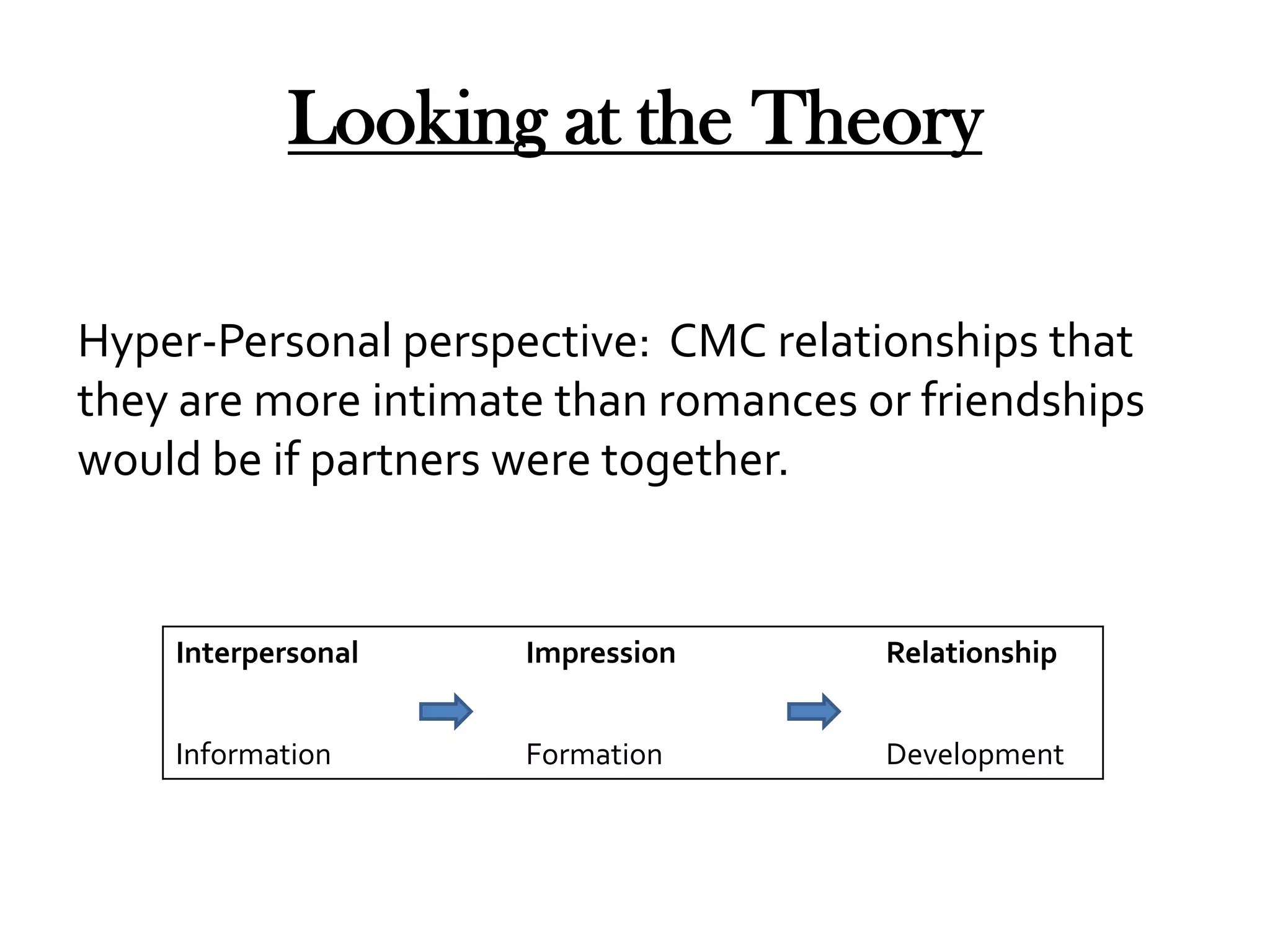
Hyper-Personal perspective: CMC relationships that
they are more intimate than romances or friendships
would be if partners were together.
Interpersonal
Impression
Relationship
Information
Formation
Development
18.
Critique
•The use ofonline dating might actually make relationships form faster
because of anticipation of future interaction makes the impression forming
process go faster.
•People who use CMC to join online discussion groups may have a higher
need for affiliation than the typical person whose relationships are developed
through multichannel modes of communication.
•The theory has plenty of holes
and the author openly admits
that. The theory makes some
claims that some may feel are
farfetched but the depth of
research and analysis provided
by Walther make it a respected
and validated theory.
19.
Advantagaes
Disadvantages
• Convince ofsending the o People become more
message in your own
self-absorbed and less
time.
inhibited
• The Intimacy of the
o CMC relationship will
relationship would be
be weaker/fragile (when
establishing the relationship)
the same if they meet
o Logging off
face-to-face.
o Terminating the
relationship
o Impersonal
o Task-oriented
20.
Conclusion
The Theory provesthat there is no difference on
the long term effect of the relationship, where
the two individuals meet:
• Online
• Face-to-Face
That it would not have an effect of
the Intimacy of the relationship.
21.
Conclusion
• The Theoryproves that the an online relationships
will take longer with the communication channels
compared to an face-to-face communication
channel
• The Theory shows that the
CMC Users are more than
likely to be Single rather than
in a current relationship