Running Head: Facebook Privacy & Information Disclosure
Facebook Privacy & Information Disclosure
Alex B. Criswell; Graduate Candidate, MA & MS Ed.
Ali Aljaziri; Graduate Candidate, MA
Donna Rettew; Graduate Candidate, MA
Purdue University Calumet
Hammond, Indiana
Abstract
This study examines the privacy settings on Facebook and explores how users disclose
personal information on their Facebook profile in order to protect their privacy. It is based on
the Communication Privacy Management (CPM) Theory. The study also provides awareness
and an explanation about the secure use of Facebook. A survey and content analysis were used
to test the relationship between the perceptions of Facebook privacy and the
efforts Facebook users make to stay updated about changes in privacy settings.
Introduction
The growth of social media has significantly influenced the way the world operates
today. Modes of communication between people have become easier, faster, more convenient
and more efficient (Skiba, 2007). With the evolution of social networking sites (SNS or SNS’s,)
which includes peer sites such as Facebook.com and Myspace.com, dating sites like Match.com,
and blog posting sites such as Twitter.com, our communication with other individuals has
increased. This paper covers the use of privacy restrictions on Facebook, a well-known social
networking site, and how these privacy restrictions relate to the Communication Privacy
Management (CPM) theory through the use of computer mediated communication.
Social networks and the need to communicate are universal human conditions, according
to Coyle and Vaughn (2008). Coyle and Vaughn (2008) feel that a social network is a
configuration of people connected to one another through interpersonal means, such as
friendships, common interests, or ideas. It is assumed that social networks existed long before
the phrase became well-known. Adam Acar (2008) argues that while social networking sites are
changing the way people use the internet, he feels that little attention has been focused on how
people’s socialization processes, feelings, and communication habits have changed.
According to Ryan, Magro, and Sharp (2011); social networking sites can aid adaptation
through:
• facilitating knowledge exchange,
• alleviating apprehension, and
Criswell et. al., 2012, 1
• enabling socialization and building community (87)
The following hypotheses were formulated to aid this study:
• H1: Individuals who use Facebook daily are more concerned about privacy than
users who do not use Facebook daily.
• H2: Individuals who use Facebook daily have misrepresented information on their
Facebook profile in order to protect their privacy.
• H3: Individuals who use Facebook daily are more likely to hide or restrict their
profile information from their co-workers than their family members, in order to
protect their privacy.
Rationale
Our goal of this study is to examine how Facebook users have concern for privacy and
whether they hide or misrepresent their information to protect their privacy. As noted by Baym
(2010), individuals can become an entirely different person online than who they are face-to-
face. In addition, we wish to further analyze how users protect their information based on
specific groups named by the authors, while using the Communication Privacy Management
(CPM) Theory as a tool to explain how surveyed users protect their information from the specific
groups mentioned in this study.
Computer Mediated Communication
According to Rice and Love (1987), computer mediated communication systems are
becoming more involved as organizations implement electronic mail (email), chat clients,
bulletin boards, and other systems. It is noted that computer mediated communication transmits
less interaction between individuals who are online versus face-to-face interaction (1987). This
is also supported by Joseph Walther (1992), who states that extremely low interaction exists in
computer mediated communication. Two indicators of behavior, according to
Rice and Love (1987) are duration and frequency of messaging in a computer-mediated setting.
The authors also state that “sociability” is implying that people who are socioeconomically
Criswell et. al., 2012, 2
oriented show greater response duration and shorter latency of a verbal response (1987, 88). In
addition, they state two general categories of a computer mediated communication which
involves the nature and structure of communication. Rice and Love (1987) feel that multiple
approaches are needed to analyze the content and structure of computer mediated
communication.
Rice and Love’s (1987) approaches:
1. Compliment the study of the changing structure with archival measure of content.
2. Conceptualize the network as the co-occurrence of similar words.
3. Directly compare the content of messages that constitute the linkages of the
communication network. (87)
Verbal questions and self-disclosure are often more common in computer mediated
communication. According to Tidwell & Walther (2002), CMC provides sheltering effects not
available in face-to-face communication. The authors also feel that the Social Information
Processing (SIP) Theory brings forth personal knowledge during computer mediated
communication interaction. Participants in computer mediated communication were found to be
more task-oriented than individuals in the face-to-face interaction setting (Walther, 1992).
Types of conversations between individuals in CMCs include video conferences, email,
instant messages, blogs, and wiki updates (Burns, Bruce, & Friedman, 2011). According
to Walther (2006), computer mediated communication displays elements of interpersonal
communication and allows people to meet and develop relationships based on typed messages as
the primary channel of communication. In addition, computer mediated communication can be
used for simple information inquiries to establishing a full connection with an individual
(2006). Computer mediated communication does have the absence of face to face
communication, which is often used by individuals to develop first impressions of
others. Aspects such as facial features, gestures, and voice are not prominent in computer
mediated communication (Walther, 2006). Walther (2006) also feels computer mediated
communication users form impressions from other users based on message contents as
receivers. As senders, these users can select how they want to form the image perceived by the
receiving user(s). While the advantages of privacy, self-control, and disclosure are evident, the
Criswell et. al., 2012, 3
disadvantages of computer mediated communication can include that users can exaggerate or lie
about their physical attributes, personality, and other aspects that are generally present in face to
face communication (Walther, 2006).
Computer mediated communication is often used when nonverbal communication and face-
to-face communication is not available, and it is often used for task-oriented and interpersonal
messages (Walther, 1992). According to Walther (1992), computer mediated communication is
“synchronous or asynchronous electronic mail and computer conferencing, by which senders
encode in text messages that are relayed from senders’ computers to receivers” (59). Walther
(1992) also states the differences between CMC and face-to-face communication eliminate non-
verbal cues that are used in face-to-face communication, which can include social context
cues. These can also include the individual’s physical environment and nonverbal behaviors that
describe the person’s status. It is also noted that computer mediated communication takes longer
to process data than face-to-face communication (Walther 1992). Walther (1992) also states that
it is sufficient over time, however it is not recommended for immediate messages and
interaction.
CMC also is known to allow users to disclose more information to others they think might be
too over-bearing in a face-to-face communication setting (Walther, 2005). This could be a
mistake, however, as many people often disclose too much information in a computer generated
setting.
Deception & Self-Presentation
Along with the evolution of computer mediated communication, comes
deception. According to Dictionary.com (2012), “deception” is the act to deceive, or intent to
fraud. With the advancing use of social media, deceit is a key issue that has grown
tremendously. Lies and deception are part of our everyday lives with people telling typically
one to two lies per day (DePaulo, Kashy, Kirkendol,Wyer, & Epstein, 1996). According to
O’Hair & Cody (1994), the deceiver who is caught and confronted by the deceived partner
frequently also suffers embarrassment, guilt, and loss of credibility.
Criswell et. al., 2012, 4
People are figuring out ways through which they can cheat people into doing what they
want (Laursen, 2009). According to Guillory & Hancock (2009), deception is very common in
online environments, especially in social network settings. Individuals will often exaggerate or
lie about their personalities, achievements, or life’s goals.
Also, deception can vary from blatant lies to indirect actions such as exaggeration and
false implication (Hopper & Bell, 1984). This has been extended to deception in online resumes,
according to Guillory & Hancock (2009). Moreover, people who created fake information in
online communications and tried to deceive others could lose their relationship. According to
Whitty (2008) blatant deception in one’s online dating profile can be grounds for terminating a
budding relationship. Moreover, Wilmot (1995) argues the deception is always damaging to the
other person and to the relationship.
O’Hair and Michael Cody (1994) identify six motives or reasons people give for lying to
their relationship partners. The three positive motives are egoism, benevolence, and utility, and
are labeled positive because they generally have positive consequences for at least one individual
and they don’t harm the relationship. Negative motives are exploitation, malevolence, and
regress, and are labeled negative because the consequences do include harm to at least one
person in the relationship.
With self-presentation, the user can construct a message with a virtually unlimited time
span, allowing the shaping of the message into the way they desire (Walther, 2006). These
messages can also include descriptive words and photographs and includes the quality of the
message as well. This message-shaping ability is beneficial so that comments may not be
repeated or misinterpreted. Users are also able to utilize the language they wish to speak, which
can differ from general to serious conversations. Moreover, self-presentation is the behavior
used to display an image of themselves to others in a desired way. According to (Goffman,
1959), self-presentation involves strategically disclosing and/or concealing information in order
to portray the self in a desirable way.
Many online social networking sites have gained recognition because of their ability of
facilitating communication between friends and acquaintances, and the renewal of old
friendships and relationships (Baym, 2010). These sites are also appreciated because of the way
Criswell et. al., 2012, 5
in which they provide information about the activities, opinions, and interests of people’s friends
(Skiba, 2007).
Communication Privacy Management Theory
Communication Privacy Management (CPM) Theory was developed to explain the
details of disclosure as information is passed from a secret entity to one that is collectively
owned (Petronio, 1991, 2002). Petronio (1991) also argues that individuals handle private
information through boundaries and a rules-based system. According to Petronio, this could
serve as a positive or negative function involving CPM Theory (2002). Thorson notes that with
the use of CPM Theory, individuals must negotiate issues of protection and access when they co-
own information (2009).
Premises of CPM Theory
According to Petronio, Ellemers, Giles, & Gallois (1998) people believe they own their
private information and have the right to control the flow of the information to others.
Youngquist (2010) notes the ownership of information includes a sense of control over the
ownership of that information to others. Petronio, Jones, & Morr (2003) also note that the CPM
theory focuses on the need to protect privacy rights and potential vulnerability. Generally, the
information is guarded by ownership lines or rules, also known as “boundaries,” within the CPM
Theory (Petronio et al., 2003).
Boundaries
According to Youngquist (2010) the “boundary” metaphor is used to “identify a
boundary or border around private information” (Petronio,2000a, 38). A boundary is also known
“to make a distinction between the private information they own and information that other
people own” (Petronio, et al. 2003).
Boundaries can either be individual or shared by multiple individuals (e.g. families)
(Youngquist, 2010). Youngquist (2010) notes that individuals who fall within these boundaries,
whether individual or shared, feel they own or co-own that information. From the perception
Criswell et. al., 2012, 6
that individuals own the information, they often create rules to manage the boundaries that have
been created (2010).
Petronio et al. (2003) notes there are several boundaries around private information:
• Personally Private Boundaries
• Private Boundaries
• Family Group Private Boundaries
• Group Private Boundaries
• Organizational Private Boundaries
Family privacy boundaries are used for self-protection from public scrutiny (Petronio et
al., 2003). These boundaries can be used as a safety zone to test the permeability of the family
boundaries and for the use of protection of private family information (2003). Petronio et al.
(2003) feels there are often several internal boundaries within the family group, such as husband-
wife, parent-child, etc., while there is often only one external boundary that includes the whole
family.
Protection Rules
Petronio (2002) states that protection rules are guidelines that individuals or groups of
people form in order to keep information from, or to avoid discussing information with,
others. This is to regulate linking others into private boundaries and establish rules regulating
co-ownership (Petronio et. al, 2003). Rules are often formulated to regulate and maintain
privacy needs for family group members to help them understand the limits of information
ownership and how it should be controlled (Petronio, 1991, 2000a). An example of a privacy
protection rule would be something a husband tells his wife or significant other, but asks not to
reveal it to the children, as he is establishing a boundary.
Petronio (2002) notes five factors during the development of privacy rules: 1) Rules
derive from cultural expectations about privacy, 2) Rules may be different between men and
women, 3) Rules are dependent on different individual motivations, 4) Group/Individual making
the rules evaluates the level of disclosure, and 5) Context affects the type of privacy rules people
develop.
Criswell et. al., 2012, 7
The management of privacy protection rules is influenced by many things such as culture,
gender, and motivation (Petronio, Sargeant, Andea, Reganis, & Cichocki, 2004). Other factors
include the context of the information and the associated risk of it (Petronio et al.,
2003). Motivations are also known to play a role in protecting information, and are categorized
within six functions: 1) bonding, 2) evaluation, 3) maintenance, 4) privacy, 5) defense, and 6)
communication (Vangelisti & Caughlin, 1997).
Access Rules
Much like protection rules, individuals often form privacy access rules (Petronio et. al.,
2004). Thorson (2009) notes access rules to be guidelines that individuals or groups of people
use in order to determine when it is appropriate for information to be discussed with
others. These rules can be dependent on factors such as gender and culture (Petronio, Martin &
Littlefield, 1984). Thorson (2009) notes that additional factors involving access rules were:
context, age, and physical environment. According to Frey (2003), family members believe they
have ownership rights to their information and set their own rules to manage boundary
permeability and linkage. Family members also expect a belief of co-ownership of privacy
rights and rules.
Information Sharing
When information is shared with others, whether within a boundary or outside the
boundary, these individuals become “shareholders” or co-owners of this information
(Youngquist, 2010). Petronio (2007) notes individuals are assumed to understand and abide by
the privacy rules around this information. These rules can be altered or changed depending on
the shareholder (Youngquist, 2010).
Social Networks
According to Boyd & Ellison (2008), the first social networking site was launched in
1997. SixDegrees.com allowed users to create profiles and list their friends. It was closed in the
year 2000 as it was not able to stay up and running, of which the authors speculate that it was
“just ahead of its time.”
Criswell et. al., 2012, 8
According to Boyd & Ellison (2008), social networking sites are defined as web-based
services that allow individuals to: 1) Construct a public or semi-public profile within a bounded
system, 2) Articulate a list of other users whom they share a connection with, and 3) View and
transverse their list of connections and those made by others within the system (2008, 11).
With the evolution of technology, people are able to multi-task while taking care of
families or doing homework (Hansen et.al., 2010). The most common types of social
networking websites include chat rooms, community information/bulletin boards, online dating
sites, and professional development venues (Acar, 2008). These internet communities allow
people to connect with individuals for personal or professional reasons that they are not able to
do in person.
Talking on the phone, texting, and emailing are how most users today are communicating
when face to face interaction is not available or desired. People access social media websites
from their personal computers, cell phones, and other portable devices which include iPads and
Tablets (Burns et. al, 2011). According to Vladar and Fife (2010), frequent users of mobile
social networking are more likely to use other types of mobile services, which can include
information and entertainment related services. The popularity of social networking sites on
personal computers (PC) have increased the popularity with mobile devices. The growth of
mobile social networking is likely due to technology – Smartphones and improved interfaces
Vladar & Fife, 2010).
Users use mobile communication when they do not desire or have access to the use of a PC
in order to communicate with other individuals. They often check their social networking site
when they have a few minutes to spare. This can include time on work breaks, in between
classes, traveling, or a quick relaxation time. According to Vladar & Fife (2010), as of
September 2009, 47 percent of online adults used a SNS, which had increased 10 percent from
the prior year. Generally, individuals who use social networking sites are of the younger
generation. In addition, smartphone usage is highest by 25-49 year olds (2010). According to
Vladar & Fife (2010), social networking is often referred to as an alternative way of
communicating and connecting with other people. It was found that females were the heavier
users of social networks. According to Wilson (2009), social networking sites are now also
being used for business purposes such as marketing, recruitment, and research.
Criswell et. al., 2012, 9
Facebook
According to Alhabash et. al. (2009) and based on existing research in social networking,
Facebook serves as a need for connectivity and that a great deal of its use could be
conceptualized as either social browsing or social searching. Facebook was also noted as the top
online photo sharing application with more than 30 million photos shared daily. As of 2011, by
personal observation it is noted that Facebook is available in over 70 different languages.
Alhabash et. al. (2009) reports social browsing screens can include personal information about
friends. The newsfeed section includes headlines concerning recent activities of different
friends, including status updates, profile picture changes, photo tags, event postings, and
comments. Social browsing is generalized as the selection of general pages, where individuals
were not looking at information of a certain individual. These individuals can search a wealth of
information that involves more than one person or one type of information. Alhabash et al.
(2009) feels that social searching is “more concerned with goal-oriented surveillance, where
participants moved from the general content to the pages belonging to a particular person. The
authors claim that the difference between social browsing and social searching is that browsing
pages are not specific to a single friend of the individual, but a wealth of information pooled
about a number of friends (e.g. linkage).
Social Networking & Privacy within Education
“Social networking is a tool being explored by many institutions as a means of
connecting to and communicating with students,” according to authors Michele Hansen, Janice
Childress and Daniel Trujillo (2010). These authors studied social networking sites and whether
the use of them had significant effects of social connectedness, college adjustment, academic
engagement and institutional commitment. While the research yielded positive reactions to
feelings of social connectedness for student to student, it displayed negative connections with
student to faculty and staff use. According to Childers (2011), faculty and staff feel social
networking sites are allowing individuals to become too personal and they fear losing their job
due to conflict of interest between a student and an educator.
Criswell et. al., 2012, 10
In a study with Hansen et al. (2010), students mentioned that they were comfortable with
“friending” faculty on Facebook so they would know more about the teacher’s
personality. Hansen et al. (2010) stated that students mentioned faculty needed to keep
professionalism in mind and that comments and tags are visible to the public and
students. Hansen et al. (2010) felt that it was possible for many students to seek this type of
online communication as a mechanism for connecting with other students, faculty, advisors,
administrators, and staff.
According to Tanja Bosch (2009), Facebook and other social networking sites allow high
surveillance options, which allow other users to view profiles, posts, photos, and profile data, all
of which considered personal information. Colleges and universities have begun screening
personal profiles of students to ensure they are not violating any university (Bosch, 2009).
Social Networks, Privacy & Regulation
Boyd & Hargatti (2010) state that Facebook uses have been criticized by privacy
advocates and the news media. A Facebook feature that sparked criticism was the “news feed,”
according to Boyd & Hargatti (2010). When a user changed/updated their profile, status, posted
a photo, etc., it was posted on the news feed and users felt it was disclosing too much
information. Privacy controls can be enabled on most social networking sites where users can
restrict specific information to be viewed only by friends or specific individuals. In addition,
network administrators can restrict certain information from the public or other users. Social
networking sites generally allow users to “friend” each other as well as exchange personal and
private messages (Boyd & Ellison, 2008).
Boyd & Hargatti (2010) claim this information was never hidden from the public, but the
advertisement of the information is what sparked a negative interest. Over the years, Facebook
has expanded to third-party applications which began to share some information with other
websites and companies without explicit permission.
According to Semitsu (2011), 30 billion pieces of content are accessed on Facebook
monthly. This includes users from at least 180 different countries. According to Katz vs. United
Criswell et. al., 2012, 11
States (1967), “What a person knowingly exposes to the public, even in his own home or office,
is not a subject of Fourth Amendment protection.” In addition, the author feels that government
law does not protect social networking site users from violations of privacy. The governing law
is noted to be the Electronic Communications Privacy Act of 1986, according to Semitsu
(2011). It does not protect users from censorship to comments posted on their profiles, photos,
or blogs which the public can read and scrutinize. Even while using the strictest privacy
controls, there is no safeguard for users. These comments have been used to terminate
employees from jobs because of negative comments they have posted about their jobs.
Semitsu (2011) refers to the Facebook Effect which has been noted as changing the way
we communicate with the use of technology. It is much easier to contact individuals with e-mail
and instant messages over social networking sites than using postal mail or a telephone. While
the Facebook Effect has a positive influence, the author also notes the negative influences of it as
well. Semitsu (2011) refers to this negative impact as the “Facebook Defect” which is noted as
“the failure of both the government and social networking sites to ensure that certain online
communications receive the same probable cause standard set forth in the Fourth Amendment as
they would offline.”
Many user profiles of people using social networking sites are now available on major
search engines like Google (Spitzberg & Cupach, 2003). The users of these sites can therefore
be under threat because of the amount of personal information available on the internet.
However, this is not very common because of the few instances of stalking in online social
networking sites (2003). These sites, however, normally provide an avenue whereby individuals
can be able to access information as well as make contact with other individuals. This kind of an
action is referred to as obsessive relational intrusion whereby a person may not be willing to
communicate with a certain party but the other party communicates anyway.
Method
This section of the research paper will be seeking to address the design procedures,
considerations and the limitation of the research study. It will also give details of population
Criswell et. al., 2012, 12
collection, and the action of the participants to take part in the study. Then it will describe the
process of data collection and analysis.
Research design
To answer the research question, the researchers designed a study to access awareness of
privacy on Facebook. The study uses a survey and content analysis to establish the relationship
between the efforts Facebook users make to stay updated on the changing privacy settings and
their awareness of current personal privacy settings. The study is non-experimental and
is descriptive in nature. The 46-question survey was available on Qualtrics survey system
for participants to take part in voluntarily.
Population
To be able to satisfy the expectations presented by the research question, an
appropriate population must be selected. Since this research paper is on Facebook privacy, the
target is participants between 18-64 years, since Facebook users are spread across all age groups.
The population consisted of the researchers' friends on Facebook and friends of these friends.
The overall projected sample size for the study was approximately 100 respondents.
Data collection
The questions were available online through the Qualtrics survey system. The
participants were to answer the questions based on their perceptions on Facebook privacy and
whether or not they kept updated with emerging privacy issues. Then, an analysis using several
programs was used to determine if there was any relationship between the variables in our study.
Procedure
Criswell et. al., 2012, 13
The research included a number of steps. First was the formulation of the research
questions on the Qualtrics and activating the survey. The next step was to distribute the link of
the survey and email the participants within Facebook. Every participant received the
anonymous link giving each participant a response ID within Qualtrics, which will allow us to
track the responses for all respondents, but not disclose their personal information or allow us to
contact them. Within Qualtrics, only the IP address and survey time was recorded with the
responses to ensure multiple submissions were not disrupting our data.
Limitations
The research takes into account several limitations facing the study. First, the sample
size of the study is very small considering the large number of people who use Facebook in their
daily lives, thus, the finding may not be used to make general conclusions about the entire
population. Second, Facebook allows people of all ages to have profiles but our study limits the
population from the age of 18-64 years. This means the study cannot have responses from the
younger population or of individuals of an advanced age. Third, the content analysis depends on
the number of people who opted to complete the survey, and since there was a limited amount of
responses due to the limited time frame, a full research analysis and time frame was not given.
Data analysis
Data found in the survey was analyzed using descriptive and inferential statistics. This
system allows collaboration with other statistical systems and Microsoft Office. We were able to
export the reports from Qualtrics to Word, Excel or Powerpoint, which enables easy presentation
of the data. It also allows us to export data to statistical software, like the computer programs
SPSS, which enable calculation of means, medians, standard deviations and several
other statistical measures which the research used to establish relationship.
Analysis
Criswell et. al., 2012, 14
H1: Individuals who use Facebook daily are more concerned about privacy than users who do
not use Facebook daily.
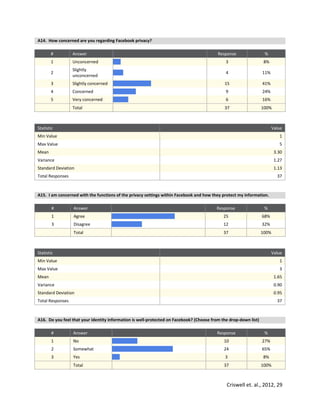
Figure A-15 reveals that a substantial majority of respondents are concerned with the
privacy setting functions within Facebook, as far as how their information is protected. Sixty-
eight percent agreed with the statement, while only 32% disagreed. Nearly an equal amount
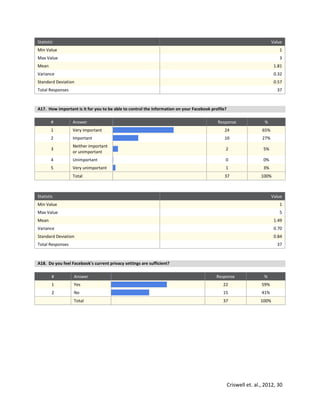
(65%) stated that it was very important for them to be able to control information on their
Facebook profile. Figure A-17 reveals that an additional 27% felt it was important while only
5% felt it was neither important nor unimportant and only 3% said it was very unimportant.
Despite these results, 65% felt their identity information was well-protected on Facebook (Figure
A-16) while 27% answered “no” and 8% said “yes.” And, surprisingly, 59% of respondents
thought their privacy settings were sufficient (Figure A-18) while just 41% said they weren’t
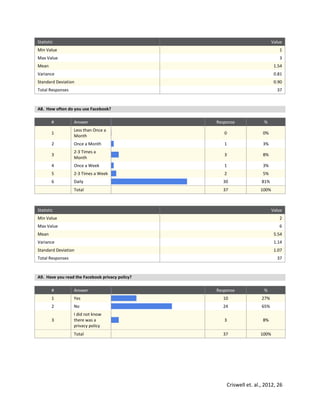
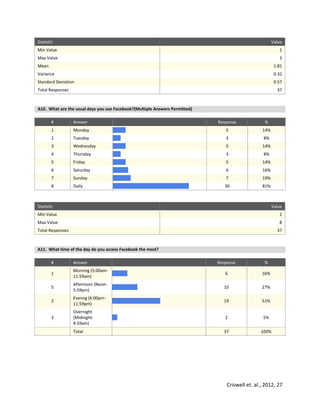
sufficient. Figure A-8 deduced that the majority of respondents (81%) used Facebook on a daily
basis with the next highest result (8%) using Facebook just 2 to 3 times per month. Five percent
said they used the social network 2 to 3 times a week, while “once a month” and “once week”
each received 3% of the respondents’ votes. Despite the high numbers of respondents indicating
a concern about Facebook privacy, Figure A-14 revealed fairly across-the-board answers to the
question of how concerned the respondents were regarding Facebook privacy. A 41% majority
said they were slightly concerned, while 24% were concerned and 16% were very concerned.
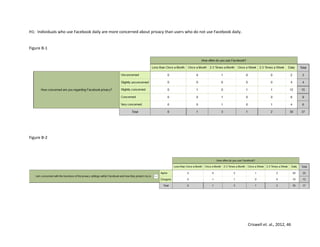
Eleven percent were slightly unconcerned and just 8% were unconcerned. Figure B-1’s cross
tabulation of H1 statistics seemed to fall in line with the other privacy tables. Twelve daily users
said they were slightly concerned with Facebook privacy while 8 daily users were concerned and
4 daily users were very concerned. By contrast, two daily users and one who used Facebook 2-3
times per month were unconcerned, while four daily users were only slightly concerned.
H2: Individuals who use Facebook daily have misrepresented information on their Facebook
profile in order to protect their privacy.
H2 (H2: Individuals who use Facebook daily have misrepresented information on their
Facebook profile in order to protect their privacy) noted that most of Facebook users are
checking their Facebook daily; eighty one percent of the sample size access their Facebook
Criswell et. al., 2012, 15
accounts every day. They use Facebook for different purposes, but most of Facebook users use
Facebook to reflect their inner though. However, the users do not prefer to present their actual
personal information because they are concerned about their privacy. Our preliminary study
found that: Facebook users are willing to misrepresent their personal information in order to
protect their privacy. In fact, eighty one percent of the tested sample agreed to misrepresent their
information on their profile to protect their privacy; forty three percent of them are willing to
misrepresent their personal information, and thirty eight percent are willing to misrepresent their
lifestyle information. Since the personal information and the lifestyle information are the most
connected categories to the privet life of users, they prefer to misrepresent them to get more
security. Therefore, H2 is confirmed. In fact, more than half of the sample size of our
preliminary study misrepresented their information on their profile on order to control their
privacy from disclosure. However, our preliminary study found that most of the Facebook users
(around thirty eight percent of the tested sample) are neither likely nor unlikely to misrepresent
their information in order to protect their privacy. Twenty four percent are likely to misrepresent
their information on their profile and the same percentage for unlikely people. Using the same
tested sample, only four people out of thirty who use Facebook daily are very likely to
misrepresent their information on their profile, seven people are likely, seven people are
unlikely, and twelve people are neither likely nor unlikely to misrepresent their information (See
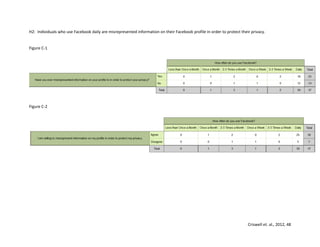
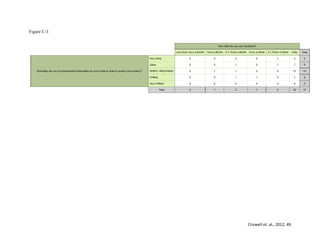
Appendix C for charts). This could be due to suspicion, ignorance, or not considering Facebook
as a trustful source of information. Users seem less concerned about the credibility of
information they disclose on their Facebook profile because they do not want Facebook to be the
only source of their personal information.
H3: Individuals who use Facebook daily are more likely to hide or restrict their profile
information from their co-workers than their family members, in order to protect their privacy.
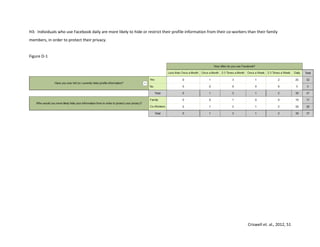
Based on Figure D-1, most of the survey responses yield that individuals have or
currently hide profile information, with 25 responses pertaining to daily users. Figure D-1 also
represents the fact that 20 daily users stated they would rather hide their profile information than
their family members. Ten daily users felt they would rather hide their information from their
family than their co-workers (Figure D-1). While figure D-1 states preliminary information that
Criswell et. al., 2012, 16
supports the hypothesis, additional survey questions were asked in order to test the validity of
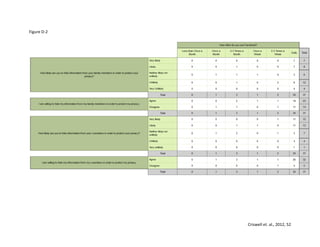
this hypotheses. Figure D-2, question 1, gives daily responses which are slightly close in
likelihood of hiding information from family members. Daily users who were likely (including
very-likely) to hide information from their family members were populated at 14, with users who
were unlikely was one less; with the remaining responses in the middle. A majority of responses
yielded that individuals were willing to hide their information from their family members, with a
higher response rate with daily users (Figure D-2, question 2). Users were also willing to hide
information from their coworkers, similar to family members. While 19 individuals felt they
would hide their information from family members, 26 users felt they would be more likely to
hide their information from family members (Figure D-1, questions 2 & 4). Only four daily
users felt they would not hide their information from their coworkers, as compared to 11 daily
users with family members. The scale of likelihood pertaining to individuals hiding information
from their coworkers was vastly different in numbers versus family members. Users, especially
daily, felt they would be more likely to hide information from their coworkers in order to protect
their privacy (Figure D-3, question 3).
Discussion
As stated in H1 (H1: Individuals who use Facebook daily are more concerned about
privacy than users who do not use Facebook daily), we found that the majority of daily users
were indeed at least slightly concerned, concerned, or very concerned about their personal
information remaining private on Facebook.
H2 (H2: Individuals who use Facebook daily have misrepresented information on their
Facebook profile in order to protect their privacy) noted that while the findings yielded that users
were willing to misrepresent their information, the likelihood of doing so was minimal.
With the thoughts of privacy concern, hidden information, and misrepresented information H3
(H3: Individuals who use Facebook daily are more likely to hide or restrict their profile
information from their co-workers than their family members, in order to protect their privacy)
examines how users protect or disclosure specific information to specific individuals or groups.
Our preliminary findings found that users appeared to be more likely to hide information from
their coworkers than their family members (See Appendix D for charts). As stated with the
Criswell et. al., 2012, 17
CMC theory, users keep boundaries around information (Petronio, 2002a). It is likely that these
boundaries are not as permeable with coworkers as families. This could be due to distrust,
deception, or boundary turbulence. Individuals seem less concerned about what information they
disclose to family members which could be because family members already “know” this
information or is within the trust boundary.
While these findings are preliminary, further study is desired in order find a more broad
response population, as while the sample was a random sample; the authors only had a limited
amount of time to distribute this survey to family members and friends as IRB approval was
being sought prior to survey distribution.
Criswell et. al., 2012, 18
References
Katz vs. United States. (1967, 12 18). Retrieved 10 1, 2011, from Justia.com US Supreme Court
Center: http://supreme.justia.com/us/389/347/case.html
Dictionary. (2012). Retrieved 10 1, 2011, from Dictionary.com:
http://dictionary.reference.com/browse/Deception
Acar, A. (2008). Antecedents and Consequences of online social networking behavior: The case
of Facebook.Journal of Website Promotion, 62-82.
Alhabash, S., Littau, J., Wise, K., Eckler, P., & Kononova, A. (2009). The "Face" of Facebook:
Emotional responses During Social Networking. pp. 1-29.
Baym, N. K. (2010). Personal connections in the digital age: Digital media and society series.
Malden: Polity.
Bosch, T. (2009, 11). Using online social networking for teaching and learning: Facebook use at
the University of Cape Town. South African Journal for Communication Theory and
Research, 35(2), 185-200.
Boyd, D. M., & Ellison, N. B. (2008). Social Network Sites: Definition, History, and
Scholarship. Journal of Computer Mediated Communication, 210-230.
Boyd, D., & Hargittai, E. (2010, 82). Facebook Privacy Settings: Who Cares? First Monday, 15,
24.
Burns, M., Bruce, C., & Friedman, B. (2011). Transforming Enterprise Communications
Through the Blending of Social Networking and Unified Communications. Bell Labs
Technical Journal, 19-34.
Childers, T. (2011, May/June). From Social Networking to Academic Networking- A paradigm
shift.Internet@Schools, 18(3), 8-11.
Coyle, C., & Vaughn, H. (2008). Social Networking: Communication--Revolution or
Evolution. Bell Labs Technical Journal, pp. 13-18.
DePaulo, B.M., Kashy, D., Kirkendol, S.E., Wyer, M.M., & Epstein, J.A. (1996). Lying in
everyday life. Journal of Personality and Social Psychology, 70(5), 979–995.
Frey, L. (2003). Group Communication in Context: Studies in Bona Fide Groups. Mahwah, NJ:
Lawrence Erlbaum Associates.
Goffman E (1959). The Presentation of Self in Everyday Life. New York: Anchor
Guillory, J., & Hancock, J. (2009). Online Social Networkings as a Constraint to Deception in
Online Resumes. International Communication Association.
Hansen, M. J., Childress, J. E., & Trujillo, D. J. (2010, 6 1). Exploring the effects on Social
Networking on Students' Perceptions of Social Connectedness, Adjustment, Academic
Engagement, and Institutional Commitment. Chicago, Illinois, USA. Retrieved 10 1,
2011.
Hopper, R., and Bell, R.A. (1984). Broadening the deception construct. Quarterly Journal of
Speech, 70, 288-300.
Criswell et. al., 2012, 19
Laursen, L. (2009). Fake Facebook pages spin web of deceit. Retrieved November 29, 2011,
from http://lib-proxy.purduecal.edu:2193/news/2009/090423/full/news.2009.398.html.
O’Hair, H. D., & Cody, M.J. (1994). Deception. In W. Cupach & B. Spitzberg (Eds), The dark
side of interpersonal communication. Hillsdale, NJ: Lawrence Erlbaum.
Petronio, S. (1991). Communication privacy management: A theoretical model of managing
disclosure of private information between marital couples. Communication Theory, 1,
311-335.
Petronio, S. (2000a). The boundaries of privacy: Praxis of everyday life. In S. Petronio
(Ed.), Balancing the secrets of private disclosures (37-50). Mahwah: NJ: Lawrence &
Erlbaum Associates.
Petronio, S. (2000b). The reluctant confidant: Problems of hearing private disclosures. In A. C.
Richards & T. Schumrum (Eds.), Invitations to dialogue: The legacy of Sidney
Jourard (113-132). Dubuque, IA: Kendall/Hunt.
Petronio, S. (2002). The boundaries of privacy: Dialectics of disclosure. Albany: State
University of New York Press.
Petronio, S. (2007). Translational research endeavors and the practices of communication
privacy management. Journal of Applied Communication Research, 35, 218-222.
Petronio, S., Ellemers, N., Giles, H., & Gallois, C. (1998). (Mis)communicating across
boundaries: Interpersonal and intergroup consideration. Communication Research, 25,
571-595.
Petronio, S., Jones, S., & Morr, M. (2003). Family privacy dilemmas: Managing communication
boundaries within family groups. In L. R. Frey (Ed.) , Group communication in context:
Studies of bona fide groups (2nd ed.) (pp. 23-55). Mahwah, NJ US: Lawrence Erlbaum
Associates Publishers.
Petronio, S., Martin, J., & Littlefield, R. (1984). Prerequisite conditions for self-disclosing: A
gender issue.Communication Monographs, 51, 268-273.
Petronio, S., & Reierson, J. (2009). Regulating the Privacy of Confidentiality: Grasping the
Complexities through Communication Privacy Management Theory. Uncertainty,
Information Management, and Disclosure Decisions: Theories and Applications. 365–
383.
Petronio, S., Sargent, J., Andea, L., Reganis, P., & Cichocki, D. (2004). Family and friends as
health care advocates: Dilemmas of confidentiality and privacy. Journal of social and
personal relationships, 21, 33-52.
Rice, R. E., & Love, G. (1987). Electronic Emotion: Socioemotional Content in a Computer-
Mediated Communication Network. Communication Research, 85-108.
Ryan, S. D., Magro, M. J., & Sharp, J. H. (2011). Exploring Educational and Cultural Adaptation
through Social Networking Sites. Journal of Information Technology Education, IIP 1-
16.
Semitsu, J. P. (2011). From Facebook to Mug Shot: How the Dearth of Social Networking
Privacy Rights Revolutionized Online Government Surveillance. Pace Law Review,
31(1), 291-381.
Skiba, D. J. (2007). Poke me. Where's your face in space. Nursing education perspective, 4(1),
214-216.
Criswell et. al., 2012, 20
Spitzberg, B., & Cupach, W. R. (2003). What mad pursuit? Obsessive relational intrusion and
stalking related phenomena.Aggression and violent behaviour, 8(1), 354-375.
Thorson, A. R. (2009). Adult children experiences with their parents infidelity: Communication
protection and access rules in the absence of divorce. Communication Studies, 60(1), 32-
48.
Tidwell, L., & Walther, J. (2002). Computer-Mediated Communication Effects on Disclosure,
Impression, and Interpersonal Evaluations: Getting to know one another a bit at a
time. Human Communication Research, 317-348.
Vangelisti, A. L., & Caughlin, J. P. (1997). Revealing family secrets: The influence of topic,
function, and relationships. Journal of social and personal relationships, 14, 679-705.
Vladar, A., & Fife, E. (2010). The growth of mobile social networking in the US. Intermedia, 30-
33.
Walther, J. (1992). Computer-Mediated Interaction. Communication Research, 58-82.
Walther, J. (1992). Interpersonal Effects in Computer Mediated Communication: A Rational
Perspective.Communication Research, 52-90.
Walther, J. (2005). Let me count the ways: The interchange of verbal and nonverbal cues in
computer mediated and face-to-face affinity. Journal of language and social psychology,
36-65.
Walther, J. (2006). Selective self-presentation in computer mediated communication:
Hyperpersonal dimensions of technology, language, and cognition. Science Direct, 2359-
2557.
Whitty M (2008). Revealing the ‘Real’ me, searching for the ‘Actual’ you: Presentations of self
on an internet dating site. Computers in Human Behavior 24(4): 1707–1723.
Willmot, W. W. (1995). Relational communication. NEW YORK: McGraw-Hill.
Wilson, J. (2009). Social Networking: The Business Case. IT Internet, 54-56.
Youngquist, J. (2010). The Walker family spy ring: Espionage and the communication privacy
management theory. Ohio Communication Journal, 48, 77-96.
Criswell et. al., 2012, 21
Appendices
Criswell et. al., 2012, 22
Appendix A
Survey Responses
Criswell et. al., 2012, 23
Initial Report
Last Modified: 11/19/2012
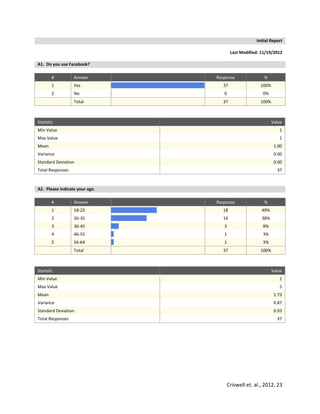
A1. Do you use Facebook?
# Answer Response %
1 Yes 37 100%
2 No 0 0%
Total 37 100%
Statistic Value
Min Value 1
Max Value 1
Mean 1.00
Variance 0.00
Standard Deviation 0.00
Total Responses 37
A2. Please indicate your age.
# Answer Response %
1 18-25 18 49%
2 26-35 14 38%
3 36-45 3 8%
4 46-55 1 3%
5 56-64 1 3%
Total 37 100%
Statistic Value
Min Value 1
Max Value 5
Mean 1.73
Variance 0.87
Standard Deviation 0.93
Total Responses 37
Criswell et. al., 2012, 24
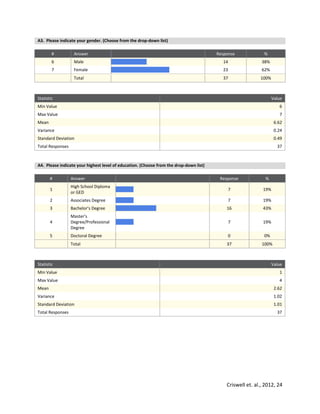
A3. Please indicate your gender. (Choose from the drop-down list)
# Answer Response %
6 Male 14 38%
7 Female 23 62%
Total 37 100%
Statistic Value
Min Value 6
Max Value 7
Mean 6.62
Variance 0.24
Standard Deviation 0.49
Total Responses 37
A4. Please indicate your highest level of education. (Choose from the drop-down list)
# Answer Response %
1
High School Diploma
or GED
7 19%
2 Associates Degree 7 19%
3 Bachelor's Degree 16 43%
4
Master's
Degree/Professional
Degree
7 19%
5 Doctoral Degree 0 0%
Total 37 100%
Statistic Value
Min Value 1
Max Value 4
Mean 2.62
Variance 1.02
Standard Deviation 1.01
Total Responses 37
Criswell et. al., 2012, 25
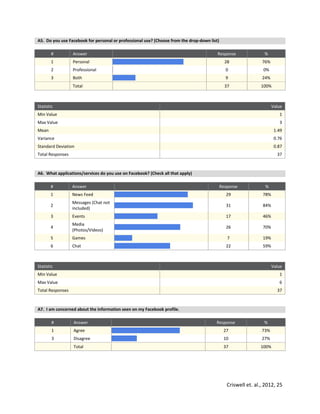
A5. Do you use Facebook for personal or professional use? (Choose from the drop-down list)
# Answer Response %
1 Personal 28 76%
2 Professional 0 0%
3 Both 9 24%
Total 37 100%
Statistic Value
Min Value 1
Max Value 3
Mean 1.49
Variance 0.76
Standard Deviation 0.87
Total Responses 37
A6. What applications/services do you use on Facebook? (Check all that apply)
# Answer Response %
1 News Feed 29 78%
2
Messages (Chat not
included)
31 84%
3 Events 17 46%
4
Media
(Photos/Videos)
26 70%
5 Games 7 19%
6 Chat 22 59%
Statistic Value
Min Value 1
Max Value 6
Total Responses 37
A7. I am concerned about the information seen on my Facebook profile.
# Answer Response %
1 Agree 27 73%
3 Disagree 10 27%
Total 37 100%
Criswell et. al., 2012, 26
Statistic Value
Min Value 1
Max Value 3
Mean 1.54
Variance 0.81
Standard Deviation 0.90
Total Responses 37
A8. How often do you use Facebook?
# Answer Response %
1
Less than Once a
Month
0 0%
2 Once a Month 1 3%
3
2-3 Times a
Month
3 8%
4 Once a Week 1 3%
5 2-3 Times a Week 2 5%
6 Daily 30 81%
Total 37 100%
Statistic Value
Min Value 2
Max Value 6
Mean 5.54
Variance 1.14
Standard Deviation 1.07
Total Responses 37
A9. Have you read the Facebook privacy policy?
# Answer Response %
1 Yes 10 27%
2 No 24 65%
3
I did not know
there was a
privacy policy
3 8%
Total 37 100%
Criswell et. al., 2012, 27
Statistic Value
Min Value 1
Max Value 3
Mean 1.81
Variance 0.32
Standard Deviation 0.57
Total Responses 37
A10. What are the usual days you use Facebook?(Multiple Answers Permitted)
# Answer Response %
1 Monday 5 14%
2 Tuesday 3 8%
3 Wednesday 5 14%
4 Thursday 3 8%
5 Friday 5 14%
6 Saturday 6 16%
7 Sunday 7 19%
8 Daily 30 81%
Statistic Value
Min Value 1
Max Value 8
Total Responses 37
A11. What time of the day do you access Facebook the most?
# Answer Response %
1
Morning (5:00am-
11:59am)
6 16%
5
Afternoon (Noon-
5:59pm)
10 27%
2
Evenng (6:00pm-
11:59pm)
19 51%
3
Overnight
(Midnight-
4:59am)
2 5%
Total 37 100%
Criswell et. al., 2012, 28
Statistic Value
Min Value 1
Max Value 5
Mean 2.70
Variance 2.21
Standard Deviation 1.49
Total Responses 37
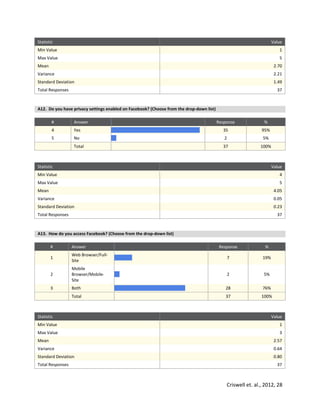
A12. Do you have privacy settings enabled on Facebook? (Choose from the drop-down list)
# Answer Response %
4 Yes 35 95%
5 No 2 5%
Total 37 100%
Statistic Value
Min Value 4
Max Value 5
Mean 4.05
Variance 0.05
Standard Deviation 0.23
Total Responses 37
A13. How do you access Facebook? (Choose from the drop-down list)
# Answer Response %
1
Web Browser/Full-
Site
7 19%
2
Mobile
Browser/Mobile-
Site
2 5%
3 Both 28 76%
Total 37 100%
Statistic Value
Min Value 1
Max Value 3
Mean 2.57
Variance 0.64
Standard Deviation 0.80
Total Responses 37
Criswell et. al., 2012, 29
A14. How concerned are you regarding Facebook privacy?
# Answer Response %
1 Unconcerned 3 8%
2
Slightly
unconcerned
4 11%
3 Slightly concerned 15 41%
4 Concerned 9 24%
5 Very concerned 6 16%
Total 37 100%
Statistic Value
Min Value 1
Max Value 5
Mean 3.30
Variance 1.27
Standard Deviation 1.13
Total Responses 37
A15. I am concerned with the functions of the privacy settings within Facebook and how they protect my information.
# Answer Response %
1 Agree 25 68%
3 Disagree 12 32%
Total 37 100%
Statistic Value
Min Value 1
Max Value 3
Mean 1.65
Variance 0.90
Standard Deviation 0.95
Total Responses 37
A16. Do you feel that your identity information is well-protected on Facebook? (Choose from the drop-down list)
# Answer Response %
1 No 10 27%
2 Somewhat 24 65%
3 Yes 3 8%
Total 37 100%
Criswell et. al., 2012, 30
Statistic Value
Min Value 1
Max Value 3
Mean 1.81
Variance 0.32
Standard Deviation 0.57
Total Responses 37
A17. How important is it for you to be able to control the information on your Facebook profile?
# Answer Response %
1 Very important 24 65%
2 Important 10 27%
3
Neither important
or unimportant
2 5%
4 Unimportant 0 0%
5 Very unimportant 1 3%
Total 37 100%
Statistic Value
Min Value 1
Max Value 5
Mean 1.49
Variance 0.70
Standard Deviation 0.84
Total Responses 37
A18. Do you feel Facebook's current privacy settings are sufficient?
# Answer Response %
1 Yes 22 59%
2 No 15 41%
Total 37 100%
Criswell et. al., 2012, 31
Statistic Value
Min Value 1
Max Value 2
Mean 1.41
Variance 0.25
Standard Deviation 0.50
Total Responses 37
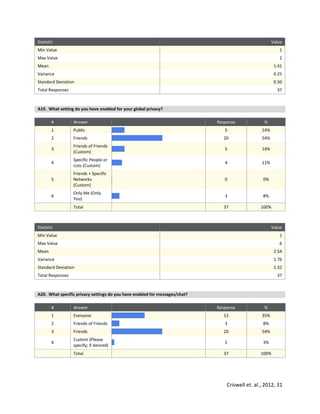
A19. What setting do you have enabled for your global privacy?
# Answer Response %
1 Public 5 14%
2 Friends 20 54%
3
Friends of Friends
(Custom)
5 14%
4
Specific People or
Lists (Custom)
4 11%
5
Friends + Specific
Networks
(Custom)
0 0%
6
Only Me (Only
You)
3 8%
Total 37 100%
Statistic Value
Min Value 1
Max Value 6
Mean 2.54
Variance 1.76
Standard Deviation 1.32
Total Responses 37
A20. What specific privacy settings do you have enabled for messages/chat?
# Answer Response %
1 Everyone 13 35%
2 Friends of Friends 3 8%
3 Friends 20 54%
4
Custom (Please
specify; if desired)
1 3%
Total 37 100%
Criswell et. al., 2012, 32
Custom (Please specify; if desired)
Statistic Value
Min Value 1
Max Value 4
Mean 2.24
Variance 0.97
Standard Deviation 0.98
Total Responses 37
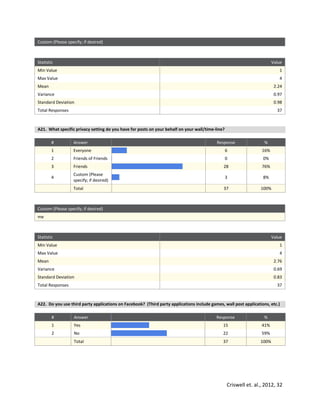
A21. What specific privacy setting do you have for posts on your behalf on your wall/time-line?
# Answer Response %
1 Everyone 6 16%
2 Friends of Friends 0 0%
3 Friends 28 76%
4
Custom (Please
specify; if desired)
3 8%
Total 37 100%
Custom (Please specify; if desired)
me
Statistic Value
Min Value 1
Max Value 4
Mean 2.76
Variance 0.69
Standard Deviation 0.83
Total Responses 37
A22. Do you use third party applications on Facebook? (Third party applications include games, wall post applications, etc.)
# Answer Response %
1 Yes 15 41%
2 No 22 59%
Total 37 100%
Criswell et. al., 2012, 33
Statistic Value
Min Value 1
Max Value 2
Mean 1.59
Variance 0.25
Standard Deviation 0.50
Total Responses 37
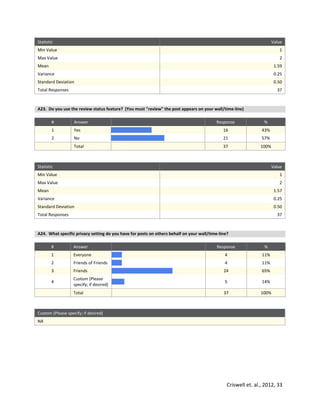
A23. Do you use the review status feature? (You must "review" the post appears on your wall/time-line)
# Answer Response %
1 Yes 16 43%
2 No 21 57%
Total 37 100%
Statistic Value
Min Value 1
Max Value 2
Mean 1.57
Variance 0.25
Standard Deviation 0.50
Total Responses 37
A24. What specific privacy setting do you have for posts on others behalf on your wall/time-line?
# Answer Response %
1 Everyone 4 11%
2 Friends of Friends 4 11%
3 Friends 24 65%
4
Custom (Please
specify; if desired)
5 14%
Total 37 100%
Custom (Please specify; if desired)
NA
Criswell et. al., 2012, 34
Statistic Value
Min Value 1
Max Value 4
Mean 2.81
Variance 0.66
Standard Deviation 0.81
Total Responses 37
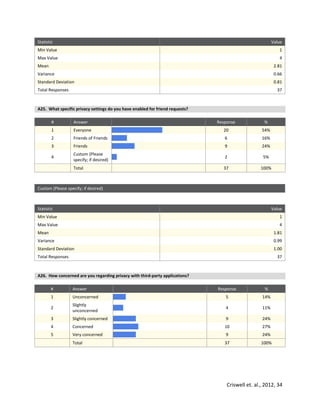
A25. What specific privacy settings do you have enabled for friend requests?
# Answer Response %
1 Everyone 20 54%
2 Friends of Friends 6 16%
3 Friends 9 24%
4
Custom (Please
specify; if desired)
2 5%
Total 37 100%
Custom (Please specify; if desired)
Statistic Value
Min Value 1
Max Value 4
Mean 1.81
Variance 0.99
Standard Deviation 1.00
Total Responses 37
A26. How concerned are you regarding privacy with third-party applications?
# Answer Response %
1 Unconcerned 5 14%
2
Slightly
unconcerned
4 11%
3 Slightly concerned 9 24%
4 Concerned 10 27%
5 Very concerned 9 24%
Total 37 100%
Criswell et. al., 2012, 35
Statistic Value
Min Value 1
Max Value 5
Mean 3.38
Variance 1.80
Standard Deviation 1.34
Total Responses 37
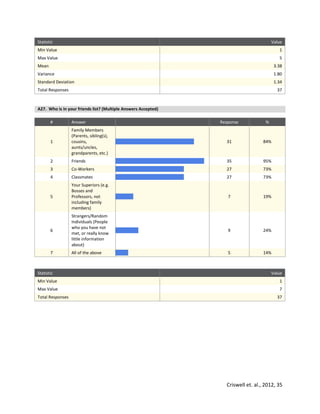
A27. Who is in your friends list? (Multiple Answers Accepted)
# Answer Response %
1
Family Members
(Parents, sibling(s),
cousins,
aunts/uncles,
grandparents, etc.)
31 84%
2 Friends 35 95%
3 Co-Workers 27 73%
4 Classmates 27 73%
5
Your Superiors (e.g.
Bosses and
Professors, not
including family
members)
7 19%
6
Strangers/Random
Individuals (People
who you have not
met, or really know
little information
about)
9 24%
7 All of the above 5 14%
Statistic Value
Min Value 1
Max Value 7
Total Responses 37
Criswell et. al., 2012, 36
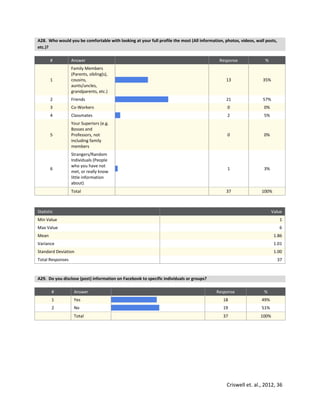
A28. Who would you be comfortable with looking at your full profile the most (All information, photos, videos, wall posts,
etc.)?
# Answer Response %
1
Family Members
(Parents, sibling(s),
cousins,
aunts/uncles,
grandparents, etc.)
13 35%
2 Friends 21 57%
3 Co-Workers 0 0%
4 Classmates 2 5%
5
Your Superiors (e.g.
Bosses and
Professors, not
including family
members
0 0%
6
Strangers/Random
Individuals (People
who you have not
met, or really know
little information
about)
1 3%
Total 37 100%
Statistic Value
Min Value 1
Max Value 6
Mean 1.86
Variance 1.01
Standard Deviation 1.00
Total Responses 37
A29. Do you disclose (post) information on Facebook to specific individuals or groups?
# Answer Response %
1 Yes 18 49%
2 No 19 51%
Total 37 100%
Criswell et. al., 2012, 37
Statistic Value
Min Value 1
Max Value 2
Mean 1.51
Variance 0.26
Standard Deviation 0.51
Total Responses 37
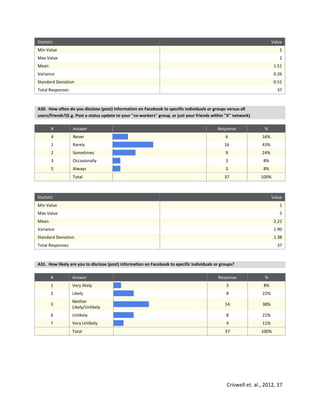
A30. How often do you disclose (post) information on Facebook to specific individuals or groups versus all
users/friends?(E.g. Post a status update to your "co-workers" group, or just your friends within "X'' network)
# Answer Response %
4 Never 6 16%
1 Rarely 16 43%
2 Sometimes 9 24%
3 Occasionally 3 8%
5 Always 3 8%
Total 37 100%
Statistic Value
Min Value 1
Max Value 5
Mean 2.22
Variance 1.90
Standard Deviation 1.38
Total Responses 37
A31. How likely are you to disclose (post) information on Facebook to specific individuals or groups?
# Answer Response %
1 Very likely 3 8%
2 Likely 8 22%
3
Neither
Likely/Unlikely
14 38%
6 Unlikely 8 22%
7 Very Unlikely 4 11%
Total 37 100%
Criswell et. al., 2012, 38
Statistic Value
Min Value 1
Max Value 7
Mean 3.70
Variance 3.83
Standard Deviation 1.96
Total Responses 37
A32. Have you ever misrepresented information on your profile to in order to protect your privacy?
# Answer Response %
1 Yes 23 62%
2 No 14 38%
Total 37 100%
Statistic Value
Min Value 1
Max Value 2
Mean 1.38
Variance 0.24
Standard Deviation 0.49
Total Responses 37
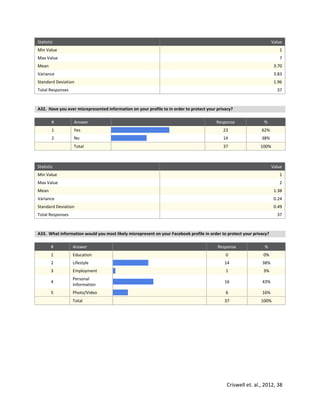
A33. What information would you most likely misrepresent on your Facebook profile in order to protect your privacy?
# Answer Response %
1 Education 0 0%
2 Lifestyle 14 38%
3 Employment 1 3%
4
Personal
Information
16 43%
5 Photo/Video 6 16%
Total 37 100%
Criswell et. al., 2012, 39
Statistic Value
Min Value 2
Max Value 5
Mean 3.38
Variance 1.35
Standard Deviation 1.16
Total Responses 37
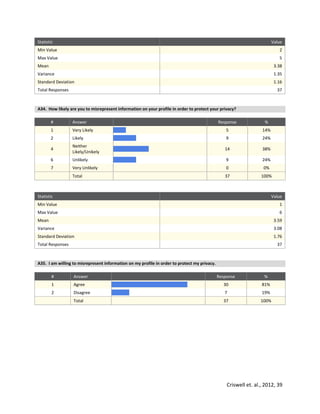
A34. How likely are you to misrepresent information on your profile in order to protect your privacy?
# Answer Response %
1 Very Likely 5 14%
2 Likely 9 24%
4
Neither
Likely/Unikely
14 38%
6 Unlikely 9 24%
7 Very Unlikely 0 0%
Total 37 100%
Statistic Value
Min Value 1
Max Value 6
Mean 3.59
Variance 3.08
Standard Deviation 1.76
Total Responses 37
A35. I am willing to misrepresent information on my profile in order to protect my privacy.
# Answer Response %
1 Agree 30 81%
2 Disagree 7 19%
Total 37 100%
Criswell et. al., 2012, 40
Statistic Value
Min Value 1
Max Value 2
Mean 1.19
Variance 0.16
Standard Deviation 0.40
Total Responses 37
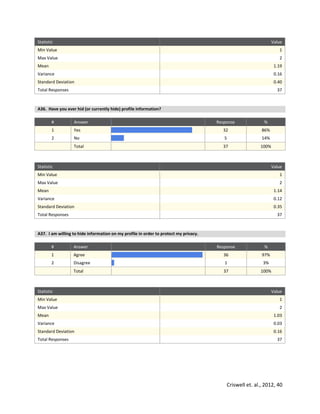
A36. Have you ever hid (or currently hide) profile information?
# Answer Response %
1 Yes 32 86%
2 No 5 14%
Total 37 100%
Statistic Value
Min Value 1
Max Value 2
Mean 1.14
Variance 0.12
Standard Deviation 0.35
Total Responses 37
A37. I am willing to hide information on my profile in order to protect my privacy.
# Answer Response %
1 Agree 36 97%
2 Disagree 1 3%
Total 37 100%
Statistic Value
Min Value 1
Max Value 2
Mean 1.03
Variance 0.03
Standard Deviation 0.16
Total Responses 37
Criswell et. al., 2012, 41
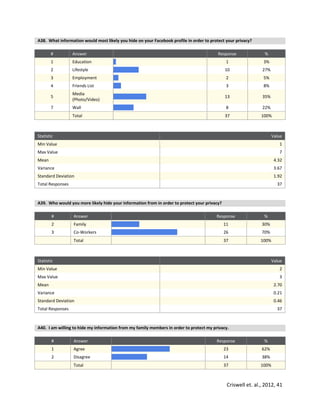
A38. What information would most likely you hide on your Facebook profile in order to protect your privacy?
# Answer Response %
1 Education 1 3%
2 Lifestyle 10 27%
3 Employment 2 5%
4 Friends List 3 8%
5
Media
(Photo/Video)
13 35%
7 Wall 8 22%
Total 37 100%
Statistic Value
Min Value 1
Max Value 7
Mean 4.32
Variance 3.67
Standard Deviation 1.92
Total Responses 37
A39. Who would you more likely hide your information from in order to protect your privacy?
# Answer Response %
2 Family 11 30%
3 Co-Workers 26 70%
Total 37 100%
Statistic Value
Min Value 2
Max Value 3
Mean 2.70
Variance 0.21
Standard Deviation 0.46
Total Responses 37
A40. I am willing to hide my information from my family members in order to protect my privacy.
# Answer Response %
1 Agree 23 62%
2 Disagree 14 38%
Total 37 100%
Criswell et. al., 2012, 42
Statistic Value
Min Value 1
Max Value 2
Mean 1.38
Variance 0.24
Standard Deviation 0.49
Total Responses 37
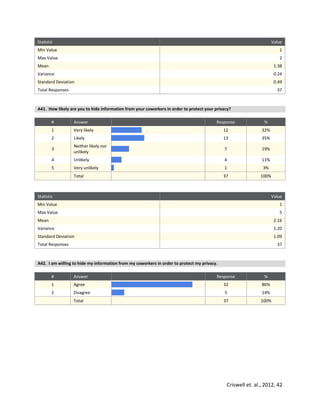
A41. How likely are you to hide information from your coworkers in order to protect your privacy?
# Answer Response %
1 Very likely 12 32%
2 Likely 13 35%
3
Neither likely nor
unlikely
7 19%
4 Unlikely 4 11%
5 Very unlikely 1 3%
Total 37 100%
Statistic Value
Min Value 1
Max Value 5
Mean 2.16
Variance 1.20
Standard Deviation 1.09
Total Responses 37
A42. I am willing to hide my information from my coworkers in order to protect my privacy.
# Answer Response %
1 Agree 32 86%
2 Disagree 5 14%
Total 37 100%
Criswell et. al., 2012, 43
Statistic Value
Min Value 1
Max Value 2
Mean 1.14
Variance 0.12
Standard Deviation 0.35
Total Responses 37
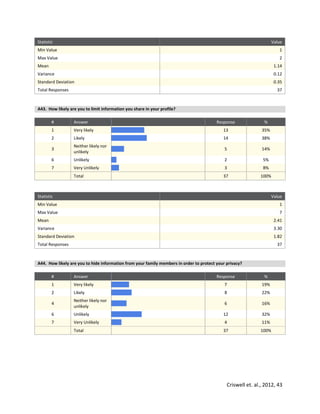
A43. How likely are you to limit information you share in your profile?
# Answer Response %
1 Very likely 13 35%
2 Likely 14 38%
3
Neither likely nor
unlikely
5 14%
6 Unlikely 2 5%
7 Very Unlikely 3 8%
Total 37 100%
Statistic Value
Min Value 1
Max Value 7
Mean 2.41
Variance 3.30
Standard Deviation 1.82
Total Responses 37
A44. How likely are you to hide information from your family members in order to protect your privacy?
# Answer Response %
1 Very likely 7 19%
2 Likely 8 22%
4
Neither likely nor
unlikely
6 16%
6 Unlikely 12 32%
7 Very Unlikely 4 11%
Total 37 100%
Criswell et. al., 2012, 44
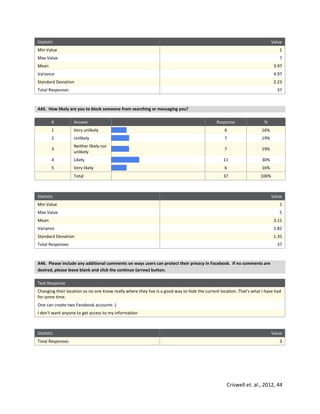
Statistic Value
Min Value 1
Max Value 7
Mean 3.97
Variance 4.97
Standard Deviation 2.23
Total Responses 37
A45. How likely are you to block someone from searching or messaging you?
# Answer Response %
1 Very unlikely 6 16%
2 Unlikely 7 19%
3
Neither likely nor
unlikely
7 19%
4 Likely 11 30%
5 Very likely 6 16%
Total 37 100%
Statistic Value
Min Value 1
Max Value 5
Mean 3.11
Variance 1.82
Standard Deviation 1.35
Total Responses 37
A46. Please include any additional comments on ways users can protect their privacy in Facebook. If no comments are
desired, please leave blank and click the continue (arrow) button.
Text Response
Changing their location so no one know really where they live is a good way to hide the current location. That's what I have had
for some time.
One can create two Facebook accounts :)
I don't want anyone to get access to my information
Statistic Value
Total Responses 3
Criswell et. al., 2012, 45
Appendix B
H1 Cross-Tabulation Report(s)
Criswell et. al., 2012, 46
H1: Individuals who use Facebook daily are more concerned about privacy than users who do not use Facebook daily.
Figure B-1
Figure B-2
Criswell et. al., 2012, 47
Appendix C
H2 Cross-Tabulation Report(s)
Criswell et. al., 2012, 48
H2: Individuals who use Facebook daily are misrepresented information on their Facebook profile in order to protect their privacy.
Figure C-1
Figure C-2
Criswell et. al., 2012, 49
Figure C-3
Criswell et. al., 2012, 50
Appendix D
H3 Cross-Tabulation Report(s)
Criswell et. al., 2012, 51
H3: Individuals who use Facebook daily are more likely to hide or restrict their profile information from their co-workers than their family
members, in order to protect their privacy.
Figure D-1
Criswell et. al., 2012, 52
Figure D-2
Criswell et. al., 2012, 53
Appendix E
General Cross-Tabulation Report(s)
Criswell et. al., 2012, 54
Figure E-1
Figure E-2

Facebook Privacy & Information Disclosure - Research Study

  • 1.
    Running Head: FacebookPrivacy & Information Disclosure Facebook Privacy & Information Disclosure Alex B. Criswell; Graduate Candidate, MA & MS Ed. Ali Aljaziri; Graduate Candidate, MA Donna Rettew; Graduate Candidate, MA Purdue University Calumet Hammond, Indiana
  • 2.
    Abstract This study examinesthe privacy settings on Facebook and explores how users disclose personal information on their Facebook profile in order to protect their privacy. It is based on the Communication Privacy Management (CPM) Theory. The study also provides awareness and an explanation about the secure use of Facebook. A survey and content analysis were used to test the relationship between the perceptions of Facebook privacy and the efforts Facebook users make to stay updated about changes in privacy settings. Introduction The growth of social media has significantly influenced the way the world operates today. Modes of communication between people have become easier, faster, more convenient and more efficient (Skiba, 2007). With the evolution of social networking sites (SNS or SNS’s,) which includes peer sites such as Facebook.com and Myspace.com, dating sites like Match.com, and blog posting sites such as Twitter.com, our communication with other individuals has increased. This paper covers the use of privacy restrictions on Facebook, a well-known social networking site, and how these privacy restrictions relate to the Communication Privacy Management (CPM) theory through the use of computer mediated communication. Social networks and the need to communicate are universal human conditions, according to Coyle and Vaughn (2008). Coyle and Vaughn (2008) feel that a social network is a configuration of people connected to one another through interpersonal means, such as friendships, common interests, or ideas. It is assumed that social networks existed long before the phrase became well-known. Adam Acar (2008) argues that while social networking sites are changing the way people use the internet, he feels that little attention has been focused on how people’s socialization processes, feelings, and communication habits have changed. According to Ryan, Magro, and Sharp (2011); social networking sites can aid adaptation through: • facilitating knowledge exchange, • alleviating apprehension, and
  • 3.
    Criswell et. al.,2012, 1 • enabling socialization and building community (87) The following hypotheses were formulated to aid this study: • H1: Individuals who use Facebook daily are more concerned about privacy than users who do not use Facebook daily. • H2: Individuals who use Facebook daily have misrepresented information on their Facebook profile in order to protect their privacy. • H3: Individuals who use Facebook daily are more likely to hide or restrict their profile information from their co-workers than their family members, in order to protect their privacy. Rationale Our goal of this study is to examine how Facebook users have concern for privacy and whether they hide or misrepresent their information to protect their privacy. As noted by Baym (2010), individuals can become an entirely different person online than who they are face-to- face. In addition, we wish to further analyze how users protect their information based on specific groups named by the authors, while using the Communication Privacy Management (CPM) Theory as a tool to explain how surveyed users protect their information from the specific groups mentioned in this study. Computer Mediated Communication According to Rice and Love (1987), computer mediated communication systems are becoming more involved as organizations implement electronic mail (email), chat clients, bulletin boards, and other systems. It is noted that computer mediated communication transmits less interaction between individuals who are online versus face-to-face interaction (1987). This is also supported by Joseph Walther (1992), who states that extremely low interaction exists in computer mediated communication. Two indicators of behavior, according to Rice and Love (1987) are duration and frequency of messaging in a computer-mediated setting. The authors also state that “sociability” is implying that people who are socioeconomically
  • 4.
    Criswell et. al.,2012, 2 oriented show greater response duration and shorter latency of a verbal response (1987, 88). In addition, they state two general categories of a computer mediated communication which involves the nature and structure of communication. Rice and Love (1987) feel that multiple approaches are needed to analyze the content and structure of computer mediated communication. Rice and Love’s (1987) approaches: 1. Compliment the study of the changing structure with archival measure of content. 2. Conceptualize the network as the co-occurrence of similar words. 3. Directly compare the content of messages that constitute the linkages of the communication network. (87) Verbal questions and self-disclosure are often more common in computer mediated communication. According to Tidwell & Walther (2002), CMC provides sheltering effects not available in face-to-face communication. The authors also feel that the Social Information Processing (SIP) Theory brings forth personal knowledge during computer mediated communication interaction. Participants in computer mediated communication were found to be more task-oriented than individuals in the face-to-face interaction setting (Walther, 1992). Types of conversations between individuals in CMCs include video conferences, email, instant messages, blogs, and wiki updates (Burns, Bruce, & Friedman, 2011). According to Walther (2006), computer mediated communication displays elements of interpersonal communication and allows people to meet and develop relationships based on typed messages as the primary channel of communication. In addition, computer mediated communication can be used for simple information inquiries to establishing a full connection with an individual (2006). Computer mediated communication does have the absence of face to face communication, which is often used by individuals to develop first impressions of others. Aspects such as facial features, gestures, and voice are not prominent in computer mediated communication (Walther, 2006). Walther (2006) also feels computer mediated communication users form impressions from other users based on message contents as receivers. As senders, these users can select how they want to form the image perceived by the receiving user(s). While the advantages of privacy, self-control, and disclosure are evident, the
  • 5.
    Criswell et. al.,2012, 3 disadvantages of computer mediated communication can include that users can exaggerate or lie about their physical attributes, personality, and other aspects that are generally present in face to face communication (Walther, 2006). Computer mediated communication is often used when nonverbal communication and face- to-face communication is not available, and it is often used for task-oriented and interpersonal messages (Walther, 1992). According to Walther (1992), computer mediated communication is “synchronous or asynchronous electronic mail and computer conferencing, by which senders encode in text messages that are relayed from senders’ computers to receivers” (59). Walther (1992) also states the differences between CMC and face-to-face communication eliminate non- verbal cues that are used in face-to-face communication, which can include social context cues. These can also include the individual’s physical environment and nonverbal behaviors that describe the person’s status. It is also noted that computer mediated communication takes longer to process data than face-to-face communication (Walther 1992). Walther (1992) also states that it is sufficient over time, however it is not recommended for immediate messages and interaction. CMC also is known to allow users to disclose more information to others they think might be too over-bearing in a face-to-face communication setting (Walther, 2005). This could be a mistake, however, as many people often disclose too much information in a computer generated setting. Deception & Self-Presentation Along with the evolution of computer mediated communication, comes deception. According to Dictionary.com (2012), “deception” is the act to deceive, or intent to fraud. With the advancing use of social media, deceit is a key issue that has grown tremendously. Lies and deception are part of our everyday lives with people telling typically one to two lies per day (DePaulo, Kashy, Kirkendol,Wyer, & Epstein, 1996). According to O’Hair & Cody (1994), the deceiver who is caught and confronted by the deceived partner frequently also suffers embarrassment, guilt, and loss of credibility.
  • 6.
    Criswell et. al.,2012, 4 People are figuring out ways through which they can cheat people into doing what they want (Laursen, 2009). According to Guillory & Hancock (2009), deception is very common in online environments, especially in social network settings. Individuals will often exaggerate or lie about their personalities, achievements, or life’s goals. Also, deception can vary from blatant lies to indirect actions such as exaggeration and false implication (Hopper & Bell, 1984). This has been extended to deception in online resumes, according to Guillory & Hancock (2009). Moreover, people who created fake information in online communications and tried to deceive others could lose their relationship. According to Whitty (2008) blatant deception in one’s online dating profile can be grounds for terminating a budding relationship. Moreover, Wilmot (1995) argues the deception is always damaging to the other person and to the relationship. O’Hair and Michael Cody (1994) identify six motives or reasons people give for lying to their relationship partners. The three positive motives are egoism, benevolence, and utility, and are labeled positive because they generally have positive consequences for at least one individual and they don’t harm the relationship. Negative motives are exploitation, malevolence, and regress, and are labeled negative because the consequences do include harm to at least one person in the relationship. With self-presentation, the user can construct a message with a virtually unlimited time span, allowing the shaping of the message into the way they desire (Walther, 2006). These messages can also include descriptive words and photographs and includes the quality of the message as well. This message-shaping ability is beneficial so that comments may not be repeated or misinterpreted. Users are also able to utilize the language they wish to speak, which can differ from general to serious conversations. Moreover, self-presentation is the behavior used to display an image of themselves to others in a desired way. According to (Goffman, 1959), self-presentation involves strategically disclosing and/or concealing information in order to portray the self in a desirable way. Many online social networking sites have gained recognition because of their ability of facilitating communication between friends and acquaintances, and the renewal of old friendships and relationships (Baym, 2010). These sites are also appreciated because of the way
  • 7.
    Criswell et. al.,2012, 5 in which they provide information about the activities, opinions, and interests of people’s friends (Skiba, 2007). Communication Privacy Management Theory Communication Privacy Management (CPM) Theory was developed to explain the details of disclosure as information is passed from a secret entity to one that is collectively owned (Petronio, 1991, 2002). Petronio (1991) also argues that individuals handle private information through boundaries and a rules-based system. According to Petronio, this could serve as a positive or negative function involving CPM Theory (2002). Thorson notes that with the use of CPM Theory, individuals must negotiate issues of protection and access when they co- own information (2009). Premises of CPM Theory According to Petronio, Ellemers, Giles, & Gallois (1998) people believe they own their private information and have the right to control the flow of the information to others. Youngquist (2010) notes the ownership of information includes a sense of control over the ownership of that information to others. Petronio, Jones, & Morr (2003) also note that the CPM theory focuses on the need to protect privacy rights and potential vulnerability. Generally, the information is guarded by ownership lines or rules, also known as “boundaries,” within the CPM Theory (Petronio et al., 2003). Boundaries According to Youngquist (2010) the “boundary” metaphor is used to “identify a boundary or border around private information” (Petronio,2000a, 38). A boundary is also known “to make a distinction between the private information they own and information that other people own” (Petronio, et al. 2003). Boundaries can either be individual or shared by multiple individuals (e.g. families) (Youngquist, 2010). Youngquist (2010) notes that individuals who fall within these boundaries, whether individual or shared, feel they own or co-own that information. From the perception
  • 8.
    Criswell et. al.,2012, 6 that individuals own the information, they often create rules to manage the boundaries that have been created (2010). Petronio et al. (2003) notes there are several boundaries around private information: • Personally Private Boundaries • Private Boundaries • Family Group Private Boundaries • Group Private Boundaries • Organizational Private Boundaries Family privacy boundaries are used for self-protection from public scrutiny (Petronio et al., 2003). These boundaries can be used as a safety zone to test the permeability of the family boundaries and for the use of protection of private family information (2003). Petronio et al. (2003) feels there are often several internal boundaries within the family group, such as husband- wife, parent-child, etc., while there is often only one external boundary that includes the whole family. Protection Rules Petronio (2002) states that protection rules are guidelines that individuals or groups of people form in order to keep information from, or to avoid discussing information with, others. This is to regulate linking others into private boundaries and establish rules regulating co-ownership (Petronio et. al, 2003). Rules are often formulated to regulate and maintain privacy needs for family group members to help them understand the limits of information ownership and how it should be controlled (Petronio, 1991, 2000a). An example of a privacy protection rule would be something a husband tells his wife or significant other, but asks not to reveal it to the children, as he is establishing a boundary. Petronio (2002) notes five factors during the development of privacy rules: 1) Rules derive from cultural expectations about privacy, 2) Rules may be different between men and women, 3) Rules are dependent on different individual motivations, 4) Group/Individual making the rules evaluates the level of disclosure, and 5) Context affects the type of privacy rules people develop.
  • 9.
    Criswell et. al.,2012, 7 The management of privacy protection rules is influenced by many things such as culture, gender, and motivation (Petronio, Sargeant, Andea, Reganis, & Cichocki, 2004). Other factors include the context of the information and the associated risk of it (Petronio et al., 2003). Motivations are also known to play a role in protecting information, and are categorized within six functions: 1) bonding, 2) evaluation, 3) maintenance, 4) privacy, 5) defense, and 6) communication (Vangelisti & Caughlin, 1997). Access Rules Much like protection rules, individuals often form privacy access rules (Petronio et. al., 2004). Thorson (2009) notes access rules to be guidelines that individuals or groups of people use in order to determine when it is appropriate for information to be discussed with others. These rules can be dependent on factors such as gender and culture (Petronio, Martin & Littlefield, 1984). Thorson (2009) notes that additional factors involving access rules were: context, age, and physical environment. According to Frey (2003), family members believe they have ownership rights to their information and set their own rules to manage boundary permeability and linkage. Family members also expect a belief of co-ownership of privacy rights and rules. Information Sharing When information is shared with others, whether within a boundary or outside the boundary, these individuals become “shareholders” or co-owners of this information (Youngquist, 2010). Petronio (2007) notes individuals are assumed to understand and abide by the privacy rules around this information. These rules can be altered or changed depending on the shareholder (Youngquist, 2010). Social Networks According to Boyd & Ellison (2008), the first social networking site was launched in 1997. SixDegrees.com allowed users to create profiles and list their friends. It was closed in the year 2000 as it was not able to stay up and running, of which the authors speculate that it was “just ahead of its time.”
  • 10.
    Criswell et. al.,2012, 8 According to Boyd & Ellison (2008), social networking sites are defined as web-based services that allow individuals to: 1) Construct a public or semi-public profile within a bounded system, 2) Articulate a list of other users whom they share a connection with, and 3) View and transverse their list of connections and those made by others within the system (2008, 11). With the evolution of technology, people are able to multi-task while taking care of families or doing homework (Hansen et.al., 2010). The most common types of social networking websites include chat rooms, community information/bulletin boards, online dating sites, and professional development venues (Acar, 2008). These internet communities allow people to connect with individuals for personal or professional reasons that they are not able to do in person. Talking on the phone, texting, and emailing are how most users today are communicating when face to face interaction is not available or desired. People access social media websites from their personal computers, cell phones, and other portable devices which include iPads and Tablets (Burns et. al, 2011). According to Vladar and Fife (2010), frequent users of mobile social networking are more likely to use other types of mobile services, which can include information and entertainment related services. The popularity of social networking sites on personal computers (PC) have increased the popularity with mobile devices. The growth of mobile social networking is likely due to technology – Smartphones and improved interfaces Vladar & Fife, 2010). Users use mobile communication when they do not desire or have access to the use of a PC in order to communicate with other individuals. They often check their social networking site when they have a few minutes to spare. This can include time on work breaks, in between classes, traveling, or a quick relaxation time. According to Vladar & Fife (2010), as of September 2009, 47 percent of online adults used a SNS, which had increased 10 percent from the prior year. Generally, individuals who use social networking sites are of the younger generation. In addition, smartphone usage is highest by 25-49 year olds (2010). According to Vladar & Fife (2010), social networking is often referred to as an alternative way of communicating and connecting with other people. It was found that females were the heavier users of social networks. According to Wilson (2009), social networking sites are now also being used for business purposes such as marketing, recruitment, and research.
  • 11.
    Criswell et. al.,2012, 9 Facebook According to Alhabash et. al. (2009) and based on existing research in social networking, Facebook serves as a need for connectivity and that a great deal of its use could be conceptualized as either social browsing or social searching. Facebook was also noted as the top online photo sharing application with more than 30 million photos shared daily. As of 2011, by personal observation it is noted that Facebook is available in over 70 different languages. Alhabash et. al. (2009) reports social browsing screens can include personal information about friends. The newsfeed section includes headlines concerning recent activities of different friends, including status updates, profile picture changes, photo tags, event postings, and comments. Social browsing is generalized as the selection of general pages, where individuals were not looking at information of a certain individual. These individuals can search a wealth of information that involves more than one person or one type of information. Alhabash et al. (2009) feels that social searching is “more concerned with goal-oriented surveillance, where participants moved from the general content to the pages belonging to a particular person. The authors claim that the difference between social browsing and social searching is that browsing pages are not specific to a single friend of the individual, but a wealth of information pooled about a number of friends (e.g. linkage). Social Networking & Privacy within Education “Social networking is a tool being explored by many institutions as a means of connecting to and communicating with students,” according to authors Michele Hansen, Janice Childress and Daniel Trujillo (2010). These authors studied social networking sites and whether the use of them had significant effects of social connectedness, college adjustment, academic engagement and institutional commitment. While the research yielded positive reactions to feelings of social connectedness for student to student, it displayed negative connections with student to faculty and staff use. According to Childers (2011), faculty and staff feel social networking sites are allowing individuals to become too personal and they fear losing their job due to conflict of interest between a student and an educator.
  • 12.
    Criswell et. al.,2012, 10 In a study with Hansen et al. (2010), students mentioned that they were comfortable with “friending” faculty on Facebook so they would know more about the teacher’s personality. Hansen et al. (2010) stated that students mentioned faculty needed to keep professionalism in mind and that comments and tags are visible to the public and students. Hansen et al. (2010) felt that it was possible for many students to seek this type of online communication as a mechanism for connecting with other students, faculty, advisors, administrators, and staff. According to Tanja Bosch (2009), Facebook and other social networking sites allow high surveillance options, which allow other users to view profiles, posts, photos, and profile data, all of which considered personal information. Colleges and universities have begun screening personal profiles of students to ensure they are not violating any university (Bosch, 2009). Social Networks, Privacy & Regulation Boyd & Hargatti (2010) state that Facebook uses have been criticized by privacy advocates and the news media. A Facebook feature that sparked criticism was the “news feed,” according to Boyd & Hargatti (2010). When a user changed/updated their profile, status, posted a photo, etc., it was posted on the news feed and users felt it was disclosing too much information. Privacy controls can be enabled on most social networking sites where users can restrict specific information to be viewed only by friends or specific individuals. In addition, network administrators can restrict certain information from the public or other users. Social networking sites generally allow users to “friend” each other as well as exchange personal and private messages (Boyd & Ellison, 2008). Boyd & Hargatti (2010) claim this information was never hidden from the public, but the advertisement of the information is what sparked a negative interest. Over the years, Facebook has expanded to third-party applications which began to share some information with other websites and companies without explicit permission. According to Semitsu (2011), 30 billion pieces of content are accessed on Facebook monthly. This includes users from at least 180 different countries. According to Katz vs. United
  • 13.
    Criswell et. al.,2012, 11 States (1967), “What a person knowingly exposes to the public, even in his own home or office, is not a subject of Fourth Amendment protection.” In addition, the author feels that government law does not protect social networking site users from violations of privacy. The governing law is noted to be the Electronic Communications Privacy Act of 1986, according to Semitsu (2011). It does not protect users from censorship to comments posted on their profiles, photos, or blogs which the public can read and scrutinize. Even while using the strictest privacy controls, there is no safeguard for users. These comments have been used to terminate employees from jobs because of negative comments they have posted about their jobs. Semitsu (2011) refers to the Facebook Effect which has been noted as changing the way we communicate with the use of technology. It is much easier to contact individuals with e-mail and instant messages over social networking sites than using postal mail or a telephone. While the Facebook Effect has a positive influence, the author also notes the negative influences of it as well. Semitsu (2011) refers to this negative impact as the “Facebook Defect” which is noted as “the failure of both the government and social networking sites to ensure that certain online communications receive the same probable cause standard set forth in the Fourth Amendment as they would offline.” Many user profiles of people using social networking sites are now available on major search engines like Google (Spitzberg & Cupach, 2003). The users of these sites can therefore be under threat because of the amount of personal information available on the internet. However, this is not very common because of the few instances of stalking in online social networking sites (2003). These sites, however, normally provide an avenue whereby individuals can be able to access information as well as make contact with other individuals. This kind of an action is referred to as obsessive relational intrusion whereby a person may not be willing to communicate with a certain party but the other party communicates anyway. Method This section of the research paper will be seeking to address the design procedures, considerations and the limitation of the research study. It will also give details of population
  • 14.
    Criswell et. al.,2012, 12 collection, and the action of the participants to take part in the study. Then it will describe the process of data collection and analysis. Research design To answer the research question, the researchers designed a study to access awareness of privacy on Facebook. The study uses a survey and content analysis to establish the relationship between the efforts Facebook users make to stay updated on the changing privacy settings and their awareness of current personal privacy settings. The study is non-experimental and is descriptive in nature. The 46-question survey was available on Qualtrics survey system for participants to take part in voluntarily. Population To be able to satisfy the expectations presented by the research question, an appropriate population must be selected. Since this research paper is on Facebook privacy, the target is participants between 18-64 years, since Facebook users are spread across all age groups. The population consisted of the researchers' friends on Facebook and friends of these friends. The overall projected sample size for the study was approximately 100 respondents. Data collection The questions were available online through the Qualtrics survey system. The participants were to answer the questions based on their perceptions on Facebook privacy and whether or not they kept updated with emerging privacy issues. Then, an analysis using several programs was used to determine if there was any relationship between the variables in our study. Procedure
  • 15.
    Criswell et. al.,2012, 13 The research included a number of steps. First was the formulation of the research questions on the Qualtrics and activating the survey. The next step was to distribute the link of the survey and email the participants within Facebook. Every participant received the anonymous link giving each participant a response ID within Qualtrics, which will allow us to track the responses for all respondents, but not disclose their personal information or allow us to contact them. Within Qualtrics, only the IP address and survey time was recorded with the responses to ensure multiple submissions were not disrupting our data. Limitations The research takes into account several limitations facing the study. First, the sample size of the study is very small considering the large number of people who use Facebook in their daily lives, thus, the finding may not be used to make general conclusions about the entire population. Second, Facebook allows people of all ages to have profiles but our study limits the population from the age of 18-64 years. This means the study cannot have responses from the younger population or of individuals of an advanced age. Third, the content analysis depends on the number of people who opted to complete the survey, and since there was a limited amount of responses due to the limited time frame, a full research analysis and time frame was not given. Data analysis Data found in the survey was analyzed using descriptive and inferential statistics. This system allows collaboration with other statistical systems and Microsoft Office. We were able to export the reports from Qualtrics to Word, Excel or Powerpoint, which enables easy presentation of the data. It also allows us to export data to statistical software, like the computer programs SPSS, which enable calculation of means, medians, standard deviations and several other statistical measures which the research used to establish relationship. Analysis
  • 16.
    Criswell et. al.,2012, 14 H1: Individuals who use Facebook daily are more concerned about privacy than users who do not use Facebook daily. Figure A-15 reveals that a substantial majority of respondents are concerned with the privacy setting functions within Facebook, as far as how their information is protected. Sixty- eight percent agreed with the statement, while only 32% disagreed. Nearly an equal amount (65%) stated that it was very important for them to be able to control information on their Facebook profile. Figure A-17 reveals that an additional 27% felt it was important while only 5% felt it was neither important nor unimportant and only 3% said it was very unimportant. Despite these results, 65% felt their identity information was well-protected on Facebook (Figure A-16) while 27% answered “no” and 8% said “yes.” And, surprisingly, 59% of respondents thought their privacy settings were sufficient (Figure A-18) while just 41% said they weren’t sufficient. Figure A-8 deduced that the majority of respondents (81%) used Facebook on a daily basis with the next highest result (8%) using Facebook just 2 to 3 times per month. Five percent said they used the social network 2 to 3 times a week, while “once a month” and “once week” each received 3% of the respondents’ votes. Despite the high numbers of respondents indicating a concern about Facebook privacy, Figure A-14 revealed fairly across-the-board answers to the question of how concerned the respondents were regarding Facebook privacy. A 41% majority said they were slightly concerned, while 24% were concerned and 16% were very concerned. Eleven percent were slightly unconcerned and just 8% were unconcerned. Figure B-1’s cross tabulation of H1 statistics seemed to fall in line with the other privacy tables. Twelve daily users said they were slightly concerned with Facebook privacy while 8 daily users were concerned and 4 daily users were very concerned. By contrast, two daily users and one who used Facebook 2-3 times per month were unconcerned, while four daily users were only slightly concerned. H2: Individuals who use Facebook daily have misrepresented information on their Facebook profile in order to protect their privacy. H2 (H2: Individuals who use Facebook daily have misrepresented information on their Facebook profile in order to protect their privacy) noted that most of Facebook users are checking their Facebook daily; eighty one percent of the sample size access their Facebook
  • 17.
    Criswell et. al.,2012, 15 accounts every day. They use Facebook for different purposes, but most of Facebook users use Facebook to reflect their inner though. However, the users do not prefer to present their actual personal information because they are concerned about their privacy. Our preliminary study found that: Facebook users are willing to misrepresent their personal information in order to protect their privacy. In fact, eighty one percent of the tested sample agreed to misrepresent their information on their profile to protect their privacy; forty three percent of them are willing to misrepresent their personal information, and thirty eight percent are willing to misrepresent their lifestyle information. Since the personal information and the lifestyle information are the most connected categories to the privet life of users, they prefer to misrepresent them to get more security. Therefore, H2 is confirmed. In fact, more than half of the sample size of our preliminary study misrepresented their information on their profile on order to control their privacy from disclosure. However, our preliminary study found that most of the Facebook users (around thirty eight percent of the tested sample) are neither likely nor unlikely to misrepresent their information in order to protect their privacy. Twenty four percent are likely to misrepresent their information on their profile and the same percentage for unlikely people. Using the same tested sample, only four people out of thirty who use Facebook daily are very likely to misrepresent their information on their profile, seven people are likely, seven people are unlikely, and twelve people are neither likely nor unlikely to misrepresent their information (See Appendix C for charts). This could be due to suspicion, ignorance, or not considering Facebook as a trustful source of information. Users seem less concerned about the credibility of information they disclose on their Facebook profile because they do not want Facebook to be the only source of their personal information. H3: Individuals who use Facebook daily are more likely to hide or restrict their profile information from their co-workers than their family members, in order to protect their privacy. Based on Figure D-1, most of the survey responses yield that individuals have or currently hide profile information, with 25 responses pertaining to daily users. Figure D-1 also represents the fact that 20 daily users stated they would rather hide their profile information than their family members. Ten daily users felt they would rather hide their information from their family than their co-workers (Figure D-1). While figure D-1 states preliminary information that
  • 18.
    Criswell et. al.,2012, 16 supports the hypothesis, additional survey questions were asked in order to test the validity of this hypotheses. Figure D-2, question 1, gives daily responses which are slightly close in likelihood of hiding information from family members. Daily users who were likely (including very-likely) to hide information from their family members were populated at 14, with users who were unlikely was one less; with the remaining responses in the middle. A majority of responses yielded that individuals were willing to hide their information from their family members, with a higher response rate with daily users (Figure D-2, question 2). Users were also willing to hide information from their coworkers, similar to family members. While 19 individuals felt they would hide their information from family members, 26 users felt they would be more likely to hide their information from family members (Figure D-1, questions 2 & 4). Only four daily users felt they would not hide their information from their coworkers, as compared to 11 daily users with family members. The scale of likelihood pertaining to individuals hiding information from their coworkers was vastly different in numbers versus family members. Users, especially daily, felt they would be more likely to hide information from their coworkers in order to protect their privacy (Figure D-3, question 3). Discussion As stated in H1 (H1: Individuals who use Facebook daily are more concerned about privacy than users who do not use Facebook daily), we found that the majority of daily users were indeed at least slightly concerned, concerned, or very concerned about their personal information remaining private on Facebook. H2 (H2: Individuals who use Facebook daily have misrepresented information on their Facebook profile in order to protect their privacy) noted that while the findings yielded that users were willing to misrepresent their information, the likelihood of doing so was minimal. With the thoughts of privacy concern, hidden information, and misrepresented information H3 (H3: Individuals who use Facebook daily are more likely to hide or restrict their profile information from their co-workers than their family members, in order to protect their privacy) examines how users protect or disclosure specific information to specific individuals or groups. Our preliminary findings found that users appeared to be more likely to hide information from their coworkers than their family members (See Appendix D for charts). As stated with the
  • 19.
    Criswell et. al.,2012, 17 CMC theory, users keep boundaries around information (Petronio, 2002a). It is likely that these boundaries are not as permeable with coworkers as families. This could be due to distrust, deception, or boundary turbulence. Individuals seem less concerned about what information they disclose to family members which could be because family members already “know” this information or is within the trust boundary. While these findings are preliminary, further study is desired in order find a more broad response population, as while the sample was a random sample; the authors only had a limited amount of time to distribute this survey to family members and friends as IRB approval was being sought prior to survey distribution.
  • 20.
    Criswell et. al.,2012, 18 References Katz vs. United States. (1967, 12 18). Retrieved 10 1, 2011, from Justia.com US Supreme Court Center: http://supreme.justia.com/us/389/347/case.html Dictionary. (2012). Retrieved 10 1, 2011, from Dictionary.com: http://dictionary.reference.com/browse/Deception Acar, A. (2008). Antecedents and Consequences of online social networking behavior: The case of Facebook.Journal of Website Promotion, 62-82. Alhabash, S., Littau, J., Wise, K., Eckler, P., & Kononova, A. (2009). The "Face" of Facebook: Emotional responses During Social Networking. pp. 1-29. Baym, N. K. (2010). Personal connections in the digital age: Digital media and society series. Malden: Polity. Bosch, T. (2009, 11). Using online social networking for teaching and learning: Facebook use at the University of Cape Town. South African Journal for Communication Theory and Research, 35(2), 185-200. Boyd, D. M., & Ellison, N. B. (2008). Social Network Sites: Definition, History, and Scholarship. Journal of Computer Mediated Communication, 210-230. Boyd, D., & Hargittai, E. (2010, 82). Facebook Privacy Settings: Who Cares? First Monday, 15, 24. Burns, M., Bruce, C., & Friedman, B. (2011). Transforming Enterprise Communications Through the Blending of Social Networking and Unified Communications. Bell Labs Technical Journal, 19-34. Childers, T. (2011, May/June). From Social Networking to Academic Networking- A paradigm shift.Internet@Schools, 18(3), 8-11. Coyle, C., & Vaughn, H. (2008). Social Networking: Communication--Revolution or Evolution. Bell Labs Technical Journal, pp. 13-18. DePaulo, B.M., Kashy, D., Kirkendol, S.E., Wyer, M.M., & Epstein, J.A. (1996). Lying in everyday life. Journal of Personality and Social Psychology, 70(5), 979–995. Frey, L. (2003). Group Communication in Context: Studies in Bona Fide Groups. Mahwah, NJ: Lawrence Erlbaum Associates. Goffman E (1959). The Presentation of Self in Everyday Life. New York: Anchor Guillory, J., & Hancock, J. (2009). Online Social Networkings as a Constraint to Deception in Online Resumes. International Communication Association. Hansen, M. J., Childress, J. E., & Trujillo, D. J. (2010, 6 1). Exploring the effects on Social Networking on Students' Perceptions of Social Connectedness, Adjustment, Academic Engagement, and Institutional Commitment. Chicago, Illinois, USA. Retrieved 10 1, 2011. Hopper, R., and Bell, R.A. (1984). Broadening the deception construct. Quarterly Journal of Speech, 70, 288-300.
  • 21.
    Criswell et. al.,2012, 19 Laursen, L. (2009). Fake Facebook pages spin web of deceit. Retrieved November 29, 2011, from http://lib-proxy.purduecal.edu:2193/news/2009/090423/full/news.2009.398.html. O’Hair, H. D., & Cody, M.J. (1994). Deception. In W. Cupach & B. Spitzberg (Eds), The dark side of interpersonal communication. Hillsdale, NJ: Lawrence Erlbaum. Petronio, S. (1991). Communication privacy management: A theoretical model of managing disclosure of private information between marital couples. Communication Theory, 1, 311-335. Petronio, S. (2000a). The boundaries of privacy: Praxis of everyday life. In S. Petronio (Ed.), Balancing the secrets of private disclosures (37-50). Mahwah: NJ: Lawrence & Erlbaum Associates. Petronio, S. (2000b). The reluctant confidant: Problems of hearing private disclosures. In A. C. Richards & T. Schumrum (Eds.), Invitations to dialogue: The legacy of Sidney Jourard (113-132). Dubuque, IA: Kendall/Hunt. Petronio, S. (2002). The boundaries of privacy: Dialectics of disclosure. Albany: State University of New York Press. Petronio, S. (2007). Translational research endeavors and the practices of communication privacy management. Journal of Applied Communication Research, 35, 218-222. Petronio, S., Ellemers, N., Giles, H., & Gallois, C. (1998). (Mis)communicating across boundaries: Interpersonal and intergroup consideration. Communication Research, 25, 571-595. Petronio, S., Jones, S., & Morr, M. (2003). Family privacy dilemmas: Managing communication boundaries within family groups. In L. R. Frey (Ed.) , Group communication in context: Studies of bona fide groups (2nd ed.) (pp. 23-55). Mahwah, NJ US: Lawrence Erlbaum Associates Publishers. Petronio, S., Martin, J., & Littlefield, R. (1984). Prerequisite conditions for self-disclosing: A gender issue.Communication Monographs, 51, 268-273. Petronio, S., & Reierson, J. (2009). Regulating the Privacy of Confidentiality: Grasping the Complexities through Communication Privacy Management Theory. Uncertainty, Information Management, and Disclosure Decisions: Theories and Applications. 365– 383. Petronio, S., Sargent, J., Andea, L., Reganis, P., & Cichocki, D. (2004). Family and friends as health care advocates: Dilemmas of confidentiality and privacy. Journal of social and personal relationships, 21, 33-52. Rice, R. E., & Love, G. (1987). Electronic Emotion: Socioemotional Content in a Computer- Mediated Communication Network. Communication Research, 85-108. Ryan, S. D., Magro, M. J., & Sharp, J. H. (2011). Exploring Educational and Cultural Adaptation through Social Networking Sites. Journal of Information Technology Education, IIP 1- 16. Semitsu, J. P. (2011). From Facebook to Mug Shot: How the Dearth of Social Networking Privacy Rights Revolutionized Online Government Surveillance. Pace Law Review, 31(1), 291-381. Skiba, D. J. (2007). Poke me. Where's your face in space. Nursing education perspective, 4(1), 214-216.
  • 22.
    Criswell et. al.,2012, 20 Spitzberg, B., & Cupach, W. R. (2003). What mad pursuit? Obsessive relational intrusion and stalking related phenomena.Aggression and violent behaviour, 8(1), 354-375. Thorson, A. R. (2009). Adult children experiences with their parents infidelity: Communication protection and access rules in the absence of divorce. Communication Studies, 60(1), 32- 48. Tidwell, L., & Walther, J. (2002). Computer-Mediated Communication Effects on Disclosure, Impression, and Interpersonal Evaluations: Getting to know one another a bit at a time. Human Communication Research, 317-348. Vangelisti, A. L., & Caughlin, J. P. (1997). Revealing family secrets: The influence of topic, function, and relationships. Journal of social and personal relationships, 14, 679-705. Vladar, A., & Fife, E. (2010). The growth of mobile social networking in the US. Intermedia, 30- 33. Walther, J. (1992). Computer-Mediated Interaction. Communication Research, 58-82. Walther, J. (1992). Interpersonal Effects in Computer Mediated Communication: A Rational Perspective.Communication Research, 52-90. Walther, J. (2005). Let me count the ways: The interchange of verbal and nonverbal cues in computer mediated and face-to-face affinity. Journal of language and social psychology, 36-65. Walther, J. (2006). Selective self-presentation in computer mediated communication: Hyperpersonal dimensions of technology, language, and cognition. Science Direct, 2359- 2557. Whitty M (2008). Revealing the ‘Real’ me, searching for the ‘Actual’ you: Presentations of self on an internet dating site. Computers in Human Behavior 24(4): 1707–1723. Willmot, W. W. (1995). Relational communication. NEW YORK: McGraw-Hill. Wilson, J. (2009). Social Networking: The Business Case. IT Internet, 54-56. Youngquist, J. (2010). The Walker family spy ring: Espionage and the communication privacy management theory. Ohio Communication Journal, 48, 77-96.
  • 23.
    Criswell et. al.,2012, 21 Appendices
  • 24.
    Criswell et. al.,2012, 22 Appendix A Survey Responses
  • 25.
    Criswell et. al.,2012, 23 Initial Report Last Modified: 11/19/2012 A1. Do you use Facebook? # Answer Response % 1 Yes 37 100% 2 No 0 0% Total 37 100% Statistic Value Min Value 1 Max Value 1 Mean 1.00 Variance 0.00 Standard Deviation 0.00 Total Responses 37 A2. Please indicate your age. # Answer Response % 1 18-25 18 49% 2 26-35 14 38% 3 36-45 3 8% 4 46-55 1 3% 5 56-64 1 3% Total 37 100% Statistic Value Min Value 1 Max Value 5 Mean 1.73 Variance 0.87 Standard Deviation 0.93 Total Responses 37
  • 26.
    Criswell et. al.,2012, 24 A3. Please indicate your gender. (Choose from the drop-down list) # Answer Response % 6 Male 14 38% 7 Female 23 62% Total 37 100% Statistic Value Min Value 6 Max Value 7 Mean 6.62 Variance 0.24 Standard Deviation 0.49 Total Responses 37 A4. Please indicate your highest level of education. (Choose from the drop-down list) # Answer Response % 1 High School Diploma or GED 7 19% 2 Associates Degree 7 19% 3 Bachelor's Degree 16 43% 4 Master's Degree/Professional Degree 7 19% 5 Doctoral Degree 0 0% Total 37 100% Statistic Value Min Value 1 Max Value 4 Mean 2.62 Variance 1.02 Standard Deviation 1.01 Total Responses 37
  • 27.
    Criswell et. al.,2012, 25 A5. Do you use Facebook for personal or professional use? (Choose from the drop-down list) # Answer Response % 1 Personal 28 76% 2 Professional 0 0% 3 Both 9 24% Total 37 100% Statistic Value Min Value 1 Max Value 3 Mean 1.49 Variance 0.76 Standard Deviation 0.87 Total Responses 37 A6. What applications/services do you use on Facebook? (Check all that apply) # Answer Response % 1 News Feed 29 78% 2 Messages (Chat not included) 31 84% 3 Events 17 46% 4 Media (Photos/Videos) 26 70% 5 Games 7 19% 6 Chat 22 59% Statistic Value Min Value 1 Max Value 6 Total Responses 37 A7. I am concerned about the information seen on my Facebook profile. # Answer Response % 1 Agree 27 73% 3 Disagree 10 27% Total 37 100%
  • 28.
    Criswell et. al.,2012, 26 Statistic Value Min Value 1 Max Value 3 Mean 1.54 Variance 0.81 Standard Deviation 0.90 Total Responses 37 A8. How often do you use Facebook? # Answer Response % 1 Less than Once a Month 0 0% 2 Once a Month 1 3% 3 2-3 Times a Month 3 8% 4 Once a Week 1 3% 5 2-3 Times a Week 2 5% 6 Daily 30 81% Total 37 100% Statistic Value Min Value 2 Max Value 6 Mean 5.54 Variance 1.14 Standard Deviation 1.07 Total Responses 37 A9. Have you read the Facebook privacy policy? # Answer Response % 1 Yes 10 27% 2 No 24 65% 3 I did not know there was a privacy policy 3 8% Total 37 100%
  • 29.
    Criswell et. al.,2012, 27 Statistic Value Min Value 1 Max Value 3 Mean 1.81 Variance 0.32 Standard Deviation 0.57 Total Responses 37 A10. What are the usual days you use Facebook?(Multiple Answers Permitted) # Answer Response % 1 Monday 5 14% 2 Tuesday 3 8% 3 Wednesday 5 14% 4 Thursday 3 8% 5 Friday 5 14% 6 Saturday 6 16% 7 Sunday 7 19% 8 Daily 30 81% Statistic Value Min Value 1 Max Value 8 Total Responses 37 A11. What time of the day do you access Facebook the most? # Answer Response % 1 Morning (5:00am- 11:59am) 6 16% 5 Afternoon (Noon- 5:59pm) 10 27% 2 Evenng (6:00pm- 11:59pm) 19 51% 3 Overnight (Midnight- 4:59am) 2 5% Total 37 100%
  • 30.
    Criswell et. al.,2012, 28 Statistic Value Min Value 1 Max Value 5 Mean 2.70 Variance 2.21 Standard Deviation 1.49 Total Responses 37 A12. Do you have privacy settings enabled on Facebook? (Choose from the drop-down list) # Answer Response % 4 Yes 35 95% 5 No 2 5% Total 37 100% Statistic Value Min Value 4 Max Value 5 Mean 4.05 Variance 0.05 Standard Deviation 0.23 Total Responses 37 A13. How do you access Facebook? (Choose from the drop-down list) # Answer Response % 1 Web Browser/Full- Site 7 19% 2 Mobile Browser/Mobile- Site 2 5% 3 Both 28 76% Total 37 100% Statistic Value Min Value 1 Max Value 3 Mean 2.57 Variance 0.64 Standard Deviation 0.80 Total Responses 37
  • 31.
    Criswell et. al.,2012, 29 A14. How concerned are you regarding Facebook privacy? # Answer Response % 1 Unconcerned 3 8% 2 Slightly unconcerned 4 11% 3 Slightly concerned 15 41% 4 Concerned 9 24% 5 Very concerned 6 16% Total 37 100% Statistic Value Min Value 1 Max Value 5 Mean 3.30 Variance 1.27 Standard Deviation 1.13 Total Responses 37 A15. I am concerned with the functions of the privacy settings within Facebook and how they protect my information. # Answer Response % 1 Agree 25 68% 3 Disagree 12 32% Total 37 100% Statistic Value Min Value 1 Max Value 3 Mean 1.65 Variance 0.90 Standard Deviation 0.95 Total Responses 37 A16. Do you feel that your identity information is well-protected on Facebook? (Choose from the drop-down list) # Answer Response % 1 No 10 27% 2 Somewhat 24 65% 3 Yes 3 8% Total 37 100%
  • 32.
    Criswell et. al.,2012, 30 Statistic Value Min Value 1 Max Value 3 Mean 1.81 Variance 0.32 Standard Deviation 0.57 Total Responses 37 A17. How important is it for you to be able to control the information on your Facebook profile? # Answer Response % 1 Very important 24 65% 2 Important 10 27% 3 Neither important or unimportant 2 5% 4 Unimportant 0 0% 5 Very unimportant 1 3% Total 37 100% Statistic Value Min Value 1 Max Value 5 Mean 1.49 Variance 0.70 Standard Deviation 0.84 Total Responses 37 A18. Do you feel Facebook's current privacy settings are sufficient? # Answer Response % 1 Yes 22 59% 2 No 15 41% Total 37 100%
  • 33.
    Criswell et. al.,2012, 31 Statistic Value Min Value 1 Max Value 2 Mean 1.41 Variance 0.25 Standard Deviation 0.50 Total Responses 37 A19. What setting do you have enabled for your global privacy? # Answer Response % 1 Public 5 14% 2 Friends 20 54% 3 Friends of Friends (Custom) 5 14% 4 Specific People or Lists (Custom) 4 11% 5 Friends + Specific Networks (Custom) 0 0% 6 Only Me (Only You) 3 8% Total 37 100% Statistic Value Min Value 1 Max Value 6 Mean 2.54 Variance 1.76 Standard Deviation 1.32 Total Responses 37 A20. What specific privacy settings do you have enabled for messages/chat? # Answer Response % 1 Everyone 13 35% 2 Friends of Friends 3 8% 3 Friends 20 54% 4 Custom (Please specify; if desired) 1 3% Total 37 100%
  • 34.
    Criswell et. al.,2012, 32 Custom (Please specify; if desired) Statistic Value Min Value 1 Max Value 4 Mean 2.24 Variance 0.97 Standard Deviation 0.98 Total Responses 37 A21. What specific privacy setting do you have for posts on your behalf on your wall/time-line? # Answer Response % 1 Everyone 6 16% 2 Friends of Friends 0 0% 3 Friends 28 76% 4 Custom (Please specify; if desired) 3 8% Total 37 100% Custom (Please specify; if desired) me Statistic Value Min Value 1 Max Value 4 Mean 2.76 Variance 0.69 Standard Deviation 0.83 Total Responses 37 A22. Do you use third party applications on Facebook? (Third party applications include games, wall post applications, etc.) # Answer Response % 1 Yes 15 41% 2 No 22 59% Total 37 100%
  • 35.
    Criswell et. al.,2012, 33 Statistic Value Min Value 1 Max Value 2 Mean 1.59 Variance 0.25 Standard Deviation 0.50 Total Responses 37 A23. Do you use the review status feature? (You must "review" the post appears on your wall/time-line) # Answer Response % 1 Yes 16 43% 2 No 21 57% Total 37 100% Statistic Value Min Value 1 Max Value 2 Mean 1.57 Variance 0.25 Standard Deviation 0.50 Total Responses 37 A24. What specific privacy setting do you have for posts on others behalf on your wall/time-line? # Answer Response % 1 Everyone 4 11% 2 Friends of Friends 4 11% 3 Friends 24 65% 4 Custom (Please specify; if desired) 5 14% Total 37 100% Custom (Please specify; if desired) NA
  • 36.
    Criswell et. al.,2012, 34 Statistic Value Min Value 1 Max Value 4 Mean 2.81 Variance 0.66 Standard Deviation 0.81 Total Responses 37 A25. What specific privacy settings do you have enabled for friend requests? # Answer Response % 1 Everyone 20 54% 2 Friends of Friends 6 16% 3 Friends 9 24% 4 Custom (Please specify; if desired) 2 5% Total 37 100% Custom (Please specify; if desired) Statistic Value Min Value 1 Max Value 4 Mean 1.81 Variance 0.99 Standard Deviation 1.00 Total Responses 37 A26. How concerned are you regarding privacy with third-party applications? # Answer Response % 1 Unconcerned 5 14% 2 Slightly unconcerned 4 11% 3 Slightly concerned 9 24% 4 Concerned 10 27% 5 Very concerned 9 24% Total 37 100%
  • 37.
    Criswell et. al.,2012, 35 Statistic Value Min Value 1 Max Value 5 Mean 3.38 Variance 1.80 Standard Deviation 1.34 Total Responses 37 A27. Who is in your friends list? (Multiple Answers Accepted) # Answer Response % 1 Family Members (Parents, sibling(s), cousins, aunts/uncles, grandparents, etc.) 31 84% 2 Friends 35 95% 3 Co-Workers 27 73% 4 Classmates 27 73% 5 Your Superiors (e.g. Bosses and Professors, not including family members) 7 19% 6 Strangers/Random Individuals (People who you have not met, or really know little information about) 9 24% 7 All of the above 5 14% Statistic Value Min Value 1 Max Value 7 Total Responses 37
  • 38.
    Criswell et. al.,2012, 36 A28. Who would you be comfortable with looking at your full profile the most (All information, photos, videos, wall posts, etc.)? # Answer Response % 1 Family Members (Parents, sibling(s), cousins, aunts/uncles, grandparents, etc.) 13 35% 2 Friends 21 57% 3 Co-Workers 0 0% 4 Classmates 2 5% 5 Your Superiors (e.g. Bosses and Professors, not including family members 0 0% 6 Strangers/Random Individuals (People who you have not met, or really know little information about) 1 3% Total 37 100% Statistic Value Min Value 1 Max Value 6 Mean 1.86 Variance 1.01 Standard Deviation 1.00 Total Responses 37 A29. Do you disclose (post) information on Facebook to specific individuals or groups? # Answer Response % 1 Yes 18 49% 2 No 19 51% Total 37 100%
  • 39.
    Criswell et. al.,2012, 37 Statistic Value Min Value 1 Max Value 2 Mean 1.51 Variance 0.26 Standard Deviation 0.51 Total Responses 37 A30. How often do you disclose (post) information on Facebook to specific individuals or groups versus all users/friends?(E.g. Post a status update to your "co-workers" group, or just your friends within "X'' network) # Answer Response % 4 Never 6 16% 1 Rarely 16 43% 2 Sometimes 9 24% 3 Occasionally 3 8% 5 Always 3 8% Total 37 100% Statistic Value Min Value 1 Max Value 5 Mean 2.22 Variance 1.90 Standard Deviation 1.38 Total Responses 37 A31. How likely are you to disclose (post) information on Facebook to specific individuals or groups? # Answer Response % 1 Very likely 3 8% 2 Likely 8 22% 3 Neither Likely/Unlikely 14 38% 6 Unlikely 8 22% 7 Very Unlikely 4 11% Total 37 100%
  • 40.
    Criswell et. al.,2012, 38 Statistic Value Min Value 1 Max Value 7 Mean 3.70 Variance 3.83 Standard Deviation 1.96 Total Responses 37 A32. Have you ever misrepresented information on your profile to in order to protect your privacy? # Answer Response % 1 Yes 23 62% 2 No 14 38% Total 37 100% Statistic Value Min Value 1 Max Value 2 Mean 1.38 Variance 0.24 Standard Deviation 0.49 Total Responses 37 A33. What information would you most likely misrepresent on your Facebook profile in order to protect your privacy? # Answer Response % 1 Education 0 0% 2 Lifestyle 14 38% 3 Employment 1 3% 4 Personal Information 16 43% 5 Photo/Video 6 16% Total 37 100%
  • 41.
    Criswell et. al.,2012, 39 Statistic Value Min Value 2 Max Value 5 Mean 3.38 Variance 1.35 Standard Deviation 1.16 Total Responses 37 A34. How likely are you to misrepresent information on your profile in order to protect your privacy? # Answer Response % 1 Very Likely 5 14% 2 Likely 9 24% 4 Neither Likely/Unikely 14 38% 6 Unlikely 9 24% 7 Very Unlikely 0 0% Total 37 100% Statistic Value Min Value 1 Max Value 6 Mean 3.59 Variance 3.08 Standard Deviation 1.76 Total Responses 37 A35. I am willing to misrepresent information on my profile in order to protect my privacy. # Answer Response % 1 Agree 30 81% 2 Disagree 7 19% Total 37 100%
  • 42.
    Criswell et. al.,2012, 40 Statistic Value Min Value 1 Max Value 2 Mean 1.19 Variance 0.16 Standard Deviation 0.40 Total Responses 37 A36. Have you ever hid (or currently hide) profile information? # Answer Response % 1 Yes 32 86% 2 No 5 14% Total 37 100% Statistic Value Min Value 1 Max Value 2 Mean 1.14 Variance 0.12 Standard Deviation 0.35 Total Responses 37 A37. I am willing to hide information on my profile in order to protect my privacy. # Answer Response % 1 Agree 36 97% 2 Disagree 1 3% Total 37 100% Statistic Value Min Value 1 Max Value 2 Mean 1.03 Variance 0.03 Standard Deviation 0.16 Total Responses 37
  • 43.
    Criswell et. al.,2012, 41 A38. What information would most likely you hide on your Facebook profile in order to protect your privacy? # Answer Response % 1 Education 1 3% 2 Lifestyle 10 27% 3 Employment 2 5% 4 Friends List 3 8% 5 Media (Photo/Video) 13 35% 7 Wall 8 22% Total 37 100% Statistic Value Min Value 1 Max Value 7 Mean 4.32 Variance 3.67 Standard Deviation 1.92 Total Responses 37 A39. Who would you more likely hide your information from in order to protect your privacy? # Answer Response % 2 Family 11 30% 3 Co-Workers 26 70% Total 37 100% Statistic Value Min Value 2 Max Value 3 Mean 2.70 Variance 0.21 Standard Deviation 0.46 Total Responses 37 A40. I am willing to hide my information from my family members in order to protect my privacy. # Answer Response % 1 Agree 23 62% 2 Disagree 14 38% Total 37 100%
  • 44.
    Criswell et. al.,2012, 42 Statistic Value Min Value 1 Max Value 2 Mean 1.38 Variance 0.24 Standard Deviation 0.49 Total Responses 37 A41. How likely are you to hide information from your coworkers in order to protect your privacy? # Answer Response % 1 Very likely 12 32% 2 Likely 13 35% 3 Neither likely nor unlikely 7 19% 4 Unlikely 4 11% 5 Very unlikely 1 3% Total 37 100% Statistic Value Min Value 1 Max Value 5 Mean 2.16 Variance 1.20 Standard Deviation 1.09 Total Responses 37 A42. I am willing to hide my information from my coworkers in order to protect my privacy. # Answer Response % 1 Agree 32 86% 2 Disagree 5 14% Total 37 100%
  • 45.
    Criswell et. al.,2012, 43 Statistic Value Min Value 1 Max Value 2 Mean 1.14 Variance 0.12 Standard Deviation 0.35 Total Responses 37 A43. How likely are you to limit information you share in your profile? # Answer Response % 1 Very likely 13 35% 2 Likely 14 38% 3 Neither likely nor unlikely 5 14% 6 Unlikely 2 5% 7 Very Unlikely 3 8% Total 37 100% Statistic Value Min Value 1 Max Value 7 Mean 2.41 Variance 3.30 Standard Deviation 1.82 Total Responses 37 A44. How likely are you to hide information from your family members in order to protect your privacy? # Answer Response % 1 Very likely 7 19% 2 Likely 8 22% 4 Neither likely nor unlikely 6 16% 6 Unlikely 12 32% 7 Very Unlikely 4 11% Total 37 100%
  • 46.
    Criswell et. al.,2012, 44 Statistic Value Min Value 1 Max Value 7 Mean 3.97 Variance 4.97 Standard Deviation 2.23 Total Responses 37 A45. How likely are you to block someone from searching or messaging you? # Answer Response % 1 Very unlikely 6 16% 2 Unlikely 7 19% 3 Neither likely nor unlikely 7 19% 4 Likely 11 30% 5 Very likely 6 16% Total 37 100% Statistic Value Min Value 1 Max Value 5 Mean 3.11 Variance 1.82 Standard Deviation 1.35 Total Responses 37 A46. Please include any additional comments on ways users can protect their privacy in Facebook. If no comments are desired, please leave blank and click the continue (arrow) button. Text Response Changing their location so no one know really where they live is a good way to hide the current location. That's what I have had for some time. One can create two Facebook accounts :) I don't want anyone to get access to my information Statistic Value Total Responses 3
  • 47.
    Criswell et. al.,2012, 45 Appendix B H1 Cross-Tabulation Report(s)
  • 48.
    Criswell et. al.,2012, 46 H1: Individuals who use Facebook daily are more concerned about privacy than users who do not use Facebook daily. Figure B-1 Figure B-2
  • 49.
    Criswell et. al.,2012, 47 Appendix C H2 Cross-Tabulation Report(s)
  • 50.
    Criswell et. al.,2012, 48 H2: Individuals who use Facebook daily are misrepresented information on their Facebook profile in order to protect their privacy. Figure C-1 Figure C-2
  • 51.
    Criswell et. al.,2012, 49 Figure C-3
  • 52.
    Criswell et. al.,2012, 50 Appendix D H3 Cross-Tabulation Report(s)
  • 53.
    Criswell et. al.,2012, 51 H3: Individuals who use Facebook daily are more likely to hide or restrict their profile information from their co-workers than their family members, in order to protect their privacy. Figure D-1
  • 54.
    Criswell et. al.,2012, 52 Figure D-2
  • 55.
    Criswell et. al.,2012, 53 Appendix E General Cross-Tabulation Report(s)
  • 56.
    Criswell et. al.,2012, 54 Figure E-1 Figure E-2