Functions
Prepared by Boipelo Radebe
Grade 10
Relation is referred to as any set of ordered pair.
Conventionally, It is represented by the ordered pair
( x , y ). x is called the first element or x-coordinate
while y is the second element or y-coordinate of the
ordered pair.
DEFINITIONDEFINITION
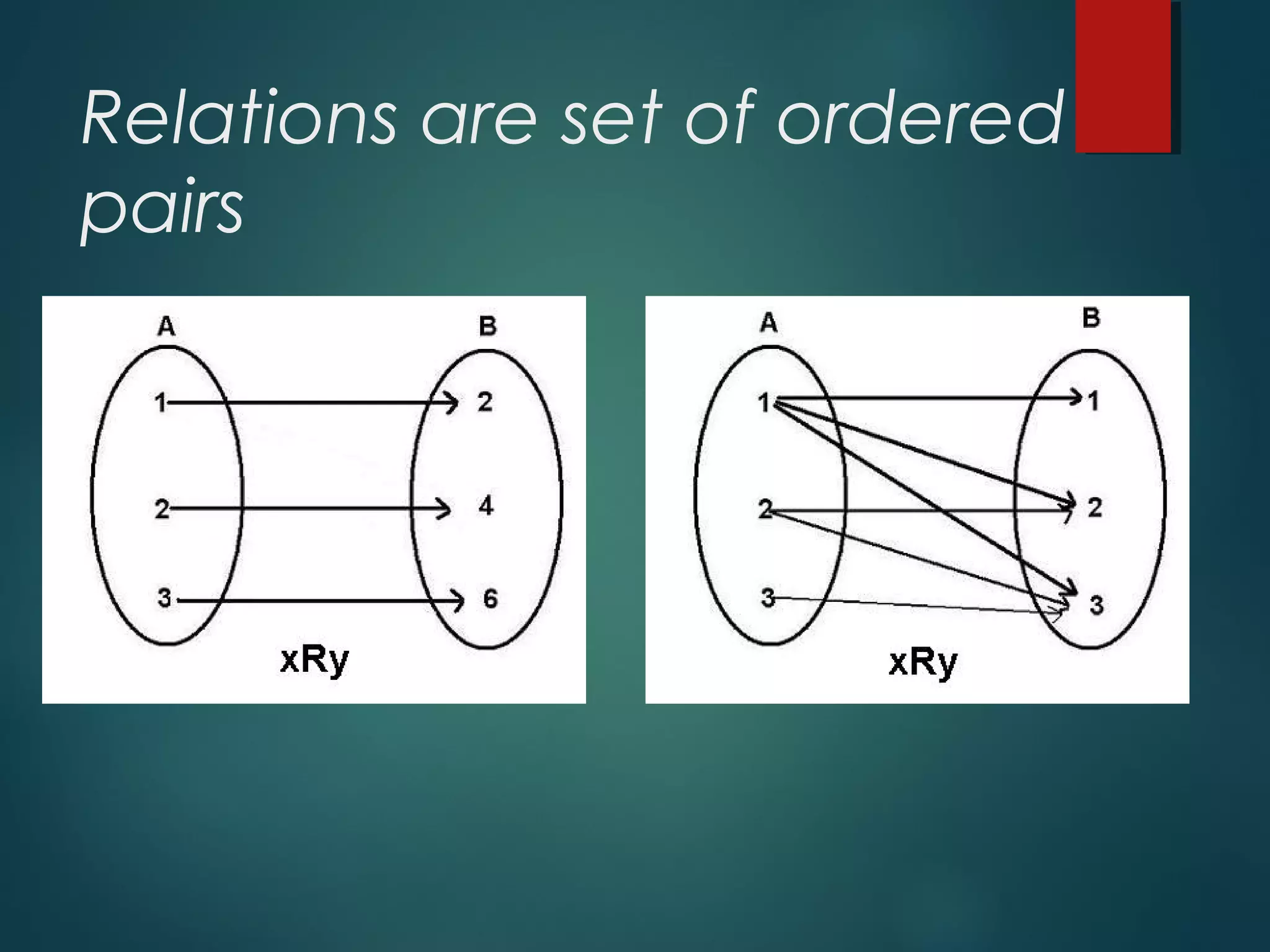
Relations are set of ordered
pairs
Definition: Function
•A function is a special relation such that every first
element is paired to a unique second element.
•It is a set of ordered pairs with no two pairs having
the same first element.
Functions
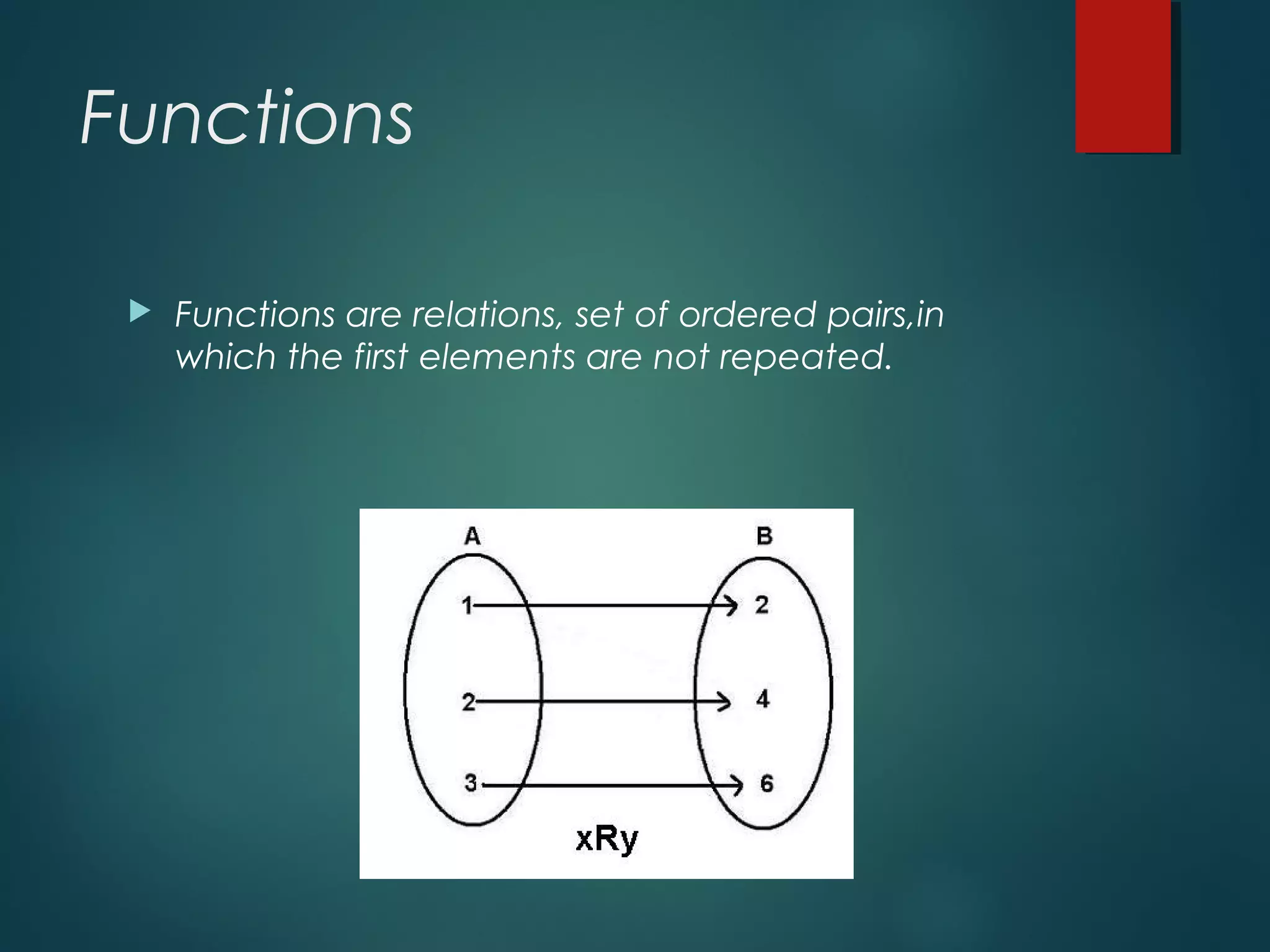
 Functions are relations, set of ordered pairs,in
which the first elements are not repeated.
Function Notation
•Letters like f , g , h and the likes are used to designate
functions.
•When we use f as a function, then for each x in the
domain of f , f ( x ) denotes the image of x under f .
•The notation f ( x ) is read as “ f of x ”.
Graph of a Function
•If f(x) is a function, then its graph is the set of all points
(x,y) in the two-dimensional plane for which (x,y) is an
ordered pair in f(x)
•One way to graph a function is by point plotting.
•We can also find the domain and range from the
graph of a function.
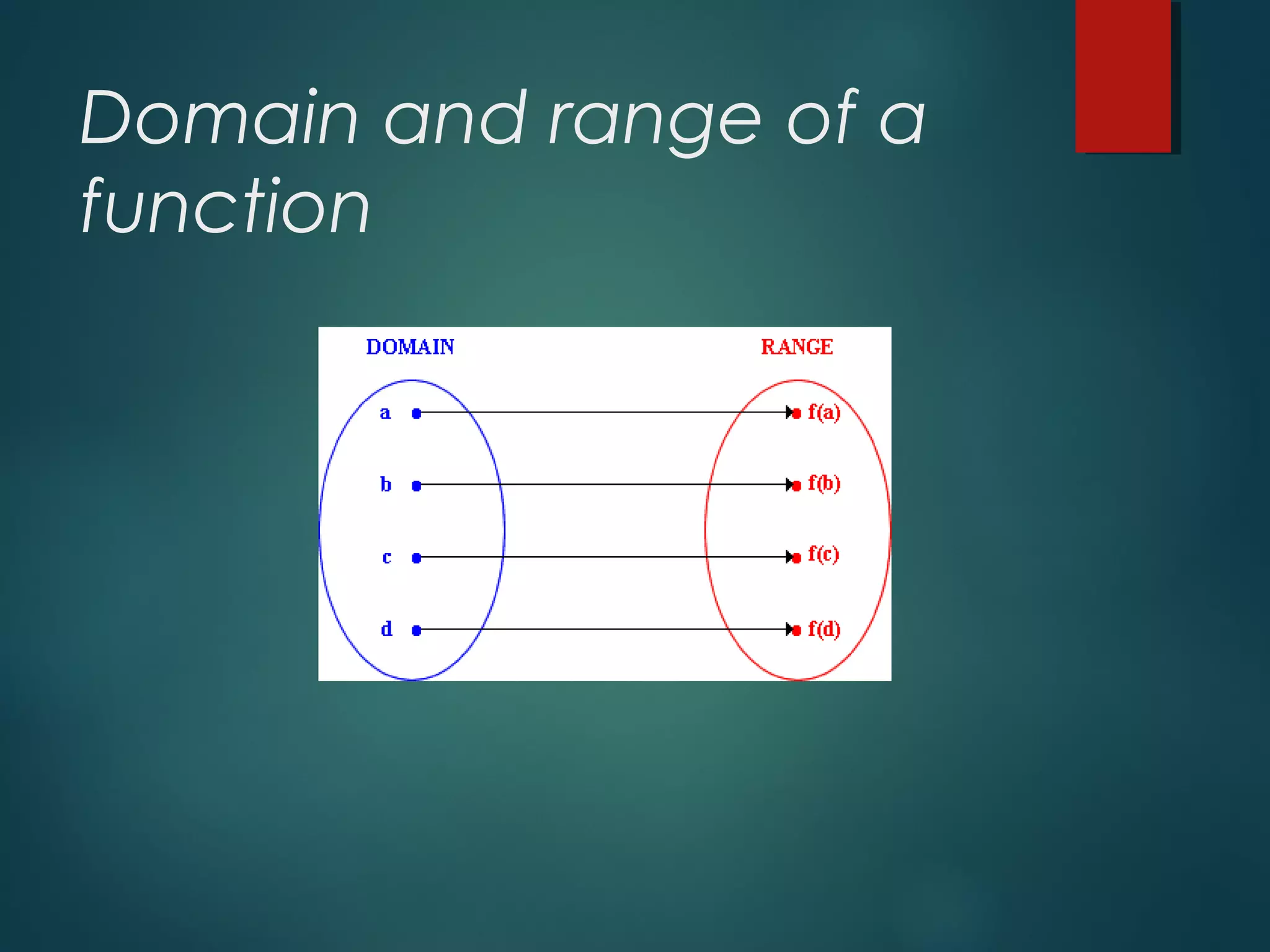
DEFINITION: Domain and RangeDEFINITION: Domain and Range
• All the possible values of x is called the domain.
• All the possible values of y is called the range.
• In a set of ordered pairs, the set of first elements
and second elements of ordered pairs is the
domain and range, respectively.
Domain and range of a
function
7 Function Families
 What you need to know:
 Name
 Equation
 Domain
 Range
Linear
 Name – Constant
 Equation –
 Domain – (-∝,∝)
 Range – [b]
y b=
Linear
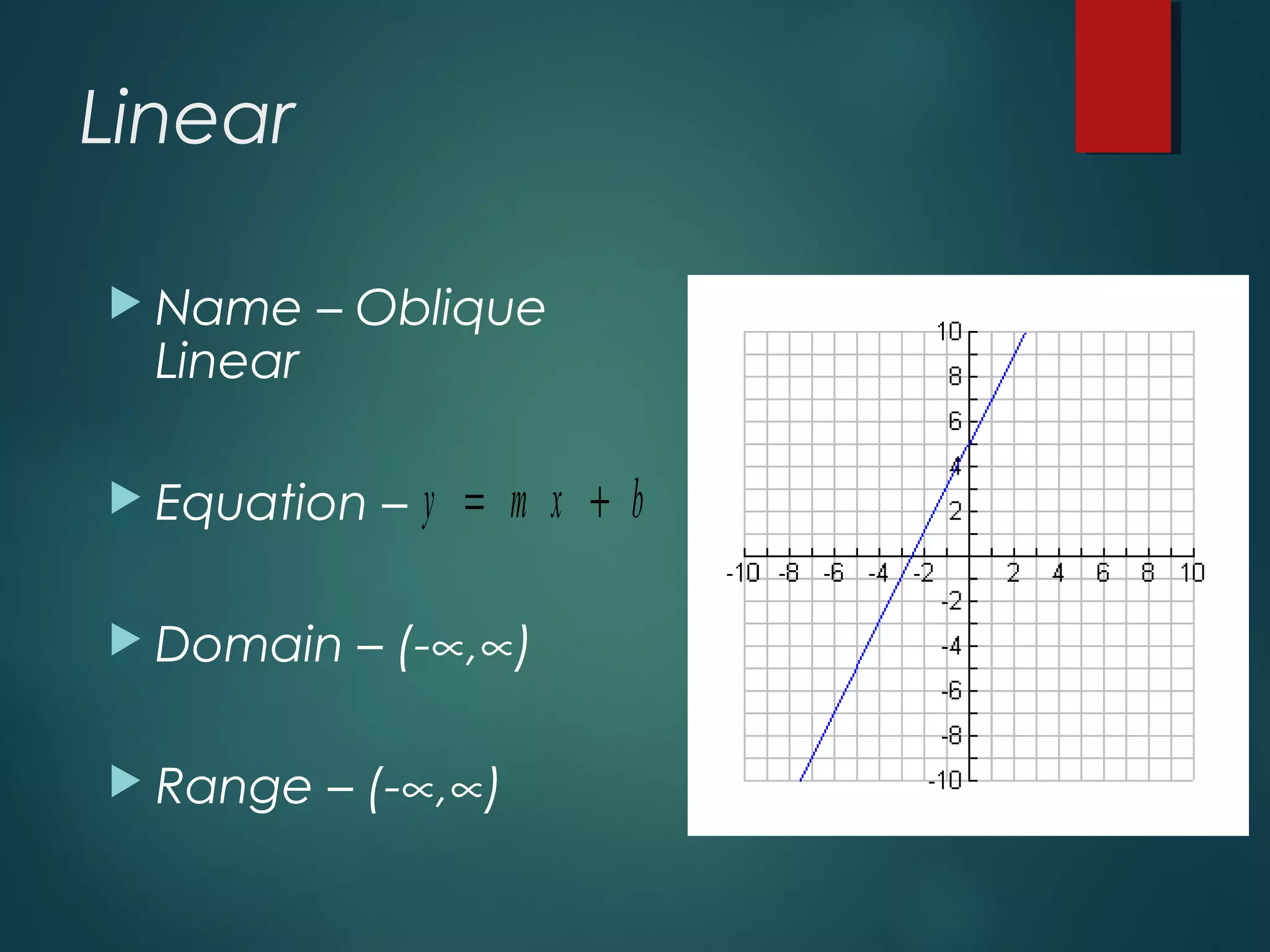
 Name – Oblique
Linear
 Equation –
 Domain – (-∝,∝)
 Range – (-∝,∝)
y m x b= +
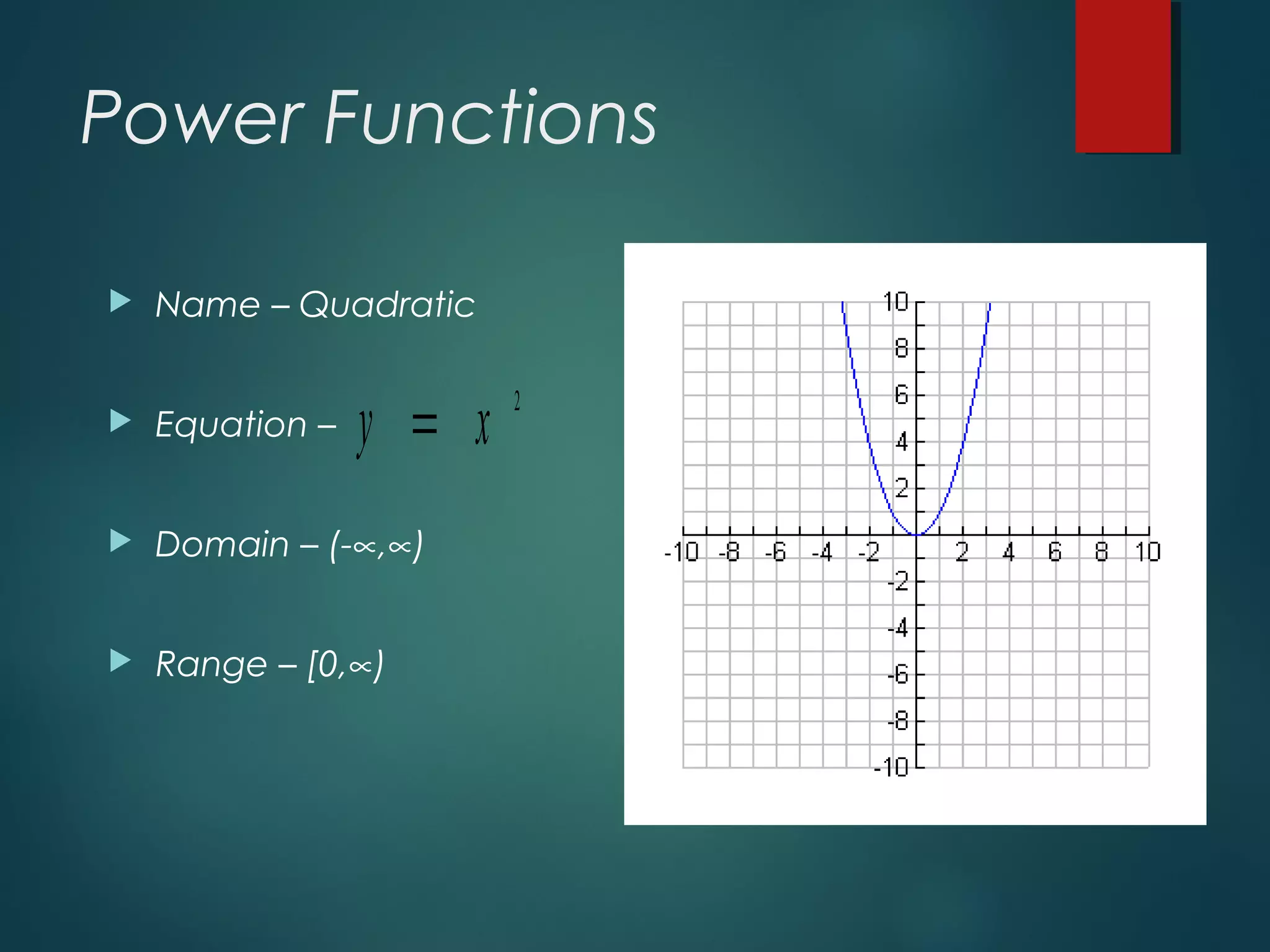
Power Functions
 Name – Quadratic
 Equation –
 Domain – (-∝,∝)
 Range – [0,∝)
y x= 2
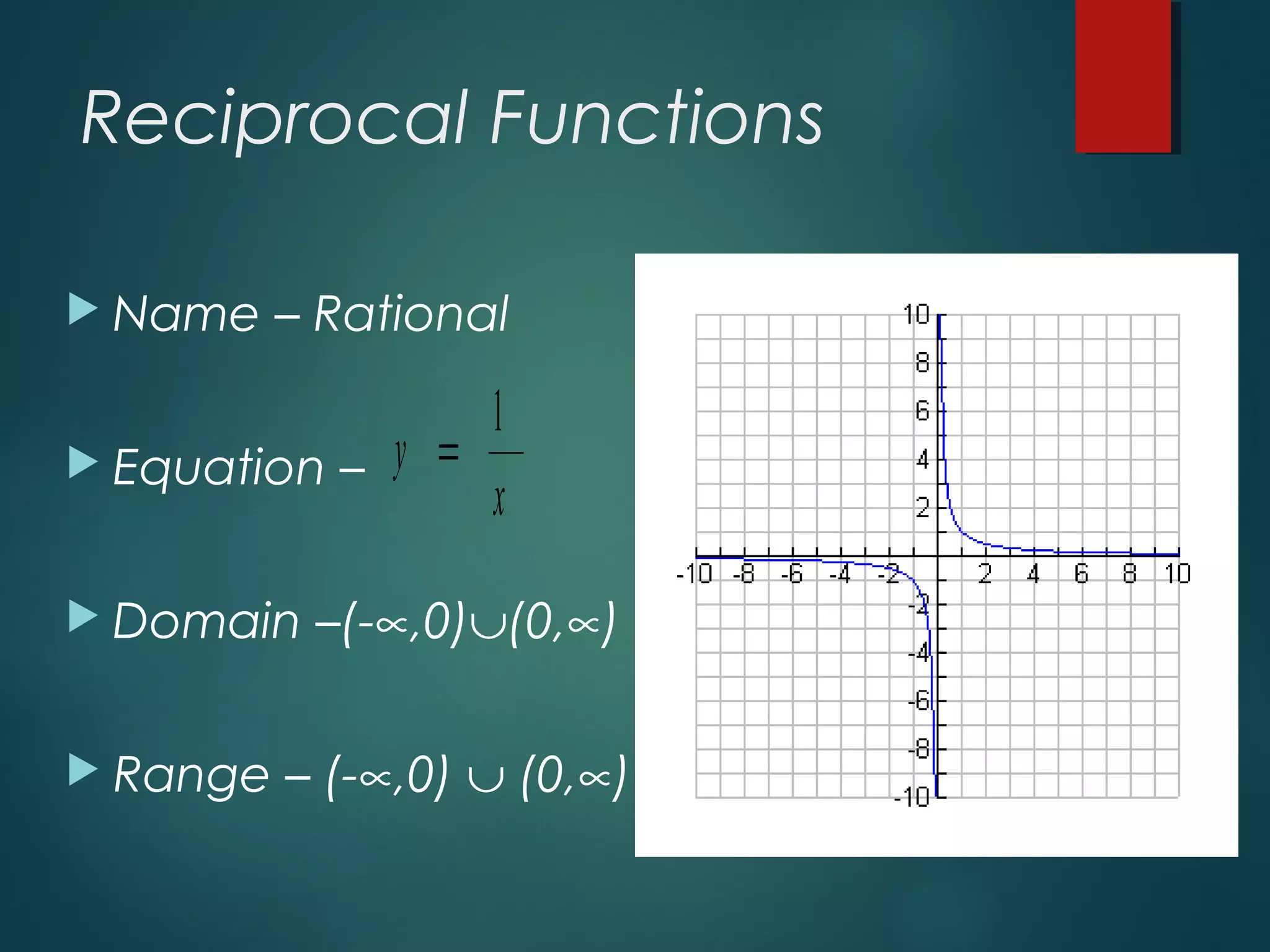
Reciprocal Functions
 Name – Rational
 Equation –
 Domain –(-∝,0)∪(0,∝)
 Range – (-∝,0) ∪ (0,∝)
y
x
=
1
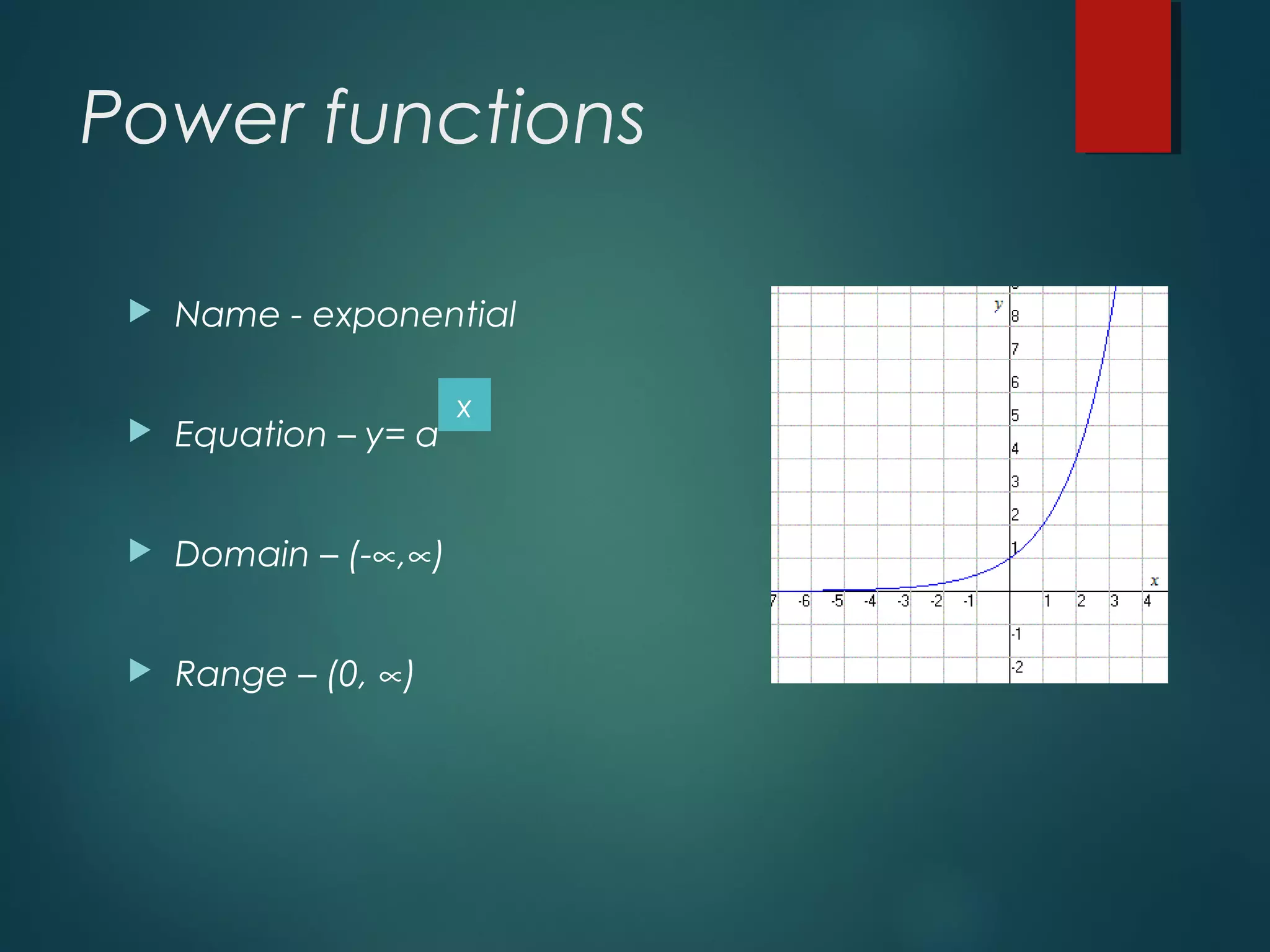
Power functions
 Name - exponential
 Equation – y= a
 Domain – (-∝,∝)
 Range – (0, ∝)
x
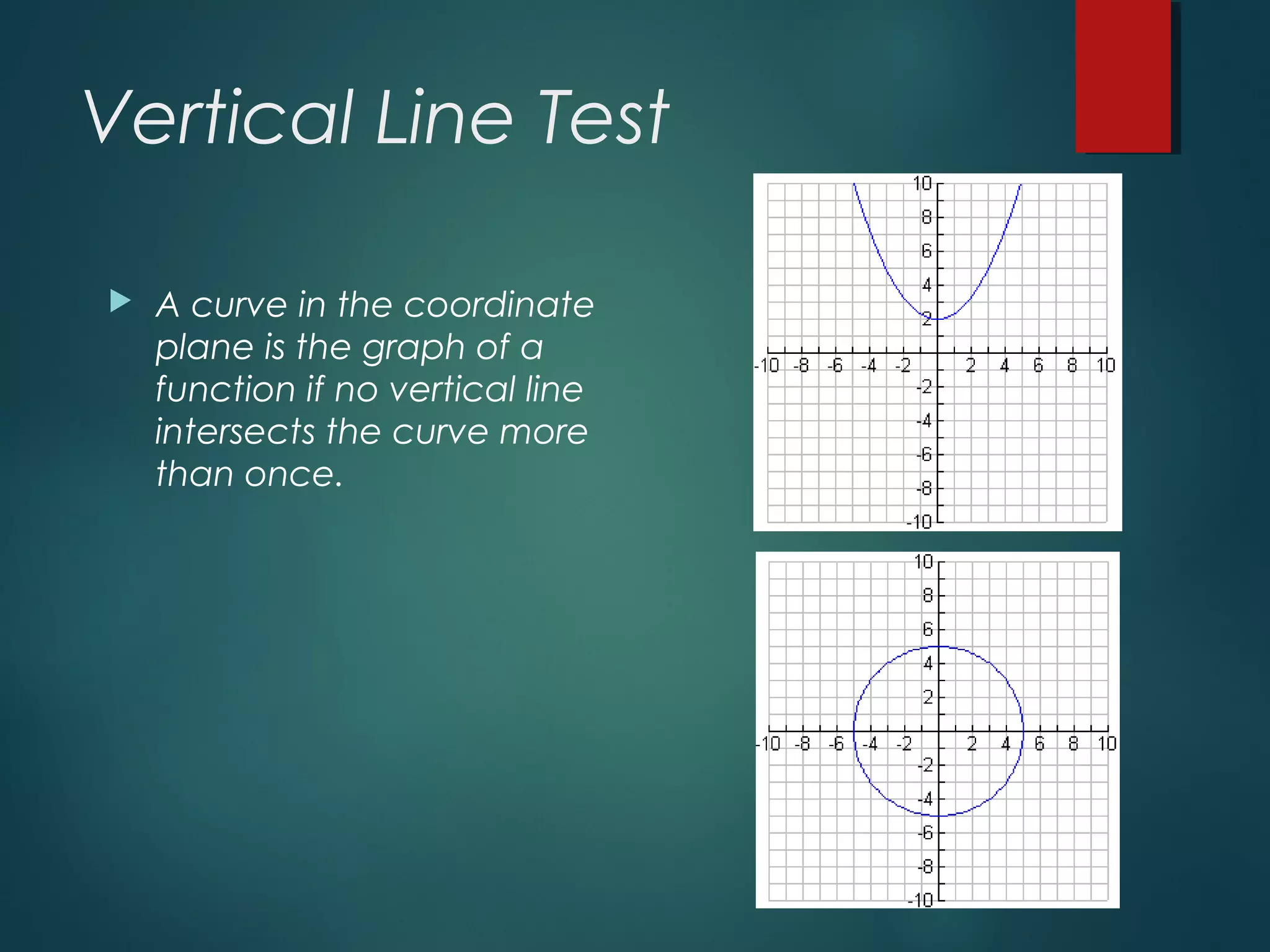
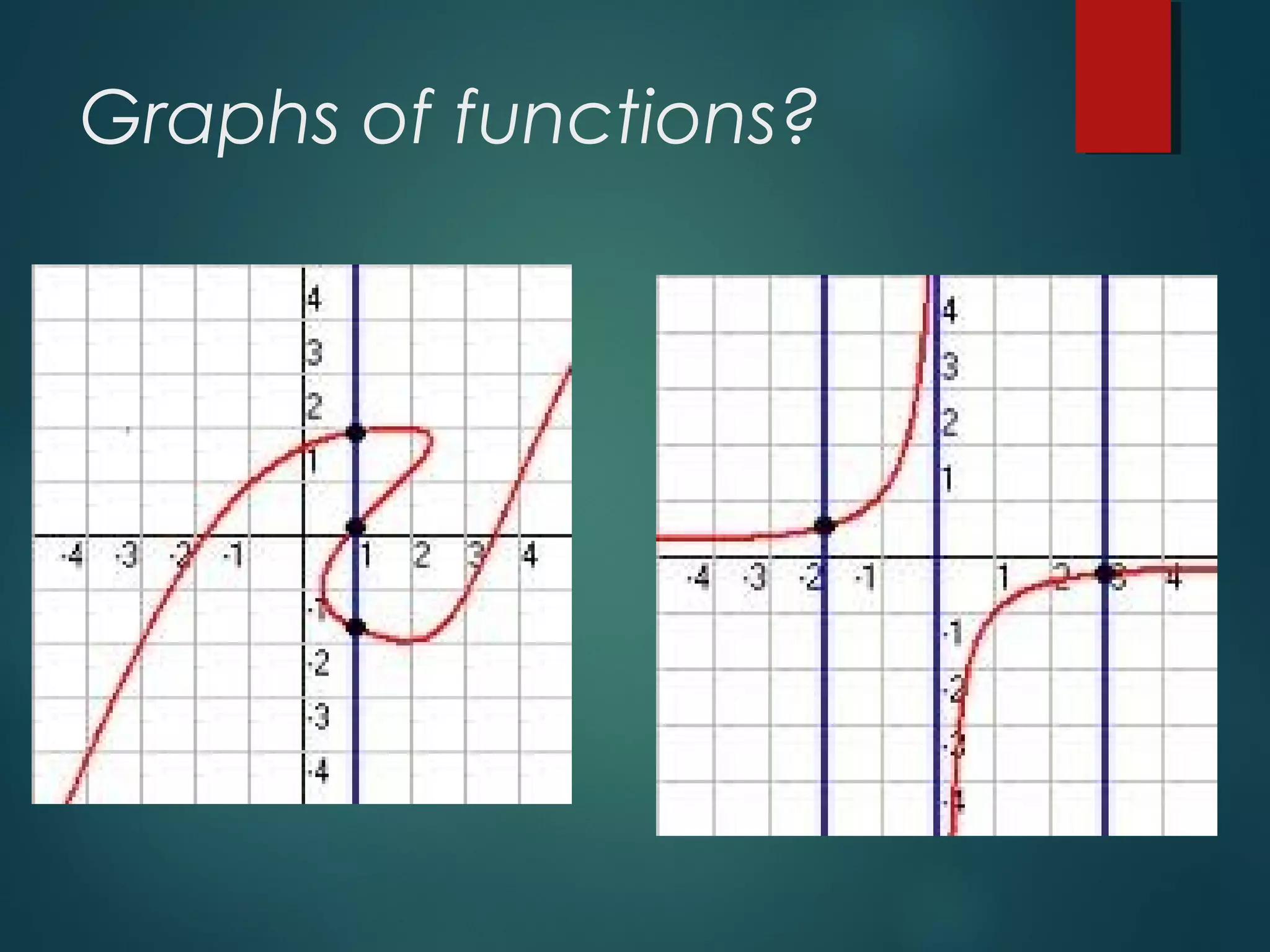
Vertical Line Test
 A curve in the coordinate
plane is the graph of a
function if no vertical line
intersects the curve more
than once.
Graphs of functions?
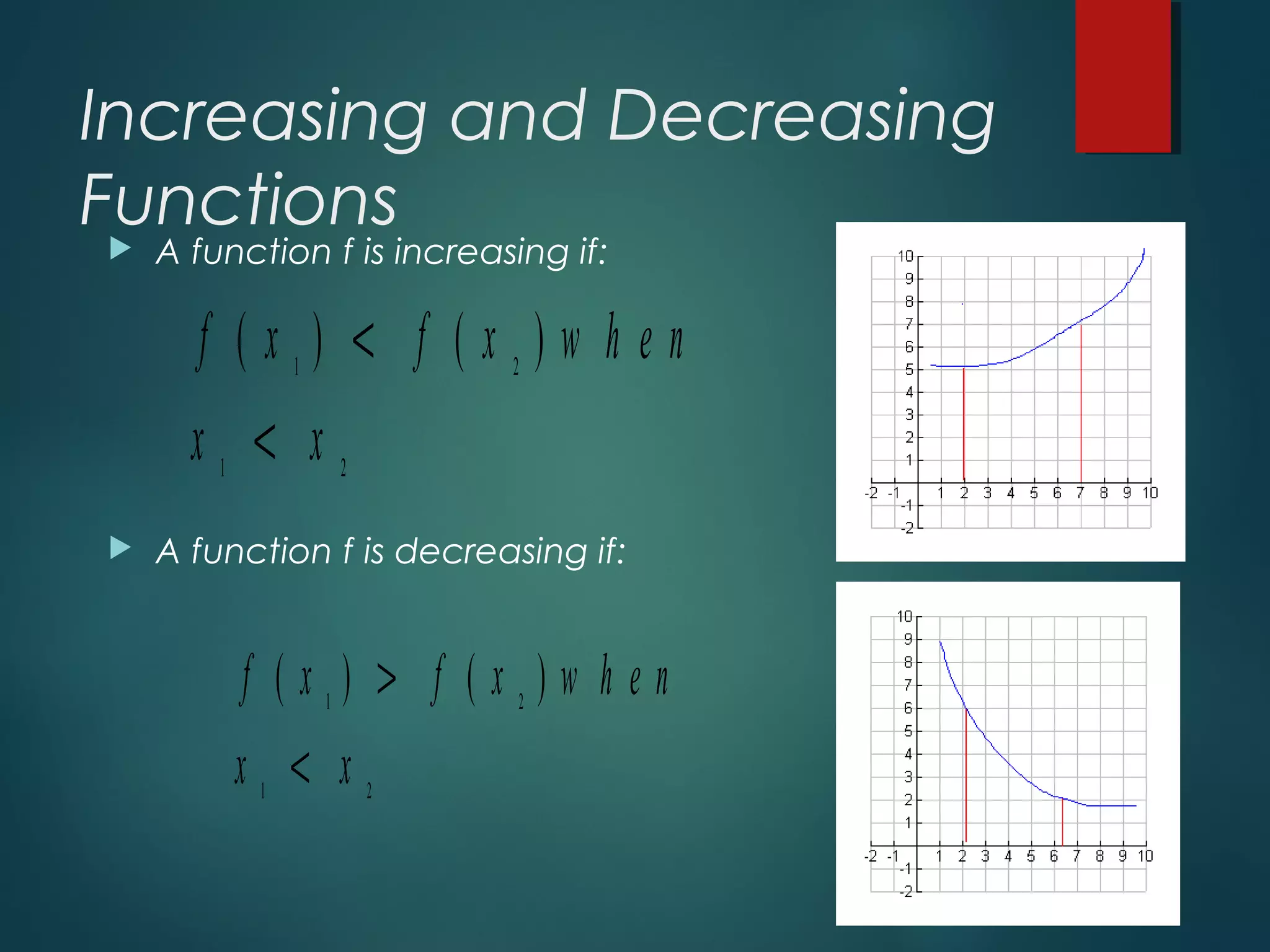
Increasing and Decreasing
Functions A function f is increasing if:
 A function f is decreasing if:
f x f x w h e n
x x
( ) ( )1 2
1 2
<
<
f x f x w h e n
x x
( ) ( )1 2
1 2
>
<
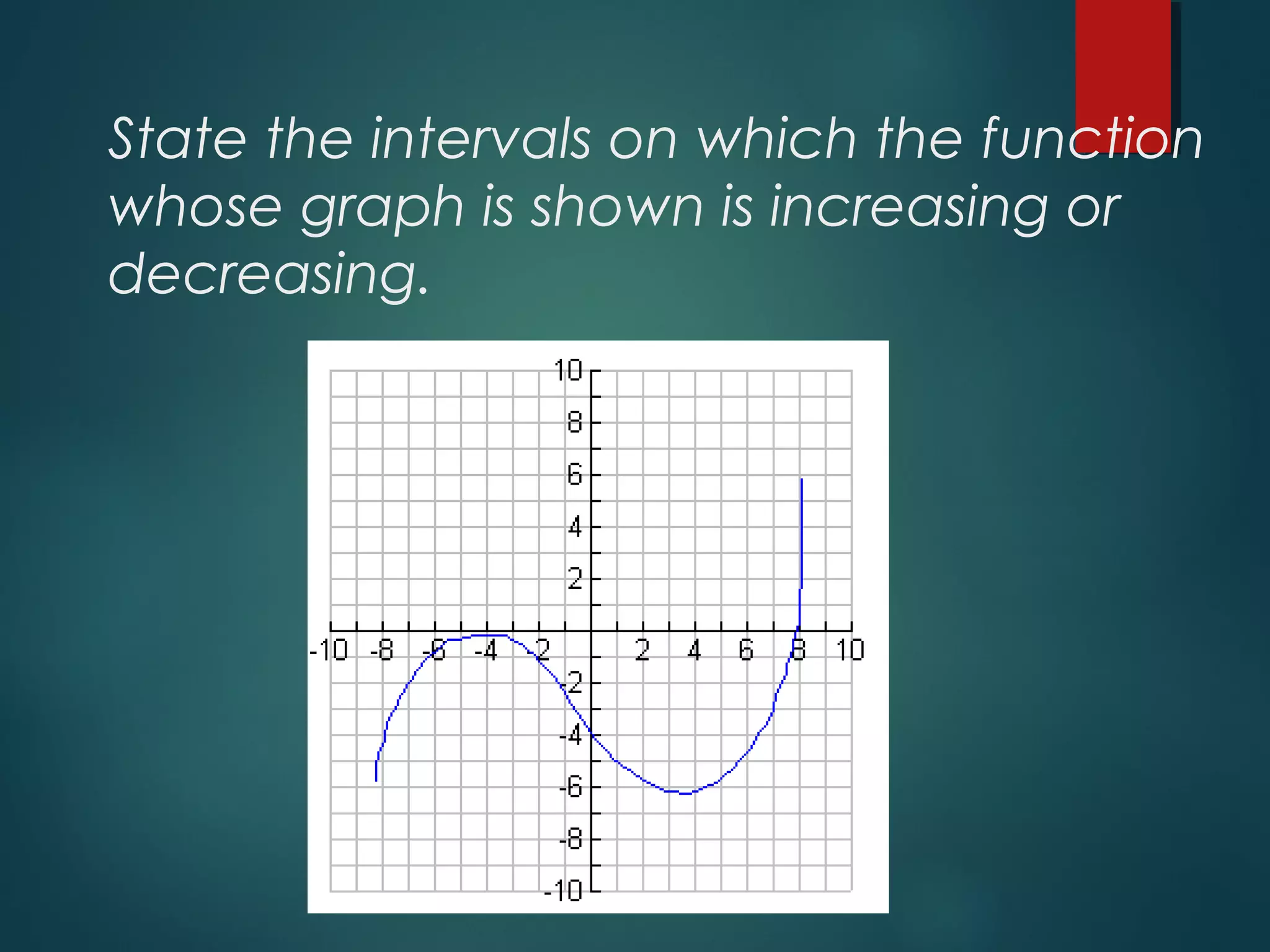
State the intervals on which the function
whose graph is shown is increasing or
decreasing.
Transformations
Vertical Shift
Horizontal Shift
Reflecting
Stretching/Shrinking
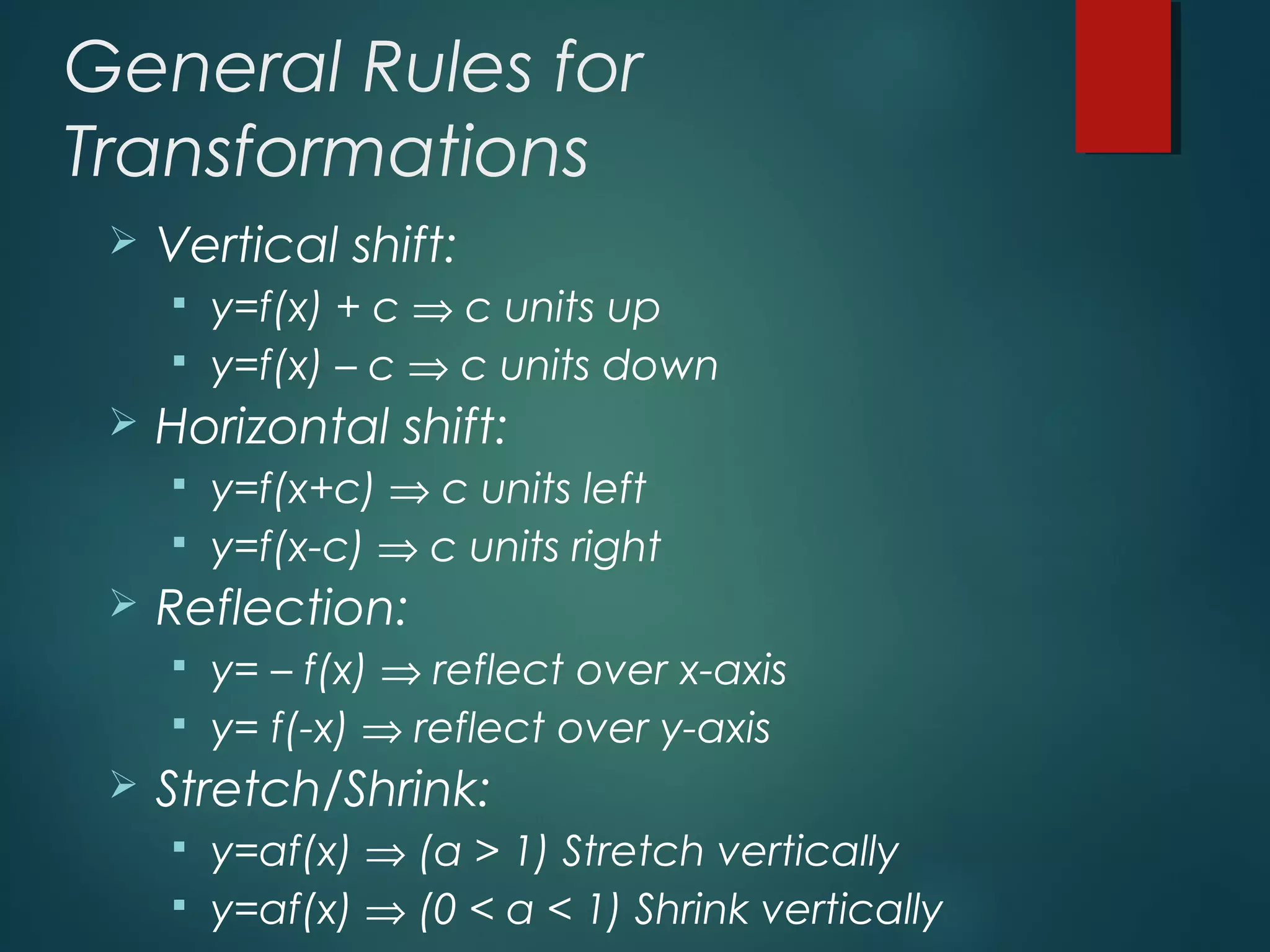
General Rules for
Transformations
 Vertical shift:
 y=f(x) + c ⇒ c units up
 y=f(x) – c ⇒ c units down
 Horizontal shift:
 y=f(x+c) ⇒ c units left
 y=f(x-c) ⇒ c units right
 Reflection:
 y= – f(x) ⇒ reflect over x-axis
 y= f(-x) ⇒ reflect over y-axis
 Stretch/Shrink:
 y=af(x) ⇒ (a > 1) Stretch vertically
 y=af(x) ⇒ (0 < a < 1) Shrink vertically
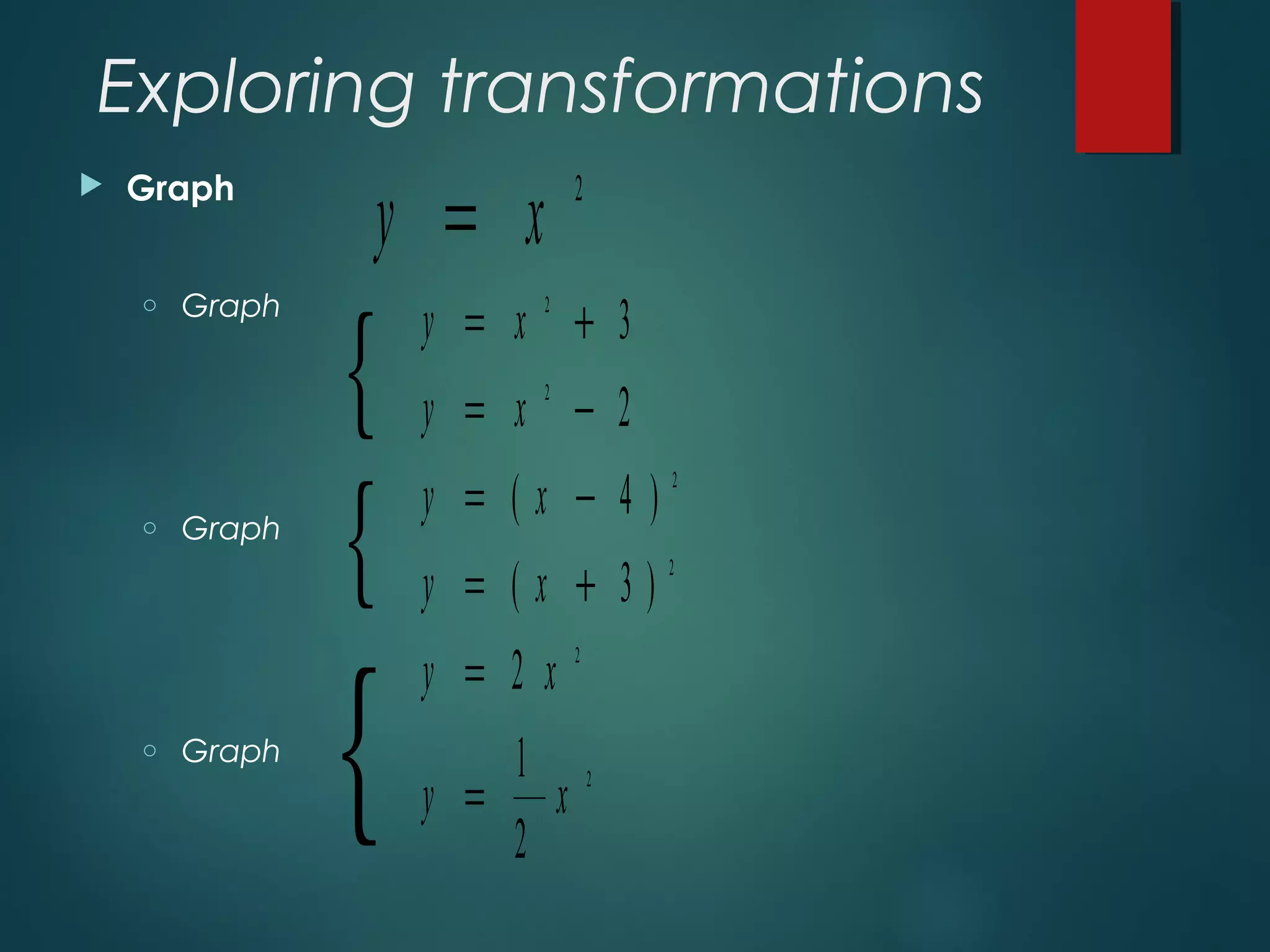
Exploring transformations
 Graph
o Graph
o Graph
o Graph
y x= 2
y x
y x
y x
y x
y x
y x
= +
= −
= −
= +
=
=
2
2
2
2
2
2
3
2
4
3
2
1
2
( )
( )
{
{
{
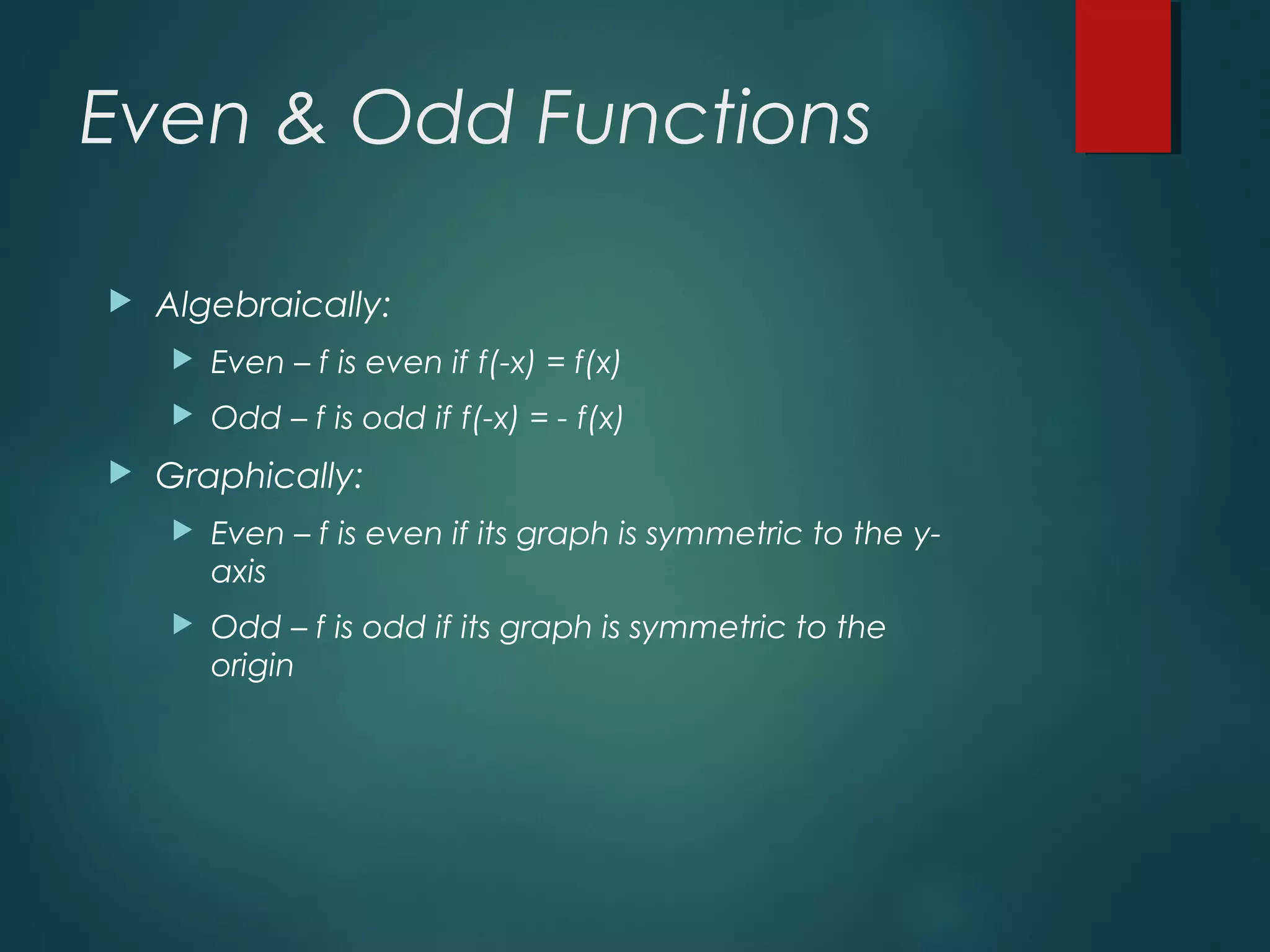
Even & Odd Functions
 Algebraically:
 Even – f is even if f(-x) = f(x)
 Odd – f is odd if f(-x) = - f(x)
 Graphically:
 Even – f is even if its graph is symmetric to the y-
axis
 Odd – f is odd if its graph is symmetric to the
origin
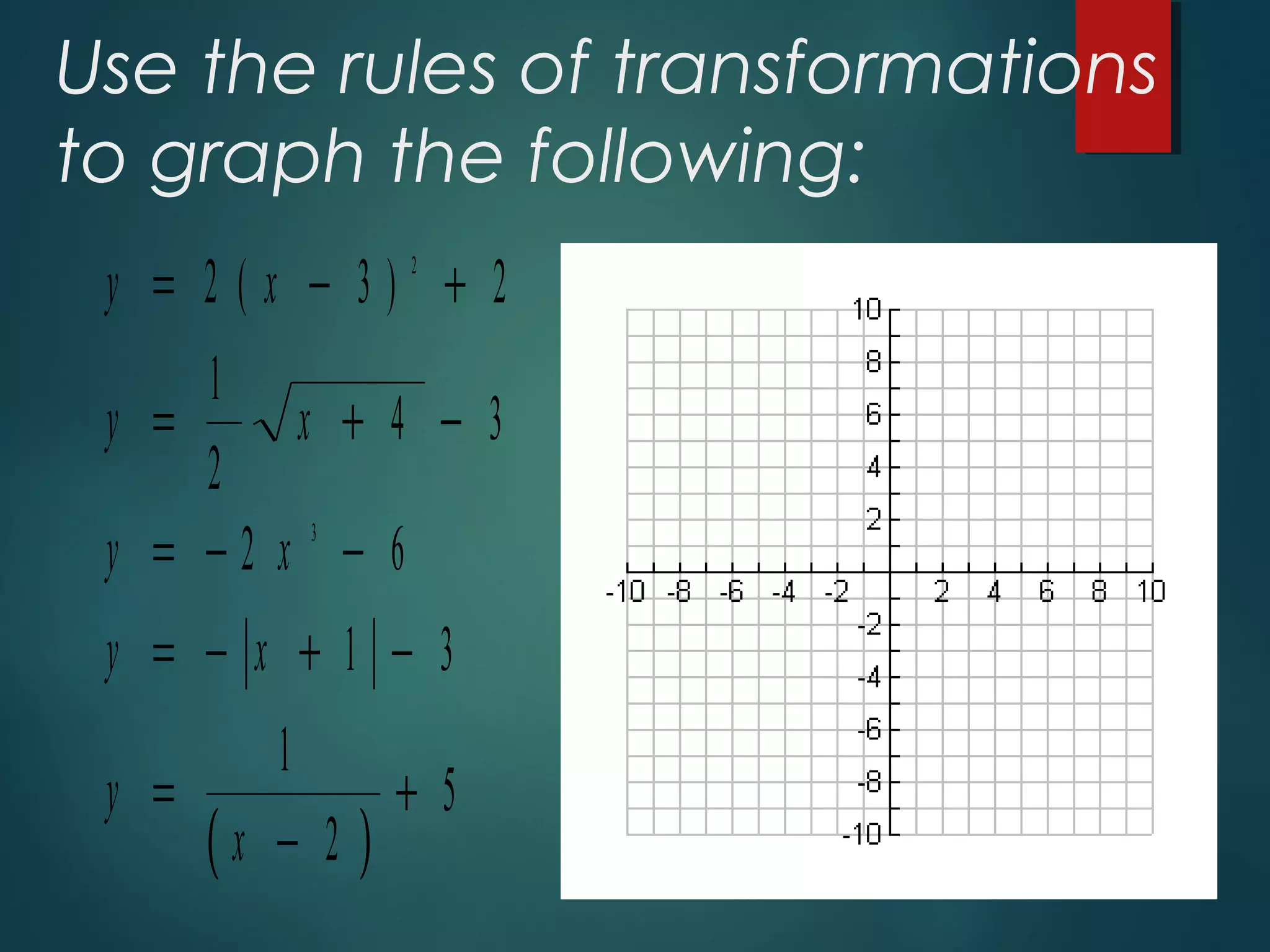
Use the rules of transformations
to graph the following:
( )
y x
y x
y x
y x
y
x
= − +
= + −
= − −
= − + −
=
−
+
2 3 2
1
2
4 3
2 6
1 3
1
2
5
2
3
( )
Trigonometric Functions
Name – Sine
Equation -y = a sin bx + c
Domain - (-∝,∝)
Range – [ 1. -1 ]
amplitude = a
period =
b
360°
phase shift = b
Vertical shift =c
Trigonometric Functions
Name – Cosine
Equation - y = acosbx + c
amplitude = a
period =
b
360°
phase shift = b
Vertical shift =c
Domain - (-∝,∝)
Range – [ 1. -1 ]
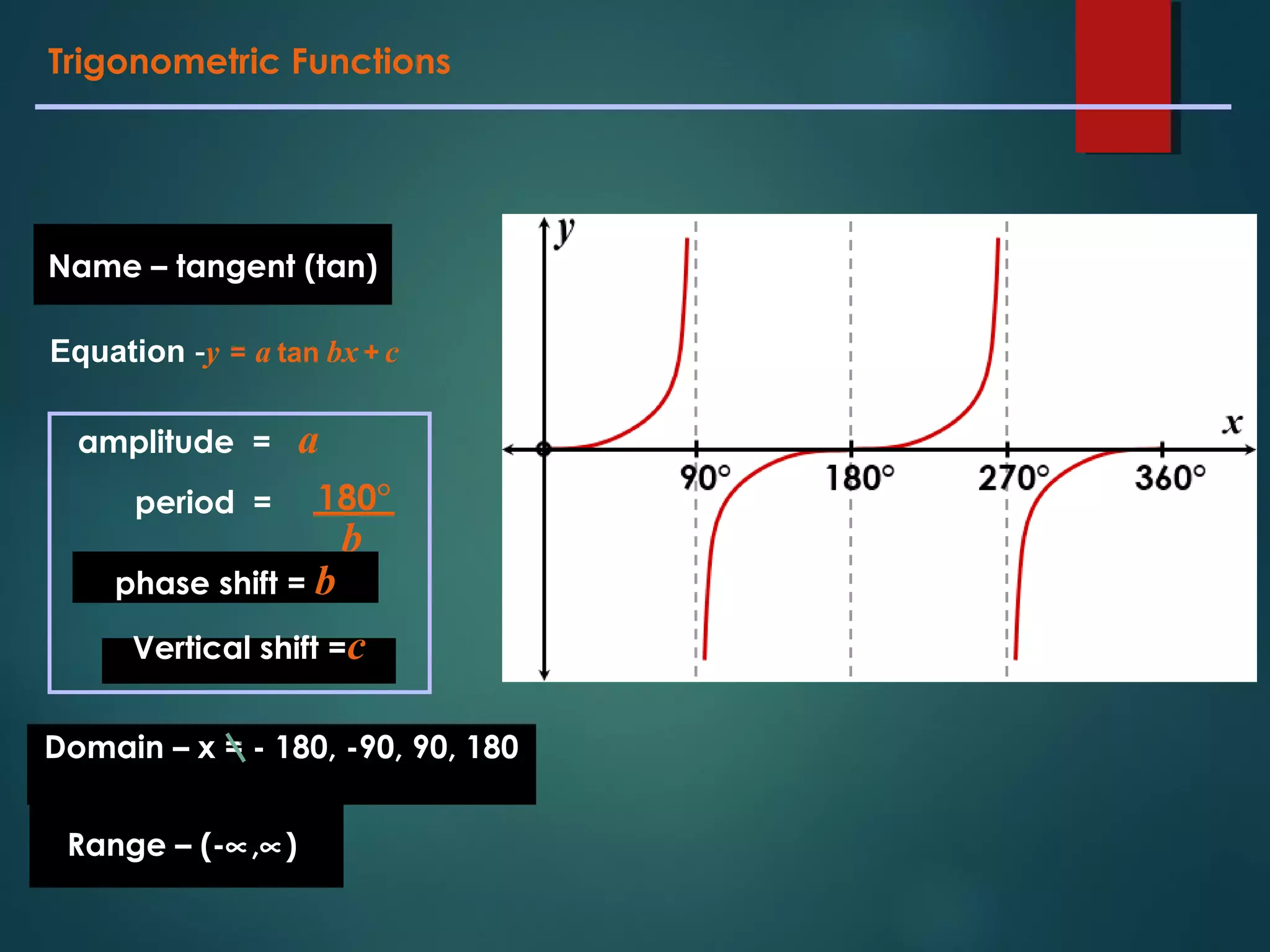
Trigonometric Functions
Name – tangent (tan)
Equation -y = a tan bx + c
amplitude = a
period =
b
180°
phase shift = b
Vertical shift =c
Domain – x = - 180, -90, 90, 180
Range – (-∝,∝)
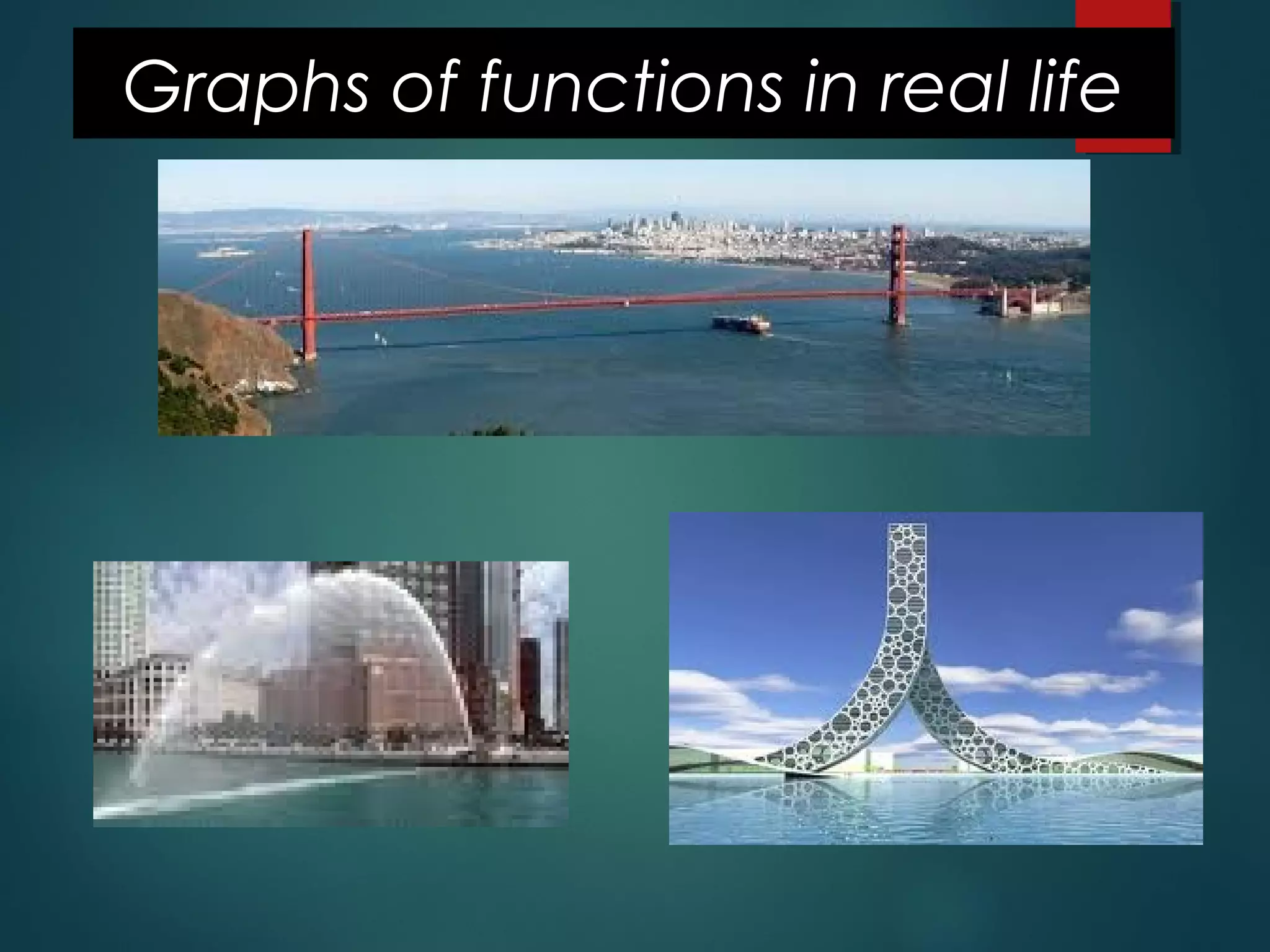
Graphs of functions in real life
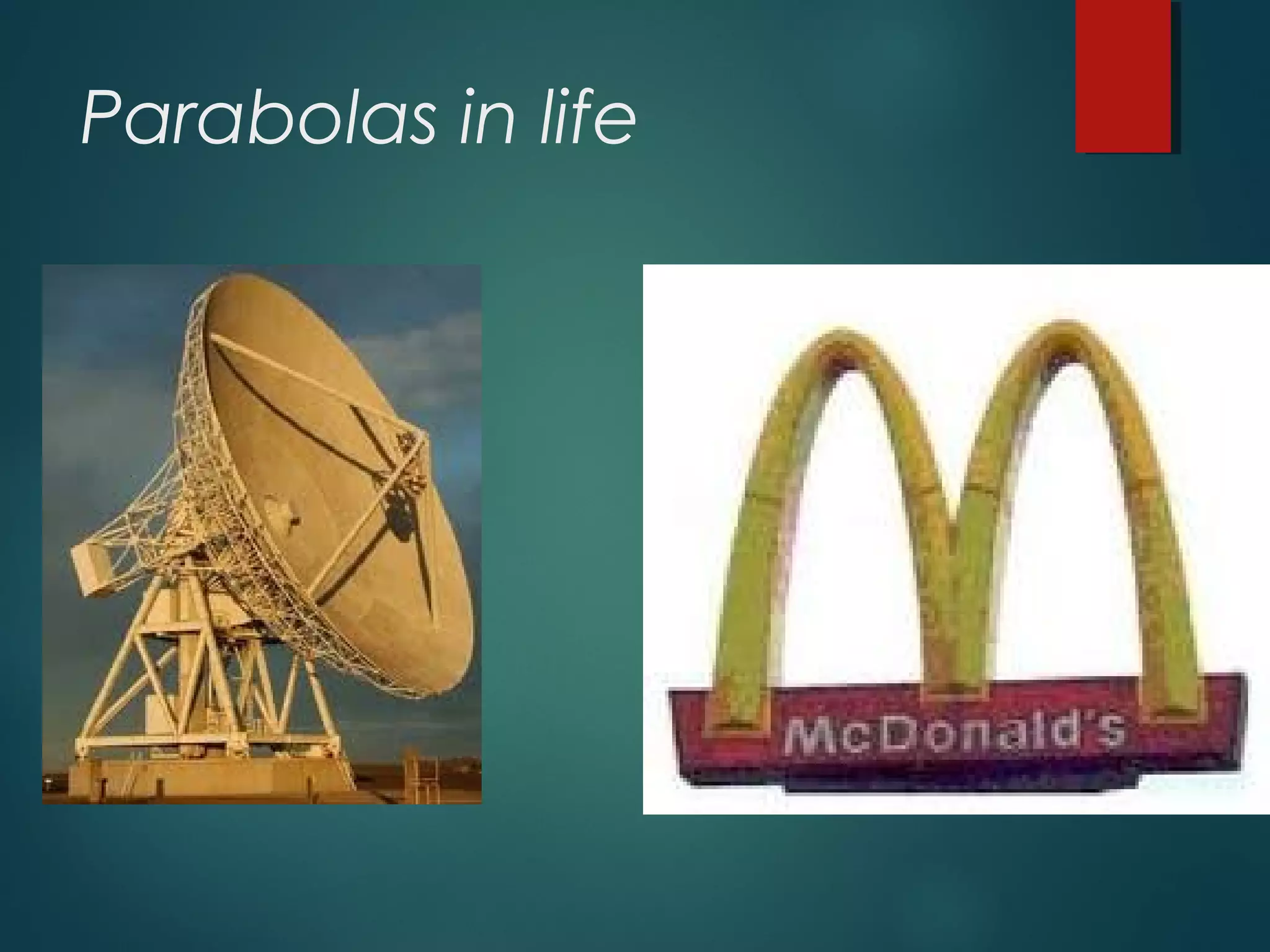
Parabolas in life
Parabolic building
Do the following work on your
own.
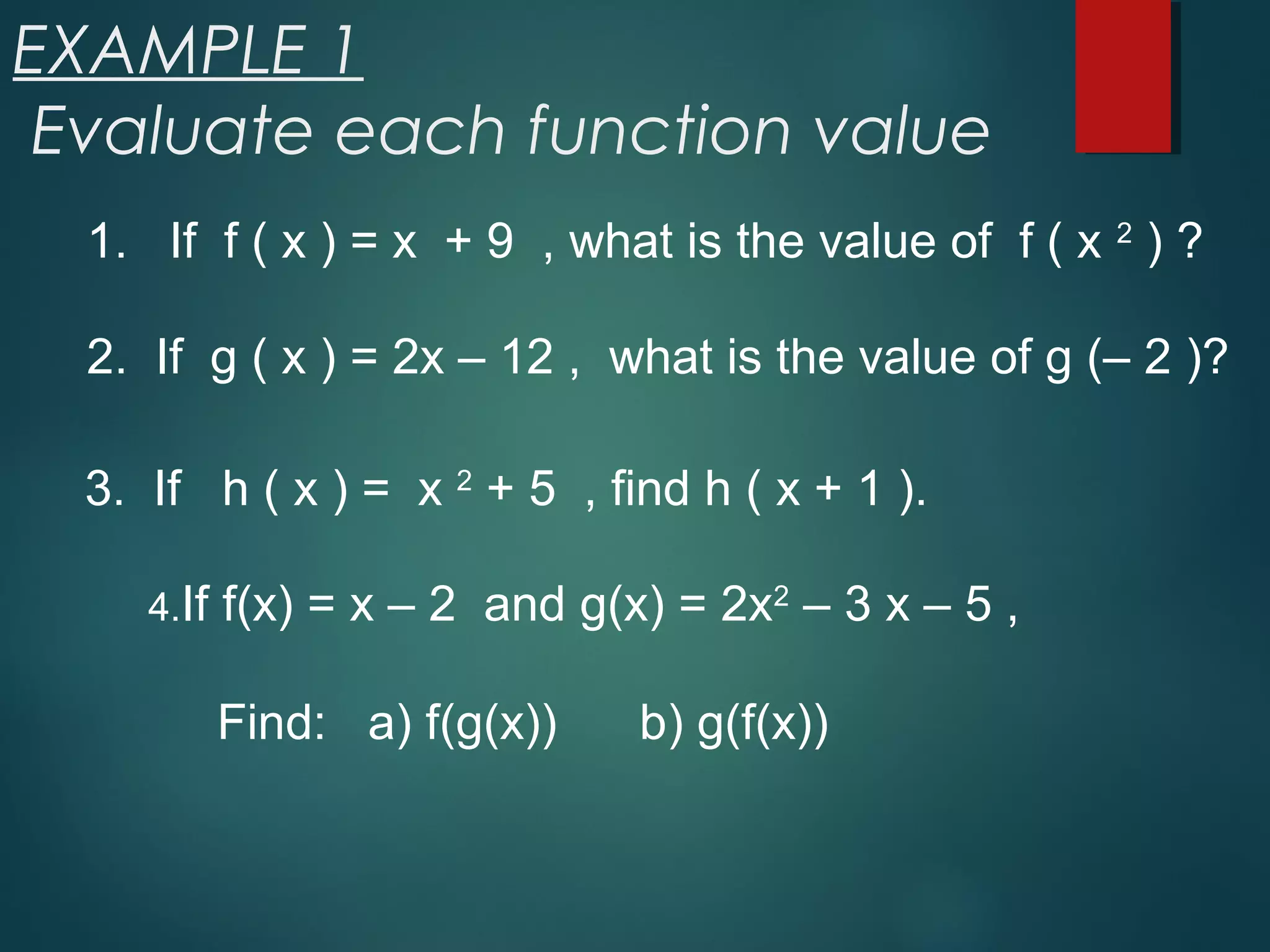
EXAMPLE 1
Evaluate each function value
1. If f ( x ) = x + 9 , what is the value of f ( x 2
) ?
2. If g ( x ) = 2x – 12 , what is the value of g (– 2 )?
3. If h ( x ) = x 2
+ 5 , find h ( x + 1 ).
4.If f(x) = x – 2 and g(x) = 2x2
– 3 x – 5 ,
Find: a) f(g(x)) b) g(f(x))
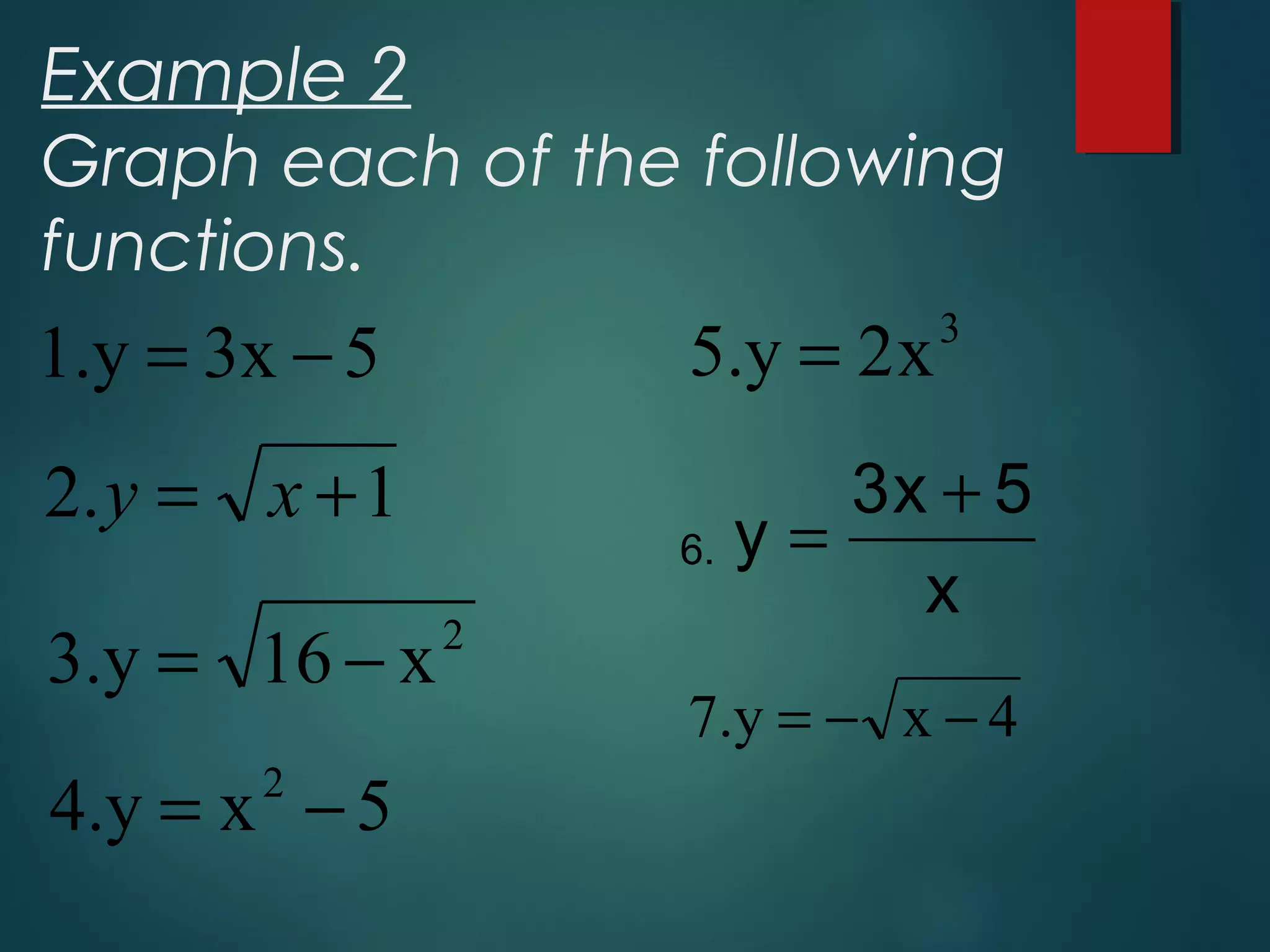
Example 2
Graph each of the following
functions.
5x3y.1 −=
1.2 += xy
2
x16y.3 −=
5xy.4 2
−=
3
x2y.5 =
x
5x3
y
+
=
4xy.7 −−=
6.
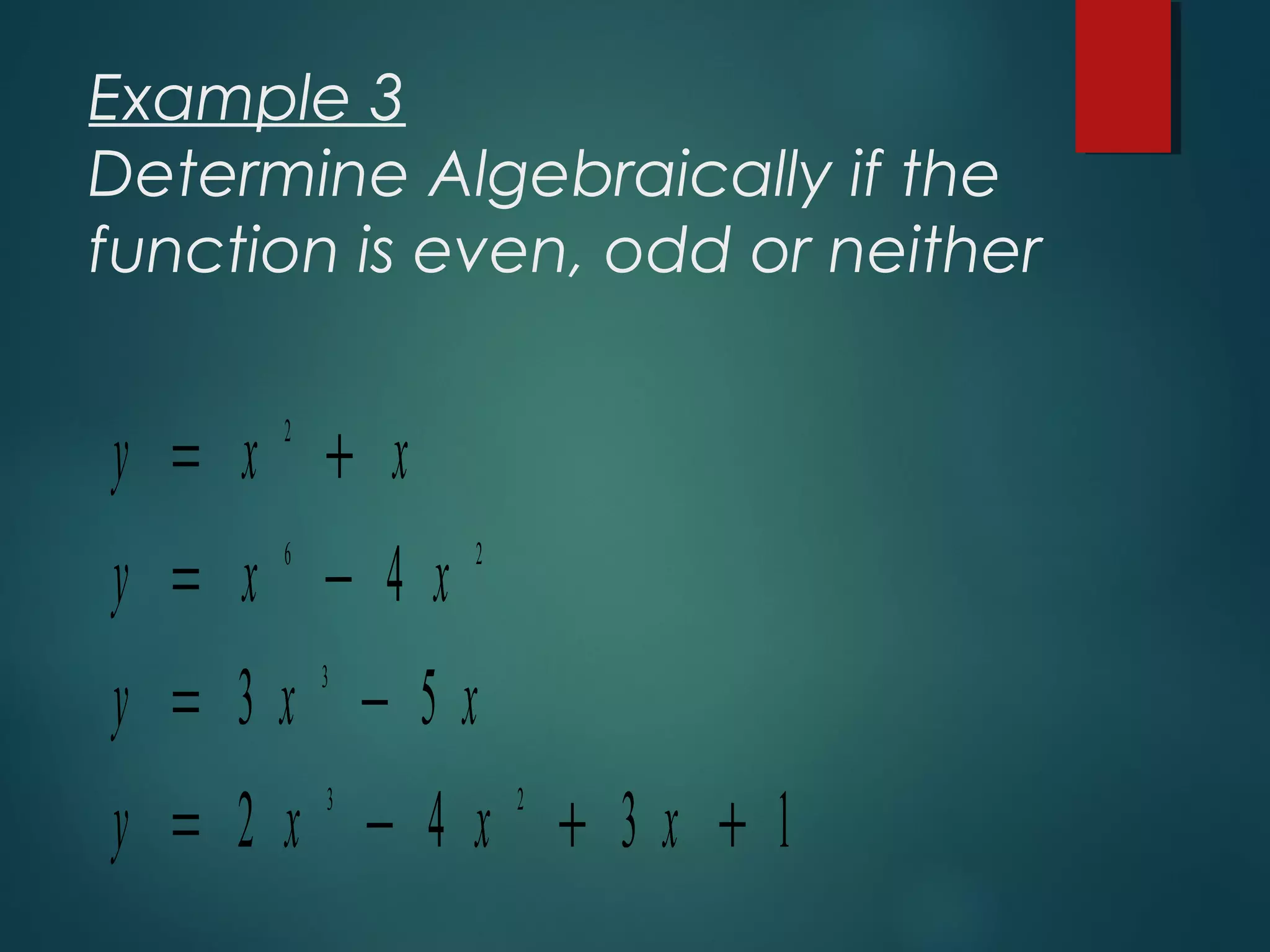
Example 3
Determine Algebraically if the
function is even, odd or neither
y x x
y x x
y x x
y x x x
= +
= −
= −
= − + +
2
6 2
3
3 2
4
3 5
2 4 3 1
Reference
 Gurl, V . 2010. Afm chapter 4. functions.
http://www.slideshare.net/volleygurl22/afm-chapter-4-powerpoint?qid=e6c
from_search=1. Accessed 06 March 2014
 Manarang, K . 2011. 7 Functions.
http://www.slideshare.net/KathManarang/7-functions-
9175161. Accessed on 06 March 2014
 Farhana S .2013. Graphs and their functions.
http://www.slideshare.net/farhanashaheen1/function-
and-their-graphs-ppt?qid=e22cda30-fde3-4c4a-b233-
f00ff6f20596&v=default&b=&from_search=2. Accessed on
06 March 2014
 Schmitz, T .2008.Higher Maths 1.2.3 - Trigonometric
Functions. http://www.slideshare.net/timschmitz/higher-
maths-123-trigonometric-functions-358346?qid=4e5bcb29-
5942-48aa-9735-bf4c30ac5f05&v=qf1&b=&from_search=1.
Accessed on 06 March 2014
Thank you

Functions for Grade 10

  • 1.
  • 2.
    Relation is referredto as any set of ordered pair. Conventionally, It is represented by the ordered pair ( x , y ). x is called the first element or x-coordinate while y is the second element or y-coordinate of the ordered pair. DEFINITIONDEFINITION
  • 3.
    Relations are setof ordered pairs
  • 4.
    Definition: Function •A functionis a special relation such that every first element is paired to a unique second element. •It is a set of ordered pairs with no two pairs having the same first element.
  • 5.
    Functions  Functions arerelations, set of ordered pairs,in which the first elements are not repeated.
  • 6.
    Function Notation •Letters likef , g , h and the likes are used to designate functions. •When we use f as a function, then for each x in the domain of f , f ( x ) denotes the image of x under f . •The notation f ( x ) is read as “ f of x ”.
  • 7.
    Graph of aFunction •If f(x) is a function, then its graph is the set of all points (x,y) in the two-dimensional plane for which (x,y) is an ordered pair in f(x) •One way to graph a function is by point plotting. •We can also find the domain and range from the graph of a function.
  • 8.
    DEFINITION: Domain andRangeDEFINITION: Domain and Range • All the possible values of x is called the domain. • All the possible values of y is called the range. • In a set of ordered pairs, the set of first elements and second elements of ordered pairs is the domain and range, respectively.
  • 9.
    Domain and rangeof a function
  • 10.
    7 Function Families What you need to know:  Name  Equation  Domain  Range
  • 11.
    Linear  Name –Constant  Equation –  Domain – (-∝,∝)  Range – [b] y b=
  • 12.
    Linear  Name –Oblique Linear  Equation –  Domain – (-∝,∝)  Range – (-∝,∝) y m x b= +
  • 13.
    Power Functions  Name– Quadratic  Equation –  Domain – (-∝,∝)  Range – [0,∝) y x= 2
  • 14.
    Reciprocal Functions  Name– Rational  Equation –  Domain –(-∝,0)∪(0,∝)  Range – (-∝,0) ∪ (0,∝) y x = 1
  • 15.
    Power functions  Name- exponential  Equation – y= a  Domain – (-∝,∝)  Range – (0, ∝) x
  • 16.
    Vertical Line Test A curve in the coordinate plane is the graph of a function if no vertical line intersects the curve more than once.
  • 17.
  • 18.
    Increasing and Decreasing FunctionsA function f is increasing if:  A function f is decreasing if: f x f x w h e n x x ( ) ( )1 2 1 2 < < f x f x w h e n x x ( ) ( )1 2 1 2 > <
  • 19.
    State the intervalson which the function whose graph is shown is increasing or decreasing.
  • 20.
  • 21.
    General Rules for Transformations Vertical shift:  y=f(x) + c ⇒ c units up  y=f(x) – c ⇒ c units down  Horizontal shift:  y=f(x+c) ⇒ c units left  y=f(x-c) ⇒ c units right  Reflection:  y= – f(x) ⇒ reflect over x-axis  y= f(-x) ⇒ reflect over y-axis  Stretch/Shrink:  y=af(x) ⇒ (a > 1) Stretch vertically  y=af(x) ⇒ (0 < a < 1) Shrink vertically
  • 22.
    Exploring transformations  Graph oGraph o Graph o Graph y x= 2 y x y x y x y x y x y x = + = − = − = + = = 2 2 2 2 2 2 3 2 4 3 2 1 2 ( ) ( ) { { {
  • 23.
    Even & OddFunctions  Algebraically:  Even – f is even if f(-x) = f(x)  Odd – f is odd if f(-x) = - f(x)  Graphically:  Even – f is even if its graph is symmetric to the y- axis  Odd – f is odd if its graph is symmetric to the origin
  • 24.
    Use the rulesof transformations to graph the following: ( ) y x y x y x y x y x = − + = + − = − − = − + − = − + 2 3 2 1 2 4 3 2 6 1 3 1 2 5 2 3 ( )
  • 25.
    Trigonometric Functions Name –Sine Equation -y = a sin bx + c Domain - (-∝,∝) Range – [ 1. -1 ] amplitude = a period = b 360° phase shift = b Vertical shift =c
  • 26.
    Trigonometric Functions Name –Cosine Equation - y = acosbx + c amplitude = a period = b 360° phase shift = b Vertical shift =c Domain - (-∝,∝) Range – [ 1. -1 ]
  • 27.
    Trigonometric Functions Name –tangent (tan) Equation -y = a tan bx + c amplitude = a period = b 180° phase shift = b Vertical shift =c Domain – x = - 180, -90, 90, 180 Range – (-∝,∝)
  • 28.
    Graphs of functionsin real life
  • 29.
  • 30.
  • 31.
    Do the followingwork on your own.
  • 32.
    EXAMPLE 1 Evaluate eachfunction value 1. If f ( x ) = x + 9 , what is the value of f ( x 2 ) ? 2. If g ( x ) = 2x – 12 , what is the value of g (– 2 )? 3. If h ( x ) = x 2 + 5 , find h ( x + 1 ). 4.If f(x) = x – 2 and g(x) = 2x2 – 3 x – 5 , Find: a) f(g(x)) b) g(f(x))
  • 33.
    Example 2 Graph eachof the following functions. 5x3y.1 −= 1.2 += xy 2 x16y.3 −= 5xy.4 2 −= 3 x2y.5 = x 5x3 y + = 4xy.7 −−= 6.
  • 34.
    Example 3 Determine Algebraicallyif the function is even, odd or neither y x x y x x y x x y x x x = + = − = − = − + + 2 6 2 3 3 2 4 3 5 2 4 3 1
  • 35.
    Reference  Gurl, V. 2010. Afm chapter 4. functions. http://www.slideshare.net/volleygurl22/afm-chapter-4-powerpoint?qid=e6c from_search=1. Accessed 06 March 2014  Manarang, K . 2011. 7 Functions. http://www.slideshare.net/KathManarang/7-functions- 9175161. Accessed on 06 March 2014  Farhana S .2013. Graphs and their functions. http://www.slideshare.net/farhanashaheen1/function- and-their-graphs-ppt?qid=e22cda30-fde3-4c4a-b233- f00ff6f20596&v=default&b=&from_search=2. Accessed on 06 March 2014  Schmitz, T .2008.Higher Maths 1.2.3 - Trigonometric Functions. http://www.slideshare.net/timschmitz/higher- maths-123-trigonometric-functions-358346?qid=4e5bcb29- 5942-48aa-9735-bf4c30ac5f05&v=qf1&b=&from_search=1. Accessed on 06 March 2014
  • 36.