
INTERMEDIARY BASES
CONTENTS
1. Introduction
2. Classification of Intermediary Bases
3. Ideal requirements for Intermediary Base materials
4. Materials used for Intermediary bases
5. Compositiion & setting reaction
6. Setting time & Factors affecting it
7. Dimensional stability & Factors affecting it
8. Strength
9. Hardness
10. Elastic Modulus
11. Biological compatibility with the P-D organ
12. Principles of Intermediary Bases
13. Determination of the Effective Depth
14. Compatibility of Intermediary Base materials with
Restorative materials & techniques
15. Conclusion
16. References
INTRODUCTION:
Intermediary bases are the agents that are applied to the cut
tooth structure after removing the diseased tissues and
completing the tooth preparation to prevent further
irritation of the P-D organ as well as to improve the
defense capabilities of that organ.
CLASSIFICATION OF INTERMEDIARY BASES:
1. Varnishes
2. Liners
3. Sub bases
4. Bases
VARNISHES(Solution Liners) : They are principally
natural gums, such as copals or rosins,or synthetic resins
dissolved in an organic solvent such as acetone,
chloroform or ether. Film thickness is 5-10µm.
Applied to all prepared dentin surfaces and frequently on
prepared enamel.
Eg: Copal Resin Varnish
LINERS: Cement or resin coating of minimal thickness
(usually less than 0.5mm) to achieve a physical barrier to
bacteria and their products and or to provide a
therapeutic effect,such as an antibacterial or pulpal
anodyne effect. Thicker than varnish - 25µm.
Eg: Ca(OH)2, GIC, Reinforced ZOE (IRM)
SUBBASES: Therapeutic materials placed in deep
portions of the cavity preparation. Possess specific
pharmacological actions. Should be covered with or
carried in a supporting base.
Eg: Unmodified ZOE, Ca(OH)2.
BASES: Materials to replace missing dentin, used for
bulk buildup and or for blocking out undercuts in
preparations for indirect restorations.
Eg: ZnPO4, Polycarboxylate cement, GIC, Resin-
modified GIC.
BASED ON STRENGTH;
1. High Strength bases
2. Low Strength bases
1. HIGH STRENGTH BASES: Provide thermal
protection for the pulp, as well as mechanical support
for the restoration.
Eg: ZnPO4, PCC, GIC, Reinforced ZOE
2. LOW STRENGTH BASES: Have minimum strength
and low rigidity. Main function is to act as a barrier to
irritating chemicals and to provide therapeutic benefit
to the pulp.
Eg: Ca(OH)2, ZOE
IDEAL REQUIREMENTS FOR INTERMEDIARY BASE
MATERIALS:
1. The material should be capable of creating an
impervious layer on cut vital dentin in a thickness
which neither impinges on the bulk of the restorative
material nor compromises the mechanical properties
of the restoration.
2. should be biologically compatible with the P-D organ
3. should be chemically compatible with both the P-D
organ and the restorative material
4. should discolor neither the tooth nor the restorative
material.
5. should harden quickly to allow for the subsequent
insertion of the restorative material
6. the set material should withstand,without changing
shape or location, the condensation forces involved in
placing permanent restorative material
7. should stabilize or diminish dentin permeability
8. should be able to be easily manipulated in its
preparation and insertion
MATERIALS USED FOR INTERMEDIARY BASES:
1. Zinc Oxide and Eugenol
2. Calcium Hydroxide
3. Zinc Phosphat cement
4. Zinc Poly Carboxylate cement
5. Varnishses & film-forming resinous materials
6. Glass Ionomoer cement or ASPA
COMPOSITION & SETTING REACTION:
1. ZINC OXIDE AND EUGENOL:
a. Unmodified ZOE
b. Modified ZOE
A. UNMODIFIED ZOE: Only as a therapeutic agent
Powder – ZnO
Liquid - Eugenol/Oil of cloves
Setting Reaction:
Setting time : 8-10 minutes
Acid-base reaction (chelation reaction)
ZnO + H2O → Zn(OH)2
Zn(OH)2 + 2HE→ZnE2 + 2H2O
Base Acid Salt
B. MODIFIED ZOE: Base
Powder – ZnO
Modifiers are:
1. Rosin
2. Fillers : Polystyrene
Silica
Alumina
Diatomaceous earth
Cotton fibers etc.,
3. Accelerators:
Zinc acetate,
Propionate/succinate
CaCl2,
Low molecular wt.
Primary alcohols
4. Medicaments:
Coagulants
Bactericidal and
Bacteriostatic
Agents
SETTING REACTION:
Saponification reaction
ZnO + 2RCOOH(EBA) → (RCOO)2 Zn + H2O
An insoluble soap is formed (Saponification reaction)
ZnO + 2HE → ZnE2 + H2O (Chelation reaction)
2. ZINC PHOSPHATE CEMENT:
Only as a base or as a luting agent
Powder – ZnO – 90%
MgO
Traces of tribismuth oxide and silicon
Dioxide
Liquid – 45-55% O-Phosphoric acid
Al, Zn & bismuth phosphates
SETTING REACTION:
Setting time – 5-9 minutes
ZnO + H3PO4 → Zn.Al.PO4 + H2O + Heat
3. CALCIUM HYDROXIDE CEMENT: Subbase
(therapeutic) & base.
Available in different forms
1. powder + distilled water / sterile saline solutioln.
2. powder suspended in plasma, distilled water/
chloroform ( applied on tooth surface with a
syringe)
3. Calcium hydroxide in pure powder form without
any carrier
4. carried in any biologically compatible and
degradable polymeric material
2-paste system
Base paste:
Monomer of methyl cellulose
Chemical initiator
Ca(OH)2 particles
Catalyst paste:
Catalyst
Ca(OH)2 particles
5. Non-polymer carried Ca(OH)2
6. Light cure Ca(OH)2
SETTING REACTION:
1. Polymer based Ca(OH)2:
Chemical coherence of the ingredients i.e., the
bonding that occurs between the polymer
macromolecules. Ca(OH)2 does not enter into
chemical reaction. The polymer meshwork
carries the Ca(OH)2 to the P-D organ, where it is
available to engage in its therapeutic action.
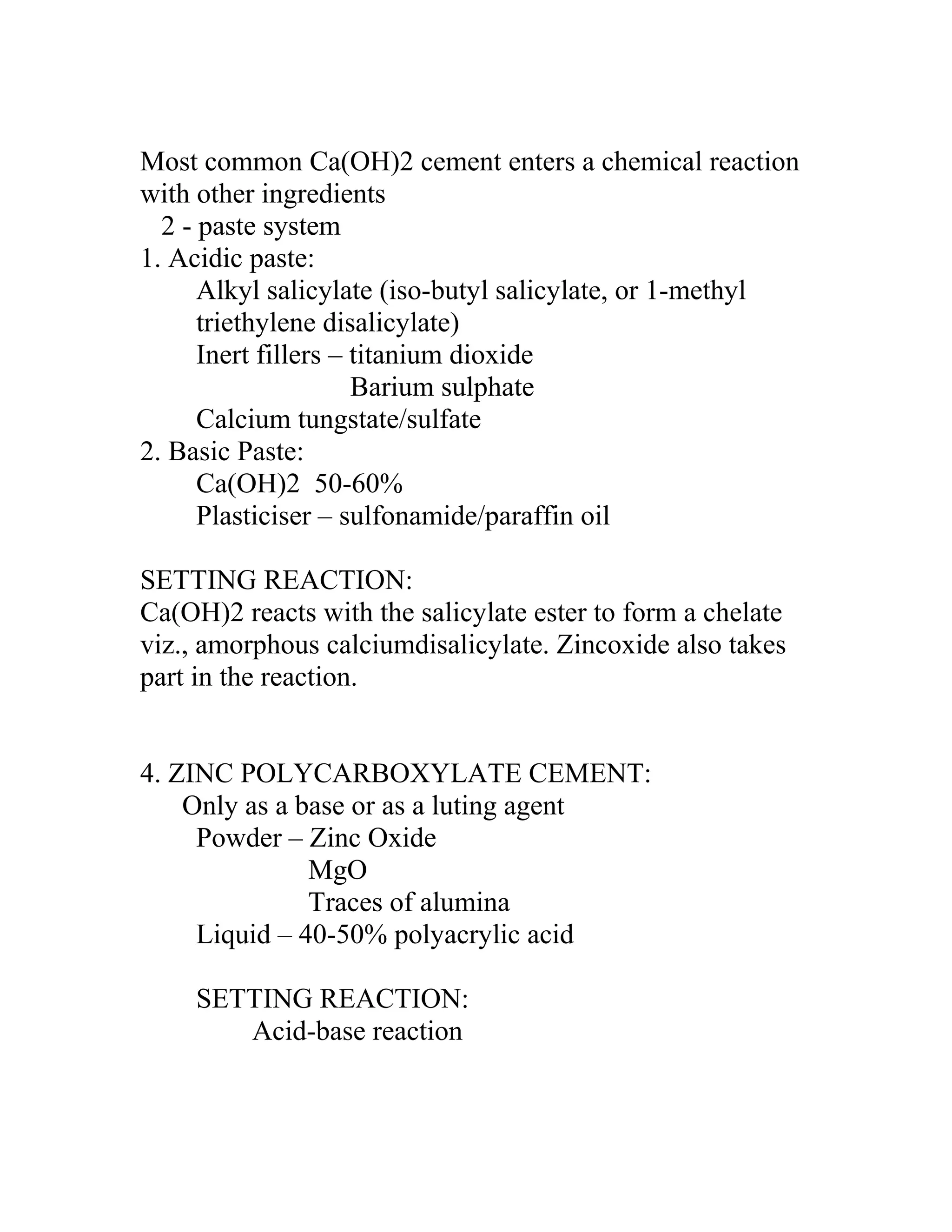
Most common Ca(OH)2 cement enters a chemical reaction
with other ingredients
2 - paste system
1. Acidic paste:
Alkyl salicylate (iso-butyl salicylate, or 1-methyl
triethylene disalicylate)
Inert fillers – titanium dioxide
Barium sulphate
Calcium tungstate/sulfate
2. Basic Paste:
Ca(OH)2 50-60%
Plasticiser – sulfonamide/paraffin oil
SETTING REACTION:
Ca(OH)2 reacts with the salicylate ester to form a chelate
viz., amorphous calciumdisalicylate. Zincoxide also takes
part in the reaction.
4. ZINC POLYCARBOXYLATE CEMENT:
Only as a base or as a luting agent
Powder – Zinc Oxide
MgO
Traces of alumina
Liquid – 40-50% polyacrylic acid
SETTING REACTION:
Acid-base reaction
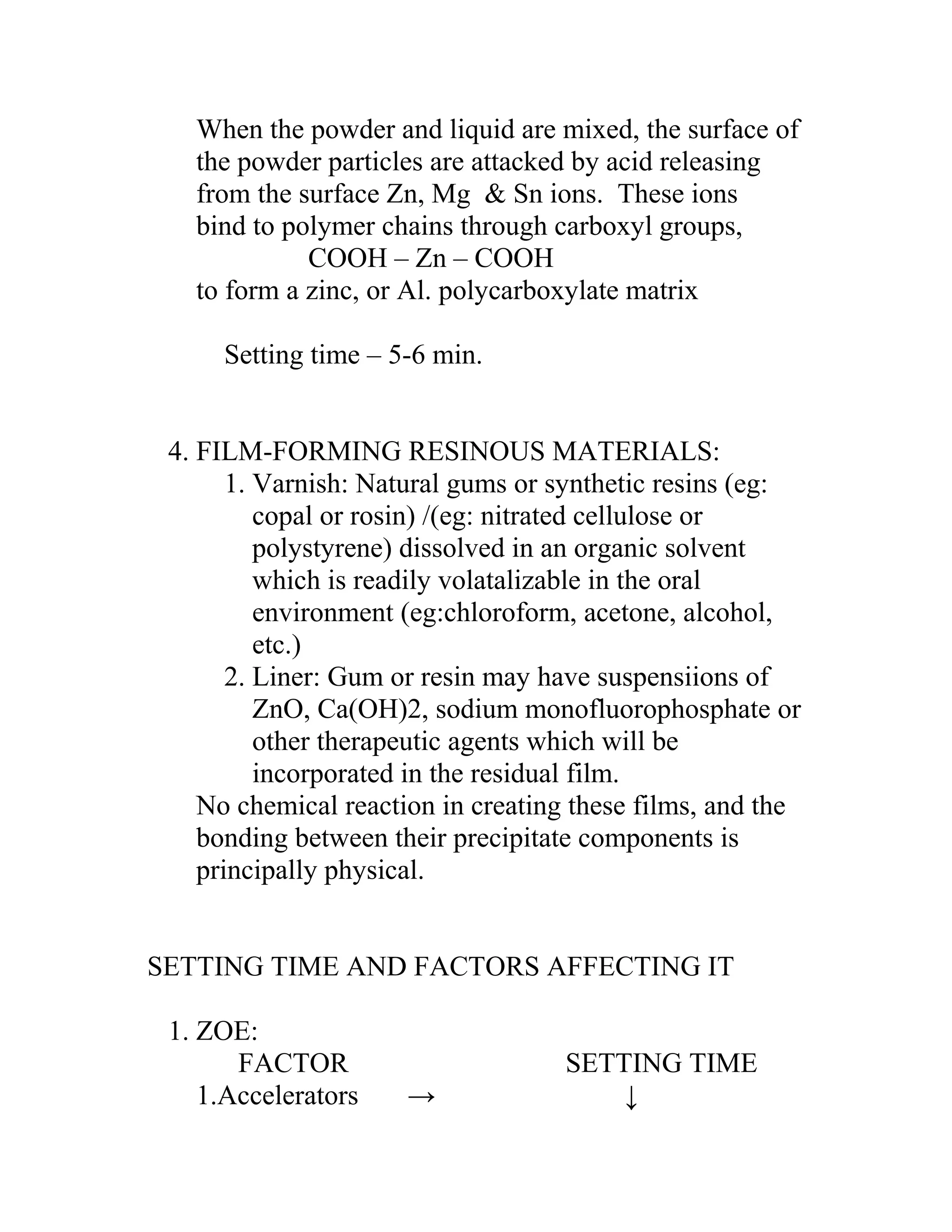
When the powder and liquid are mixed, the surface of
the powder particles are attacked by acid releasing
from the surface Zn, Mg & Sn ions. These ions
bind to polymer chains through carboxyl groups,
COOH – Zn – COOH
to form a zinc, or Al. polycarboxylate matrix
Setting time – 5-6 min.
4. FILM-FORMING RESINOUS MATERIALS:
1. Varnish: Natural gums or synthetic resins (eg:
copal or rosin) /(eg: nitrated cellulose or
polystyrene) dissolved in an organic solvent
which is readily volatalizable in the oral
environment (eg:chloroform, acetone, alcohol,
etc.)
2. Liner: Gum or resin may have suspensiions of
ZnO, Ca(OH)2, sodium monofluorophosphate or
other therapeutic agents which will be
incorporated in the residual film.
No chemical reaction in creating these films, and the
bonding between their precipitate components is
principally physical.
SETTING TIME AND FACTORS AFFECTING IT
1. ZOE:
FACTOR SETTING TIME
1.Accelerators → ↓
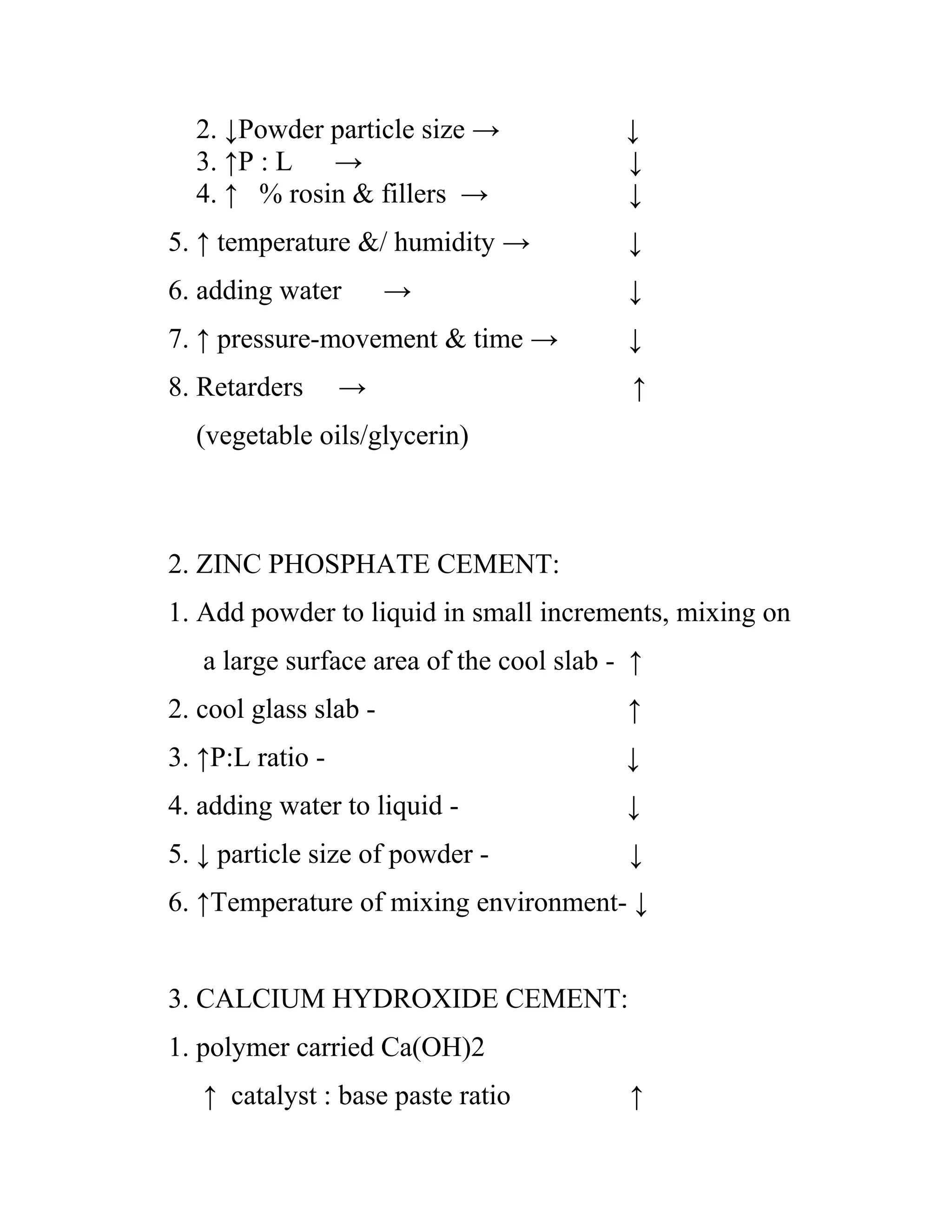
2. ↓Powder particle size → ↓
3. ↑P : L → ↓
4. ↑ % rosin & fillers → ↓
5. ↑ temperature &/ humidity → ↓
6. adding water → ↓
7. ↑ pressure-movement & time → ↓
8. Retarders → ↑
(vegetable oils/glycerin)
2. ZINC PHOSPHATE CEMENT:
1. Add powder to liquid in small increments, mixing on
a large surface area of the cool slab - ↑
2. cool glass slab - ↑
3. ↑P:L ratio - ↓
4. adding water to liquid - ↓
5. ↓ particle size of powder - ↓
6. ↑Temperature of mixing environment- ↓
3. CALCIUM HYDROXIDE CEMENT:
1. polymer carried Ca(OH)2
↑ catalyst : base paste ratio ↑
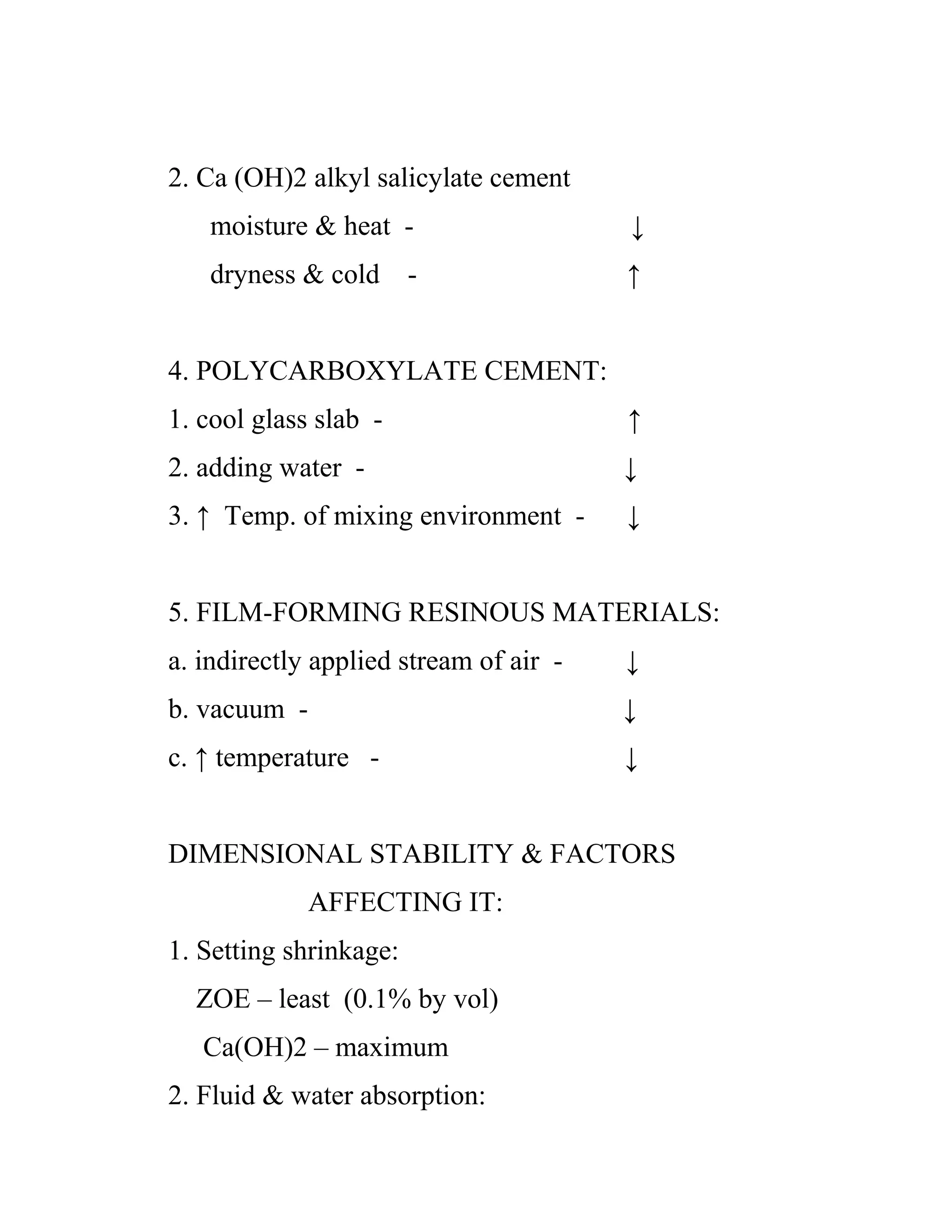
2. Ca (OH)2 alkyl salicylate cement
moisture & heat - ↓
dryness & cold - ↑
4. POLYCARBOXYLATE CEMENT:
1. cool glass slab - ↑
2. adding water - ↓
3. ↑ Temp. of mixing environment - ↓
5. FILM-FORMING RESINOUS MATERIALS:
a. indirectly applied stream of air - ↓
b. vacuum - ↓
c. ↑ temperature - ↓
DIMENSIONAL STABILITY & FACTORS
AFFECTING IT:
1. Setting shrinkage:
ZOE – least (0.1% by vol)
Ca(OH)2 – maximum
2. Fluid & water absorption:
More in Ca(OH)2 & ZnPO4
3. LCTE:
ZOE – closest to tooth structure
4. Solubility & disintegration
Ca(OH)2 – most soluble
ZOE – disintegrates very fast in mouth
6. Flow :
Uncarried Ca(OH)2 has the highest flow followed by
unmodified ZOE, polymer carried and cement type
Ca(OH)2, polycarboxylate cement and the lowest is
for Zinc Phosphate cement
STRENGTH:
1. Compressive Strength:
• ZOE – 3-55 Mpa
• Ca(OH)2 – 10-27 Mpa
• ZnPO4 – 120 Mpa
• PCC – 60-80 Mpa
• GIC – 150 Mpa
2. Tensile Strength:
• ZOE – 0.32-5.8 Mpa
• Ca(OH)2 - 1 Mpa
• ZnPO4 – 5.5 Mpa
• PCC – 6-8 Mpa
• GIC – 6.6 Mpa
Film – forming resinous materials : thin film
thicknesses – not possible to ascertain strength figures
ADAPTABILITY:
1. FILM THICKNESS:
film-forming resinous mat. - least (5 - 10µ)
followed by Zinc Phosphate (8 - 10µ)
ZOE – (35 - 40µ)
Ca(OH)2 – highest (70 - 90µ)
The lower the film thickness, the better its wetting
ability and the better its adaptability.
2. VISCOSITY:
film-forming resinous mat. – lowest
followed by Zinc Phosphate
PCC – highest
The lower the viscosity, the better its wetting ability
and the greater its adaptability
3. PHYSICO-CHEMICAL BONDING TO TOOTH
STRUCTURE:
Only PCC & GIC have ability to chelate calcium
from tooth structure.
4. LCTE:
ZOE – closest to tooth LCTE
Similar LCTE between base and tooth – increased
adhesion.
5. STRENGTH :
GIC – 150 Mpa
The higher the strength of base, the more permanent
will be its adaptability.
6. SELF-ETCHING:
Achieved by creating irregularities in the tooth surface
and increasing the adaptability and retentive
adhesiveness of the base to tooth structure, especially
enamel.
 Every IB material has some characteristics that
enhance its adaptability & the possibility of adhesion
to tooth structure. Eg:-
 Zn phosphate has low film thickness, high
strength & has low viscosity
 ZOE has a favourable LCTE & initial low
viscosity
 PCC possess physico-chemical adhesion &
strength
 Film-forming resinous materials have the lowest
viscosity & lowest film thickness of all materials
 GIC possess physico-chemical adhesion &
strength
 The only material that has none of the
adaptability enhancing properties is Calcium
hydroxide & then it demonstrates the lowest
adaptability to tooth substance.
BIOLOGICAL COMPATIBILITY WITH THE
P-D ORGAN:
1. ZOE:
 Least irritating of all intermediary bases
 If comes in direct contact with the pulp –
a. if pulp healthy – limited chronic inflammation -
the area will be walled off by fibrous tissues followed
by bridging of exposure.
 Chronic inflammation may propagate to involve
all the pulp & root canal tissues with slow
symptomless necrosis
 Completely impervious layer
 Does not ↑ the permeablity of underlying dentin
 Excellent thermal insulator. Not an E.I.
2. ZINC PHOSPHATE CEMENT:
 Most irritating of all Intermediary bases
 1.E.D. ≥ 2.5mm – usually healthy,
occasionally unhealthy reparative
reaction may precipitate
 2.E.D.1.5-2.5mm – mostly unhealthy, sometimes
destruction will occur
 3.E.D.<1.5mm – always destruction in the pulpal
tissues
 Creates partially impervious layer- >1mm
thickness
 Completely pervious – thinner applications
 ↑ permeability of the underylin dentin
 Excellent thermal insulator in 1mm or more
 Not an electrical insulator
3. CALCIUM HYDROXIDE CEMENT:
• Irritant to P-D organ, if it comes in contact with it
• Healthy pulp, following pulpal reaction can occur:
• 1. E.D.≥100µm-healthy reparative reaction
• 2. E.D.<100µm-unhealthy reparative
• 3. E.D.-0µm-layer of tissue in contact directly will
undergo necrosis
• 4. If Ca(OH)2 comes in contact with degenerating
pulp tissues, the degeneration will be converted to a
calcific type of degeneration – devitalized.
• Porous at any thickness
• ↓ permeability of the underlying dentin
• Can be a Thermal insulator
• Not an electrical insulator
4. ZINC POLYCARBOXYLATE CEMENT:
• Minimally irritating
• E.D.≥1mm – healthy reparative reaction
• E.D.<1mm – either unhealthy or more
frequently, destruction
• E.D.0mm – destructive reaction
• Partially impervious layer
• Does not ↑ permeability of underlying dentin
• ≥1.5mm – good thermal insulator
• <1.5mm – not an effective thermal insulator
• Not an electrical insulator
Intermediary bases

Intermediary bases

  • 1.
  • 2.
    CONTENTS 1. Introduction 2. Classificationof Intermediary Bases 3. Ideal requirements for Intermediary Base materials 4. Materials used for Intermediary bases 5. Compositiion & setting reaction 6. Setting time & Factors affecting it 7. Dimensional stability & Factors affecting it 8. Strength 9. Hardness 10. Elastic Modulus 11. Biological compatibility with the P-D organ 12. Principles of Intermediary Bases 13. Determination of the Effective Depth 14. Compatibility of Intermediary Base materials with Restorative materials & techniques 15. Conclusion 16. References
  • 3.
    INTRODUCTION: Intermediary bases arethe agents that are applied to the cut tooth structure after removing the diseased tissues and completing the tooth preparation to prevent further irritation of the P-D organ as well as to improve the defense capabilities of that organ. CLASSIFICATION OF INTERMEDIARY BASES: 1. Varnishes 2. Liners 3. Sub bases 4. Bases VARNISHES(Solution Liners) : They are principally natural gums, such as copals or rosins,or synthetic resins dissolved in an organic solvent such as acetone, chloroform or ether. Film thickness is 5-10µm. Applied to all prepared dentin surfaces and frequently on prepared enamel. Eg: Copal Resin Varnish LINERS: Cement or resin coating of minimal thickness (usually less than 0.5mm) to achieve a physical barrier to bacteria and their products and or to provide a therapeutic effect,such as an antibacterial or pulpal anodyne effect. Thicker than varnish - 25µm.
  • 4.
    Eg: Ca(OH)2, GIC,Reinforced ZOE (IRM) SUBBASES: Therapeutic materials placed in deep portions of the cavity preparation. Possess specific pharmacological actions. Should be covered with or carried in a supporting base. Eg: Unmodified ZOE, Ca(OH)2. BASES: Materials to replace missing dentin, used for bulk buildup and or for blocking out undercuts in preparations for indirect restorations. Eg: ZnPO4, Polycarboxylate cement, GIC, Resin- modified GIC. BASED ON STRENGTH; 1. High Strength bases 2. Low Strength bases 1. HIGH STRENGTH BASES: Provide thermal protection for the pulp, as well as mechanical support for the restoration. Eg: ZnPO4, PCC, GIC, Reinforced ZOE 2. LOW STRENGTH BASES: Have minimum strength and low rigidity. Main function is to act as a barrier to irritating chemicals and to provide therapeutic benefit to the pulp. Eg: Ca(OH)2, ZOE
  • 5.
    IDEAL REQUIREMENTS FORINTERMEDIARY BASE MATERIALS: 1. The material should be capable of creating an impervious layer on cut vital dentin in a thickness which neither impinges on the bulk of the restorative material nor compromises the mechanical properties of the restoration. 2. should be biologically compatible with the P-D organ 3. should be chemically compatible with both the P-D organ and the restorative material 4. should discolor neither the tooth nor the restorative material. 5. should harden quickly to allow for the subsequent insertion of the restorative material 6. the set material should withstand,without changing shape or location, the condensation forces involved in placing permanent restorative material 7. should stabilize or diminish dentin permeability 8. should be able to be easily manipulated in its preparation and insertion MATERIALS USED FOR INTERMEDIARY BASES: 1. Zinc Oxide and Eugenol 2. Calcium Hydroxide 3. Zinc Phosphat cement 4. Zinc Poly Carboxylate cement 5. Varnishses & film-forming resinous materials
  • 6.
    6. Glass Ionomoercement or ASPA COMPOSITION & SETTING REACTION: 1. ZINC OXIDE AND EUGENOL: a. Unmodified ZOE b. Modified ZOE A. UNMODIFIED ZOE: Only as a therapeutic agent Powder – ZnO Liquid - Eugenol/Oil of cloves Setting Reaction: Setting time : 8-10 minutes Acid-base reaction (chelation reaction) ZnO + H2O → Zn(OH)2 Zn(OH)2 + 2HE→ZnE2 + 2H2O Base Acid Salt B. MODIFIED ZOE: Base Powder – ZnO Modifiers are: 1. Rosin 2. Fillers : Polystyrene Silica Alumina Diatomaceous earth Cotton fibers etc., 3. Accelerators:
  • 7.
    Zinc acetate, Propionate/succinate CaCl2, Low molecularwt. Primary alcohols 4. Medicaments: Coagulants Bactericidal and Bacteriostatic Agents SETTING REACTION: Saponification reaction ZnO + 2RCOOH(EBA) → (RCOO)2 Zn + H2O An insoluble soap is formed (Saponification reaction) ZnO + 2HE → ZnE2 + H2O (Chelation reaction) 2. ZINC PHOSPHATE CEMENT: Only as a base or as a luting agent Powder – ZnO – 90% MgO Traces of tribismuth oxide and silicon Dioxide Liquid – 45-55% O-Phosphoric acid Al, Zn & bismuth phosphates SETTING REACTION: Setting time – 5-9 minutes
  • 8.
    ZnO + H3PO4→ Zn.Al.PO4 + H2O + Heat 3. CALCIUM HYDROXIDE CEMENT: Subbase (therapeutic) & base. Available in different forms 1. powder + distilled water / sterile saline solutioln. 2. powder suspended in plasma, distilled water/ chloroform ( applied on tooth surface with a syringe) 3. Calcium hydroxide in pure powder form without any carrier 4. carried in any biologically compatible and degradable polymeric material 2-paste system Base paste: Monomer of methyl cellulose Chemical initiator Ca(OH)2 particles Catalyst paste: Catalyst Ca(OH)2 particles 5. Non-polymer carried Ca(OH)2 6. Light cure Ca(OH)2 SETTING REACTION: 1. Polymer based Ca(OH)2: Chemical coherence of the ingredients i.e., the bonding that occurs between the polymer macromolecules. Ca(OH)2 does not enter into chemical reaction. The polymer meshwork carries the Ca(OH)2 to the P-D organ, where it is available to engage in its therapeutic action.
  • 9.
    Most common Ca(OH)2cement enters a chemical reaction with other ingredients 2 - paste system 1. Acidic paste: Alkyl salicylate (iso-butyl salicylate, or 1-methyl triethylene disalicylate) Inert fillers – titanium dioxide Barium sulphate Calcium tungstate/sulfate 2. Basic Paste: Ca(OH)2 50-60% Plasticiser – sulfonamide/paraffin oil SETTING REACTION: Ca(OH)2 reacts with the salicylate ester to form a chelate viz., amorphous calciumdisalicylate. Zincoxide also takes part in the reaction. 4. ZINC POLYCARBOXYLATE CEMENT: Only as a base or as a luting agent Powder – Zinc Oxide MgO Traces of alumina Liquid – 40-50% polyacrylic acid SETTING REACTION: Acid-base reaction
  • 10.
    When the powderand liquid are mixed, the surface of the powder particles are attacked by acid releasing from the surface Zn, Mg & Sn ions. These ions bind to polymer chains through carboxyl groups, COOH – Zn – COOH to form a zinc, or Al. polycarboxylate matrix Setting time – 5-6 min. 4. FILM-FORMING RESINOUS MATERIALS: 1. Varnish: Natural gums or synthetic resins (eg: copal or rosin) /(eg: nitrated cellulose or polystyrene) dissolved in an organic solvent which is readily volatalizable in the oral environment (eg:chloroform, acetone, alcohol, etc.) 2. Liner: Gum or resin may have suspensiions of ZnO, Ca(OH)2, sodium monofluorophosphate or other therapeutic agents which will be incorporated in the residual film. No chemical reaction in creating these films, and the bonding between their precipitate components is principally physical. SETTING TIME AND FACTORS AFFECTING IT 1. ZOE: FACTOR SETTING TIME 1.Accelerators → ↓
  • 11.
    2. ↓Powder particlesize → ↓ 3. ↑P : L → ↓ 4. ↑ % rosin & fillers → ↓ 5. ↑ temperature &/ humidity → ↓ 6. adding water → ↓ 7. ↑ pressure-movement & time → ↓ 8. Retarders → ↑ (vegetable oils/glycerin) 2. ZINC PHOSPHATE CEMENT: 1. Add powder to liquid in small increments, mixing on a large surface area of the cool slab - ↑ 2. cool glass slab - ↑ 3. ↑P:L ratio - ↓ 4. adding water to liquid - ↓ 5. ↓ particle size of powder - ↓ 6. ↑Temperature of mixing environment- ↓ 3. CALCIUM HYDROXIDE CEMENT: 1. polymer carried Ca(OH)2 ↑ catalyst : base paste ratio ↑
  • 12.
    2. Ca (OH)2alkyl salicylate cement moisture & heat - ↓ dryness & cold - ↑ 4. POLYCARBOXYLATE CEMENT: 1. cool glass slab - ↑ 2. adding water - ↓ 3. ↑ Temp. of mixing environment - ↓ 5. FILM-FORMING RESINOUS MATERIALS: a. indirectly applied stream of air - ↓ b. vacuum - ↓ c. ↑ temperature - ↓ DIMENSIONAL STABILITY & FACTORS AFFECTING IT: 1. Setting shrinkage: ZOE – least (0.1% by vol) Ca(OH)2 – maximum 2. Fluid & water absorption:
  • 13.
    More in Ca(OH)2& ZnPO4 3. LCTE: ZOE – closest to tooth structure 4. Solubility & disintegration Ca(OH)2 – most soluble ZOE – disintegrates very fast in mouth 6. Flow : Uncarried Ca(OH)2 has the highest flow followed by unmodified ZOE, polymer carried and cement type Ca(OH)2, polycarboxylate cement and the lowest is for Zinc Phosphate cement STRENGTH: 1. Compressive Strength: • ZOE – 3-55 Mpa • Ca(OH)2 – 10-27 Mpa • ZnPO4 – 120 Mpa • PCC – 60-80 Mpa • GIC – 150 Mpa 2. Tensile Strength: • ZOE – 0.32-5.8 Mpa • Ca(OH)2 - 1 Mpa
  • 14.
    • ZnPO4 –5.5 Mpa • PCC – 6-8 Mpa • GIC – 6.6 Mpa Film – forming resinous materials : thin film thicknesses – not possible to ascertain strength figures ADAPTABILITY: 1. FILM THICKNESS: film-forming resinous mat. - least (5 - 10µ) followed by Zinc Phosphate (8 - 10µ) ZOE – (35 - 40µ) Ca(OH)2 – highest (70 - 90µ) The lower the film thickness, the better its wetting ability and the better its adaptability. 2. VISCOSITY: film-forming resinous mat. – lowest followed by Zinc Phosphate PCC – highest The lower the viscosity, the better its wetting ability and the greater its adaptability
  • 15.
    3. PHYSICO-CHEMICAL BONDINGTO TOOTH STRUCTURE: Only PCC & GIC have ability to chelate calcium from tooth structure. 4. LCTE: ZOE – closest to tooth LCTE Similar LCTE between base and tooth – increased adhesion. 5. STRENGTH : GIC – 150 Mpa The higher the strength of base, the more permanent will be its adaptability. 6. SELF-ETCHING: Achieved by creating irregularities in the tooth surface and increasing the adaptability and retentive adhesiveness of the base to tooth structure, especially enamel.
  • 16.
     Every IBmaterial has some characteristics that enhance its adaptability & the possibility of adhesion to tooth structure. Eg:-  Zn phosphate has low film thickness, high strength & has low viscosity  ZOE has a favourable LCTE & initial low viscosity  PCC possess physico-chemical adhesion & strength  Film-forming resinous materials have the lowest viscosity & lowest film thickness of all materials  GIC possess physico-chemical adhesion & strength  The only material that has none of the adaptability enhancing properties is Calcium hydroxide & then it demonstrates the lowest adaptability to tooth substance. BIOLOGICAL COMPATIBILITY WITH THE P-D ORGAN:
  • 17.
    1. ZOE:  Leastirritating of all intermediary bases  If comes in direct contact with the pulp – a. if pulp healthy – limited chronic inflammation - the area will be walled off by fibrous tissues followed by bridging of exposure.  Chronic inflammation may propagate to involve all the pulp & root canal tissues with slow symptomless necrosis  Completely impervious layer  Does not ↑ the permeablity of underlying dentin  Excellent thermal insulator. Not an E.I. 2. ZINC PHOSPHATE CEMENT:  Most irritating of all Intermediary bases  1.E.D. ≥ 2.5mm – usually healthy, occasionally unhealthy reparative reaction may precipitate  2.E.D.1.5-2.5mm – mostly unhealthy, sometimes destruction will occur
  • 18.
     3.E.D.<1.5mm –always destruction in the pulpal tissues  Creates partially impervious layer- >1mm thickness  Completely pervious – thinner applications  ↑ permeability of the underylin dentin  Excellent thermal insulator in 1mm or more  Not an electrical insulator 3. CALCIUM HYDROXIDE CEMENT: • Irritant to P-D organ, if it comes in contact with it • Healthy pulp, following pulpal reaction can occur: • 1. E.D.≥100µm-healthy reparative reaction • 2. E.D.<100µm-unhealthy reparative • 3. E.D.-0µm-layer of tissue in contact directly will undergo necrosis • 4. If Ca(OH)2 comes in contact with degenerating pulp tissues, the degeneration will be converted to a calcific type of degeneration – devitalized.
  • 19.
    • Porous atany thickness • ↓ permeability of the underlying dentin • Can be a Thermal insulator • Not an electrical insulator 4. ZINC POLYCARBOXYLATE CEMENT: • Minimally irritating • E.D.≥1mm – healthy reparative reaction • E.D.<1mm – either unhealthy or more frequently, destruction • E.D.0mm – destructive reaction • Partially impervious layer • Does not ↑ permeability of underlying dentin • ≥1.5mm – good thermal insulator • <1.5mm – not an effective thermal insulator • Not an electrical insulator