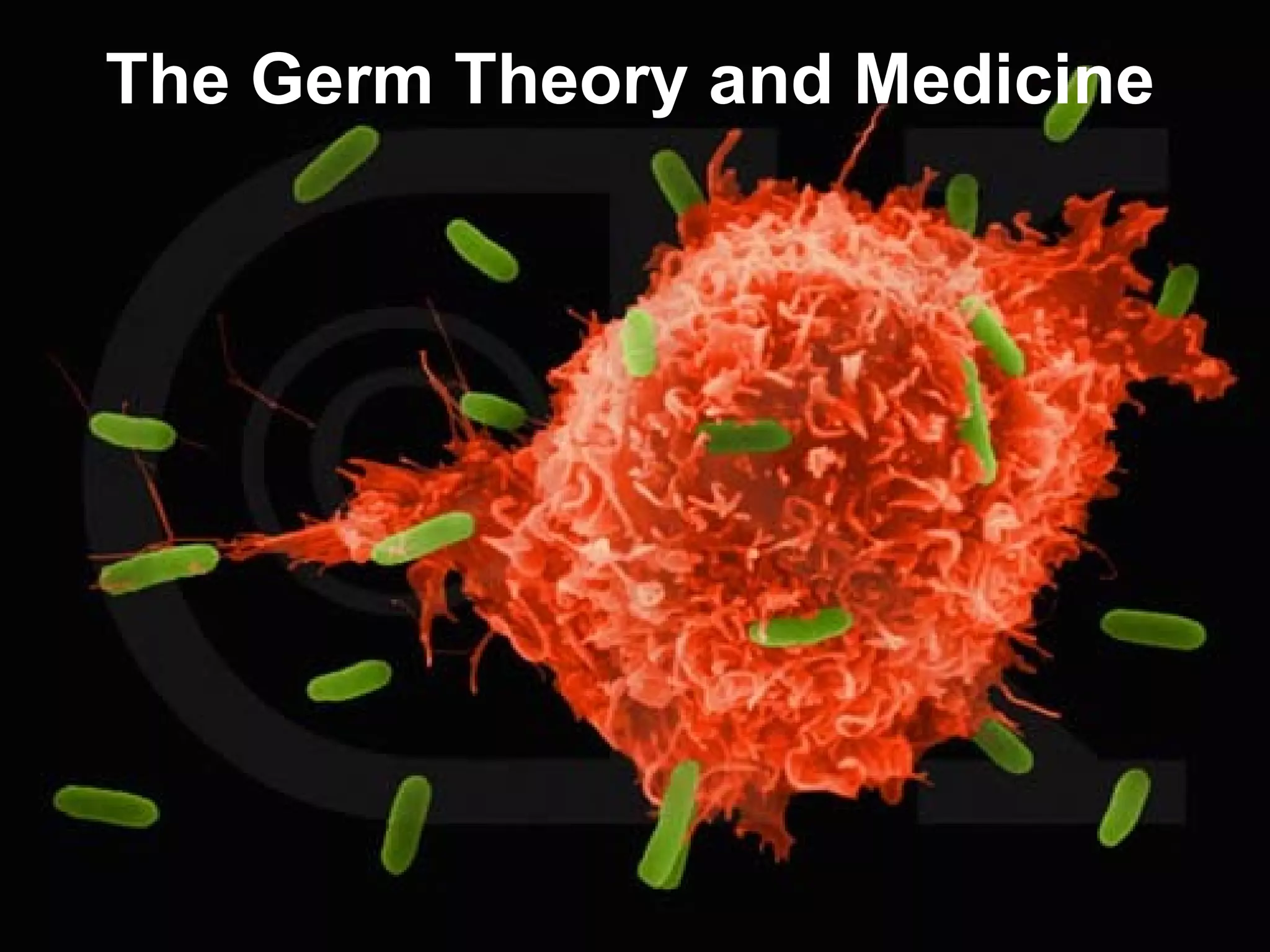
The Germ Theory and Medicine
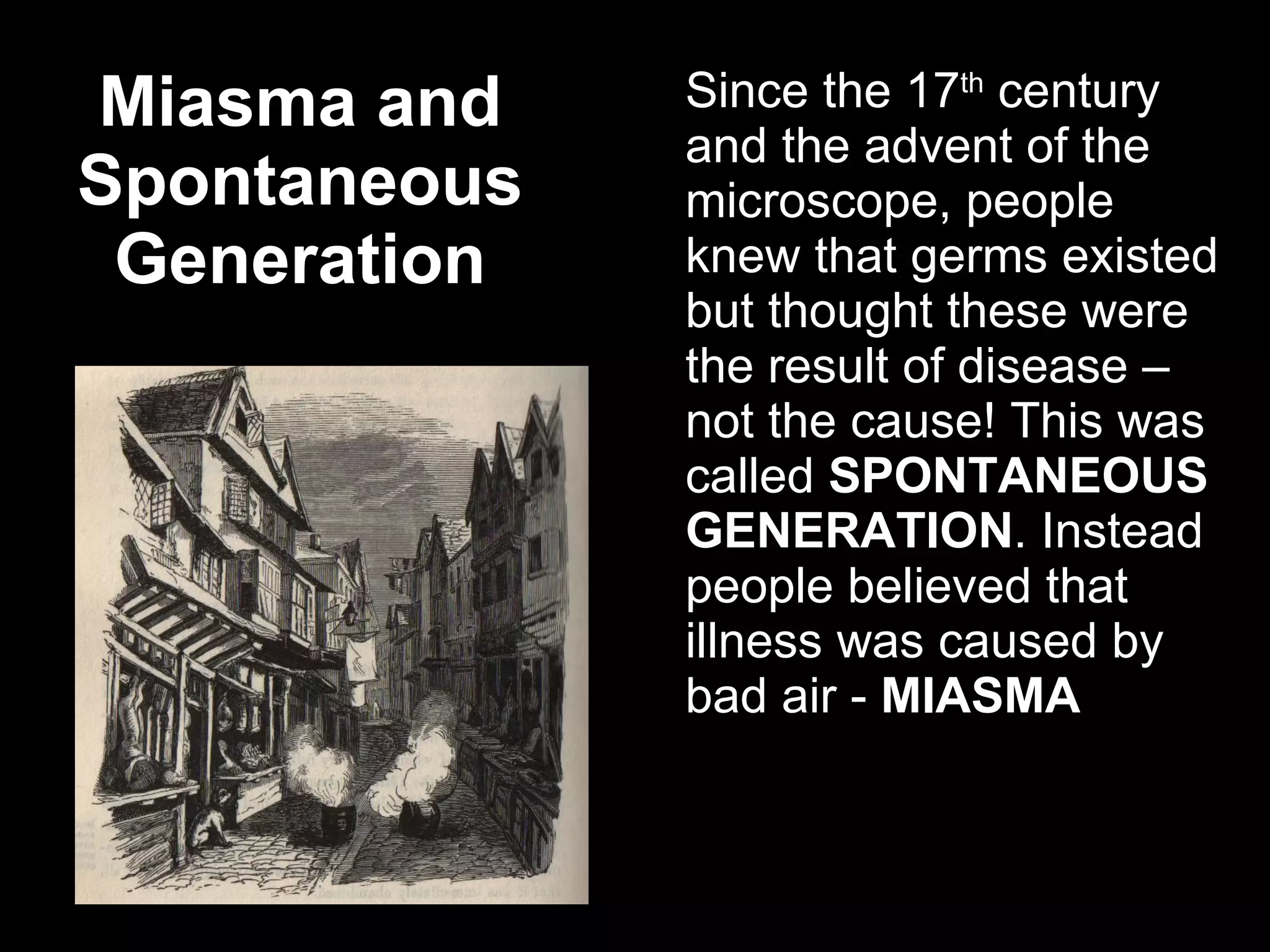
Miasma and Spontaneous Generation Since the 17 th  century and the advent of the microscope, people knew that germs existed but thought these were the result of disease – not the cause! This was called  SPONTANEOUS GENERATION . Instead people believed that illness was caused by bad air -  MIASMA
 
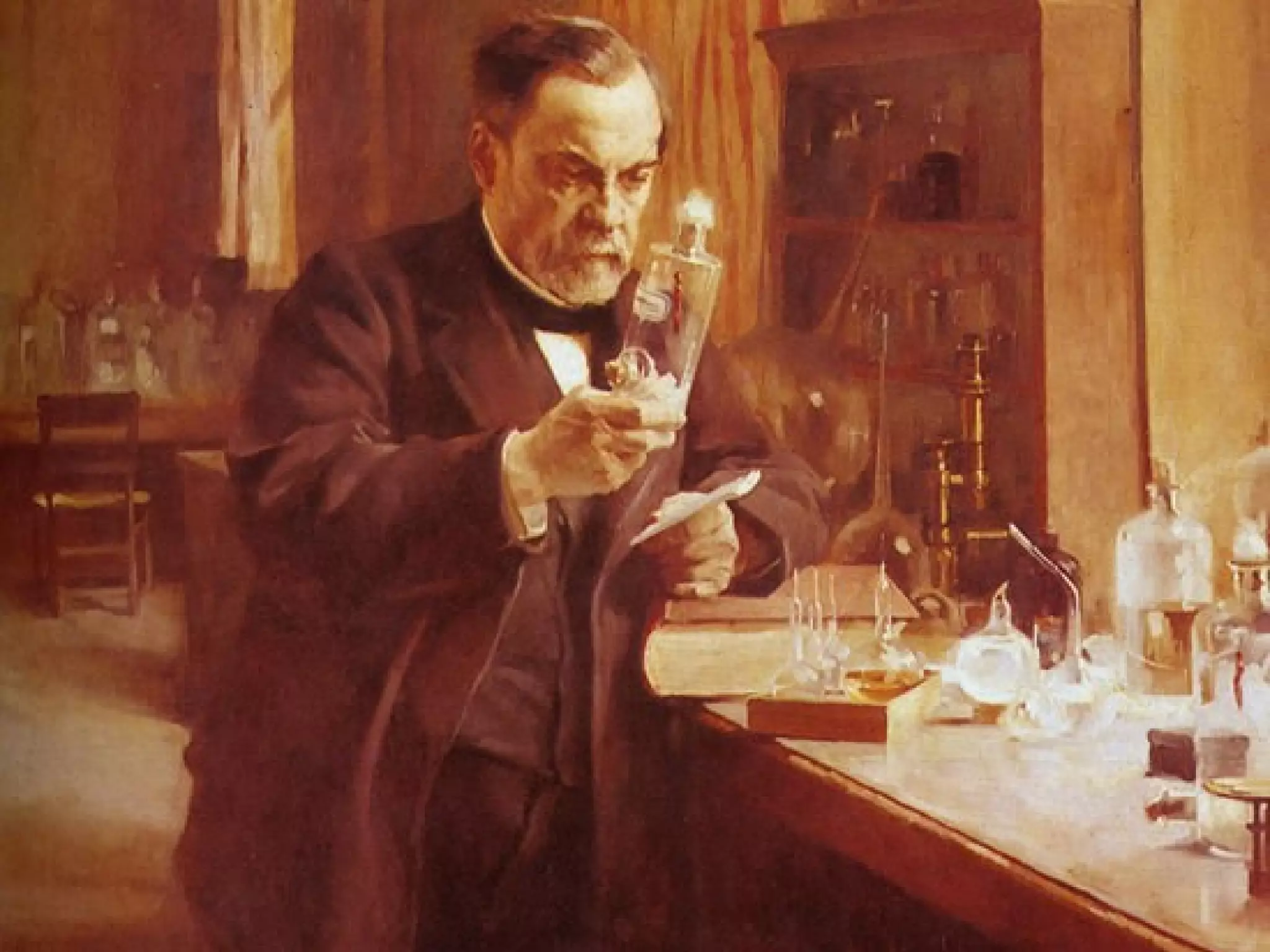
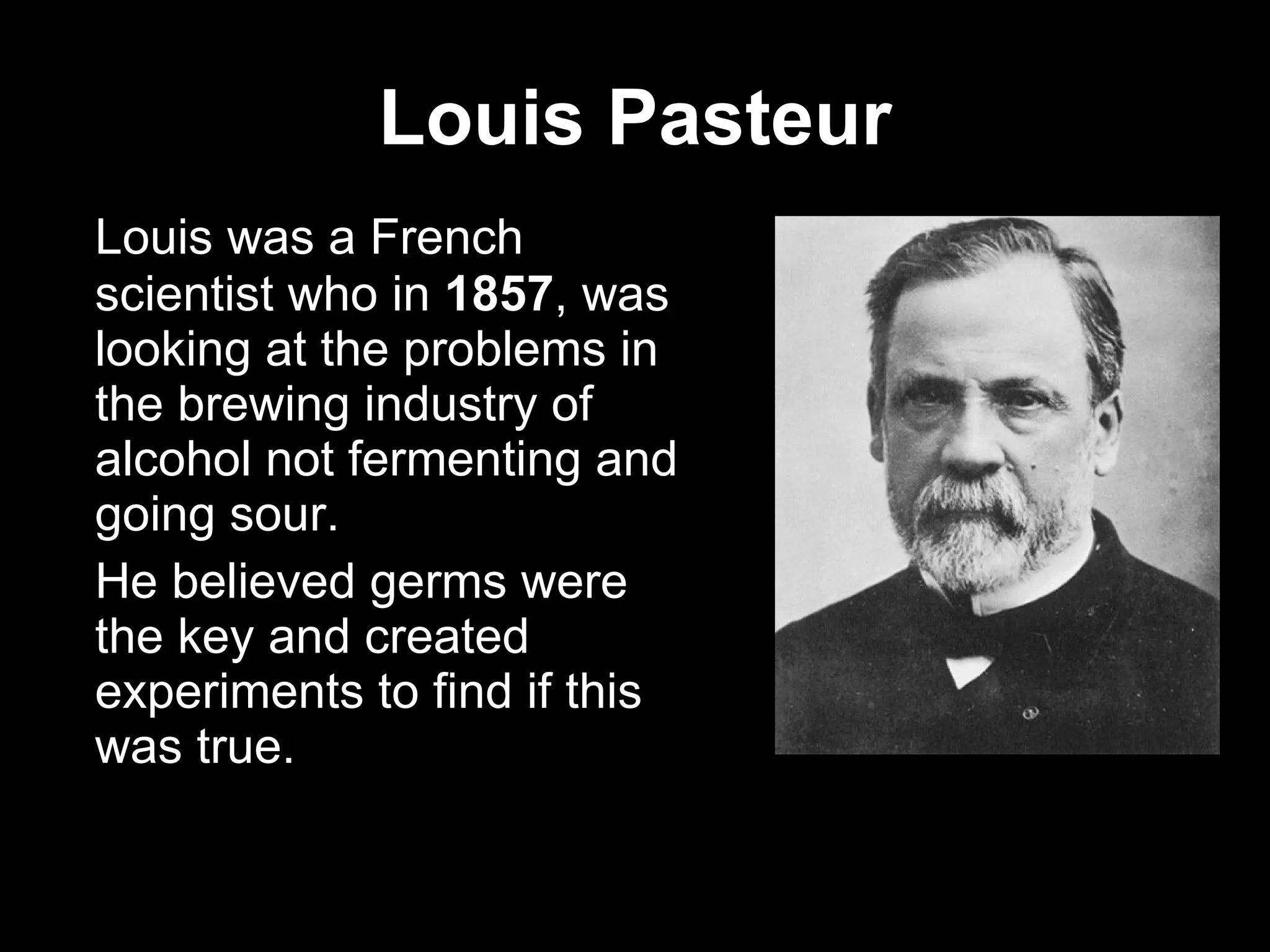
Louis Pasteur Louis was a French scientist who in  1857 , was looking at the problems in the brewing industry of alcohol not fermenting and going sour.  He believed germs were the key and created experiments to find if this was true.
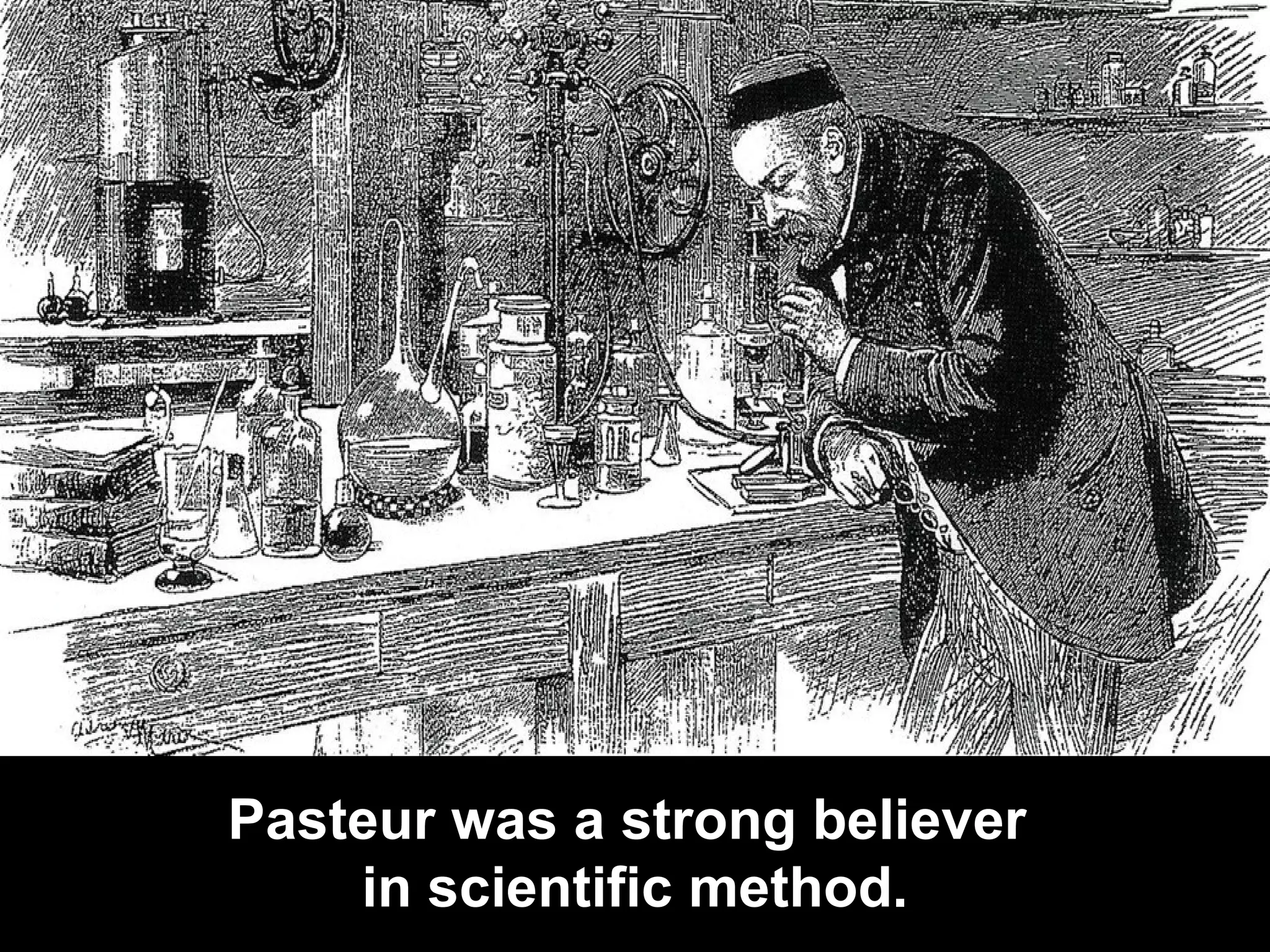
Pasteur was a strong believer  in scientific method.
Reaction Some doctors still held to the belief of spontaneous generation rather than the new germ theory. This was principally because of the long history the theory had.
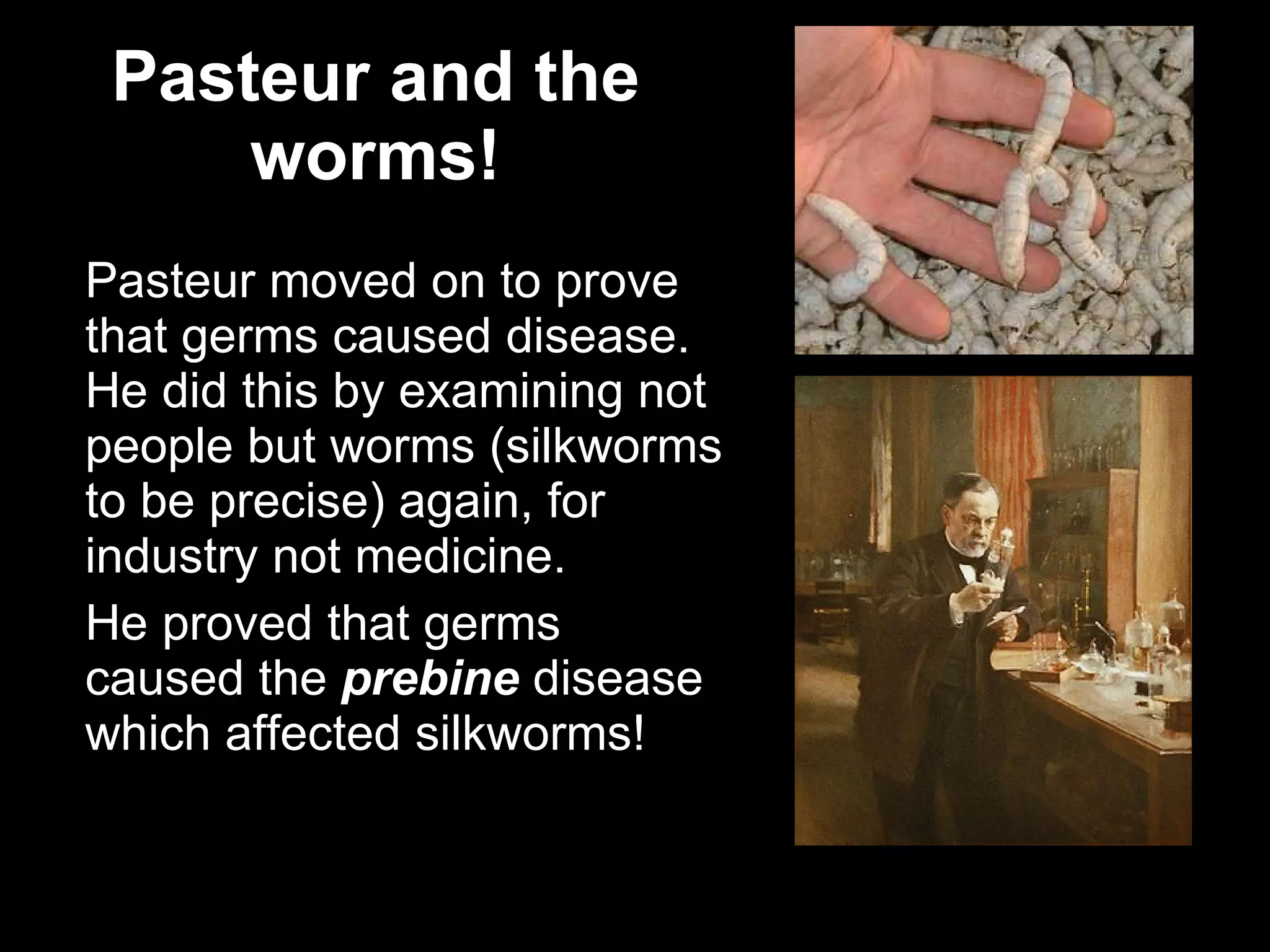
Pasteur and the worms! Pasteur moved on to prove that germs caused disease. He did this by examining not people but worms (silkworms to be precise) again, for industry not medicine. He proved that germs caused the  prebine  disease which affected silkworms!
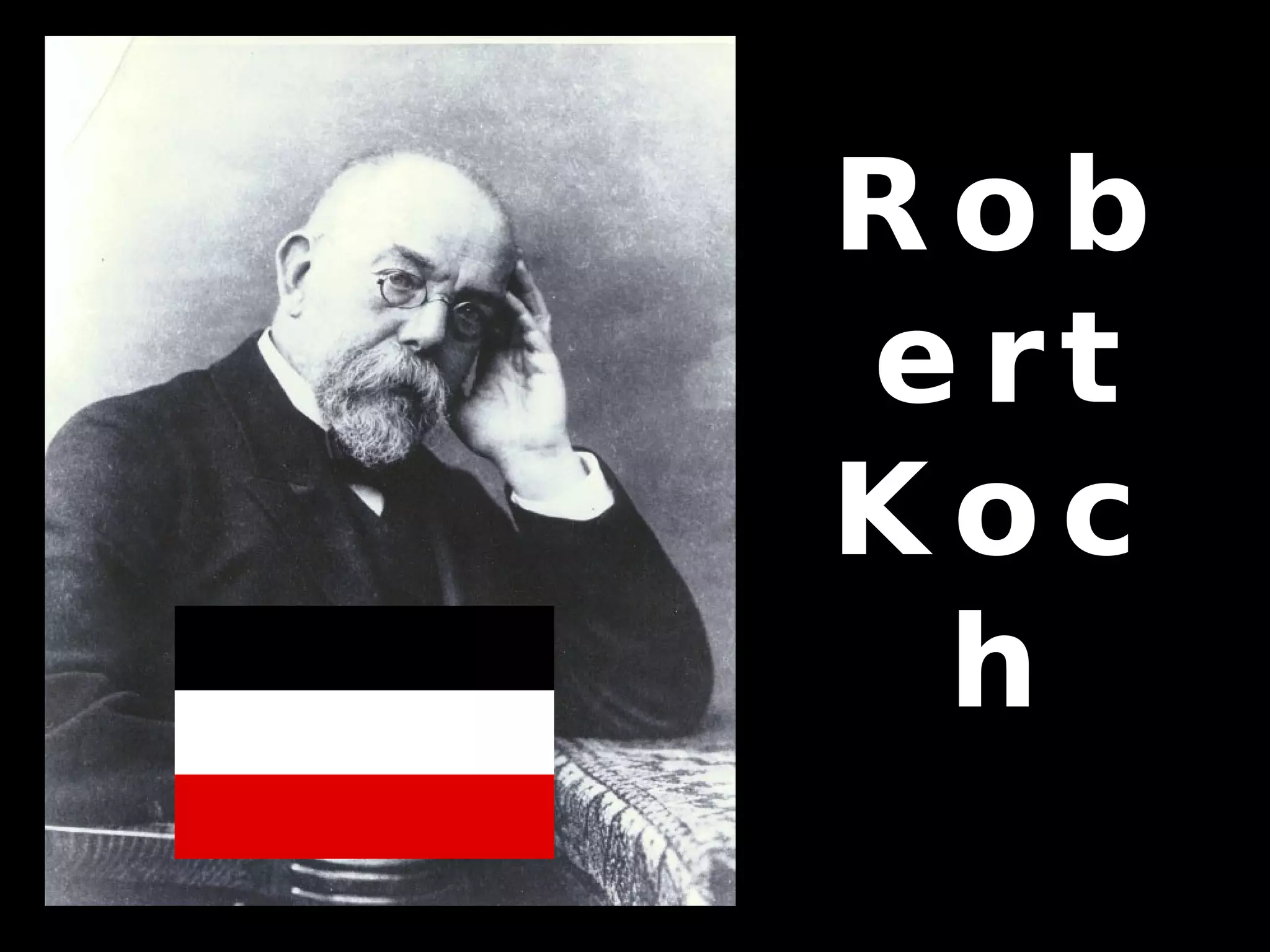
Robert Koch
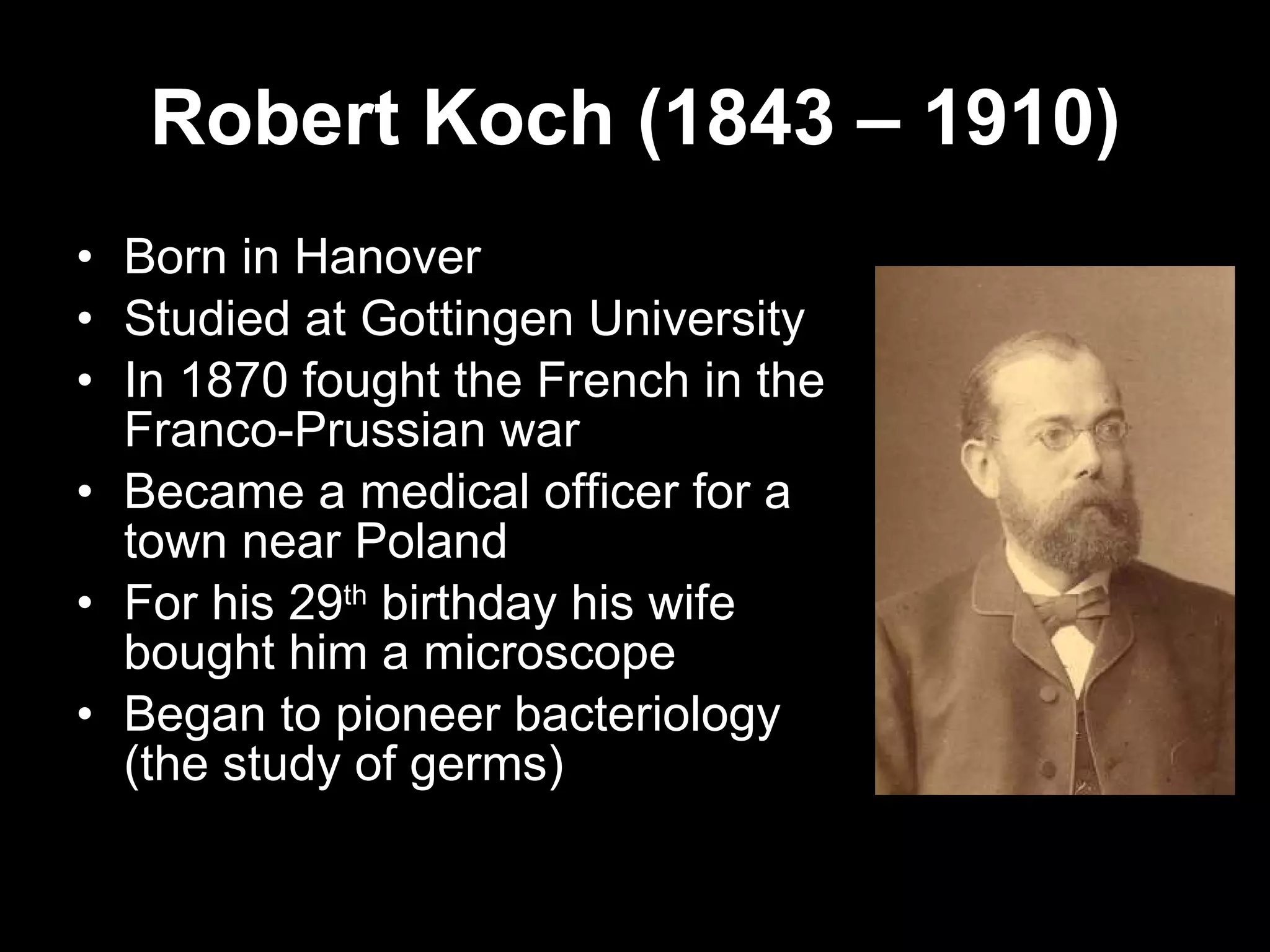
Robert Koch (1843 – 1910) Born in Hanover Studied at Gottingen University In 1870 fought the French in the Franco-Prussian war Became a medical officer for a town near Poland For his 29 th  birthday his wife bought him a microscope Began to pioneer bacteriology (the study of germs)
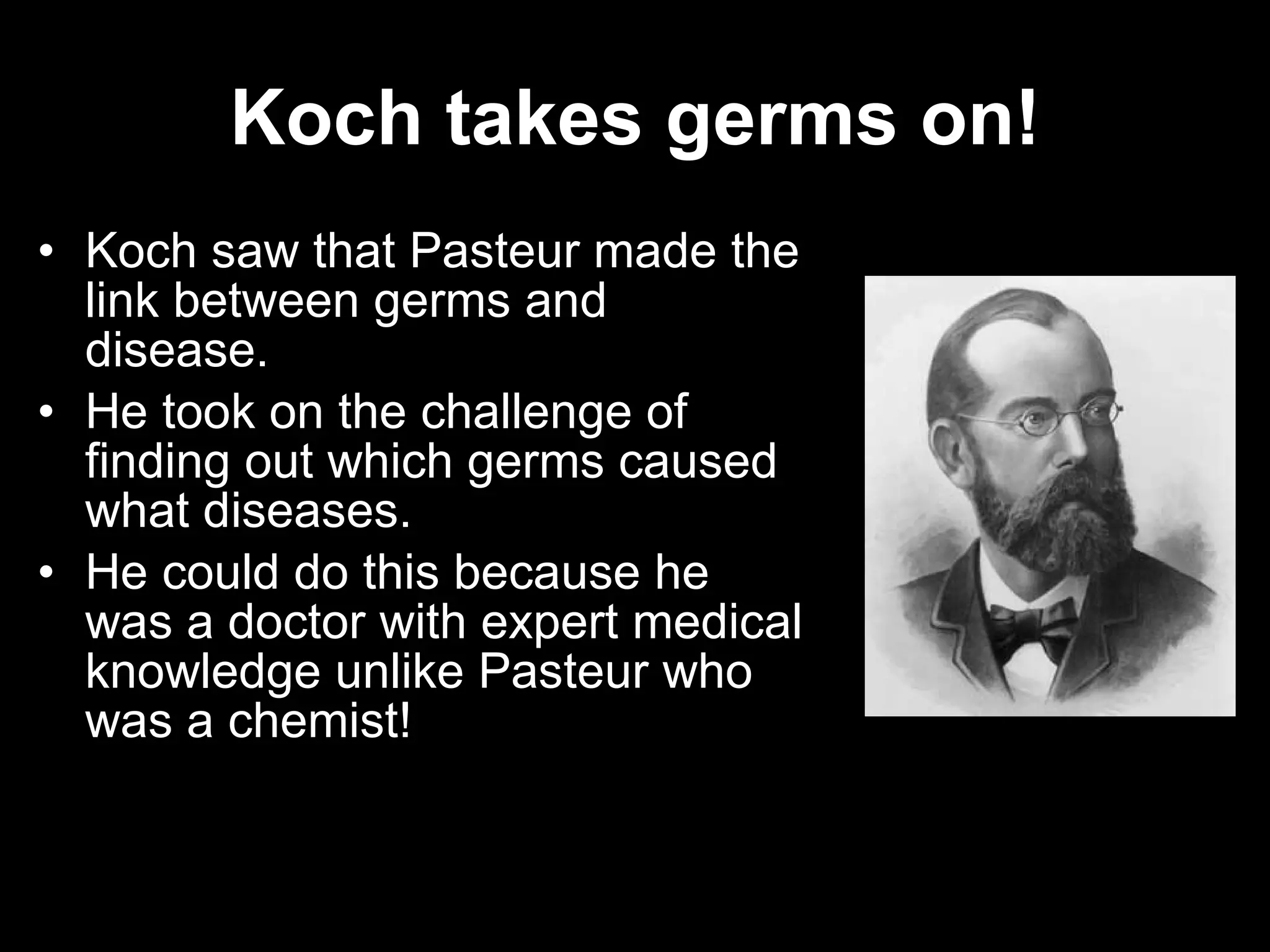
Koch takes germs on! Koch saw that Pasteur made the link between germs and disease. He took on the challenge of finding out which germs caused what diseases. He could do this because he was a doctor with expert medical knowledge unlike Pasteur who was a chemist!
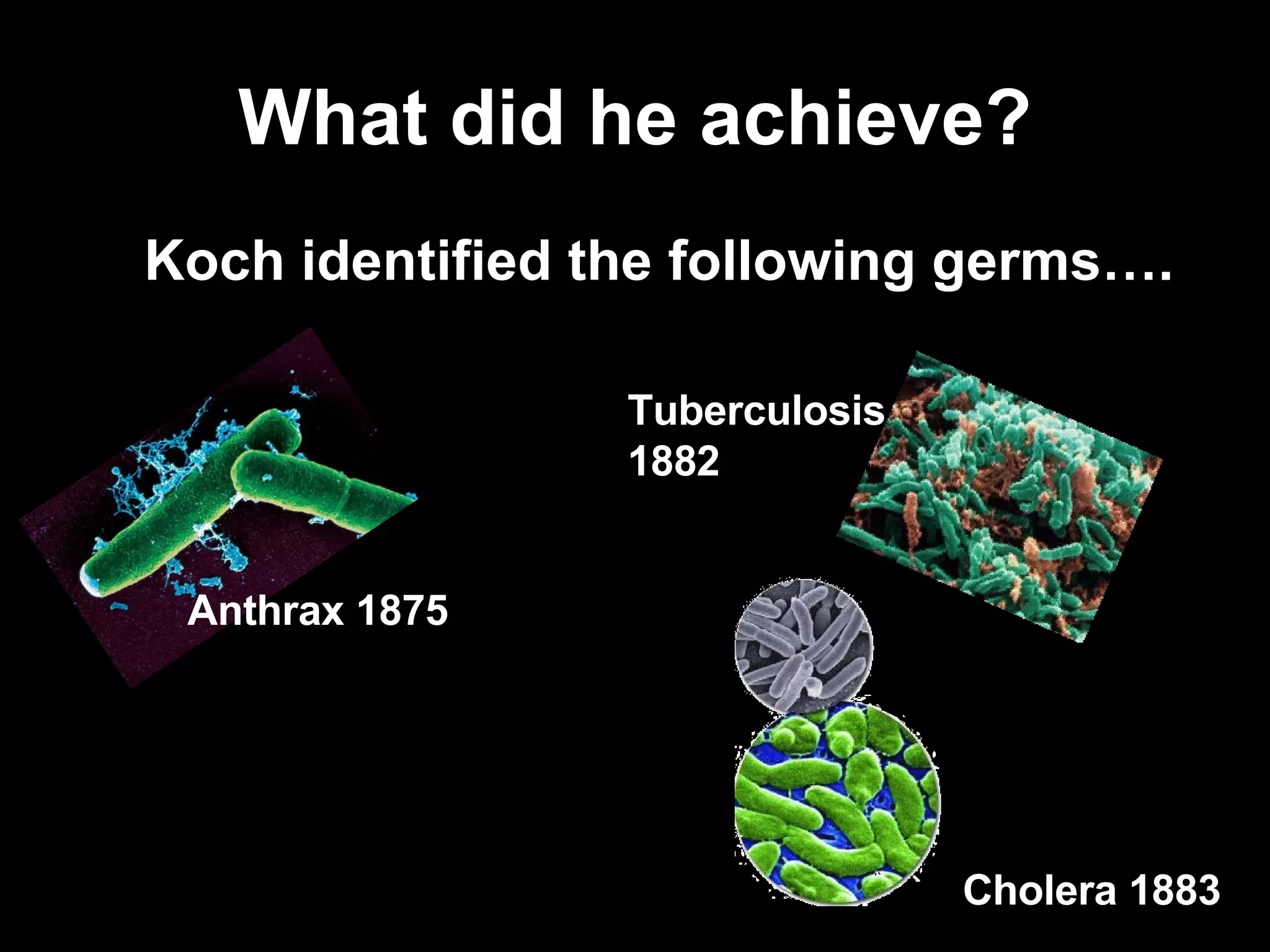
What did he achieve? Koch identified the following germs…. Anthrax 1875 Tuberculosis 1882 Cholera 1883
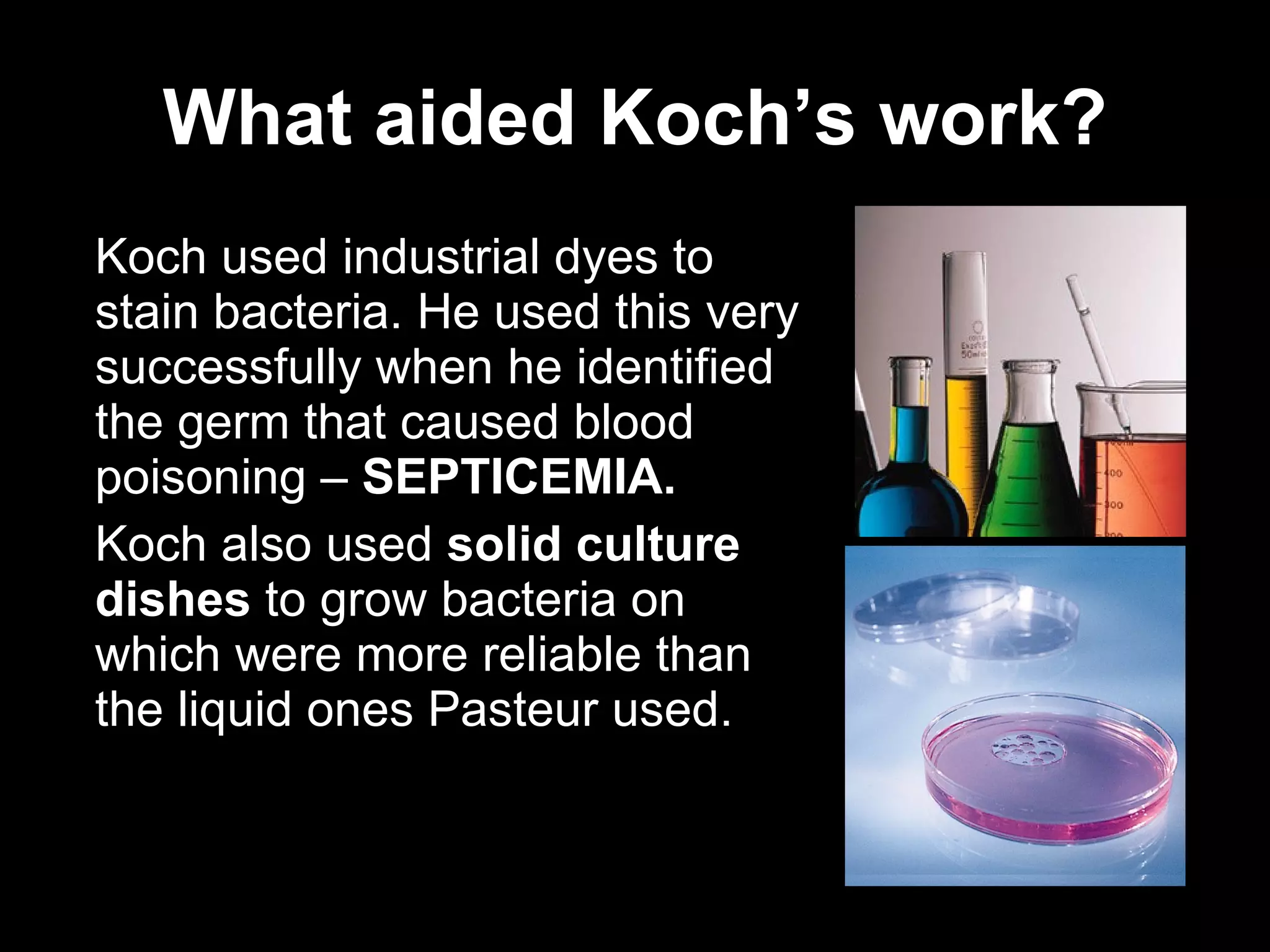
What aided Koch’s work? Koch used industrial dyes to stain bacteria. He used this very successfully when he identified the germ that caused blood poisoning –  SEPTICEMIA. Koch also used  solid culture dishes  to grow bacteria on which were more reliable than the liquid ones Pasteur used.
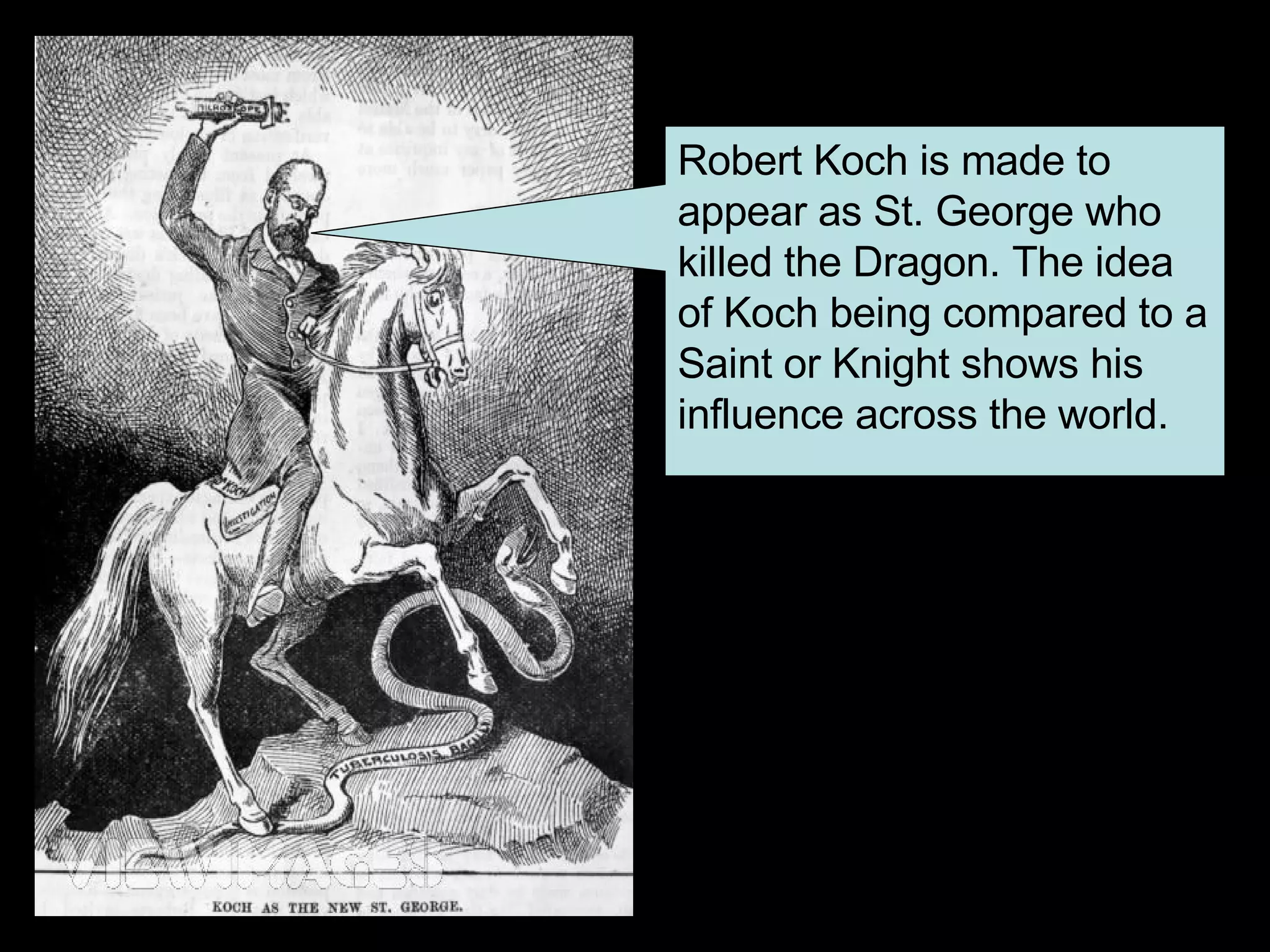
Robert Koch is made to appear as St. George who killed the Dragon. The idea of Koch being compared to a Saint or Knight shows his influence across the world.
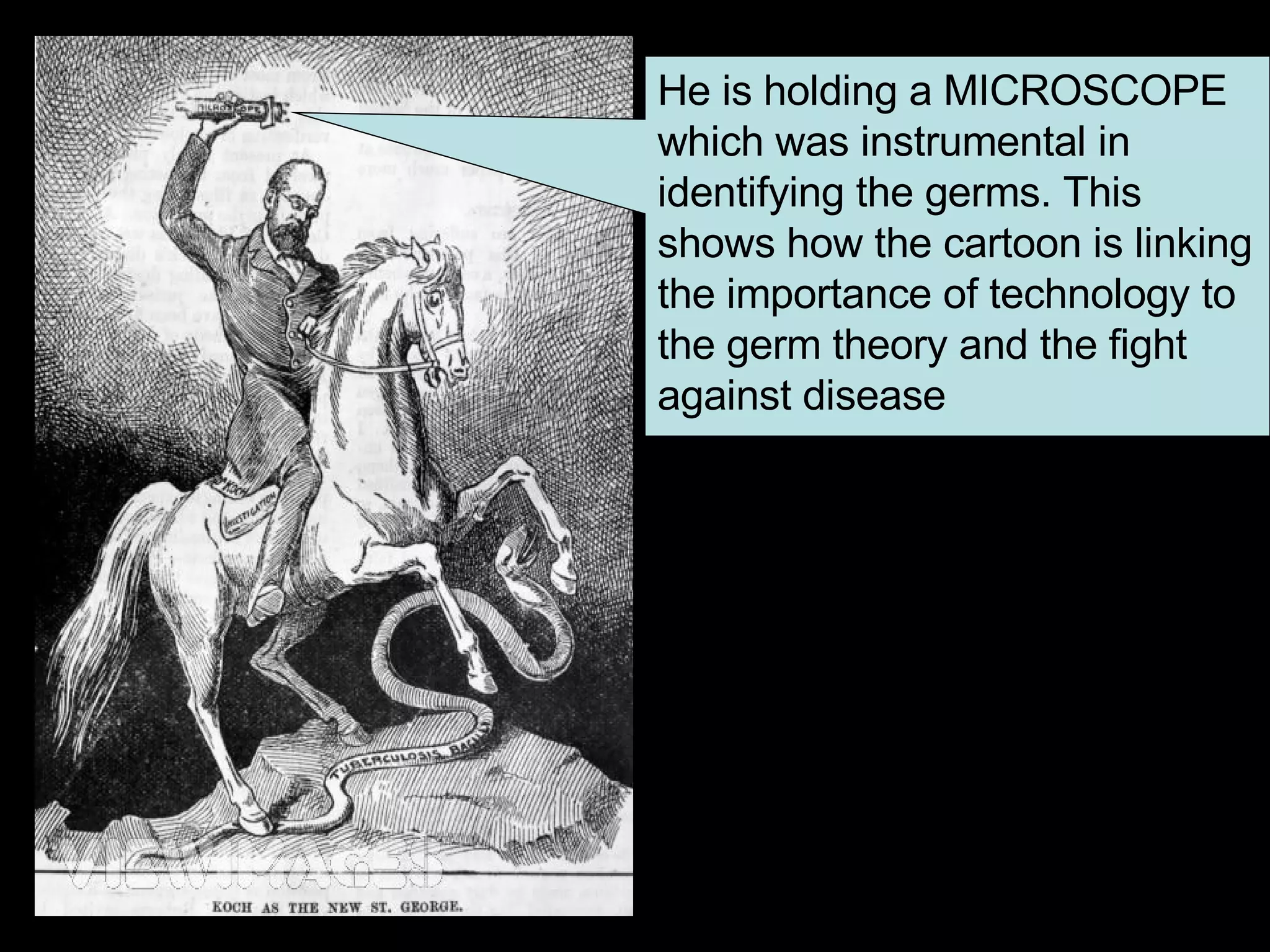
He is holding a MICROSCOPE which was instrumental in identifying the germs. This shows how the cartoon is linking the importance of technology to the germ theory and the fight against disease
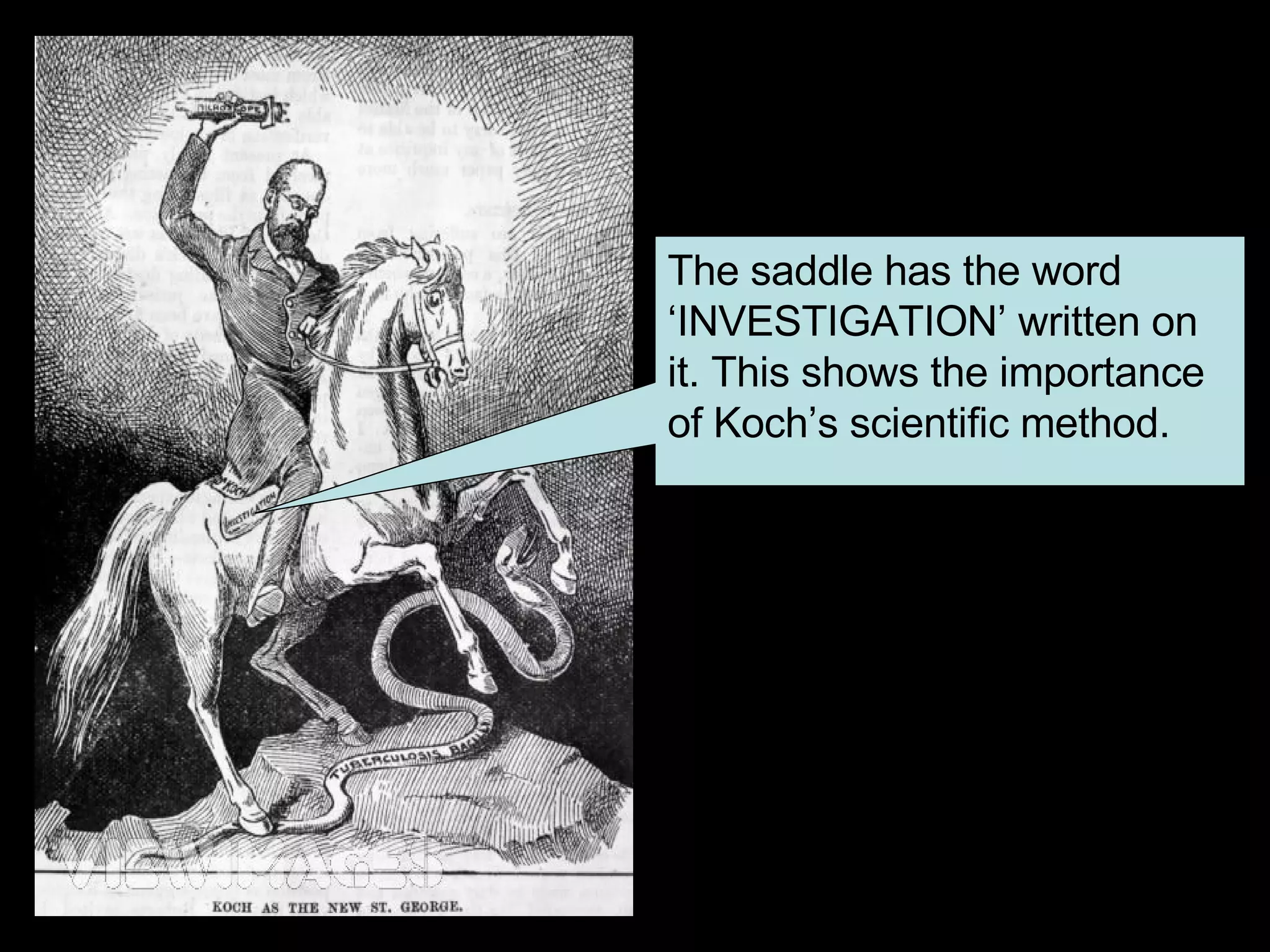
The saddle has the word ‘INVESTIGATION’ written on it. This shows the importance of Koch’s scientific method.
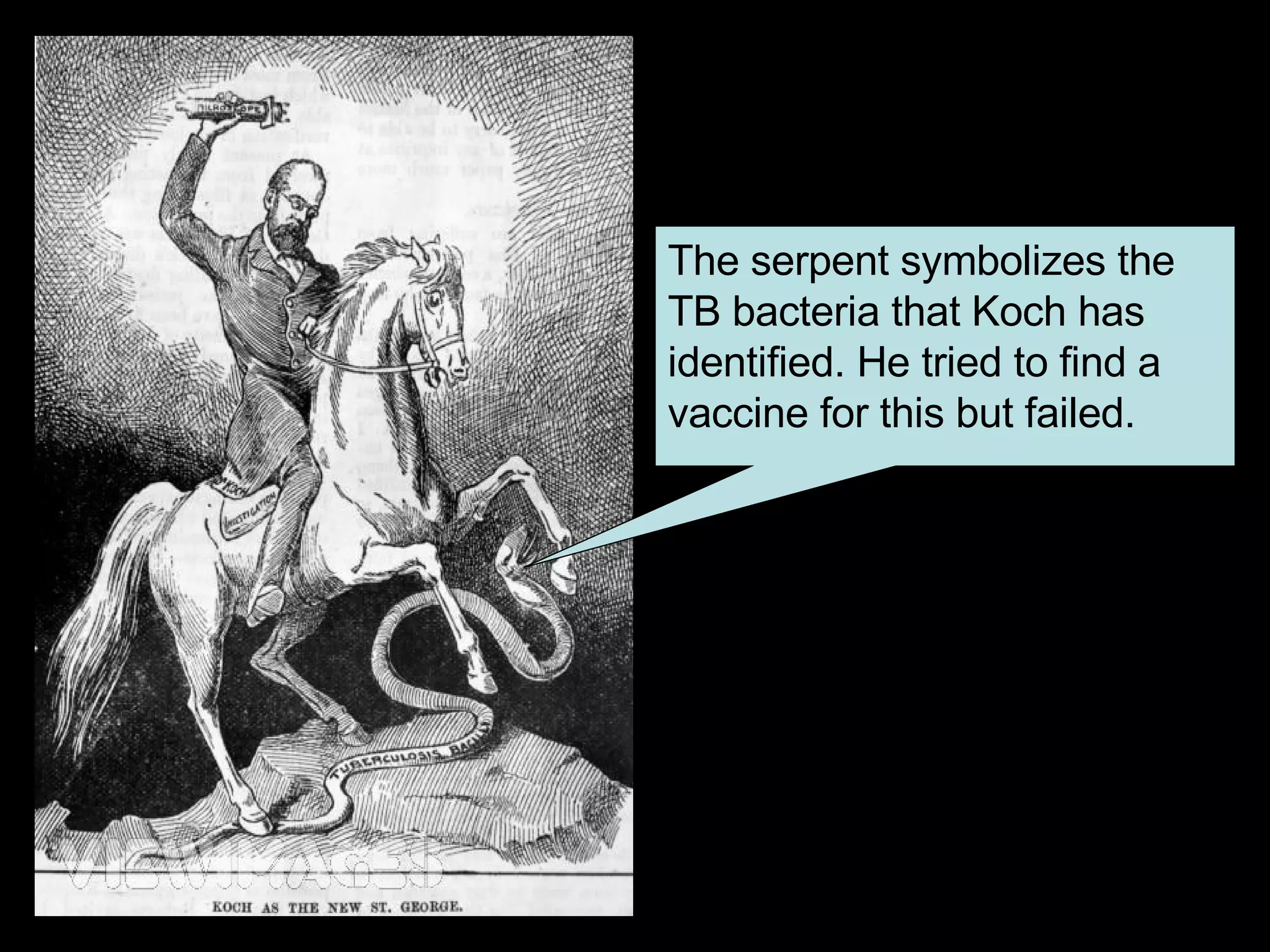
The serpent symbolizes the TB bacteria that Koch has identified. He tried to find a vaccine for this but failed.
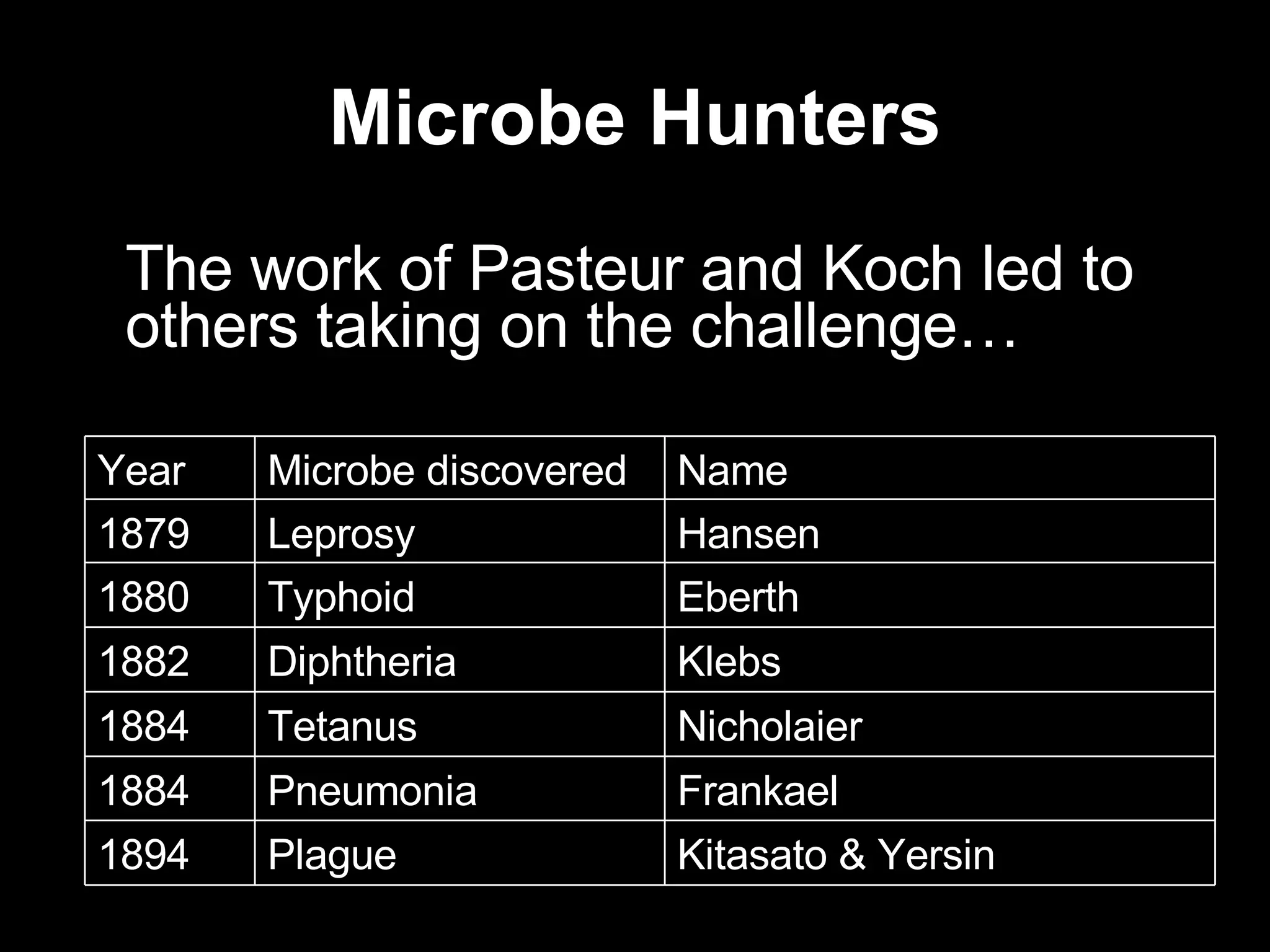
Microbe Hunters The work of Pasteur and Koch led to others taking on the challenge… Hansen Leprosy 1879 Kitasato & Yersin Plague 1894 Frankael Pneumonia 1884 Nicholaier Tetanus 1884 Klebs Diphtheria 1882 Eberth Typhoid 1880 Name Microbe discovered Year
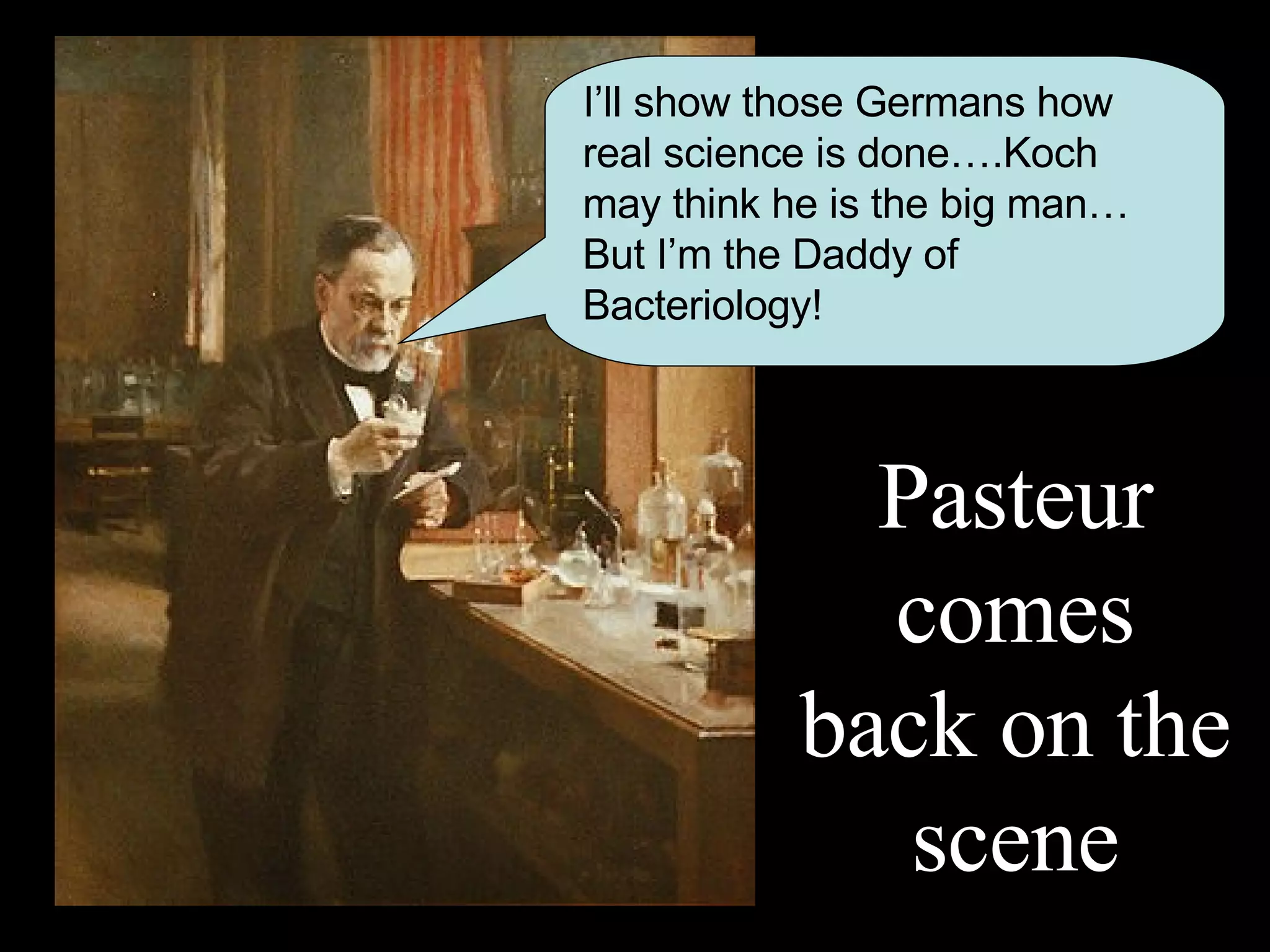
Pasteur comes back on the scene I’ll show those Germans how real science is done….Koch may think he is the big man…But I’m the Daddy of Bacteriology!
French pride When France was soundly beaten by the Germans in war in 1870, national pride was at stake. If the French could not beat the Germans at war then they’d beat them at science (very masculine). Pasteur created a research team and started work on the anthrax germ…
 
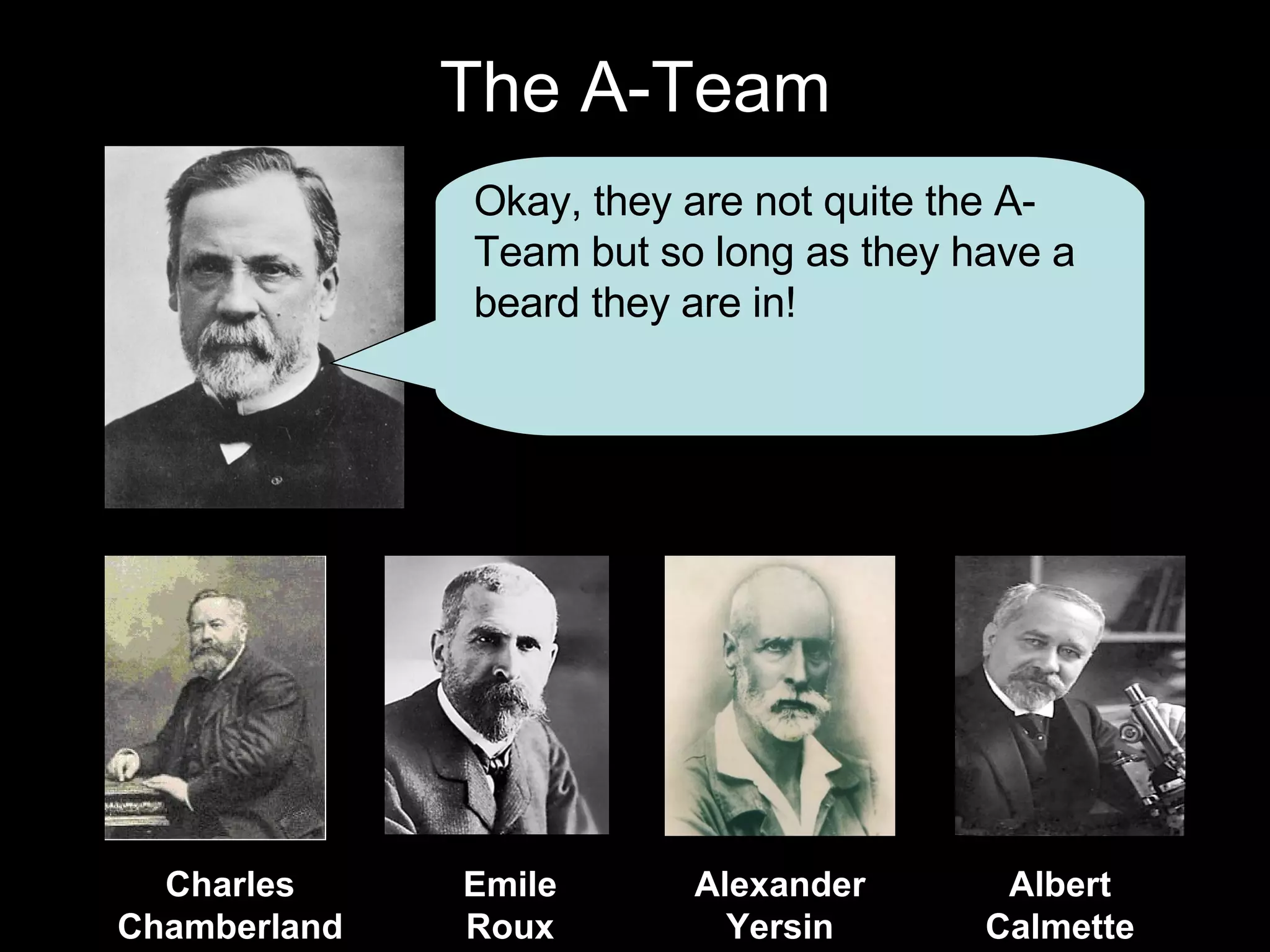
The A-Team Emile Roux Charles Chamberland Alexander Yersin Albert Calmette Okay, they are not quite the A-Team but so long as they have a beard they are in!
1880 Chicken Cholera In 1880, the team stopped what they were doing and began looking at  CHICKEN CHOLERA  which was devastating the poultry industry. Pasteur’s team took a while to find a liquid culture that would grow the disease on it. Once that was done, the injection of the disease into the chickens could begin.
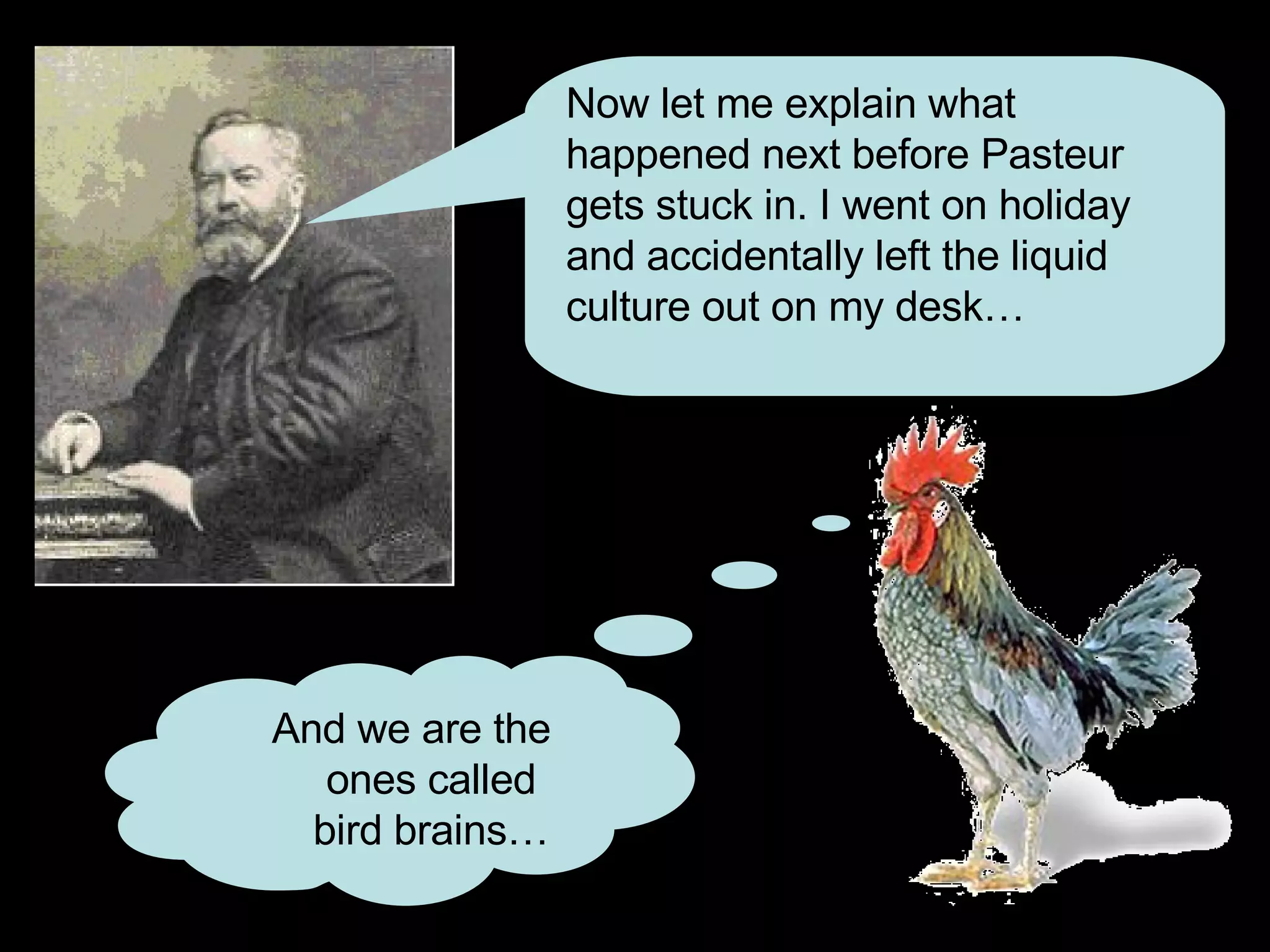
Now let me explain what happened next before Pasteur gets stuck in. I went on holiday and accidentally left the liquid culture out on my desk… And we are the ones called bird brains…
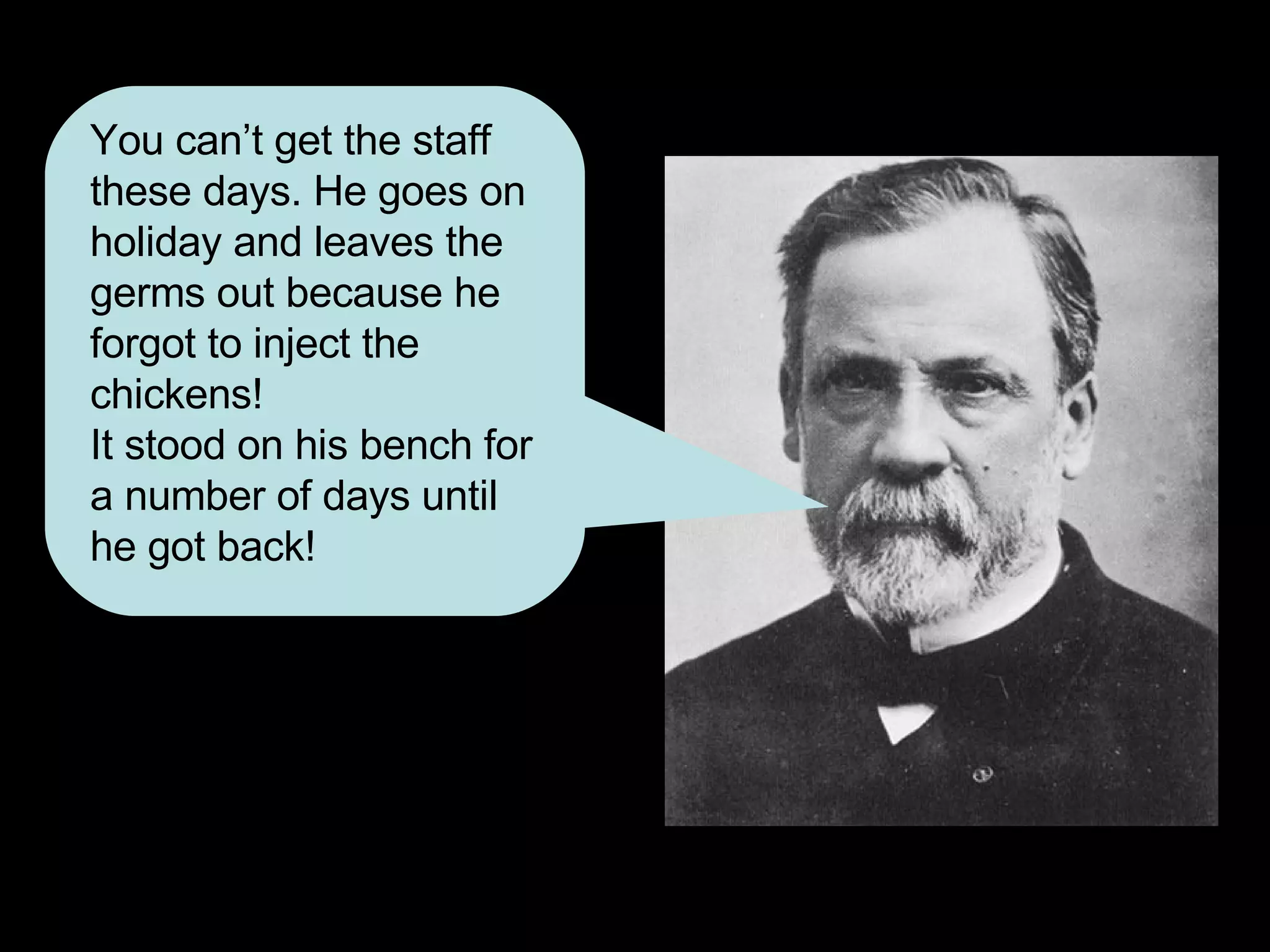
You can’t get the staff these days. He goes on holiday and leaves the germs out because he forgot to inject the chickens! It stood on his bench for a number of days until he got back!
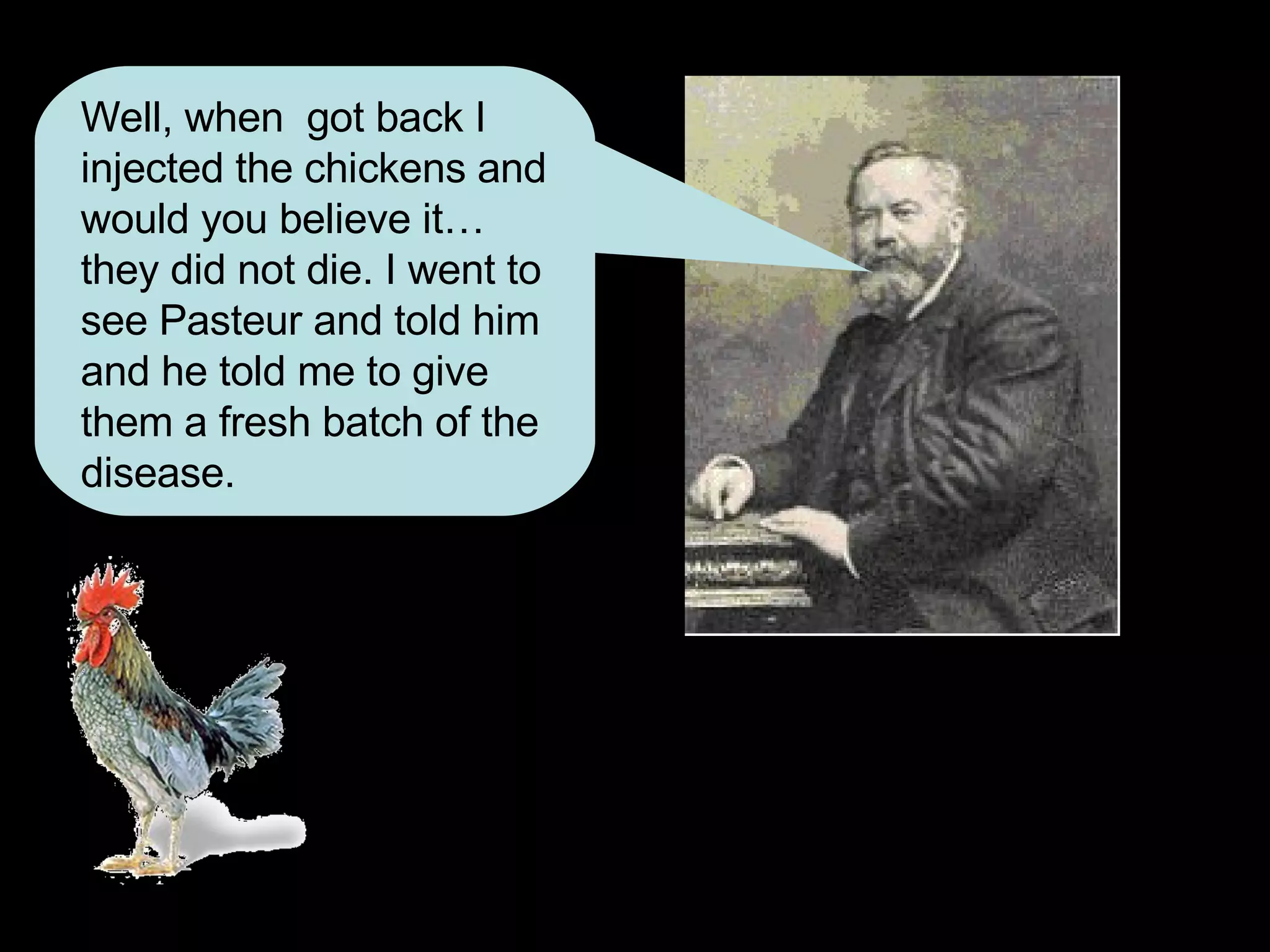
Well, when  got back I injected the chickens and would you believe it…they did not die. I went to see Pasteur and told him and he told me to give them a fresh batch of the disease.
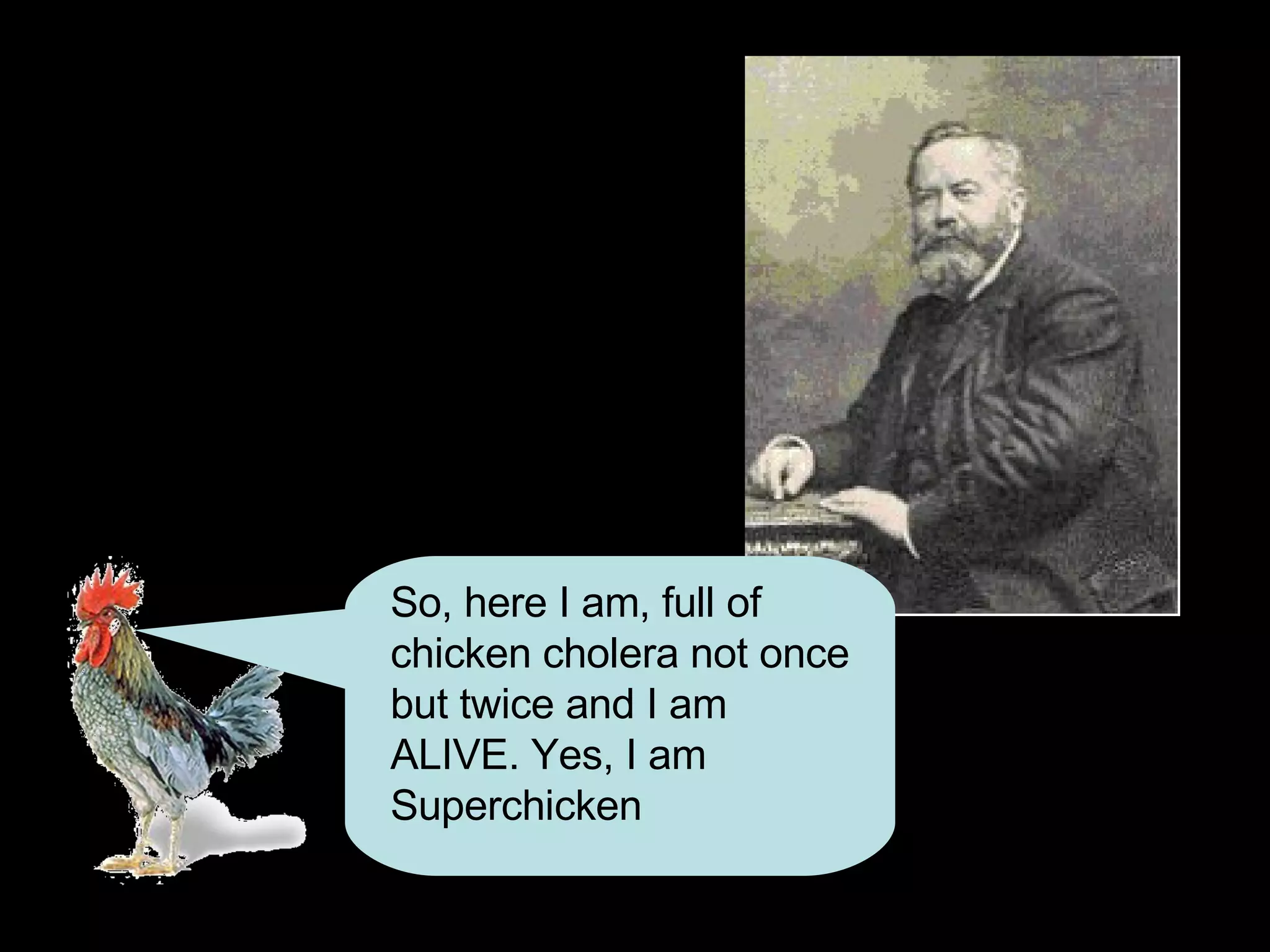
So, here I am, full of chicken cholera not once but twice and I am ALIVE. Yes, I am Superchicken
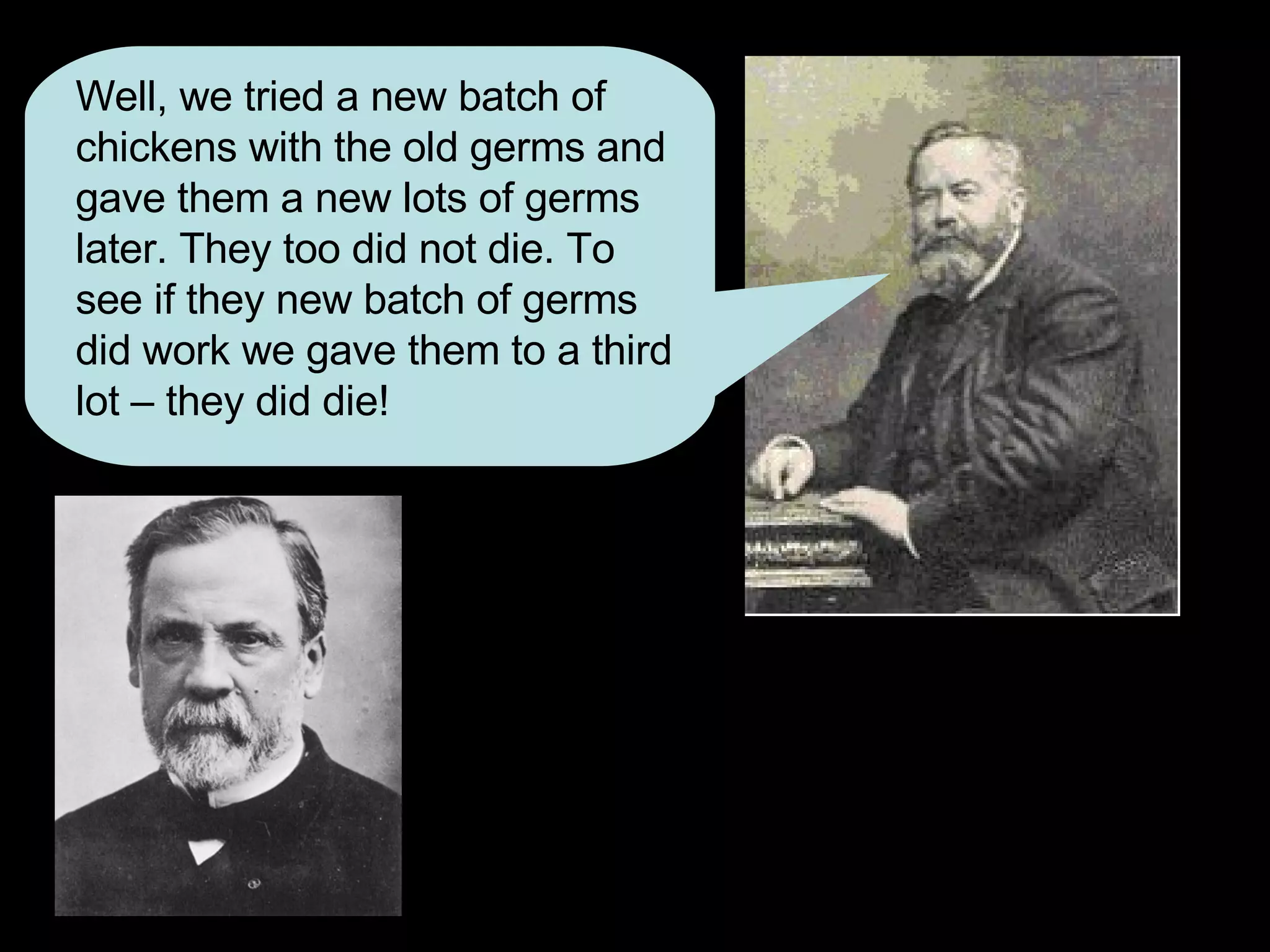
Well, we tried a new batch of chickens with the old germs and gave them a new lots of germs later. They too did not die. To see if they new batch of germs did work we gave them to a third lot – they did die!
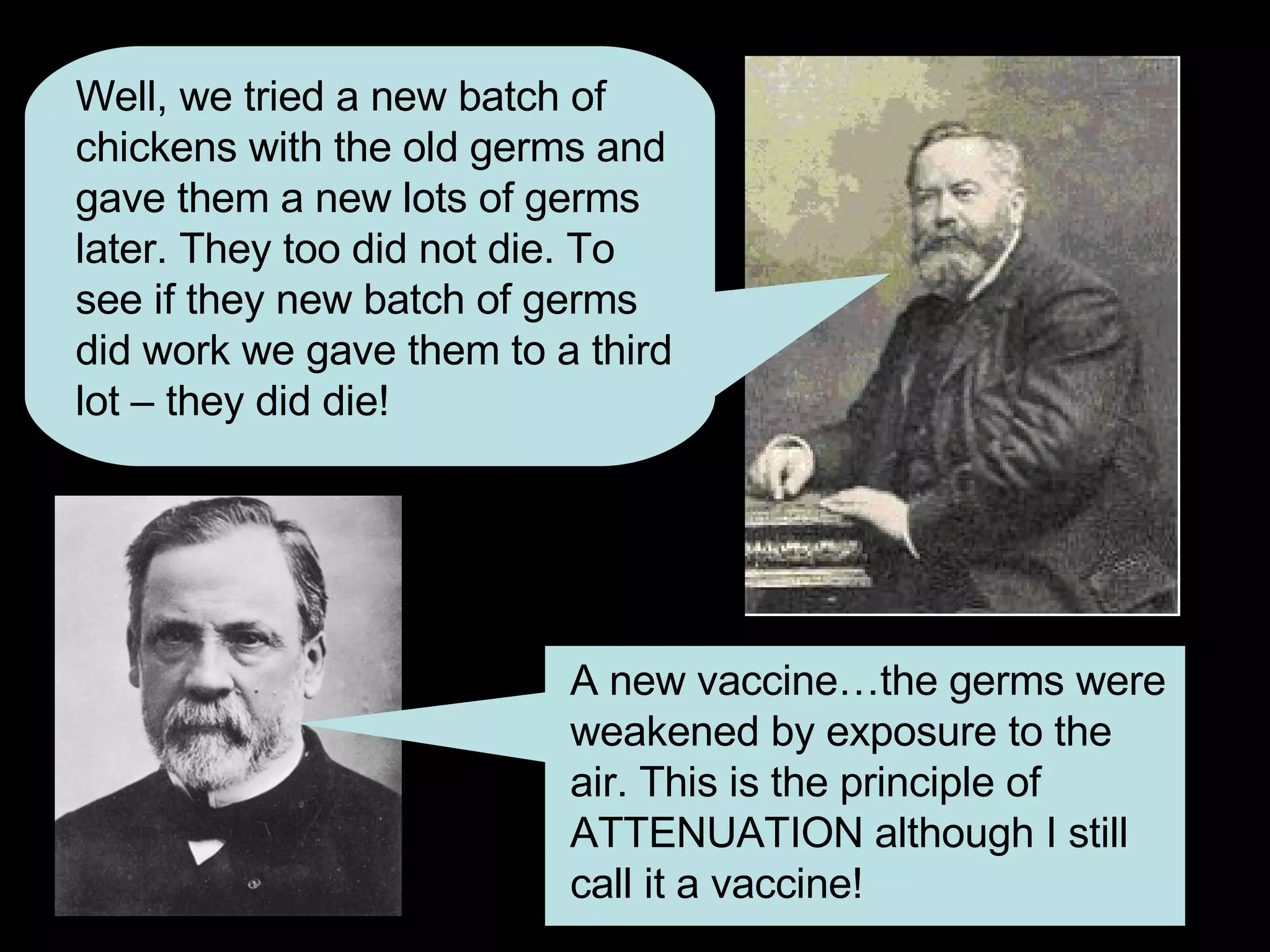
Well, we tried a new batch of chickens with the old germs and gave them a new lots of germs later. They too did not die. To see if they new batch of germs did work we gave them to a third lot – they did die! A new vaccine…the germs were weakened by exposure to the air. This is the principle of ATTENUATION although I still call it a vaccine!
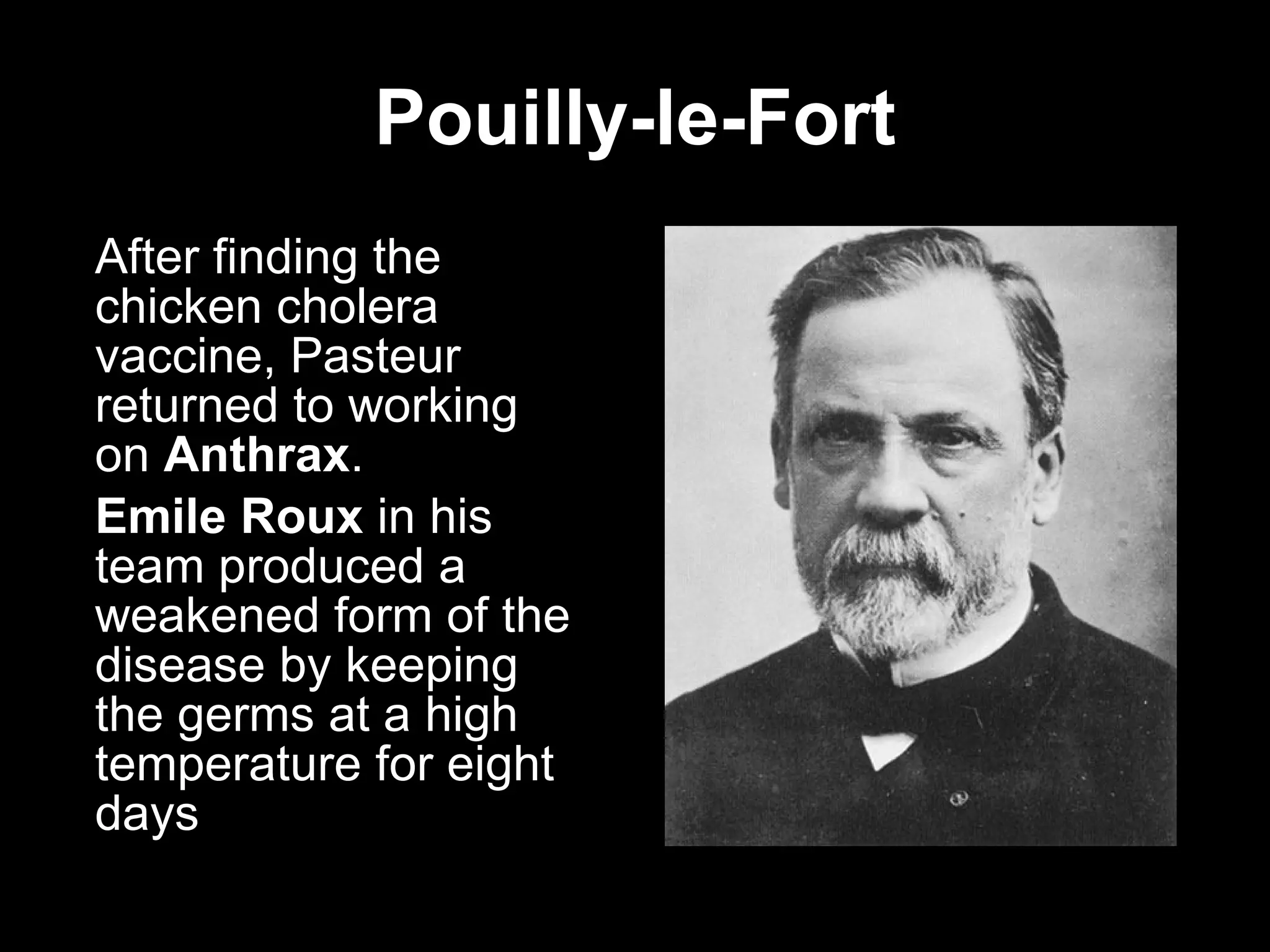
Pouilly-le-Fort After finding the chicken cholera vaccine, Pasteur returned to working on  Anthrax . Emile Roux  in his team produced a weakened form of the disease by keeping the germs at a high temperature for eight days
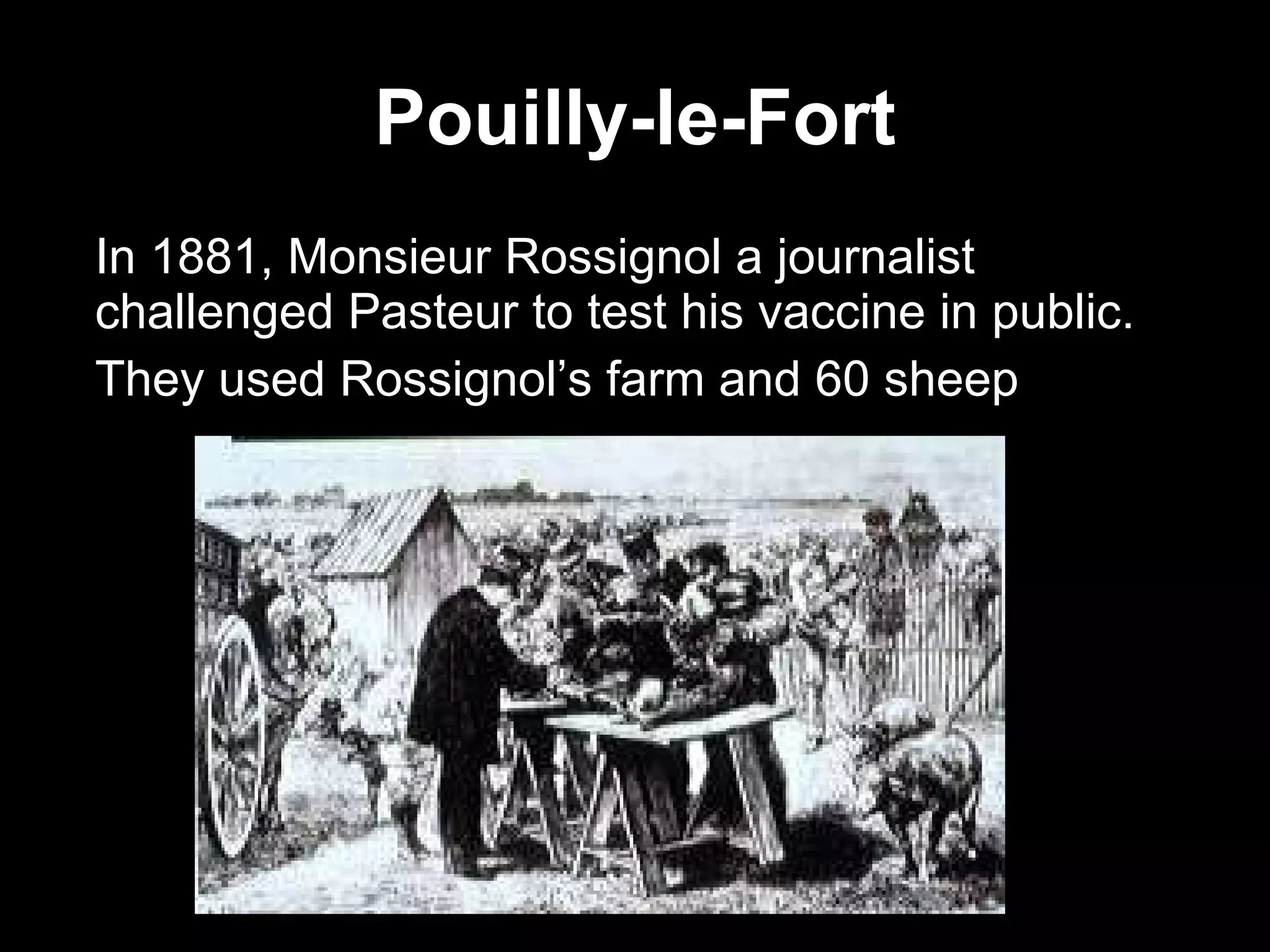
Pouilly-le-Fort In 1881, Monsieur Rossignol a journalist challenged Pasteur to test his vaccine in public.  They used Rossignol’s farm and 60 sheep
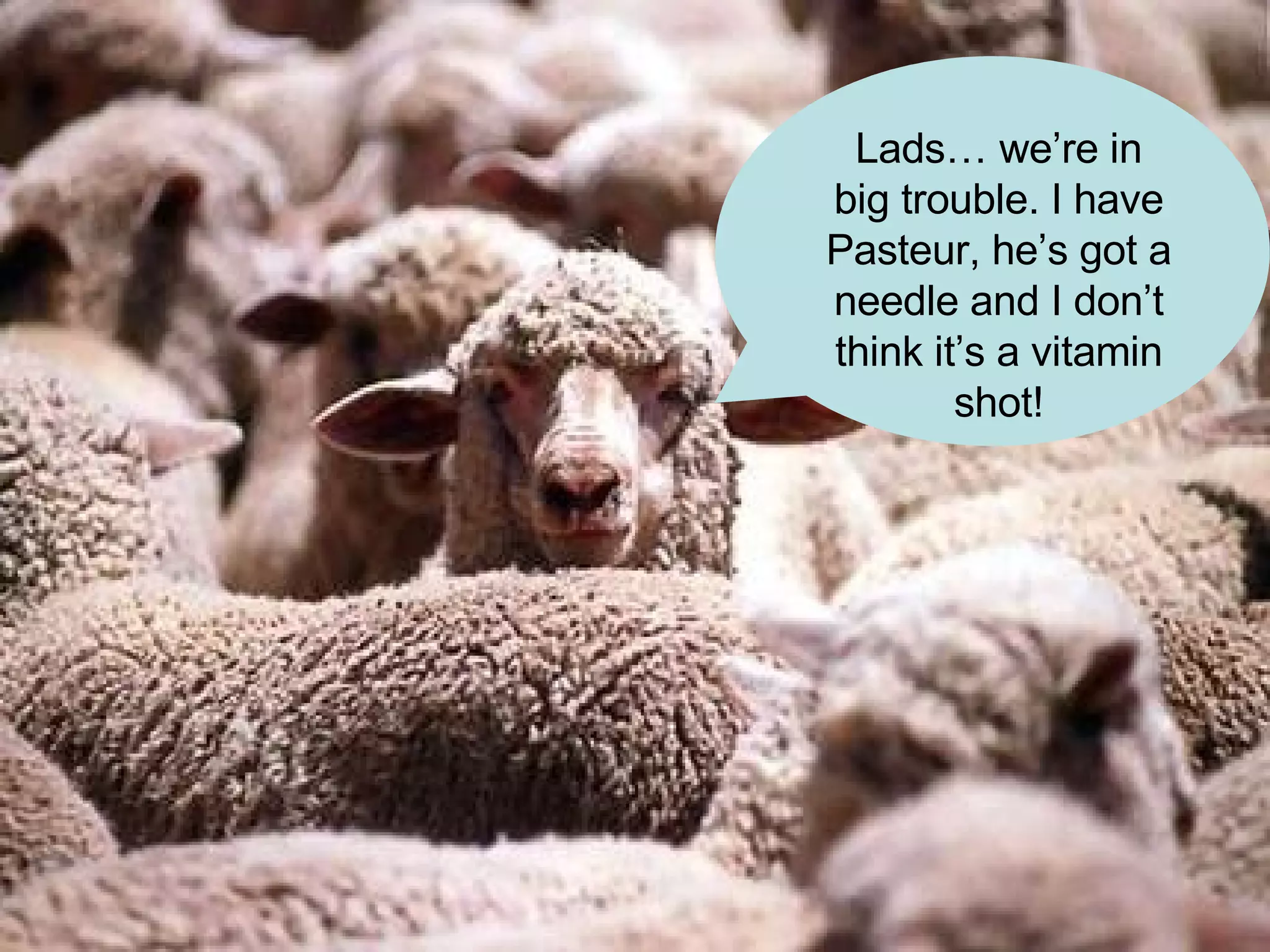
Lads… we’re in big trouble. I have Pasteur, he’s got a needle and I don’t think it’s a vitamin shot!
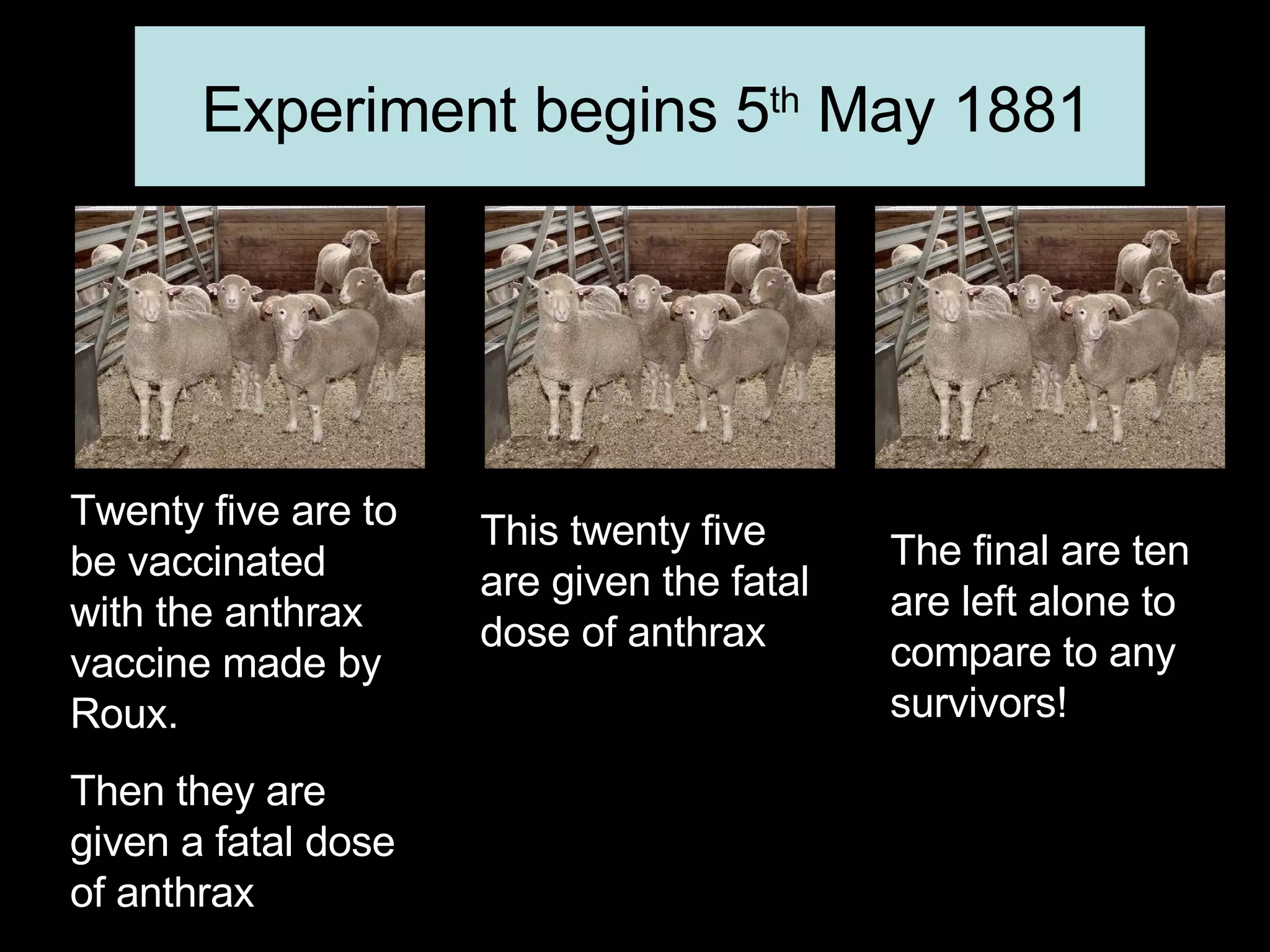
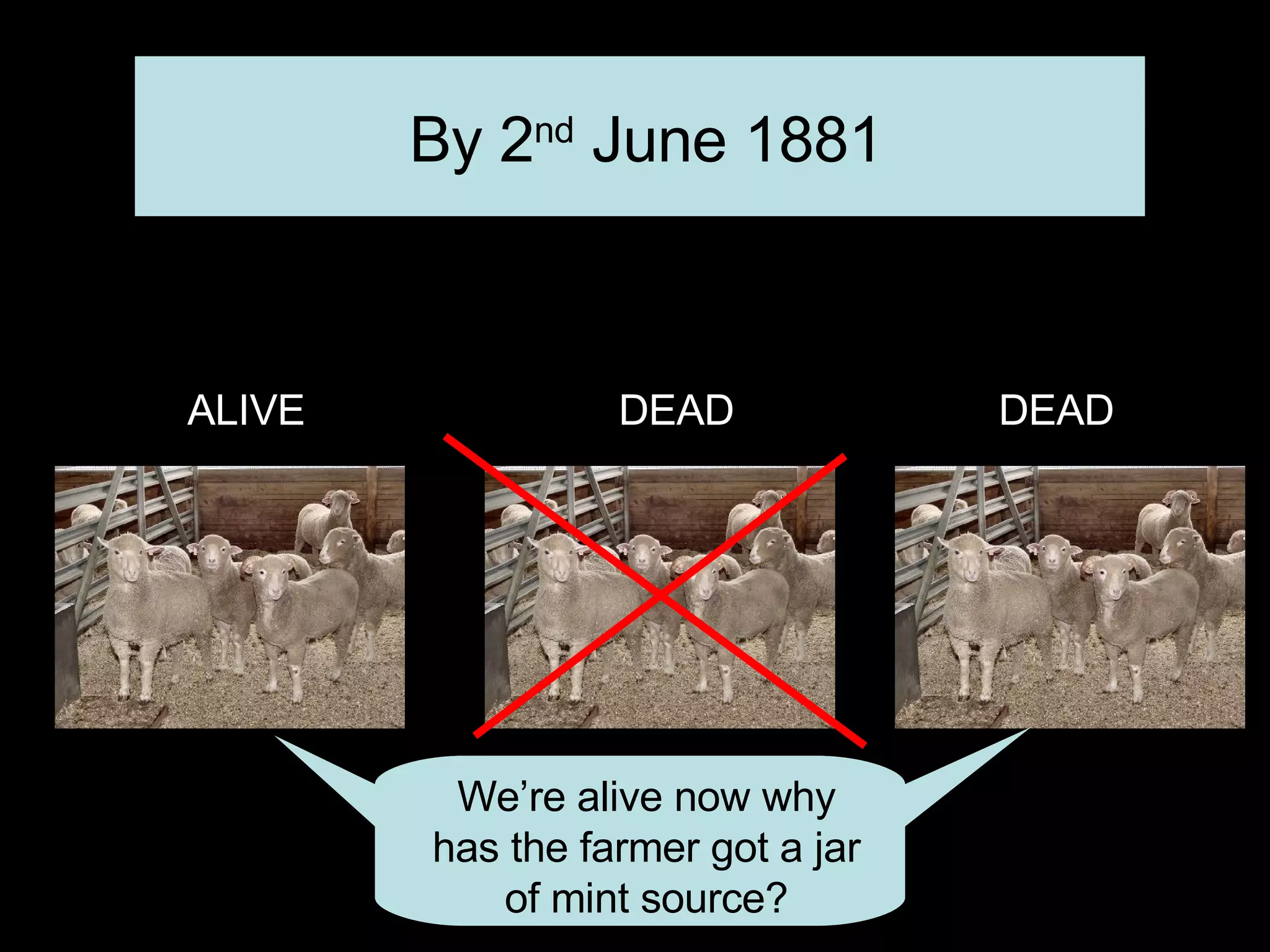
Twenty five are to be vaccinated with the anthrax vaccine made by Roux. Then they are given a fatal dose of anthrax This twenty five are given the fatal dose of anthrax The final are ten are left alone to compare to any survivors! Experiment begins 5 th  May 1881
ALIVE DEAD DEAD By 2 nd  June 1881 We’re alive now why has the farmer got a jar of mint source?
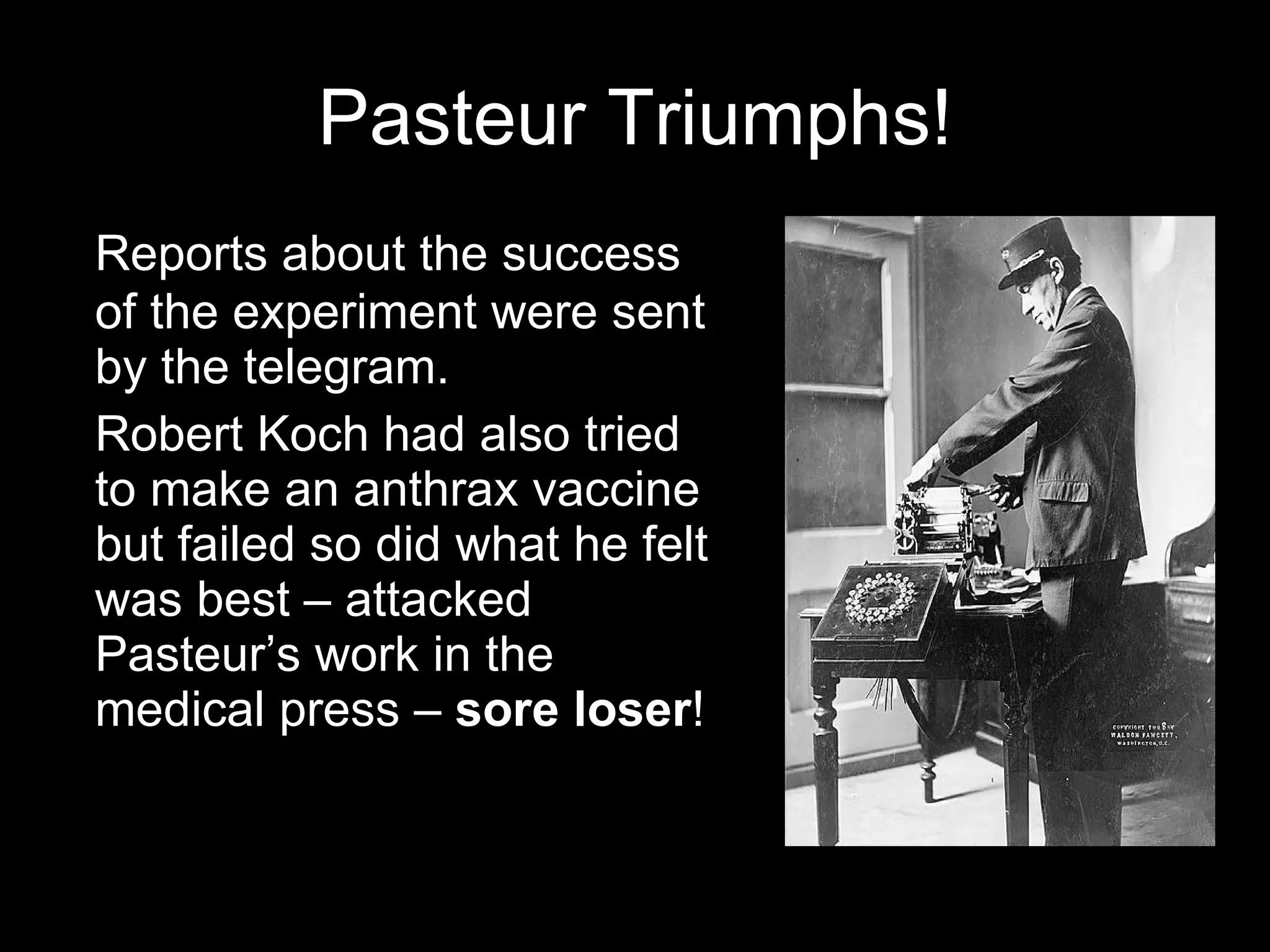
Pasteur Triumphs! Reports about the success of the experiment were sent by the telegram. Robert Koch had also tried to make an anthrax vaccine but failed so did what he felt was best – attacked Pasteur’s work in the medical press –  sore loser !
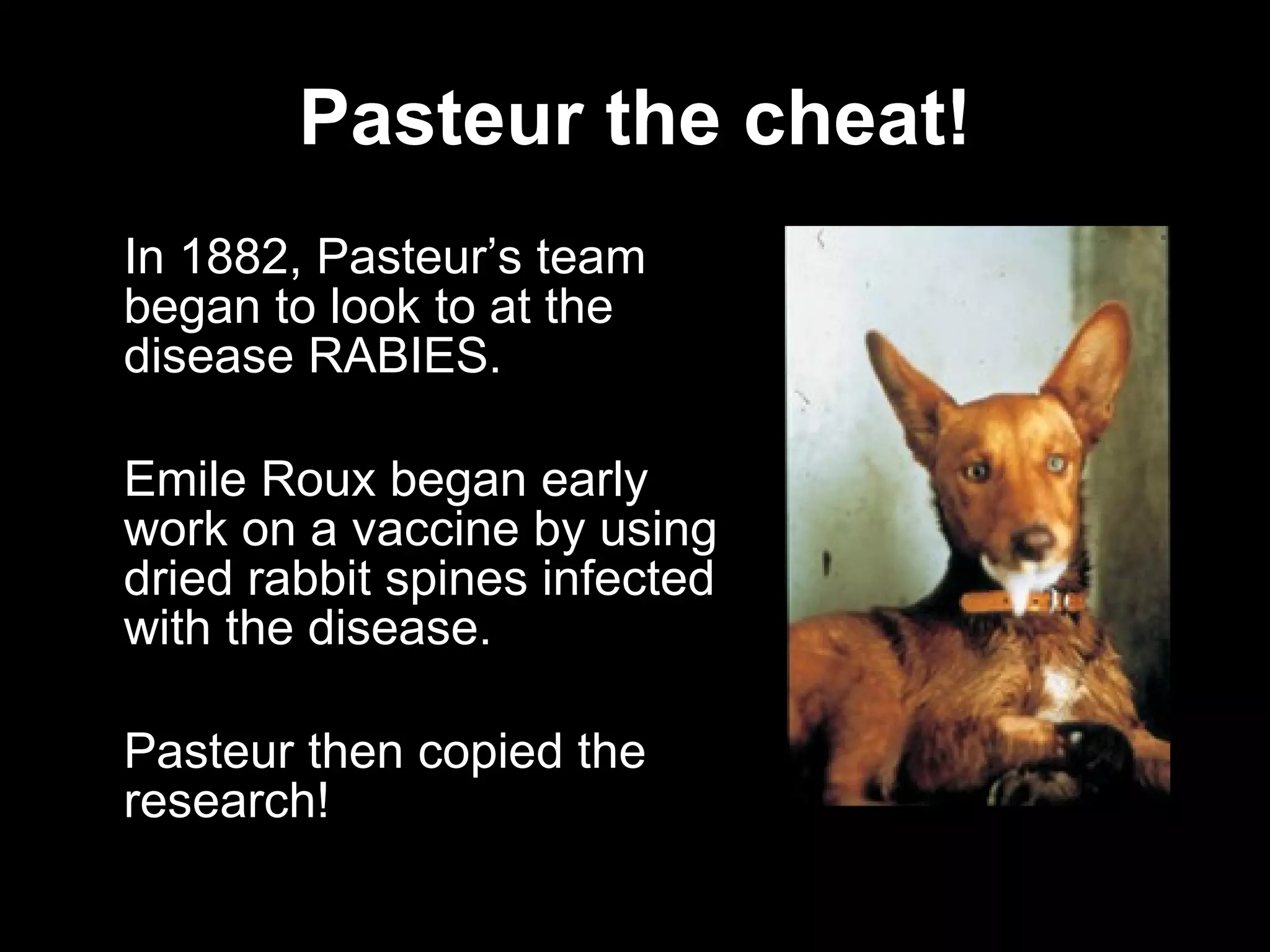
Pasteur the cheat! In 1882, Pasteur’s team began to look to at the disease RABIES. Emile Roux began early work on a vaccine by using dried rabbit spines infected with the disease. Pasteur then copied the research!
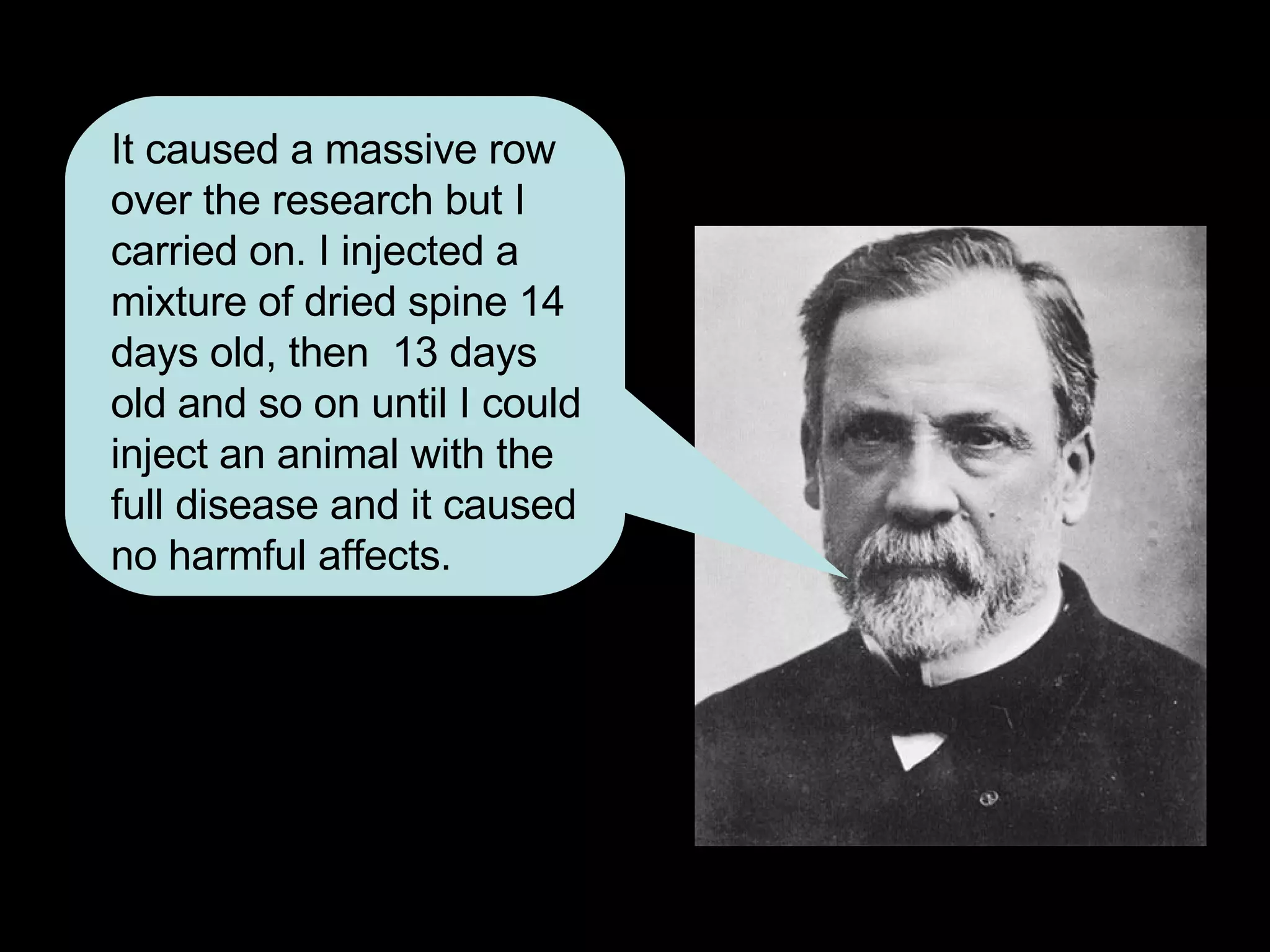
It caused a massive row over the research but I carried on. I injected a mixture of dried spine 14 days old, then  13 days old and so on until I could inject an animal with the full disease and it caused no harmful affects.
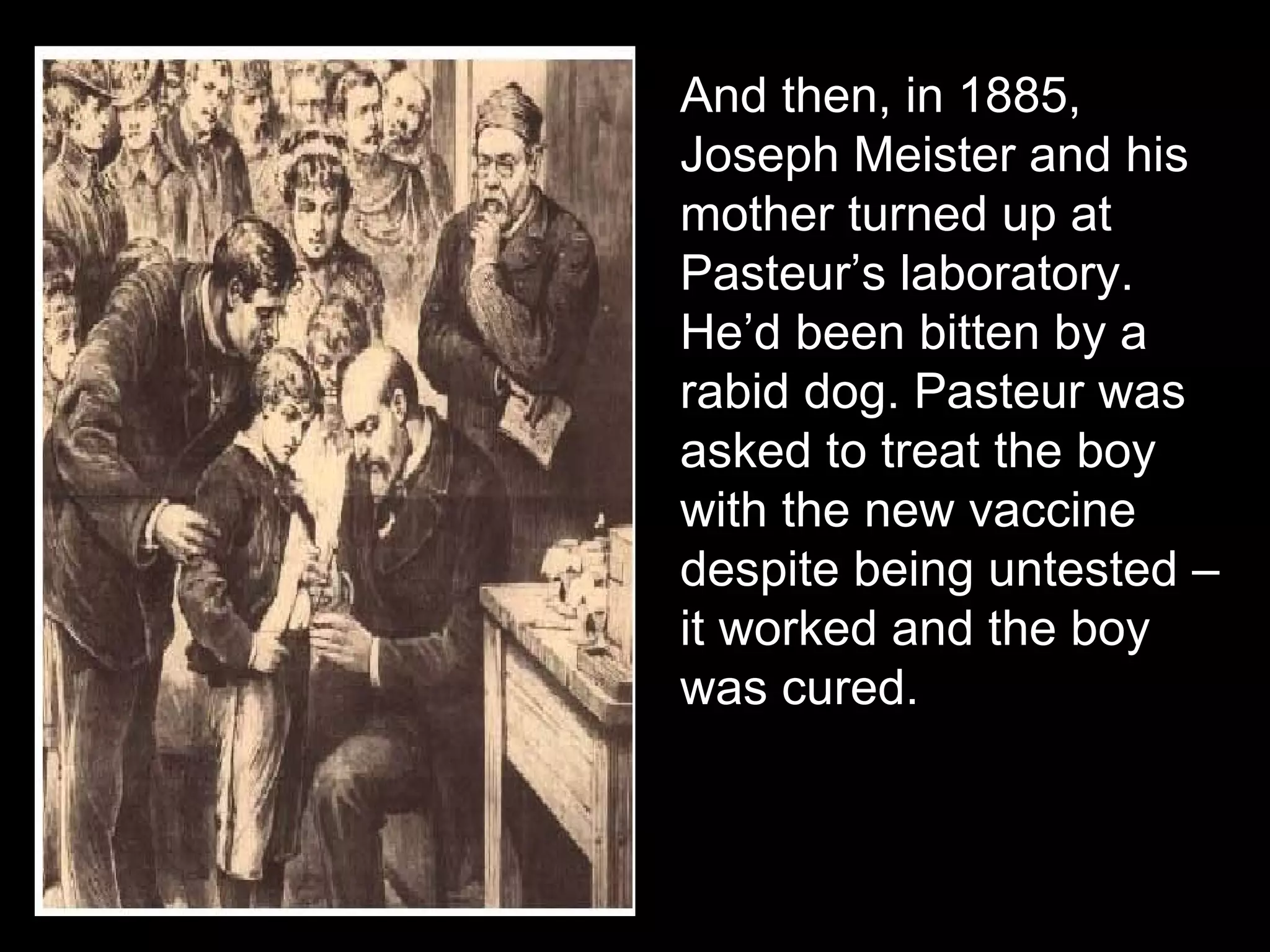
And then, in 1885, Joseph Meister and his mother turned up at Pasteur’s laboratory. He’d been bitten by a rabid dog. Pasteur was asked to treat the boy with the new vaccine despite being untested – it worked and the boy was cured.

Germ Theory V1

  • 1.
    The Germ Theoryand Medicine
  • 2.
    Miasma and SpontaneousGeneration Since the 17 th century and the advent of the microscope, people knew that germs existed but thought these were the result of disease – not the cause! This was called SPONTANEOUS GENERATION . Instead people believed that illness was caused by bad air - MIASMA
  • 3.
  • 4.
    Louis Pasteur Louiswas a French scientist who in 1857 , was looking at the problems in the brewing industry of alcohol not fermenting and going sour. He believed germs were the key and created experiments to find if this was true.
  • 5.
    Pasteur was astrong believer in scientific method.
  • 6.
    Reaction Some doctorsstill held to the belief of spontaneous generation rather than the new germ theory. This was principally because of the long history the theory had.
  • 7.
    Pasteur and theworms! Pasteur moved on to prove that germs caused disease. He did this by examining not people but worms (silkworms to be precise) again, for industry not medicine. He proved that germs caused the prebine disease which affected silkworms!
  • 8.
  • 9.
    Robert Koch (1843– 1910) Born in Hanover Studied at Gottingen University In 1870 fought the French in the Franco-Prussian war Became a medical officer for a town near Poland For his 29 th birthday his wife bought him a microscope Began to pioneer bacteriology (the study of germs)
  • 10.
    Koch takes germson! Koch saw that Pasteur made the link between germs and disease. He took on the challenge of finding out which germs caused what diseases. He could do this because he was a doctor with expert medical knowledge unlike Pasteur who was a chemist!
  • 11.
    What did heachieve? Koch identified the following germs…. Anthrax 1875 Tuberculosis 1882 Cholera 1883
  • 12.
    What aided Koch’swork? Koch used industrial dyes to stain bacteria. He used this very successfully when he identified the germ that caused blood poisoning – SEPTICEMIA. Koch also used solid culture dishes to grow bacteria on which were more reliable than the liquid ones Pasteur used.
  • 13.
    Robert Koch ismade to appear as St. George who killed the Dragon. The idea of Koch being compared to a Saint or Knight shows his influence across the world.
  • 14.
    He is holdinga MICROSCOPE which was instrumental in identifying the germs. This shows how the cartoon is linking the importance of technology to the germ theory and the fight against disease
  • 15.
    The saddle hasthe word ‘INVESTIGATION’ written on it. This shows the importance of Koch’s scientific method.
  • 16.
    The serpent symbolizesthe TB bacteria that Koch has identified. He tried to find a vaccine for this but failed.
  • 17.
    Microbe Hunters Thework of Pasteur and Koch led to others taking on the challenge… Hansen Leprosy 1879 Kitasato & Yersin Plague 1894 Frankael Pneumonia 1884 Nicholaier Tetanus 1884 Klebs Diphtheria 1882 Eberth Typhoid 1880 Name Microbe discovered Year
  • 18.
    Pasteur comes backon the scene I’ll show those Germans how real science is done….Koch may think he is the big man…But I’m the Daddy of Bacteriology!
  • 19.
    French pride WhenFrance was soundly beaten by the Germans in war in 1870, national pride was at stake. If the French could not beat the Germans at war then they’d beat them at science (very masculine). Pasteur created a research team and started work on the anthrax germ…
  • 20.
  • 21.
    The A-Team EmileRoux Charles Chamberland Alexander Yersin Albert Calmette Okay, they are not quite the A-Team but so long as they have a beard they are in!
  • 22.
    1880 Chicken CholeraIn 1880, the team stopped what they were doing and began looking at CHICKEN CHOLERA which was devastating the poultry industry. Pasteur’s team took a while to find a liquid culture that would grow the disease on it. Once that was done, the injection of the disease into the chickens could begin.
  • 23.
    Now let meexplain what happened next before Pasteur gets stuck in. I went on holiday and accidentally left the liquid culture out on my desk… And we are the ones called bird brains…
  • 24.
    You can’t getthe staff these days. He goes on holiday and leaves the germs out because he forgot to inject the chickens! It stood on his bench for a number of days until he got back!
  • 25.
    Well, when got back I injected the chickens and would you believe it…they did not die. I went to see Pasteur and told him and he told me to give them a fresh batch of the disease.
  • 26.
    So, here Iam, full of chicken cholera not once but twice and I am ALIVE. Yes, I am Superchicken
  • 27.
    Well, we trieda new batch of chickens with the old germs and gave them a new lots of germs later. They too did not die. To see if they new batch of germs did work we gave them to a third lot – they did die!
  • 28.
    Well, we trieda new batch of chickens with the old germs and gave them a new lots of germs later. They too did not die. To see if they new batch of germs did work we gave them to a third lot – they did die! A new vaccine…the germs were weakened by exposure to the air. This is the principle of ATTENUATION although I still call it a vaccine!
  • 29.
    Pouilly-le-Fort After findingthe chicken cholera vaccine, Pasteur returned to working on Anthrax . Emile Roux in his team produced a weakened form of the disease by keeping the germs at a high temperature for eight days
  • 30.
    Pouilly-le-Fort In 1881,Monsieur Rossignol a journalist challenged Pasteur to test his vaccine in public. They used Rossignol’s farm and 60 sheep
  • 31.
    Lads… we’re inbig trouble. I have Pasteur, he’s got a needle and I don’t think it’s a vitamin shot!
  • 32.
    Twenty five areto be vaccinated with the anthrax vaccine made by Roux. Then they are given a fatal dose of anthrax This twenty five are given the fatal dose of anthrax The final are ten are left alone to compare to any survivors! Experiment begins 5 th May 1881
  • 33.
    ALIVE DEAD DEADBy 2 nd June 1881 We’re alive now why has the farmer got a jar of mint source?
  • 34.
    Pasteur Triumphs! Reportsabout the success of the experiment were sent by the telegram. Robert Koch had also tried to make an anthrax vaccine but failed so did what he felt was best – attacked Pasteur’s work in the medical press – sore loser !
  • 35.
    Pasteur the cheat!In 1882, Pasteur’s team began to look to at the disease RABIES. Emile Roux began early work on a vaccine by using dried rabbit spines infected with the disease. Pasteur then copied the research!
  • 36.
    It caused amassive row over the research but I carried on. I injected a mixture of dried spine 14 days old, then 13 days old and so on until I could inject an animal with the full disease and it caused no harmful affects.
  • 37.
    And then, in1885, Joseph Meister and his mother turned up at Pasteur’s laboratory. He’d been bitten by a rabid dog. Pasteur was asked to treat the boy with the new vaccine despite being untested – it worked and the boy was cured.