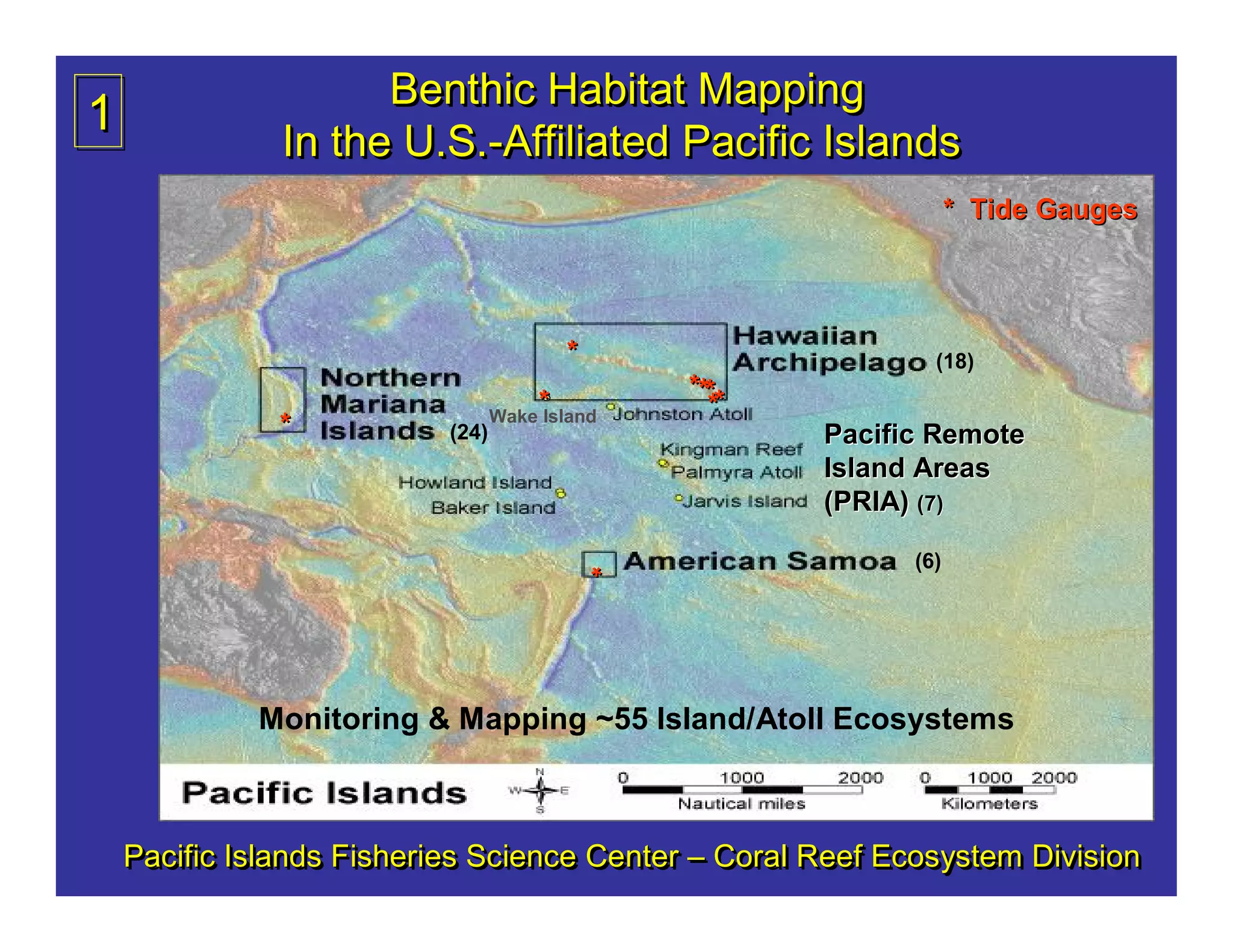
Benthic Habitat Mapping
1
               In the U.S.-Affiliated Pacific Islands
                      U.S.-Affiliated
                                                                    * Tide Gauges


                                         *                      (18)
                                                 ***
                                      *
                                  Wake Island      **
               *           (24)                         Pacific Remote
                                                        Island Areas
                                                        (PRIA) (7)
                                             *
                                             *
                                             *                (6)


             Monitoring & Mapping ~55 Island/Atoll Ecosystems


    Pacific Islands Fisheries Science Center – Coral Reef Ecosystem Division
2
    U.S. Coral Reef Task Force Goal

    Produce comprehensive digital
      maps of all shallow (<30m)
     coral reef ecosystems in the
    United States and characterize
     priority moderate-depth reef
           systems by 2009.
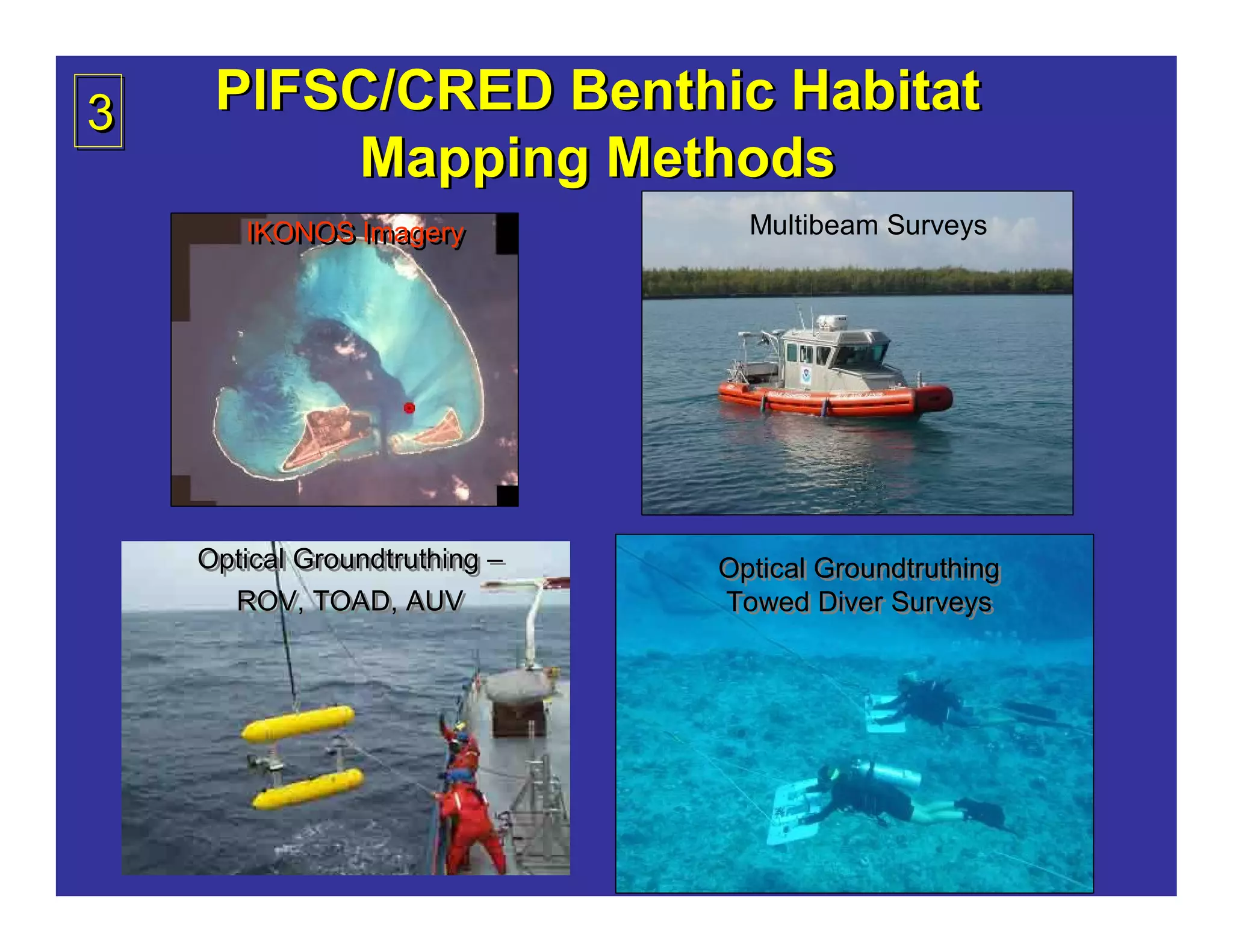
3    PIFSC/CRED Benthic Habitat
         Mapping Methods
       IKONOS Imagery
       IKONOS Imagery            Multibeam Surveys


    Optical Groundtruthing –
    Optical Groundtruthing –   Optical Groundtruthing
                               Optical Groundtruthing
      ROV, TOAD, AUV
       ROV, TOAD, AUV          Towed Diver Surveys
                               Towed Diver Surveys
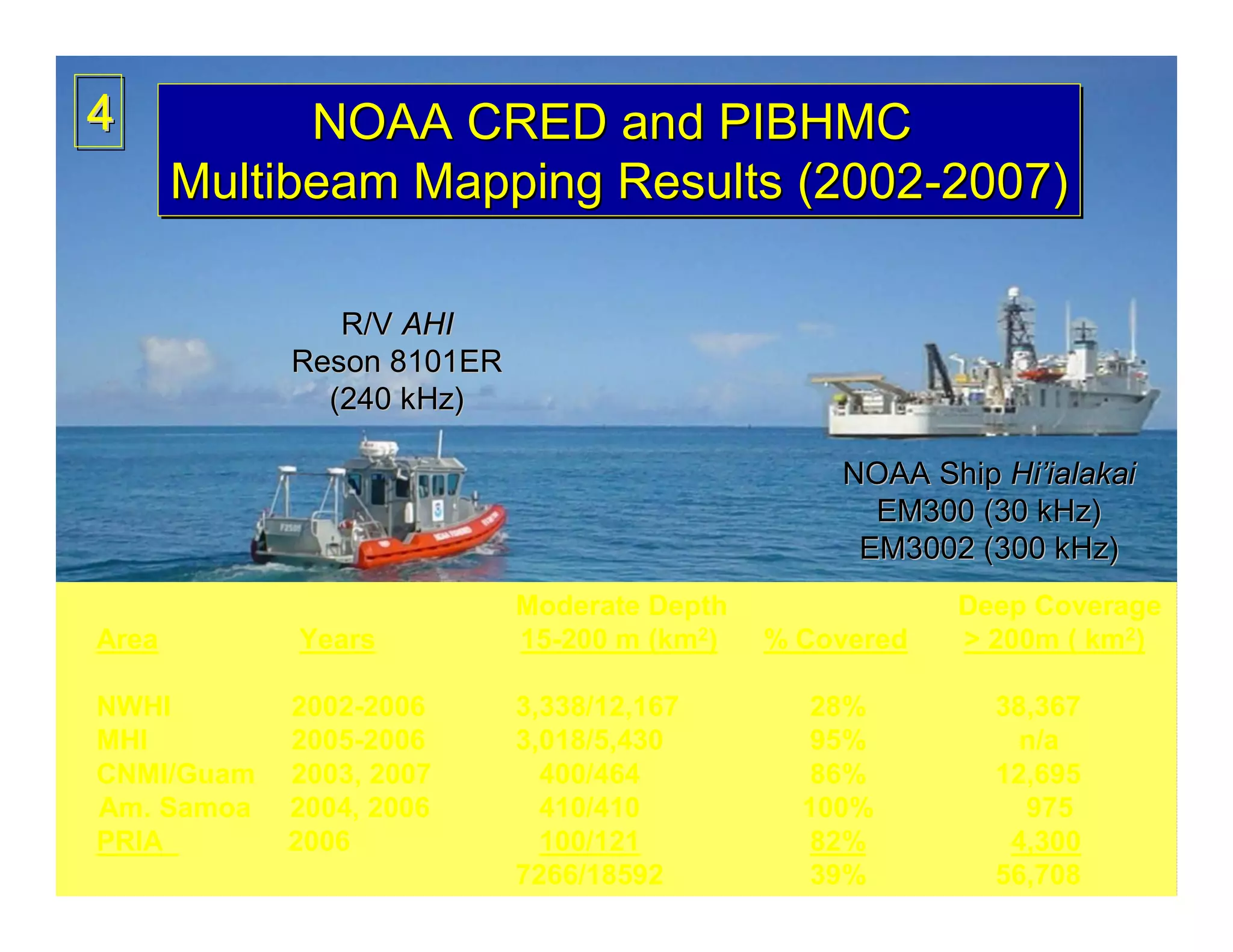
4            NOAA CRED and PIBHMC
       Multibeam Mapping Results (2002-2007)
                                 (2002-2007)

               R/V AHI
            Reson 8101ER
              (240 kHz)

                                                NOAA Ship Hi’ialakai
                                                  EM300 (30 kHz)
                                                 EM3002 (300 kHz)
                           Moderate Depth               Deep Coverage
Area        Years          15-200 m (km2)   % Covered   > 200m ( km2)

NWHI        2002-2006      3,338/12,167        28%        38,367
MHI         2005-2006      3,018/5,430         95%          n/a
CNMI/Guam   2003, 2007       400/464           86%        12,695
Am. Samoa   2004, 2006       410/410          100%          975
PRIA        2006             100/121           82%         4,300
                           7266/18592          39%        56,708
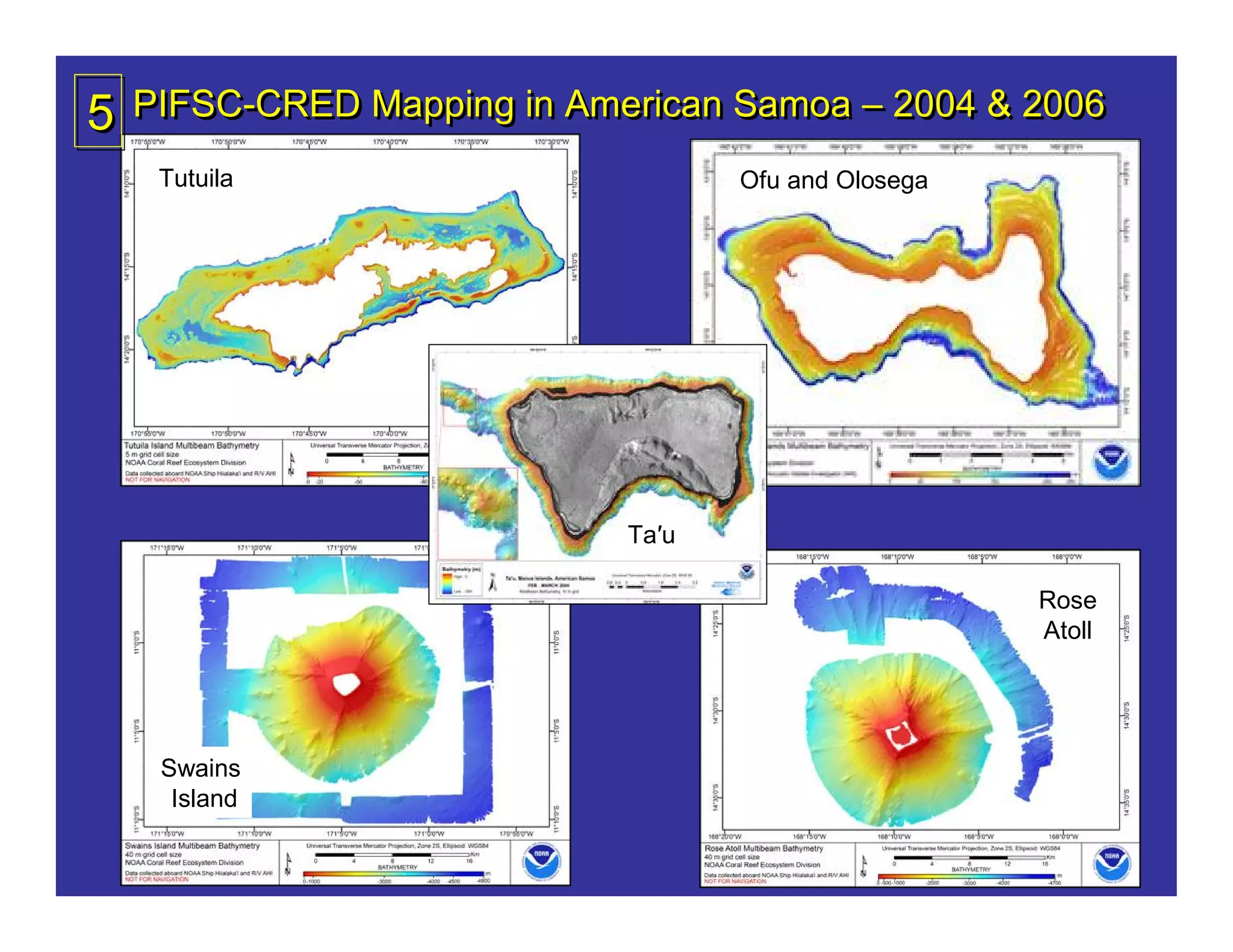
5   PIFSC-CRED Mapping in American Samoa – 2004 & 2006
     Tutuila                        Ofu and Olosega


                             Ta′u

                                                      Rose
                                                      Atoll


     Swains
      Island
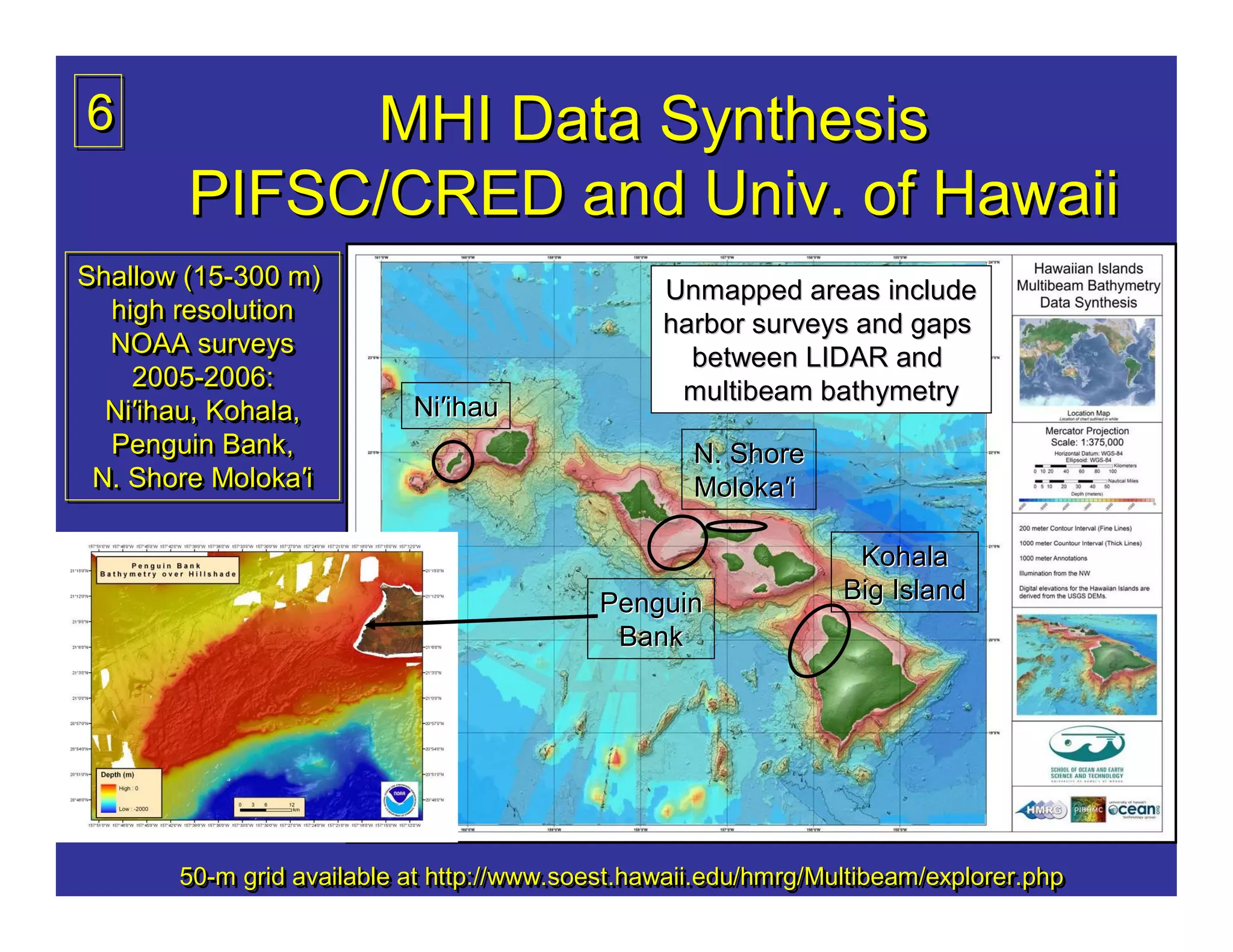
6            MHI Data Synthesis
        PIFSC/CRED and Univ. of Hawaii
Shallow (15-300 m)
Shallow (15-300 m)                               Unmapped areas include
  high resolution
  high resolution                                harbor surveys and gaps
  NOAA surveys
  NOAA surveys                                     between LIDAR and
    2005-2006:
     2005-2006:                                   multibeam bathymetry
  Ni′ihau, Kohala,
  Ni′ihau, Kohala,         Ni′ihau
  Penguin Bank,
  Penguin Bank,                                     N. Shore
 N. Shore Moloka′i
 N. Shore Moloka′i                                  Moloka′i

                                                                  Kohala
                                           Penguin               Big Island
                                            Bank


       50-m grid available at http://www.soest.hawaii.edu/hmrg/Multibeam/explorer.php
       50- grid available at http://www.soest.hawaii.edu/hmrg/Multibeam/explorer.php
       50-m                   http://www.soest.hawaii.edu/hmrg/Multibeam/explorer.php
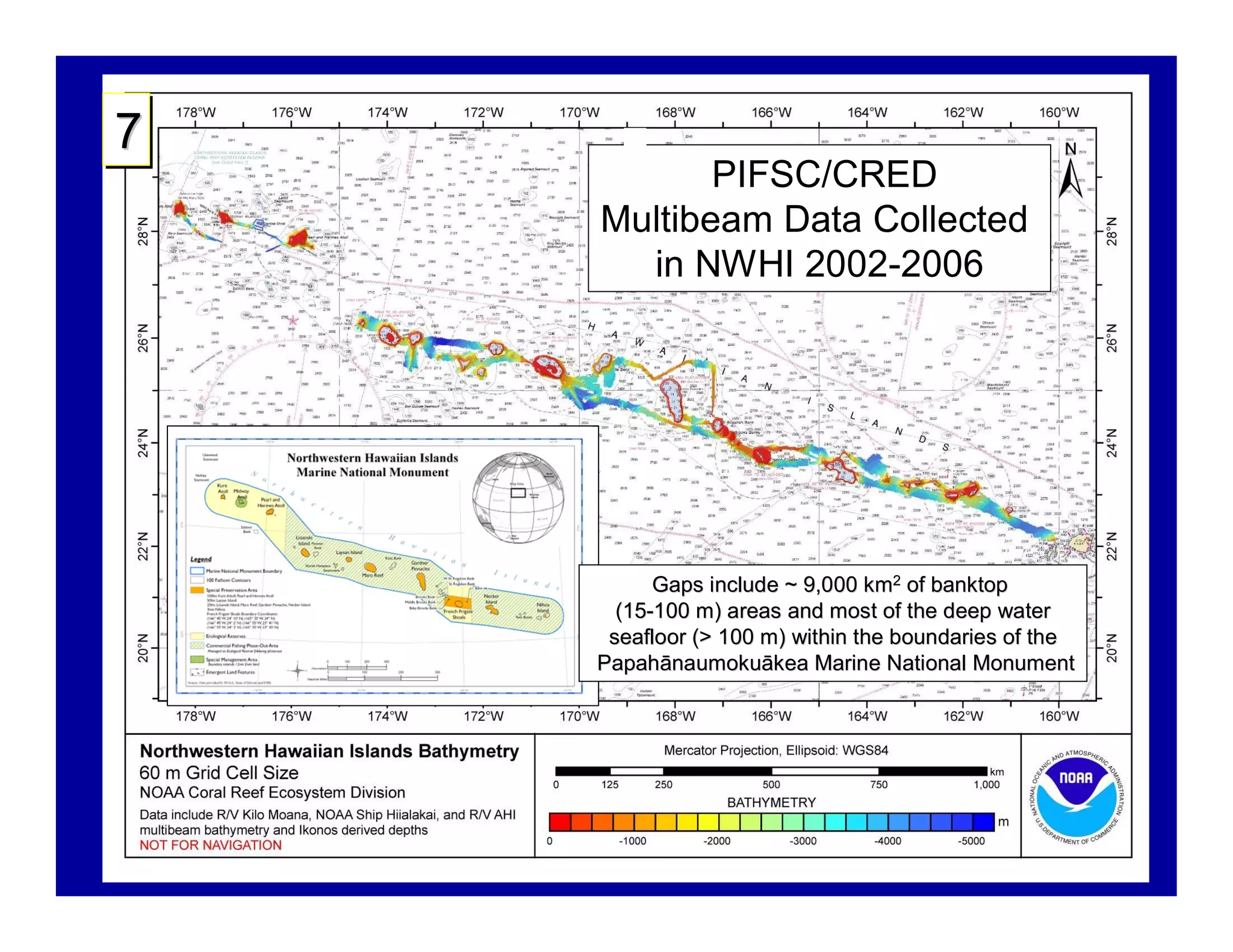
7
           PIFSC/CRED
    Multibeam Data Collected
      in NWHI 2002-2006


          Gaps include ~ 9,000 km2 of banktop
      (15-100 m) areas and most of the deep water
      (15-
     seafloor (> 100 m) within the boundaries of the
    Papahā naumokuā
    Papahānaumokuākea Marine National Monument
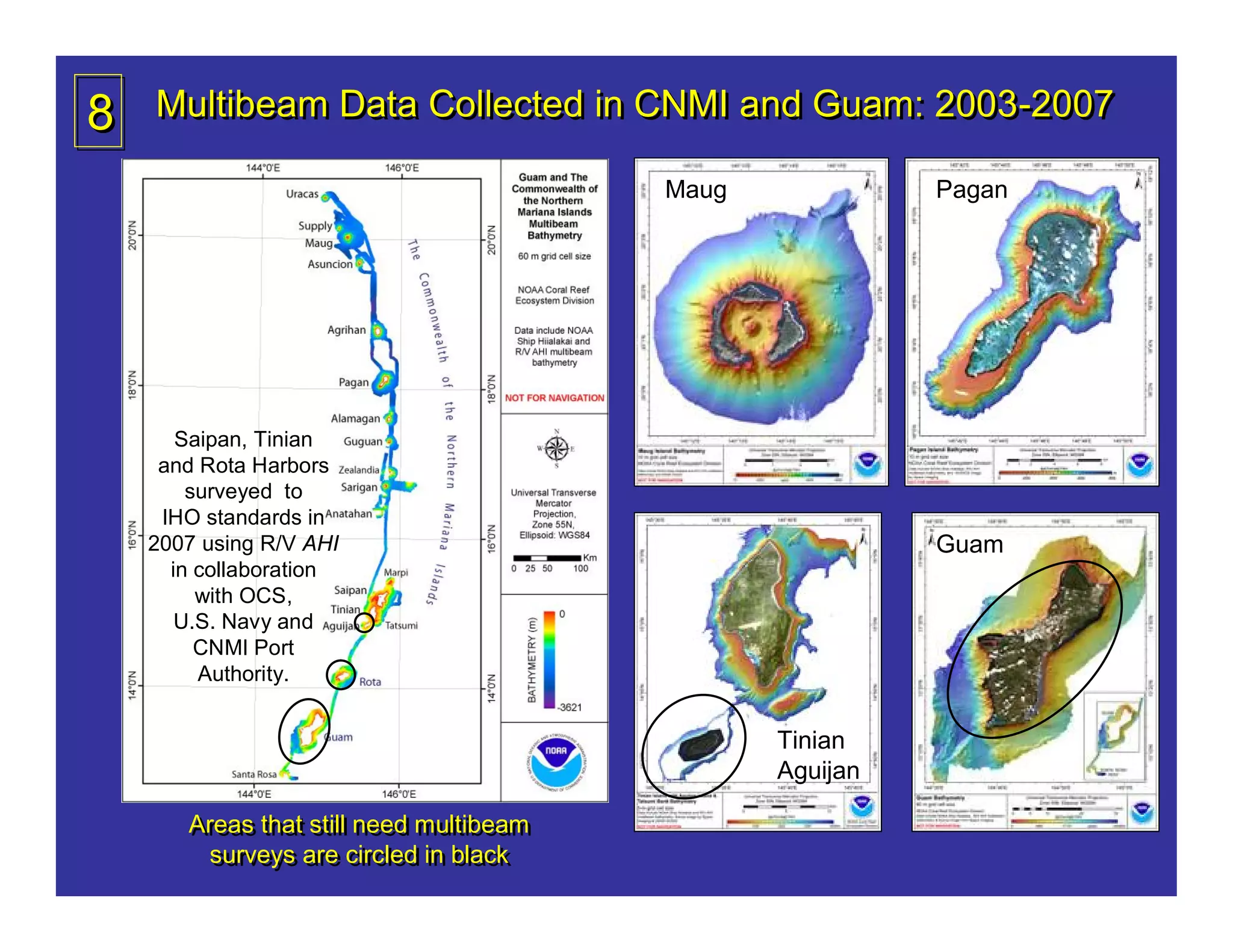
8   Multibeam Data Collected in CNMI and Guam: 2003-2007

                                         Maug             Pagan


       Saipan, Tinian
     and Rota Harbors
        surveyed to
     IHO standards in
    2007 using R/V AHI                                    Guam
      in collaboration
         with OCS,
       U.S. Navy and
         CNMI Port
         Authority.


                                                Tinian
                                                Aguijan

       Areas that still need multibeam
       Areas that still need multibeam
         surveys are circled in black
         surveys are circled in black
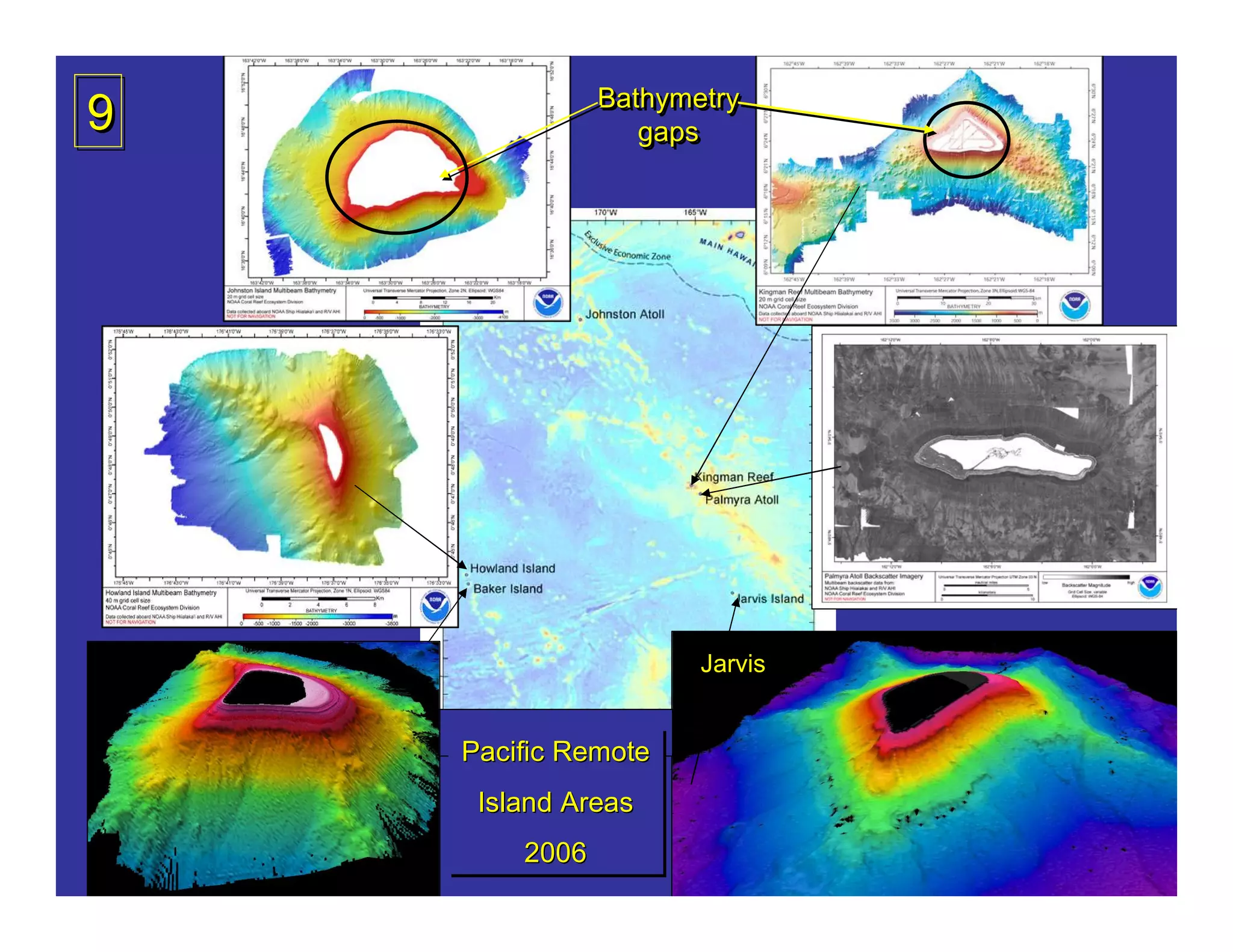
Bathymetry
                   Bathymetry
9                     gaps
                      gaps


Baker                     Jarvis


        Pacific Remote
        Pacific Remote
         Island Areas
         Island Areas
            2006
            2006
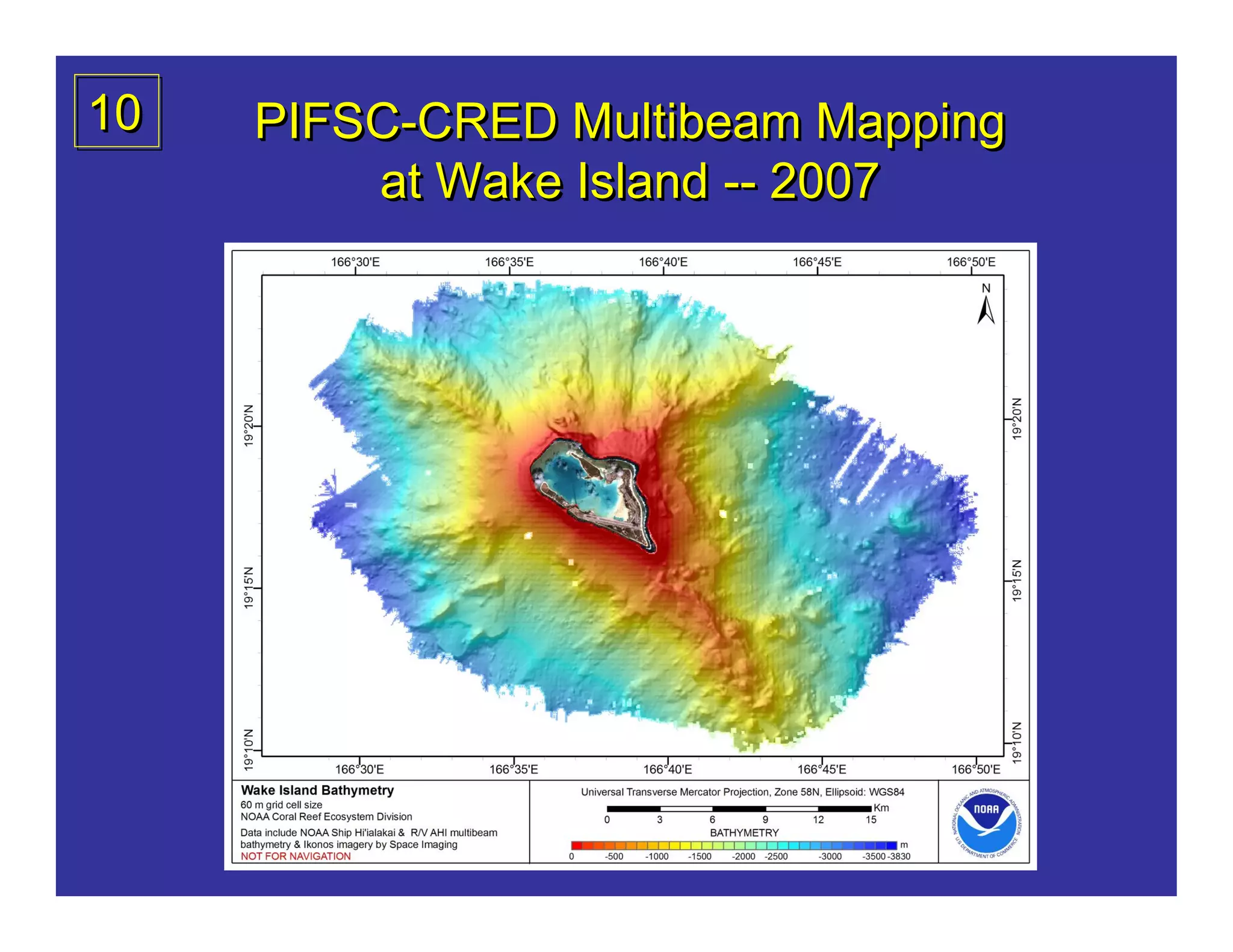
10   PIFSC-CRED Multibeam Mapping
     PIFSC-CRED
         at Wake Island -- 2007
11   Bathymetric Mapping Completion
 •   Many areas completely mapped in 20-1000 m.
                                     20-1000
 •   Guam, Rota, and Aguijan 15-300 m ~ 1 month
                             15-300
 •   Kingman & Johnston 15-50 m ~ 1 week
                        15-50
 •   MHI
     – Harbor surveys using R/V AHI are currently under
       discussion with NOAA Office of Coast Survey (OCS)
     – Areas between LIDAR and deeper multibeam
       coverage could be mapped with R/V AHI ~ 3-6 mos.
                                                 3-6
       Need mandate and support from other mgmt. groups.
 • NWHI
     – ~9,000 km2 of bank tops (15-100 m) remain
                 2             (15-100
       ~ 10-20 years at 15-30 days/yr.
         10-20          15-30
     – Deep (> 100 m) mapping in MNM ~ 2 mos.
 • LIDAR could be used in most areas in < 30 m
12       Key Mapping                •
                                    •   Pacific Consortium of Undersea
                                        Pacific Consortium of Undersea
                                        Habitat Centers (proposed)
                                        Habitat Centers (proposed)
         Partnerships               •
                                    •   CNMI and Guam
                                        CNMI and Guam
                                         –
                                         –   U.S. Navy
                                             U.S. Navy
                                         –
                                         –   NOAA Office of Coast Survey
                                             NOAA Office of Coast Survey
                                         –
                                         –   CNMI Port Authority
                                             CNMI Port Authority
                                         –
                                         –   National Park Service
                                             National Park Service
                                         –
                                         –   U.S. Geological Survey
                                             U.S. Geological Survey
                                         –
                                         –   Guam Fisherman’s Co-op
                                             Guam Fisherman’ Co-
                                                   Fisherman’s Co-op
                                         –
                                         –   University of Guam
                                             University of Guam
                                    •
                                    •   Hawaiian Archipelago
                                        Hawaiian Archipelago
                                         –
                                         –   Papahānaumokuā
                                             Papahānaumokuākea MNM
                                             Papahānaumokuākea MNM
                                         –
                                         –   Div. of Land & Natural Resources
                                             Div. of Land & Natural Resources
                                         –
                                         –   U.S. Fish and Wildlife Service
                                             U.S. Fish and Wildlife Service
                                         –
                                         –   University of Hawaii – HMRG, HURL
                                             University of Hawaii – HMRG, HURL
                                         –
                                         –   NOAA Office of Coast Survey
                                             NOAA Office of Coast Survey
                                         –
                                         –   NOAA Pacific Services Center
                                             NOAA Pacific Services Center
                                    •
                                    •   American Samoa
                                        American Samoa
                                         – National Park Service
                                         – National Park Service
                                         – NOAA National Marine Sanctuaries
                                         – NOAA National Marine Sanctuaries
                                    •
                                    •   PRIA
                                        PRIA
                                         – U.S. Fish and Wildlife Service
                                         – U.S. Fish and Wildlife Service
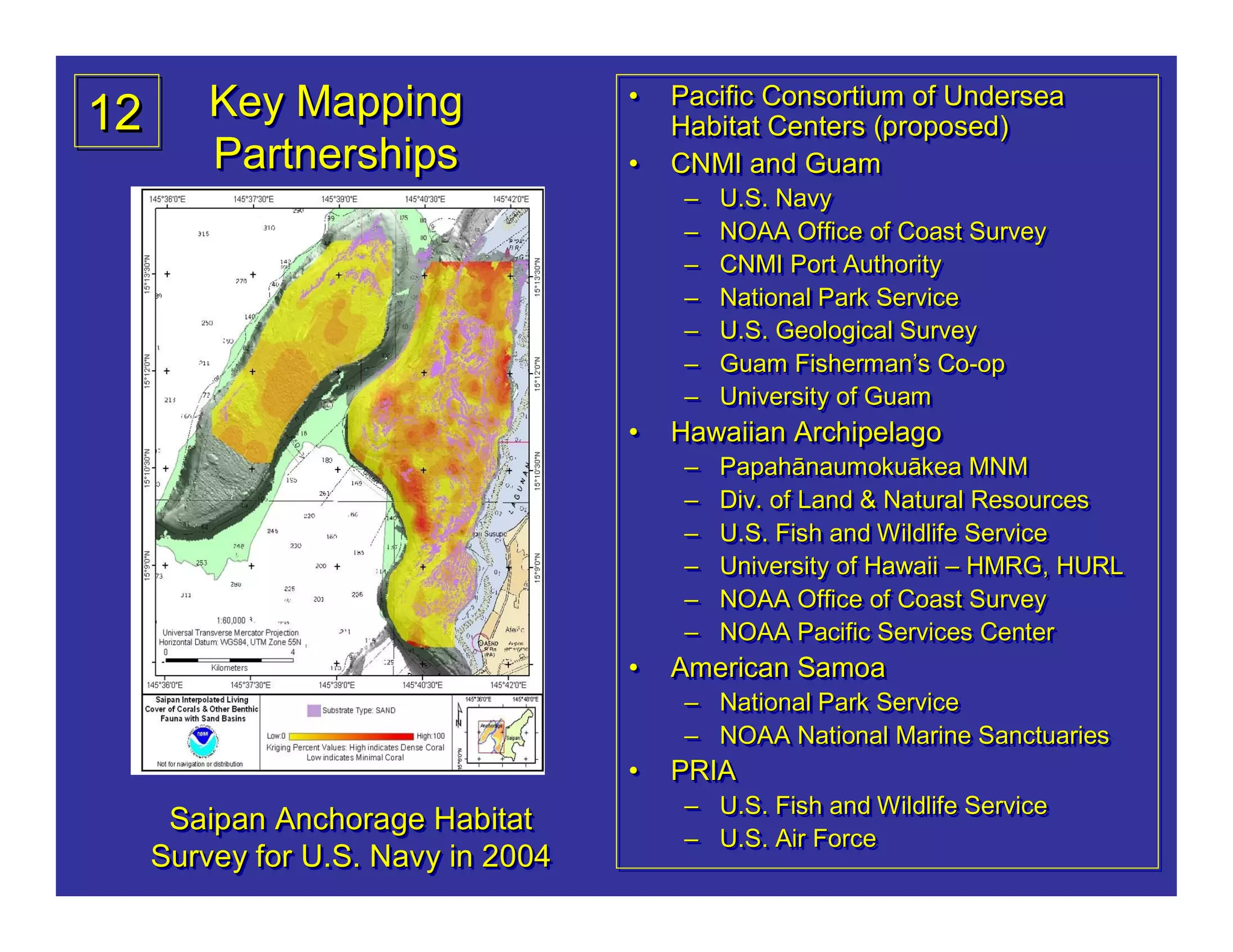
      Saipan Anchorage Habitat
                                         – U.S. Air Force
                                         – U.S. Air Force
     Survey for U.S. Navy in 2004
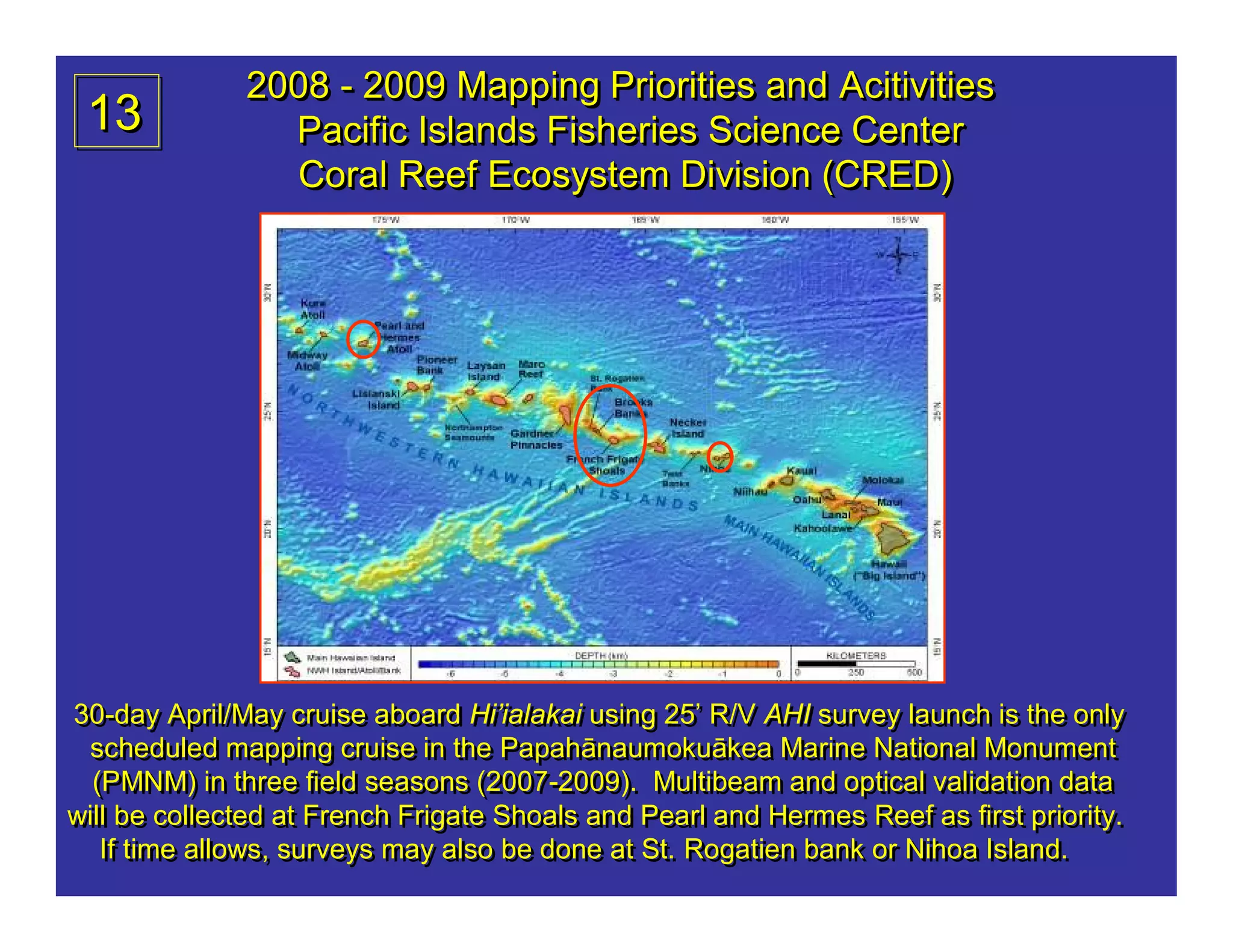
2008 - 2009 Mapping Priorities and Acitivities
 13             Pacific Islands Fisheries Science Center
                Coral Reef Ecosystem Division (CRED)


30-day April/May cruise aboard Hi’ialakai using 25’ R/V AHI survey launch is the only
 scheduled mapping cruise in the Papahānaumokuākea Marine National Monument
  scheduled mapping cruise in the Papahānaumokuākea Marine National Monument
  (PMNM) in three field seasons (2007-2009). Multibeam and optical validation data
  (PMNM) in three field seasons (2007-2009). Multibeam and optical validation data
will be collected at French Frigate Shoals and Pearl and Hermes Reef as first priority.
   If time allows, surveys may also be done at St. Rogatien bank or Nihoa Island.
   If time allows, surveys may also be done at St. Rogatien bank or Nihoa Island.
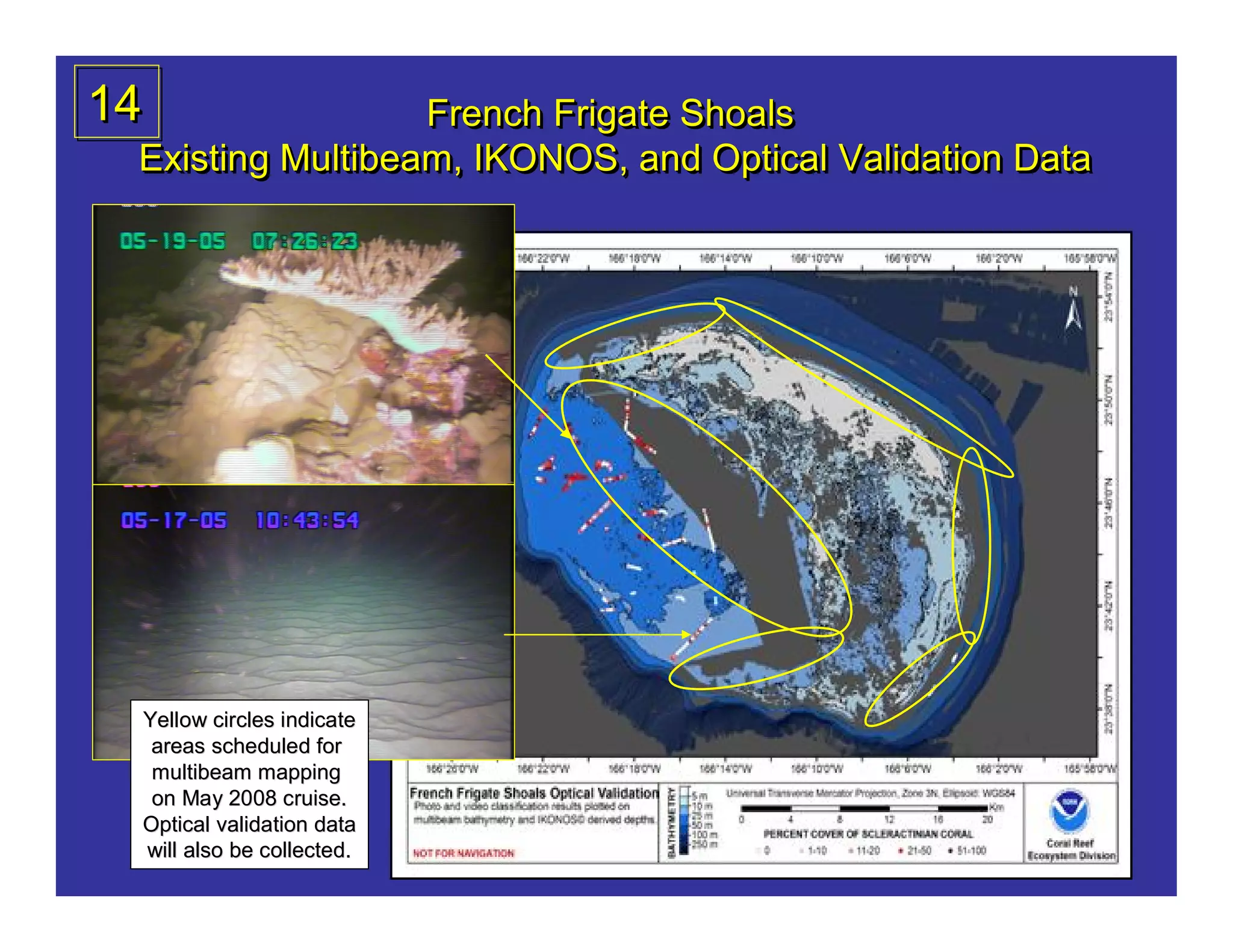
14                French Frigate Shoals
 Existing Multibeam, IKONOS, and Optical Validation Data


 Yellow circles indicate
  areas scheduled for
  multibeam mapping
  on May 2008 cruise.
 Optical validation data
 will also be collected.
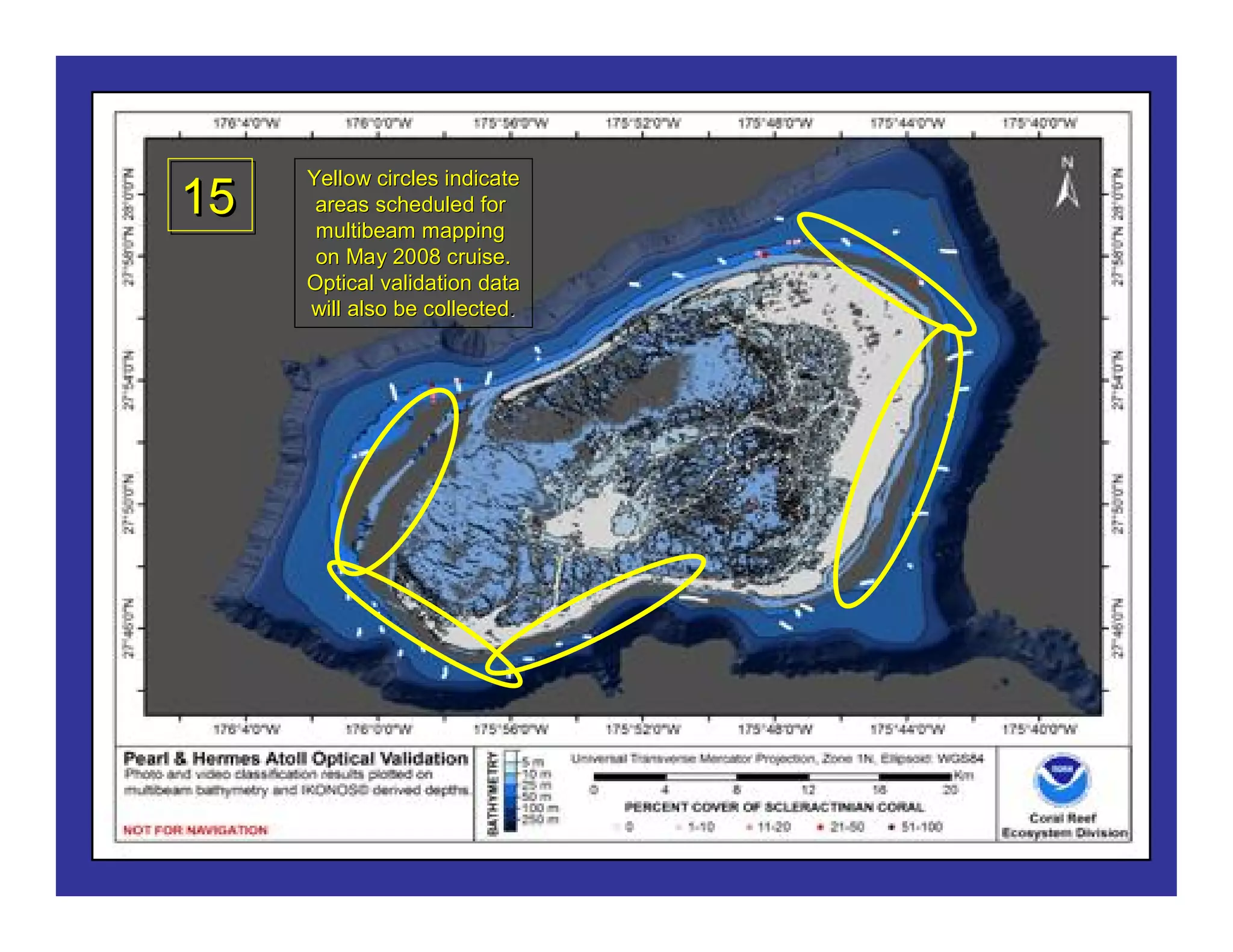
Pearl and Hermes Reef
Existing Multibeam, IKONOS, and Optical Validation Data
          Yellow circles indicate
  15      areas scheduled for
          multibeam mapping
          on May 2008 cruise.
         Optical validation data
         will also be collected.
                      collected.
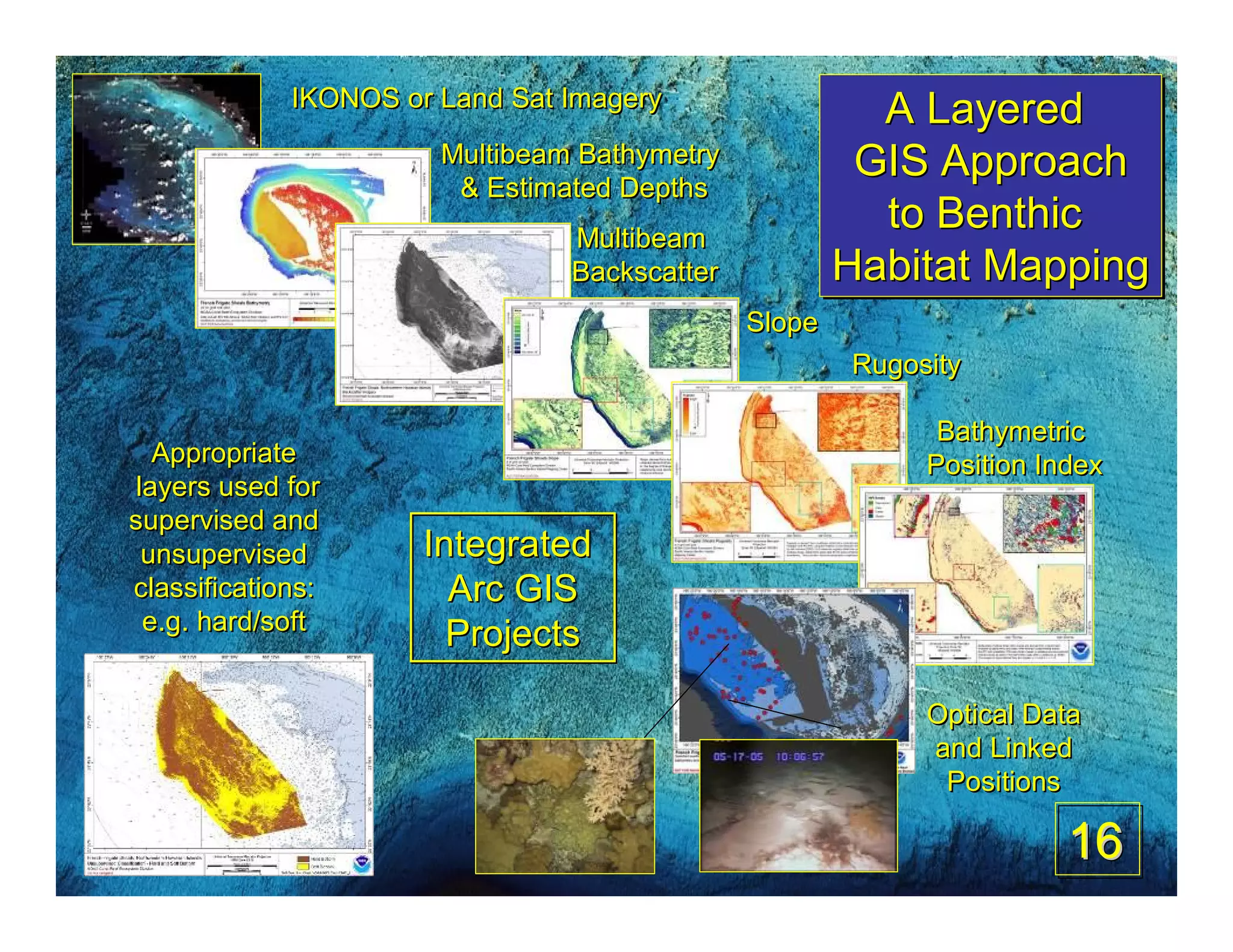
IKONOS or Land Sat Imagery
                                                        A Layered
                       Multibeam Bathymetry            GIS Approach
                        & Estimated Depths
                                Multibeam
                                                        to Benthic
                                Backscatter           Habitat Mapping
                                              Slope
                                                      Rugosity

                                                            Bathymetric
   Appropriate                                             Position Index
 layers used for
supervised and
  unsupervised        Integrated
classifications:        Arc GIS
  e.g. hard/soft
                        Projects

                                                           Optical Data
                                                           and Linked
                                                            Positions

                                                                      16
17                   Multibeam Data Products,
                      Standards and Issues
•
•    Data collected using standard hydrographic techniques and equipment with
     Data collected using standard hydrographic techniques and equipment with
     documented calibrations
     documented calibrations
      –
      –   Few tide stations
          Few tide stations
      –
      –   No DGPS in most areas until 2007 (NavCom)
          No DGPS in most areas until 2007 (NavCom)
                                             (NavCom)
      –
      –   Much more (10-20 x) expensive to collect all data to IHO standards because of
          Much more (10-
                      (10-20 x) expensive to collect all data to IHO standards because of
          bottom coverage requirements and documentation required to meet IHO standards
          bottom coverage requirements and documentation required to meet IHO standards
•
•    Multibeam swath data in generic sensor format submitted to NGDC within one
     Multibeam swath data in generic sensor format submitted to NGDC within one
     year of collection
     year of collection
      – Request from State of Hawaii to not make Main Hawaiian Island data in 100-500 m
      – Request from State of Hawaii to not make Main Hawaiian Island data in 100-
                                                                         data 100-500 m
        depths available to public because of Essential Fish Habitat concerns
        depths available to public because of Essential Fish Habitat concerns
                                                                     concerns
      – Metadata creation very time consuming and as yet no “standard” for multibeam
                                                               standard”
      – Metadata creation very time consuming and as yet no “standard” for multibeam
        format – this needs to be automated
        format – this needs to be automated
      – Much of data is in areas with pre-WWII soundings, but is not being or will not be
      – Much of data is in areas with pre-
                                      pre-WWII soundings, but is not being or will not be
        used for nautical chart updates
        used for nautical chart updates
•
•    Gridded bathymetric and backscatter data products (with metadata) available
     Gridded bathymetric and backscatter data products (with metadata) available
     on web at www.soest.hawaii.edu/pibhmc within one year
     on web at www.soest.hawaii.edu/pibhmc within one year
      – Metadata produced for all products, time consuming & needs automation
      – Metadata produced for all products, time consuming & needs automation
                                                                    automation
      – Metadata sent to Coral Reef Information System (CoRIS) site
      – Metadata sent to Coral Reef Information System (CoRIS) site
                                                        (CoRIS)
18
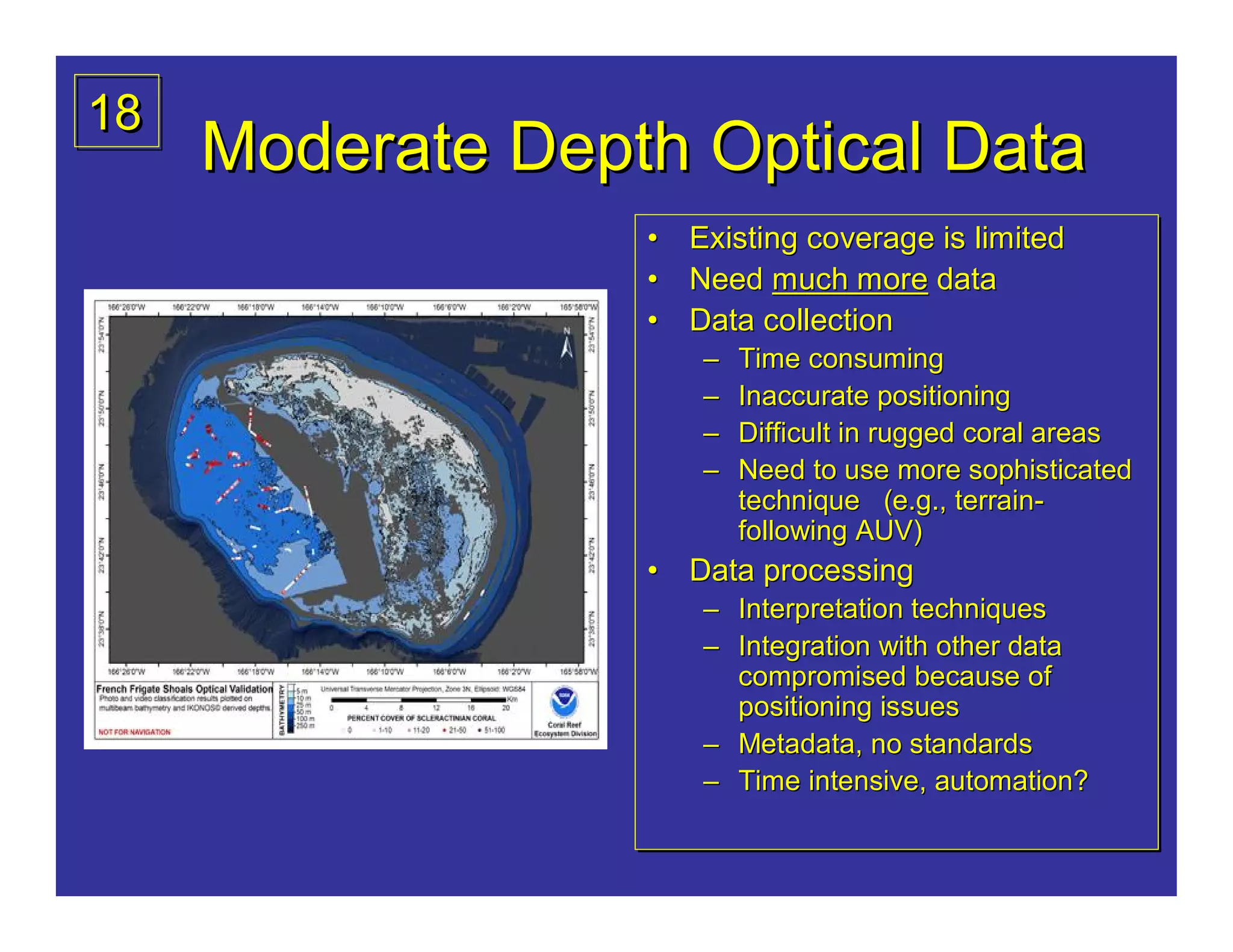
     Moderate Depth Optical Data
                  •   Existing coverage is limited
                  •   Need much more data
                  •   Data collection
                       –
                       –   Time consuming
                           Time consuming
                       –
                       –   Inaccurate positioning
                           Inaccurate positioning
                       –
                       –   Difficult in rugged coral areas
                           Difficult in rugged coral areas
                       –
                       –   Need to use more sophisticated
                           Need to use more sophisticated
                           technique (e.g., terrain-
                           technique (e.g., terrain-
                           following AUV)
                           following AUV)
                  • Data processing
                       – Interpretation techniques
                       – Interpretation techniques
                       – Integration with other data
                       – Integration with other data
                         compromised because of
                         compromised because of
                         positioning issues
                         positioning issues
                       – Metadata, no standards
                       – Metadata, no standards
                       – Time intensive, automation?
                       – Time intensive, automation?
19     Habitat Mapping Challenges
     Shallow water habitats (<~15 m)
       Need bathymetry and backscatter
       LIDAR works well, but not accessible in remote areas
     Moderate depth habitats (~15 – 400 m)
       Very sparse biological cover information
       Terrain-following AUV for optical validation needed
       Terrain-following
     Integration of shallow and deep mapping
       Shallow maps based on optical imagery, lack structure
       Moderate maps based on acoustic mapping, lack biology
       Need seamless mapping products
     Need Habitat Utilization Maps
       Which organisms utilize which habitats

Benthic Habitat Mapping

  • 1.
    Benthic Habitat Mapping 1 In the U.S.-Affiliated Pacific Islands U.S.-Affiliated * Tide Gauges * (18) *** * Wake Island ** * (24) Pacific Remote Island Areas (PRIA) (7) * * * (6) Monitoring & Mapping ~55 Island/Atoll Ecosystems Pacific Islands Fisheries Science Center – Coral Reef Ecosystem Division
  • 2.
    2 U.S. Coral Reef Task Force Goal Produce comprehensive digital maps of all shallow (<30m) coral reef ecosystems in the United States and characterize priority moderate-depth reef systems by 2009.
  • 3.
    3 PIFSC/CRED Benthic Habitat Mapping Methods IKONOS Imagery IKONOS Imagery Multibeam Surveys Optical Groundtruthing – Optical Groundtruthing – Optical Groundtruthing Optical Groundtruthing ROV, TOAD, AUV ROV, TOAD, AUV Towed Diver Surveys Towed Diver Surveys
  • 4.
    4 NOAA CRED and PIBHMC Multibeam Mapping Results (2002-2007) (2002-2007) R/V AHI Reson 8101ER (240 kHz) NOAA Ship Hi’ialakai EM300 (30 kHz) EM3002 (300 kHz) Moderate Depth Deep Coverage Area Years 15-200 m (km2) % Covered > 200m ( km2) NWHI 2002-2006 3,338/12,167 28% 38,367 MHI 2005-2006 3,018/5,430 95% n/a CNMI/Guam 2003, 2007 400/464 86% 12,695 Am. Samoa 2004, 2006 410/410 100% 975 PRIA 2006 100/121 82% 4,300 7266/18592 39% 56,708
  • 5.
    5 PIFSC-CRED Mapping in American Samoa – 2004 & 2006 Tutuila Ofu and Olosega Ta′u Rose Atoll Swains Island
  • 6.
    6 MHI Data Synthesis PIFSC/CRED and Univ. of Hawaii Shallow (15-300 m) Shallow (15-300 m) Unmapped areas include high resolution high resolution harbor surveys and gaps NOAA surveys NOAA surveys between LIDAR and 2005-2006: 2005-2006: multibeam bathymetry Ni′ihau, Kohala, Ni′ihau, Kohala, Ni′ihau Penguin Bank, Penguin Bank, N. Shore N. Shore Moloka′i N. Shore Moloka′i Moloka′i Kohala Penguin Big Island Bank 50-m grid available at http://www.soest.hawaii.edu/hmrg/Multibeam/explorer.php 50- grid available at http://www.soest.hawaii.edu/hmrg/Multibeam/explorer.php 50-m http://www.soest.hawaii.edu/hmrg/Multibeam/explorer.php
  • 7.
    7 PIFSC/CRED Multibeam Data Collected in NWHI 2002-2006 Gaps include ~ 9,000 km2 of banktop (15-100 m) areas and most of the deep water (15- seafloor (> 100 m) within the boundaries of the Papahā naumokuā Papahānaumokuākea Marine National Monument
  • 8.
    8 Multibeam Data Collected in CNMI and Guam: 2003-2007 Maug Pagan Saipan, Tinian and Rota Harbors surveyed to IHO standards in 2007 using R/V AHI Guam in collaboration with OCS, U.S. Navy and CNMI Port Authority. Tinian Aguijan Areas that still need multibeam Areas that still need multibeam surveys are circled in black surveys are circled in black
  • 9.
    Bathymetry Bathymetry 9 gaps gaps Baker Jarvis Pacific Remote Pacific Remote Island Areas Island Areas 2006 2006
  • 10.
    10 PIFSC-CRED Multibeam Mapping PIFSC-CRED at Wake Island -- 2007
  • 11.
    11 Bathymetric Mapping Completion • Many areas completely mapped in 20-1000 m. 20-1000 • Guam, Rota, and Aguijan 15-300 m ~ 1 month 15-300 • Kingman & Johnston 15-50 m ~ 1 week 15-50 • MHI – Harbor surveys using R/V AHI are currently under discussion with NOAA Office of Coast Survey (OCS) – Areas between LIDAR and deeper multibeam coverage could be mapped with R/V AHI ~ 3-6 mos. 3-6 Need mandate and support from other mgmt. groups. • NWHI – ~9,000 km2 of bank tops (15-100 m) remain 2 (15-100 ~ 10-20 years at 15-30 days/yr. 10-20 15-30 – Deep (> 100 m) mapping in MNM ~ 2 mos. • LIDAR could be used in most areas in < 30 m
  • 12.
    12 Key Mapping • • Pacific Consortium of Undersea Pacific Consortium of Undersea Habitat Centers (proposed) Habitat Centers (proposed) Partnerships • • CNMI and Guam CNMI and Guam – – U.S. Navy U.S. Navy – – NOAA Office of Coast Survey NOAA Office of Coast Survey – – CNMI Port Authority CNMI Port Authority – – National Park Service National Park Service – – U.S. Geological Survey U.S. Geological Survey – – Guam Fisherman’s Co-op Guam Fisherman’ Co- Fisherman’s Co-op – – University of Guam University of Guam • • Hawaiian Archipelago Hawaiian Archipelago – – Papahānaumokuā Papahānaumokuākea MNM Papahānaumokuākea MNM – – Div. of Land & Natural Resources Div. of Land & Natural Resources – – U.S. Fish and Wildlife Service U.S. Fish and Wildlife Service – – University of Hawaii – HMRG, HURL University of Hawaii – HMRG, HURL – – NOAA Office of Coast Survey NOAA Office of Coast Survey – – NOAA Pacific Services Center NOAA Pacific Services Center • • American Samoa American Samoa – National Park Service – National Park Service – NOAA National Marine Sanctuaries – NOAA National Marine Sanctuaries • • PRIA PRIA – U.S. Fish and Wildlife Service – U.S. Fish and Wildlife Service Saipan Anchorage Habitat – U.S. Air Force – U.S. Air Force Survey for U.S. Navy in 2004
  • 13.
    2008 - 2009Mapping Priorities and Acitivities 13 Pacific Islands Fisheries Science Center Coral Reef Ecosystem Division (CRED) 30-day April/May cruise aboard Hi’ialakai using 25’ R/V AHI survey launch is the only 30-day April/May cruise aboard Hi’ialakai using 25’ R/V AHI survey launch is the only scheduled mapping cruise in the Papahānaumokuākea Marine National Monument scheduled mapping cruise in the Papahānaumokuākea Marine National Monument (PMNM) in three field seasons (2007-2009). Multibeam and optical validation data (PMNM) in three field seasons (2007-2009). Multibeam and optical validation data will be collected at French Frigate Shoals and Pearl and Hermes Reef as first priority. will be collected at French Frigate Shoals and Pearl and Hermes Reef as first priority. If time allows, surveys may also be done at St. Rogatien bank or Nihoa Island. If time allows, surveys may also be done at St. Rogatien bank or Nihoa Island.
  • 14.
    14 French Frigate Shoals Existing Multibeam, IKONOS, and Optical Validation Data Yellow circles indicate areas scheduled for multibeam mapping on May 2008 cruise. Optical validation data will also be collected.
  • 15.
    Pearl and HermesReef Existing Multibeam, IKONOS, and Optical Validation Data Yellow circles indicate 15 areas scheduled for multibeam mapping on May 2008 cruise. Optical validation data will also be collected. collected.
  • 16.
    IKONOS or LandSat Imagery A Layered Multibeam Bathymetry GIS Approach & Estimated Depths Multibeam to Benthic Backscatter Habitat Mapping Slope Rugosity Bathymetric Appropriate Position Index layers used for supervised and unsupervised Integrated classifications: Arc GIS e.g. hard/soft Projects Optical Data and Linked Positions 16
  • 17.
    17 Multibeam Data Products, Standards and Issues • • Data collected using standard hydrographic techniques and equipment with Data collected using standard hydrographic techniques and equipment with documented calibrations documented calibrations – – Few tide stations Few tide stations – – No DGPS in most areas until 2007 (NavCom) No DGPS in most areas until 2007 (NavCom) (NavCom) – – Much more (10-20 x) expensive to collect all data to IHO standards because of Much more (10- (10-20 x) expensive to collect all data to IHO standards because of bottom coverage requirements and documentation required to meet IHO standards bottom coverage requirements and documentation required to meet IHO standards • • Multibeam swath data in generic sensor format submitted to NGDC within one Multibeam swath data in generic sensor format submitted to NGDC within one year of collection year of collection – Request from State of Hawaii to not make Main Hawaiian Island data in 100-500 m – Request from State of Hawaii to not make Main Hawaiian Island data in 100- data 100-500 m depths available to public because of Essential Fish Habitat concerns depths available to public because of Essential Fish Habitat concerns concerns – Metadata creation very time consuming and as yet no “standard” for multibeam standard” – Metadata creation very time consuming and as yet no “standard” for multibeam format – this needs to be automated format – this needs to be automated – Much of data is in areas with pre-WWII soundings, but is not being or will not be – Much of data is in areas with pre- pre-WWII soundings, but is not being or will not be used for nautical chart updates used for nautical chart updates • • Gridded bathymetric and backscatter data products (with metadata) available Gridded bathymetric and backscatter data products (with metadata) available on web at www.soest.hawaii.edu/pibhmc within one year on web at www.soest.hawaii.edu/pibhmc within one year – Metadata produced for all products, time consuming & needs automation – Metadata produced for all products, time consuming & needs automation automation – Metadata sent to Coral Reef Information System (CoRIS) site – Metadata sent to Coral Reef Information System (CoRIS) site (CoRIS)
  • 18.
    18 Moderate Depth Optical Data • Existing coverage is limited • Need much more data • Data collection – – Time consuming Time consuming – – Inaccurate positioning Inaccurate positioning – – Difficult in rugged coral areas Difficult in rugged coral areas – – Need to use more sophisticated Need to use more sophisticated technique (e.g., terrain- technique (e.g., terrain- following AUV) following AUV) • Data processing – Interpretation techniques – Interpretation techniques – Integration with other data – Integration with other data compromised because of compromised because of positioning issues positioning issues – Metadata, no standards – Metadata, no standards – Time intensive, automation? – Time intensive, automation?
  • 19.
    19 Habitat Mapping Challenges Shallow water habitats (<~15 m) Need bathymetry and backscatter LIDAR works well, but not accessible in remote areas Moderate depth habitats (~15 – 400 m) Very sparse biological cover information Terrain-following AUV for optical validation needed Terrain-following Integration of shallow and deep mapping Shallow maps based on optical imagery, lack structure Moderate maps based on acoustic mapping, lack biology Need seamless mapping products Need Habitat Utilization Maps Which organisms utilize which habitats