06/09/12 Venue Name: Go to 'View' menu > 'Header and Footer' to change slide 1
Developing academic practice
Helen Beetham Independent consultant for Jisc and CLL
CLL Digital Literacy workshop | LSE | May 7th
2014
Outcomes from the Jisc Developing Digital Literacies programme
relevant to subject teaching in the disciplines
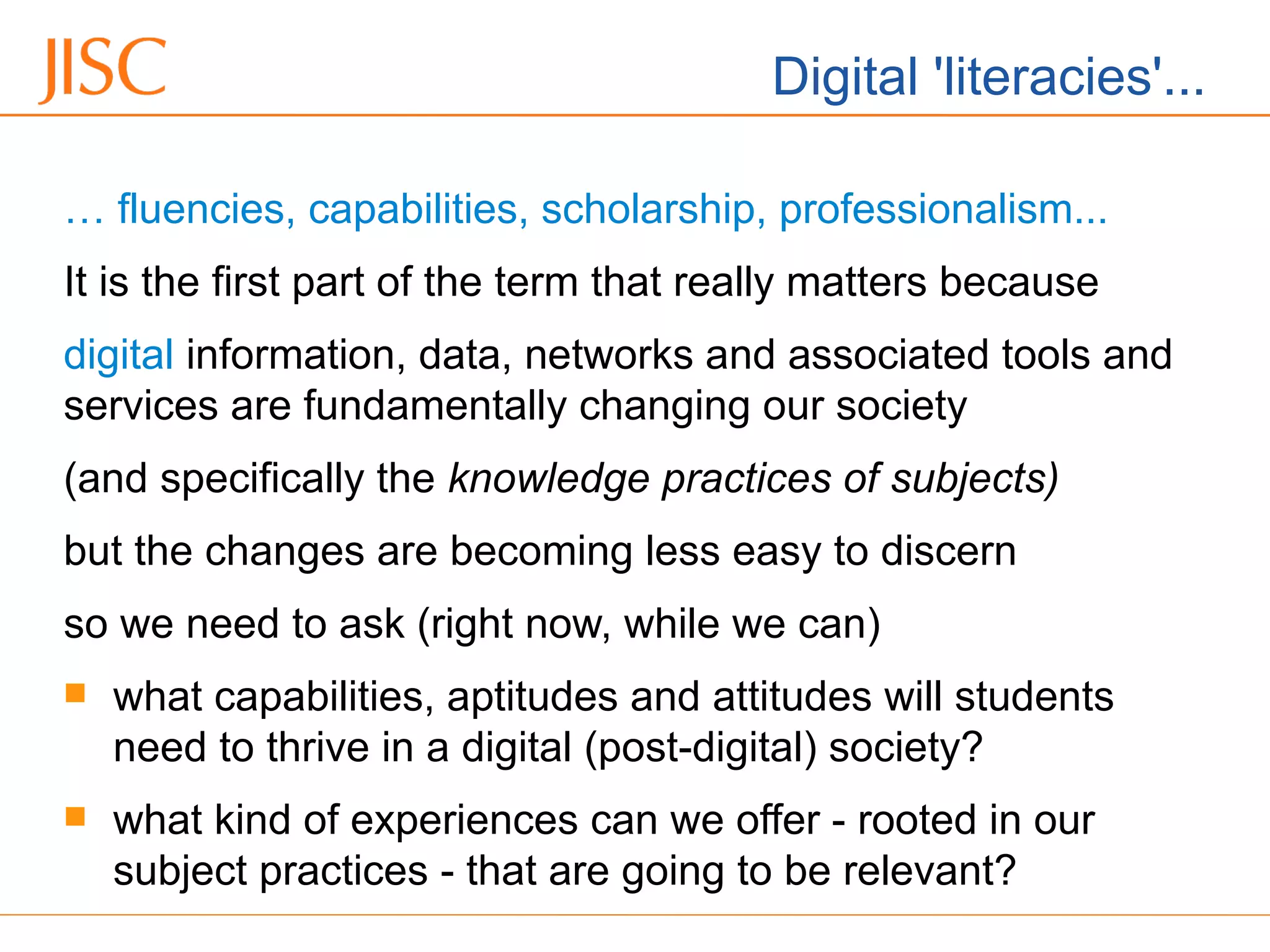
Digital 'literacies'...
… fluencies, capabilities, scholarship, professionalism...
It is the first part of the term that really matters because
digital information, data, networks and associated tools and
services are fundamentally changing our society
(and specifically the knowledge practices of subjects)
but the changes are becoming less easy to discern
so we need to ask (right now, while we can)
 what capabilities, aptitudes and attitudes will students
need to thrive in a digital (post-digital) society?
 what kind of experiences can we offer - rooted in our
subject practices - that are going to be relevant?
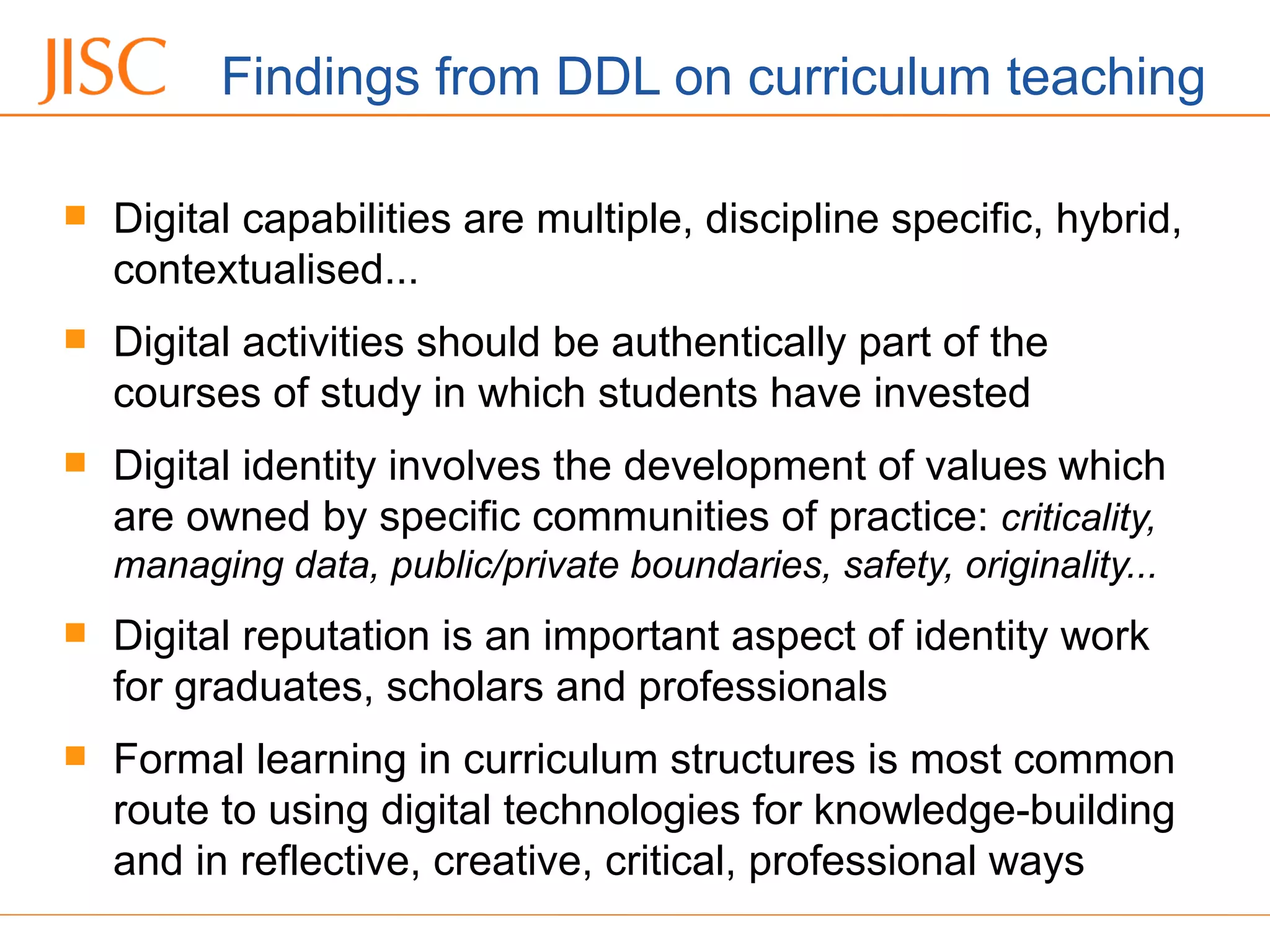
Findings from DDL on curriculum teaching
 Digital capabilities are multiple, discipline specific, hybrid,
contextualised...
 Digital activities should be authentically part of the
courses of study in which students have invested
 Digital identity involves the development of values which
are owned by specific communities of practice: criticality,
managing data, public/private boundaries, safety, originality...
 Digital reputation is an important aspect of identity work
for graduates, scholars and professionals
 Formal learning in curriculum structures is most common
route to using digital technologies for knowledge-building
and in reflective, creative, critical, professional ways
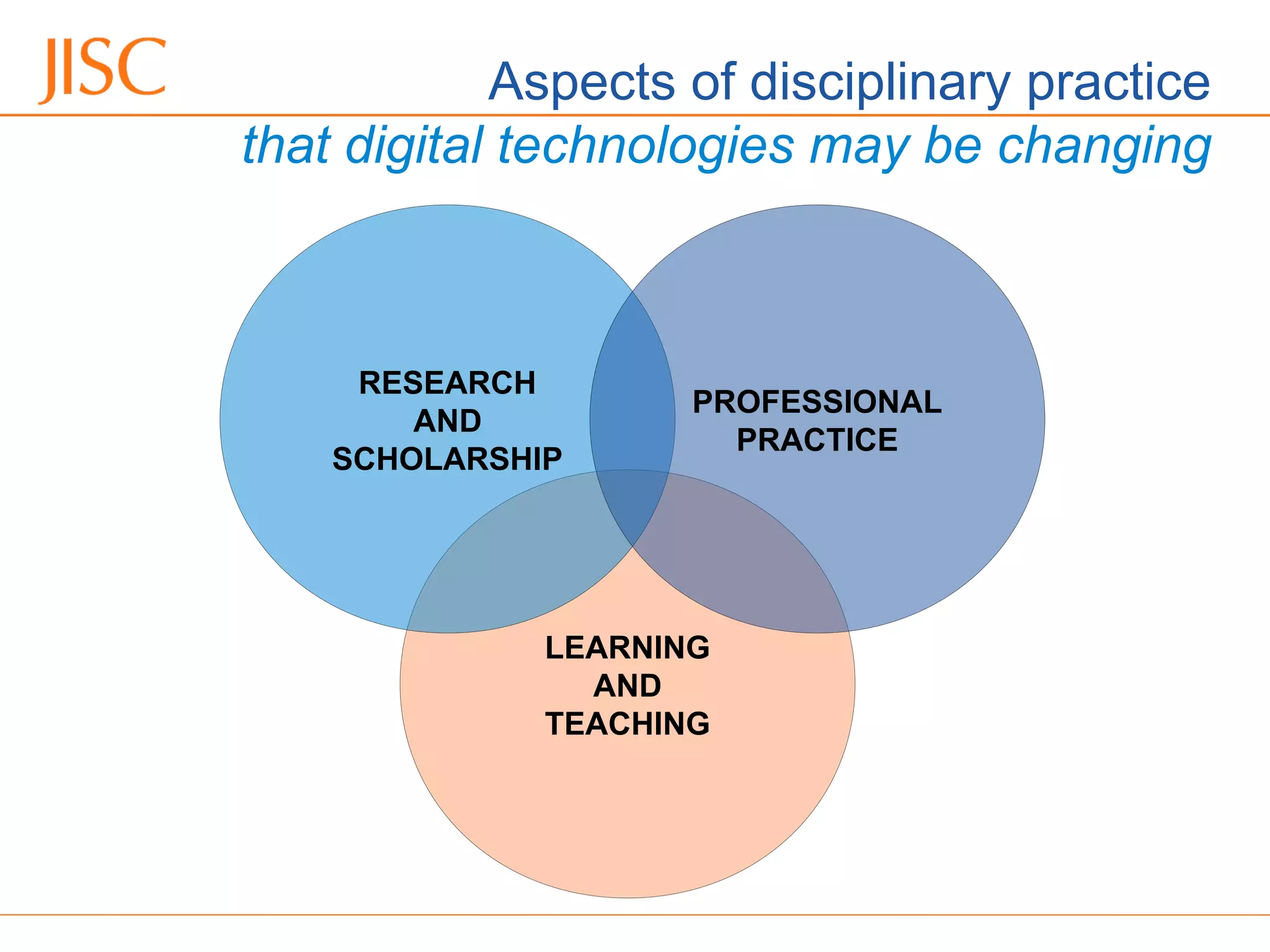
Aspects of disciplinary practice
that digital technologies may be changing
LEARNING
AND
TEACHING
RESEARCH
AND
SCHOLARSHIP
PROFESSIONAL
PRACTICE
06/09/12 Venue Name: Go to 'View' menu > 'Header and Footer' to change
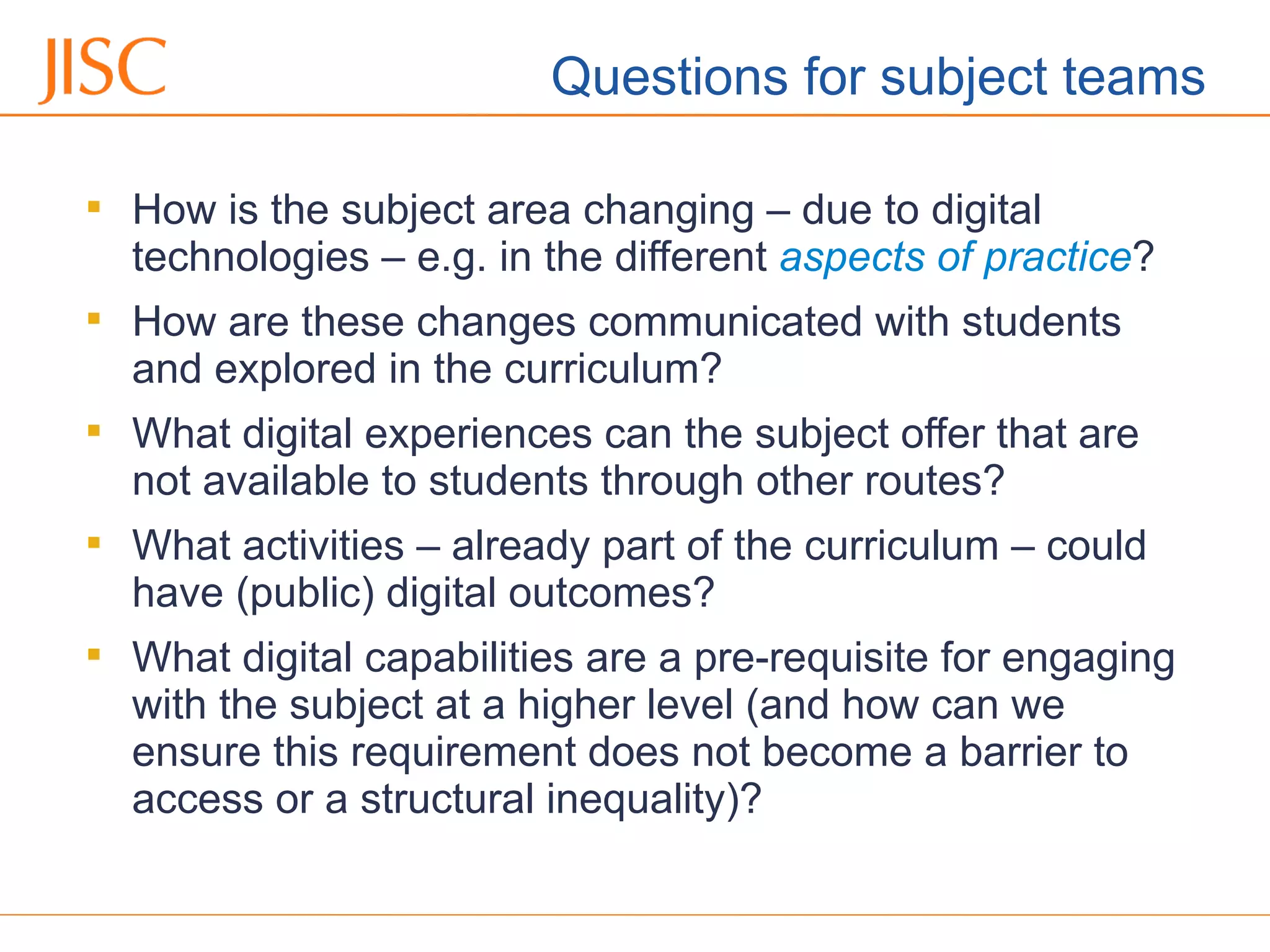

How is the subject area changing – due to digital
technologies – e.g. in the different aspects of practice?

How are these changes communicated with students
and explored in the curriculum?

What digital experiences can the subject offer that are
not available to students through other routes?

What activities – already part of the curriculum – could
have (public) digital outcomes?

What digital capabilities are a pre-requisite for engaging
with the subject at a higher level (and how can we
ensure this requirement does not become a barrier to
access or a structural inequality)?
Questions for subject teams
06/09/12 Venue Name: Go to 'View' menu > 'Header and Footer' to change
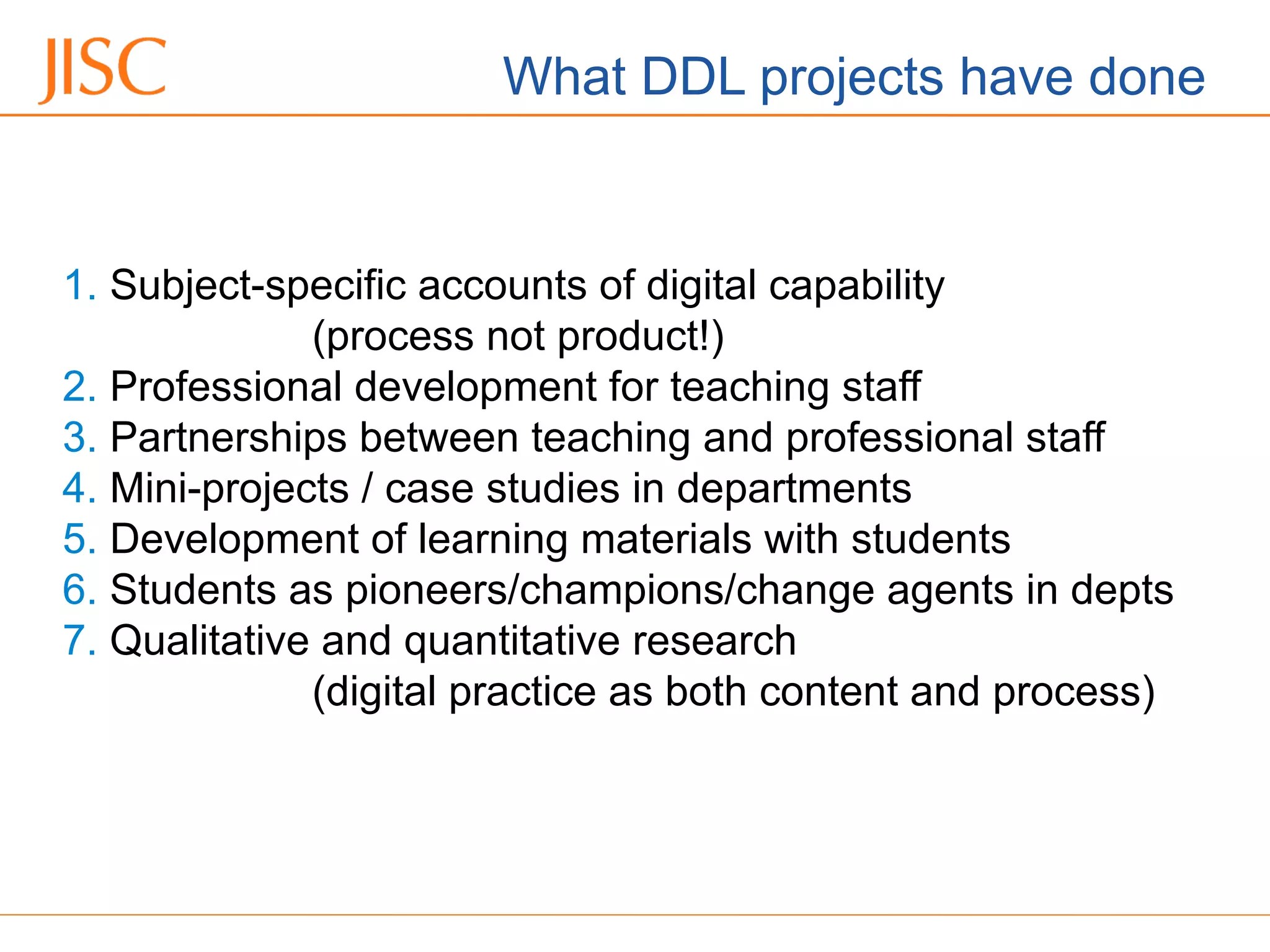
1. Subject-specific accounts of digital capability
(process not product!)
2. Professional development for teaching staff
3. Partnerships between teaching and professional staff
4. Mini-projects / case studies in departments
5. Development of learning materials with students
6. Students as pioneers/champions/change agents in depts
7. Qualitative and quantitative research
(digital practice as both content and process)
What DDL projects have done
06/09/12 Venue Name: Go to 'View' menu > 'Header and Footer' to change
Further resources
http://bit.ly/DLinfokit
http://bit.ly/DLdisc
06/09/12 Venue Name: Go to 'View' menu > 'Header and Footer' to change
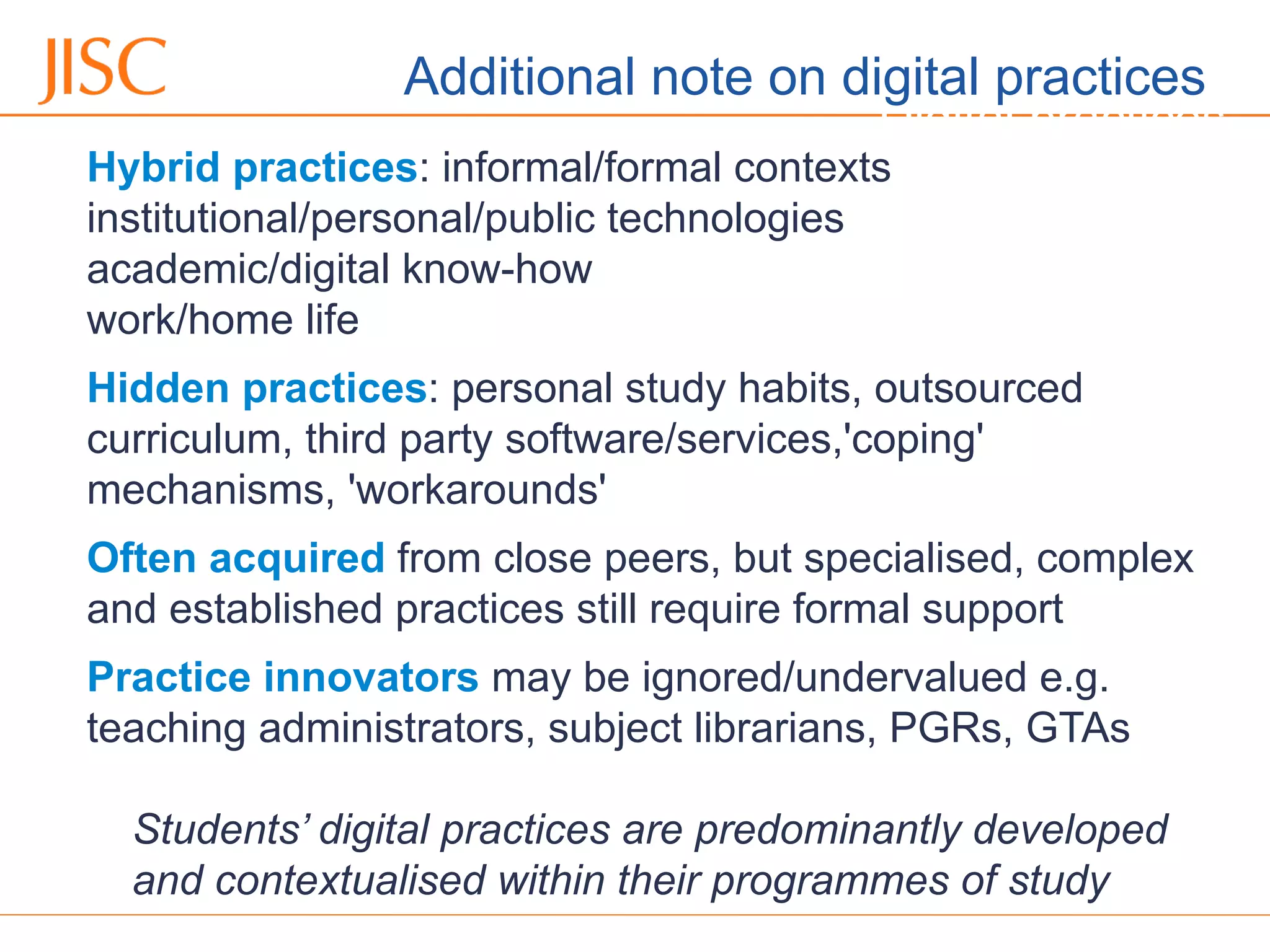
Digital practices
Hybrid practices: informal/formal contexts
institutional/personal/public technologies
academic/digital know-how
work/home life
Hidden practices: personal study habits, outsourced
curriculum, third party software/services,'coping'
mechanisms, 'workarounds'
Often acquired from close peers, but specialised, complex
and established practices still require formal support
Practice innovators may be ignored/undervalued e.g.
teaching administrators, subject librarians, PGRs, GTAs
Students’ digital practices are predominantly developed
and contextualised within their programmes of study
Additional note on digital practices

Cll dl workshop may14

  • 1.
    06/09/12 Venue Name:Go to 'View' menu > 'Header and Footer' to change slide 1 Developing academic practice Helen Beetham Independent consultant for Jisc and CLL CLL Digital Literacy workshop | LSE | May 7th 2014 Outcomes from the Jisc Developing Digital Literacies programme relevant to subject teaching in the disciplines
  • 2.
    Digital 'literacies'... … fluencies,capabilities, scholarship, professionalism... It is the first part of the term that really matters because digital information, data, networks and associated tools and services are fundamentally changing our society (and specifically the knowledge practices of subjects) but the changes are becoming less easy to discern so we need to ask (right now, while we can)  what capabilities, aptitudes and attitudes will students need to thrive in a digital (post-digital) society?  what kind of experiences can we offer - rooted in our subject practices - that are going to be relevant?
  • 3.
    Findings from DDLon curriculum teaching  Digital capabilities are multiple, discipline specific, hybrid, contextualised...  Digital activities should be authentically part of the courses of study in which students have invested  Digital identity involves the development of values which are owned by specific communities of practice: criticality, managing data, public/private boundaries, safety, originality...  Digital reputation is an important aspect of identity work for graduates, scholars and professionals  Formal learning in curriculum structures is most common route to using digital technologies for knowledge-building and in reflective, creative, critical, professional ways
  • 4.
    Aspects of disciplinarypractice that digital technologies may be changing LEARNING AND TEACHING RESEARCH AND SCHOLARSHIP PROFESSIONAL PRACTICE
  • 5.
    06/09/12 Venue Name:Go to 'View' menu > 'Header and Footer' to change  How is the subject area changing – due to digital technologies – e.g. in the different aspects of practice?  How are these changes communicated with students and explored in the curriculum?  What digital experiences can the subject offer that are not available to students through other routes?  What activities – already part of the curriculum – could have (public) digital outcomes?  What digital capabilities are a pre-requisite for engaging with the subject at a higher level (and how can we ensure this requirement does not become a barrier to access or a structural inequality)? Questions for subject teams
  • 6.
    06/09/12 Venue Name:Go to 'View' menu > 'Header and Footer' to change 1. Subject-specific accounts of digital capability (process not product!) 2. Professional development for teaching staff 3. Partnerships between teaching and professional staff 4. Mini-projects / case studies in departments 5. Development of learning materials with students 6. Students as pioneers/champions/change agents in depts 7. Qualitative and quantitative research (digital practice as both content and process) What DDL projects have done
  • 7.
    06/09/12 Venue Name:Go to 'View' menu > 'Header and Footer' to change Further resources http://bit.ly/DLinfokit http://bit.ly/DLdisc
  • 8.
    06/09/12 Venue Name:Go to 'View' menu > 'Header and Footer' to change Digital practices Hybrid practices: informal/formal contexts institutional/personal/public technologies academic/digital know-how work/home life Hidden practices: personal study habits, outsourced curriculum, third party software/services,'coping' mechanisms, 'workarounds' Often acquired from close peers, but specialised, complex and established practices still require formal support Practice innovators may be ignored/undervalued e.g. teaching administrators, subject librarians, PGRs, GTAs Students’ digital practices are predominantly developed and contextualised within their programmes of study Additional note on digital practices