Sisir Sarma 18.318: Introduction to Econometrics
What is Heteroskedasticity
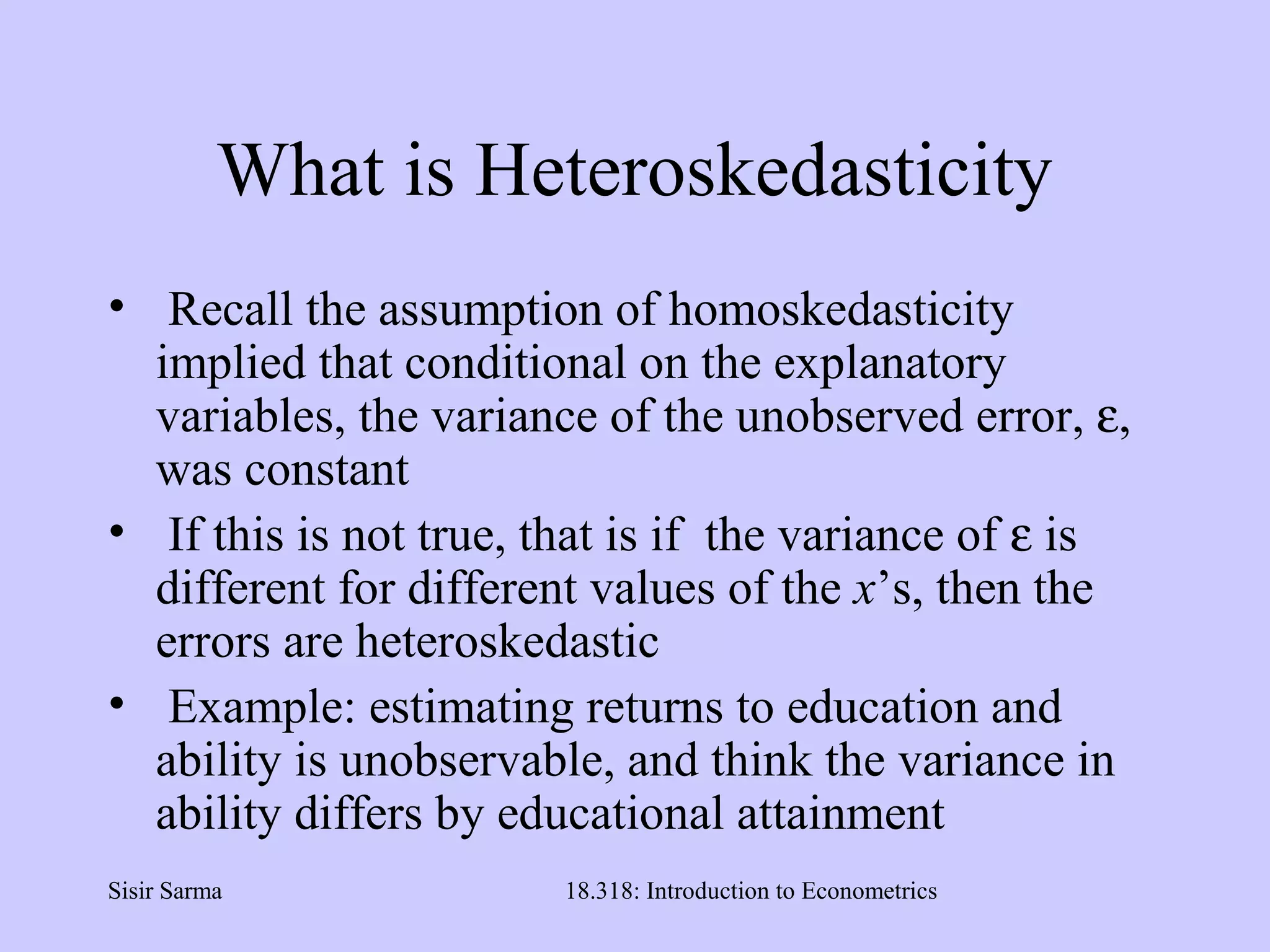
• Recall the assumption of homoskedasticity
implied that conditional on the explanatory
variables, the variance of the unobserved error, ε,
was constant
• If this is not true, that is if the variance of ε is
different for different values of the x’s, then the
errors are heteroskedastic
• Example: estimating returns to education and
ability is unobservable, and think the variance in
ability differs by educational attainment
Sisir Sarma 18.318: Introduction to Econometrics
.
xx1 x2
y
f(y|x)
Example of Heteroskedasticity
x3
.
. E(y|x) = β0 + β1x
Sisir Sarma 18.318: Introduction to Econometrics
Why Worry About
Heteroskedasticity?
• OLS is still unbiased and consistent, even if
we do not assume homoskedasticity
• The standard errors of the estimates are
biased if we have heteroskedasticity
• If the standard errors are biased, we can not
use the usual t statistics or F statistics for
drawing inferences
Sisir Sarma 18.318: Introduction to Econometrics
Robust Standard Errors
• Find consistent estimate of the variance
• The square root can be used as a standard
error for inference
• Typically call these robust standard errors
• Sometimes the estimated variance is
corrected for degrees of freedom by
multiplying by n/(n – k – 1)
• As n → ∞ it’s all the same, though
Sisir Sarma 18.318: Introduction to Econometrics
Robust Standard Errors (cont)
• Important to remember that these robust
standard errors only have asymptotic
justification – with small sample sizes t
statistics formed with robust standard errors
will not have a distribution close to the t,
and inferences will not be correct
• In Eviews, robust standard errors are easily
obtained using the white option
Sisir Sarma 18.318: Introduction to Econometrics
Testing for Heteroskedasticity
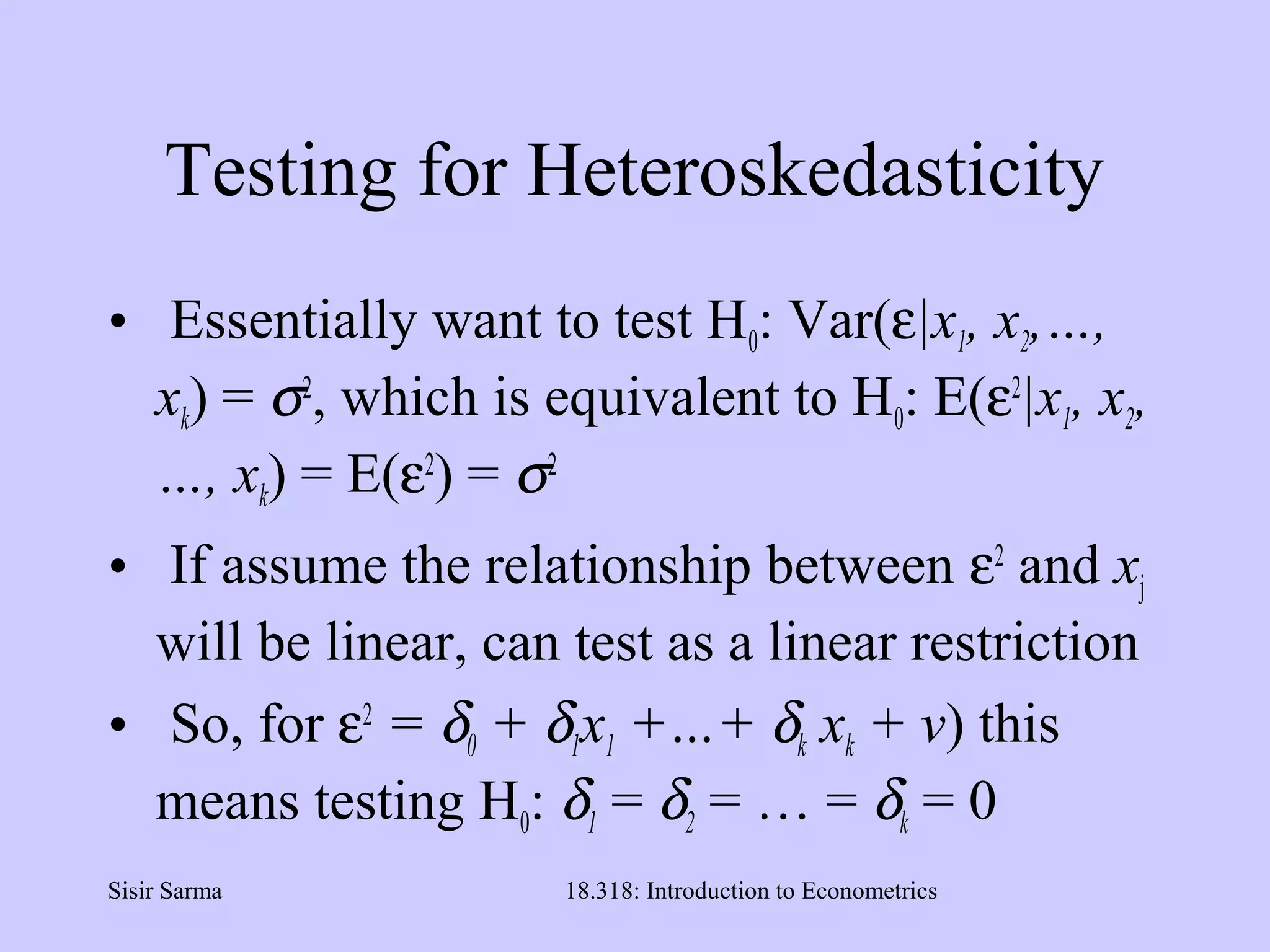
• Essentially want to test H0: Var(ε|x1, x2,…,
xk) = σ2
, which is equivalent to H0: E(ε2
|x1, x2,
…, xk) = E(ε2
) = σ2
• If assume the relationship between ε2
and xj
will be linear, can test as a linear restriction
• So, for ε2
= δ0 + δ1x1 +…+ δk xk + v) this
means testing H0: δ1 = δ2 = … = δk = 0
Sisir Sarma 18.318: Introduction to Econometrics
The Breusch-Pagan Test
• Don’t observe the error, but can estimate it with
the residuals from the OLS regression
• After regressing the residuals squared on all of
the x’s, can use the R2
to form an F or LM test
• The F statistic is just the reported F statistic for
overall significance of the regression, F = [R2
/k]/
[(1 – R2
)/(n – k – 1)], which is distributed Fk, n–k-1
• The LM statistic is LM = nR2
, which is distributed
χ2
k
Sisir Sarma 18.318: Introduction to Econometrics
The White Test
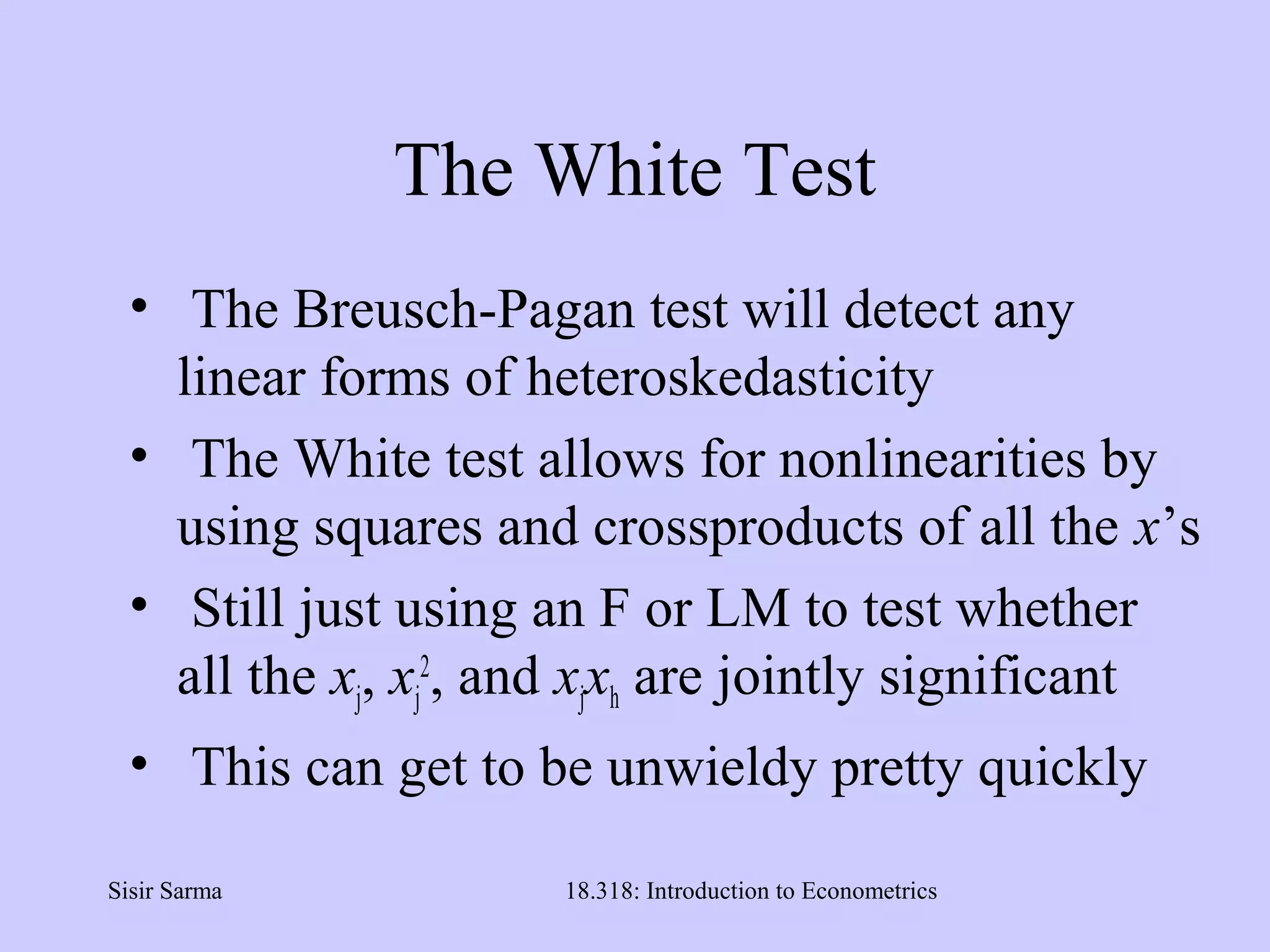
• The Breusch-Pagan test will detect any
linear forms of heteroskedasticity
• The White test allows for nonlinearities by
using squares and crossproducts of all the x’s
• Still just using an F or LM to test whether
all the xj, xj
2
, and xjxh are jointly significant
• This can get to be unwieldy pretty quickly
Sisir Sarma 18.318: Introduction to Econometrics
Alternate form of the White test
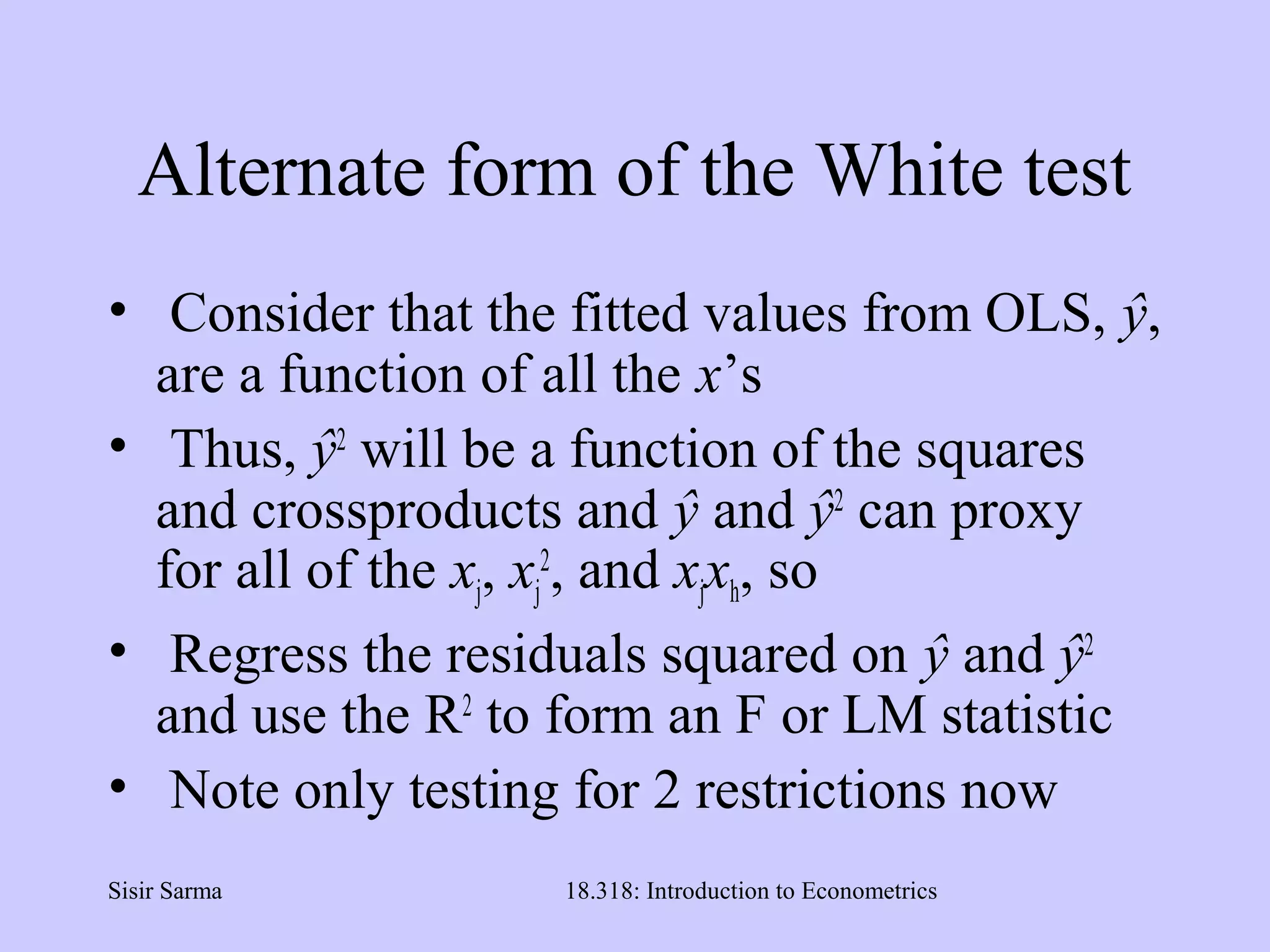
• Consider that the fitted values from OLS, ŷ,
are a function of all the x’s
• Thus, ŷ2
will be a function of the squares
and crossproducts and ŷ and ŷ2
can proxy
for all of the xj, xj
2
, and xjxh, so
• Regress the residuals squared on ŷ and ŷ2
and use the R2
to form an F or LM statistic
• Note only testing for 2 restrictions now
Sisir Sarma 18.318: Introduction to Econometrics
Weighted Least Squares
• While it’s always possible to estimate
robust standard errors for OLS estimates, if
we know something about the specific form
of the heteroskedasticity, we can obtain
more efficient estimates than OLS
• The basic idea is going to be to transform
the model into one that has homoskedastic
errors – called weighted least squares

Heteroskedasticity

  • 1.
    Sisir Sarma 18.318:Introduction to Econometrics What is Heteroskedasticity • Recall the assumption of homoskedasticity implied that conditional on the explanatory variables, the variance of the unobserved error, ε, was constant • If this is not true, that is if the variance of ε is different for different values of the x’s, then the errors are heteroskedastic • Example: estimating returns to education and ability is unobservable, and think the variance in ability differs by educational attainment
  • 2.
    Sisir Sarma 18.318:Introduction to Econometrics . xx1 x2 y f(y|x) Example of Heteroskedasticity x3 . . E(y|x) = β0 + β1x
  • 3.
    Sisir Sarma 18.318:Introduction to Econometrics Why Worry About Heteroskedasticity? • OLS is still unbiased and consistent, even if we do not assume homoskedasticity • The standard errors of the estimates are biased if we have heteroskedasticity • If the standard errors are biased, we can not use the usual t statistics or F statistics for drawing inferences
  • 4.
    Sisir Sarma 18.318:Introduction to Econometrics Robust Standard Errors • Find consistent estimate of the variance • The square root can be used as a standard error for inference • Typically call these robust standard errors • Sometimes the estimated variance is corrected for degrees of freedom by multiplying by n/(n – k – 1) • As n → ∞ it’s all the same, though
  • 5.
    Sisir Sarma 18.318:Introduction to Econometrics Robust Standard Errors (cont) • Important to remember that these robust standard errors only have asymptotic justification – with small sample sizes t statistics formed with robust standard errors will not have a distribution close to the t, and inferences will not be correct • In Eviews, robust standard errors are easily obtained using the white option
  • 6.
    Sisir Sarma 18.318:Introduction to Econometrics Testing for Heteroskedasticity • Essentially want to test H0: Var(ε|x1, x2,…, xk) = σ2 , which is equivalent to H0: E(ε2 |x1, x2, …, xk) = E(ε2 ) = σ2 • If assume the relationship between ε2 and xj will be linear, can test as a linear restriction • So, for ε2 = δ0 + δ1x1 +…+ δk xk + v) this means testing H0: δ1 = δ2 = … = δk = 0
  • 7.
    Sisir Sarma 18.318:Introduction to Econometrics The Breusch-Pagan Test • Don’t observe the error, but can estimate it with the residuals from the OLS regression • After regressing the residuals squared on all of the x’s, can use the R2 to form an F or LM test • The F statistic is just the reported F statistic for overall significance of the regression, F = [R2 /k]/ [(1 – R2 )/(n – k – 1)], which is distributed Fk, n–k-1 • The LM statistic is LM = nR2 , which is distributed χ2 k
  • 8.
    Sisir Sarma 18.318:Introduction to Econometrics The White Test • The Breusch-Pagan test will detect any linear forms of heteroskedasticity • The White test allows for nonlinearities by using squares and crossproducts of all the x’s • Still just using an F or LM to test whether all the xj, xj 2 , and xjxh are jointly significant • This can get to be unwieldy pretty quickly
  • 9.
    Sisir Sarma 18.318:Introduction to Econometrics Alternate form of the White test • Consider that the fitted values from OLS, ŷ, are a function of all the x’s • Thus, ŷ2 will be a function of the squares and crossproducts and ŷ and ŷ2 can proxy for all of the xj, xj 2 , and xjxh, so • Regress the residuals squared on ŷ and ŷ2 and use the R2 to form an F or LM statistic • Note only testing for 2 restrictions now
  • 10.
    Sisir Sarma 18.318:Introduction to Econometrics Weighted Least Squares • While it’s always possible to estimate robust standard errors for OLS estimates, if we know something about the specific form of the heteroskedasticity, we can obtain more efficient estimates than OLS • The basic idea is going to be to transform the model into one that has homoskedastic errors – called weighted least squares