Getting ready for CLIL
The essence of CLIL Creating connections between learners’ lives and the content being taught in school; Learners will co-construct their understanding and learning. “ Learners learn to use the language and use the language to learn”  CLIL recreates the conditions to which young children are exposed when they learn their first language.
CLIL environment It makes a child’s language-learning potential work by providing: Rich INPUT Opportunities for rich INTAKE and  OUTPUT BUT: not all INPUT becomes INTAKE CONSEQUENCE: limited opprotunities for output and learning will be HINDERED
WHAT IS AND ISN’T UNIQUE ABOUT CLIL? Although CLIL is a new  approach  , it fits into the parametres of national or regional curriculum; It is a new approach that seeks to enrich the learning enviroment; It requieres a co-operation and skills exchange among language and content teachers; It requieres a colective agreement on common teaching strategies and students learning activities; An essencial step in CLIL implementation: Interdiciplinary fusion
CORE-FEATURES OF CLIL METHODOLOGY These are essencial elements of good practice in CLIL and in education in general; These strategies support the successful deliver of CLIL lessons.
MULTIPLE FOCUS SAFE AND ENRICHING ENVIROMENT  AUTHENTICITY ACTIVE LEARNING  SCAFFOLDING CO-OPERATION
WHAT DRIVES THE CORE-FEATURES? THINKING drives the teaching/learning process; COGNITION drives the good CLIL practice. THINKING = COGNITION It is the mental faculty of knowing which includes: Perceiving  Recognizing Judging Reasoning Conceiving imagining
CLIL GOALS The holistic development of learners; To guide students towards becoming capable and motivated; To form independent students To put the focus on SUBSTANCE Not only provide with new information but also permit the connection between that new information and the existing knowldge, skills and attitudes.
CLIL MODEL MEANING-MAKING is both a personal and social process  (COMUNITY) The new knowledge and skills develop through:  Personal and cooperative reflection  (COGNITION) A communicative process  (COMMUNICATION)
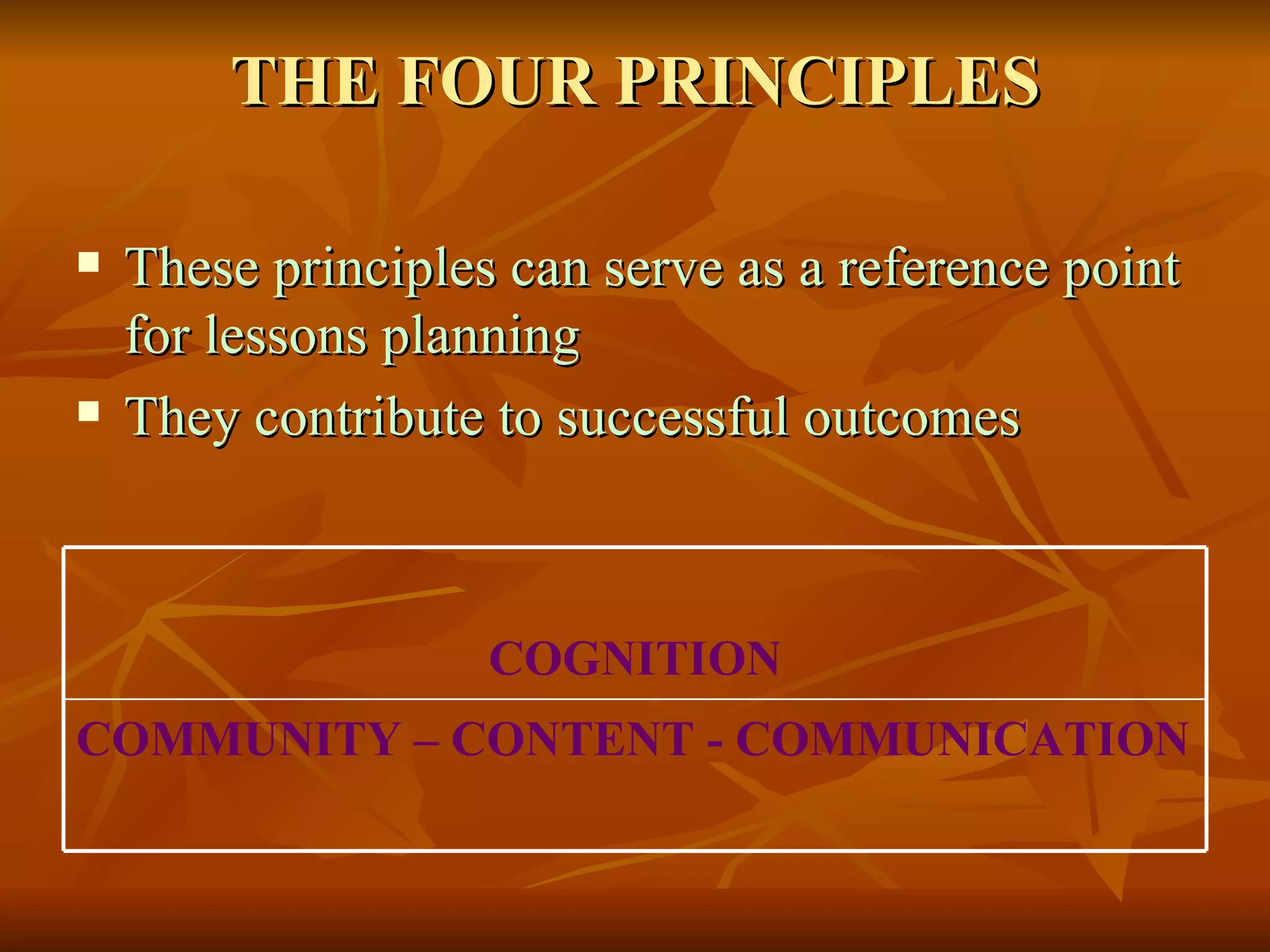
THE FOUR PRINCIPLES These principles can serve as a reference point for lessons planning  They contribute to successful outcomes COMMUNITY – CONTENT - COMMUNICATION COGNITION
How does clil work for  students ? CLIL classes work: To create life experiences; To tap into the innate language learning ability we all have. Communication and learning take place in the CLIL language
CLIL lessons around the world http://www.youtube.com/watch?v=uAJSzSTUNT0&feature=related http://www.youtube.com/watch?v=-J-s_OCc8zw&feature=related http://www.youtube.com/watch?v=RYsG52Vw5do&feature=related http://www.youtube.com/watch?v=KsSGFsgWNVg&feature=related
Sources Book: “Uncovering CLIL”,by Peter Mehisto, Maria-Jesus Frigols, and David Marsh. (Chapter 2: Getting ready for CLIL) Youtube lessons

Getting Ready For Clil

  • 1.
  • 2.
    The essence ofCLIL Creating connections between learners’ lives and the content being taught in school; Learners will co-construct their understanding and learning. “ Learners learn to use the language and use the language to learn” CLIL recreates the conditions to which young children are exposed when they learn their first language.
  • 3.
    CLIL environment Itmakes a child’s language-learning potential work by providing: Rich INPUT Opportunities for rich INTAKE and OUTPUT BUT: not all INPUT becomes INTAKE CONSEQUENCE: limited opprotunities for output and learning will be HINDERED
  • 4.
    WHAT IS ANDISN’T UNIQUE ABOUT CLIL? Although CLIL is a new approach , it fits into the parametres of national or regional curriculum; It is a new approach that seeks to enrich the learning enviroment; It requieres a co-operation and skills exchange among language and content teachers; It requieres a colective agreement on common teaching strategies and students learning activities; An essencial step in CLIL implementation: Interdiciplinary fusion
  • 5.
    CORE-FEATURES OF CLILMETHODOLOGY These are essencial elements of good practice in CLIL and in education in general; These strategies support the successful deliver of CLIL lessons.
  • 6.
    MULTIPLE FOCUS SAFEAND ENRICHING ENVIROMENT AUTHENTICITY ACTIVE LEARNING SCAFFOLDING CO-OPERATION
  • 7.
    WHAT DRIVES THECORE-FEATURES? THINKING drives the teaching/learning process; COGNITION drives the good CLIL practice. THINKING = COGNITION It is the mental faculty of knowing which includes: Perceiving Recognizing Judging Reasoning Conceiving imagining
  • 8.
    CLIL GOALS Theholistic development of learners; To guide students towards becoming capable and motivated; To form independent students To put the focus on SUBSTANCE Not only provide with new information but also permit the connection between that new information and the existing knowldge, skills and attitudes.
  • 9.
    CLIL MODEL MEANING-MAKINGis both a personal and social process (COMUNITY) The new knowledge and skills develop through: Personal and cooperative reflection (COGNITION) A communicative process (COMMUNICATION)
  • 10.
    THE FOUR PRINCIPLESThese principles can serve as a reference point for lessons planning They contribute to successful outcomes COMMUNITY – CONTENT - COMMUNICATION COGNITION
  • 11.
    How does clilwork for students ? CLIL classes work: To create life experiences; To tap into the innate language learning ability we all have. Communication and learning take place in the CLIL language
  • 12.
    CLIL lessons aroundthe world http://www.youtube.com/watch?v=uAJSzSTUNT0&feature=related http://www.youtube.com/watch?v=-J-s_OCc8zw&feature=related http://www.youtube.com/watch?v=RYsG52Vw5do&feature=related http://www.youtube.com/watch?v=KsSGFsgWNVg&feature=related
  • 13.
    Sources Book: “UncoveringCLIL”,by Peter Mehisto, Maria-Jesus Frigols, and David Marsh. (Chapter 2: Getting ready for CLIL) Youtube lessons