V550 Medical Documentation Charting & Terminology Richard E. Meetz, OD, MS 2008
Medical Records A record of the patient’s care. Basis for 3rd party reimbursement. Medical-Legal document.
Medical Records A record of patient care Provides essential information on the day of the exam. Continuity of care from one practitioner/visit to the next. Allows evaluation of changes in a patient’s health or condition.
Medical Records Basis for 3 rd  party reimbursement Shows the necessity for any procedures and level of care. By counting Hx entries, numbers and types of tests and procedures, the complexity of the case can be established and correctly billed for. Supports claims in cases of reviews & audits .  Medicare/Medicaid, VSP, etc.
Medical Records Medical-Legal Record The medical record provides a  legal record of care . Defense of the doctor and staff in cases of malpractice claims. “ In court, the medical record IS the care rendered!  If it isn’t in the record, it never happened!”
Medical Records Medical-Legal Record Should include all the vital information needed to reconstruct the events of the exam. Should reflect the current standard of care. Should  NEVER be altered  after care is called into question for review or litigation. (See error correction)
Medical Records Confidentiality Records are confidential information Patient’s written permission is necessary for record release Records should not leave the clinic or office Must be kept in secure location  Locked or restricted  Avoid discussing patient care issues in public areas
Medical Records Confidentiality Computerized/electronic records are new security/confidentiality issue Hipaa: Health Information Portability and Accountability Act Standardized how and when information is  released and how transferred. 1st Requested by the insurance companies, FTC took over  Strict rules on record keeping & rule for release HAD to have sign copy of Hipaa policy in record in every office
Medical Records Content of Medical records All parts of the examination Intake Hx, exam forms, F/U forms, prescription copies, informed consents  Laboratory results Visual Field print outs Correspondence Referrals, forwarded records Patient letters and telephone communications With date, time, “question” & instructions
Medical Records Content of Medical records Billing information Patient personal data Address, phone contact Place & Date of birth Copies of past bills sent Patient releases
Medical Charting Guidelines for Documentation 1. The patient’s full name  MUST  appear on every page. 2.The full date  MUST  appear on all pages. Entries with only a month and day are NO better than a lost page. 3. All Entries/exams  MUST  be signed! By writer’s full name & degree.
Medical Charting Guidelines for Documentation 4. All entries  MUST  be in permanent ink. NO pencils or erasable pens Best in black ink, best if ball point . 5. All entries  MUST  be LEGIBLE!  6. Entries should use only approved terminology & abbreviations.
Medical Charting Guidelines for Documentation 7. Entries should only be made on approved forms. 8. Entries should be made in the appropriate sequence.  9.  Never  skip lines or leave blanks. 10. Late entries should be marked as such.
Medical Charting Miscellaneous Documentation Patient intake forms Patient generated history forms. Must be signed by patient. Should be dated & initialed by Dr. indicating that it was reviewed. Must be reviewed, updated and initialed at each visit. Laboratory results Should be dated & initial indicating that it was read. Documentation that the patient was notified of the results.
Medical Charting Miscellaneous Documentation Telephone calls from patients regarding health Documentation of date, time, “question” and instructions to patient. Late entries - Cancelled or missed appointments Also attempts to contact patient should be documented Any returned postal notices (cards) are to be kept in the record.
Medical Charting Adding to a record After a chart has been signed off, DO NOT go back and alter it at a later date. Use the following procedure: Date Time “ Late entry to (date)” Complete note and sign off as usual
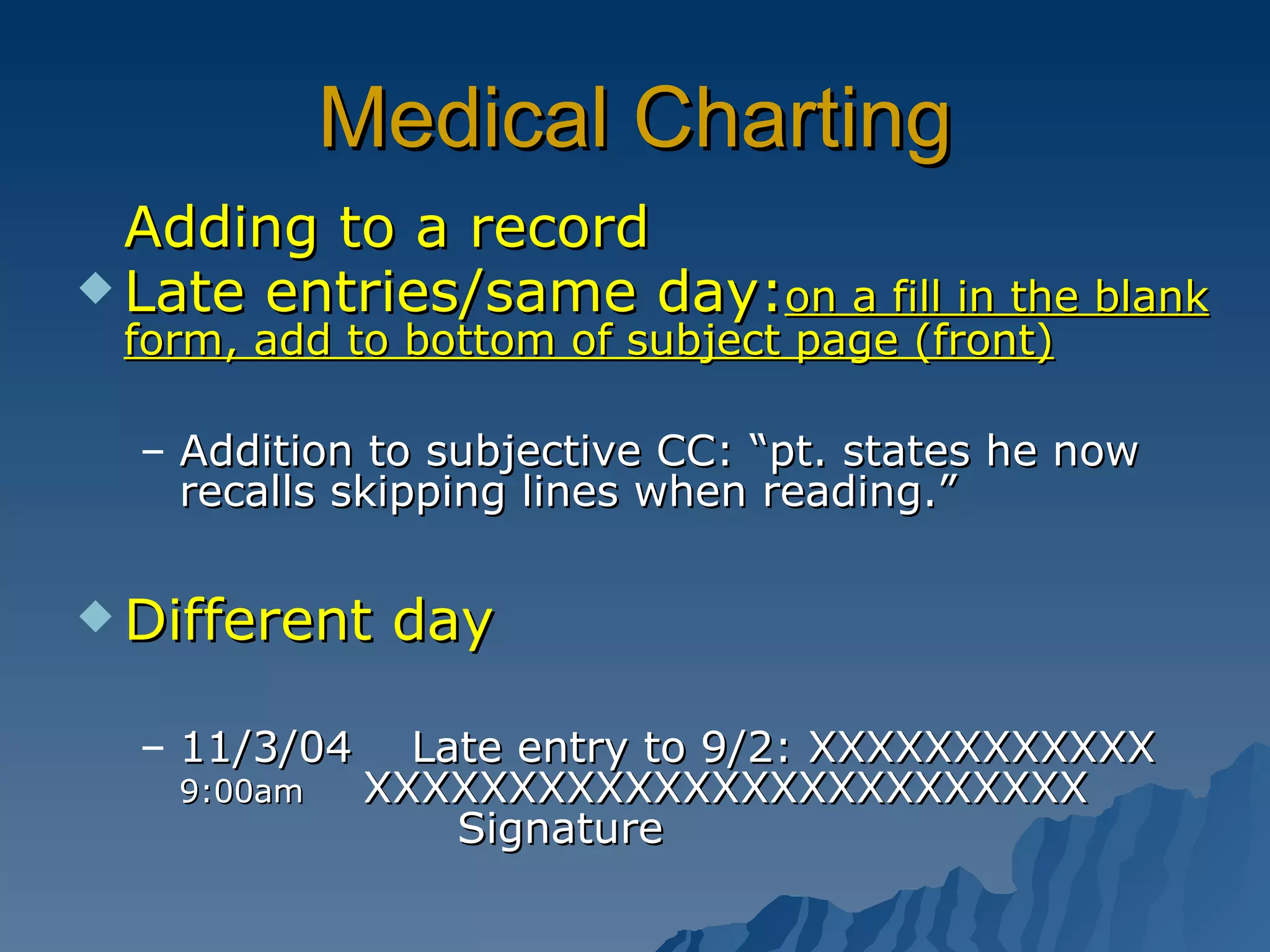
Medical Charting Adding to a record Late entries/same day: on a fill in the blank form, add to bottom of subject page (front) Addition to subjective CC: “pt. states he now recalls skipping lines when reading.” Different day 11/3/04  Late entry to 9/2: XXXXXXXXXXXX  9:00am   XXXXXXXXXXXXXXXXXXXXXXXXX  Signature
Medical Charting Documentation of procedures: Who performed the procedure (if other than the person charting) How procedure was done How patient tolerated the procedure Any change in symptoms Condition/status of patient at time of release Signed release/informed consent in chart
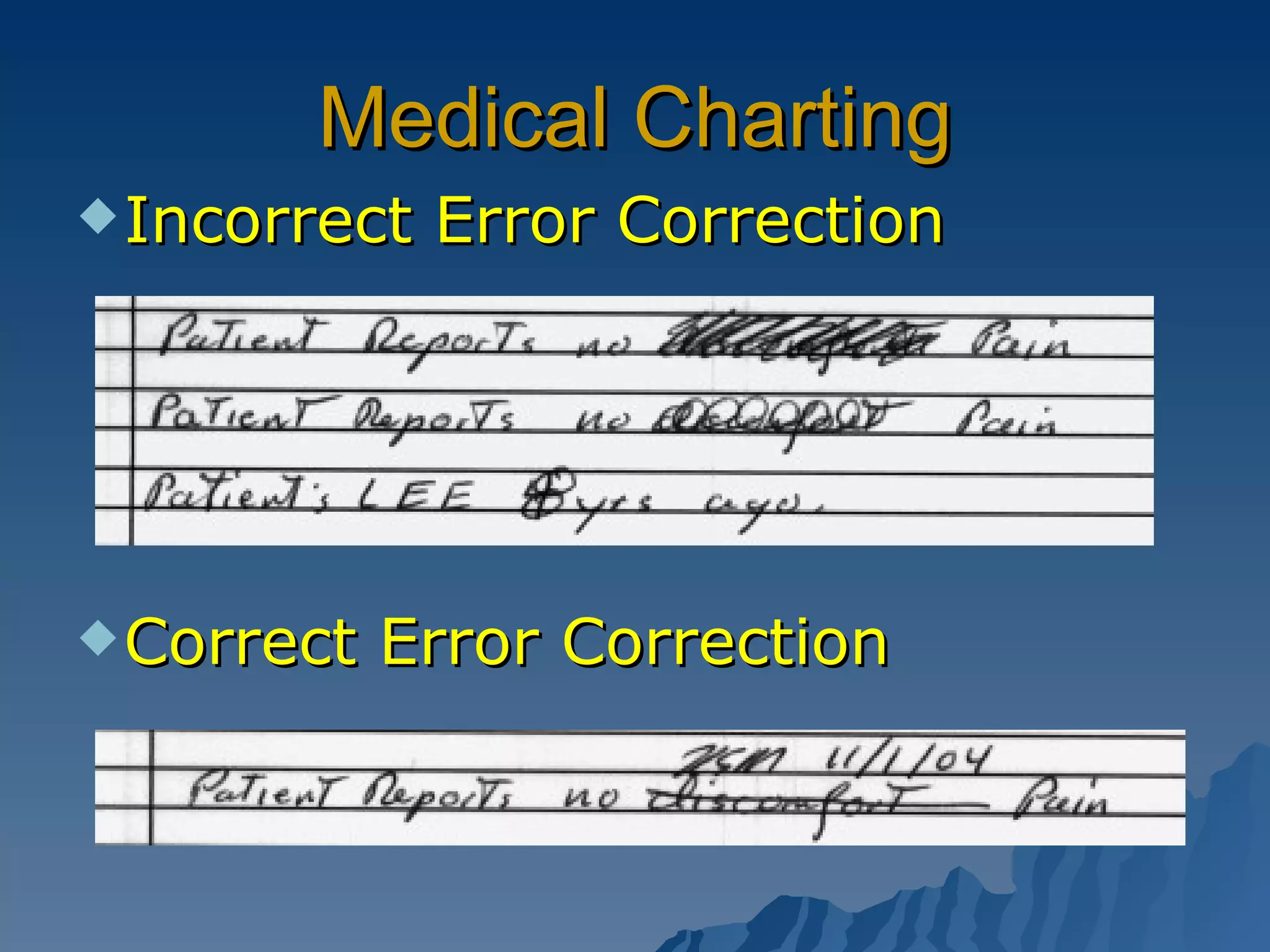
Medical Charting Error Correction Never Cross out, overwrite or blacken an error! Use a single line Then: Your initials Date Add correcting information
Medical Charting Incorrect Error Correction Correct Error Correction
Medical Charting Recording the History Things to avoid Jousting Arguing, complaining, belittling, criticizing others to defend oneself. Stating opinions vs. fact Patient  is  intoxicated Vague statements Patient  appears  to be sleeping Derogatory or frivolous comments Patient  is a rock
Medical Charting Recording the History Defn: Jargon  Nonsensical gibberish A hybrid language Language or terminology peculiar to a specific field, profession or group.  To exclude outsiders.  Excessive use of abbreviations falls into this category .
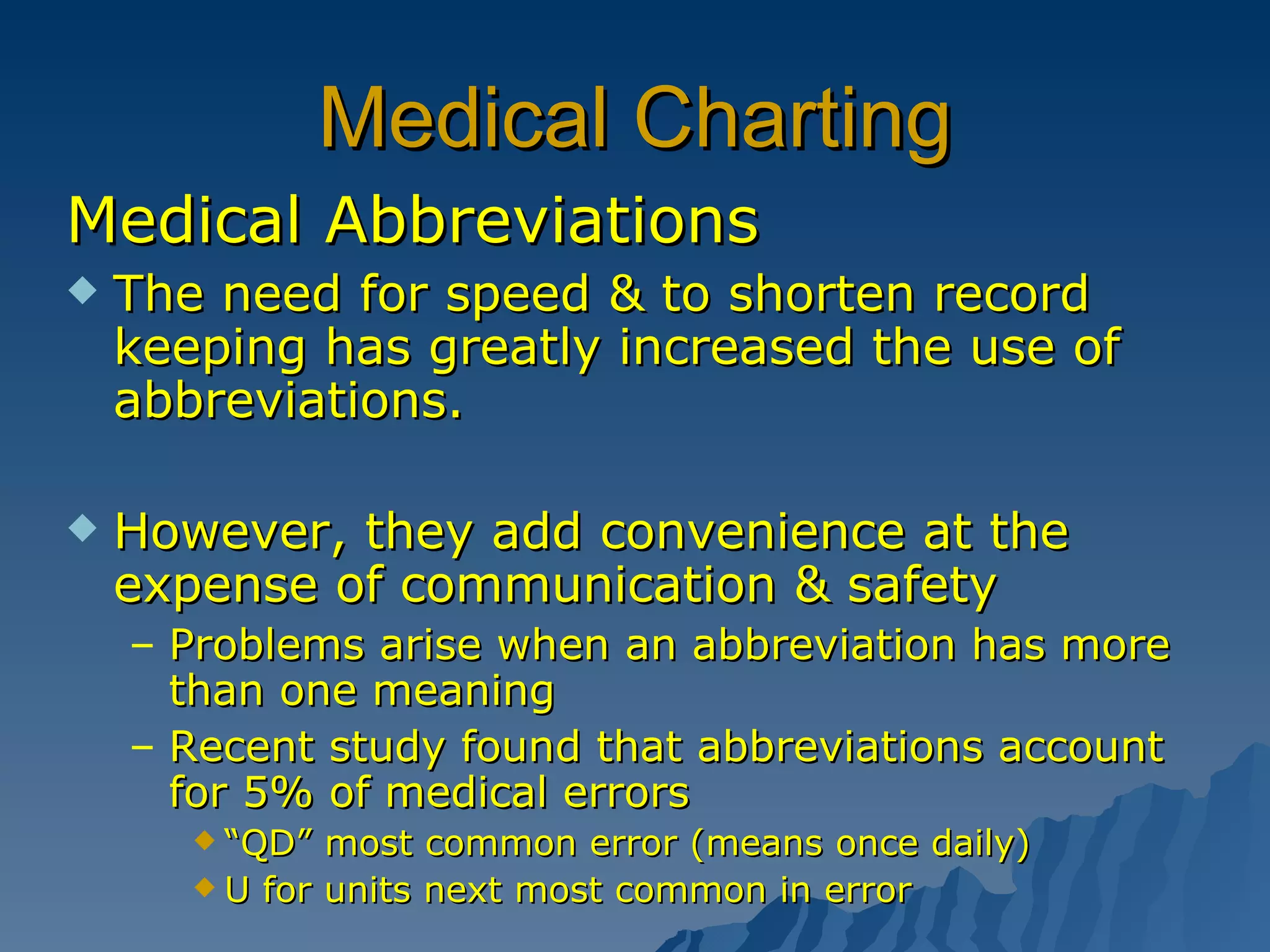
Medical Charting Medical Abbreviations The need for speed & to shorten record keeping has greatly increased the use of abbreviations. However, they add convenience at the expense of communication & safety Problems arise when an abbreviation has more than one meaning Recent study found that abbreviations account for 5% of medical errors “ QD” most common error (means once daily)  U for units next most common in error
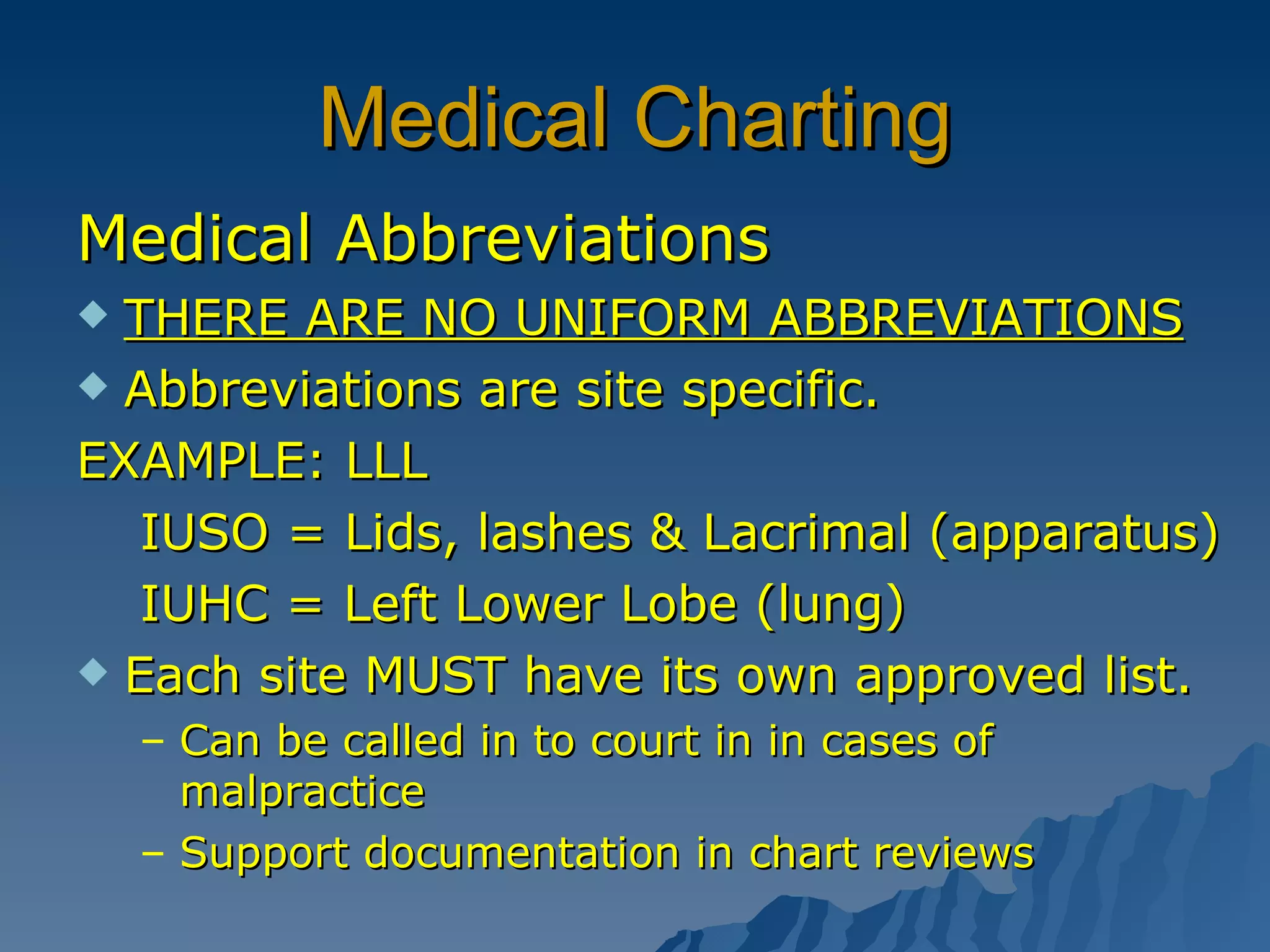
Medical Charting Medical Abbreviations THERE ARE NO UNIFORM ABBREVIATIONS Abbreviations are site specific. EXAMPLE: LLL IUSO = Lids, lashes & Lacrimal (apparatus) IUHC = Left Lower Lobe (lung)  Each site MUST have its own approved list. Can be called in to court in in cases of malpractice Support documentation in chart reviews
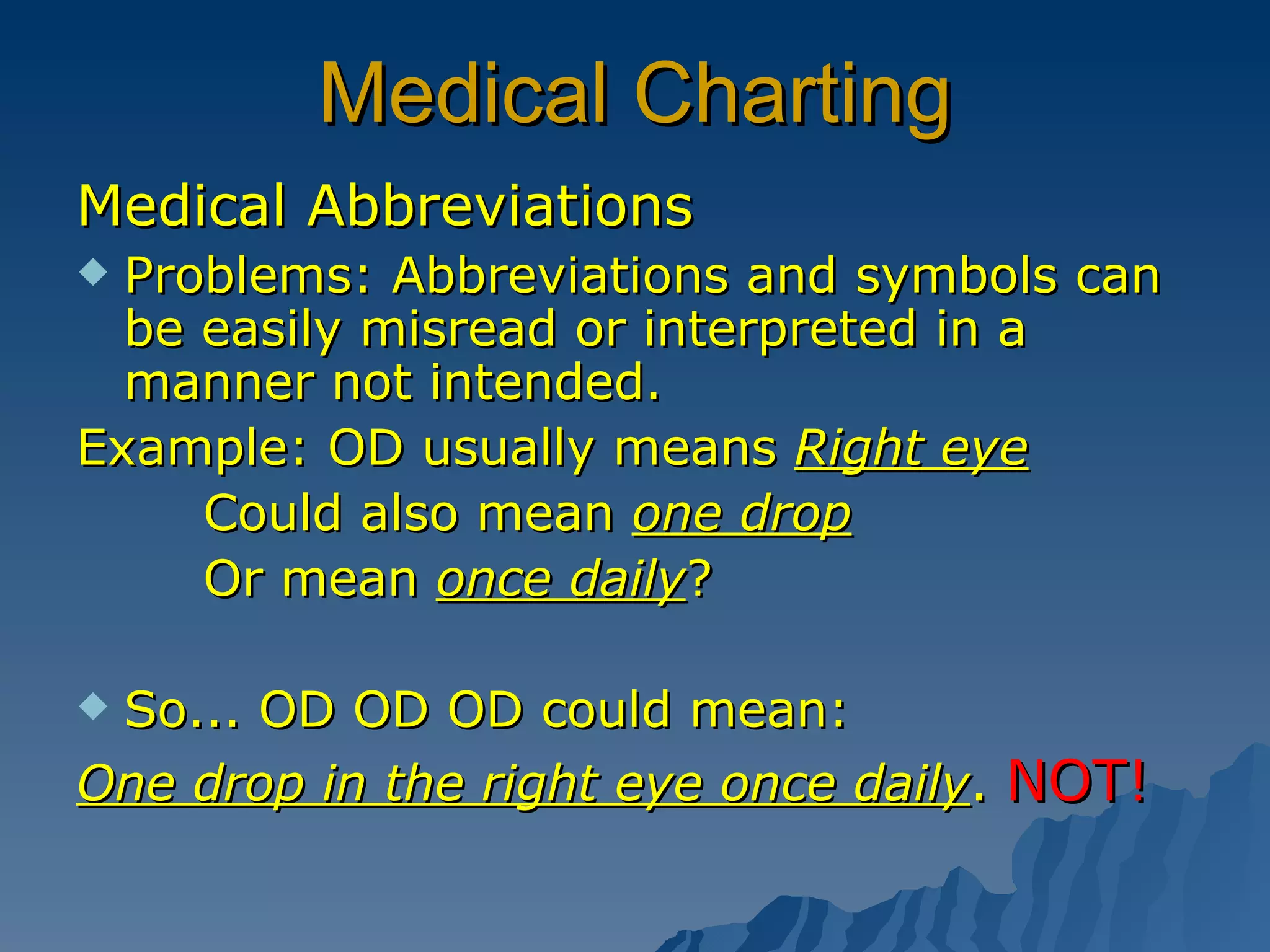
Medical Charting Medical Abbreviations Problems: Abbreviations and symbols can be easily misread or interpreted in a manner not intended. Example: OD usually means  Right eye Could also mean  one drop Or mean  once daily ? So... OD OD OD could mean: One drop in the right eye once daily .  NOT!
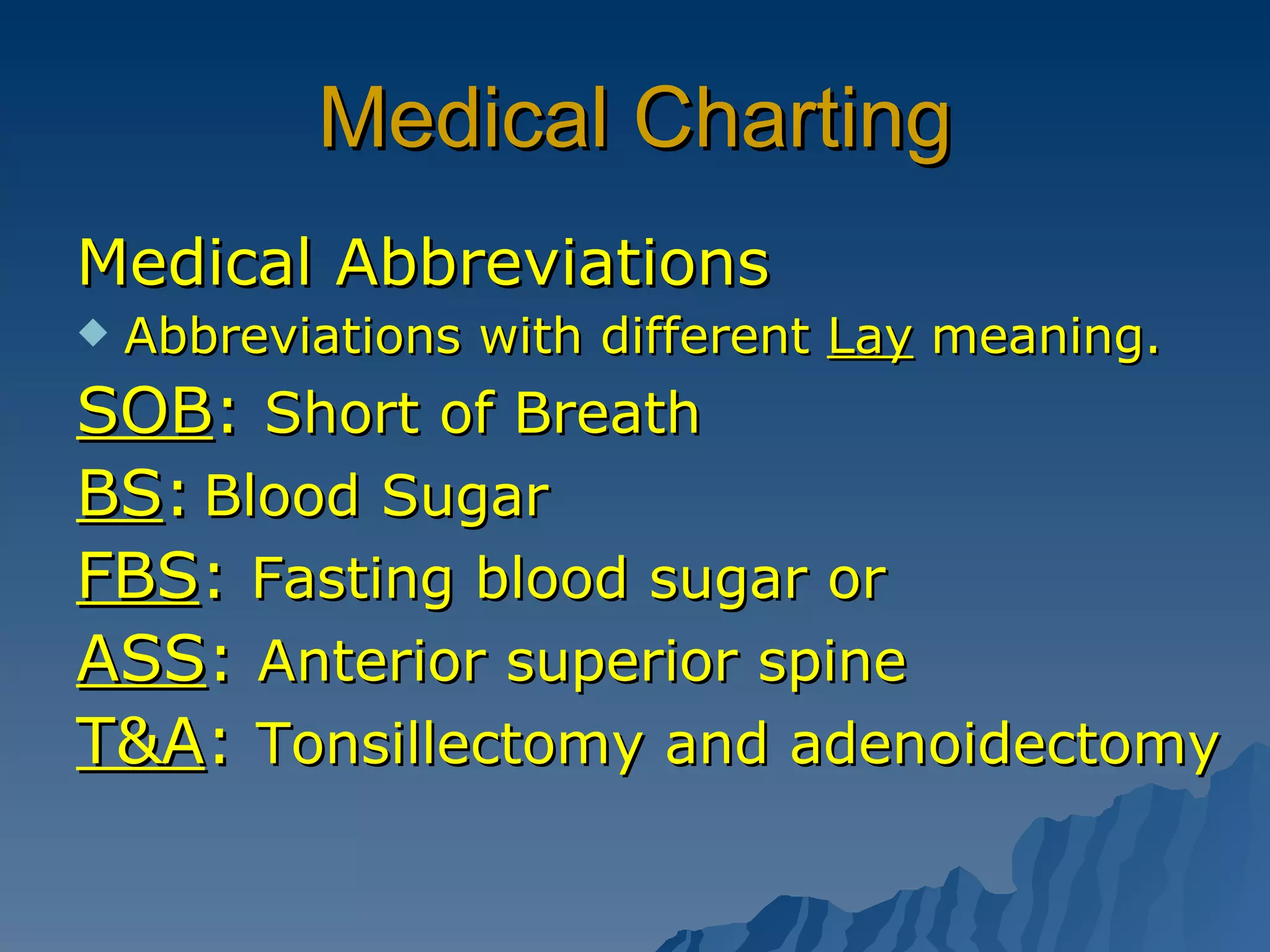
Medical Charting Medical Abbreviations Abbreviations with different  Lay  meaning. SOB :  Short of Breath BS : Blood Sugar FBS :  Fasting blood sugar or  ASS :  Anterior superior spine T&A :  Tonsillectomy and adenoidectomy
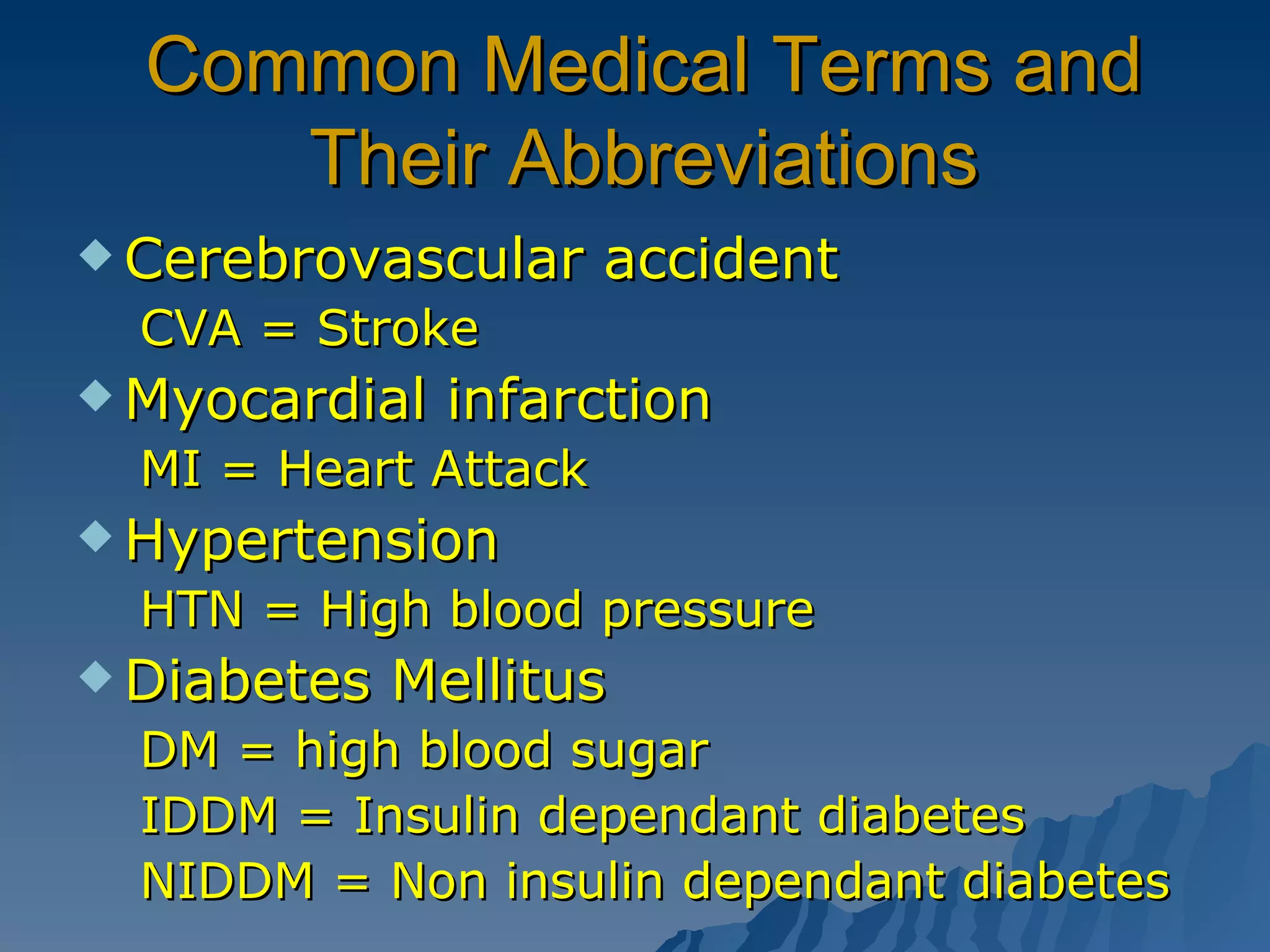
Common Medical Terms and Their Abbreviations Cerebrovascular accident  CVA = Stroke  Myocardial infarction MI = Heart Attack Hypertension HTN = High blood pressure Diabetes Mellitus DM = high blood sugar IDDM = Insulin dependant diabetes NIDDM = Non insulin dependant diabetes
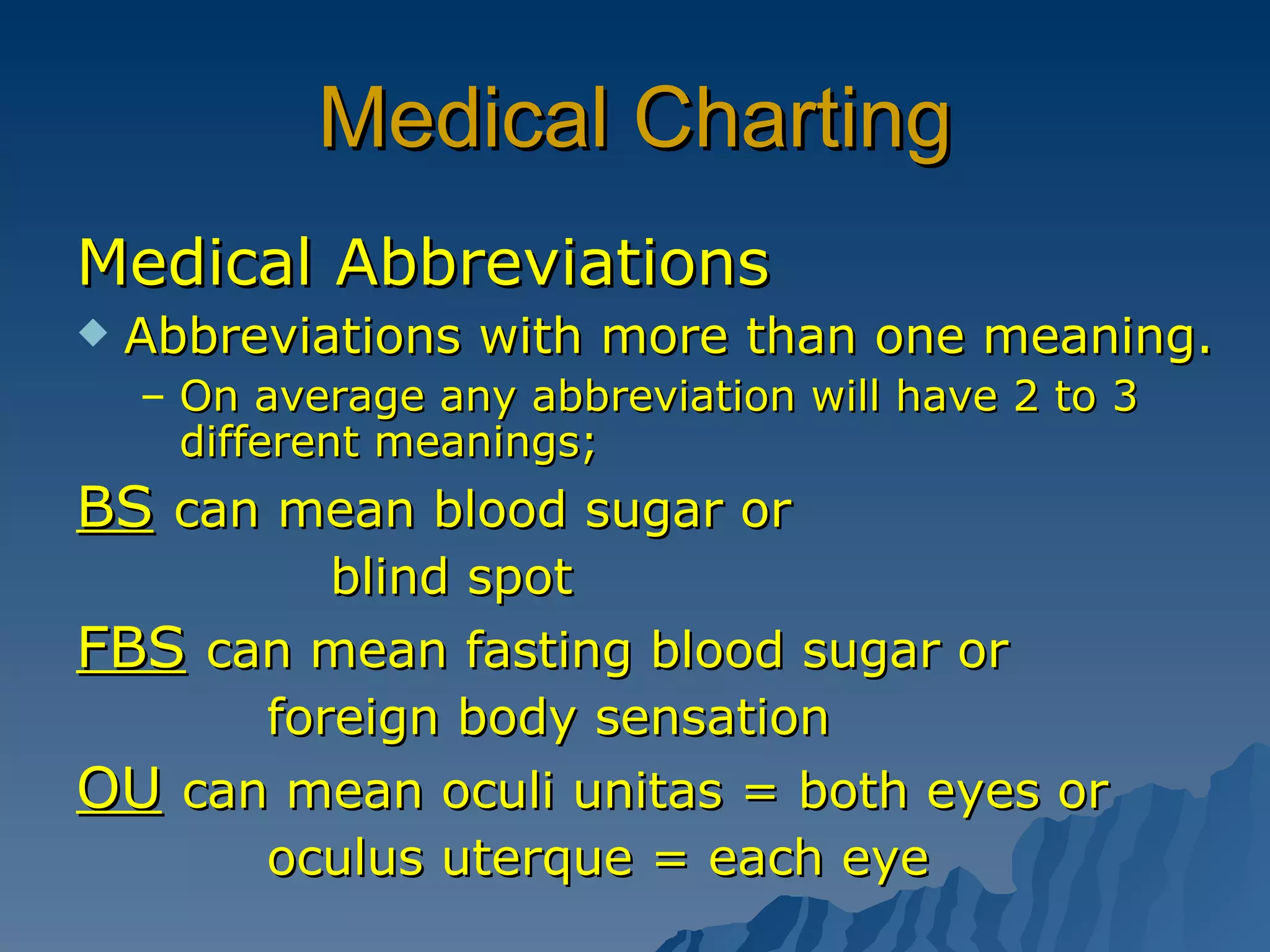
Medical Charting Medical Abbreviations Abbreviations with more than one meaning. On average any abbreviation will have 2 to 3 different meanings; BS   can mean blood sugar or blind spot FBS   can mean fasting blood sugar or   foreign body sensation OU   can mean oculi unitas = both eyes or   oculus uterque = each eye
Medical Terminology
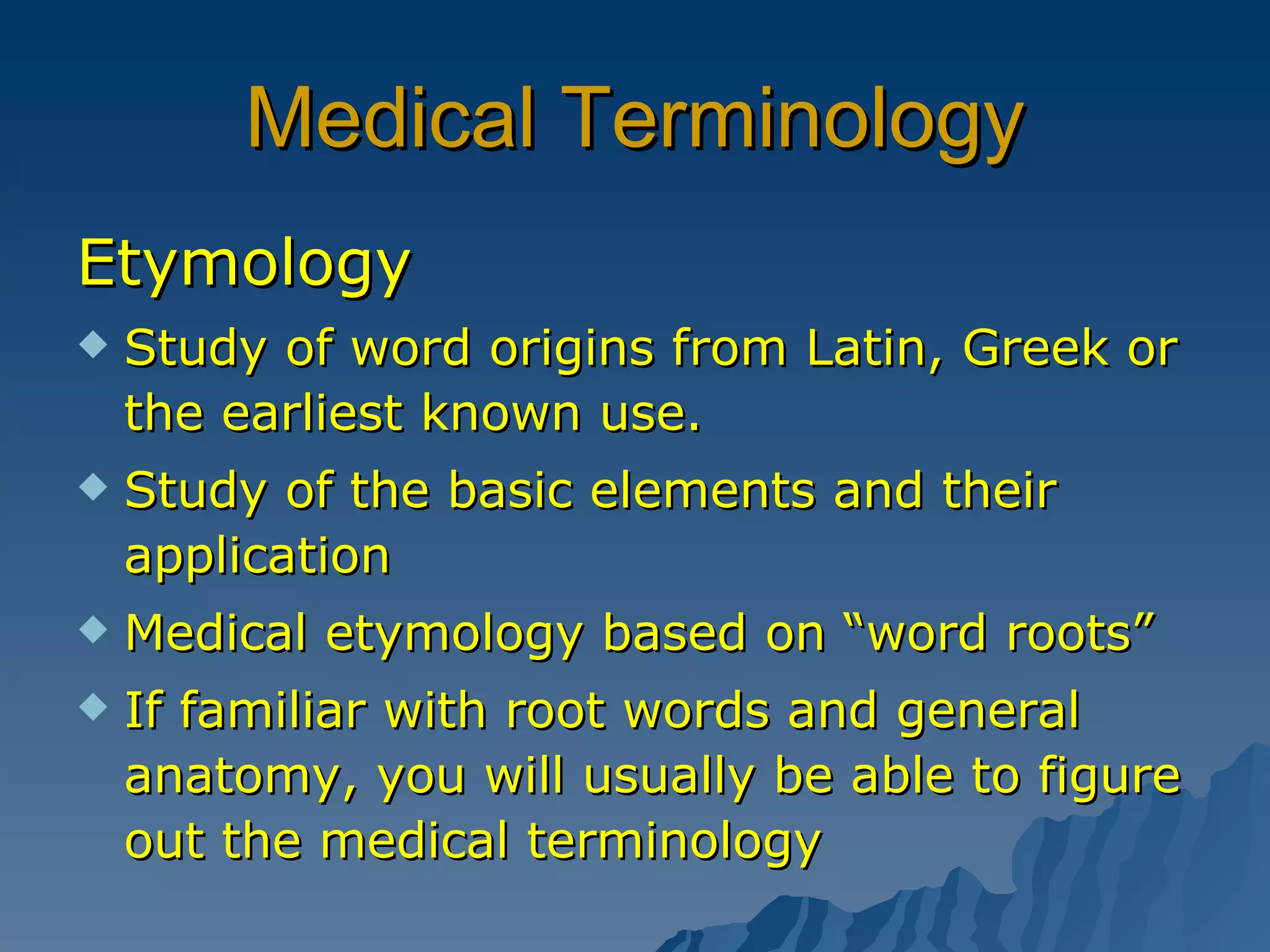
Medical Terminology Etymology Study of word origins from Latin, Greek or the earliest known use. Study of the basic elements and their application Medical etymology based on “word roots” If familiar with root words and general anatomy, you will usually be able to figure out the medical terminology
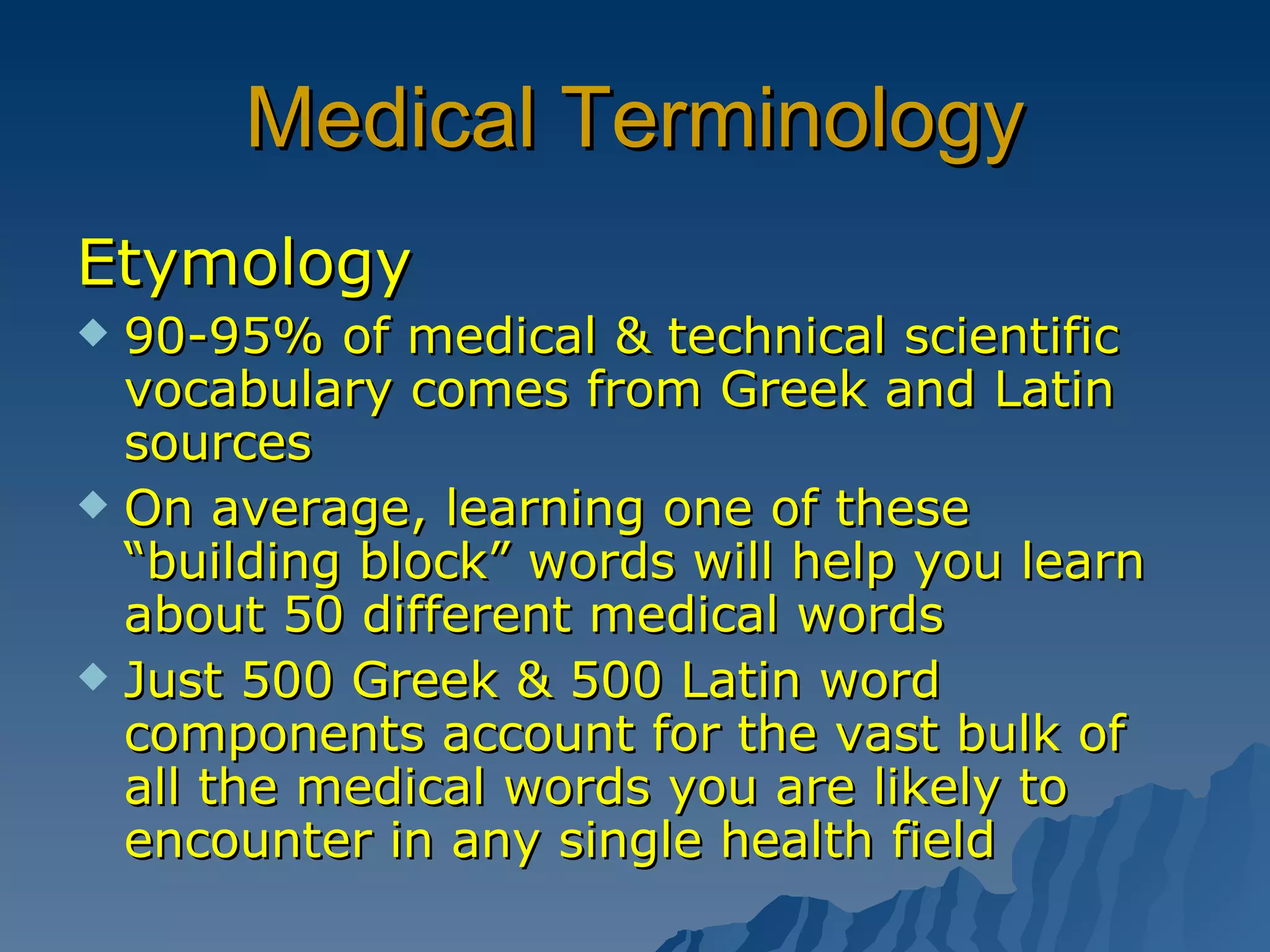
Medical Terminology Etymology 90-95% of medical & technical scientific vocabulary comes from Greek and Latin sources On average, learning one of these “building block” words will help you learn about 50 different medical words Just 500 Greek & 500 Latin word components account for the vast bulk of all the medical words you are likely to encounter in any single health field
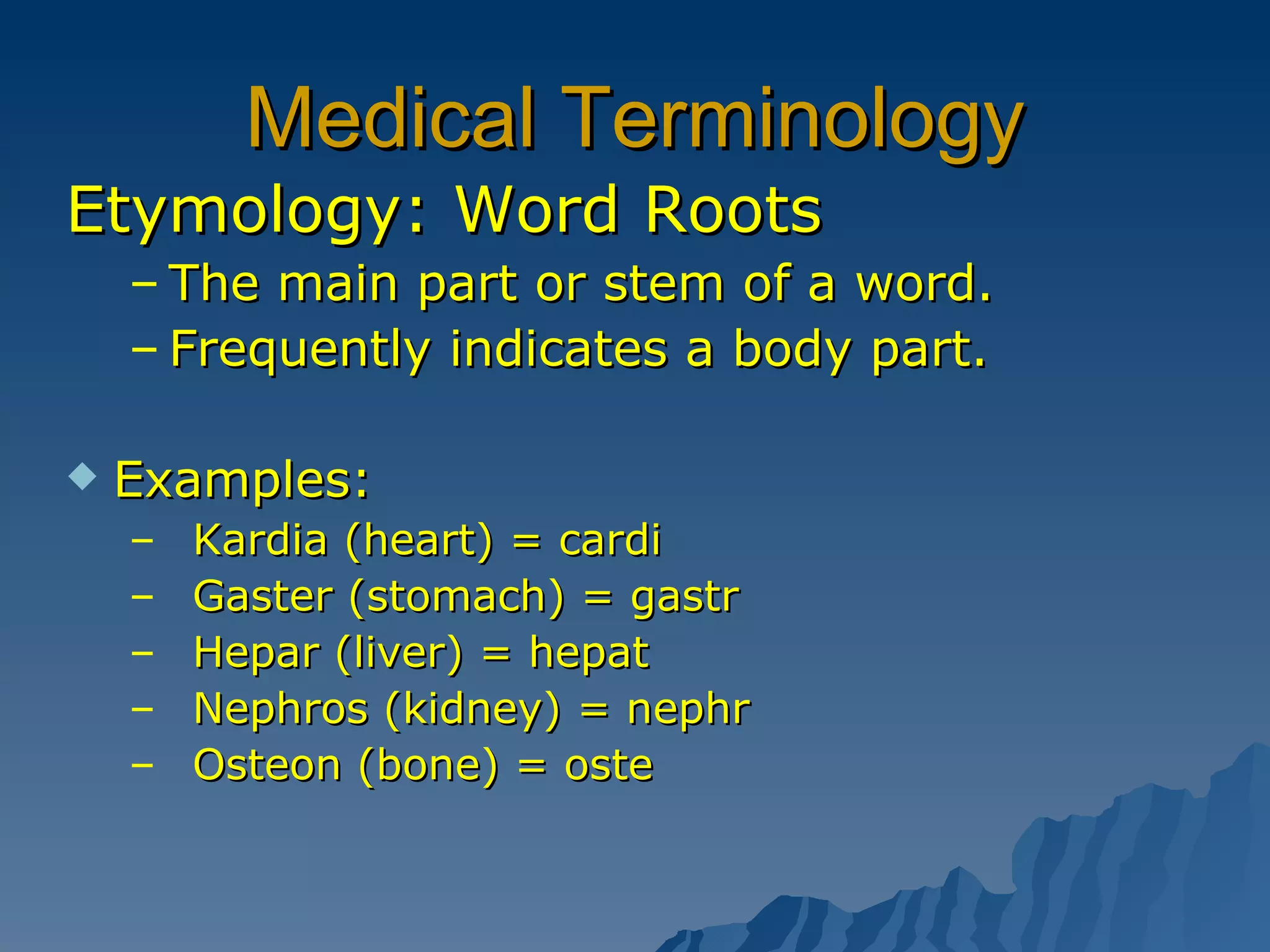
Medical Terminology Etymology: Word Roots The main part or stem of a word. Frequently indicates a body part. Examples:  Kardia (heart) = cardi Gaster (stomach) = gastr Hepar (liver) = hepat Nephros (kidney) = nephr Osteon (bone) = oste
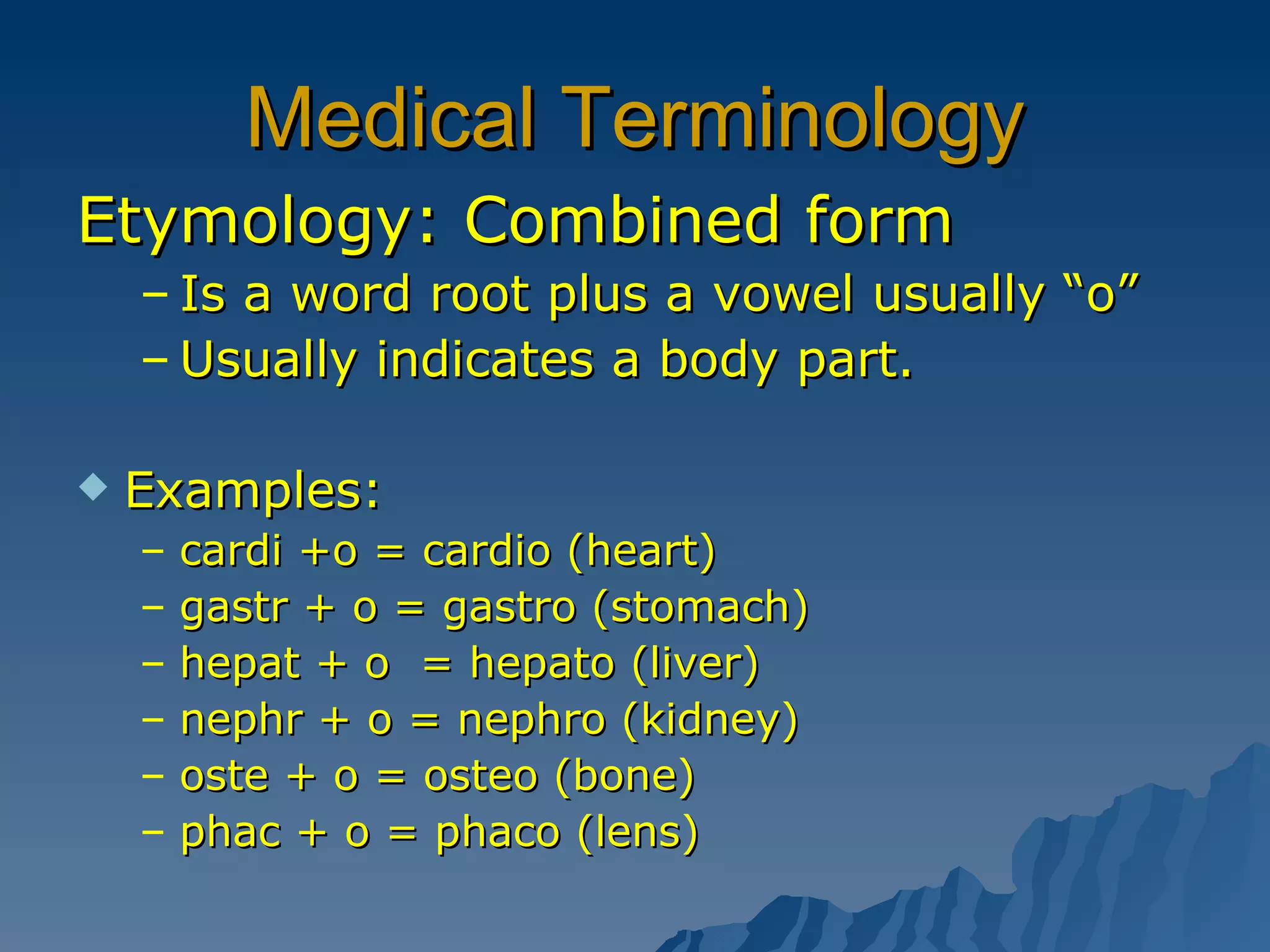
Medical Terminology Etymology: Combined form Is a word root plus a vowel usually “o” Usually indicates a body part. Examples: cardi +o = cardio (heart)  gastr + o = gastro (stomach)  hepat + o  = hepato (liver) nephr + o = nephro (kidney) oste + o = osteo (bone) phac + o = phaco (lens)
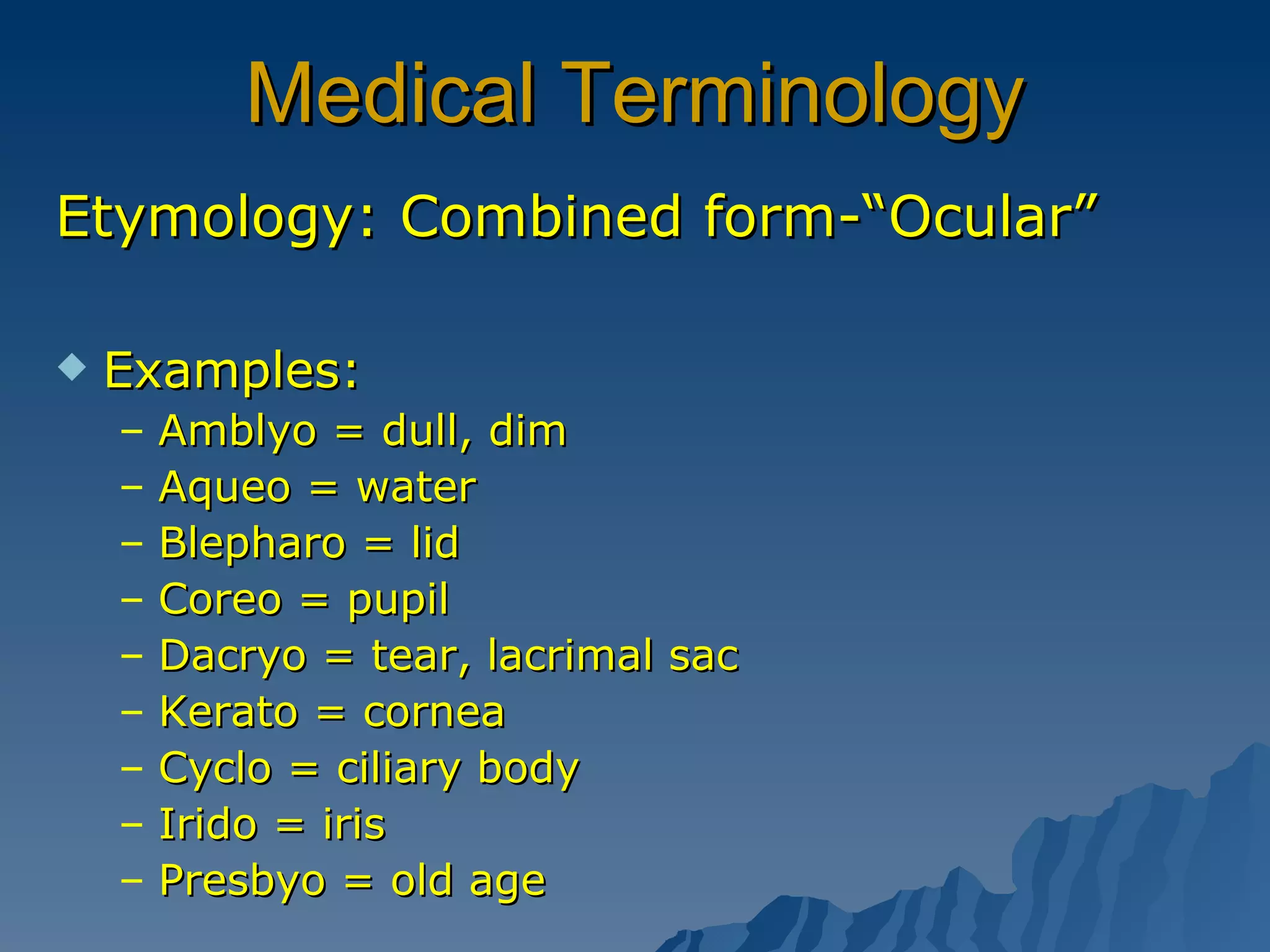
Medical Terminology Etymology: Combined form-“Ocular” Examples:  Amblyo = dull, dim  Aqueo = water Blepharo = lid Coreo = pupil Dacryo = tear, lacrimal sac Kerato = cornea Cyclo = ciliary body Irido = iris Presbyo = old age
Medical Terminology Etymology: Suffix Is a word ending.  Usually indicates a procedure, condition, disease. Examples:  itis = inflammation  megaly = enlargement plegia = paralysis condition  ia = condition  osis = abnormal condition opia = vision stenosis = narrowing condition
Medical Terminology Etymology: Suffix; Procedures Examples:  ectomy = excision, removal centesis = puncture plasty = surgical repair tomy = incision, cut into lysis = separation, destruction, loosening
Medical Terminology Etymology: Prefix Is a word element at the beginning of a word.  When a medical word contains a prefix the meaning of the word is altered. Usually indicates a number, time, position, direction, color or sense of negation.
Medical Terminology Etymology: Prefixes of Position Examples:  ante, pre, pro = before  hyper = excessive or high (also of number) hypo, infra, sub = under, below (also of #) Intra = within* Inter = between* peri = around medi, meso = middle retro = behind, backward Eso = inward / exo = outward, outside *most commonly confused ie. IOP
Medical Terminology Etymology: Prefixes of Number Examples   Bi = two Dipl, diplo = double Hemi = half Mono, uni = one Macro = large Micro = small Poly = many
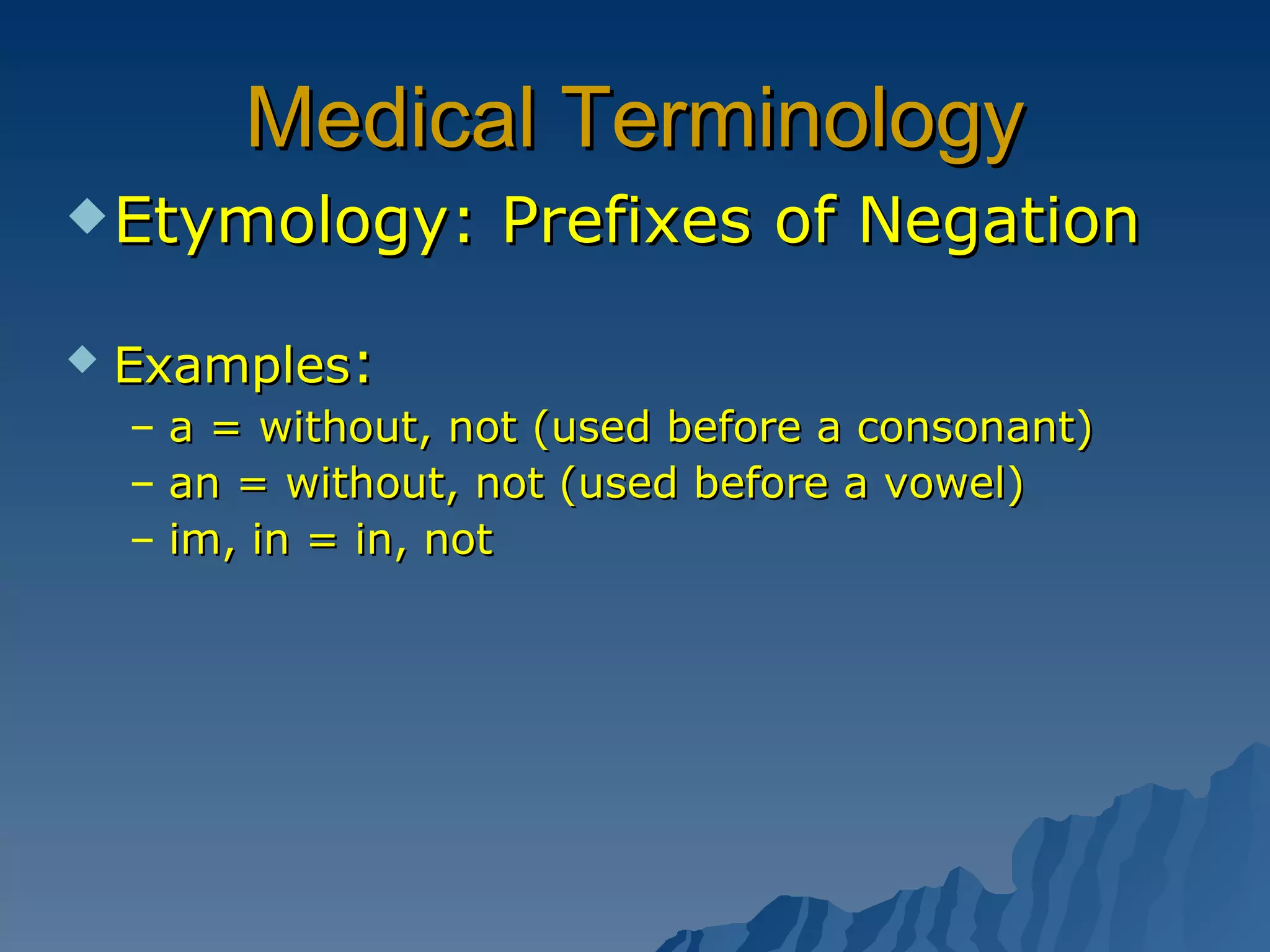
Medical Terminology Etymology: Prefixes of Negation Examples :   a = without, not (used before a consonant) an = without, not (used before a vowel) im, in = in, not
Medical Terminology Etymology: Other Prefixes Examples :  Anti, contra = against Brady = slow Tachy = fast Dys = bad, painful, difficult Hetero = different Pan = all
Medical Terminology Etymology: Rules Two basic rules for building words . 1) a root word is used before a suffix that begins with a vowel. Example: Scler (hardening) + osis (abnormal condition) = sclerosis (abnormal condition of hardening
Medical Terminology Etymology: Rules 2-1) a combining vowel is used to link a root word to a suffix that begins with a consonant. Example: ophthalm (eye) + o + scopy (to view) = ophthalmoscopy (visual examination of the eye interior)
Medical Terminology Etymology: Rules 2-2) a combining vowel is used to link two word roots together. Example : oste (bone) + o + arthr (joint) + itis (inflammation) = osteoathritis (inflammation of the bone & joint)
Medical Terminology Etymology: Defining words Three steps: 1) Define the suffix, or last part of the word 2) Define the prefix, or the first part of the word 3) Define the middle
Medical Terminology Etymology: Defining words Example: gastroenteritis 1) define the suffix, itis = inflammation 2) define the prefix, gastro = stomach 3) define the middle, enter = intestine Definition:   inflammation of the stomach & intestine
Medical Terminology Etymology: Defining words Example: polyarthritis 1) define the suffix, itis = inflammation 2) define the prefix, poly = many 3) define the middle, arthr = joint Definition:   inflammation of many joints
Medical Documentation Charting & Terminology References Bates’ Guide to Physical Examination and History Taking , 8th Ed., Chap 1&2 The Record That Defends its Friends , all Medical Terminology; A Systems Approach , 4th Ed., chap 1-4 & 16
*

Lecture 6

  • 1.
    V550 Medical DocumentationCharting & Terminology Richard E. Meetz, OD, MS 2008
  • 2.
    Medical Records Arecord of the patient’s care. Basis for 3rd party reimbursement. Medical-Legal document.
  • 3.
    Medical Records Arecord of patient care Provides essential information on the day of the exam. Continuity of care from one practitioner/visit to the next. Allows evaluation of changes in a patient’s health or condition.
  • 4.
    Medical Records Basisfor 3 rd party reimbursement Shows the necessity for any procedures and level of care. By counting Hx entries, numbers and types of tests and procedures, the complexity of the case can be established and correctly billed for. Supports claims in cases of reviews & audits . Medicare/Medicaid, VSP, etc.
  • 5.
    Medical Records Medical-LegalRecord The medical record provides a legal record of care . Defense of the doctor and staff in cases of malpractice claims. “ In court, the medical record IS the care rendered! If it isn’t in the record, it never happened!”
  • 6.
    Medical Records Medical-LegalRecord Should include all the vital information needed to reconstruct the events of the exam. Should reflect the current standard of care. Should NEVER be altered after care is called into question for review or litigation. (See error correction)
  • 7.
    Medical Records ConfidentialityRecords are confidential information Patient’s written permission is necessary for record release Records should not leave the clinic or office Must be kept in secure location Locked or restricted Avoid discussing patient care issues in public areas
  • 8.
    Medical Records ConfidentialityComputerized/electronic records are new security/confidentiality issue Hipaa: Health Information Portability and Accountability Act Standardized how and when information is released and how transferred. 1st Requested by the insurance companies, FTC took over Strict rules on record keeping & rule for release HAD to have sign copy of Hipaa policy in record in every office
  • 9.
    Medical Records Contentof Medical records All parts of the examination Intake Hx, exam forms, F/U forms, prescription copies, informed consents Laboratory results Visual Field print outs Correspondence Referrals, forwarded records Patient letters and telephone communications With date, time, “question” & instructions
  • 10.
    Medical Records Contentof Medical records Billing information Patient personal data Address, phone contact Place & Date of birth Copies of past bills sent Patient releases
  • 11.
    Medical Charting Guidelinesfor Documentation 1. The patient’s full name MUST appear on every page. 2.The full date MUST appear on all pages. Entries with only a month and day are NO better than a lost page. 3. All Entries/exams MUST be signed! By writer’s full name & degree.
  • 12.
    Medical Charting Guidelinesfor Documentation 4. All entries MUST be in permanent ink. NO pencils or erasable pens Best in black ink, best if ball point . 5. All entries MUST be LEGIBLE! 6. Entries should use only approved terminology & abbreviations.
  • 13.
    Medical Charting Guidelinesfor Documentation 7. Entries should only be made on approved forms. 8. Entries should be made in the appropriate sequence. 9. Never skip lines or leave blanks. 10. Late entries should be marked as such.
  • 14.
    Medical Charting MiscellaneousDocumentation Patient intake forms Patient generated history forms. Must be signed by patient. Should be dated & initialed by Dr. indicating that it was reviewed. Must be reviewed, updated and initialed at each visit. Laboratory results Should be dated & initial indicating that it was read. Documentation that the patient was notified of the results.
  • 15.
    Medical Charting MiscellaneousDocumentation Telephone calls from patients regarding health Documentation of date, time, “question” and instructions to patient. Late entries - Cancelled or missed appointments Also attempts to contact patient should be documented Any returned postal notices (cards) are to be kept in the record.
  • 16.
    Medical Charting Addingto a record After a chart has been signed off, DO NOT go back and alter it at a later date. Use the following procedure: Date Time “ Late entry to (date)” Complete note and sign off as usual
  • 17.
    Medical Charting Addingto a record Late entries/same day: on a fill in the blank form, add to bottom of subject page (front) Addition to subjective CC: “pt. states he now recalls skipping lines when reading.” Different day 11/3/04 Late entry to 9/2: XXXXXXXXXXXX 9:00am XXXXXXXXXXXXXXXXXXXXXXXXX Signature
  • 18.
    Medical Charting Documentationof procedures: Who performed the procedure (if other than the person charting) How procedure was done How patient tolerated the procedure Any change in symptoms Condition/status of patient at time of release Signed release/informed consent in chart
  • 19.
    Medical Charting ErrorCorrection Never Cross out, overwrite or blacken an error! Use a single line Then: Your initials Date Add correcting information
  • 20.
    Medical Charting IncorrectError Correction Correct Error Correction
  • 21.
    Medical Charting Recordingthe History Things to avoid Jousting Arguing, complaining, belittling, criticizing others to defend oneself. Stating opinions vs. fact Patient is intoxicated Vague statements Patient appears to be sleeping Derogatory or frivolous comments Patient is a rock
  • 22.
    Medical Charting Recordingthe History Defn: Jargon Nonsensical gibberish A hybrid language Language or terminology peculiar to a specific field, profession or group. To exclude outsiders.  Excessive use of abbreviations falls into this category .
  • 23.
    Medical Charting MedicalAbbreviations The need for speed & to shorten record keeping has greatly increased the use of abbreviations. However, they add convenience at the expense of communication & safety Problems arise when an abbreviation has more than one meaning Recent study found that abbreviations account for 5% of medical errors “ QD” most common error (means once daily) U for units next most common in error
  • 24.
    Medical Charting MedicalAbbreviations THERE ARE NO UNIFORM ABBREVIATIONS Abbreviations are site specific. EXAMPLE: LLL IUSO = Lids, lashes & Lacrimal (apparatus) IUHC = Left Lower Lobe (lung) Each site MUST have its own approved list. Can be called in to court in in cases of malpractice Support documentation in chart reviews
  • 25.
    Medical Charting MedicalAbbreviations Problems: Abbreviations and symbols can be easily misread or interpreted in a manner not intended. Example: OD usually means Right eye Could also mean one drop Or mean once daily ? So... OD OD OD could mean: One drop in the right eye once daily . NOT!
  • 26.
    Medical Charting MedicalAbbreviations Abbreviations with different Lay meaning. SOB : Short of Breath BS : Blood Sugar FBS : Fasting blood sugar or ASS : Anterior superior spine T&A : Tonsillectomy and adenoidectomy
  • 27.
    Common Medical Termsand Their Abbreviations Cerebrovascular accident CVA = Stroke Myocardial infarction MI = Heart Attack Hypertension HTN = High blood pressure Diabetes Mellitus DM = high blood sugar IDDM = Insulin dependant diabetes NIDDM = Non insulin dependant diabetes
  • 28.
    Medical Charting MedicalAbbreviations Abbreviations with more than one meaning. On average any abbreviation will have 2 to 3 different meanings; BS can mean blood sugar or blind spot FBS can mean fasting blood sugar or foreign body sensation OU can mean oculi unitas = both eyes or oculus uterque = each eye
  • 29.
  • 30.
    Medical Terminology EtymologyStudy of word origins from Latin, Greek or the earliest known use. Study of the basic elements and their application Medical etymology based on “word roots” If familiar with root words and general anatomy, you will usually be able to figure out the medical terminology
  • 31.
    Medical Terminology Etymology90-95% of medical & technical scientific vocabulary comes from Greek and Latin sources On average, learning one of these “building block” words will help you learn about 50 different medical words Just 500 Greek & 500 Latin word components account for the vast bulk of all the medical words you are likely to encounter in any single health field
  • 32.
    Medical Terminology Etymology:Word Roots The main part or stem of a word. Frequently indicates a body part. Examples: Kardia (heart) = cardi Gaster (stomach) = gastr Hepar (liver) = hepat Nephros (kidney) = nephr Osteon (bone) = oste
  • 33.
    Medical Terminology Etymology:Combined form Is a word root plus a vowel usually “o” Usually indicates a body part. Examples: cardi +o = cardio (heart) gastr + o = gastro (stomach) hepat + o = hepato (liver) nephr + o = nephro (kidney) oste + o = osteo (bone) phac + o = phaco (lens)
  • 34.
    Medical Terminology Etymology:Combined form-“Ocular” Examples: Amblyo = dull, dim Aqueo = water Blepharo = lid Coreo = pupil Dacryo = tear, lacrimal sac Kerato = cornea Cyclo = ciliary body Irido = iris Presbyo = old age
  • 35.
    Medical Terminology Etymology:Suffix Is a word ending. Usually indicates a procedure, condition, disease. Examples: itis = inflammation megaly = enlargement plegia = paralysis condition ia = condition osis = abnormal condition opia = vision stenosis = narrowing condition
  • 36.
    Medical Terminology Etymology:Suffix; Procedures Examples: ectomy = excision, removal centesis = puncture plasty = surgical repair tomy = incision, cut into lysis = separation, destruction, loosening
  • 37.
    Medical Terminology Etymology:Prefix Is a word element at the beginning of a word. When a medical word contains a prefix the meaning of the word is altered. Usually indicates a number, time, position, direction, color or sense of negation.
  • 38.
    Medical Terminology Etymology:Prefixes of Position Examples: ante, pre, pro = before hyper = excessive or high (also of number) hypo, infra, sub = under, below (also of #) Intra = within* Inter = between* peri = around medi, meso = middle retro = behind, backward Eso = inward / exo = outward, outside *most commonly confused ie. IOP
  • 39.
    Medical Terminology Etymology:Prefixes of Number Examples Bi = two Dipl, diplo = double Hemi = half Mono, uni = one Macro = large Micro = small Poly = many
  • 40.
    Medical Terminology Etymology:Prefixes of Negation Examples : a = without, not (used before a consonant) an = without, not (used before a vowel) im, in = in, not
  • 41.
    Medical Terminology Etymology:Other Prefixes Examples : Anti, contra = against Brady = slow Tachy = fast Dys = bad, painful, difficult Hetero = different Pan = all
  • 42.
    Medical Terminology Etymology:Rules Two basic rules for building words . 1) a root word is used before a suffix that begins with a vowel. Example: Scler (hardening) + osis (abnormal condition) = sclerosis (abnormal condition of hardening
  • 43.
    Medical Terminology Etymology:Rules 2-1) a combining vowel is used to link a root word to a suffix that begins with a consonant. Example: ophthalm (eye) + o + scopy (to view) = ophthalmoscopy (visual examination of the eye interior)
  • 44.
    Medical Terminology Etymology:Rules 2-2) a combining vowel is used to link two word roots together. Example : oste (bone) + o + arthr (joint) + itis (inflammation) = osteoathritis (inflammation of the bone & joint)
  • 45.
    Medical Terminology Etymology:Defining words Three steps: 1) Define the suffix, or last part of the word 2) Define the prefix, or the first part of the word 3) Define the middle
  • 46.
    Medical Terminology Etymology:Defining words Example: gastroenteritis 1) define the suffix, itis = inflammation 2) define the prefix, gastro = stomach 3) define the middle, enter = intestine Definition: inflammation of the stomach & intestine
  • 47.
    Medical Terminology Etymology:Defining words Example: polyarthritis 1) define the suffix, itis = inflammation 2) define the prefix, poly = many 3) define the middle, arthr = joint Definition: inflammation of many joints
  • 48.
    Medical Documentation Charting& Terminology References Bates’ Guide to Physical Examination and History Taking , 8th Ed., Chap 1&2 The Record That Defends its Friends , all Medical Terminology; A Systems Approach , 4th Ed., chap 1-4 & 16
  • 49.