Patient Record
Requirements
By: Kenda Coleman
Week 8 Medical Law Presentation
Time Spent: 3 hours
Health information
professionals have
traditionally influenced the
risk management process by
implementing, enforcing, and
educating health care
providers about patient
records requirements.
● Purposes medical records are used
● HIPAA Risk Compliance Categories
● Proper documentation
● Security Issues
● Retaining Records
● Confidentiality
● Privacy Rule
● Benefits and Drawbacks of going
paperless
Purposes of a Medical Record
● Providing a basis for evaluating the adequacy
and appropriateness of care
● Providing a means of communication between
the physician and the other member of the
health care team caring for the patient
● Providing data to insurance claims
● Protecting the legal interests of the patient,
facility, and the physician
● Providing clinical data for research and
education
HIPAA Risk Compliance Categories
● Risk Assessment
● Currency of Policies and Procedures
● Security Awareness and Training
● Workforce Clearance
● Workstation Security
● Encryption
Proper Documentation
● Proper documentation is timely and complete.
This means that all entries in the record are
authored and authenticated and reflect the total
care actually rendered to the patient
● A properly documented health record benefits a
health care provider's defense in a law suit. It
is both timely and complete, and it meets the
appropriate requirements for record content.
● A complete timely and accurate record reduces
risk at trial because the health care providers
defense ability is enhanced.
Security Issues
● Security issues regarding a risk management
program centers on the availability of health
records for purposes of patient care, access to
patient specific information, retention of records
and database management.
● Falure to make health records availaible during
a current or subsequent episode of patient care
may result in harm to the patient and exposure
of the health care provider to liability.
Security Issues
● Requests for
access to patient-
specific health
information
should be
handled only by
those with proper
training and
supervision
● Health Care
facilities reduce
the risk of a
lawsuit for
negligent loss of
record by
retaining records
for the minimum
period
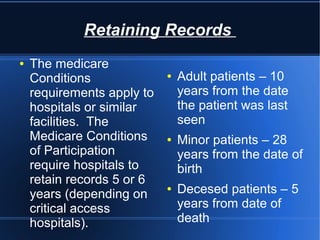
Retaining Records
● The medicare
Conditions
requirements apply to
hospitals or similar
facilities. The
Medicare Conditions
of Participation
require hospitals to
retain records 5 or 6
years (depending on
critical access
hospitals).
● Adult patients – 10
years from the date
the patient was last
seen
● Minor patients – 28
years from the date of
birth
● Decesed patients – 5
years from date of
death
Confidentiality
● Confidentiality is the obligation of the health
care provider to maintain patient information in
a manner that will not permit dissemination
beyond the health care provider
● The failure of health care providers to respect
confidentiality will have an in pack on risk
management programs through an increased
number of lawsuits.
●
Privacy Rule gives you the right to
inspect, review, and receive a copy
of your medical record and billing
record that are held by health plans
and health care providers covered
by the privacy rule. One exception
is that a patient access to the
providers psychotherapyherapy
notes.
Pros of going
paperless
● Save time with billing and
scheduling tasks
● Easily attach media files to patient
records
● Export documents quickly
● Reduce overall transcription costs
by eliminating many tasks
● Streamline office workflow
● Assign staff members documents
electronically for review
● Free up storage space in filing
cabinets and the office
● Eliminate paper and lessen other
supplies costs
Drawbacks of going
paperless
● You will need to make sure all
computer hardware and software
programs are up-to-date and
perform system-wide upgrades
regularly to prevent any gaps in
data transfers and losses. You will
also need to make sure all
computer systems are password-
protected and connected to a
secure server. You will need to
back up data regularly and
implement a system for restoring
data in the event of an emergency.
Another thing to consider is that it
may take time to train staff
members how to scan and save
documents for easy retrieval.
References
● Legal and Ethical Aspects of Health Information
Management (Fourth Edition – class textbook pages
270-275)
● The Doctors Company (2016)
www.thedoctors.com/KnowledgeCenter/PatientSafety/articles/MedicalRecord-Rention
● U.S. Department of Health and Human Services
(HHS.gov)www.hhs.gov/hipaa/for-individuals/medical-records/index.htm.
● AHIMA Practice Briefhttp://www.patientnow.com/pros-cons-going-paperless-emr/

week 8 presentation medical law

  • 1.
    Patient Record Requirements By: KendaColeman Week 8 Medical Law Presentation Time Spent: 3 hours
  • 2.
    Health information professionals have traditionallyinfluenced the risk management process by implementing, enforcing, and educating health care providers about patient records requirements.
  • 3.
    ● Purposes medicalrecords are used ● HIPAA Risk Compliance Categories ● Proper documentation ● Security Issues ● Retaining Records ● Confidentiality ● Privacy Rule ● Benefits and Drawbacks of going paperless
  • 4.
    Purposes of aMedical Record ● Providing a basis for evaluating the adequacy and appropriateness of care ● Providing a means of communication between the physician and the other member of the health care team caring for the patient ● Providing data to insurance claims ● Protecting the legal interests of the patient, facility, and the physician ● Providing clinical data for research and education
  • 5.
    HIPAA Risk ComplianceCategories ● Risk Assessment ● Currency of Policies and Procedures ● Security Awareness and Training ● Workforce Clearance ● Workstation Security ● Encryption
  • 6.
    Proper Documentation ● Properdocumentation is timely and complete. This means that all entries in the record are authored and authenticated and reflect the total care actually rendered to the patient ● A properly documented health record benefits a health care provider's defense in a law suit. It is both timely and complete, and it meets the appropriate requirements for record content. ● A complete timely and accurate record reduces risk at trial because the health care providers defense ability is enhanced.
  • 7.
    Security Issues ● Securityissues regarding a risk management program centers on the availability of health records for purposes of patient care, access to patient specific information, retention of records and database management. ● Falure to make health records availaible during a current or subsequent episode of patient care may result in harm to the patient and exposure of the health care provider to liability.
  • 8.
    Security Issues ● Requestsfor access to patient- specific health information should be handled only by those with proper training and supervision ● Health Care facilities reduce the risk of a lawsuit for negligent loss of record by retaining records for the minimum period
  • 9.
    Retaining Records ● Themedicare Conditions requirements apply to hospitals or similar facilities. The Medicare Conditions of Participation require hospitals to retain records 5 or 6 years (depending on critical access hospitals). ● Adult patients – 10 years from the date the patient was last seen ● Minor patients – 28 years from the date of birth ● Decesed patients – 5 years from date of death
  • 10.
    Confidentiality ● Confidentiality isthe obligation of the health care provider to maintain patient information in a manner that will not permit dissemination beyond the health care provider ● The failure of health care providers to respect confidentiality will have an in pack on risk management programs through an increased number of lawsuits. ●
  • 11.
    Privacy Rule givesyou the right to inspect, review, and receive a copy of your medical record and billing record that are held by health plans and health care providers covered by the privacy rule. One exception is that a patient access to the providers psychotherapyherapy notes.
  • 12.
    Pros of going paperless ●Save time with billing and scheduling tasks ● Easily attach media files to patient records ● Export documents quickly ● Reduce overall transcription costs by eliminating many tasks ● Streamline office workflow ● Assign staff members documents electronically for review ● Free up storage space in filing cabinets and the office ● Eliminate paper and lessen other supplies costs Drawbacks of going paperless ● You will need to make sure all computer hardware and software programs are up-to-date and perform system-wide upgrades regularly to prevent any gaps in data transfers and losses. You will also need to make sure all computer systems are password- protected and connected to a secure server. You will need to back up data regularly and implement a system for restoring data in the event of an emergency. Another thing to consider is that it may take time to train staff members how to scan and save documents for easy retrieval.
  • 13.
    References ● Legal andEthical Aspects of Health Information Management (Fourth Edition – class textbook pages 270-275) ● The Doctors Company (2016) www.thedoctors.com/KnowledgeCenter/PatientSafety/articles/MedicalRecord-Rention ● U.S. Department of Health and Human Services (HHS.gov)www.hhs.gov/hipaa/for-individuals/medical-records/index.htm. ● AHIMA Practice Briefhttp://www.patientnow.com/pros-cons-going-paperless-emr/

Editor's Notes

  • #4 This is an outline of today's presentation.
  • #10 OSHA requires 30 years to be retained for employees that have been exposed to toxic or harmful substances.