Fundamentals to Medical  Terminology By Ryan Lewis
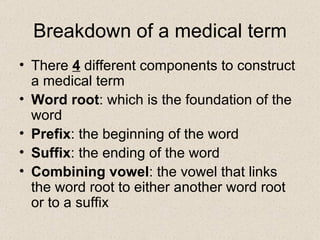
Breakdown of a medical term There  4  different components to construct a medical term Word root : which is the foundation of the word Prefix : the beginning of the word Suffix : the ending of the word Combining vowel : the vowel that links the word root to either another word root or to a suffix
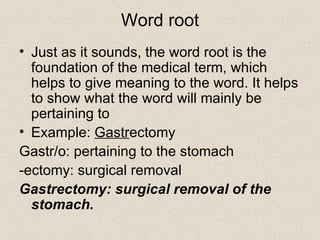
Word root Just as it sounds, the word root is the foundation of the medical term, which helps to give meaning to the word. It helps to show what the word will mainly be pertaining to Example:  Gastr ectomy Gastr/o: pertaining to the stomach -ectomy: surgical removal Gastrectomy: surgical removal of the stomach.
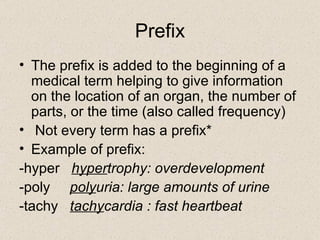
Prefix The prefix is added to the beginning of a medical term helping to give information on the location of an organ, the number of parts, or the time (also called frequency) Not every term has a prefix* Example of prefix:  -hyper  hyper trophy: overdevelopment   -poly  poly uria: large amounts of urine   -tachy  tachy cardia : fast heartbeat
Suffix The suffix is found at the end of the word, attached to indicate meaning such as a disease, procedure, or a condition. *Every medical term has a suffix Example:  -itis (inflammation)  cellul itis : imflammation of the cells -dynia (pain)  cardio dynia : pain of the heart
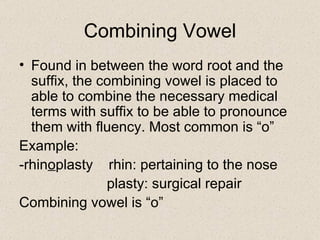
Combining Vowel Found in between the word root and the suffix, the combining vowel is placed to able to combine the necessary medical terms with suffix to be able to pronounce them with fluency. Most common is “o” Example:  -rhin o plasty  rhin: pertaining to the nose   plasty: surgical repair Combining vowel is “o”
All four terms.. Pericardial Word Root: Cardi (the heart) Prefix: peri (around, surrounding) Suffix: -ial (pertaining to) Cardiodynia Word root: cardi (the heart) Suffix: dynia (pain) Combining Vowel: “o”
Other things about medical terms Singular/Plural: Because most medical terms are derived from Latin or Greek origin, when going from singular to plural, they follow a different set of rules from the given English standard ones. Example sarco ma   sarco mata   ov um   ov a
Medical Record The medical records of the patients are the documents that chart the details of a patient stay while in the hospital. This piece of document is one of the most essential to the patient because it contains his/her information. Each and every physician who comes in contact with the patient is to reference the proper results from the consultation or care given.
Medical Records History & Physical Physicians Order Nurse’s Notes Physician’s Progress Notes Consultation Reports Ancillary Reports Diagnostic Reports Informed Consent  Operative Reports Anesthesiologist Reports Pathologists Reports Discharge Summary
Where is medical terminology used? Mainly in health care settings, medical terminology is preferred because it helps to enable physician and professionals of the medical field to communicate efficienty regardless of state, community, facility, or profession.
Health Care Settings List of some places where medical terminology is commonly used General hospitals Specialty Care Hospitals Nursing Homes Outpatient Clinics Surgical Centers Physicians Offices HMO Home Health Care Rehabilitation Centers Hospice
Confidentiality is the Key Confidentiality is a must when regarding anyone who works medical terminology and in general, in the medical profession. Meaning that all information regarding a patient is to be kept confidential. Legally and morally, its your responsibility to with hold information unless, through proper authorization, the patient has consented. The Health Insurance Portability and Accountability Act of 1996 ensures that patients are provided with protection of their records and health information.

Fundamentals To Medical

  • 1.
    Fundamentals to Medical Terminology By Ryan Lewis
  • 2.
    Breakdown of amedical term There 4 different components to construct a medical term Word root : which is the foundation of the word Prefix : the beginning of the word Suffix : the ending of the word Combining vowel : the vowel that links the word root to either another word root or to a suffix
  • 3.
    Word root Justas it sounds, the word root is the foundation of the medical term, which helps to give meaning to the word. It helps to show what the word will mainly be pertaining to Example: Gastr ectomy Gastr/o: pertaining to the stomach -ectomy: surgical removal Gastrectomy: surgical removal of the stomach.
  • 4.
    Prefix The prefixis added to the beginning of a medical term helping to give information on the location of an organ, the number of parts, or the time (also called frequency) Not every term has a prefix* Example of prefix: -hyper hyper trophy: overdevelopment -poly poly uria: large amounts of urine -tachy tachy cardia : fast heartbeat
  • 5.
    Suffix The suffixis found at the end of the word, attached to indicate meaning such as a disease, procedure, or a condition. *Every medical term has a suffix Example: -itis (inflammation) cellul itis : imflammation of the cells -dynia (pain) cardio dynia : pain of the heart
  • 6.
    Combining Vowel Foundin between the word root and the suffix, the combining vowel is placed to able to combine the necessary medical terms with suffix to be able to pronounce them with fluency. Most common is “o” Example: -rhin o plasty rhin: pertaining to the nose plasty: surgical repair Combining vowel is “o”
  • 7.
    All four terms..Pericardial Word Root: Cardi (the heart) Prefix: peri (around, surrounding) Suffix: -ial (pertaining to) Cardiodynia Word root: cardi (the heart) Suffix: dynia (pain) Combining Vowel: “o”
  • 8.
    Other things aboutmedical terms Singular/Plural: Because most medical terms are derived from Latin or Greek origin, when going from singular to plural, they follow a different set of rules from the given English standard ones. Example sarco ma  sarco mata ov um  ov a
  • 9.
    Medical Record Themedical records of the patients are the documents that chart the details of a patient stay while in the hospital. This piece of document is one of the most essential to the patient because it contains his/her information. Each and every physician who comes in contact with the patient is to reference the proper results from the consultation or care given.
  • 10.
    Medical Records History& Physical Physicians Order Nurse’s Notes Physician’s Progress Notes Consultation Reports Ancillary Reports Diagnostic Reports Informed Consent Operative Reports Anesthesiologist Reports Pathologists Reports Discharge Summary
  • 11.
    Where is medicalterminology used? Mainly in health care settings, medical terminology is preferred because it helps to enable physician and professionals of the medical field to communicate efficienty regardless of state, community, facility, or profession.
  • 12.
    Health Care SettingsList of some places where medical terminology is commonly used General hospitals Specialty Care Hospitals Nursing Homes Outpatient Clinics Surgical Centers Physicians Offices HMO Home Health Care Rehabilitation Centers Hospice
  • 13.
    Confidentiality is theKey Confidentiality is a must when regarding anyone who works medical terminology and in general, in the medical profession. Meaning that all information regarding a patient is to be kept confidential. Legally and morally, its your responsibility to with hold information unless, through proper authorization, the patient has consented. The Health Insurance Portability and Accountability Act of 1996 ensures that patients are provided with protection of their records and health information.