Electronic Data Interchange (EDI) Atul Kahate [email_address]
EDI and XML XML is a data description language It has its roots in EDI EDI technology is still in use, but is being replaced with XML
What is EDI? Electronic Data Interchange (EDI) Related to the history of XML Document exchange standard e.g. Purchase Order (PO), Sales Order (SO) Documents are inter-related But their formats differ! Aims at:  Making formats uniform  Document exchanges easier
EDI Example Company A wants to buy spare parts from company B Company A prepares a Purchase Order (PO) Sends it to company B Company B sends the goods, and a Sales Order (SO) to B Formats of the SO and the PO differ
EDI’s Role Take care of all such mismatches Make document exchange easier Make it electronic Hence the name  Electronic  Data Interchange (EDI)
EDI Definition Exchange of business documents such as Purchase Orders (PO), Invoices, etc in an electronic format
EDI Characteristics Happens electronically (like emails) Little or no manual intervention Very fast and accurate Little or no clumsy paperwork
EDI Usage Started in the 1960s Used mainly by very large organizations Doing business with suppliers/customers Slowly getting replaced by transactions over the Internet
EDI History Has roots in another innovation 1964, Sales Manager at American Hospital Supply Company (AHSC) Developed a system for its customers (i.e. hospitals) Use of punched cards for placing orders
Value Added Network (VAN) Private Networks Communications layer over the basic network infrastructure Similar to how all parties communicating using emails would need SMTP
VAN Provider Similar to an Internet Service Provider (ISP) Provides VAN Maintains  mailboxes  for all the EDI users Stores and forwards messages between EDI users
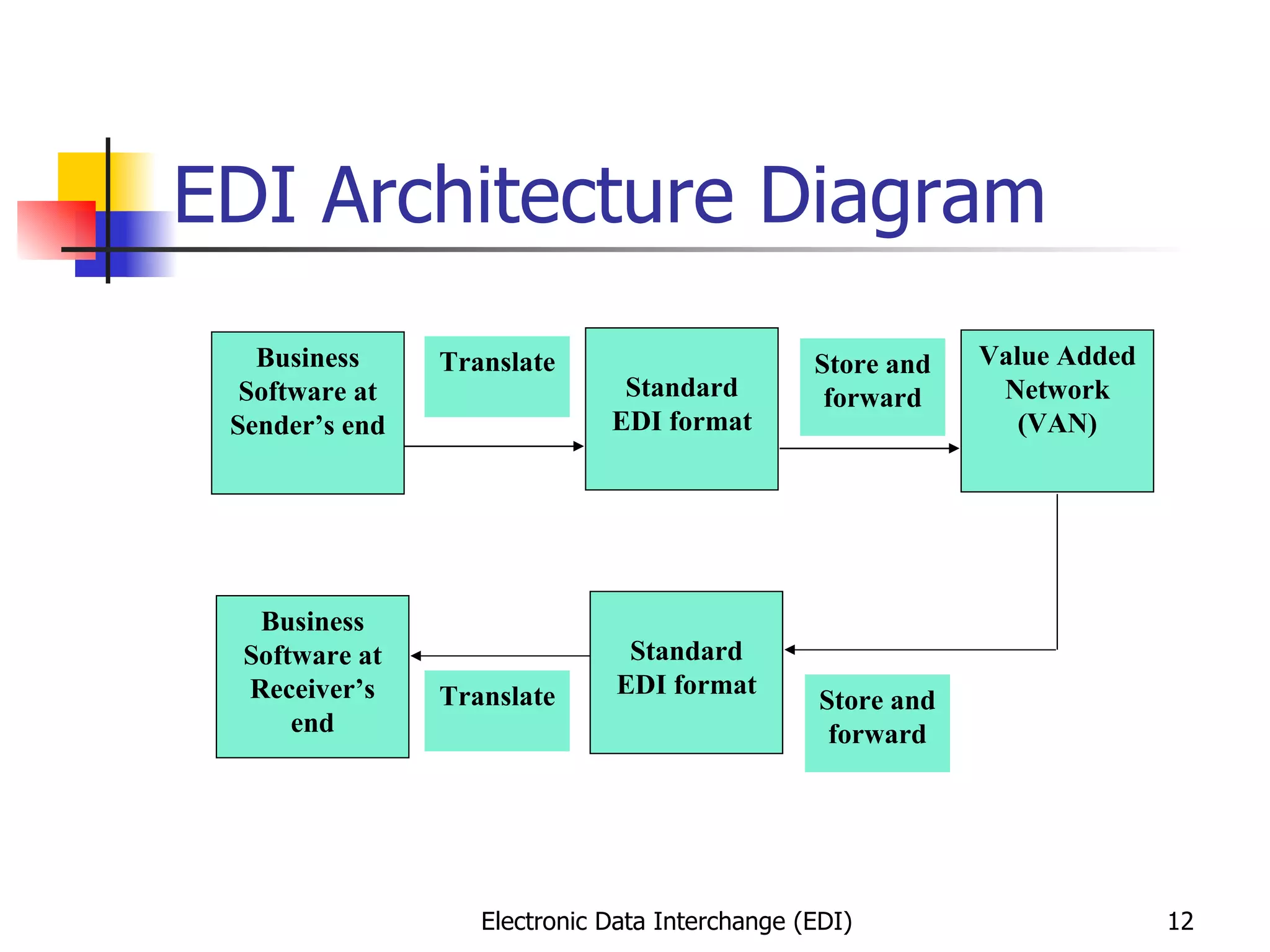
EDI Architecture Diagram Business Software at Sender’s end Standard EDI format Translate Value Added Network (VAN) Store and forward Standard EDI format Store and forward Business Software at Receiver’s end Translate
VAN Approaches Third-party Preferred method More costly In-house Complicated May be cheaper
EDI Types No EDI Partially Integrated EDI Fully Integrated EDI
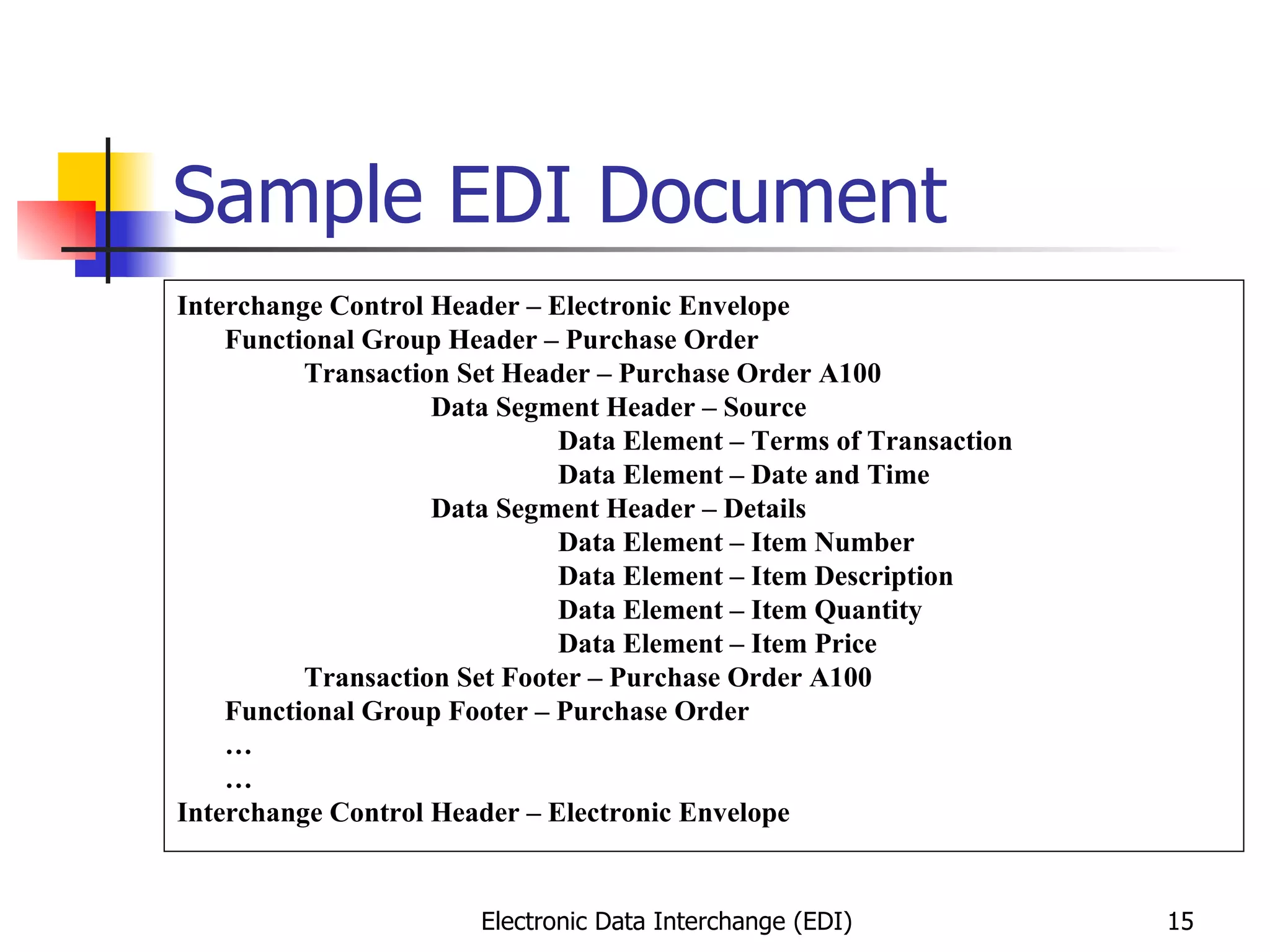
Sample EDI Document Interchange Control Header – Electronic Envelope Functional Group Header – Purchase Order Transaction Set Header – Purchase Order A100 Data Segment Header – Source Data Element – Terms of Transaction Data Element – Date and Time Data Segment Header – Details Data Element – Item Number Data Element – Item Description Data Element – Item Quantity Data Element – Item Price Transaction Set Footer – Purchase Order A100 Functional Group Footer – Purchase Order … … Interchange Control Header – Electronic Envelope
EDI Data Formats Decided by ANSI ANSI ASC X12 in North America EDIFACT in Europe Efforts are on to merge the two
EDI Advantages Reduced lead-time Reduction in number of errors Reduction in processing costs overall Availability of information at all times Planning becomes easier Long-term relationships between trading partners
EDI Drawbacks Very high initial costs Barrier to entry Not using EDI is also a problem Technologically non-savvy companies cannot use EDI with ease
Emerging Trends Use of EDI over the Internet Allows smaller players to use EDI Substantial reduction in costs Use of XML
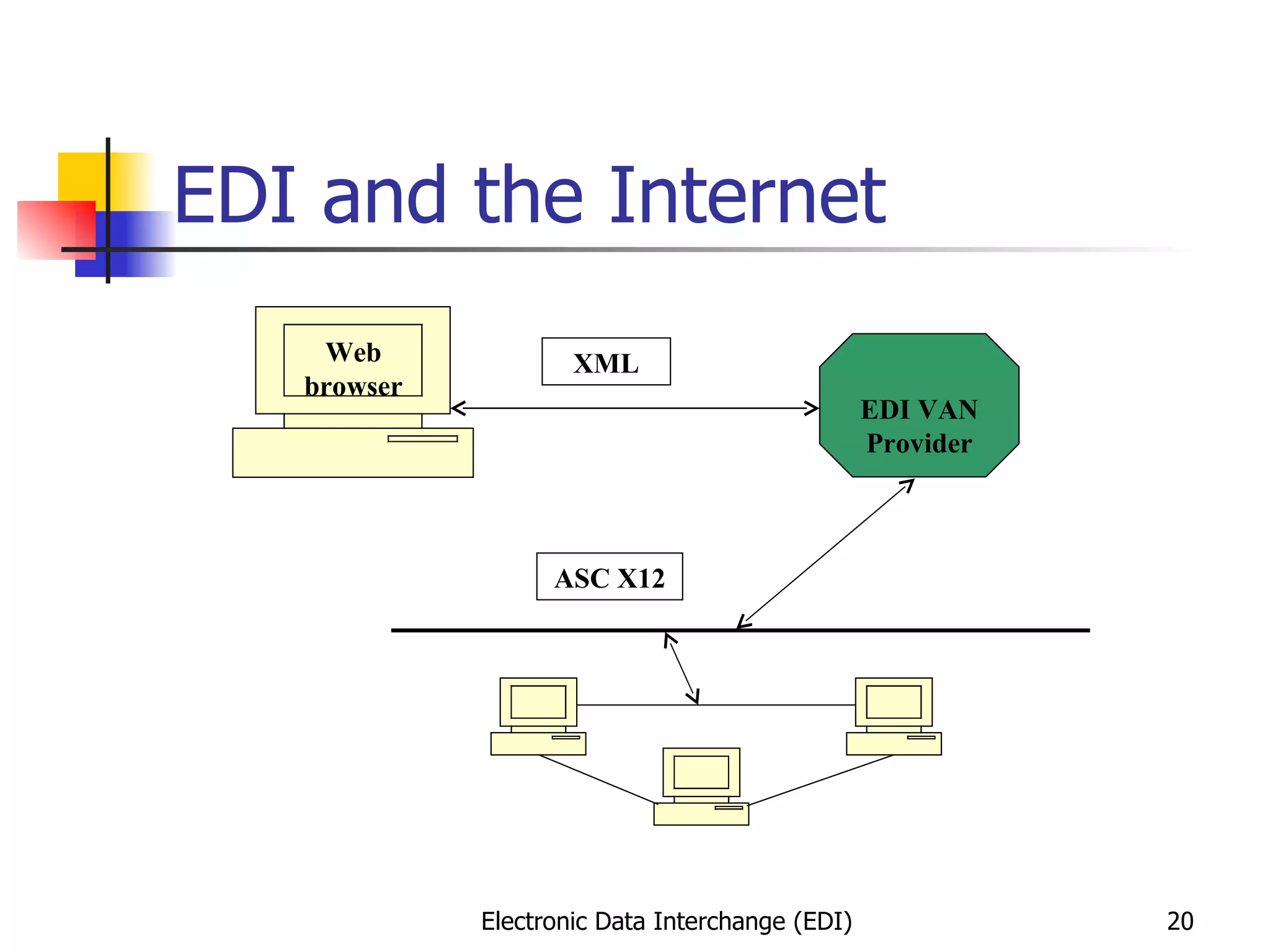
EDI and the Internet Web browser XML EDI VAN Provider ASC X12
Thank you! Any Questions?

1 electronic data interchange (edi)

  • 1.
    Electronic Data Interchange(EDI) Atul Kahate [email_address]
  • 2.
    EDI and XMLXML is a data description language It has its roots in EDI EDI technology is still in use, but is being replaced with XML
  • 3.
    What is EDI?Electronic Data Interchange (EDI) Related to the history of XML Document exchange standard e.g. Purchase Order (PO), Sales Order (SO) Documents are inter-related But their formats differ! Aims at: Making formats uniform Document exchanges easier
  • 4.
    EDI Example CompanyA wants to buy spare parts from company B Company A prepares a Purchase Order (PO) Sends it to company B Company B sends the goods, and a Sales Order (SO) to B Formats of the SO and the PO differ
  • 5.
    EDI’s Role Takecare of all such mismatches Make document exchange easier Make it electronic Hence the name Electronic Data Interchange (EDI)
  • 6.
    EDI Definition Exchangeof business documents such as Purchase Orders (PO), Invoices, etc in an electronic format
  • 7.
    EDI Characteristics Happenselectronically (like emails) Little or no manual intervention Very fast and accurate Little or no clumsy paperwork
  • 8.
    EDI Usage Startedin the 1960s Used mainly by very large organizations Doing business with suppliers/customers Slowly getting replaced by transactions over the Internet
  • 9.
    EDI History Hasroots in another innovation 1964, Sales Manager at American Hospital Supply Company (AHSC) Developed a system for its customers (i.e. hospitals) Use of punched cards for placing orders
  • 10.
    Value Added Network(VAN) Private Networks Communications layer over the basic network infrastructure Similar to how all parties communicating using emails would need SMTP
  • 11.
    VAN Provider Similarto an Internet Service Provider (ISP) Provides VAN Maintains mailboxes for all the EDI users Stores and forwards messages between EDI users
  • 12.
    EDI Architecture DiagramBusiness Software at Sender’s end Standard EDI format Translate Value Added Network (VAN) Store and forward Standard EDI format Store and forward Business Software at Receiver’s end Translate
  • 13.
    VAN Approaches Third-partyPreferred method More costly In-house Complicated May be cheaper
  • 14.
    EDI Types NoEDI Partially Integrated EDI Fully Integrated EDI
  • 15.
    Sample EDI DocumentInterchange Control Header – Electronic Envelope Functional Group Header – Purchase Order Transaction Set Header – Purchase Order A100 Data Segment Header – Source Data Element – Terms of Transaction Data Element – Date and Time Data Segment Header – Details Data Element – Item Number Data Element – Item Description Data Element – Item Quantity Data Element – Item Price Transaction Set Footer – Purchase Order A100 Functional Group Footer – Purchase Order … … Interchange Control Header – Electronic Envelope
  • 16.
    EDI Data FormatsDecided by ANSI ANSI ASC X12 in North America EDIFACT in Europe Efforts are on to merge the two
  • 17.
    EDI Advantages Reducedlead-time Reduction in number of errors Reduction in processing costs overall Availability of information at all times Planning becomes easier Long-term relationships between trading partners
  • 18.
    EDI Drawbacks Veryhigh initial costs Barrier to entry Not using EDI is also a problem Technologically non-savvy companies cannot use EDI with ease
  • 19.
    Emerging Trends Useof EDI over the Internet Allows smaller players to use EDI Substantial reduction in costs Use of XML
  • 20.
    EDI and theInternet Web browser XML EDI VAN Provider ASC X12
  • 21.
    Thank you! AnyQuestions?