Jonathan Osborne
Graduate School of Education
Stanford University
Styles of Scientific Reasoning, Scientific Practices and
Argument in Science and Science Education
The History of Science
“A history of vision and argument”
Crombie, Alistair Cameron. (1994). Styles of scientific thinking in
the European tradition: The history of argument and explanation
especially in the mathematical and biomedical sciences and arts
(Vol. 1): Duckworth London.
Crazy Ideas in Science
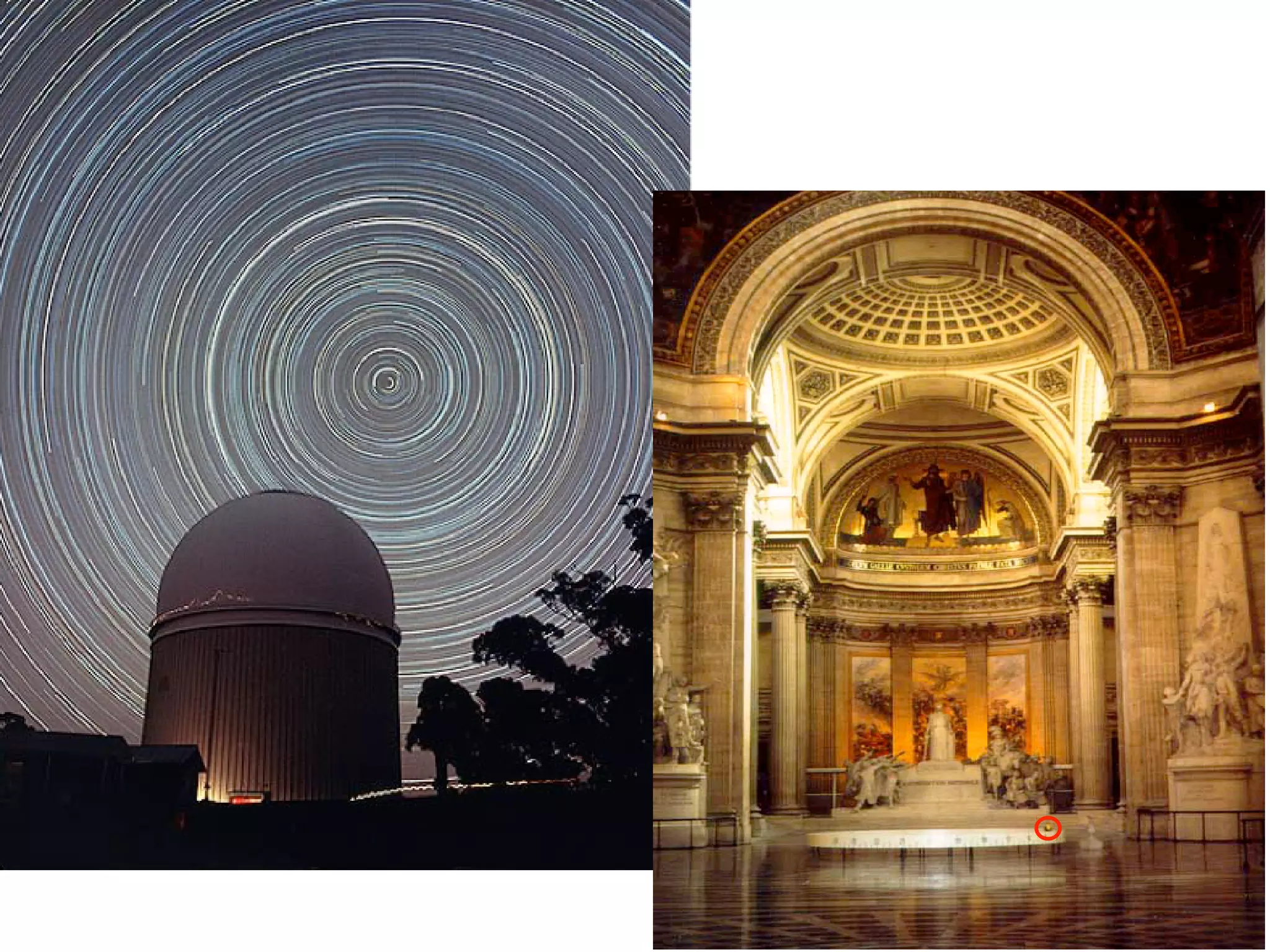
Day and Night is caused by a Spinning Earth
The Continents have moved
We have evolved from other animals
The Earth is 5 billion years old
Diseases are caused by tiny living organisms
We live at the bottom of a sea of air
You look like your parents because every cell carries a chemically
coded message of how to reproduce yourself
History of Science as a History of Error
Ptolemy’s geocentric universe,
Lamarkianism
The ether,
The Denial of Wegner/s Theory
Cold fusion
Phlogiston
Spontaneous generation,
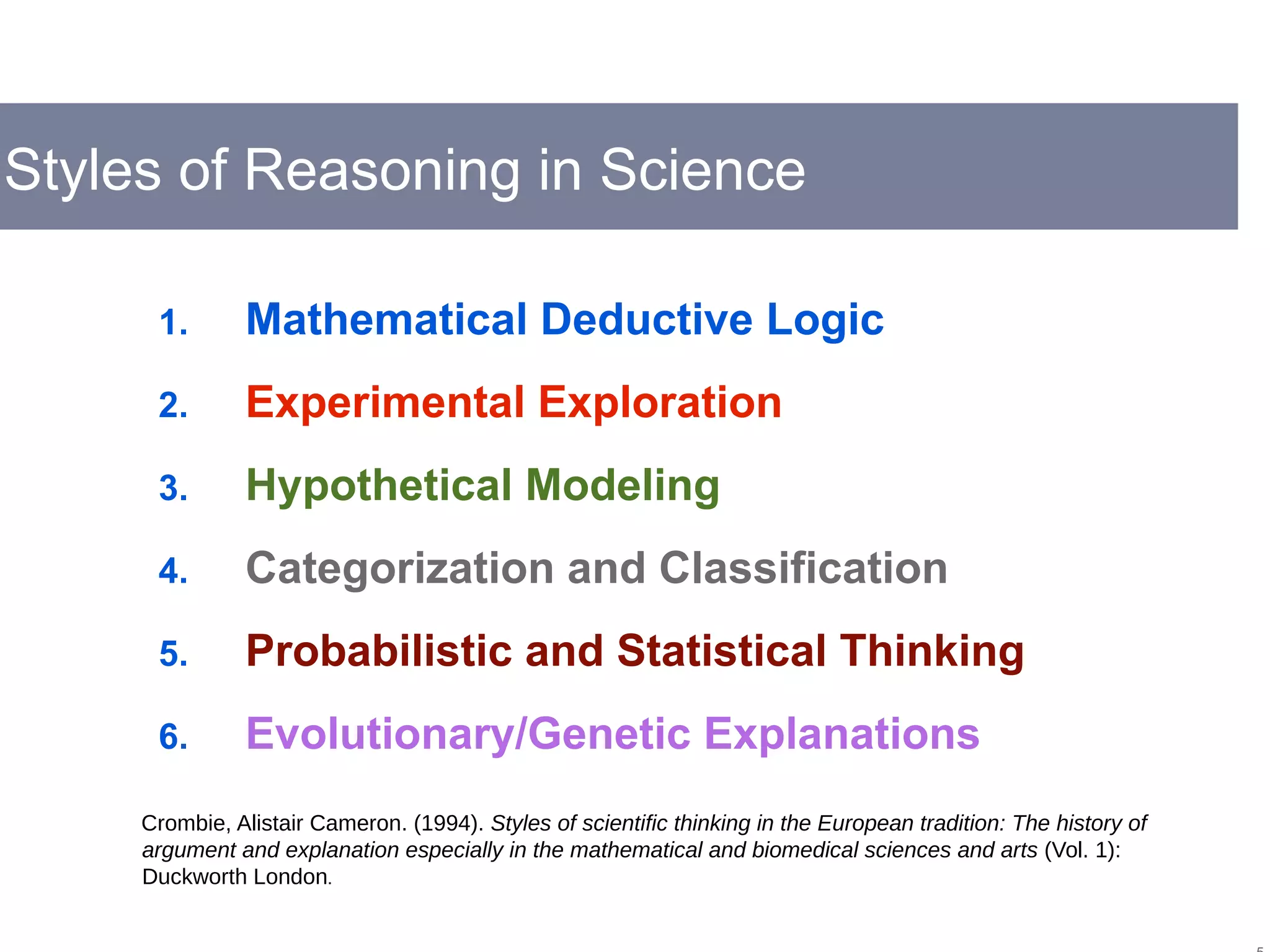
Styles of Reasoning in Science
1. Mathematical Deductive Logic
2. Experimental Exploration
3. Hypothetical Modeling
4. Categorization and Classification
5. Probabilistic and Statistical Thinking
6. Evolutionary/Genetic Explanations
Crombie, Alistair Cameron. (1994). Styles of scientific thinking in the European tradition: The history of
argument and explanation especially in the mathematical and biomedical sciences and arts (Vol. 1):
Duckworth London.
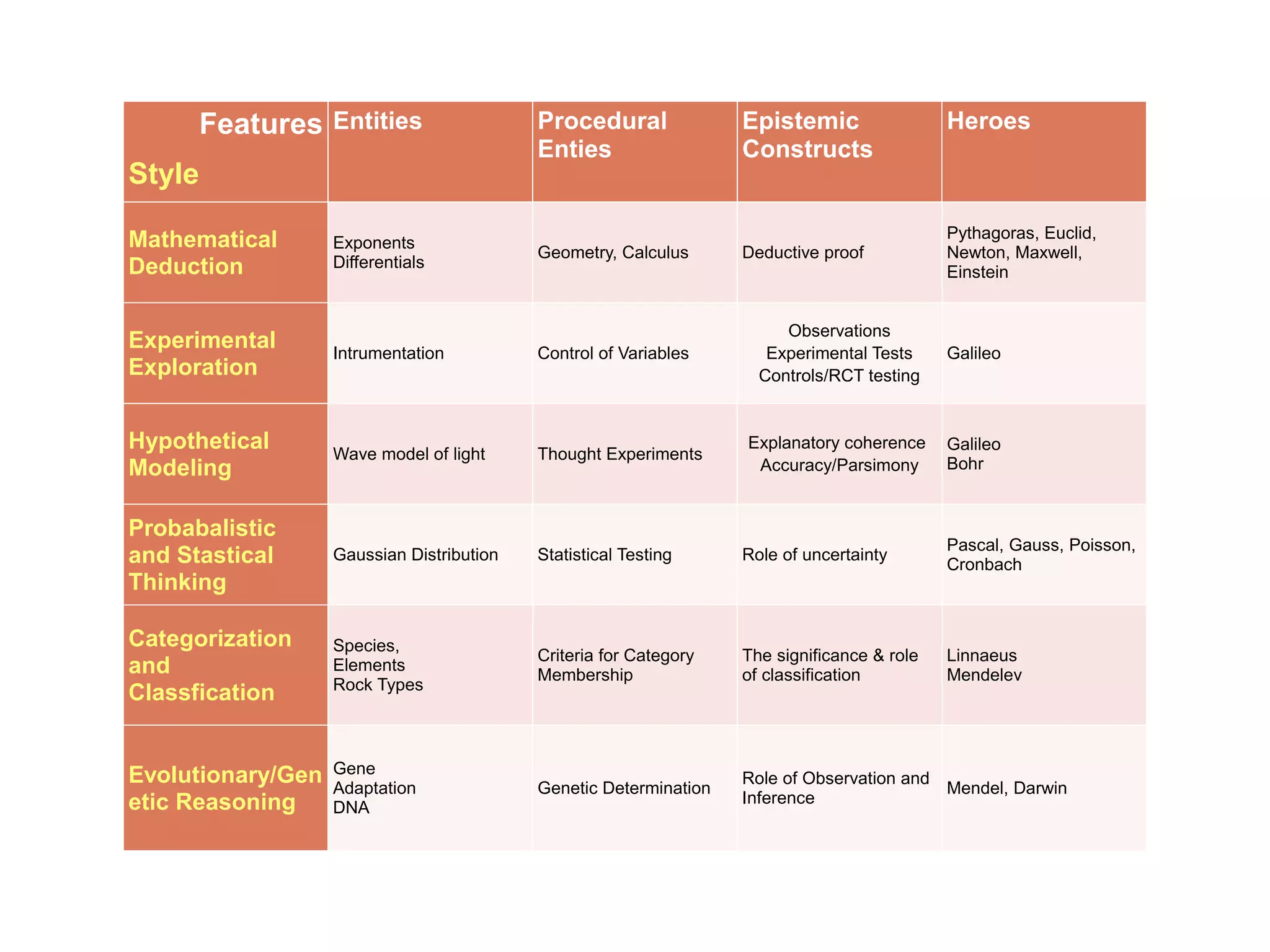
Features
Style
Entities Procedural
Enties
Epistemic
Constructs
Heroes
Mathematical
Deduction
Exponents
Differentials
Geometry, Calculus Deductive proof
Pythagoras, Euclid,
Newton, Maxwell,
Einstein
Experimental
Exploration
Intrumentation Control of Variables
Observations
Experimental Tests
Controls/RCT testing
Galileo
Hypothetical
Modeling
Wave model of light Thought Experiments
Explanatory coherence
Accuracy/Parsimony
Galileo
Bohr
Probabalistic
and Stastical
Thinking
Gaussian Distribution Statistical Testing Role of uncertainty
Pascal, Gauss, Poisson,
Cronbach
Categorization
and
Classfication
Species,
Elements
Rock Types
Criteria for Category
Membership
The significance & role
of classification
Linnaeus
Mendelev
Evolutionary/Gen
etic Reasoning
Gene
Adaptation
DNA
Genetic Determination
Role of Observation and
Inference
Mendel, Darwin
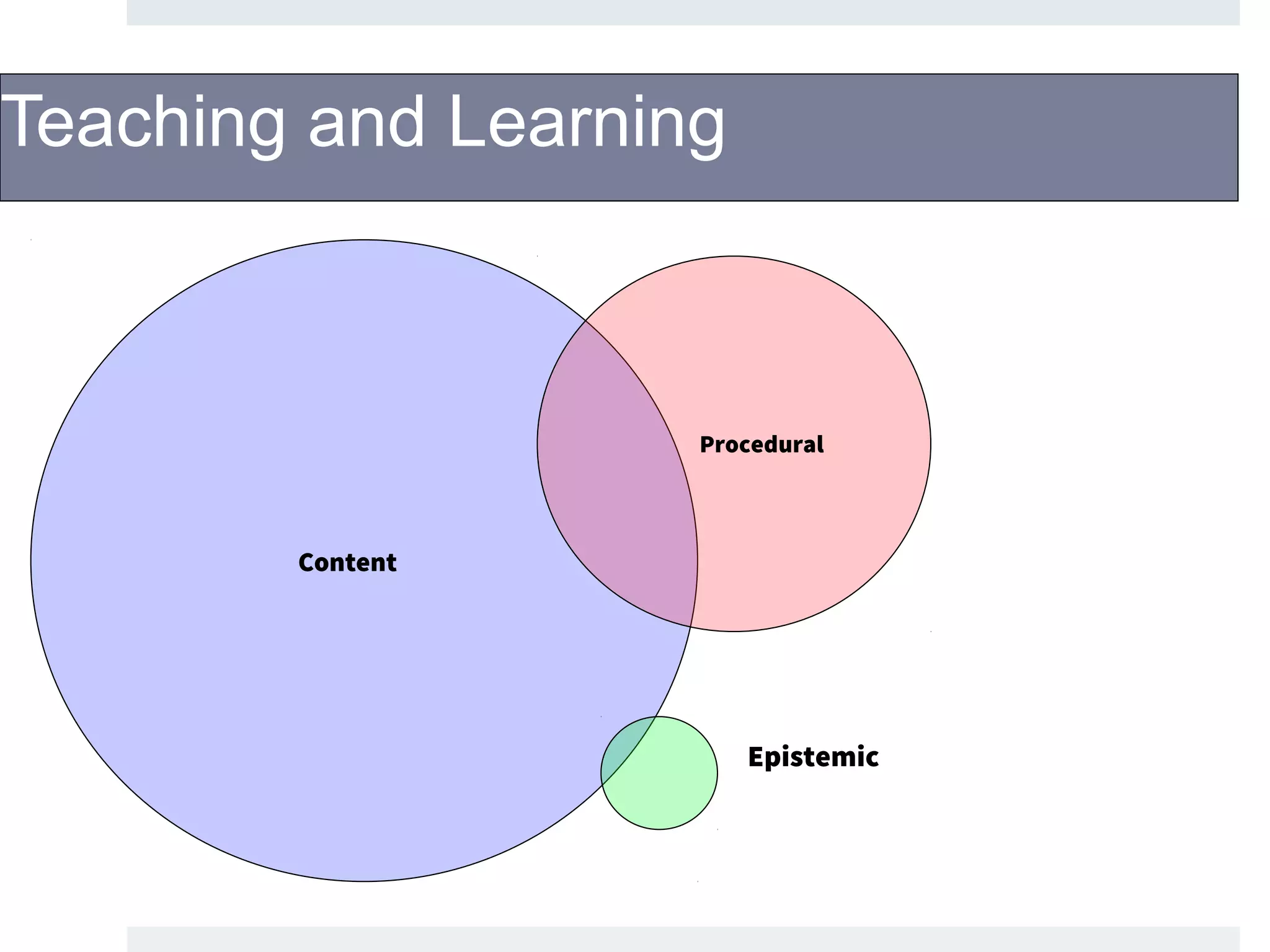
Teaching and Learning
Content Procedural
Epistemic
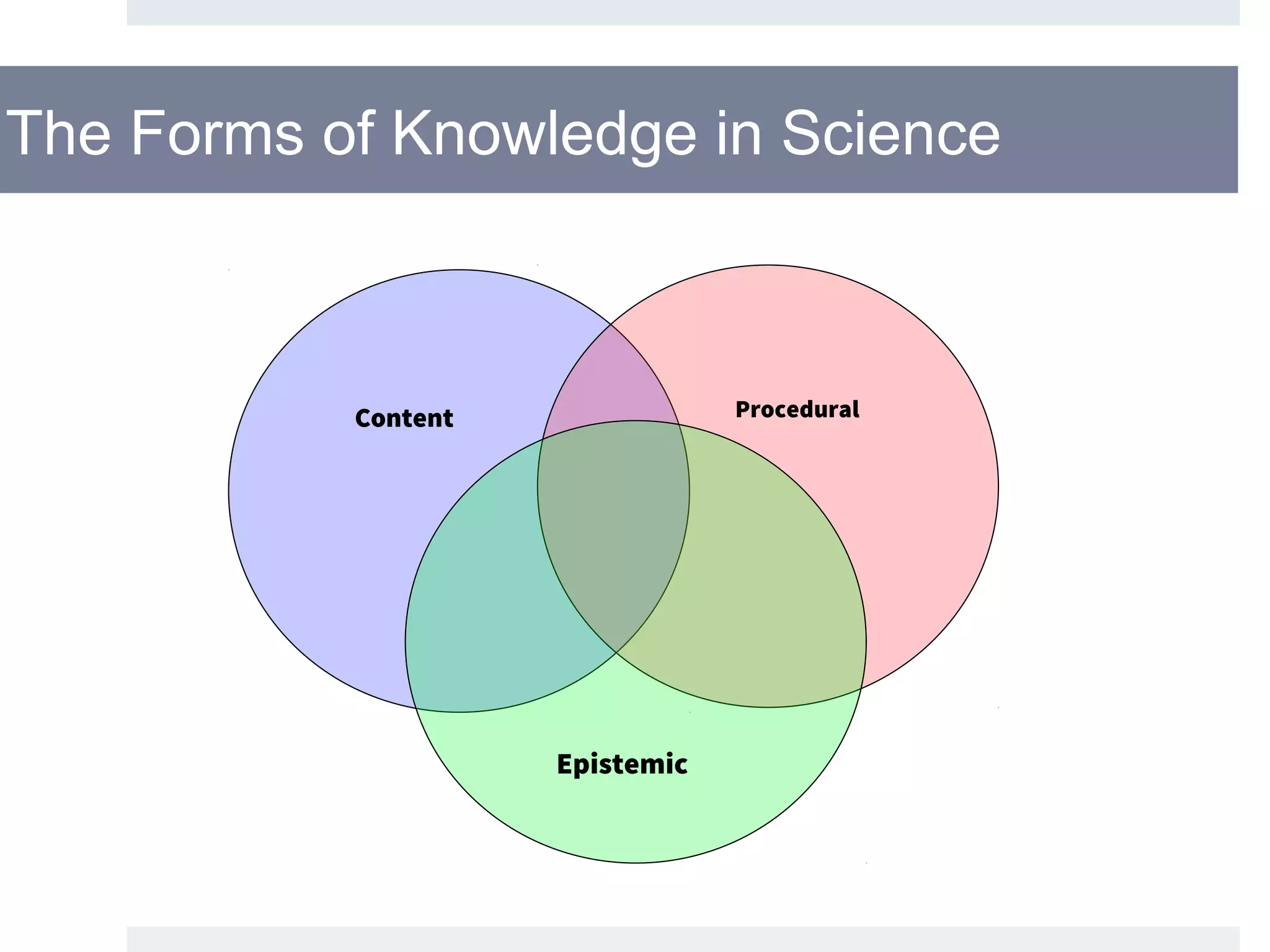
The Forms of Knowledge in Science
Content
Procedural
Epistemic
Teaching and Learning
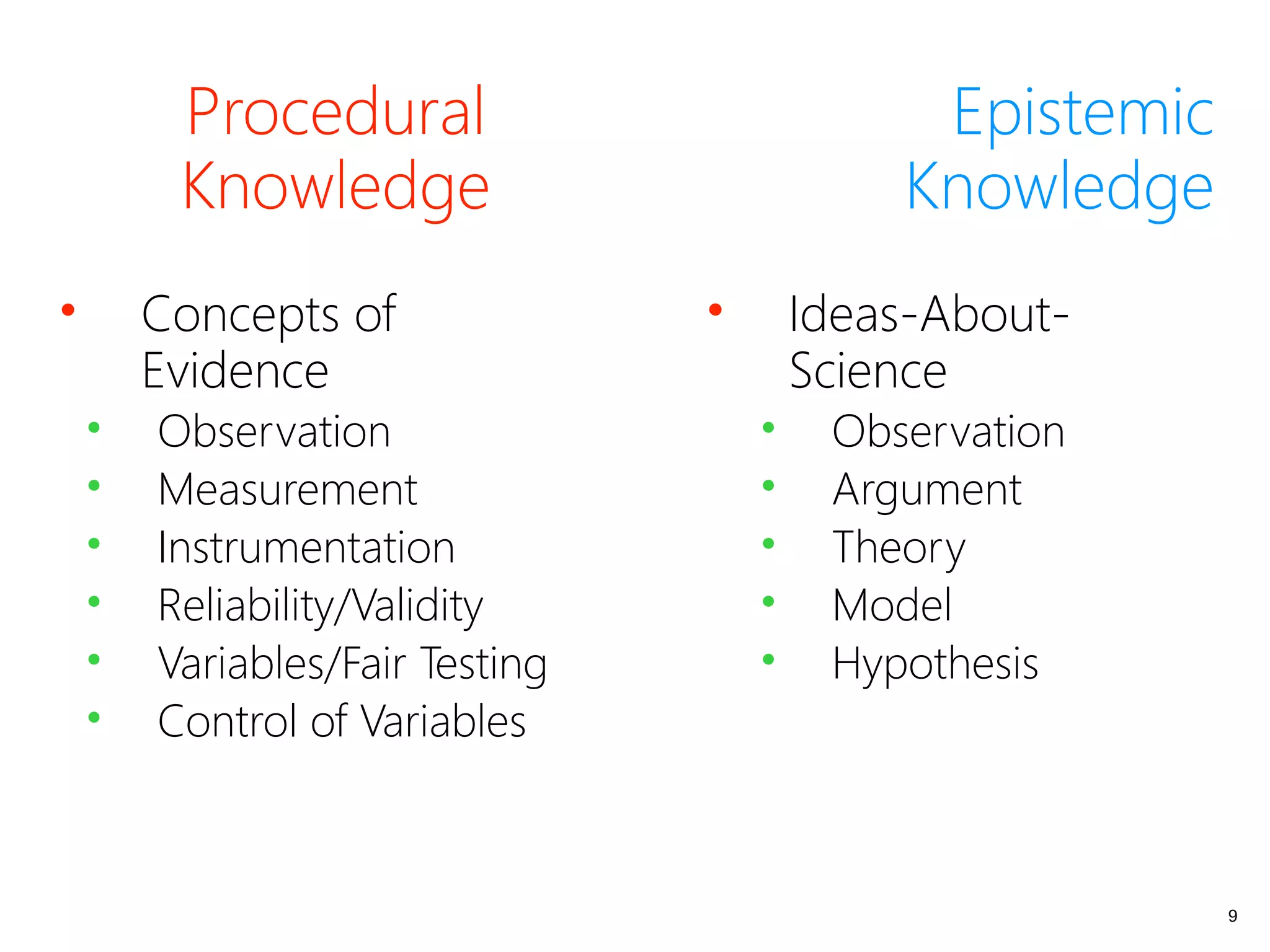
Procedural
Knowledge
• Concepts of
Evidence
• Observation
• Measurement
• Instrumentation
• Reliability/Validity
• Variables/Fair Testing
• Control of Variables
Epistemic
Knowledge
• Ideas-About-
Science
• Observation
• Argument
• Theory
• Model
• Hypothesis
9
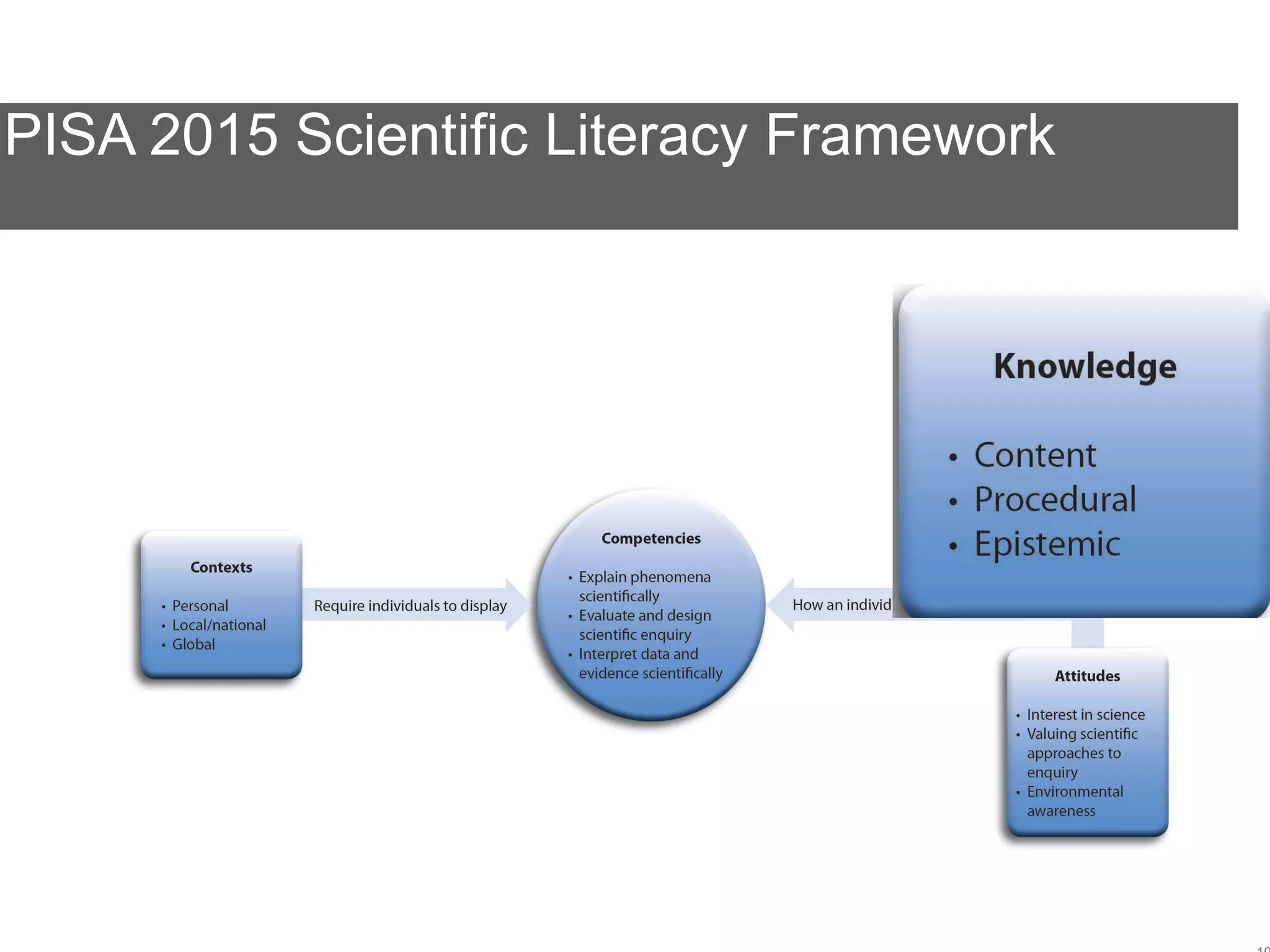
PISA 2015 Scientific Literacy Framework
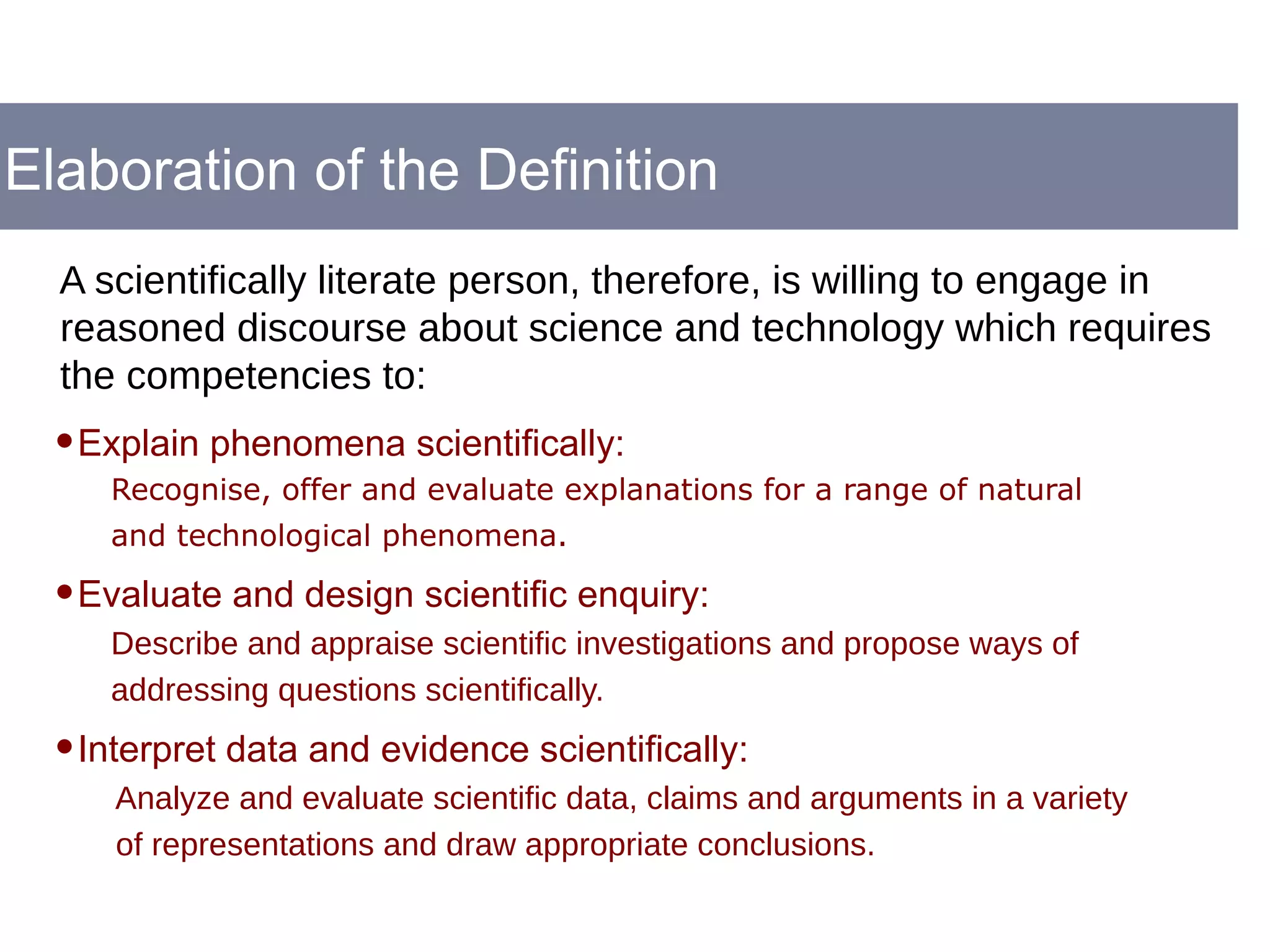
Elaboration of the Definition
•Explain phenomena scientifically:
Recognise, offer and evaluate explanations for a range of natural
and technological phenomena.
•Evaluate and design scientific enquiry:
Describe and appraise scientific investigations and propose ways of
addressing questions scientifically.
•Interpret data and evidence scientifically:
Analyze and evaluate scientific data, claims and arguments in a variety
of representations and draw appropriate conclusions.
A scientifically literate person, therefore, is willing to engage in
reasoned discourse about science and technology which requires
the competencies to:
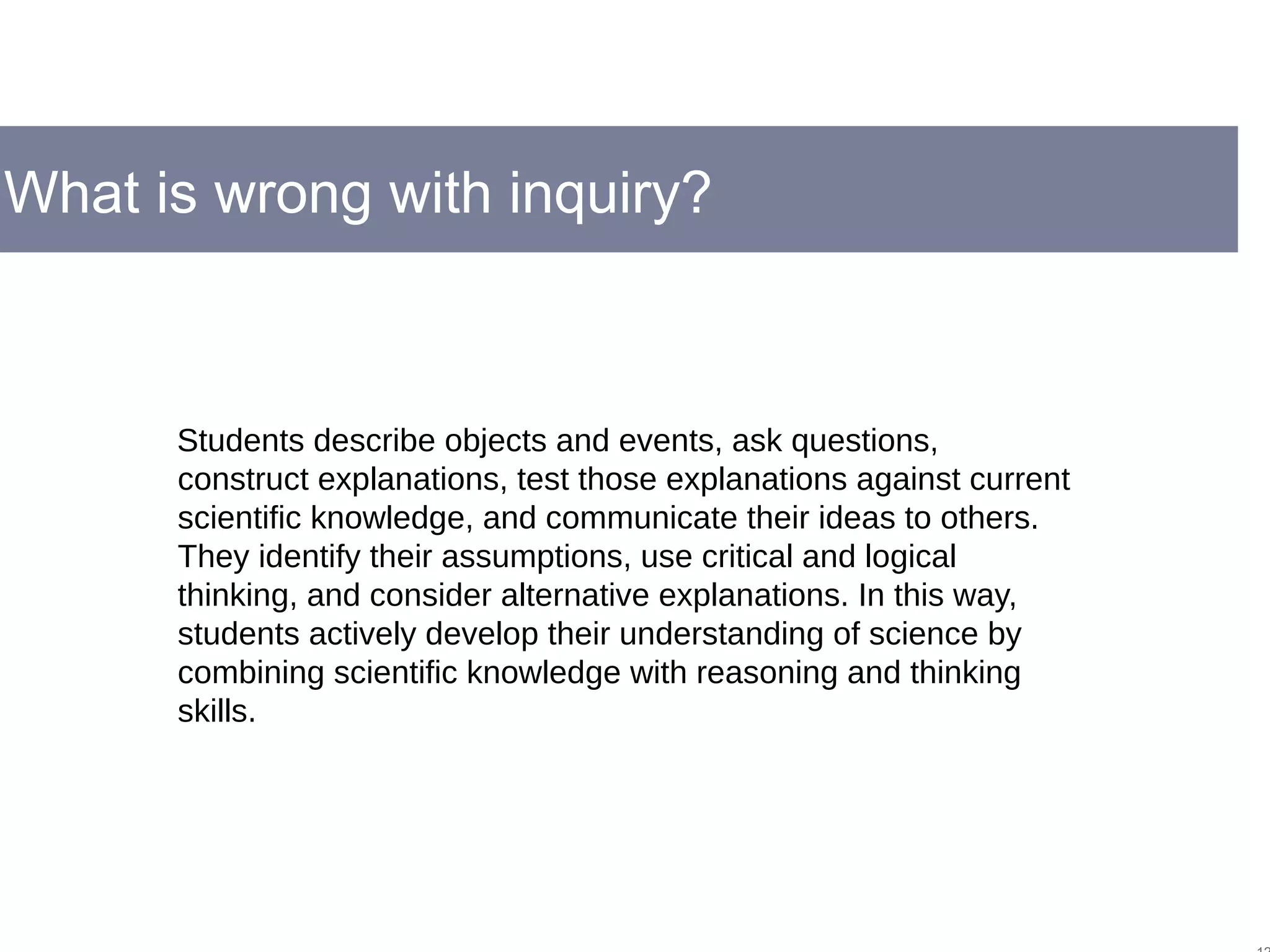
What is wrong with inquiry?
Students describe objects and events, ask questions,
construct explanations, test those explanations against current
scientific knowledge, and communicate their ideas to others.
They identify their assumptions, use critical and logical
thinking, and consider alternative explanations. In this way,
students actively develop their understanding of science by
combining scientific knowledge with reasoning and thinking
skills.
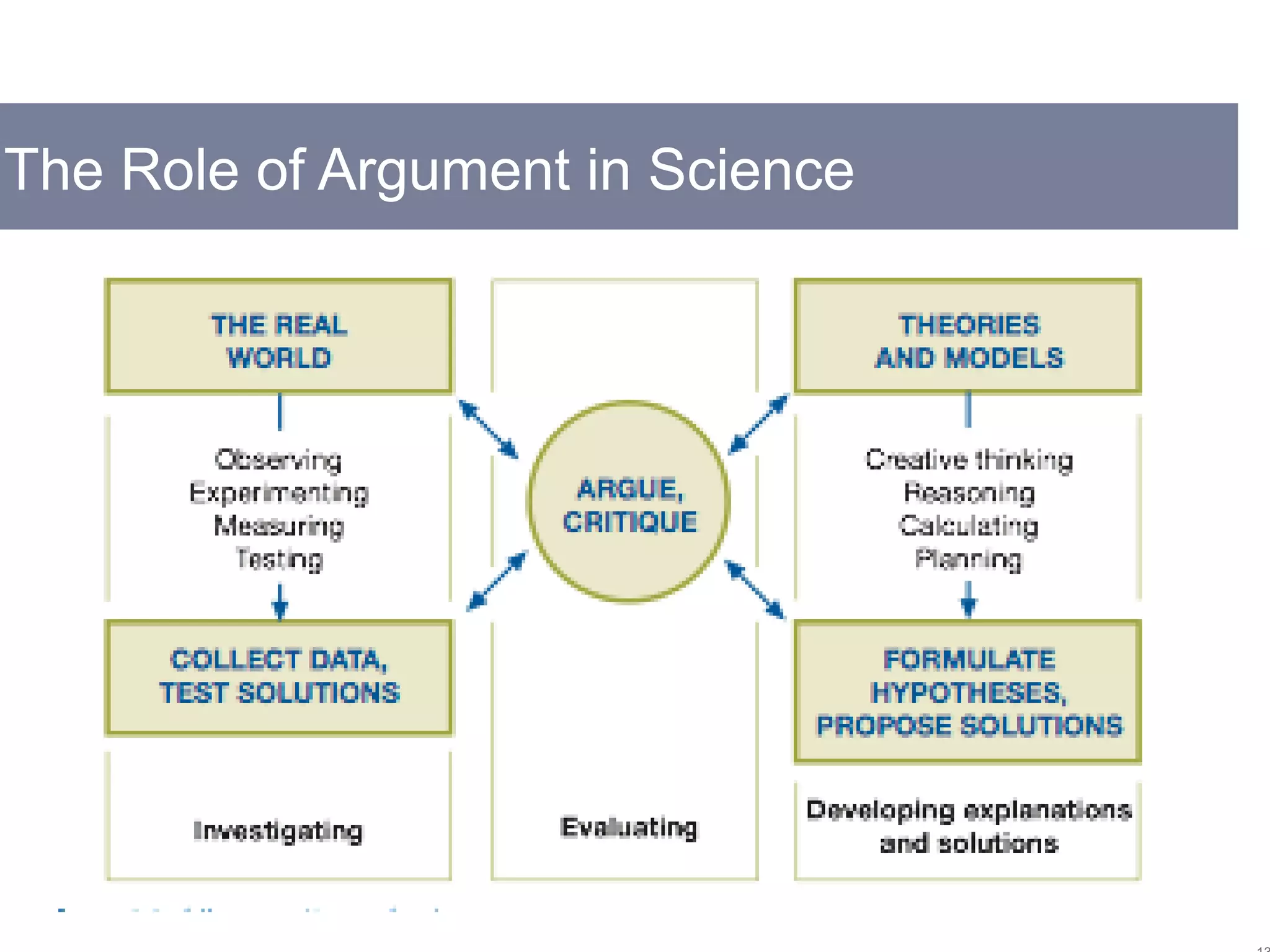
The Role of Argument in Science
The Practices of Science
1. Asking Questions and Defining Problems
2. Developing and Using Models
3. Planning and Carrying out Investigations
4. Analyzing and Interpreting Data
5. Using Mathematics and Computational Thinking
6. Constructing Explanations and Designing Solutions
7. Engaging in Argument from Evidence
8. Obtaining, Evaluating and Communicating Information
Thee Central Questions of Science
1. What exists? (The ontological question)
2. Why does it happen? (The causal question)
3. How do we know? (The epistemic question)
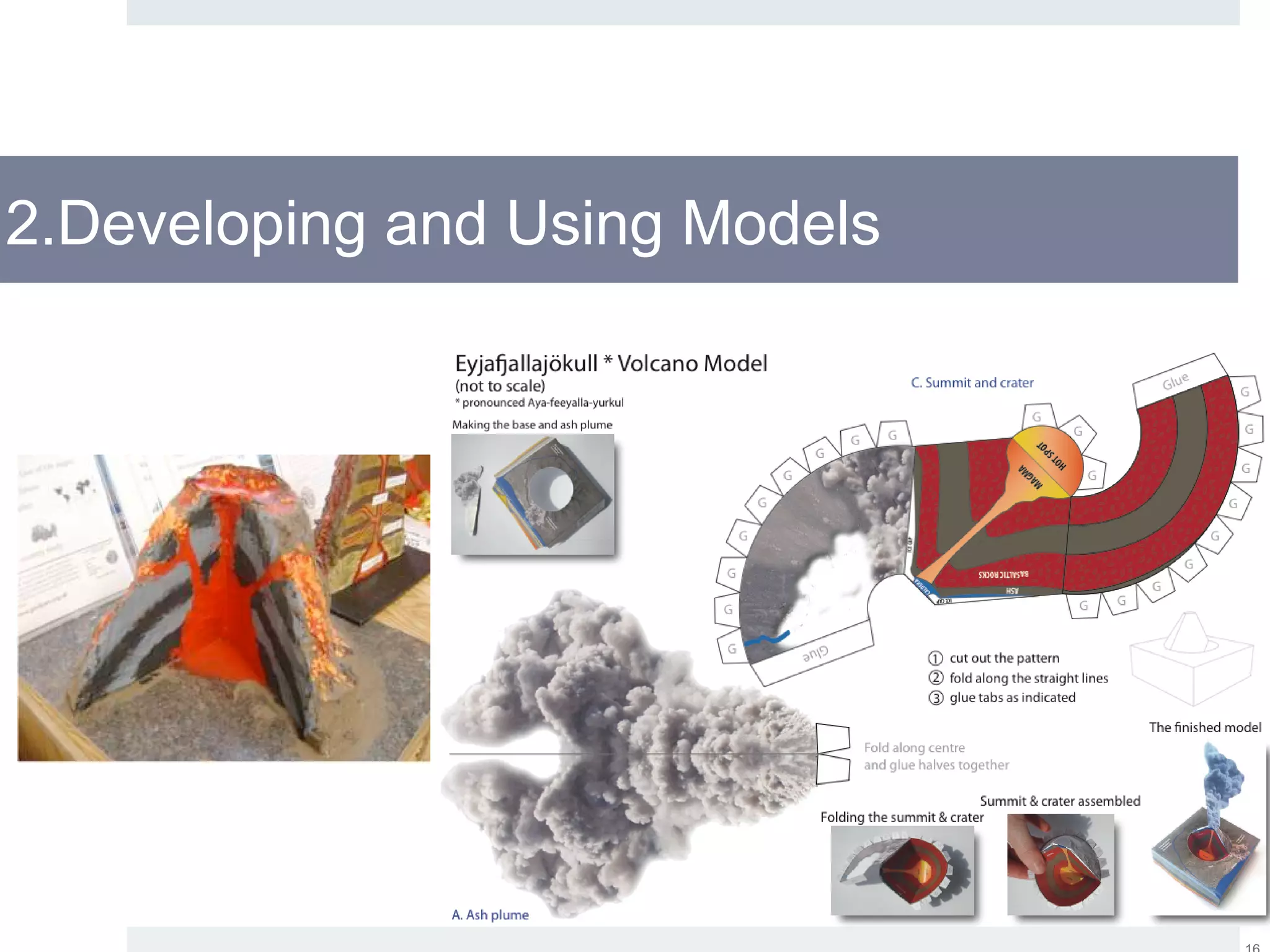
2.Developing and Using Models
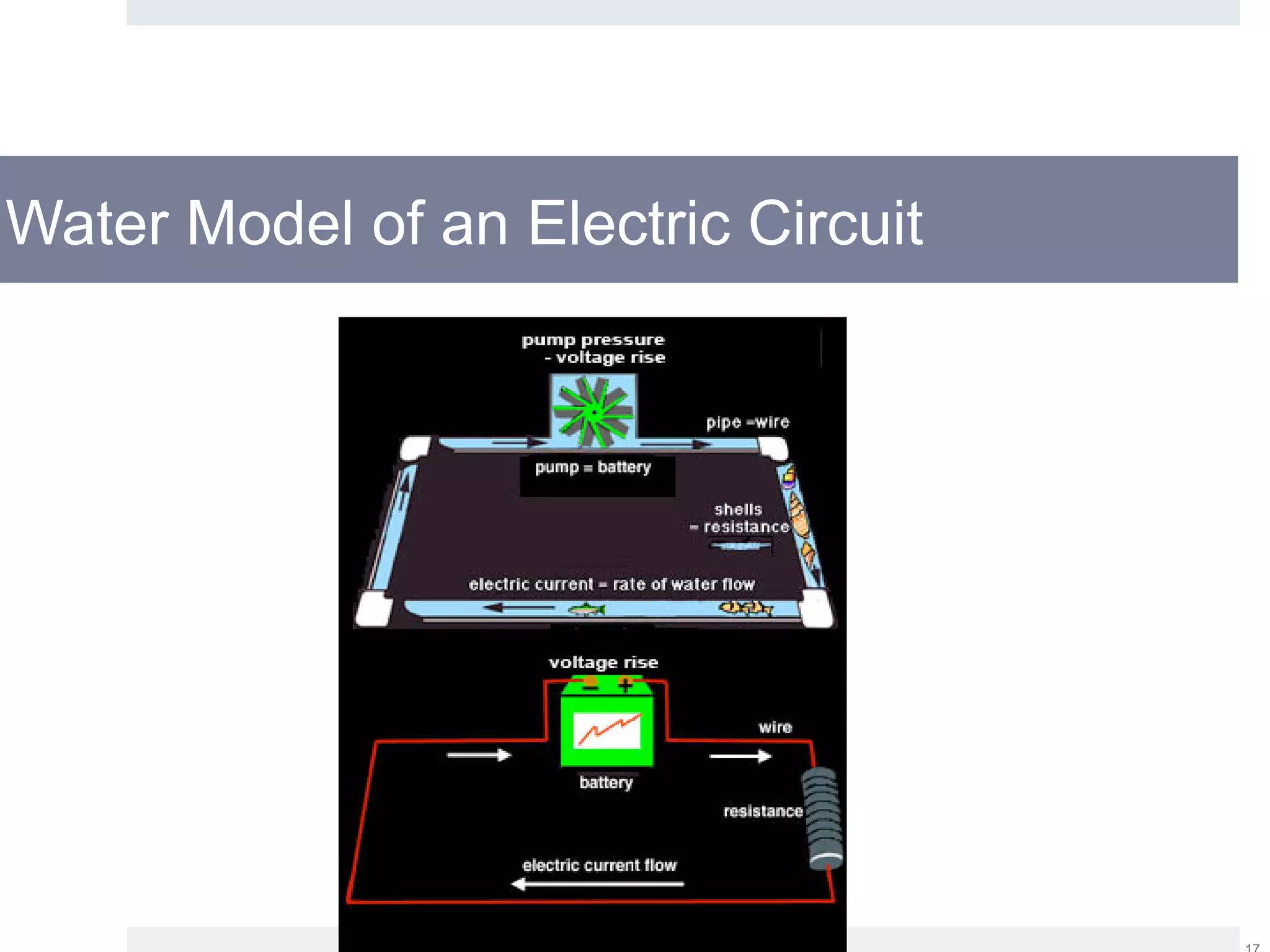
Water Model of an Electric Circuit
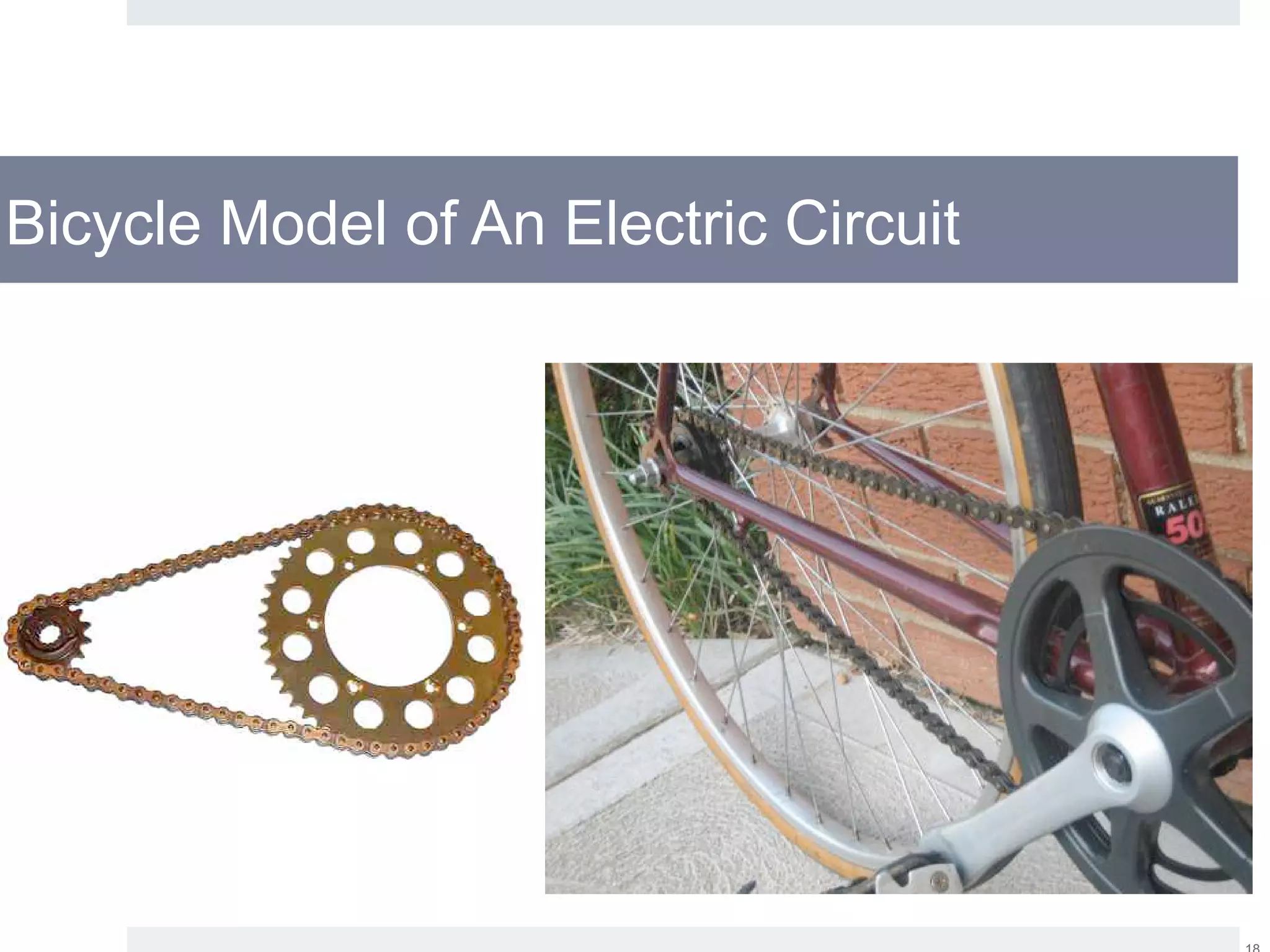
Bicycle Model of An Electric Circuit
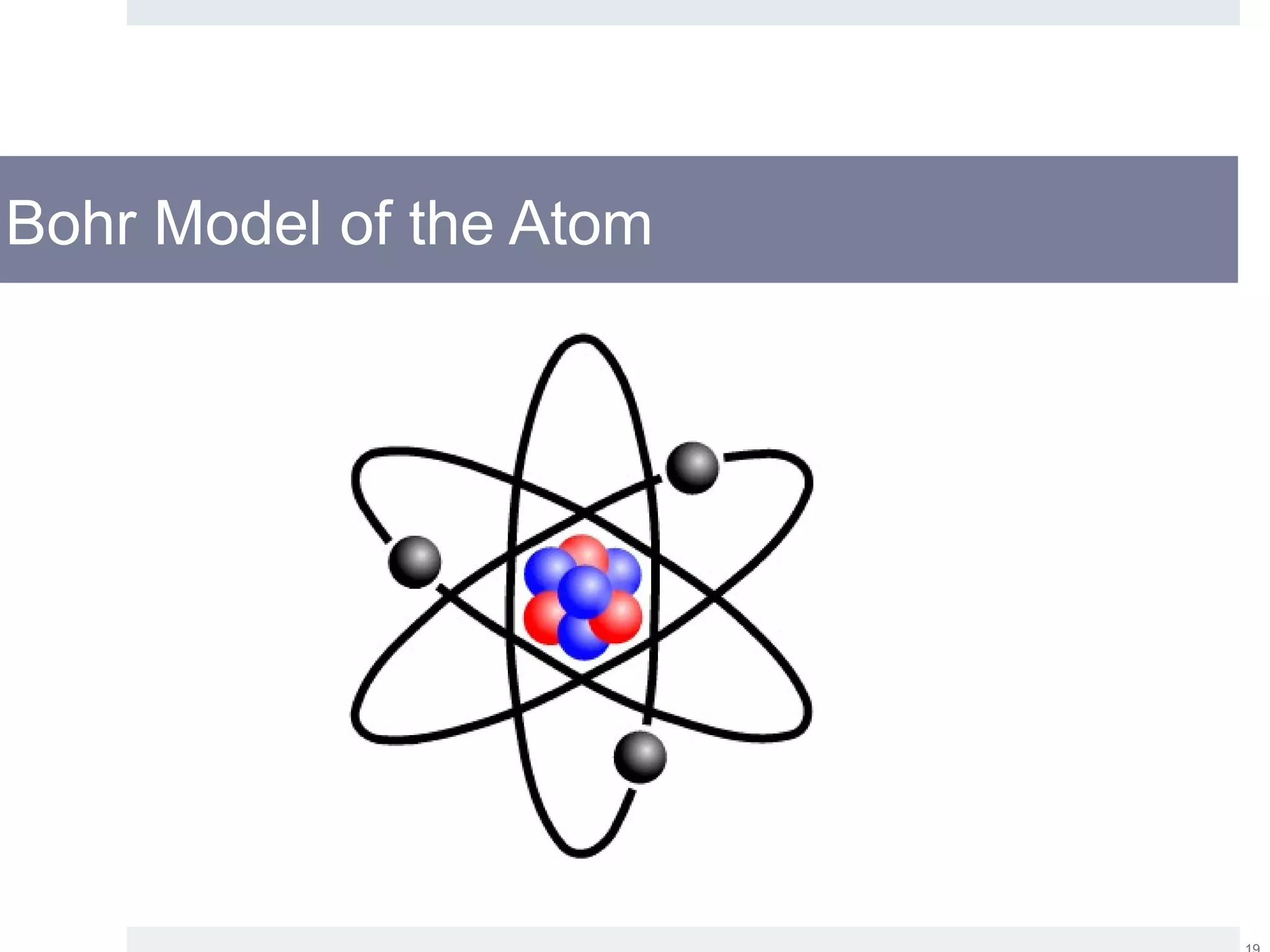
Bohr Model of the Atom
3. Planning and Carrying Out Investigations
A Teacher asked her students to investigate this problem:
How does temperature affect the time taken for sugar to dissolve?
The students were asked to describe the investigation. These are some of the
things they write. How clearly has each student described the investigation? And
which is the best?
JEMMA: We have got to write down what we are going to do and then do it.
KIRSTY: We are looking to see how different temperatures affect how long
it takes the sugar to dissolve.
EMMA: We are trying to see if sugar dissolves in water.
ANITA: We are adding sugar to hot and cold water to see how long it takes
to dissolve
ALEX: We are trying to find the best temperature for dissolving sugar in
water.
LOUISE: We have to put the same amount of sugar in water with different
temperatures and see what happened
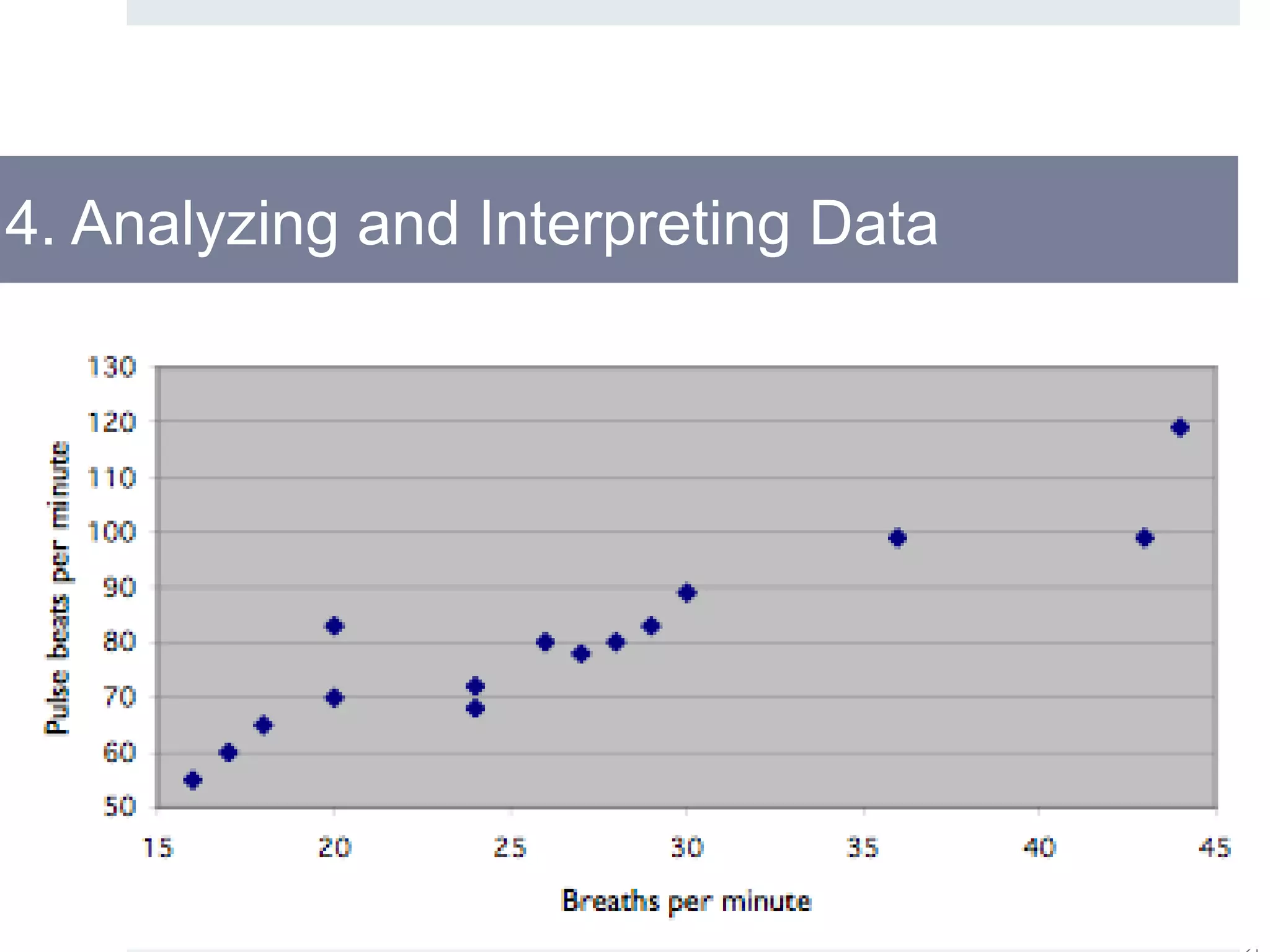
4. Analyzing and Interpreting Data
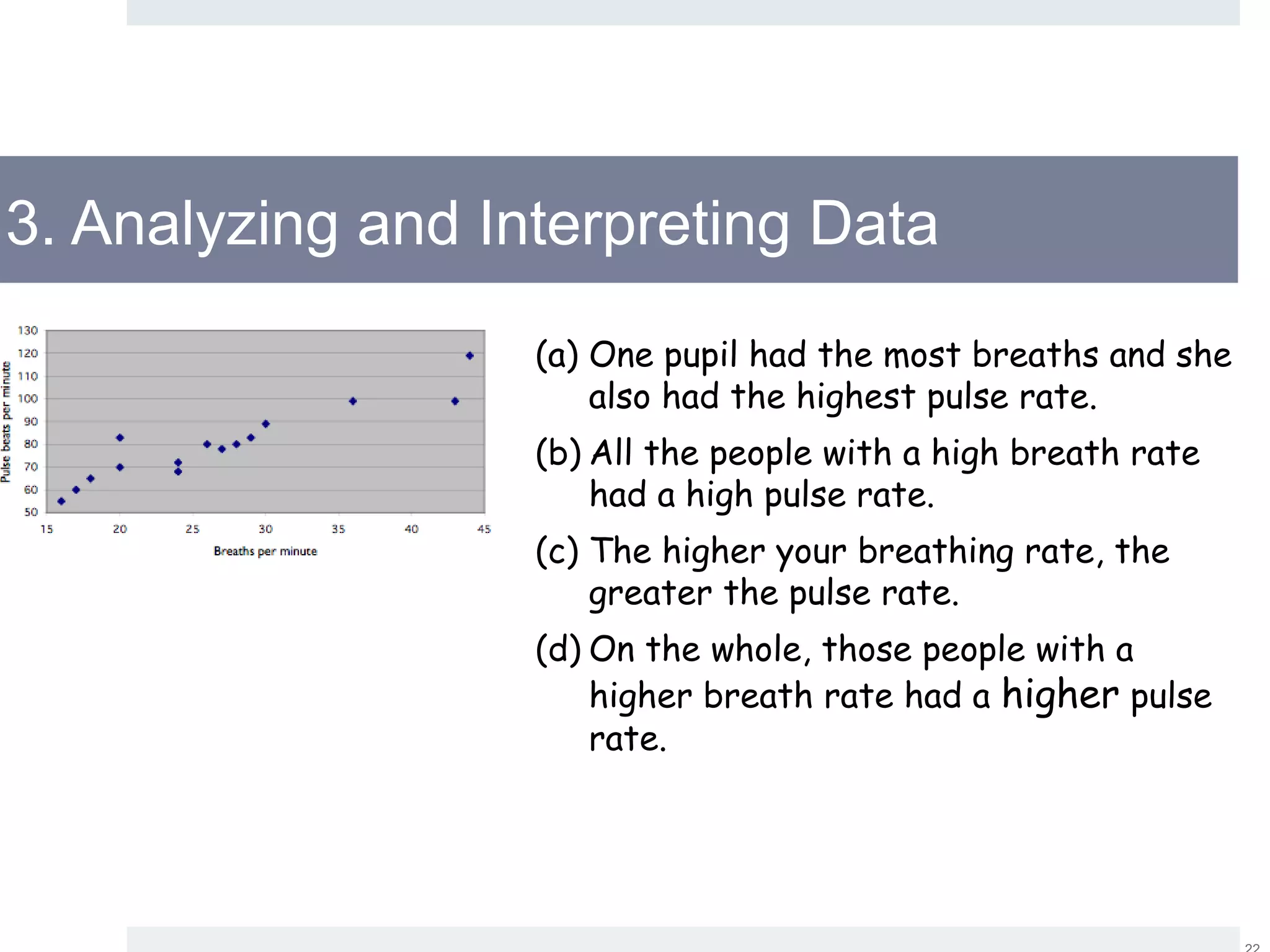
3. Analyzing and Interpreting Data
(a) One pupil had the most breaths and she
also had the highest pulse rate.
(b) All the people with a high breath rate
had a high pulse rate.
(c) The higher your breathing rate, the
greater the pulse rate.
(d) On the whole, those people with a
higher breath rate had a higher pulse
rate.
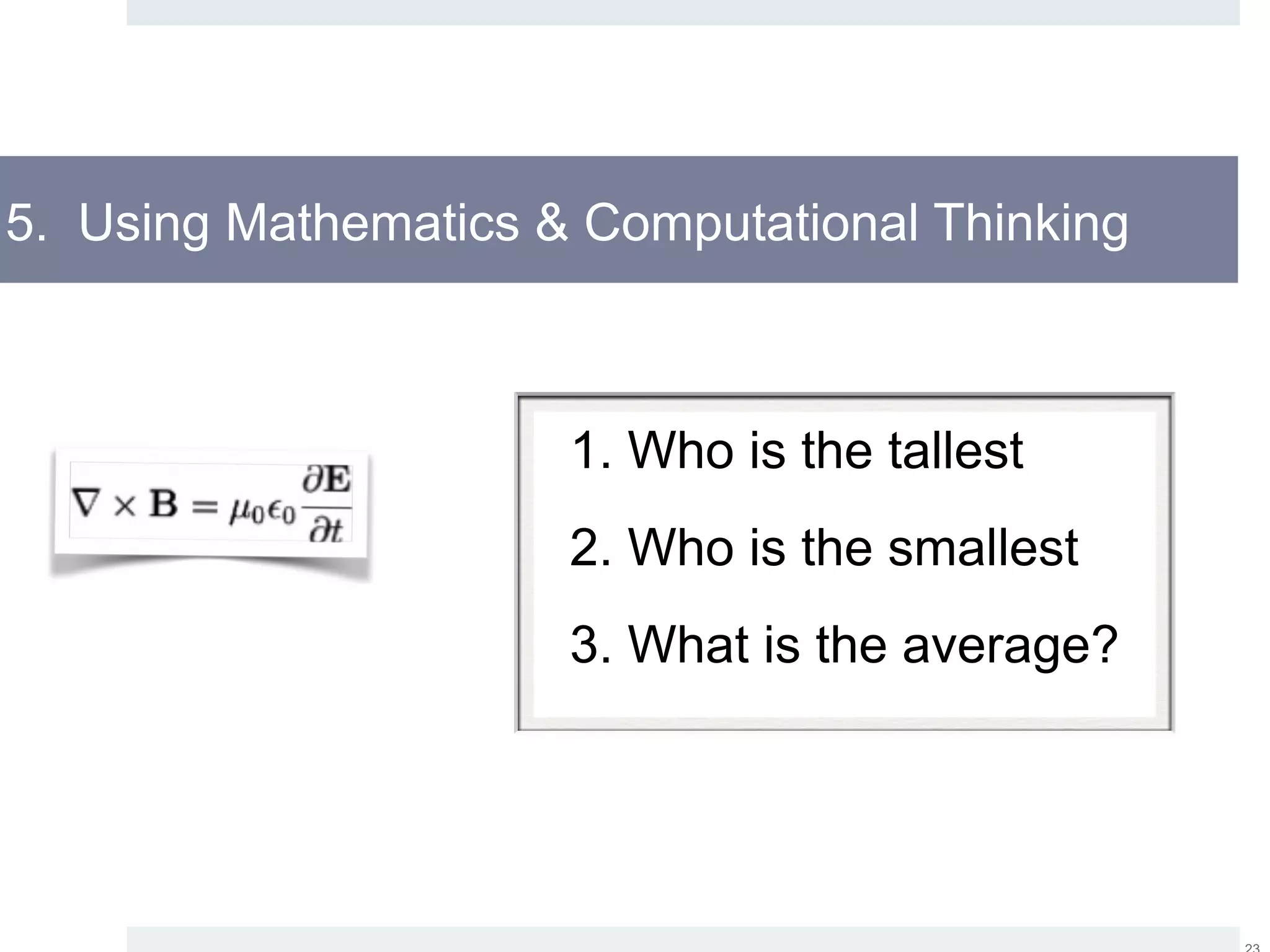
5. Using Mathematics & Computational Thinking
1. Who is the tallest
2. Who is the smallest
3. What is the average?
6. Constructing Explanations
Why do objects fall at the same rate in the absence
of air?
• Gravity pulls on all objects
• If the mass is double, the pull of gravity will double
• Twice the mass takes twice as long to speed up
• Think of two objects, one twice as massive as the other
• Force is double but so is the mass
7. Engaging in Argument from Evidence
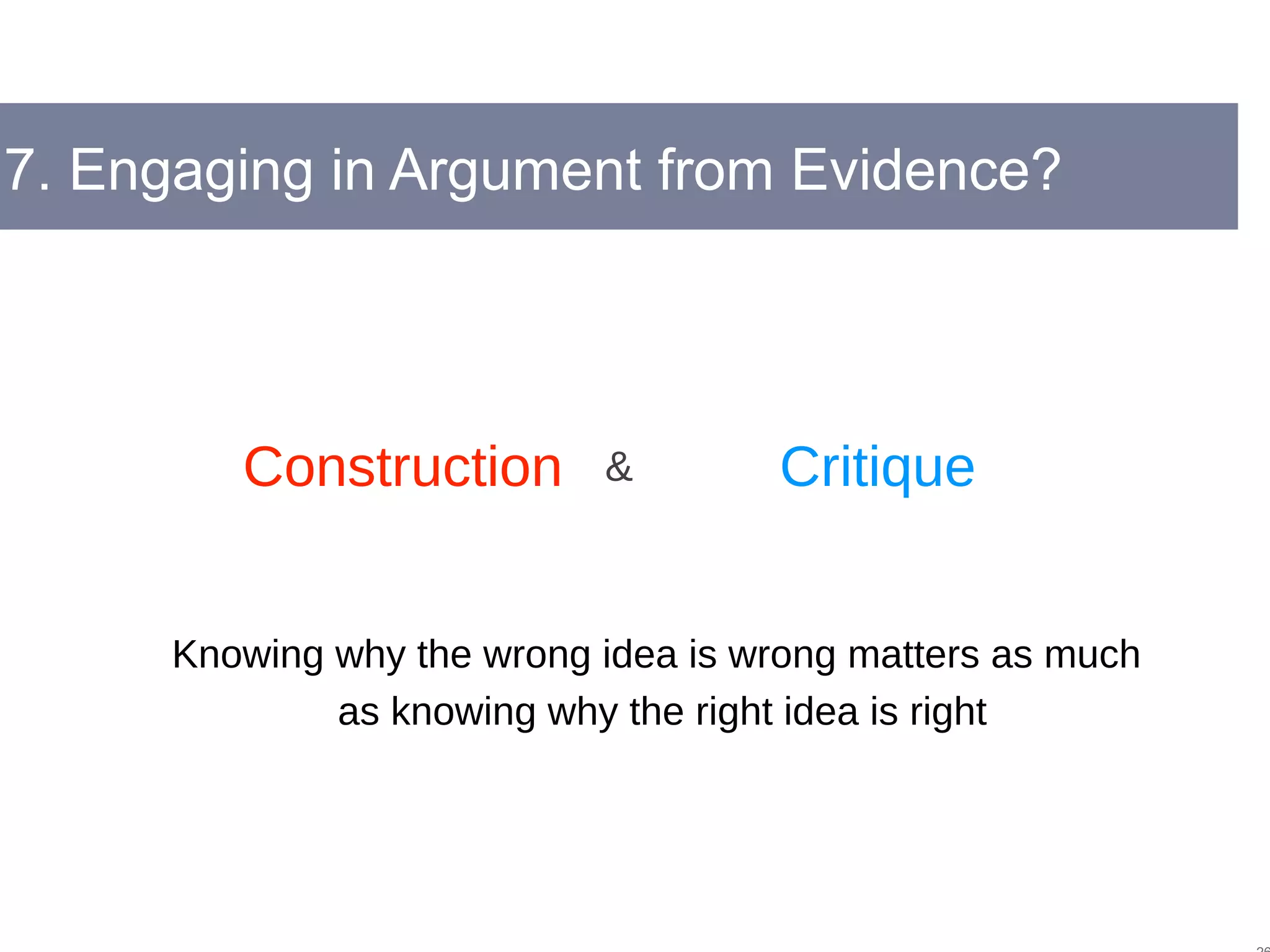
7. Engaging in Argument from Evidence?
Construction Critique&
Knowing why the wrong idea is wrong matters as much
as knowing why the right idea is right
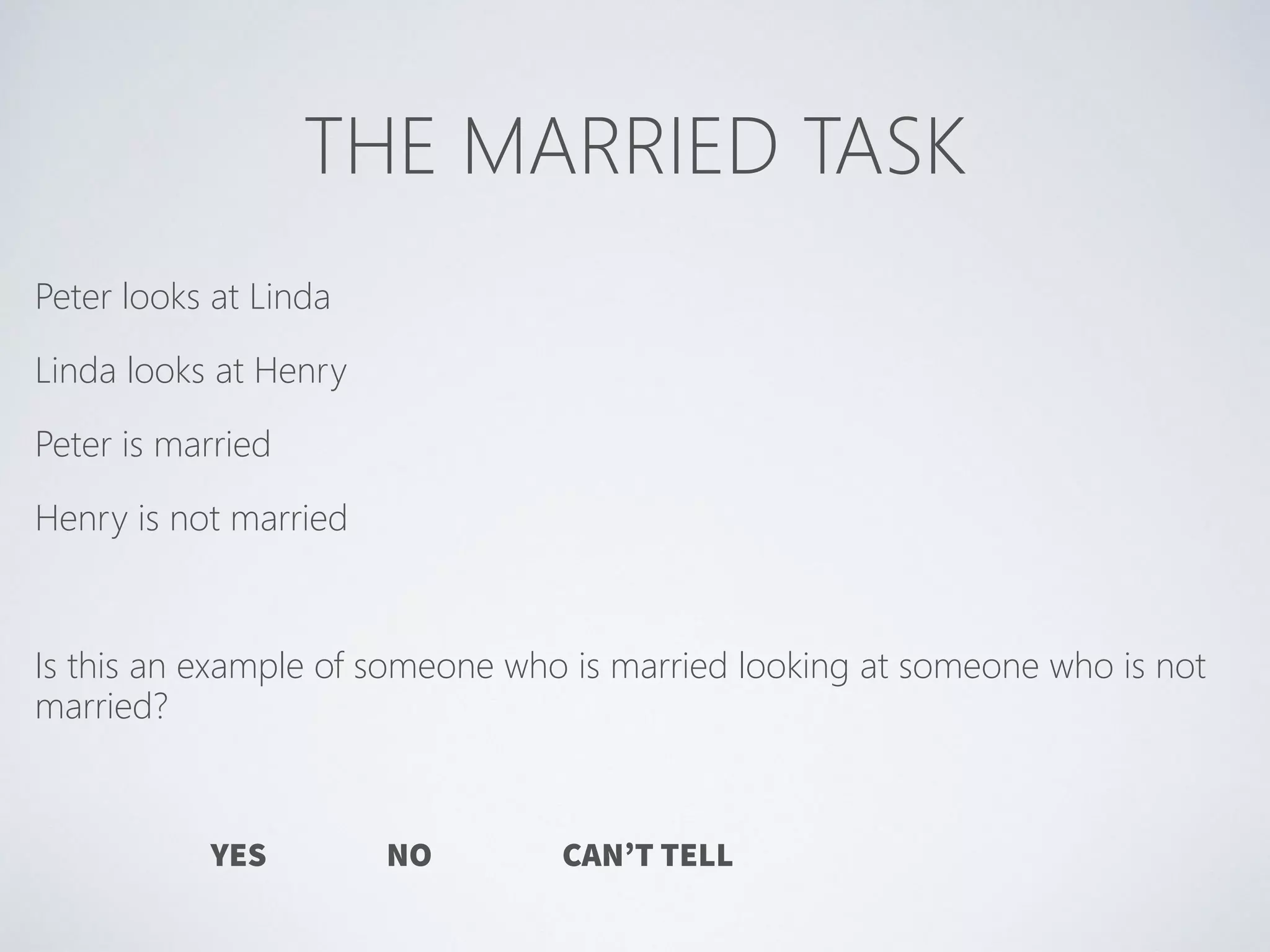
THE MARRIED TASK
Peter looks at Linda
Linda looks at Henry
Peter is married
Henry is not married
 
Is this an example of someone who is married looking at someone who is not
married?
YES NO CAN’T TELL
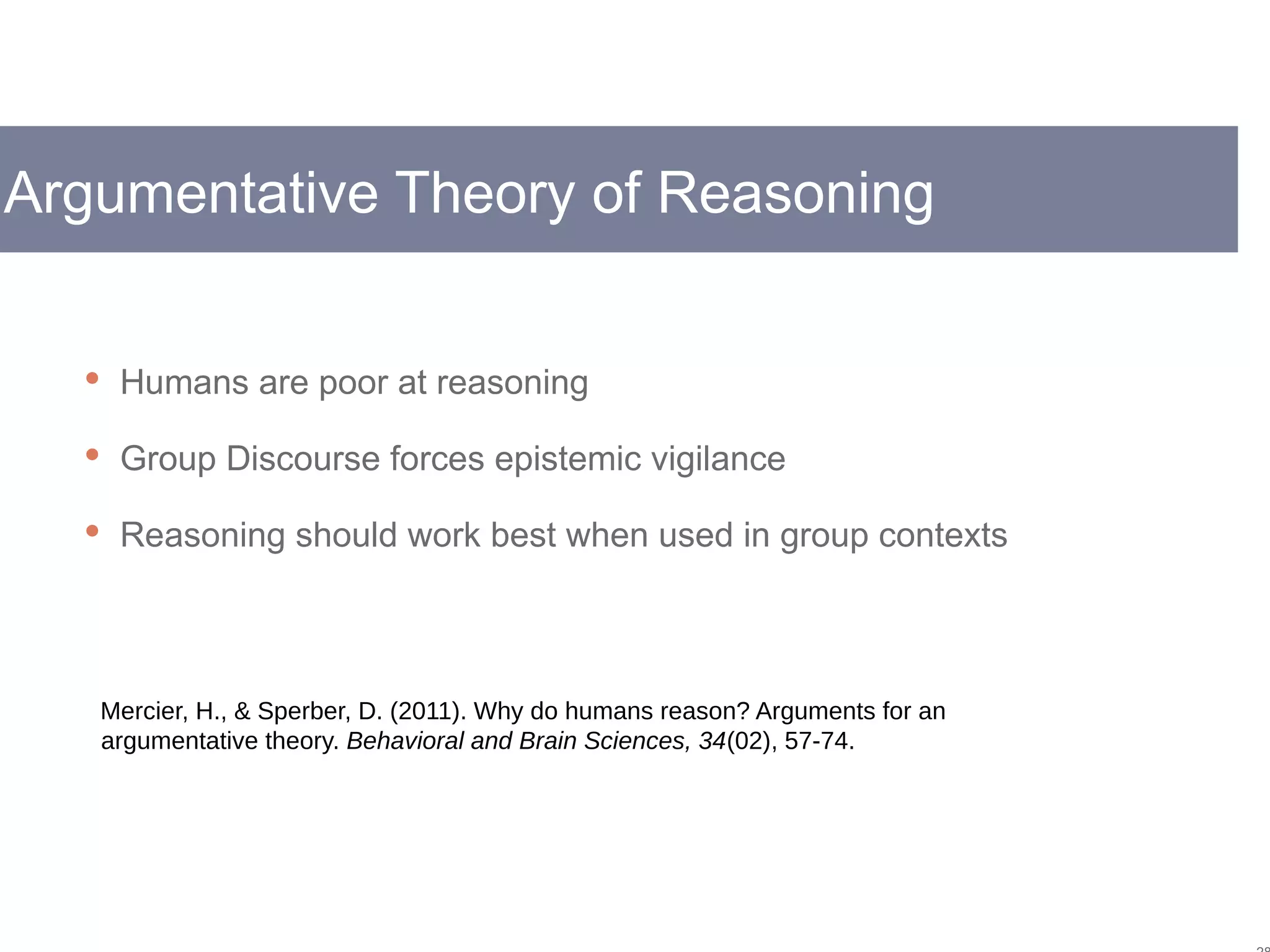
Argumentative Theory of Reasoning
 Humans are poor at reasoning
 Group Discourse forces epistemic vigilance
 Reasoning should work best when used in group contexts
Mercier, H., & Sperber, D. (2011). Why do humans reason? Arguments for an
argumentative theory. Behavioral and Brain Sciences, 34(02), 57-74.
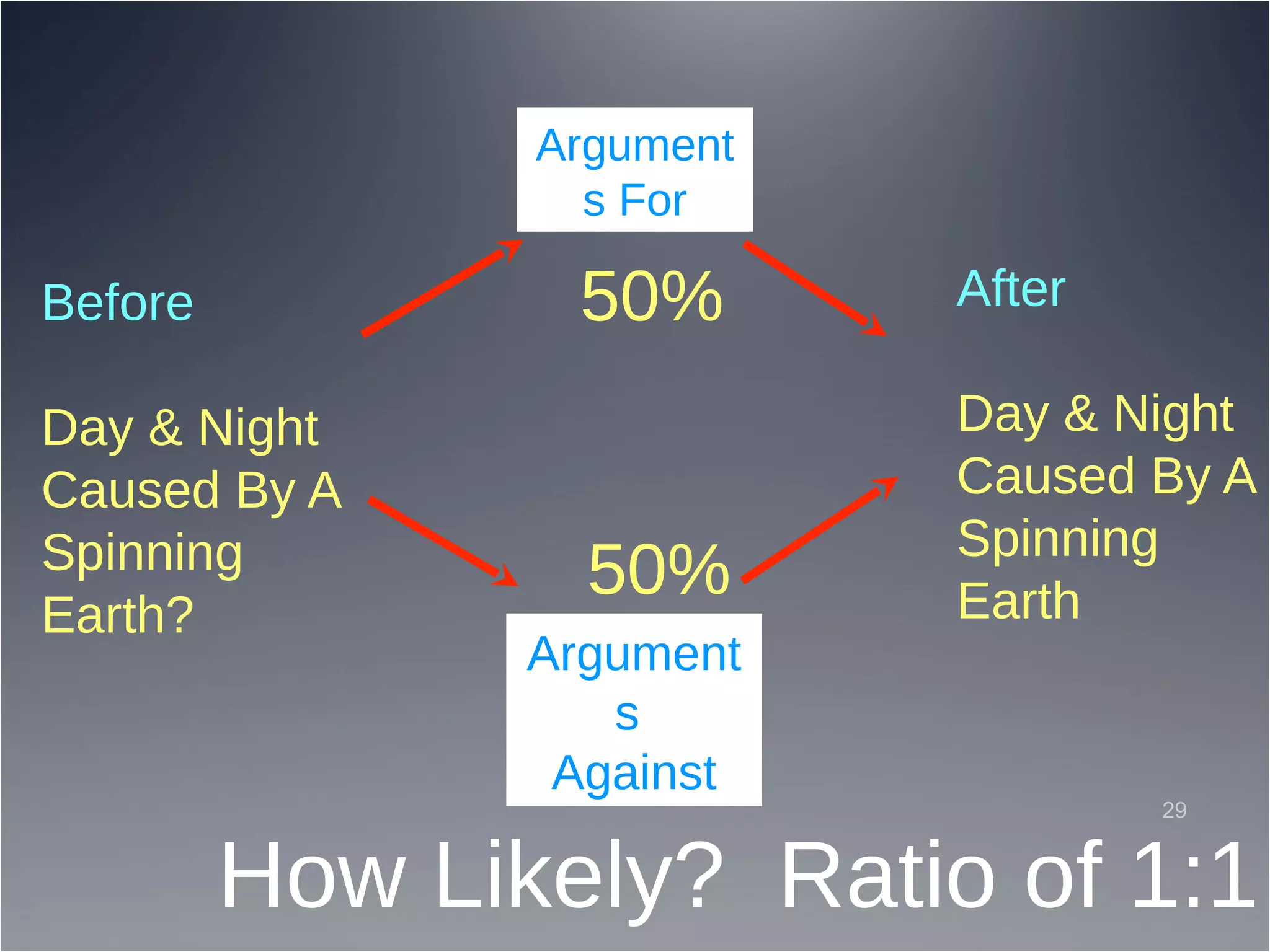
Before
Day & Night
Caused By A
Spinning
Earth?
Argument
s For
Argument
s
Against
After
Day & Night
Caused By A
Spinning
Earth
50%
50%
How Likely? Ratio of 1:1
29
Before
Teaching
Day & Night
Caused By A
Spinning
Earth?
After
Teaching
Day & Night
Caused By A
Spinning
Earth?
Argument
s For
Argument
s
Against
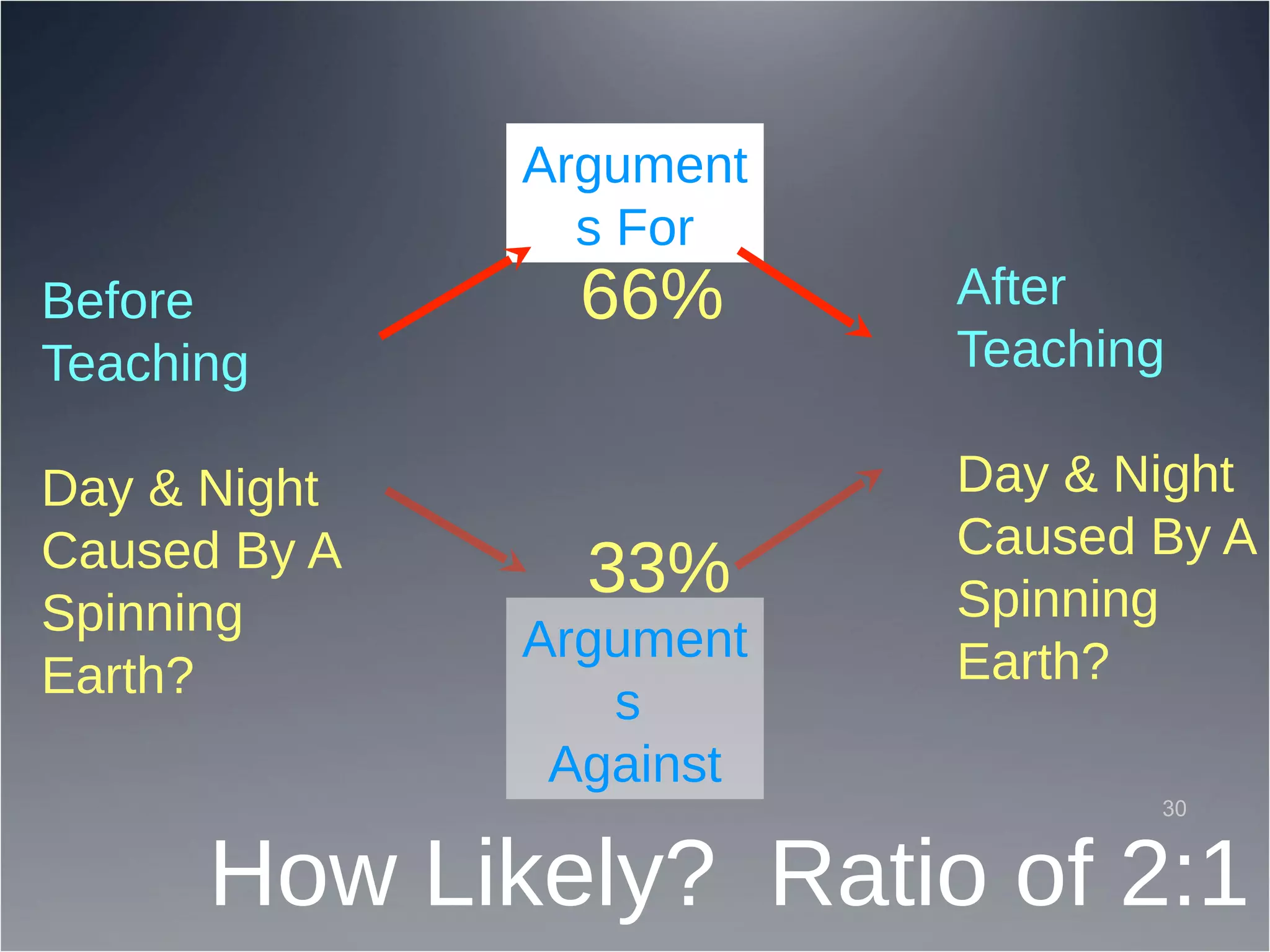
66%
33%
How Likely? Ratio of 2:1
30
Before
Teaching
Day & Night
Caused By A
Spinning
Earth?
After
Teaching
Day & Night
Caused By A
Spinning
Earth?
Argument
s For
Argument
s
Against
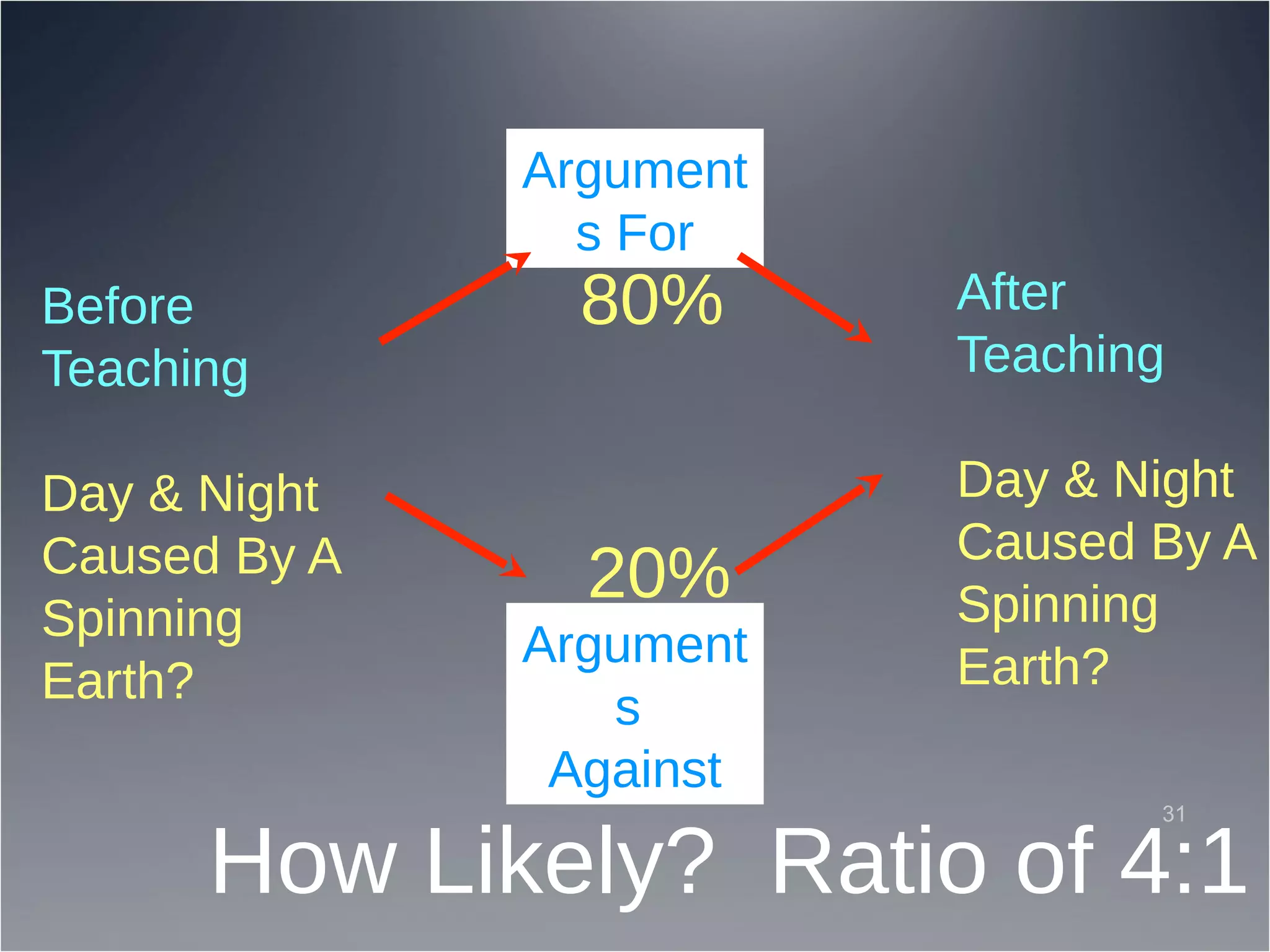
80%
20%
How Likely? Ratio of 4:1
31
10
Text
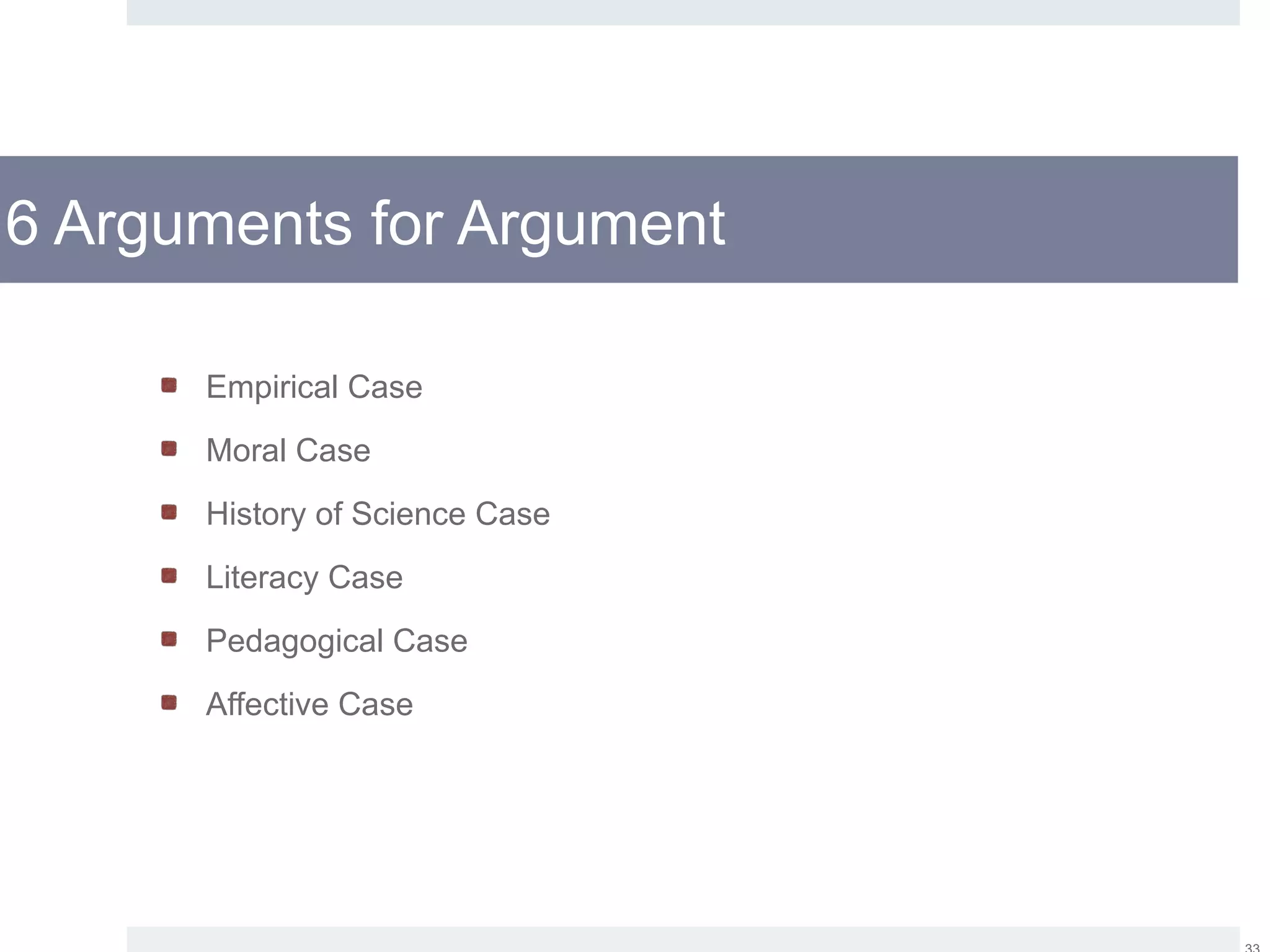
6 Arguments for Argument
Empirical Case
Moral Case
History of Science Case
Literacy Case
Pedagogical Case
Affective Case
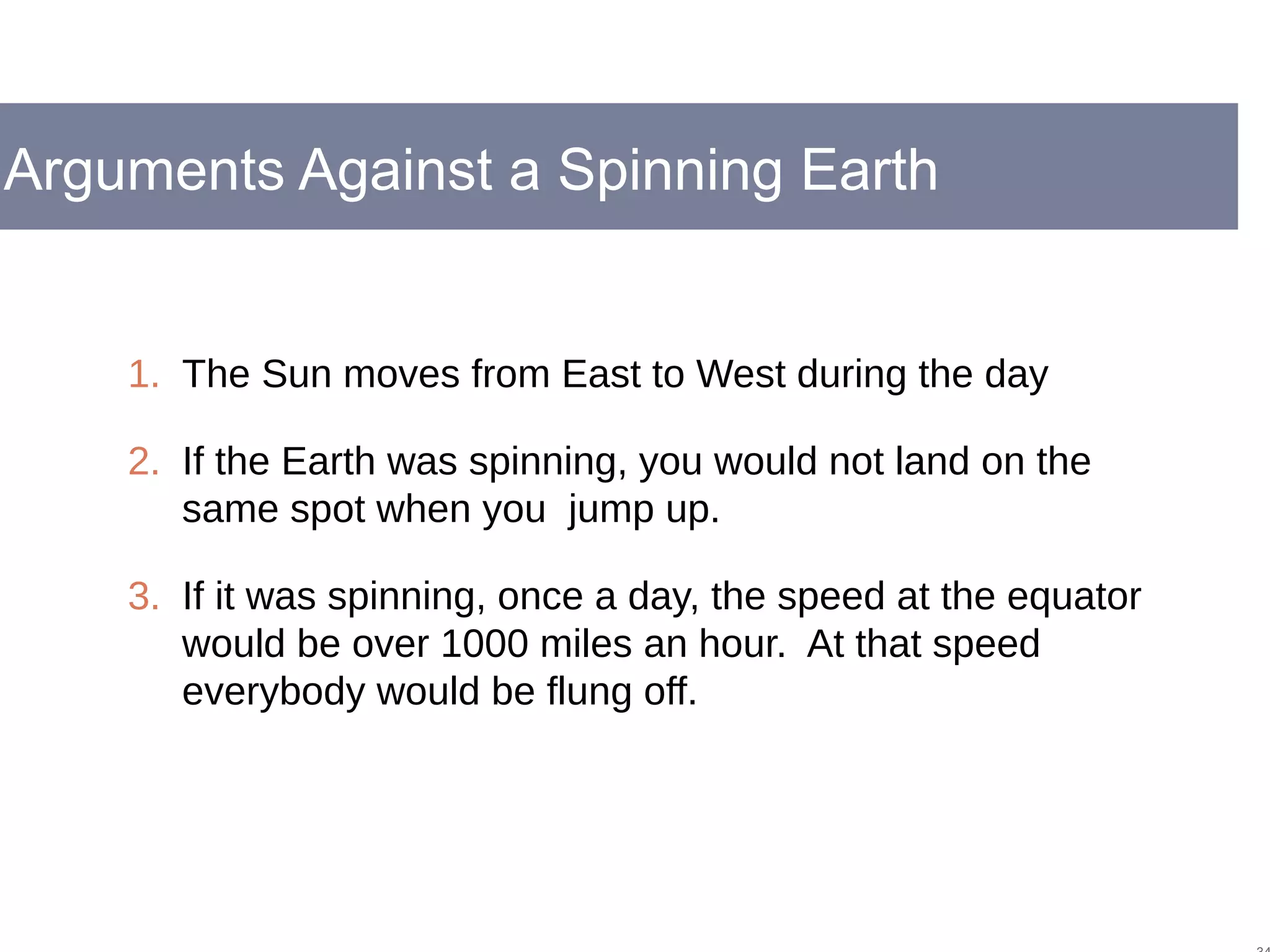
Arguments Against a Spinning Earth
1. The Sun moves from East to West during the day
2. If the Earth was spinning, you would not land on the
same spot when you jump up.
3. If it was spinning, once a day, the speed at the equator
would be over 1000 miles an hour. At that speed
everybody would be flung off.
8. Obtaining, evaluating and communicating
information
Science without Literacy is like a ship without a sail
1
•Dr
Phenomena
Ideas
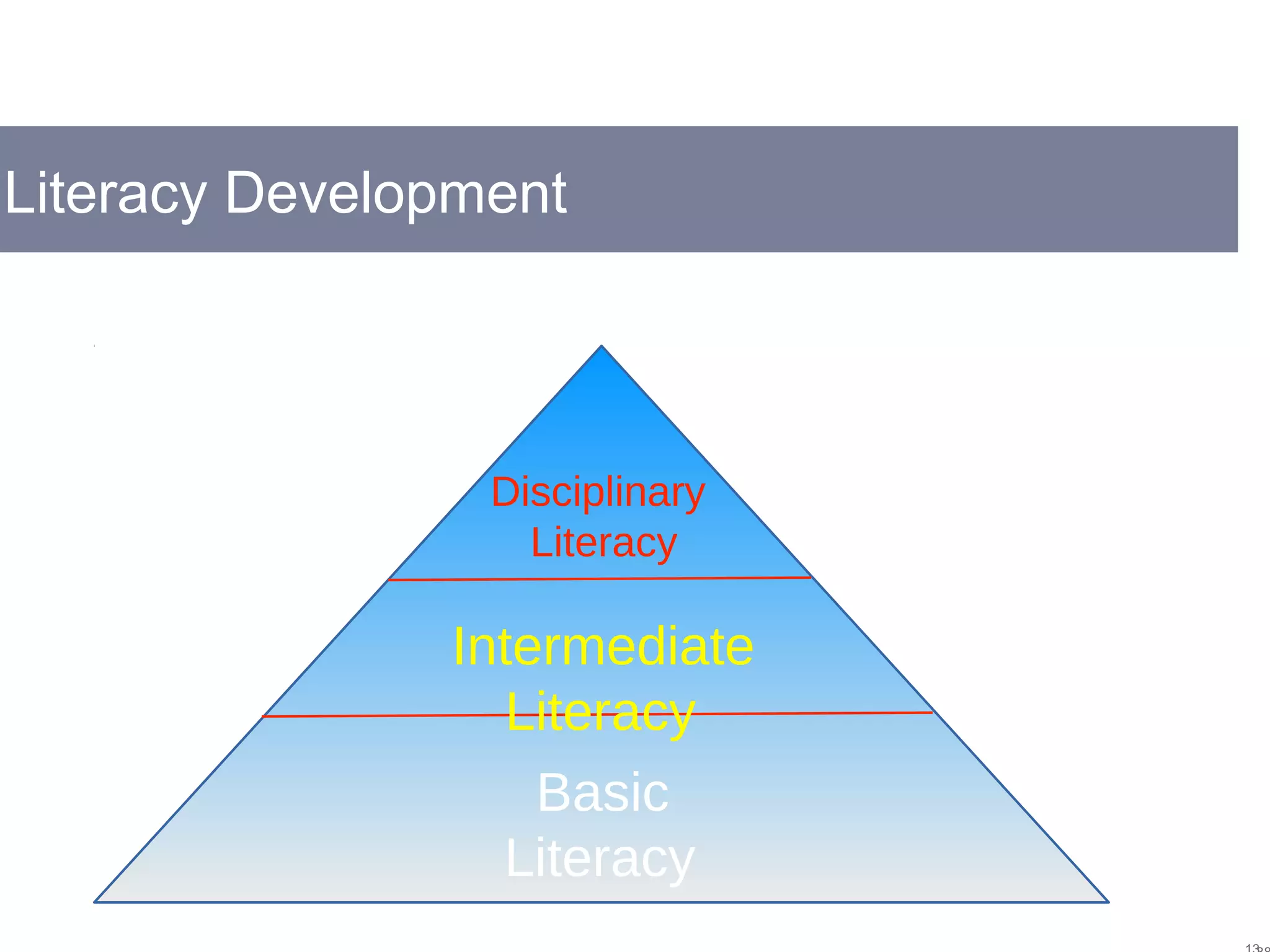
Literacy Development
Basic
Literacy
Intermediate
Literacy
Disciplinary
Literacy
Theory of Reading in Science
Reading is a constructive
Dependent on interpretation
Principled
Good reader is a critical reader
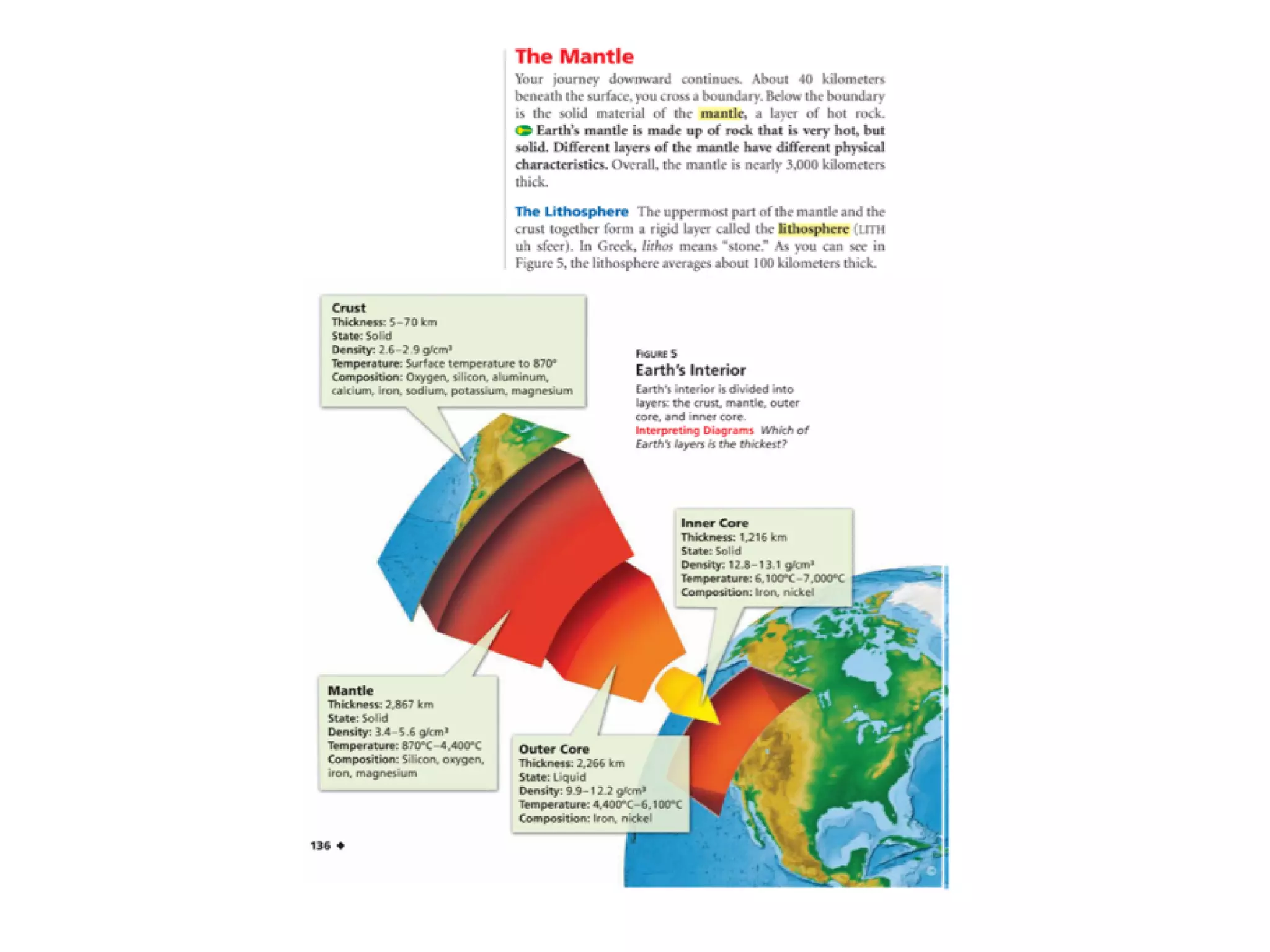
Specific Challenges of Science Texts
 Density
 Academic Language
 Multi-modality
 Genre
Summary and Conclusions
 Styles of Reasoning offer a rationale for the cultural value of science
 Content
 Procedural
 Epistemic Knowledge
 The turn to practice is a move in the right direction
 But??

Styles of Scientific Reasoning, Scientific Practices and Argument in Science and Science Education

  • 1.
    Jonathan Osborne Graduate Schoolof Education Stanford University Styles of Scientific Reasoning, Scientific Practices and Argument in Science and Science Education
  • 2.
    The History ofScience “A history of vision and argument” Crombie, Alistair Cameron. (1994). Styles of scientific thinking in the European tradition: The history of argument and explanation especially in the mathematical and biomedical sciences and arts (Vol. 1): Duckworth London.
  • 3.
    Crazy Ideas inScience Day and Night is caused by a Spinning Earth The Continents have moved We have evolved from other animals The Earth is 5 billion years old Diseases are caused by tiny living organisms We live at the bottom of a sea of air You look like your parents because every cell carries a chemically coded message of how to reproduce yourself
  • 4.
    History of Scienceas a History of Error Ptolemy’s geocentric universe, Lamarkianism The ether, The Denial of Wegner/s Theory Cold fusion Phlogiston Spontaneous generation,
  • 5.
    Styles of Reasoningin Science 1. Mathematical Deductive Logic 2. Experimental Exploration 3. Hypothetical Modeling 4. Categorization and Classification 5. Probabilistic and Statistical Thinking 6. Evolutionary/Genetic Explanations Crombie, Alistair Cameron. (1994). Styles of scientific thinking in the European tradition: The history of argument and explanation especially in the mathematical and biomedical sciences and arts (Vol. 1): Duckworth London.
  • 6.
    Features Style Entities Procedural Enties Epistemic Constructs Heroes Mathematical Deduction Exponents Differentials Geometry, CalculusDeductive proof Pythagoras, Euclid, Newton, Maxwell, Einstein Experimental Exploration Intrumentation Control of Variables Observations Experimental Tests Controls/RCT testing Galileo Hypothetical Modeling Wave model of light Thought Experiments Explanatory coherence Accuracy/Parsimony Galileo Bohr Probabalistic and Stastical Thinking Gaussian Distribution Statistical Testing Role of uncertainty Pascal, Gauss, Poisson, Cronbach Categorization and Classfication Species, Elements Rock Types Criteria for Category Membership The significance & role of classification Linnaeus Mendelev Evolutionary/Gen etic Reasoning Gene Adaptation DNA Genetic Determination Role of Observation and Inference Mendel, Darwin
  • 7.
    Teaching and Learning ContentProcedural Epistemic The Forms of Knowledge in Science
  • 8.
  • 9.
    Procedural Knowledge • Concepts of Evidence •Observation • Measurement • Instrumentation • Reliability/Validity • Variables/Fair Testing • Control of Variables Epistemic Knowledge • Ideas-About- Science • Observation • Argument • Theory • Model • Hypothesis 9
  • 10.
    PISA 2015 ScientificLiteracy Framework
  • 11.
    Elaboration of theDefinition •Explain phenomena scientifically: Recognise, offer and evaluate explanations for a range of natural and technological phenomena. •Evaluate and design scientific enquiry: Describe and appraise scientific investigations and propose ways of addressing questions scientifically. •Interpret data and evidence scientifically: Analyze and evaluate scientific data, claims and arguments in a variety of representations and draw appropriate conclusions. A scientifically literate person, therefore, is willing to engage in reasoned discourse about science and technology which requires the competencies to:
  • 12.
    What is wrongwith inquiry? Students describe objects and events, ask questions, construct explanations, test those explanations against current scientific knowledge, and communicate their ideas to others. They identify their assumptions, use critical and logical thinking, and consider alternative explanations. In this way, students actively develop their understanding of science by combining scientific knowledge with reasoning and thinking skills.
  • 13.
    The Role ofArgument in Science
  • 14.
    The Practices ofScience 1. Asking Questions and Defining Problems 2. Developing and Using Models 3. Planning and Carrying out Investigations 4. Analyzing and Interpreting Data 5. Using Mathematics and Computational Thinking 6. Constructing Explanations and Designing Solutions 7. Engaging in Argument from Evidence 8. Obtaining, Evaluating and Communicating Information
  • 15.
    Thee Central Questionsof Science 1. What exists? (The ontological question) 2. Why does it happen? (The causal question) 3. How do we know? (The epistemic question)
  • 16.
  • 17.
    Water Model ofan Electric Circuit
  • 18.
    Bicycle Model ofAn Electric Circuit
  • 19.
    Bohr Model ofthe Atom
  • 20.
    3. Planning andCarrying Out Investigations A Teacher asked her students to investigate this problem: How does temperature affect the time taken for sugar to dissolve? The students were asked to describe the investigation. These are some of the things they write. How clearly has each student described the investigation? And which is the best? JEMMA: We have got to write down what we are going to do and then do it. KIRSTY: We are looking to see how different temperatures affect how long it takes the sugar to dissolve. EMMA: We are trying to see if sugar dissolves in water. ANITA: We are adding sugar to hot and cold water to see how long it takes to dissolve ALEX: We are trying to find the best temperature for dissolving sugar in water. LOUISE: We have to put the same amount of sugar in water with different temperatures and see what happened
  • 21.
    4. Analyzing andInterpreting Data
  • 22.
    3. Analyzing andInterpreting Data (a) One pupil had the most breaths and she also had the highest pulse rate. (b) All the people with a high breath rate had a high pulse rate. (c) The higher your breathing rate, the greater the pulse rate. (d) On the whole, those people with a higher breath rate had a higher pulse rate.
  • 23.
    5. Using Mathematics& Computational Thinking 1. Who is the tallest 2. Who is the smallest 3. What is the average?
  • 24.
    6. Constructing Explanations Whydo objects fall at the same rate in the absence of air? • Gravity pulls on all objects • If the mass is double, the pull of gravity will double • Twice the mass takes twice as long to speed up • Think of two objects, one twice as massive as the other • Force is double but so is the mass
  • 25.
    7. Engaging inArgument from Evidence
  • 26.
    7. Engaging inArgument from Evidence? Construction Critique& Knowing why the wrong idea is wrong matters as much as knowing why the right idea is right
  • 27.
    THE MARRIED TASK Peterlooks at Linda Linda looks at Henry Peter is married Henry is not married   Is this an example of someone who is married looking at someone who is not married? YES NO CAN’T TELL
  • 28.
    Argumentative Theory ofReasoning  Humans are poor at reasoning  Group Discourse forces epistemic vigilance  Reasoning should work best when used in group contexts Mercier, H., & Sperber, D. (2011). Why do humans reason? Arguments for an argumentative theory. Behavioral and Brain Sciences, 34(02), 57-74.
  • 29.
    Before Day & Night CausedBy A Spinning Earth? Argument s For Argument s Against After Day & Night Caused By A Spinning Earth 50% 50% How Likely? Ratio of 1:1 29
  • 30.
    Before Teaching Day & Night CausedBy A Spinning Earth? After Teaching Day & Night Caused By A Spinning Earth? Argument s For Argument s Against 66% 33% How Likely? Ratio of 2:1 30
  • 31.
    Before Teaching Day & Night CausedBy A Spinning Earth? After Teaching Day & Night Caused By A Spinning Earth? Argument s For Argument s Against 80% 20% How Likely? Ratio of 4:1 31
  • 32.
  • 33.
    6 Arguments forArgument Empirical Case Moral Case History of Science Case Literacy Case Pedagogical Case Affective Case
  • 34.
    Arguments Against aSpinning Earth 1. The Sun moves from East to West during the day 2. If the Earth was spinning, you would not land on the same spot when you jump up. 3. If it was spinning, once a day, the speed at the equator would be over 1000 miles an hour. At that speed everybody would be flung off.
  • 36.
    8. Obtaining, evaluatingand communicating information Science without Literacy is like a ship without a sail
  • 37.
  • 38.
  • 41.
    Theory of Readingin Science Reading is a constructive Dependent on interpretation Principled Good reader is a critical reader Specific Challenges of Science Texts  Density  Academic Language  Multi-modality  Genre
  • 42.
    Summary and Conclusions Styles of Reasoning offer a rationale for the cultural value of science  Content  Procedural  Epistemic Knowledge  The turn to practice is a move in the right direction  But??