Reflective writing
Form and Content
Reflective Style - Blog/Portfolio
Uses first person ‘I’ more extensively than academic (essay) style to record:
● your feelings about your course, progress, tasks and activities
● things you find difficult: challenges
● how you tackle tasks: strategies/solutions
● changes in your attitude/motivation
● thoughts about how you learn best (Cottrell, 2008, p.63)
Models for reflection
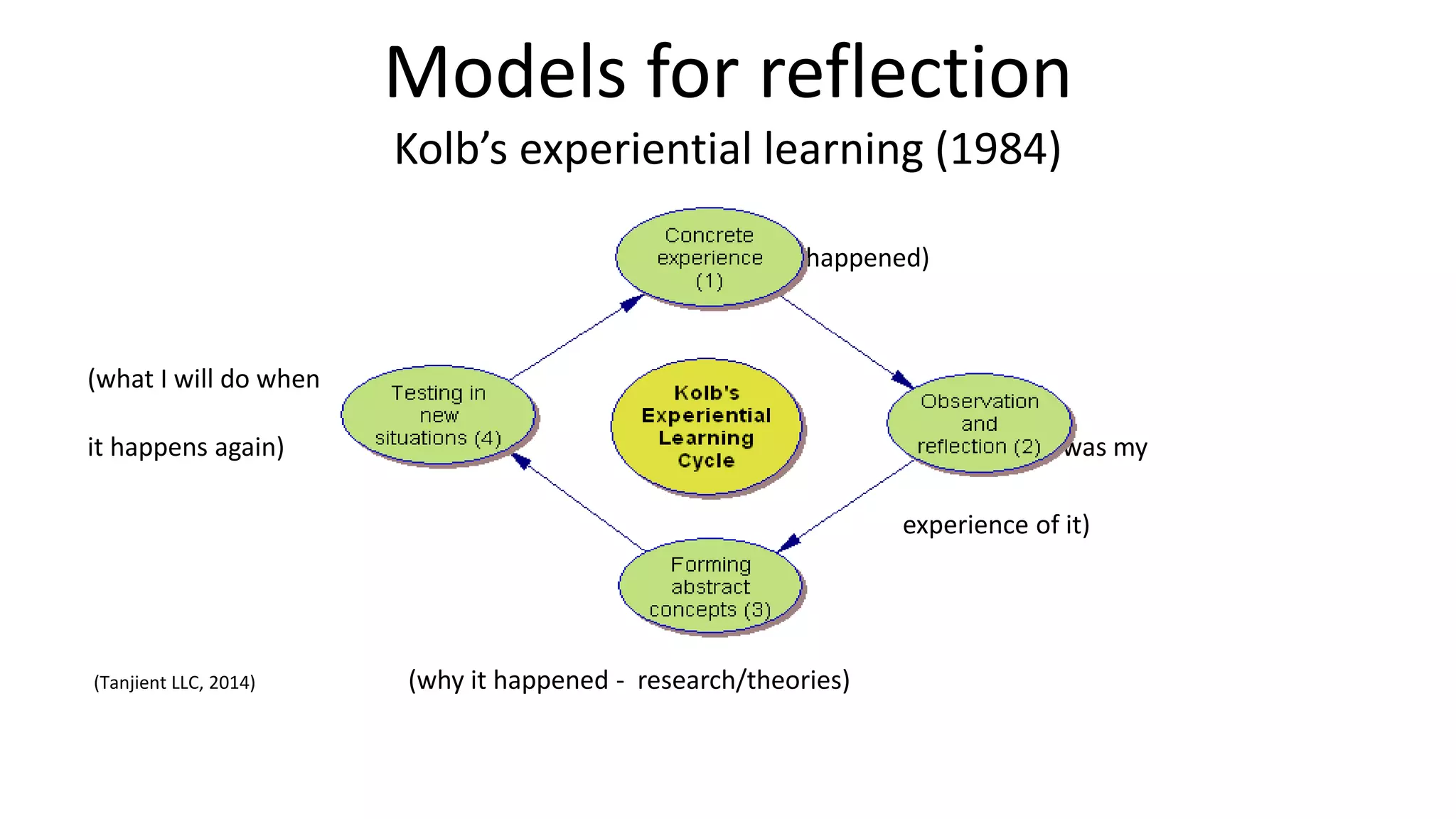
Kolb’s experiential learning (1984)
(what happened)
(what I will do when
it happens again) (what was my
experience of it)
(Tanjient LLC, 2014) (why it happened - research/theories)
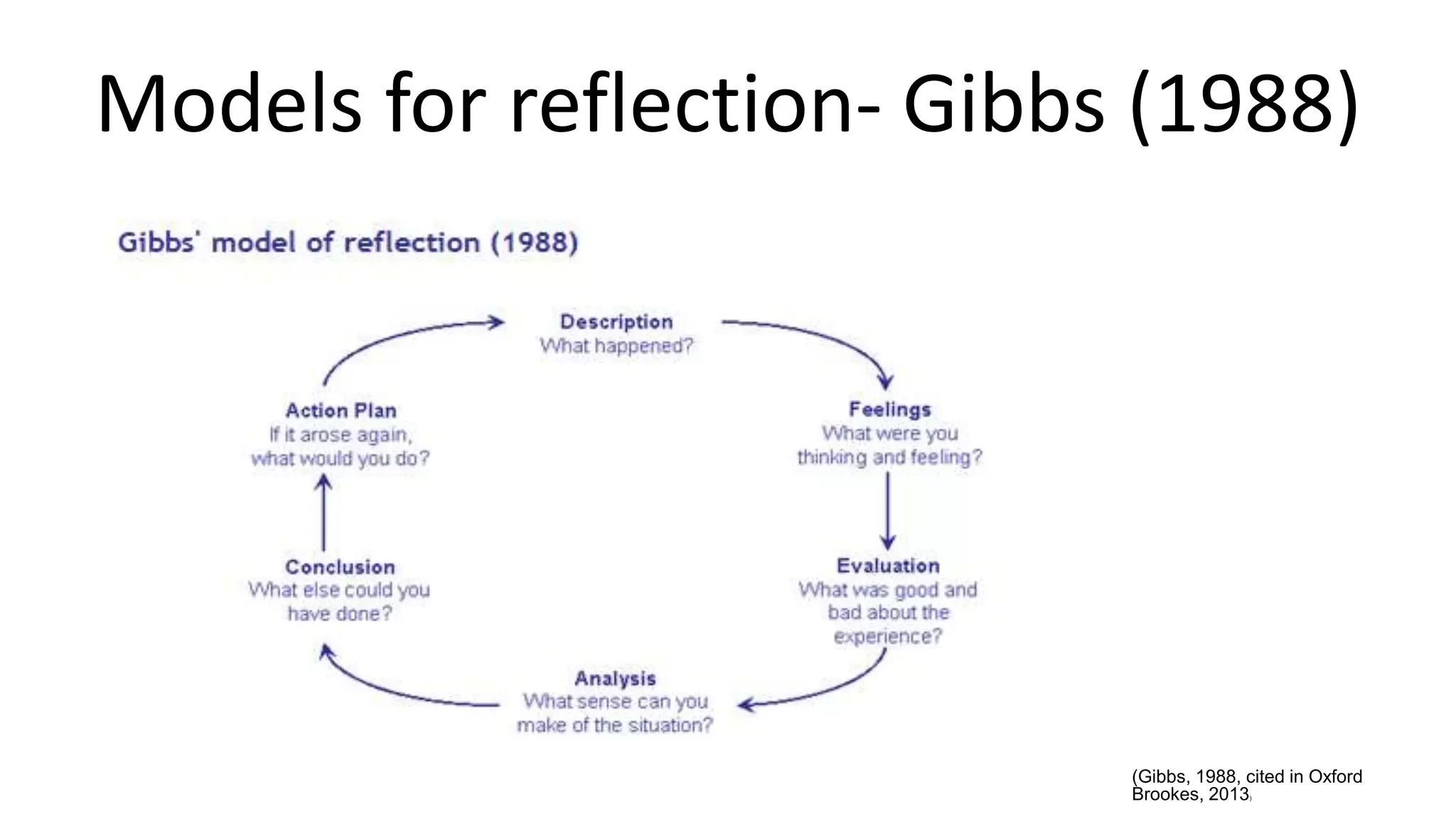
Models for reflection- Gibbs (1988)
(Gibbs, 1988, cited in Oxford
Brookes, 2013)
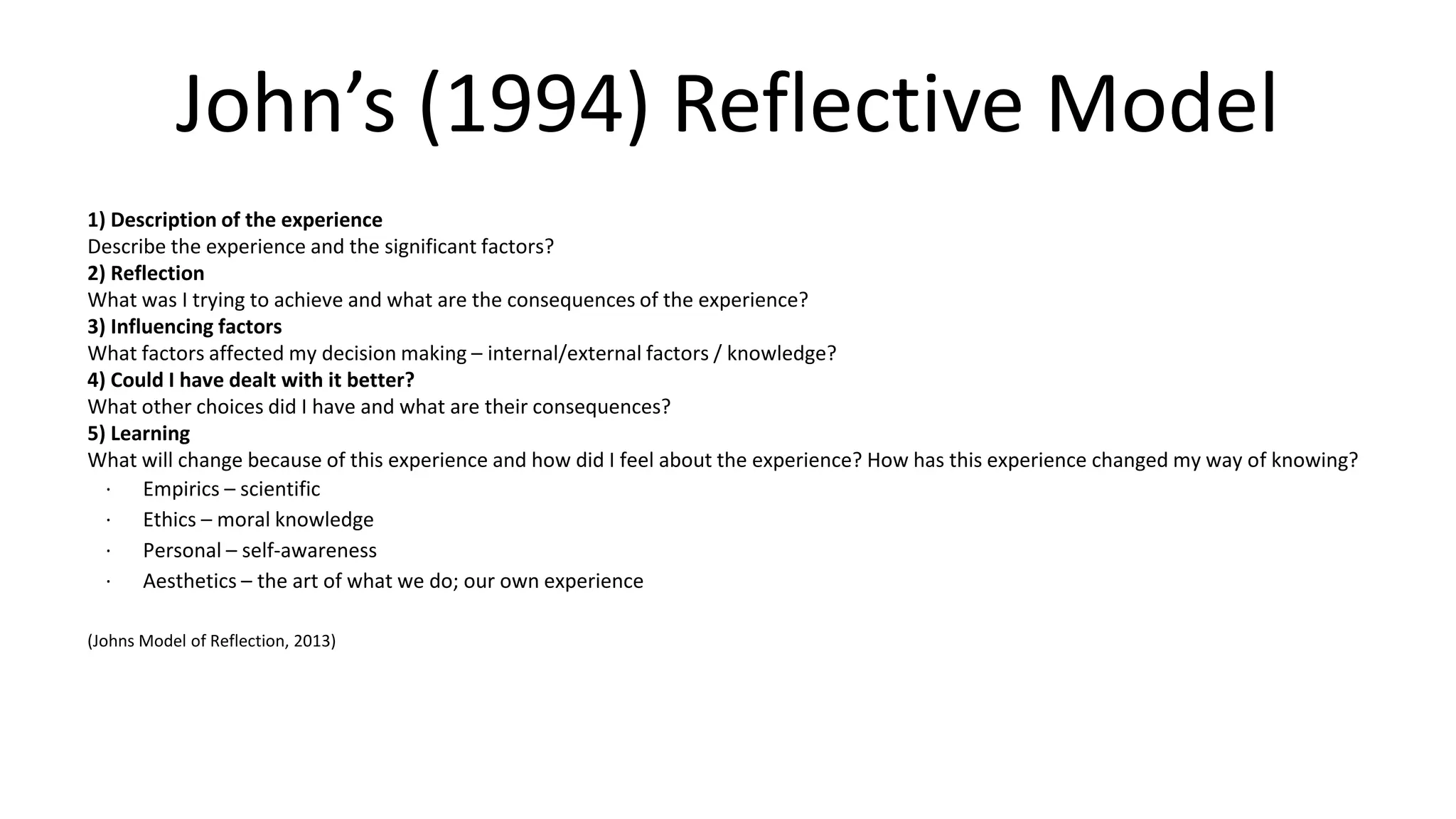
John’s (1994) Reflective Model
1) Description of the experience
Describe the experience and the significant factors?
2) Reflection
What was I trying to achieve and what are the consequences of the experience?
3) Influencing factors
What factors affected my decision making – internal/external factors / knowledge?
4) Could I have dealt with it better?
What other choices did I have and what are their consequences?
5) Learning
What will change because of this experience and how did I feel about the experience? How has this experience changed my way of knowing?
· Empirics – scientific
· Ethics – moral knowledge
· Personal – self-awareness
· Aesthetics – the art of what we do; our own experience
(Johns Model of Reflection, 2013)
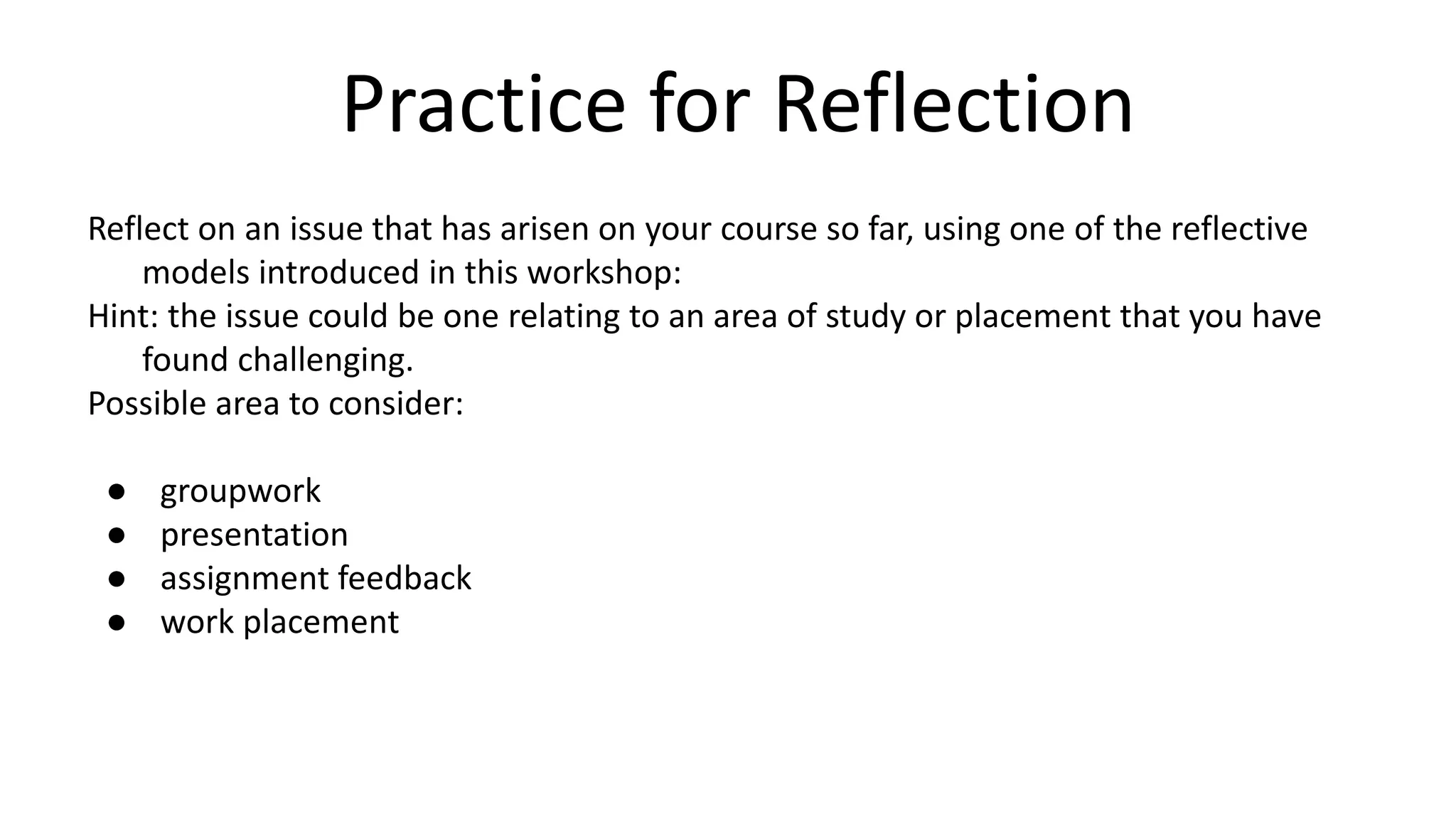
Practice for Reflection
Reflect on an issue that has arisen on your course so far, using one of the reflective
models introduced in this workshop:
Hint: the issue could be one relating to an area of study or placement that you have
found challenging.
Possible area to consider:
● groupwork
● presentation
● assignment feedback
● work placement
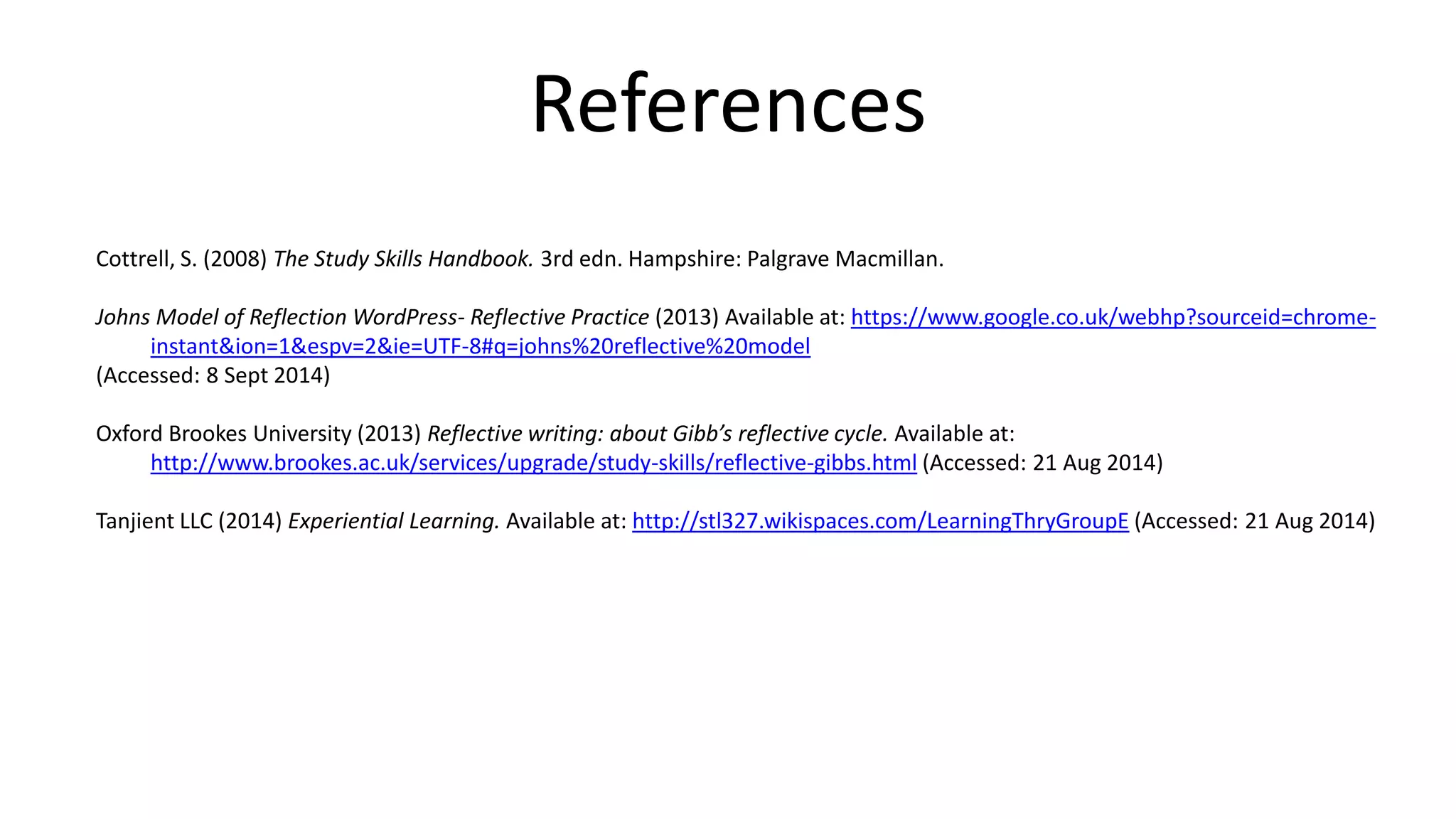
References
Cottrell, S. (2008) The Study Skills Handbook. 3rd edn. Hampshire: Palgrave Macmillan.
Johns Model of Reflection WordPress- Reflective Practice (2013) Available at: https://www.google.co.uk/webhp?sourceid=chrome-
instant&ion=1&espv=2&ie=UTF-8#q=johns%20reflective%20model
(Accessed: 8 Sept 2014)
Oxford Brookes University (2013) Reflective writing: about Gibb’s reflective cycle. Available at:
http://www.brookes.ac.uk/services/upgrade/study-skills/reflective-gibbs.html (Accessed: 21 Aug 2014)
Tanjient LLC (2014) Experiential Learning. Available at: http://stl327.wikispaces.com/LearningThryGroupE (Accessed: 21 Aug 2014)

Reflective writing general workshop

  • 1.
  • 2.
    Reflective Style -Blog/Portfolio Uses first person ‘I’ more extensively than academic (essay) style to record: ● your feelings about your course, progress, tasks and activities ● things you find difficult: challenges ● how you tackle tasks: strategies/solutions ● changes in your attitude/motivation ● thoughts about how you learn best (Cottrell, 2008, p.63)
  • 3.
    Models for reflection Kolb’sexperiential learning (1984) (what happened) (what I will do when it happens again) (what was my experience of it) (Tanjient LLC, 2014) (why it happened - research/theories)
  • 4.
    Models for reflection-Gibbs (1988) (Gibbs, 1988, cited in Oxford Brookes, 2013)
  • 5.
    John’s (1994) ReflectiveModel 1) Description of the experience Describe the experience and the significant factors? 2) Reflection What was I trying to achieve and what are the consequences of the experience? 3) Influencing factors What factors affected my decision making – internal/external factors / knowledge? 4) Could I have dealt with it better? What other choices did I have and what are their consequences? 5) Learning What will change because of this experience and how did I feel about the experience? How has this experience changed my way of knowing? · Empirics – scientific · Ethics – moral knowledge · Personal – self-awareness · Aesthetics – the art of what we do; our own experience (Johns Model of Reflection, 2013)
  • 6.
    Practice for Reflection Reflecton an issue that has arisen on your course so far, using one of the reflective models introduced in this workshop: Hint: the issue could be one relating to an area of study or placement that you have found challenging. Possible area to consider: ● groupwork ● presentation ● assignment feedback ● work placement
  • 7.
    References Cottrell, S. (2008)The Study Skills Handbook. 3rd edn. Hampshire: Palgrave Macmillan. Johns Model of Reflection WordPress- Reflective Practice (2013) Available at: https://www.google.co.uk/webhp?sourceid=chrome- instant&ion=1&espv=2&ie=UTF-8#q=johns%20reflective%20model (Accessed: 8 Sept 2014) Oxford Brookes University (2013) Reflective writing: about Gibb’s reflective cycle. Available at: http://www.brookes.ac.uk/services/upgrade/study-skills/reflective-gibbs.html (Accessed: 21 Aug 2014) Tanjient LLC (2014) Experiential Learning. Available at: http://stl327.wikispaces.com/LearningThryGroupE (Accessed: 21 Aug 2014)