Information Sources for
Nursing and Health
Katharine Holmes
Academic Liaison Librarian
k.holmes@uos.ac.uk
You need information and evidence to:
• Underpin your academic studies and course/theory work
• Support your practice (EBP)
 Making the best decisions about treatment and care delivery
 Keeping your practice up-to-date and maintaining standards
Evidence in nursing and healthcare
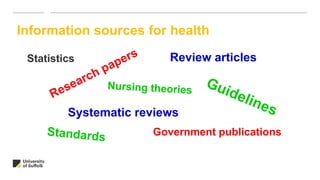
Information sources for health
Review articles
Government publications
Systematic reviews
Statistics
• Books
• Journals
• Web resources
Key academic sources
• Provide a foundation or overview of information related to a subject area.
• Are useful for finding out about key theories, models or philosophies e.g. nursing
theories and reflective models.
• Are usually secondary information sources – they review, analyse, interpret and
discuss existing ideas and research.
Academic textbooks
You can borrow up to 16 items
• Standard loan books - 3 weeks
• Short loan books - 1 week (yellow spine labels)
• Self-service issue, return and reservation
Unlimited online renewals
• Unless the item is reserved by someone else.
Overdue charges
• Standard loans – 10p per day
• Short loans – 50 per day
• Overdue and courtesy reminders sent to university email address.
Print books
Books are filed by class number and then alphabetically by the 1st three
letters of the author’s surname e.g. 610.73 SMI
After the decimal point, books are filed digit by digit rather than by whole number e.g.
610.7306 BUR is filed before 610.744 BAC
362.107 SUL is filed before 362.12 CAR
Locating books in the library
Video
e-Books offer instant access to high demand material 24/7 on or off-campus
It is more easy to navigate to information within e-books
No renewals or overdue charges!
Some titles are only available as e-copies
e-Books
• Library shelves - browse for print books
• Reading lists - link to the module reading lists for print and e-books, e-journals and
key web resources via your course/module on Learn or at:
http://libguides.uos.ac.uk/rrlist/
• Summon - search beyond your reading list for print and e-books
Searching for books
http://libguides.ucs.ac.uk/
You can borrow up to 6 items from libraries at
• West Suffolk College – Bury St. Edmunds
• East Coast College – Lowestoft and Great Yarmouth
Other universities
• SCONUL card gives visiting rights (reference only for undergraduates)
• Online application form is available
Hospital libraries
• You will need your NHS card to use these while on placement or in practice.
Using other libraries
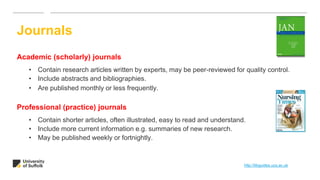
Academic (scholarly) journals
• Contain research articles written by experts, may be peer-reviewed for quality control.
• Include abstracts and bibliographies.
• Are published monthly or less frequently.
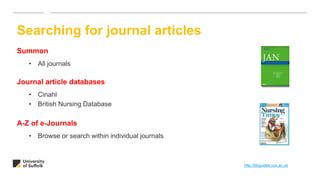
Professional (practice) journals
• Contain shorter articles, often illustrated, easy to read and understand.
• Include more current information e.g. summaries of new research.
• May be published weekly or fortnightly.
•
Journals
http://libguides.ucs.ac.uk
Summon
• All journals
Journal article databases
• Cinahl
• British Nursing Database
A-Z of e-Journals
• Browse or search within individual journals
Searching for journal articles
http://libguides.ucs.ac.uk
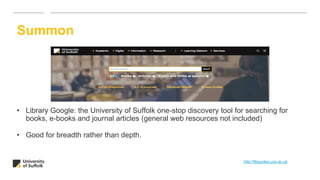
• Library Google: the University of Suffolk one-stop discovery tool for searching for
books, e-books and journal articles (general web resources not included)
• Good for breadth rather than depth.
Summon
http://libguides.ucs.ac.uk
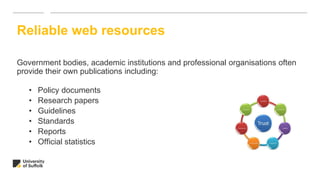
Government bodies, academic institutions and professional organisations often
provide their own publications including:
• Policy documents
• Research papers
• Guidelines
• Standards
• Reports
• Official statistics
Reliable web resources
Government bodies
• Department of Health
• NHS England
• Public Health England
Professional bodies and organisations
• NMC – Nursing and Midwifery Council
• RCN – Royal College of Nursing
• NICE – National Institute of Health and Care Excellence
Reliable web resources
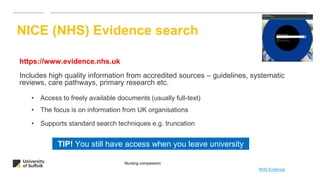
https://www.evidence.nhs.uk
Includes high quality information from accredited sources – guidelines, systematic
reviews, care pathways, primary research etc.
• Access to freely available documents (usually full-text)
• The focus is on information from UK organisations
• Supports standard search techniques e.g. truncation
NICE (NHS) Evidence search
TIP! You still have access when you leave university
NHS Evidence
Nursing compassion
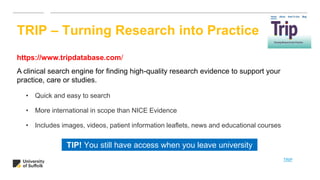
https://www.tripdatabase.com/
A clinical search engine for finding high-quality research evidence to support your
practice, care or studies.
• Quick and easy to search
• More international in scope than NICE Evidence
• Includes images, videos, patient information leaflets, news and educational courses
TRIP – Turning Research into Practice
TIP! You still have access when you leave university
TRIP
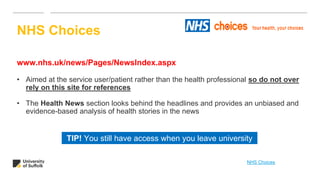
www.nhs.uk/news/Pages/NewsIndex.aspx
• Aimed at the service user/patient rather than the health professional so do not over
rely on this site for references
• The Health News section looks behind the headlines and provides an unbiased and
evidence-based analysis of health stories in the news
NHS Choices
TIP! You still have access when you leave university
NHS Choices
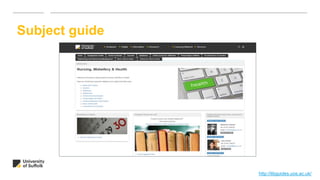
Subject guide
http://libguides.uos.ac.uk/
Searching individual journals
Use the A-Z of e-Journals tool to search for and access individual journals
http://libguides.uos.ac.uk/a-z-ejournals
• You can browse all issues or search within a journal.
• Useful for accessing journals not included in standard databases.
• Useful double check if Summon links fail.
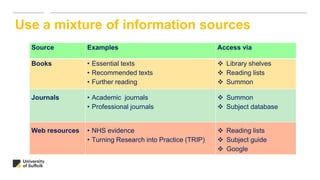
Use a mixture of information sources
Source Examples Access via
Books • Essential texts
• Recommended texts
• Further reading
 Library shelves
 Reading lists
 Summon
Journals • Academic journals
• Professional journals
 Summon
 Subject database
Web resources • NHS evidence
• Turning Research into Practice (TRIP)
 Reading lists
 Subject guide
 Google
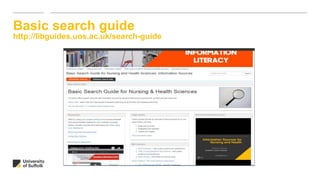
Basic search guide
http://libguides.uos.ac.uk/search-guide
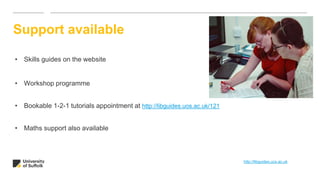
Support available
• Skills guides on the website
• Workshop programme
• Bookable 1-2-1 tutorials appointment at http://libguides.uos.ac.uk/121
• Maths support also available
http://libguides.ucs.ac.uk

Information sources overview

  • 1.
    Information Sources for Nursingand Health Katharine Holmes Academic Liaison Librarian k.holmes@uos.ac.uk
  • 2.
    You need informationand evidence to: • Underpin your academic studies and course/theory work • Support your practice (EBP)  Making the best decisions about treatment and care delivery  Keeping your practice up-to-date and maintaining standards Evidence in nursing and healthcare
  • 3.
    Information sources forhealth Review articles Government publications Systematic reviews Statistics
  • 4.
    • Books • Journals •Web resources Key academic sources
  • 5.
    • Provide afoundation or overview of information related to a subject area. • Are useful for finding out about key theories, models or philosophies e.g. nursing theories and reflective models. • Are usually secondary information sources – they review, analyse, interpret and discuss existing ideas and research. Academic textbooks
  • 6.
    You can borrowup to 16 items • Standard loan books - 3 weeks • Short loan books - 1 week (yellow spine labels) • Self-service issue, return and reservation Unlimited online renewals • Unless the item is reserved by someone else. Overdue charges • Standard loans – 10p per day • Short loans – 50 per day • Overdue and courtesy reminders sent to university email address. Print books
  • 7.
    Books are filedby class number and then alphabetically by the 1st three letters of the author’s surname e.g. 610.73 SMI After the decimal point, books are filed digit by digit rather than by whole number e.g. 610.7306 BUR is filed before 610.744 BAC 362.107 SUL is filed before 362.12 CAR Locating books in the library Video
  • 8.
    e-Books offer instantaccess to high demand material 24/7 on or off-campus It is more easy to navigate to information within e-books No renewals or overdue charges! Some titles are only available as e-copies e-Books
  • 9.
    • Library shelves- browse for print books • Reading lists - link to the module reading lists for print and e-books, e-journals and key web resources via your course/module on Learn or at: http://libguides.uos.ac.uk/rrlist/ • Summon - search beyond your reading list for print and e-books Searching for books http://libguides.ucs.ac.uk/
  • 10.
    You can borrowup to 6 items from libraries at • West Suffolk College – Bury St. Edmunds • East Coast College – Lowestoft and Great Yarmouth Other universities • SCONUL card gives visiting rights (reference only for undergraduates) • Online application form is available Hospital libraries • You will need your NHS card to use these while on placement or in practice. Using other libraries
  • 11.
    Academic (scholarly) journals •Contain research articles written by experts, may be peer-reviewed for quality control. • Include abstracts and bibliographies. • Are published monthly or less frequently. Professional (practice) journals • Contain shorter articles, often illustrated, easy to read and understand. • Include more current information e.g. summaries of new research. • May be published weekly or fortnightly. • Journals http://libguides.ucs.ac.uk
  • 12.
    Summon • All journals Journalarticle databases • Cinahl • British Nursing Database A-Z of e-Journals • Browse or search within individual journals Searching for journal articles http://libguides.ucs.ac.uk
  • 13.
    • Library Google:the University of Suffolk one-stop discovery tool for searching for books, e-books and journal articles (general web resources not included) • Good for breadth rather than depth. Summon http://libguides.ucs.ac.uk
  • 14.
    Government bodies, academicinstitutions and professional organisations often provide their own publications including: • Policy documents • Research papers • Guidelines • Standards • Reports • Official statistics Reliable web resources
  • 15.
    Government bodies • Departmentof Health • NHS England • Public Health England Professional bodies and organisations • NMC – Nursing and Midwifery Council • RCN – Royal College of Nursing • NICE – National Institute of Health and Care Excellence Reliable web resources
  • 16.
    https://www.evidence.nhs.uk Includes high qualityinformation from accredited sources – guidelines, systematic reviews, care pathways, primary research etc. • Access to freely available documents (usually full-text) • The focus is on information from UK organisations • Supports standard search techniques e.g. truncation NICE (NHS) Evidence search TIP! You still have access when you leave university NHS Evidence Nursing compassion
  • 17.
    https://www.tripdatabase.com/ A clinical searchengine for finding high-quality research evidence to support your practice, care or studies. • Quick and easy to search • More international in scope than NICE Evidence • Includes images, videos, patient information leaflets, news and educational courses TRIP – Turning Research into Practice TIP! You still have access when you leave university TRIP
  • 18.
    www.nhs.uk/news/Pages/NewsIndex.aspx • Aimed atthe service user/patient rather than the health professional so do not over rely on this site for references • The Health News section looks behind the headlines and provides an unbiased and evidence-based analysis of health stories in the news NHS Choices TIP! You still have access when you leave university NHS Choices
  • 19.
  • 20.
    Searching individual journals Usethe A-Z of e-Journals tool to search for and access individual journals http://libguides.uos.ac.uk/a-z-ejournals • You can browse all issues or search within a journal. • Useful for accessing journals not included in standard databases. • Useful double check if Summon links fail.
  • 21.
    Use a mixtureof information sources Source Examples Access via Books • Essential texts • Recommended texts • Further reading  Library shelves  Reading lists  Summon Journals • Academic journals • Professional journals  Summon  Subject database Web resources • NHS evidence • Turning Research into Practice (TRIP)  Reading lists  Subject guide  Google
  • 22.
  • 23.
    Support available • Skillsguides on the website • Workshop programme • Bookable 1-2-1 tutorials appointment at http://libguides.uos.ac.uk/121 • Maths support also available http://libguides.ucs.ac.uk