Immersive Technologies, Learning and Rural
                          Development
                                                                  David Wortley,
                                        Immersive Technology Strategies, Leicester, United Kingdom
                                                       david@davidwortley.com


Abstract— Rural and remote communities have been amongst the               This phenomenon has been called the “Prosumer Revolution” because
hardest hit by global developments in Information Communications           it provides unprecedented access to technologies which not only
Technologies. Globalisation has impacted these communities and             facilitate Consumption of goods, services and knowledge, but also the
caused a loss of services and jobs as the internet revolutionised          Production and dissemination of knowledge, services and goods to a
commerce and communications. There have been a number of                   global audience. Whilst disruptive communications technologies have
initiatives over the last decade to explore how emerging digital media     been commonplace in mankind’s history, including Roman roads, the
                                                                           printing press, canals, railways, radio, telephony, cinema and
technologies and applications can support lifelong learning and rural
                                                                           television, all previous communications revolutions have always
development.
                                                                           disrupted consumption patterns without empowering individual
                                                                           citizens to produce and disseminate information on a mass scale with
This paper reviews some of these initiatives at UK and European            the infrastructure to reach a global audience.
level and explores how the latest generation of immersive
technologies which include video games, virtual worlds and social          These developments, driven largely by the internet, have had a major
networks can reverse some of the trends of previous years and act as       impact on communities and the social relationships which sustain all
an engine for innovation and growth in these more remote areas.            aspects of society. The traditional and long established hierarchical
The projects to be discussed include the Community Commerce and            relationships which governed the way we live, work and trade with
Knowledge Network (ComKnet) and Harborough Community                       each other have been broken down in a process of “disintermediation”,
Learning Network projects which were UK regional development               creating new ways of doing almost everything in our daily lives. The
initiatives based around community learning networks in rural              impact of these changes has probably been most deeply felt in rural
                                                                           communities which have suffered the loss of the kind of facilities and
environments, and the European Rural Development by Education
                                                                           services which form the bedrock of their lives including local shops,
project (ERDE) Grundtvig 2 mobility project which involved partners        transport, banks, post offices and schools.
from the UK, Poland, Lithuania, Hungary, Austria and Germany. All
of these projects were focused on Lifelong Learning and the use of         II MASS MITEC AND THE MMDP
ICT to support the social and economic development of rural
communities.

Examples of innovative uses of technology within these projects
included “The Radio with Pictures Show” which combined
community radio with web and tele-conferencing technologies and
the Virtual Pub Quiz in which village pubs in remote rural
communities competed against each other on line.

Today there is a new generation of immersive technologies which
arguably have even greater potential to unleash the talent which
exists in rural settings and can support many different kinds of
applications for community social and economic development.
Building on the experience of earlier projects, this paper explores
how immersive technologies can harness local resources in new and
innovative ways.
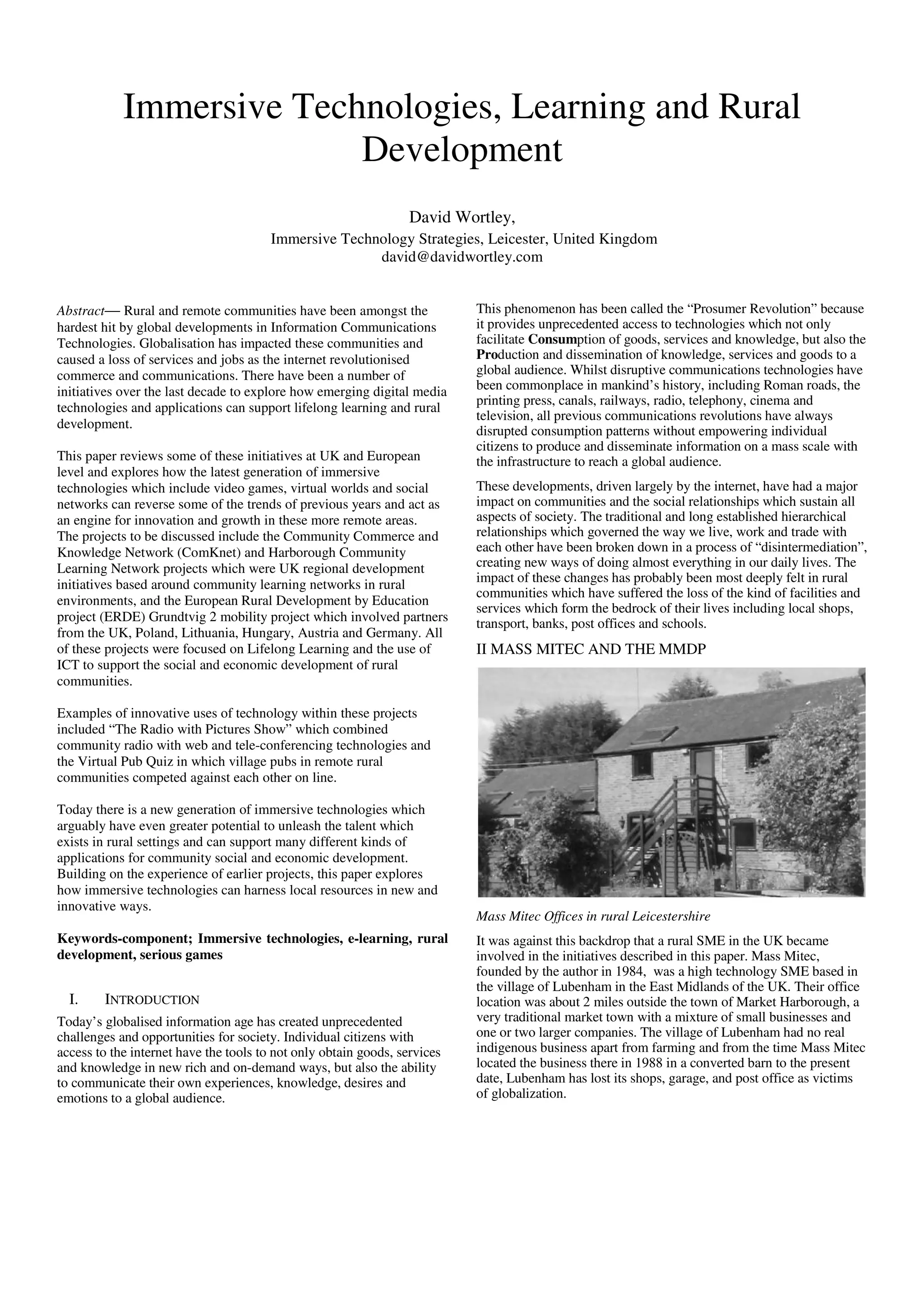
                                                                           Mass Mitec Offices in rural Leicestershire
Keywords-component; Immersive technologies, e-learning, rural              It was against this backdrop that a rural SME in the UK became
development, serious games                                                 involved in the initiatives described in this paper. Mass Mitec,
                                                                           founded by the author in 1984, was a high technology SME based in
                                                                           the village of Lubenham in the East Midlands of the UK. Their office
  I.    INTRODUCTION                                                       location was about 2 miles outside the town of Market Harborough, a
Today’s globalised information age has created unprecedented               very traditional market town with a mixture of small businesses and
challenges and opportunities for society. Individual citizens with         one or two larger companies. The village of Lubenham had no real
access to the internet have the tools to not only obtain goods, services   indigenous business apart from farming and from the time Mass Mitec
and knowledge in new rich and on-demand ways, but also the ability         located the business there in 1988 in a converted barn to the present
to communicate their own experiences, knowledge, desires and               date, Lubenham has lost its shops, garage, and post office as victims
emotions to a global audience.                                             of globalization.
The nature of Mass Mitec’s operation within business presentation          It came as a big shock to learn that this web site had been developed
graphics and collaboration technologies meant that                         by a local man who delivered milk every morning and who had taught
telecommunications played a vital role in the delivery of services to      himself everything he needed to know to build his computer and
customers with a consequence that Mass Mitec’s customers were              create this web site which contained many of the elements planned for
literally all over the globe with quite a number of corporate clients in   a £250k Govt funded project.
the UK. However, somewhat paradoxically, there were none of the
bigger companies in Market Harborough who chose instead to go to
larger cities like London and Birmingham to acquire the same services      III THE COMKNET PROJECT LESSON
that Mass Mitec could provide on their doorstep. It was this challenge
of developing a more local customer base to counteract competitive         The ComKnet project had established, through the discovery of
forces in Mass Mitec’s sector that led the author to submit a proposal     milkman Frank Bingley and other local talent such as a senior BBC
to the UK’s Department of Trade and Industry as part of the Govt’s         cameraman based in Lubenham and a “Harry Potter” video special
Multimedia Demonstrator Programme (MMDP) designed to stimulate             effects expert based in nearby Market Harborough, that modern
the use of multimedia technologies within SMEs.                            communication and collaboration technologies could not only help to
                                                                           identify local talent but could also empower citizens with knowledge
Mass Mitec submitted a consortium bid for a project known as               and skills that they could use not only for their own benefit but also to
ComKnet (Community Commerce and Knowledge Network) based on                support the sustainable development of rural communities.
the development of web-based services designed to encourage
knowledge sharing and trading within rural communities typical of          The ComKnet project acted as a gateway for Mass Mitec to engage
Mass Mitec’s region in the UK. The proposal was based on the               with the international community to share experiences and expertise in
premise that every community has untapped human potential which            the use of learning and collaboration technologies for sustainable rural
might be harnessed by modern technology and thus challenge the             development. Over the two years spent developing ComKnet, it
negative effects of globalization.                                         became clear from the other projects presented at social enterprise
                                                                           conferences around the world that the ComKnet phenomenon of local
The consortium bid was successful and the project started in 1998 by       talent engaged in community development is far from unique with
using the web search engines to find local community champions to          many examples from across the globe in places as diverse as the
act as a foundation of the network and focal point for knowledge           Peruvian jungle, Indian rural communities and Alaskan herd dwellers.
sharing.

                                                                           IV THE RADIO WITH PICTURES SHOW


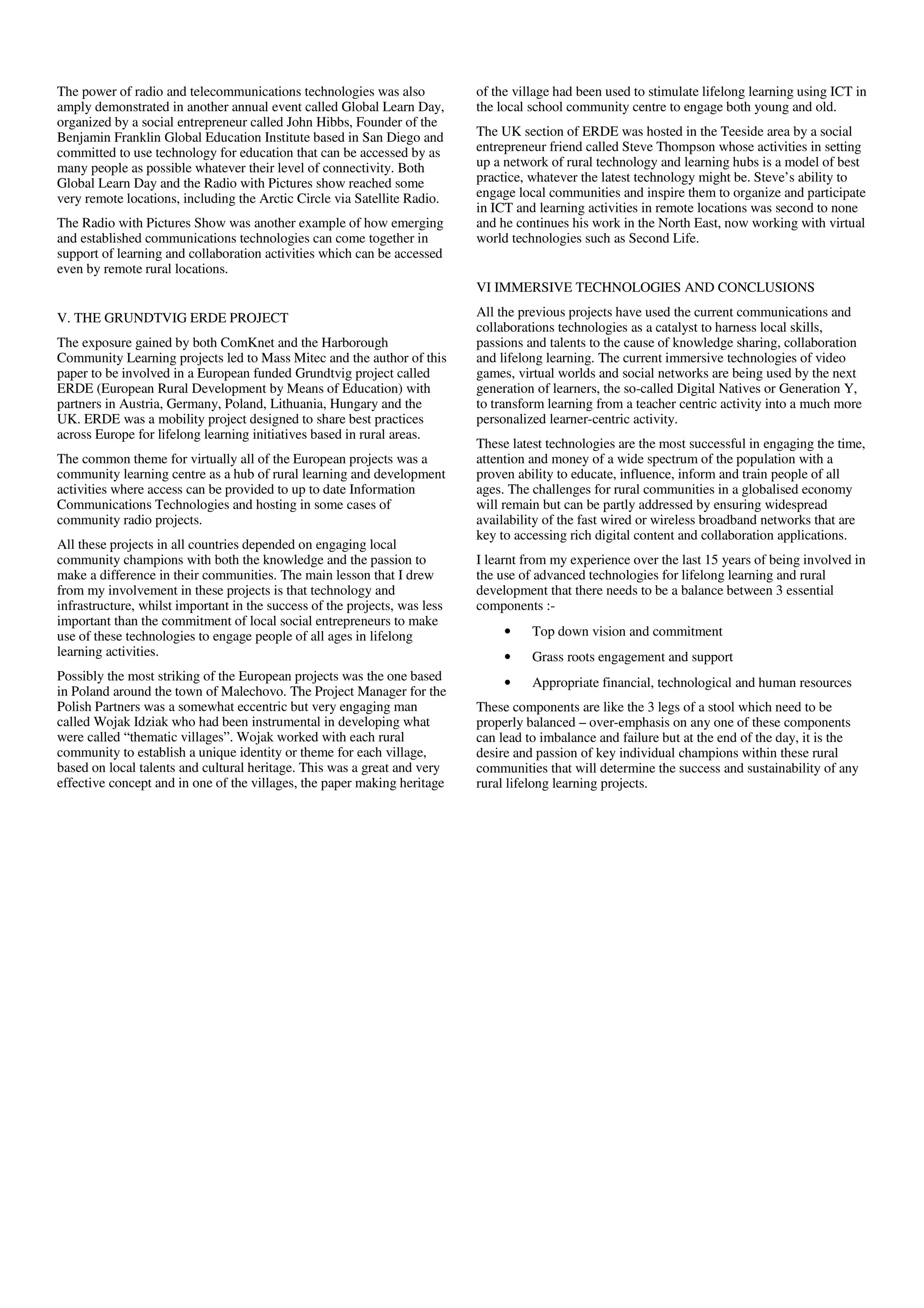
                                                                           The Radio with Pictures Show
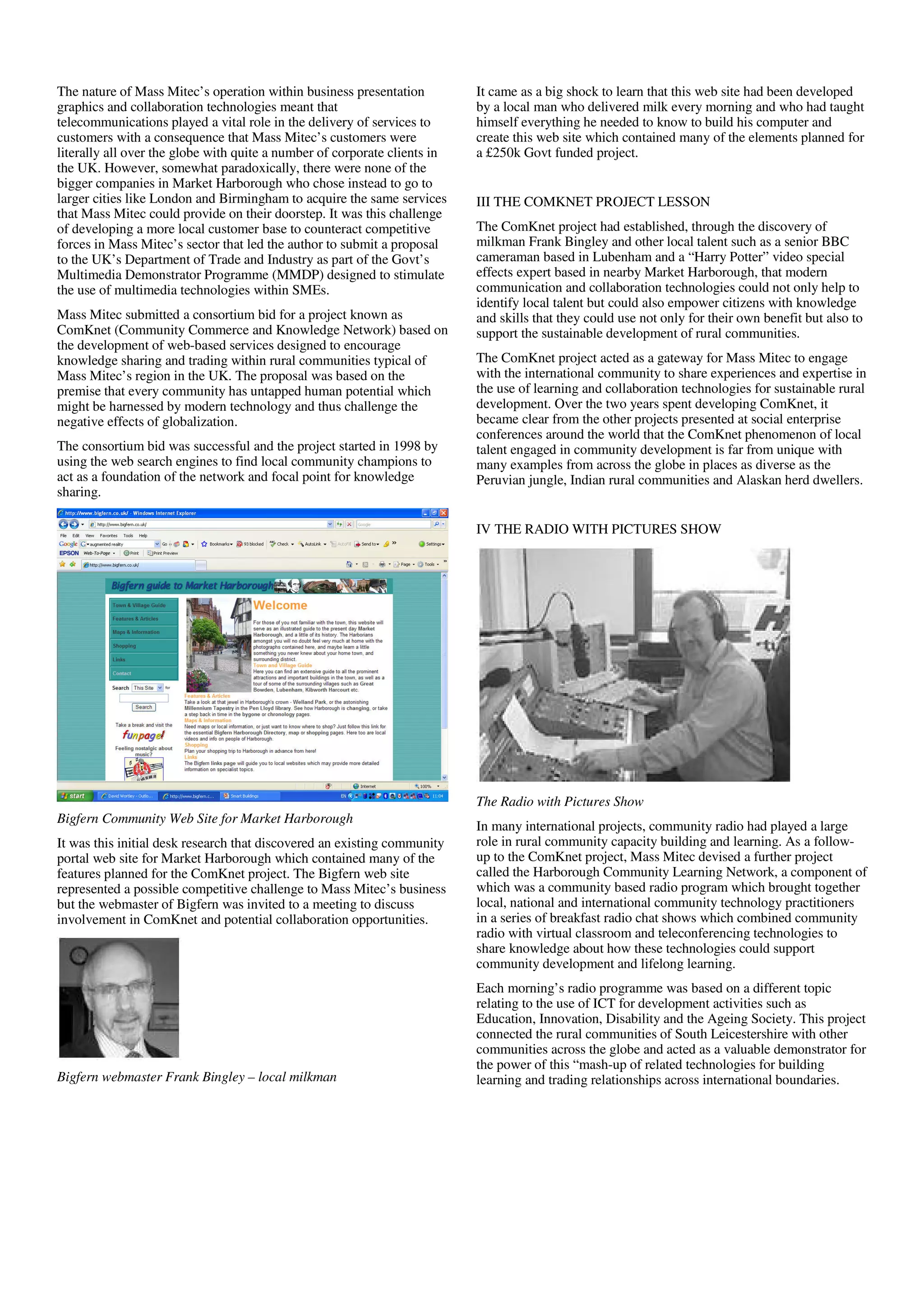
Bigfern Community Web Site for Market Harborough
                                                                           In many international projects, community radio had played a large
It was this initial desk research that discovered an existing community    role in rural community capacity building and learning. As a follow-
portal web site for Market Harborough which contained many of the          up to the ComKnet project, Mass Mitec devised a further project
features planned for the ComKnet project. The Bigfern web site             called the Harborough Community Learning Network, a component of
represented a possible competitive challenge to Mass Mitec’s business      which was a community based radio program which brought together
but the webmaster of Bigfern was invited to a meeting to discuss           local, national and international community technology practitioners
involvement in ComKnet and potential collaboration opportunities.          in a series of breakfast radio chat shows which combined community
                                                                           radio with virtual classroom and teleconferencing technologies to
                                                                           share knowledge about how these technologies could support
                                                                           community development and lifelong learning.
                                                                           Each morning’s radio programme was based on a different topic
                                                                           relating to the use of ICT for development activities such as
                                                                           Education, Innovation, Disability and the Ageing Society. This project
                                                                           connected the rural communities of South Leicestershire with other
                                                                           communities across the globe and acted as a valuable demonstrator for
                                                                           the power of this “mash-up of related technologies for building
Bigfern webmaster Frank Bingley – local milkman                            learning and trading relationships across international boundaries.
The power of radio and telecommunications technologies was also             of the village had been used to stimulate lifelong learning using ICT in
amply demonstrated in another annual event called Global Learn Day,         the local school community centre to engage both young and old.
organized by a social entrepreneur called John Hibbs, Founder of the
Benjamin Franklin Global Education Institute based in San Diego and         The UK section of ERDE was hosted in the Teeside area by a social
committed to use technology for education that can be accessed by as        entrepreneur friend called Steve Thompson whose activities in setting
many people as possible whatever their level of connectivity. Both          up a network of rural technology and learning hubs is a model of best
Global Learn Day and the Radio with Pictures show reached some              practice, whatever the latest technology might be. Steve’s ability to
very remote locations, including the Arctic Circle via Satellite Radio.     engage local communities and inspire them to organize and participate
                                                                            in ICT and learning activities in remote locations was second to none
The Radio with Pictures Show was another example of how emerging            and he continues his work in the North East, now working with virtual
and established communications technologies can come together in            world technologies such as Second Life.
support of learning and collaboration activities which can be accessed
even by remote rural locations.
                                                                            VI IMMERSIVE TECHNOLOGIES AND CONCLUSIONS

V. THE GRUNDTVIG ERDE PROJECT                                               All the previous projects have used the current communications and
                                                                            collaborations technologies as a catalyst to harness local skills,
The exposure gained by both ComKnet and the Harborough                      passions and talents to the cause of knowledge sharing, collaboration
Community Learning projects led to Mass Mitec and the author of this        and lifelong learning. The current immersive technologies of video
paper to be involved in a European funded Grundtvig project called          games, virtual worlds and social networks are being used by the next
ERDE (European Rural Development by Means of Education) with                generation of learners, the so-called Digital Natives or Generation Y,
partners in Austria, Germany, Poland, Lithuania, Hungary and the            to transform learning from a teacher centric activity into a much more
UK. ERDE was a mobility project designed to share best practices            personalized learner-centric activity.
across Europe for lifelong learning initiatives based in rural areas.
                                                                            These latest technologies are the most successful in engaging the time,
The common theme for virtually all of the European projects was a           attention and money of a wide spectrum of the population with a
community learning centre as a hub of rural learning and development        proven ability to educate, influence, inform and train people of all
activities where access can be provided to up to date Information           ages. The challenges for rural communities in a globalised economy
Communications Technologies and hosting in some cases of                    will remain but can be partly addressed by ensuring widespread
community radio projects.                                                   availability of the fast wired or wireless broadband networks that are
                                                                            key to accessing rich digital content and collaboration applications.
All these projects in all countries depended on engaging local
community champions with both the knowledge and the passion to              I learnt from my experience over the last 15 years of being involved in
make a difference in their communities. The main lesson that I drew         the use of advanced technologies for lifelong learning and rural
from my involvement in these projects is that technology and                development that there needs to be a balance between 3 essential
infrastructure, whilst important in the success of the projects, was less   components :-
important than the commitment of local social entrepreneurs to make
use of these technologies to engage people of all ages in lifelong               •    Top down vision and commitment
learning activities.                                                             •    Grass roots engagement and support
Possibly the most striking of the European projects was the one based            •    Appropriate financial, technological and human resources
in Poland around the town of Malechovo. The Project Manager for the
Polish Partners was a somewhat eccentric but very engaging man              These components are like the 3 legs of a stool which need to be
called Wojak Idziak who had been instrumental in developing what            properly balanced – over-emphasis on any one of these components
were called “thematic villages”. Wojak worked with each rural               can lead to imbalance and failure but at the end of the day, it is the
community to establish a unique identity or theme for each village,         desire and passion of key individual champions within these rural
based on local talents and cultural heritage. This was a great and very     communities that will determine the success and sustainability of any
effective concept and in one of the villages, the paper making heritage     rural lifelong learning projects.

Immersive Technologies, Learning and Rural Development

  • 1.
    Immersive Technologies, Learningand Rural Development David Wortley, Immersive Technology Strategies, Leicester, United Kingdom david@davidwortley.com Abstract— Rural and remote communities have been amongst the This phenomenon has been called the “Prosumer Revolution” because hardest hit by global developments in Information Communications it provides unprecedented access to technologies which not only Technologies. Globalisation has impacted these communities and facilitate Consumption of goods, services and knowledge, but also the caused a loss of services and jobs as the internet revolutionised Production and dissemination of knowledge, services and goods to a commerce and communications. There have been a number of global audience. Whilst disruptive communications technologies have initiatives over the last decade to explore how emerging digital media been commonplace in mankind’s history, including Roman roads, the printing press, canals, railways, radio, telephony, cinema and technologies and applications can support lifelong learning and rural television, all previous communications revolutions have always development. disrupted consumption patterns without empowering individual citizens to produce and disseminate information on a mass scale with This paper reviews some of these initiatives at UK and European the infrastructure to reach a global audience. level and explores how the latest generation of immersive technologies which include video games, virtual worlds and social These developments, driven largely by the internet, have had a major networks can reverse some of the trends of previous years and act as impact on communities and the social relationships which sustain all an engine for innovation and growth in these more remote areas. aspects of society. The traditional and long established hierarchical The projects to be discussed include the Community Commerce and relationships which governed the way we live, work and trade with Knowledge Network (ComKnet) and Harborough Community each other have been broken down in a process of “disintermediation”, Learning Network projects which were UK regional development creating new ways of doing almost everything in our daily lives. The initiatives based around community learning networks in rural impact of these changes has probably been most deeply felt in rural communities which have suffered the loss of the kind of facilities and environments, and the European Rural Development by Education services which form the bedrock of their lives including local shops, project (ERDE) Grundtvig 2 mobility project which involved partners transport, banks, post offices and schools. from the UK, Poland, Lithuania, Hungary, Austria and Germany. All of these projects were focused on Lifelong Learning and the use of II MASS MITEC AND THE MMDP ICT to support the social and economic development of rural communities. Examples of innovative uses of technology within these projects included “The Radio with Pictures Show” which combined community radio with web and tele-conferencing technologies and the Virtual Pub Quiz in which village pubs in remote rural communities competed against each other on line. Today there is a new generation of immersive technologies which arguably have even greater potential to unleash the talent which exists in rural settings and can support many different kinds of applications for community social and economic development. Building on the experience of earlier projects, this paper explores how immersive technologies can harness local resources in new and innovative ways. Mass Mitec Offices in rural Leicestershire Keywords-component; Immersive technologies, e-learning, rural It was against this backdrop that a rural SME in the UK became development, serious games involved in the initiatives described in this paper. Mass Mitec, founded by the author in 1984, was a high technology SME based in the village of Lubenham in the East Midlands of the UK. Their office I. INTRODUCTION location was about 2 miles outside the town of Market Harborough, a Today’s globalised information age has created unprecedented very traditional market town with a mixture of small businesses and challenges and opportunities for society. Individual citizens with one or two larger companies. The village of Lubenham had no real access to the internet have the tools to not only obtain goods, services indigenous business apart from farming and from the time Mass Mitec and knowledge in new rich and on-demand ways, but also the ability located the business there in 1988 in a converted barn to the present to communicate their own experiences, knowledge, desires and date, Lubenham has lost its shops, garage, and post office as victims emotions to a global audience. of globalization.
  • 2.
    The nature ofMass Mitec’s operation within business presentation It came as a big shock to learn that this web site had been developed graphics and collaboration technologies meant that by a local man who delivered milk every morning and who had taught telecommunications played a vital role in the delivery of services to himself everything he needed to know to build his computer and customers with a consequence that Mass Mitec’s customers were create this web site which contained many of the elements planned for literally all over the globe with quite a number of corporate clients in a £250k Govt funded project. the UK. However, somewhat paradoxically, there were none of the bigger companies in Market Harborough who chose instead to go to larger cities like London and Birmingham to acquire the same services III THE COMKNET PROJECT LESSON that Mass Mitec could provide on their doorstep. It was this challenge of developing a more local customer base to counteract competitive The ComKnet project had established, through the discovery of forces in Mass Mitec’s sector that led the author to submit a proposal milkman Frank Bingley and other local talent such as a senior BBC to the UK’s Department of Trade and Industry as part of the Govt’s cameraman based in Lubenham and a “Harry Potter” video special Multimedia Demonstrator Programme (MMDP) designed to stimulate effects expert based in nearby Market Harborough, that modern the use of multimedia technologies within SMEs. communication and collaboration technologies could not only help to identify local talent but could also empower citizens with knowledge Mass Mitec submitted a consortium bid for a project known as and skills that they could use not only for their own benefit but also to ComKnet (Community Commerce and Knowledge Network) based on support the sustainable development of rural communities. the development of web-based services designed to encourage knowledge sharing and trading within rural communities typical of The ComKnet project acted as a gateway for Mass Mitec to engage Mass Mitec’s region in the UK. The proposal was based on the with the international community to share experiences and expertise in premise that every community has untapped human potential which the use of learning and collaboration technologies for sustainable rural might be harnessed by modern technology and thus challenge the development. Over the two years spent developing ComKnet, it negative effects of globalization. became clear from the other projects presented at social enterprise conferences around the world that the ComKnet phenomenon of local The consortium bid was successful and the project started in 1998 by talent engaged in community development is far from unique with using the web search engines to find local community champions to many examples from across the globe in places as diverse as the act as a foundation of the network and focal point for knowledge Peruvian jungle, Indian rural communities and Alaskan herd dwellers. sharing. IV THE RADIO WITH PICTURES SHOW The Radio with Pictures Show Bigfern Community Web Site for Market Harborough In many international projects, community radio had played a large It was this initial desk research that discovered an existing community role in rural community capacity building and learning. As a follow- portal web site for Market Harborough which contained many of the up to the ComKnet project, Mass Mitec devised a further project features planned for the ComKnet project. The Bigfern web site called the Harborough Community Learning Network, a component of represented a possible competitive challenge to Mass Mitec’s business which was a community based radio program which brought together but the webmaster of Bigfern was invited to a meeting to discuss local, national and international community technology practitioners involvement in ComKnet and potential collaboration opportunities. in a series of breakfast radio chat shows which combined community radio with virtual classroom and teleconferencing technologies to share knowledge about how these technologies could support community development and lifelong learning. Each morning’s radio programme was based on a different topic relating to the use of ICT for development activities such as Education, Innovation, Disability and the Ageing Society. This project connected the rural communities of South Leicestershire with other communities across the globe and acted as a valuable demonstrator for the power of this “mash-up of related technologies for building Bigfern webmaster Frank Bingley – local milkman learning and trading relationships across international boundaries.
  • 3.
    The power ofradio and telecommunications technologies was also of the village had been used to stimulate lifelong learning using ICT in amply demonstrated in another annual event called Global Learn Day, the local school community centre to engage both young and old. organized by a social entrepreneur called John Hibbs, Founder of the Benjamin Franklin Global Education Institute based in San Diego and The UK section of ERDE was hosted in the Teeside area by a social committed to use technology for education that can be accessed by as entrepreneur friend called Steve Thompson whose activities in setting many people as possible whatever their level of connectivity. Both up a network of rural technology and learning hubs is a model of best Global Learn Day and the Radio with Pictures show reached some practice, whatever the latest technology might be. Steve’s ability to very remote locations, including the Arctic Circle via Satellite Radio. engage local communities and inspire them to organize and participate in ICT and learning activities in remote locations was second to none The Radio with Pictures Show was another example of how emerging and he continues his work in the North East, now working with virtual and established communications technologies can come together in world technologies such as Second Life. support of learning and collaboration activities which can be accessed even by remote rural locations. VI IMMERSIVE TECHNOLOGIES AND CONCLUSIONS V. THE GRUNDTVIG ERDE PROJECT All the previous projects have used the current communications and collaborations technologies as a catalyst to harness local skills, The exposure gained by both ComKnet and the Harborough passions and talents to the cause of knowledge sharing, collaboration Community Learning projects led to Mass Mitec and the author of this and lifelong learning. The current immersive technologies of video paper to be involved in a European funded Grundtvig project called games, virtual worlds and social networks are being used by the next ERDE (European Rural Development by Means of Education) with generation of learners, the so-called Digital Natives or Generation Y, partners in Austria, Germany, Poland, Lithuania, Hungary and the to transform learning from a teacher centric activity into a much more UK. ERDE was a mobility project designed to share best practices personalized learner-centric activity. across Europe for lifelong learning initiatives based in rural areas. These latest technologies are the most successful in engaging the time, The common theme for virtually all of the European projects was a attention and money of a wide spectrum of the population with a community learning centre as a hub of rural learning and development proven ability to educate, influence, inform and train people of all activities where access can be provided to up to date Information ages. The challenges for rural communities in a globalised economy Communications Technologies and hosting in some cases of will remain but can be partly addressed by ensuring widespread community radio projects. availability of the fast wired or wireless broadband networks that are key to accessing rich digital content and collaboration applications. All these projects in all countries depended on engaging local community champions with both the knowledge and the passion to I learnt from my experience over the last 15 years of being involved in make a difference in their communities. The main lesson that I drew the use of advanced technologies for lifelong learning and rural from my involvement in these projects is that technology and development that there needs to be a balance between 3 essential infrastructure, whilst important in the success of the projects, was less components :- important than the commitment of local social entrepreneurs to make use of these technologies to engage people of all ages in lifelong • Top down vision and commitment learning activities. • Grass roots engagement and support Possibly the most striking of the European projects was the one based • Appropriate financial, technological and human resources in Poland around the town of Malechovo. The Project Manager for the Polish Partners was a somewhat eccentric but very engaging man These components are like the 3 legs of a stool which need to be called Wojak Idziak who had been instrumental in developing what properly balanced – over-emphasis on any one of these components were called “thematic villages”. Wojak worked with each rural can lead to imbalance and failure but at the end of the day, it is the community to establish a unique identity or theme for each village, desire and passion of key individual champions within these rural based on local talents and cultural heritage. This was a great and very communities that will determine the success and sustainability of any effective concept and in one of the villages, the paper making heritage rural lifelong learning projects.