Community Networks
 … neutrality or hostage?


       Malcolm Matson
    email: malcolm.matson@oplan.org

            www.oplan.org

         http://confine‐project.eu
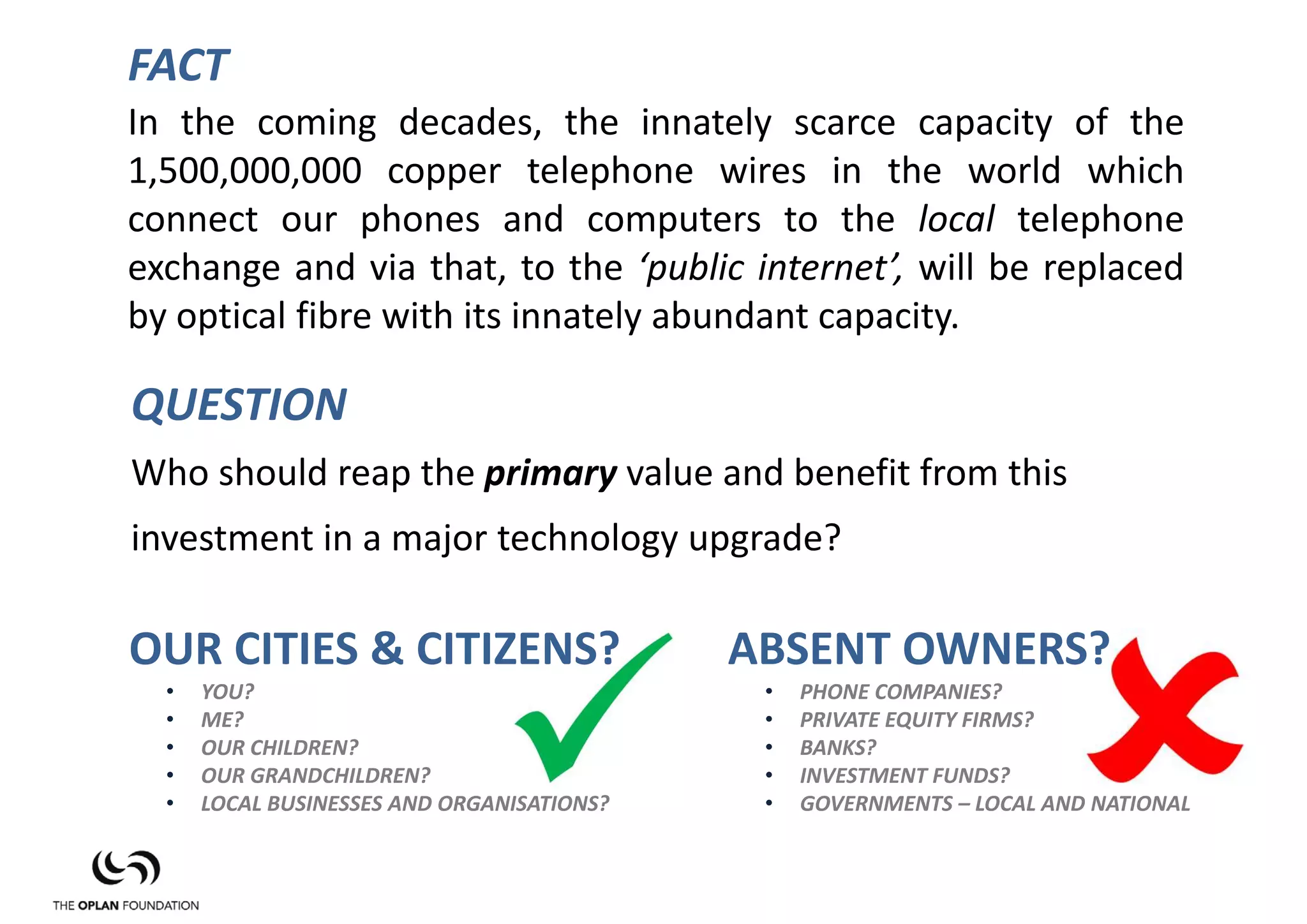
FACT
In the coming decades, the innately scarce capacity of the
1,500,000,000 copper telephone wires in the world which
connect our phones and computers to the local telephone
exchange and via that, to the ‘public internet’, will be replaced
by optical fibre with its innately abundant capacity.

QUESTION
Who should reap the primary value and benefit from this 
investment in a major technology upgrade?

OUR CITIES & CITIZENS?                      ABSENT OWNERS?
  •   YOU?                                   •   PHONE COMPANIES?
  •   ME?                                    •   PRIVATE EQUITY FIRMS?
  •   OUR CHILDREN?                          •   BANKS?
  •   OUR GRANDCHILDREN?                     •   INVESTMENT FUNDS?
  •   LOCAL BUSINESSES AND ORGANISATIONS?    •   GOVERNMENTS – LOCAL AND NATIONAL
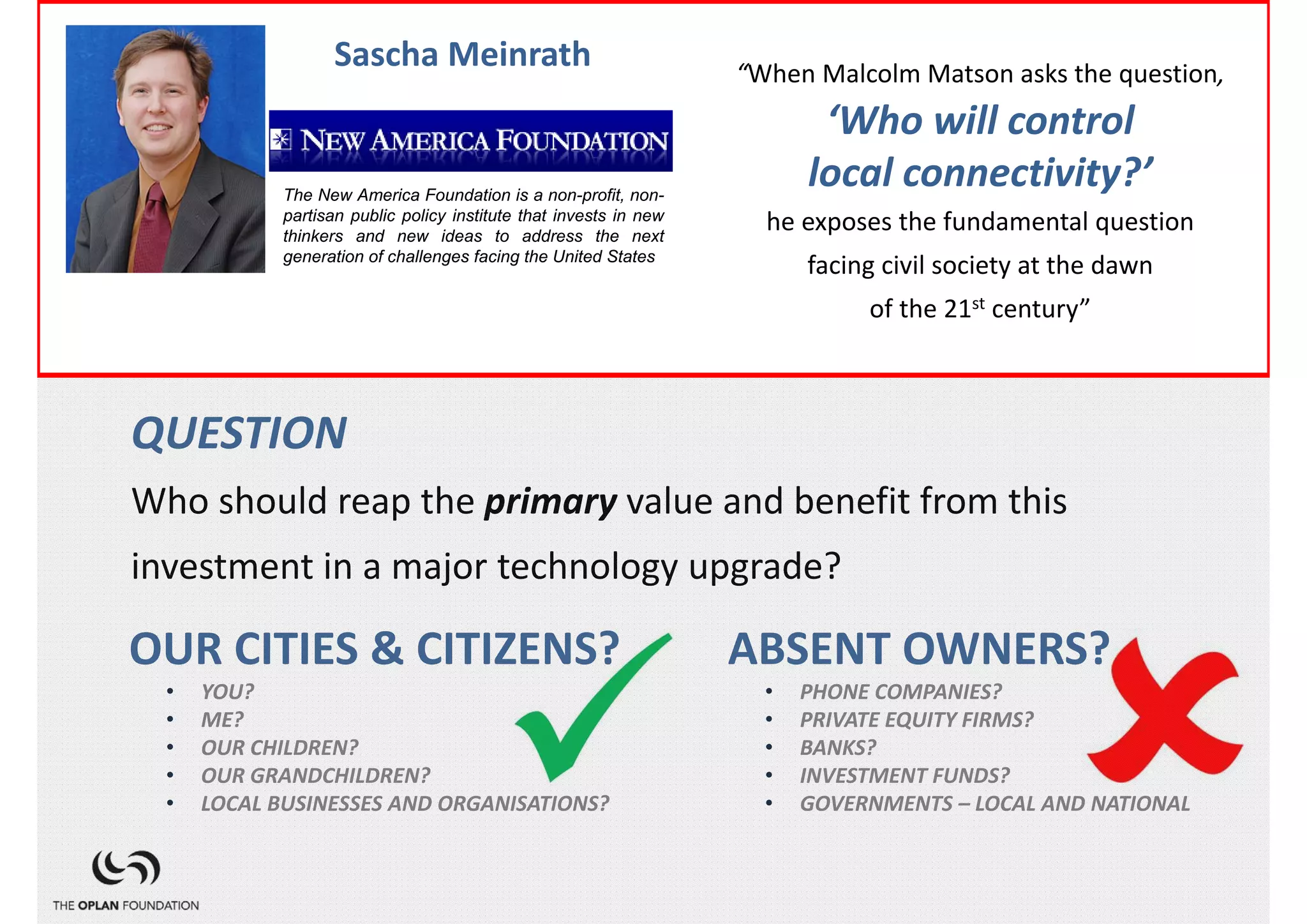
FACT              Sascha Meinrath                       “When Malcolm Matson asks the question, 
                 Director, Open Technology Initiative
In the coming decades, the innately scarce capacity of the   ‘Who will control 
1,500,000,000America Foundation istelephone wires local connectivity?’  
          The New
                       copper a non-profit, non-             in the world which
connect our public new ideas toand computers he exposes the fundamental question 
          partisan
                   phones that invests in next
          thinkers and
                         policy institute
                                          address the
                                                      new
                                                          to the local telephone
exchange generation of challenges facing toUnited States
            and via that, the the ‘public internet’, will be replaced
                                                           facing civil society at the dawn 
by optical fibre with its innately abundant capacity. st century”of the 21


QUESTION
Who should reap the primary value and benefit from this 
investment in a major technology upgrade?

OUR CITIES & CITIZENS?                                  ABSENT OWNERS?
   •   YOU?                                               •   PHONE COMPANIES?
   •   ME?                                                •   PRIVATE EQUITY FIRMS?
   •   OUR CHILDREN?                                      •   BANKS?
   •   OUR GRANDCHILDREN?                                 •   INVESTMENT FUNDS?
   •   LOCAL BUSINESSES AND ORGANISATIONS?                •   GOVERNMENTS – LOCAL AND NATIONAL
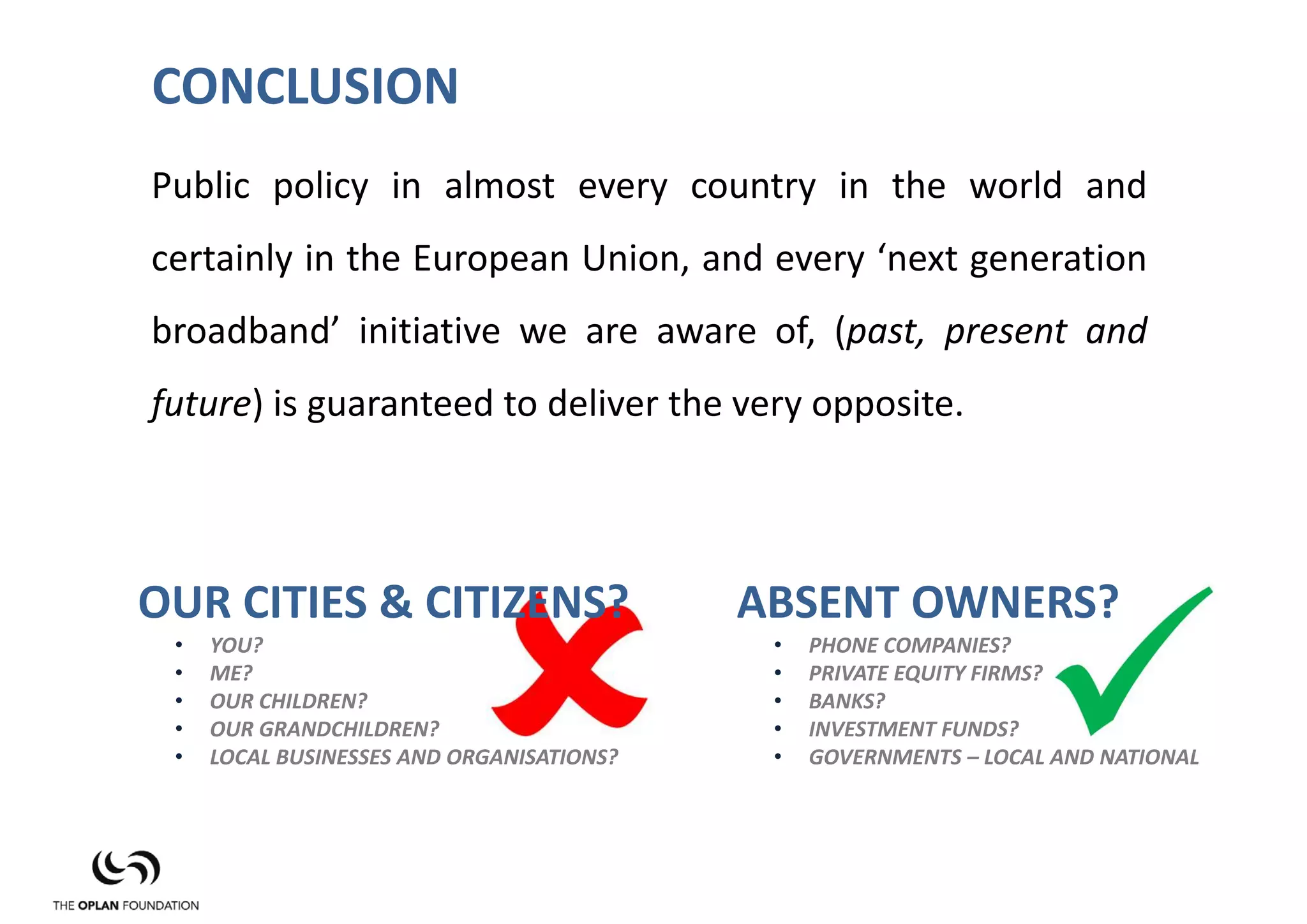
CONCLUSION
Public policy in almost every country in the world and
certainly in the European Union, and every ‘next generation
broadband’ initiative we are aware of, (past, present and
future) is guaranteed to deliver the very opposite.


OUR CITIES & CITIZENS?                     ABSENT OWNERS?
 •   YOU?                                   •   PHONE COMPANIES?
 •   ME?                                    •   PRIVATE EQUITY FIRMS?
 •   OUR CHILDREN?                          •   BANKS?
 •   OUR GRANDCHILDREN?                     •   INVESTMENT FUNDS?
 •   LOCAL BUSINESSES AND ORGANISATIONS?    •   GOVERNMENTS – LOCAL AND NATIONAL
Open Public Local Access Network ‐ OPLAN
   capacity is dictated by the technology deployed – not by ‘artificial scarcity’ tariffing mechanisms
   restricted to serving a local geographic community – usually defined by administrative boundaries

   provides abundant low cost local ‘point‐to‐point’, symmetrical connectivity
   a 4th Utility© ‐ available for access by any party (no artificial ‘retail / wholesale’ differentiation)
   no differentiation between ‘content creators’ and ‘content consumers’ 

   infrastructure is owned and controlled independent of traffic/service/content using it
   is structured, financially and legally with governance measures that:
         protects the local ’common public good’
         ensures the long term ‘value and benefit’ rests with users of the network (not absent owners)
   ‘access’ charges are based on servicing capital, and recovering maintenance and upgrade costs
   to preserve global competitiveness, ‘rent seeking’, even for local public benefit, should be avoided

   financed by the private sector and market driven – not government funded/owned/controlled
   subsumes the incumbent telco’s existing local copper PSTN network
   EU's Seventh Framework Programme for Research (FP7)
                    ICT‐2011 Future Internet Research & Experimentation (FIRE)
                    Large Scale Integrating Project


 construction and operation of a new “experimental testbed” for research in 
  community networking
 ‘mesh networking’ based on distributed, open source control


GOALS
       experimentally, rather than theoretically driven research into community networking
       evaluation of the community network model for the ‘future internet’
       free and open dissemination
       socio/technical/economic/legal evaluation of the testbed outputs and model
       sustainability (technical and financial)  
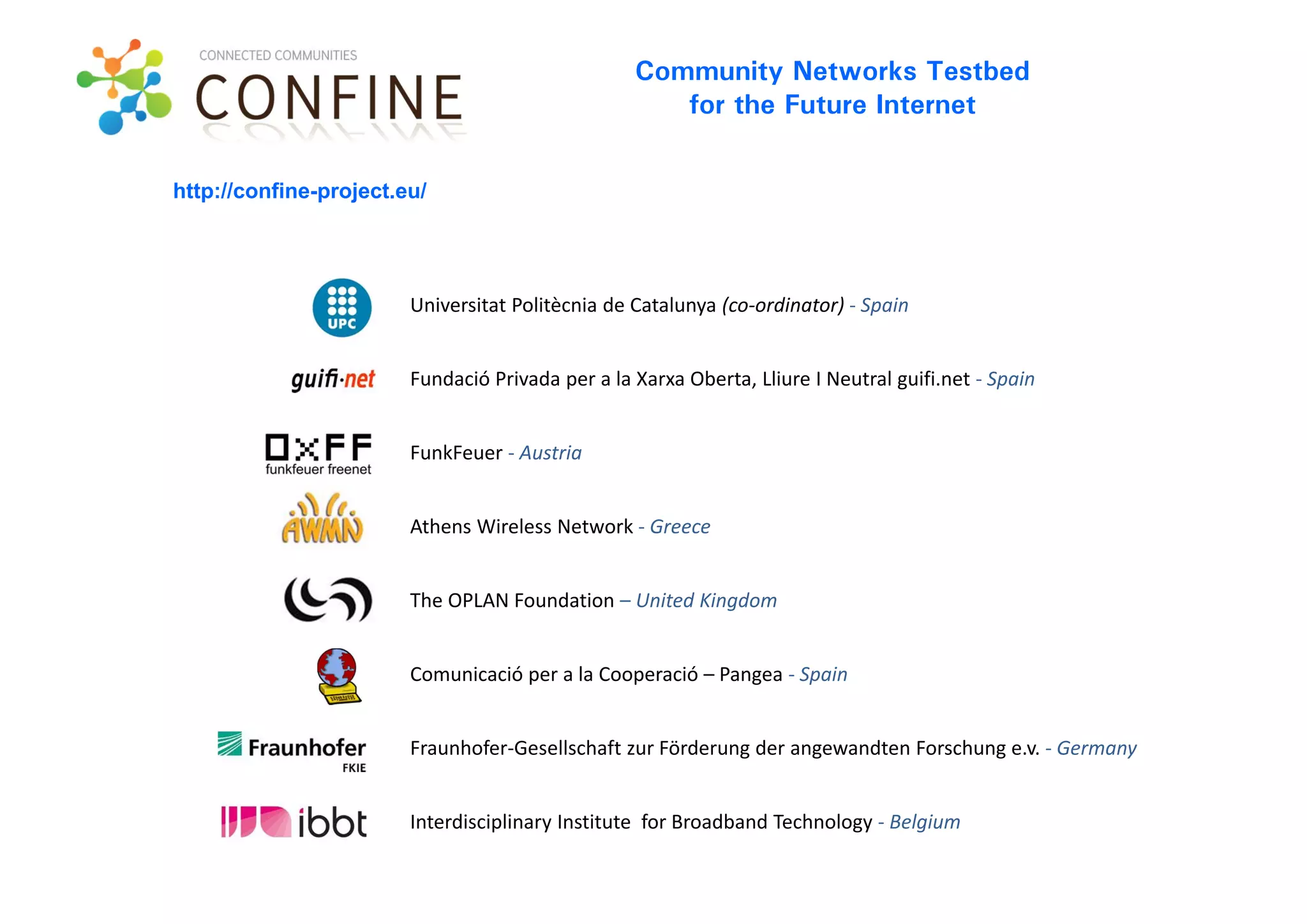
Community Networks Testbed
                                                     for the Future Internet


http://confine-project.eu/


                        Universitat Politècnia de Catalunya (co‐ordinator) ‐ Spain


                        Fundació Privada per a la Xarxa Oberta, Lliure I Neutral guifi.net ‐ Spain


                        FunkFeuer ‐ Austria


                        Athens Wireless Network ‐ Greece


                        The OPLAN Foundation – United Kingdom


                        Comunicació per a la Cooperació – Pangea ‐ Spain


                        Fraunhofer‐Gesellschaft zur Förderung der angewandten Forschung e.v. ‐ Germany


                        Interdisciplinary Institute  for Broadband Technology ‐ Belgium
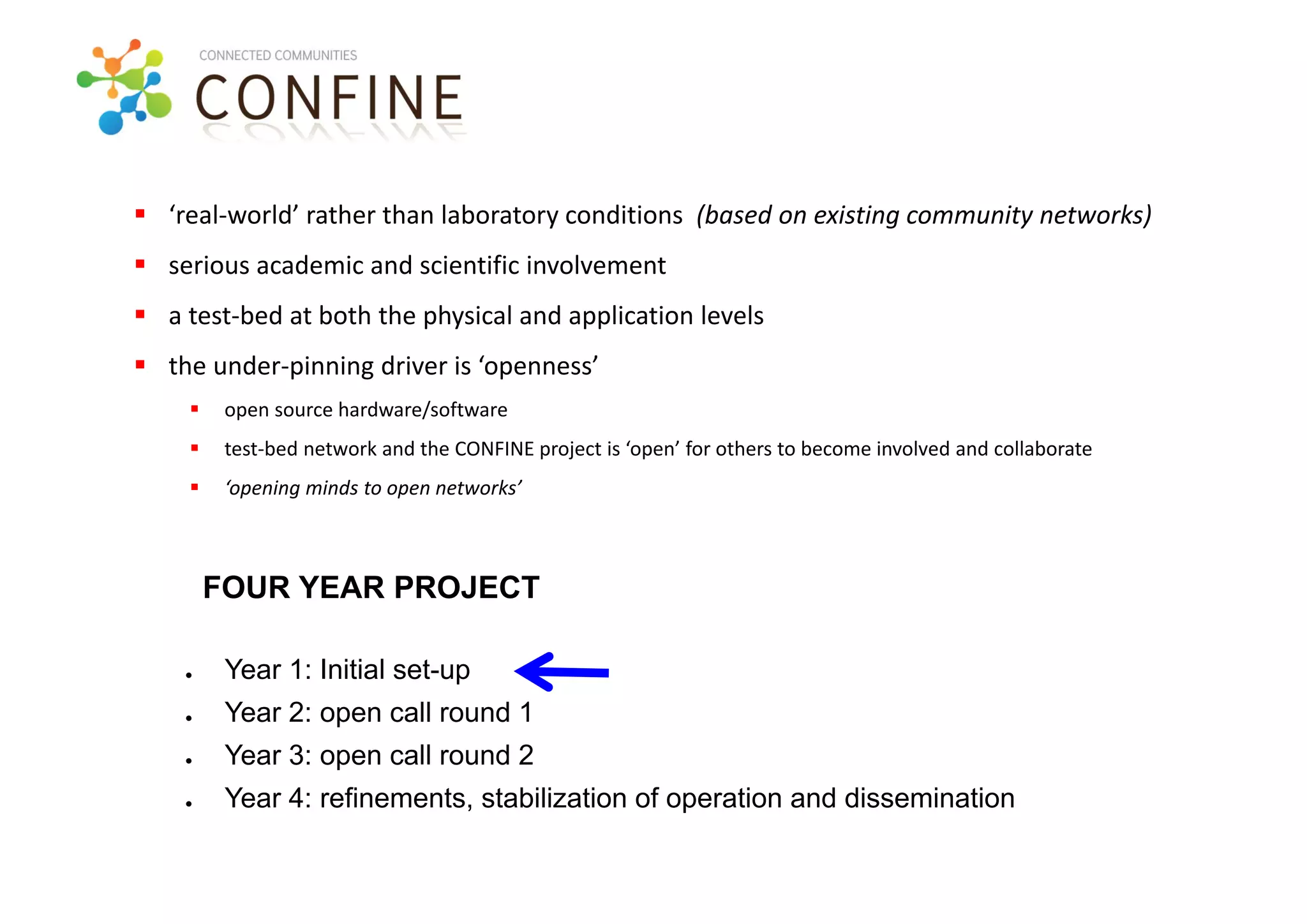
 ‘real‐world’ rather than laboratory conditions  (based on existing community networks)
 serious academic and scientific involvement 
 a test‐bed at both the physical and application levels
 the under‐pinning driver is ‘openness’ 
        open source hardware/software
        test‐bed network and the CONFINE project is ‘open’ for others to become involved and collaborate
        ‘opening minds to open networks’


        FOUR YEAR PROJECT

    ●    Year 1: Initial set-up
    ●    Year 2: open call round 1
    ●    Year 3: open call round 2
    ●    Year 4: refinements, stabilization of operation and dissemination
Community Networks
 … neutrality or hostage?


       Malcolm Matson
    email: malcolm.matson@oplan.org

            www.oplan.org

         http://confine‐project.eu

Community Networks Malcom Matson

  • 1.
    Community Networks …neutrality or hostage? Malcolm Matson email: malcolm.matson@oplan.org www.oplan.org http://confine‐project.eu
  • 2.
    FACT In the comingdecades, the innately scarce capacity of the 1,500,000,000 copper telephone wires in the world which connect our phones and computers to the local telephone exchange and via that, to the ‘public internet’, will be replaced by optical fibre with its innately abundant capacity. QUESTION Who should reap the primary value and benefit from this  investment in a major technology upgrade? OUR CITIES & CITIZENS? ABSENT OWNERS? • YOU? • PHONE COMPANIES? • ME? • PRIVATE EQUITY FIRMS? • OUR CHILDREN? • BANKS? • OUR GRANDCHILDREN? • INVESTMENT FUNDS? • LOCAL BUSINESSES AND ORGANISATIONS? • GOVERNMENTS – LOCAL AND NATIONAL
  • 3.
    FACT Sascha Meinrath “When Malcolm Matson asks the question,  Director, Open Technology Initiative In the coming decades, the innately scarce capacity of the ‘Who will control  1,500,000,000America Foundation istelephone wires local connectivity?’   The New copper a non-profit, non- in the world which connect our public new ideas toand computers he exposes the fundamental question  partisan phones that invests in next thinkers and policy institute address the new to the local telephone exchange generation of challenges facing toUnited States and via that, the the ‘public internet’, will be replaced facing civil society at the dawn  by optical fibre with its innately abundant capacity. st century”of the 21 QUESTION Who should reap the primary value and benefit from this  investment in a major technology upgrade? OUR CITIES & CITIZENS? ABSENT OWNERS? • YOU? • PHONE COMPANIES? • ME? • PRIVATE EQUITY FIRMS? • OUR CHILDREN? • BANKS? • OUR GRANDCHILDREN? • INVESTMENT FUNDS? • LOCAL BUSINESSES AND ORGANISATIONS? • GOVERNMENTS – LOCAL AND NATIONAL
  • 4.
    CONCLUSION Public policy inalmost every country in the world and certainly in the European Union, and every ‘next generation broadband’ initiative we are aware of, (past, present and future) is guaranteed to deliver the very opposite. OUR CITIES & CITIZENS? ABSENT OWNERS? • YOU? • PHONE COMPANIES? • ME? • PRIVATE EQUITY FIRMS? • OUR CHILDREN? • BANKS? • OUR GRANDCHILDREN? • INVESTMENT FUNDS? • LOCAL BUSINESSES AND ORGANISATIONS? • GOVERNMENTS – LOCAL AND NATIONAL
  • 5.
    Open Public Local Access Network ‐ OPLAN  capacity is dictated by the technology deployed – not by ‘artificial scarcity’ tariffing mechanisms  restricted to serving a local geographic community – usually defined by administrative boundaries  provides abundant low cost local ‘point‐to‐point’, symmetrical connectivity  a 4th Utility© ‐ available for access by any party (no artificial ‘retail / wholesale’ differentiation)  no differentiation between ‘content creators’ and ‘content consumers’   infrastructure is owned and controlled independent of traffic/service/content using it  is structured, financially and legally with governance measures that:  protects the local ’common public good’  ensures the long term ‘value and benefit’ rests with users of the network (not absent owners)  ‘access’ charges are based on servicing capital, and recovering maintenance and upgrade costs  to preserve global competitiveness, ‘rent seeking’, even for local public benefit, should be avoided  financed by the private sector and market driven – not government funded/owned/controlled  subsumes the incumbent telco’s existing local copper PSTN network
  • 6.
    EU's Seventh Framework Programme for Research (FP7)  ICT‐2011 Future Internet Research & Experimentation (FIRE)  Large Scale Integrating Project  construction and operation of a new “experimental testbed” for research in  community networking  ‘mesh networking’ based on distributed, open source control GOALS  experimentally, rather than theoretically driven research into community networking  evaluation of the community network model for the ‘future internet’  free and open dissemination  socio/technical/economic/legal evaluation of the testbed outputs and model  sustainability (technical and financial)  
  • 7.
    Community Networks Testbed for the Future Internet http://confine-project.eu/ Universitat Politècnia de Catalunya (co‐ordinator) ‐ Spain Fundació Privada per a la Xarxa Oberta, Lliure I Neutral guifi.net ‐ Spain FunkFeuer ‐ Austria Athens Wireless Network ‐ Greece The OPLAN Foundation – United Kingdom Comunicació per a la Cooperació – Pangea ‐ Spain Fraunhofer‐Gesellschaft zur Förderung der angewandten Forschung e.v. ‐ Germany Interdisciplinary Institute  for Broadband Technology ‐ Belgium
  • 8.
     ‘real‐world’ rather than laboratory conditions  (based on existing community networks)  serious academic and scientific involvement  a test‐bed at both the physical and application levels  the under‐pinning driver is ‘openness’   open source hardware/software  test‐bed network and the CONFINE project is ‘open’ for others to become involved and collaborate  ‘opening minds to open networks’ FOUR YEAR PROJECT ● Year 1: Initial set-up ● Year 2: open call round 1 ● Year 3: open call round 2 ● Year 4: refinements, stabilization of operation and dissemination
  • 9.
    Community Networks …neutrality or hostage? Malcolm Matson email: malcolm.matson@oplan.org www.oplan.org http://confine‐project.eu