Novel ZnS NanostructuresSynthesis, Growth Mechanism, and ApplicationsPh.D. Defense presented byDaniel F. MooreAdvisor – Dr. Zhong L. WangSchool of Materials Science and EngineeringGeorgia Institute of TechnologyOctober 24, 2006
OutlineApplicationsZnS applicationsZnS nanostructure applicationsModelsZnS crystal structureSynthesis and growthNovel ZnS NanostructuresNanobelts/NanowiresAligned ZnS NanowiresNanohelicesUltralongZnS/SiO2 nanowires
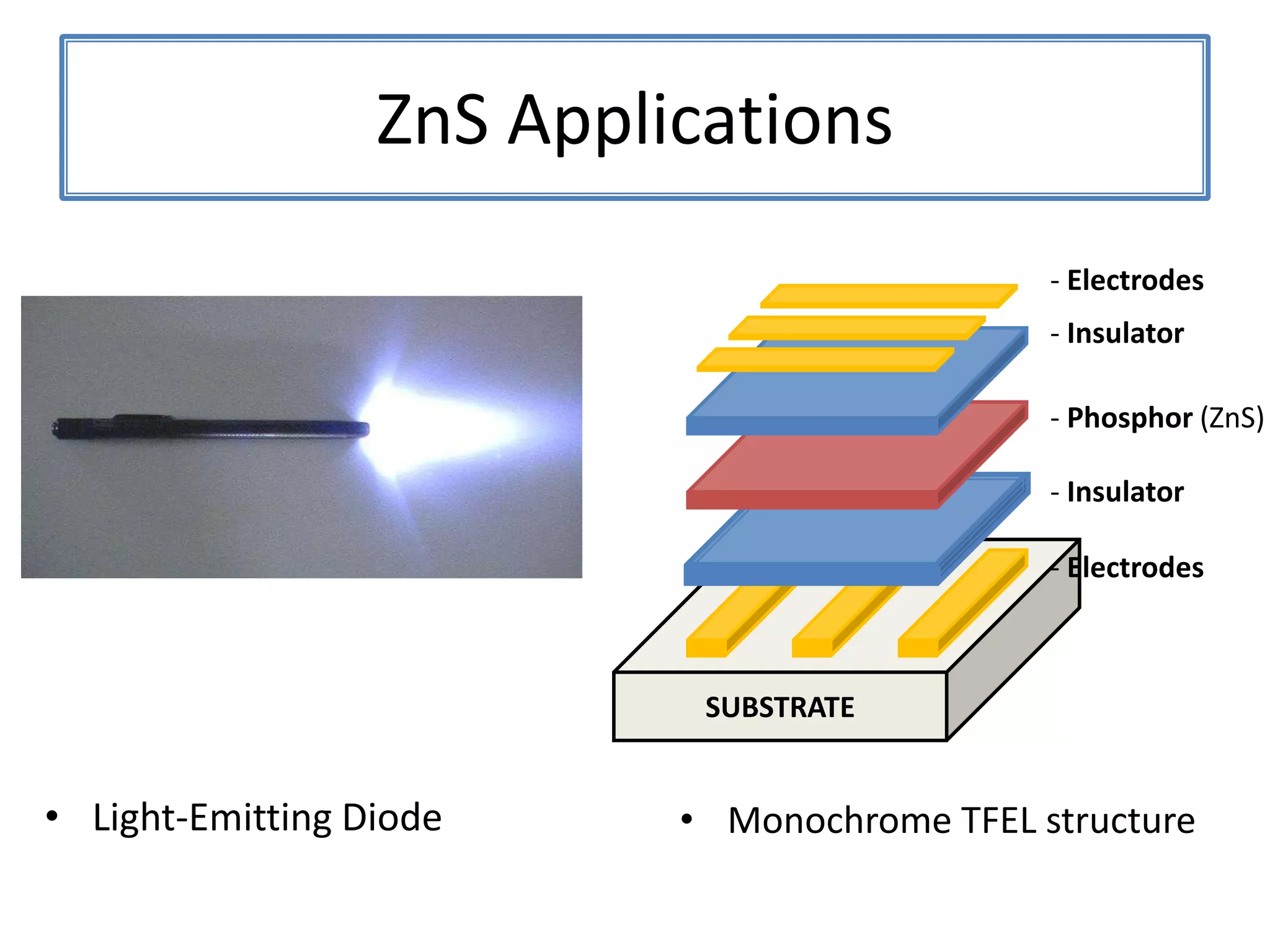
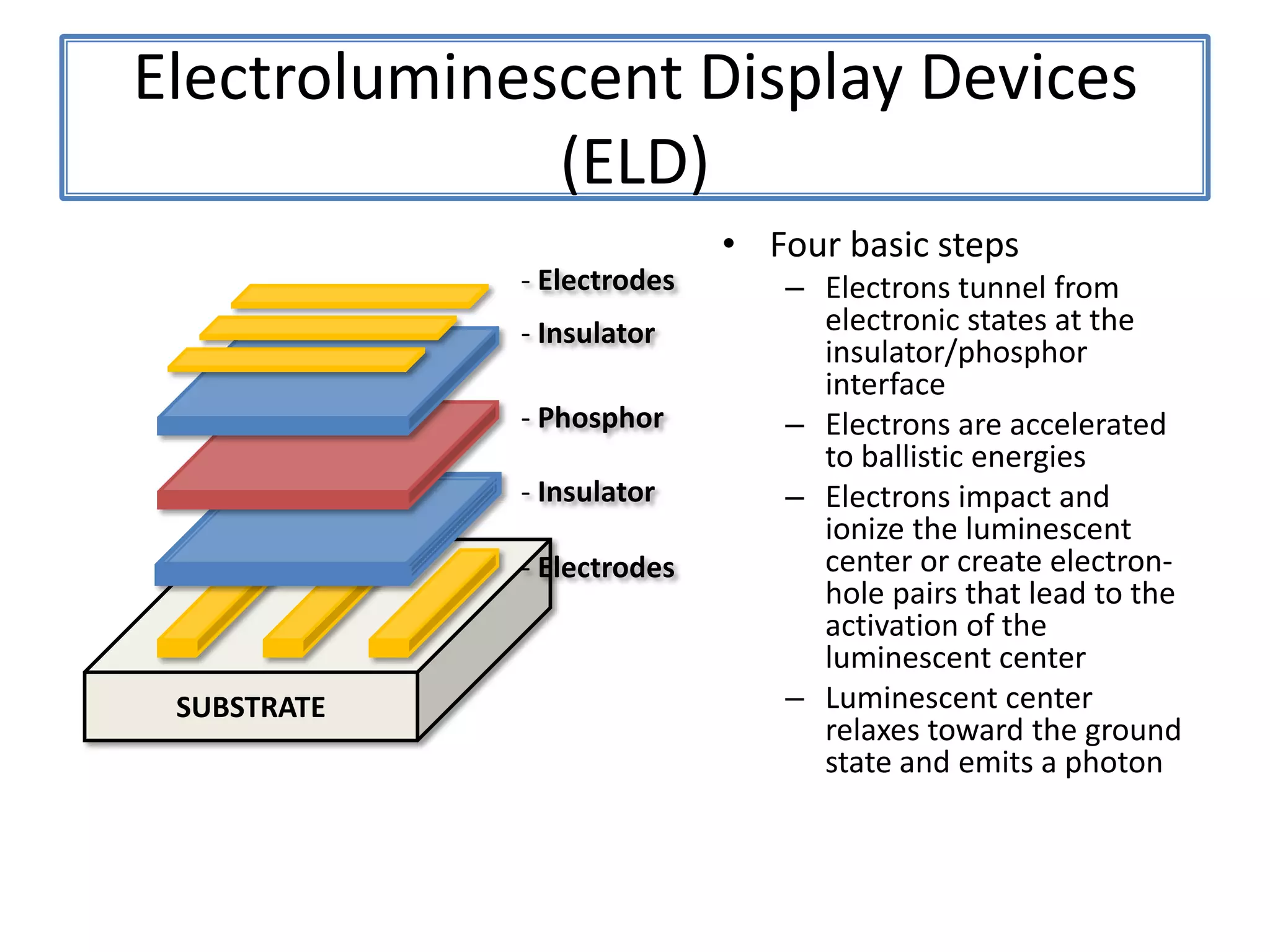
ZnS Applications- Electrodes- Insulator- Phosphor (ZnS)- InsulatorSUBSTRATE- ElectrodesLight-Emitting Diode
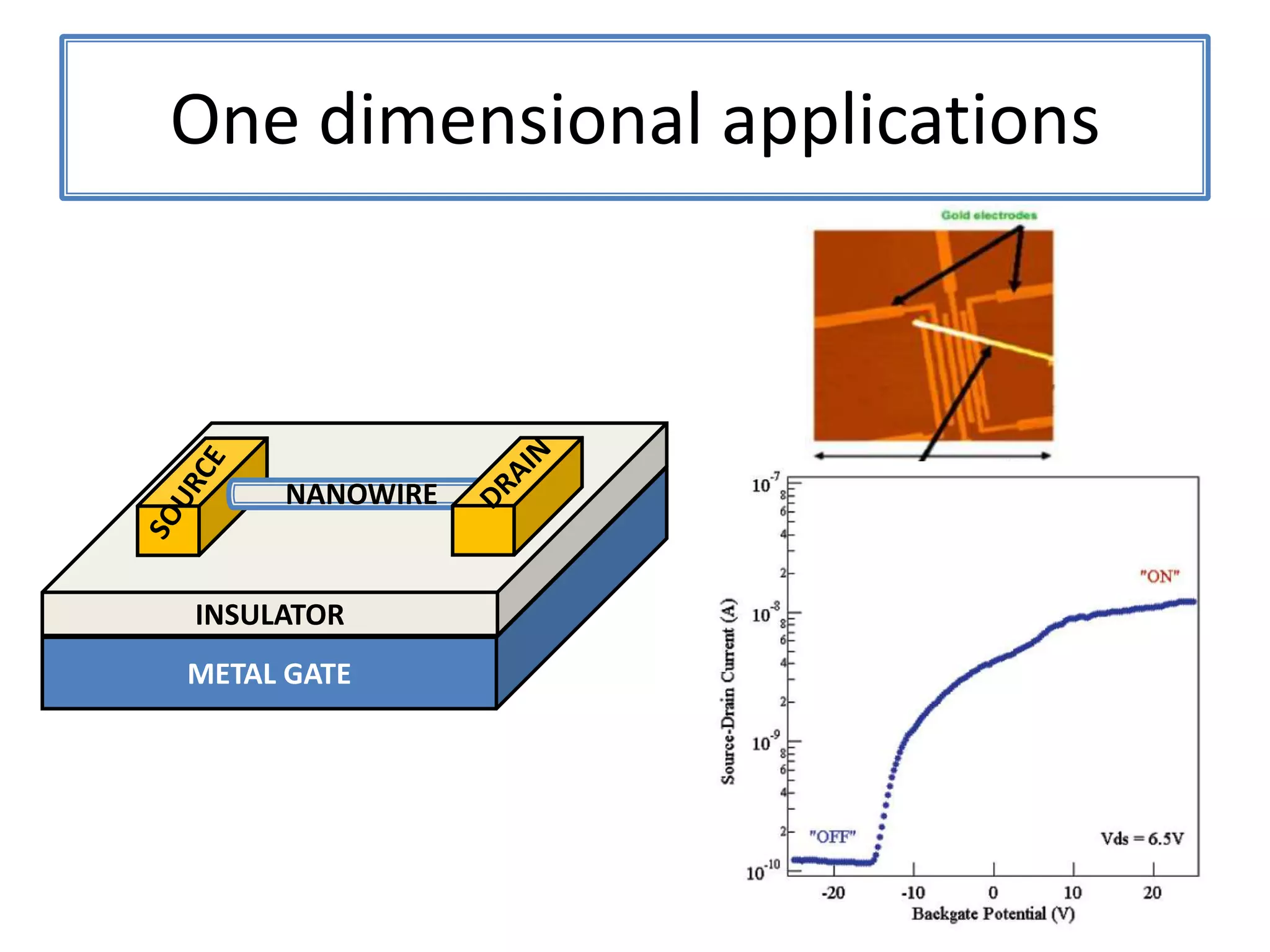
Monochrome TFEL structureOne dimensional applicationsINSULATORDRAINSOURCEMETAL GATENANOWIRE
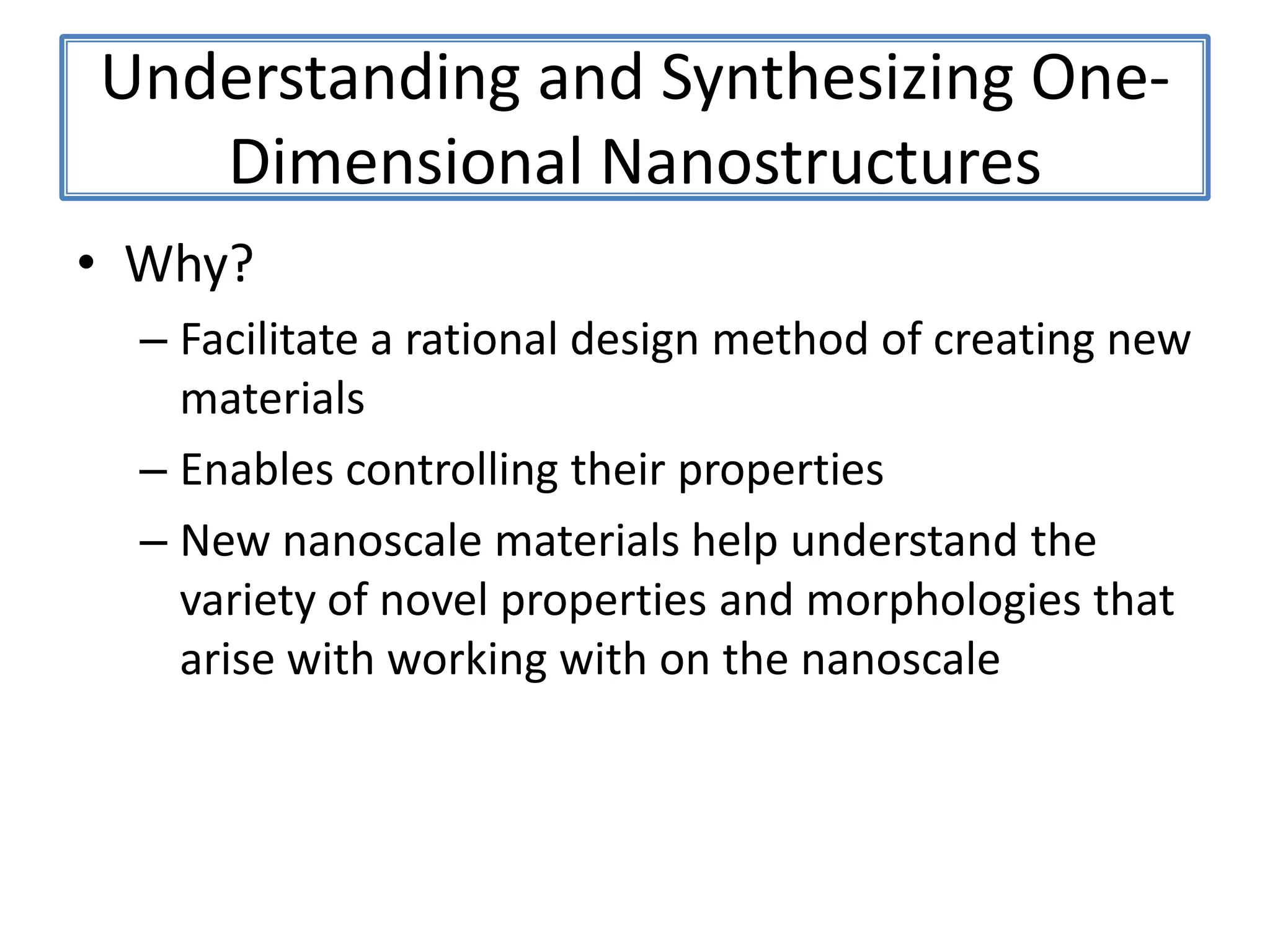
Understanding and Synthesizing One-Dimensional NanostructuresWhy?Facilitate a rational design method of creating new materialsEnables controlling their propertiesNew nanoscale materials help understand the variety of novel properties and morphologies that arise with working with on the nanoscale
ZnS Crystallographic and Growth ModelsApplicationsModelsCrystallographic StructureSynthesis and GrowthNovel ZnS NanostructuresNanobelts/NanowiresAligned ZnS NanowiresNanohelicesUltralongZnS/SiO2 nanowires
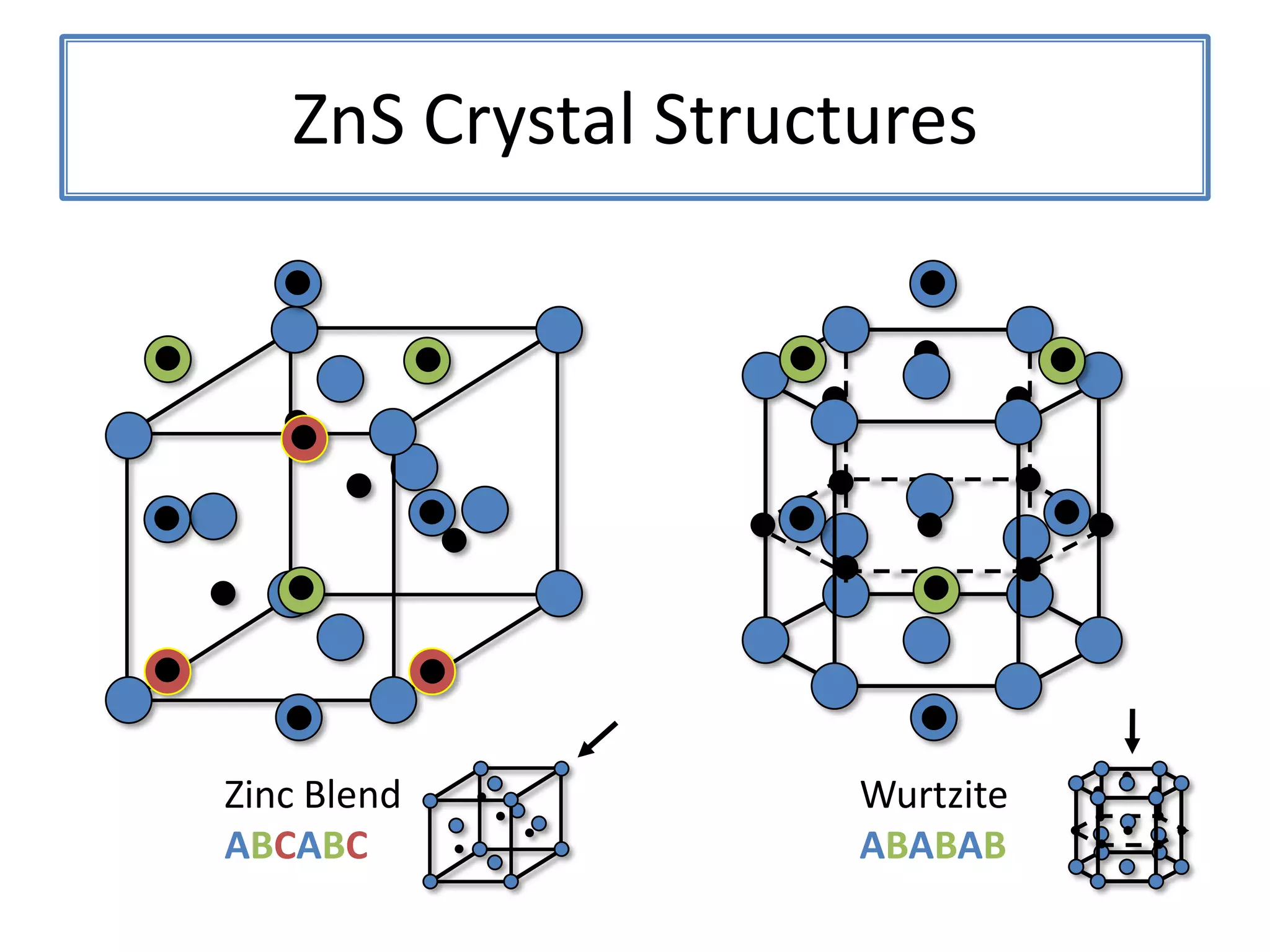
ZnS Crystal StructuresZinc BlendABCABCWurtziteABABAB
ZnS Wurtzite(0111)(0001)Wurtzite crystal structure projected along [2110]
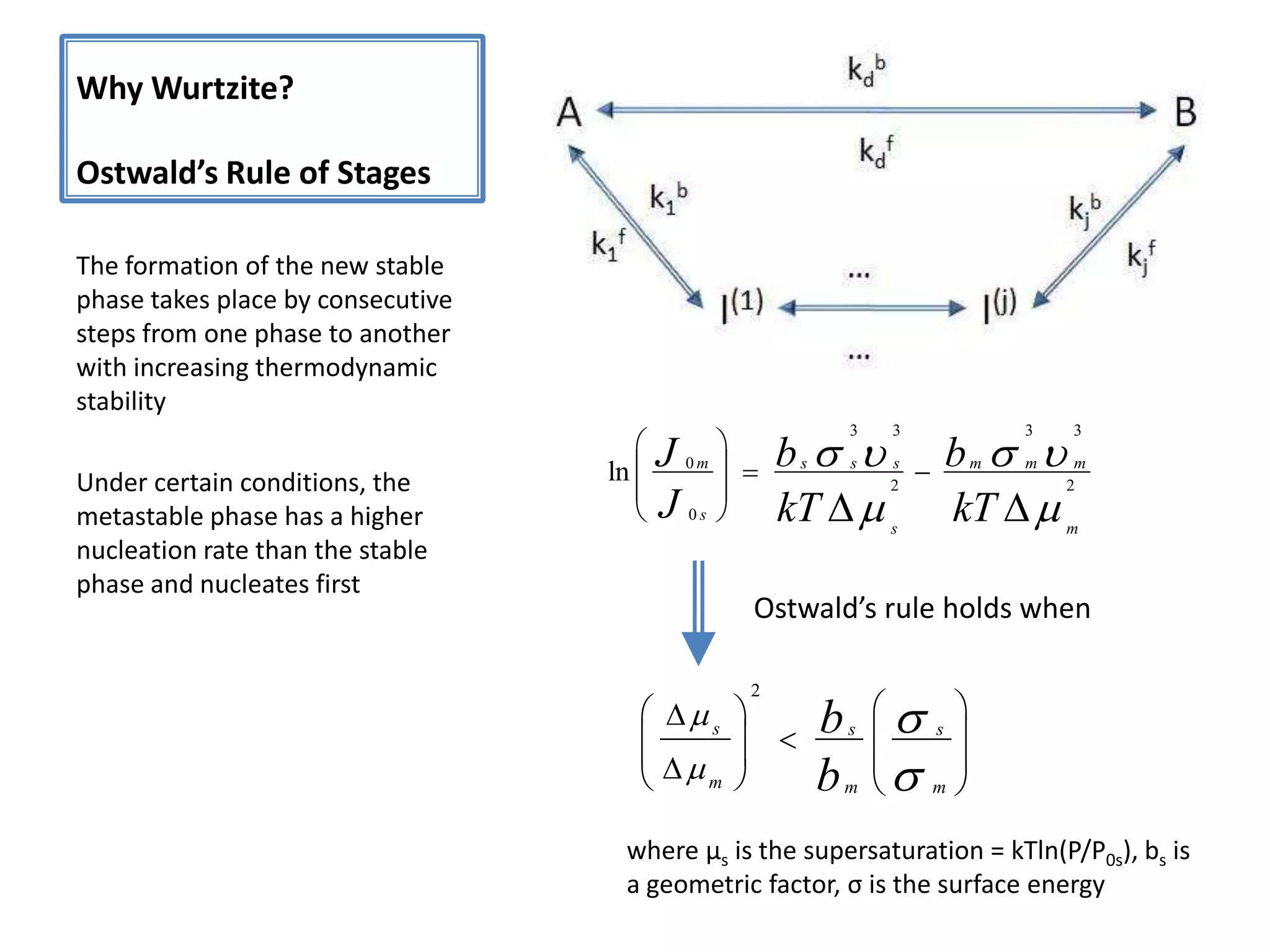
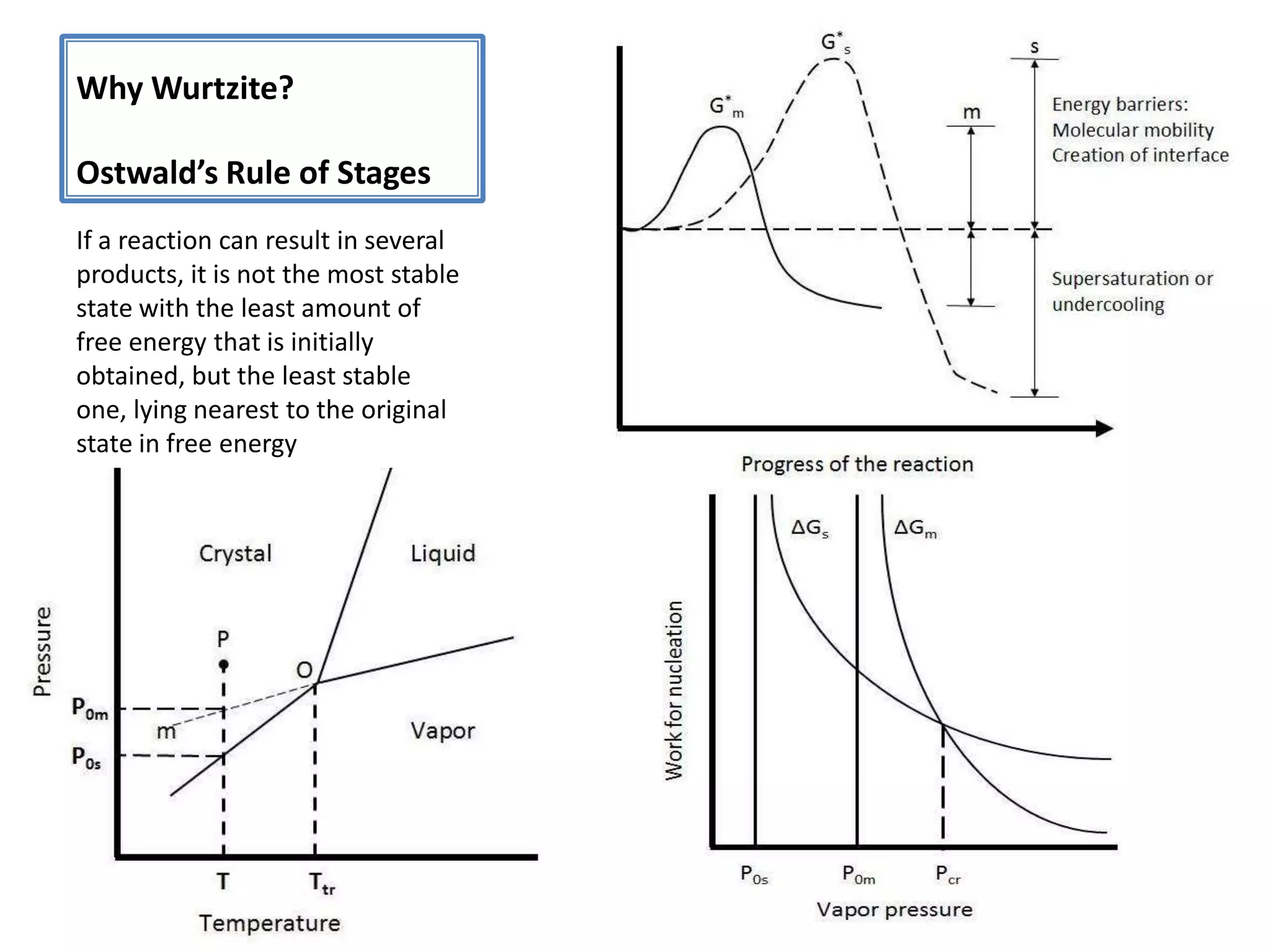
Why Wurtzite?Ostwald’s Rule of StagesThe formation of the new stable phase takes place by consecutive steps from one phase to another with increasing thermodynamic stabilityUnder certain conditions, the metastable phase has a higher nucleation rate than the stable phase and nucleates firstOstwald’s rule holds whenwhere μs is the supersaturation = kTln(P/P0s), bs is a geometric factor, σ is the surface energy
Why Wurtzite?Ostwald’s Rule of StagesIf a reaction can result in several products, it is not the most stable state with the least amount of free energy that is initially obtained, but the least stable one, lying nearest to the original state in free energy
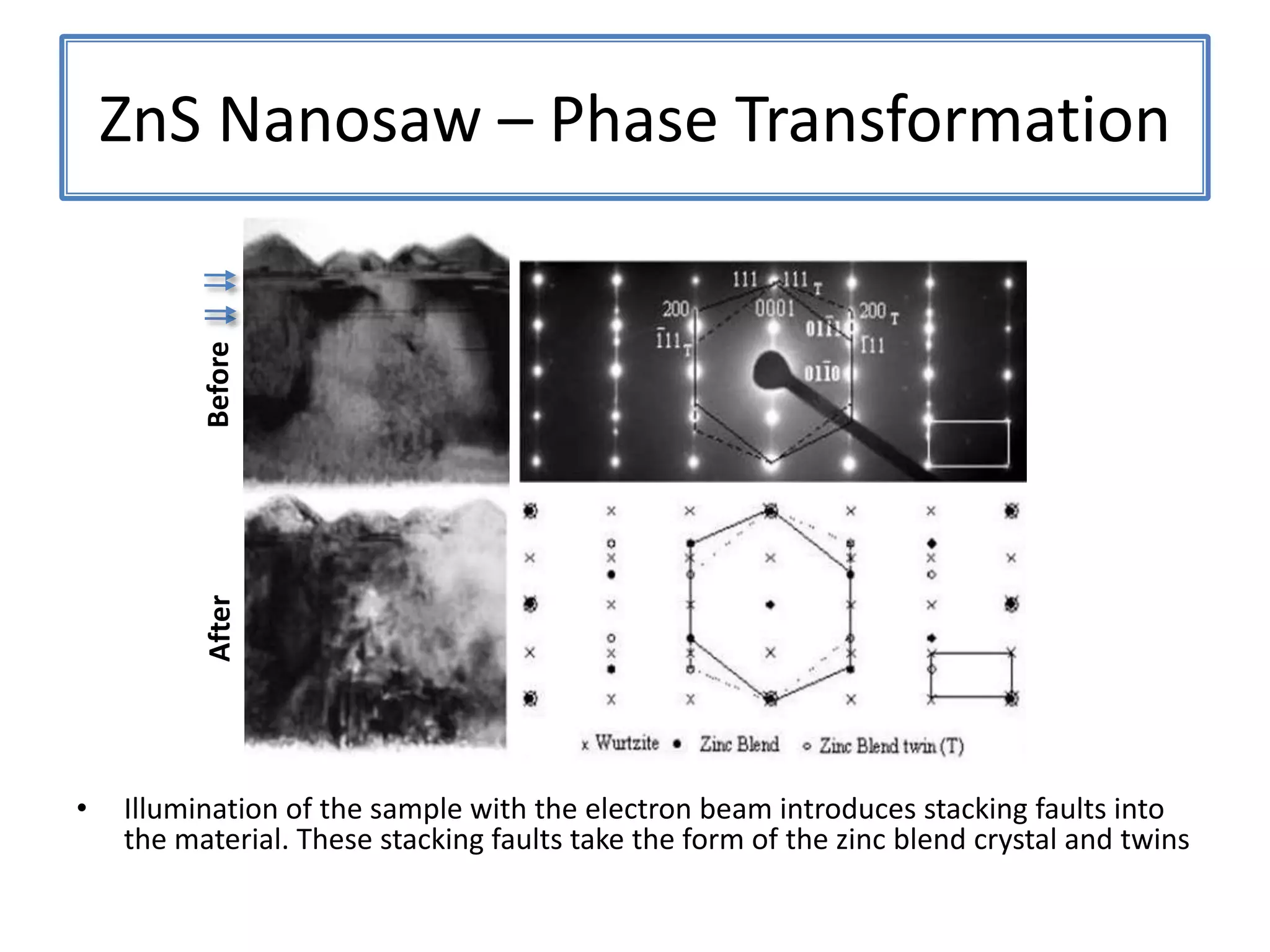
ZnS Nanosaw – Phase TransformationBeforeAfterIllumination of the sample with the electron beam introduces stacking faults into the material. These stacking faults take the form of the zinc blend crystal and twins
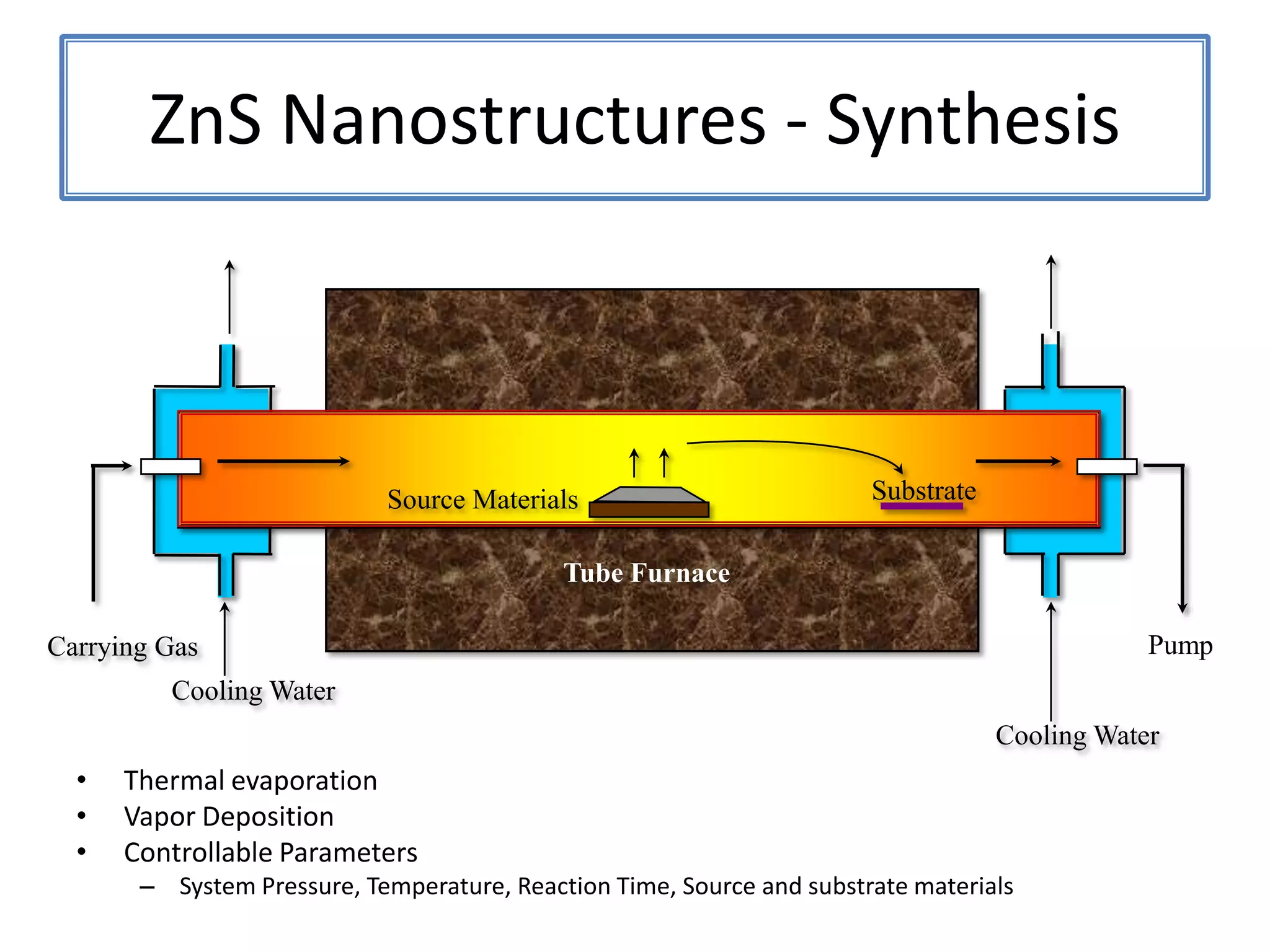
ZnS Nanostructures - SynthesisSubstrateSource MaterialsCooling WaterCooling WaterTube FurnacePumpCarrying GasThermal evaporationVapor DepositionControllable ParametersSystem Pressure, Temperature, Reaction Time, Source and substrate materials
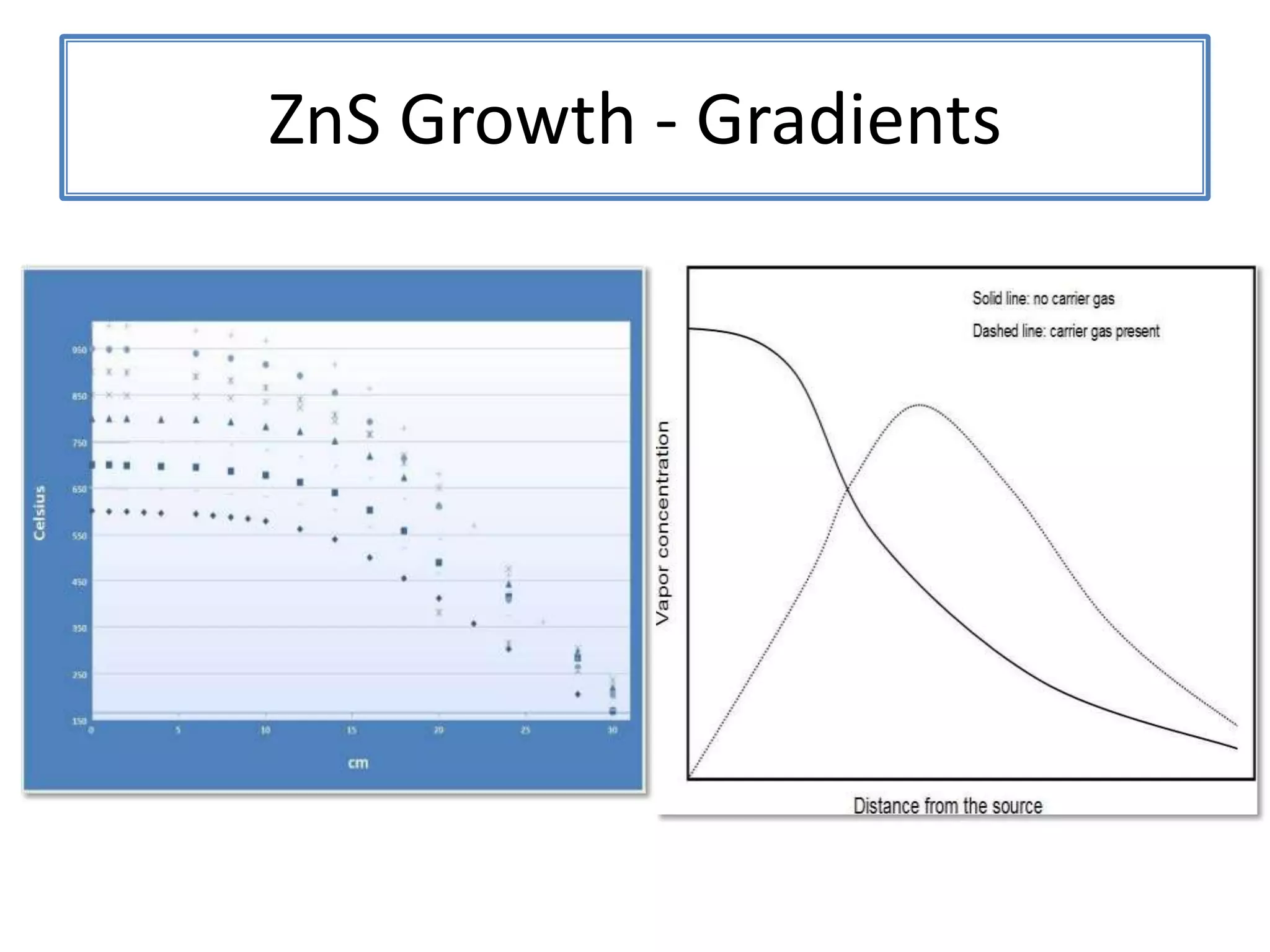
ZnS Growth - Gradients
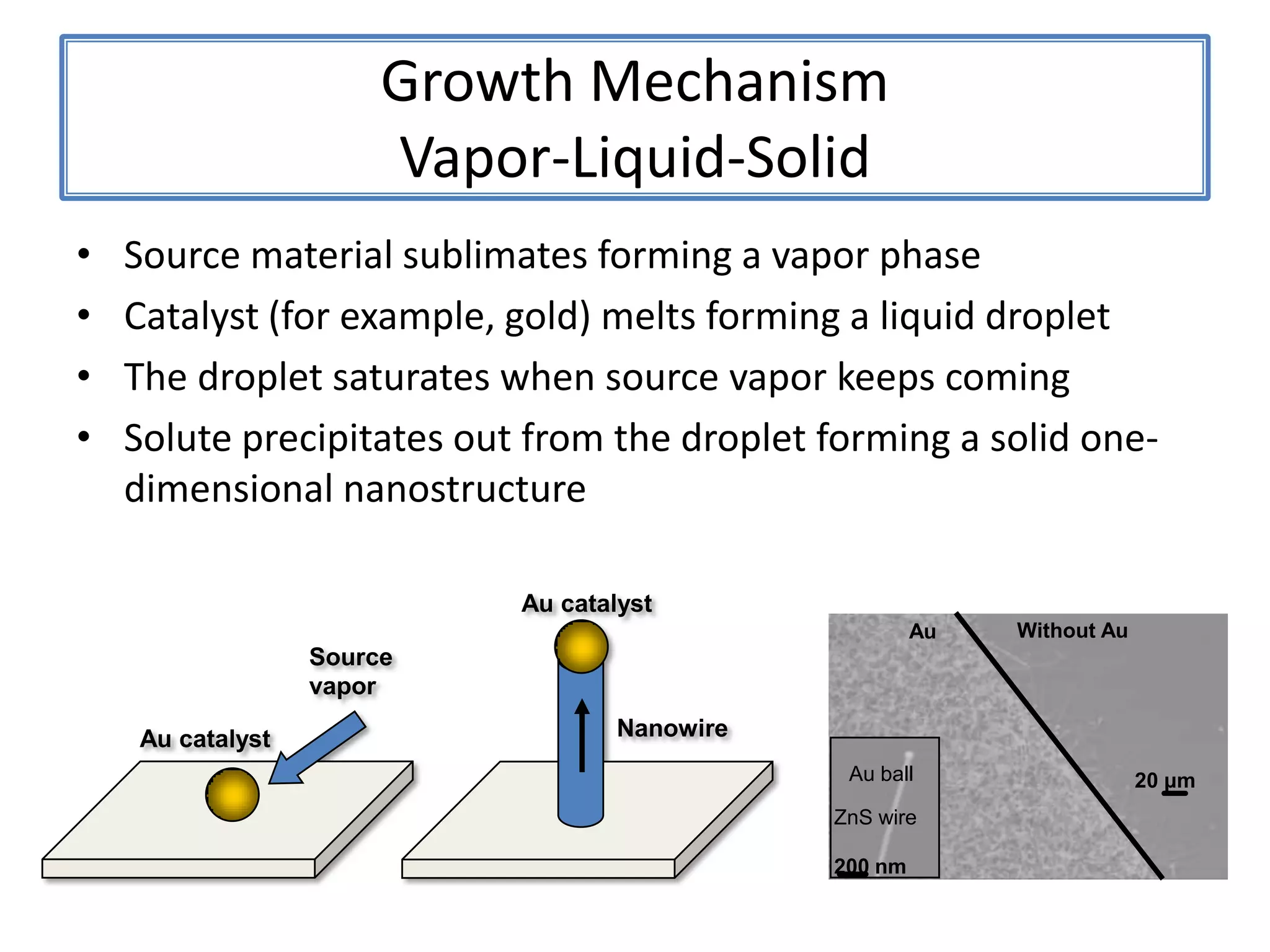
Growth MechanismVapor-Liquid-SolidAu catalystSource vaporNanowireAu catalystWithout AuAuSource material sublimates forming a vapor phaseCatalyst (for example, gold) melts forming a liquid dropletThe droplet saturates when source vapor keeps comingSolute precipitates out from the droplet forming a solid one-dimensional nanostructure20 μmAu ballZnS wire200 nm
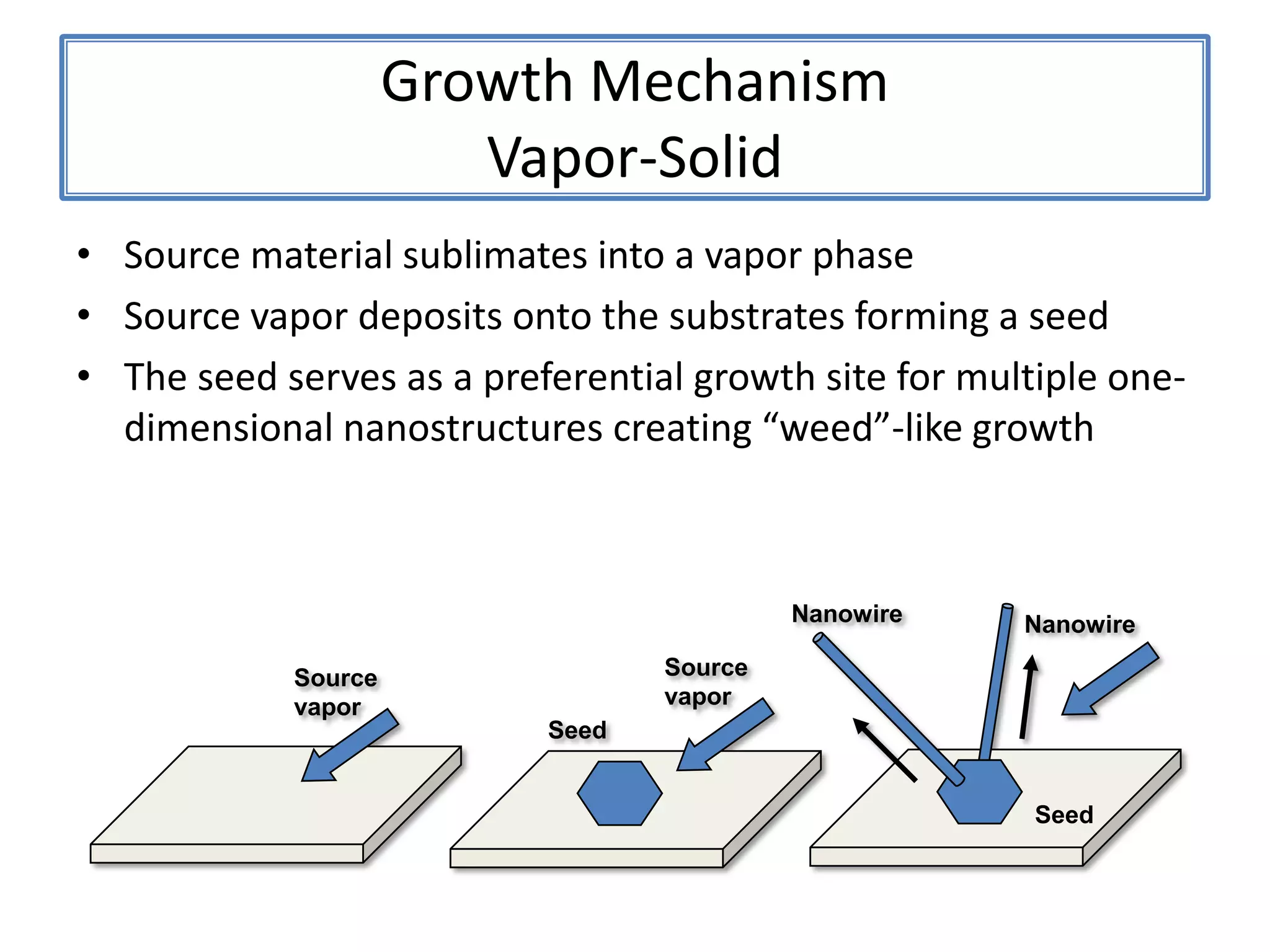
Growth MechanismVapor-SolidNanowireNanowireSource vaporSource vaporSeedSeedSource material sublimates into a vapor phaseSource vapor deposits onto the substrates forming a seedThe seed serves as a preferential growth site for multiple one-dimensional nanostructures creating “weed”-like growth
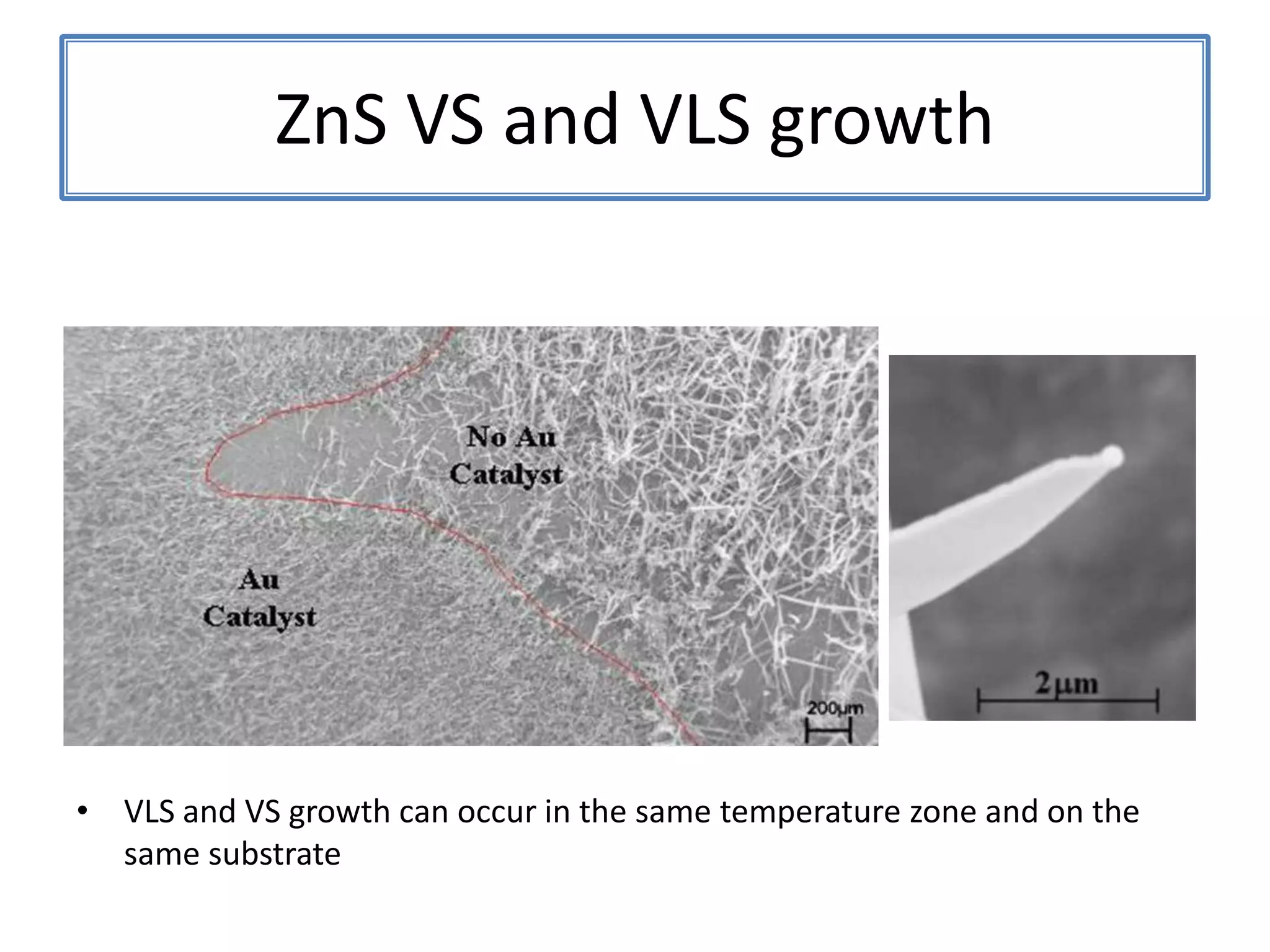
ZnS VS and VLS growthVLS and VS growth can occur in the same temperature zone and on the same substrate
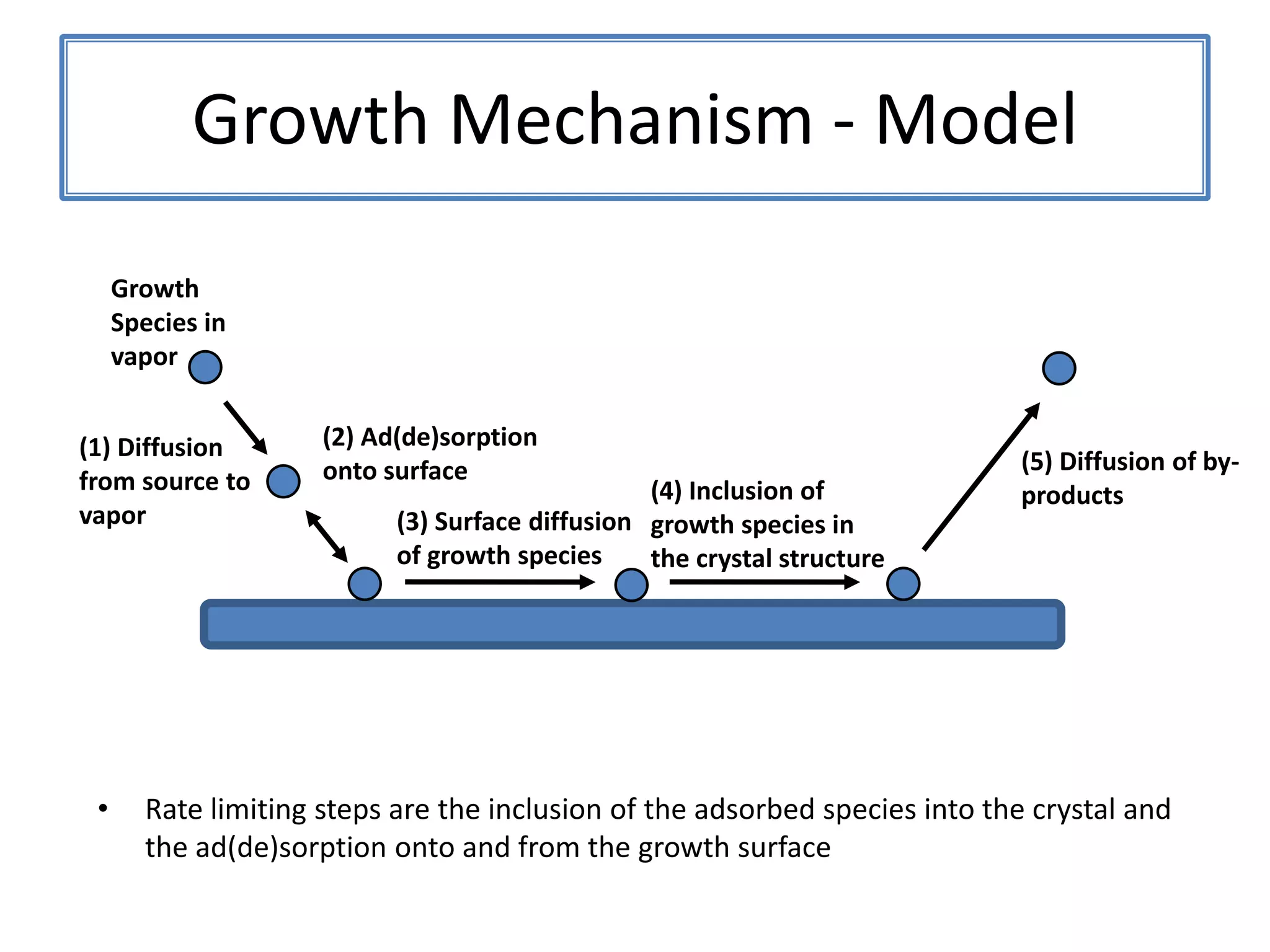
Growth Mechanism - ModelGrowth Species in vapor(2) Ad(de)sorption onto surface(1) Diffusion from source to vapor(5) Diffusion of by- products(4) Inclusion of growth species in the crystal structure(3) Surface diffusion of growth speciesRate limiting steps are the inclusion of the adsorbed species into the crystal and the ad(de)sorption onto and from the growth surface
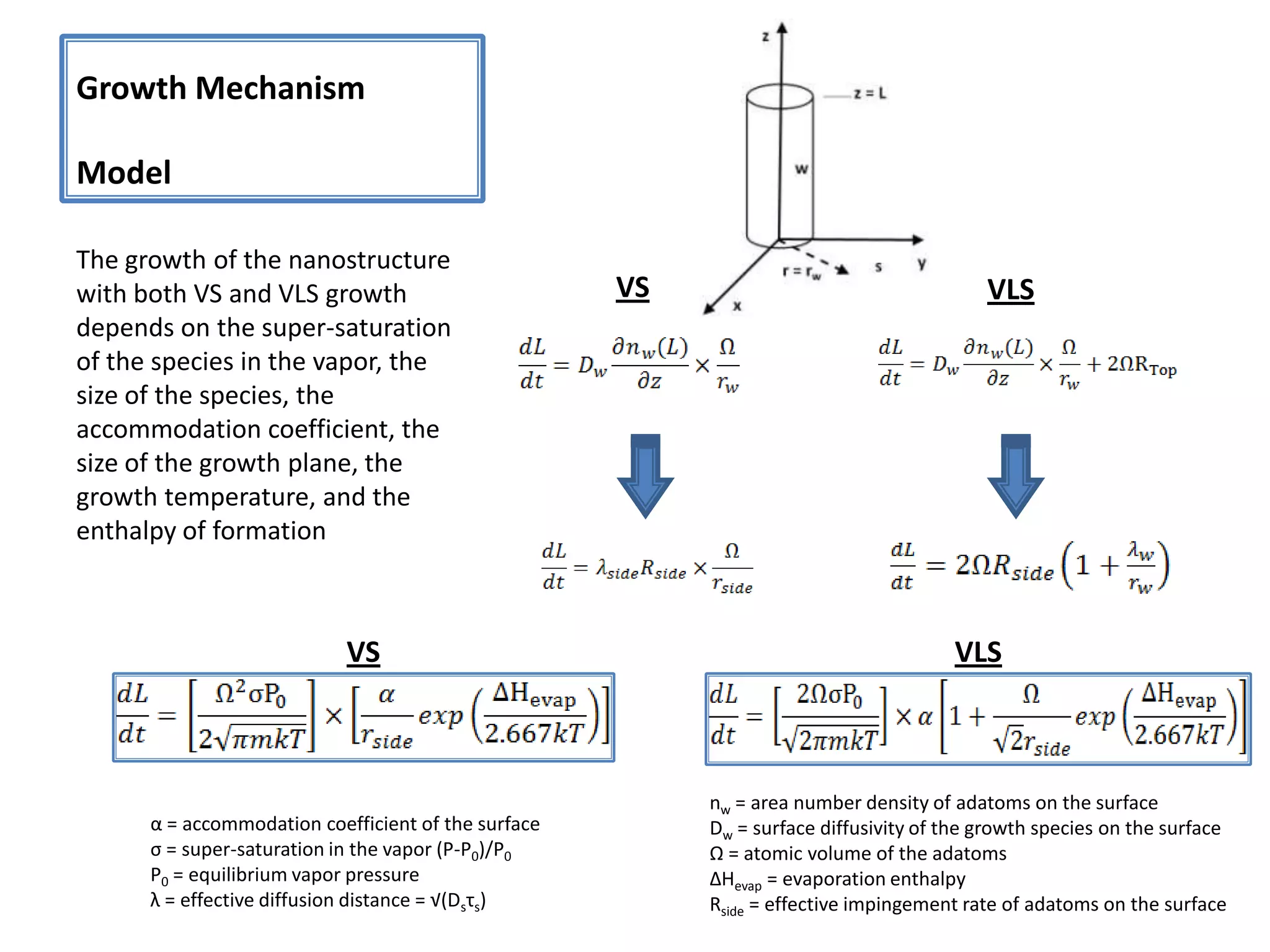
Growth MechanismModelThe growth of the nanostructure with both VS and VLS growth depends on the super-saturation of the species in the vapor, the size of the species, the accommodation coefficient, the size of the growth plane, the growth temperature, and the enthalpy of formationVSVLSVLSVSnw = area number density of adatoms on the surfaceDw= surface diffusivity of the growth species on the surfaceΩ = atomic volume of the adatoms∆Hevap = evaporation enthalpyRside = effective impingement rate of adatoms on the surfaceα = accommodation coefficient of the surfaceσ = super-saturation in the vapor (P-P0)/P0P0 = equilibrium vapor pressureλ = effective diffusion distance = √(Dsτs)
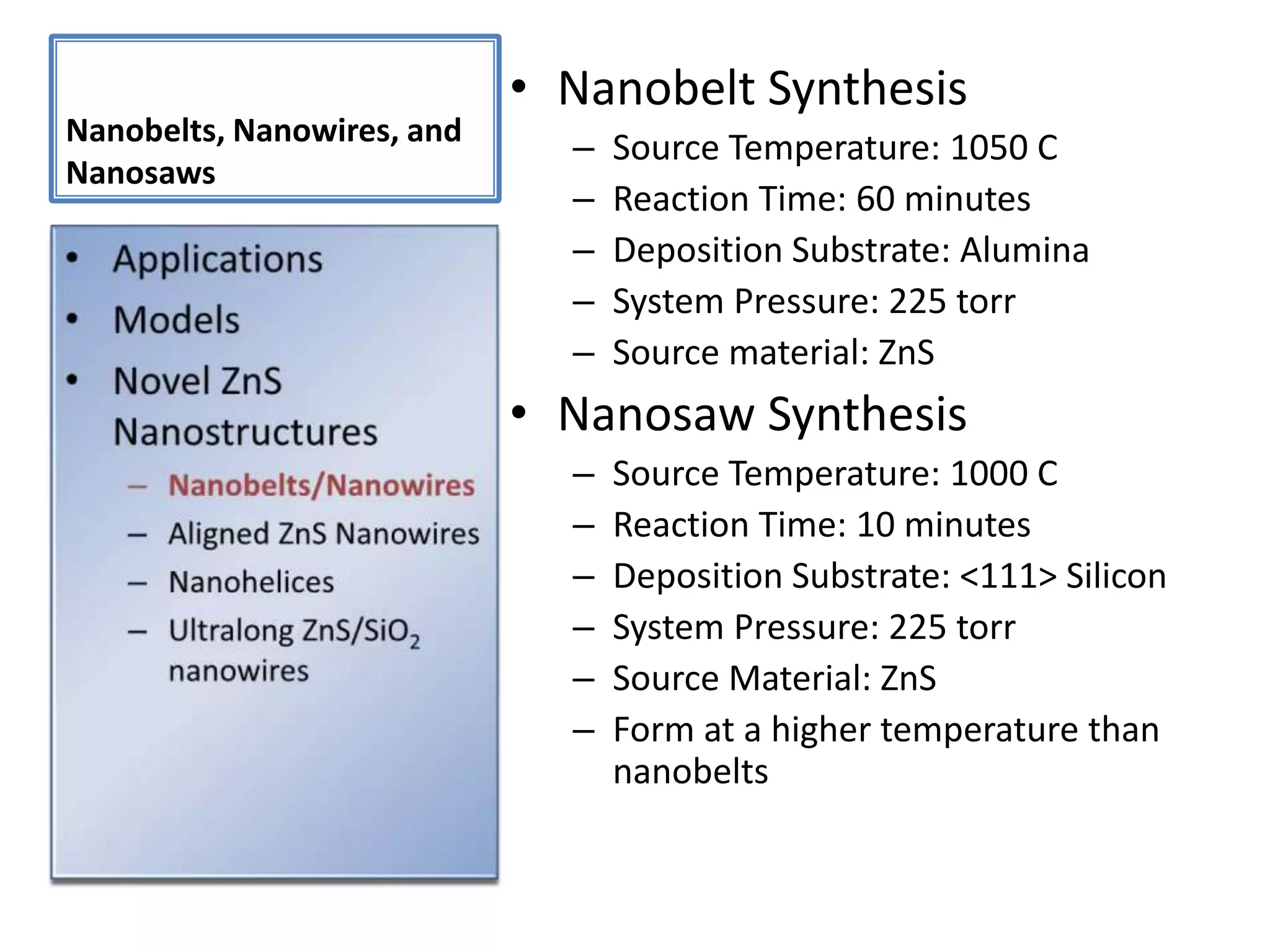
Nanobelts, Nanowires, and NanosawsNanobelt SynthesisSource Temperature: 1050 CReaction Time: 60 minutesDeposition Substrate: AluminaSystem Pressure: 225 torrSource material: ZnSNanosaw SynthesisSource Temperature: 1000 CReaction Time: 10 minutesDeposition Substrate: <111> SiliconSystem Pressure: 225 torrSource Material: ZnSForm at a higher temperature than nanobeltsApplications
Models
Novel ZnS Nanostructures
Nanobelts/Nanowires
Aligned ZnS Nanowires
Nanohelices
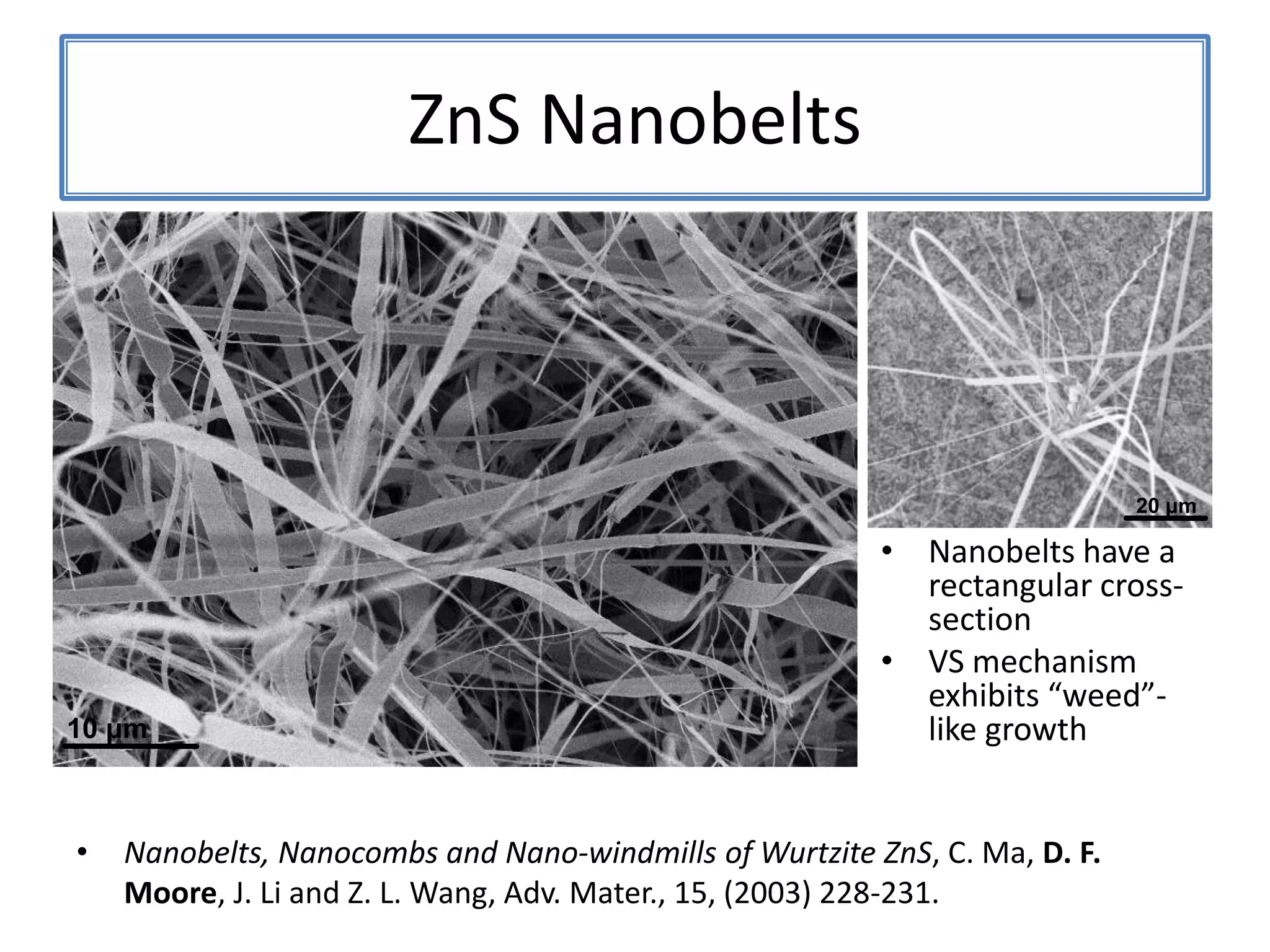
Ultralong ZnS/SiO2 nanowiresZnS Nanobelts20 μmNanobelts have a rectangular cross-sectionVS mechanism exhibits “weed”-like growth10 μmNanobelts, Nanocombs and Nano-windmills of Wurtzite ZnS, C. Ma, D. F. Moore, J. Li and Z. L. Wang, Adv. Mater., 15, (2003) 228-231.
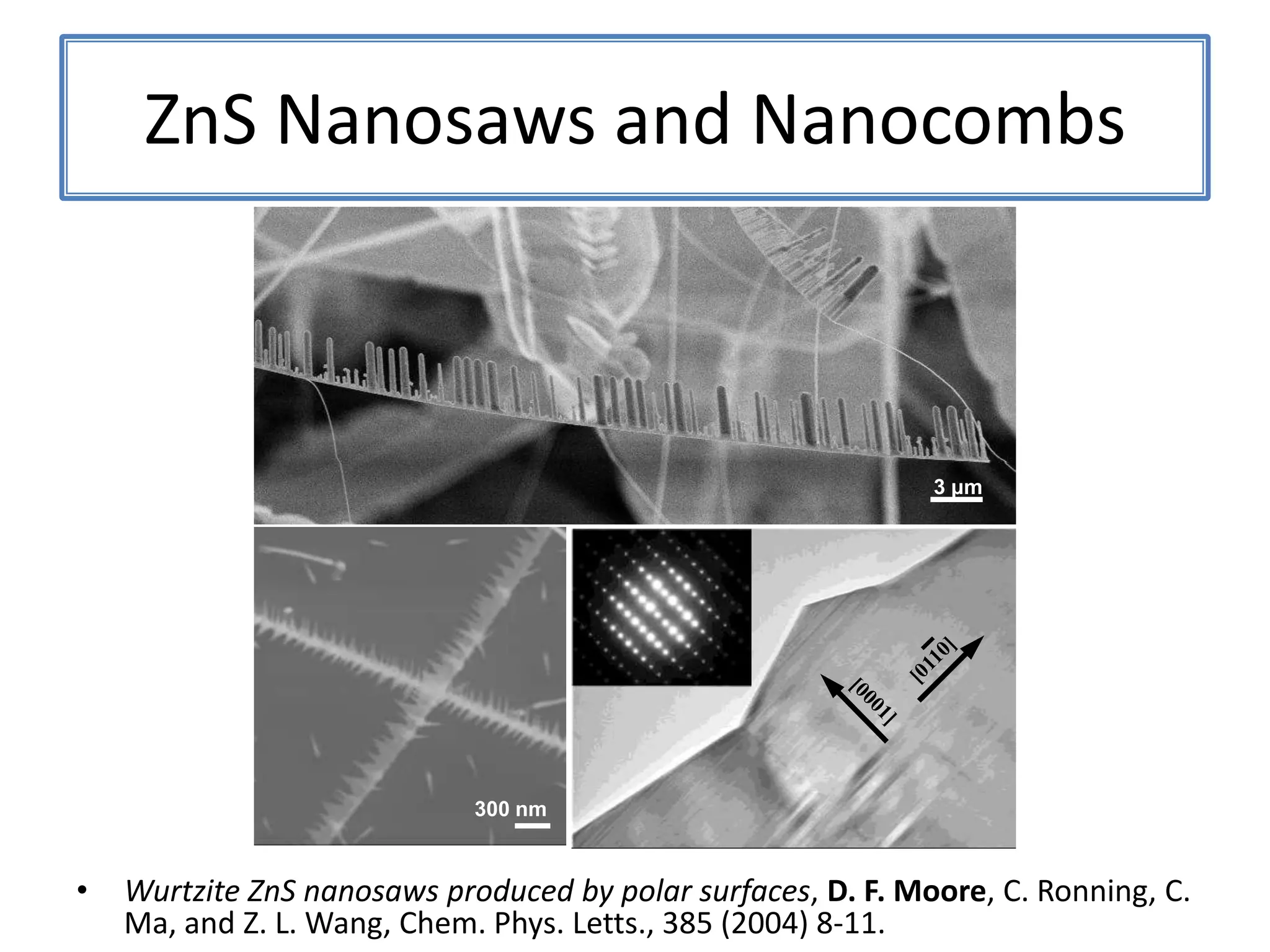
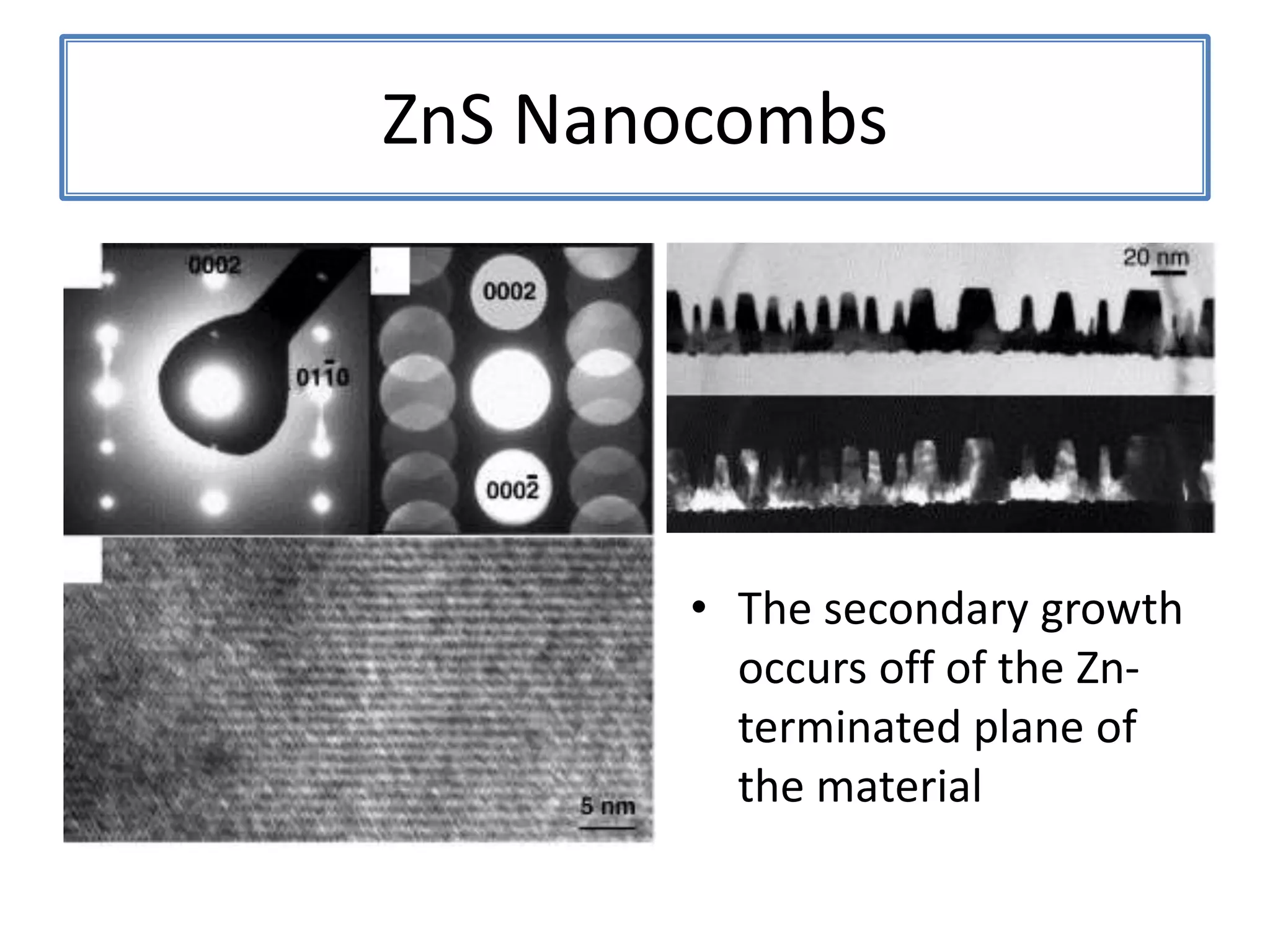
ZnSNanosaws and Nanocombs3 μm[0110][0001]300 nmWurtzite ZnS nanosaws produced by polar surfaces, D. F. Moore, C. Ronning, C. Ma, and Z. L. Wang, Chem. Phys. Letts., 385 (2004) 8-11.
ZnS NanocombsThe secondary growth occurs off of the Zn-terminated plane of the material
ZnS Nanobelt/Nanosaws - GrowthNanosaws form at high temperature zones, closer to the source materialCloser to the source material also has higher concentration of the growth species in the atmosphereThe higher concentration of the growth species contributes to the secondary growthThe secondary growth forms on the more chemically active plane (here, the Zn-terminated plane)
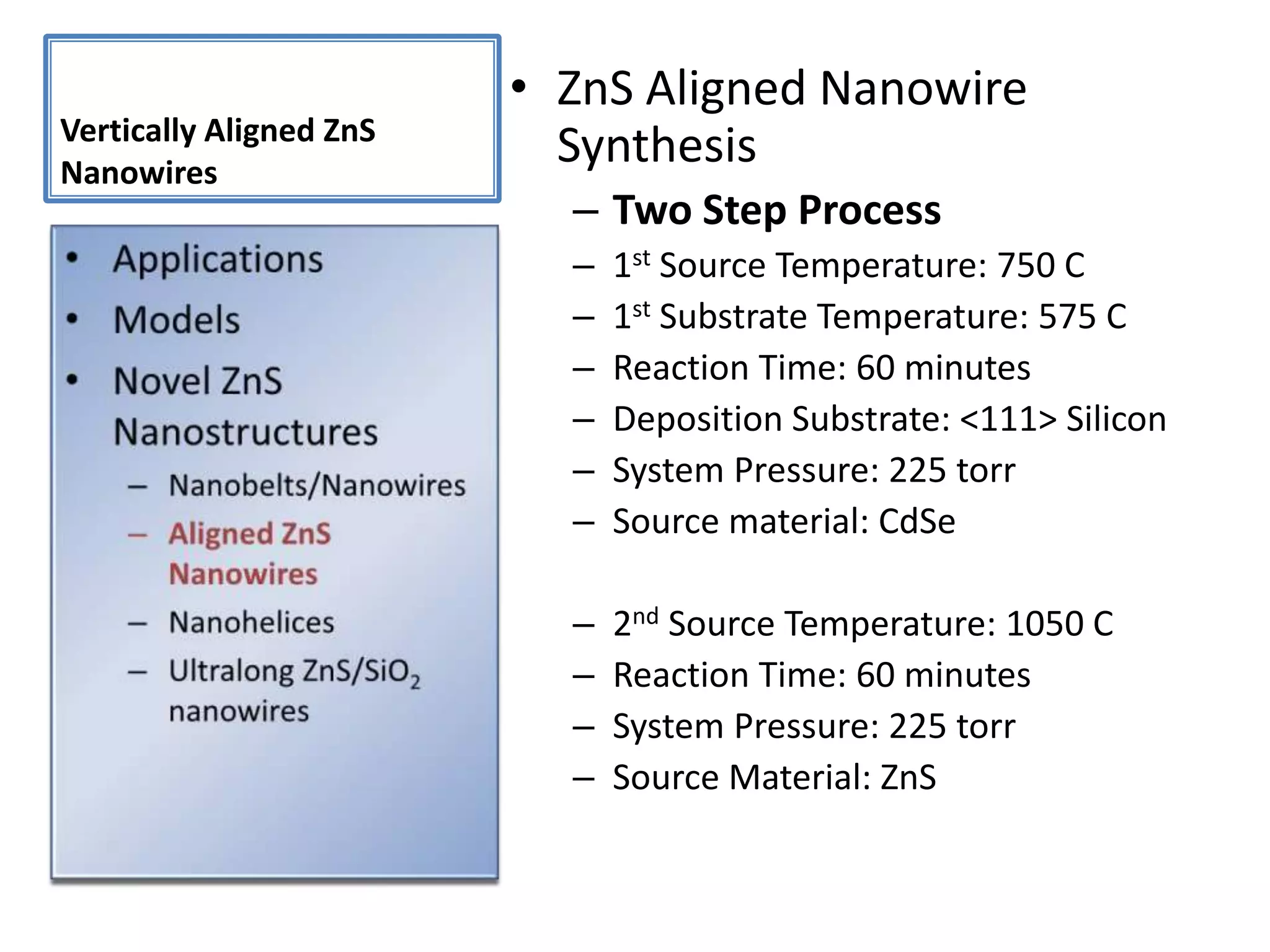
Vertically Aligned ZnS NanowiresZnS Aligned Nanowire SynthesisTwo Step Process1st Source Temperature: 750 C1st Substrate Temperature: 575 CReaction Time: 60 minutesDeposition Substrate: <111> SiliconSystem Pressure: 225 torrSource material: CdSe2nd Source Temperature: 1050 CReaction Time: 60 minutesSystem Pressure: 225 torrSource Material: ZnSApplications
Models
Novel ZnS Nanostructures
Nanobelts/Nanowires
Aligned ZnS Nanowires
Nanohelices
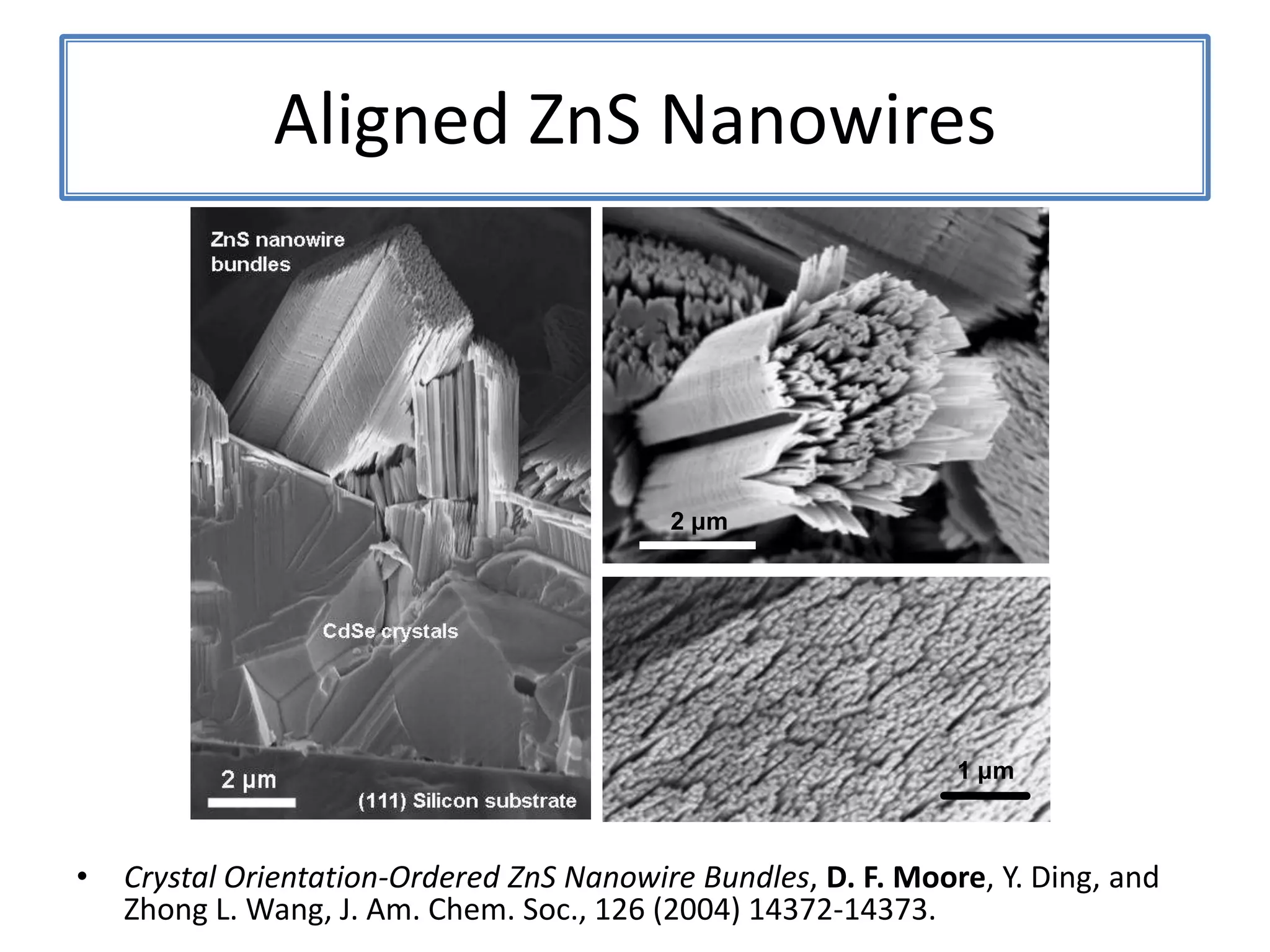
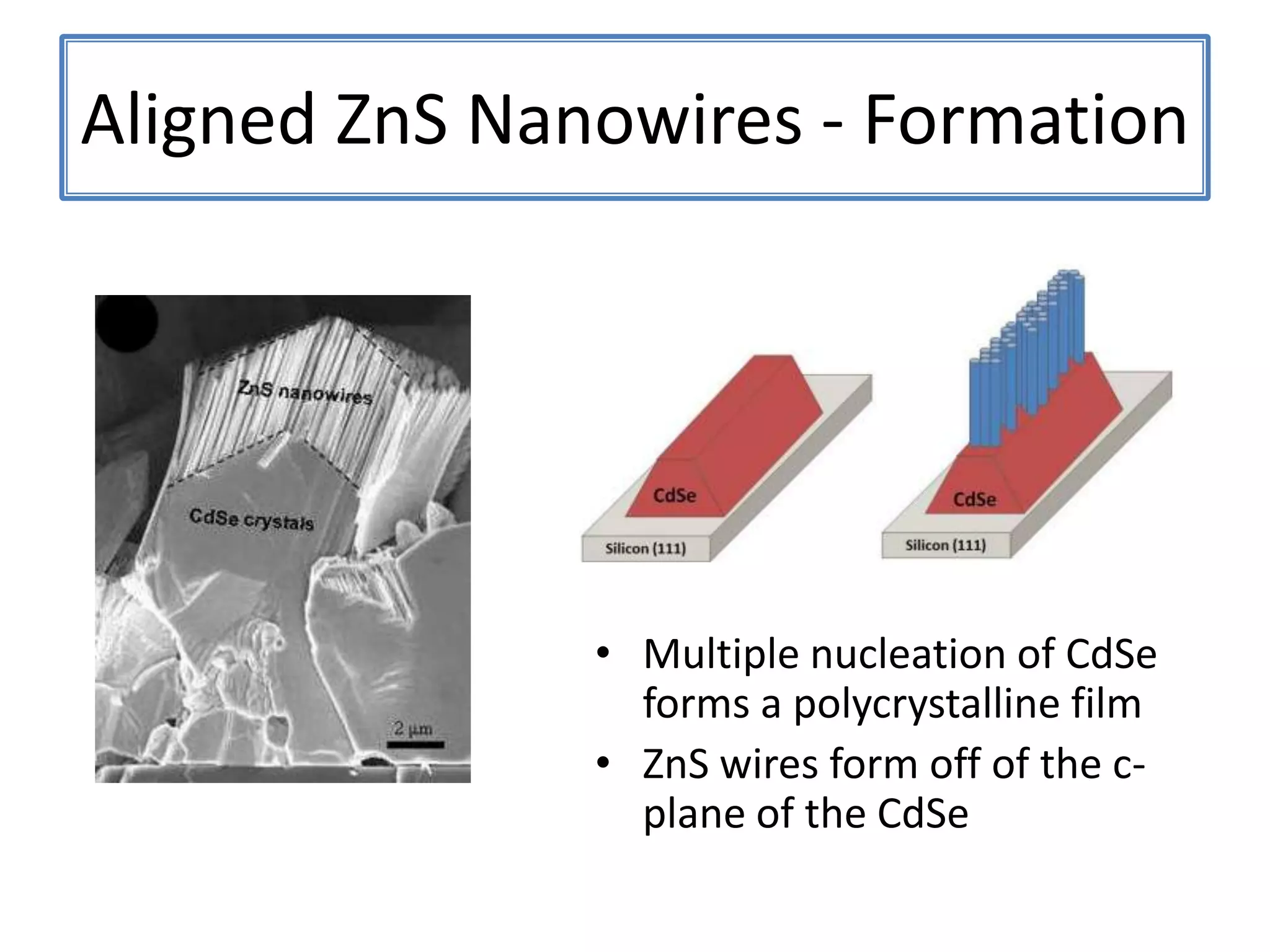
Ultralong ZnS/SiO2 nanowiresAligned ZnS Nanowires2 μm1 μmCrystal Orientation-Ordered ZnSNanowire Bundles, D. F. Moore, Y. Ding, and Zhong L. Wang, J. Am. Chem. Soc., 126 (2004) 14372-14373.
Aligned ZnS Nanowires
Aligned ZnS Nanowires - FormationMultiple nucleation of CdSe forms a polycrystalline filmZnS wires form off of the c-plane of the CdSe
Aligned ZnS Nanowires - GrowthThe initial deposit of CdSe forms a polycrystalline filmThis film on the silicon serves as the deposition surface for the ZnS nanowiresGrowth occurs because of the lattice match between (0001)-CdSe and (0001)-ZnS and continues because of low growth energy of the growth direction
Hierarchical Structured ZnS NanohelicesZnS Hierarchical Nanohelices SynthesisSource Temperature: 1000 CSubstrate Temperature: 750 CReaction Time: 120 minutesDeposition Substrate: <111> Silicon with 1.5 nm AuSystem Pressure: 20 torrSource material: ZnSLonger growth time, lower growth pressure, and the presence of gold catalystApplications
Models
Novel ZnS Nanostructures
Nanobelts/Nanowires
Aligned ZnS Nanowires
Nanohelices
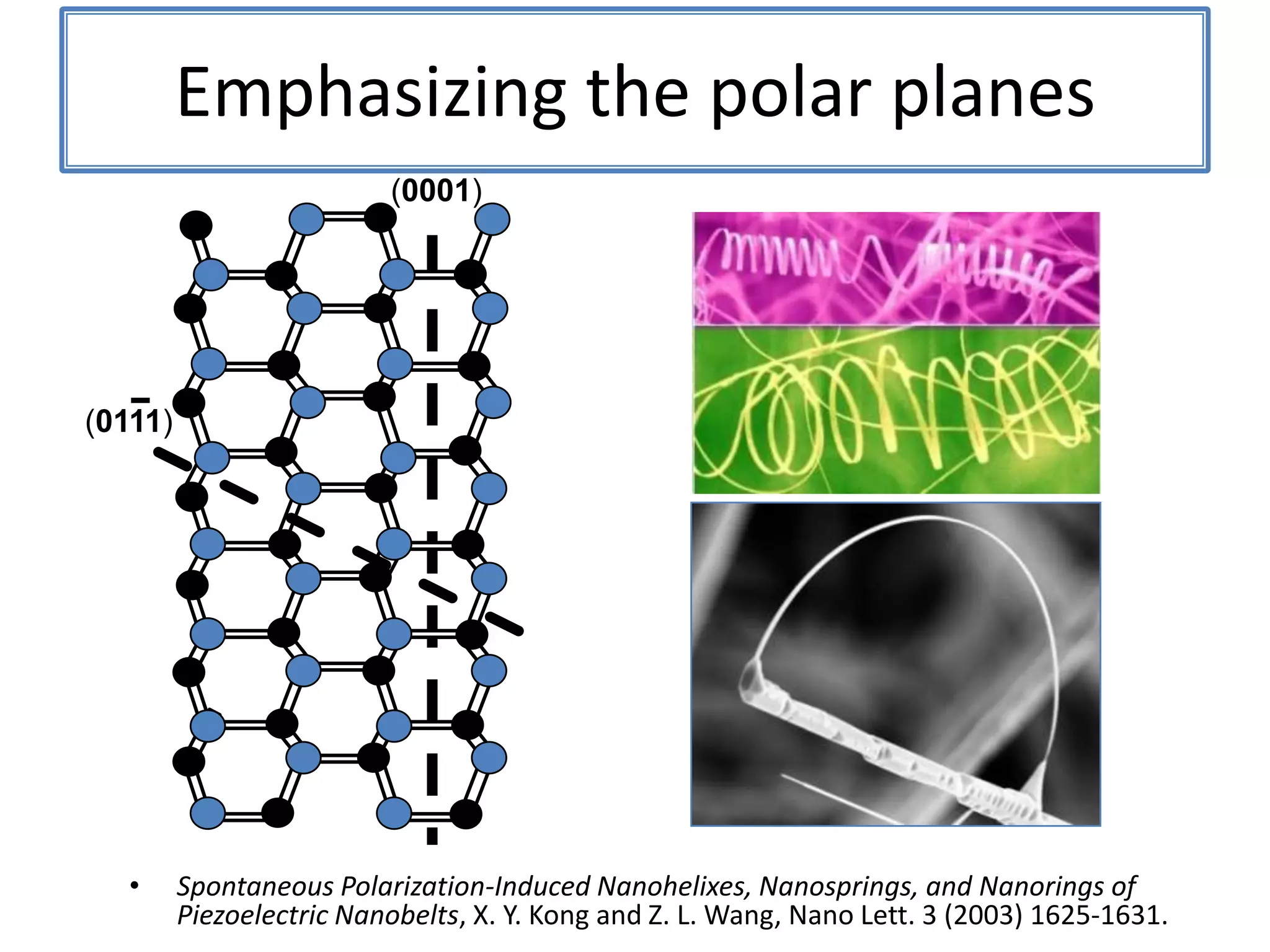
Ultralong ZnS/SiO2 nanowires(0111)Emphasizing the polar planes(0001)Spontaneous Polarization-Induced Nanohelixes, Nanosprings, and Nanorings of Piezoelectric Nanobelts, X. Y. Kong and Z. L. Wang, NanoLett. 3 (2003) 1625-1631.
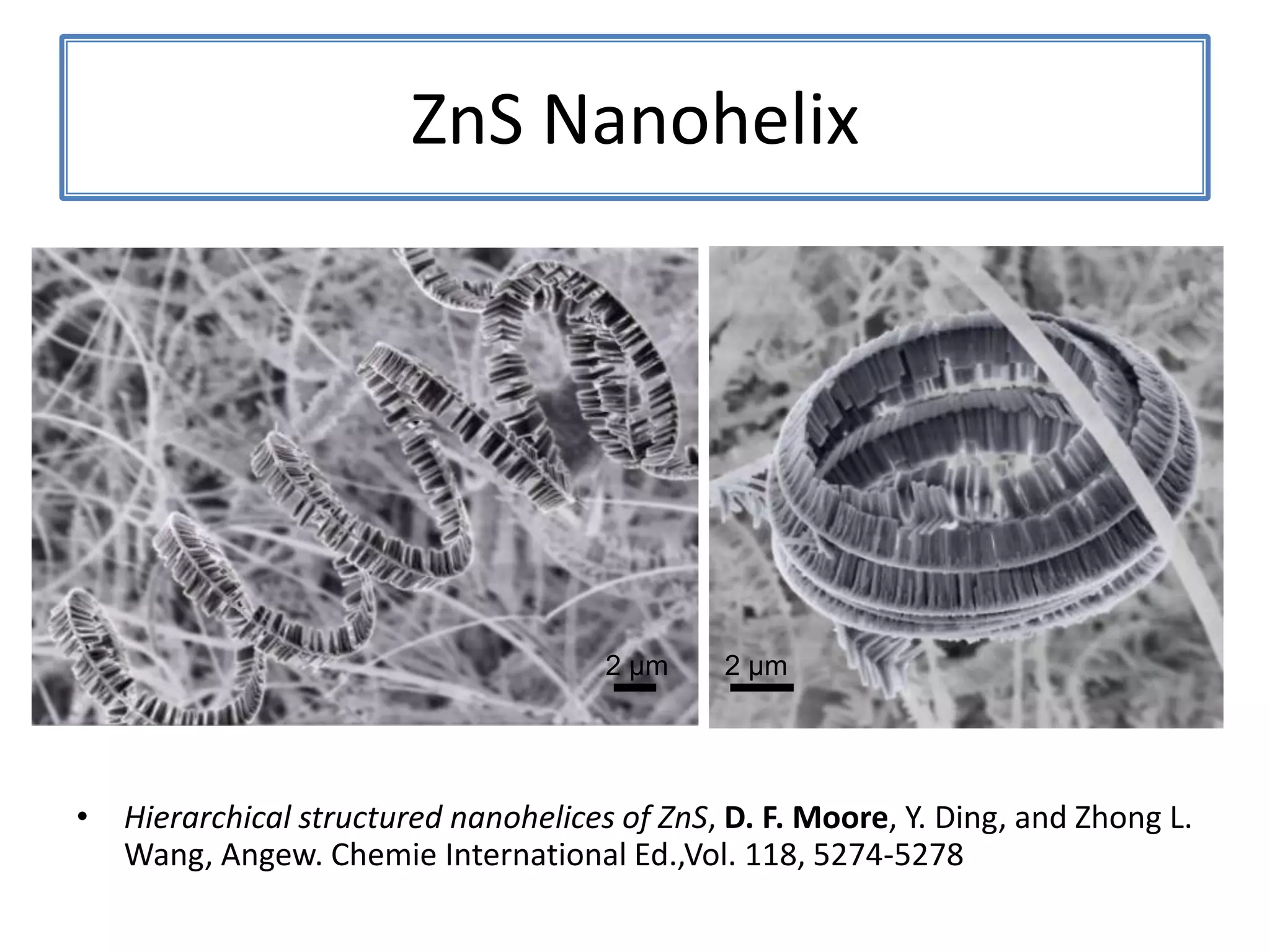
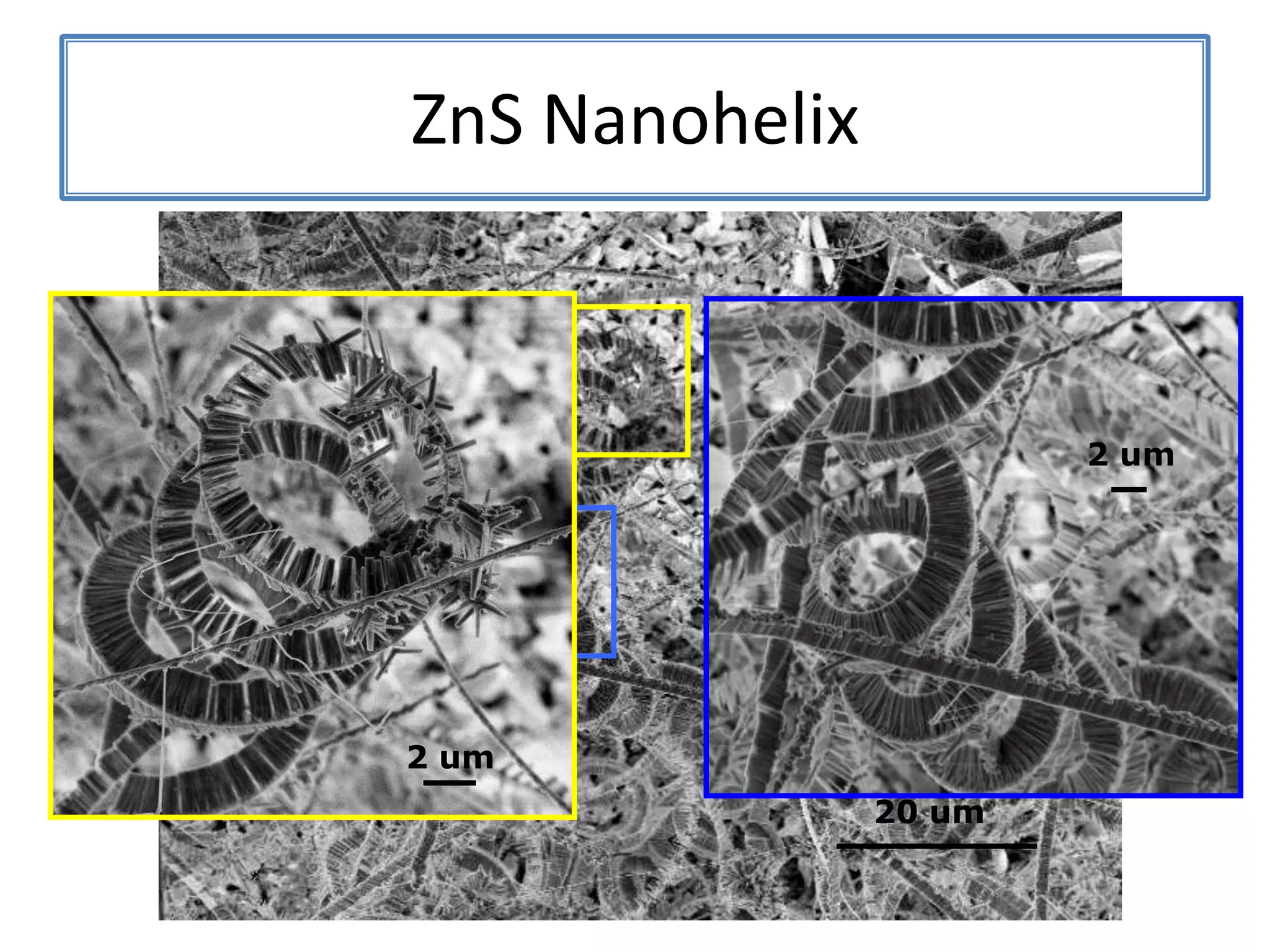
ZnSNanohelix2 μm2 μmHierarchical structured nanohelices of ZnS, D. F. Moore, Y. Ding, and Zhong L. Wang, Angew. Chemie International Ed.,Vol. 118, 5274-5278
ZnSNanohelix2 um2 um20 um
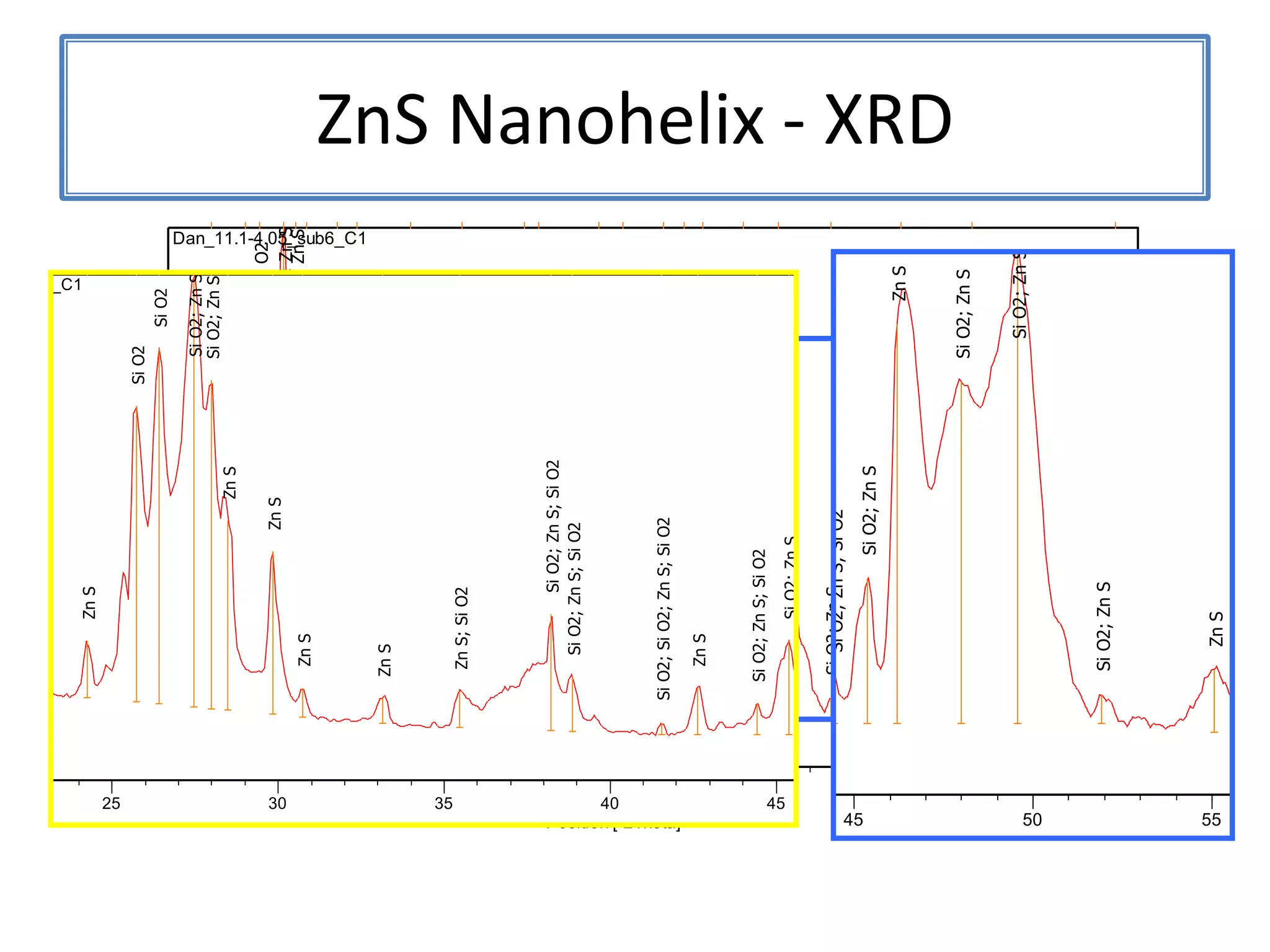
ZnSNanohelix - XRD
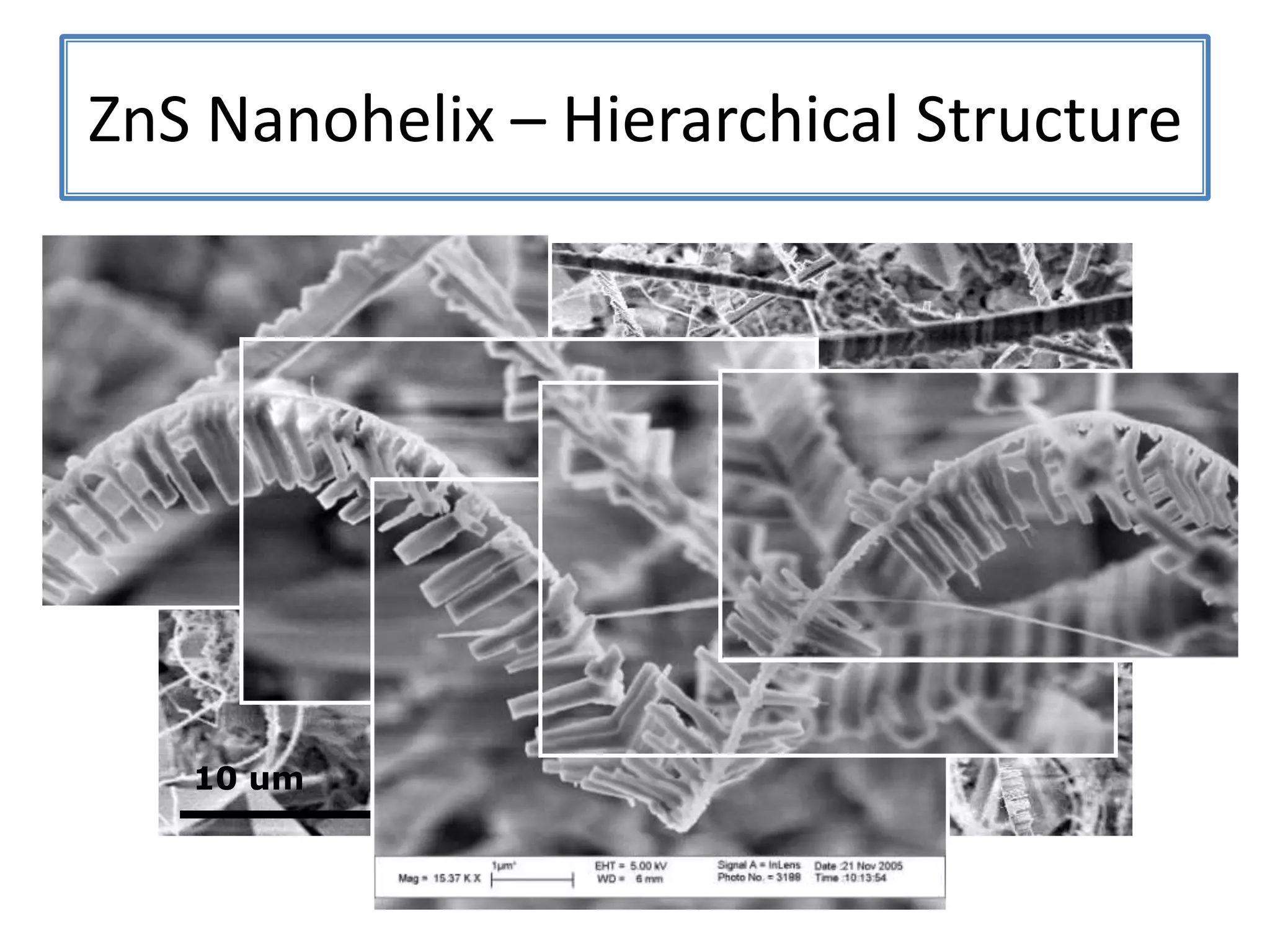
10 umZnSNanohelix – Hierarchical Structure
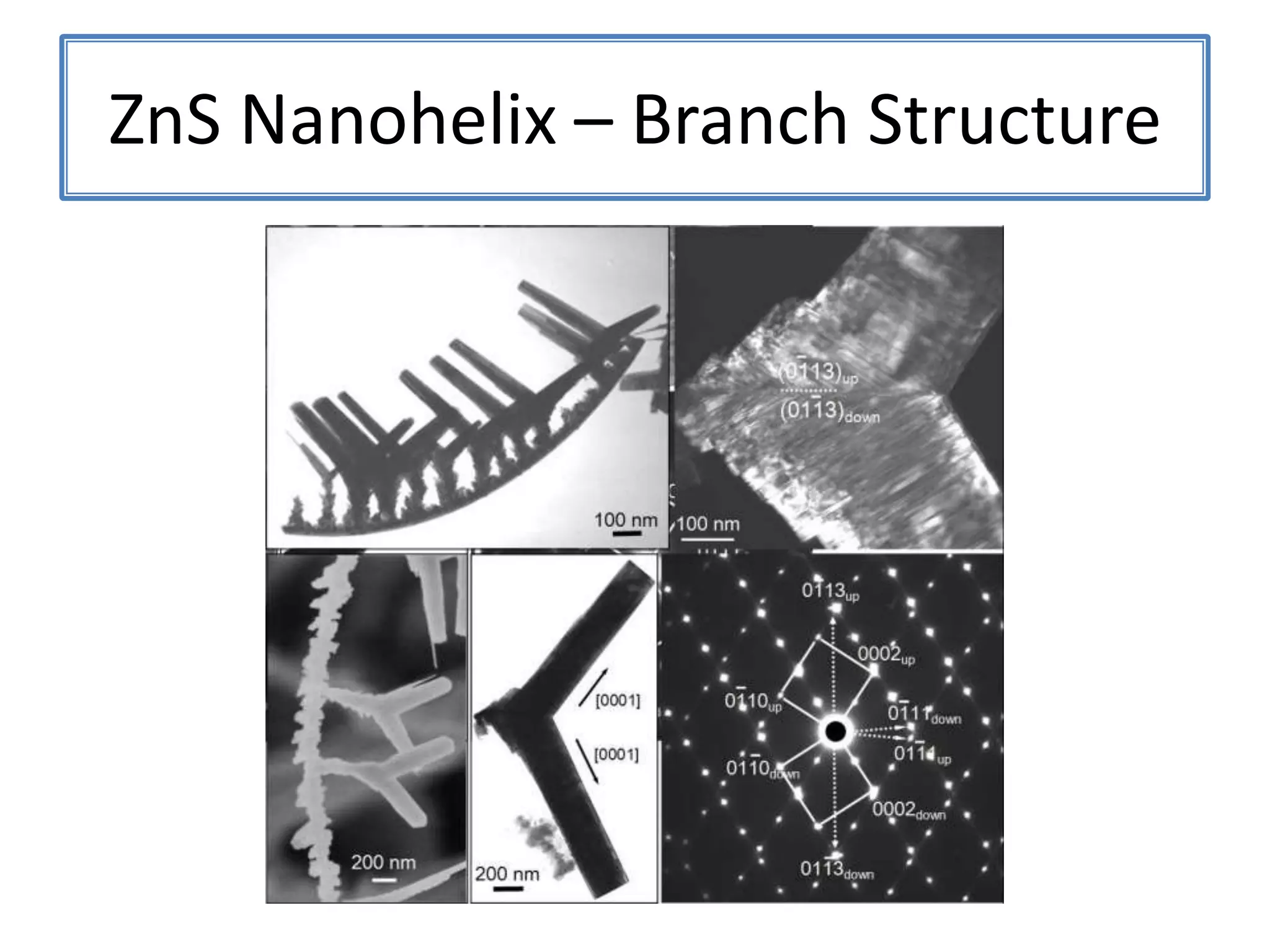
ZnSNanohelix – Branch Structure
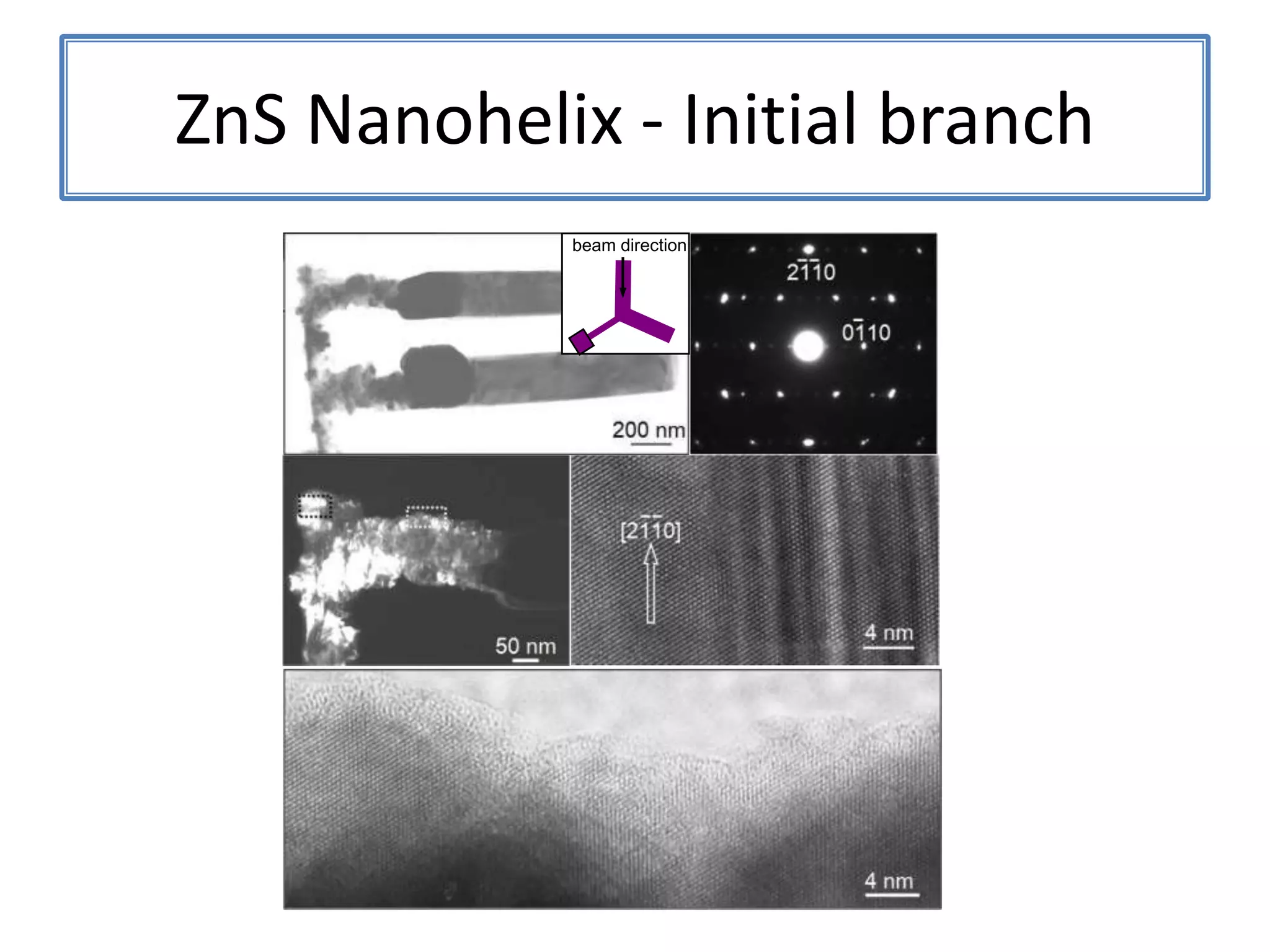
ZnSNanohelix - Initial branchbeam direction
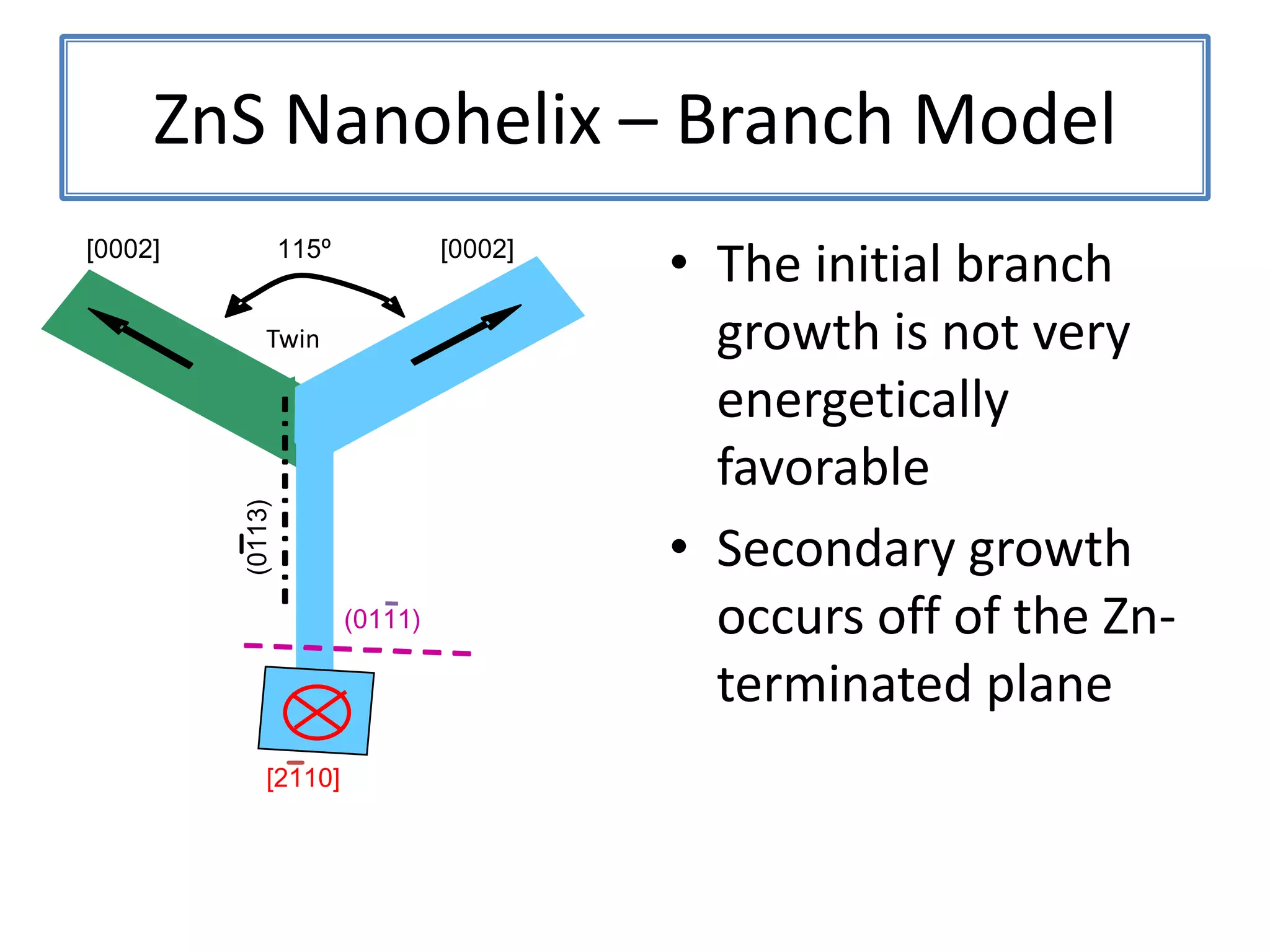
ZnSNanohelix – Branch ModelThe initial branch growth is not very energetically favorableSecondary growth occurs off of the Zn-terminated plane[0002][0002]115ºTwin(0113)(0111)[2110]
ZnS Nanohelices - GrowthNanohelices form with longer growth time, lower pressure, and the presence of a gold catalystZnS nanohelix formation is not explained solely by the polarity of the surfaces; surface tension may be used to explain the bendingSecondary growth is first along a non-favorable direction because it is growing off of the (0111) plane of the helical wire. It soon switches to more favorable  growth
Ultra-long Core-Shell ZnS-SiO2 NanowiresCore-Shell ZnS-SiO2 Nanowires SynthesisSource Temperature: 1000 CSubstrate Temperature: 750 CReaction Time: 120 minutesDeposition Substrate: <111> Silicon with 20 nm AuSystem Pressure: 20 torrSource material: ZnSLonger growth time, lower growth pressure, and the significant presence of gold catalystApplications
Models
Novel ZnS Nanostructures
Nanobelts/Nanowires
Aligned ZnS Nanowires
Nanohelices
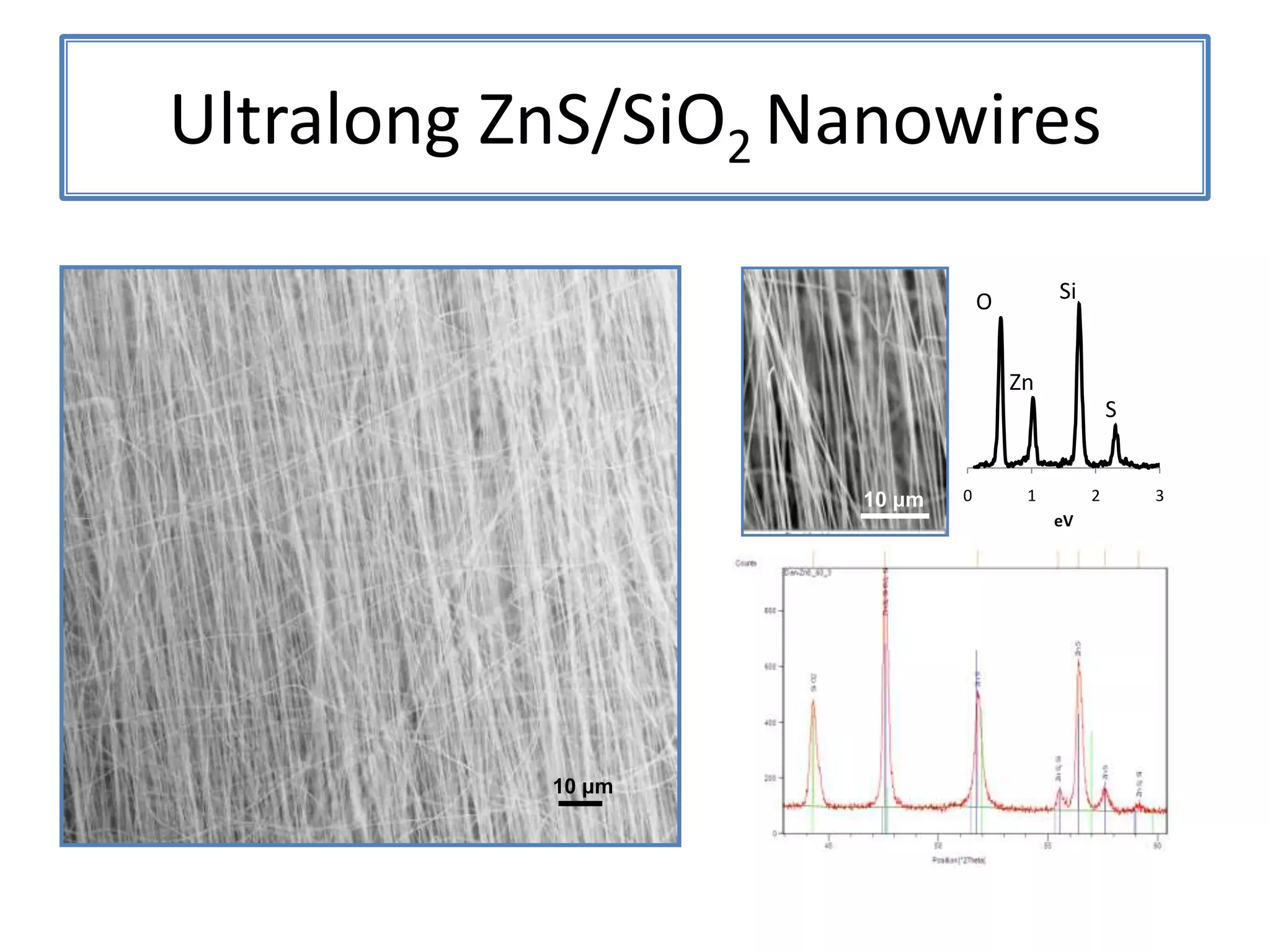
Ultralong ZnS/SiO2 nanowiresUltralongZnS/SiO2 Nanowires10 μm10 μmSiOZnS
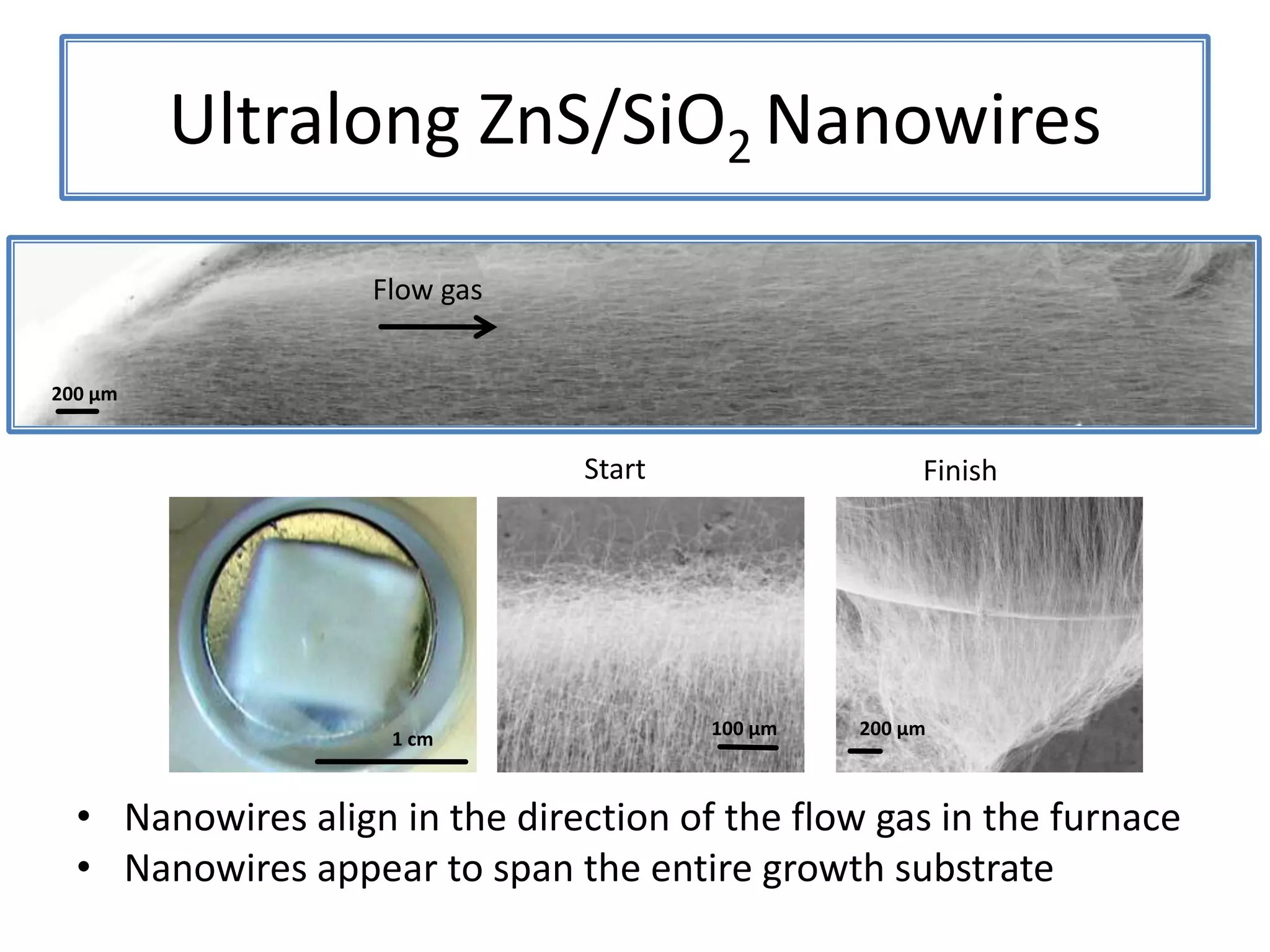
UltralongZnS/SiO2 NanowiresFlow gas200 μmStartFinish100 μm200 μm1 cmNanowires align in the direction of the flow gas in the furnaceNanowires appear to span the entire growth substrate
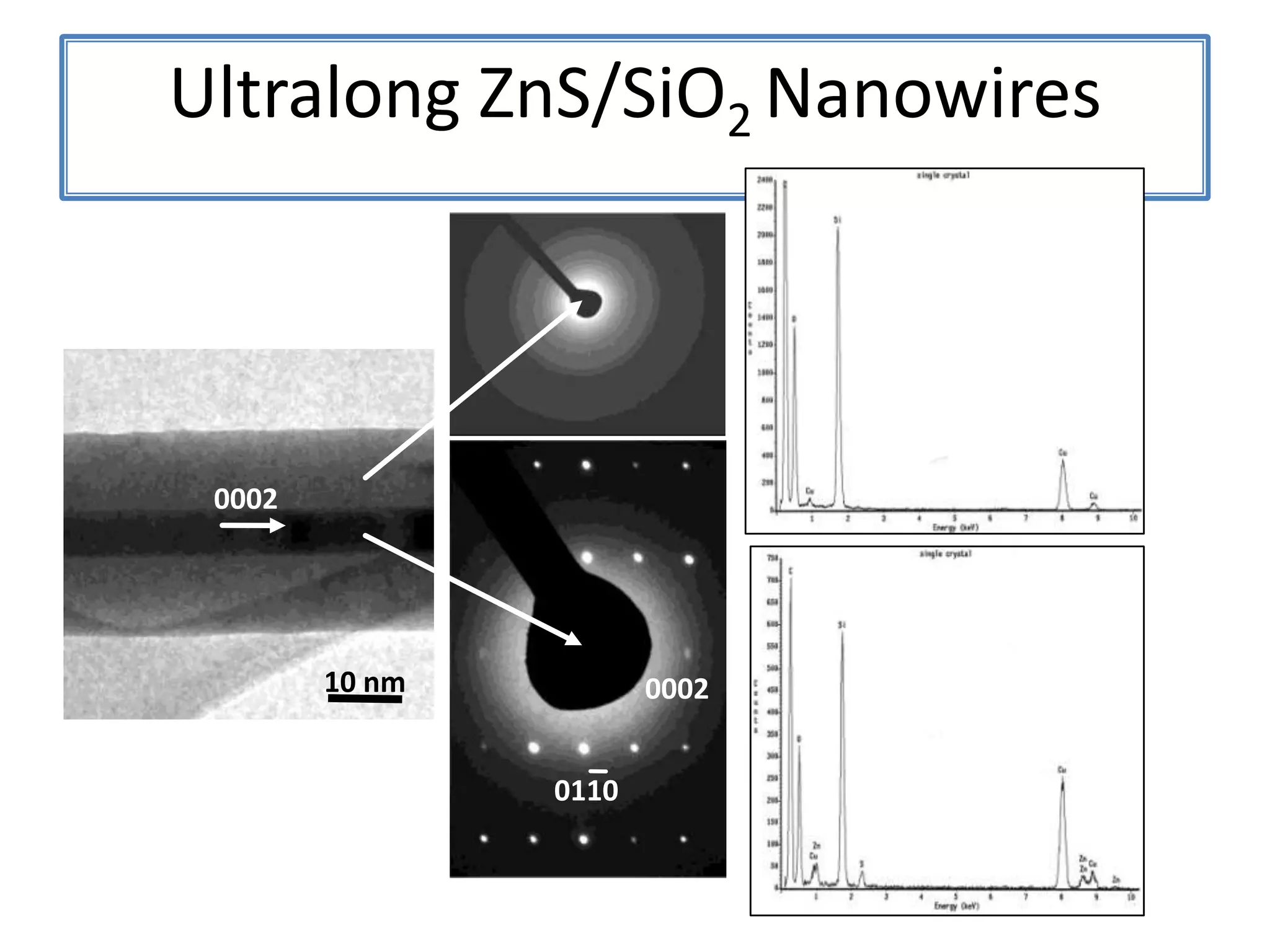
UltralongZnS/SiO2 Nanowires000210 nm00020110
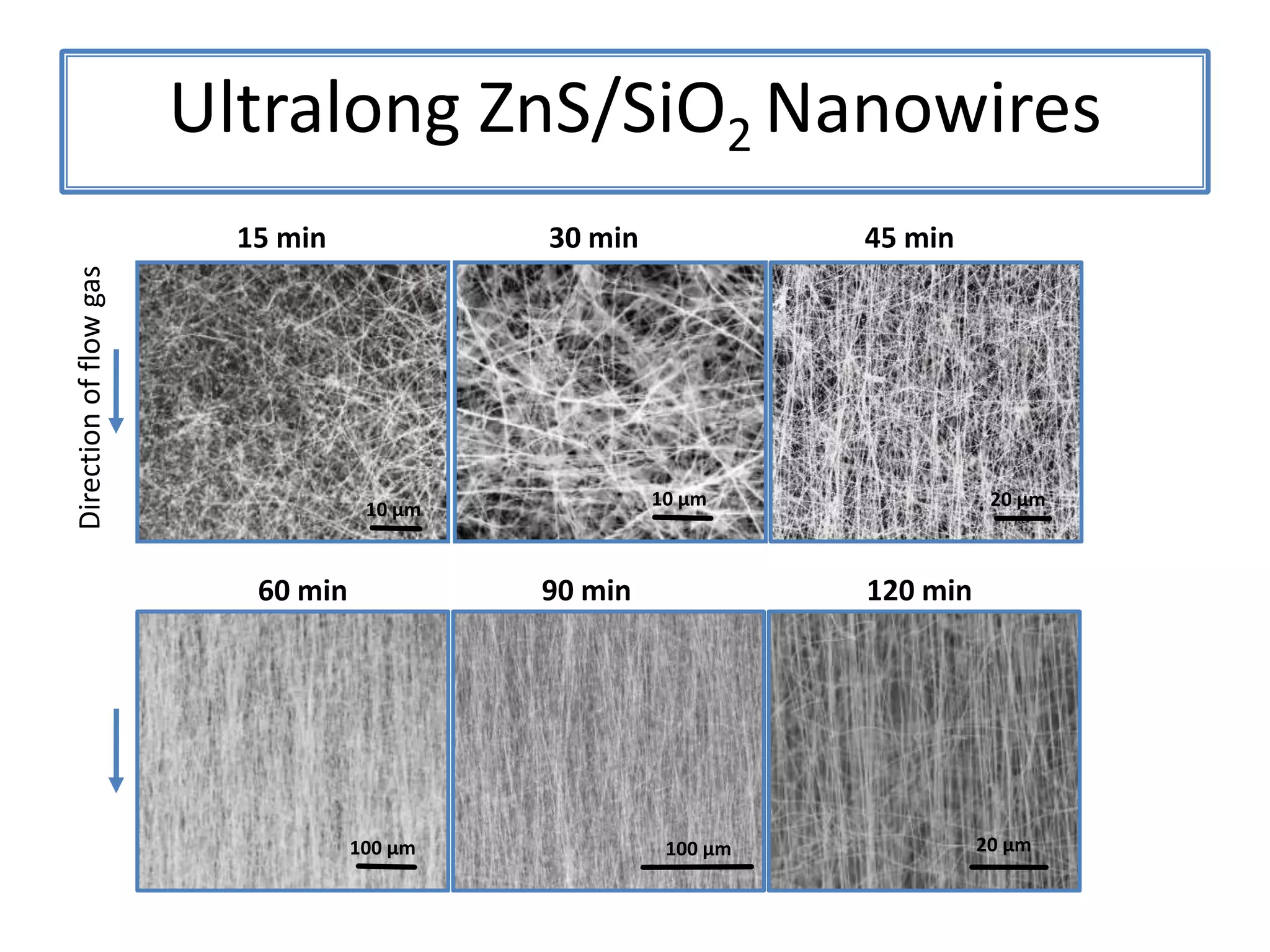
Ultralong ZnS/SiO2 Nanowires15 min30 min45 minDirection of flow gas10 μm20 μm10 μm90 min120 min60 min20 μm100 μm100 μm
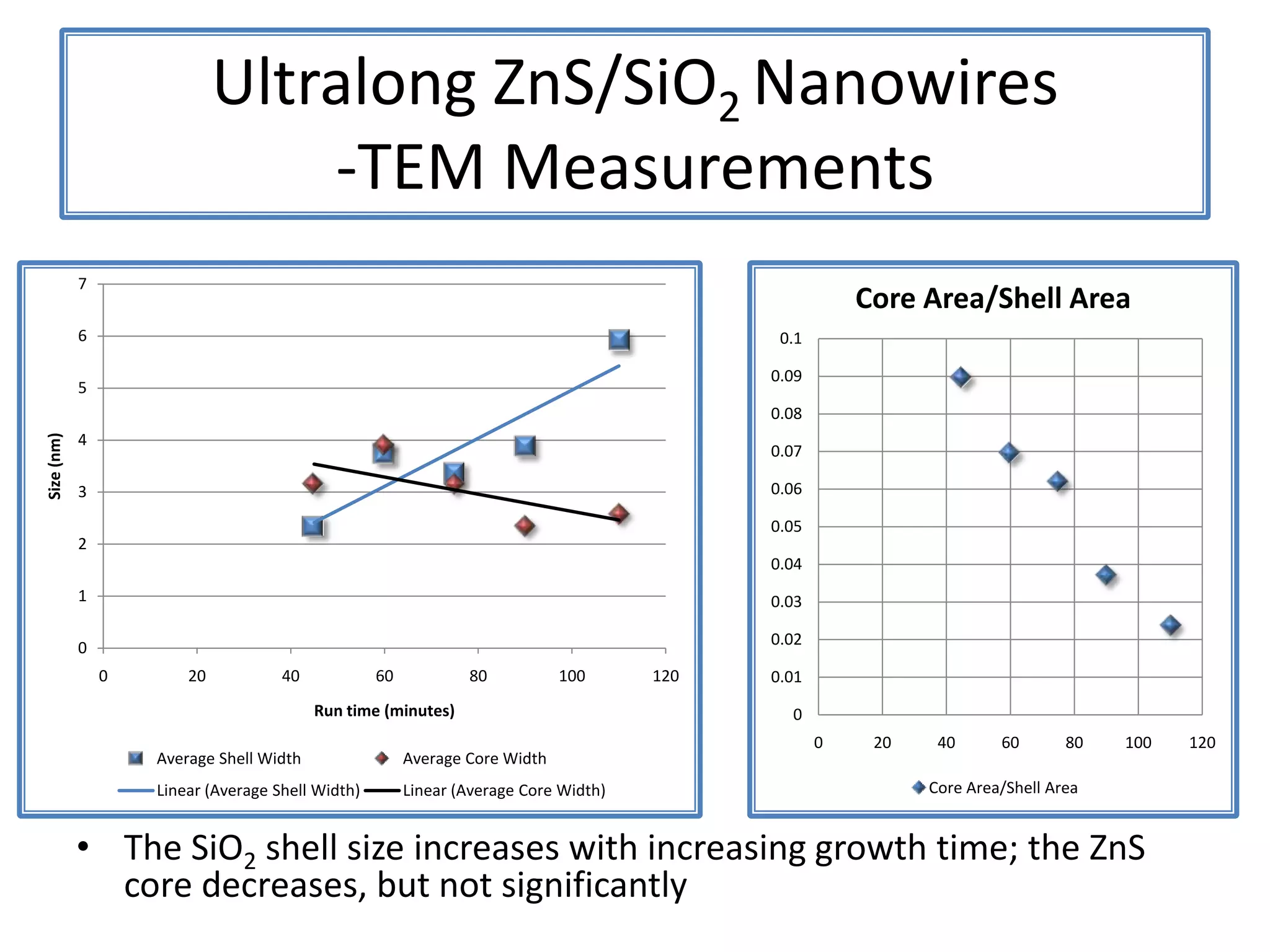
Ultralong ZnS/SiO2 Nanowires-TEM MeasurementsThe SiO2 shell size increases with increasing growth time; the ZnS core decreases, but not significantly
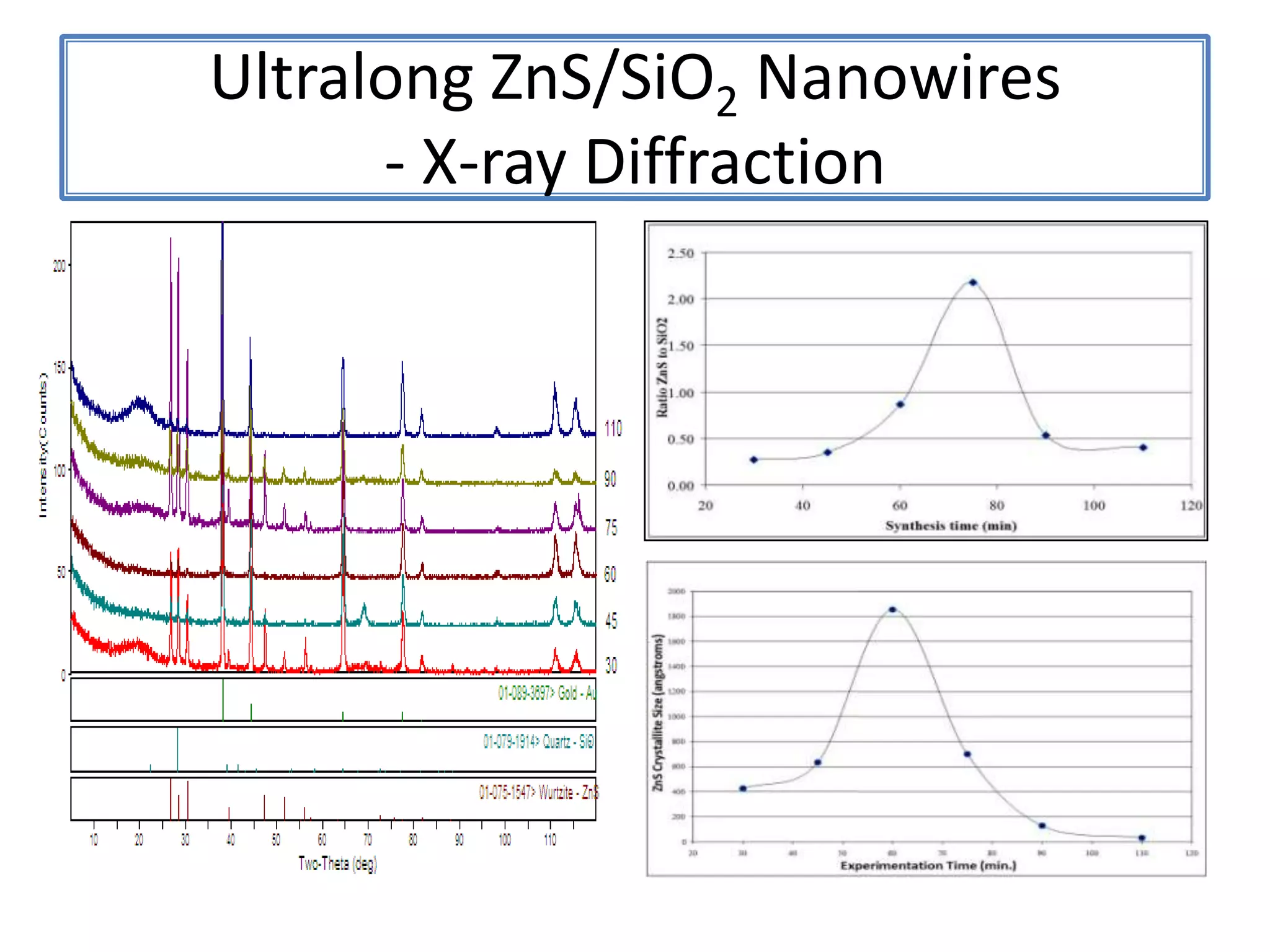
Ultralong ZnS/SiO2 Nanowires- X-ray Diffraction
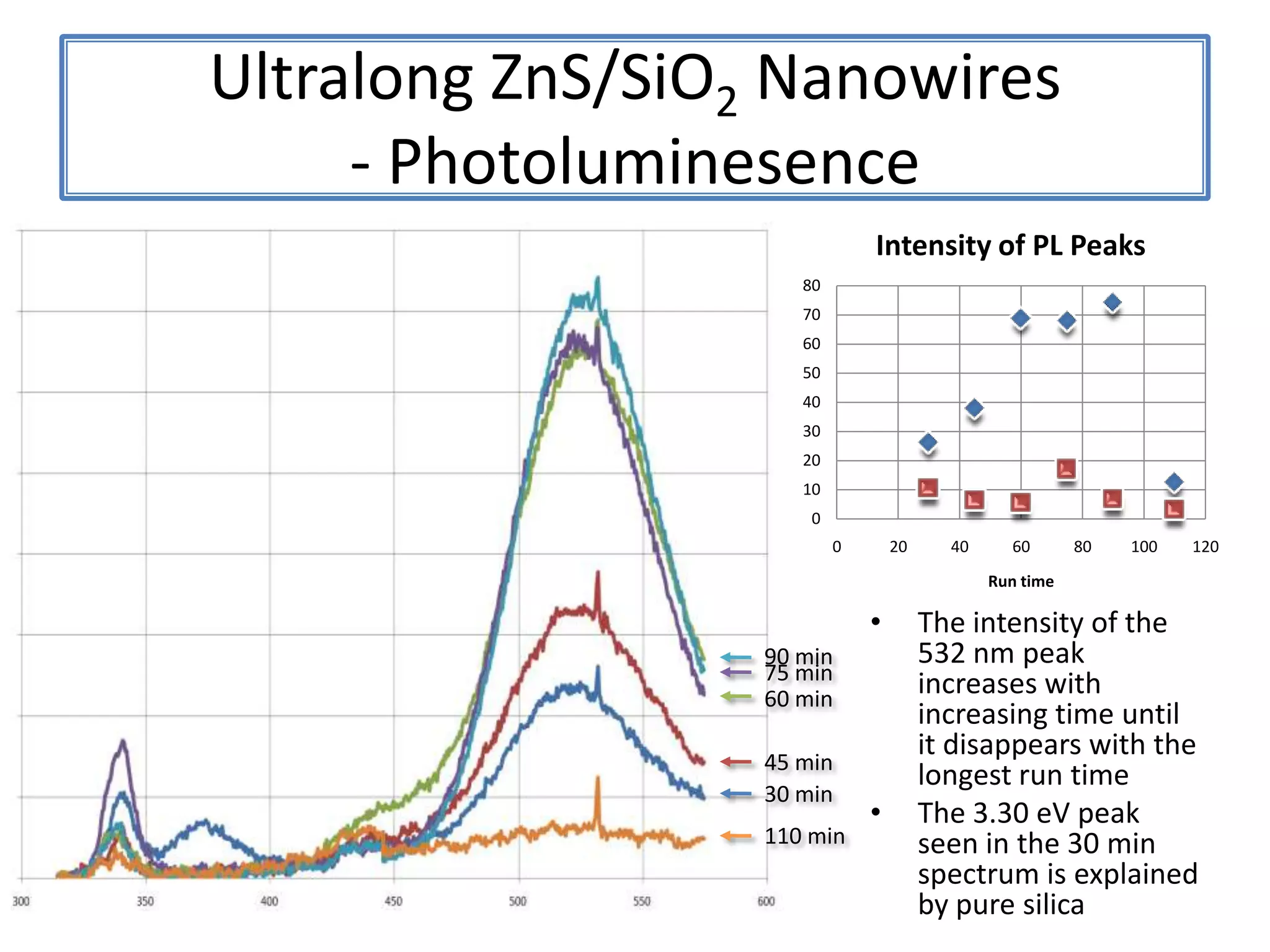
Ultralong ZnS/SiO2 Nanowires- PhotoluminesenceThe intensity of the 532 nm peak increases with increasing time until it disappears with the longest run timeThe 3.30 eV peak seen in the 30 min spectrum is explained by pure silica90 min75 min60 min45 min30 min110 min
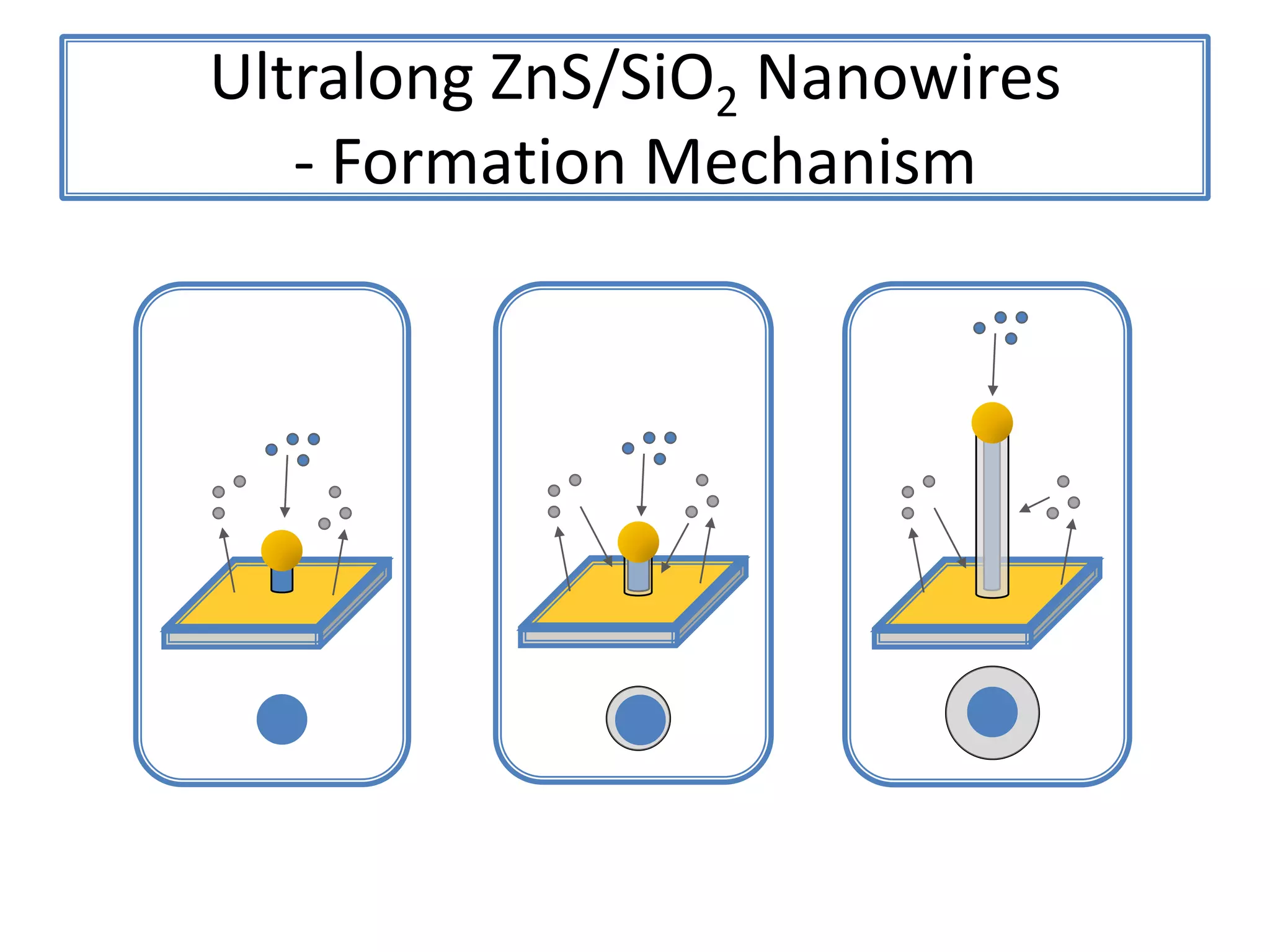
UltralongZnS/SiO2 Nanowires- Formation Mechanism
Ultralong ZnS/SiO2 Nanowires - GrowthIncreasing the amount of catalyst has a variety of effects; including a higher number of catalyst sites and greater competition for the incoming growth speciesThe extra gold catalyst forms a eutectic with the silicon substrate and helps form the SiO2 shell

ZnS Nanostructures: Synthesis, Characterization, and Theory - Defense Presentation

  • 1.
    Novel ZnS NanostructuresSynthesis,Growth Mechanism, and ApplicationsPh.D. Defense presented byDaniel F. MooreAdvisor – Dr. Zhong L. WangSchool of Materials Science and EngineeringGeorgia Institute of TechnologyOctober 24, 2006
  • 2.
    OutlineApplicationsZnS applicationsZnS nanostructureapplicationsModelsZnS crystal structureSynthesis and growthNovel ZnS NanostructuresNanobelts/NanowiresAligned ZnS NanowiresNanohelicesUltralongZnS/SiO2 nanowires
  • 3.
    ZnS Applications- Electrodes-Insulator- Phosphor (ZnS)- InsulatorSUBSTRATE- ElectrodesLight-Emitting Diode
  • 4.
    Monochrome TFEL structureOnedimensional applicationsINSULATORDRAINSOURCEMETAL GATENANOWIRE
  • 5.
    Understanding and SynthesizingOne-Dimensional NanostructuresWhy?Facilitate a rational design method of creating new materialsEnables controlling their propertiesNew nanoscale materials help understand the variety of novel properties and morphologies that arise with working with on the nanoscale
  • 6.
    ZnS Crystallographic andGrowth ModelsApplicationsModelsCrystallographic StructureSynthesis and GrowthNovel ZnS NanostructuresNanobelts/NanowiresAligned ZnS NanowiresNanohelicesUltralongZnS/SiO2 nanowires
  • 7.
    ZnS Crystal StructuresZincBlendABCABCWurtziteABABAB
  • 8.
    ZnS Wurtzite(0111)(0001)Wurtzite crystalstructure projected along [2110]
  • 9.
    Why Wurtzite?Ostwald’s Ruleof StagesThe formation of the new stable phase takes place by consecutive steps from one phase to another with increasing thermodynamic stabilityUnder certain conditions, the metastable phase has a higher nucleation rate than the stable phase and nucleates firstOstwald’s rule holds whenwhere μs is the supersaturation = kTln(P/P0s), bs is a geometric factor, σ is the surface energy
  • 10.
    Why Wurtzite?Ostwald’s Ruleof StagesIf a reaction can result in several products, it is not the most stable state with the least amount of free energy that is initially obtained, but the least stable one, lying nearest to the original state in free energy
  • 11.
    ZnS Nanosaw –Phase TransformationBeforeAfterIllumination of the sample with the electron beam introduces stacking faults into the material. These stacking faults take the form of the zinc blend crystal and twins
  • 12.
    ZnS Nanostructures -SynthesisSubstrateSource MaterialsCooling WaterCooling WaterTube FurnacePumpCarrying GasThermal evaporationVapor DepositionControllable ParametersSystem Pressure, Temperature, Reaction Time, Source and substrate materials
  • 13.
    ZnS Growth -Gradients
  • 14.
    Growth MechanismVapor-Liquid-SolidAu catalystSourcevaporNanowireAu catalystWithout AuAuSource material sublimates forming a vapor phaseCatalyst (for example, gold) melts forming a liquid dropletThe droplet saturates when source vapor keeps comingSolute precipitates out from the droplet forming a solid one-dimensional nanostructure20 μmAu ballZnS wire200 nm
  • 15.
    Growth MechanismVapor-SolidNanowireNanowireSource vaporSourcevaporSeedSeedSource material sublimates into a vapor phaseSource vapor deposits onto the substrates forming a seedThe seed serves as a preferential growth site for multiple one-dimensional nanostructures creating “weed”-like growth
  • 16.
    ZnS VS andVLS growthVLS and VS growth can occur in the same temperature zone and on the same substrate
  • 17.
    Growth Mechanism -ModelGrowth Species in vapor(2) Ad(de)sorption onto surface(1) Diffusion from source to vapor(5) Diffusion of by- products(4) Inclusion of growth species in the crystal structure(3) Surface diffusion of growth speciesRate limiting steps are the inclusion of the adsorbed species into the crystal and the ad(de)sorption onto and from the growth surface
  • 18.
    Growth MechanismModelThe growthof the nanostructure with both VS and VLS growth depends on the super-saturation of the species in the vapor, the size of the species, the accommodation coefficient, the size of the growth plane, the growth temperature, and the enthalpy of formationVSVLSVLSVSnw = area number density of adatoms on the surfaceDw= surface diffusivity of the growth species on the surfaceΩ = atomic volume of the adatoms∆Hevap = evaporation enthalpyRside = effective impingement rate of adatoms on the surfaceα = accommodation coefficient of the surfaceσ = super-saturation in the vapor (P-P0)/P0P0 = equilibrium vapor pressureλ = effective diffusion distance = √(Dsτs)
  • 19.
    Nanobelts, Nanowires, andNanosawsNanobelt SynthesisSource Temperature: 1050 CReaction Time: 60 minutesDeposition Substrate: AluminaSystem Pressure: 225 torrSource material: ZnSNanosaw SynthesisSource Temperature: 1000 CReaction Time: 10 minutesDeposition Substrate: <111> SiliconSystem Pressure: 225 torrSource Material: ZnSForm at a higher temperature than nanobeltsApplications
  • 20.
  • 21.
  • 22.
  • 23.
  • 24.
  • 25.
    Ultralong ZnS/SiO2 nanowiresZnSNanobelts20 μmNanobelts have a rectangular cross-sectionVS mechanism exhibits “weed”-like growth10 μmNanobelts, Nanocombs and Nano-windmills of Wurtzite ZnS, C. Ma, D. F. Moore, J. Li and Z. L. Wang, Adv. Mater., 15, (2003) 228-231.
  • 26.
    ZnSNanosaws and Nanocombs3μm[0110][0001]300 nmWurtzite ZnS nanosaws produced by polar surfaces, D. F. Moore, C. Ronning, C. Ma, and Z. L. Wang, Chem. Phys. Letts., 385 (2004) 8-11.
  • 27.
    ZnS NanocombsThe secondarygrowth occurs off of the Zn-terminated plane of the material
  • 28.
    ZnS Nanobelt/Nanosaws -GrowthNanosaws form at high temperature zones, closer to the source materialCloser to the source material also has higher concentration of the growth species in the atmosphereThe higher concentration of the growth species contributes to the secondary growthThe secondary growth forms on the more chemically active plane (here, the Zn-terminated plane)
  • 29.
    Vertically Aligned ZnSNanowiresZnS Aligned Nanowire SynthesisTwo Step Process1st Source Temperature: 750 C1st Substrate Temperature: 575 CReaction Time: 60 minutesDeposition Substrate: <111> SiliconSystem Pressure: 225 torrSource material: CdSe2nd Source Temperature: 1050 CReaction Time: 60 minutesSystem Pressure: 225 torrSource Material: ZnSApplications
  • 30.
  • 31.
  • 32.
  • 33.
  • 34.
  • 35.
    Ultralong ZnS/SiO2 nanowiresAlignedZnS Nanowires2 μm1 μmCrystal Orientation-Ordered ZnSNanowire Bundles, D. F. Moore, Y. Ding, and Zhong L. Wang, J. Am. Chem. Soc., 126 (2004) 14372-14373.
  • 36.
  • 37.
    Aligned ZnS Nanowires- FormationMultiple nucleation of CdSe forms a polycrystalline filmZnS wires form off of the c-plane of the CdSe
  • 38.
    Aligned ZnS Nanowires- GrowthThe initial deposit of CdSe forms a polycrystalline filmThis film on the silicon serves as the deposition surface for the ZnS nanowiresGrowth occurs because of the lattice match between (0001)-CdSe and (0001)-ZnS and continues because of low growth energy of the growth direction
  • 39.
    Hierarchical Structured ZnSNanohelicesZnS Hierarchical Nanohelices SynthesisSource Temperature: 1000 CSubstrate Temperature: 750 CReaction Time: 120 minutesDeposition Substrate: <111> Silicon with 1.5 nm AuSystem Pressure: 20 torrSource material: ZnSLonger growth time, lower growth pressure, and the presence of gold catalystApplications
  • 40.
  • 41.
  • 42.
  • 43.
  • 44.
  • 45.
    Ultralong ZnS/SiO2 nanowires(0111)Emphasizingthe polar planes(0001)Spontaneous Polarization-Induced Nanohelixes, Nanosprings, and Nanorings of Piezoelectric Nanobelts, X. Y. Kong and Z. L. Wang, NanoLett. 3 (2003) 1625-1631.
  • 46.
    ZnSNanohelix2 μm2 μmHierarchicalstructured nanohelices of ZnS, D. F. Moore, Y. Ding, and Zhong L. Wang, Angew. Chemie International Ed.,Vol. 118, 5274-5278
  • 47.
  • 48.
  • 49.
    10 umZnSNanohelix –Hierarchical Structure
  • 50.
  • 51.
    ZnSNanohelix - Initialbranchbeam direction
  • 52.
    ZnSNanohelix – BranchModelThe initial branch growth is not very energetically favorableSecondary growth occurs off of the Zn-terminated plane[0002][0002]115ºTwin(0113)(0111)[2110]
  • 53.
    ZnS Nanohelices -GrowthNanohelices form with longer growth time, lower pressure, and the presence of a gold catalystZnS nanohelix formation is not explained solely by the polarity of the surfaces; surface tension may be used to explain the bendingSecondary growth is first along a non-favorable direction because it is growing off of the (0111) plane of the helical wire. It soon switches to more favorable growth
  • 54.
    Ultra-long Core-Shell ZnS-SiO2NanowiresCore-Shell ZnS-SiO2 Nanowires SynthesisSource Temperature: 1000 CSubstrate Temperature: 750 CReaction Time: 120 minutesDeposition Substrate: <111> Silicon with 20 nm AuSystem Pressure: 20 torrSource material: ZnSLonger growth time, lower growth pressure, and the significant presence of gold catalystApplications
  • 55.
  • 56.
  • 57.
  • 58.
  • 59.
  • 60.
  • 61.
    UltralongZnS/SiO2 NanowiresFlow gas200μmStartFinish100 μm200 μm1 cmNanowires align in the direction of the flow gas in the furnaceNanowires appear to span the entire growth substrate
  • 62.
  • 63.
    Ultralong ZnS/SiO2 Nanowires15min30 min45 minDirection of flow gas10 μm20 μm10 μm90 min120 min60 min20 μm100 μm100 μm
  • 64.
    Ultralong ZnS/SiO2 Nanowires-TEMMeasurementsThe SiO2 shell size increases with increasing growth time; the ZnS core decreases, but not significantly
  • 65.
  • 66.
    Ultralong ZnS/SiO2 Nanowires-PhotoluminesenceThe intensity of the 532 nm peak increases with increasing time until it disappears with the longest run timeThe 3.30 eV peak seen in the 30 min spectrum is explained by pure silica90 min75 min60 min45 min30 min110 min
  • 67.
  • 68.
    Ultralong ZnS/SiO2 Nanowires- GrowthIncreasing the amount of catalyst has a variety of effects; including a higher number of catalyst sites and greater competition for the incoming growth speciesThe extra gold catalyst forms a eutectic with the silicon substrate and helps form the SiO2 shell
  • 69.
    ConclusionsA model forthe basic growth of ZnS nanostructures was presentedNovel ZnS nanostructures were presented and characterized including nanobelts, nanosaws, orientationally aligned nanowires, nanohelices, and core-shell nanowiresGrowth process can be controlled and affected by changing the local pressure, temperature, vapor concentration, catalyst, and substrateThis research allows for a more fundamental understanding of the processes that affect nanostructure growth
  • 70.
    AcknowledgementsMy advisor –Dr. Zhong L. WangMy committee – Dr. Nie, Dr. Snyder, Dr. Summers, and Dr. WongGroup members – Dr. Xudong Wang, Dr. Puxian Gao, Dr. William Hughes
  • 71.
    PublicationsHierarchical Structured Nanohelicesof ZnS, D.F. Moore, Y. Ding, and Z.L. Wang, AngewandteChemie International Edition, Vol 118, 5274-5278, 2006Growth of anisotropic one-dimensional ZnS nanostructures, D.F. Moore and Z.L. Wang, J. Materials Chemistry, 2006 (16) 3898-3905Nanobelt and nanosaw structures of II-VI semiconductors, C. Ma, D. F. Moore, Y. Ding, J. Li and Z. L. Wang, Int. J. Nanotechnology 1 (2004) 431-451Crystal Orientation-Ordered ZnS Nanowire Bundles, D. F. Moore, Y. Ding, and Zhong L. Wang, J. Am. Chem. Soc., 126 (2004) 14372-14373Wurtzite ZnS nanosaws produced by polar surfaces,D. F. Moore, C. Ronning, C. Ma, and Z. L. Wang, Chem. Phys. Letts., 385 (2004) 8-11Single-Crystal CdSe Nanosaws, C. Ma, Y. Ding, D. F. Moore, X. D. Wang and Z. L. Wang, J. Am. Chem. Soc., 126 (2004) 708-709 (featured in Nature 427 (2004) 497)Nanobelts, Nanocombs, and Nano-windmills of Wurtzite ZnS, C. Ma, D. F. Moore, J. Li and Z. L. Wang, Adv. Mater., 15, (2003) 228-231
  • 72.
  • 73.
  • 74.
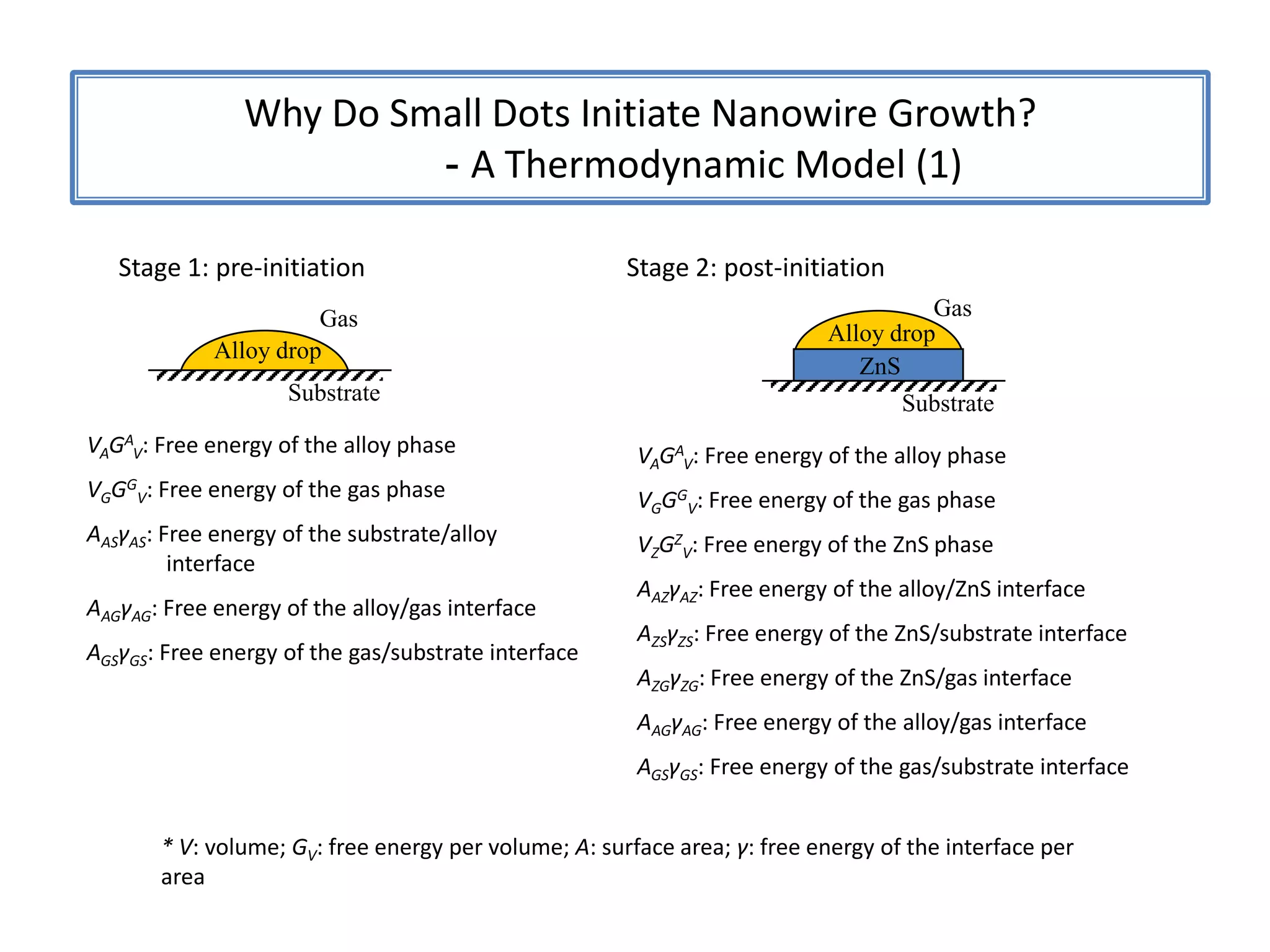
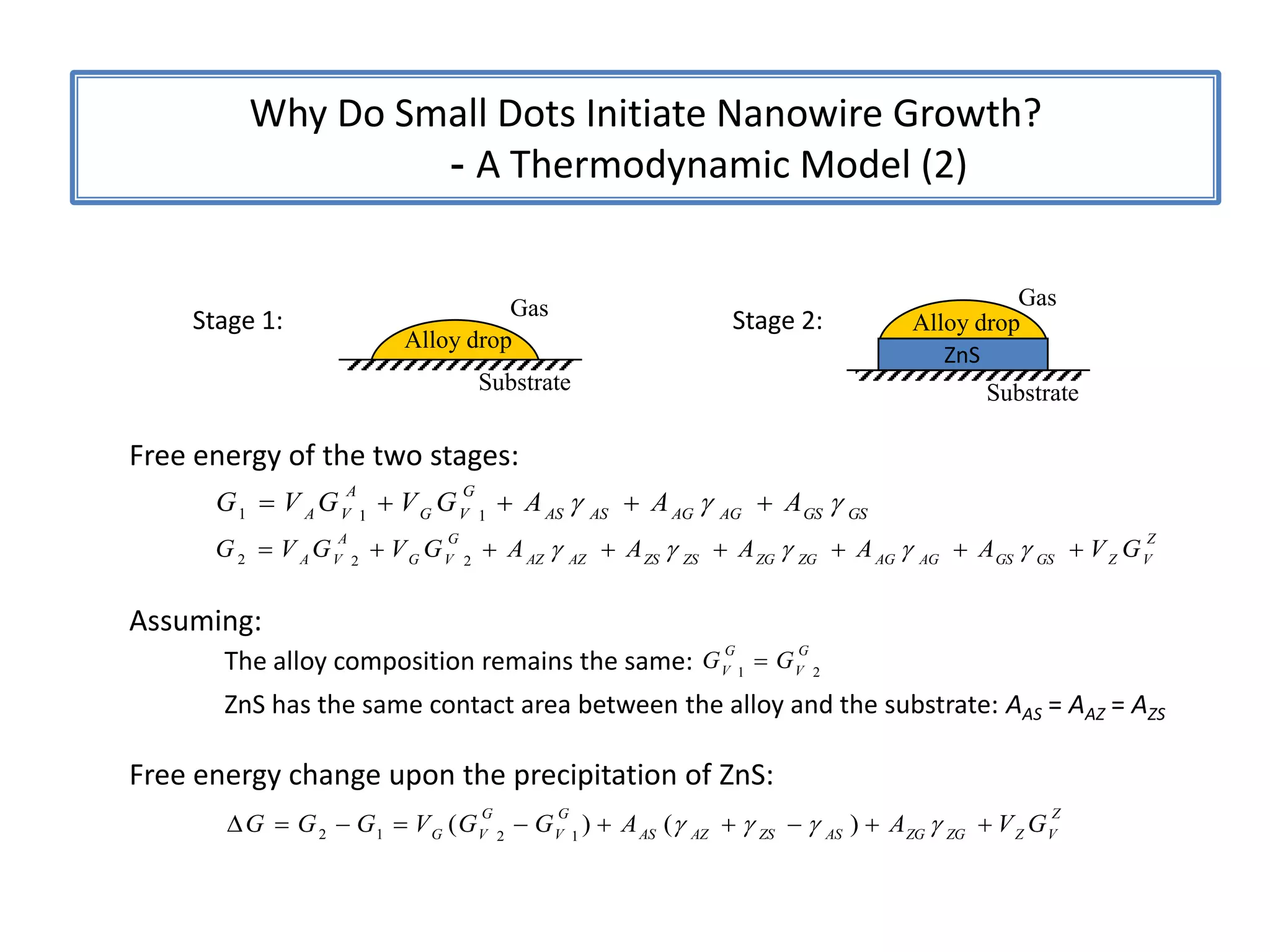
    GasGasAlloy dropAlloy dropZnSSubstrateSubstrateWhyDo Small Dots Initiate Nanowire Growth?- A Thermodynamic Model (1)Stage 1: pre-initiationStage 2: post-initiationVAGAV: Free energy of the alloy phaseVGGGV: Free energy of the gas phaseAASγAS: Free energy of the substrate/alloy interfaceAAGγAG: Free energy of the alloy/gas interfaceAGSγGS: Free energy of the gas/substrate interfaceVAGAV: Free energy of the alloy phaseVGGGV: Free energy of the gas phaseVZGZV: Free energy of the ZnS phaseAAZγAZ: Free energy of the alloy/ZnS interfaceAZSγZS: Free energy of the ZnS/substrate interfaceAZGγZG: Free energy of the ZnS/gas interfaceAAGγAG: Free energy of the alloy/gas interfaceAGSγGS: Free energy of the gas/substrate interface* V: volume; GV: free energy per volume; A: surface area; γ: free energy of the interface per area
  • 75.
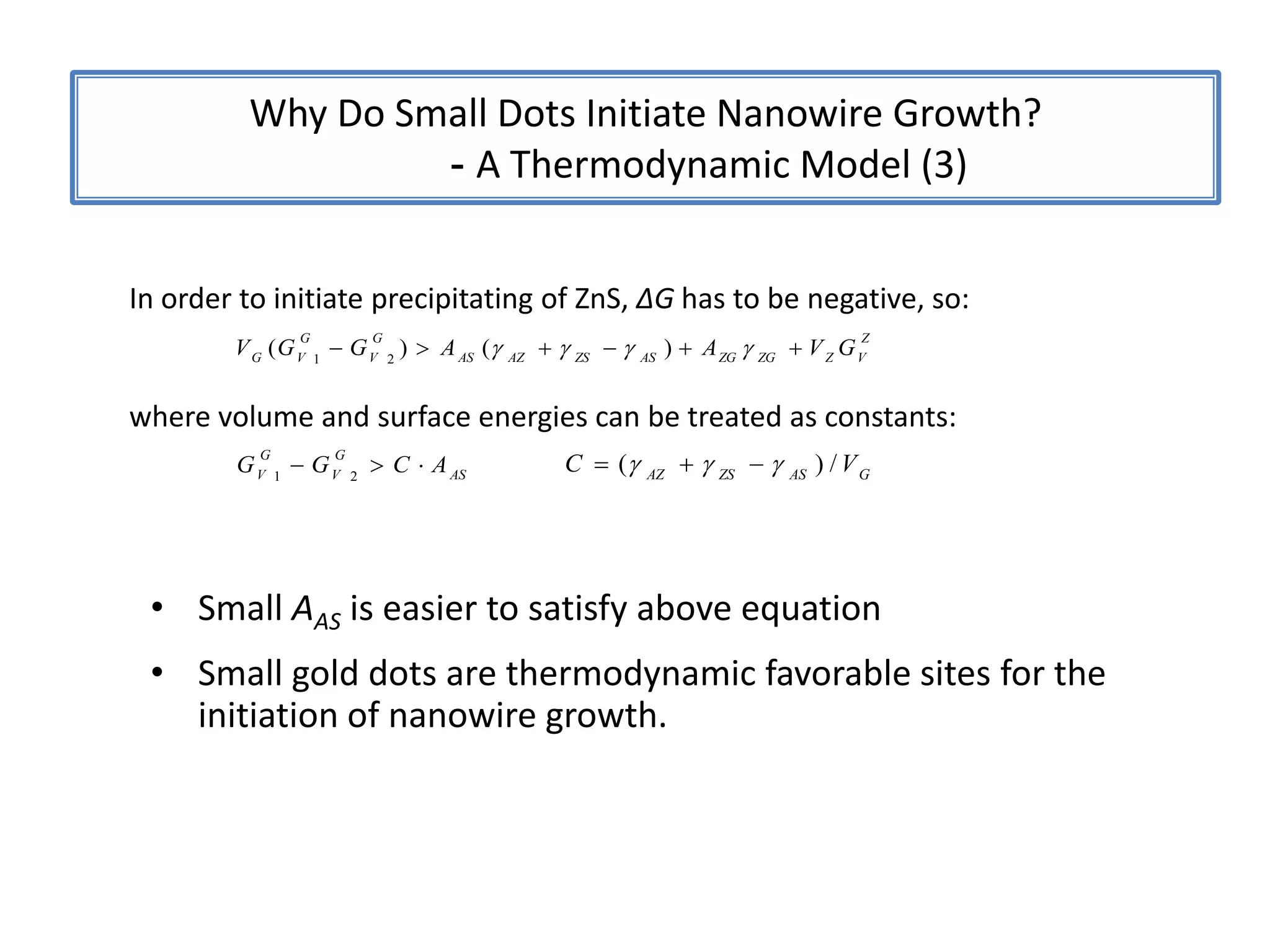
    Free energy ofthe two stages:GasGasAlloy dropStage 1:Stage 2:Alloy dropZnSSubstrateSubstrateFree energy change upon the precipitation of ZnS:Assuming: The alloy composition remains the same:ZnS has the same contact area between the alloy and the substrate:AAS= AAZ = AZSWhy Do Small Dots Initiate Nanowire Growth?- A Thermodynamic Model (2)
  • 76.
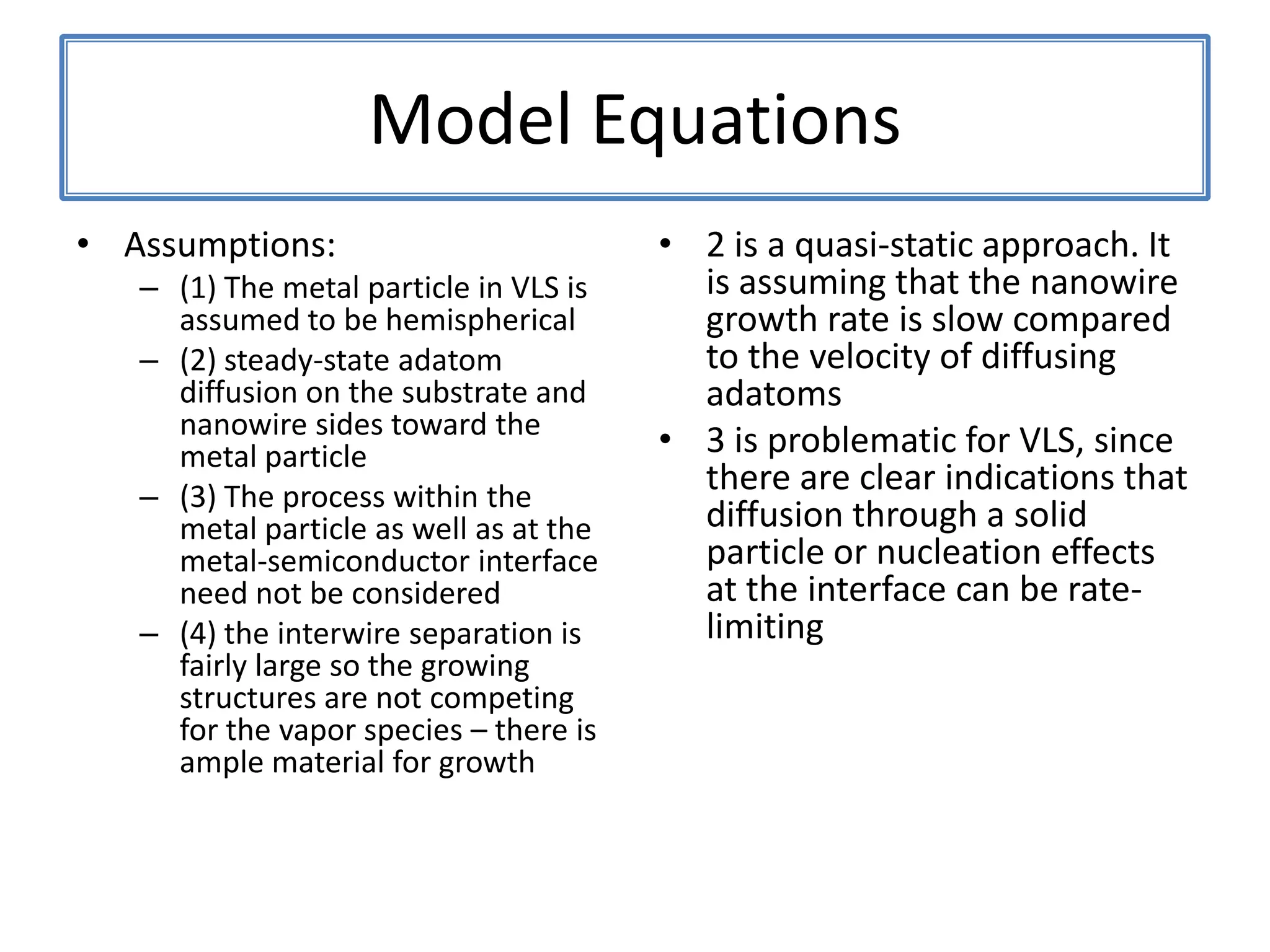
    In order toinitiate precipitating of ZnS, ΔG has to be negative, so:where volume and surface energies can be treated as constants:Why Do Small Dots Initiate Nanowire Growth?- A Thermodynamic Model (3)Small AAS is easier to satisfy above equationSmall gold dots are thermodynamic favorable sites for the initiation of nanowire growth.
  • 77.
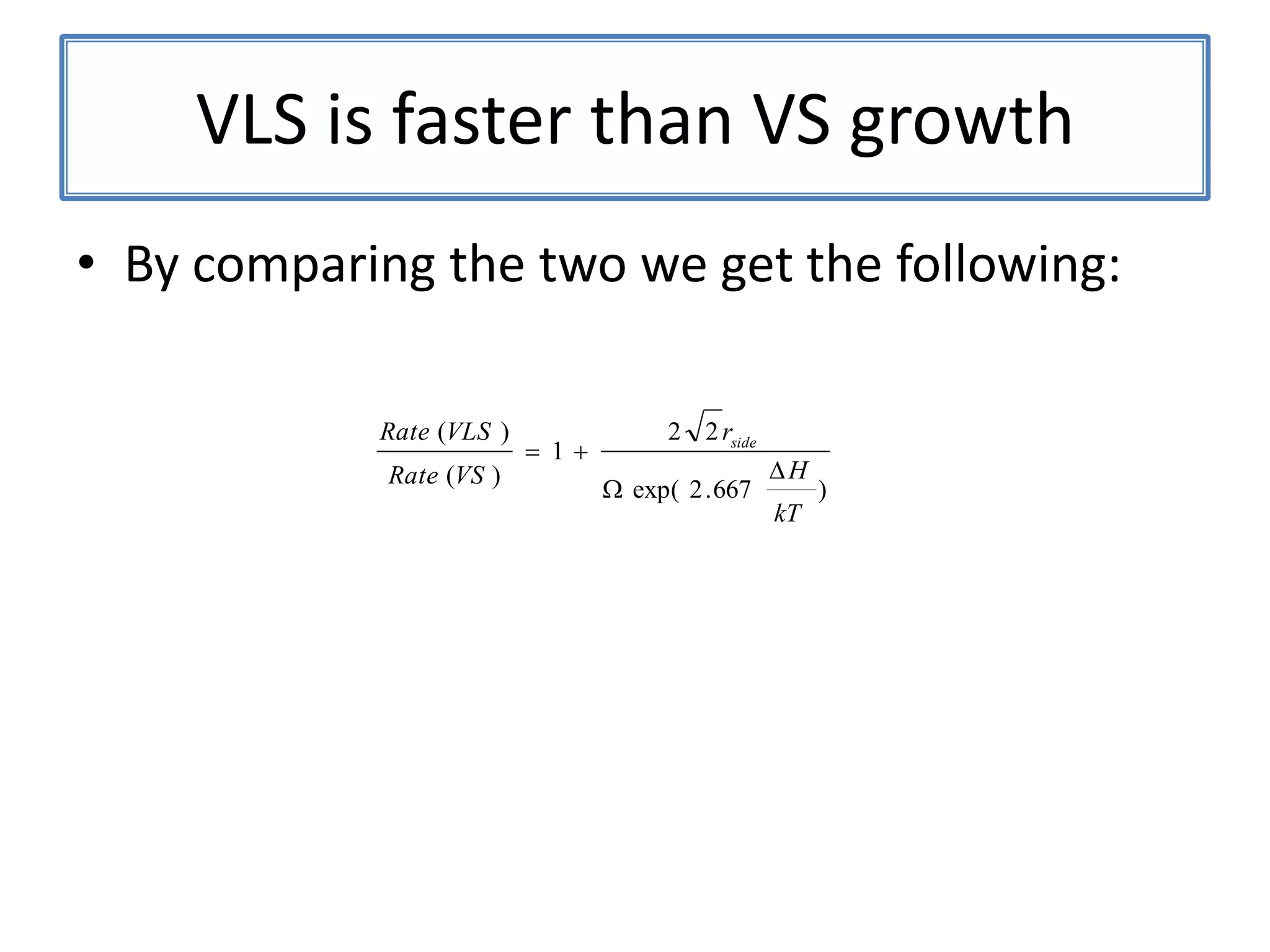
    Model EquationsAssumptions: (1)The metal particle in VLS is assumed to be hemispherical (2) steady-state adatom diffusion on the substrate and nanowire sides toward the metal particle (3) The process within the metal particle as well as at the metal-semiconductor interface need not be considered (4) the interwire separation is fairly large so the growing structures are not competing for the vapor species – there is ample material for growth2 is a quasi-static approach. It is assuming that the nanowire growth rate is slow compared to the velocity of diffusing adatoms3 is problematic for VLS, since there are clear indications that diffusion through a solid particle or nucleation effects at the interface can be rate-limiting
  • 78.
    VLS is fasterthan VS growthBy comparing the two we get the following:
  • 79.
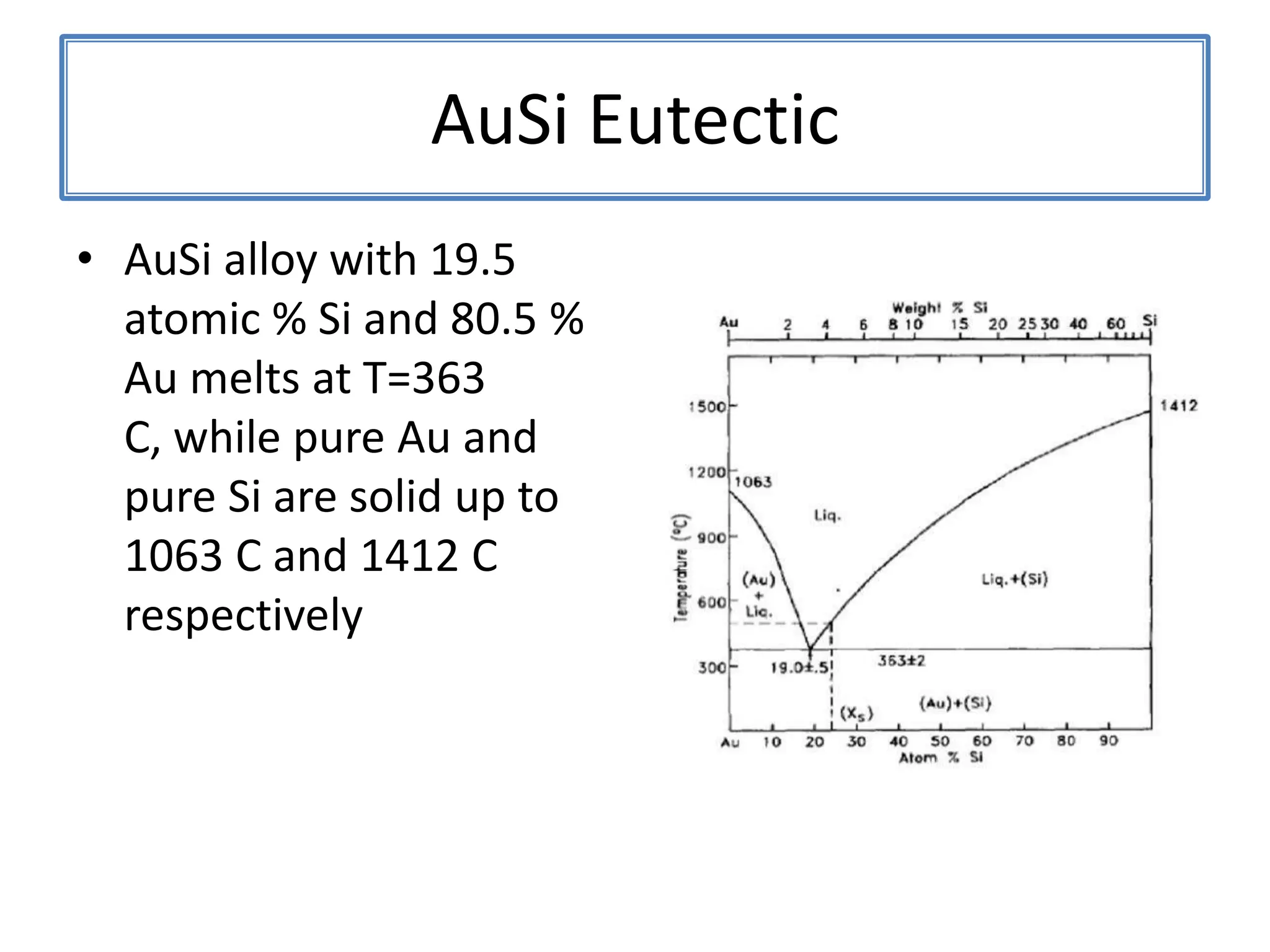
    AuSi EutecticAuSi alloywith 19.5 atomic % Si and 80.5 % Au melts at T=363 C, while pure Au and pure Si are solid up to 1063 C and 1412 C respectively
  • 80.
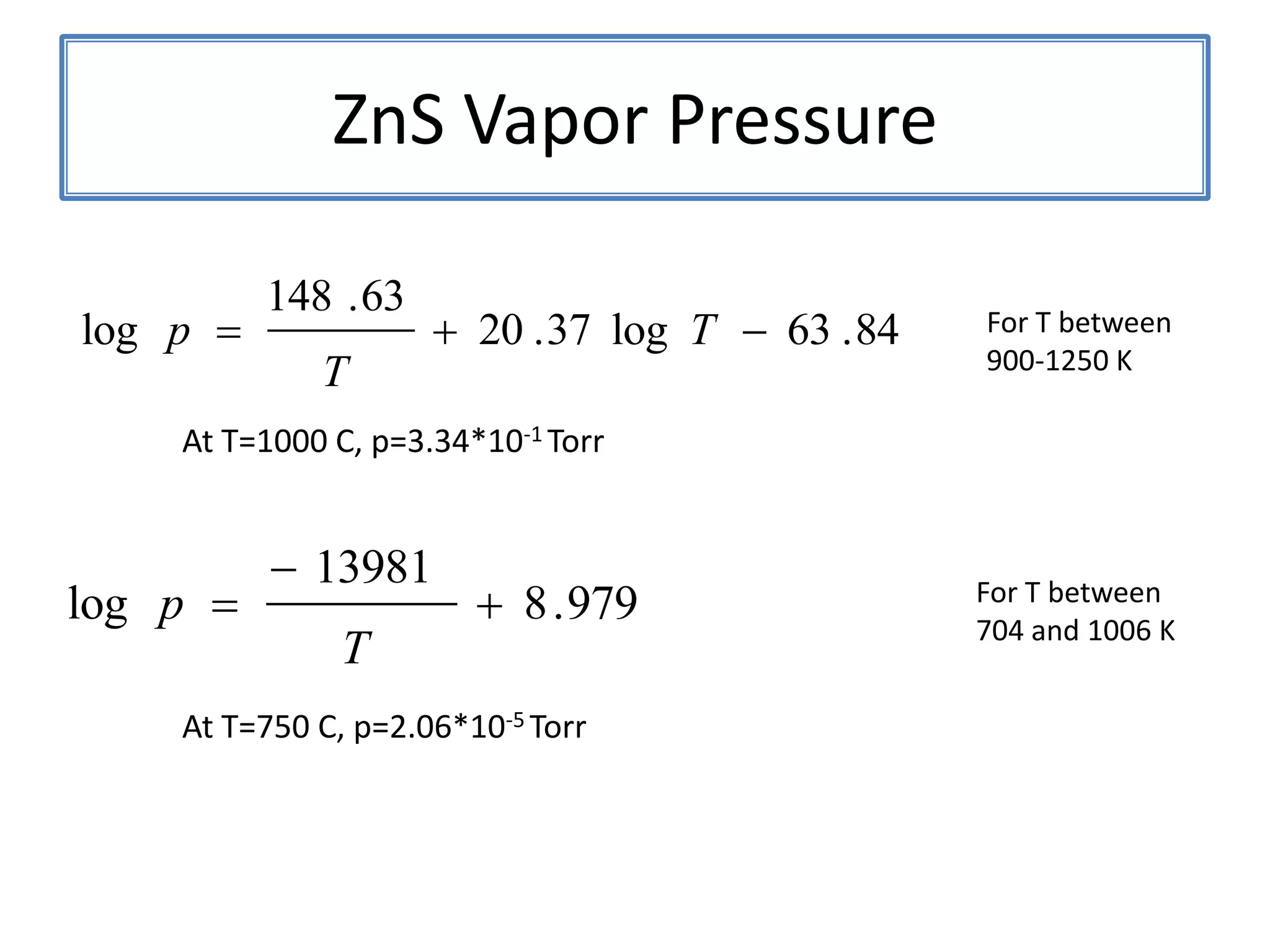
    ZnS Vapor PressureForT between 900-1250 KAt T=1000 C, p=3.34*10-1 TorrFor T between 704 and 1006 KAt T=750 C, p=2.06*10-5 Torr
  • 81.
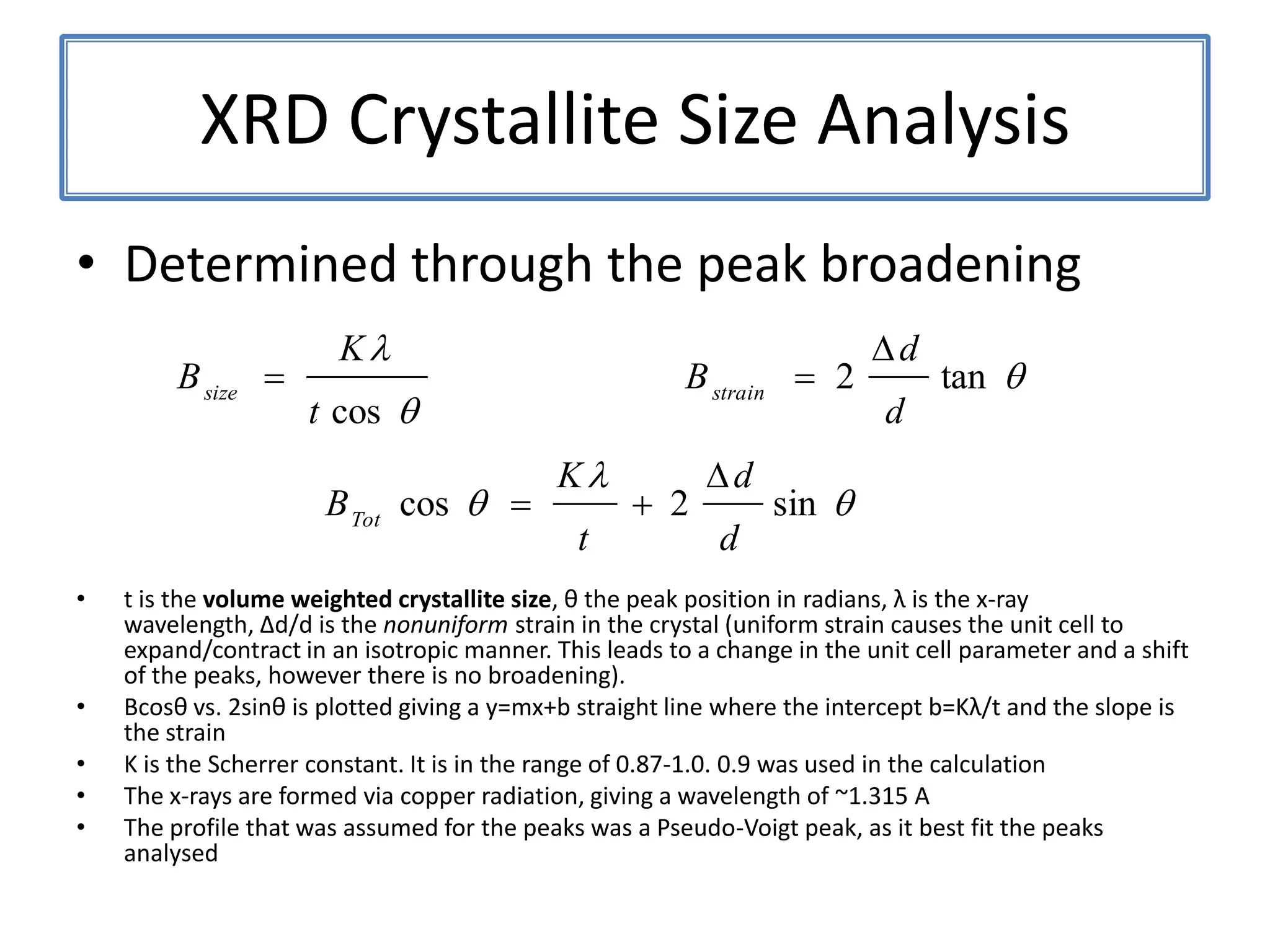
    XRD Crystallite SizeAnalysisDetermined through the peak broadeningt is the volume weighted crystallite size, θ the peak position in radians, λ is the x-ray wavelength, ∆d/d is the nonuniform strain in the crystal (uniform strain causes the unit cell to expand/contract in an isotropic manner. This leads to a change in the unit cell parameter and a shift of the peaks, however there is no broadening).Bcosθ vs. 2sinθ is plotted giving a y=mx+b straight line where the intercept b=Kλ/t and the slope is the strainK is the Scherrer constant. It is in the range of 0.87-1.0. 0.9 was used in the calculationThe x-rays are formed via copper radiation, giving a wavelength of ~1.315 AThe profile that was assumed for the peaks was a Pseudo-Voigt peak, as it best fit the peaks analysed
  • 82.
  • 83.
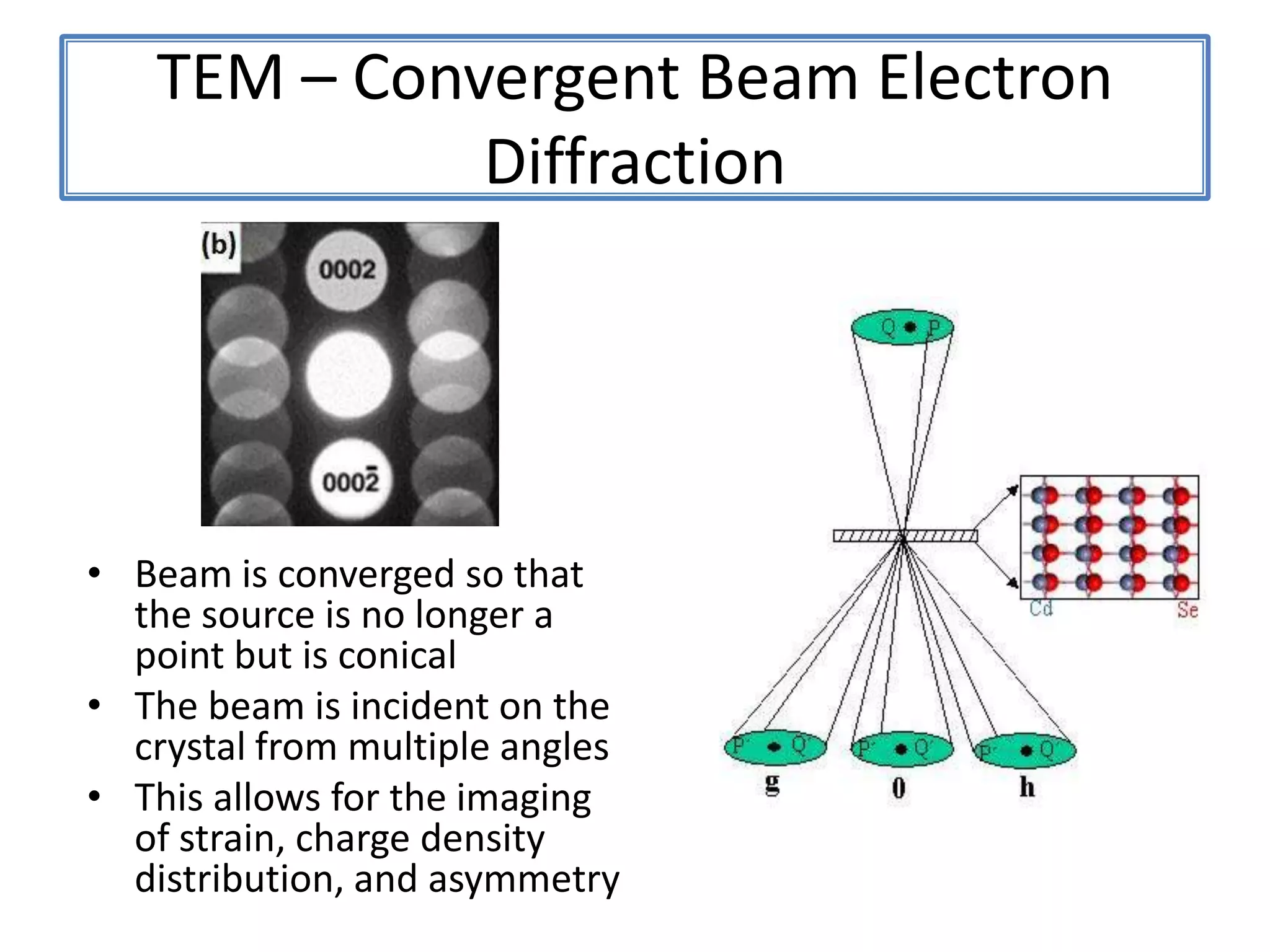
    TEM – ConvergentBeam Electron DiffractionBeam is converged so that the source is no longer a point but is conicalThe beam is incident on the crystal from multiple anglesThis allows for the imaging of strain, charge density distribution, and asymmetry
  • 84.
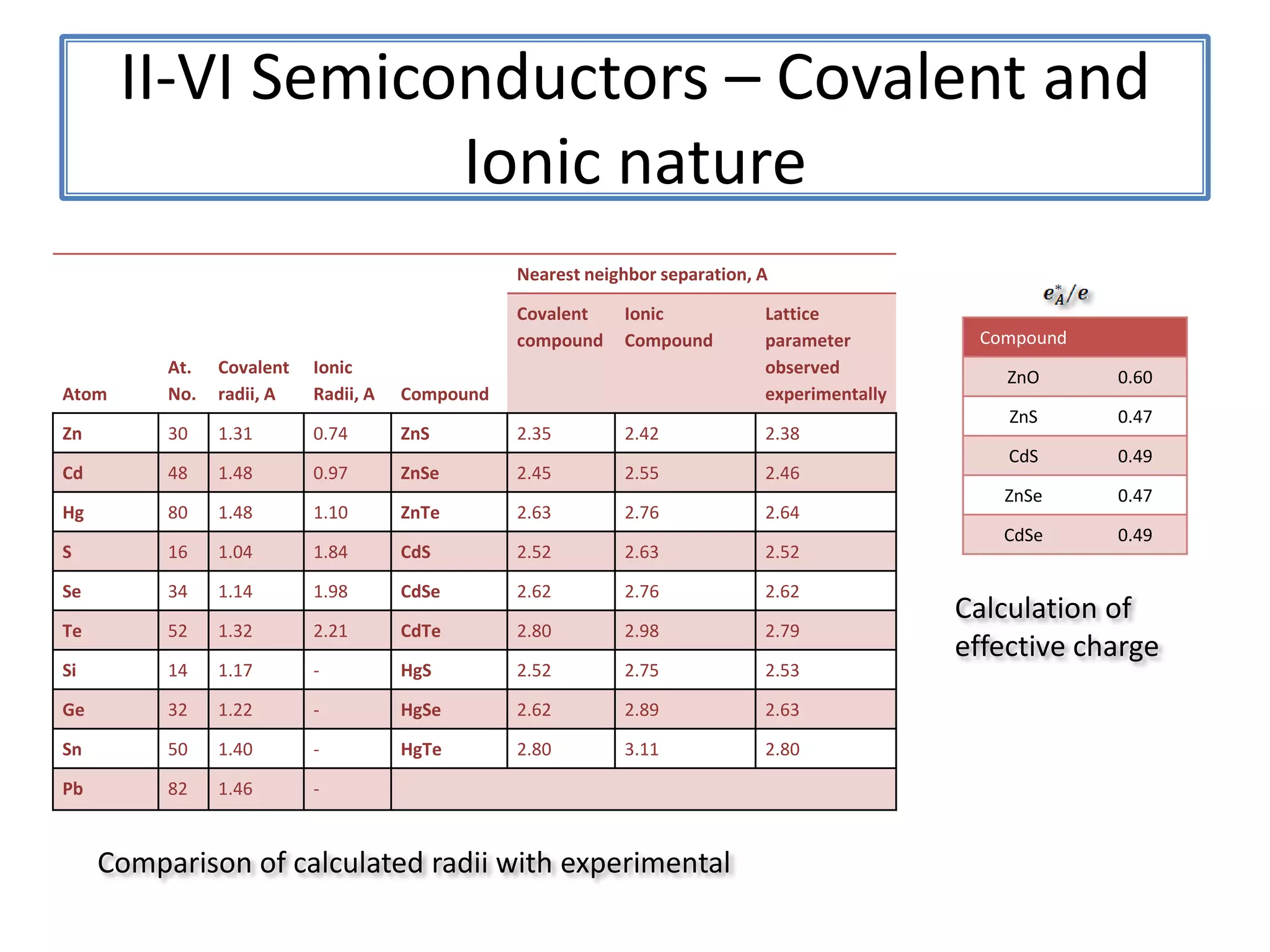
    II-VI Semiconductors –Covalent and Ionic natureCalculation of effective chargeComparison of calculated radii with experimental
  • 85.
    ZnS Propertiesa,b-plane spacing:3.8227 Ac-plane spacing: 6.2607 ABand gap (wurtzite) 3.91 eV (~317 nm)Band gap (Zinc blend) 3.54 eV (~350 nm)Effective mass of electron, hole ~.25m(e), .60m(e)Dielectric constant 8.9Resistivity 3.5*102 ohm-mCan be doped in both p and n type
  • 86.
    ZnS Thermodynamic PropertiesTransition– 1020 C (1293.15 K)Melting point – 1718 CEnthalpy of Formation: -204.6 kJ/mol for zinc blendDeltaG(wurtzite)=376700-191.9T kJ/molDeltaG(zinc blend)=374200-190.4T kJ/mol
  • 87.
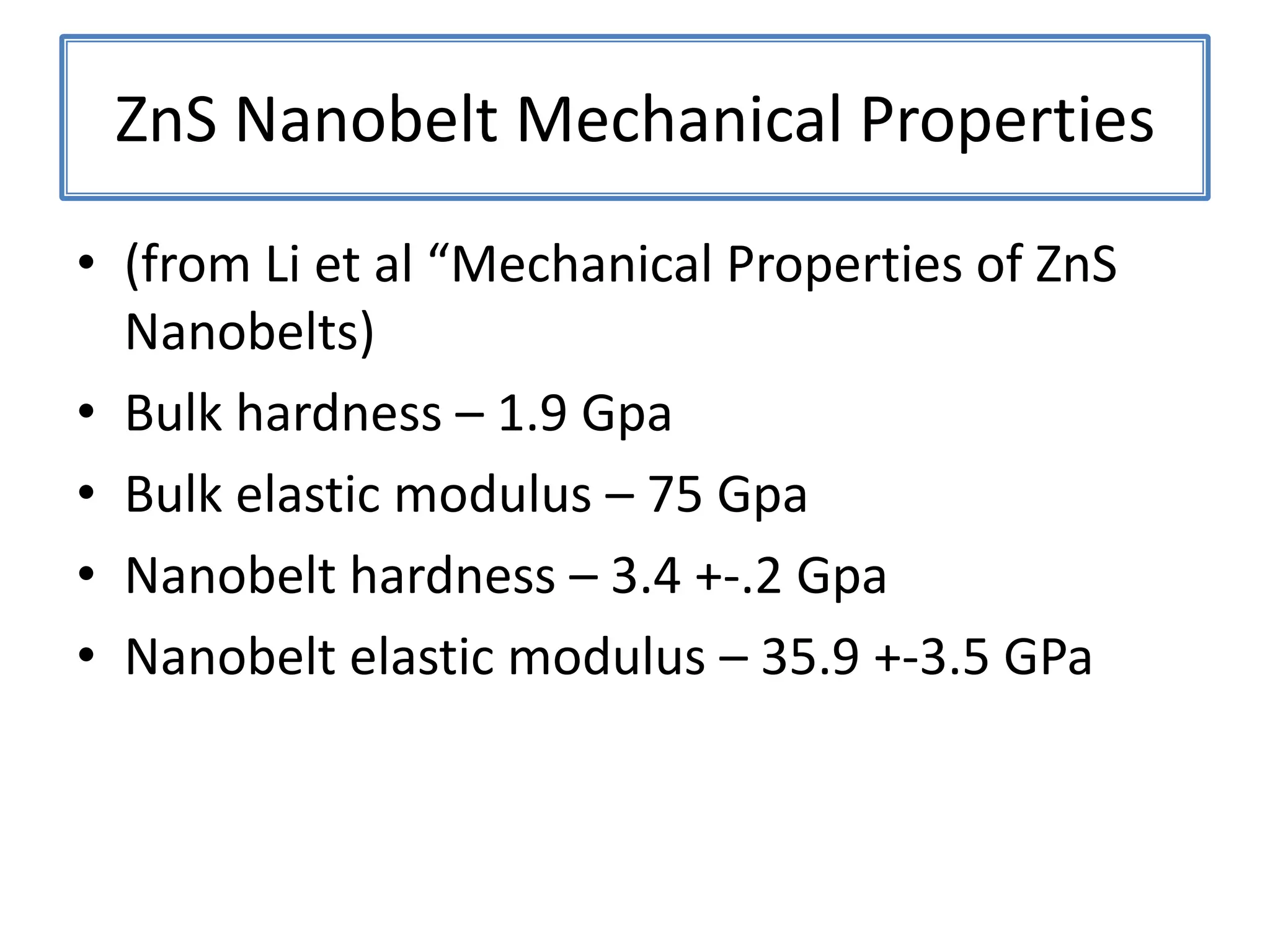
    ZnS Nanobelt MechanicalProperties(from Li et al “Mechanical Properties of ZnS Nanobelts)Bulk hardness – 1.9 GpaBulk elastic modulus – 75 GpaNanobelt hardness – 3.4 +-.2 GpaNanobelt elastic modulus – 35.9 +-3.5 GPa
  • 88.
    Four basic stepsElectronstunnel from electronic states at the insulator/phosphor interfaceElectrons are accelerated to ballistic energiesElectrons impact and ionize the luminescent center or create electron-hole pairs that lead to the activation of the luminescent centerLuminescent center relaxes toward the ground state and emits a photon- Electrodes- Insulator- Phosphor- InsulatorSUBSTRATE- ElectrodesElectroluminescent Display Devices (ELD)

Editor's Notes

  • #2 Good morning, my name is Daniel Moore and I am presenting on Novel ZnS Nanostructures. I have been working on this topic under the advisement of Dr. Z. L. Wang. I’d also like to welcome the members of my committee – Dr. Snyder, Dr. Summers, Dr. Wong, and Dr. Nie.
  • #4 Copper and aluminum doped ZnS typically can be used to created green emitting LEDs.ZnS is the most common phosphor material used for Electroluminescent Display devices. ELDs work by electroluminescence – the result of radiative recombination of electrons and holes. Essentially, ELDs are “lossy capacitors” that become electrically charged and then lose their energy in the form of light. The insulator layer is necessary to prevent arcing between the two conductive layers.ELD are commonly used as backlights in LCDs, providing a gentle even illuminationEL devices have low power consumption when compared with neon signs, and have a wide range of applications such as their use on advertising boards and safety signs. Because an EL layer can be very thin (around 1 mm thick), it can be used as decoration added to everyday items, including clothing and accessories such as bags and earphone cords
  • #5 Nanowires have been shown to be used in an array of applications, including field electronic transistors and related devices.
  • #9 Planes are polarized due to the semi-ionic nature of the bonding in the crystalThe different terminated species also lead to the planes having different chemical activities
  • #10 Ever since Ostwald stated his Rule of stages in 1897, attempts have been made to derive a theoretical basis for the rule. Now, even after 100 years, an undisputed theoretical basis for the rule has not been formulated successfully, even though field and laboratory observations supporting the rule are now too numerous to mention. A general consensus is that the rule can be explained through an understanding of nucleation theory and reaction kinetics. How-ever, there is no rigorous basis for the rule in fact, i.e., in principle, there is no reason for the rule not to be violated, and occasional exceptions to the rule have been cited. In fact, one school of thought has attempted to formulate the rule on the basis of irreversible thermodynamics. In natural systems, manifestations of the Ostwald rule, may in fact contain components both of kinetics, irreversible thermodynamics, and equilibrium thermodynamics. (See, for example, Duffy, 1993). Because quantitative evaluations of alteration rates in complex natural systems have hardly ever been made, it is not possible at this time to comment further on the applicability of each approach, and whether or not they can be reconciled, particularly when the complexity of the problem is fully appreciated. Perhaps, the strongest argument for preferring a kinetic treatment for the Ostwald rule, is evidence for the simultaneous growth of two or more phases of the same composition. Experimental results on a zeolitic system, cited by Barrer (1982), provide substantiation, although further examples are needed to lend credibility to this position.
  • #11 deltaG(wurtzite)=376700-191.9T=324.31 kJ/mol at room temp=180.36 at 750CdeltaG(sphalerite)=374200-190.4T=322.22 kJ/mol at room temp=179.39 at 750CThe transition from sphalerite to wurtzite is nearly athermal, from room temperature up to the transition temperature at 1020 C.Sphalerite very rarely exists without stacking faults.
  • #12 Thermodynamically, the zinc blend to wurtzite phase transformation occurs at 1020 C (1293 K). Here, the illumination of a region of a nanosaw with a 200 keV electron beam for 10 minutes
  • #14 On the left are measurements of the temperature gradient in the furnace. These were measured at atmospheric pressure, but this is believed to have a minimal impact.On the right is a schematic showing the vapor concentration of the species with and without a carrier gas present.The main point of this slide is to show that the vapor concentration is coupled with the deposition substrate temperature.
  • #19 Combines the incoming of the vapor species (condensation rate J=σP0/(sqrt(2πmkT))) and the inclusion into the crystal structure (α) as rate-limiting stepsMass-transport-limited model. It is a diffusion-deposition model with kinetically hindered growth on the substrate surface and on the sides of the nanowiresAssumptions: (1) The metal particle in VLS is assumed to be hemispherical (2) steady-state adatom diffusion on the substrate and nanowire sides toward the metal particle (3) The process within the metal particle as well as at the metal-semiconductor interface need not be considered (4) the interwire separation is fairly large so the growing structures are not competing for the vapor species – there is ample material for growthIn VS The length growth rate of the nanowire can be expressed as the adatom flux from the nanowire sides into the metal particle multiplied by the circumference, divided by the cross-sectional area of the nanowire.The 2 in the VLS comes from that the mantle area of the metal particle divided by the cross-sectional area of the nanowire equals 2.VLS equation is for growth only along the direction encouraged by the metal particle2.667 comes from the formulation for the effective diffusion distance. The real exponential is (Edes-Es). Es=0.1Edes and Edes=(5/6)∆Hevap
  • #21 Nanobelts have a rectangular cross section. There is one fast growth direction, typically the [0001] direction. In the wurtzite structure these planes are the lowest energy to form and this is typically the fast growth direction.This research was presented in the journal Advanced Materials and was featured by Thomson’s Essential Science Indicators as a “Fast Moving Front” in the field of Materials Science in July 2005
  • #22 Features one main growth direction, the fast growth direction, and secondary growth off of at least one of the edges. Typically, the main growth direction of nanosaws and nanocombs is not the [0001] direction.This research was presented in the Journal Chemical Physics Letters
  • #23 The difference in the polarity associated with the Zn surface and the S surface results in different diffraction contrast in the +-(0001) discs. This is compared with a computed pattern to determine which disc (and direction) represents which surface. The simulated pattern is formed by a dynamic simulation conducted by a Bloch wave program. (See Spence, ZuoElectron Microdiffraction)
  • #24 When the growth is adsorption limited, the growth rate is determined in large part by the impingement rate of the growth species onto the growth surface of the nanocrystal. This is directly proportional to the concentration of the growth species in the vapor. In reality, a combination of these two steps provide for the limiting and permitting of growth of the nanostructure.Typically, the VS growth of ZnS one-dimensional nanostructures results in very few imperfections. This probably occurs because the adsorption rate of incoming molecules and the rate of incorporation of that molecule into the crystal structure are comparable. However, if the vapor concentration is high enough and gas-phase supersaturation is high, the incoming molecules adsorb onto the growth surface at a higher rate than they can be incorporated into the forming crystal structure and defects and stacking faults can be formed within the crystal. These sites can serve as preferable nucleation sites for secondary growth causing the growth of nanosaws, nanocombs, and other such nanostructures.This high vapor concentration can be the result of one of two things. First, it could be the result of a higher pressure used in the system. Higher pressure is obtained because of the presence of more molecules. This means that the vapor concentration is higher than if we maintained a lower pressure. Ma et al have shown that in a similar process with CdSe, and a similar result has been shown with ZnS. Second, an increased vapor concentration could be the result of the carrier gas. Within a single experiment, there is a varying gas-phase supersaturation throughout the tube furnace (illustrated in the figure) and this may explain for the different types of growth that is achieved at different distances from the source material.
  • #26 The CdSe is a solid film, but the ZnS is a bundle of aligned nanowiresThis research was presented in the Journal of the American Chemical Society
  • #27 Low-magnification TEM images of bundles of aligned ZnS nanowires and the electron diffraction patterns showing growth along the [0001] direction. The high resolution image shows a uniform lattice structure, without dislocations
  • #28 The [0001]-oriented CdSe has a 6-fold-symmetric a-plane, {10-10}, with an interplanar distance of 0.3724 nm, which matches well to the 6-foldsymmetric Si(111) substrate, with an interplanar distance 0.3839 nm, resulting in a c-axis-oriented growth of CdSe on Si(111). Due to a larger lattice mismatch, single-crystal thin films are not grown, but rather, multiple nucleation of CdSe results in the growth of a polycrystalline CdSe film.ZnS has an a-plane lattice of 0.38227 nmCdSe bandgap of 1.8 eV (~688 nm)In the second step, the CdSe film serves as a substrate for epitaxial growth of the ZnS nanowires. Because both CdSe and ZnS have wurtzite structure, an epitaxial growth along the c-axis would be preferred to minimize the interface lattice mismatch.
  • #29 The [0001]-oriented CdSe has a 6-fold-symmetric a-plane, {10-10}, with an interplanar distance of 0.3724 nm, which matches well to the 6-foldsymmetric Si(111) substrate, with an interplanar distance 0.3839 nm, resulting in a c-axis-oriented growth of CdSe on Si(111). Due to a larger lattice mismatch, single-crystal thin films are not grown, but rather, multiple nucleation of CdSe results in the growth of a polycrystalline CdSe film.ZnS has an a-plane lattice of 0.38227 nmCdSe bandgap of 1.8 eV (~688 nm)
  • #31 ZnO helical structure form because of the dipole across the surface created by the polar planesThey are equally likely to form with the Zn or the O on the inside of the spiral
  • #32 This research was presented in the journal AngewandteChemie International Edition
  • #33 The secondary growth is all approximately the same size, regardless of where on the spine it grows
  • #36 The (01-13) twin is the most common wurtzite twin structure
  • #37 Diffraction pattern comes from the spineThough the secondary growth appears rough, it is stacking fault and dislocation free. It is single crystal.
  • #39 The Surface Tension model proposed by Cahn and Hanneman may help explain the helix formation. This research calculated the relationship of surface tension to “spontaneous bending of thin crystals.”Cahn, J. W.; Hanneman, R. E. Surf. Sci.1964, 1, 387
  • #46 The crystallite size and ratio measurements measure the relative weight fraction. This has to be converted to volume, though the trend will be the same. This is done my multiplying by the ratio of the densities. ZnS density= 4090 kg/m^3 in bulkSiO2 density = 2197.7 kg/m^3 in bulkRatio (ZnS/SiO2) = 1.861Assumptions for RIR – that the SiO2 is crystalline. Though there is some crystalline SiO2 present, this is generally not true as seen in the TEM data. However, the qualitative trend is usefulAssumptions for the crystallite size – The ZnS cores are single crystalline without twins
  • #47 Room-temperature photoluminescence (PL) properties using a 266 nm Nd:YAG Q-switched laser with an average power of 1.9 mW as the excitation light source. A Si photodetector is used to measure the PL.Nd:YAG is an acronym for neodymium-doped yttrium aluminium garnet (Nd:Y3Al5O12).Q-switching, sometimes known as giant pulse formation, is a technique by which a laser can be made to produce a pulsed output beam. An optical switch is inserted in the laser cavity waiting for a maximum population inversion in the neodymium ions before it opens. Then the light wave can run through the cavity, depopulating the excited laser medium at maximum population inversion.
  • #48 The ZnS nanowires forms via the vapor-liquid-solid process. At the same time, the gold forms a eutectic with the silicon and vaporizes, oxidizing in air. This SiO2 the deposits on the outside of the ZnS wire, limiting its radial growth and using the ZnS wire as a template. In this way, the ZnS wire can continue to grow axially through the gold-ZnS alloy and the shell continues to grow larger
  • #50 The reasons for undertaking this research were to understand the formation and fundamental processes influencing nanoscale materials. This was in order to facilitate a rational design method of creating new materials; enables controlling their properties; and develop new nanoscale materials to help understand the variety of novel properties and morphologies that arise with working with on the nanoscale
  • #52 Research has been cited over 200 times
  • #58 Mass-transport-limited model. It is a diffusion-deposition model with kinetically hindered growth on the substrate surface and on the sides of the nanowiresAssumptions: (1) The metal particle in VLS is assumed to be hemispherical (2) steady-state adatom diffusion on the substrate and nanowire sides toward the metal particle (3) The process within the metal particle as well as at the metal-semiconductor interface need not be considered (4) the interwire separation is fairly large so the growing structures are not competing for the vapor species – there is ample material for growthEquation for area number density of adatoms on the substrate surface comes from Einstein and brownian motion – see Johansson et al.
  • #61 Equation is from Addamiano, Dell, “The Melting Point of Zinc Sulfide,” Journal of Phys. Chemistry, 1957, Vol. 61, 1020
  • #64 Convergent beam electron diffraction (CBED). This technique differs from conventional electron diffraction in the shape of the incident beam. In normal TEM, the e-beam is a point source that strikes a sample for one direction and is then diffracted, giving diffractions dots. With the CBED technique, the e-beam is changed from a point source to having a conical shape. Now as the cone-shaped e-beam strikes the sample, instead of “seeing” the crystal from only one direction, the e-beam “sees” the crystal from many different directions simultaneously. This results in a change from what were once diffraction dots in conventional TEM to diffraction discs in the convergent beam technique. CBED is a powerful technique because it can yield information such as crystal structure factor, strain, charge density distribution, and most importantly for this investigation, symmetry.The difference in the polarity associated with the Zn surface and the S surface results in different diffraction contrast in the +-(0001) discs. This is compared with a computed pattern to determine which disc (and direction) represents which surface.