MICROPROCESSORS
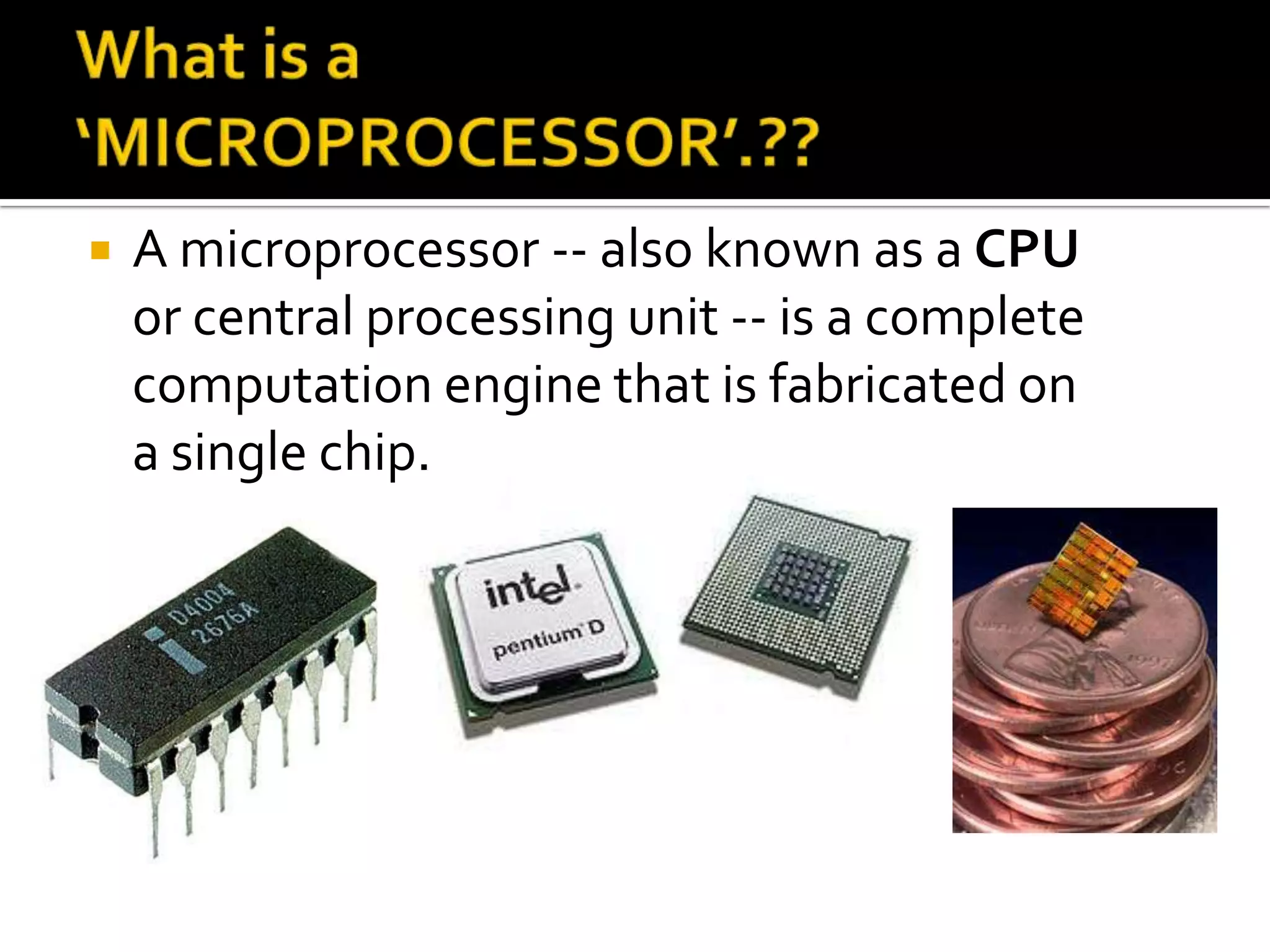
What is a ‘MICROPROCESSOR’.??A microprocessor -- also known as a CPU or central processing unit -- is a complete computation engine that is fabricated on a single chip.
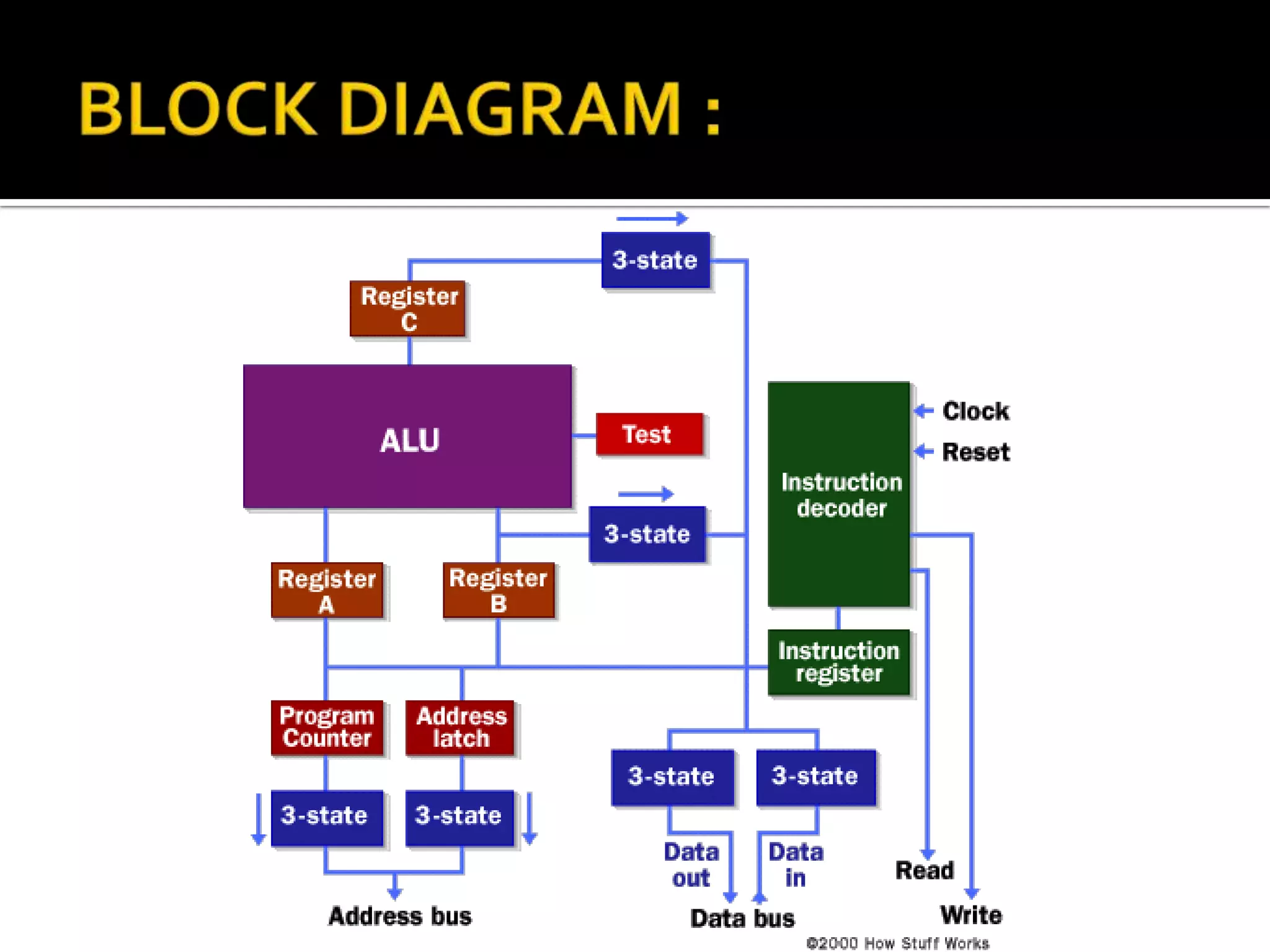
What a Microprocessor does..??A microprocessor executes a collection of machine instructions that tell the processor what to do. Based on the instructions, a microprocessor does three basic things: Using its ALU (Arithmetic/Logic Unit), a microprocessor can perform mathematical operations like addition, subtraction, multiplication and division. A microprocessor can move data from one memory location to another. A microprocessor can make decisions and jump to a new set of instructions based on those decisions.
BLOCK DIAGRAM :
What are Registers..??In computer architecture, a processor register is a small amount of storage available on the CPU whose contents can be accessed more quickly than storage available elsewhere. Most, but not all, modern computers adopt the so-called load-store architecture.
Types of Registers..User-accessible Registers - The most common division of user-accessible registers is into data registers and address registers.Data registers are used to hold numeric values such as integer and floating-point values. In some older and low end CPUs, a special data register, known as the accumulator, is used implicitly for many operations.Address registers hold addresses and are used by instructions that indirectly access memory. Conditional registers hold truth values often used to determine whether some instruction should or should not be executed.General purpose registers (GPRs) can store both data and addresses, i.e., they are combined Data/Address registers.Floating point registers (FPRs) store floating point numbers in many architectures.Constant registers hold read-only values such as zero, one, or pi.Vector registers hold data for vector processing done by SIMD instructions (Single Instruction, Multiple Data).Special purpose registers hold program state; they usually include the program counter (aka instruction pointer), stack pointer, and status register (aka processor status word). In embedded microprocessors, they can also correspond to specialised hardware elements. In some architectures, model-specific registers (also called machine-specific registers) store data and settings related to the processor itself. Because their meanings are attached to the design of a specific processor, they cannot be expected to remain standard between processor generations.Control and status registers - It has three types. Program counter, instruction registers, Program status word (PSW).

Microprocessors

  • 1.
  • 2.
    What is a‘MICROPROCESSOR’.??A microprocessor -- also known as a CPU or central processing unit -- is a complete computation engine that is fabricated on a single chip.
  • 3.
    What a Microprocessordoes..??A microprocessor executes a collection of machine instructions that tell the processor what to do. Based on the instructions, a microprocessor does three basic things: Using its ALU (Arithmetic/Logic Unit), a microprocessor can perform mathematical operations like addition, subtraction, multiplication and division. A microprocessor can move data from one memory location to another. A microprocessor can make decisions and jump to a new set of instructions based on those decisions.
  • 4.
  • 5.
    What are Registers..??Incomputer architecture, a processor register is a small amount of storage available on the CPU whose contents can be accessed more quickly than storage available elsewhere. Most, but not all, modern computers adopt the so-called load-store architecture.
  • 6.
    Types of Registers..User-accessibleRegisters - The most common division of user-accessible registers is into data registers and address registers.Data registers are used to hold numeric values such as integer and floating-point values. In some older and low end CPUs, a special data register, known as the accumulator, is used implicitly for many operations.Address registers hold addresses and are used by instructions that indirectly access memory. Conditional registers hold truth values often used to determine whether some instruction should or should not be executed.General purpose registers (GPRs) can store both data and addresses, i.e., they are combined Data/Address registers.Floating point registers (FPRs) store floating point numbers in many architectures.Constant registers hold read-only values such as zero, one, or pi.Vector registers hold data for vector processing done by SIMD instructions (Single Instruction, Multiple Data).Special purpose registers hold program state; they usually include the program counter (aka instruction pointer), stack pointer, and status register (aka processor status word). In embedded microprocessors, they can also correspond to specialised hardware elements. In some architectures, model-specific registers (also called machine-specific registers) store data and settings related to the processor itself. Because their meanings are attached to the design of a specific processor, they cannot be expected to remain standard between processor generations.Control and status registers - It has three types. Program counter, instruction registers, Program status word (PSW).