Introduce a systematic approach to developing and delivering an effective training program Identify ways to establish business partnerships
Need Analysis focuses on the specific operational needs of the business. Identifies knowledge based solution Identifies skills based solution Identifies operational objectives of the training STEP ONE: CONDUCT A NEED ANALYSIS How do you determine what a business unit needs?
Objectives are the rules for implementing program to improve performance What is to be accomplished Realistic goals are to be set Objectives are to meet the immediate business needs of the organization Develop the “how to” in meeting these objectives Identify timelines for meeting objectives STEP TWO: SET OBJECTIVES
Identify if the training material will be in the form of hardcopy textbooks, on-line access, PowerPoint presentations, or a distance learning medium. Solicit the expertise of a curriculum designer. All aspects of the training materials must focus on the needs of the business organization. Include assessment sections and critical thinking modules to reinforce learning. STEP THREE: DEVELOP TRAINING MATERIALS
Material content Presentation Class participation Facilitator’s knowledge of the subject matter STEP FOUR: DEVELOP AND DESIGN EVALUATION MATERIAL Determine if the evaluation phase will be in the form of hard copy material or an on-line assessment. Evaluation areas include:
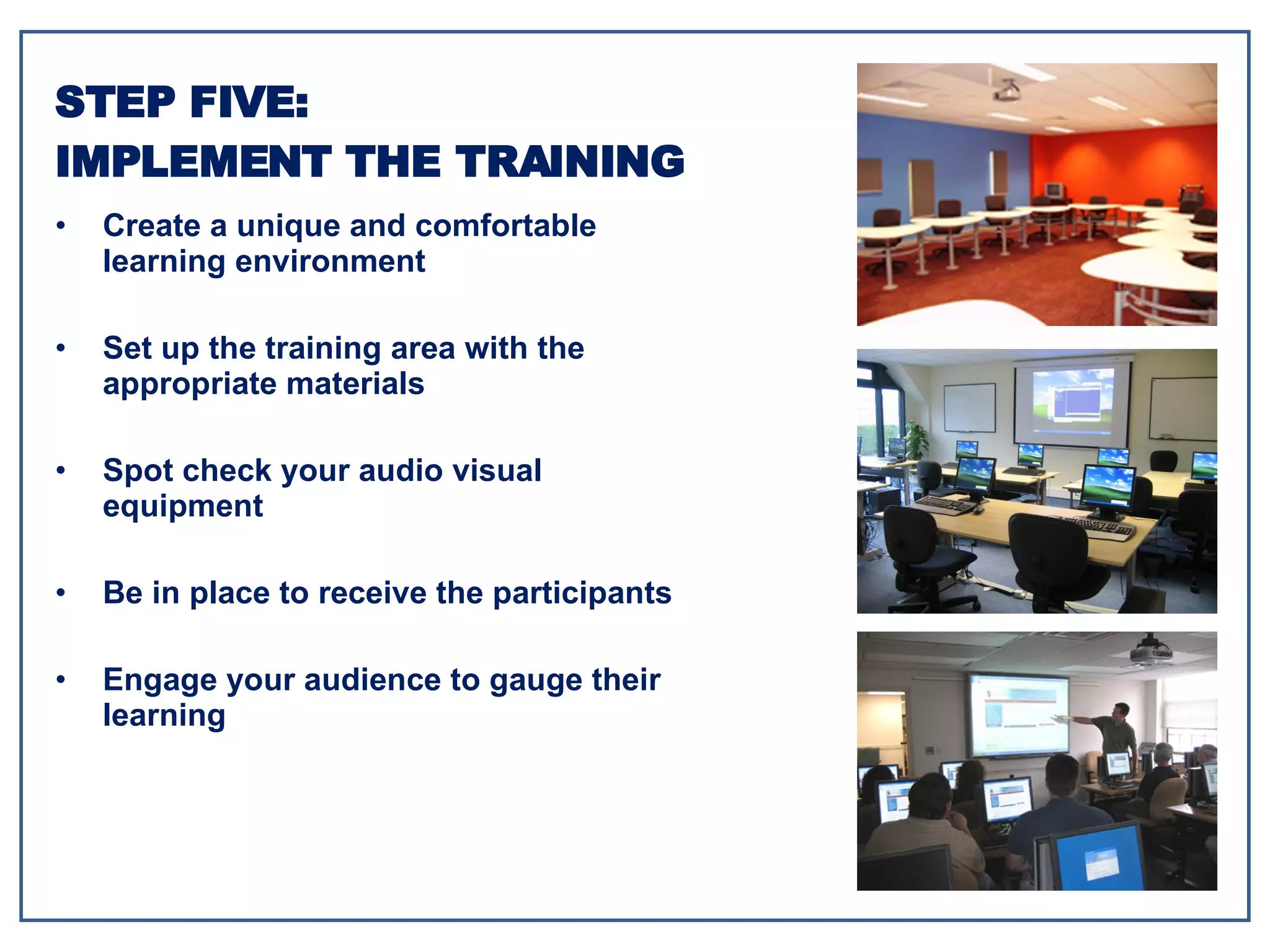
Create a unique and comfortable learning environment Set up the training area with the appropriate materials Spot check your audio visual equipment Be in place to receive the participants Engage your audience to gauge their learning STEP FIVE: IMPLEMENT THE TRAINING
Explain the purpose of the evaluation Communicate that the evaluation is a chance for the participants to improve the quality of training for the program or future programs. Encourage the audience to participate in the Evaluation process. STEP SIX: EVALUATE THE TRAINING
Revisit your focus groups with the evaluation results Solicit evaluation and feedback from the focus group after the training Measure the evaluation results in lieu of operational objectives Incorporate modifications into the next training Communicate to the focus group regarding their ROI (Return of Investment) STEP SEVEN: MODIFY THE TRAINING
Proactively seeks to learn the organization’s business Create opportunities to where you are actively engaged in certain aspects of their business (this earns credibility) Offer training solutions and be willing to set up a time (via focus groups) to learn their operational needs and aid in identifying needs HOW DOES THE TRAINING DEPARTMENT BUILD PARTNERSHIPS?
Revisit the training objectives Incorporate the 7-step Training Program Proactively seek to understand the business of your partner Earn credibility Aggressively recruit a proven Training Consultant
Greg Consulta Training Consultant

Seven Steps To Creating Training Materials

  • 1.
  • 2.
    Introduce a systematicapproach to developing and delivering an effective training program Identify ways to establish business partnerships
  • 3.
    Need Analysis focuseson the specific operational needs of the business. Identifies knowledge based solution Identifies skills based solution Identifies operational objectives of the training STEP ONE: CONDUCT A NEED ANALYSIS How do you determine what a business unit needs?
  • 4.
    Objectives are therules for implementing program to improve performance What is to be accomplished Realistic goals are to be set Objectives are to meet the immediate business needs of the organization Develop the “how to” in meeting these objectives Identify timelines for meeting objectives STEP TWO: SET OBJECTIVES
  • 5.
    Identify if thetraining material will be in the form of hardcopy textbooks, on-line access, PowerPoint presentations, or a distance learning medium. Solicit the expertise of a curriculum designer. All aspects of the training materials must focus on the needs of the business organization. Include assessment sections and critical thinking modules to reinforce learning. STEP THREE: DEVELOP TRAINING MATERIALS
  • 6.
    Material content PresentationClass participation Facilitator’s knowledge of the subject matter STEP FOUR: DEVELOP AND DESIGN EVALUATION MATERIAL Determine if the evaluation phase will be in the form of hard copy material or an on-line assessment. Evaluation areas include:
  • 7.
    Create a uniqueand comfortable learning environment Set up the training area with the appropriate materials Spot check your audio visual equipment Be in place to receive the participants Engage your audience to gauge their learning STEP FIVE: IMPLEMENT THE TRAINING
  • 8.
    Explain the purposeof the evaluation Communicate that the evaluation is a chance for the participants to improve the quality of training for the program or future programs. Encourage the audience to participate in the Evaluation process. STEP SIX: EVALUATE THE TRAINING
  • 9.
    Revisit your focusgroups with the evaluation results Solicit evaluation and feedback from the focus group after the training Measure the evaluation results in lieu of operational objectives Incorporate modifications into the next training Communicate to the focus group regarding their ROI (Return of Investment) STEP SEVEN: MODIFY THE TRAINING
  • 10.
    Proactively seeks tolearn the organization’s business Create opportunities to where you are actively engaged in certain aspects of their business (this earns credibility) Offer training solutions and be willing to set up a time (via focus groups) to learn their operational needs and aid in identifying needs HOW DOES THE TRAINING DEPARTMENT BUILD PARTNERSHIPS?
  • 11.
    Revisit the trainingobjectives Incorporate the 7-step Training Program Proactively seek to understand the business of your partner Earn credibility Aggressively recruit a proven Training Consultant
  • 12.