ServSafe™ Exam Prep & Study Guide

          AtTheInstitute.com
2. The Microworld

  AtTheInstitute.com
Section Goals
• List the types of          • List the major
  pathogens which cause        foodborne illnesses,
  foodborne illness.           their characteristics and
• List the factors that        methods of prevention.
  affect the growth of       • List additional biological
  bacteria.                    hazards to food safety
• List the foods most          along with their
  likely to become unsafe.     characteristics and
                               prevention methods.
Definitions
• TCS (Temperature Control for Safety) Foods – TCS foods
  are those items for which time & temperature control are
  vital in order to ensure the safety of the food.

• Toxin – A poison produced by a living organism.

• Spore –A form adopted by some bacteria allowing them
  to survive for extended periods of time in unfavorable
  conditions. They can change back and begin growing
  again once conditions are more favorable.
Pathogens
Most microorganisms are harmless. Some are even
  beneficial. But others (Pathogens) can cause illness.
  Some pathogens can make you sick. Other pathogens
  can produce poisons (toxins) that make you sick.
Pathogens include:
• Viruses
• Bacteria
• Parasites
• Fungi
Foods Most Likely to Become Unsafe
    Though any food can be contaminated, certain foods are
    better for the growth of pathogens. These foods are
    known as TCS (Temperature Control for Safety) foods.

•   Meat, Fish & Shellfish & Poultry
•   Eggs, Milk & Dairy Products
•   Soy products and Synthetic Meat Replacements
•   Cooked Plant Foods
•   Sprouts and sprout seeds
•   Untreated Garlic-and-Oil mixtures
•   Sliced Melons & Tomatoes
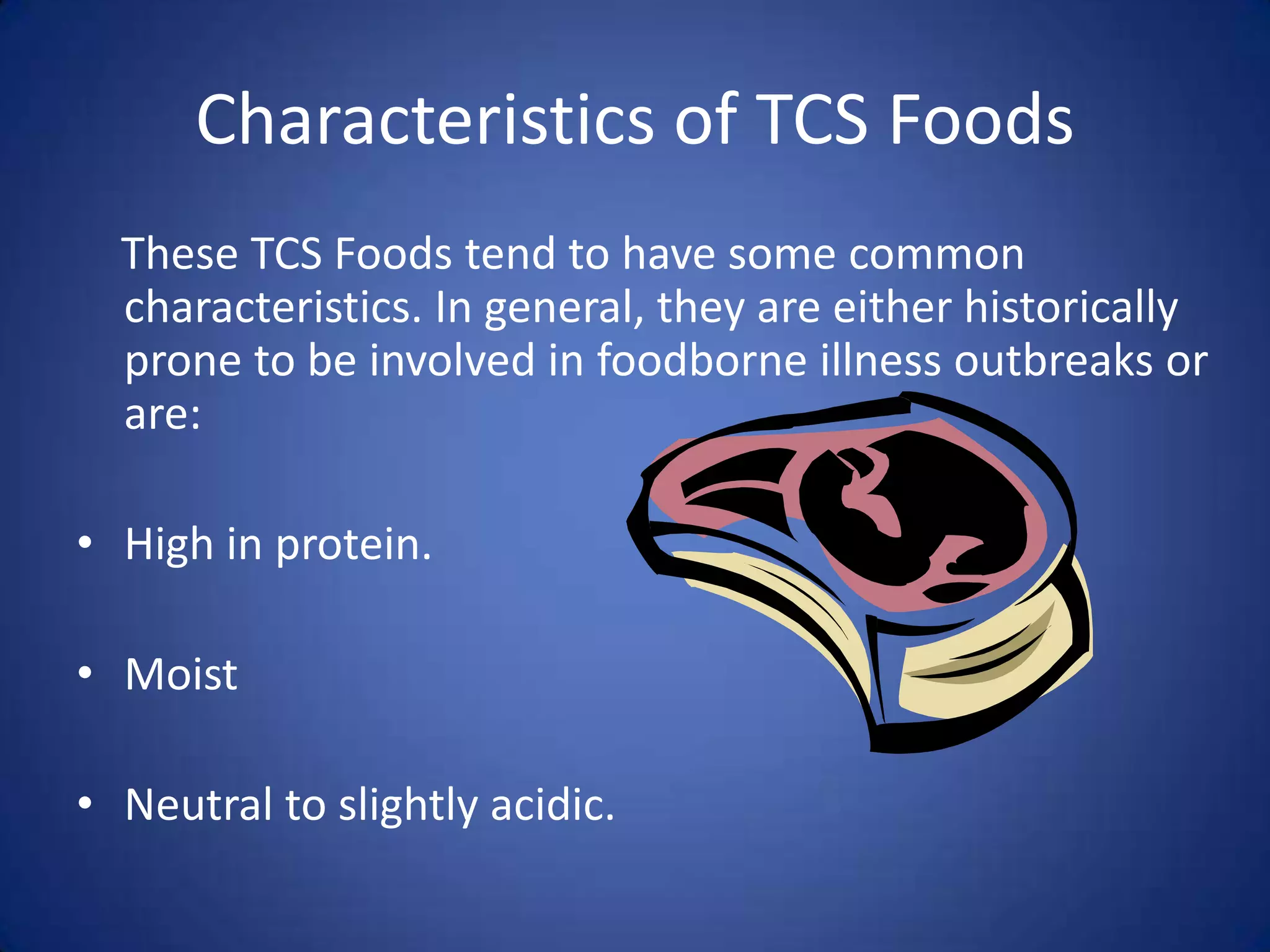
Characteristics of TCS Foods
  These TCS Foods tend to have some common
  characteristics. In general, they are either historically
  prone to be involved in foodborne illness outbreaks or
  are:

• High in protein.

• Moist

• Neutral to slightly acidic.
Controlling Pathogen Growth
To control the growth of pathogens you need to
keep food at the right temperature. An example of
this might be refrigerating potato salad or placing
soup into a hot-holding unit for service.

Like TCS foods, ready-to-eat foods also need careful
handling to avoid contamination. Already cooked
foods, deli-meats and cheeses, baked goods and
washed fruits & vegetables are easily
contaminated.
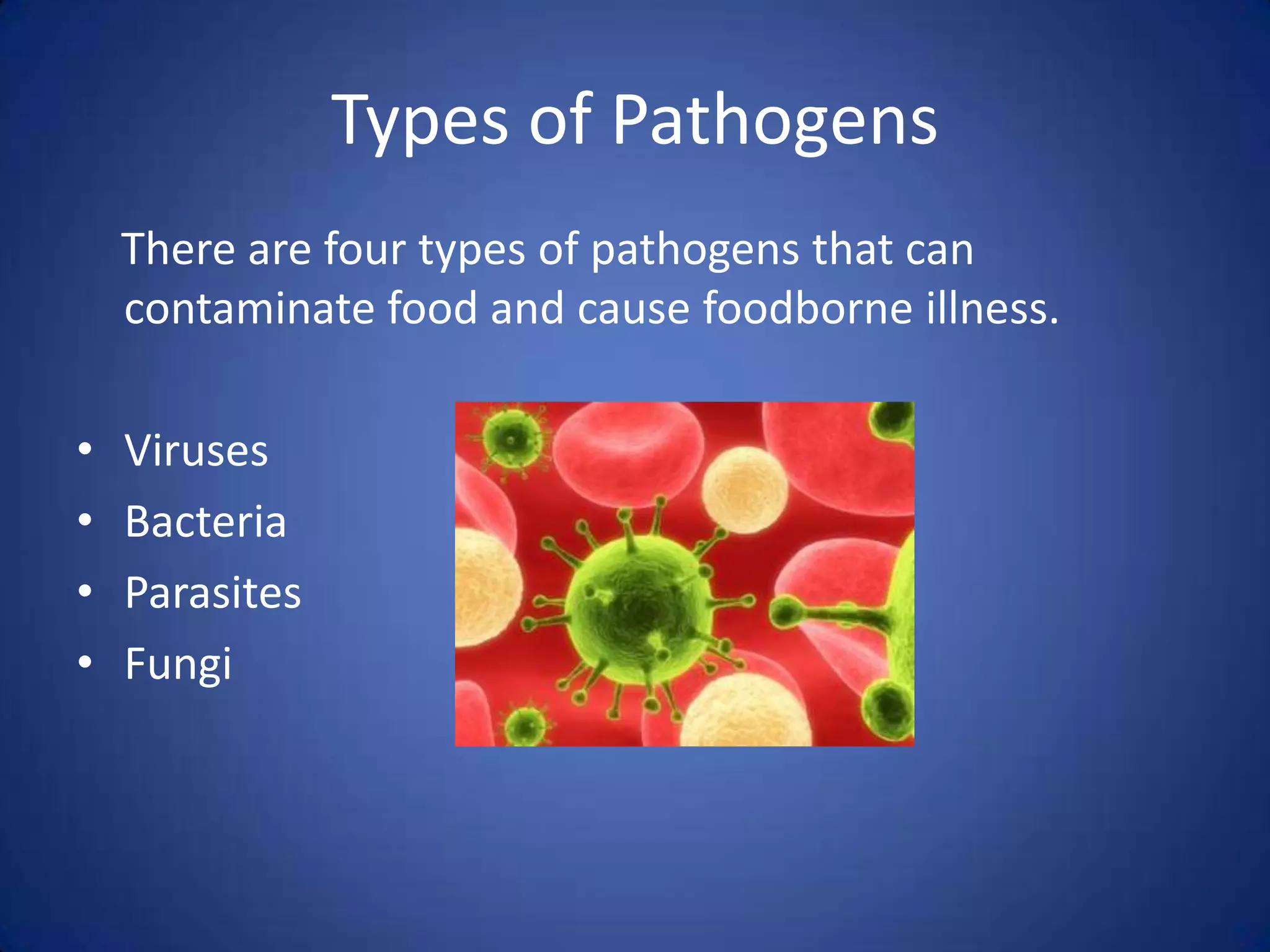
Types of Pathogens
    There are four types of pathogens that can
    contaminate food and cause foodborne illness.

•   Viruses
•   Bacteria
•   Parasites
•   Fungi
Viruses
  Viruses are the leading cause of foodborne illness. When
  customers get sick from food contaminated by viruses, it’s
  usually because their food was handled by an employee who
  has that virus.

Virus Facts:
• Viruses can survive refrigerator and freezer temperatures.
• Viruses can contaminate food and water.
• Viruses do not grow in food but once eaten can grow in a
   person’s intestines.
• Viruses can be transferred from person to person, person to
   food, or person to food-contact surface.
Preventing Foodborne Illnesses caused
             by Viruses
  There are several ways to help prevent the spread of
  viruses within your operation.

• Keep foodhandlers who are vomiting, have diarrhea, or
  jaundice out of the operation.
• Ensure that foodhandles wash their hands properly.
• Eliminate bare-hand-contact with ready-to-eat food.

          The viruses of most concern to us are
                 Hepatitis A & Norovirus.
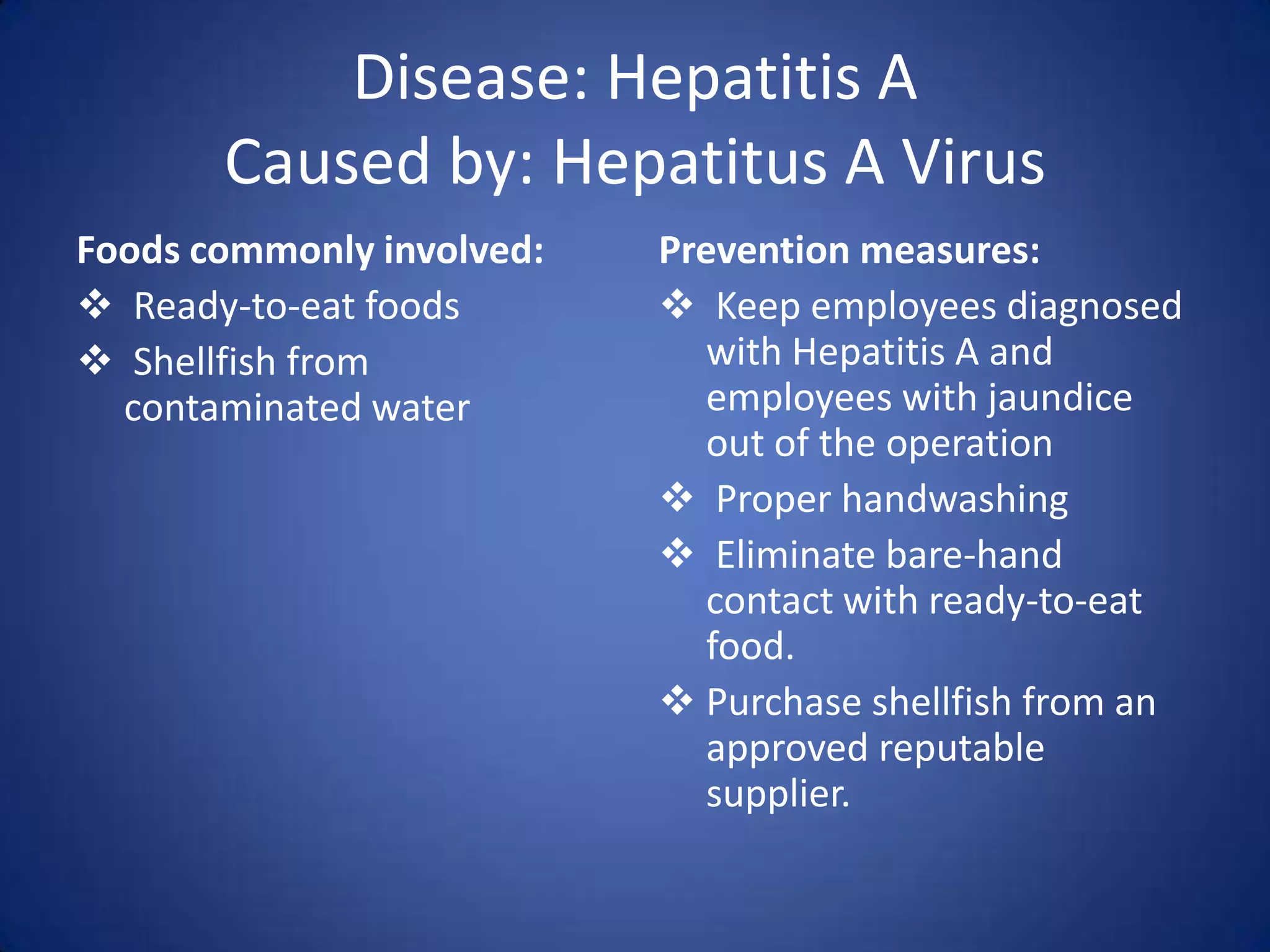
Disease: Hepatitis A
       Caused by: Hepatitus A Virus
Foods commonly involved:   Prevention measures:
 Ready-to-eat foods        Keep employees diagnosed
 Shellfish from              with Hepatitis A and
  contaminated water          employees with jaundice
                              out of the operation
                            Proper handwashing
                            Eliminate bare-hand
                              contact with ready-to-eat
                              food.
                            Purchase shellfish from an
                              approved reputable
                              supplier.
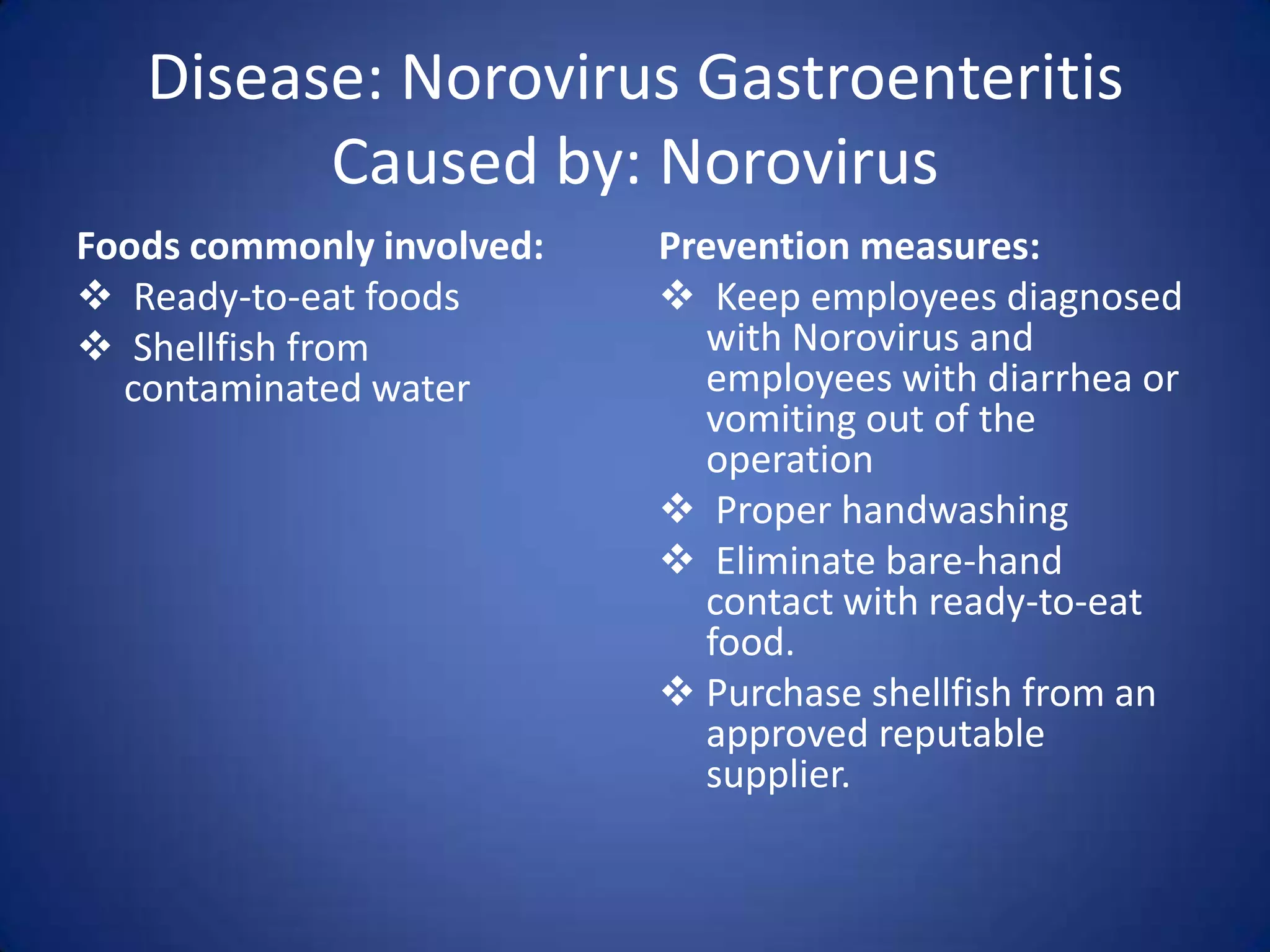
Disease: Norovirus Gastroenteritis
         Caused by: Norovirus
Foods commonly involved:   Prevention measures:
 Ready-to-eat foods        Keep employees diagnosed
 Shellfish from              with Norovirus and
  contaminated water          employees with diarrhea or
                              vomiting out of the
                              operation
                            Proper handwashing
                            Eliminate bare-hand
                              contact with ready-to-eat
                              food.
                            Purchase shellfish from an
                              approved reputable
                              supplier.
Bacteria
Though viruses are the leading cause of foodborne illness, bacteria also cause
   many cases of foodborne illness.

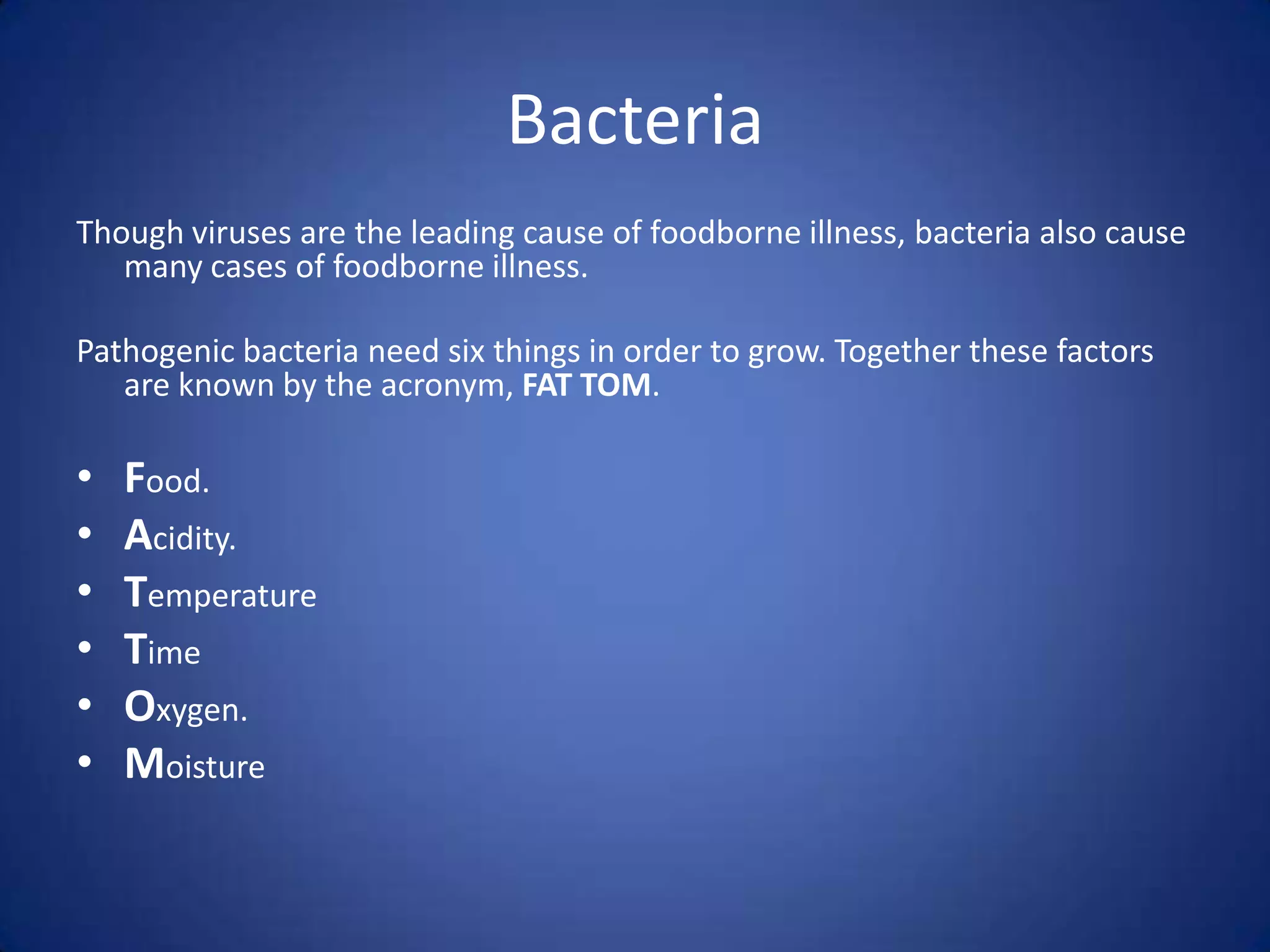
Pathogenic bacteria need six things in order to grow. Together these factors
   are known by the acronym, FAT TOM.

•   Food.
•   Acidity.
•   Temperature
•   Time
•   Oxygen.
•   Moisture
FAT TOM
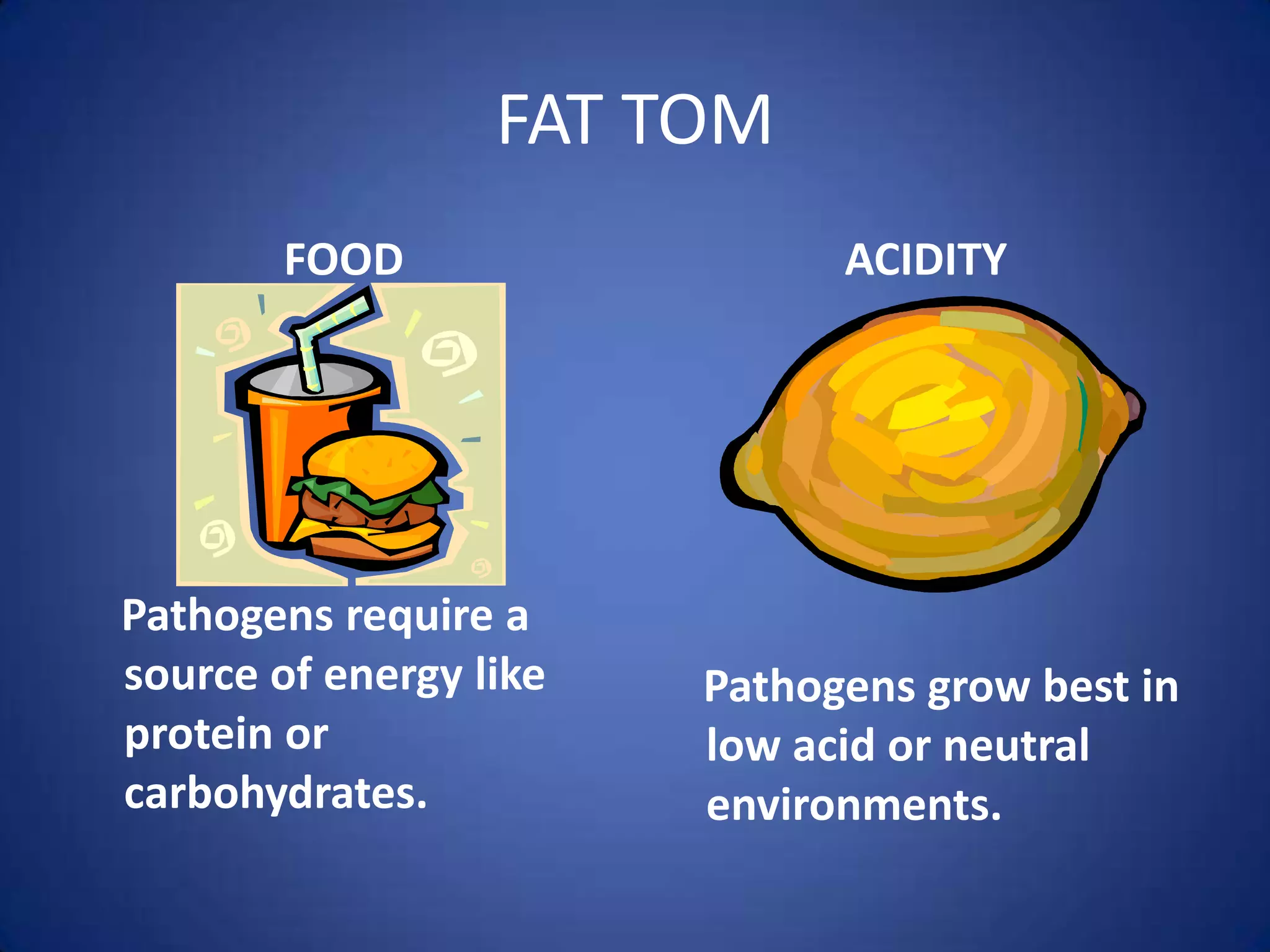
        FOOD                  ACIDITY


Pathogens require a
source of energy like   Pathogens grow best in
protein or              low acid or neutral
carbohydrates.          environments.
FAT TOM (continued)
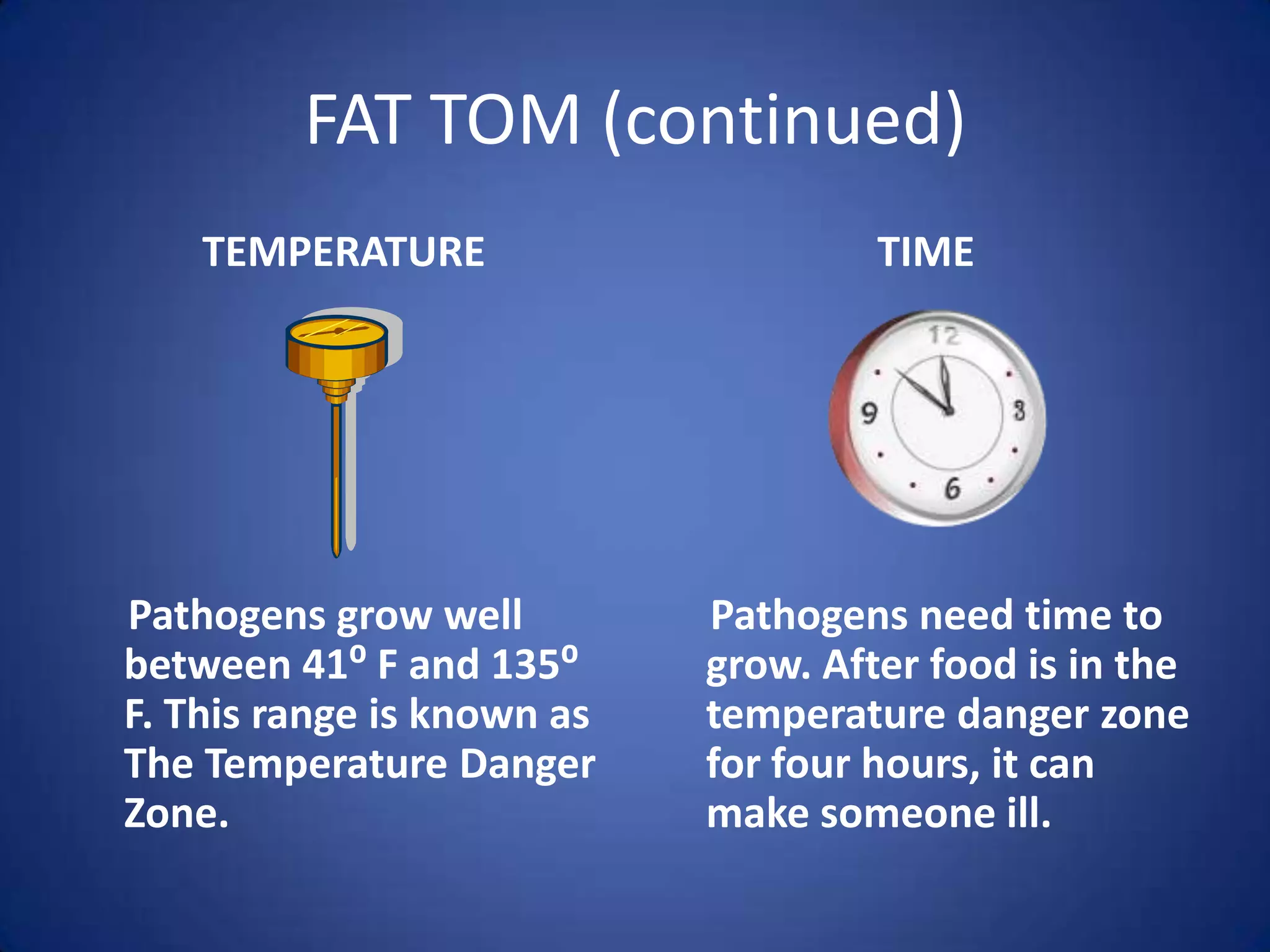
    TEMPERATURE                      TIME


Pathogens grow well         Pathogens need time to
between 41⁰ F and 135⁰      grow. After food is in the
F. This range is known as   temperature danger zone
The Temperature Danger      for four hours, it can
Zone.                       make someone ill.
FAT TOM (continued)
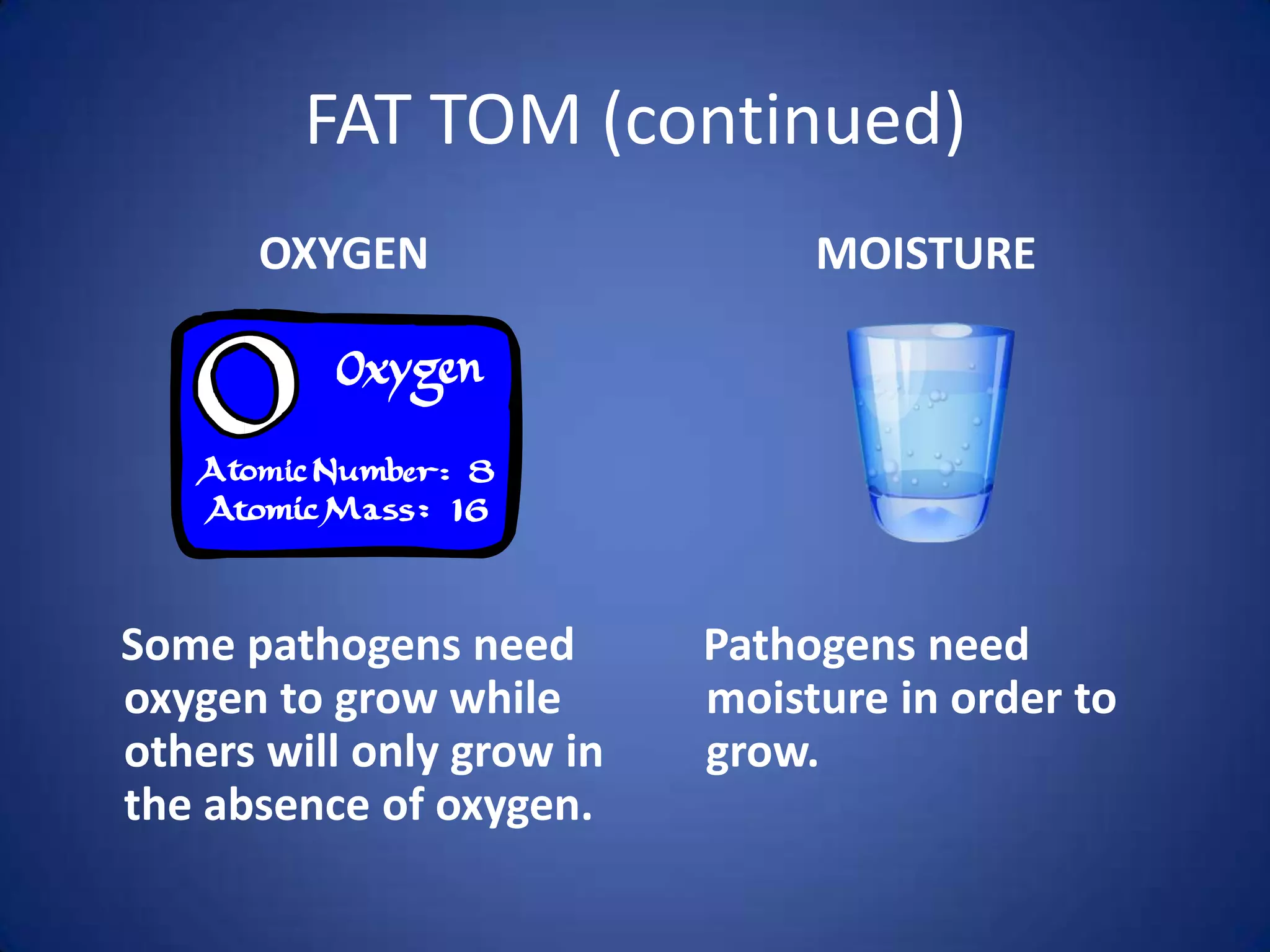
      OXYGEN                    MOISTURE


Some pathogens need        Pathogens need
oxygen to grow while       moisture in order to
others will only grow in   grow.
the absence of oxygen.
Bacteria

• Most bacteria are controlled by controlling time and
  temperature.
• If FAT TOM conditions are right bacteria can multiply
  every twenty minutes.
• Bacteria can survive by temporarily changing into
  spore form when conditions are unfavorable.
• Some bacteria make toxins as they grow and die.
  Cooking and freezing may not destroy these toxins.
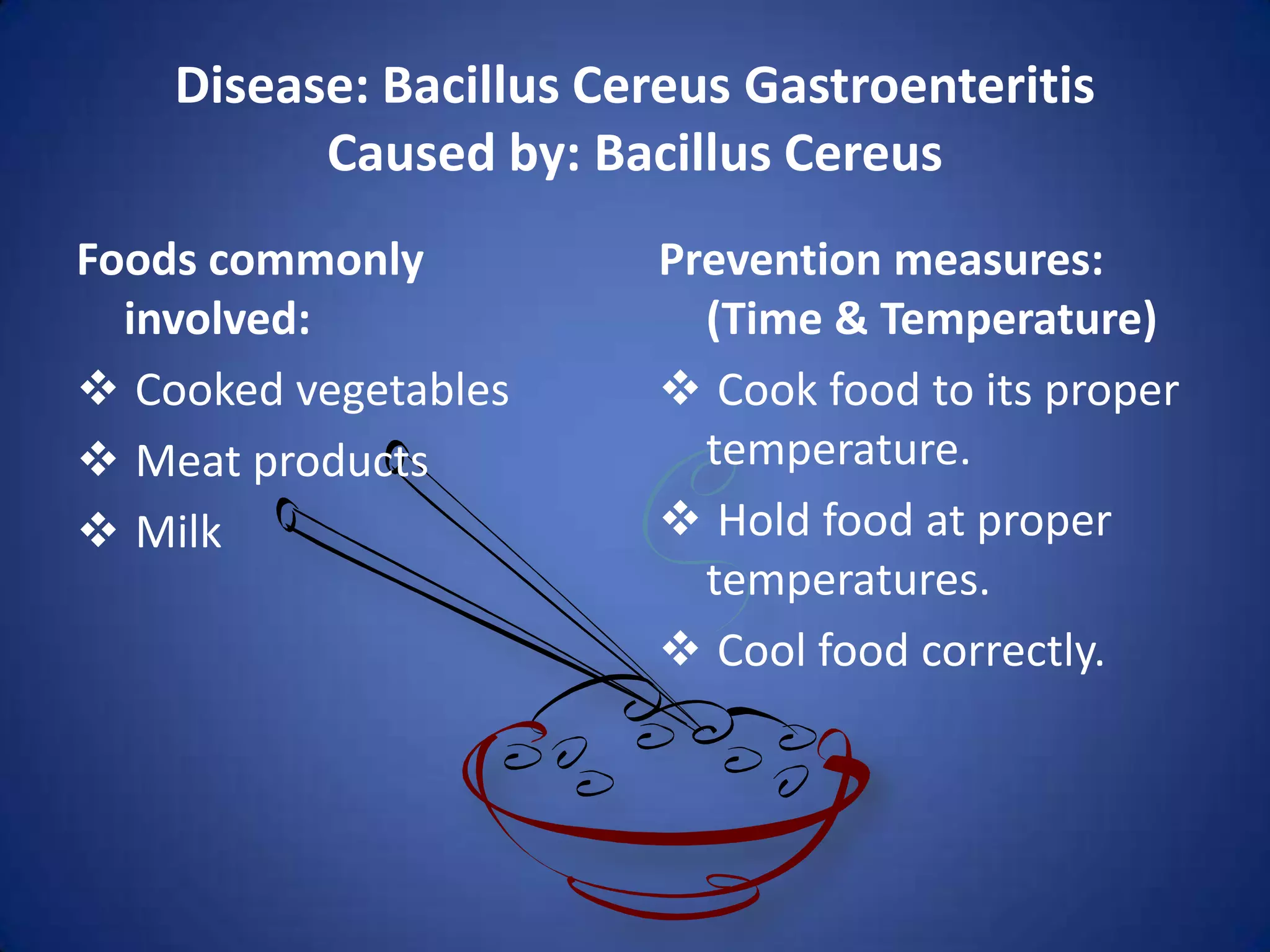
Disease: Bacillus Cereus Gastroenteritis
          Caused by: Bacillus Cereus
Foods commonly           Prevention measures:
  involved:                (Time & Temperature)
 Cooked vegetables       Cook food to its proper
 Meat products            temperature.
 Milk                    Hold food at proper
                           temperatures.
                          Cool food correctly.
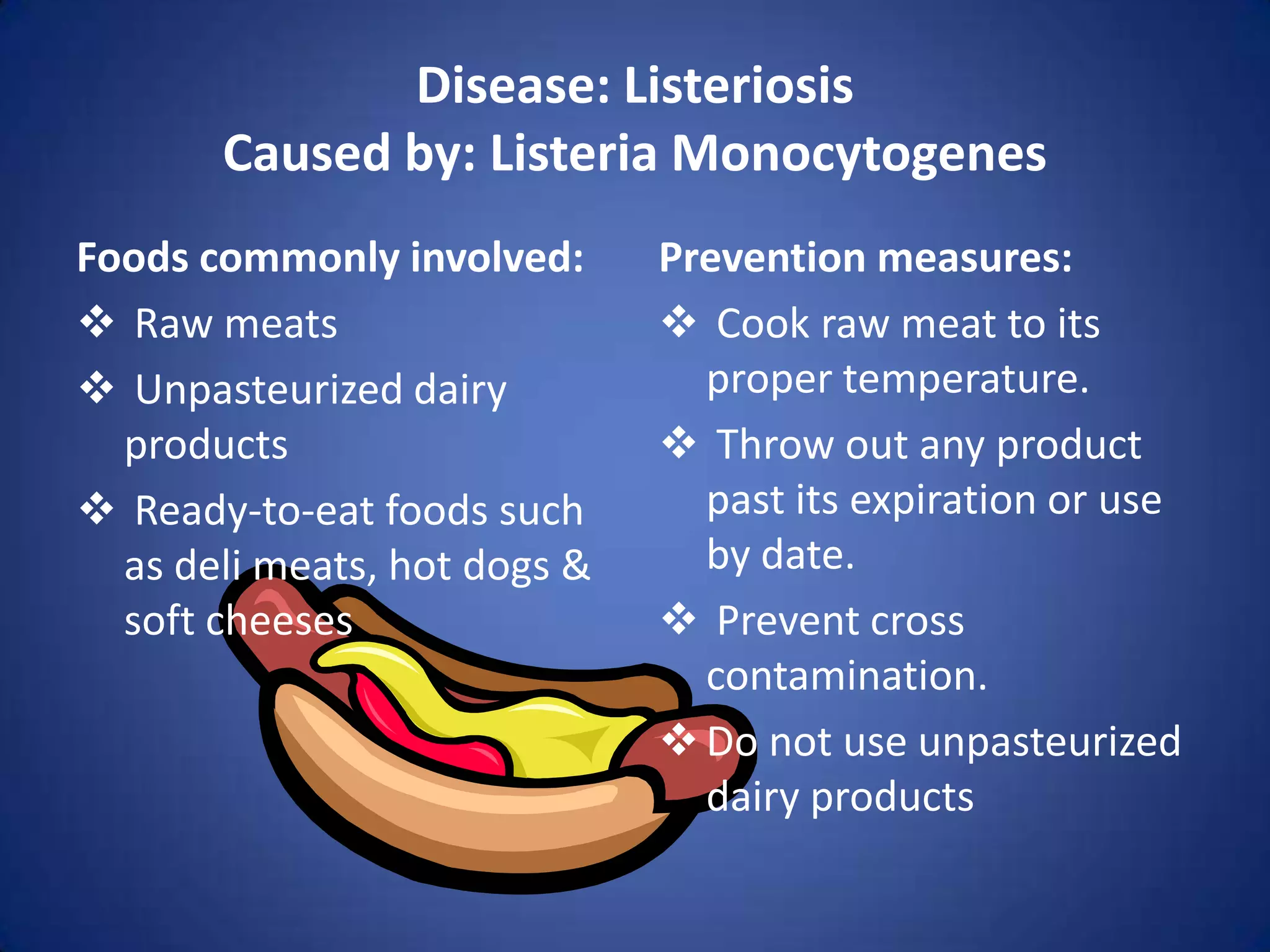
Disease: Listeriosis
       Caused by: Listeria Monocytogenes
Foods commonly involved:      Prevention measures:
 Raw meats                    Cook raw meat to its
 Unpasteurized dairy           proper temperature.
  products                     Throw out any product
 Ready-to-eat foods such       past its expiration or use
  as deli meats, hot dogs &     by date.
  soft cheeses                 Prevent cross
                                contamination.
                               Do not use unpasteurized
                                dairy products
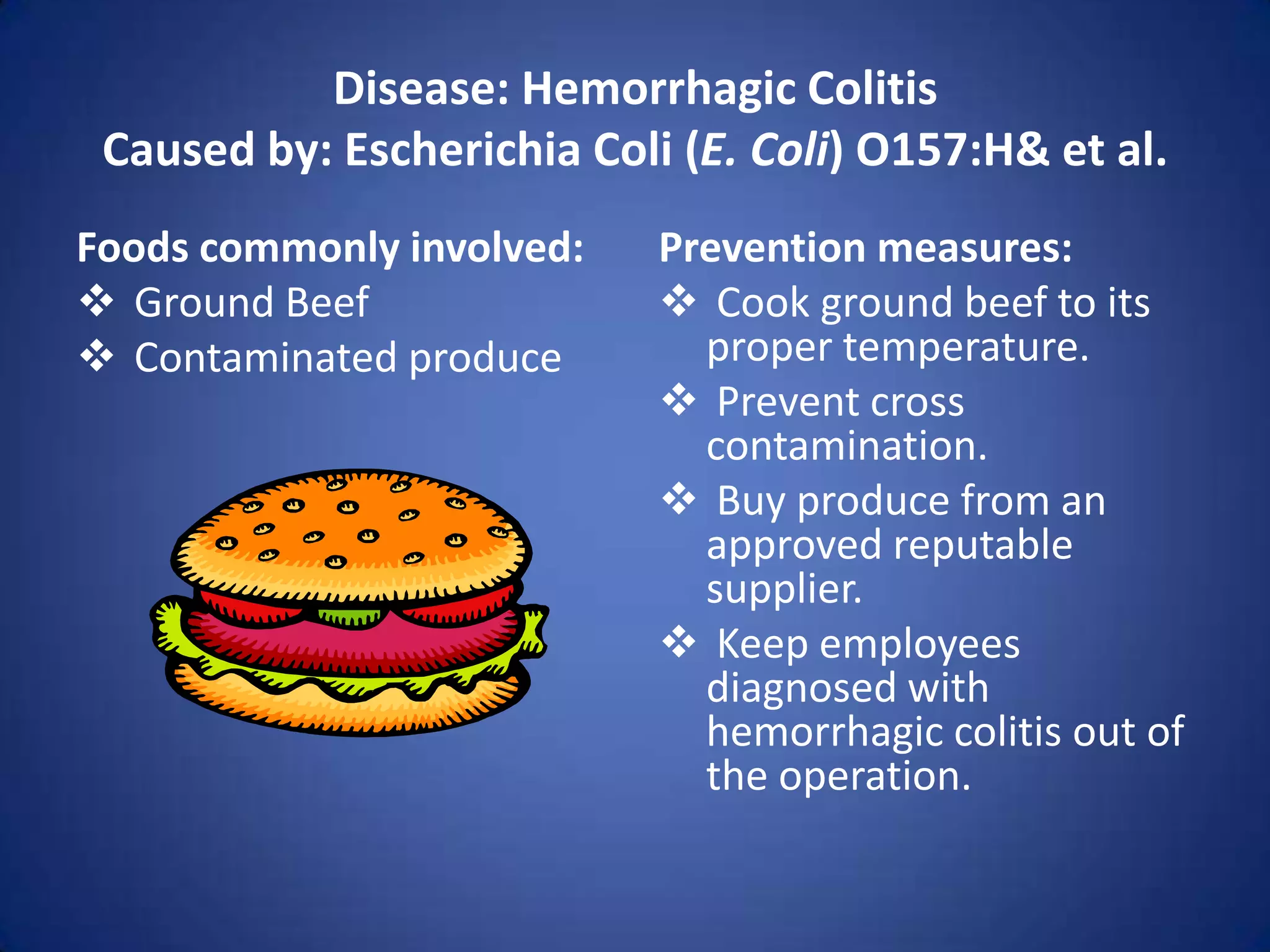
Disease: Hemorrhagic Colitis
 Caused by: Escherichia Coli (E. Coli) O157:H& et al.
Foods commonly involved:    Prevention measures:
 Ground Beef                Cook ground beef to its
 Contaminated produce        proper temperature.
                             Prevent cross
                              contamination.
                             Buy produce from an
                              approved reputable
                              supplier.
                             Keep employees
                              diagnosed with
                              hemorrhagic colitis out of
                              the operation.
Disease: Clostridium Perfringens Gastroenteritis
        Caused by: Clostridium Perfringens

Foods commonly             Prevention measures:
  involved:                  (Time & Temperature)
 Meat                      Hold food at proper
 Poultry                    temperatures.
 Soups, stews & gravies    Cool food correctly.
  containing meat or
  poultry
Disease: Botulism
       Caused by: Clostridium Botulinum
Foods commonly involved:    Prevention measures: (Time
 Improperly canned foods     & Temperature)
 Reduced Oxygen             Hold, cool & reheat food
  Packaging (ROP) foods       properly.
 Time/Temperature           Inspect canned foods for
  abused vegetables such      signs of damage.
  as baked potatoes
 Untreated garlic & oil
  mixtures
Disease: Salmonellosis
         Caused by: Salmonella spp
Foods commonly        Prevention measures:
  involved:            Cook poultry and eggs
 Poultry               to their proper
 Eggs                  temperatures.
 Dairy               Prevent cross
 Produce               contamination.
                       Keep foodhandlers
                        diagnosed with
                        Salmonellosis out of the
                        operation.
Disease: Shigellosis
            Caused by: Shigella spp
Foods commonly            Prevention measures:
  involved:                 (Proper Hygiene)
 Foods easily             Keep foodhandlers who
  contaminated by hands     have diarrhea out of the
  such as ready-to-eat      operation.
  foods.                  Wash hands properly.
 Foods that have come     Keep foodhandlers
  in contact with           diagnosed with
  contaminated water        Shigellosis out of the
                            operation.
Disease: Staphylococcal Gastroenteritis
      Caused by: Staphylococcus Aureus
Foods commonly            Prevention measures:
  involved:                 (Proper Hygiene)
 Foods easily            Wash hands properly.
  contaminated by hands   Cover wounds on the
  such as ready-to-eat      hands and arms.
  foods.
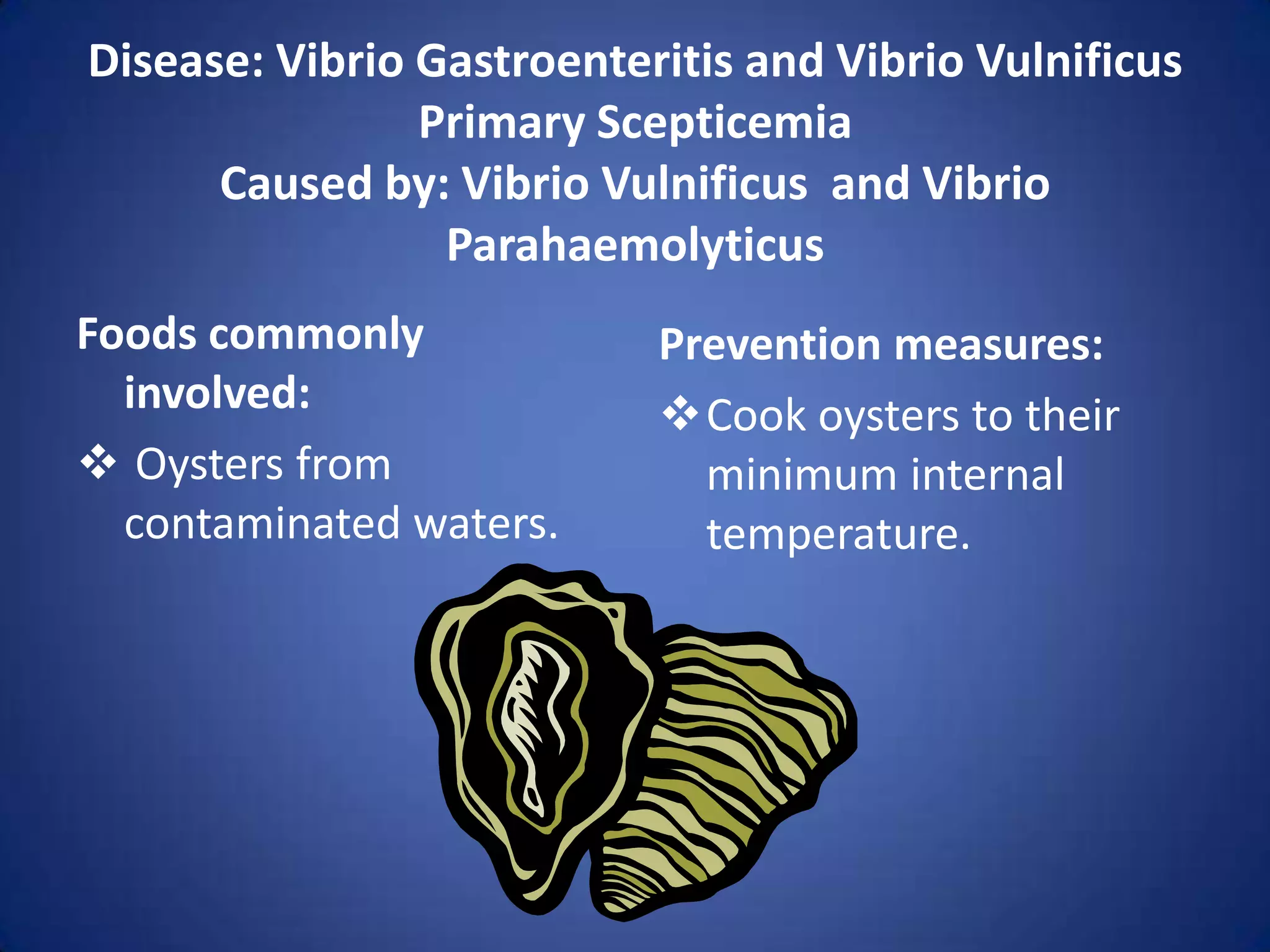
Disease: Vibrio Gastroenteritis and Vibrio Vulnificus
                Primary Scepticemia
      Caused by: Vibrio Vulnificus and Vibrio
                 Parahaemolyticus
Foods commonly             Prevention measures:
  involved:                Cook oysters to their
 Oysters from               minimum internal
  contaminated waters.       temperature.
Parasites
  Though illnesses from parasites are not as
  widespread as those from viruses or bacteria it is still
  important to guard against the threat they pose.

• Parasites can contaminate both food & water.
• Parasites cannot grow in food. They need to be in the
  flesh of an animal to grow and survive.
• The best defense against parasites is to purchase
  food from approved, reputable suppliers.
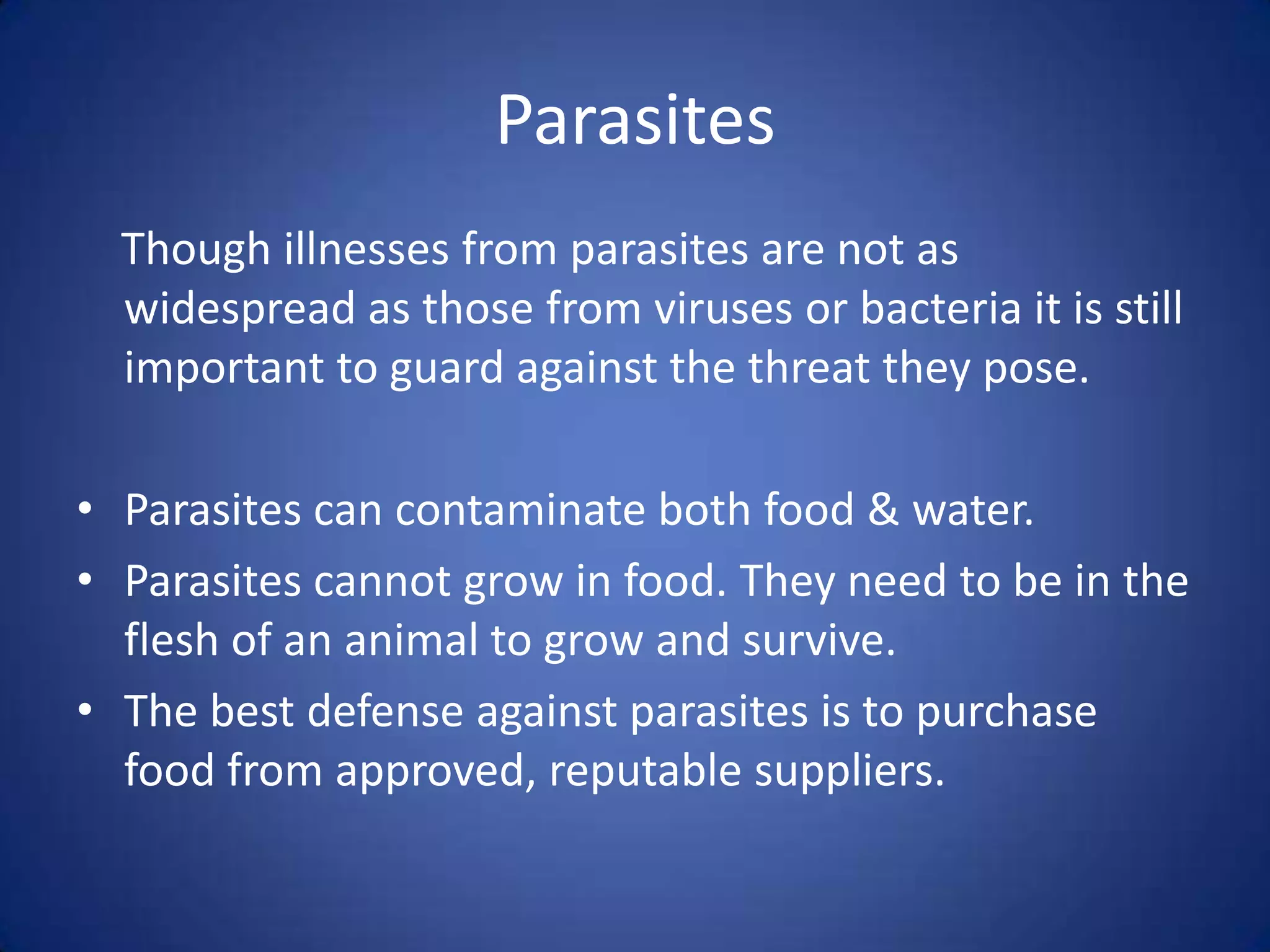
Disease: Anisakiasis
          Caused by: Anisakis Simplex
Foods commonly             Prevention measures:
  involved:                 Cook fish to proper
 Raw and undercooked        temperatures.
  fish including: herring,  If serving raw or
  cod, halibut, mackerel &   undercooked fish,
  Pacific salmon             purchase sushi-grade
                             fish.
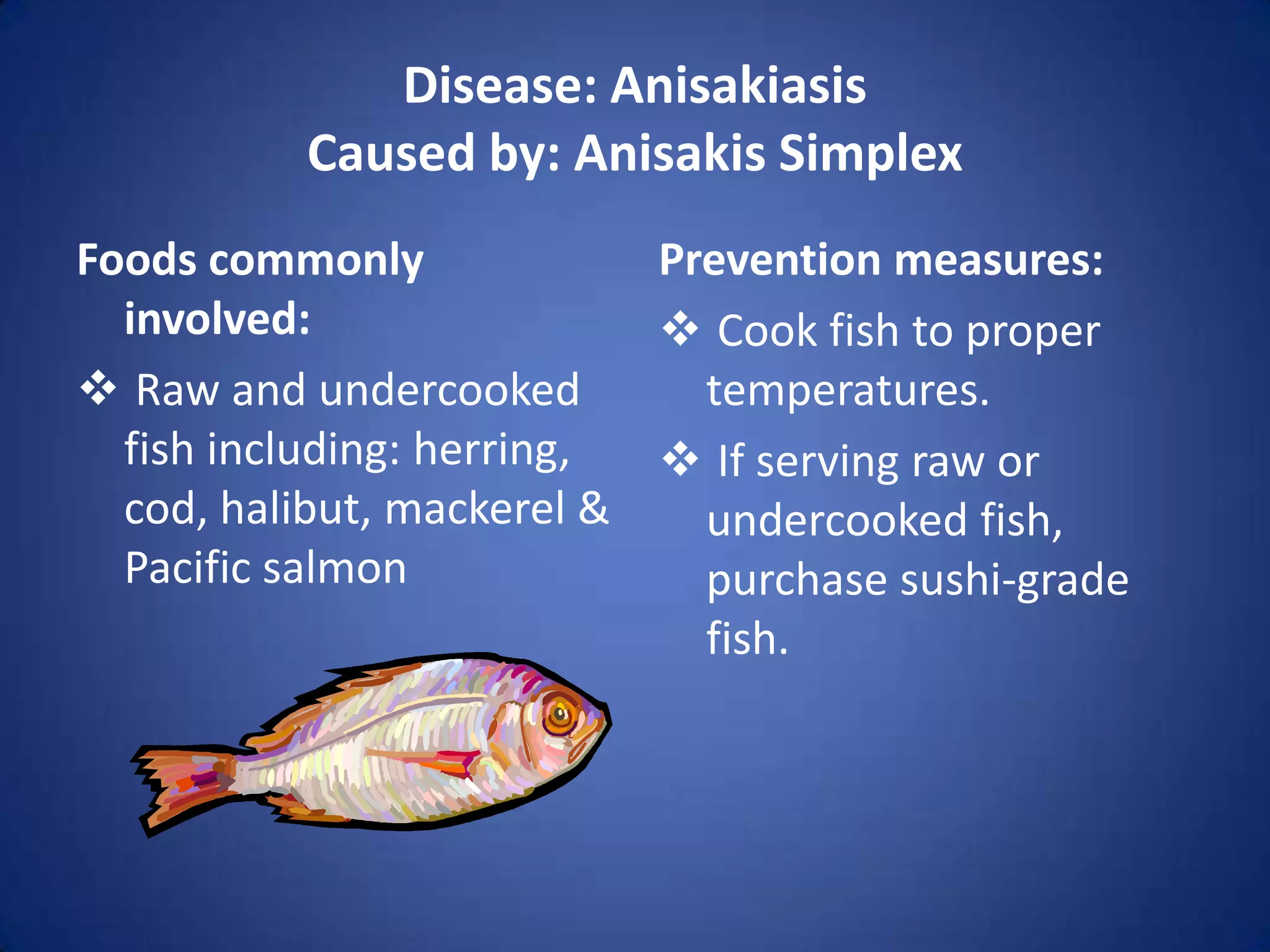
Disease: Cryptosporidiosis
     Caused by: Cryptosporidium Parvum
Foods commonly           Prevention measures:
  involved:               Use properly treated
 Contaminated water &     water.
  produce.                Keep foodhandlers with
                           diarrhea out of the
                           operation.
                         Wash hands.
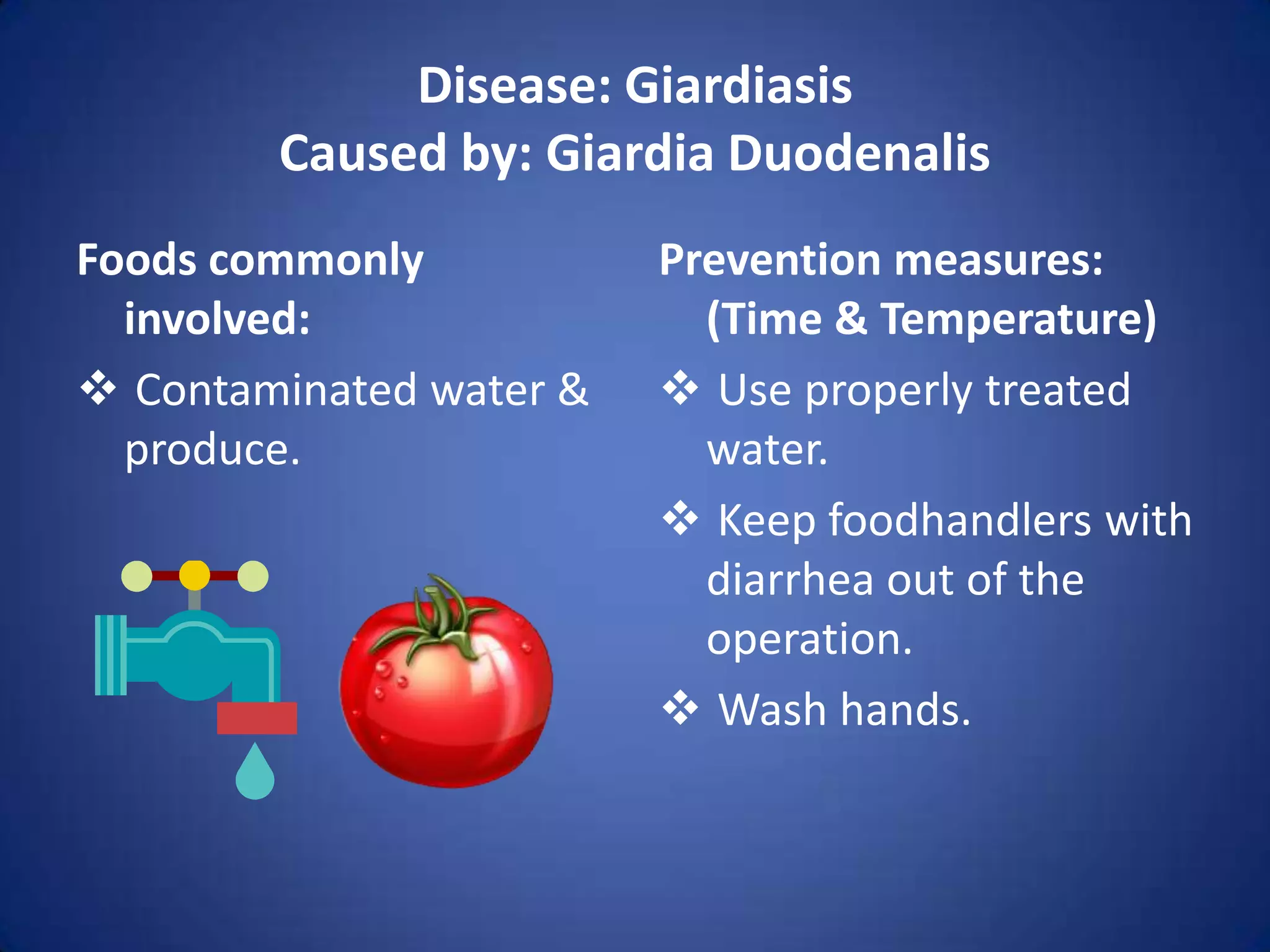
Disease: Giardiasis
        Caused by: Giardia Duodenalis
Foods commonly           Prevention measures:
  involved:                (Time & Temperature)
 Contaminated water &    Use properly treated
  produce.                 water.
                          Keep foodhandlers with
                           diarrhea out of the
                           operation.
                          Wash hands.
Fungi
Fungi are known primarily for spoiling food but some
can make people sick. They can be found in air,
water, soil, plants and some food. Mold & yeast are
the two fungi of primary concern.
Molds
  Molds spoil food and sometimes cause illness. Some
  molds produce toxins, such as aflatoxins.

• Molds grow well in acidic foods with little or no moisture,
  such as jams & jellies and in salty meats like bacon,
  salami and ham.
• Throw out moldy food unless mold is a natural part of
  the product.
• The FDA recommends that mold on hard cheese, salami
  and firm produce may be cut away at least one inch (2.5
  centimeters) around the moldy area.
Yeasts
  Yeasts can spoil foods quickly. Signs of spoilage
  include a smell or taste of alcohol. The yeast itself
  may appear as a white or pink discoloration or slime
  and may bubble. Like molds, yeasts grow well in
  acidic foods with little moisture, such as jams &
  jellies, syrup, honey and fruit and fruit juices.

• Discard any food that shows signs of yeast spoilage.
Seafood Toxins
  Seafood toxins cannot be smelled or tasted nor can
  they be destroyed by freezing or cooking.

• Fish Toxins may be a natural part of the fish or made
  by pathogens on the fish. Others occur when a
  predatory fish eats a smaller, contaminated fish that
  has consumed a toxin.
• Shellfish Toxins can contaminate shellfish when they
  consume contaminated marine algae.
Disease: Scromboid Poisoning
               Caused by: Histamine
When Scromboid fish are time and temperature abused,
bacteria on the fish make the toxin, histamine. This toxin
cannot be destroyed by cooking, freezing, smoking, or
curing.
 Foods commonly               Prevention measures:
   involved:                  Prevent time &
  Scromboid fish: tuna,        temperature abuse.
   bonito, mackerel, and
   mahi-mahi.
Disease: Ciguatera Fish Poisoning
              Caused by: Ciguatoxin
Ciguatoxin can be found in certain marine algae. It can
build up in larger fish when they eat smaller fish that
have eaten these algae. Symptoms of Ciguatera poisoning
can last for months or years.
 Foods commonly               Prevention measures:
   involved:                  Purchase fish from an
  Predatory tropical reef      approved reputable
   fish: baracuda. snapper,     supplier.
   grouper, and jacks.
Disease: Shellfish Poisoning (Paralytic, Neurotoxic,
                     or Amnesic)
    Caused by: Saxitoxin (paralytic), Brevetoxin
      (neurotoxic), or Domoic Acid (amnesic)
Foods commonly              Prevention measures:
  involved:                 Purchase shellfish from
 Clams, Mussels,             approved, reputable
  Oysters, and Scallops.      suppliers.
Mushroom Toxins
  Almost all cases of mushroom-borne illnesses
  happen when amateur mushroom hunters collect
  and serve wild mushrooms. Often toxic and edible
  mushrooms appear nearly identical to one another.

• Mushroom toxins cannot be destroyed by cooking or
  freezing.
• Only use mushrooms that are grown by and
  purchased from approved, reputable suppliers.
Plant Toxins
  Illnesses caused by plant toxins occur when products are
   purchased from unapproved sources or if a particular
   product is not cooked or handled correctly. Here are
   some of the items that can make people sick.

• Toxic plants may be confused for their edible versions,
  like fool’s parsley or wild turnips.
• Honey gathered from bees that have harvested toxic
  nectar is toxic.
• Undercooked kidney beans can make people ill.
ServSafe Essentials

    ISBN: 0135026520
      http://nraef.org
http://www.servsafe.com
AtTheInstitute.com

feedback@AtTheInstitute.com

02 chapter two

  • 1.
    ServSafe™ Exam Prep& Study Guide AtTheInstitute.com
  • 2.
    2. The Microworld AtTheInstitute.com
  • 3.
    Section Goals • Listthe types of • List the major pathogens which cause foodborne illnesses, foodborne illness. their characteristics and • List the factors that methods of prevention. affect the growth of • List additional biological bacteria. hazards to food safety • List the foods most along with their likely to become unsafe. characteristics and prevention methods.
  • 4.
    Definitions • TCS (TemperatureControl for Safety) Foods – TCS foods are those items for which time & temperature control are vital in order to ensure the safety of the food. • Toxin – A poison produced by a living organism. • Spore –A form adopted by some bacteria allowing them to survive for extended periods of time in unfavorable conditions. They can change back and begin growing again once conditions are more favorable.
  • 5.
    Pathogens Most microorganisms areharmless. Some are even beneficial. But others (Pathogens) can cause illness. Some pathogens can make you sick. Other pathogens can produce poisons (toxins) that make you sick. Pathogens include: • Viruses • Bacteria • Parasites • Fungi
  • 6.
    Foods Most Likelyto Become Unsafe Though any food can be contaminated, certain foods are better for the growth of pathogens. These foods are known as TCS (Temperature Control for Safety) foods. • Meat, Fish & Shellfish & Poultry • Eggs, Milk & Dairy Products • Soy products and Synthetic Meat Replacements • Cooked Plant Foods • Sprouts and sprout seeds • Untreated Garlic-and-Oil mixtures • Sliced Melons & Tomatoes
  • 7.
    Characteristics of TCSFoods These TCS Foods tend to have some common characteristics. In general, they are either historically prone to be involved in foodborne illness outbreaks or are: • High in protein. • Moist • Neutral to slightly acidic.
  • 8.
    Controlling Pathogen Growth Tocontrol the growth of pathogens you need to keep food at the right temperature. An example of this might be refrigerating potato salad or placing soup into a hot-holding unit for service. Like TCS foods, ready-to-eat foods also need careful handling to avoid contamination. Already cooked foods, deli-meats and cheeses, baked goods and washed fruits & vegetables are easily contaminated.
  • 9.
    Types of Pathogens There are four types of pathogens that can contaminate food and cause foodborne illness. • Viruses • Bacteria • Parasites • Fungi
  • 10.
    Viruses Virusesare the leading cause of foodborne illness. When customers get sick from food contaminated by viruses, it’s usually because their food was handled by an employee who has that virus. Virus Facts: • Viruses can survive refrigerator and freezer temperatures. • Viruses can contaminate food and water. • Viruses do not grow in food but once eaten can grow in a person’s intestines. • Viruses can be transferred from person to person, person to food, or person to food-contact surface.
  • 11.
    Preventing Foodborne Illnessescaused by Viruses There are several ways to help prevent the spread of viruses within your operation. • Keep foodhandlers who are vomiting, have diarrhea, or jaundice out of the operation. • Ensure that foodhandles wash their hands properly. • Eliminate bare-hand-contact with ready-to-eat food. The viruses of most concern to us are Hepatitis A & Norovirus.
  • 12.
    Disease: Hepatitis A Caused by: Hepatitus A Virus Foods commonly involved: Prevention measures:  Ready-to-eat foods  Keep employees diagnosed  Shellfish from with Hepatitis A and contaminated water employees with jaundice out of the operation  Proper handwashing  Eliminate bare-hand contact with ready-to-eat food.  Purchase shellfish from an approved reputable supplier.
  • 13.
    Disease: Norovirus Gastroenteritis Caused by: Norovirus Foods commonly involved: Prevention measures:  Ready-to-eat foods  Keep employees diagnosed  Shellfish from with Norovirus and contaminated water employees with diarrhea or vomiting out of the operation  Proper handwashing  Eliminate bare-hand contact with ready-to-eat food.  Purchase shellfish from an approved reputable supplier.
  • 14.
    Bacteria Though viruses arethe leading cause of foodborne illness, bacteria also cause many cases of foodborne illness. Pathogenic bacteria need six things in order to grow. Together these factors are known by the acronym, FAT TOM. • Food. • Acidity. • Temperature • Time • Oxygen. • Moisture
  • 15.
    FAT TOM FOOD ACIDITY Pathogens require a source of energy like Pathogens grow best in protein or low acid or neutral carbohydrates. environments.
  • 16.
    FAT TOM (continued) TEMPERATURE TIME Pathogens grow well Pathogens need time to between 41⁰ F and 135⁰ grow. After food is in the F. This range is known as temperature danger zone The Temperature Danger for four hours, it can Zone. make someone ill.
  • 17.
    FAT TOM (continued) OXYGEN MOISTURE Some pathogens need Pathogens need oxygen to grow while moisture in order to others will only grow in grow. the absence of oxygen.
  • 18.
    Bacteria • Most bacteriaare controlled by controlling time and temperature. • If FAT TOM conditions are right bacteria can multiply every twenty minutes. • Bacteria can survive by temporarily changing into spore form when conditions are unfavorable. • Some bacteria make toxins as they grow and die. Cooking and freezing may not destroy these toxins.
  • 19.
    Disease: Bacillus CereusGastroenteritis Caused by: Bacillus Cereus Foods commonly Prevention measures: involved: (Time & Temperature)  Cooked vegetables  Cook food to its proper  Meat products temperature.  Milk  Hold food at proper temperatures.  Cool food correctly.
  • 20.
    Disease: Listeriosis Caused by: Listeria Monocytogenes Foods commonly involved: Prevention measures:  Raw meats  Cook raw meat to its  Unpasteurized dairy proper temperature. products  Throw out any product  Ready-to-eat foods such past its expiration or use as deli meats, hot dogs & by date. soft cheeses  Prevent cross contamination.  Do not use unpasteurized dairy products
  • 21.
    Disease: Hemorrhagic Colitis Caused by: Escherichia Coli (E. Coli) O157:H& et al. Foods commonly involved: Prevention measures:  Ground Beef  Cook ground beef to its  Contaminated produce proper temperature.  Prevent cross contamination.  Buy produce from an approved reputable supplier.  Keep employees diagnosed with hemorrhagic colitis out of the operation.
  • 22.
    Disease: Clostridium PerfringensGastroenteritis Caused by: Clostridium Perfringens Foods commonly Prevention measures: involved: (Time & Temperature)  Meat  Hold food at proper  Poultry temperatures.  Soups, stews & gravies  Cool food correctly. containing meat or poultry
  • 23.
    Disease: Botulism Caused by: Clostridium Botulinum Foods commonly involved: Prevention measures: (Time  Improperly canned foods & Temperature)  Reduced Oxygen  Hold, cool & reheat food Packaging (ROP) foods properly.  Time/Temperature  Inspect canned foods for abused vegetables such signs of damage. as baked potatoes  Untreated garlic & oil mixtures
  • 24.
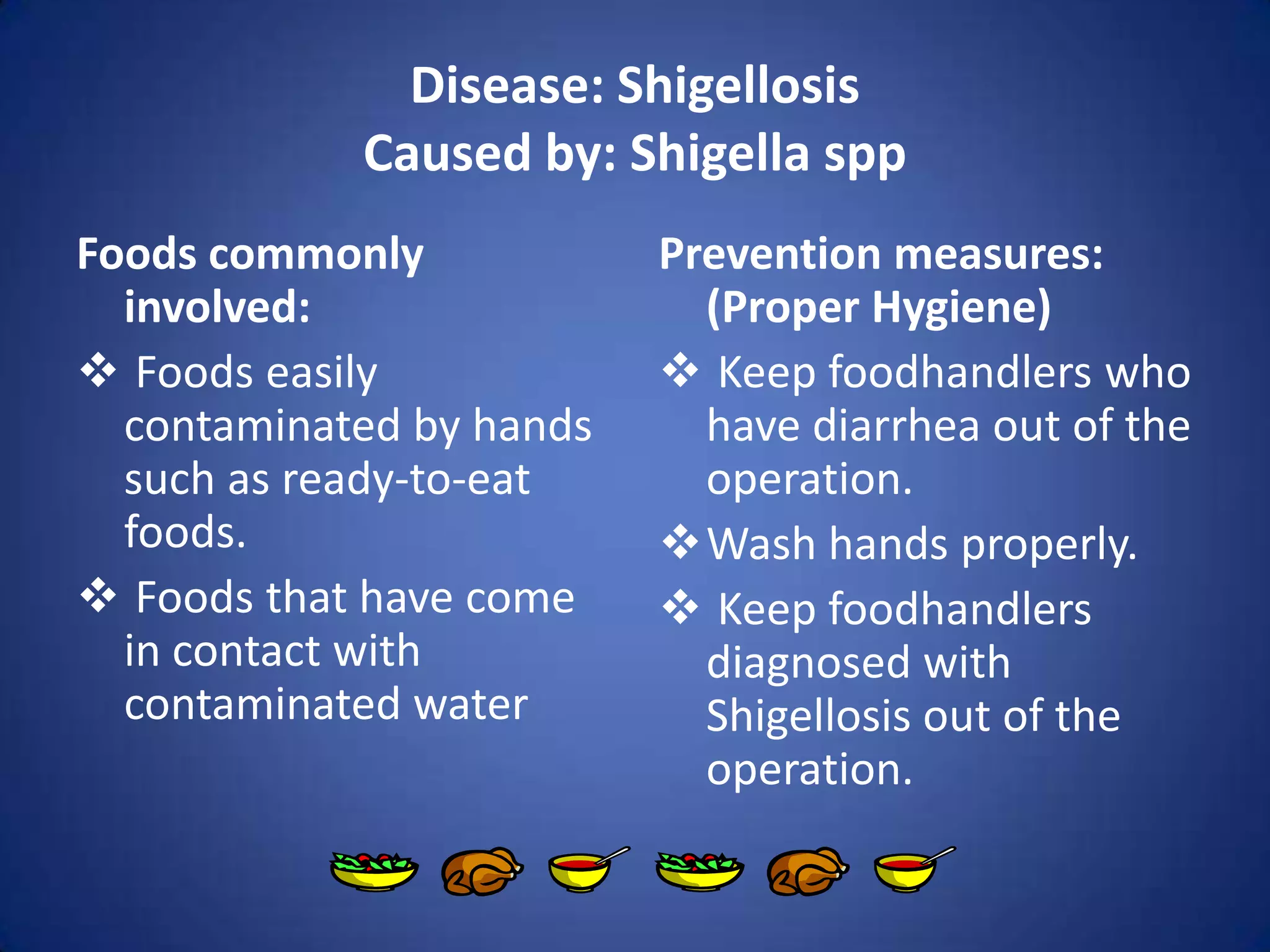
    Disease: Salmonellosis Caused by: Salmonella spp Foods commonly Prevention measures: involved:  Cook poultry and eggs  Poultry to their proper  Eggs temperatures.  Dairy Prevent cross  Produce contamination.  Keep foodhandlers diagnosed with Salmonellosis out of the operation.
  • 25.
    Disease: Shigellosis Caused by: Shigella spp Foods commonly Prevention measures: involved: (Proper Hygiene)  Foods easily  Keep foodhandlers who contaminated by hands have diarrhea out of the such as ready-to-eat operation. foods. Wash hands properly.  Foods that have come  Keep foodhandlers in contact with diagnosed with contaminated water Shigellosis out of the operation.
  • 26.
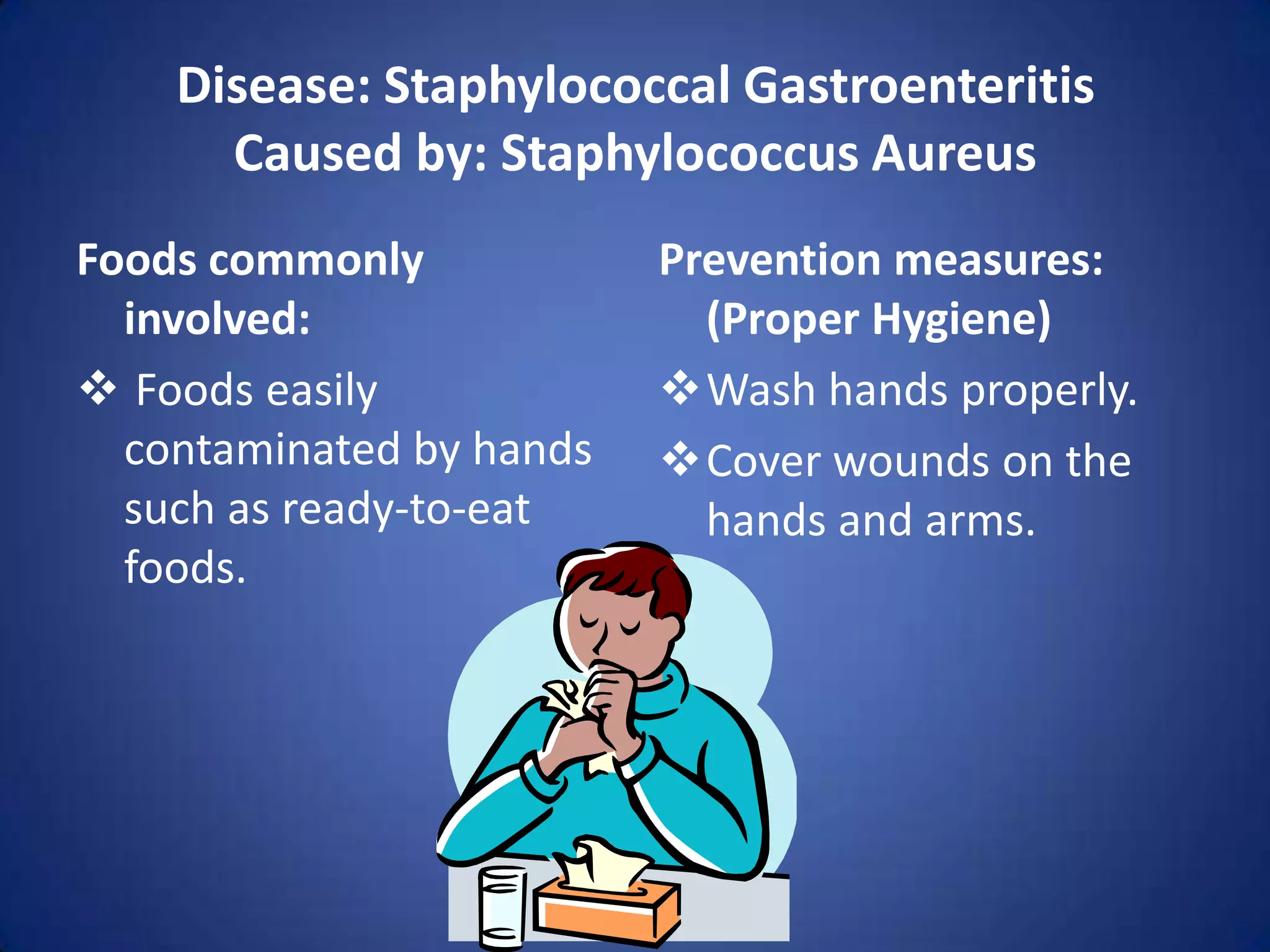
    Disease: Staphylococcal Gastroenteritis Caused by: Staphylococcus Aureus Foods commonly Prevention measures: involved: (Proper Hygiene)  Foods easily Wash hands properly. contaminated by hands Cover wounds on the such as ready-to-eat hands and arms. foods.
  • 27.
    Disease: Vibrio Gastroenteritisand Vibrio Vulnificus Primary Scepticemia Caused by: Vibrio Vulnificus and Vibrio Parahaemolyticus Foods commonly Prevention measures: involved: Cook oysters to their  Oysters from minimum internal contaminated waters. temperature.
  • 28.
    Parasites Thoughillnesses from parasites are not as widespread as those from viruses or bacteria it is still important to guard against the threat they pose. • Parasites can contaminate both food & water. • Parasites cannot grow in food. They need to be in the flesh of an animal to grow and survive. • The best defense against parasites is to purchase food from approved, reputable suppliers.
  • 29.
    Disease: Anisakiasis Caused by: Anisakis Simplex Foods commonly Prevention measures: involved:  Cook fish to proper  Raw and undercooked temperatures. fish including: herring,  If serving raw or cod, halibut, mackerel & undercooked fish, Pacific salmon purchase sushi-grade fish.
  • 30.
    Disease: Cryptosporidiosis Caused by: Cryptosporidium Parvum Foods commonly Prevention measures: involved:  Use properly treated  Contaminated water & water. produce.  Keep foodhandlers with diarrhea out of the operation. Wash hands.
  • 31.
    Disease: Giardiasis Caused by: Giardia Duodenalis Foods commonly Prevention measures: involved: (Time & Temperature)  Contaminated water &  Use properly treated produce. water.  Keep foodhandlers with diarrhea out of the operation.  Wash hands.
  • 32.
    Fungi Fungi are knownprimarily for spoiling food but some can make people sick. They can be found in air, water, soil, plants and some food. Mold & yeast are the two fungi of primary concern.
  • 33.
    Molds Moldsspoil food and sometimes cause illness. Some molds produce toxins, such as aflatoxins. • Molds grow well in acidic foods with little or no moisture, such as jams & jellies and in salty meats like bacon, salami and ham. • Throw out moldy food unless mold is a natural part of the product. • The FDA recommends that mold on hard cheese, salami and firm produce may be cut away at least one inch (2.5 centimeters) around the moldy area.
  • 34.
    Yeasts Yeastscan spoil foods quickly. Signs of spoilage include a smell or taste of alcohol. The yeast itself may appear as a white or pink discoloration or slime and may bubble. Like molds, yeasts grow well in acidic foods with little moisture, such as jams & jellies, syrup, honey and fruit and fruit juices. • Discard any food that shows signs of yeast spoilage.
  • 35.
    Seafood Toxins Seafood toxins cannot be smelled or tasted nor can they be destroyed by freezing or cooking. • Fish Toxins may be a natural part of the fish or made by pathogens on the fish. Others occur when a predatory fish eats a smaller, contaminated fish that has consumed a toxin. • Shellfish Toxins can contaminate shellfish when they consume contaminated marine algae.
  • 36.
    Disease: Scromboid Poisoning Caused by: Histamine When Scromboid fish are time and temperature abused, bacteria on the fish make the toxin, histamine. This toxin cannot be destroyed by cooking, freezing, smoking, or curing. Foods commonly Prevention measures: involved: Prevent time &  Scromboid fish: tuna, temperature abuse. bonito, mackerel, and mahi-mahi.
  • 37.
    Disease: Ciguatera FishPoisoning Caused by: Ciguatoxin Ciguatoxin can be found in certain marine algae. It can build up in larger fish when they eat smaller fish that have eaten these algae. Symptoms of Ciguatera poisoning can last for months or years. Foods commonly Prevention measures: involved: Purchase fish from an  Predatory tropical reef approved reputable fish: baracuda. snapper, supplier. grouper, and jacks.
  • 38.
    Disease: Shellfish Poisoning(Paralytic, Neurotoxic, or Amnesic) Caused by: Saxitoxin (paralytic), Brevetoxin (neurotoxic), or Domoic Acid (amnesic) Foods commonly Prevention measures: involved: Purchase shellfish from  Clams, Mussels, approved, reputable Oysters, and Scallops. suppliers.
  • 39.
    Mushroom Toxins Almost all cases of mushroom-borne illnesses happen when amateur mushroom hunters collect and serve wild mushrooms. Often toxic and edible mushrooms appear nearly identical to one another. • Mushroom toxins cannot be destroyed by cooking or freezing. • Only use mushrooms that are grown by and purchased from approved, reputable suppliers.
  • 40.
    Plant Toxins Illnesses caused by plant toxins occur when products are purchased from unapproved sources or if a particular product is not cooked or handled correctly. Here are some of the items that can make people sick. • Toxic plants may be confused for their edible versions, like fool’s parsley or wild turnips. • Honey gathered from bees that have harvested toxic nectar is toxic. • Undercooked kidney beans can make people ill.
  • 41.
    ServSafe Essentials ISBN: 0135026520 http://nraef.org http://www.servsafe.com
  • 42.

Editor's Notes

  • #2 Hello and welcome to AtTheInstitute.com’s online preparatory course for the National Restaurant AssociationServSafe Manager Certification Exam.
  • #3 This is section two of the online course: The Microworld.
  • #4 In this section you will learn to: List the types of pathogens which cause foodborne illness.List the factors that affect the growth of bacteria.List the foods most likely to become unsafe.List the major foodborne illnesses, their characteristics and methods of prevention.List additional biological hazards to food safety along with their characteristics and prevention methods.
  • #5 Just a few definitions you’ll need to know before beginning.TCS (Temperature Control for Safety) Foods – TCS foods are those items for which time & temperature control are vital in order to ensure the safety of the food.Toxin – Toxins are poisons produced by a living organism.Spore –A spore is a form adopted by some bacteria allowing them to survive for extended periods of time in unfavorable conditions. They can change back and begin growing again once conditions are more favorable.
  • #6 Most microorganisms are harmless. Some are even beneficial. But others (Pathogens) can cause illness. Some pathogens can make you sick. Other pathogens can produce poisons (toxins) that make you sick.Pathogens include:VirusesBacteriaParasitesFungiMany viruses, bacteria & parasites can not bee seen, smelled or tasted. On the other hand, some fungi (like mold) can change the appearance, taste and smell of food – though they may or may not cause illness.
  • #7 [Read slide text]
  • #8 TCS Foods tend to have some common characteristics. In general, they are either historically prone to be involved in foodborne illness outbreaks or are:High in protein.MoistNeutral to slightly acidic.
  • #9 To control the growth of pathogens you need to keep food at the right temperature. An example of this might be refrigerating potato salad or placing soup into a hot-holding unit for service. Like TCS foods, ready-to-eat foods also need careful handling to avoid contamination. Already cooked foods, deli-meats and cheeses, baked goods and washed fruits & vegetables are easily contaminated.
  • #10 As we’ve already noted, there are four types of pathogens. They are: viruses, bacteria, parasites and fungi.
  • #11  Viruses are the leading cause of foodborne illness. When customers get sick from food contaminated by viruses, it’s usually because their food was handled by an employee who has that virus.Here’s some Virus Facts:Viruses can survive refrigerator and freezer temperatures.Viruses can contaminate food and water.Viruses do not grow in food but once eaten can grow in a person’s intestines.Viruses can be transferred from person to person, person to food, or person to food-contact surface.readslide text]
  • #12 There are several ways to help prevent the spread of viruses within your operation.Keep foodhandlers who are vomiting, have diarrhea, or jaundice out of the operation.Ensure that foodhandles wash their hands properly.Eliminate bare-hand-contact with ready-to-eat food.The viruses of most concern to us are Hepatitis A & Norovirus.
  • #13 This table lists the foods commonly involved in a Hepatitis A outbreak and some ways to prevent such incidents. Familiarize yourself with these foods and with the prevention measures.[read slide text]
  • #14 This table lists the foods commonly involved in a Norovirus outbreak and some ways to prevent such incidents. Again, you’ll need to know these foods and the appropriate prevention measures.[read slide text]
  • #15 Though viruses are the leading cause of foodborne illness, bacteria also cause many cases of foodborne illness. Pathogenic bacteria need six things in order to grow. Together these factors are known by the acronym, FAT TOM.Food.Acidity.TemperatureTimeOxygen.Moisture
  • #16 [read slide text]
  • #17 [read slide text]
  • #18 [read slide text]
  • #19 Bacteria that cause foodborne illness have some basic characteristics:Most bacteria are controlled by controlling time and temperature.If FAT TOM conditions are right bacteria can multiply every twenty minutes.Bacteria can survive by temporarily changing into spore form when conditions are unfavorable.Some bacteria make toxins as they grow and die. Cooking and freezing may not destroy these toxins.
  • #20 As with the viral diseases, you’ll need to know the foods involved with each bacterial disease and some basic prevention methods.[read bacteria and disease name and slide text]
  • #21 [read bacteria and disease name and slide text]
  • #22 [read bacteria and disease name and slide text]
  • #23 [read bacteria and disease name and slide text]
  • #24 [read bacteria and disease name and slide text]
  • #25 [read bacteria and disease name and slide text]
  • #26 Note: The next two diseases are closely associated with poor personal hygiene practices.[read bacteria and disease name and slide text]
  • #27 [read bacteria and disease name and slide text]
  • #28 Lastly there are the “Virbio-related” diseases from oysters. These diseases are best prevented by cooking oysters to their safe, minimum internal temperature. We’ll learn this temperature (and many others) in coming sections.
  • #29 Though illnesses from parasites are not as widespread as those from viruses or bacteria it is still important to guard against the threat they pose.Parasites can contaminate both food & water.Parasites cannot grow in food. They need to be in the flesh of an animal to grow and survive.The best defense against parasites is to purchase food from approved, reputable suppliers.
  • #30 As with Viruses and Bacteria, here are some charts showing some diseases caused by parasites and their prevention measures:[read disease and parasite name and slide text]
  • #31 [read disease and parasite name and slide text]
  • #32 [read disease and parasite name and slide text]
  • #33 So far, we’ve looked at viruses, bacteria and parasites that cause foodborne illness. Now we’ll take a look at Fungi. Remember fungi only sometimes make people sick.Fungi are known primarily for spoiling food but some can make people sick. They can be found in air, water, soil, plants and some food. Mold & yeast are the two fungi of primary concern.
  • #34 Molds spoil food and sometimes cause illness. Some molds produce toxins, such as aflatoxins.Molds grow well in acidic foods with little or no moisture, such as jams & jellies and in salty meats like bacon, salami and ham.Throw out moldy food unless mold is a natural part of the product.The FDA recommends that mold on hard cheese, salami and firm produce may be cut away at least one inch (2.5 centimeters) around the moldy area.
  • #35  Yeasts can spoil foods quickly. Signs of spoilage include a smell or taste of alcohol. The yeast itself may appear as a white or pink discoloration or slime and may bubble. Like molds, yeasts grow well in acidic foods with little moisture, such as jams & jellies, syrup, honey and fruit and fruit juices.Discard any food that shows signs of yeast spoilage.
  • #36 Though pathogens are the most likely cause of foodborne illness, Biological Toxins can also make people sick and so, must be prevented. We’ll start with seafood toxins. Seafood toxins cannot be smelled or tasted nor can they be destroyed by freezing or cooking.Fish Toxins may be a natural part of the fish or made by pathogens on the fish. Others occur when a predatory fish eats a smaller, contaminated fish that has consumed a toxin.Shellfish Toxins can contaminate shellfish when they consume contaminated marine algae.
  • #37 [read disease name, cause and slide text]
  • #38 [read disease name, cause and slide text]
  • #39 Additionally, we have shellfish poisons associated with mollusks. These diseases are best prevented by purchasing shellfish from approved, reputable suppliers.
  • #40 And last but not least we have mushroom and plant toxins: Almost all cases of mushroom-borne illnesses happen when amateur mushroom hunters collect and serve wild mushrooms. Often toxic and edible mushrooms appear nearly identical to one another.Mushroom toxins cannot be destroyed by cooking or freezing.Only use mushrooms that are grown by and purchased from approved, reputable suppliers.
  • #41 [read slide text]Remember to purchase only from approved, reputable suppliers, then handle, cook and hold ingredients correctly.
  • #42 All of the information provided can be found in The National Restaurant Association’s, ServSafe Essentials, 5th Edition with 2009 FDA Food Code Updates.For more information check them out online at www.servsafe.com.
  • #43 Please take this opportunity to complete the review questions for this section before continuing on to section Three of the course.For AtTheInstitute.com, this is [your name]. Feel free to send us comments and feedback by email at feedback@AtTheInstitute.com.