ServSafe™ Exam Prep & Study Guide

          AtTheInstitute.com
3. Contamination & Food Allergies

         AtTheInstitute.com
Section Goals
• Be able to list and    • List the steps necessary
  recognize the risks      to protect customers
  associated with          against food allergens in
  chemical & physical      both the front – and
  contamination.           back-of house.
• Be able to list and
  recognize the risks
  associated with food
  allergens.
Definitions
• Chemical Hazard – Cleaners, sanitizers, polishes,
  machine lubricants, and toxic metals that can
  contaminate food and make people sick.

• Physical Hazard – Objects such as hair, dirt, metal
  staples, bones, and broken glass that can find their way
  into food.

• Allergic Reaction –The body’s negative reaction to a food
  protein. Symptoms of this reaction may be mild to life-
  threatening.
Chemical Contamination
Chemical contamination has caused many cases of
foodborne illness. These contaminates can come
from everyday items found in the operation: notably
toxic metals and foodservice chemicals.
Toxic Metals
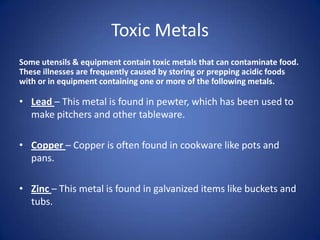
Some utensils & equipment contain toxic metals that can contaminate food.
These illnesses are frequently caused by storing or prepping acidic foods
with or in equipment containing one or more of the following metals.

• Lead – This metal is found in pewter, which has been used to
  make pitchers and other tableware.

• Copper – Copper is often found in cookware like pots and
  pans.

• Zinc – This metal is found in galvanized items like buckets and
  tubs.
Foodservice Chemicals
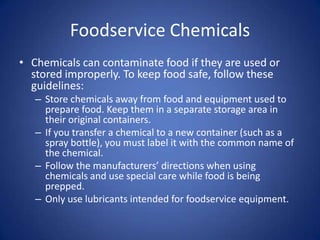
• Chemicals can contaminate food if they are used or
  stored improperly. To keep food safe, follow these
  guidelines:
   – Store chemicals away from food and equipment used to
     prepare food. Keep them in a separate storage area in
     their original containers.
   – If you transfer a chemical to a new container (such as a
     spray bottle), you must label it with the common name of
     the chemical.
   – Follow the manufacturers’ directions when using
     chemicals and use special care while food is being
     prepped.
   – Only use lubricants intended for foodservice equipment.
Physical Contaminants
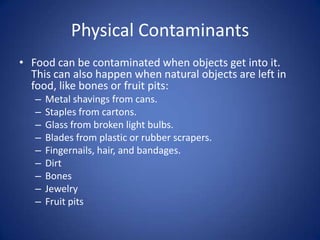
• Food can be contaminated when objects get into it.
  This can also happen when natural objects are left in
  food, like bones or fruit pits:
   –   Metal shavings from cans.
   –   Staples from cartons.
   –   Glass from broken light bulbs.
   –   Blades from plastic or rubber scrapers.
   –   Fingernails, hair, and bandages.
   –   Dirt
   –   Bones
   –   Jewelry
   –   Fruit pits
Deliberate Contamination
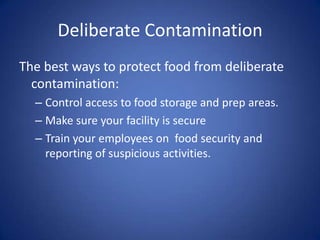
The best ways to protect food from deliberate
  contamination:
  – Control access to food storage and prep areas.
  – Make sure your facility is secure
  – Train your employees on food security and
    reporting of suspicious activities.
Food Allergies
• Depending upon the person, an allergic reaction could
  include a range of symptoms.
   –    Itching in and around the mouth, face, or scalp.
   –    Tightening in the throat.
   –    Wheezing or shortness of breath.
   –    Hives.
   –    Swelling of the face, eyes, hands, or feet.
   –    Abdominal cramps, vomiting, or diarrhea.
   –    Loss of consciousness.
   –    Death.
       IF A PERSON IS HAVING AN ALLERGIC REACTION TO FOOD,
              CALL THE EMERGENCY NUMBER IN YOUR AREA.
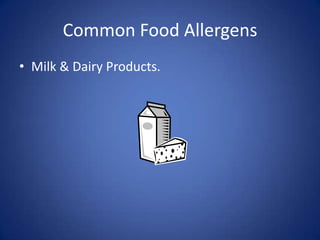
Common Food Allergens
• Milk & Dairy Products.
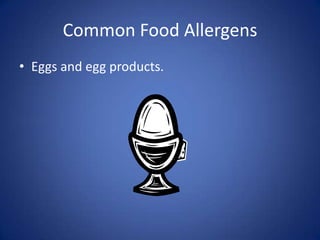
Common Food Allergens
• Eggs and egg products.
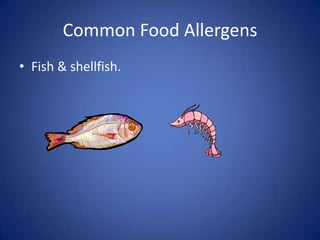
Common Food Allergens
• Fish & shellfish.
Common Food Allergens
• Wheat.
Common Food Allergens
• Soy and Soy Products.
Common Food Allergens
• Peanuts and Tree Nuts (like Pecans &
  Walnuts).
Preventing Allergic Reactions: Service
                 Staff
• Have at least one person who can tell
  customers about how menu items are
  prepared and presented; including all
  accompaniments, like sauces, marinades, and
  garnishes.
• Be able to identify all the ingredients in a
  menu item (including any “secret”
  ingredients).
• Suggest simple menu items.
Preventing Allergic Reactions: Kitchen
                  Staff
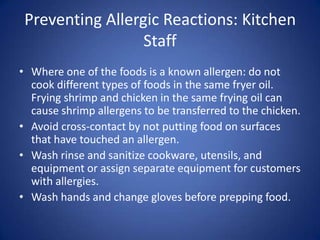
• Where one of the foods is a known allergen: do not
  cook different types of foods in the same fryer oil.
  Frying shrimp and chicken in the same frying oil can
  cause shrimp allergens to be transferred to the chicken.
• Avoid cross-contact by not putting food on surfaces
  that have touched an allergen.
• Wash rinse and sanitize cookware, utensils, and
  equipment or assign separate equipment for customers
  with allergies.
• Wash hands and change gloves before prepping food.
ServSafe Essentials

    ISBN: 0135026520
      http://nraef.org
http://www.servsafe.com
JNA Institute of Culinary Arts

           215.468.8800
      http://culinaryarts.edu