ServSafe™ Exam Prep & Study Guide

          AtTheInstitute.com
4. The Safe Foodhandler

    AtTheInstitute.com
Section Goals
• Recognize and avoid       • Limit where employees
  personal behaviors that     eat, drink, smoke, and
  can contaminate food.       chew gum and tobacco.
• Know the rules for        • Prevent employees
  handwashing and hand        carrying pathogens
  care.                       from working with or
• Proper care and use of      around food, or from
  work clothing and           working in the
  uniforms                    operation.
Definitions
• Jaundice – Jaundice is a yellowing of the skin or eyes and
  can be a symptom of certain health problems.

• Carrier – A person who carries pathogens and can infect
  others while displaying no signs or symptoms of illness.

• Regulatory Authority –This will generally be the local or
  state health department. Check in your area for the
  applicable regulatory authority for you operation.
Definitions
• Restrict – To keep a person from working with food.
  The individual may perform other (non-foodhandler)
  duties.
• Exclude – To keep a person physically out of the
  operation. Excluded individuals are not permitted on
  premises.
Situations That Can Lead to Contaminating Food

Foodhandlers can contaminate food in any of the following ways:


• When they have a                • When they touch anything
  foodborne illness.                that can contaminate their
• When they have a wound            hands and fail to wash
  that contains a pathogen.         them.
• When they have contact          • When they have symptoms
  with a person who is ill.         such as diarrhea, vomiting,
                                    or jaundice.
Behaviors That Can Lead to Contaminating Food
Pay close attention to employees’ behaviors. Foodhandlers can
contaminate food by the following behaviors:


• Scratching the scalp.            • Touching a pimple or an
• Running fingers through            infected wound.
  their hair.                      • Wearing dirty clothes or
• Wiping or touching the             uniforms.
  nose.                            • Coughing/sneezing into the
• Rubbing an ear.                    hand.
                                   • Spitting in the operation.
A Good Personal Hygeine Program
As a manager, you must make sure to create and support
  policies to address the following areas:

• Hand Practices
   –   Handwashing
   –   Hand Care
   –   Glove Use
   –   Policy regarding bare-hand contact with ready-to-eat food.
• Personal Cleanliness
• Proper Clothing – including hair restraints & jewelry
Handwashing
Handwashing is the most important part
 of personal hygiene.

You must train and monitor your employees for proper
  handwashing practices.
Proper Handwashing
Washing your hands properly is one of the most important things you can do to keep
   microorganisms from contaminating food.
You should wash your hands before you start work and after the following activities:

•   Using the restroom
•   Handling raw meat, fish, or poultry (before and after)
•   Touching your hair, face, or body
•   Sneezing, coughing, or using a tissue
•   Smoking, eating, drinking, or chewing gum or tobacco
•   Handling chemicals that might affect the safety of the food
•   Taking out garbage
•   Clearing tables or bussing dirty dishes
•   Touching clothing or aprons
•   Touching anything else that may contaminate hands such as unsanitized
    equipment, work surfaces or wash cloths
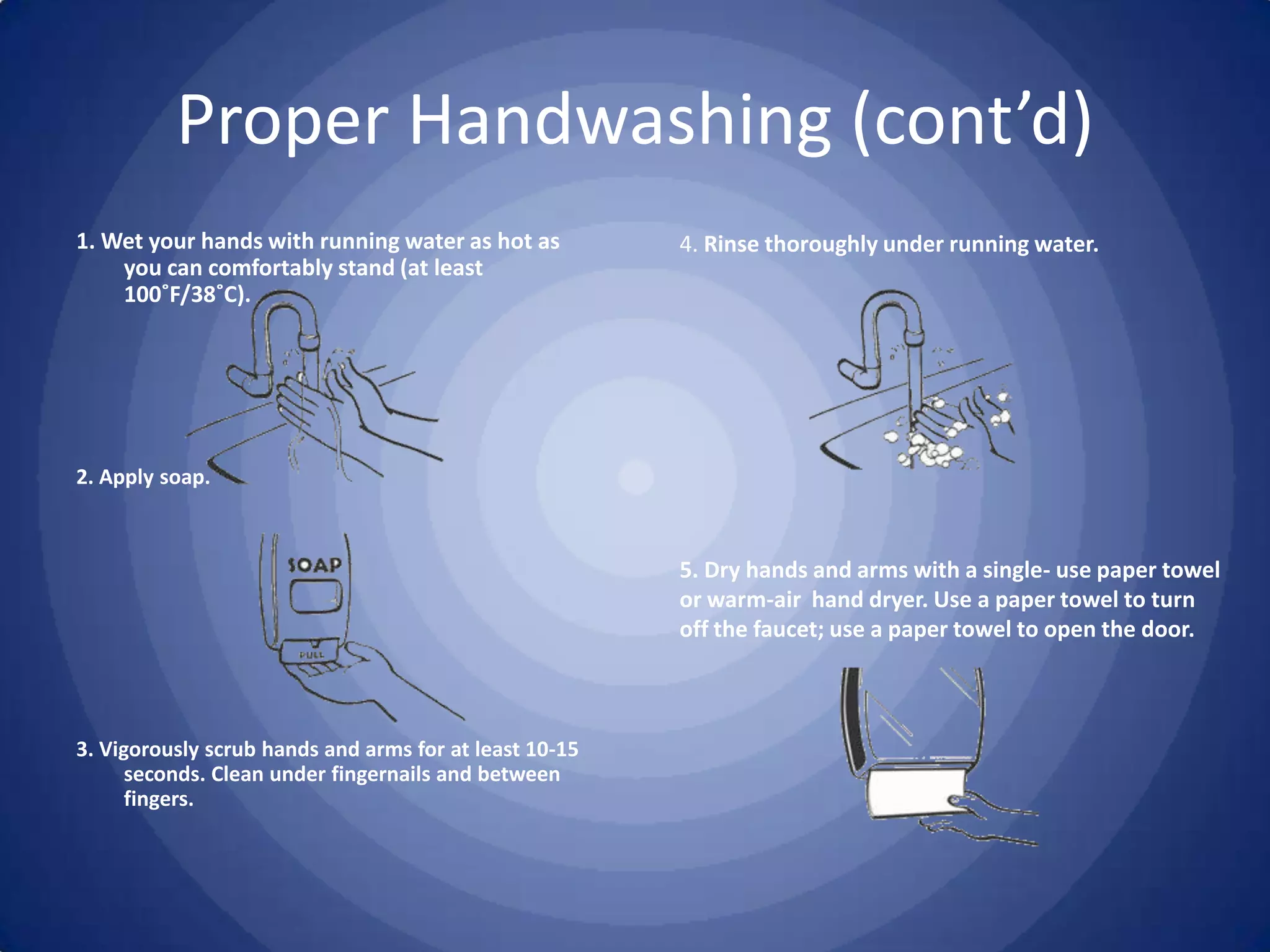
Proper Handwashing (cont’d)
1. Wet your hands with running water as hot as          4. Rinse thoroughly under running water.
    you can comfortably stand (at least
    100˚F/38˚C).


2. Apply soap.


                                                        5. Dry hands and arms with a single- use paper towel
                                                        or warm-air hand dryer. Use a paper towel to turn
                                                        off the faucet; use a paper towel to open the door.


3. Vigorously scrub hands and arms for at least 10-15
      seconds. Clean under fingernails and between
      fingers.
When To Wash Hands (Again!)
Foodhandlers must wash their hands before they start work and
after the following activities:

• Using the restroom!              • Handling chemicals that
• Handling raw meat, poultry,        might affect food safety.
  and seafood (before and          • Taking out the garbage.
  after).
                                   • Clearing tables or bussing
• Touching the hair, face, body,
                                     dirty dishes and tableware.
  clothing or apron.
• Sneezing, coughing, or using a   • Handling money.
  tissue.                          • Touching anything else that
• Eating, drinking, smoking and      might contaminate the
  chewing gum or tobacco.            hands.
Hand Care
In addition to handwashing make sure foodhandlers
   follow these guidelines:

•   Keep fingernails short & clean
•   Do not wear false fingernails
•   Do not wear nail polish
•   Wear a bandage over hand and arm wounds.
    – You must wear a single-use glove or finger cot over
      bandages on hands or fingers.
Single-Use Gloves
Single-use gloves help keep food safe by creating a
  barrier between hands & food. Remember: gloves
  are used in addition to handwashing and not in
  place of handwashing.

• Buy only single-use gloves. Gloves are not re-usable.
• Provide your staff with different glove sizes as
  appropriate.
• Some foodhandlers will be sensitive to latex.
  Consider purchasing latex-free gloves.
When to Change Gloves
Foodhandlers must change gloves at these times:.

•   As soon as they become soiled or torn.
•   Before beginning a different task.
•   At least every 4 (four) hours during continual use.
•   After handling raw meat, poultry, or seafood and
    before handling ready-to-eat food.
Note:
Philadelphia food regulations require:

• No barehand contact with ready-to-eat food.
• Minimize barehand contact with other, non-ready-
  to-eat foods.
Cleanliness and Work Attire

Dirty clothing may carry pathogens that can cause foodborne illness. Set up
an employee dress code that includes the following guidelines:


• Hair restraints such as hats         • Remove aprons before leaving
  and beard restraints for facial        prep areas.
  hair.                                • Remove jewelry from hands
• Wear clean clothing daily. If          and arms before prepping
  possible change into uniforms          food. You cannot wear rings
  at work.                               (except for a plain band)
• Dirty clothing stored in the           bracelets (including medical
  operation must be kept away            bracelets) and watches.
  from food prep and storage
  areas.
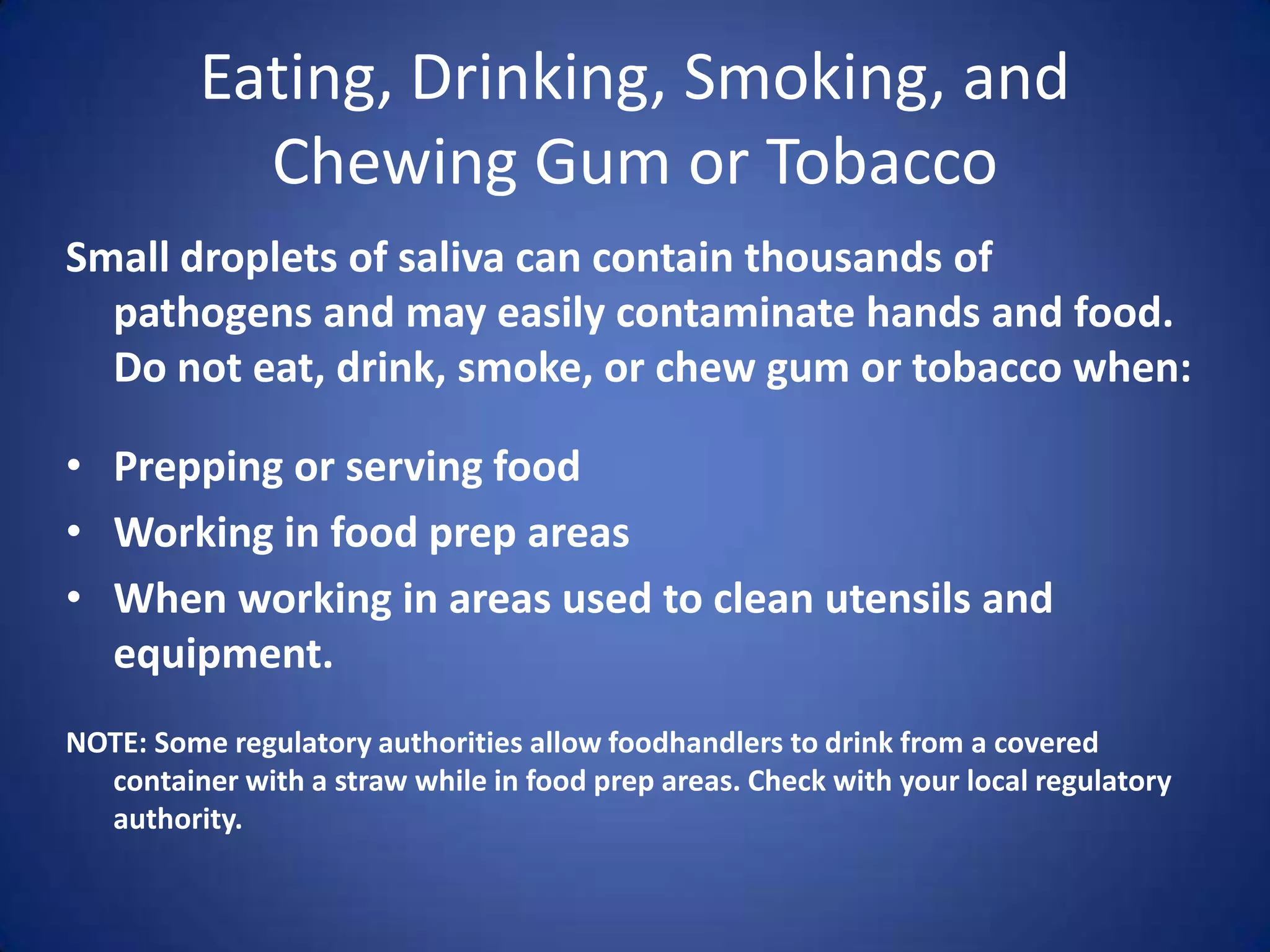
Eating, Drinking, Smoking, and
            Chewing Gum or Tobacco
Small droplets of saliva can contain thousands of
  pathogens and may easily contaminate hands and food.
  Do not eat, drink, smoke, or chew gum or tobacco when:

• Prepping or serving food
• Working in food prep areas
• When working in areas used to clean utensils and
  equipment.
NOTE: Some regulatory authorities allow foodhandlers to drink from a covered
  container with a straw while in food prep areas. Check with your local regulatory
  authority.
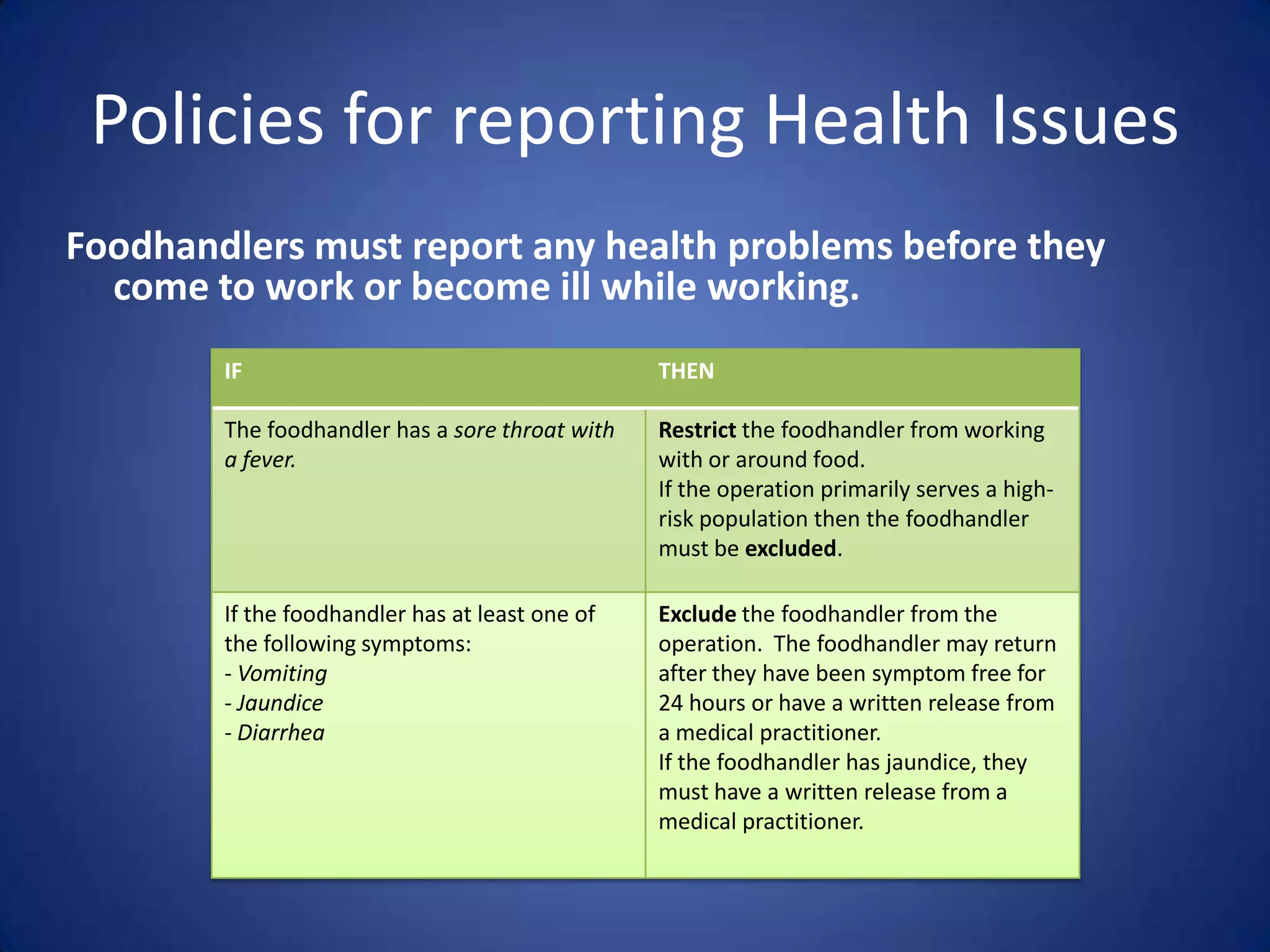
Policies for reporting Health Issues
Foodhandlers must report any health problems before they
  come to work or become ill while working.
        IF                                       THEN

        The foodhandler has a sore throat with   Restrict the foodhandler from working
        a fever.                                 with or around food.
                                                 If the operation primarily serves a high-
                                                 risk population then the foodhandler
                                                 must be excluded.

        If the foodhandler has at least one of   Exclude the foodhandler from the
        the following symptoms:                  operation. The foodhandler may return
        - Vomiting                               after they have been symptom free for
        - Jaundice                               24 hours or have a written release from
        - Diarrhea                               a medical practitioner.
                                                 If the foodhandler has jaundice, they
                                                 must have a written release from a
                                                 medical practitioner.
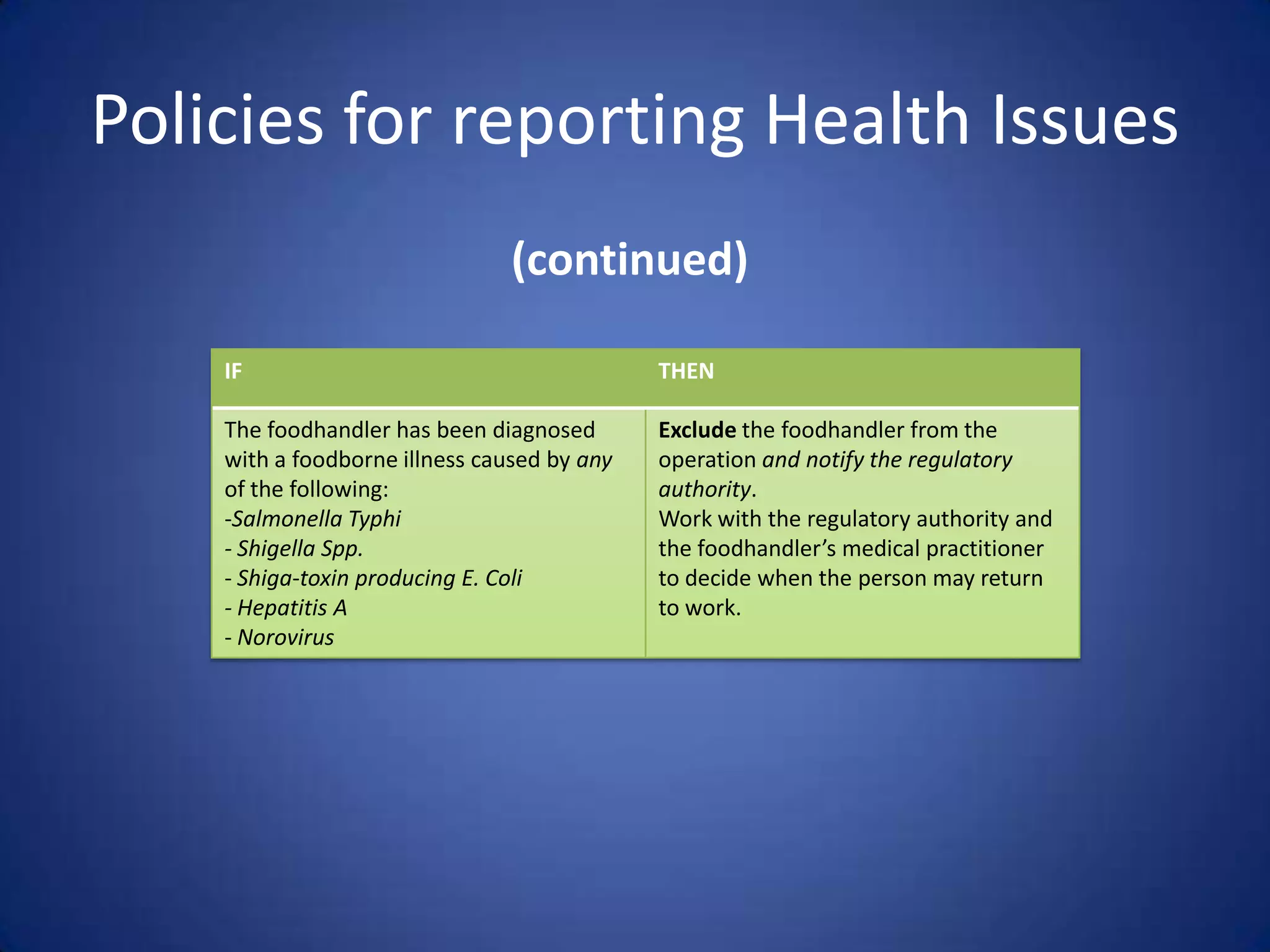
Policies for reporting Health Issues
                                (continued)

    IF                                       THEN

    The foodhandler has been diagnosed       Exclude the foodhandler from the
    with a foodborne illness caused by any   operation and notify the regulatory
    of the following:                        authority.
    -Salmonella Typhi                        Work with the regulatory authority and
    - Shigella Spp.                          the foodhandler’s medical practitioner
    - Shiga-toxin producing E. Coli          to decide when the person may return
    - Hepatitis A                            to work.
    - Norovirus
Resources from ServSafe.com
•   ServSafe: Handwashing Guide
•   ServSafe: Proper Hand Care
•   ServSafe: Proper Glove Use
•   ServSafe: Proper Cleanliness & Attire
•   ServSafe: Employee Illness
ServSafe Essentials

    ISBN: 0135026520
      http://nraef.org
http://www.servsafe.com
JNA Institute of Culinary Arts

           215.468.8800
      http://culinaryarts.edu

04 chapter four

  • 1.
    ServSafe™ Exam Prep& Study Guide AtTheInstitute.com
  • 2.
    4. The SafeFoodhandler AtTheInstitute.com
  • 3.
    Section Goals • Recognizeand avoid • Limit where employees personal behaviors that eat, drink, smoke, and can contaminate food. chew gum and tobacco. • Know the rules for • Prevent employees handwashing and hand carrying pathogens care. from working with or • Proper care and use of around food, or from work clothing and working in the uniforms operation.
  • 4.
    Definitions • Jaundice –Jaundice is a yellowing of the skin or eyes and can be a symptom of certain health problems. • Carrier – A person who carries pathogens and can infect others while displaying no signs or symptoms of illness. • Regulatory Authority –This will generally be the local or state health department. Check in your area for the applicable regulatory authority for you operation.
  • 5.
    Definitions • Restrict –To keep a person from working with food. The individual may perform other (non-foodhandler) duties. • Exclude – To keep a person physically out of the operation. Excluded individuals are not permitted on premises.
  • 6.
    Situations That CanLead to Contaminating Food Foodhandlers can contaminate food in any of the following ways: • When they have a • When they touch anything foodborne illness. that can contaminate their • When they have a wound hands and fail to wash that contains a pathogen. them. • When they have contact • When they have symptoms with a person who is ill. such as diarrhea, vomiting, or jaundice.
  • 7.
    Behaviors That CanLead to Contaminating Food Pay close attention to employees’ behaviors. Foodhandlers can contaminate food by the following behaviors: • Scratching the scalp. • Touching a pimple or an • Running fingers through infected wound. their hair. • Wearing dirty clothes or • Wiping or touching the uniforms. nose. • Coughing/sneezing into the • Rubbing an ear. hand. • Spitting in the operation.
  • 8.
    A Good PersonalHygeine Program As a manager, you must make sure to create and support policies to address the following areas: • Hand Practices – Handwashing – Hand Care – Glove Use – Policy regarding bare-hand contact with ready-to-eat food. • Personal Cleanliness • Proper Clothing – including hair restraints & jewelry
  • 9.
    Handwashing Handwashing is themost important part of personal hygiene. You must train and monitor your employees for proper handwashing practices.
  • 10.
    Proper Handwashing Washing yourhands properly is one of the most important things you can do to keep microorganisms from contaminating food. You should wash your hands before you start work and after the following activities: • Using the restroom • Handling raw meat, fish, or poultry (before and after) • Touching your hair, face, or body • Sneezing, coughing, or using a tissue • Smoking, eating, drinking, or chewing gum or tobacco • Handling chemicals that might affect the safety of the food • Taking out garbage • Clearing tables or bussing dirty dishes • Touching clothing or aprons • Touching anything else that may contaminate hands such as unsanitized equipment, work surfaces or wash cloths
  • 11.
    Proper Handwashing (cont’d) 1.Wet your hands with running water as hot as 4. Rinse thoroughly under running water. you can comfortably stand (at least 100˚F/38˚C). 2. Apply soap. 5. Dry hands and arms with a single- use paper towel or warm-air hand dryer. Use a paper towel to turn off the faucet; use a paper towel to open the door. 3. Vigorously scrub hands and arms for at least 10-15 seconds. Clean under fingernails and between fingers.
  • 12.
    When To WashHands (Again!) Foodhandlers must wash their hands before they start work and after the following activities: • Using the restroom! • Handling chemicals that • Handling raw meat, poultry, might affect food safety. and seafood (before and • Taking out the garbage. after). • Clearing tables or bussing • Touching the hair, face, body, dirty dishes and tableware. clothing or apron. • Sneezing, coughing, or using a • Handling money. tissue. • Touching anything else that • Eating, drinking, smoking and might contaminate the chewing gum or tobacco. hands.
  • 13.
    Hand Care In additionto handwashing make sure foodhandlers follow these guidelines: • Keep fingernails short & clean • Do not wear false fingernails • Do not wear nail polish • Wear a bandage over hand and arm wounds. – You must wear a single-use glove or finger cot over bandages on hands or fingers.
  • 14.
    Single-Use Gloves Single-use gloveshelp keep food safe by creating a barrier between hands & food. Remember: gloves are used in addition to handwashing and not in place of handwashing. • Buy only single-use gloves. Gloves are not re-usable. • Provide your staff with different glove sizes as appropriate. • Some foodhandlers will be sensitive to latex. Consider purchasing latex-free gloves.
  • 15.
    When to ChangeGloves Foodhandlers must change gloves at these times:. • As soon as they become soiled or torn. • Before beginning a different task. • At least every 4 (four) hours during continual use. • After handling raw meat, poultry, or seafood and before handling ready-to-eat food.
  • 16.
    Note: Philadelphia food regulationsrequire: • No barehand contact with ready-to-eat food. • Minimize barehand contact with other, non-ready- to-eat foods.
  • 17.
    Cleanliness and WorkAttire Dirty clothing may carry pathogens that can cause foodborne illness. Set up an employee dress code that includes the following guidelines: • Hair restraints such as hats • Remove aprons before leaving and beard restraints for facial prep areas. hair. • Remove jewelry from hands • Wear clean clothing daily. If and arms before prepping possible change into uniforms food. You cannot wear rings at work. (except for a plain band) • Dirty clothing stored in the bracelets (including medical operation must be kept away bracelets) and watches. from food prep and storage areas.
  • 18.
    Eating, Drinking, Smoking,and Chewing Gum or Tobacco Small droplets of saliva can contain thousands of pathogens and may easily contaminate hands and food. Do not eat, drink, smoke, or chew gum or tobacco when: • Prepping or serving food • Working in food prep areas • When working in areas used to clean utensils and equipment. NOTE: Some regulatory authorities allow foodhandlers to drink from a covered container with a straw while in food prep areas. Check with your local regulatory authority.
  • 19.
    Policies for reportingHealth Issues Foodhandlers must report any health problems before they come to work or become ill while working. IF THEN The foodhandler has a sore throat with Restrict the foodhandler from working a fever. with or around food. If the operation primarily serves a high- risk population then the foodhandler must be excluded. If the foodhandler has at least one of Exclude the foodhandler from the the following symptoms: operation. The foodhandler may return - Vomiting after they have been symptom free for - Jaundice 24 hours or have a written release from - Diarrhea a medical practitioner. If the foodhandler has jaundice, they must have a written release from a medical practitioner.
  • 20.
    Policies for reportingHealth Issues (continued) IF THEN The foodhandler has been diagnosed Exclude the foodhandler from the with a foodborne illness caused by any operation and notify the regulatory of the following: authority. -Salmonella Typhi Work with the regulatory authority and - Shigella Spp. the foodhandler’s medical practitioner - Shiga-toxin producing E. Coli to decide when the person may return - Hepatitis A to work. - Norovirus
  • 21.
    Resources from ServSafe.com • ServSafe: Handwashing Guide • ServSafe: Proper Hand Care • ServSafe: Proper Glove Use • ServSafe: Proper Cleanliness & Attire • ServSafe: Employee Illness
  • 22.
    ServSafe Essentials ISBN: 0135026520 http://nraef.org http://www.servsafe.com
  • 23.
    JNA Institute ofCulinary Arts 215.468.8800 http://culinaryarts.edu

Editor's Notes

  • #2 Hello and welcome once again to AtTheInstitute.com’s online preparatory course for the National Restaurant AssociationServSafe Manager Certification Exam.
  • #3 We are on to section four. The Safe Foodhandler.
  • #4 In this section we’ll learn to:Recognize and avoid personal behaviors that can contaminate food.Know the rules for handwashing and hand care.We’ll learn proper care and storage of work clothing and uniformsWe’ll learn to limit when and where employees eat, drink, smoke, and chew gum and tobacco.And we’ll understand the importance of preventing employees carrying pathogens from working with or around food, or (in some cases)from working in the operation (period).
  • #5 Again. Some definitions before we begin.Jaundice – Jaundice is a yellowing of the skin or eyes and can be a symptom of certain health problems.Carrier – A carrier is a person who carries pathogens and can infect others while displaying no signs or symptoms of illness themselves.The Regulatory Authority –This will generally be the local or state health department. Check in your area for the applicable regulatory authority for you operation.[NEXT -]
  • #6 And two terms regarding when and how we deal with sick employees: Restrict & Exclude.When we Restrict an employee – we keep that person from working with food.The individual may perform other (non-foodhandling) duties such as cashier or coat-check.When we Exclude an employee– we keep that person physically out of the operation. Excluded individuals are not permitted on premises.
  • #7 There are a number of ways Foodhandlers can contaminate food:They can contaminate food:When they have a foodborne illness.When they have a wound that contains a pathogen.When they have contact with a person who is ill.When they touch anything that can contaminate their hands and then fail to wash them correctly.And when they have symptoms of a foodborne illness such as diarrhea, vomiting, or jaundice.
  • #8 Pay close attention to employees’ behaviors. Foodhandlers can contaminate food by any of the following behaviors:Scratching the scalp.Running fingers through their hair.Wiping or touching the nose.Rubbing an ear.Touching a pimple or an infected wound.Wearing dirty clothes or wearing a dirty uniform or apron.Coughing or sneezing into the hand.And spitting in the operation.
  • #9 In order to have a good personal hygiene program, managers must make sure to create and support policies to address the following areas:Hand Practices - Including:HandwashingHand CareGlove UseAnd a policy regarding bare-hand contact with ready-to-eat food.Personal CleanlinessAnd Proper Clothing in the workplace – including hair restraints & jewelry
  • #10 Handwashing is the most important part of personal hygiene.You must train and constantly monitor your employees for proper handwashing practices.
  • #11 Handwashing is one of the most important methods in keeping microorganisms from contaminating food.Employees should wash your hands before you start work and after the following activities:Using the restroomHandling raw meat, fish, or poultry (both before and after)Touching the hair, face, or bodySneezing, coughing, or using a tissueSmoking, eating, drinking, or chewing gum or tobaccoHandling chemicals that might affect the safety of the foodTaking out garbageClearing tables or bussing dirty dishesTouching clothing or apronsTouching anything else that may contaminate hands such as unsanitized equipment, work surfaces or wash cloths
  • #12 It is vital to know the steps in proper handwashing.1. Wet your hands with running water as hot as you can comfortably stand (at least 100˚F/38˚C).2. Apply enough soap to build up a good lather.3. Vigorously scrub hands and arms for at least 10-15 seconds. Clean under the fingernails and between the fingers.4. Rinse hands thoroughly under running water.And 5. Dry hands and arms with a single- use paper towel or hand dryer. Be careful not to contaminate hands after washing them. Use a paper towel to turn off the faucet. (You can also use a paper towel to open the restroom door when leaving the restroom.)
  • #13 Foodhandlers must know when to wash their hands.At the risk of repeating ourselves… Foodhandlers must wash their hands before they start work and after the following activities:Using the restroom! (Foodborne illnesses like Norovirus can be transferred to food if they fail to wash hands correctly)Handling raw meat, poultry, and seafood (both before and after).Touching the hair, face, body, clothing or apron.Sneezing, coughing, or using a tissue.Eating, drinking, smoking and chewing gum or tobacco.Handling chemicals that might affect food safety.Taking out the garbage.Clearing tables or bussing dirty dishes and tableware.Handling money.Touching anything else that might contaminate the hands.
  • #14 In addition to handwashing, hands require additional care to prevent the spread of pathogens. Follow these guidelines:Keep fingernails short & cleanDo not wear false fingernailsDo not wear nail polishWear a bandage over hand and arm wounds.(Foodhandlers must wear a single-use glove or finger cot over bandages on hands or fingers. Ensure that it keeps the wound from leaking)
  • #15 Single-use gloves help keep food safe by creating a barrier between hands & food. Remember: gloves are used in addition to handwashing and not in place of handwashing.Follow these guidelines:Buy only single-use gloves. Gloves are not re-usable.Provide your staff with different glove sizes as appropriate.Some foodhandlers will be sensitive to latex. Consider purchasing latex-free gloves.
  • #16 Foodhandlers must change gloves at these times:.As soon as they become soiled or torn.Before beginning a different task.At least every 4 (four) hours during continual use.After handling raw meat, poultry, or seafood and before handling ready-to-eat food
  • #17 LocalFood regulations require there be:No barehand contact with ready-to-eat food.And operations should Minimize barehand contact with other, non-ready-to-eat foods.For all Philadelphia Food Regulations, refer to the Office of Food Protection website: http://www.phila.gov/health/environment/foodProtection.html
  • #18 Pathogens can be found on the hair and skin. Make sure foodhandlers shower or bathe before work. Dirty clothing may also carry pathogens that can cause foodborne illness. Set up an employee dress code that includes the following guidelines:Use of hair restraints such as hats and beard restraints for facial hair.Wear clean clothing daily. If possible change into uniforms at work.Dirty clothing stored in the operation must be kept away from food prep and storage areas.Remove aprons before leaving prep areas.Remove jewelry from hands and arms before prepping food. You cannot wear rings (except for a plain band ring), bracelets (including medical alert bracelets) or watches
  • #19 Small droplets of saliva can contain thousands of pathogens and may easily contaminate hands and food. Employees may not eat, drink, smoke, or chew gum or tobacco when:Prepping or serving foodWorking in food prep areasOr when working in areas used to clean utensils and equipment.NOTE: Some regulatory authorities allow foodhandlers to drink from a covered container with a straw while in food prep areas. Check with your local regulatory authority.
  • #20 You must encourage foodhandlers to report any health problem before they come to work. They should also be trained to let you know when they become ill while working. When foodhandlers are ill you may need to restrict (or limit them from working with or around food). In more serious cases or when your facility serves one or more high risk population, it may be necessary to exclude (or prevent an employee from coming to work). Use the following chart when deciding:[read from chart][part two of chart NEXT PAGE -]
  • #21 [finish reading from chart]
  • #22 You can find additional support materials and valuable information at The National Restaurant Association’s, ServSafe.com website.
  • #23 All of the information provided here can be found in The National Restaurant Association’s, ServSafe Essentials, 5th Edition with 2009 FDA Food Code Updates.For more information check them out online at www.servsafe.com.
  • #24 We strongly suggest that you complete the review questions for this section before continuing on to section five of the course.We’d love to hear your feedback regarding this class. Send us email at “feedback@AtTheInstitute.com”.For AtTheInstitute.com, I’m [your name]. Thank you.