
PENETRATION TESTING MUST DIE
          Rory McCune
INTRODUCTION
•   IT/Information Security person for the last 15 years
•   Currently a director of 7 Elements ( http://www.7elements.co.uk )
     • IT Security consultancy based in Scotland.
•   Scottish chapter lead for the OWASP project.
AGENDA
•   Why must it die
     • Overloaded Terminology.
     • Clients aren’t ready.
     • Mission Impossible.
•   How do you fix it?
     • Better Terms.
     • Better Scoping.
WHAT’S IN A NAME?
•   First thing is to define what we mean by penetration testing
•   One definition from Wikipedia “A penetration test, occasionally pentest, is a
    method of evaluating the security of a computer system or network by
    simulating an attack from a malicious source, known as a Black Hat Hacker, or
    Cracker.”
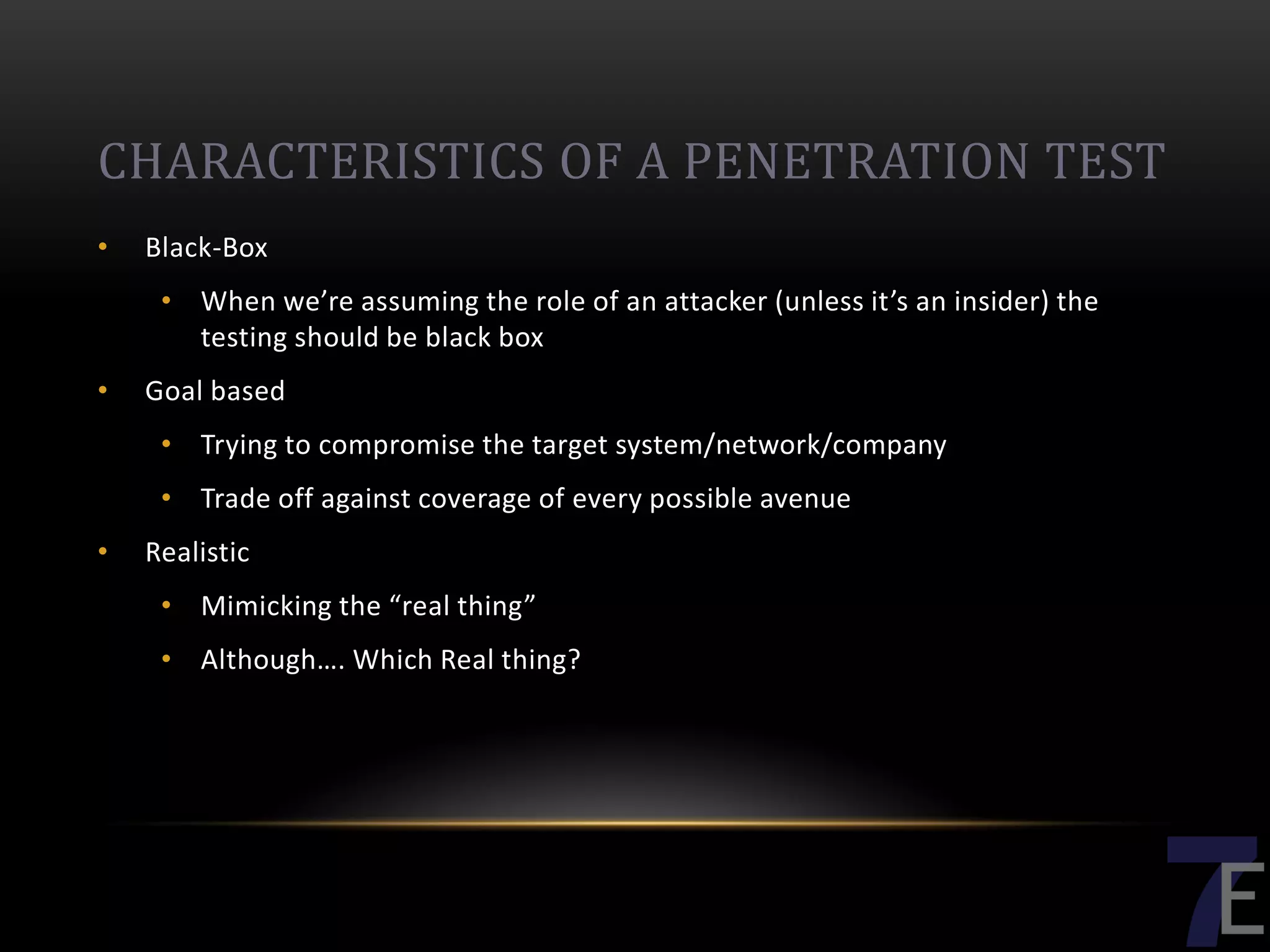
CHARACTERISTICS OF A PENETRATION TEST
•   Black-Box
     • When we’re assuming the role of an attacker (unless it’s an insider) the
       testing should be black box
•   Goal based
     • Trying to compromise the target system/network/company
     • Trade off against coverage of every possible avenue
•   Realistic
     • Mimicking the “real thing”
     • Although…. Which Real thing?
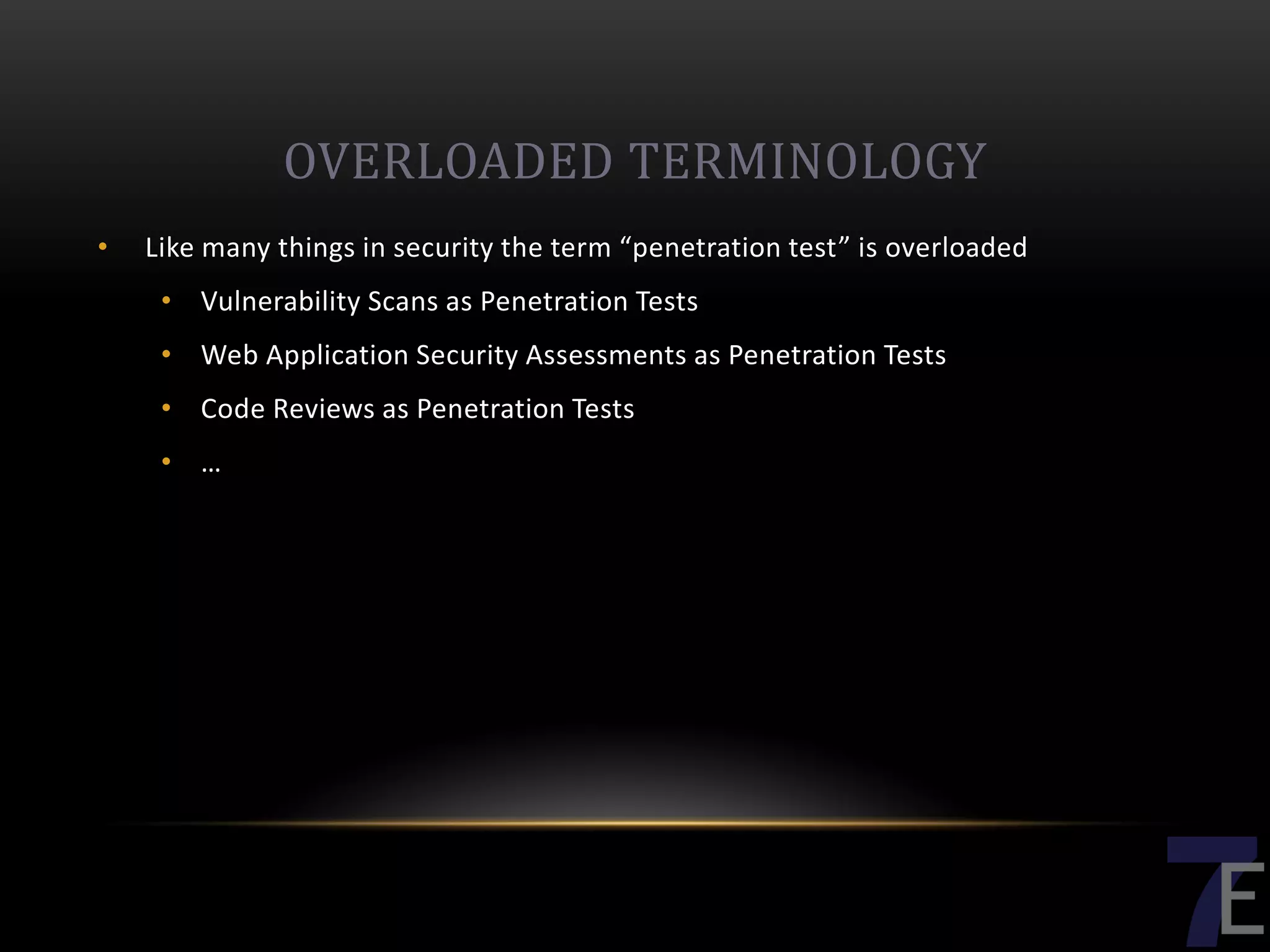
OVERLOADED TERMINOLOGY
•   Like many things in security the term “penetration test” is overloaded
     • Vulnerability Scans as Penetration Tests
     • Web Application Security Assessments as Penetration Tests
     • Code Reviews as Penetration Tests
     • …
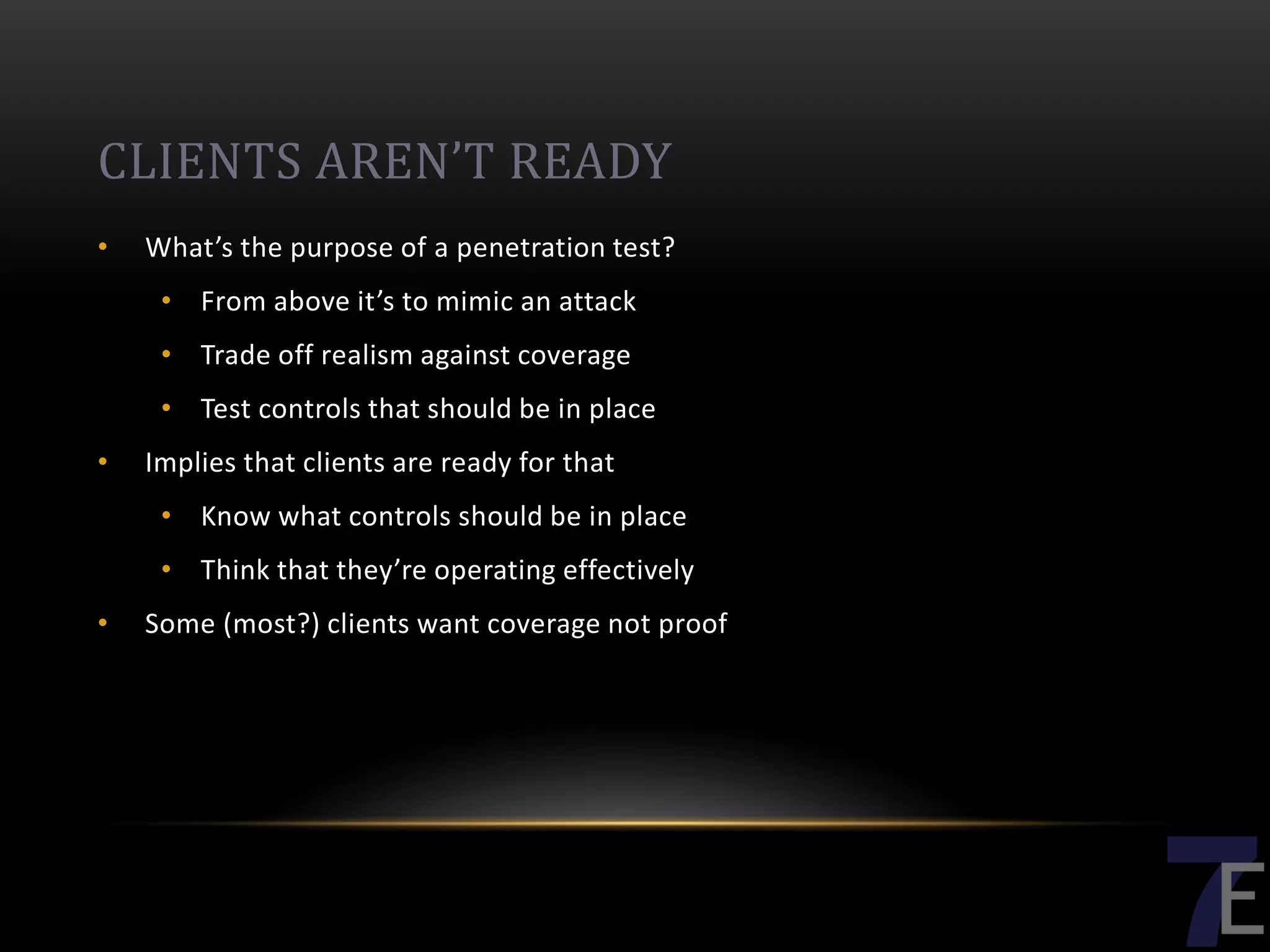
CLIENTS AREN’T READY
•   What’s the purpose of a penetration test?
     • From above it’s to mimic an attack
     • Trade off realism against coverage
     • Test controls that should be in place
•   Implies that clients are ready for that
     • Know what controls should be in place
     • Think that they’re operating effectively
•   Some (most?) clients want coverage not proof
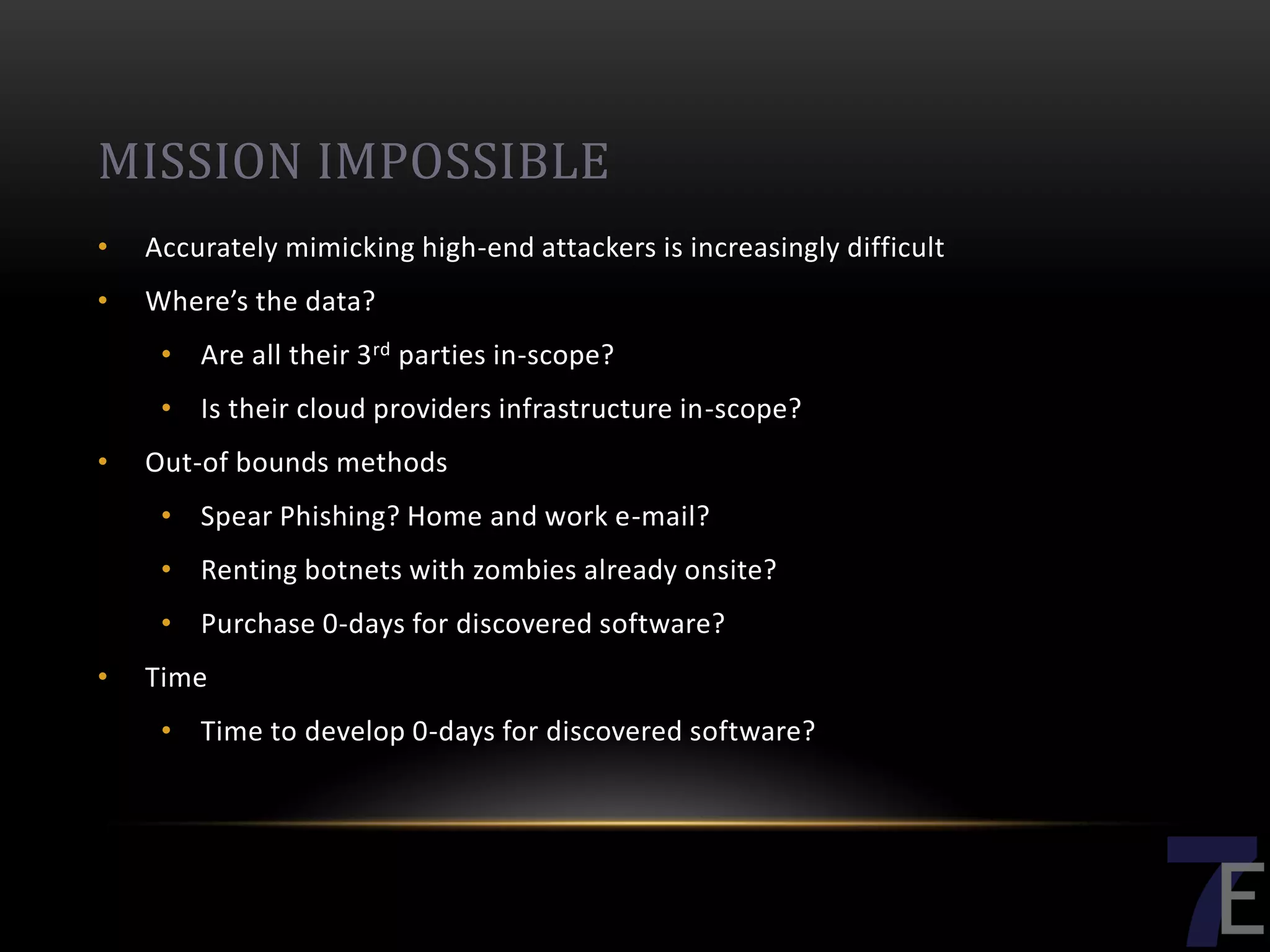
MISSION IMPOSSIBLE
•   Accurately mimicking high-end attackers is increasingly difficult
•   Where’s the data?
     • Are all their 3 rd parties in-scope?
     • Is their cloud providers infrastructure in-scope?
•   Out-of bounds methods
     • Spear Phishing? Home and work e-mail?
     • Renting botnets with zombies already onsite?
     • Purchase 0-days for discovered software?
•   Time
     • Time to develop 0-days for discovered software?
FIXING THE PROBLEM - TERMS
•   Use different terms for differing job types
     • Vulnerability Scan
     • Vulnerability Assessment
     • Security Assessment
     • Penetration Test
FIXING THE PROBLEM - SCOPING
•   Threat modelling needs to be done first.
•   Right type of test for the customer
     • Assessment style testing for establishing controls in place (less developed
       customers).
     • Penetration style testing for mature companies to prove what they think
       should be in place.
•   The Underwriters Lab Approach
     • Testing specifies the type of attacker being emulated.
     • Specifies what’s not in-scope.
     • Resistant for a specified duration.
Penetration testing must die

Penetration testing must die

  • 1.
    PENETRATION TESTING MUSTDIE Rory McCune
  • 2.
    INTRODUCTION • IT/Information Security person for the last 15 years • Currently a director of 7 Elements ( http://www.7elements.co.uk ) • IT Security consultancy based in Scotland. • Scottish chapter lead for the OWASP project.
  • 3.
    AGENDA • Why must it die • Overloaded Terminology. • Clients aren’t ready. • Mission Impossible. • How do you fix it? • Better Terms. • Better Scoping.
  • 4.
    WHAT’S IN ANAME? • First thing is to define what we mean by penetration testing • One definition from Wikipedia “A penetration test, occasionally pentest, is a method of evaluating the security of a computer system or network by simulating an attack from a malicious source, known as a Black Hat Hacker, or Cracker.”
  • 5.
    CHARACTERISTICS OF APENETRATION TEST • Black-Box • When we’re assuming the role of an attacker (unless it’s an insider) the testing should be black box • Goal based • Trying to compromise the target system/network/company • Trade off against coverage of every possible avenue • Realistic • Mimicking the “real thing” • Although…. Which Real thing?
  • 6.
    OVERLOADED TERMINOLOGY • Like many things in security the term “penetration test” is overloaded • Vulnerability Scans as Penetration Tests • Web Application Security Assessments as Penetration Tests • Code Reviews as Penetration Tests • …
  • 7.
    CLIENTS AREN’T READY • What’s the purpose of a penetration test? • From above it’s to mimic an attack • Trade off realism against coverage • Test controls that should be in place • Implies that clients are ready for that • Know what controls should be in place • Think that they’re operating effectively • Some (most?) clients want coverage not proof
  • 8.
    MISSION IMPOSSIBLE • Accurately mimicking high-end attackers is increasingly difficult • Where’s the data? • Are all their 3 rd parties in-scope? • Is their cloud providers infrastructure in-scope? • Out-of bounds methods • Spear Phishing? Home and work e-mail? • Renting botnets with zombies already onsite? • Purchase 0-days for discovered software? • Time • Time to develop 0-days for discovered software?
  • 9.
    FIXING THE PROBLEM- TERMS • Use different terms for differing job types • Vulnerability Scan • Vulnerability Assessment • Security Assessment • Penetration Test
  • 10.
    FIXING THE PROBLEM- SCOPING • Threat modelling needs to be done first. • Right type of test for the customer • Assessment style testing for establishing controls in place (less developed customers). • Penetration style testing for mature companies to prove what they think should be in place. • The Underwriters Lab Approach • Testing specifies the type of attacker being emulated. • Specifies what’s not in-scope. • Resistant for a specified duration.