Join the conversation #devseccon
SECURING THE
CONTAINER DEVOPS
PIPELINE
By WILLIAM HENRY
WHY DO WE NEED THE TERM DEVSECOPS?
● DevOps “purists” point out that security was always part of
DevOps.
● Did people just not read the book? Are practitioners
skipping security?
● DevSecOps practitioners say it’s about how to better
integrate or automate security.
○ Incorporating security at scale
○ Making security infrastructure more adaptive and programmable
○ Think of it as Continuous Security
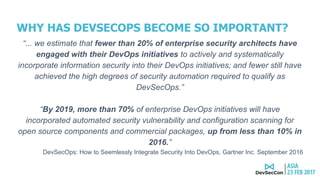
WHY HAS DEVSECOPS BECOME SO IMPORTANT?
“... we estimate that fewer than 20% of enterprise security architects have
engaged with their DevOps initiatives to actively and systematically
incorporate information security into their DevOps initiatives; and fewer still have
achieved the high degrees of security automation required to qualify as
DevSecOps.”
“By 2019, more than 70% of enterprise DevOps initiatives will have
incorporated automated security vulnerability and configuration scanning for
open source components and commercial packages, up from less than 10% in
2016.”
DevSecOps: How to Seemlessly Integrate Security Into DevOps, Gartner Inc. September 2016
DEVELOPING AND DEPLOYING CODE TODAY
DEVOPS
LIFECYCLE
SAAS/APP
PAAS
IAAS
A
P
I
Modern Architectures are API driven.
DEVOPS + API
Cloud Based Services
CI/CD
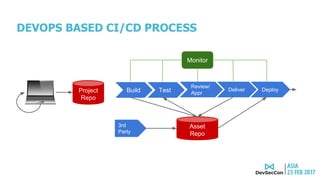
DEVOPS BASED CI/CD PROCESS
Project
Repo
Asset
Repo
Monitor
Build Test
Review/
Appr
Deliver Deploy
3rd
Party
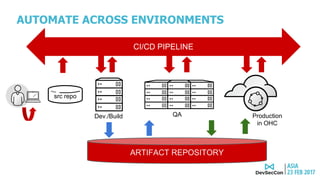
AUTOMATE ACROSS ENVIRONMENTS
CI/CD PIPELINE
ARTIFACT REPOSITORY
src repo
Dev./Build QA Production
in OHC
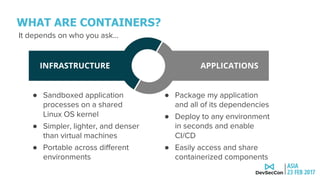
WHAT ARE CONTAINERS?
It depends on who you ask...
7
● Sandboxed application
processes on a shared
Linux OS kernel
● Simpler, lighter, and denser
than virtual machines
● Portable across different
environments
● Package my application
and all of its dependencies
● Deploy to any environment
in seconds and enable
CI/CD
● Easily access and share
containerized components
INFRASTRUCTURE APPLICATIONS
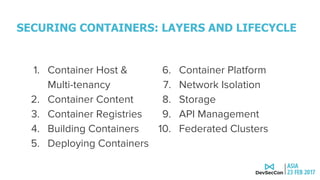
SECURING CONTAINERS: LAYERS AND LIFECYCLE
6. Container Platform
7. Network Isolation
8. Storage
9. API Management
10. Federated Clusters
1. Container Host &
Multi-tenancy
2. Container Content
3. Container Registries
4. Building Containers
5. Deploying Containers
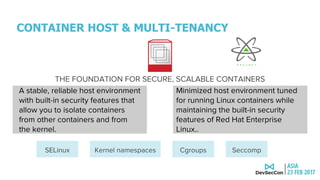
CONTAINER HOST & MULTI-TENANCY
Minimized host environment tuned
for running Linux containers while
maintaining the built-in security
features of Red Hat Enterprise
Linux..
A stable, reliable host environment
with built-in security features that
allow you to isolate containers
from other containers and from
the kernel.
SELinux Kernel namespaces Cgroups Seccomp
THE FOUNDATION FOR SECURE, SCALABLE CONTAINERS
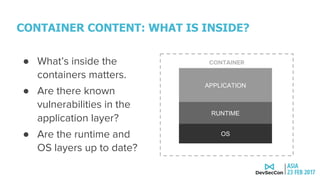
CONTAINER CONTENT: WHAT IS INSIDE?
● What’s inside the
containers matters.
● Are there known
vulnerabilities in the
application layer?
● Are the runtime and
OS layers up to date?
CONTAINER
OS
RUNTIME
APPLICATION
REGISTRIES: WHERE DO YOUR CONTAINERS
COME FROM?
● Policies to control
who can deploy
which containers
● Certification
Catalog
● Trusted content
with security
updates
HOST OS
CONTAINER
OS
RUNTIME
APP
HOST OS
CONTAINER
OS
RUNTIME
APP
11
Public and private registries
● What security meta-data is
available for your images?
● Are the images in the
registry updated regularly?
● Are there access controls
on the registry? How
strong are they?
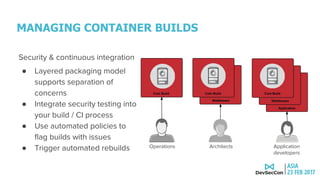
MANAGING CONTAINER BUILDS
Security & continuous integration
● Layered packaging model
supports separation of
concerns
● Integrate security testing into
your build / CI process
● Use automated policies to
flag builds with issues
● Trigger automated rebuilds Operations Architects Application
developers
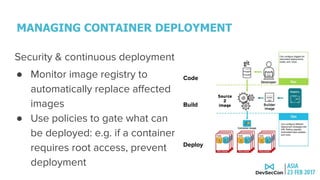
MANAGING CONTAINER DEPLOYMENT
Code
Build
Deploy
Security & continuous deployment
● Monitor image registry to
automatically replace affected
images
● Use policies to gate what can
be deployed: e.g. if a container
requires root access, prevent
deployment
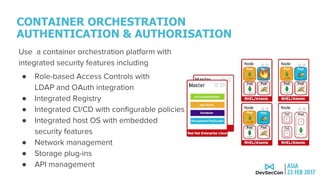
CONTAINER ORCHESTRATION
AUTHENTICATION & AUTHORISATION
Use a container orchestration platform with
integrated security features including
● Role-based Access Controls with
LDAP and OAuth integration
● Integrated Registry
● Integrated CI/CD with configurable policies
● Integrated host OS with embedded
security features
● Network management
● Storage plug-ins
● API management
NETWORK DEFENCE
Use network namespaces to
● Isolate applications from other
applications within a cluster
● Isolate environments (Dev /
Test / Prod) from other
environments within a cluster
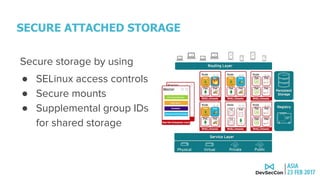
SECURE ATTACHED STORAGE
Secure storage by using
● SELinux access controls
● Secure mounts
● Supplemental group IDs
for shared storage
API MANAGEMENT
Container platform & application APIs
● Service based
● Public versus private
● Authentication and authorization
● LDAP integration
● End-point access controls
● Rate limiting
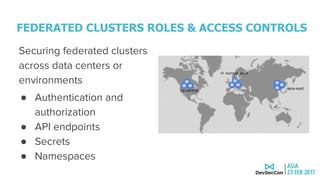
FEDERATED CLUSTERS ROLES & ACCESS CONTROLS
Securing federated clusters
across data centers or
environments
● Authentication and
authorization
● API endpoints
● Secrets
● Namespaces
BRING IT ALL TOGETHER
19
Container
Business
Automation
Container
Integration
Container
Data &
Storage
Contaner
Web &
Mobile
Application Lifecycle Management
(CI/CD)
Build Automation Deployment Automation
Service Catalog
(Language Runtimes, Middleware, Databases)
Self-Service
Infrastructure Automation
Networking Storage Registry
Logs &
Metrics
Security
Container Orchestration & Cluster Management
Container Runtime & Packaging
(OCI/Docker)
Enterprise Container Host
RH Enterprise LinuxAtomic Host
Physical
Virtual
Private cloud
Public cloud
Join the conversation #devseccon
THANK YOU
@ipbabble
whenry@redhat.com

Securing the container DevOps pipeline by William Henry

  • 1.
    Join the conversation#devseccon SECURING THE CONTAINER DEVOPS PIPELINE By WILLIAM HENRY
  • 2.
    WHY DO WENEED THE TERM DEVSECOPS? ● DevOps “purists” point out that security was always part of DevOps. ● Did people just not read the book? Are practitioners skipping security? ● DevSecOps practitioners say it’s about how to better integrate or automate security. ○ Incorporating security at scale ○ Making security infrastructure more adaptive and programmable ○ Think of it as Continuous Security
  • 3.
    WHY HAS DEVSECOPSBECOME SO IMPORTANT? “... we estimate that fewer than 20% of enterprise security architects have engaged with their DevOps initiatives to actively and systematically incorporate information security into their DevOps initiatives; and fewer still have achieved the high degrees of security automation required to qualify as DevSecOps.” “By 2019, more than 70% of enterprise DevOps initiatives will have incorporated automated security vulnerability and configuration scanning for open source components and commercial packages, up from less than 10% in 2016.” DevSecOps: How to Seemlessly Integrate Security Into DevOps, Gartner Inc. September 2016
  • 4.
    DEVELOPING AND DEPLOYINGCODE TODAY DEVOPS LIFECYCLE SAAS/APP PAAS IAAS A P I Modern Architectures are API driven. DEVOPS + API Cloud Based Services CI/CD
  • 5.
    DEVOPS BASED CI/CDPROCESS Project Repo Asset Repo Monitor Build Test Review/ Appr Deliver Deploy 3rd Party
  • 6.
    AUTOMATE ACROSS ENVIRONMENTS CI/CDPIPELINE ARTIFACT REPOSITORY src repo Dev./Build QA Production in OHC
  • 7.
    WHAT ARE CONTAINERS? Itdepends on who you ask... 7 ● Sandboxed application processes on a shared Linux OS kernel ● Simpler, lighter, and denser than virtual machines ● Portable across different environments ● Package my application and all of its dependencies ● Deploy to any environment in seconds and enable CI/CD ● Easily access and share containerized components INFRASTRUCTURE APPLICATIONS
  • 8.
    SECURING CONTAINERS: LAYERSAND LIFECYCLE 6. Container Platform 7. Network Isolation 8. Storage 9. API Management 10. Federated Clusters 1. Container Host & Multi-tenancy 2. Container Content 3. Container Registries 4. Building Containers 5. Deploying Containers
  • 9.
    CONTAINER HOST &MULTI-TENANCY Minimized host environment tuned for running Linux containers while maintaining the built-in security features of Red Hat Enterprise Linux.. A stable, reliable host environment with built-in security features that allow you to isolate containers from other containers and from the kernel. SELinux Kernel namespaces Cgroups Seccomp THE FOUNDATION FOR SECURE, SCALABLE CONTAINERS
  • 10.
    CONTAINER CONTENT: WHATIS INSIDE? ● What’s inside the containers matters. ● Are there known vulnerabilities in the application layer? ● Are the runtime and OS layers up to date? CONTAINER OS RUNTIME APPLICATION
  • 11.
    REGISTRIES: WHERE DOYOUR CONTAINERS COME FROM? ● Policies to control who can deploy which containers ● Certification Catalog ● Trusted content with security updates HOST OS CONTAINER OS RUNTIME APP HOST OS CONTAINER OS RUNTIME APP 11 Public and private registries ● What security meta-data is available for your images? ● Are the images in the registry updated regularly? ● Are there access controls on the registry? How strong are they?
  • 12.
    MANAGING CONTAINER BUILDS Security& continuous integration ● Layered packaging model supports separation of concerns ● Integrate security testing into your build / CI process ● Use automated policies to flag builds with issues ● Trigger automated rebuilds Operations Architects Application developers
  • 13.
    MANAGING CONTAINER DEPLOYMENT Code Build Deploy Security& continuous deployment ● Monitor image registry to automatically replace affected images ● Use policies to gate what can be deployed: e.g. if a container requires root access, prevent deployment
  • 14.
    CONTAINER ORCHESTRATION AUTHENTICATION &AUTHORISATION Use a container orchestration platform with integrated security features including ● Role-based Access Controls with LDAP and OAuth integration ● Integrated Registry ● Integrated CI/CD with configurable policies ● Integrated host OS with embedded security features ● Network management ● Storage plug-ins ● API management
  • 15.
    NETWORK DEFENCE Use networknamespaces to ● Isolate applications from other applications within a cluster ● Isolate environments (Dev / Test / Prod) from other environments within a cluster
  • 16.
    SECURE ATTACHED STORAGE Securestorage by using ● SELinux access controls ● Secure mounts ● Supplemental group IDs for shared storage
  • 17.
    API MANAGEMENT Container platform& application APIs ● Service based ● Public versus private ● Authentication and authorization ● LDAP integration ● End-point access controls ● Rate limiting
  • 18.
    FEDERATED CLUSTERS ROLES& ACCESS CONTROLS Securing federated clusters across data centers or environments ● Authentication and authorization ● API endpoints ● Secrets ● Namespaces
  • 19.
    BRING IT ALLTOGETHER 19 Container Business Automation Container Integration Container Data & Storage Contaner Web & Mobile Application Lifecycle Management (CI/CD) Build Automation Deployment Automation Service Catalog (Language Runtimes, Middleware, Databases) Self-Service Infrastructure Automation Networking Storage Registry Logs & Metrics Security Container Orchestration & Cluster Management Container Runtime & Packaging (OCI/Docker) Enterprise Container Host RH Enterprise LinuxAtomic Host Physical Virtual Private cloud Public cloud
  • 20.
    Join the conversation#devseccon THANK YOU @ipbabble whenry@redhat.com