Chapter 5 
SSeerrvviiccee DDeessiiggnn 
Beni Asllani 
OOppeerraattiioonnss MMaannaaggeemmeenntt -- 66tthh EEddiittiioonn 
Roberta Russell & Bernard W. Taylor, III 
University of Tennessee at Chattanooga
LLeeccttuurree oouuttlliinnee 
 Service economy 
 Characteristics of services 
 Service design process 
 Tools for service design 
 Waiting line analysis for service 
improvement 
5-2
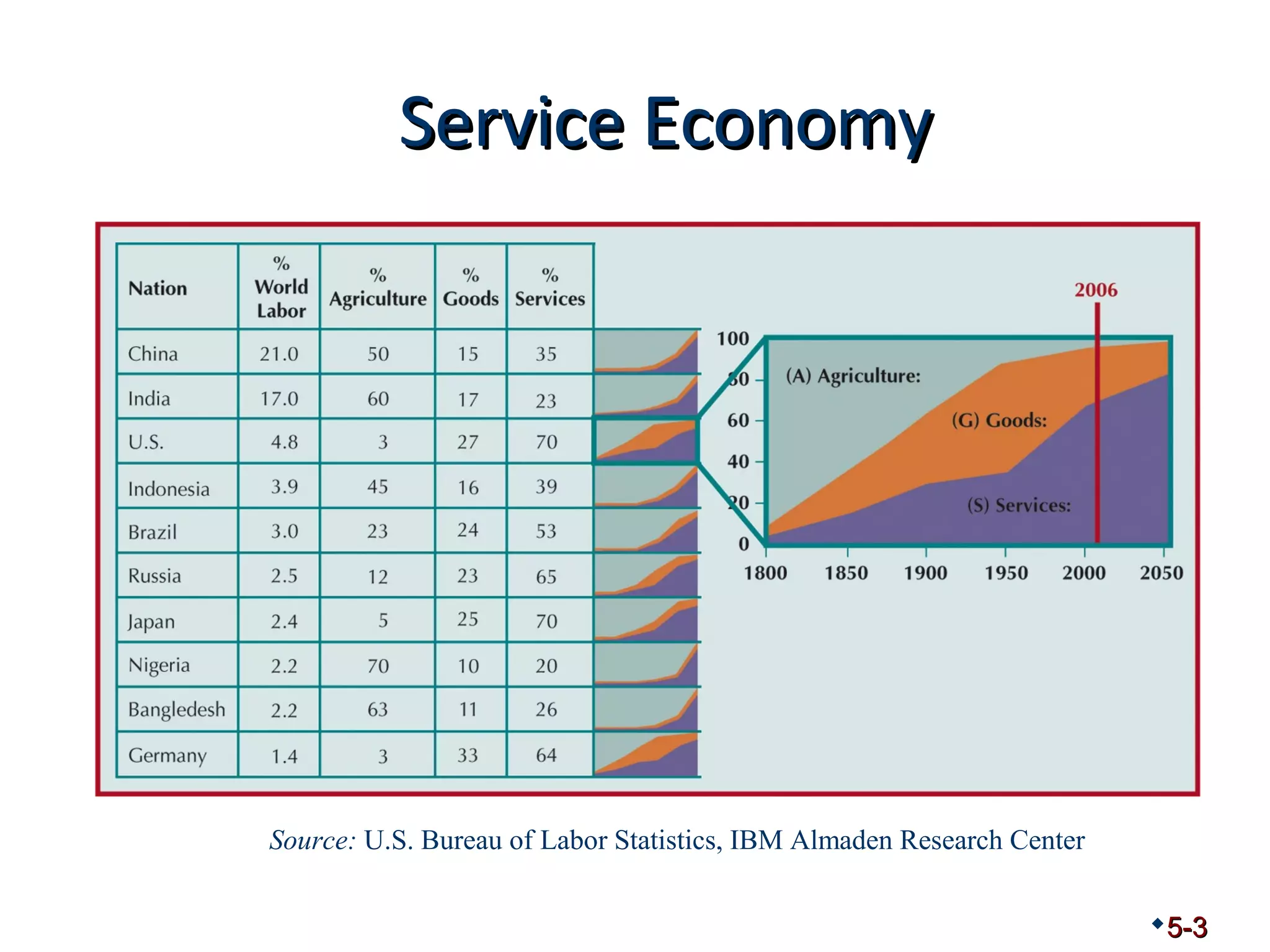
SSeerrvviiccee EEccoonnoommyy 
5-3 
Source: U.S. Bureau of Labor Statistics, IBM Almaden Research Center
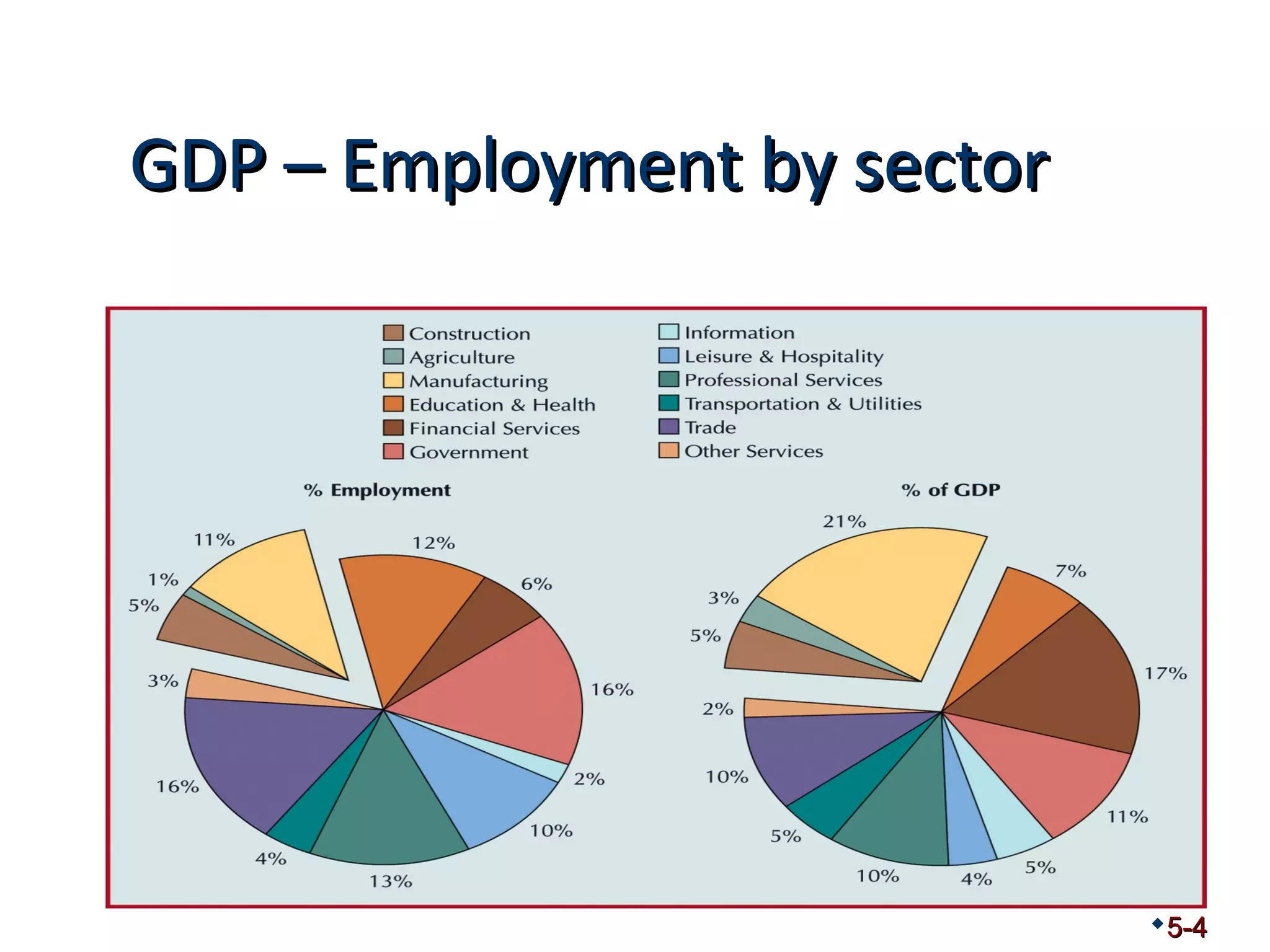
GGDDPP –– EEmmppllooyymmeenntt bbyy sseeccttoorr 
5-4
CChhaarraacctteerriissttiiccss ooff SSeerrvviicceess 
 Services 
 acts, deeds, or performances 
 Goods 
 tangible objects 
 Facilitating services 
 accompany almost all purchases of goods 
 Facilitating goods 
 accompany almost all service purchases 
5-5
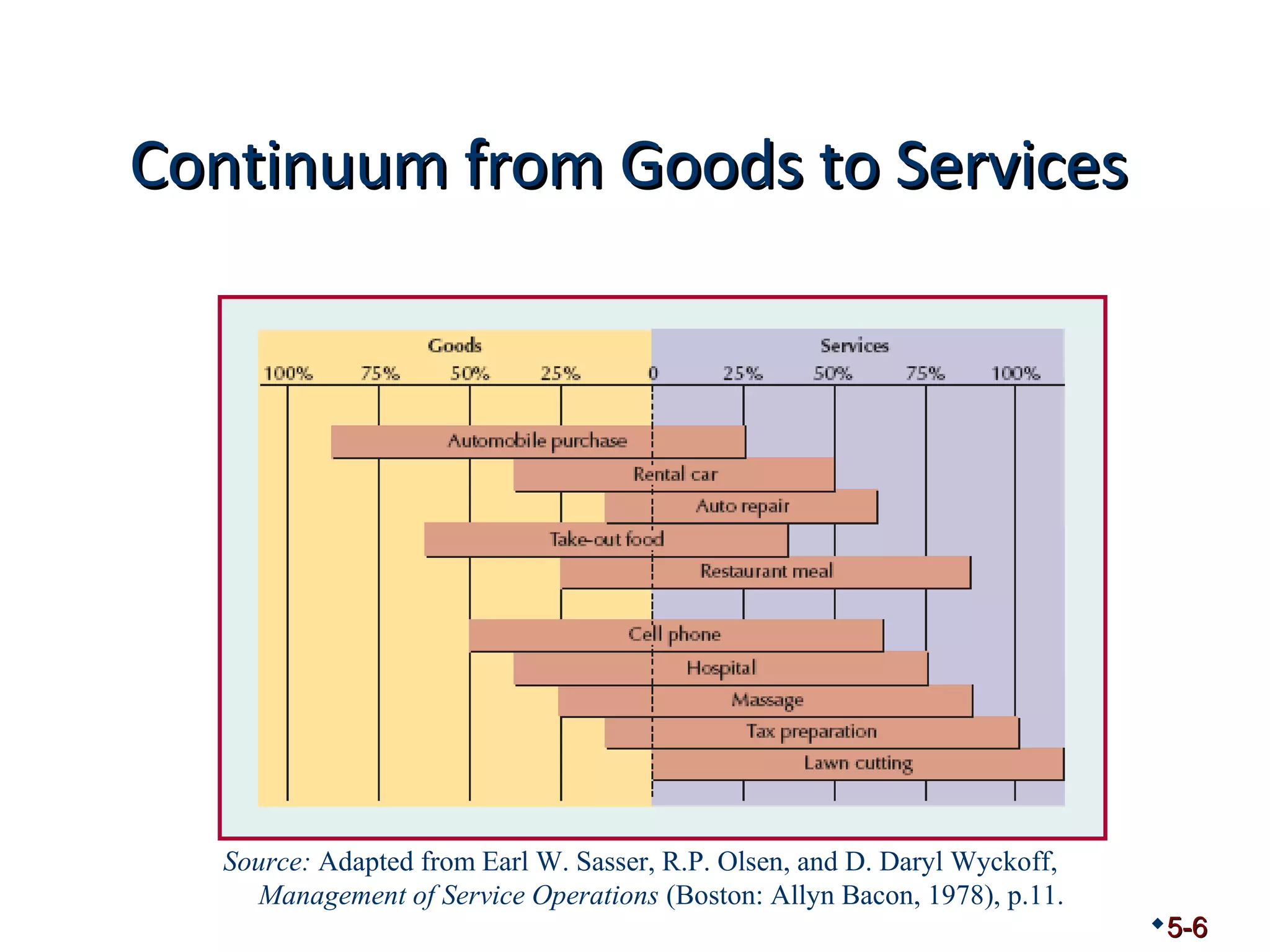
CCoonnttiinnuuuumm ffrroomm GGooooddss ttoo SSeerrvviicceess 
5-6 
Source: Adapted from Earl W. Sasser, R.P. Olsen, and D. Daryl Wyckoff, 
Management of Service Operations (Boston: Allyn Bacon, 1978), p.11.
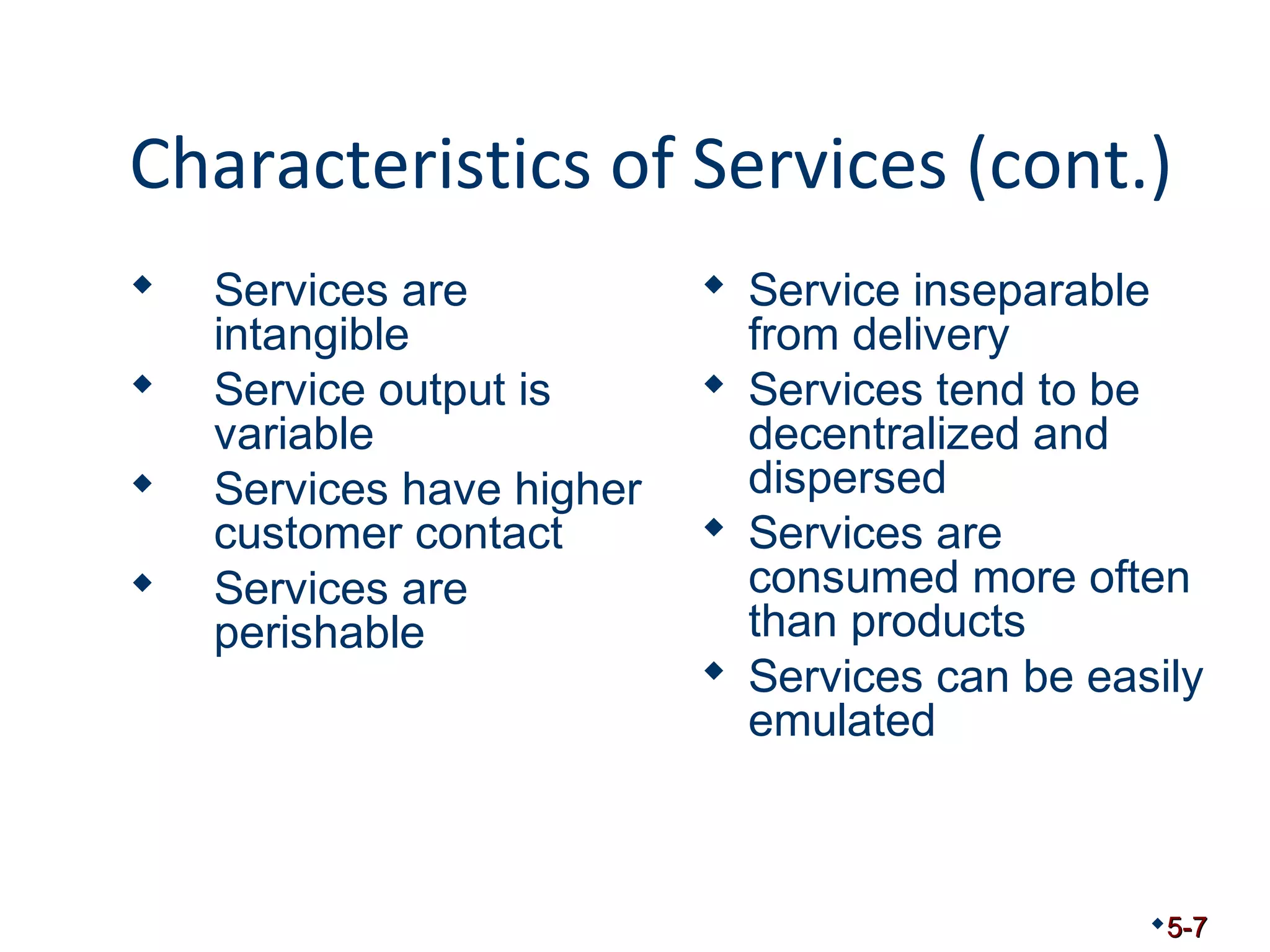
Characteristics of Services (cont.) 
 Services are 
intangible 
 Service output is 
variable 
 Services have higher 
customer contact 
 Services are 
perishable 
 Service inseparable 
from delivery 
 Services tend to be 
decentralized and 
dispersed 
 Services are 
consumed more often 
than products 
 Services can be easily 
emulated 
5-7
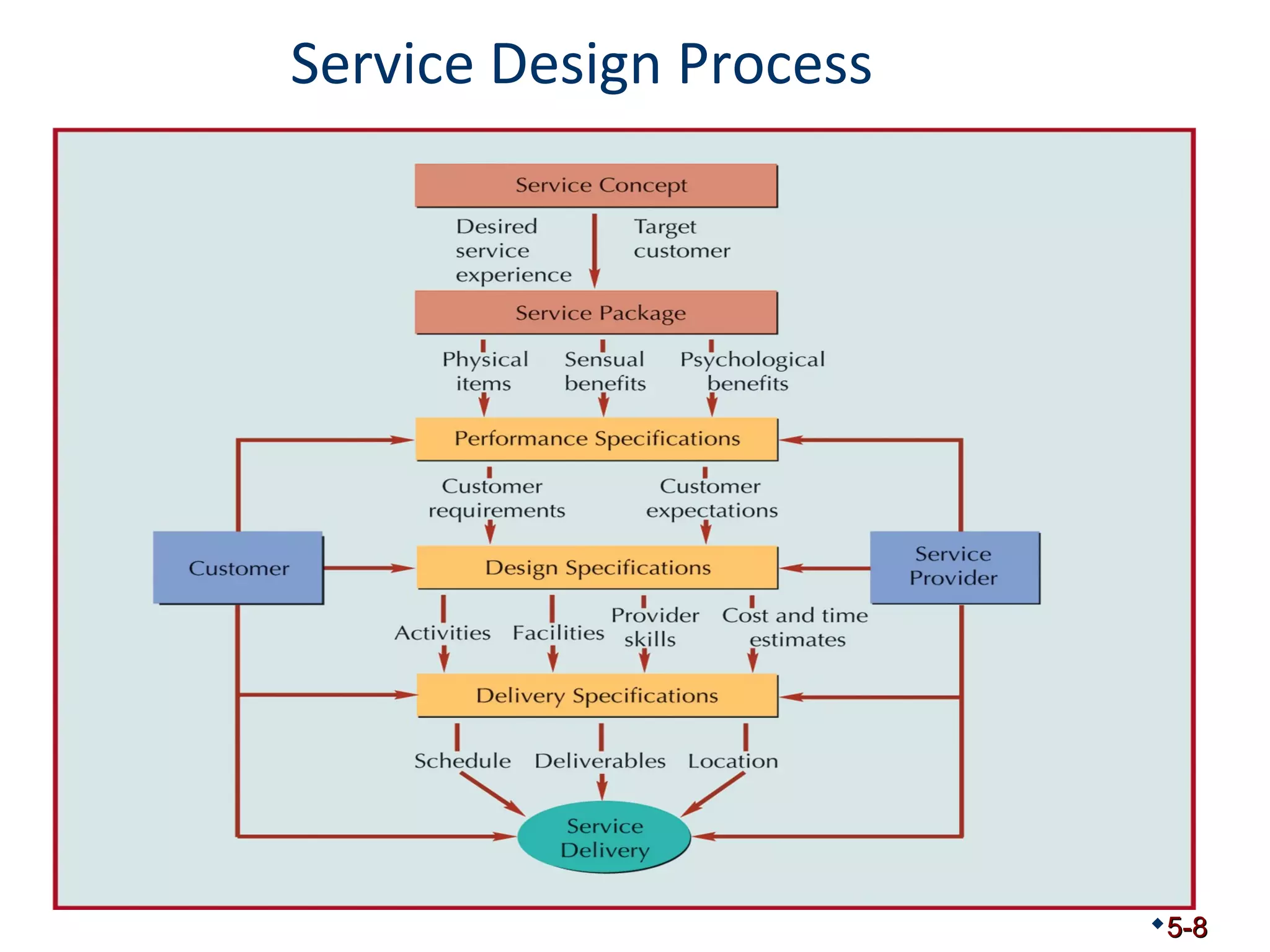
Service Design Process 
5-8
Service Design Process (cont.) 
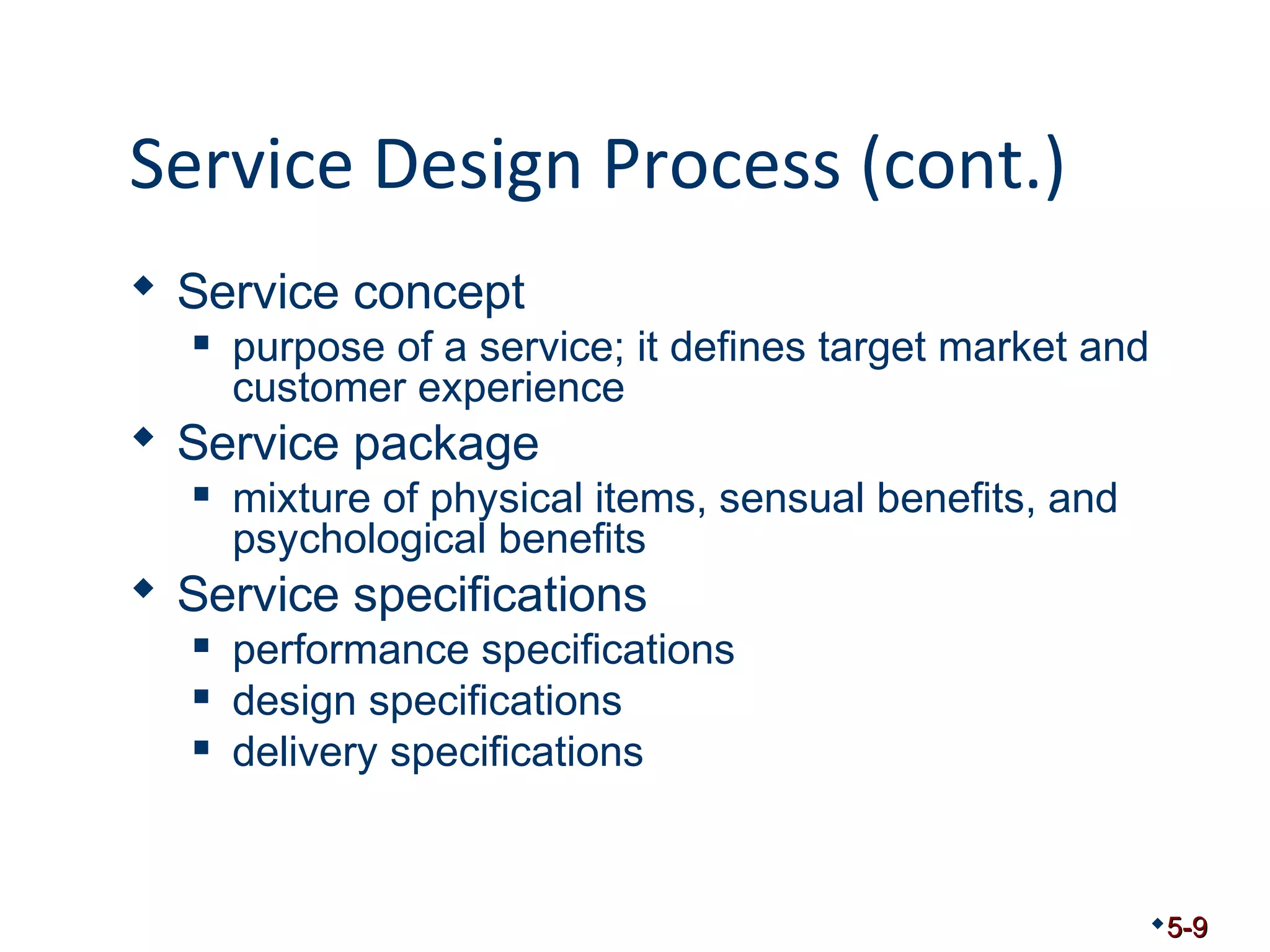
 Service concept 
 purpose of a service; it defines target market and 
customer experience 
 Service package 
 mixture of physical items, sensual benefits, and 
psychological benefits 
 Service specifications 
 performance specifications 
 design specifications 
 delivery specifications 
5-9
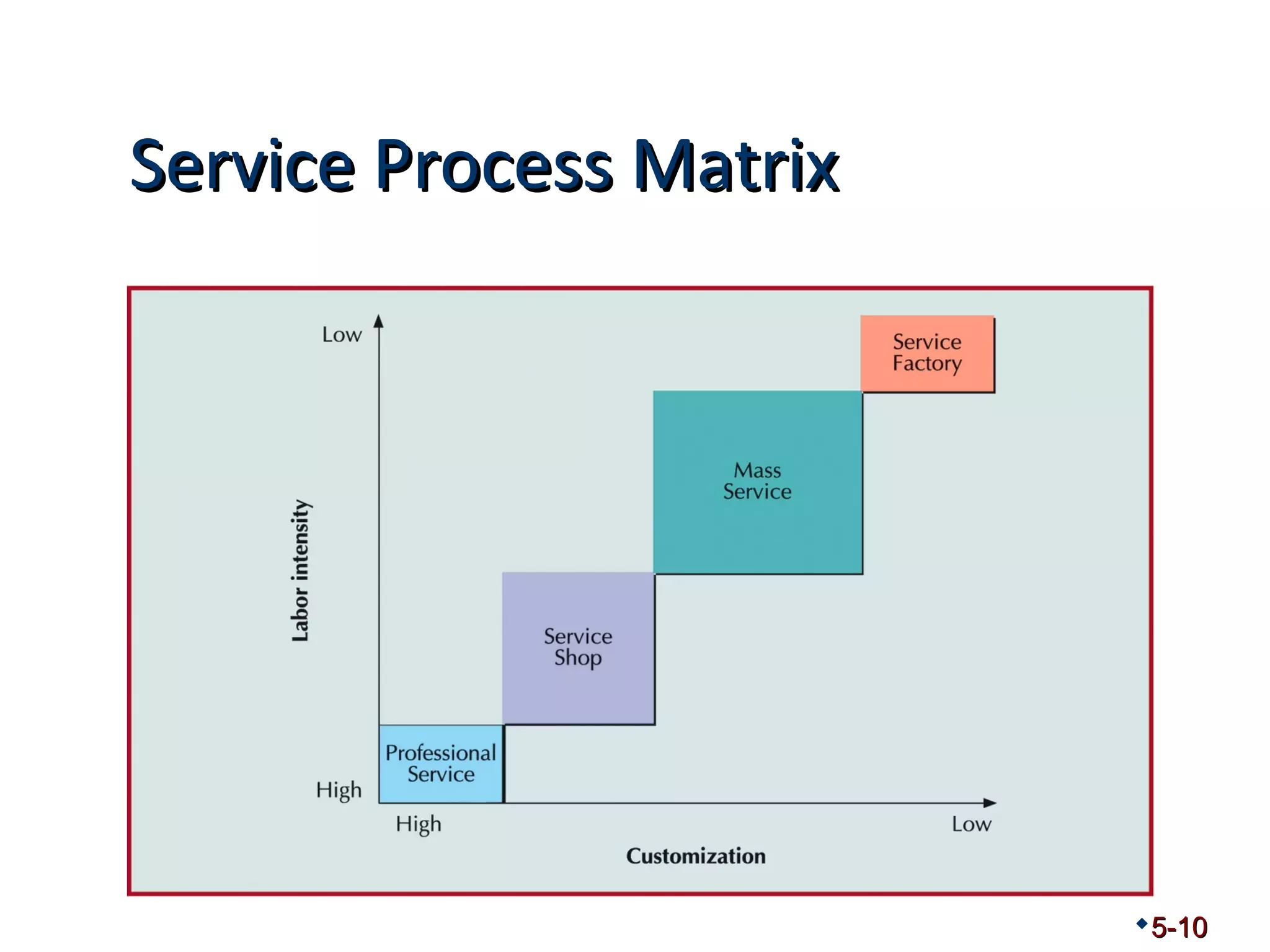
SSeerrvviiccee PPrroocceessss MMaattrriixx 
5-10
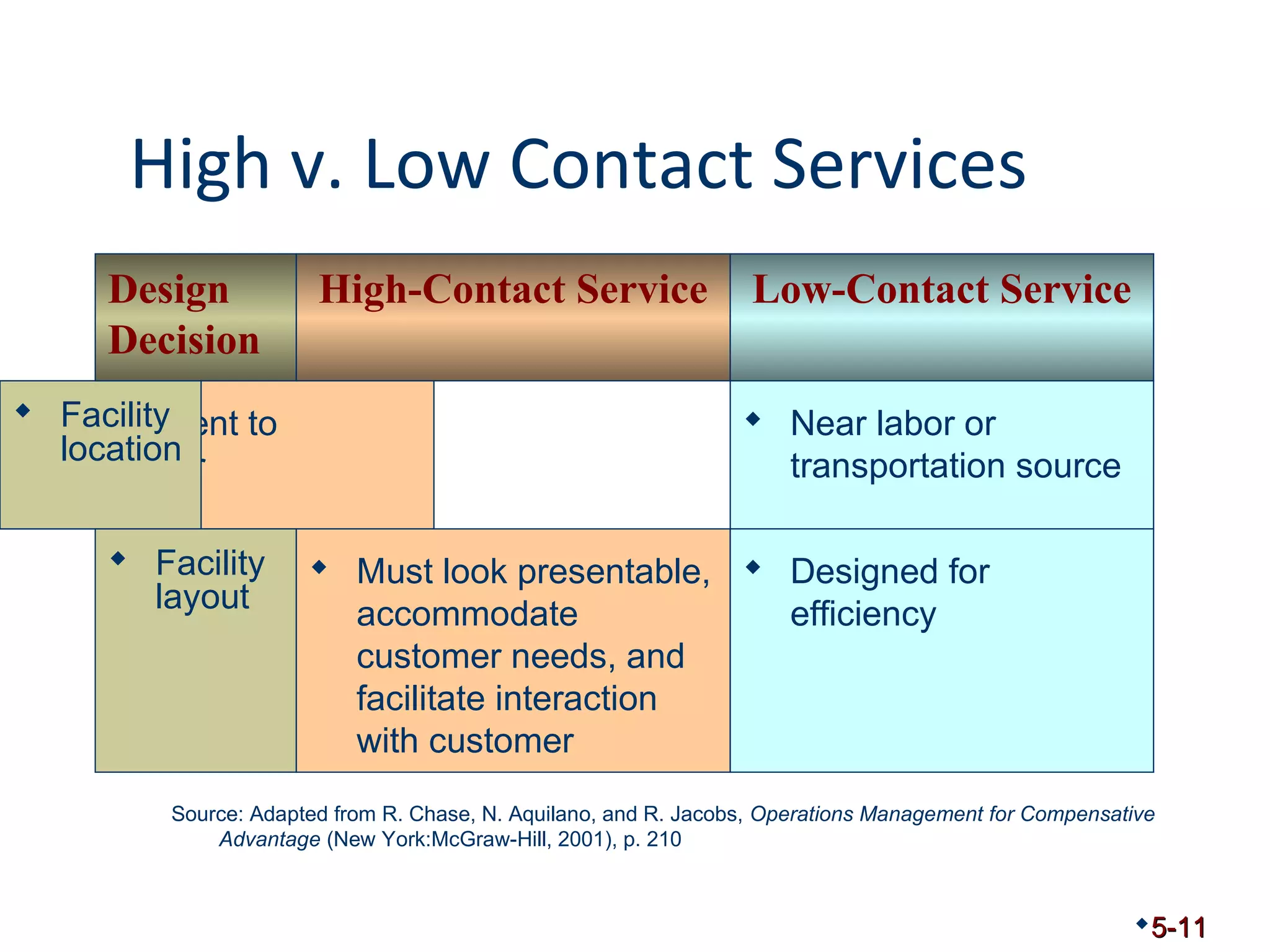
High v. Low Contact Services 
5-11 
Design 
Decision 
 Facility 
 Convenient to 
location 
customer 
High-Contact Service Low-Contact Service 
 Near labor or 
transportation source 
 Facility 
layout 
 Must look presentable, 
accommodate 
customer needs, and 
facilitate interaction 
with customer 
Source: Adapted from R. Chase, N. Aquilano, and R. Jacobs, Operations Management for Compensative 
Advantage (New York:McGraw-Hill, 2001), p. 210 
 Designed for 
efficiency
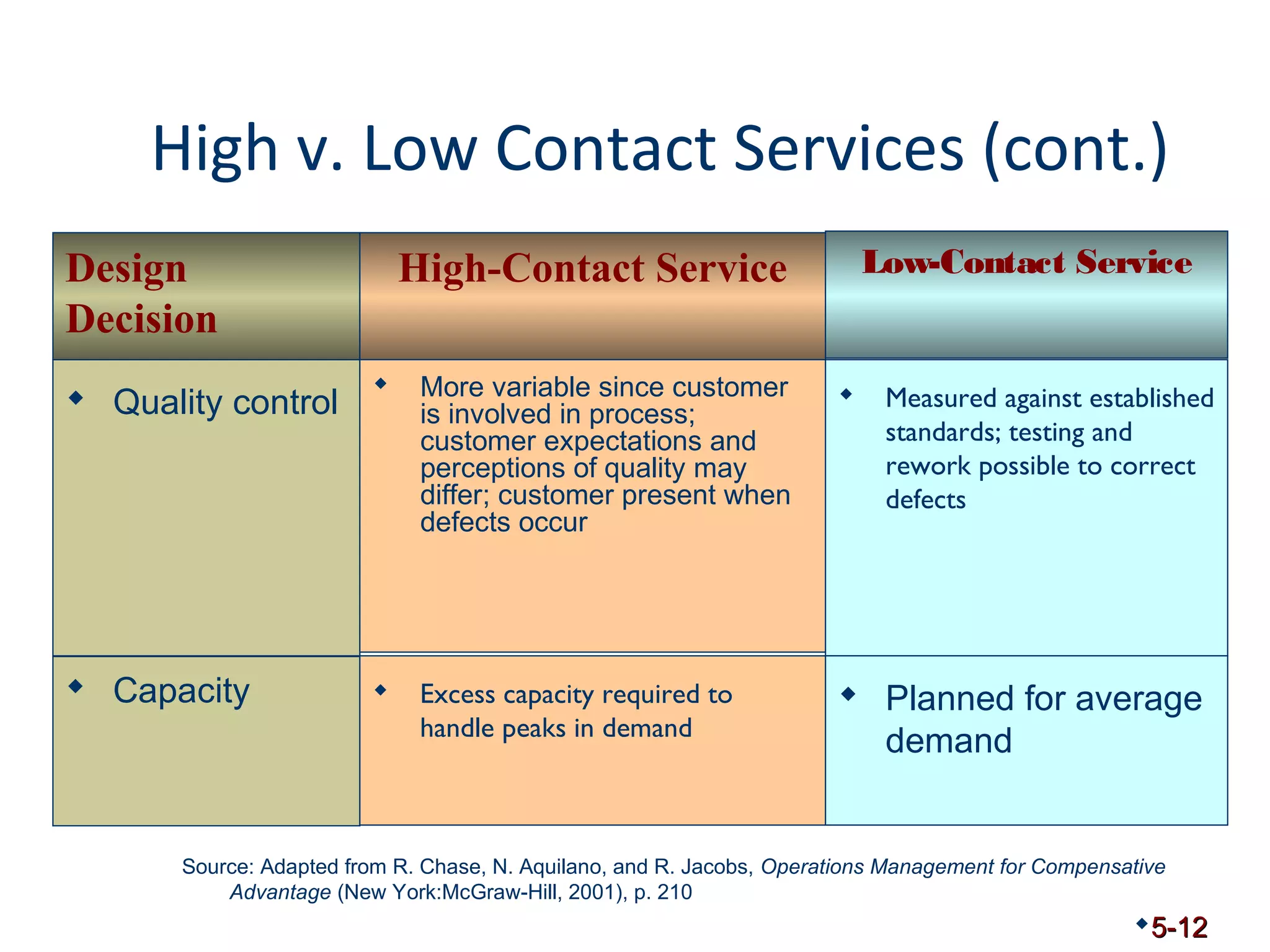
High v. Low Contact Services (cont.) 
 Quality control  More variable since customer 
is involved in process; 
customer expectations and 
perceptions of quality may 
differ; customer present when 
defects occur 
5-12 
Design 
Decision 
High-Contact Service Low-Contact Service 
 Measured against established 
standards; testing and 
rework possible to correct 
defects 
 Capacity  Excess capacity required to 
handle peaks in demand 
Source: Adapted from R. Chase, N. Aquilano, and R. Jacobs, Operations Management for Compensative 
Advantage (New York:McGraw-Hill, 2001), p. 210 
 Planned for average 
demand
High v. Low Contact Services (cont.) 
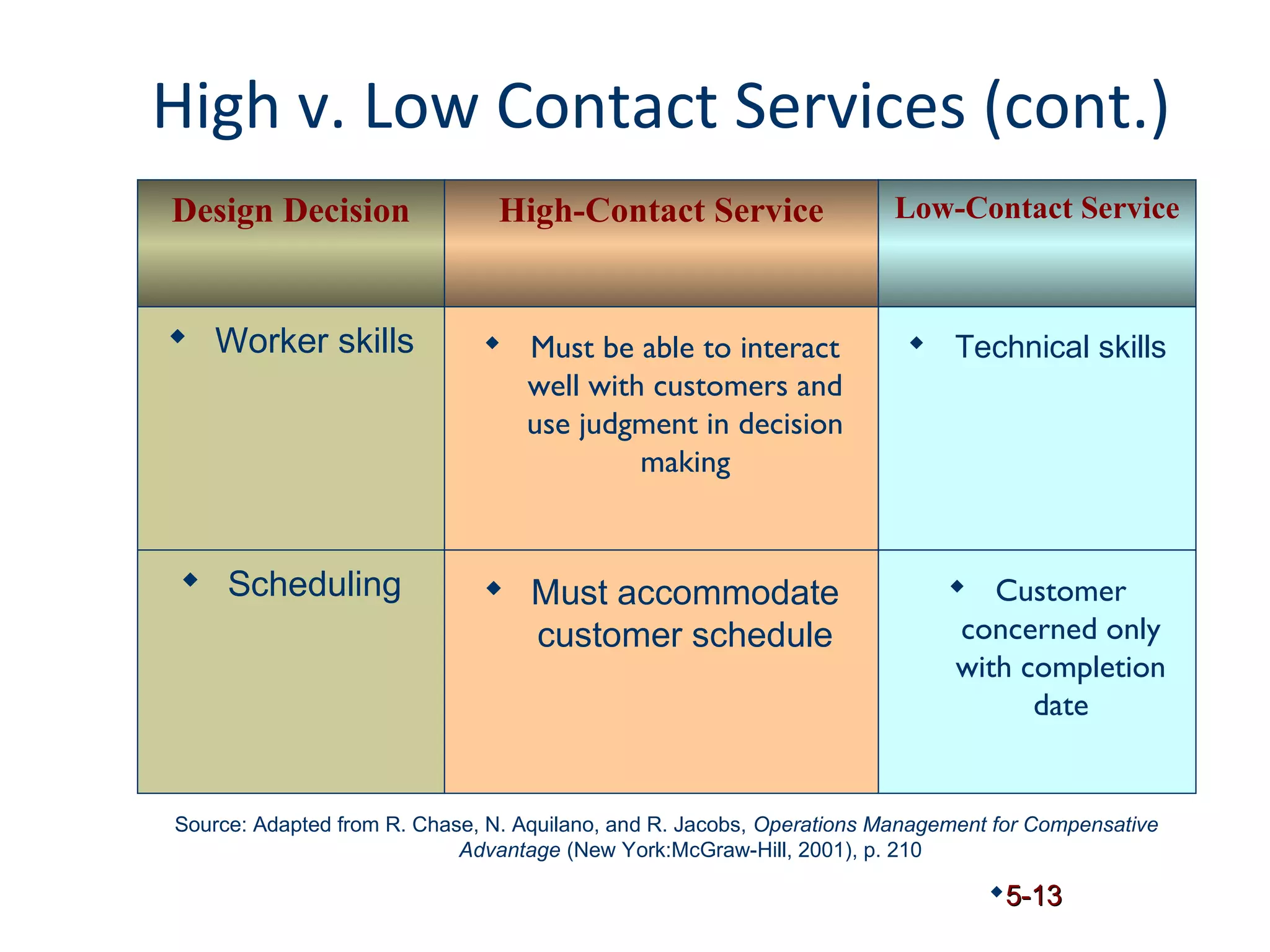
Design Decision High-Contact Service Low-Contact Service 
 Worker skills  Must be able to interact 
well with customers and 
use judgment in decision 
making 
 Technical skills 
 Scheduling  Must accommodate 
customer schedule 
Source: Adapted from R. Chase, N. Aquilano, and R. Jacobs, Operations Management for Compensative 
5-13 
Advantage (New York:McGraw-Hill, 2001), p. 210 
 Customer 
concerned only 
with completion 
date
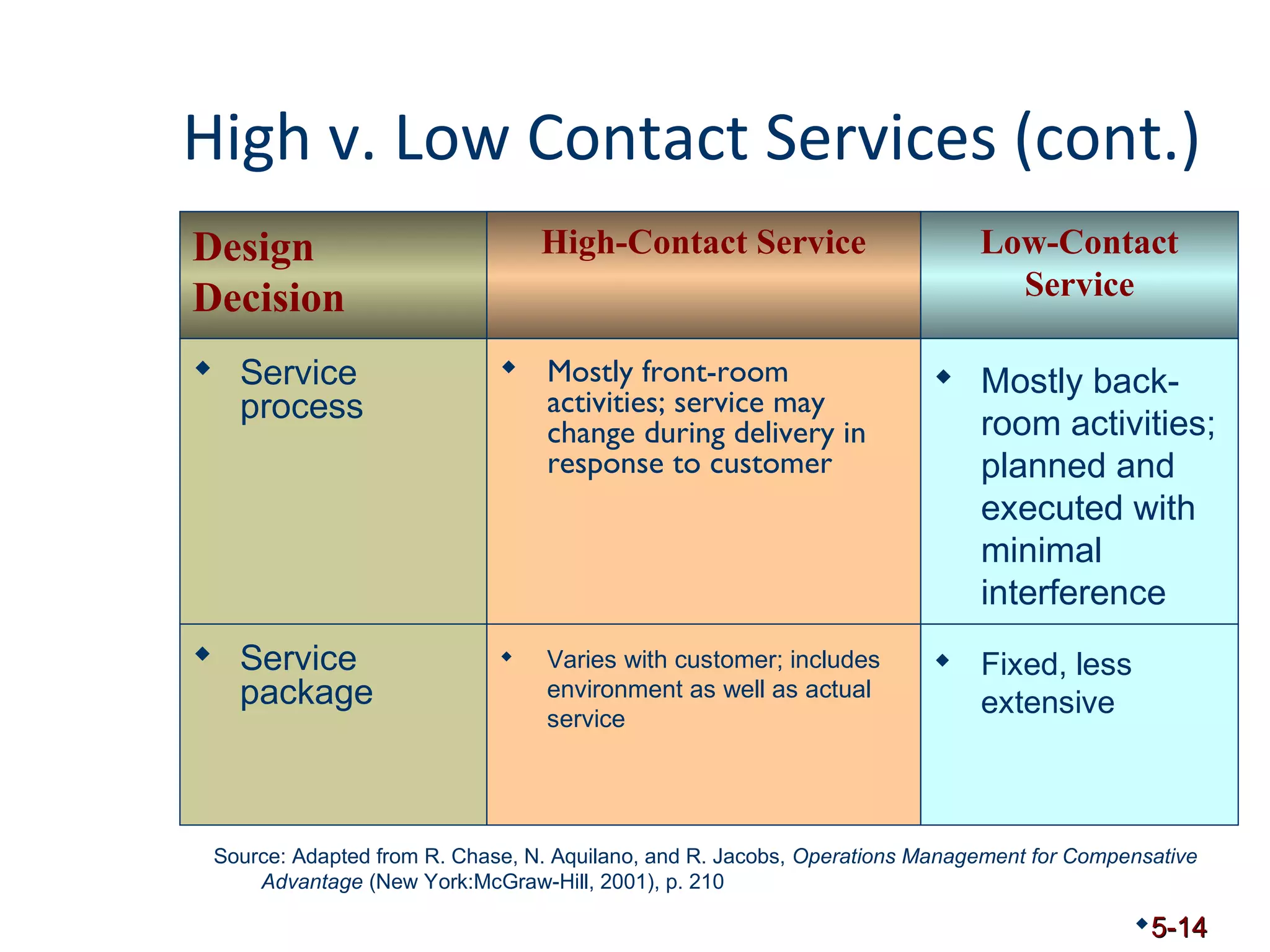
High v. Low Contact Services (cont.) 
 Service 
process 
 Mostly front-room 
activities; service may 
change during delivery in 
response to customer 
5-14 
Design 
Decision 
High-Contact Service Low-Contact 
Service 
 Mostly back-room 
activities; 
planned and 
executed with 
minimal 
interference 
 Service 
package 
 Varies with customer; includes 
environment as well as actual 
service 
Source: Adapted from R. Chase, N. Aquilano, and R. Jacobs, Operations Management for Compensative 
Advantage (New York:McGraw-Hill, 2001), p. 210 
 Fixed, less 
extensive
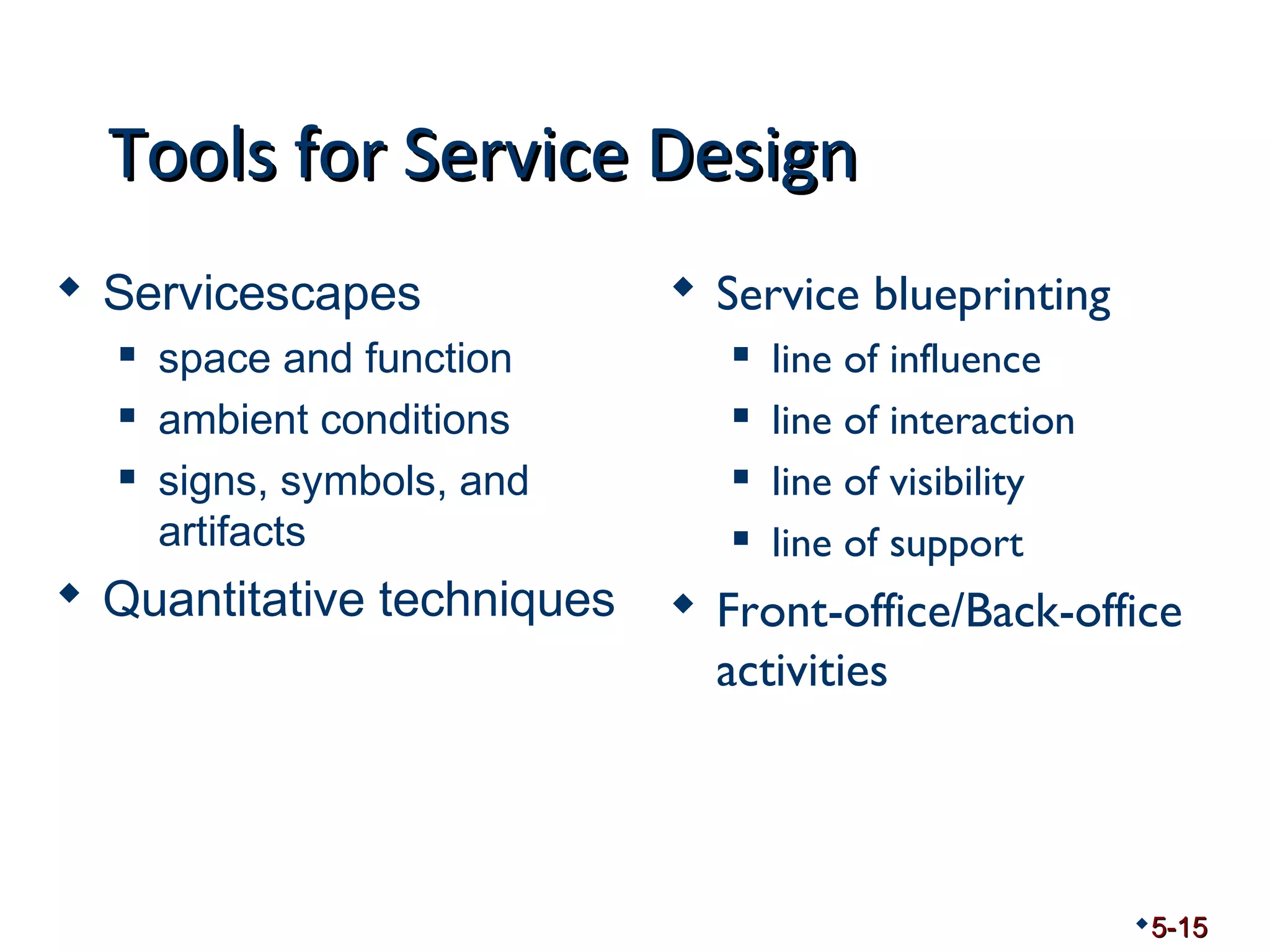
TToooollss ffoorr SSeerrvviiccee DDeessiiggnn 
 Servicescapes 
 space and function 
 ambient conditions 
 signs, symbols, and 
artifacts 
 Quantitative techniques 
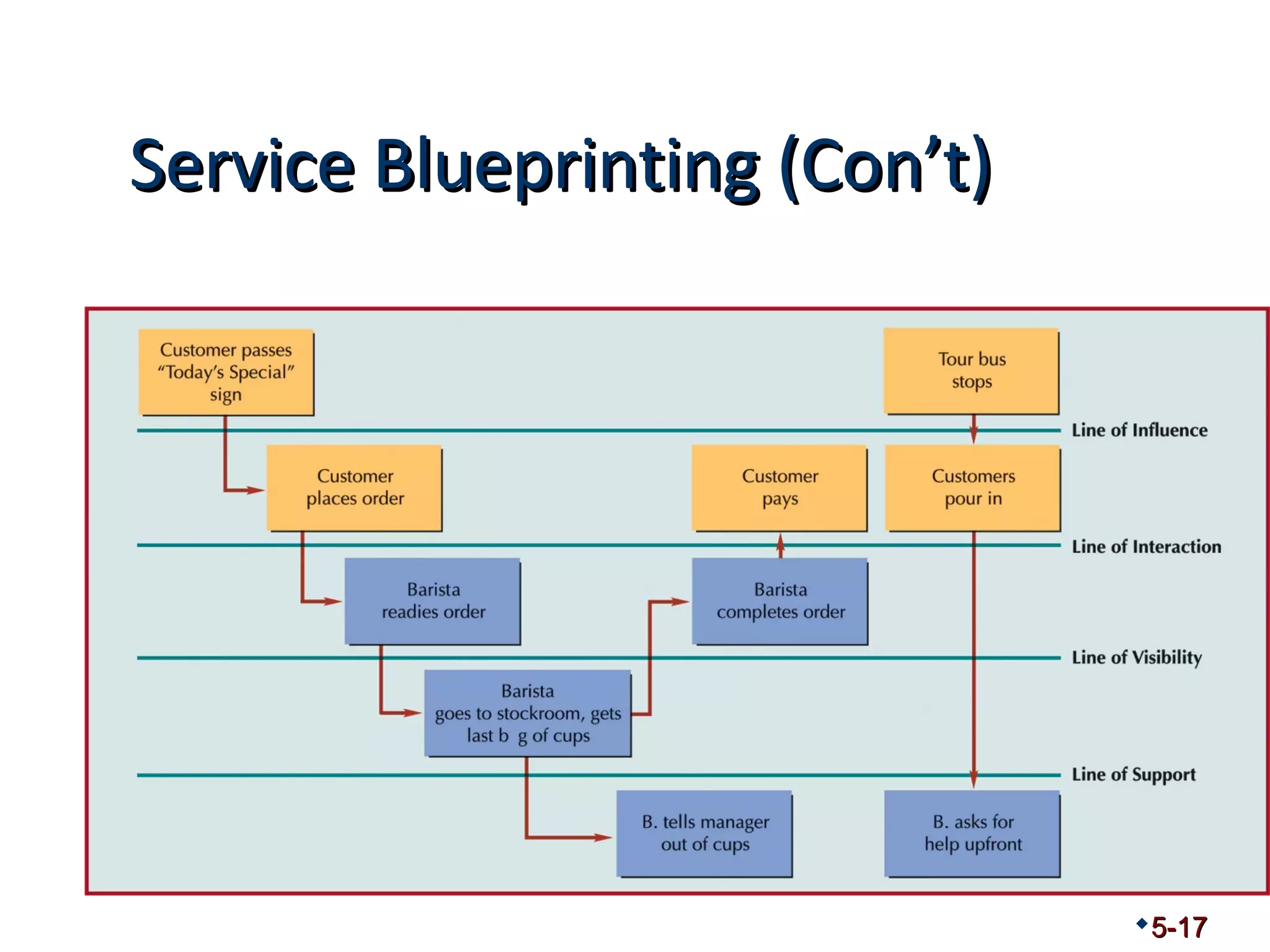
 Service blueprinting 
 line of influence 
 line of interaction 
 line of visibility 
 line of support 
 Front-office/Back-office 
activities 
5-15
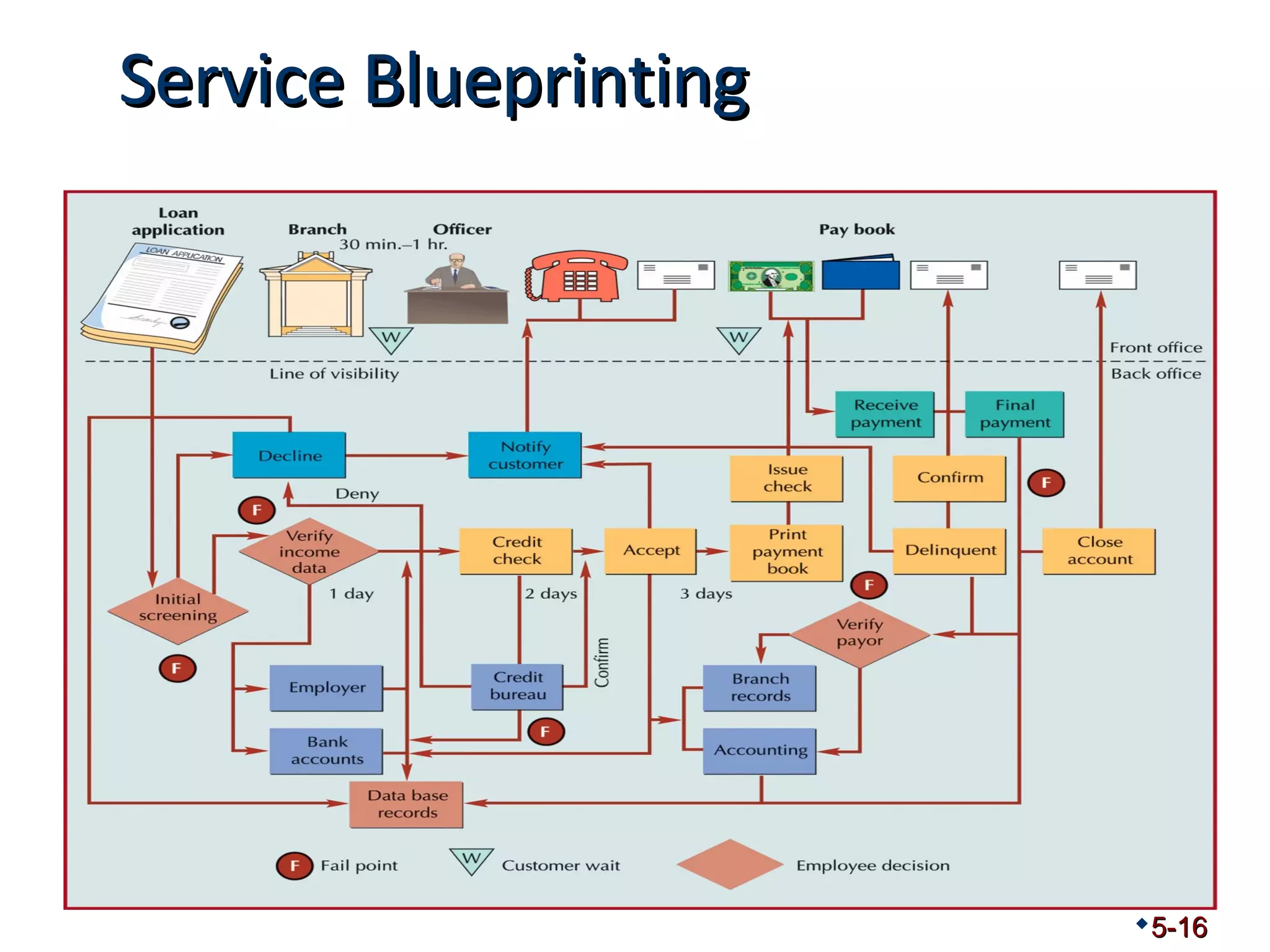
SSeerrvviiccee BBlluueepprriinnttiinngg 
5-16
SSeerrvviiccee BBlluueepprriinnttiinngg ((CCoonn’’tt)) 
5-17
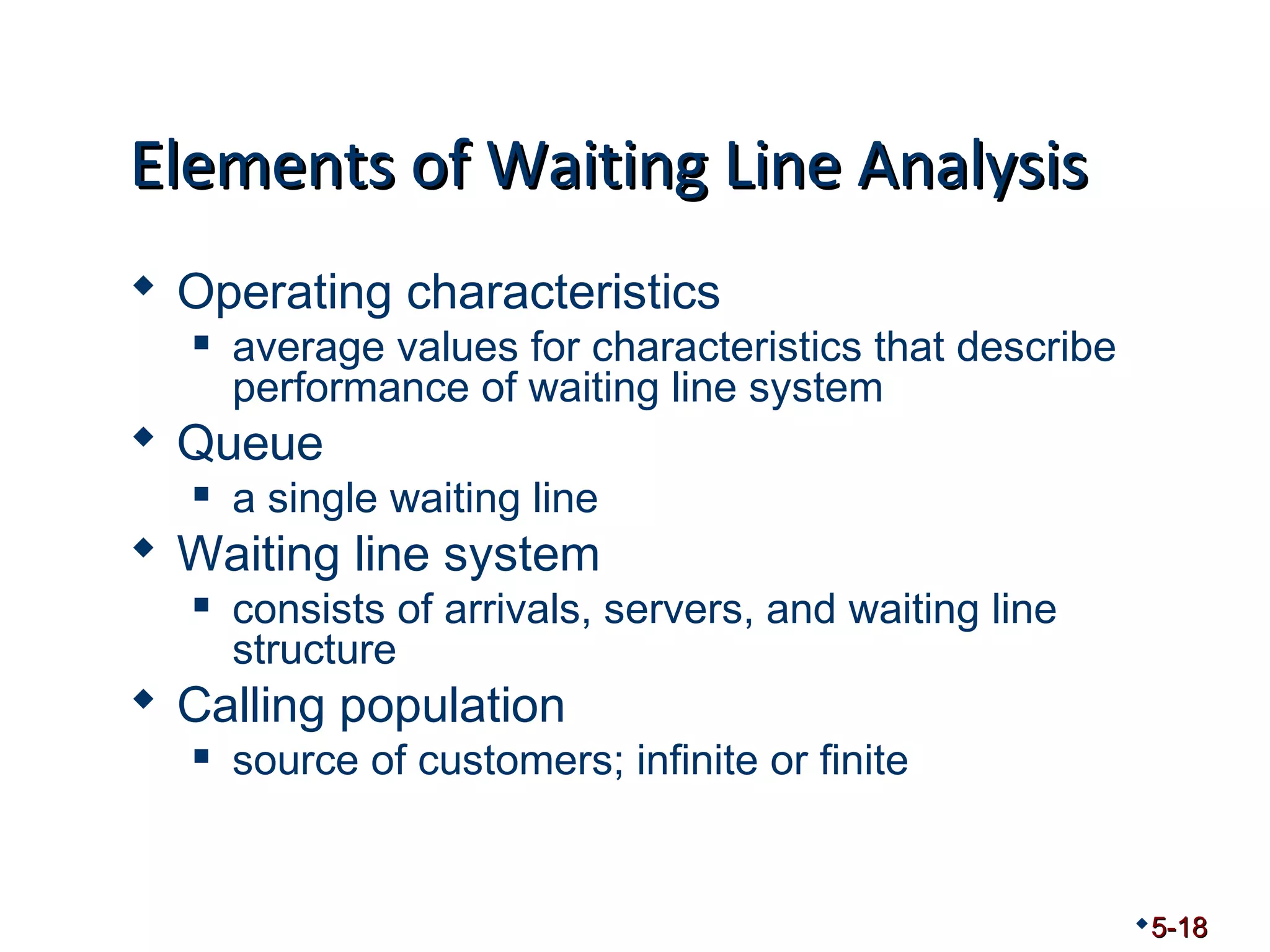
EElleemmeennttss ooff WWaaiittiinngg LLiinnee AAnnaallyyssiiss 
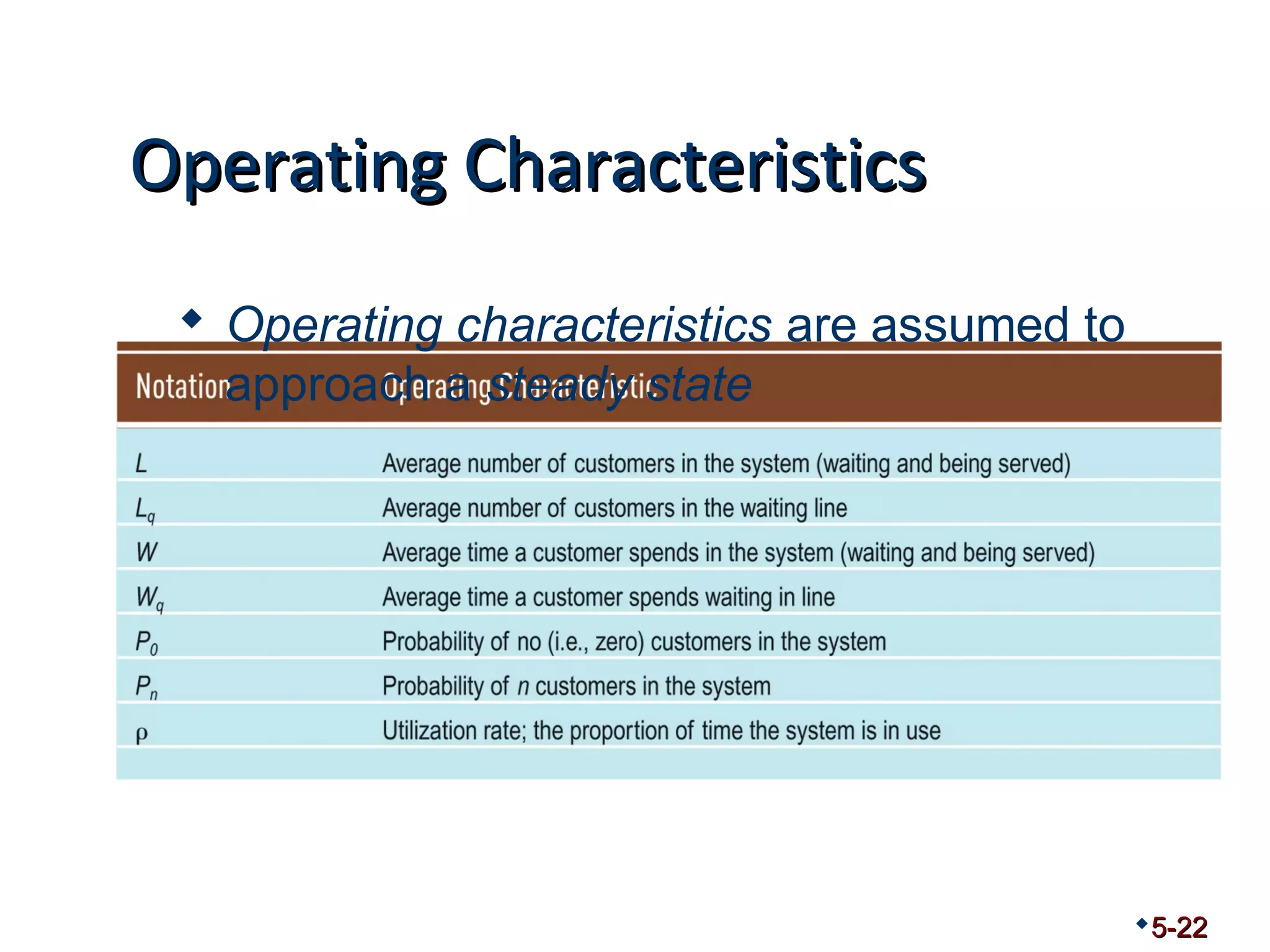
 Operating characteristics 
 average values for characteristics that describe 
performance of waiting line system 
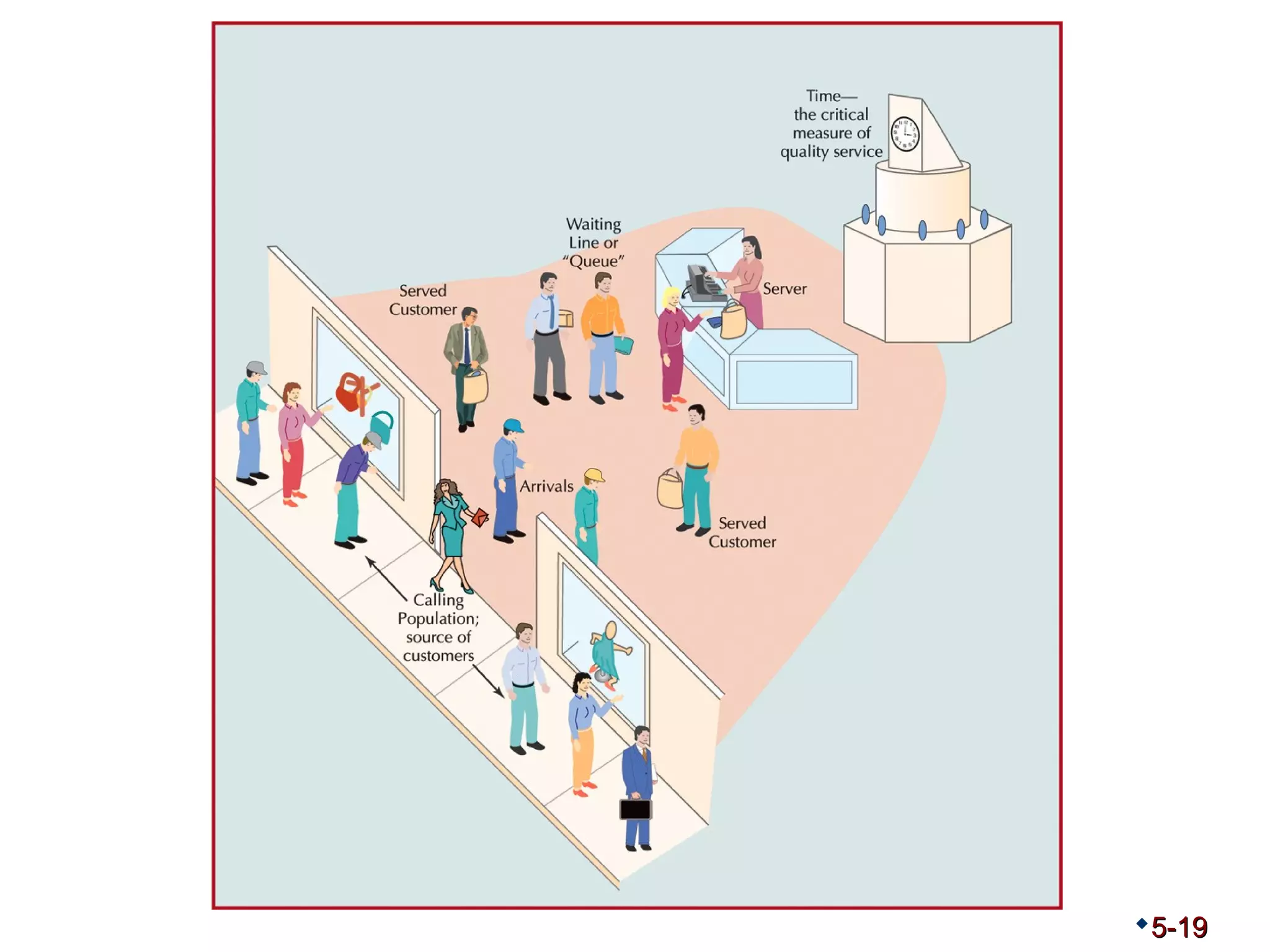
 Queue 
 a single waiting line 
 Waiting line system 
 consists of arrivals, servers, and waiting line 
structure 
 Calling population 
 source of customers; infinite or finite 
5-18
5-19
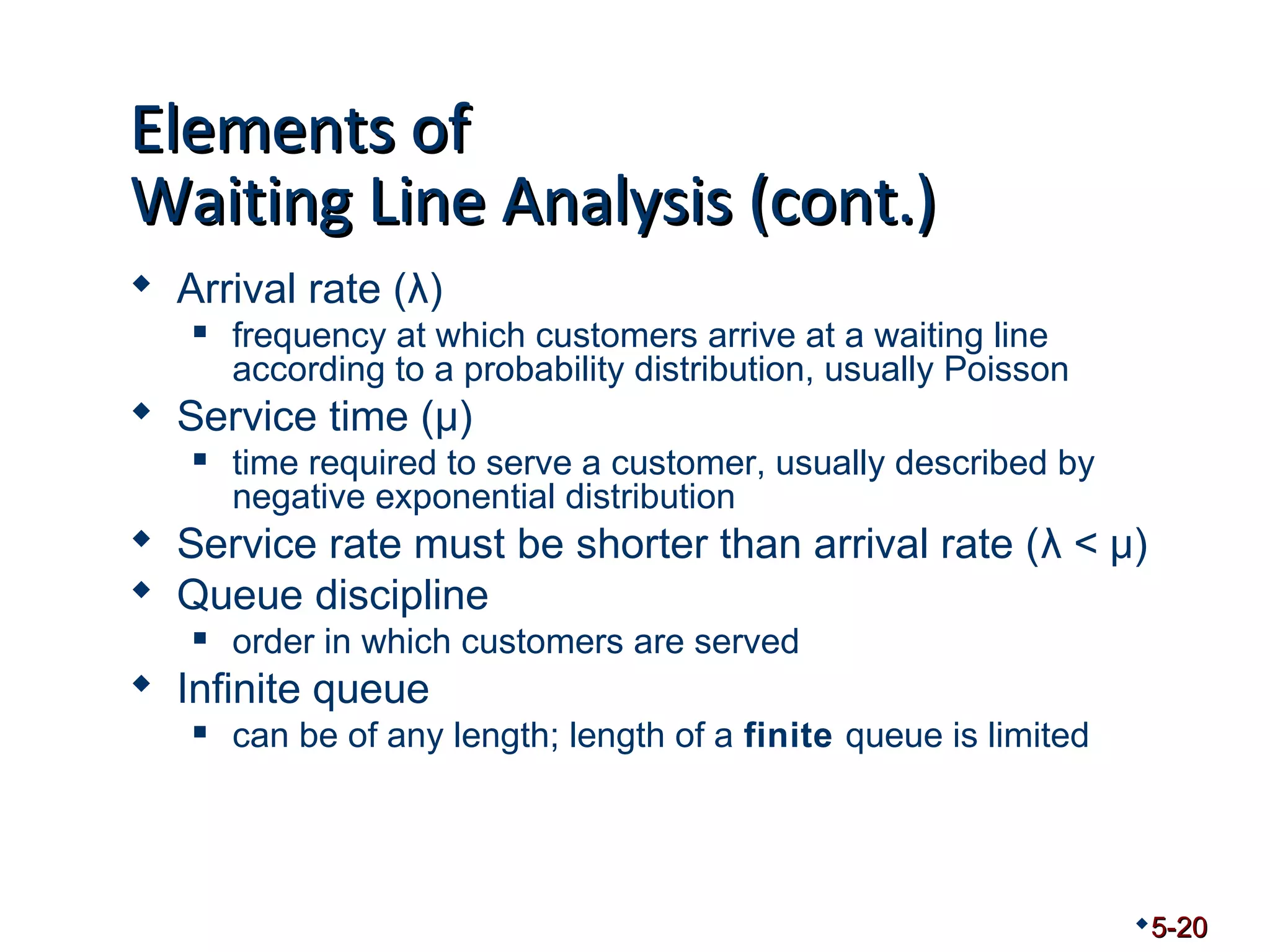
EElleemmeennttss ooff 
WWaaiittiinngg LLiinnee AAnnaallyyssiiss ((ccoonntt..)) 
 Arrival rate (λ) 
 frequency at which customers arrive at a waiting line 
according to a probability distribution, usually Poisson 
 Service time (μ) 
 time required to serve a customer, usually described by 
negative exponential distribution 
 Service rate must be shorter than arrival rate (λ < μ) 
 Queue discipline 
 order in which customers are served 
 Infinite queue 
 can be of any length; length of a finite queue is limited 
5-20
EElleemmeennttss ooff 
WWaaiittiinngg LLiinnee AAnnaallyyssiiss ((ccoonntt..)) 
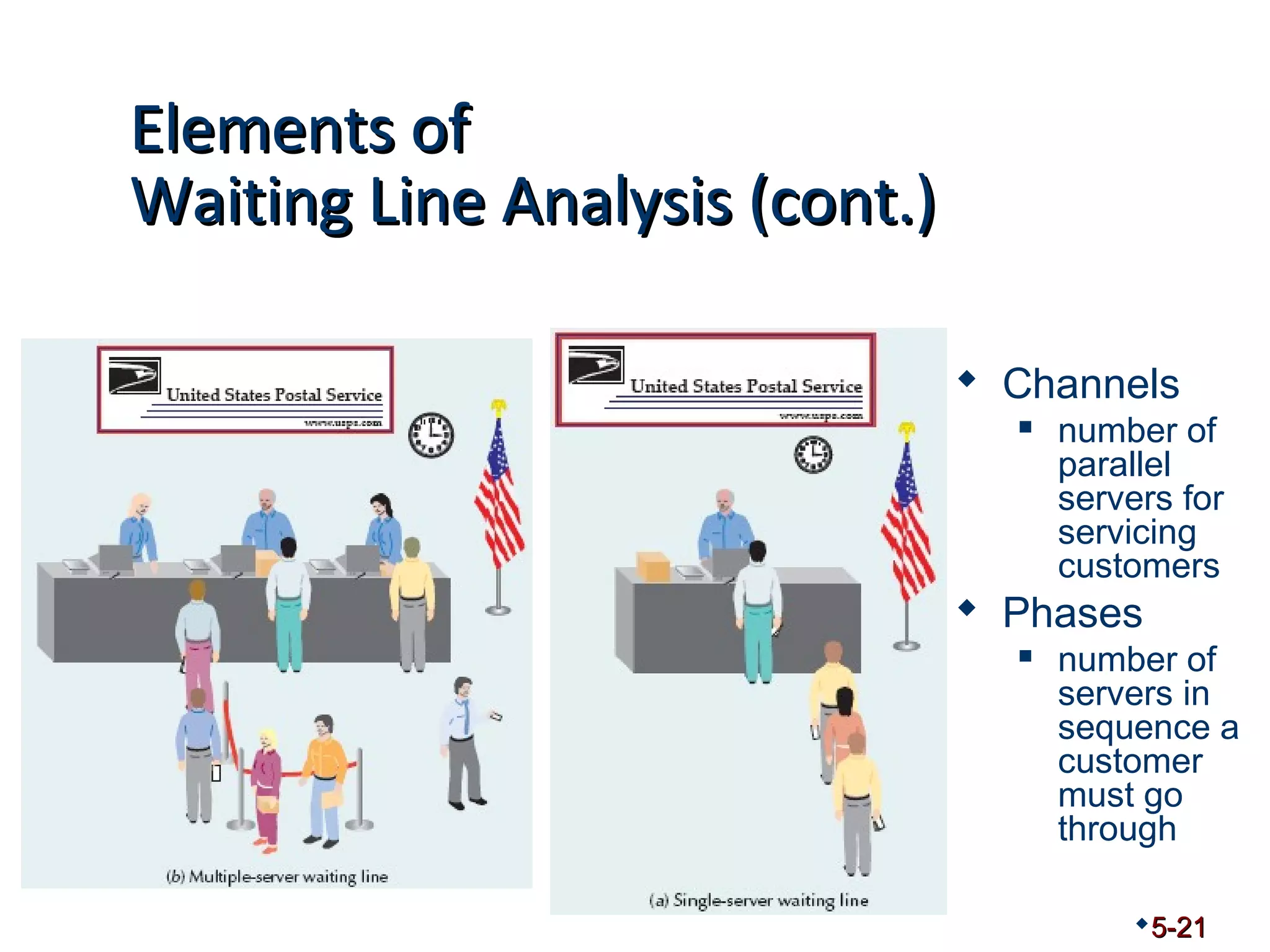
 Channels 
 number of 
parallel 
servers for 
servicing 
customers 
 Phases 
 number of 
servers in 
sequence a 
customer 
must go 
through 
5-21
OOppeerraattiinngg CChhaarraacctteerriissttiiccss 
5-22 
 Operating characteristics are assumed to 
approach a steady state
TTrraaddiittiioonnaall CCoosstt RReellaattiioonnsshhiippss 
5-23 
 as service improves, cost increases
PPssyycchhoollooggyy ooff WWaaiittiinngg 
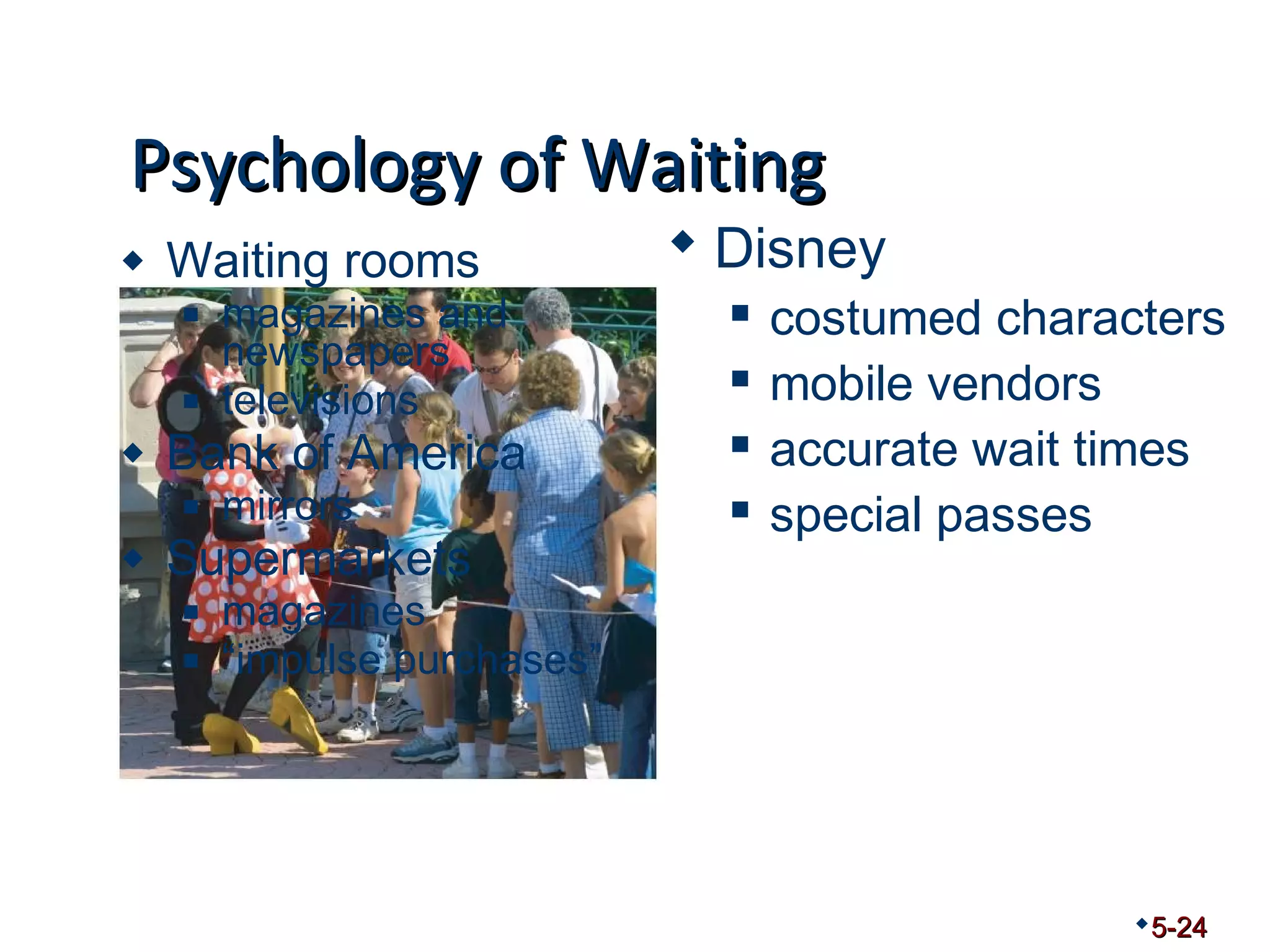
 Waiting rooms 
 magazines and 
newspapers 
 televisions 
 Bank of America 
 mirrors 
 Supermarkets 
 magazines 
 “impulse purchases” 
5-24 
 Disney 
 costumed characters 
 mobile vendors 
 accurate wait times 
 special passes
PPssyycchhoollooggyy ooff WWaaiittiinngg ((ccoonntt..)) 
 Preferential treatment 
 Grocery stores: express lanes for customers with 
few purchases 
 Airlines/car rental agencies: special cards available 
to frequent-users or for an additional fee 
 Phone retailers: route calls to more or less 
experienced salespeople based on customer’s 
sales history 
 Critical service providers 
 services of police department, fire department, etc. 
 waiting is unacceptable; cost is not important 
5-25
WWaaiittiinngg LLiinnee MMooddeellss 
 Single-server model 
 simplest, most basic waiting line structure 
 Frequent variations (all with Poisson arrival 
rate) 
 exponential service times 
 general (unknown) distribution of service times 
 constant service times 
 exponential service times with finite queue 
 exponential service times with finite calling 
population 
5-26
BBaassiicc SSiinnggllee--SSeerrvveerr MMooddeell 
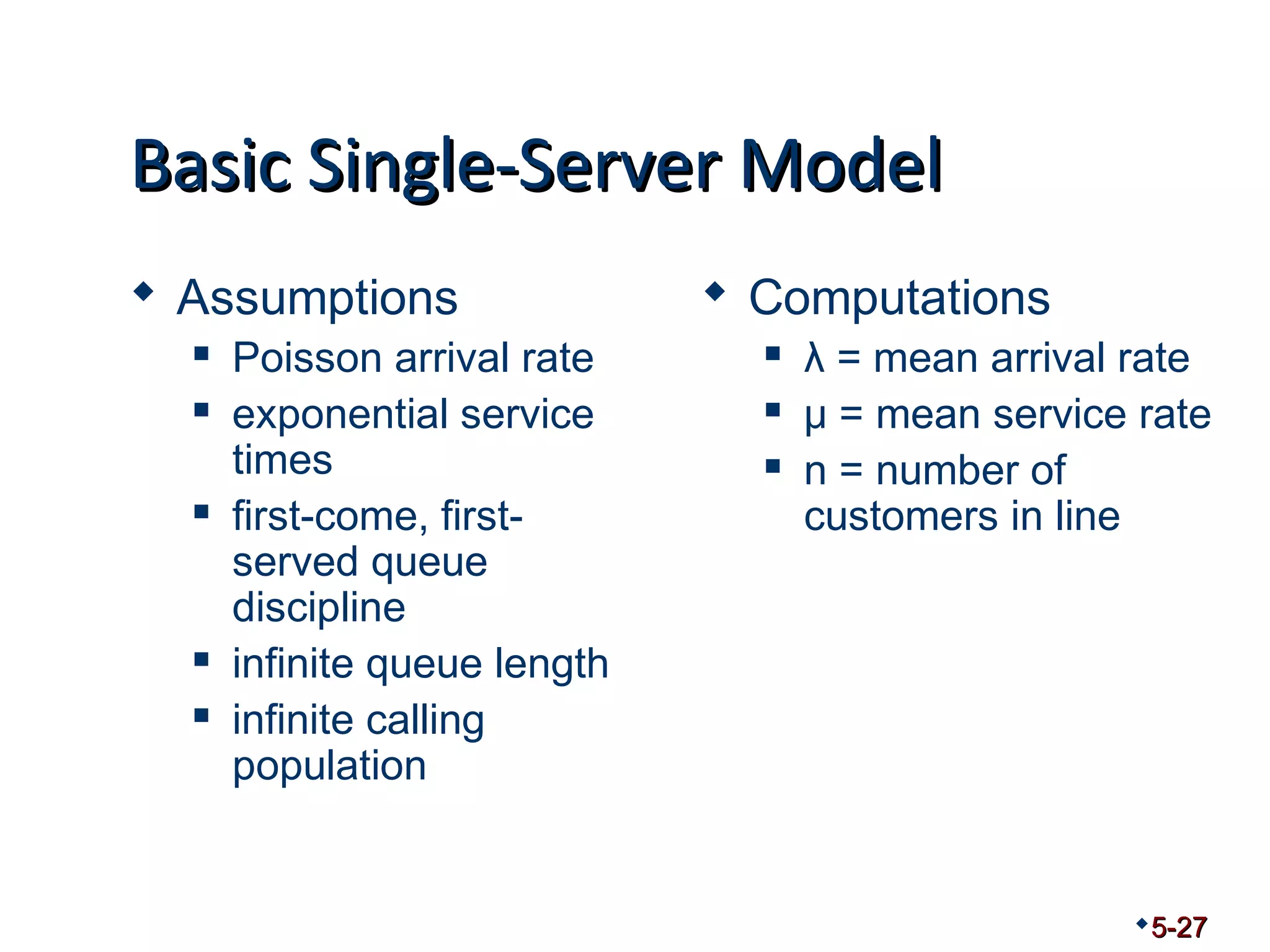
 Assumptions 
 Poisson arrival rate 
 exponential service 
times 
 first-come, first-served 
queue 
discipline 
 infinite queue length 
 infinite calling 
population 
 Computations 
 λ = mean arrival rate 
 μ = mean service rate 
 n = number of 
customers in line 
5-27
BBaassiicc SSiinnggllee--SSeerrvveerr MMooddeell ((ccoonntt..)) 
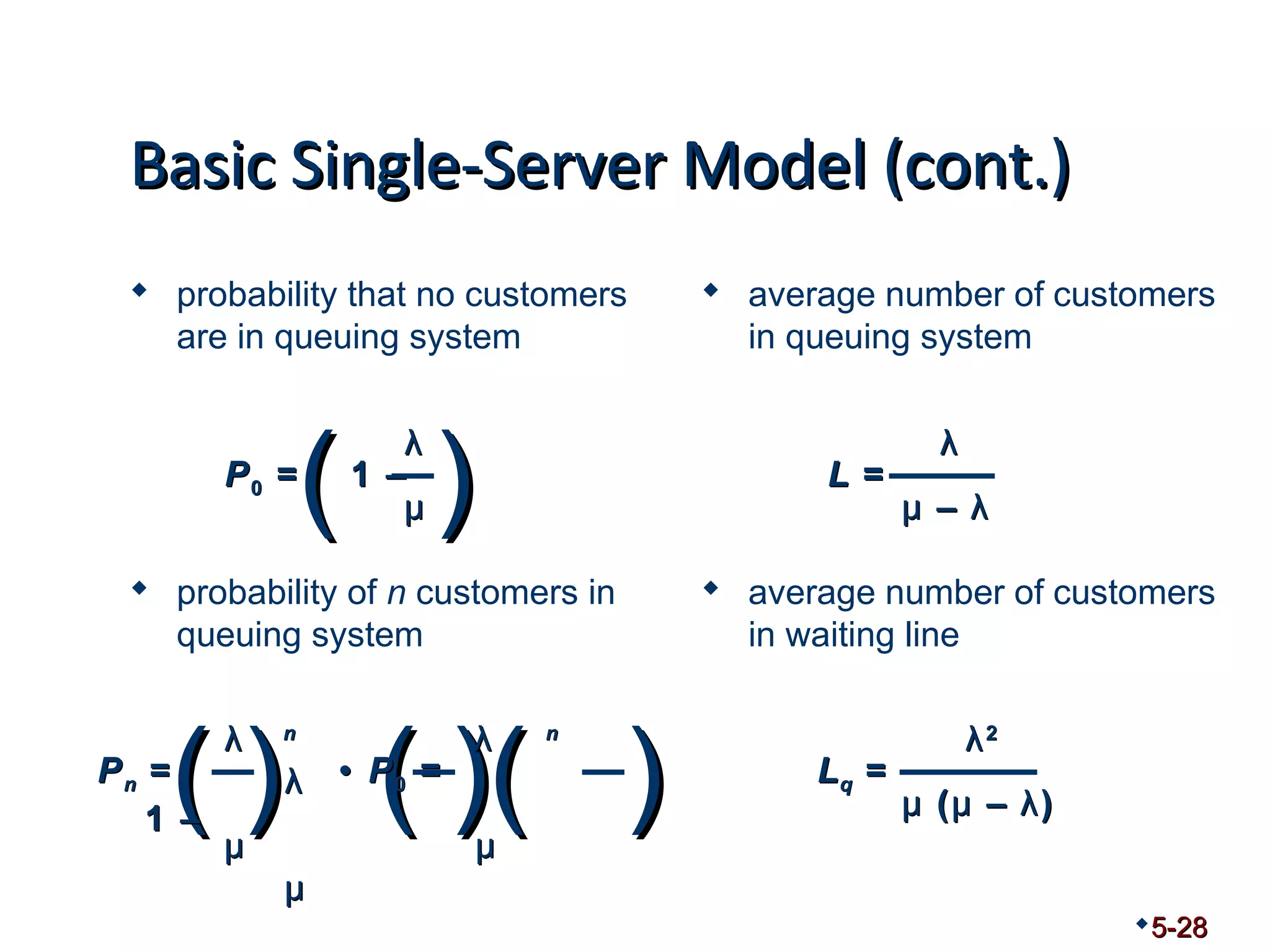
 probability that no customers 
are in queuing system 
 probability of n customers in 
queuing system 
 average number of customers 
in queuing system 
 average number of customers 
in waiting line 
5-28 
λλ 
P = 1 –– 
0 ( ) μμ 
( λλ ) n λλ n 
P = n λλ 
∙∙ P( = 
0 )( ) 1 –– 
μμ μμ 
μμ 
L = 
λλ 
μμ –– λλ 
Lq = 
λλ2 
μμ (μμ –– λλ)
BBaassiicc SSiinnggllee--SSeerrvveerr MMooddeell ((ccoonntt..)) 
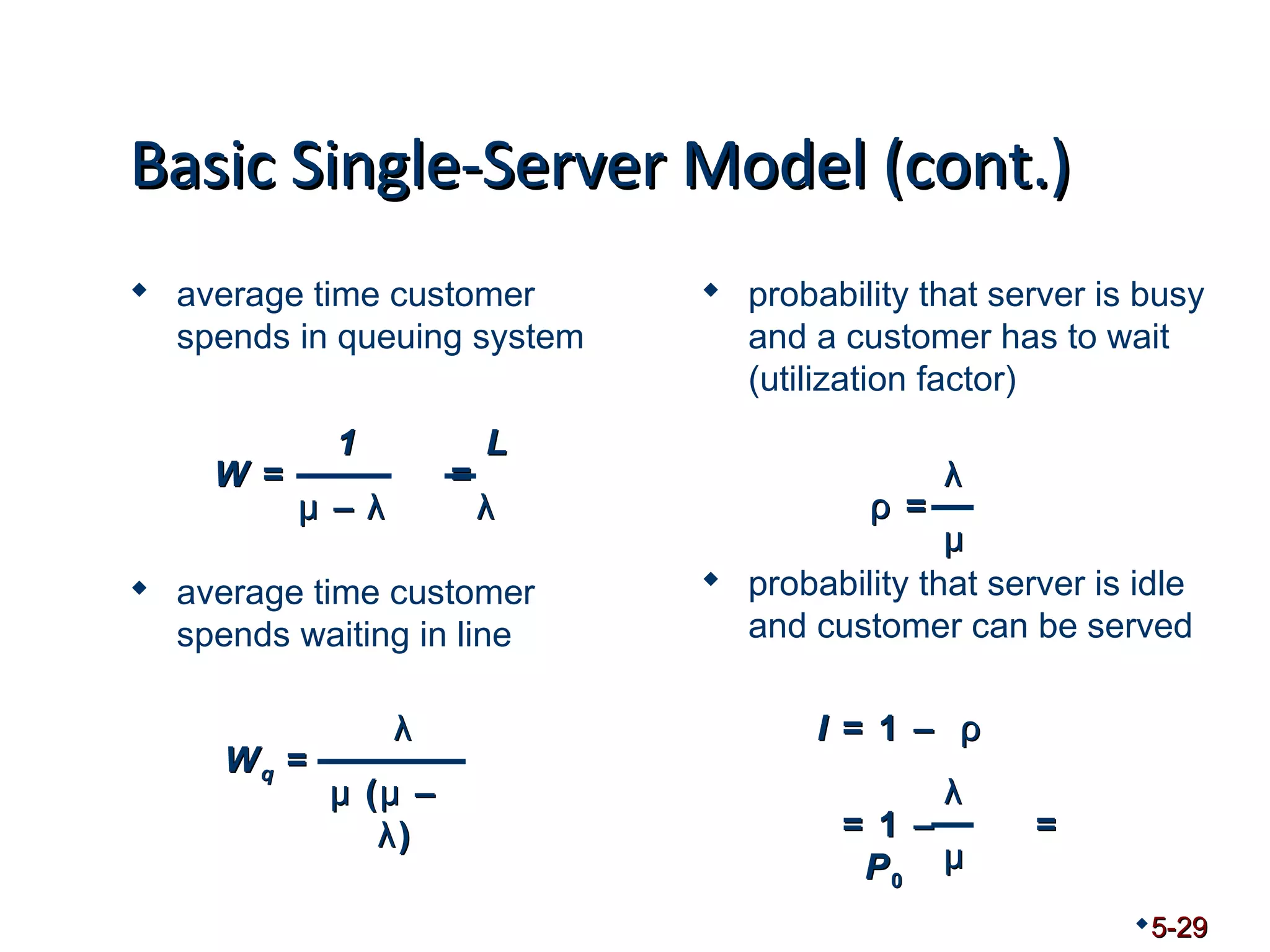
 average time customer 
spends in queuing system 
 average time customer 
spends waiting in line 
 probability that server is busy 
and a customer has to wait 
(utilization factor) 
 probability that server is idle 
and customer can be served 
5-29 
1 L 
μμ –– λλ λλ 
W = = 
λλ 
μμ (μμ –– 
λλ ) 
Wq = 
λλ 
μμ 
ρρ = 
I = 1 –– ρρ 
λλ 
μμ 
= 1 –– = 
P0
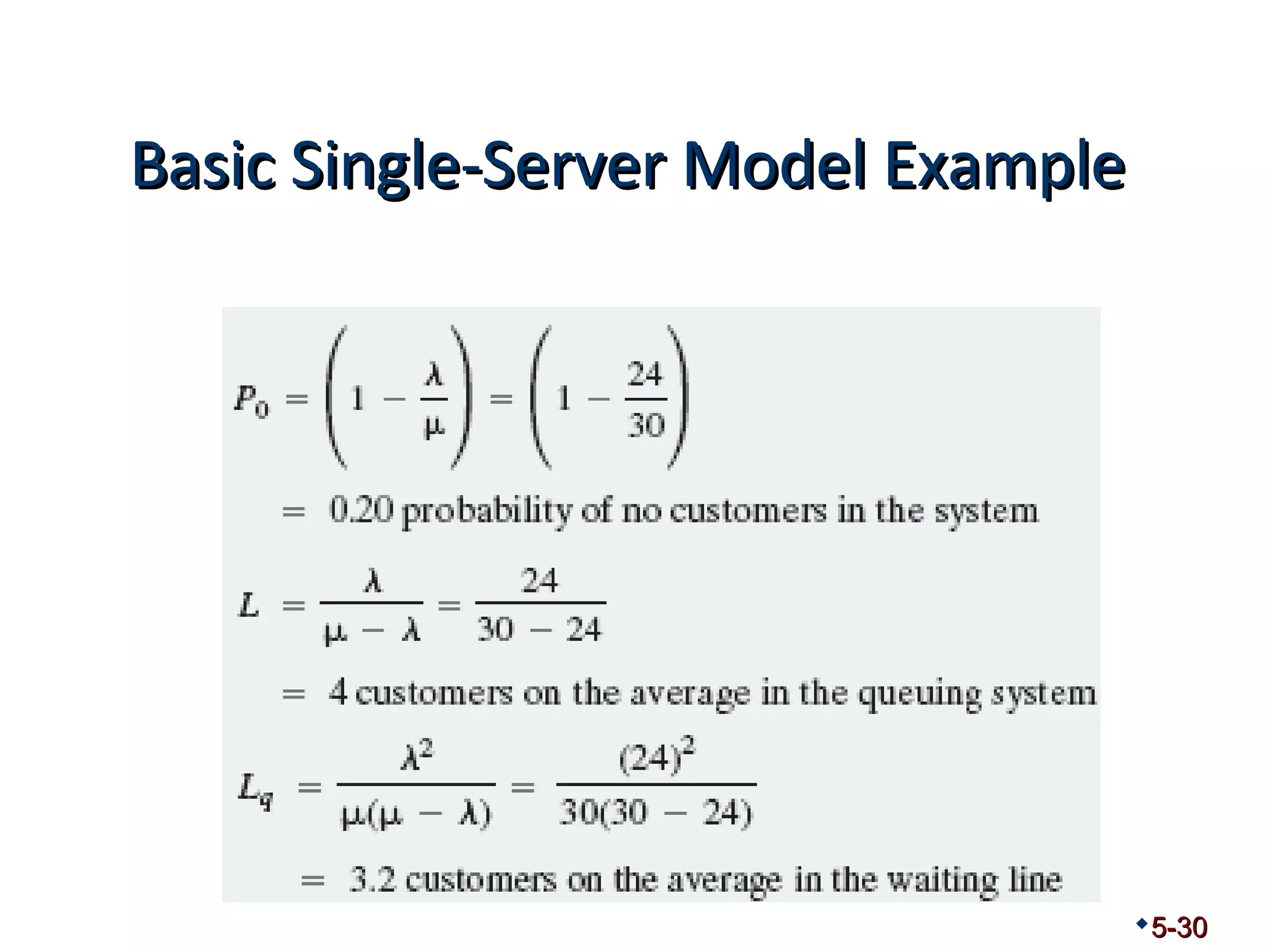
BBaassiicc SSiinnggllee--SSeerrvveerr MMooddeell EExxaammppllee 
5-30
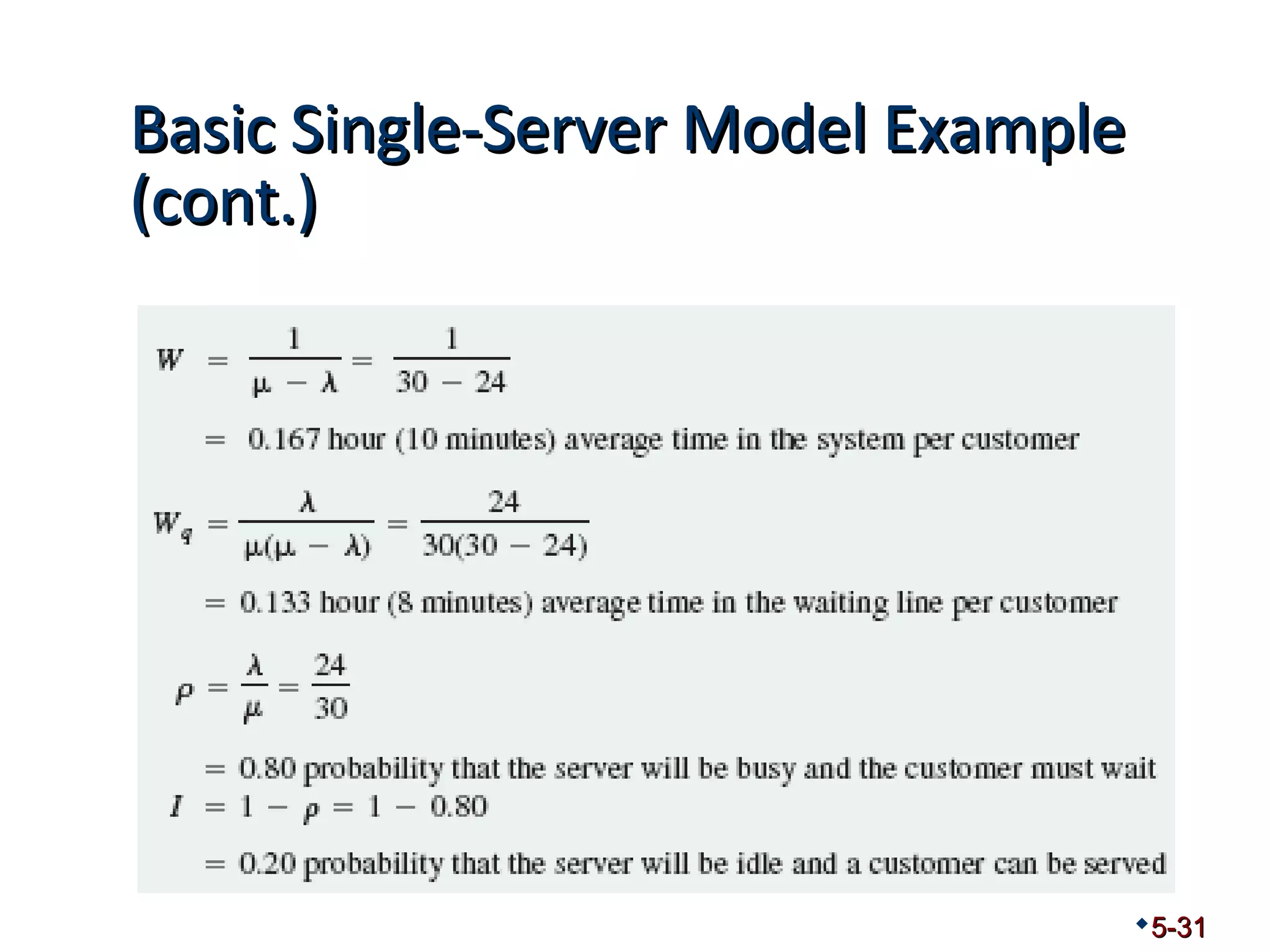
BBaassiicc SSiinnggllee--SSeerrvveerr MMooddeell EExxaammppllee 
((ccoonntt..)) 
5-31
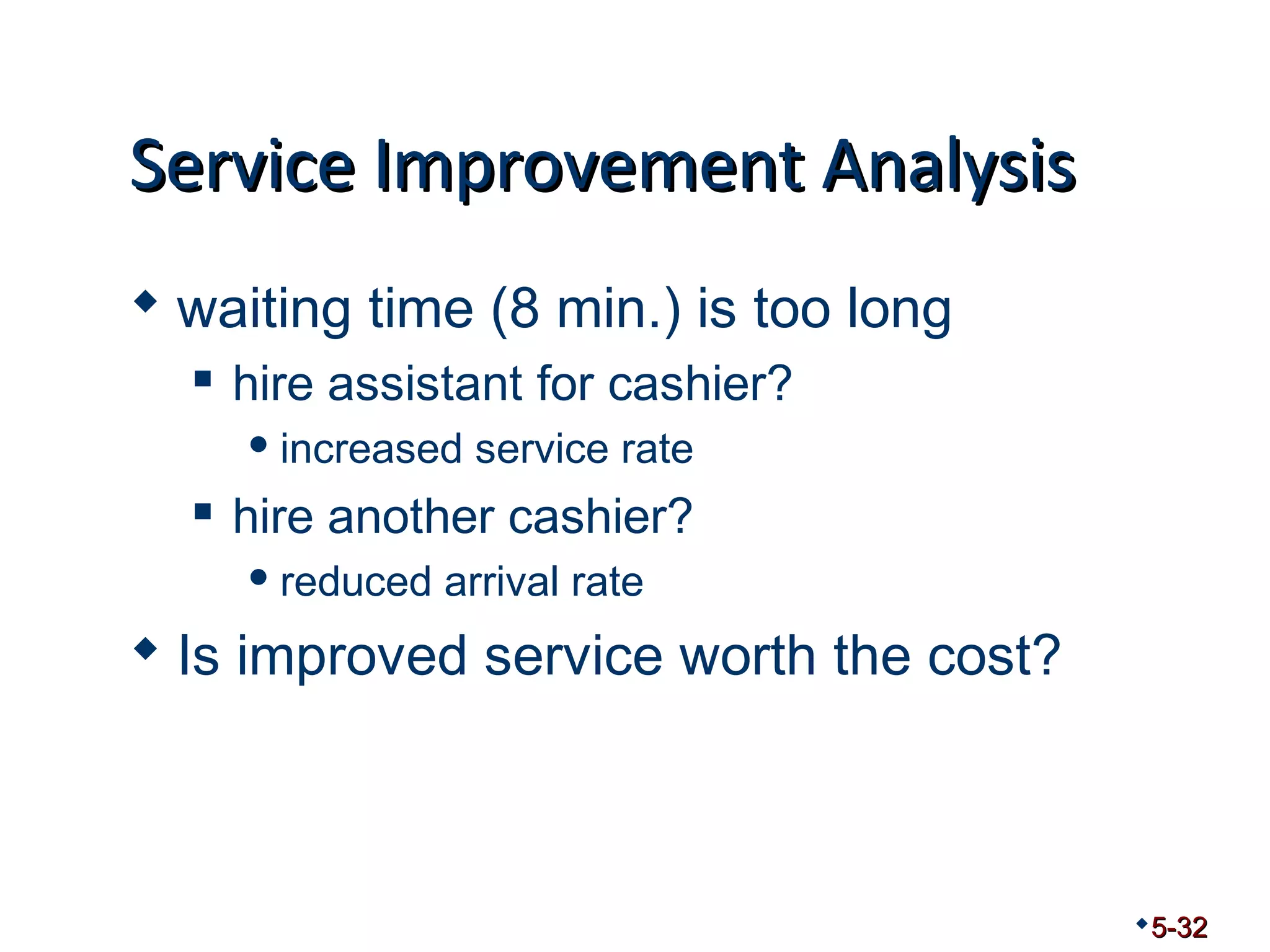
SSeerrvviiccee IImmpprroovveemmeenntt AAnnaallyyssiiss 
 waiting time (8 min.) is too long 
 hire assistant for cashier? 
increased service rate 
 hire another cashier? 
reduced arrival rate 
 Is improved service worth the cost? 
5-32
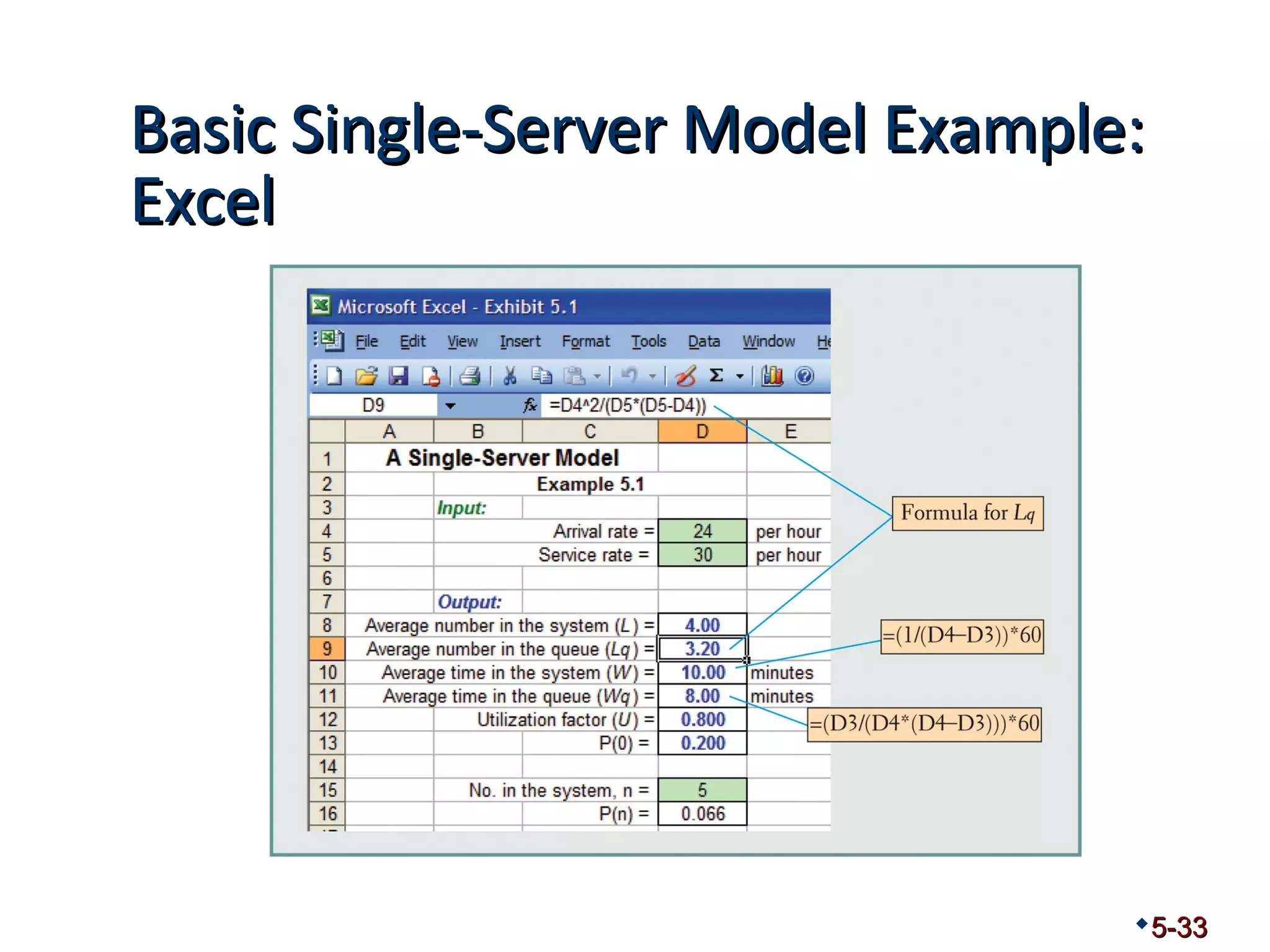
Basic SSiinnggllee--SSeerrvveerr MMooddeell EExxaammppllee:: 
EExxcceell 
5-33
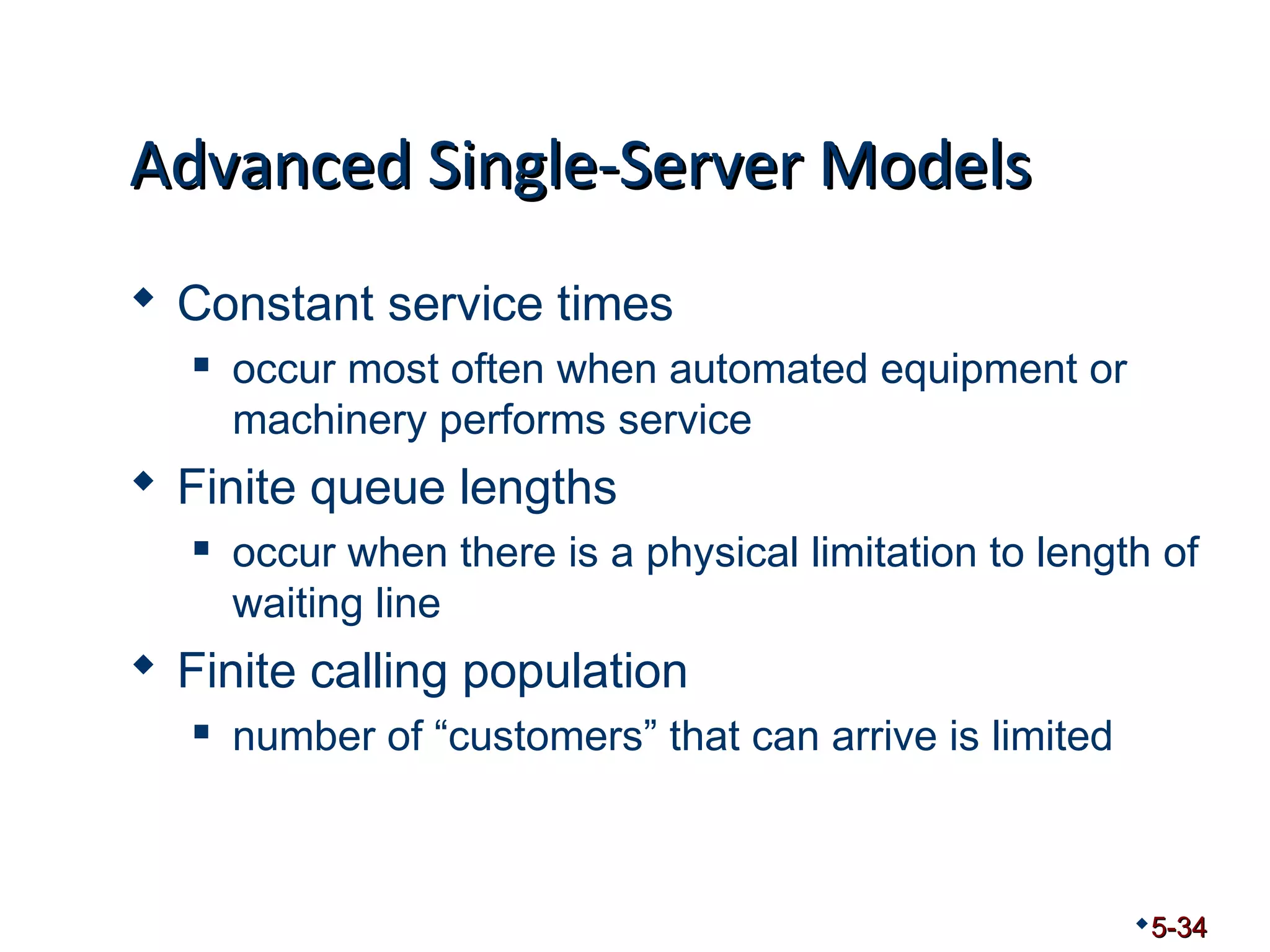
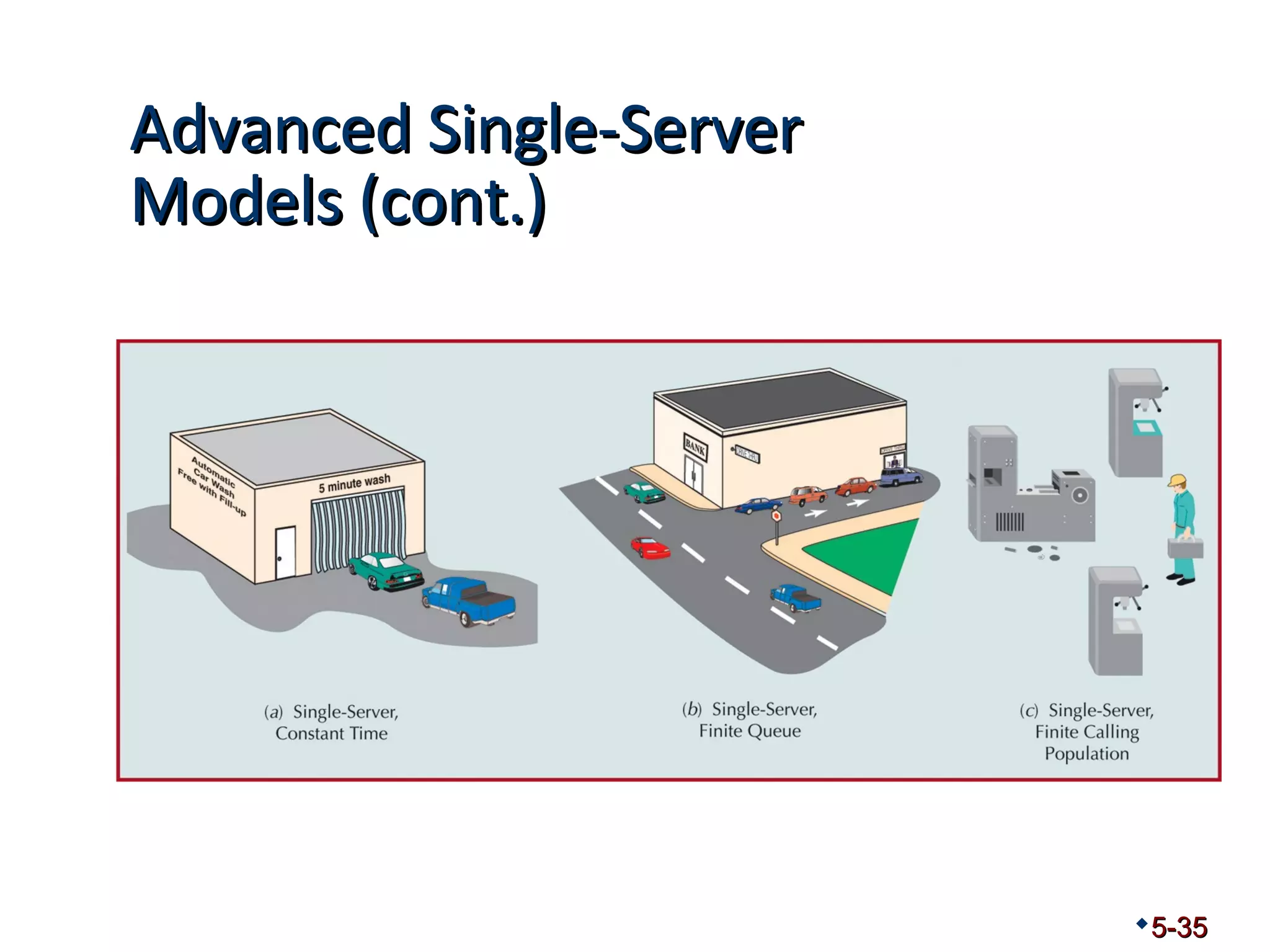
AAddvvaanncceedd SSiinnggllee--SSeerrvveerr MMooddeellss 
 Constant service times 
 occur most often when automated equipment or 
machinery performs service 
 Finite queue lengths 
 occur when there is a physical limitation to length of 
waiting line 
 Finite calling population 
 number of “customers” that can arrive is limited 
5-34
AAddvvaanncceedd SSiinnggllee--SSeerrvveerr 
MMooddeellss ((ccoonntt..)) 
5-35
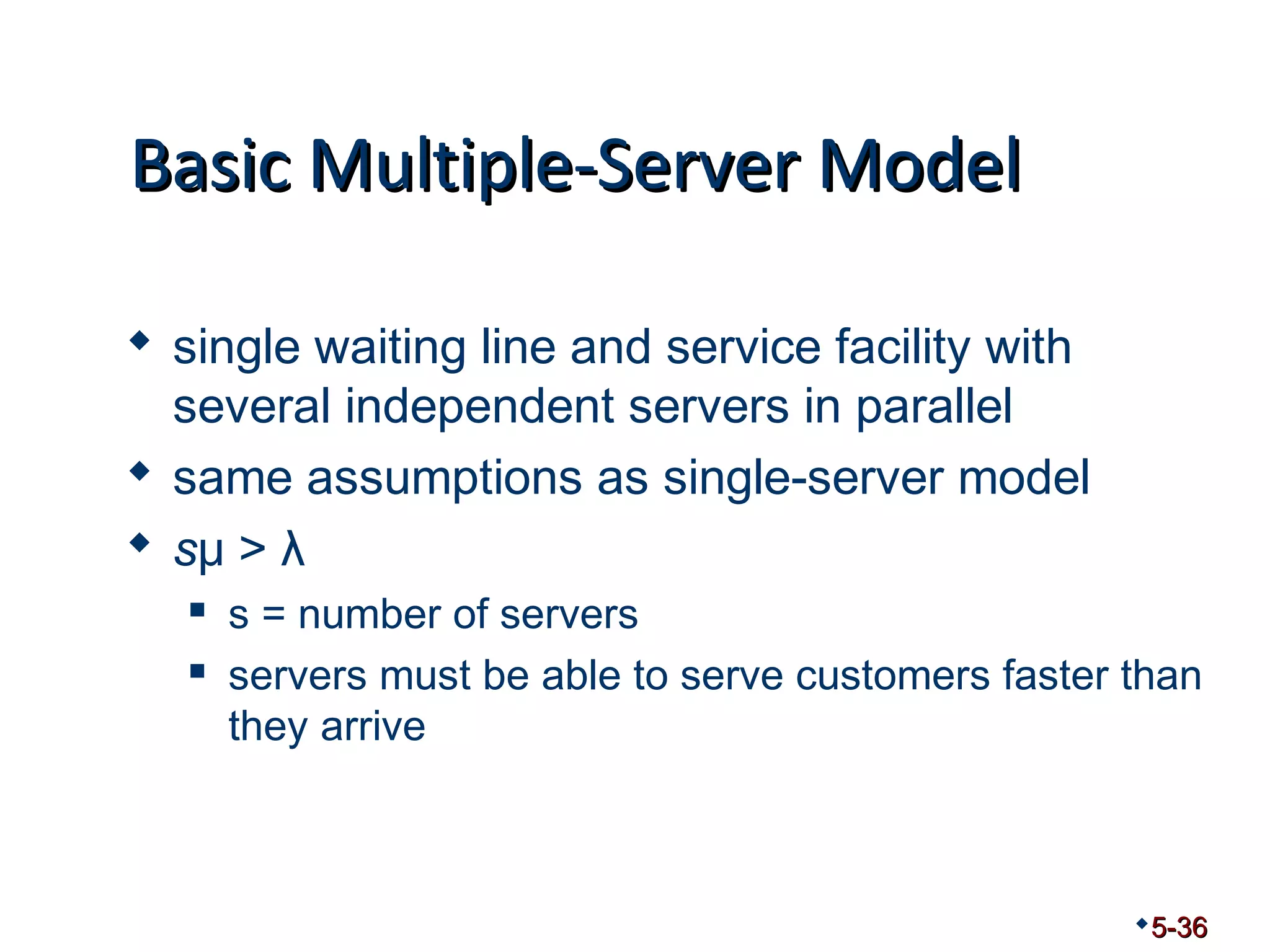
BBaassiicc MMuullttiippllee--SSeerrvveerr MMooddeell 
 single waiting line and service facility with 
several independent servers in parallel 
 same assumptions as single-server model 
 sμ > λ 
 s = number of servers 
 servers must be able to serve customers faster than 
they arrive 
5-36
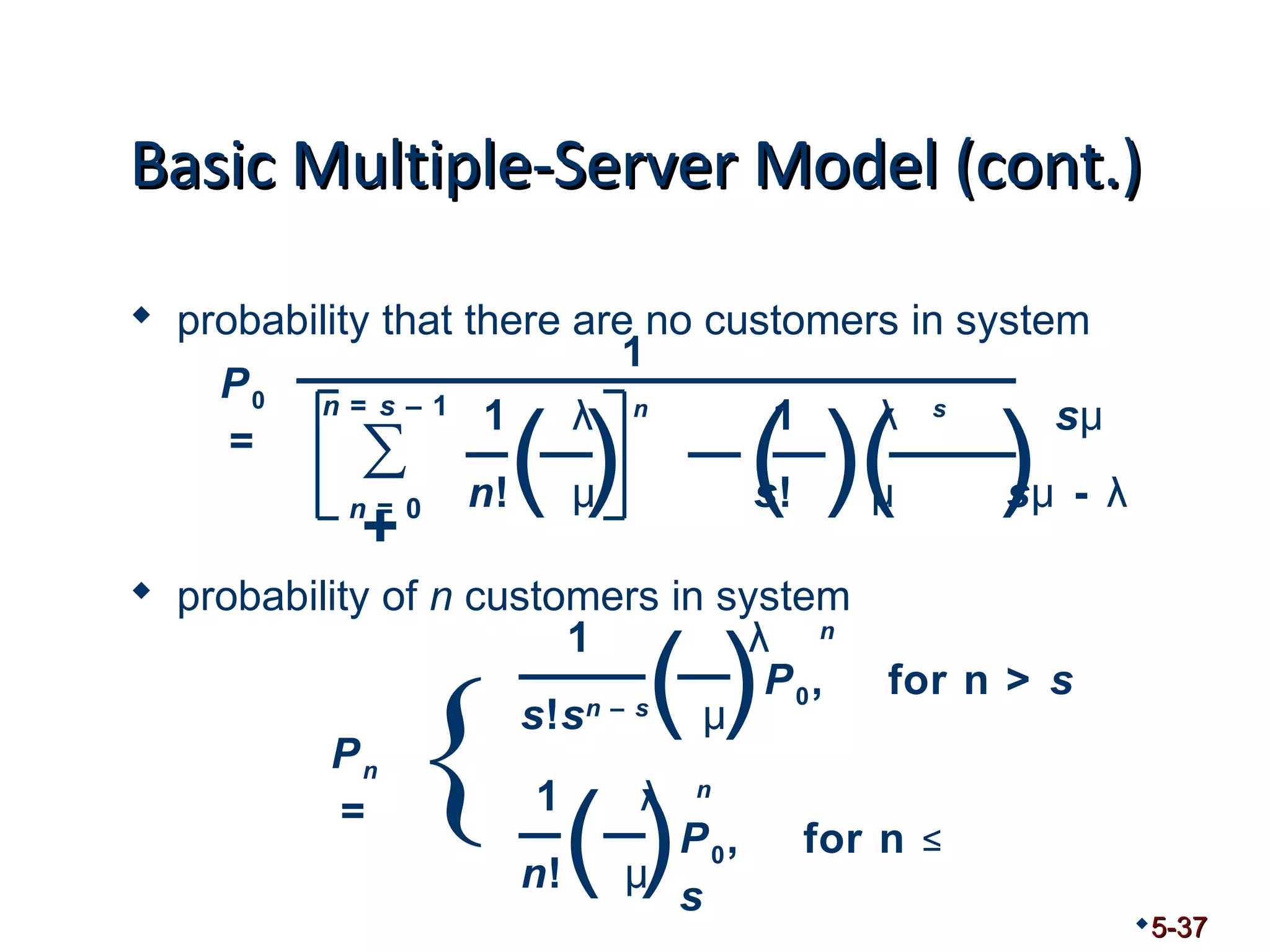
BBaassiicc MMuullttiippllee--SSeerrvveerr MMooddeell ((ccoonntt..)) 
 probability that there are no customers in system 
1 λ n 1 λ s sμ 
n! μ s! μ sμ - λ ( ) ( )( ) n = s – 1 
n = 0 
 probability of n customers in system 
5-37 
1 λ n 
s!sn – s μ 
1 λ n 
n! μ ( ) { ( )P0, for n > s 
P0, for n ≤ 
s 
Pn 
= 
1 
P0 
= Σ+
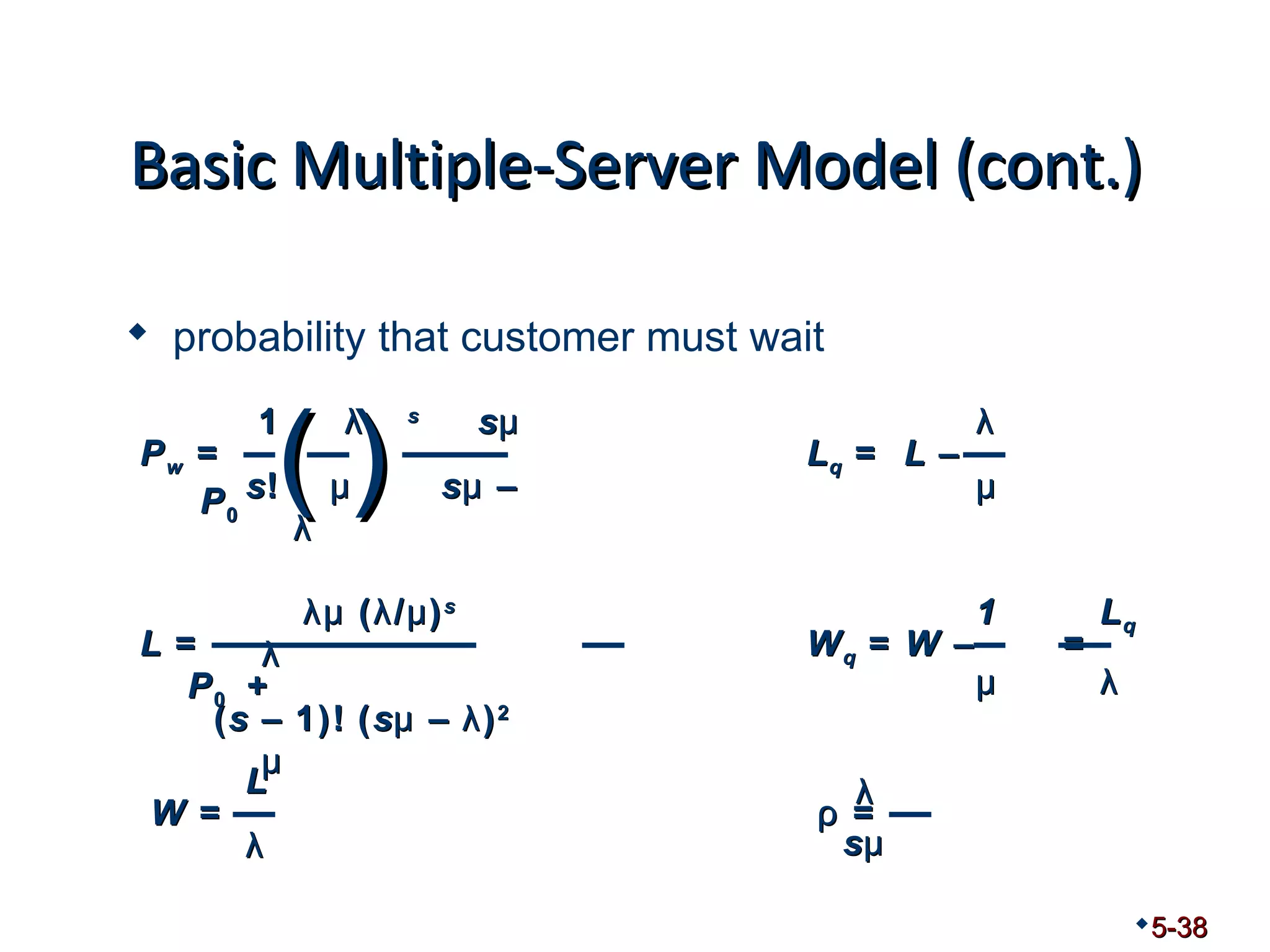
BBaassiicc MMuullttiippllee--SSeerrvveerr MMooddeell ((ccoonntt..)) 
 probability that customer must wait 
5-38 
( ) 1 λλ s sμμ 
s! μμ sμμ –– 
λλ 
Pw = 
P0 
λλμμ (λλ/μμ)s 
λλ 
(s –– 1)! (sμμ –– λλ)2 
μμ 
L = 
P0 + 
L 
λλ 
W = 
Lq = L –– 
λλ 
μμ 
1 Lq 
μμ λλ 
Wq = W –– = 
ρρ =λλ 
sμμ
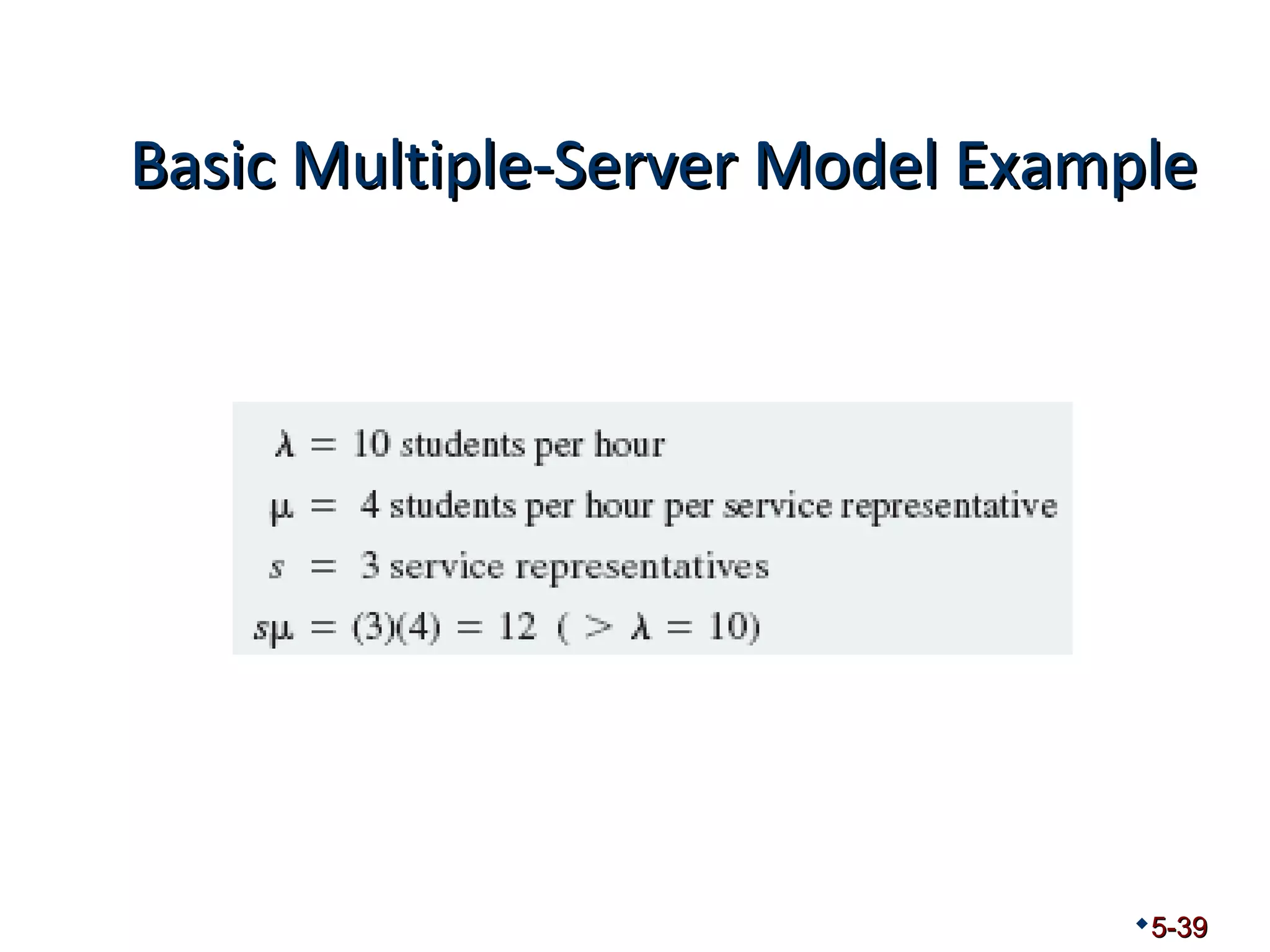
Basic MMuullttiippllee--SSeerrvveerr MMooddeell EExxaammppllee 
5-39
Basic MMuullttiippllee--SSeerrvveerr MMooddeell EExxaammppllee 
((ccoonntt..)) 
5-40
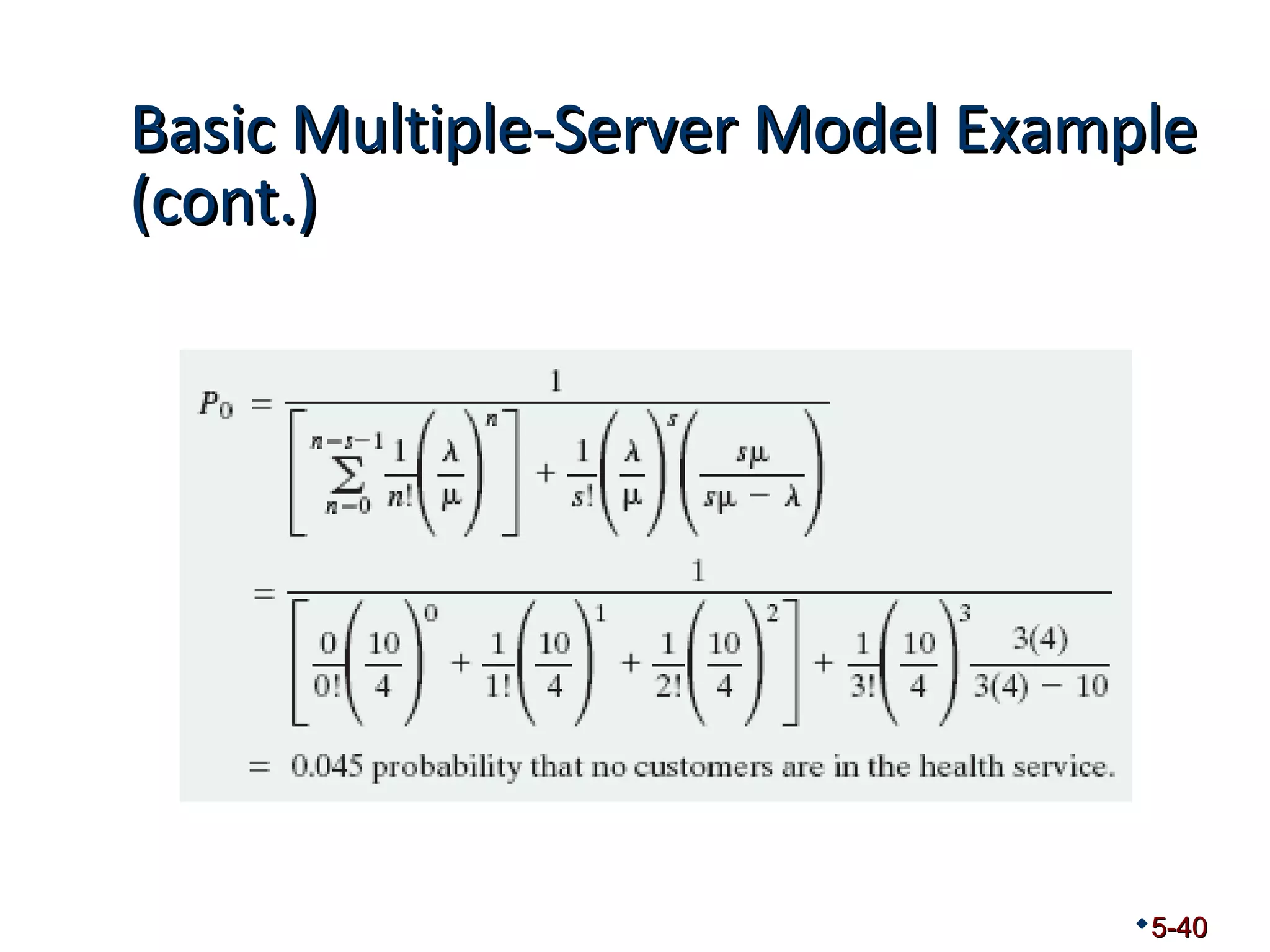
Basic MMuullttiippllee--SSeerrvveerr MMooddeell EExxaammppllee 
((ccoonntt..)) 
5-41
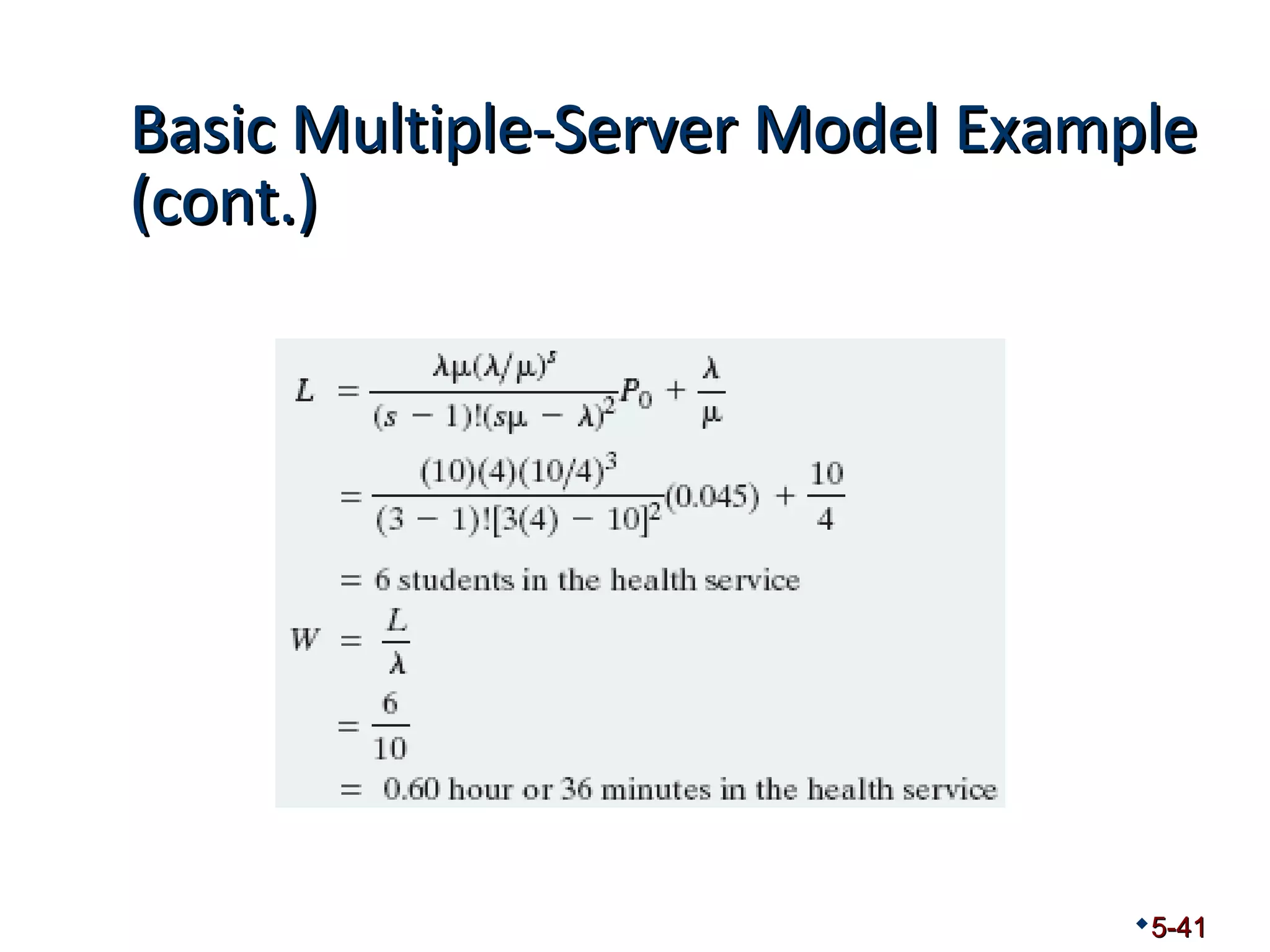
Basic MMuullttiippllee--SSeerrvveerr MMooddeell EExxaammppllee 
((ccoonntt..)) 
5-42
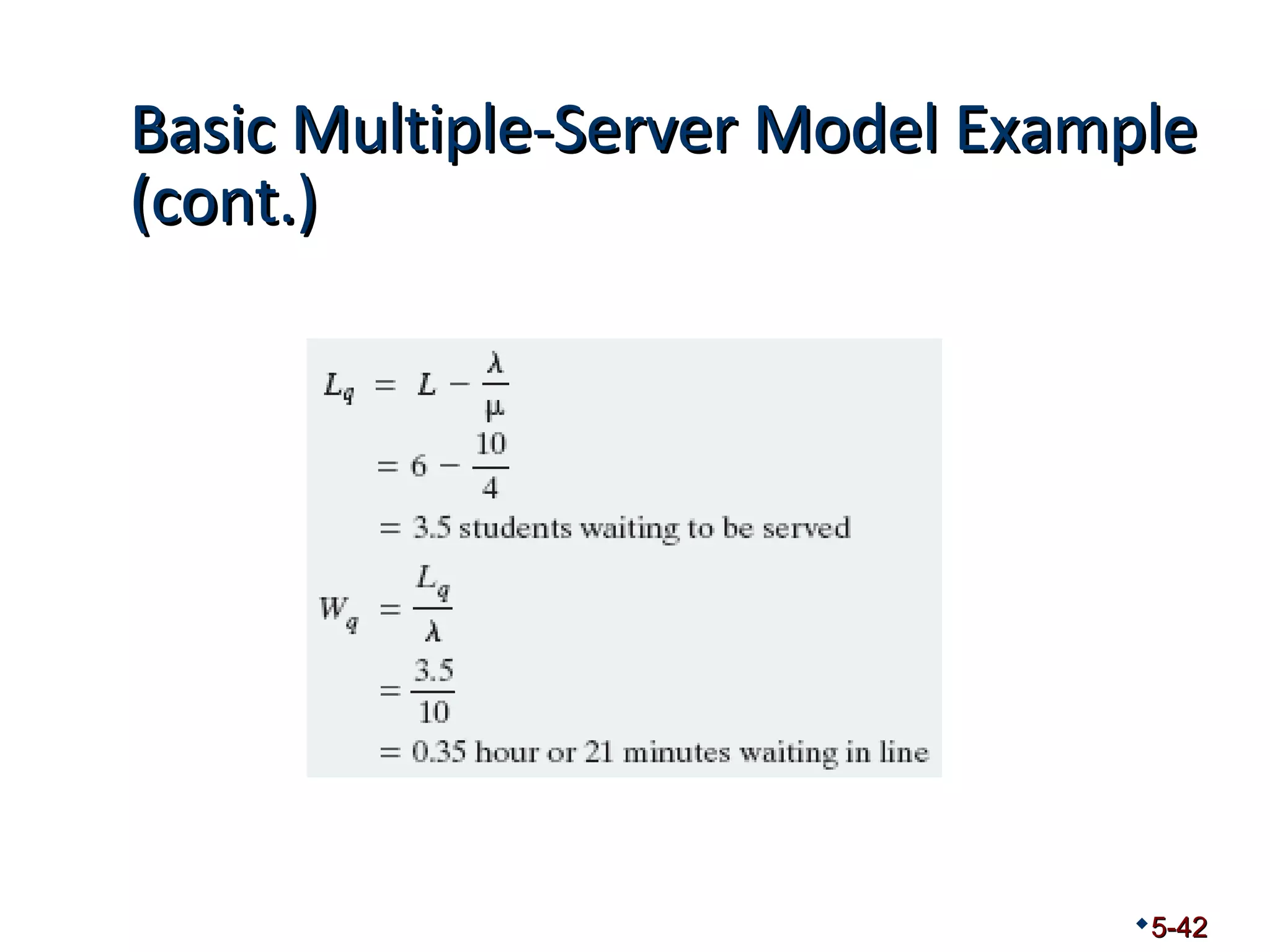
Basic MMuullttiippllee--SSeerrvveerr MMooddeell EExxaammppllee 
((ccoonntt..)) 
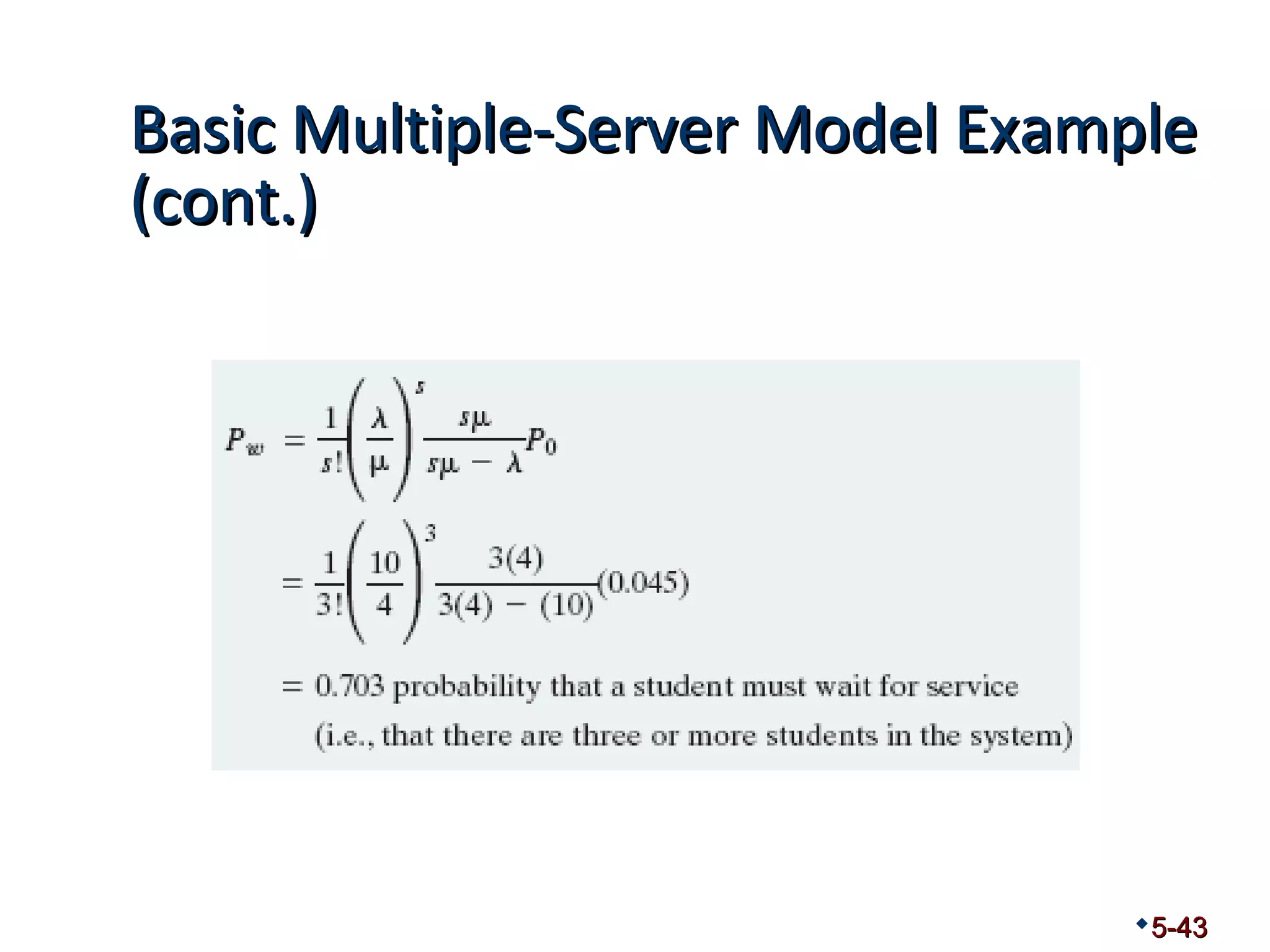
5-43
BBaassiicc MMuullttiippllee--SSeerrvveerr MMooddeell 
EExxaammppllee ((ccoonntt..)) 
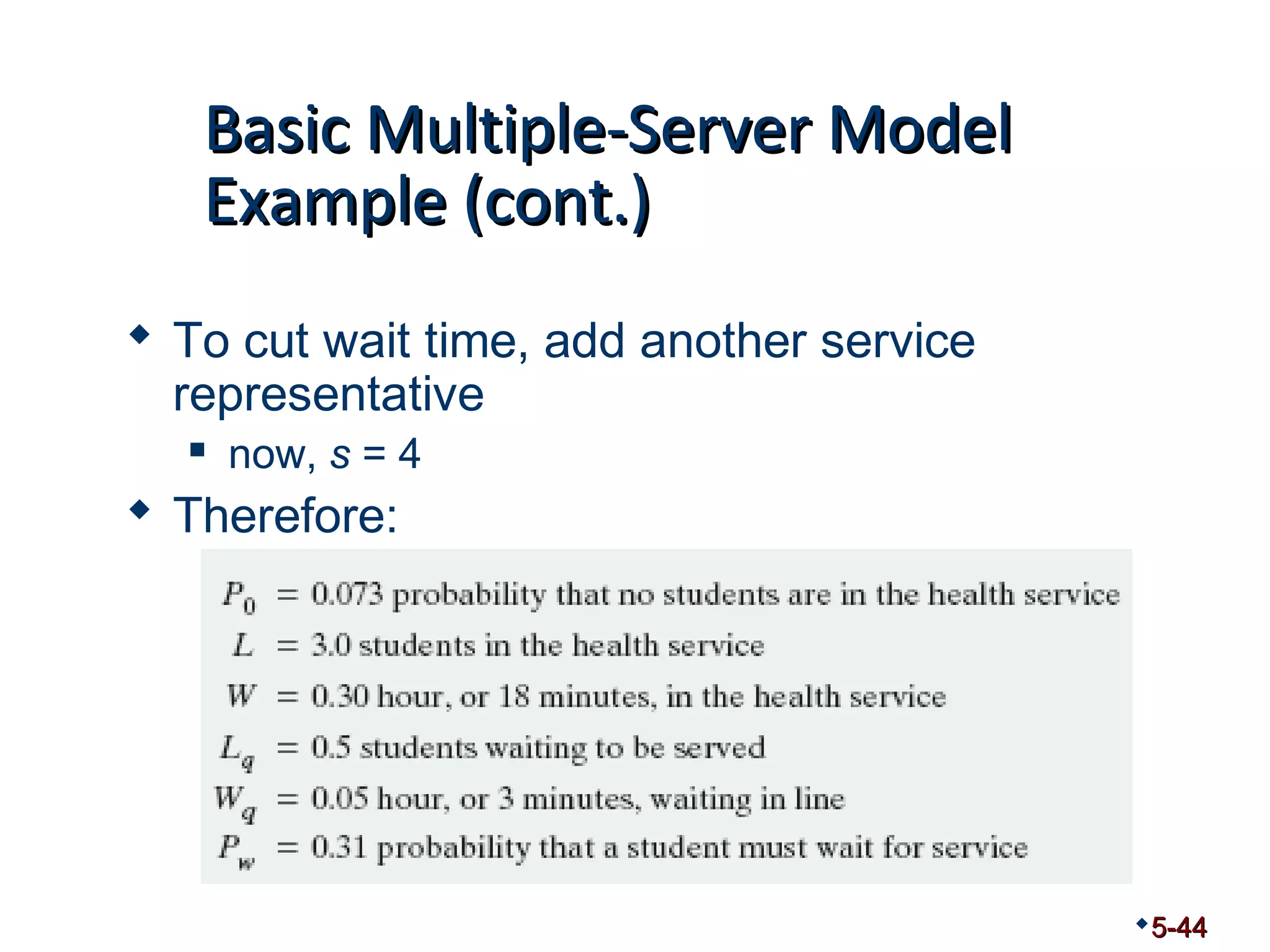
 To cut wait time, add another service 
representative 
 now, s = 4 
 Therefore: 
5-44
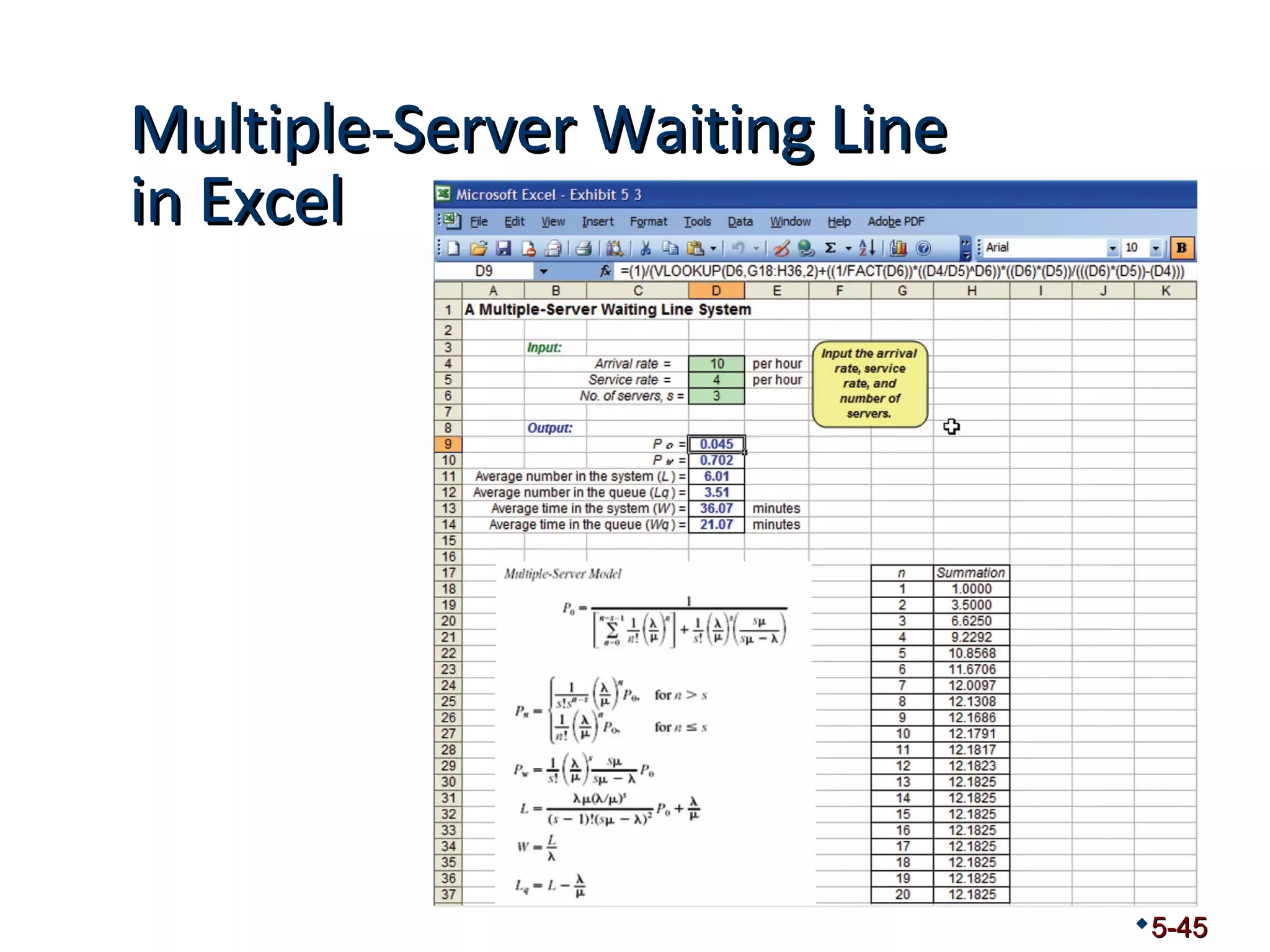
MMuullttiippllee--SSeerrvveerr WWaaiittiinngg LLiinnee 
iinn EExxcceell 
5-45
CCooppyyrriigghhtt 22000099 JJoohhnn WWiilleeyy && SSoonnss,, IInncc.. 
AAllll rriigghhttss rreesseerrvveedd.. RReepprroodduuccttiioonn oorr ttrraannssllaattiioonn ooff tthhiiss wwoorrkk bbeeyyoonndd tthhaatt 
ppeerrmmiitttteedd iinn sseeccttiioonn 111177 ooff tthhee 11997766 UUnniitteedd SSttaatteess CCooppyyrriigghhtt AAcctt wwiitthhoouutt 
eexxpprreessss ppeerrmmiissssiioonn ooff tthhee ccooppyyrriigghhtt oowwnneerr iiss uunnllaawwffuull.. RReeqquueesstt ffoorr ffuurrtthheerr 
iinnffoorrmmaattiioonn sshhoouulldd bbee aaddddrreesssseedd ttoo tthhee PPeerrmmiissssiioonn DDeeppaarrttmmeenntt,, JJoohhnn WWiilleeyy && 
SSoonnss,, IInncc.. TThhee ppuurrcchhaasseerr mmaayy mmaakkee bbaacckk--uupp ccooppiieess ffoorr hhiiss/hheerr oowwnn uussee oonnllyy aanndd 
nnoott ffoorr ddiissttrriibbuuttiioonn oorr rreessaallee.. TThhee PPuubblliisshheerr aassssuummeess nnoo rreessppoonnssiibbiilliittyy ffoorr 
eerrrroorrss,, oommiissssiioonnss,, oorr ddaammaaggeess ccaauusseedd bbyy tthhee uussee ooff tthheessee pprrooggrraammss oorr ffrroomm tthhee 
uussee ooff tthhee iinnffoorrmmaattiioonn hheerreeiinn.. 
5-46

Chapter 5 service design

  • 1.
    Chapter 5 SSeerrvviicceeDDeessiiggnn Beni Asllani OOppeerraattiioonnss MMaannaaggeemmeenntt -- 66tthh EEddiittiioonn Roberta Russell & Bernard W. Taylor, III University of Tennessee at Chattanooga
  • 2.
    LLeeccttuurree oouuttlliinnee Service economy  Characteristics of services  Service design process  Tools for service design  Waiting line analysis for service improvement 5-2
  • 3.
    SSeerrvviiccee EEccoonnoommyy 5-3 Source: U.S. Bureau of Labor Statistics, IBM Almaden Research Center
  • 4.
    GGDDPP –– EEmmppllooyymmeennttbbyy sseeccttoorr 5-4
  • 5.
    CChhaarraacctteerriissttiiccss ooff SSeerrvviicceess  Services  acts, deeds, or performances  Goods  tangible objects  Facilitating services  accompany almost all purchases of goods  Facilitating goods  accompany almost all service purchases 5-5
  • 6.
    CCoonnttiinnuuuumm ffrroomm GGooooddssttoo SSeerrvviicceess 5-6 Source: Adapted from Earl W. Sasser, R.P. Olsen, and D. Daryl Wyckoff, Management of Service Operations (Boston: Allyn Bacon, 1978), p.11.
  • 7.
    Characteristics of Services(cont.)  Services are intangible  Service output is variable  Services have higher customer contact  Services are perishable  Service inseparable from delivery  Services tend to be decentralized and dispersed  Services are consumed more often than products  Services can be easily emulated 5-7
  • 8.
  • 9.
    Service Design Process(cont.)  Service concept  purpose of a service; it defines target market and customer experience  Service package  mixture of physical items, sensual benefits, and psychological benefits  Service specifications  performance specifications  design specifications  delivery specifications 5-9
  • 10.
  • 11.
    High v. LowContact Services 5-11 Design Decision  Facility  Convenient to location customer High-Contact Service Low-Contact Service  Near labor or transportation source  Facility layout  Must look presentable, accommodate customer needs, and facilitate interaction with customer Source: Adapted from R. Chase, N. Aquilano, and R. Jacobs, Operations Management for Compensative Advantage (New York:McGraw-Hill, 2001), p. 210  Designed for efficiency
  • 12.
    High v. LowContact Services (cont.)  Quality control  More variable since customer is involved in process; customer expectations and perceptions of quality may differ; customer present when defects occur 5-12 Design Decision High-Contact Service Low-Contact Service  Measured against established standards; testing and rework possible to correct defects  Capacity  Excess capacity required to handle peaks in demand Source: Adapted from R. Chase, N. Aquilano, and R. Jacobs, Operations Management for Compensative Advantage (New York:McGraw-Hill, 2001), p. 210  Planned for average demand
  • 13.
    High v. LowContact Services (cont.) Design Decision High-Contact Service Low-Contact Service  Worker skills  Must be able to interact well with customers and use judgment in decision making  Technical skills  Scheduling  Must accommodate customer schedule Source: Adapted from R. Chase, N. Aquilano, and R. Jacobs, Operations Management for Compensative 5-13 Advantage (New York:McGraw-Hill, 2001), p. 210  Customer concerned only with completion date
  • 14.
    High v. LowContact Services (cont.)  Service process  Mostly front-room activities; service may change during delivery in response to customer 5-14 Design Decision High-Contact Service Low-Contact Service  Mostly back-room activities; planned and executed with minimal interference  Service package  Varies with customer; includes environment as well as actual service Source: Adapted from R. Chase, N. Aquilano, and R. Jacobs, Operations Management for Compensative Advantage (New York:McGraw-Hill, 2001), p. 210  Fixed, less extensive
  • 15.
    TToooollss ffoorr SSeerrvviicceeDDeessiiggnn  Servicescapes  space and function  ambient conditions  signs, symbols, and artifacts  Quantitative techniques  Service blueprinting  line of influence  line of interaction  line of visibility  line of support  Front-office/Back-office activities 5-15
  • 16.
  • 17.
  • 18.
    EElleemmeennttss ooff WWaaiittiinnggLLiinnee AAnnaallyyssiiss  Operating characteristics  average values for characteristics that describe performance of waiting line system  Queue  a single waiting line  Waiting line system  consists of arrivals, servers, and waiting line structure  Calling population  source of customers; infinite or finite 5-18
  • 19.
  • 20.
    EElleemmeennttss ooff WWaaiittiinnggLLiinnee AAnnaallyyssiiss ((ccoonntt..))  Arrival rate (λ)  frequency at which customers arrive at a waiting line according to a probability distribution, usually Poisson  Service time (μ)  time required to serve a customer, usually described by negative exponential distribution  Service rate must be shorter than arrival rate (λ < μ)  Queue discipline  order in which customers are served  Infinite queue  can be of any length; length of a finite queue is limited 5-20
  • 21.
    EElleemmeennttss ooff WWaaiittiinnggLLiinnee AAnnaallyyssiiss ((ccoonntt..))  Channels  number of parallel servers for servicing customers  Phases  number of servers in sequence a customer must go through 5-21
  • 22.
    OOppeerraattiinngg CChhaarraacctteerriissttiiccss 5-22  Operating characteristics are assumed to approach a steady state
  • 23.
    TTrraaddiittiioonnaall CCoosstt RReellaattiioonnsshhiippss 5-23  as service improves, cost increases
  • 24.
    PPssyycchhoollooggyy ooff WWaaiittiinngg  Waiting rooms  magazines and newspapers  televisions  Bank of America  mirrors  Supermarkets  magazines  “impulse purchases” 5-24  Disney  costumed characters  mobile vendors  accurate wait times  special passes
  • 25.
    PPssyycchhoollooggyy ooff WWaaiittiinngg((ccoonntt..))  Preferential treatment  Grocery stores: express lanes for customers with few purchases  Airlines/car rental agencies: special cards available to frequent-users or for an additional fee  Phone retailers: route calls to more or less experienced salespeople based on customer’s sales history  Critical service providers  services of police department, fire department, etc.  waiting is unacceptable; cost is not important 5-25
  • 26.
    WWaaiittiinngg LLiinnee MMooddeellss  Single-server model  simplest, most basic waiting line structure  Frequent variations (all with Poisson arrival rate)  exponential service times  general (unknown) distribution of service times  constant service times  exponential service times with finite queue  exponential service times with finite calling population 5-26
  • 27.
    BBaassiicc SSiinnggllee--SSeerrvveerr MMooddeell  Assumptions  Poisson arrival rate  exponential service times  first-come, first-served queue discipline  infinite queue length  infinite calling population  Computations  λ = mean arrival rate  μ = mean service rate  n = number of customers in line 5-27
  • 28.
    BBaassiicc SSiinnggllee--SSeerrvveerr MMooddeell((ccoonntt..))  probability that no customers are in queuing system  probability of n customers in queuing system  average number of customers in queuing system  average number of customers in waiting line 5-28 λλ P = 1 –– 0 ( ) μμ ( λλ ) n λλ n P = n λλ ∙∙ P( = 0 )( ) 1 –– μμ μμ μμ L = λλ μμ –– λλ Lq = λλ2 μμ (μμ –– λλ)
  • 29.
    BBaassiicc SSiinnggllee--SSeerrvveerr MMooddeell((ccoonntt..))  average time customer spends in queuing system  average time customer spends waiting in line  probability that server is busy and a customer has to wait (utilization factor)  probability that server is idle and customer can be served 5-29 1 L μμ –– λλ λλ W = = λλ μμ (μμ –– λλ ) Wq = λλ μμ ρρ = I = 1 –– ρρ λλ μμ = 1 –– = P0
  • 30.
  • 31.
    BBaassiicc SSiinnggllee--SSeerrvveerr MMooddeellEExxaammppllee ((ccoonntt..)) 5-31
  • 32.
    SSeerrvviiccee IImmpprroovveemmeenntt AAnnaallyyssiiss  waiting time (8 min.) is too long  hire assistant for cashier? increased service rate  hire another cashier? reduced arrival rate  Is improved service worth the cost? 5-32
  • 33.
    Basic SSiinnggllee--SSeerrvveerr MMooddeellEExxaammppllee:: EExxcceell 5-33
  • 34.
    AAddvvaanncceedd SSiinnggllee--SSeerrvveerr MMooddeellss  Constant service times  occur most often when automated equipment or machinery performs service  Finite queue lengths  occur when there is a physical limitation to length of waiting line  Finite calling population  number of “customers” that can arrive is limited 5-34
  • 35.
  • 36.
    BBaassiicc MMuullttiippllee--SSeerrvveerr MMooddeell  single waiting line and service facility with several independent servers in parallel  same assumptions as single-server model  sμ > λ  s = number of servers  servers must be able to serve customers faster than they arrive 5-36
  • 37.
    BBaassiicc MMuullttiippllee--SSeerrvveerr MMooddeell((ccoonntt..))  probability that there are no customers in system 1 λ n 1 λ s sμ n! μ s! μ sμ - λ ( ) ( )( ) n = s – 1 n = 0  probability of n customers in system 5-37 1 λ n s!sn – s μ 1 λ n n! μ ( ) { ( )P0, for n > s P0, for n ≤ s Pn = 1 P0 = Σ+
  • 38.
    BBaassiicc MMuullttiippllee--SSeerrvveerr MMooddeell((ccoonntt..))  probability that customer must wait 5-38 ( ) 1 λλ s sμμ s! μμ sμμ –– λλ Pw = P0 λλμμ (λλ/μμ)s λλ (s –– 1)! (sμμ –– λλ)2 μμ L = P0 + L λλ W = Lq = L –– λλ μμ 1 Lq μμ λλ Wq = W –– = ρρ =λλ sμμ
  • 39.
  • 40.
    Basic MMuullttiippllee--SSeerrvveerr MMooddeellEExxaammppllee ((ccoonntt..)) 5-40
  • 41.
    Basic MMuullttiippllee--SSeerrvveerr MMooddeellEExxaammppllee ((ccoonntt..)) 5-41
  • 42.
    Basic MMuullttiippllee--SSeerrvveerr MMooddeellEExxaammppllee ((ccoonntt..)) 5-42
  • 43.
    Basic MMuullttiippllee--SSeerrvveerr MMooddeellEExxaammppllee ((ccoonntt..)) 5-43
  • 44.
    BBaassiicc MMuullttiippllee--SSeerrvveerr MMooddeell EExxaammppllee ((ccoonntt..))  To cut wait time, add another service representative  now, s = 4  Therefore: 5-44
  • 45.
  • 46.
    CCooppyyrriigghhtt 22000099 JJoohhnnWWiilleeyy && SSoonnss,, IInncc.. AAllll rriigghhttss rreesseerrvveedd.. RReepprroodduuccttiioonn oorr ttrraannssllaattiioonn ooff tthhiiss wwoorrkk bbeeyyoonndd tthhaatt ppeerrmmiitttteedd iinn sseeccttiioonn 111177 ooff tthhee 11997766 UUnniitteedd SSttaatteess CCooppyyrriigghhtt AAcctt wwiitthhoouutt eexxpprreessss ppeerrmmiissssiioonn ooff tthhee ccooppyyrriigghhtt oowwnneerr iiss uunnllaawwffuull.. RReeqquueesstt ffoorr ffuurrtthheerr iinnffoorrmmaattiioonn sshhoouulldd bbee aaddddrreesssseedd ttoo tthhee PPeerrmmiissssiioonn DDeeppaarrttmmeenntt,, JJoohhnn WWiilleeyy && SSoonnss,, IInncc.. TThhee ppuurrcchhaasseerr mmaayy mmaakkee bbaacckk--uupp ccooppiieess ffoorr hhiiss/hheerr oowwnn uussee oonnllyy aanndd nnoott ffoorr ddiissttrriibbuuttiioonn oorr rreessaallee.. TThhee PPuubblliisshheerr aassssuummeess nnoo rreessppoonnssiibbiilliittyy ffoorr eerrrroorrss,, oommiissssiioonnss,, oorr ddaammaaggeess ccaauusseedd bbyy tthhee uussee ooff tthheessee pprrooggrraammss oorr ffrroomm tthhee uussee ooff tthhee iinnffoorrmmaattiioonn hheerreeiinn.. 5-46