www.PairCoaching.netReboot your team to Team²Yves Hanoulle
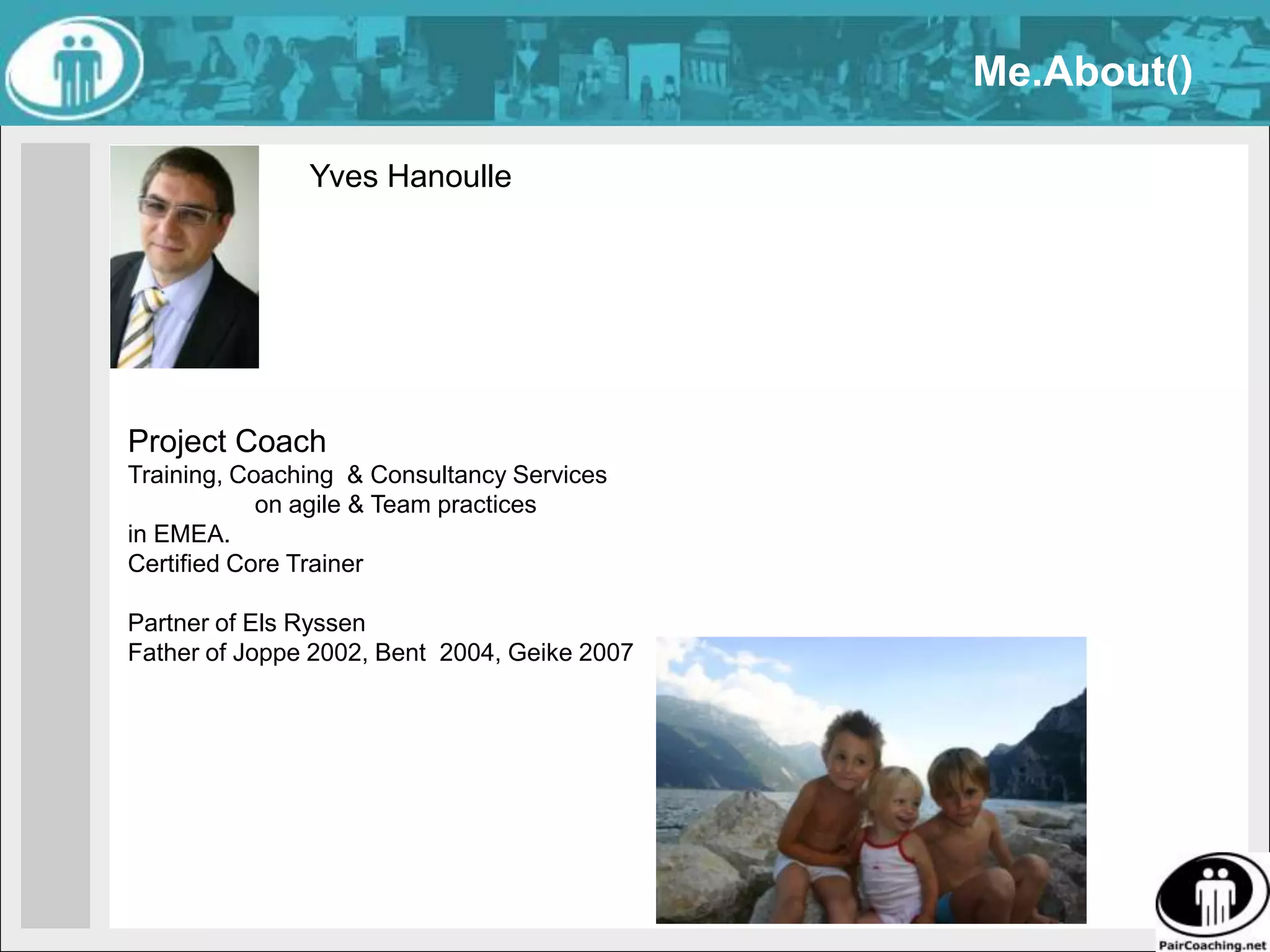
Me.About()Yves HanoulleProject CoachTraining, Coaching  & Consultancy Services on agile & Team practicesin EMEA. Certified Core TrainerPartner of Els RyssenFather of Joppe 2002, Bent  2004, Geike 2007
You.About()Who are you?What makes you different?What do you know about the Core?Other info you like to share?What would be the successful 	outcome of this talk for you?
DisclaimerYou don’t have to believe in the sea to get wetYou do have to get IN to get wet
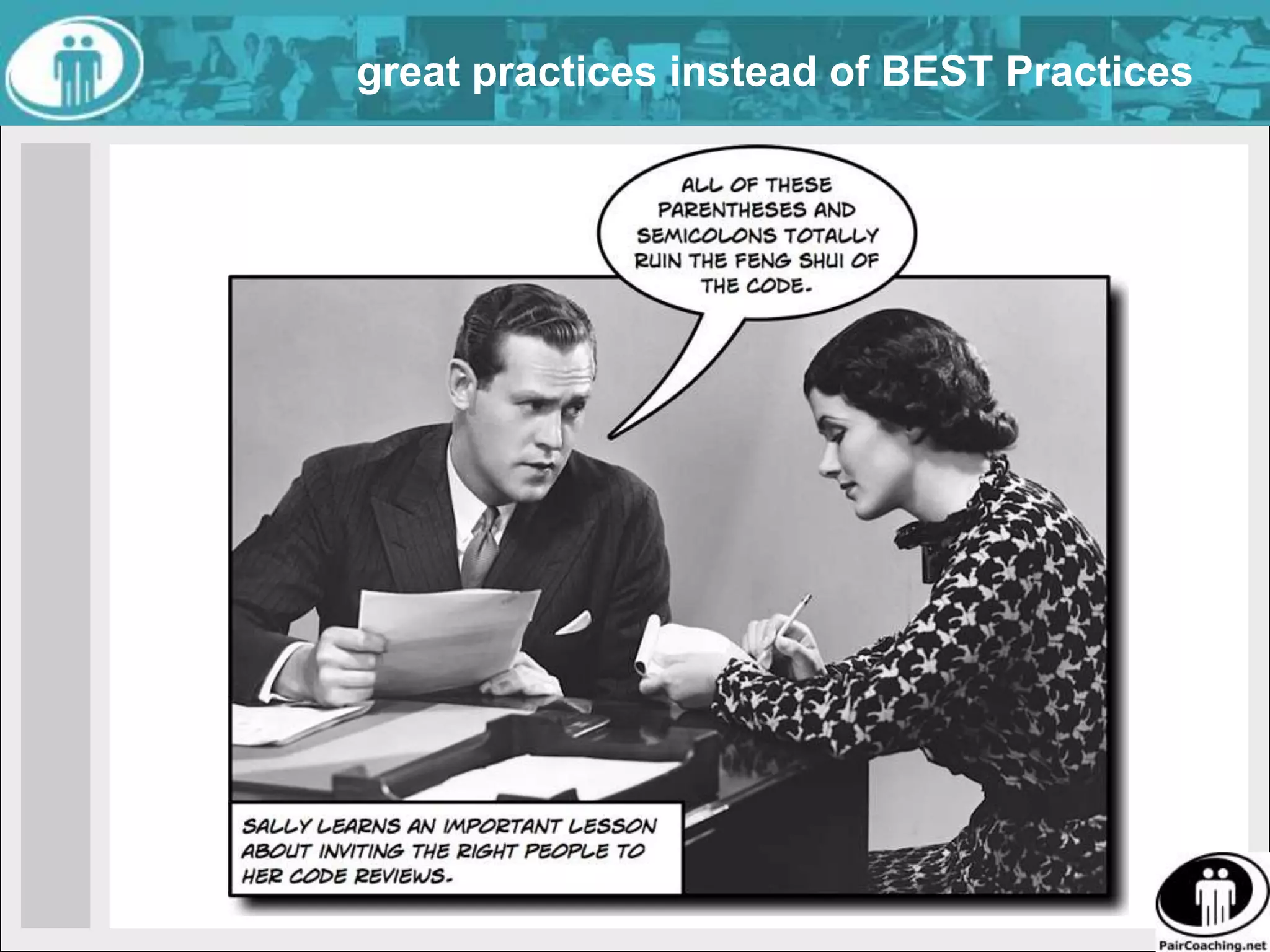
great practices instead of BEST Practices
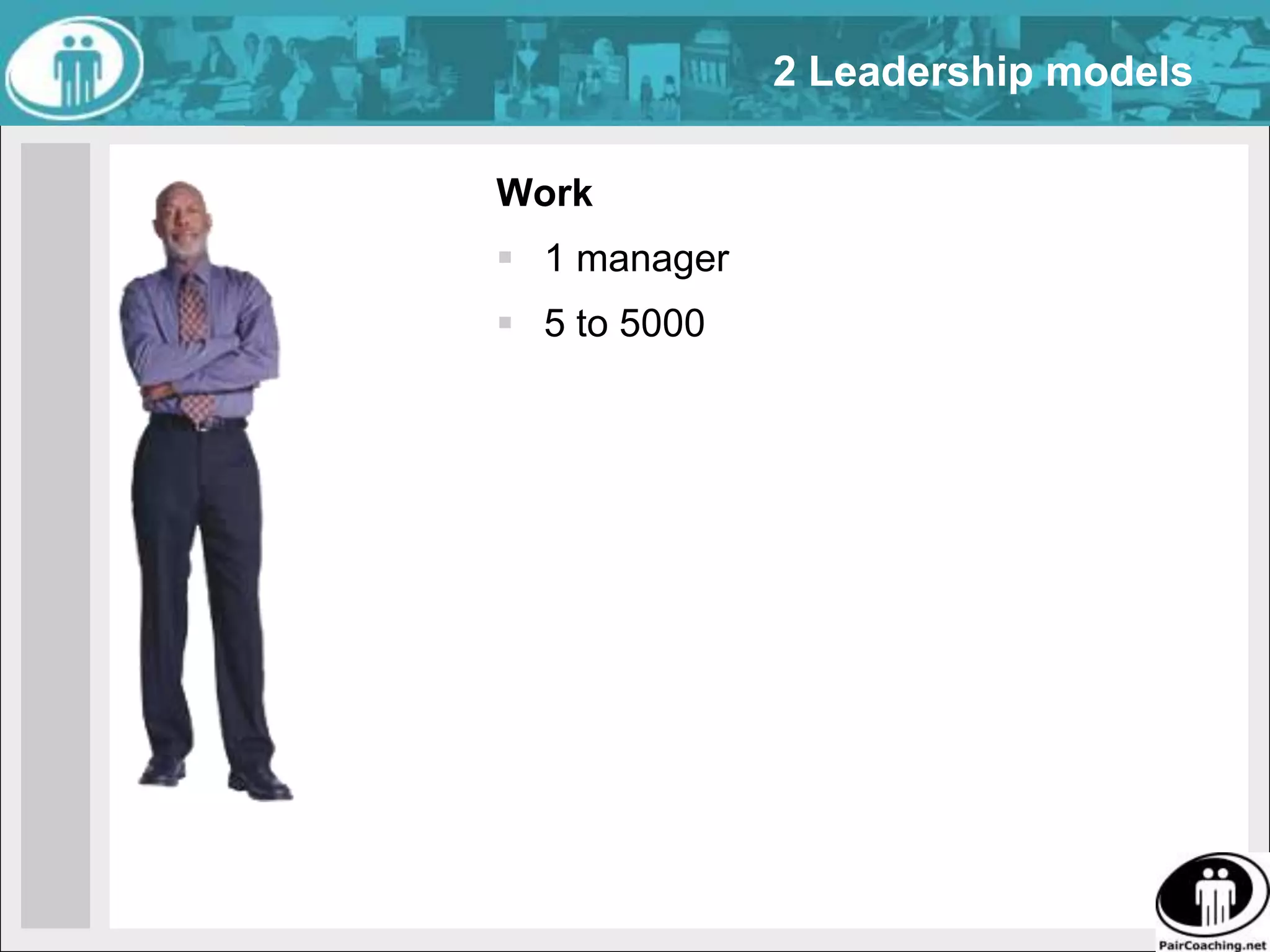
2 Leadership modelsWork1 manager5 to 5000
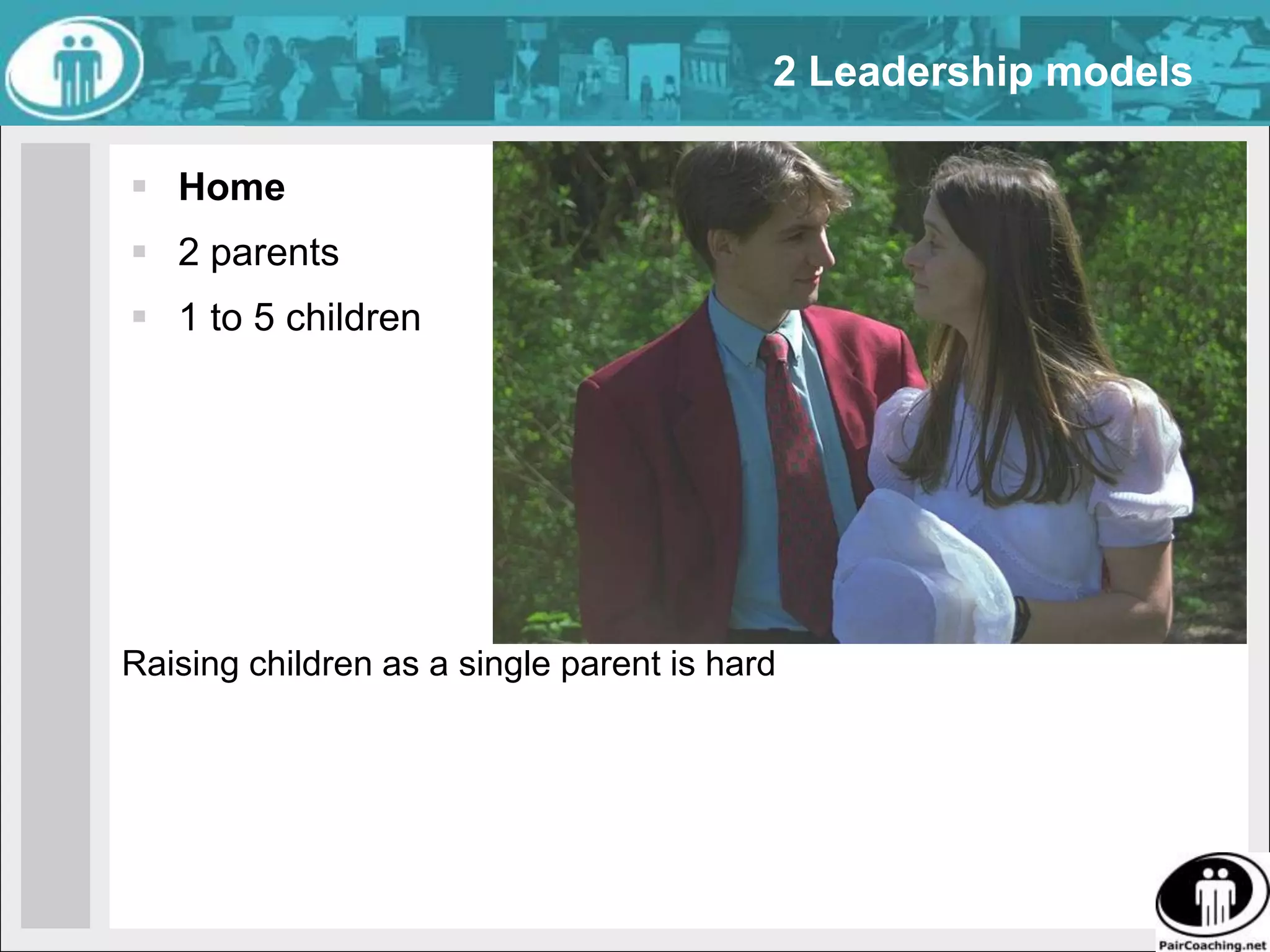
2 Leadership modelsHome2 parents1 to 5 childrenRaising children as a single parent is hard
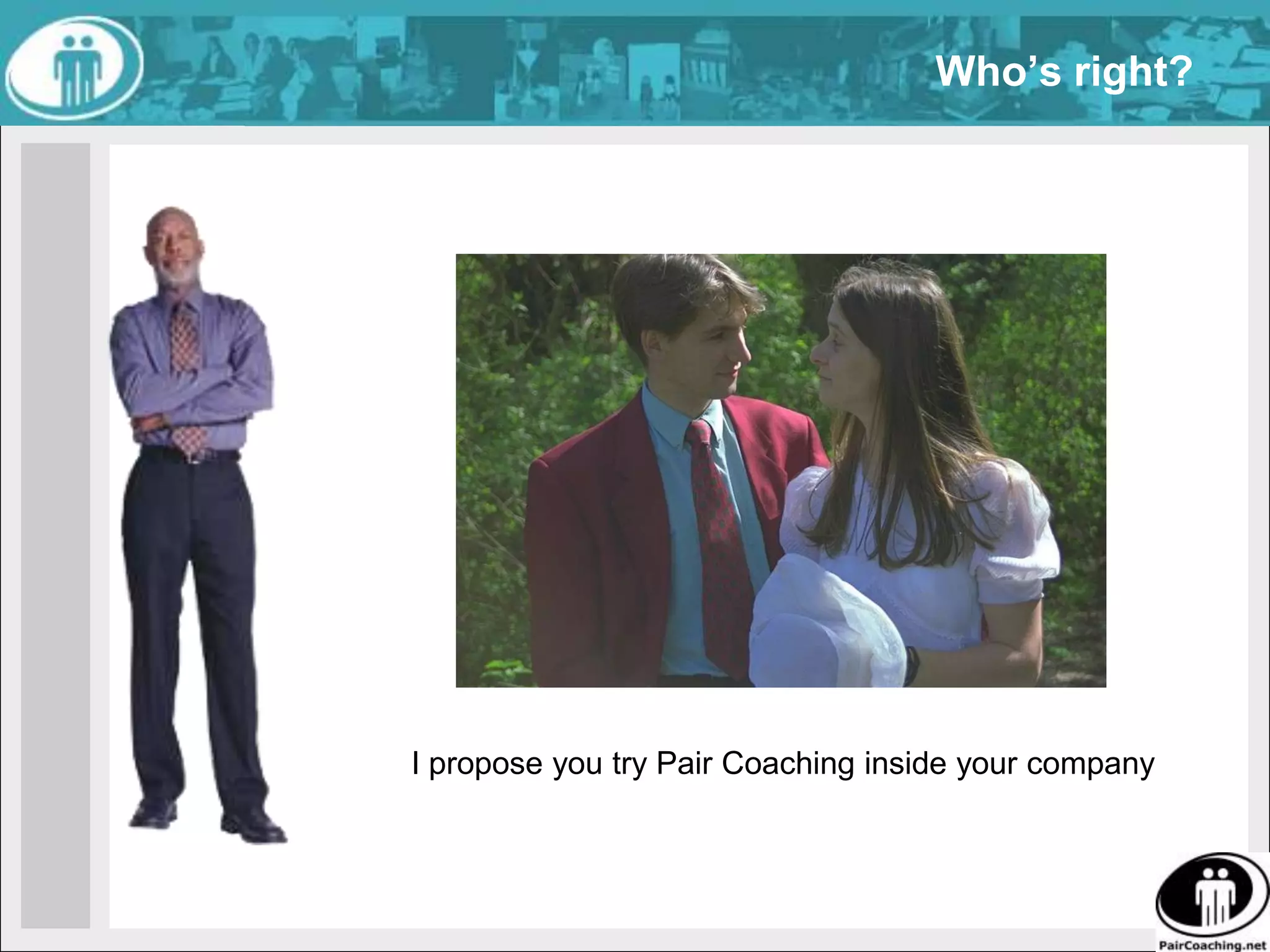
Who’s right?I propose you try Pair Coaching inside your company
The agile manifestoIndividuals and interactionsWorking softwareCustomer collaborationResponding to changeover processes and toolscomprehensive documentation over contract negotiation over following a plan http://agilemanifesto.org/
Principles behind the Agile ManifestoOur highest priority is to satisfy the customer through early and continuous delivery of valuable software. Welcome changing requirements, even late in development. Agile processes harness change for  the customer's competitive advantage. Deliver working software frequently, from a couple of weeks to a couple of months, with a preference to the shorter timescale. Business people and developers must work together daily throughout the project. Build projects around motivated individuals. Give them the environment and support they need, and trust them to get the job done. The most efficient and effective method of conveying information to and within a development team is face-to-face conversation. Working software is the primary measure of progress. Agile processes promote sustainable development. The sponsors, developers, and users should be able to maintain a constant pace indefinitely. Continuous attention to technical excellence and good design enhances agility. Simplicity--the art of maximizing the amount of work not done--is essential. The best architectures, requirements, and designs emerge from self-organizing teams. At regular intervals, the team reflects on how to become more effective, then tunes and adjusts its behavior accordingly.
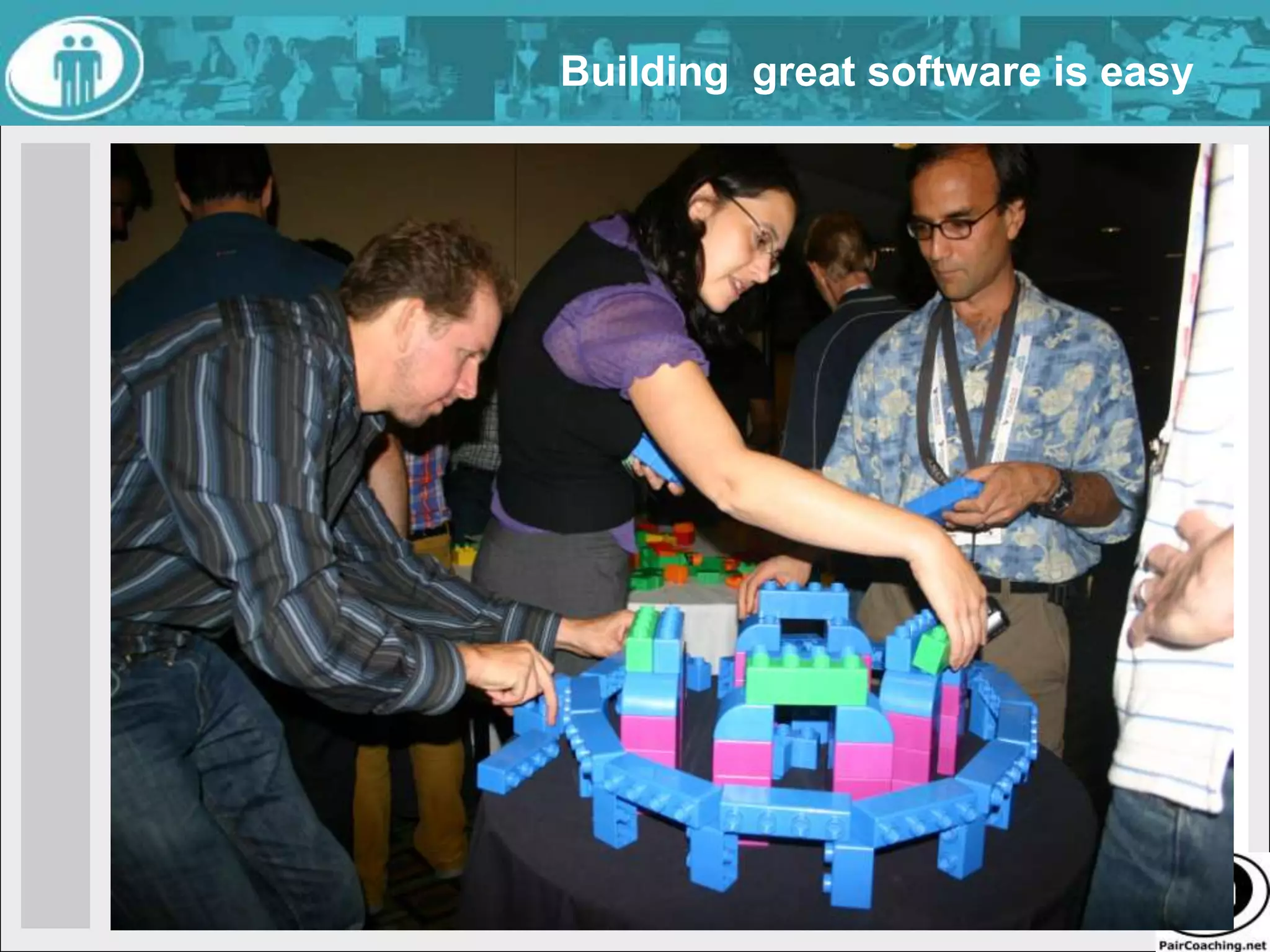
Building  great software is easy
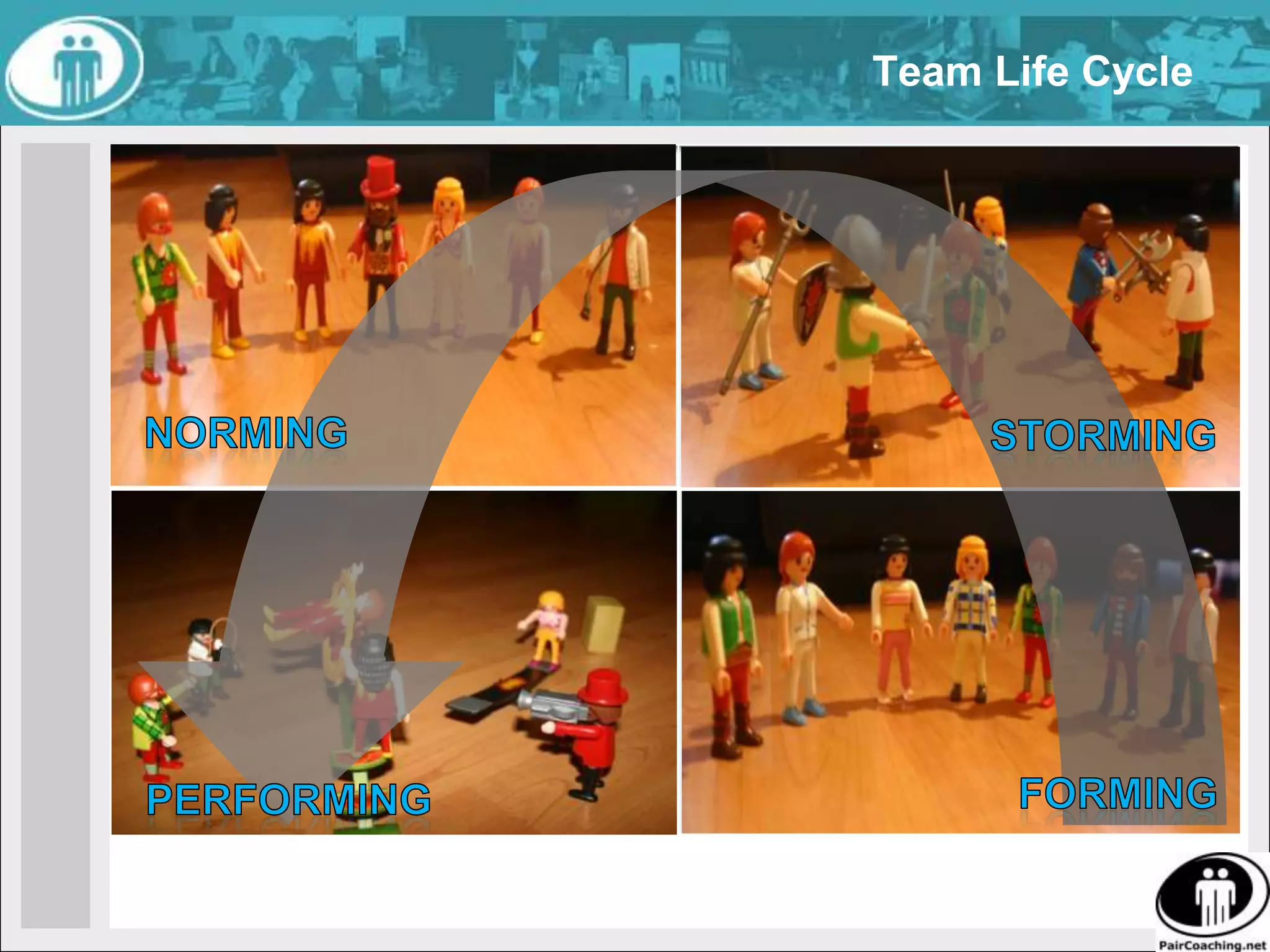
Team Life CycleNormingStormingFormingPerforming
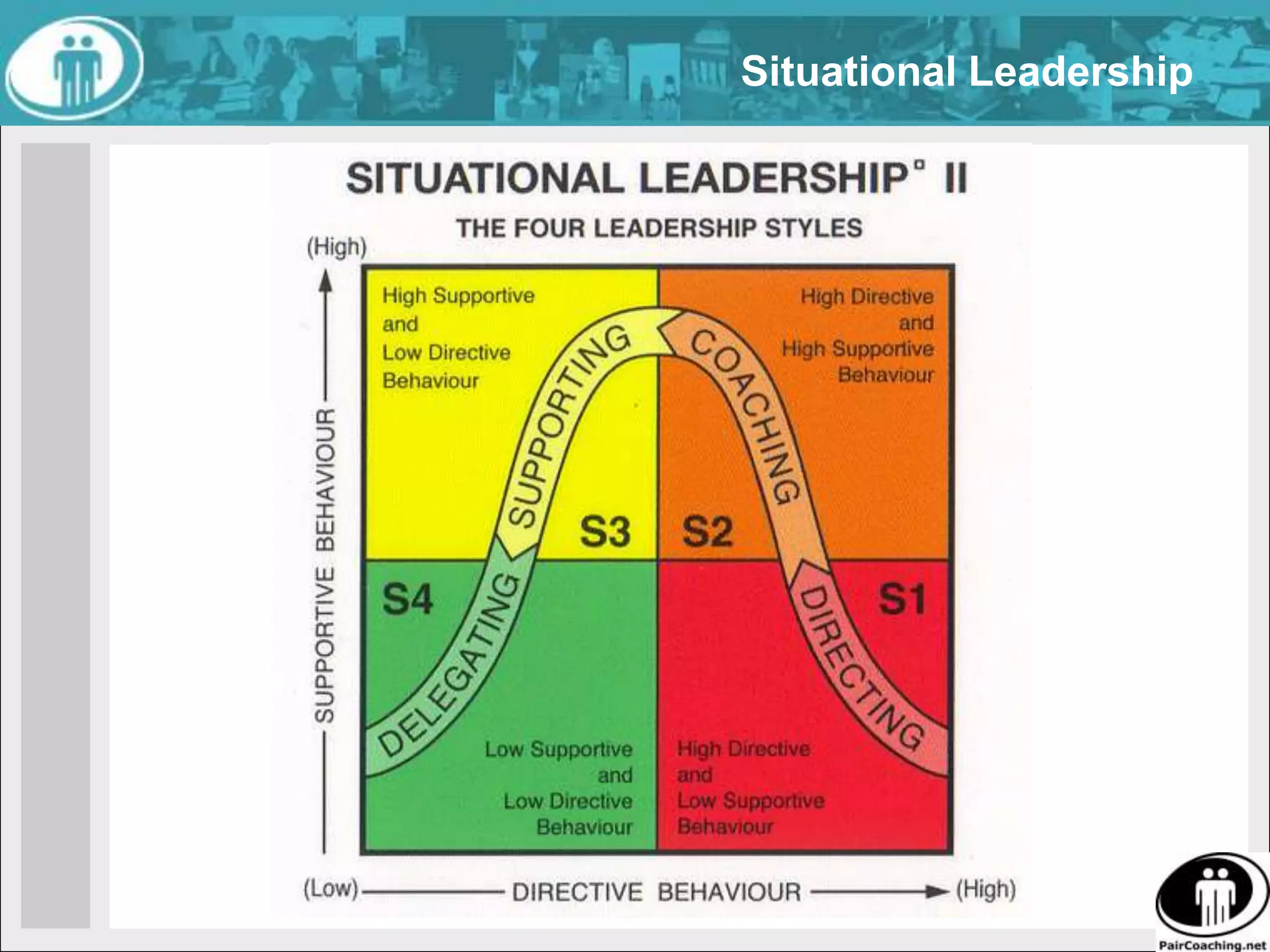
Situational Leadership
Shared VisionPlease stand if you have ever been on a team with a shared visionPlease sit down when what I say is NOT true from your experience on that team
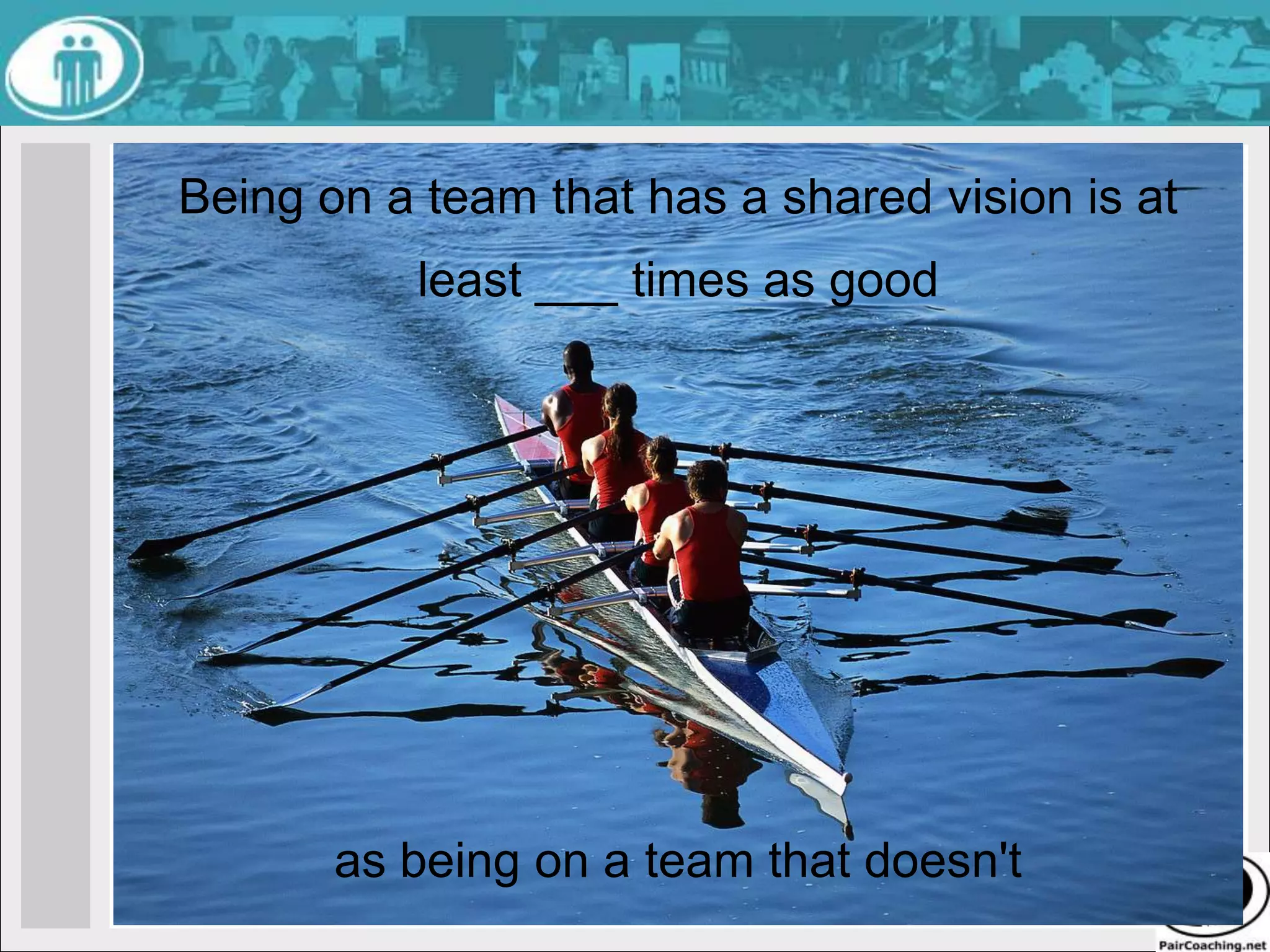
Being on a team that has a shared vision is atleast ___ times as goodas being on a team that doesn't
Emotions at workPlease say Oh my god ! if you ever had a team member hiding how he felt.123
Great practiceBeing on a team that states feelings, is better thanbeing on a team where feelings get in the way
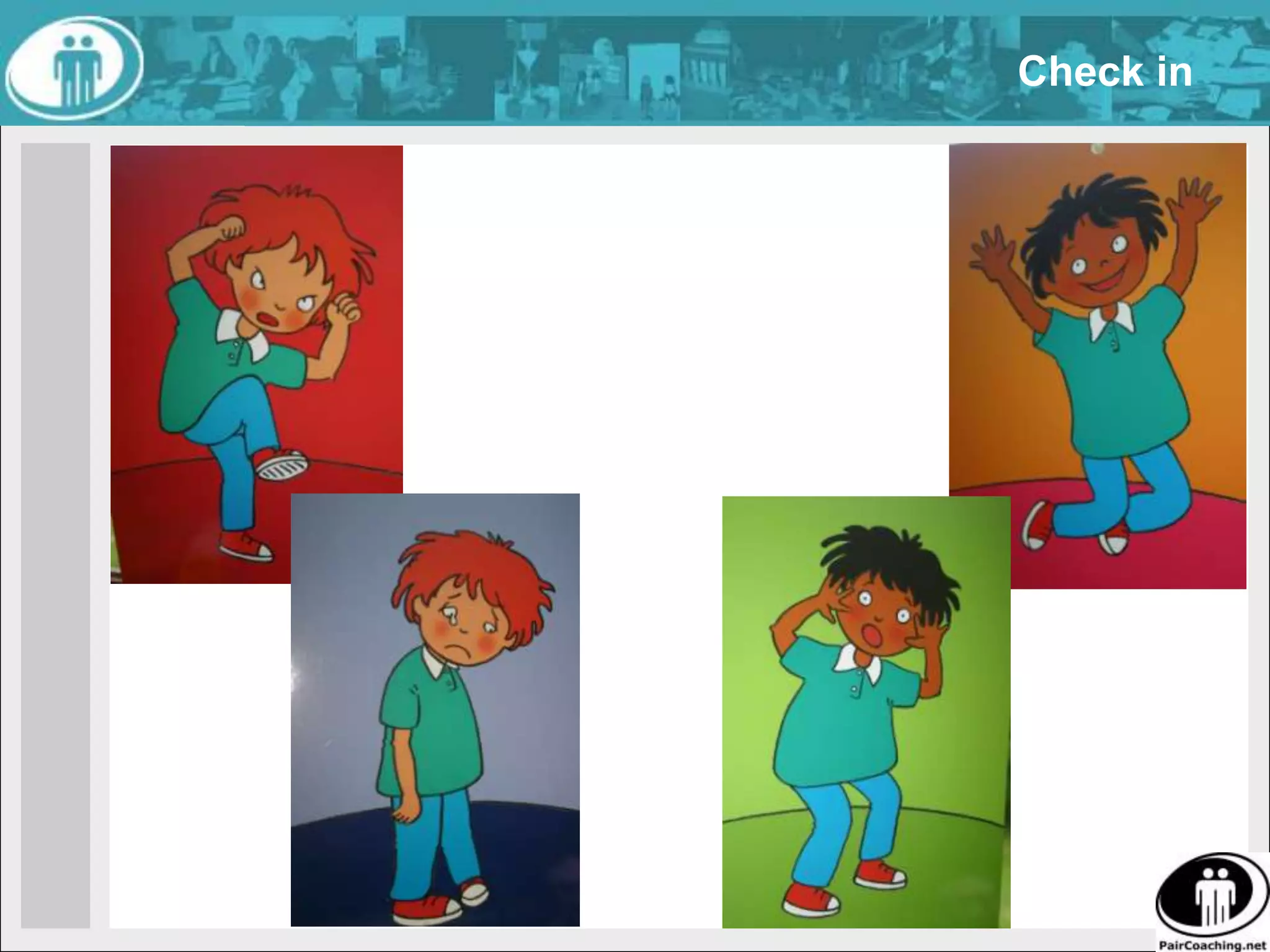
Check in
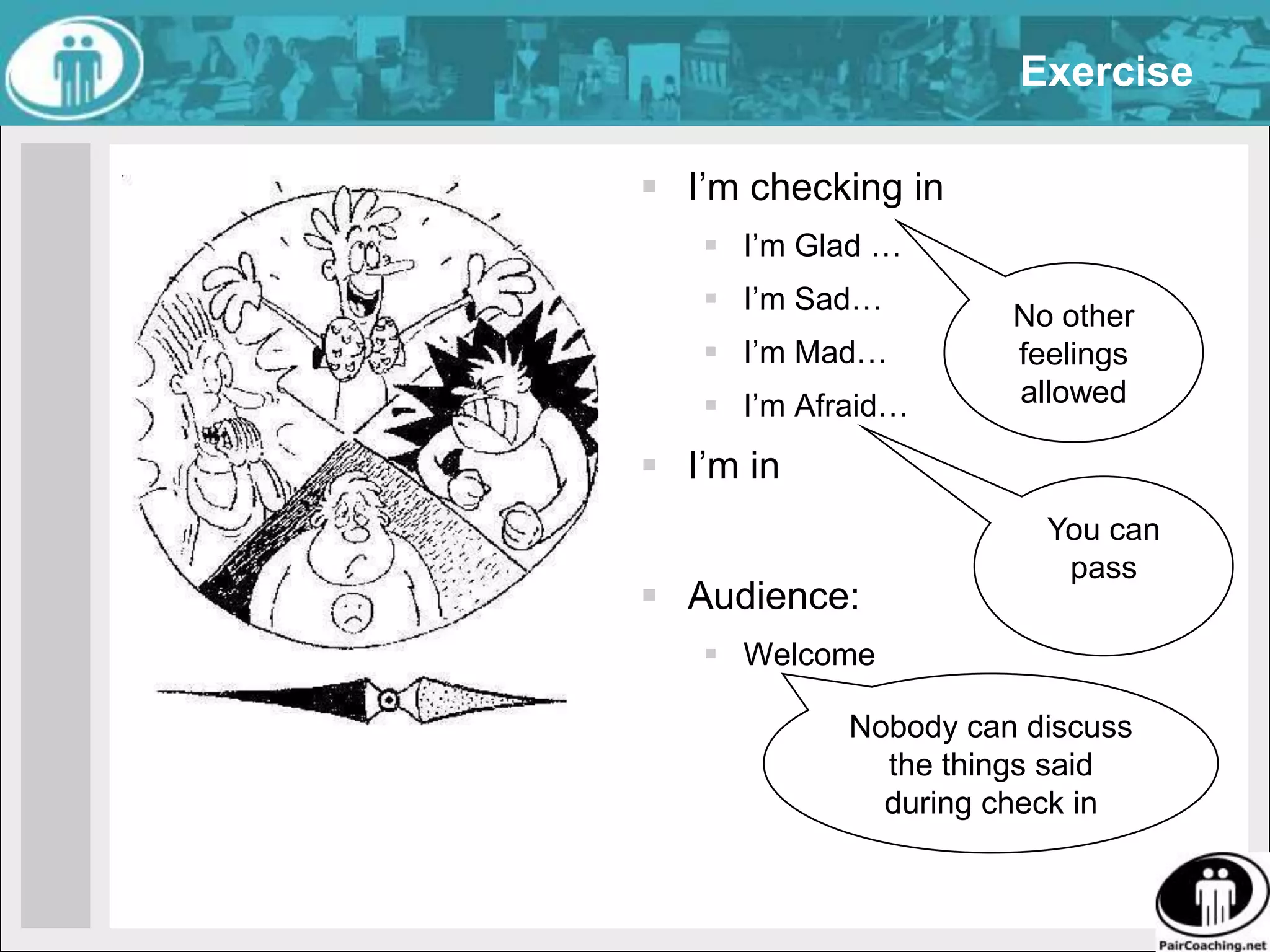
ExerciseI’m checking inI’m Glad …I’m Sad…I’m Mad…I’m Afraid…I’m inAudience:WelcomeNo other feelings allowedYou can passNobody can discuss the things said during check in
Decision MakingPlease say YES! if you have been on a team that made decisions without pain
Great PracticeBeing on a team that makes unanimous decisionsquickly, without redundant blather, is better thanbeing on a team that does not
Decider
ResolutionProblemWe have difficulties reaching unanimous support for a proposalSolutionOnly talk about what it will take to get the outlier “in”.
ResolutionSteps1. Proposer asks outlier “What will it take to get you in?”2. Outlier states in a single, short, declarative sentence the precise modification required to be in.3. Proposer offers to adopt the outlier’s changes or withdraws the proposal.Only outliers can talk
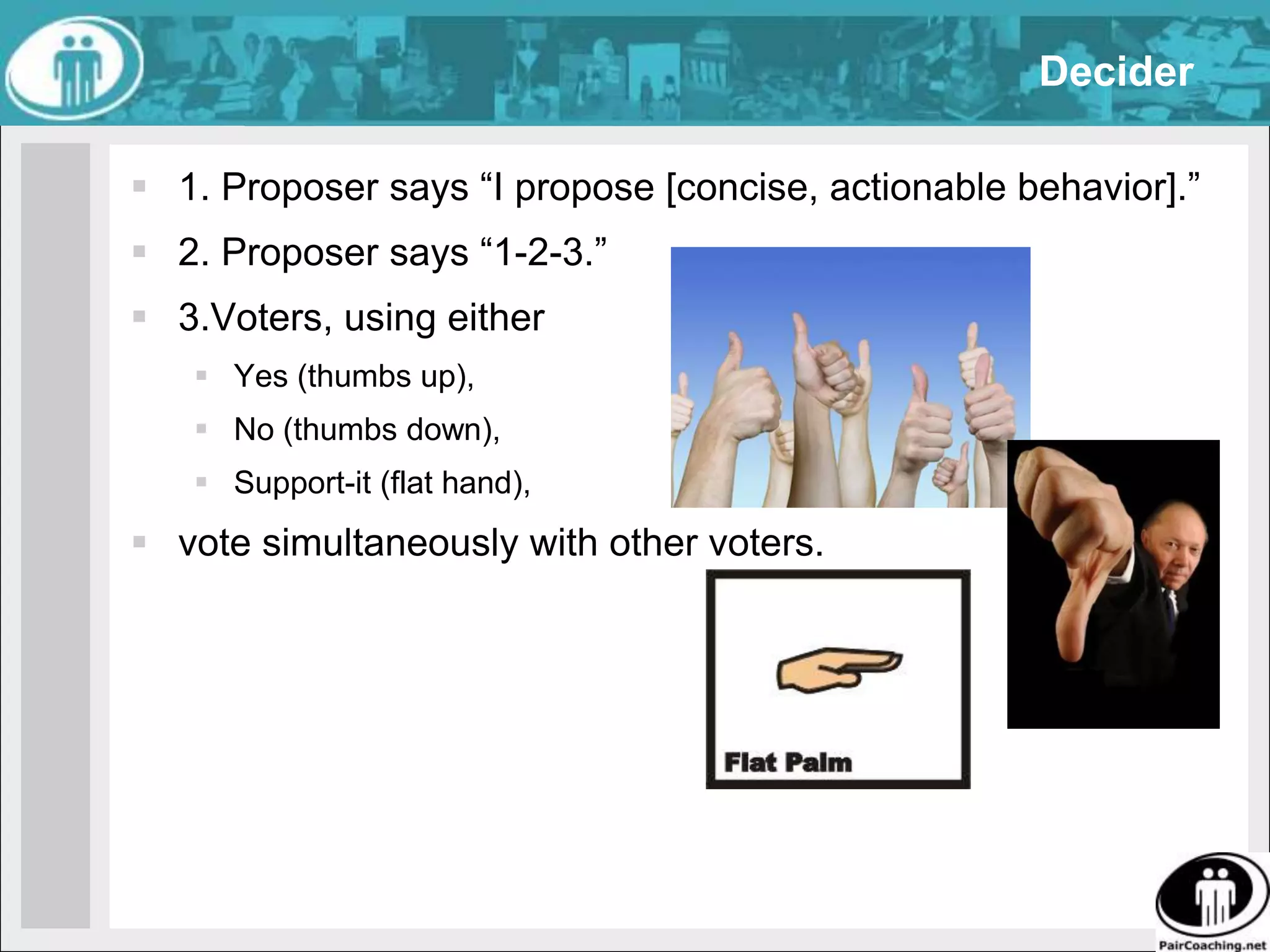
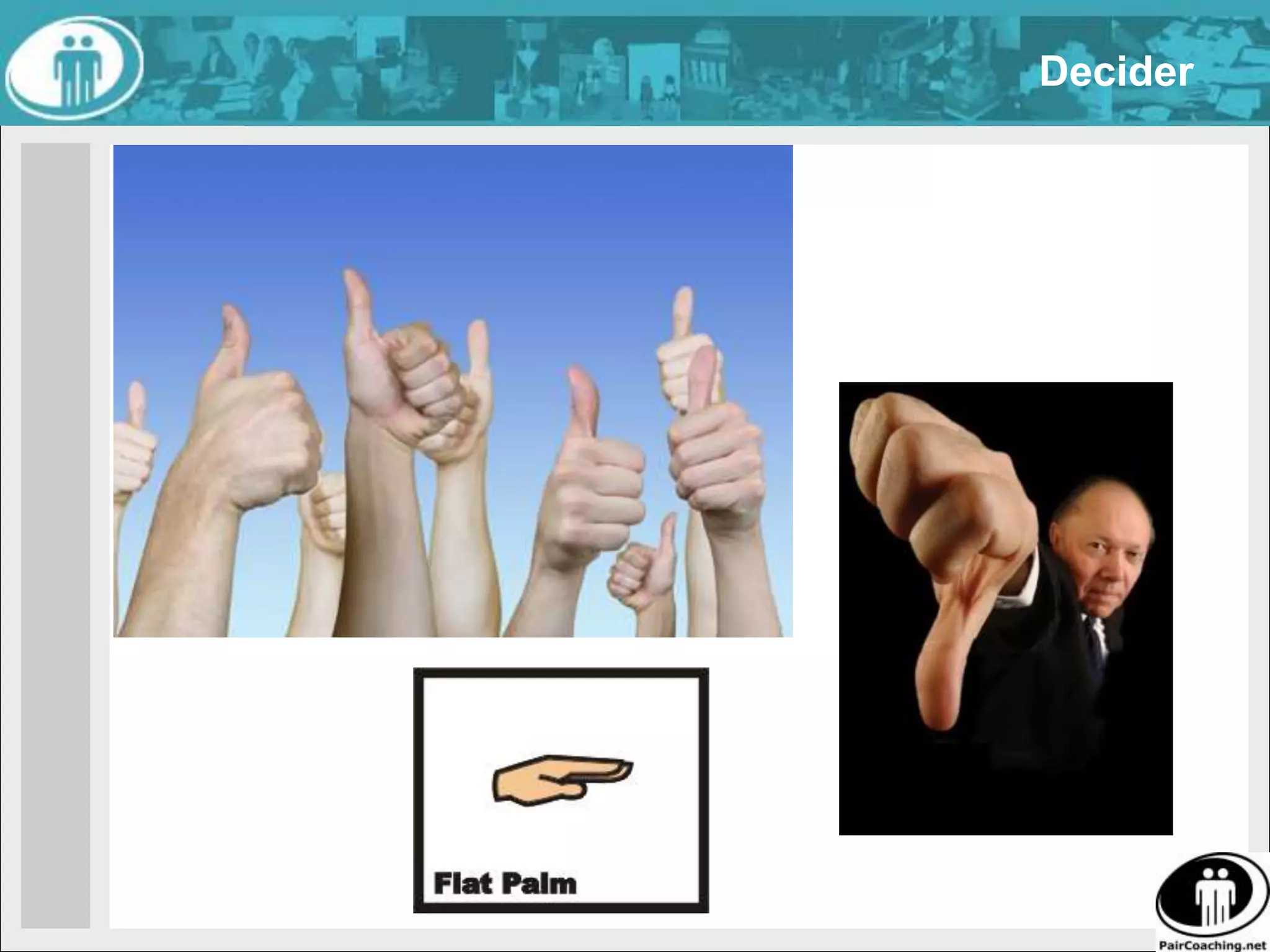
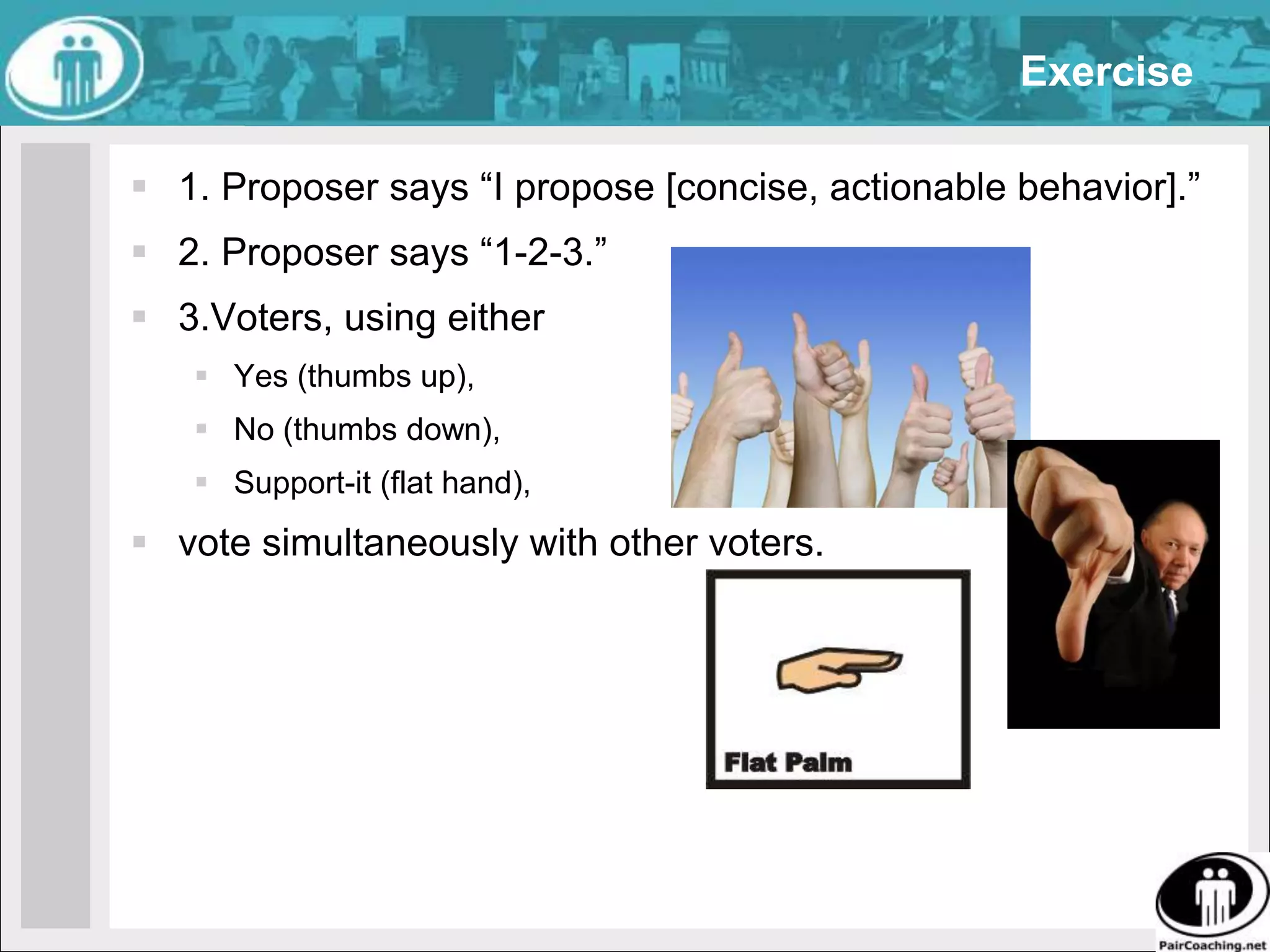
Exercise1. Proposer says “I propose [concise, actionable behavior].”2. Proposer says “1-2-3.”3.Voters, using either Yes (thumbs up), No (thumbs down), Support-it (flat hand), vote simultaneously with other voters.
Motivation
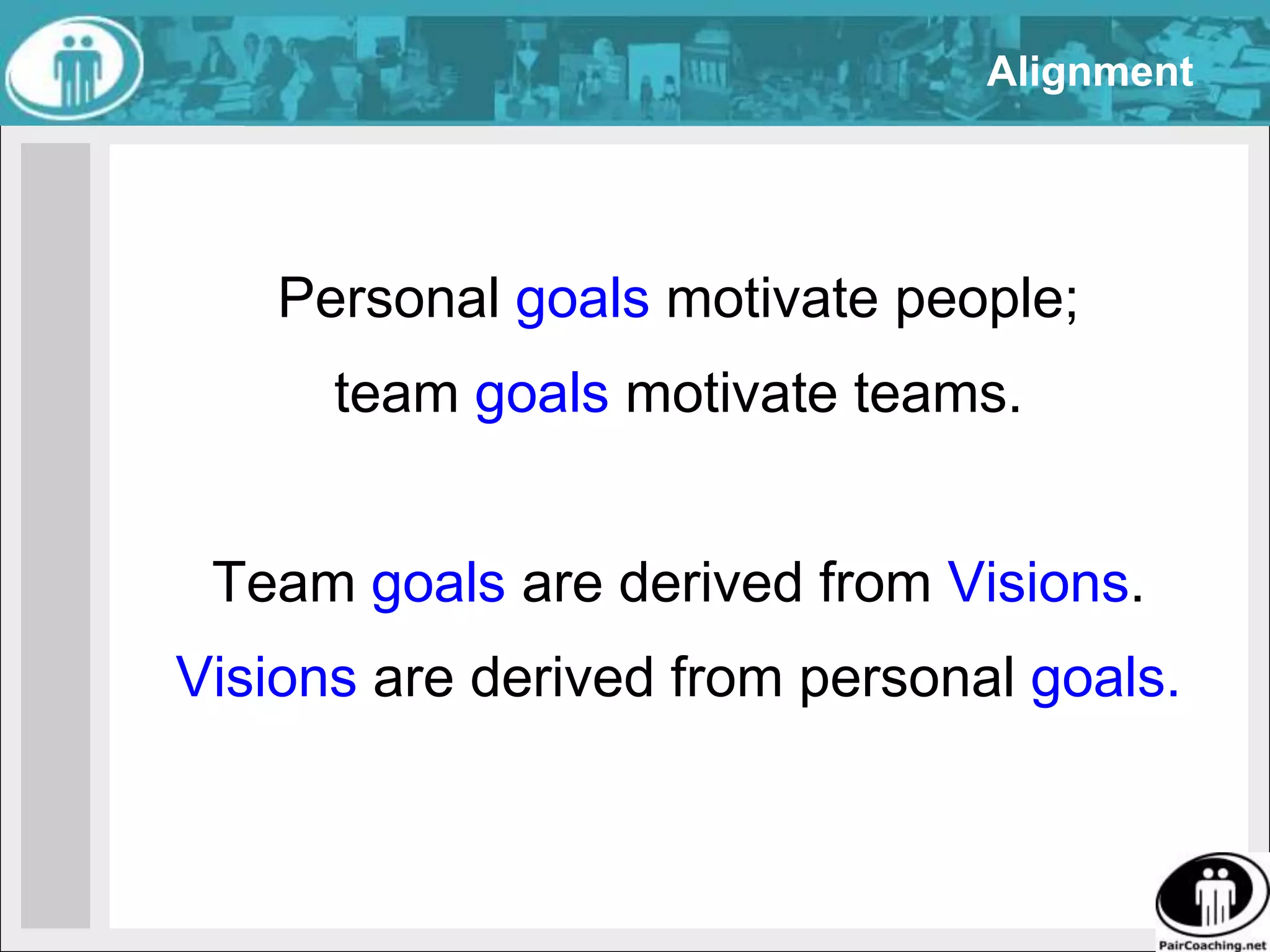
AlignmentPersonal goals motivate people; team goals motivate teams. Team goals are derived from Visions. Visions are derived from personal goals.
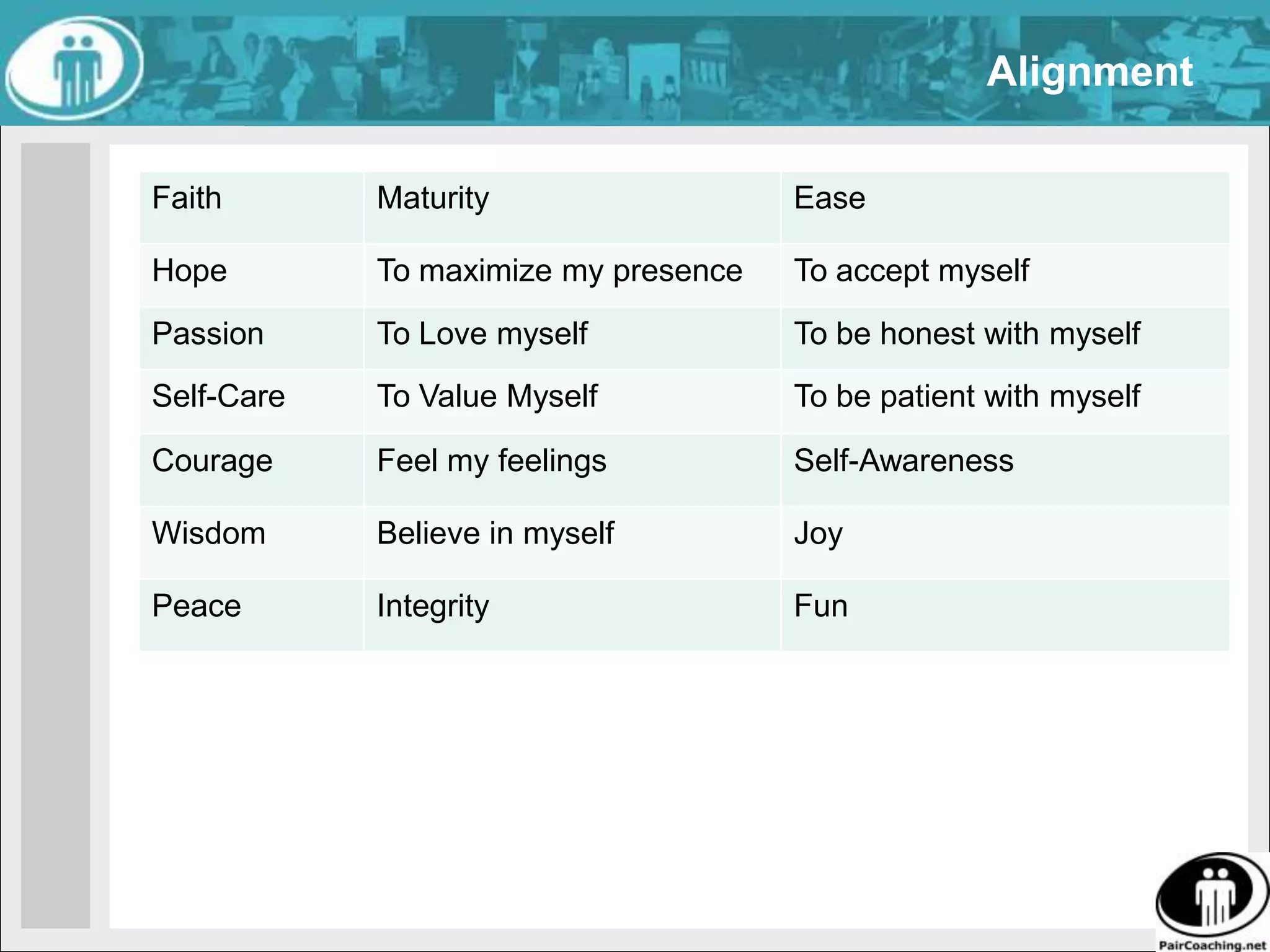
Alignment
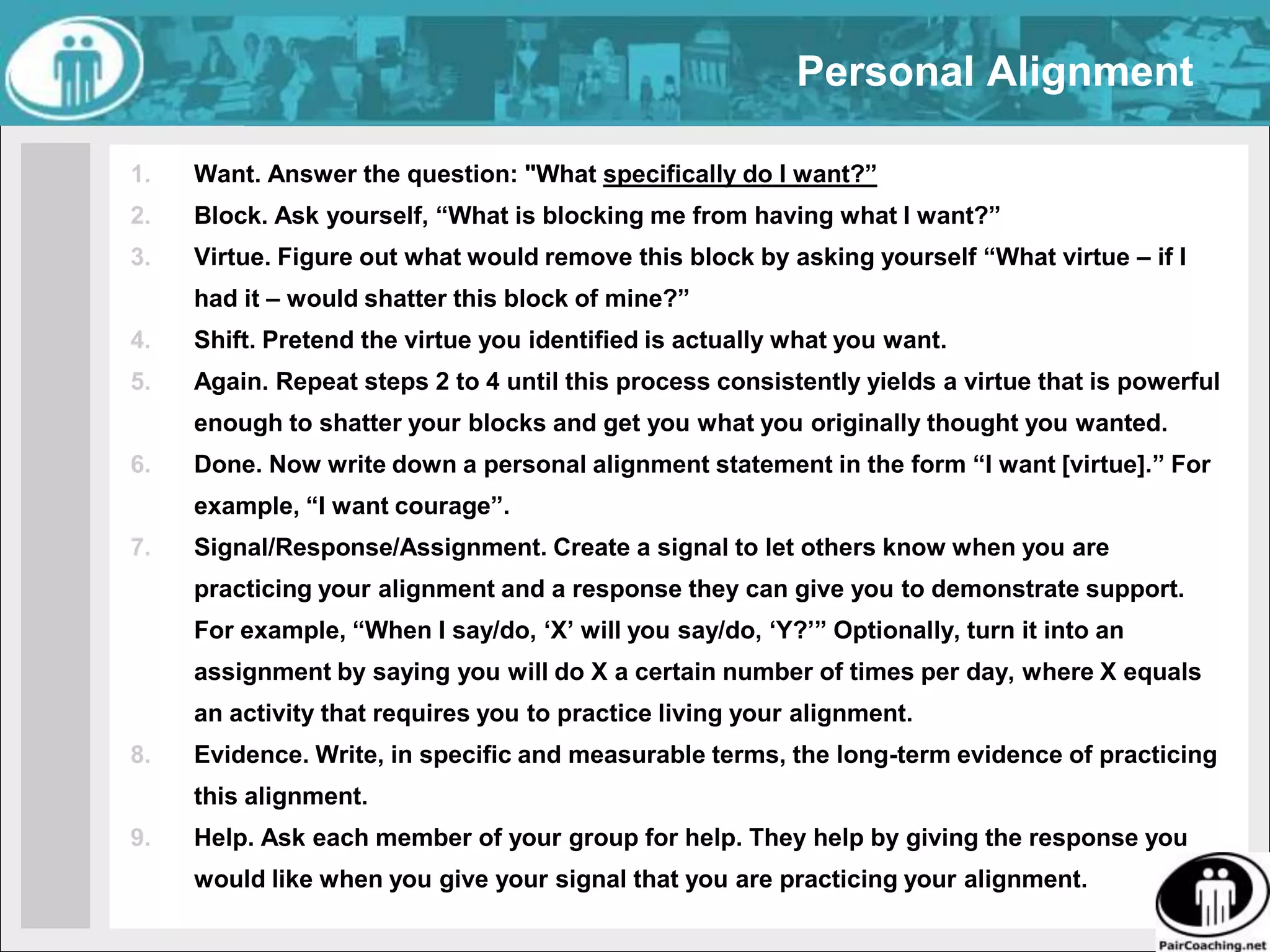
Personal AlignmentWant. Answer the question: "What specifically do I want?” Block. Ask yourself, “What is blocking me from having what I want?” Virtue. Figure out what would remove this block by asking yourself “What virtue – if I had it – would shatter this block of mine?” Shift. Pretend the virtue you identified is actually what you want. Again. Repeat steps 2 to 4 until this process consistently yields a virtue that is powerful enough to shatter your blocks and get you what you originally thought you wanted. Done. Now write down a personal alignment statement in the form “I want [virtue].” For example, “I want courage”.Signal/Response/Assignment. Create a signal to let others know when you are practicing your alignment and a response they can give you to demonstrate support. For example, “When I say/do, ‘X’ will you say/do, ‘Y?’” Optionally, turn it into an assignment by saying you will do X a certain number of times per day, where X equals an activity that requires you to practice living your alignment. Evidence. Write, in specific and measurable terms, the long-term evidence of practicing this alignment. Help. Ask each member of your group for help. They help by giving the response you would like when you give your signal that you are practicing your alignment.
EvidenceTime:Short time: todayMid term: this yearLong term: 5 years from nowWork/Life balancePersonal EvidenceWork EvidenceHow can we check?
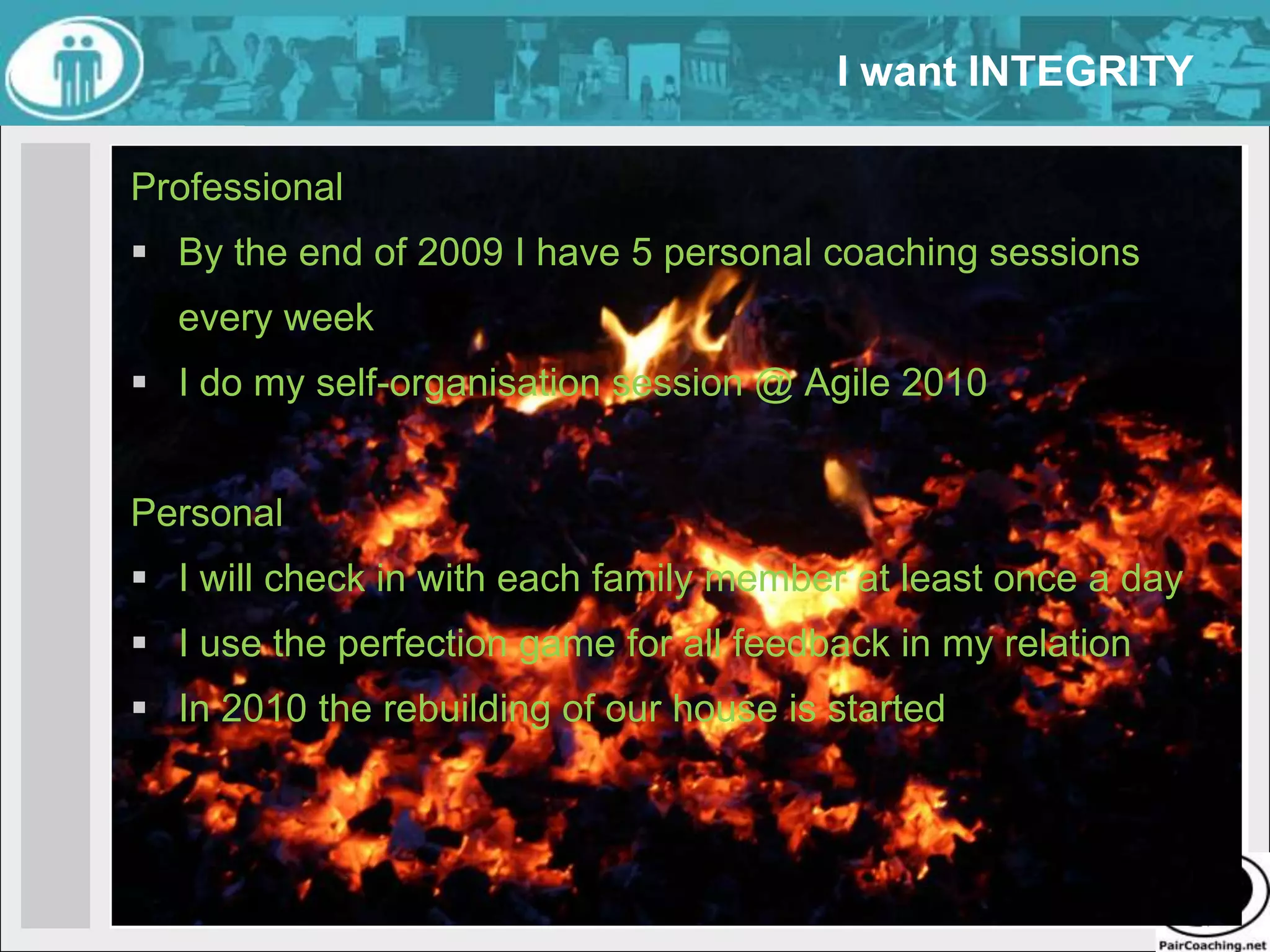
I want INTEGRITYProfessionalBy the end of 2009 I have 5 personal coaching sessions every weekI do my self-organisation session @ Agile 2010PersonalI will check in with each family member at least once a dayI use the perfection game for all feedback in my relationIn 2010 the rebuilding of our house is started
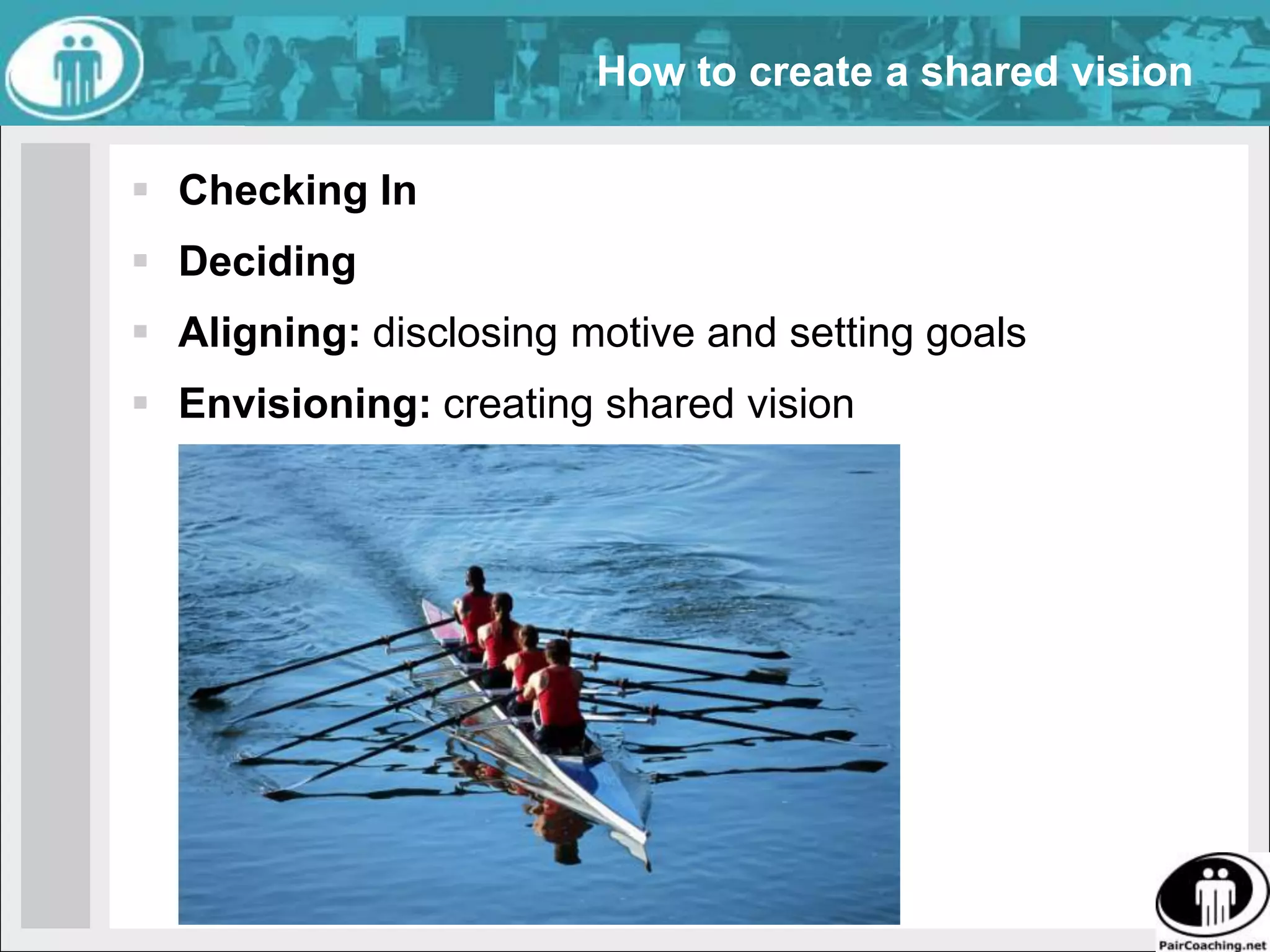
How to create a shared visionChecking InDecidingAligning: disclosing motive and setting goalsEnvisioning: creating shared vision
Conflict ResolutionPlease put your hand up if you have experienced conflict within a team
Great PracticeBeing on a team that is able to use the energyfrom conflict, and resolves every conflict directlyand efficiently, is better ...
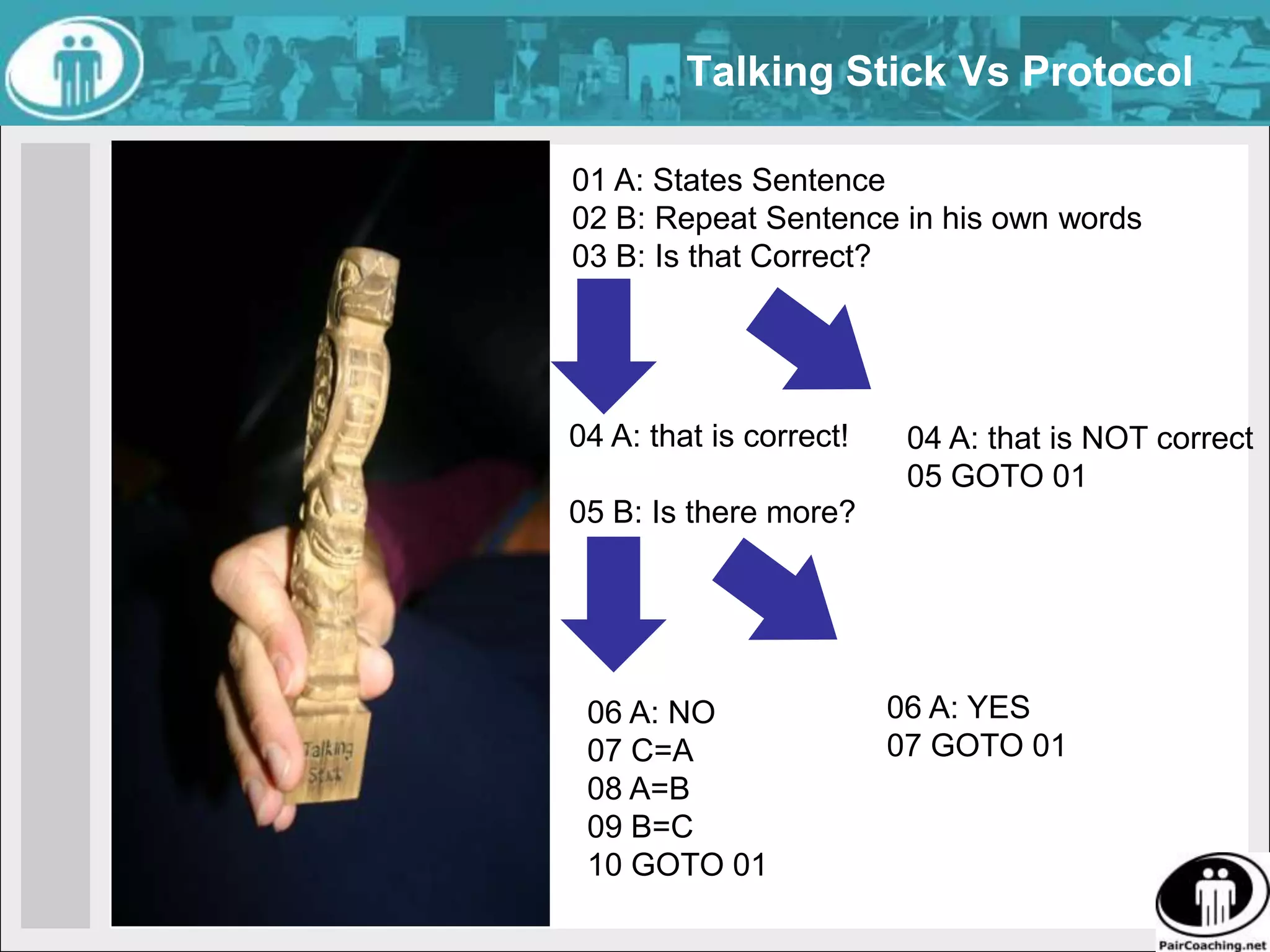
Talking Stick Vs Protocol01 A: States Sentence 02 B: Repeat Sentence in his own words03 B: Is that Correct?04 A: that is correct!05 B: Is there more?04 A: that is NOT correct05 GOTO 0106 A: YES07 GOTO 0106 A: NO07 C=A08 A=B09 B=C10 GOTO 01
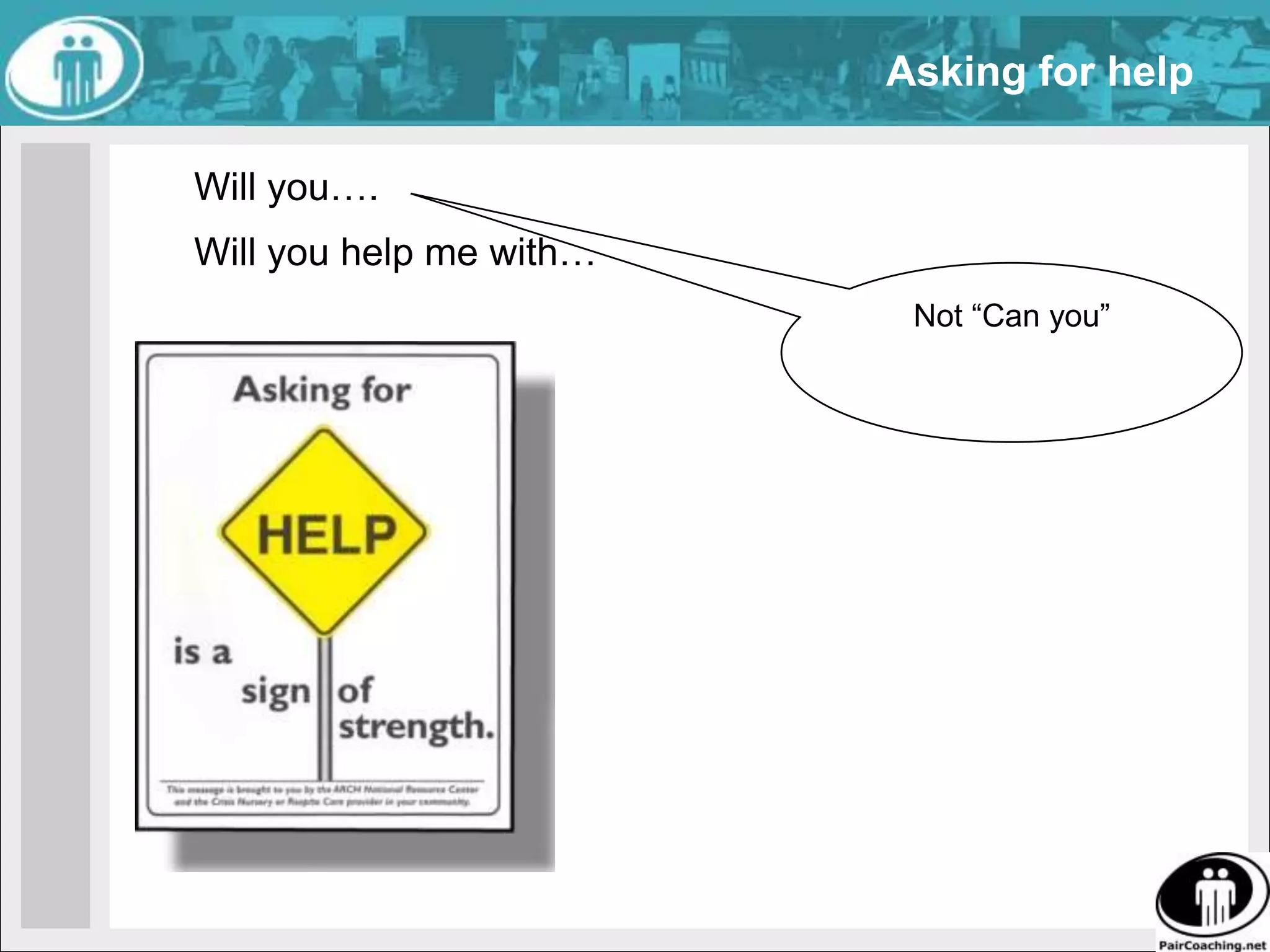
Asking for helpWill you….Will you help me with…Not “Can you”
TrustWhistle if you have been on a team that had ahigh level of trust among all team members
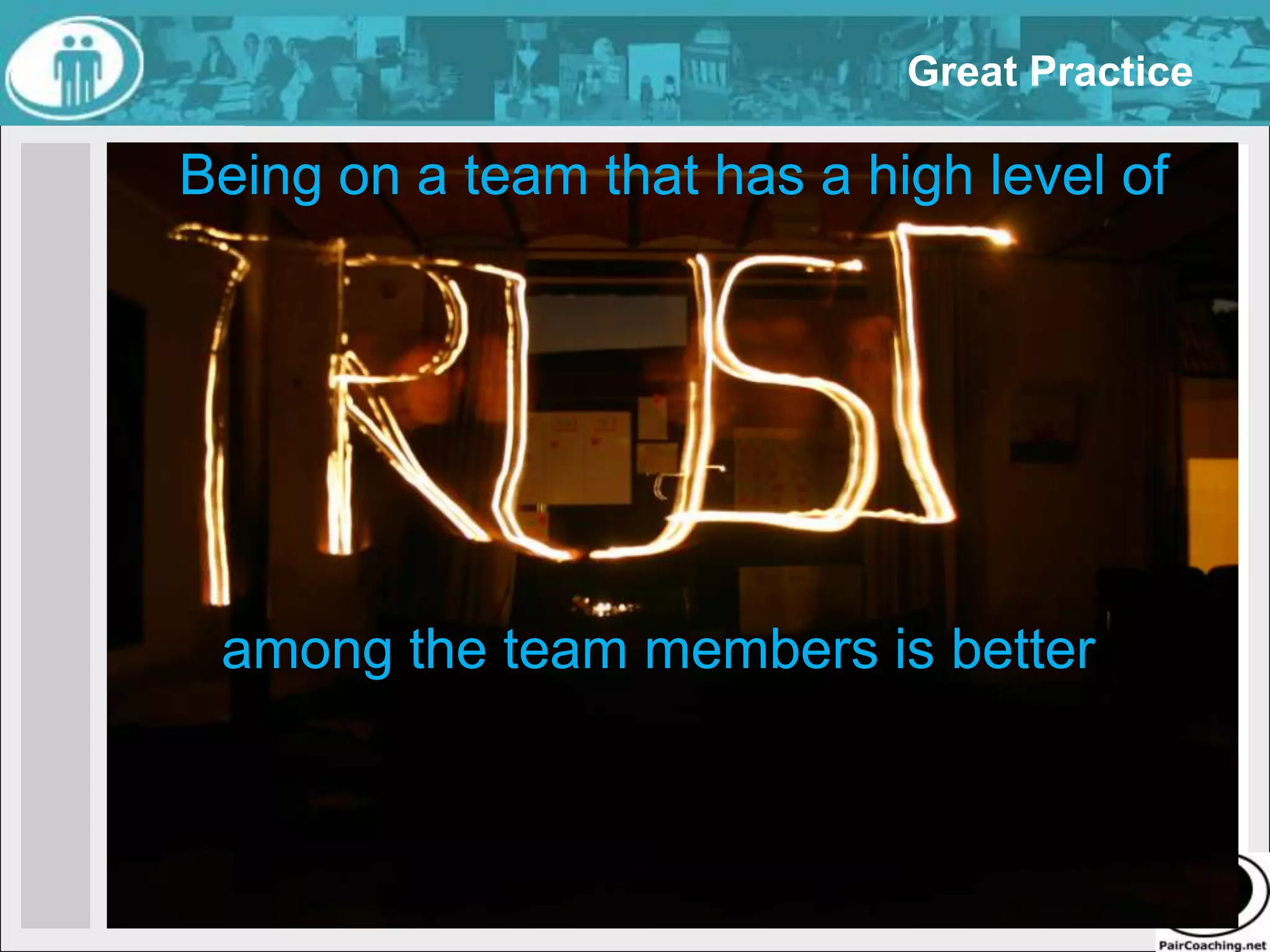
Great PracticeBeing on a team that has a high level of among the team members is better .
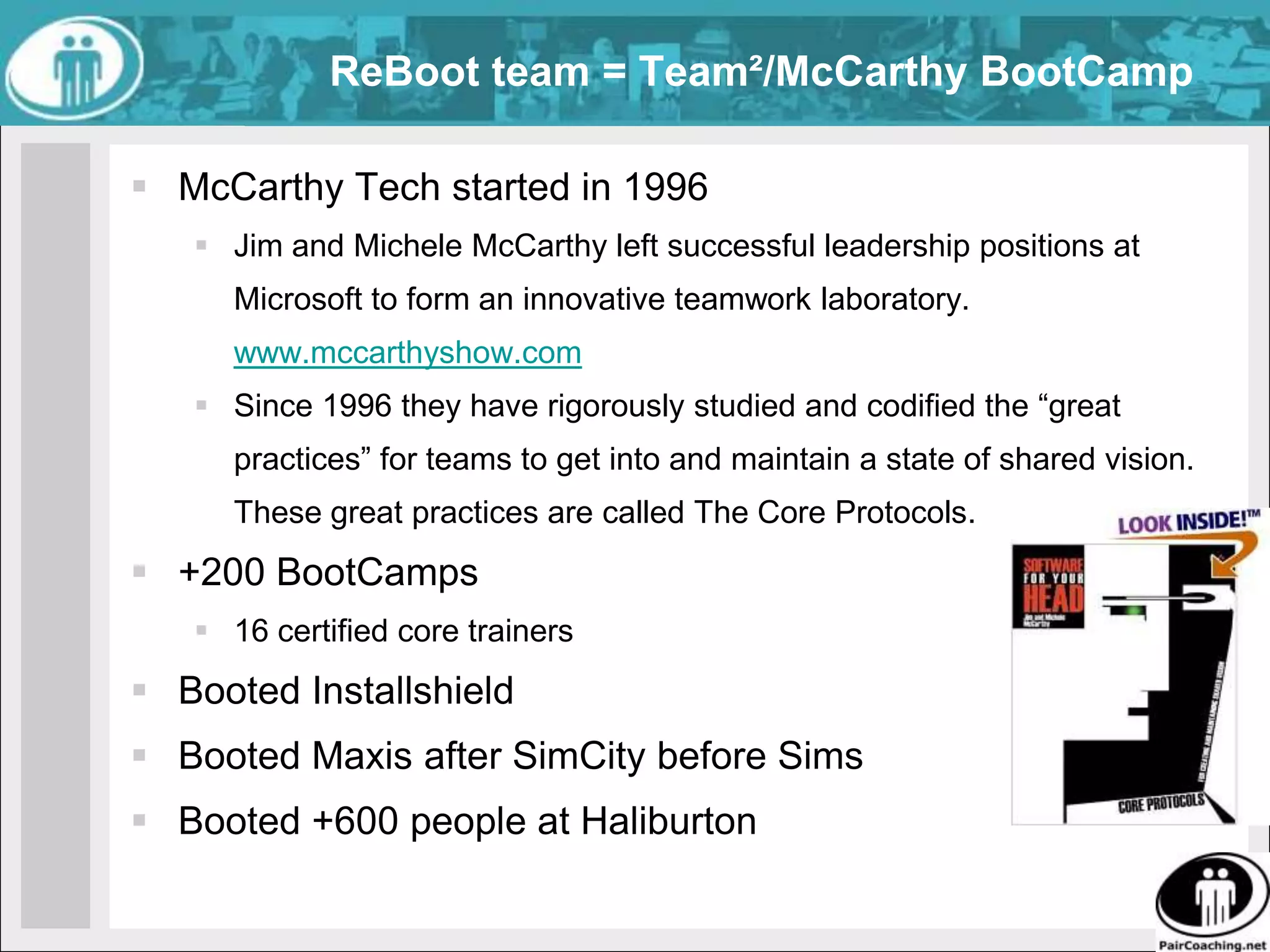
ReBoot team = Team²/McCarthy BootCampMcCarthy Tech started in 1996Jim and Michele McCarthy left successful leadership positions at Microsoft to form an innovative teamwork laboratory. www.mccarthyshow.comSince 1996 they have rigorously studied and codified the “great practices” for teams to get into and maintain a state of shared vision. These great practices are called The Core Protocols.+200 BootCamps16 certified core trainersBooted Installshield Booted Maxis after SimCity before SimsBooted +600 people at Haliburton
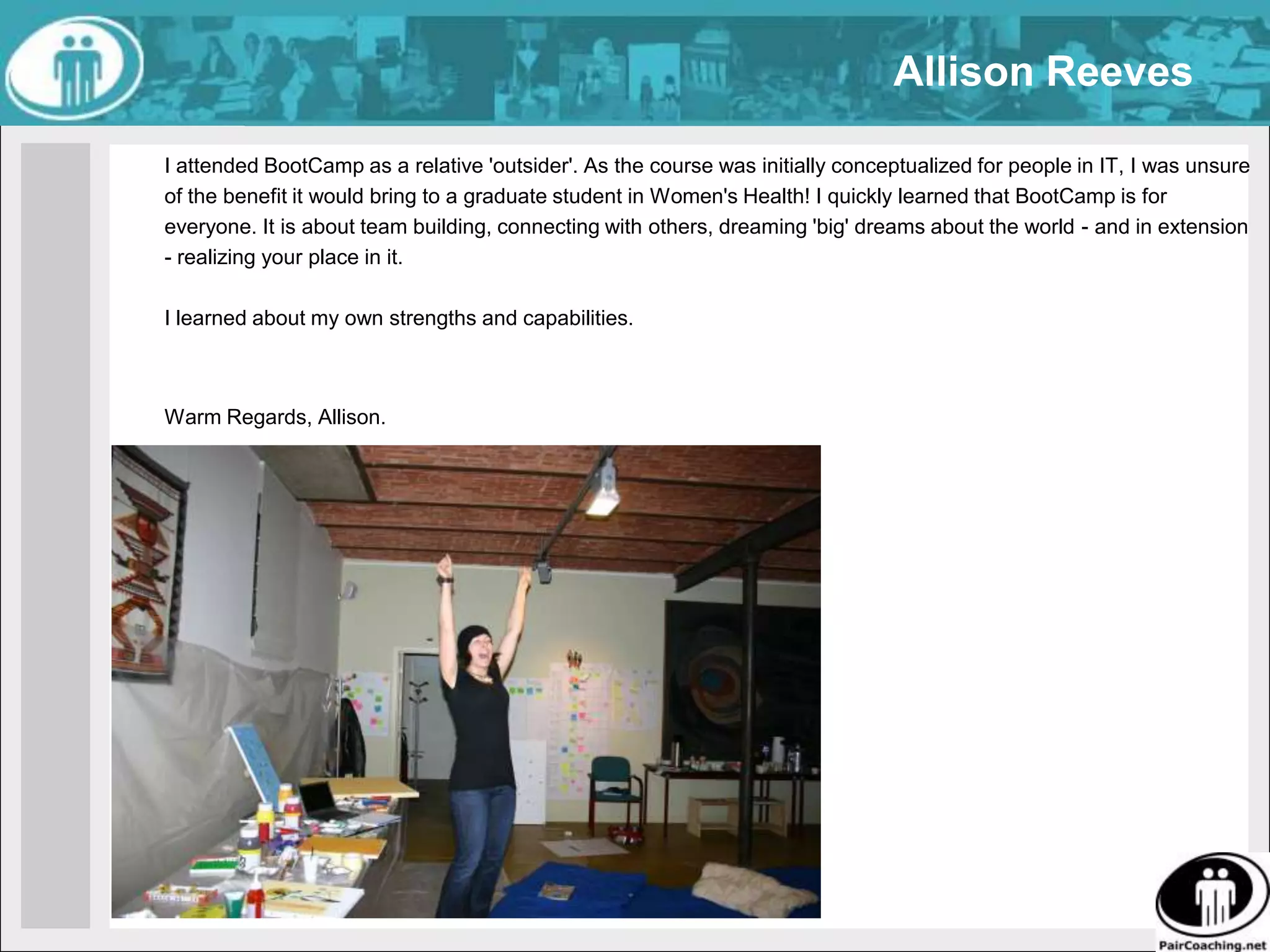
Allison Reeves	I attended BootCamp as a relative 'outsider'. As the course was initially conceptualized for people in IT, I was unsure of the benefit it would bring to a graduate student in Women's Health! I quickly learned that BootCamp is for everyone. It is about team building, connecting with others, dreaming 'big' dreams about the world - and in extension - realizing your place in it. 	I learned about my own strengths and capabilities.  	Warm Regards, Allison.
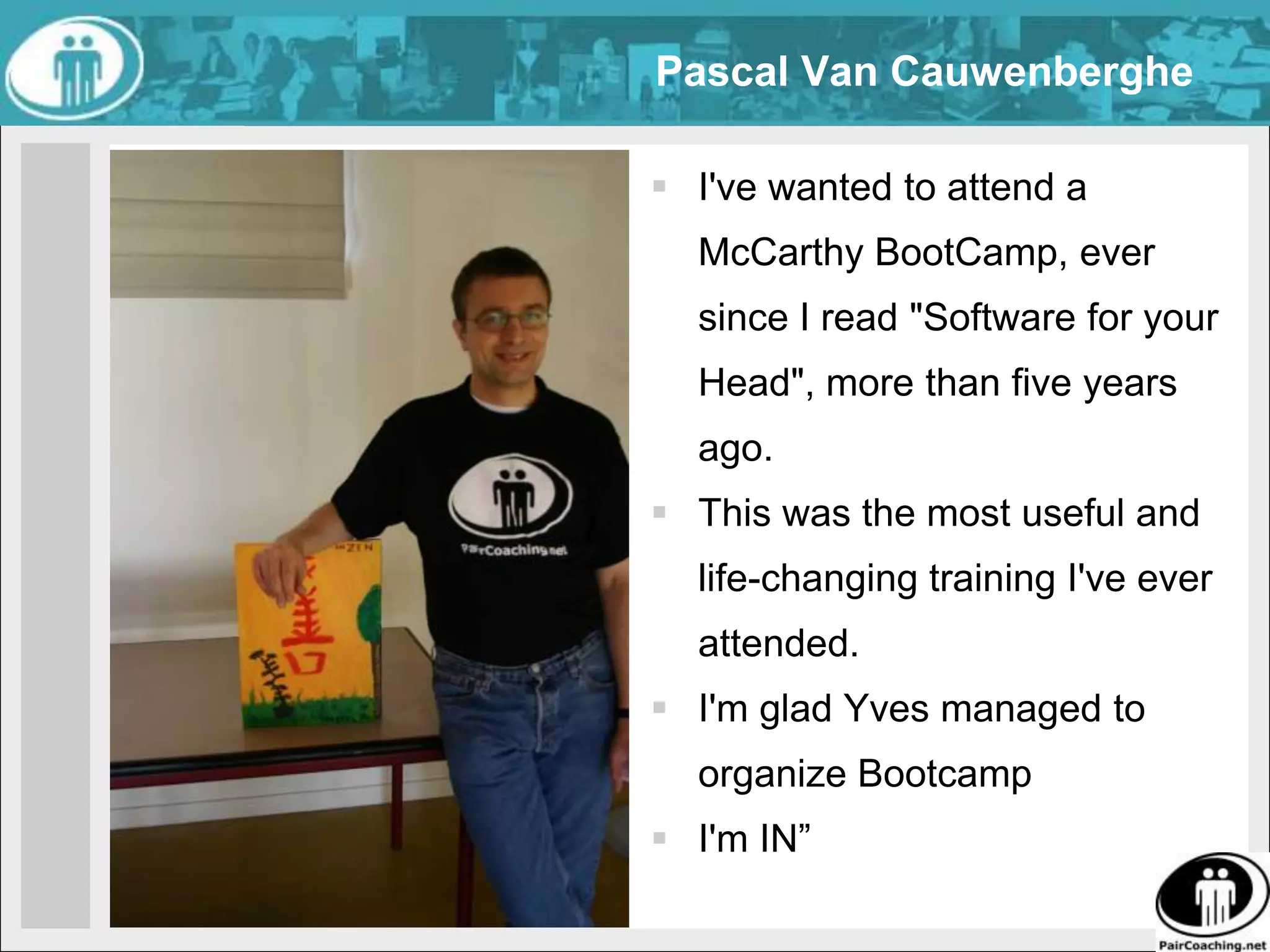
Pascal Van CauwenbergheI've wanted to attend a McCarthy BootCamp, ever since I read "Software for your Head", more than five years ago. This was the most useful and life-changing training I've ever attended. I'm glad Yves managed to organize Bootcamp I'm IN”
Bernard NotarianniThe BootCamp was one of the most amazing experience I had, both in professional and private life.
Joe Sandy Vice President Haliburton Corp.Working with the McCarthys' technology has been the smartest thing I have done in years. The 600+ people who work for me have drastically increased productivity and have shown incredible results.  In 6 months, a problem team that hadn't successfully delivered for years started finishing on time (or early) and earned rave reviews from customers.  Another team who was building heavy machinery shipped in 8 months instead of the typical 18 month time period.  Our meetings are much more efficient, with the average size down from 15 people to 5 people, and accomplishing much more in less time.The investment to date in the McCarthys' technology was easily paid back by results in only a few months.
The Core System V 3.011 commitments11 protocols
The Core CommitmentsEngage when present.Know and disclose:what I want,what I think,what I feel .
The Core CommitmentsAlways seek effective help.Decline to offer and refuse to accept incoherent emotional transmissions.
The Core CommitmentsWhen I have or hear a better idea than the currently prevailing idea, I will immediately either:propose it for decisive acceptance or rejection, and/orexplicitly seek its improvement.
The Core CommitmentsPersonally support the best idea :regardless of its source.however much I hope an even better idea may later arise.when I have no superior alternative idea.
The Core CommitmentsSeek to perceive more than I seek to be perceived.Use teams, especially when undertaking difficult tasks.
The Core CommitmentsSpeak always and only when I believe it will improve the general results/effort ratio.Offer and accept only rational, results-oriented behavior and communication.
The Core CommitmentsDisengage from less productive situations:when I cannot keep these commitments. when it is more important that I engage elsewhere.
The Core CommitmentsDo now what must be done eventually and can effectively be done now.Seek to move forward toward a particular goal, by biasing my behavior toward action.
The Core CommitmentsUse the Core Protocols (or better) when applicable.Offer and accept timely and proper use of the Protocol Check Protocol without prejudice.
The Core CommitmentsNeither harm - nor tolerate the harming of - anyone for their fidelity to these commitments.Never do anything dumb on purpose.
The Core ProtocolsPass / UnpassCheck In Check outAsk For HelpProtocol CheckIntention checkDeciderResolutionPerfection GamePersonal AlignmentInvestigate
PasserProblemWe “go along” with group activities that we don’t believe in, with increasing cynism and a sense of powerlessness for our self and our teamSolutionExplictly decline to participate when we don’t want to do something
Check-inProblemResults are unsatisfyingSolutionPublicly commit to rational behavior and efficiently disclose our feelings at work
Check-inI’m checking inI’m Glad …I’m Sad…I’m Mad…I’m Afraid…I’m inAudience:WelcomeNo other feelings allowedYou can passNobody can discuss the things said during check in
Check-outProblemWhen we can’t be mentally present we stay in a meeting anyway, regardless of the cost to our false presence to our self and our teamSolutionWhen we are not contributing, we must leave the environment without distracting our teammates
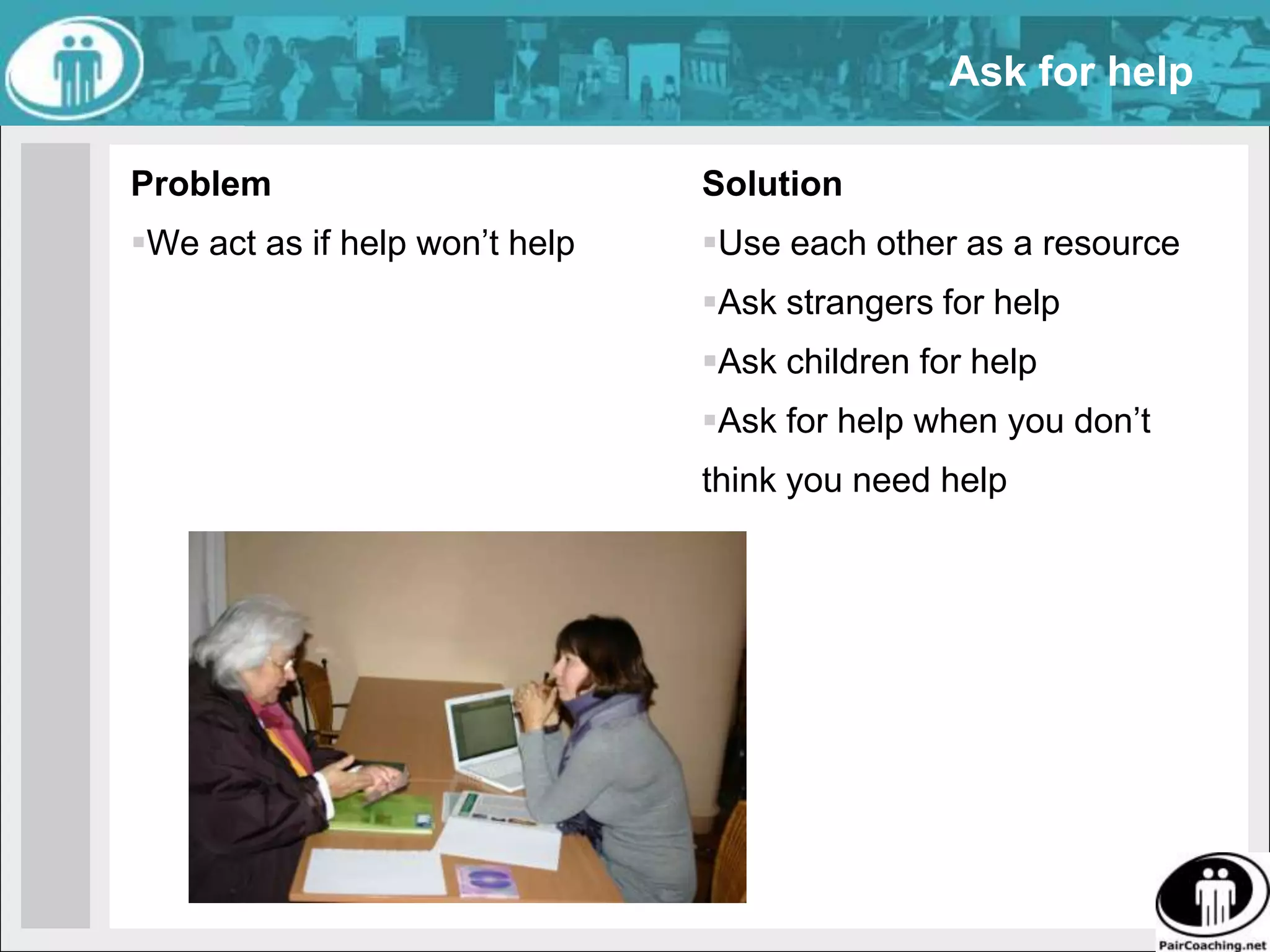
Ask for helpProblemWe act as if help won’t helpSolutionUse each other as a resourceAsk strangers for helpAsk children for helpAsk for help when you don’t think you need help
Asking for helpWill you….
Will you help me with…Not “Can you”
Protocol CheckSay “Protocol Check”If you know the protocol, state it. If you don’t, ask for help
Work with IntentionProblemWe don’t know if our behaviour will be what we wantSolutionDecide on our intention before we act or speakUse Intention Check to clarify the purpose of your own or another’s behavior. Use it when you can’t imagine a positive outcome resulting from the current behavior
Intention CheckAsk “What is your/my intention with X?” Where x equals some type of actual  or pending behavior to the persons whose intention you want to know?If it would be helpfull, ask ”What response or behavior did you want from whom as a result of X?”
DeciderProblemOur Team’s decision process does not provide each member with an explicit say, or provide a means to hold members accountable for the resultSolutionUse a reliable, unanimity-driven process within the team.
Decider1. Proposer says “I propose [concise, actionable behavior].”2. Proposer says “1-2-3.”3.Voters, using either Yes (thumbs up), No (thumbs down), Support-it (flat hand), vote simultaneously with other voters.
ResolutionProblemWe have difficulties reaching unanimous support for a proposalSolutionOnly talk about what it will take to get the outlier “in”.
ResolutionSteps1. Proposer asks outlier “What will it take to get you in?”2. Outlier states in a single, short, declarative sentence the precise modification required to be in.3. Proposer offers to adopt the outlier’s changes or withdraws the proposal.Only outliers can talk
FeedbackProblemThere is no standard way to gain value for our work or personal performance from another personOr to add our value to the work product or the personal performance of another personFalse SolutionWe give or seek feedbackActual SolutionUse the perfection game when asked
The Perfection GameWill you perfect my …I will give it a x out of 10What I like about it is …To give it a ten I would need…If you have nothing to make it better, you have to give a 10
AligningPersonal goals motivate people; team goals motivate teams. Team goals are derived from Visions. Visions are derived from personal goals.Tie Goals to VisionTie Vision to Goals
AlignmentProblemWe think there are not enough people or other resources to get the job done well.SolutionAlign the team around what each member wantsInstead of adding head count, make the heads we have count.
Personal AlignmentProblemWe don’t know what we wantSolutionDiscover what we want, tell our teammates what that is.Ask for their helpExpect them to do likewise
InvestigateProblemWe see others as better than ourselvesCommunciation barriers prevent us from stating this clearlySolutionInquire into one another as a naïvely curious and nonjudgmental investigator
Shared VisonA shared vision is not a statement or a goal, it is a “state of being” which is intentionally created by a mature team
Shared VisionProblemWe work without first together deciding what we are going to createSolutionFirst and always, make sure our team is aligned around our vision
Far VisionProblemWe work hard, burn out, and wonder why we botherSolutionInsist that all projects have a long term noble purpose
Versions of the VisionProblemWe have an unwieldy list of features or demands from our customersSolutionCreate a sequence of “Solution versions” that must be accomplished in a step-by-step manner in order to satisfy the customer
Anti-patternsNo Hurt feelingsWrong toleranceTeam==productResolution avoidance
No hurt feelingsProblemWe don’t want to hurt the feelings of our teammates, so we fail to add the value we have to our team’s work  productFalse SolutionIf we can’t find a way to tell the truth without upsetting people, we don’t speakActual SolutionFocus on team results, not on team member’s feelings
Wrong toleranceProblemWe tolerate behaviors that don’t work wellFalse SolutionWe learn to live in the “real world” or complain to others who we think can fix the problemActual SolutionAcknowledge that if we tolerate it, we insist on it
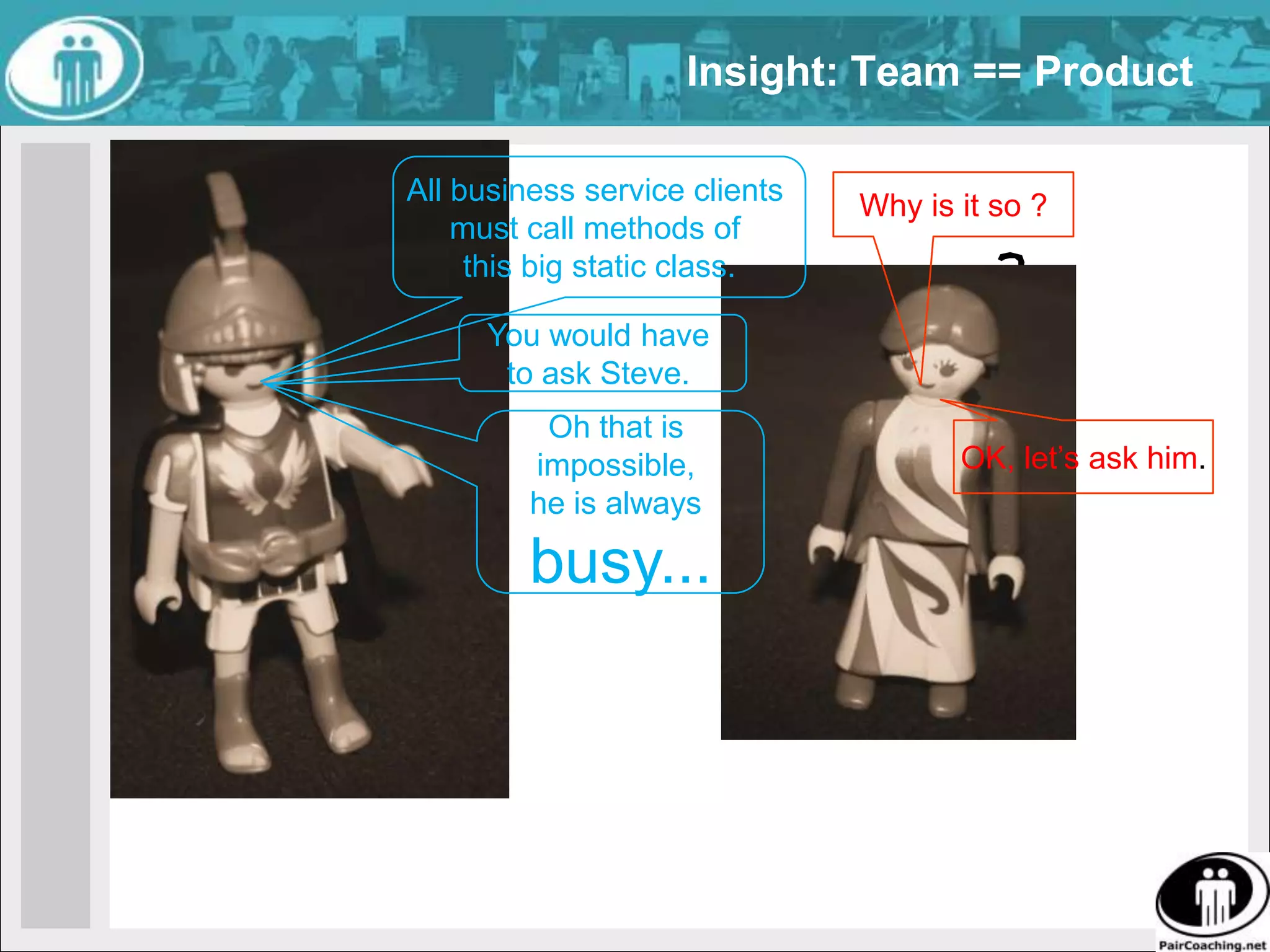
Insight: Team == ProductAll business service clients must call methods of this big static class.Why is it so ?You would have to ask Steve. Oh that is impossible, he is always busy...OK, let’s ask him.
Resolution avoidanceProblemWe don’t deal efficiently with conflict because we are afraid of itFalse SolutionLay lowDon’t cause problemsAvoid conflictThis does not avoid conflict, it postpones itActual SolutionSeek resolution
Typical QuestionsWhat is the methodology used?What are the underlying principles
Methodologyan experiential workshop a results oriented business simulation using behavioural tools to provide structured empowerment

The Core Protocols Zen

  • 1.
  • 2.
    Me.About()Yves HanoulleProject CoachTraining,Coaching & Consultancy Services on agile & Team practicesin EMEA. Certified Core TrainerPartner of Els RyssenFather of Joppe 2002, Bent 2004, Geike 2007
  • 3.
    You.About()Who are you?Whatmakes you different?What do you know about the Core?Other info you like to share?What would be the successful outcome of this talk for you?
  • 4.
    DisclaimerYou don’t haveto believe in the sea to get wetYou do have to get IN to get wet
  • 5.
    great practices insteadof BEST Practices
  • 6.
    2 Leadership modelsWork1manager5 to 5000
  • 7.
    2 Leadership modelsHome2parents1 to 5 childrenRaising children as a single parent is hard
  • 8.
    Who’s right?I proposeyou try Pair Coaching inside your company
  • 9.
    The agile manifestoIndividualsand interactionsWorking softwareCustomer collaborationResponding to changeover processes and toolscomprehensive documentation over contract negotiation over following a plan http://agilemanifesto.org/
  • 10.
    Principles behind theAgile ManifestoOur highest priority is to satisfy the customer through early and continuous delivery of valuable software. Welcome changing requirements, even late in development. Agile processes harness change for the customer's competitive advantage. Deliver working software frequently, from a couple of weeks to a couple of months, with a preference to the shorter timescale. Business people and developers must work together daily throughout the project. Build projects around motivated individuals. Give them the environment and support they need, and trust them to get the job done. The most efficient and effective method of conveying information to and within a development team is face-to-face conversation. Working software is the primary measure of progress. Agile processes promote sustainable development. The sponsors, developers, and users should be able to maintain a constant pace indefinitely. Continuous attention to technical excellence and good design enhances agility. Simplicity--the art of maximizing the amount of work not done--is essential. The best architectures, requirements, and designs emerge from self-organizing teams. At regular intervals, the team reflects on how to become more effective, then tunes and adjusts its behavior accordingly.
  • 11.
    Building greatsoftware is easy
  • 12.
  • 13.
  • 14.
    Shared VisionPlease standif you have ever been on a team with a shared visionPlease sit down when what I say is NOT true from your experience on that team
  • 15.
    Being on ateam that has a shared vision is atleast ___ times as goodas being on a team that doesn't
  • 16.
    Emotions at workPleasesay Oh my god ! if you ever had a team member hiding how he felt.123
  • 17.
    Great practiceBeing ona team that states feelings, is better thanbeing on a team where feelings get in the way
  • 18.
  • 19.
    ExerciseI’m checking inI’mGlad …I’m Sad…I’m Mad…I’m Afraid…I’m inAudience:WelcomeNo other feelings allowedYou can passNobody can discuss the things said during check in
  • 20.
    Decision MakingPlease sayYES! if you have been on a team that made decisions without pain
  • 21.
    Great PracticeBeing ona team that makes unanimous decisionsquickly, without redundant blather, is better thanbeing on a team that does not
  • 22.
  • 23.
    ResolutionProblemWe have difficultiesreaching unanimous support for a proposalSolutionOnly talk about what it will take to get the outlier “in”.
  • 24.
    ResolutionSteps1. Proposer asksoutlier “What will it take to get you in?”2. Outlier states in a single, short, declarative sentence the precise modification required to be in.3. Proposer offers to adopt the outlier’s changes or withdraws the proposal.Only outliers can talk
  • 25.
    Exercise1. Proposer says“I propose [concise, actionable behavior].”2. Proposer says “1-2-3.”3.Voters, using either Yes (thumbs up), No (thumbs down), Support-it (flat hand), vote simultaneously with other voters.
  • 26.
  • 27.
    AlignmentPersonal goals motivatepeople; team goals motivate teams. Team goals are derived from Visions. Visions are derived from personal goals.
  • 28.
  • 29.
    Personal AlignmentWant. Answerthe question: "What specifically do I want?” Block. Ask yourself, “What is blocking me from having what I want?” Virtue. Figure out what would remove this block by asking yourself “What virtue – if I had it – would shatter this block of mine?” Shift. Pretend the virtue you identified is actually what you want. Again. Repeat steps 2 to 4 until this process consistently yields a virtue that is powerful enough to shatter your blocks and get you what you originally thought you wanted. Done. Now write down a personal alignment statement in the form “I want [virtue].” For example, “I want courage”.Signal/Response/Assignment. Create a signal to let others know when you are practicing your alignment and a response they can give you to demonstrate support. For example, “When I say/do, ‘X’ will you say/do, ‘Y?’” Optionally, turn it into an assignment by saying you will do X a certain number of times per day, where X equals an activity that requires you to practice living your alignment. Evidence. Write, in specific and measurable terms, the long-term evidence of practicing this alignment. Help. Ask each member of your group for help. They help by giving the response you would like when you give your signal that you are practicing your alignment.
  • 30.
    EvidenceTime:Short time: todayMidterm: this yearLong term: 5 years from nowWork/Life balancePersonal EvidenceWork EvidenceHow can we check?
  • 31.
    I want INTEGRITYProfessionalBythe end of 2009 I have 5 personal coaching sessions every weekI do my self-organisation session @ Agile 2010PersonalI will check in with each family member at least once a dayI use the perfection game for all feedback in my relationIn 2010 the rebuilding of our house is started
  • 32.
    How to createa shared visionChecking InDecidingAligning: disclosing motive and setting goalsEnvisioning: creating shared vision
  • 33.
    Conflict ResolutionPlease putyour hand up if you have experienced conflict within a team
  • 34.
    Great PracticeBeing ona team that is able to use the energyfrom conflict, and resolves every conflict directlyand efficiently, is better ...
  • 35.
    Talking Stick VsProtocol01 A: States Sentence 02 B: Repeat Sentence in his own words03 B: Is that Correct?04 A: that is correct!05 B: Is there more?04 A: that is NOT correct05 GOTO 0106 A: YES07 GOTO 0106 A: NO07 C=A08 A=B09 B=C10 GOTO 01
  • 36.
    Asking for helpWillyou….Will you help me with…Not “Can you”
  • 37.
    TrustWhistle if youhave been on a team that had ahigh level of trust among all team members
  • 38.
    Great PracticeBeing ona team that has a high level of among the team members is better .
  • 39.
    ReBoot team =Team²/McCarthy BootCampMcCarthy Tech started in 1996Jim and Michele McCarthy left successful leadership positions at Microsoft to form an innovative teamwork laboratory. www.mccarthyshow.comSince 1996 they have rigorously studied and codified the “great practices” for teams to get into and maintain a state of shared vision. These great practices are called The Core Protocols.+200 BootCamps16 certified core trainersBooted Installshield Booted Maxis after SimCity before SimsBooted +600 people at Haliburton
  • 40.
    Allison Reeves I attendedBootCamp as a relative 'outsider'. As the course was initially conceptualized for people in IT, I was unsure of the benefit it would bring to a graduate student in Women's Health! I quickly learned that BootCamp is for everyone. It is about team building, connecting with others, dreaming 'big' dreams about the world - and in extension - realizing your place in it.  I learned about my own strengths and capabilities.   Warm Regards, Allison.
  • 41.
    Pascal Van CauwenbergheI'vewanted to attend a McCarthy BootCamp, ever since I read "Software for your Head", more than five years ago. This was the most useful and life-changing training I've ever attended. I'm glad Yves managed to organize Bootcamp I'm IN”
  • 42.
    Bernard NotarianniThe BootCampwas one of the most amazing experience I had, both in professional and private life.
  • 43.
    Joe Sandy VicePresident Haliburton Corp.Working with the McCarthys' technology has been the smartest thing I have done in years. The 600+ people who work for me have drastically increased productivity and have shown incredible results.  In 6 months, a problem team that hadn't successfully delivered for years started finishing on time (or early) and earned rave reviews from customers.  Another team who was building heavy machinery shipped in 8 months instead of the typical 18 month time period.  Our meetings are much more efficient, with the average size down from 15 people to 5 people, and accomplishing much more in less time.The investment to date in the McCarthys' technology was easily paid back by results in only a few months.
  • 44.
    The Core SystemV 3.011 commitments11 protocols
  • 45.
    The Core CommitmentsEngagewhen present.Know and disclose:what I want,what I think,what I feel .
  • 46.
    The Core CommitmentsAlwaysseek effective help.Decline to offer and refuse to accept incoherent emotional transmissions.
  • 47.
    The Core CommitmentsWhenI have or hear a better idea than the currently prevailing idea, I will immediately either:propose it for decisive acceptance or rejection, and/orexplicitly seek its improvement.
  • 48.
    The Core CommitmentsPersonallysupport the best idea :regardless of its source.however much I hope an even better idea may later arise.when I have no superior alternative idea.
  • 49.
    The Core CommitmentsSeekto perceive more than I seek to be perceived.Use teams, especially when undertaking difficult tasks.
  • 50.
    The Core CommitmentsSpeakalways and only when I believe it will improve the general results/effort ratio.Offer and accept only rational, results-oriented behavior and communication.
  • 51.
    The Core CommitmentsDisengagefrom less productive situations:when I cannot keep these commitments. when it is more important that I engage elsewhere.
  • 52.
    The Core CommitmentsDonow what must be done eventually and can effectively be done now.Seek to move forward toward a particular goal, by biasing my behavior toward action.
  • 53.
    The Core CommitmentsUsethe Core Protocols (or better) when applicable.Offer and accept timely and proper use of the Protocol Check Protocol without prejudice.
  • 54.
    The Core CommitmentsNeitherharm - nor tolerate the harming of - anyone for their fidelity to these commitments.Never do anything dumb on purpose.
  • 55.
    The Core ProtocolsPass/ UnpassCheck In Check outAsk For HelpProtocol CheckIntention checkDeciderResolutionPerfection GamePersonal AlignmentInvestigate
  • 56.
    PasserProblemWe “go along”with group activities that we don’t believe in, with increasing cynism and a sense of powerlessness for our self and our teamSolutionExplictly decline to participate when we don’t want to do something
  • 57.
    Check-inProblemResults are unsatisfyingSolutionPubliclycommit to rational behavior and efficiently disclose our feelings at work
  • 58.
    Check-inI’m checking inI’mGlad …I’m Sad…I’m Mad…I’m Afraid…I’m inAudience:WelcomeNo other feelings allowedYou can passNobody can discuss the things said during check in
  • 59.
    Check-outProblemWhen we can’tbe mentally present we stay in a meeting anyway, regardless of the cost to our false presence to our self and our teamSolutionWhen we are not contributing, we must leave the environment without distracting our teammates
  • 60.
    Ask for helpProblemWeact as if help won’t helpSolutionUse each other as a resourceAsk strangers for helpAsk children for helpAsk for help when you don’t think you need help
  • 61.
  • 62.
    Will you helpme with…Not “Can you”
  • 63.
    Protocol CheckSay “ProtocolCheck”If you know the protocol, state it. If you don’t, ask for help
  • 64.
    Work with IntentionProblemWedon’t know if our behaviour will be what we wantSolutionDecide on our intention before we act or speakUse Intention Check to clarify the purpose of your own or another’s behavior. Use it when you can’t imagine a positive outcome resulting from the current behavior
  • 65.
    Intention CheckAsk “Whatis your/my intention with X?” Where x equals some type of actual or pending behavior to the persons whose intention you want to know?If it would be helpfull, ask ”What response or behavior did you want from whom as a result of X?”
  • 66.
    DeciderProblemOur Team’s decisionprocess does not provide each member with an explicit say, or provide a means to hold members accountable for the resultSolutionUse a reliable, unanimity-driven process within the team.
  • 67.
    Decider1. Proposer says“I propose [concise, actionable behavior].”2. Proposer says “1-2-3.”3.Voters, using either Yes (thumbs up), No (thumbs down), Support-it (flat hand), vote simultaneously with other voters.
  • 68.
    ResolutionProblemWe have difficultiesreaching unanimous support for a proposalSolutionOnly talk about what it will take to get the outlier “in”.
  • 69.
    ResolutionSteps1. Proposer asksoutlier “What will it take to get you in?”2. Outlier states in a single, short, declarative sentence the precise modification required to be in.3. Proposer offers to adopt the outlier’s changes or withdraws the proposal.Only outliers can talk
  • 70.
    FeedbackProblemThere is nostandard way to gain value for our work or personal performance from another personOr to add our value to the work product or the personal performance of another personFalse SolutionWe give or seek feedbackActual SolutionUse the perfection game when asked
  • 71.
    The Perfection GameWillyou perfect my …I will give it a x out of 10What I like about it is …To give it a ten I would need…If you have nothing to make it better, you have to give a 10
  • 72.
    AligningPersonal goals motivatepeople; team goals motivate teams. Team goals are derived from Visions. Visions are derived from personal goals.Tie Goals to VisionTie Vision to Goals
  • 73.
    AlignmentProblemWe think thereare not enough people or other resources to get the job done well.SolutionAlign the team around what each member wantsInstead of adding head count, make the heads we have count.
  • 74.
    Personal AlignmentProblemWe don’tknow what we wantSolutionDiscover what we want, tell our teammates what that is.Ask for their helpExpect them to do likewise
  • 75.
    InvestigateProblemWe see othersas better than ourselvesCommunciation barriers prevent us from stating this clearlySolutionInquire into one another as a naïvely curious and nonjudgmental investigator
  • 76.
    Shared VisonA sharedvision is not a statement or a goal, it is a “state of being” which is intentionally created by a mature team
  • 77.
    Shared VisionProblemWe workwithout first together deciding what we are going to createSolutionFirst and always, make sure our team is aligned around our vision
  • 78.
    Far VisionProblemWe workhard, burn out, and wonder why we botherSolutionInsist that all projects have a long term noble purpose
  • 79.
    Versions of theVisionProblemWe have an unwieldy list of features or demands from our customersSolutionCreate a sequence of “Solution versions” that must be accomplished in a step-by-step manner in order to satisfy the customer
  • 80.
    Anti-patternsNo Hurt feelingsWrongtoleranceTeam==productResolution avoidance
  • 81.
    No hurt feelingsProblemWedon’t want to hurt the feelings of our teammates, so we fail to add the value we have to our team’s work productFalse SolutionIf we can’t find a way to tell the truth without upsetting people, we don’t speakActual SolutionFocus on team results, not on team member’s feelings
  • 82.
    Wrong toleranceProblemWe toleratebehaviors that don’t work wellFalse SolutionWe learn to live in the “real world” or complain to others who we think can fix the problemActual SolutionAcknowledge that if we tolerate it, we insist on it
  • 83.
    Insight: Team ==ProductAll business service clients must call methods of this big static class.Why is it so ?You would have to ask Steve. Oh that is impossible, he is always busy...OK, let’s ask him.
  • 84.
    Resolution avoidanceProblemWe don’tdeal efficiently with conflict because we are afraid of itFalse SolutionLay lowDon’t cause problemsAvoid conflictThis does not avoid conflict, it postpones itActual SolutionSeek resolution
  • 85.
    Typical QuestionsWhat isthe methodology used?What are the underlying principles
  • 86.
    Methodologyan experiential workshopa results oriented business simulation using behavioural tools to provide structured empowerment
  • 87.
    Underlying principlesself andgroup alignmenttight accountabilityshared visiontimely delivery
  • 88.
    Resources:BooksSoftware for yourheadThe Speed of TrustThe 7 habits of highly effective peopleThe five dysfunctions of a teamSituational LeadershipTeamwork is an individual skillWave RiderX-TeamsLeading Geeks
  • 89.
    Resources: URLThe CoreProtocols: http://alturl.com/b9fnBruce Tuckmanhttp://en.wikipedia.org/wiki/Forming-storming-norming-performingSituational Leadership Hersey-Blanchardhttp://en.wikipedia.org/wiki/Situational_leadership_theoryDan Pink on TED about Intrinsic vs Extrinsic motivation http://paircoaching.wordpress.com/2009/09/03/daniel-pink-on-intrinsic-extrinsic-motivation/
  • 90.
    Copyright Pictures:© HamedSaber http://www.flickr.com/photos/hamed© Ed Yourdon http://www.flickr.com/photos/yourdon/© Jan Tielens http://www.flickr.com/photos/neleenjan/
  • 91.
    Free Lifetime supportTwitter:http://twitter.com/YvesHanoulleSlideShare: http://slideshare.net/YvesHanoulleLinkedin: http://www.linkedin.com/in/YvesHanoulleWeb: http://www.PairCoaching.netBlog: http://PairCoaching.wordpress.comFlickr: http://www.Flickr.com/YvesHanoulleBooks: http://www.librarything.com/catalog.php?view=YvesHanoulleMail : FirstName at Paircoaching dot netMobile: +32 476 43 38 32Skype: YvesHanoulle
  • 92.
    PairCoaching.net the wayto leading greatnessThank you !!www.PairCoaching.net

Editor's Notes

  • #6 JB Tweet had a big impact on my presentation.
  • #12 Build a great team and they wil build the software (dixit Pascal Van Cauwenberghe)
  • #13 FormingThe “polite”stage in which the team starts to form.􀂆Everyone is trying to figure out what the team concept is.􀂆Initial “silent”leaders may take the rein.􀂆The team is usually positive –for the most part –for the initial meetings.􀂆No one has offended anyone at this point yet! StormingThe honeymoon is over.􀂆The silent leaders may be clashing for control of the group.􀂆People disagree and may blame the team concept, saying it doesn’t work.􀂆Management needs to do a lot of coaching to get people to work past their differences, may take separate 1–on–1’s with people.Norming: The team is starting to work well together, and has turned around from the ‘storming”phase. 􀂆They may start to “brag up”the team concept to others who aren’t in the team and will be very positive about their role/team group. 􀂆Often, the team will bounce back and forth between “storming”and “norming”when issues crop up.PerformingThis is the level where the team is a high–performance team.􀂆They can be given new projects and tasks and accomplish them successfully, and very seldom fall back into the “storming”phase.􀂆At this level, the team is taking on new work on their own, and selling it to other teams.
  • #14 Horizontal Stearing: Task Oriented behaviourSet goalsOrganisingDefine timeboxesGive directionsChecking up (control)Vertical Support: Relation oriented behaviorSupply supportCommunicationCollaboration improvingActive listening (See my next Session)Give relational feedback
  • #15 Shared Vision is a state, not a statement
  • #16 Shared Vision is a State not a statement
  • #17 How would you describe effective decision makingon a team?What are some of the important team results ofefficient, painless decision making?
  • #19 Remember the social connections that Juta talked aboutStory of discussion with Els in the morningI’ll check inI’m GLAD that I’m at Agile Eastern EuropeI’m SAD, AFRAID that Tom Poppendieck had a stroke last weekI’m GLAD he’s OK nowI’m SAD I could not play my leadership GameI’m GLAD, AFRAID this gave me the opportunity to create this talkI’m AFRAID as this is the first iteration of this talkI’m GLAD I did a lot of dry run’sI’m MAD & GLAD JB tweet has moved me to change my slidesI’m AFRAID I changed my talk after my last Dry RUNI’m GLAD, AFRAID this talk is captured by Camera’sI’m SAD as I wo’nt see my family for 5 daysI’m GLAD to see so many people in this roomI’m IN
  • #21 How would you describe effective decision makingon a team?What are some of the important team results ofefficient, painless decision making?
  • #27 In eight of the nine tasks we examined across the three experiments higher incentives led to worse performance
  • #28 Instead of adding head count, make the heads we have count
  • #34 Was the conflict a help or a hindrance?Did resolving the conflict help the team move forward?
  • #36 Seek first to understandThen to be understood
  • #38 How did you recognize that trust?What did that level of trust do for the team?
  • #57 Also known as the law of 2 feet