Social Human
Architecture for
Beginners
Sebastian Schürmann
@sschuermann
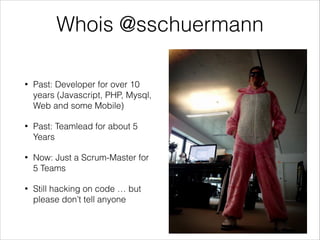
Whois @sschuermann
•

Past: Developer for over 10
years (Javascript, PHP, Mysql,
Web and some Mobile)

•

Past: Teamlead for about 5
Years

•

Now: Just a Scrum-Master for
5 Teams

•

Still hacking on code … but
please don’t tell anyone
Thesis:!
The Job as a Senior Developer or TeamLead is about excelling in Technology,
Architecture and Programming!
It’s not!
It’s about people, how to make
them working together as groups
and how to motivate them to do
the right things the right way.
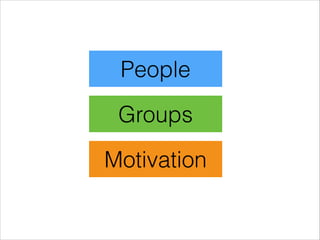
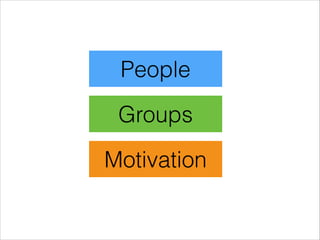
People
Groups
Motivation
People
“I am not young enough to know everything.”
O.Wilde
Introversion /
Extraversion
Extraversion tends to be manifested in outgoing,
talkative, energetic behavior, whereas introversion
is manifested in more reserved and solitary
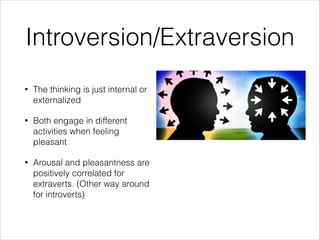
Introversion/Extraversion
•

The thinking is just internal or
externalized

•

Both engage in different
activities when feeling
pleasant

•

Arousal and pleasantness are
positively correlated for
extraverts. (Other way around
for introverts)
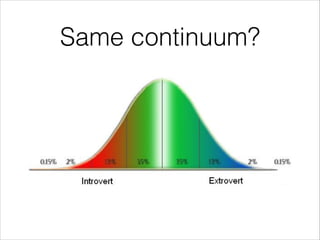
Same continuum?
How much of an
Introvert are you?
How much of an
extrovert are you?
Does this account for
thinking AND feeling?
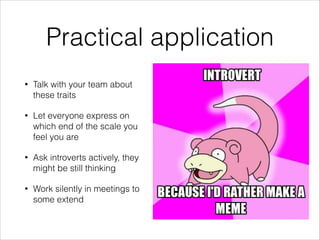
Practical application
•

Talk with your team about
these traits

•

Let everyone express on
which end of the scale you
feel you are

•

Ask introverts actively, they
might be still thinking

•

Work silently in meetings to
some extend
Maslow’s hierarchy of
needs
"the study of crippled, stunted, immature, and unhealthy
specimens can yield only a cripple psychology and a
cripple philosophy.“
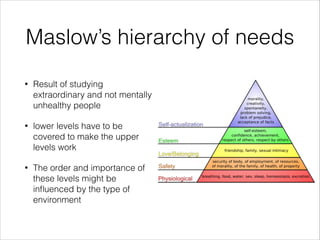
Maslow’s hierarchy of needs
•

Result of studying
extraordinary and not mentally
unhealthy people

•

lower levels have to be
covered to make the upper
levels work

•

The order and importance of
these levels might be
influenced by the type of
environment
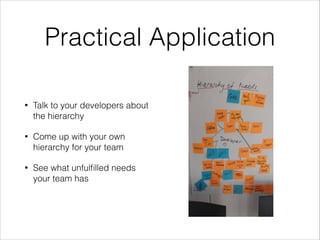
Practical Application
•

Talk to your developers about
the hierarchy

•

Come up with your own
hierarchy for your team

•

See what unfulfilled needs
your team has
Non-Violent
Communication
… focuses on three aspects of communication: selfempathy, empathy and honest self-expression
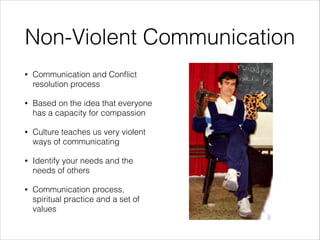
Non-Violent Communication
•

Communication and Conflict
resolution process

•

Based on the idea that everyone
has a capacity for compassion

•

Culture teaches us very violent
ways of communicating

•

Identify your needs and the
needs of others

•

Communication process,
spiritual practice and a set of
values
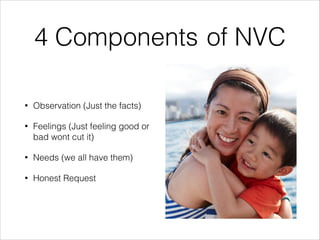
4 Components of NVC
•

Observation (Just the facts)

•

Feelings (Just feeling good or
bad wont cut it)

•

Needs (we all have them)

•

Honest Request
Assumptions of NVC
Common sense hitting home
1. All human beings share the same
basic needs
2. Our world offers sufficient resources for
meeting everyone's basic needs
3. All actions are attempts to meet needs
4. Feelings point to needs unmet
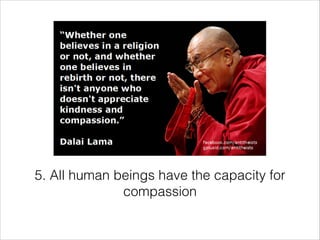
5. All human beings have the capacity for
compassion
6. Human beings enjoy giving
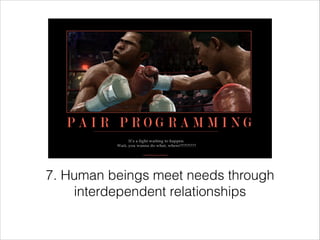
7. Human beings meet needs through
interdependent relationships
8. Human beings change
9. Choice is internal
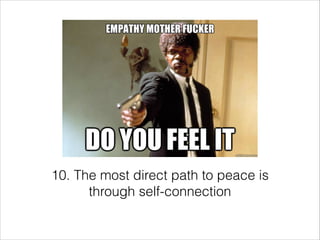
10. The most direct path to peace is
through self-connection
Let’s assume one of your
team-mates fucks up.
You have 4 choices
4 Choices of NVC
•

It’s his fault!

•

It’s my fault!

•

What were his feelings and needs in that moment?

•

What are my (unmet) feelings and needs?
Practical Application
•

RTFM! the Book from Rosenberg

•

Come to terms with your own feelings and needs
when working with groups

•

Start dividing out Observations, Feelings and
Needs

•

When enraged, think of the 4 choices
Groups
I like people who are working on practical things and
who are working in teams. It's not so important to get the
glory. It's much more important to get something that
works. It's a better way to live.
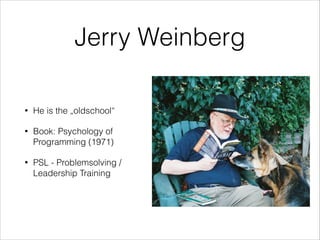
Jerry Weinberg
•

He is the „oldschool“

•

Book: Psychology of
Programming (1971)

•

PSL - Problemsolving /
Leadership Training
Egoless Programming
The ego is that ugly little troll that lives underneath the
bridge between your mind and your heart.
!

Gael Greene
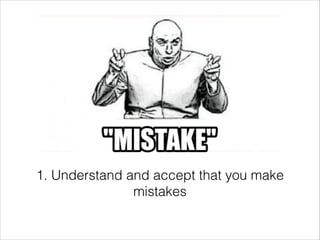
1. Understand and accept that you make
mistakes
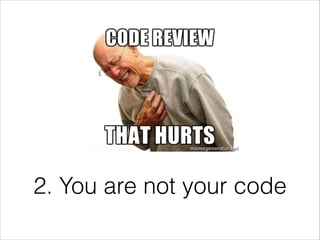
2. You are not your code
3. No matter how much Karate you know,
someone else will know more
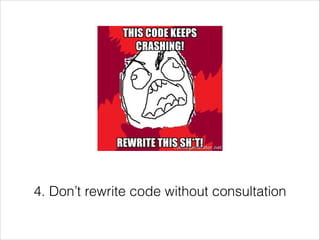
4. Don’t rewrite code without consultation
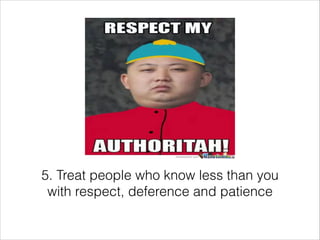
5. Treat people who know less than you
with respect, deference and patience
6. The only constant in the world is
change
7. The only true authority stems from
knowledge, not position.
8. Fight for what you believe, but
gracefully accept defeat
9. Don’t be the guy in the room
10.Critique the code instead of people be kind to the coder, not the code.
Practical Applications
•

Discuss and install this as rules with your teams

•

Buyin by everyone

•

Sign it and display it where everyone can see it
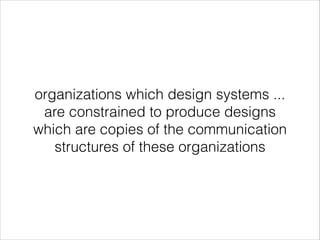
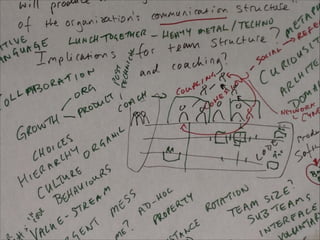
Conway’s Law
organizations which design systems ...
are constrained to produce designs
which are copies of the communication
structures of these organizations
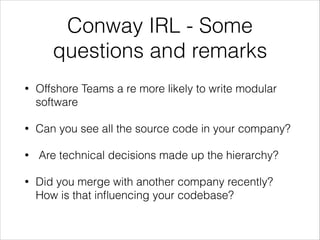
Conway IRL - Some
questions and remarks
•

Offshore Teams a re more likely to write modular
software

•

Can you see all the source code in your company?

•
•

Are technical decisions made up the hierarchy?
Did you merge with another company recently?
How is that influencing your codebase?
Practical Application
•

Review your Organizations structure and dive into
your code

•

Find similarities and ask yourself: Is this good or
bad

•

You might have to change the structure of your org
to change your code!
Tuckman’s stages of
group development
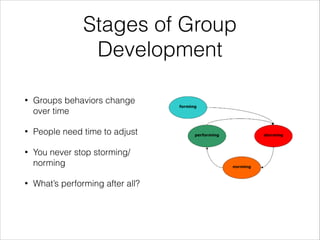
Stages of Group
Development
•

Groups behaviors change
over time

•

People need time to adjust

•

You never stop storming/
norming

•

What’s performing after all?
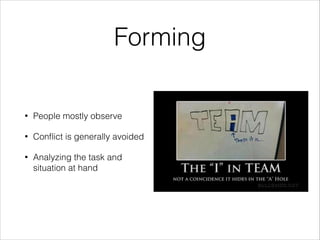
Forming
•

People mostly observe

•

Conflict is generally avoided

•

Analyzing the task and
situation at hand
Storming
•

Ideas compete for
consideration

•

Some teams never leave this
stage

•

Emphasize tolerance there

•

Moderate this phase - Don’t
be directive
Norming
•

The common goal is known

•

Some original ideas are give
up, others are improved on

•

General norms (e.g. codestyle, conflict resolution) are
implemented

•

Write this stuff down!

•

Inform newbies
Performing
•

Not every team reaches this
stage

•

No (or little) need for external
supervision

•

Dissent is welcome
Back to Storming?
•

Change in
•
•

Tools

•

Team Members

•
•

Leadership

Company Ownership

Or mistakes made ;)
Practical Application
•

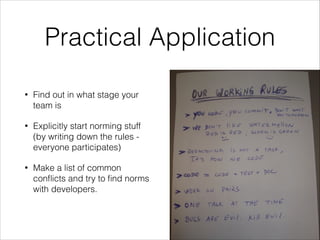
Find out in what stage your
team is

•

Explicitly start norming stuff
(by writing down the rules everyone participates)

•

Make a list of common
conflicts and try to find norms
with developers.
Motivation
“Control leads to compliance; autonomy leads to
engagement.”
D.Pink
A-M-P
Autonomy-MasteryPurpose
When it comes to motivation, there’s a gap between what
science knows and what business does.
Autonomy - Mastery Purpose
•

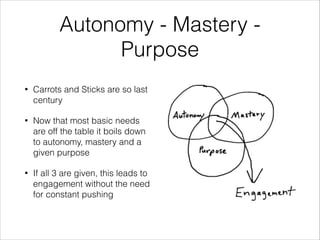
Carrots and Sticks are so last
century

•

Now that most basic needs
are off the table it boils down
to autonomy, mastery and a
given purpose

•

If all 3 are given, this leads to
engagement without the need
for constant pushing
Autonomy
•

The desire to direct our own
lives

•

Choose the technology we like

•

Change our workplaces

•

Choose the right processes
Mastery
•

The urge to get better at what
we do

•

A natural thing for every
craftsman

•

This is why we are here in the
first place, right?
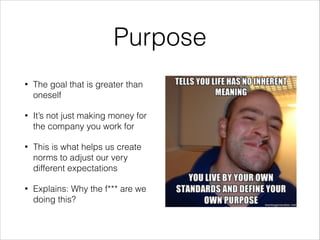
Purpose
•

The goal that is greater than
oneself

•

It’s not just making money for
the company you work for

•

This is what helps us create
norms to adjust our very
different expectations

•

Explains: Why the f*** are we
doing this?
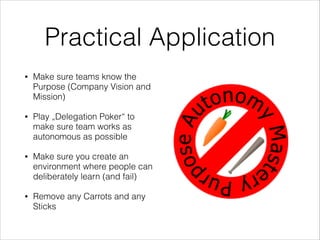
Practical Application
•

Make sure teams know the
Purpose (Company Vision and
Mission)

•

Play „Delegation Poker“ to
make sure team works as
autonomous as possible

•

Make sure you create an
environment where people can
deliberately learn (and fail)

•

Remove any Carrots and any
Sticks
Flow
“...It is when we act freely, for the sake of the action itself rather than
for ulterior motives, that we learn to become more than what we were.”
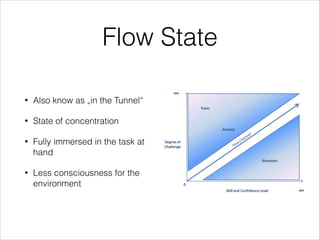
Flow State
•

Also know as „in the Tunnel“

•

State of concentration

•

Fully immersed in the task at
hand

•

Less consciousness for the
environment
How to reach flow state?
•

Find a challenge

•

Develop the skills in order to
meet the challenge

•

Set clear goals

•

Focus completely on the task
at hand

•

Make sure you’ve set aside
sufficient time

•

Monitor your emotional state
How does Flow-State feel?
•

You are completely involved in what
you are doing

•

There is a sense of ecstasy - being
outside of reality

•

You know what needs to be done and
get immediate feedback

•

You have the skills and know it’s
doable

•

You loose sense of self and worries

•

Loosing track of time

•

Intrinsic motivation - Producing flow
becomes it’s own reward
Practical Application
•

There is something called group flow. Hammer this
in the head of your developers

•

If something is to easy for you: Explain it to
someone else

•

If something is to hard: get some help

•

If something is to boring for everyone: Automate it ;)

•

Try a Fed-Ex Day!
Theory X - Theory Y
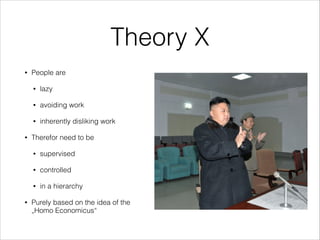
Theory X
•

People are
•
•

avoiding work

•
•

lazy

inherently disliking work

Therefor need to be
•
•

controlled

•
•

supervised

in a hierarchy

Purely based on the idea of the
„Homo Economicus“
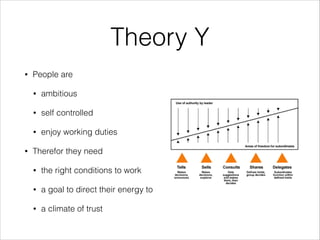
Theory Y
•

People are
•
•

self controlled

•
•

ambitious

enjoy working duties

Therefor they need
•

the right conditions to work

•

a goal to direct their energy to

•

a climate of trust
Practical Applications
•

How much Y and how much X
are you?

•

How do you control after
command?

•

What would you need to
become more Y?

•

Why are you still keeping
those type Y attitudes? (goto
Non-Violent-Communication)
Conclusions!
Clicko ergo sum!
Now that you work with
people, you are back at
„Beginner Level“
RTFM!
No need to go „Neuroscience“
and „Brain Research“. Most of
the stuff is pretty old.
Get a Training (by a
Professional)
Get a Mentor/Coach!
Success = Look outside
the Window
Failure = Look in the mirror
Jim Collins
Thesis:!
The Job as a Senior Developer or TeamLead is about excelling in Technology,
Architecture and Programming!
It’s not!
It’s about people, how to make
them working together as groups
and how to motivate them to do
the right things the right way.
People
Groups
Motivation
People
Groups
Motivation
Questions?

Social Human Architecture for Beginners

  • 1.
  • 2.
    Whois @sschuermann • Past: Developerfor over 10 years (Javascript, PHP, Mysql, Web and some Mobile) • Past: Teamlead for about 5 Years • Now: Just a Scrum-Master for 5 Teams • Still hacking on code … but please don’t tell anyone
  • 3.
    Thesis:! The Job asa Senior Developer or TeamLead is about excelling in Technology, Architecture and Programming!
  • 4.
  • 5.
    It’s about people,how to make them working together as groups and how to motivate them to do the right things the right way.
  • 6.
  • 7.
    People “I am notyoung enough to know everything.” O.Wilde
  • 8.
    Introversion / Extraversion Extraversion tendsto be manifested in outgoing, talkative, energetic behavior, whereas introversion is manifested in more reserved and solitary
  • 9.
    Introversion/Extraversion • The thinking isjust internal or externalized • Both engage in different activities when feeling pleasant • Arousal and pleasantness are positively correlated for extraverts. (Other way around for introverts)
  • 10.
  • 11.
    How much ofan Introvert are you?
  • 12.
    How much ofan extrovert are you?
  • 13.
    Does this accountfor thinking AND feeling?
  • 14.
    Practical application • Talk withyour team about these traits • Let everyone express on which end of the scale you feel you are • Ask introverts actively, they might be still thinking • Work silently in meetings to some extend
  • 15.
    Maslow’s hierarchy of needs "thestudy of crippled, stunted, immature, and unhealthy specimens can yield only a cripple psychology and a cripple philosophy.“
  • 16.
    Maslow’s hierarchy ofneeds • Result of studying extraordinary and not mentally unhealthy people • lower levels have to be covered to make the upper levels work • The order and importance of these levels might be influenced by the type of environment
  • 17.
    Practical Application • Talk toyour developers about the hierarchy • Come up with your own hierarchy for your team • See what unfulfilled needs your team has
  • 18.
    Non-Violent Communication … focuses onthree aspects of communication: selfempathy, empathy and honest self-expression
  • 19.
    Non-Violent Communication • Communication andConflict resolution process • Based on the idea that everyone has a capacity for compassion • Culture teaches us very violent ways of communicating • Identify your needs and the needs of others • Communication process, spiritual practice and a set of values
  • 20.
    4 Components ofNVC • Observation (Just the facts) • Feelings (Just feeling good or bad wont cut it) • Needs (we all have them) • Honest Request
  • 21.
    Assumptions of NVC Commonsense hitting home
  • 22.
    1. All humanbeings share the same basic needs
  • 23.
    2. Our worldoffers sufficient resources for meeting everyone's basic needs
  • 24.
    3. All actionsare attempts to meet needs
  • 25.
    4. Feelings pointto needs unmet
  • 26.
    5. All humanbeings have the capacity for compassion
  • 27.
    6. Human beingsenjoy giving
  • 28.
    7. Human beingsmeet needs through interdependent relationships
  • 29.
  • 30.
    9. Choice isinternal
  • 31.
    10. The mostdirect path to peace is through self-connection
  • 32.
    Let’s assume oneof your team-mates fucks up.
  • 33.
    You have 4choices
  • 34.
    4 Choices ofNVC • It’s his fault! • It’s my fault! • What were his feelings and needs in that moment? • What are my (unmet) feelings and needs?
  • 35.
    Practical Application • RTFM! theBook from Rosenberg • Come to terms with your own feelings and needs when working with groups • Start dividing out Observations, Feelings and Needs • When enraged, think of the 4 choices
  • 36.
    Groups I like peoplewho are working on practical things and who are working in teams. It's not so important to get the glory. It's much more important to get something that works. It's a better way to live.
  • 37.
    Jerry Weinberg • He isthe „oldschool“ • Book: Psychology of Programming (1971) • PSL - Problemsolving / Leadership Training
  • 38.
    Egoless Programming The egois that ugly little troll that lives underneath the bridge between your mind and your heart. ! Gael Greene
  • 39.
    1. Understand andaccept that you make mistakes
  • 40.
    2. You arenot your code
  • 41.
    3. No matterhow much Karate you know, someone else will know more
  • 42.
    4. Don’t rewritecode without consultation
  • 43.
    5. Treat peoplewho know less than you with respect, deference and patience
  • 44.
    6. The onlyconstant in the world is change
  • 45.
    7. The onlytrue authority stems from knowledge, not position.
  • 46.
    8. Fight forwhat you believe, but gracefully accept defeat
  • 47.
    9. Don’t bethe guy in the room
  • 48.
    10.Critique the codeinstead of people be kind to the coder, not the code.
  • 49.
    Practical Applications • Discuss andinstall this as rules with your teams • Buyin by everyone • Sign it and display it where everyone can see it
  • 50.
  • 51.
    organizations which designsystems ... are constrained to produce designs which are copies of the communication structures of these organizations
  • 53.
    Conway IRL -Some questions and remarks • Offshore Teams a re more likely to write modular software • Can you see all the source code in your company? • • Are technical decisions made up the hierarchy? Did you merge with another company recently? How is that influencing your codebase?
  • 54.
    Practical Application • Review yourOrganizations structure and dive into your code • Find similarities and ask yourself: Is this good or bad • You might have to change the structure of your org to change your code!
  • 55.
  • 56.
    Stages of Group Development • Groupsbehaviors change over time • People need time to adjust • You never stop storming/ norming • What’s performing after all?
  • 57.
    Forming • People mostly observe • Conflictis generally avoided • Analyzing the task and situation at hand
  • 58.
    Storming • Ideas compete for consideration • Someteams never leave this stage • Emphasize tolerance there • Moderate this phase - Don’t be directive
  • 59.
    Norming • The common goalis known • Some original ideas are give up, others are improved on • General norms (e.g. codestyle, conflict resolution) are implemented • Write this stuff down! • Inform newbies
  • 60.
    Performing • Not every teamreaches this stage • No (or little) need for external supervision • Dissent is welcome
  • 61.
    Back to Storming? • Changein • • Tools • Team Members • • Leadership Company Ownership Or mistakes made ;)
  • 62.
    Practical Application • Find outin what stage your team is • Explicitly start norming stuff (by writing down the rules everyone participates) • Make a list of common conflicts and try to find norms with developers.
  • 63.
    Motivation “Control leads tocompliance; autonomy leads to engagement.” D.Pink
  • 64.
    A-M-P Autonomy-MasteryPurpose When it comesto motivation, there’s a gap between what science knows and what business does.
  • 65.
    Autonomy - MasteryPurpose • Carrots and Sticks are so last century • Now that most basic needs are off the table it boils down to autonomy, mastery and a given purpose • If all 3 are given, this leads to engagement without the need for constant pushing
  • 66.
    Autonomy • The desire todirect our own lives • Choose the technology we like • Change our workplaces • Choose the right processes
  • 67.
    Mastery • The urge toget better at what we do • A natural thing for every craftsman • This is why we are here in the first place, right?
  • 68.
    Purpose • The goal thatis greater than oneself • It’s not just making money for the company you work for • This is what helps us create norms to adjust our very different expectations • Explains: Why the f*** are we doing this?
  • 69.
    Practical Application • Make sureteams know the Purpose (Company Vision and Mission) • Play „Delegation Poker“ to make sure team works as autonomous as possible • Make sure you create an environment where people can deliberately learn (and fail) • Remove any Carrots and any Sticks
  • 70.
    Flow “...It is whenwe act freely, for the sake of the action itself rather than for ulterior motives, that we learn to become more than what we were.”
  • 71.
    Flow State • Also knowas „in the Tunnel“ • State of concentration • Fully immersed in the task at hand • Less consciousness for the environment
  • 72.
    How to reachflow state? • Find a challenge • Develop the skills in order to meet the challenge • Set clear goals • Focus completely on the task at hand • Make sure you’ve set aside sufficient time • Monitor your emotional state
  • 73.
    How does Flow-Statefeel? • You are completely involved in what you are doing • There is a sense of ecstasy - being outside of reality • You know what needs to be done and get immediate feedback • You have the skills and know it’s doable • You loose sense of self and worries • Loosing track of time • Intrinsic motivation - Producing flow becomes it’s own reward
  • 74.
    Practical Application • There issomething called group flow. Hammer this in the head of your developers • If something is to easy for you: Explain it to someone else • If something is to hard: get some help • If something is to boring for everyone: Automate it ;) • Try a Fed-Ex Day!
  • 75.
    Theory X -Theory Y
  • 76.
    Theory X • People are • • avoidingwork • • lazy inherently disliking work Therefor need to be • • controlled • • supervised in a hierarchy Purely based on the idea of the „Homo Economicus“
  • 77.
    Theory Y • People are • • selfcontrolled • • ambitious enjoy working duties Therefor they need • the right conditions to work • a goal to direct their energy to • a climate of trust
  • 78.
    Practical Applications • How muchY and how much X are you? • How do you control after command? • What would you need to become more Y? • Why are you still keeping those type Y attitudes? (goto Non-Violent-Communication)
  • 79.
  • 80.
    Now that youwork with people, you are back at „Beginner Level“
  • 81.
  • 82.
    No need togo „Neuroscience“ and „Brain Research“. Most of the stuff is pretty old.
  • 83.
    Get a Training(by a Professional)
  • 84.
  • 85.
    Success = Lookoutside the Window Failure = Look in the mirror Jim Collins
  • 86.
    Thesis:! The Job asa Senior Developer or TeamLead is about excelling in Technology, Architecture and Programming!
  • 87.
  • 88.
    It’s about people,how to make them working together as groups and how to motivate them to do the right things the right way.
  • 89.
  • 90.