PRACTICAL SCRUM
Like us: www.facebook.com/PracticalAgile 

Visit: www.practical-agile.com

Follow me: @Linkedin

Tweet: @PracticalAgile1

CONSTANT
HIGHER
MORE
LEARNING
QUALITY
FUN
Day 2
EXERCISE
Write 5 Multiple Selection Questions On
Yesterday Material
Reminder:
Agile

Scrum (roles, ceremonies)

Transparency 

DoD

Waste
Lean Thinking
BEING AGILE IS OUR FAVORITE THING
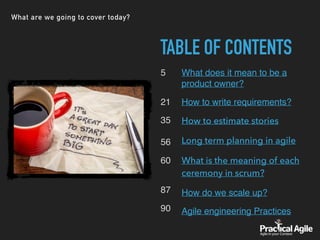
What are we going to cover today?
TABLE OF CONTENTS
5

21
35


56
60

87
90
What does it mean to be a
product owner?
How to write requirements?
How to estimate stories
Long term planning in agile
What is the meaning of each
ceremony in scrum?
How do we scale up?
Agile engineering Practices
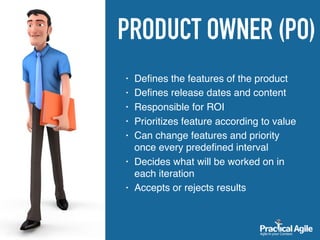
PRODUCT OWNER (PO)
• Defines the features of the product
• Defines release dates and content
• Responsible for ROI
• Prioritizes feature according to value
• Can change features and priority 

once every predefined interval
• Decides what will be worked on in
each iteration
• Accepts or rejects results
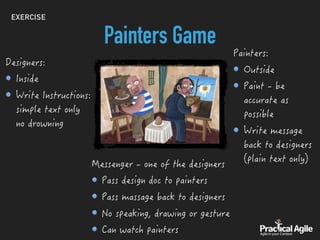
EXERCISE
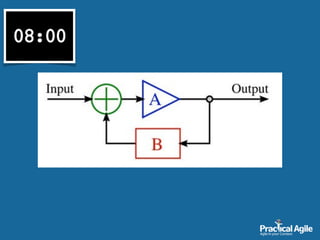
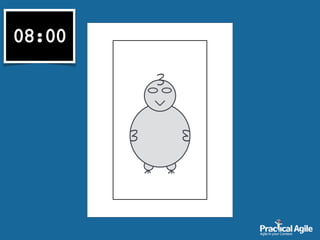
Painters Game


Round 1
Round 2
Round 3
SOUNDS FAMILIAR?
Traditionally throws content “over the fence”
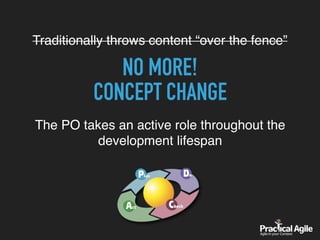
The PO takes an active role throughout the
development lifespan
Traditionally throws content “over the fence”
NO MORE!
CONCEPT CHANGE
How?
• Talk directly and frequently with your
customers

• Talk directly and frequently with your
development teams

• Engage the development teams in
creating value for your customers

• Maintain your product’s quality and
agility – do not let technical debt
accumulate
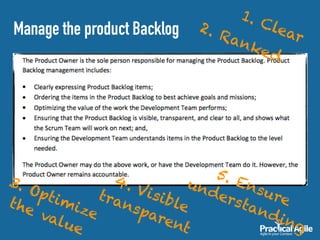
Manage the product Backlog
1. Clear
2. Ranked
3. Optimize
the value
4. Visible
transparent
5. Ensure
understanding
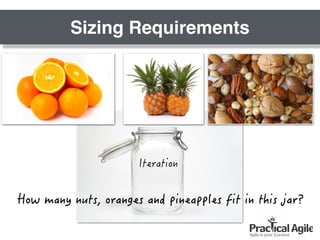
Sizing Requirements
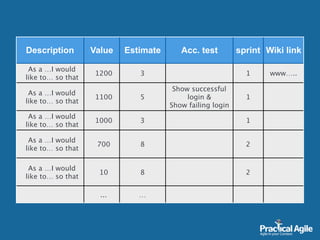
Description Value Estimate Acc. test sprint Wiki link
As a …I would
like to… so that
1200 3 1 www…..
As a …I would
like to… so that
1100 5
Show successful
login &

Show failing login
1
As a …I would
like to… so that
1000 3 1
As a …I would
like to… so that
700 8 2
As a …I would
like to… so that
10 8 2
... …
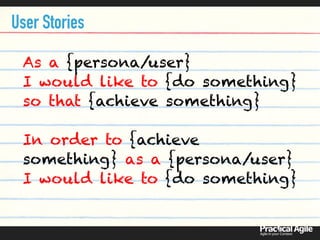
As a {persona/user} 

I would like to {do something} 

so that {achieve something} 


In order to {achieve
something} as a {persona/user}
I would like to {do something}
User Stories
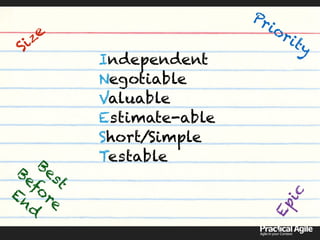
Size
Priority
Best
Before
End
Epic
Independent
Negotiable
Valuable
Estimate-able
Short/Simple
Testable
EXERCISE
Define 3 Users For A Social Network
Special For Dog Owners
EXERCISE
Create a 2-3 PBI For A Social Network
Special For Dog Owners
As a [user]
I would like to [what]
So that [why]
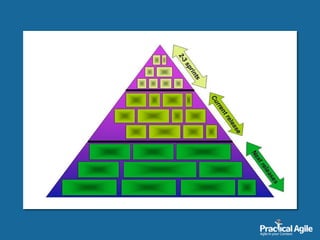
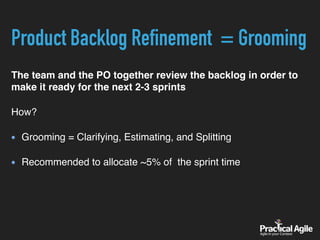
Product Backlog Refinement = Grooming
The team and the PO together review the backlog in order to
make it ready for the next 2-3 sprints
How?
Grooming = Clarifying, Estimating, and Splitting
Recommended to allocate ~5% of the sprint time
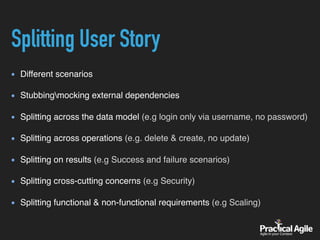
Splitting User Story
Different scenarios
Stubbingmocking external dependencies
Splitting across the data model (e.g login only via username, no password)
Splitting across operations (e.g. delete & create, no update)
Splitting on results (e.g Success and failure scenarios)
Splitting cross-cutting concerns (e.g Security)
Splitting functional & non-functional requirements (e.g Scaling)
EXERCISE
Split The Biggest PBI
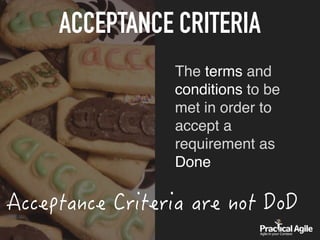
The terms and
conditions to be
met in order to
accept a
requirement as
Done
ACCEPTANCE CRITERIA
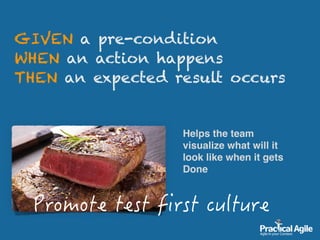
GIVEN a pre-condition

WHEN an action happens

THEN an expected result occurs
Helps the team
visualize what will it
look like when it gets
Done
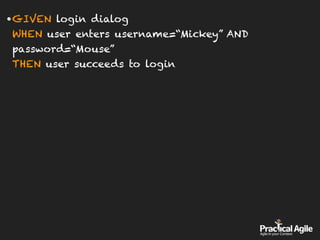
•GIVEN login dialog

WHEN user enters username=“Mickey” AND
password=“Mouse”

THEN user succeeds to login
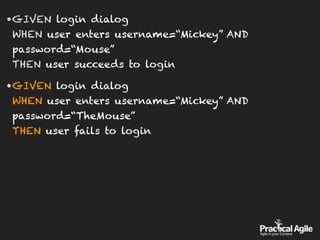
•GIVEN login dialog

WHEN user enters username=“Mickey” AND
password=“Mouse”

THEN user succeeds to login
•GIVEN login dialog

WHEN user enters username=“Mickey” AND
password=“TheMouse”

THEN user fails to login
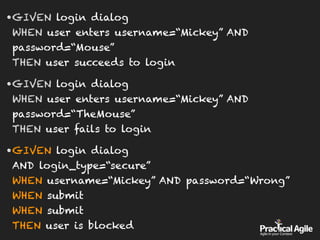
•GIVEN login dialog

WHEN user enters username=“Mickey” AND
password=“Mouse”

THEN user succeeds to login
•GIVEN login dialog

WHEN user enters username=“Mickey” AND
password=“TheMouse”

THEN user fails to login
•GIVEN login dialog

AND login_type=“secure”

WHEN username=“Mickey” AND password=“Wrong”

WHEN submit

WHEN submit

THEN user is blocked
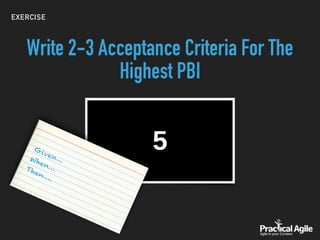
EXERCISE
Write 2-3 Acceptance Criteria For The
Highest PBI
Given…When…Then….
Agile Effort
Estimations
EXERCISE
Estimate The Following Based On Weight In
Kilograms [No Google Please!!!]
• Chihuahua
• Great Dane
• Staffordshire bull terrier
• Appalachian mountain dog
• Border Collie
• American Cocker spaniel
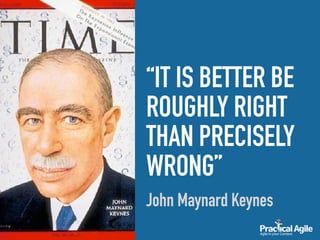
“IT IS BETTER BE
ROUGHLY RIGHT
THAN PRECISELY
WRONG”
John Maynard Keynes
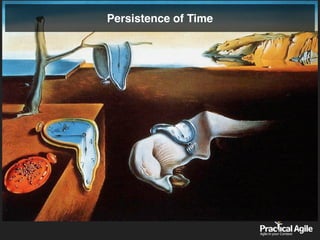
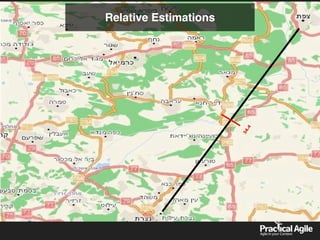
Persistence of Time
34.4
Relative Estimations
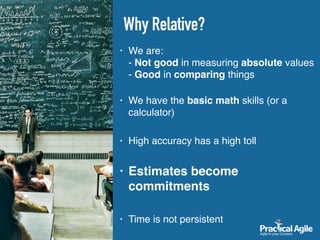
• We are: 

- Not good in measuring absolute values

- Good in comparing things

• We have the basic math skills (or a
calculator)
• High accuracy has a high toll
• Estimates become
commitments
• Time is not persistent
Why Relative?
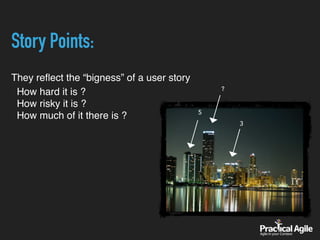
Story Points:
They reflect the “bigness” of a user story
How hard it is ?

How risky it is ?

How much of it there is ? 5
?
3
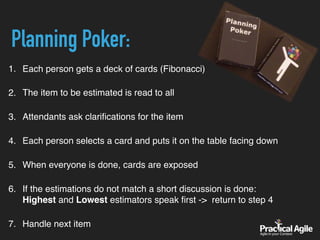
1. Each person gets a deck of cards (Fibonacci)

2. The item to be estimated is read to all

3. Attendants ask clarifications for the item

4. Each person selects a card and puts it on the table facing down

5. When everyone is done, cards are exposed

6. If the estimations do not match a short discussion is done:

Highest and Lowest estimators speak first -> return to step 4

7. Handle next item
Planning Poker:
EXERCISE
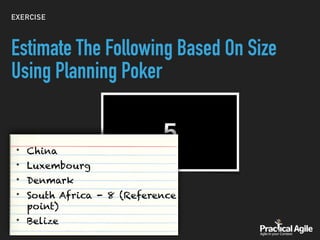
Estimate The Following Based On Size
Using Planning Poker
• China
• Luxembourg
• Denmark
• South Africa - 8 (Reference
point)
• Belize
• Those who do the work estimate it

• Emphasizes relative estimation
• Estimates are within one order of magnitude
• Modeled for open discussion – forces thinking

• Reduces anchoring - Everyone's opinion is heard
WHY USE PLANNING POKER?
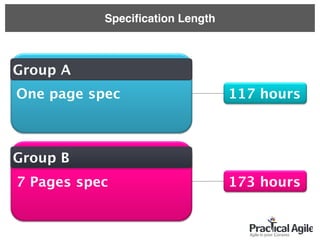
One page spec
Group A
7 Pages spec
Group B
173 hours
117 hours
Specification Length
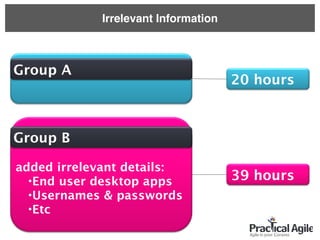
Group A
added irrelevant details:
•End user desktop apps
•Usernames & passwords
•Etc
Group B
39 hours
20 hours
Irrelevant Information
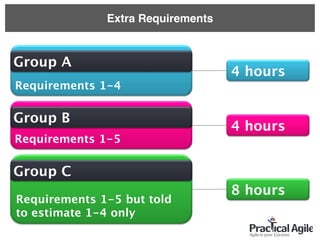
Requirements 1-4
Group A
Requirements 1-5
Group B
4 hours
4 hours
Requirements 1-5 but told 

to estimate 1-4 only
Group C
8 hours
Extra Requirements
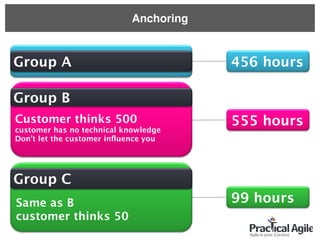
Group A
Customer thinks 500
customer has no technical knowledge
Don’t let the customer influence you
Group B
555 hours
456 hours
Same as B 

customer thinks 50
Group C
99 hours
Anchoring
WHY USE
PLANNING
POKER?
IT IS QUICK!
IT IS FUN!
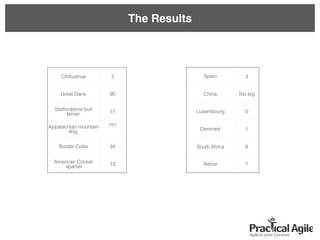
Spain 3
China Too big
Luxembourg 0
Denmark 1
South Africa 8
Belize 1
Chihuahua 3
Great Dane 90
Staffordshire bull
terrier.
17
Appalachian mountain
dog.
???
Border Collie 34
American Cocker
spaniel
13
The Results
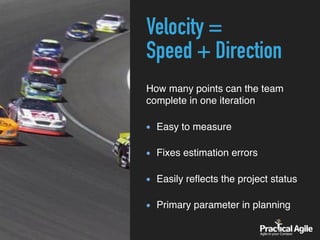
Velocity = 

Speed + Direction
How many points can the team
complete in one iteration

Easy to measure

Fixes estimation errors

Easily reflects the project status

Primary parameter in planning
SP
8
priority 5
priority 4
SP
8
priority 3
Planning
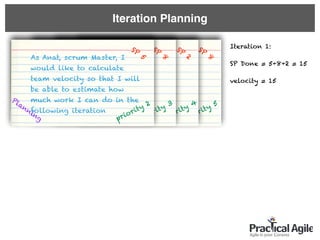
Iteration Planning
As Anat, scrum Master, I
would like to calculate
team velocity so that I will
be able to estimate how
much work I can do in the
following iteration
SP
5
priority 2
Planning
SP
2
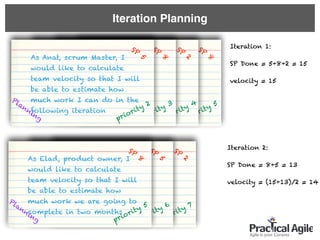
Iteration 1:
SP Done = 5+8+2 = 15
velocity = 15
SP
8
priority 5
priority 4
SP
8
priority 3
Planning
Iteration Planning
As Anat, scrum Master, I
would like to calculate
team velocity so that I will
be able to estimate how
much work I can do in the
following iteration
SP
5
priority 2
Planning
SP
2
Iteration 1:
SP Done = 5+8+2 = 15
velocity = 15
priority 7
SP
5
priority 6
Planning
As Elad, product owner, I
would like to calculate
team velocity so that I will
be able to estimate how
much work we are going to
complete in two months
SP
8
priority 5
Planning
SP
2
Iteration 2:
SP Done = 8+5 = 13
velocity = (15+13)/2 = 14
SP
5
priority 8
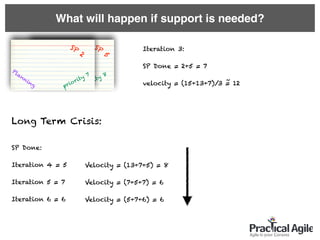
What will happen if support is needed?
SP
2
priority 7
Long Term Crisis:
Planning
Iteration 3:
SP Done = 2+5 = 7
velocity = (15+13+7)/3 = 12~
SP Done:
Iteration 4 = 5
Iteration 5 = 7
Iteration 6 = 6
Velocity = (13+7+5) = 8
Velocity = (7+5+7) = 6
Velocity = (5+7+6) = 6
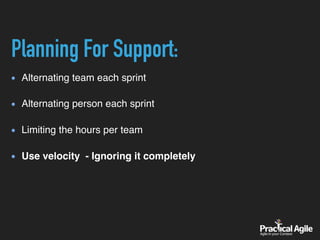
Planning For Support:
Alternating team each sprint

Alternating person each sprint

Limiting the hours per team

Use velocity - Ignoring it completely
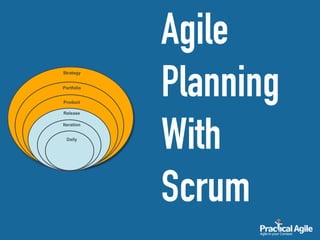
Agile
Planning
With
Scrum
Daily
Iteration
Release
Product
Portfolio
Strategy
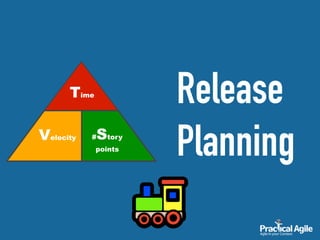
Release
Planning#Story
points
Time
Velocity
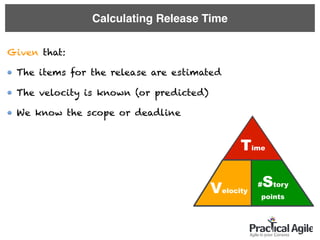
Calculating Release Time
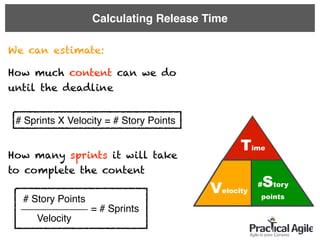
Given that:
The items for the release are estimated
The velocity is known (or predicted)
We know the scope or deadline
#Story
points
Time
Velocity
Calculating Release Time
We can estimate:
How much content can we do
until the deadline
How many sprints it will take
to complete the content
# Sprints X Velocity = # Story Points
# Story Points
Velocity
= # Sprints____________
#Story
points
Time
Velocity
Scrum
Ceremonies
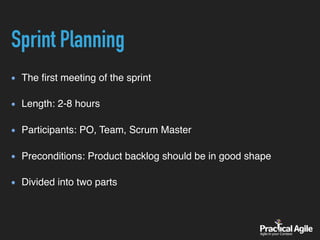
Sprint Planning
The first meeting of the sprint

Length: 2-8 hours

Participants: PO, Team, Scrum Master

Preconditions: Product backlog should be in good shape

Divided into two parts
Sprint Planning Goal
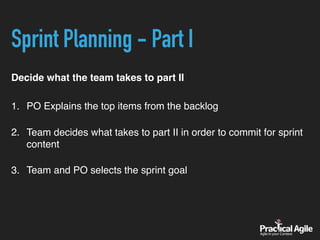
Sprint Planning - Part I
Decide what the team takes to part II
1. PO Explains the top items from the backlog

2. Team decides what takes to part II in order to commit for sprint
content

3. Team and PO selects the sprint goal
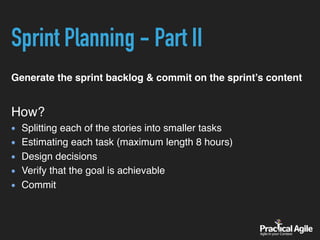
Sprint Planning - Part II
Generate the sprint backlog & commit on the sprint’s content
How?
Splitting each of the stories into smaller tasks
Estimating each task (maximum length 8 hours)
Design decisions
Verify that the goal is achievable
Commit
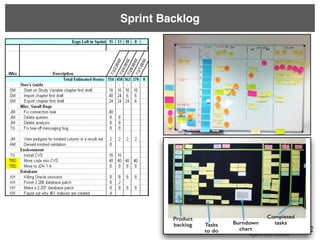
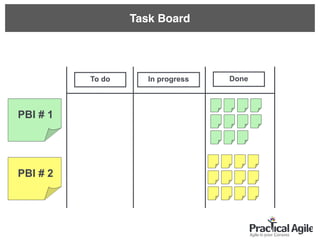
Sprint Backlog
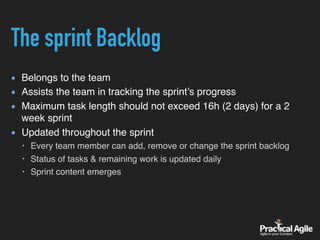
The sprint Backlog
Belongs to the team
Assists the team in tracking the sprint’s progress
Maximum task length should not exceed 16h (2 days) for a 2
week sprint
Updated throughout the sprint
• Every team member can add, remove or change the sprint backlog
• Status of tasks & remaining work is updated daily
• Sprint content emerges
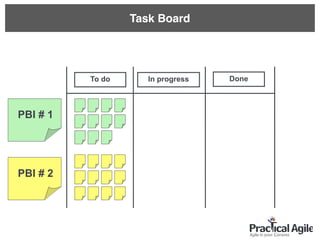
To do In progress Done
PBI # 1
PBI # 2
Task Board
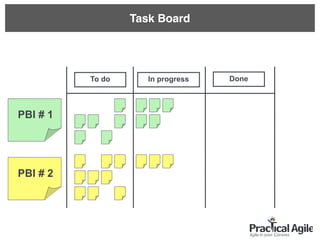
To do In progress Done
PBI # 1
PBI # 2
Task Board
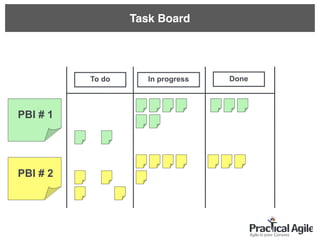
To do In progress Done
PBI # 1
PBI # 2
Task Board
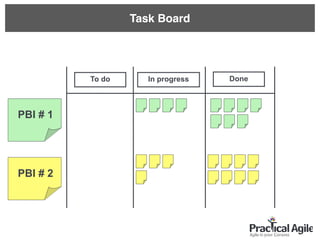
To do In progress Done
PBI # 1
PBI # 2
Task Board
To do In progress Done
PBI # 1
PBI # 2
Task Board
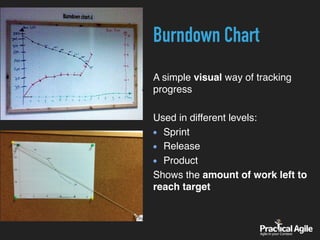
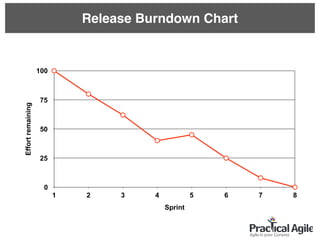
Burndown Chart
A simple visual way of tracking
progress
Used in different levels:
Sprint
Release
Product
Shows the amount of work left to
reach target
Effortremaining
0
25
50
75
100
Sprint
1 2 3 4 5 6 7 8
Release Burndown Chart
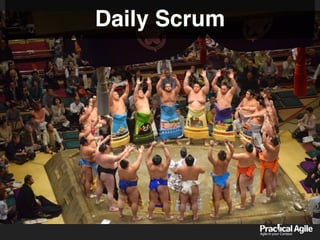
Daily Scrum
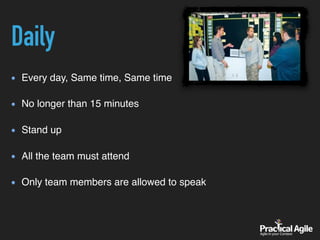
Every day, Same time, Same time

No longer than 15 minutes

Stand up

All the team must attend

Only team members are allowed to speak
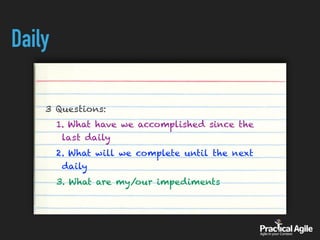
Daily
Daily
3 Questions:
1. What have we accomplished since the
last daily
2. What will we complete until the next
daily
3. What are my/our impediments
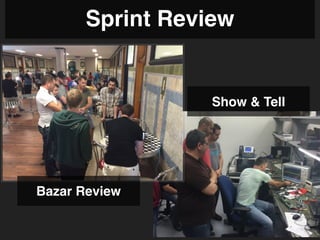
Sprint Review
Show & Tell
Bazar Review
Close the sprint 

Participants: The team, PO, everyone (managers, customers..)

Inspect & adapt, focus on feedback - this is NOT a Demo

Focus on shard learning - not reporting

Only Done Working Software allowed 

Avoid power point presentation
Sprint Review
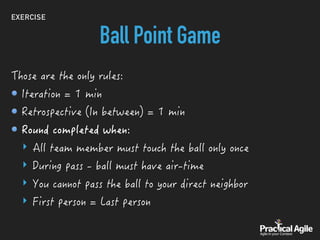
EXERCISE
Ball Point Game
EXERCISE
Ball Point Game
‣
‣
‣
‣
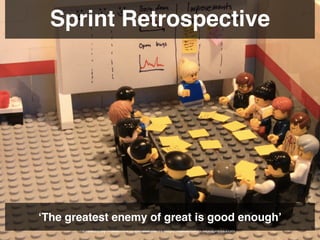
Sprint Retrospective
‘The greatest enemy of great is good enough’
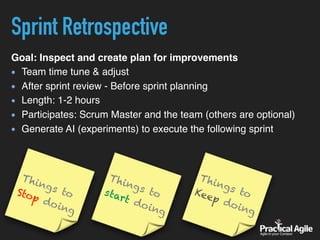
Goal: Inspect and create plan for improvements
Team time tune & adjust
After sprint review - Before sprint planning
Length: 1-2 hours
Participates: Scrum Master and the team (others are optional)
Generate AI (experiments) to execute the following sprint
Sprint Retrospective
Things to 
Stop doing
Things to 
start doing
Things to 
Keep doing
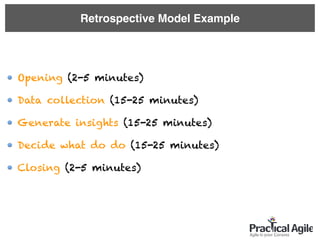
Retrospective Model Example
Opening (2-5 minutes)
Data collection (15-25 minutes)
Generate insights (15-25 minutes)
Decide what do do (15-25 minutes)
Closing (2-5 minutes)
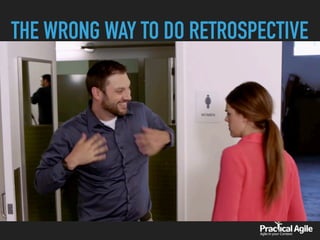
THE WRONG WAY TO DO RETROSPECTIVE
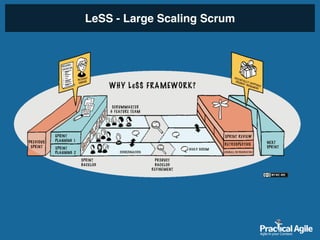
LeSS - Large Scaling Scrum
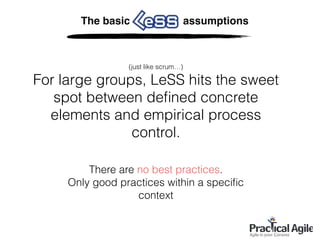
The basic assumptions
(just like scrum…)
For large groups, LeSS hits the sweet
spot between defined concrete
elements and empirical process
control.
There are no best practices.
Only good practices within a specific
context
Engineering Practices
Pair programming

Refactoring

TDD  ATDD

Continuous integration
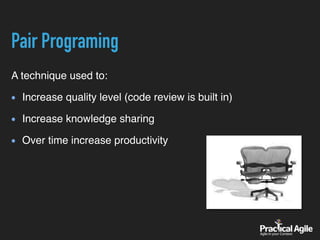
Pair Programing
A technique used to:
Increase quality level (code review is built in)
Increase knowledge sharing
Over time increase productivity
Refactoring
Goal: Improve readability while preserving meaning
Refactoring ≠ Redesign
Does not fix bugs
Done as a series of steps, each step does a little
Refactoring is not a “standalone” task
Most modern IDE’s have auto-refactoring tools
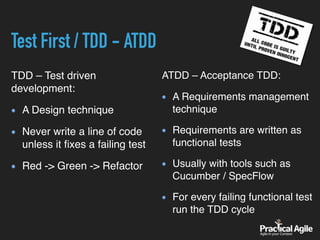
Test First / TDD - ATDD
TDD – Test driven
development:
A Design technique
Never write a line of code
unless it fixes a failing test
Red -> Green -> Refactor
ATDD – Acceptance TDD:
A Requirements management
technique
Requirements are written as
functional tests
Usually with tools such as
Cucumber / SpecFlow
For every failing functional test
run the TDD cycle
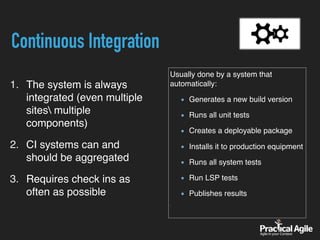
Continuous Integration
1. The system is always
integrated (even multiple
sites multiple
components)
2. CI systems can and
should be aggregated
3. Requires check ins as
often as possible
Usually done by a system that
automatically:
Generates a new build version
Runs all unit tests
Creates a deployable package
Installs it to production equipment
Runs all system tests
Run LSP tests
Publishes results
•
Parking lot
“THE VALUE OF
AN IDEA LIES IN
THE USING OF IT”
Thomas Edison

Practical Scrum - day 2

  • 1.
    PRACTICAL SCRUM Like us:www.facebook.com/PracticalAgile 
 Visit: www.practical-agile.com
 Follow me: @Linkedin
 Tweet: @PracticalAgile1
 CONSTANT HIGHER MORE LEARNING QUALITY FUN Day 2
  • 2.
    EXERCISE Write 5 MultipleSelection Questions On Yesterday Material Reminder: Agile
 Scrum (roles, ceremonies)
 Transparency 
 DoD
 Waste
Lean Thinking
  • 3.
    BEING AGILE ISOUR FAVORITE THING
  • 4.
    What are wegoing to cover today? TABLE OF CONTENTS 5
 21 35
 
 56 60
 87 90 What does it mean to be a product owner? How to write requirements? How to estimate stories Long term planning in agile What is the meaning of each ceremony in scrum? How do we scale up? Agile engineering Practices
  • 5.
    PRODUCT OWNER (PO) •Defines the features of the product • Defines release dates and content • Responsible for ROI • Prioritizes feature according to value • Can change features and priority 
 once every predefined interval • Decides what will be worked on in each iteration • Accepts or rejects results
  • 6.
  • 7.
  • 9.
  • 11.
  • 13.
  • 14.
    Traditionally throws content“over the fence”
  • 15.
    The PO takesan active role throughout the development lifespan Traditionally throws content “over the fence” NO MORE! CONCEPT CHANGE
  • 16.
    How? • Talk directlyand frequently with your customers
 • Talk directly and frequently with your development teams
 • Engage the development teams in creating value for your customers
 • Maintain your product’s quality and agility – do not let technical debt accumulate
  • 17.
    Manage the productBacklog 1. Clear 2. Ranked 3. Optimize the value 4. Visible transparent 5. Ensure understanding
  • 19.
  • 20.
    Description Value EstimateAcc. test sprint Wiki link As a …I would like to… so that 1200 3 1 www….. As a …I would like to… so that 1100 5 Show successful login &
 Show failing login 1 As a …I would like to… so that 1000 3 1 As a …I would like to… so that 700 8 2 As a …I would like to… so that 10 8 2 ... …
  • 21.
    As a {persona/user}
 I would like to {do something} 
 so that {achieve something} 
 
 In order to {achieve something} as a {persona/user} I would like to {do something} User Stories
  • 22.
  • 23.
    EXERCISE Define 3 UsersFor A Social Network Special For Dog Owners
  • 24.
    EXERCISE Create a 2-3PBI For A Social Network Special For Dog Owners As a [user] I would like to [what] So that [why]
  • 25.
    Product Backlog Refinement= Grooming The team and the PO together review the backlog in order to make it ready for the next 2-3 sprints How? Grooming = Clarifying, Estimating, and Splitting Recommended to allocate ~5% of the sprint time
  • 26.
    Splitting User Story Differentscenarios Stubbingmocking external dependencies Splitting across the data model (e.g login only via username, no password) Splitting across operations (e.g. delete & create, no update) Splitting on results (e.g Success and failure scenarios) Splitting cross-cutting concerns (e.g Security) Splitting functional & non-functional requirements (e.g Scaling)
  • 27.
  • 28.
    The terms and conditionsto be met in order to accept a requirement as Done ACCEPTANCE CRITERIA
  • 29.
    GIVEN a pre-condition
 WHENan action happens
 THEN an expected result occurs Helps the team visualize what will it look like when it gets Done
  • 30.
    •GIVEN login dialog
 WHENuser enters username=“Mickey” AND password=“Mouse”
 THEN user succeeds to login
  • 31.
    •GIVEN login dialog
 WHENuser enters username=“Mickey” AND password=“Mouse”
 THEN user succeeds to login •GIVEN login dialog
 WHEN user enters username=“Mickey” AND password=“TheMouse”
 THEN user fails to login
  • 32.
    •GIVEN login dialog
 WHENuser enters username=“Mickey” AND password=“Mouse”
 THEN user succeeds to login •GIVEN login dialog
 WHEN user enters username=“Mickey” AND password=“TheMouse”
 THEN user fails to login •GIVEN login dialog
 AND login_type=“secure”
 WHEN username=“Mickey” AND password=“Wrong”
 WHEN submit
 WHEN submit
 THEN user is blocked
  • 33.
    EXERCISE Write 2-3 AcceptanceCriteria For The Highest PBI Given…When…Then….
  • 35.
  • 36.
    EXERCISE Estimate The FollowingBased On Weight In Kilograms [No Google Please!!!] • Chihuahua • Great Dane • Staffordshire bull terrier • Appalachian mountain dog • Border Collie • American Cocker spaniel
  • 37.
    “IT IS BETTERBE ROUGHLY RIGHT THAN PRECISELY WRONG” John Maynard Keynes
  • 38.
  • 39.
  • 40.
    • We are:
 - Not good in measuring absolute values
 - Good in comparing things
 • We have the basic math skills (or a calculator) • High accuracy has a high toll • Estimates become commitments • Time is not persistent Why Relative?
  • 41.
    Story Points: They reflectthe “bigness” of a user story How hard it is ?
 How risky it is ?
 How much of it there is ? 5 ? 3
  • 42.
    1. Each persongets a deck of cards (Fibonacci)
 2. The item to be estimated is read to all
 3. Attendants ask clarifications for the item
 4. Each person selects a card and puts it on the table facing down
 5. When everyone is done, cards are exposed
 6. If the estimations do not match a short discussion is done:
 Highest and Lowest estimators speak first -> return to step 4
 7. Handle next item Planning Poker:
  • 43.
    EXERCISE Estimate The FollowingBased On Size Using Planning Poker • China • Luxembourg • Denmark • South Africa - 8 (Reference point) • Belize
  • 44.
    • Those whodo the work estimate it
 • Emphasizes relative estimation • Estimates are within one order of magnitude • Modeled for open discussion – forces thinking
 • Reduces anchoring - Everyone's opinion is heard WHY USE PLANNING POKER?
  • 45.
    One page spec GroupA 7 Pages spec Group B 173 hours 117 hours Specification Length
  • 46.
    Group A added irrelevantdetails: •End user desktop apps •Usernames & passwords •Etc Group B 39 hours 20 hours Irrelevant Information
  • 47.
    Requirements 1-4 Group A Requirements1-5 Group B 4 hours 4 hours Requirements 1-5 but told 
 to estimate 1-4 only Group C 8 hours Extra Requirements
  • 48.
    Group A Customer thinks500 customer has no technical knowledge Don’t let the customer influence you Group B 555 hours 456 hours Same as B 
 customer thinks 50 Group C 99 hours Anchoring
  • 49.
  • 50.
    Spain 3 China Toobig Luxembourg 0 Denmark 1 South Africa 8 Belize 1 Chihuahua 3 Great Dane 90 Staffordshire bull terrier. 17 Appalachian mountain dog. ??? Border Collie 34 American Cocker spaniel 13 The Results
  • 51.
    Velocity = 
 Speed+ Direction How many points can the team complete in one iteration
 Easy to measure
 Fixes estimation errors
 Easily reflects the project status
 Primary parameter in planning
  • 52.
    SP 8 priority 5 priority 4 SP 8 priority3 Planning Iteration Planning As Anat, scrum Master, I would like to calculate team velocity so that I will be able to estimate how much work I can do in the following iteration SP 5 priority 2 Planning SP 2 Iteration 1: SP Done = 5+8+2 = 15 velocity = 15
  • 53.
    SP 8 priority 5 priority 4 SP 8 priority3 Planning Iteration Planning As Anat, scrum Master, I would like to calculate team velocity so that I will be able to estimate how much work I can do in the following iteration SP 5 priority 2 Planning SP 2 Iteration 1: SP Done = 5+8+2 = 15 velocity = 15 priority 7 SP 5 priority 6 Planning As Elad, product owner, I would like to calculate team velocity so that I will be able to estimate how much work we are going to complete in two months SP 8 priority 5 Planning SP 2 Iteration 2: SP Done = 8+5 = 13 velocity = (15+13)/2 = 14
  • 54.
    SP 5 priority 8 What willhappen if support is needed? SP 2 priority 7 Long Term Crisis: Planning Iteration 3: SP Done = 2+5 = 7 velocity = (15+13+7)/3 = 12~ SP Done: Iteration 4 = 5 Iteration 5 = 7 Iteration 6 = 6 Velocity = (13+7+5) = 8 Velocity = (7+5+7) = 6 Velocity = (5+7+6) = 6
  • 55.
    Planning For Support: Alternatingteam each sprint
 Alternating person each sprint
 Limiting the hours per team
 Use velocity - Ignoring it completely
  • 56.
  • 57.
  • 58.
    Calculating Release Time Giventhat: The items for the release are estimated The velocity is known (or predicted) We know the scope or deadline #Story points Time Velocity
  • 59.
    Calculating Release Time Wecan estimate: How much content can we do until the deadline How many sprints it will take to complete the content # Sprints X Velocity = # Story Points # Story Points Velocity = # Sprints____________ #Story points Time Velocity
  • 60.
  • 61.
    Sprint Planning The firstmeeting of the sprint
 Length: 2-8 hours
 Participants: PO, Team, Scrum Master
 Preconditions: Product backlog should be in good shape
 Divided into two parts
  • 62.
  • 63.
    Sprint Planning -Part I Decide what the team takes to part II 1. PO Explains the top items from the backlog
 2. Team decides what takes to part II in order to commit for sprint content
 3. Team and PO selects the sprint goal
  • 64.
    Sprint Planning -Part II Generate the sprint backlog & commit on the sprint’s content How? Splitting each of the stories into smaller tasks Estimating each task (maximum length 8 hours) Design decisions Verify that the goal is achievable Commit
  • 65.
  • 66.
    The sprint Backlog Belongsto the team Assists the team in tracking the sprint’s progress Maximum task length should not exceed 16h (2 days) for a 2 week sprint Updated throughout the sprint • Every team member can add, remove or change the sprint backlog • Status of tasks & remaining work is updated daily • Sprint content emerges
  • 67.
    To do Inprogress Done PBI # 1 PBI # 2 Task Board
  • 68.
    To do Inprogress Done PBI # 1 PBI # 2 Task Board
  • 69.
    To do Inprogress Done PBI # 1 PBI # 2 Task Board
  • 70.
    To do Inprogress Done PBI # 1 PBI # 2 Task Board
  • 71.
    To do Inprogress Done PBI # 1 PBI # 2 Task Board
  • 72.
    Burndown Chart A simplevisual way of tracking progress Used in different levels: Sprint Release Product Shows the amount of work left to reach target
  • 73.
    Effortremaining 0 25 50 75 100 Sprint 1 2 34 5 6 7 8 Release Burndown Chart
  • 74.
  • 75.
    Every day, Sametime, Same time
 No longer than 15 minutes
 Stand up
 All the team must attend
 Only team members are allowed to speak Daily
  • 76.
    Daily 3 Questions: 1. Whathave we accomplished since the last daily 2. What will we complete until the next daily 3. What are my/our impediments
  • 77.
    Sprint Review Show &Tell Bazar Review
  • 78.
    Close the sprint
 Participants: The team, PO, everyone (managers, customers..)
 Inspect & adapt, focus on feedback - this is NOT a Demo
 Focus on shard learning - not reporting
 Only Done Working Software allowed 
 Avoid power point presentation Sprint Review
  • 79.
  • 80.
  • 83.
    Sprint Retrospective ‘The greatestenemy of great is good enough’
  • 84.
    Goal: Inspect andcreate plan for improvements Team time tune & adjust After sprint review - Before sprint planning Length: 1-2 hours Participates: Scrum Master and the team (others are optional) Generate AI (experiments) to execute the following sprint Sprint Retrospective Things to 
Stop doing Things to 
start doing Things to 
Keep doing
  • 85.
    Retrospective Model Example Opening(2-5 minutes) Data collection (15-25 minutes) Generate insights (15-25 minutes) Decide what do do (15-25 minutes) Closing (2-5 minutes)
  • 86.
    THE WRONG WAYTO DO RETROSPECTIVE
  • 87.
    LeSS - LargeScaling Scrum
  • 88.
    The basic assumptions (justlike scrum…) For large groups, LeSS hits the sweet spot between defined concrete elements and empirical process control. There are no best practices. Only good practices within a specific context
  • 91.
  • 92.
    Pair Programing A techniqueused to: Increase quality level (code review is built in) Increase knowledge sharing Over time increase productivity
  • 93.
    Refactoring Goal: Improve readabilitywhile preserving meaning Refactoring ≠ Redesign Does not fix bugs Done as a series of steps, each step does a little Refactoring is not a “standalone” task Most modern IDE’s have auto-refactoring tools
  • 94.
    Test First /TDD - ATDD TDD – Test driven development: A Design technique Never write a line of code unless it fixes a failing test Red -> Green -> Refactor ATDD – Acceptance TDD: A Requirements management technique Requirements are written as functional tests Usually with tools such as Cucumber / SpecFlow For every failing functional test run the TDD cycle
  • 95.
    Continuous Integration 1. Thesystem is always integrated (even multiple sites multiple components) 2. CI systems can and should be aggregated 3. Requires check ins as often as possible Usually done by a system that automatically: Generates a new build version Runs all unit tests Creates a deployable package Installs it to production equipment Runs all system tests Run LSP tests Publishes results •
  • 96.
  • 97.
    “THE VALUE OF ANIDEA LIES IN THE USING OF IT” Thomas Edison