By Bambang Murtjahjanto The Senior Consulting Engineer
Origins of Six Sigma 1987 Motorola Develops Six Sigma Raised Quality Standards Other Companies Adopt Six Sigma GE Promotions, Profit Sharing (Stock Options), etc. directly tied to Six Sigma training Dow Chemical, DuPont, Honeywell, Whirlpool
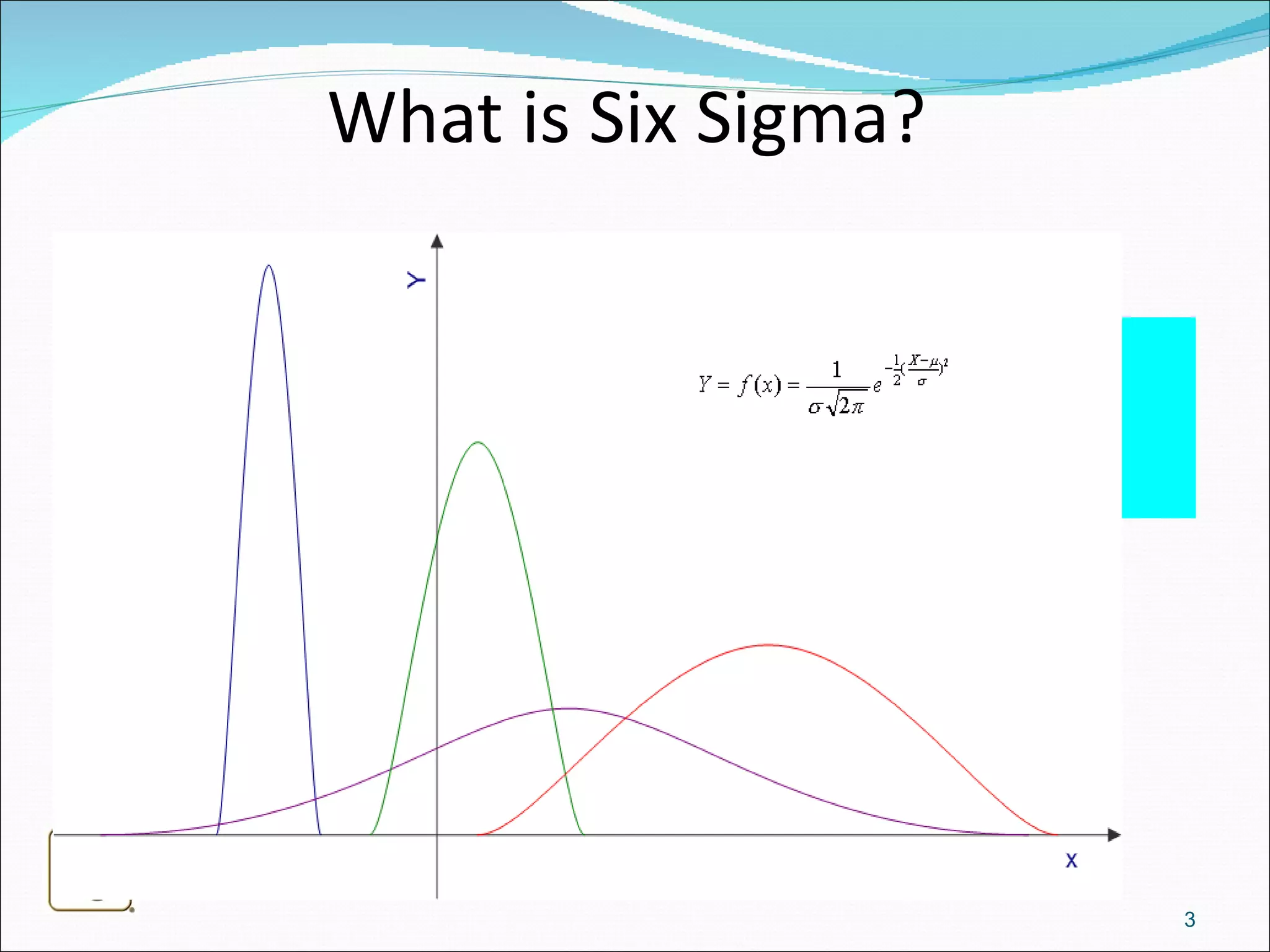
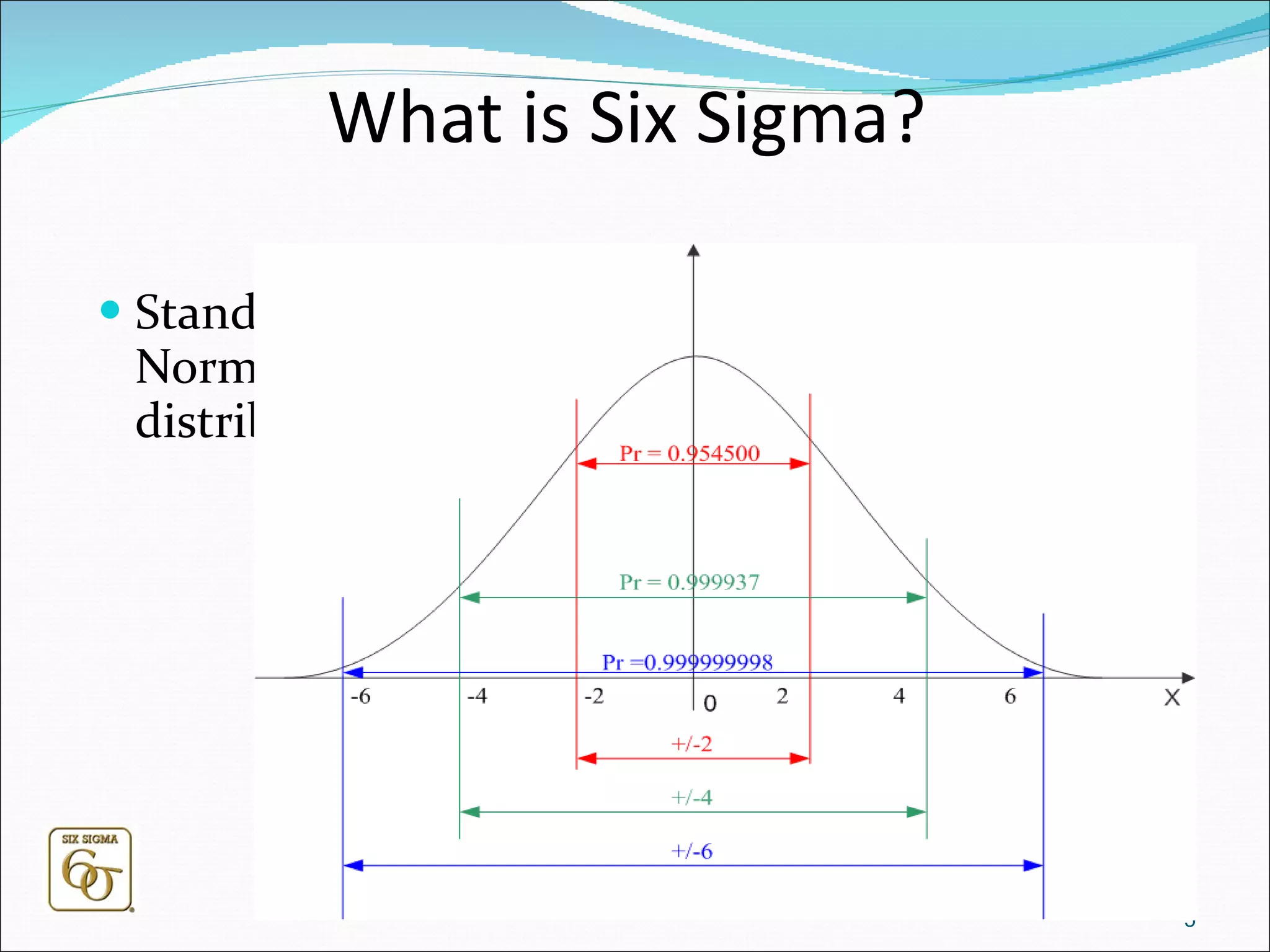
What is Six Sigma? Normal distribution  Mean (  )   Standard deviation (σ)
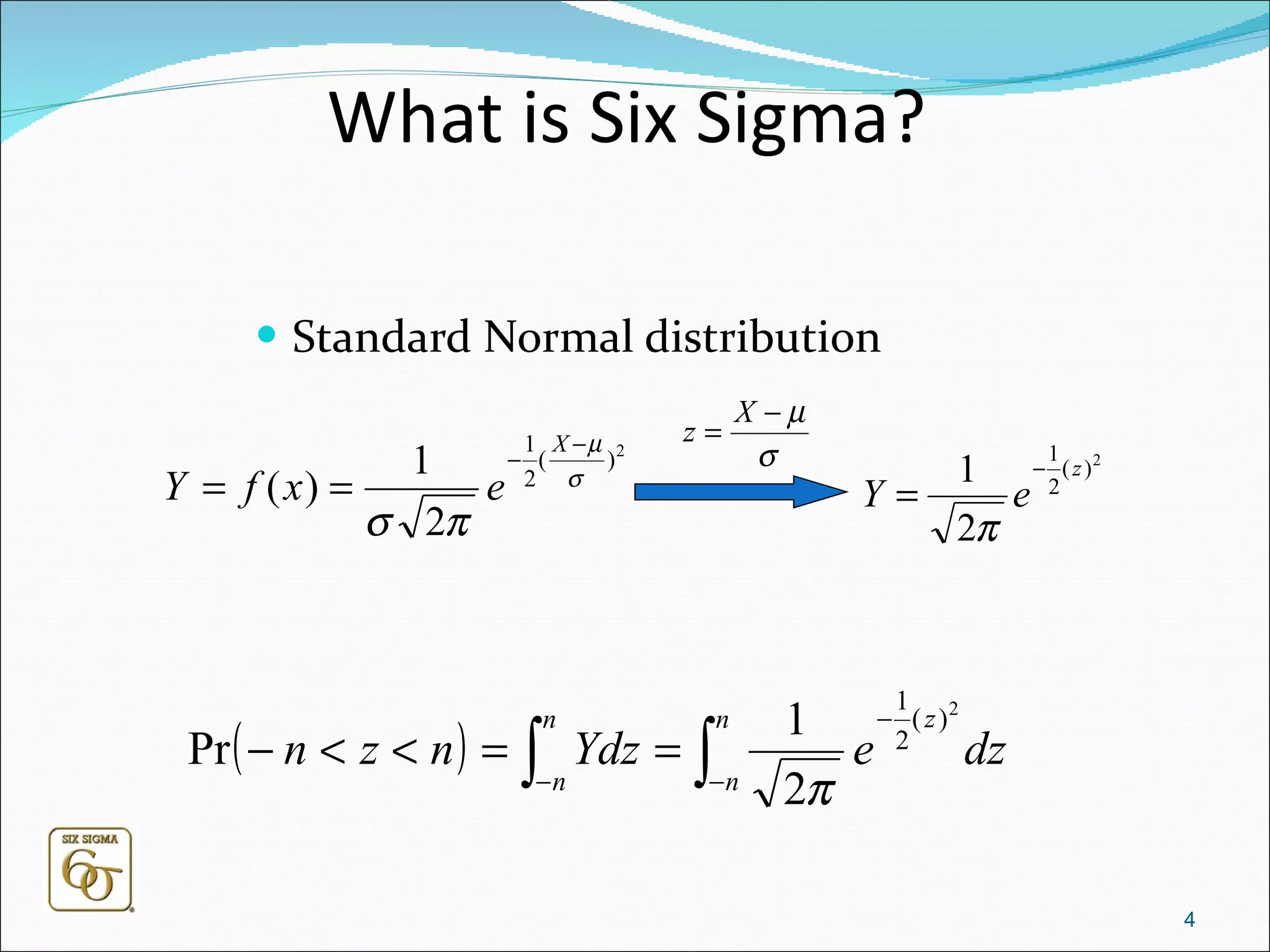
What is Six Sigma? Standard Normal distribution
What is Six Sigma? Assumes 1.5 sigma process drift Defect levels decrease exponentially as sigma levels increase from one value to the next  Six sigma is 3.4 defects per million
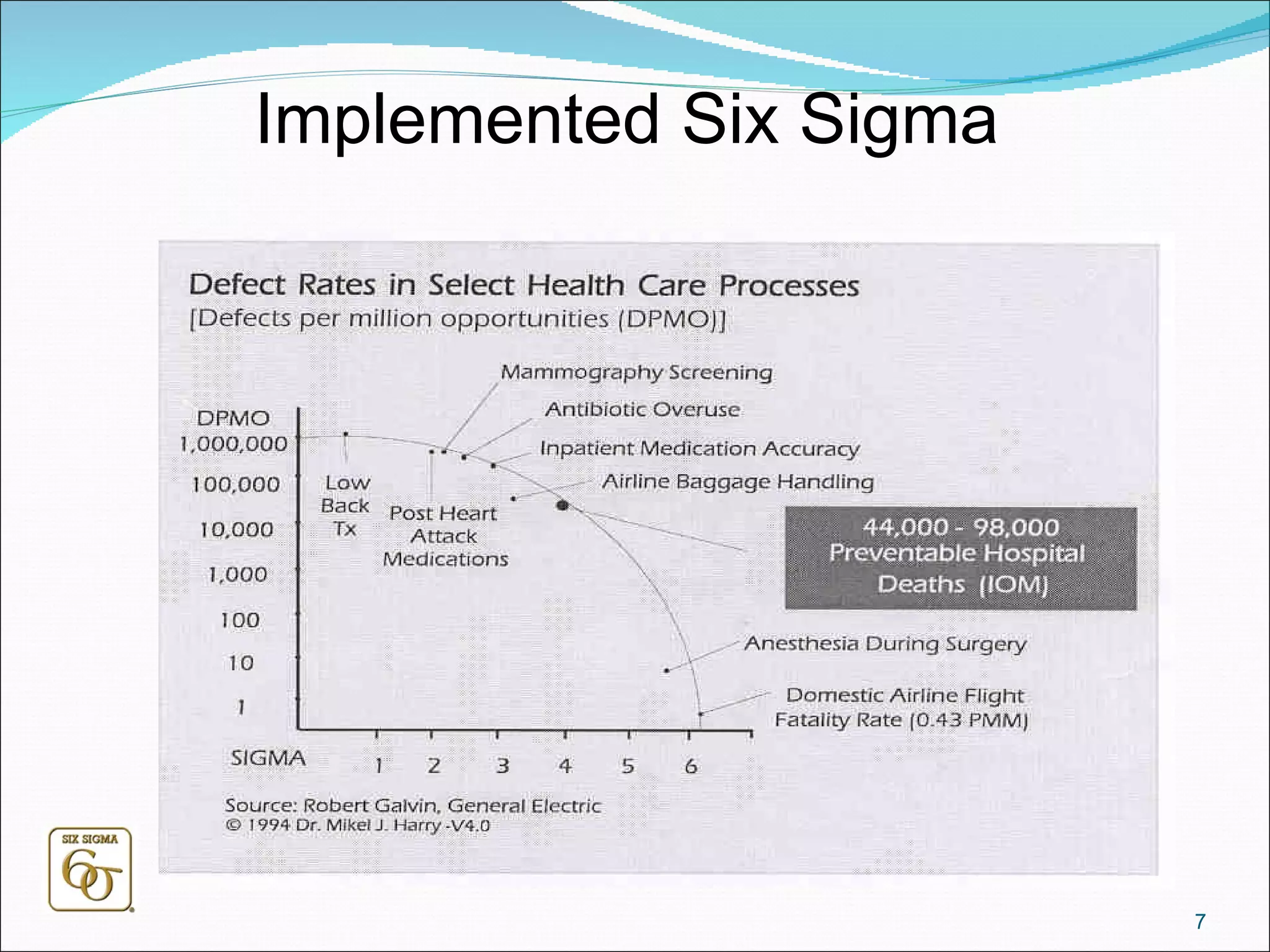
Implemented Six Sigma
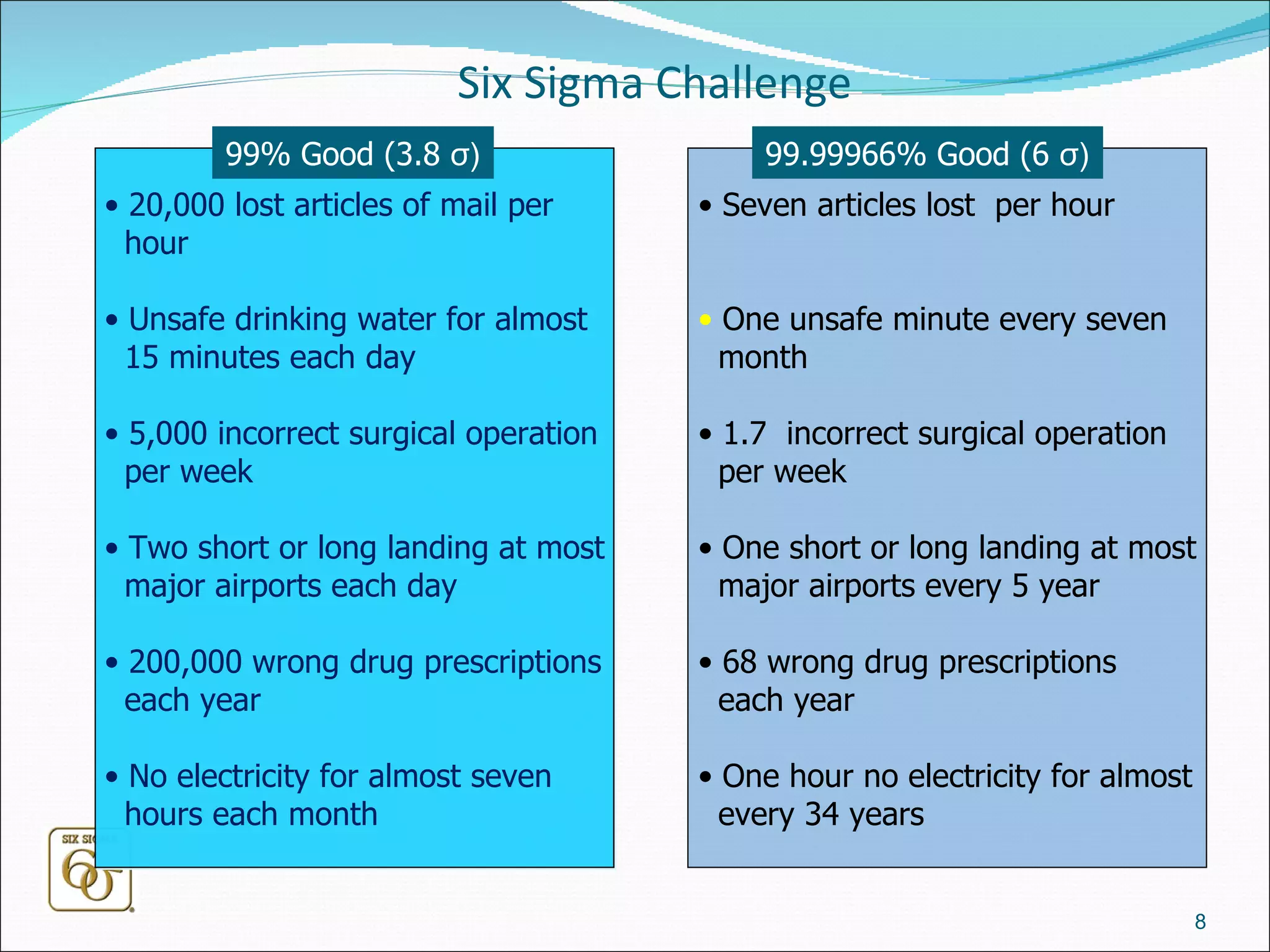
Six Sigma Challenge 20,000 lost articles of mail per hour Unsafe drinking water for almost 15 minutes each day 5,000 incorrect surgical operation per week Two short or long landing at most major airports each day 200,000 wrong drug prescriptions each year No electricity for almost seven hours each month 99% Good (3.8  σ ) Seven articles lost  per hour One unsafe minute every seven month 1.7  incorrect surgical operation per week One short or long landing at most major airports every 5 year 68 wrong drug prescriptions each year One hour no electricity for almost every 34 years 99.99966% Good (6  σ )
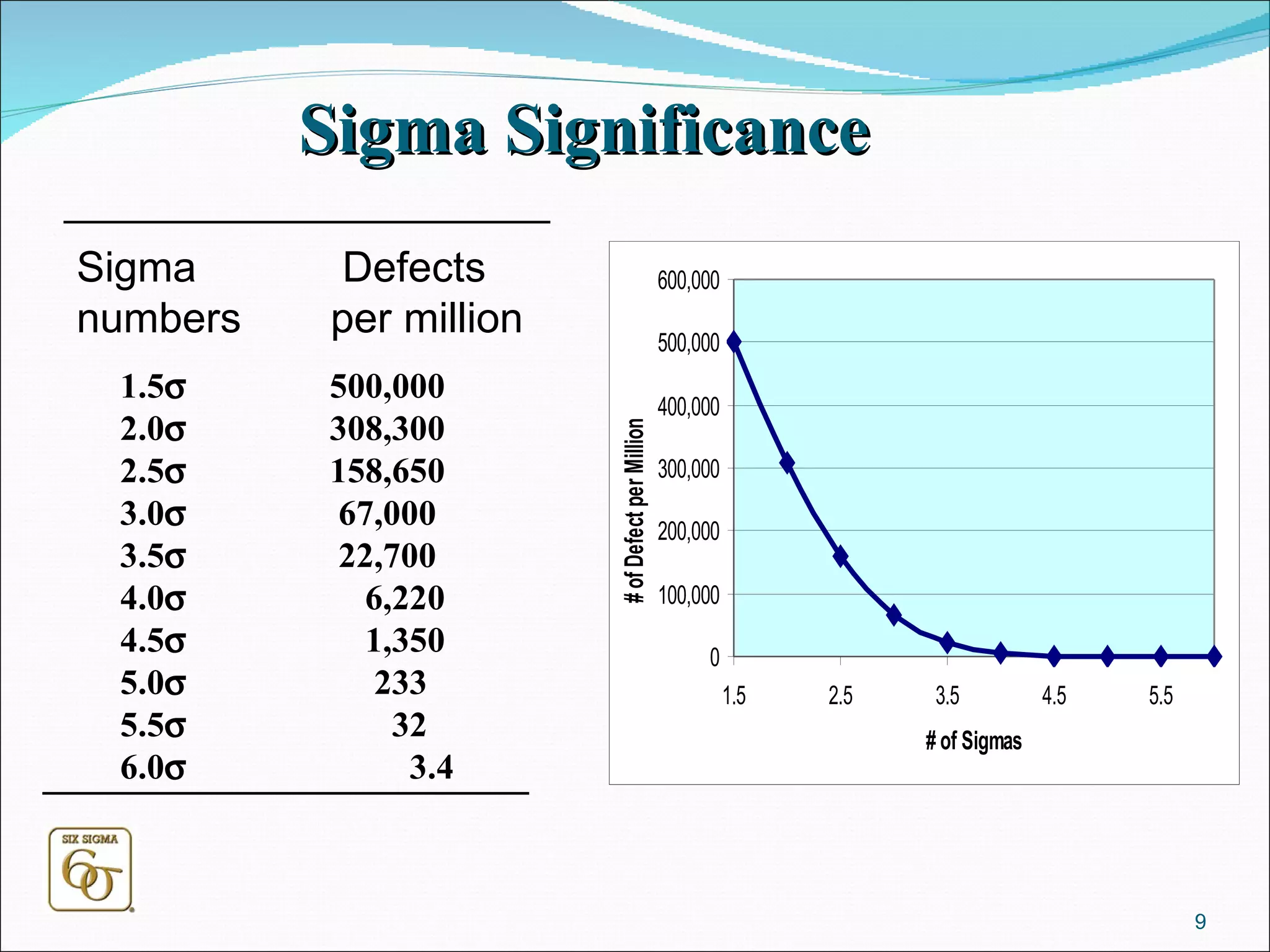
Sigma Significance Sigma   Defects  numbers per million 1.5  500,000 2.0  308,300 2.5  158,650 3.0     67,000 3.5     22,700 4.0    6,220 4.5    1,350 5.0      233 5.5      32 6.0      3.4
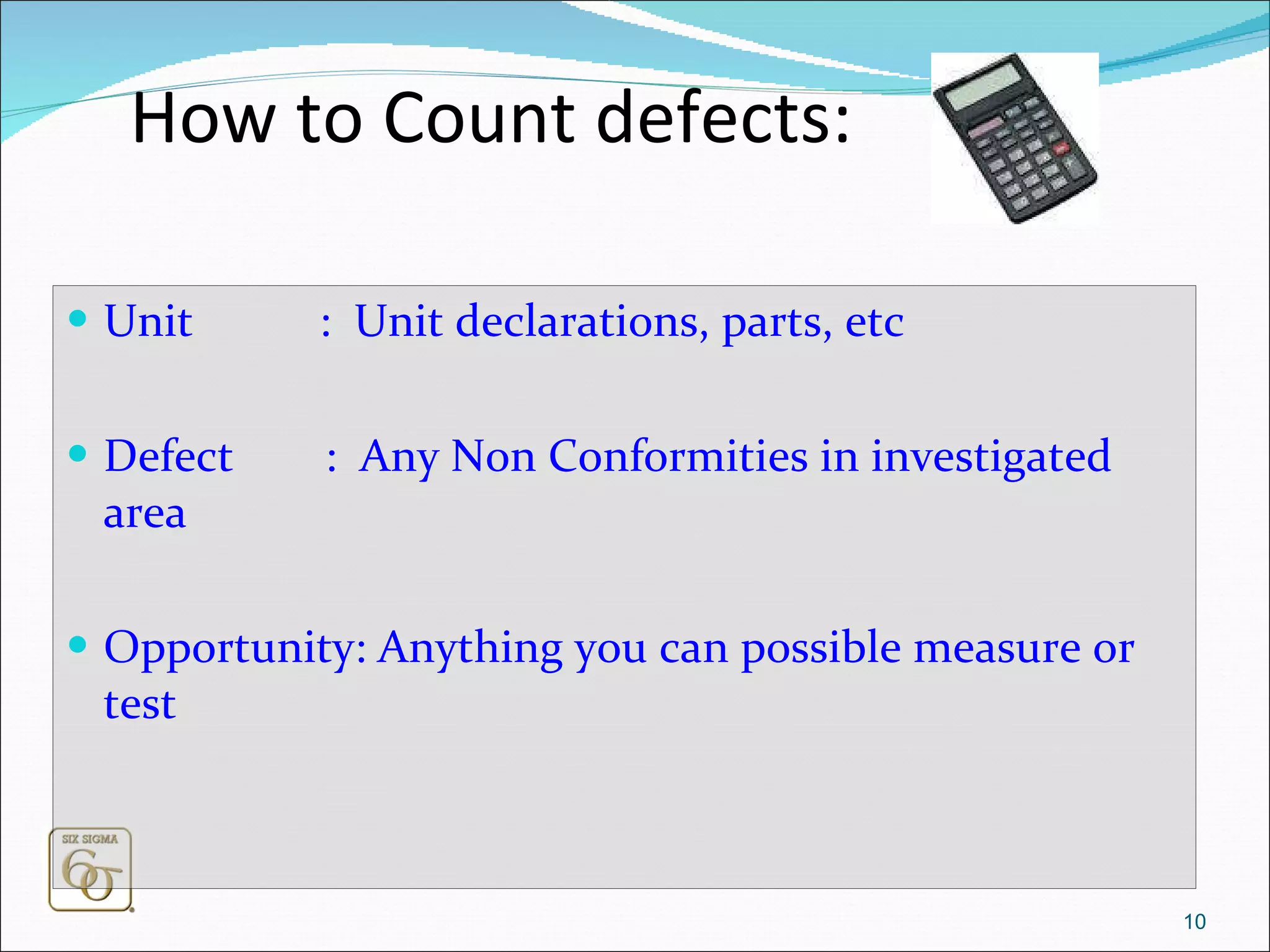
How to Count defects: Unit  :  Unit declarations, parts, etc Defect  :  Any Non Conformities in investigated area Opportunity: Anything you can possible measure or test
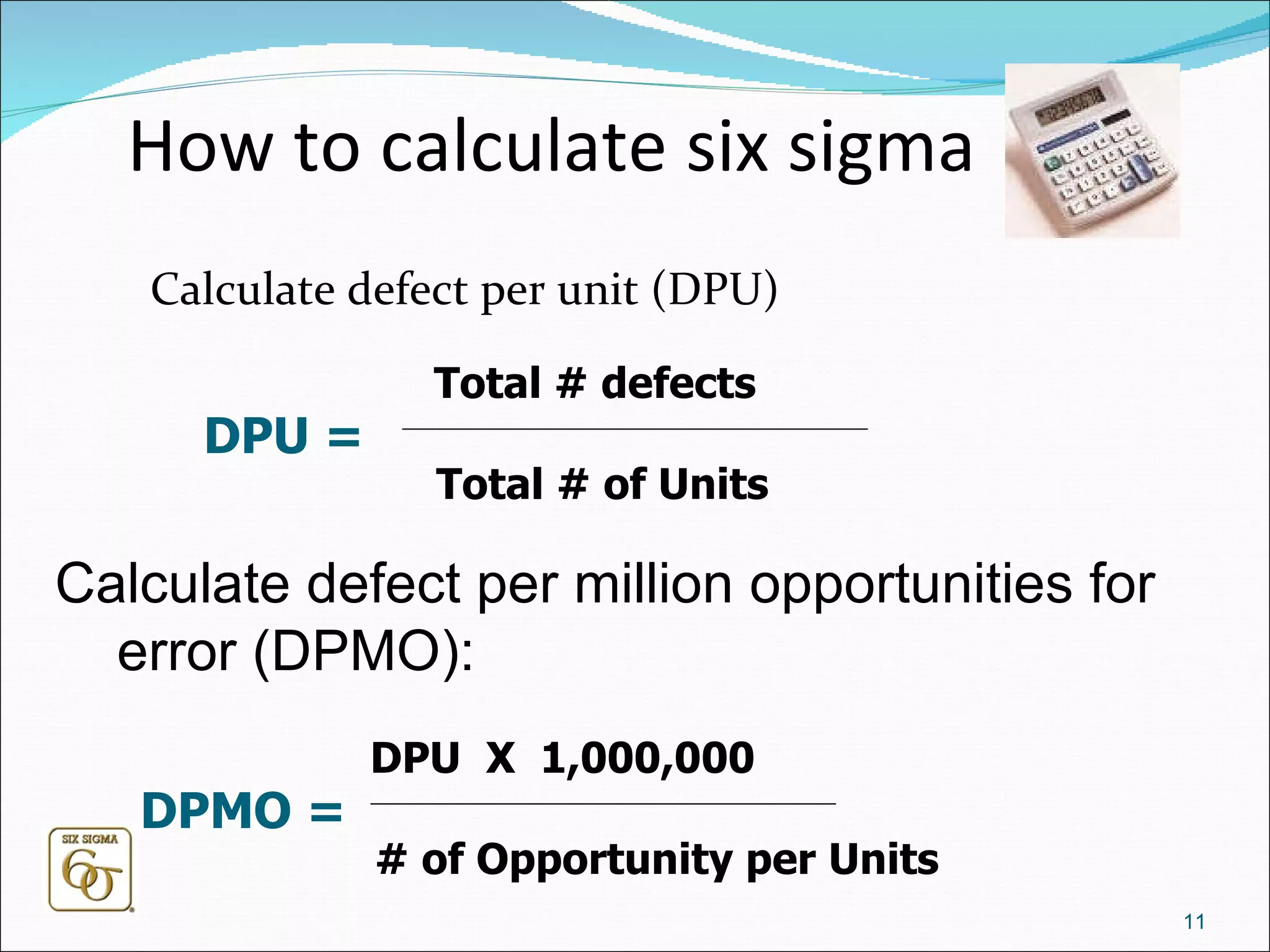
How to calculate six sigma Calculate defect per unit (DPU) Calculate defect per million opportunities for error (DPMO):  DPU =  Total # defects Total # of Units DPMO =  DPU  X  1,000,000 # of Opportunity per Units
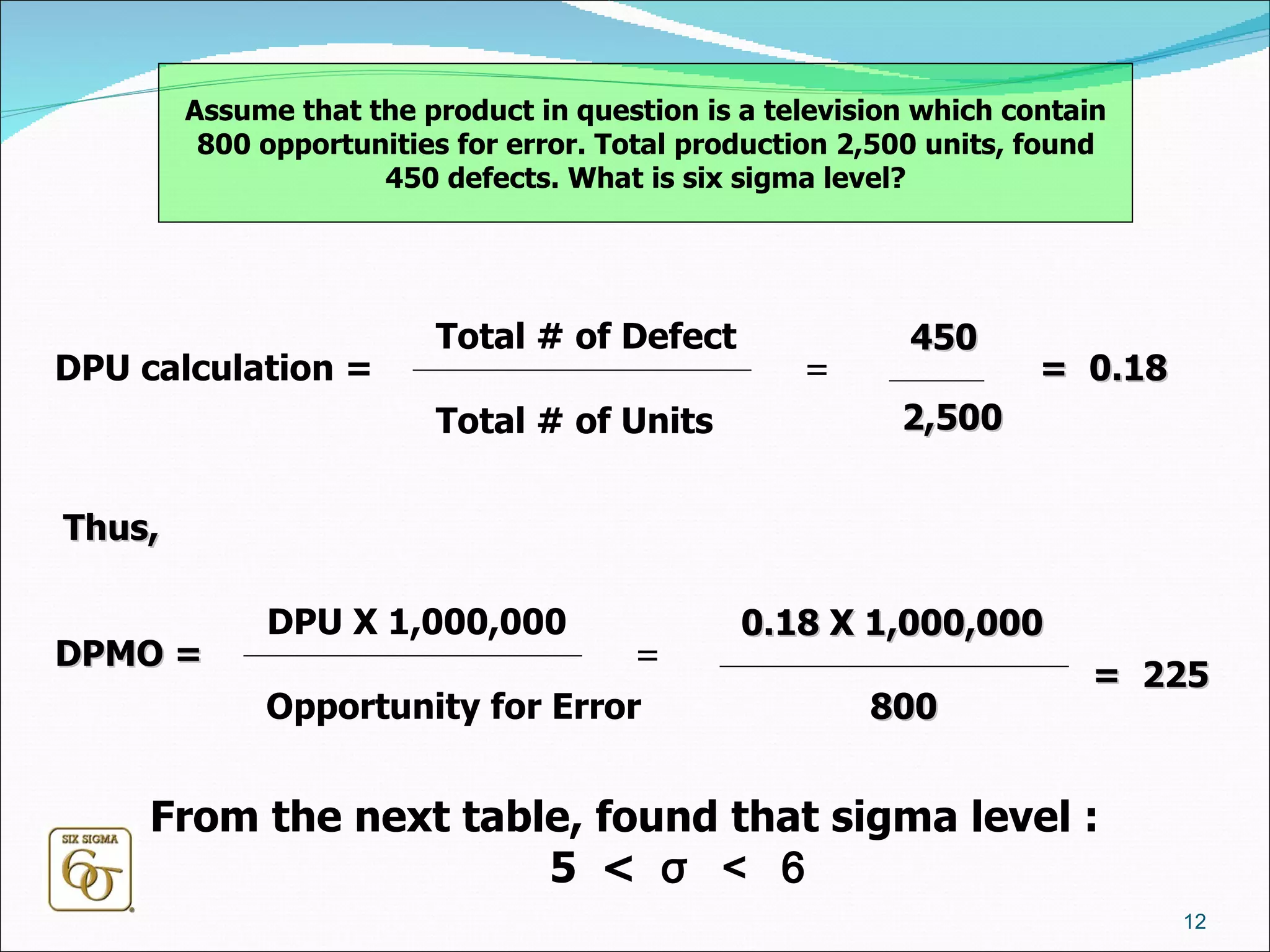
Assume that the product in question is a television which contain 800 opportunities for error. Total production 2,500 units, found 450 defects. What is six sigma level? DPU calculation = Total # of Defect Total # of Units =  450 2,500 =  0.18 Thus,  DPU X 1,000,000 Opportunity for Error =  0.18 X 1,000,000 800 =  225 DPMO =  From the next table, found that sigma level :  5  <  σ   <  6
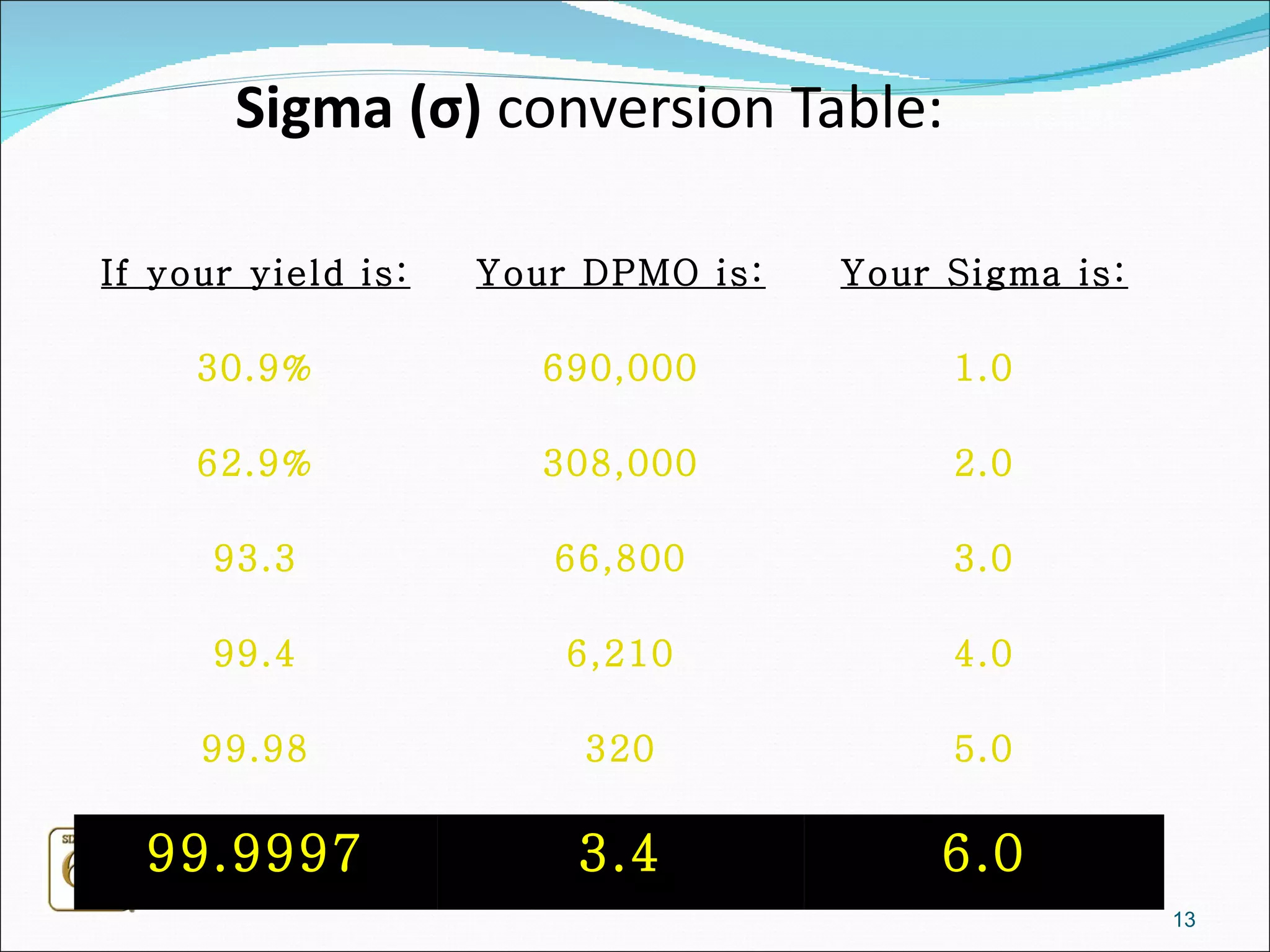
Sigma ( σ )  conversion Table: If your yield is: Your DPMO is: Your Sigma is: 30.9% 690,000 1.0 62.9% 308,000 2.0 93.3 66,800 3.0 99.4 6,210 4.0 99.98 320 5.0 99.9997 3.4 6.0
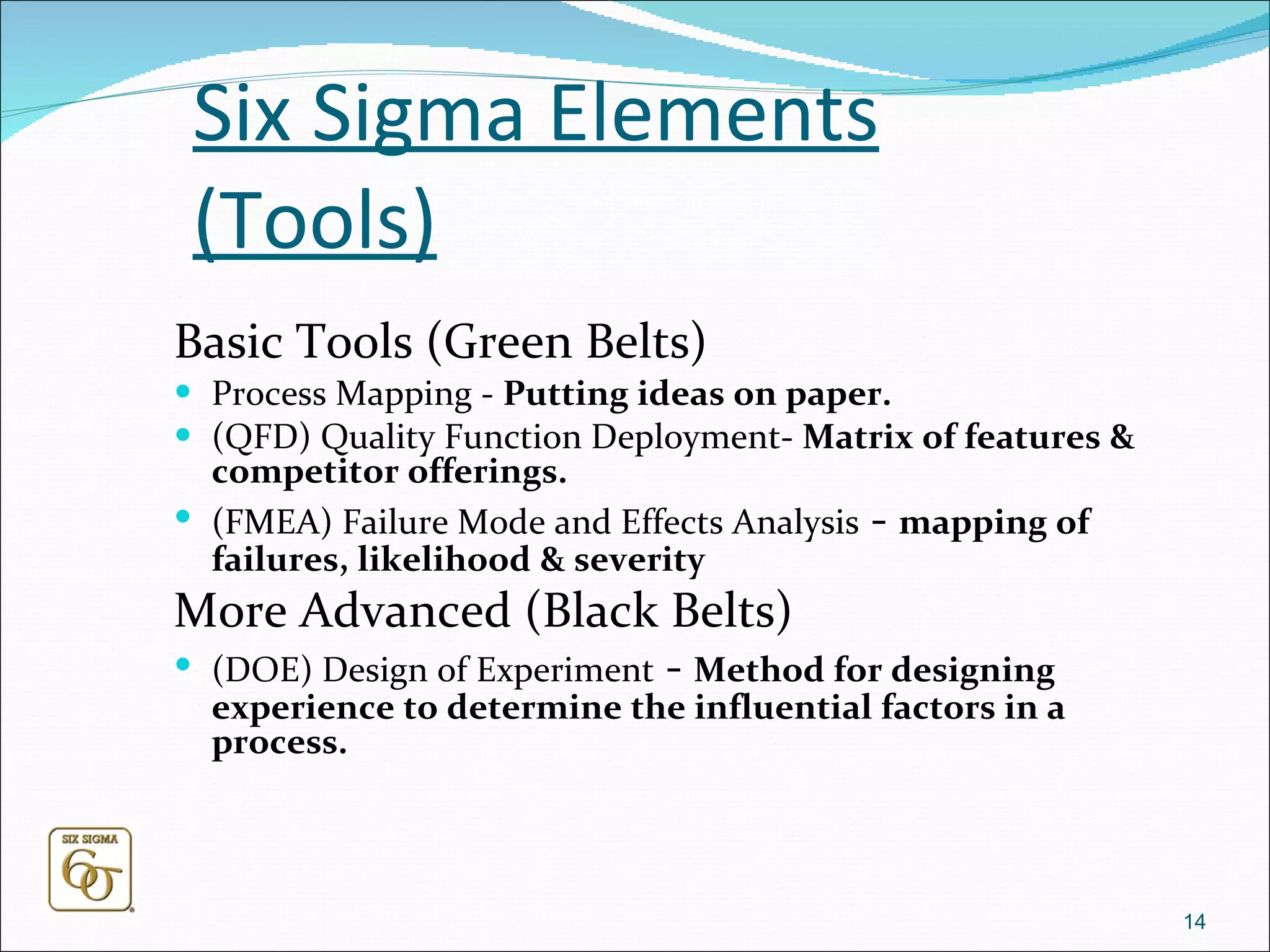
Six Sigma Elements (Tools) Basic Tools (Green Belts) Process Mapping -  Putting ideas on paper. (QFD) Quality Function Deployment-  Matrix of features & competitor offerings. (FMEA) Failure Mode and Effects Analysis  -  mapping of failures, likelihood & severity More Advanced (Black Belts)   (DOE) Design of Experiment  -  Method for designing experience to determine the influential factors in a process.
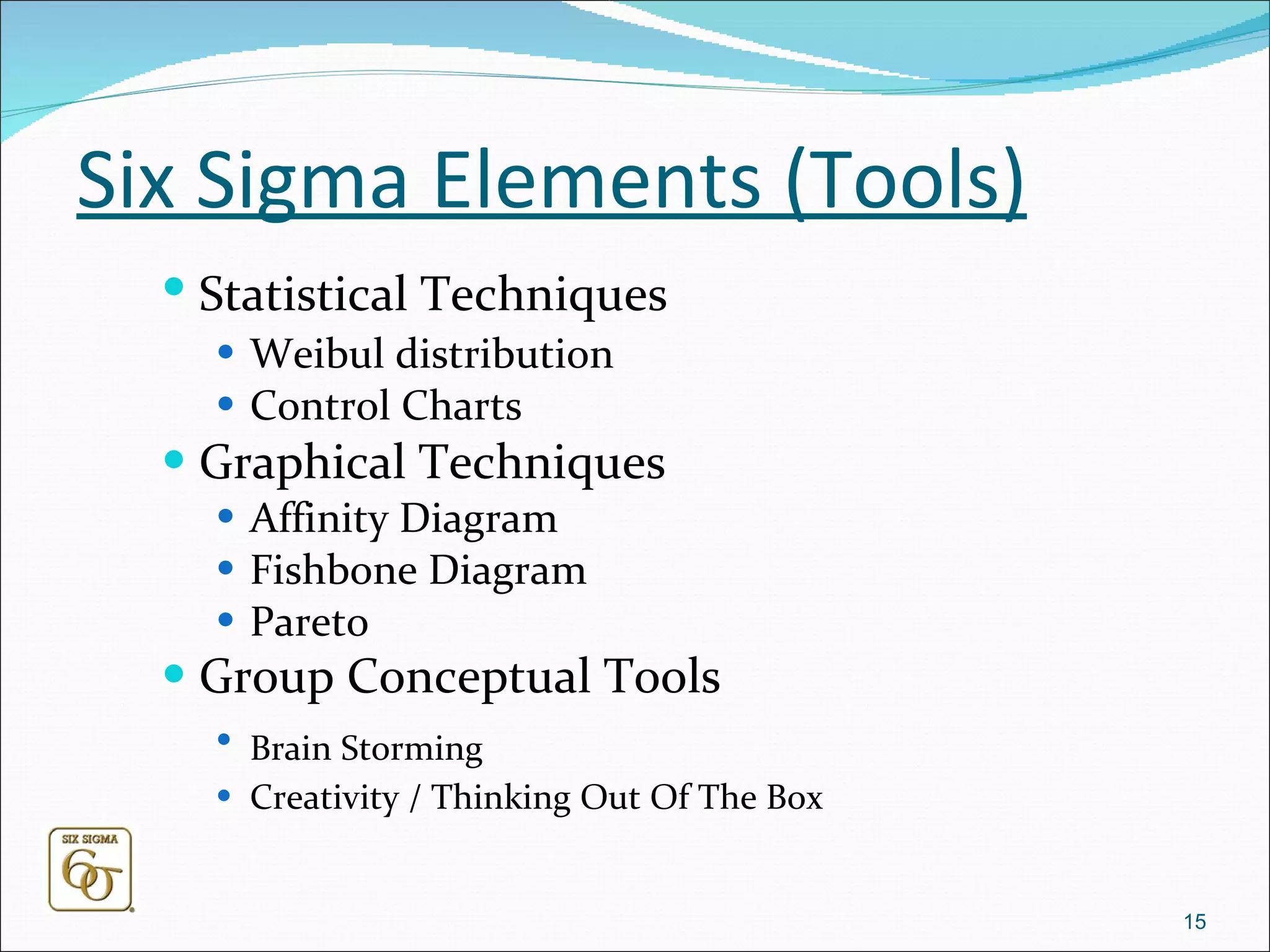
Six Sigma Elements (Tools) Statistical Techniques   Weibul distribution Control Charts Graphical Techniques Affinity Diagram Fishbone Diagram Pareto Group Conceptual Tools   Brain Storming Creativity / Thinking Out Of The Box
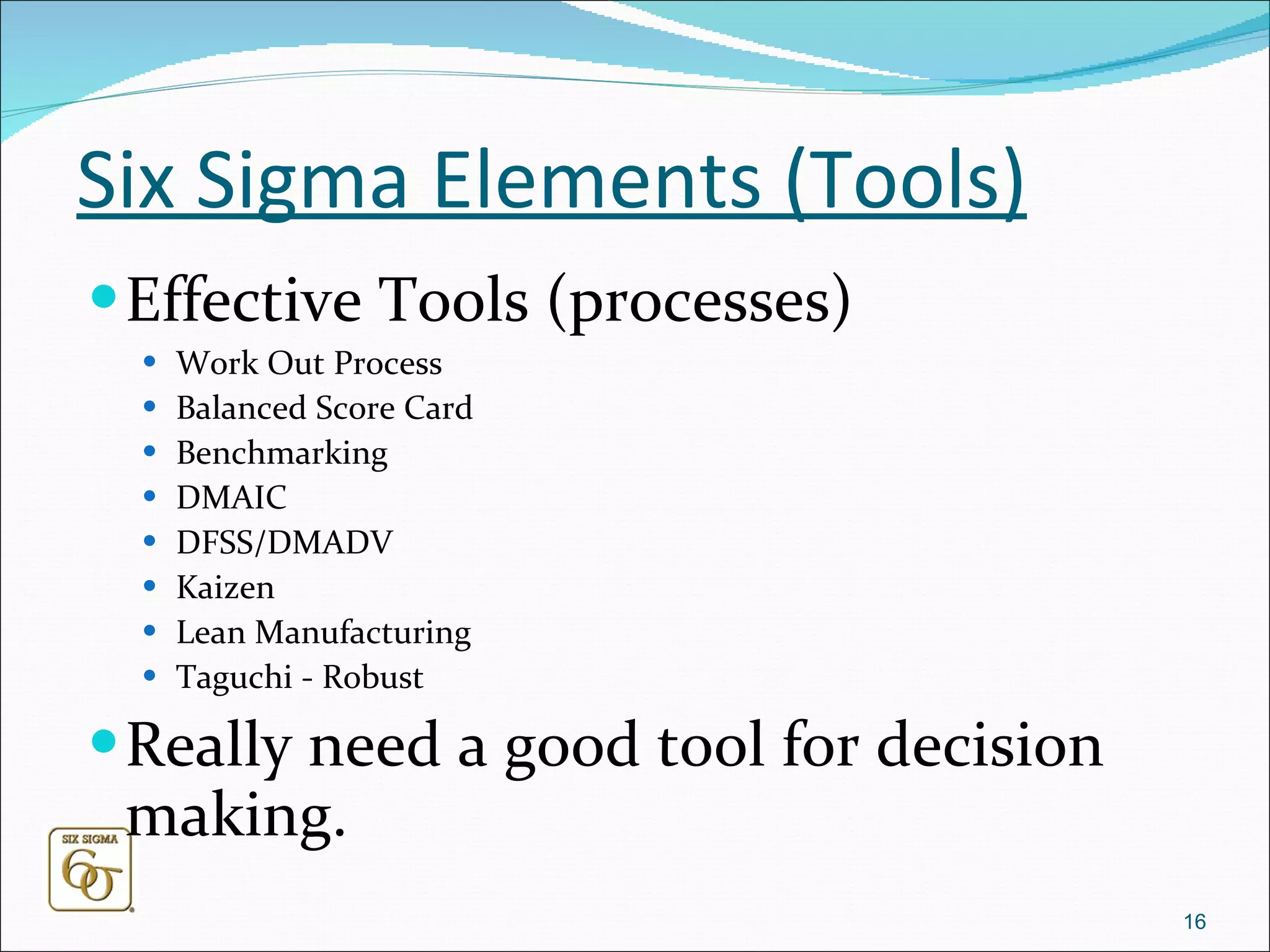
Six Sigma Elements (Tools) Effective Tools (processes)  Work Out Process Balanced Score Card Benchmarking DMAIC DFSS/DMADV Kaizen Lean Manufacturing Taguchi - Robust Really need a good tool for decision making.
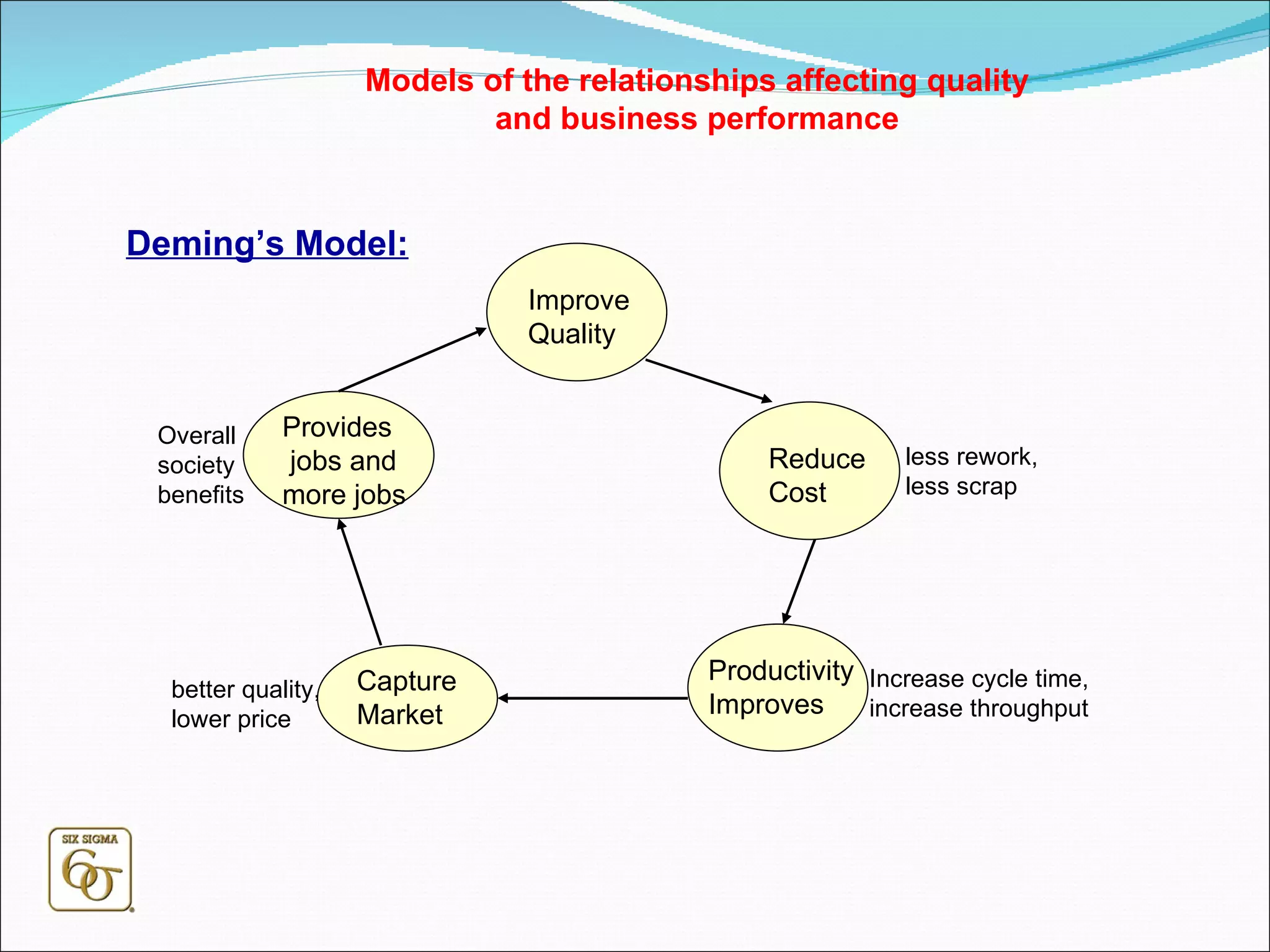
Improve  Quality Reduce Cost Productivity Improves Capture Market Provides jobs and more jobs Models of the relationships affecting quality and business performance Deming’s Model: less rework,  less scrap Increase cycle time, increase throughput better quality, lower price Overall  society benefits
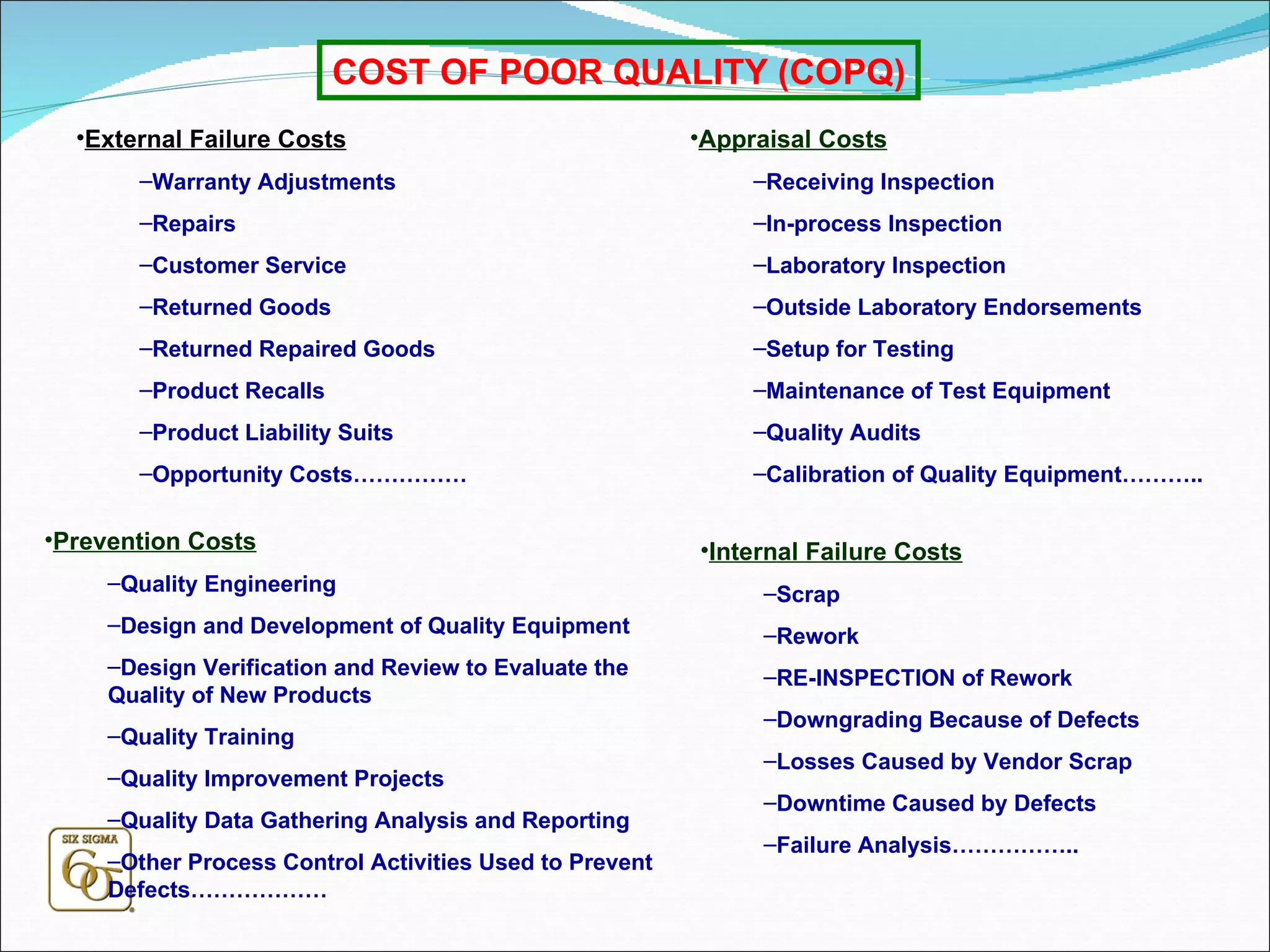
COST OF POOR QUALITY (COPQ) External Failure Costs Warranty Adjustments Repairs Customer Service Returned Goods Returned Repaired Goods Product Recalls Product Liability Suits Opportunity Costs…………… Internal Failure Costs Scrap Rework RE-INSPECTION of Rework Downgrading Because of Defects Losses Caused by Vendor Scrap Downtime Caused by Defects Failure Analysis…………….. Appraisal Costs Receiving Inspection In-process Inspection Laboratory Inspection Outside Laboratory Endorsements Setup for Testing Maintenance of Test Equipment Quality Audits Calibration of Quality Equipment……….. Prevention Costs Quality Engineering Design and Development of Quality Equipment Design Verification and Review to Evaluate the Quality of New Products Quality Training Quality Improvement Projects Quality Data Gathering Analysis and Reporting Other Process Control Activities Used to Prevent Defects………………
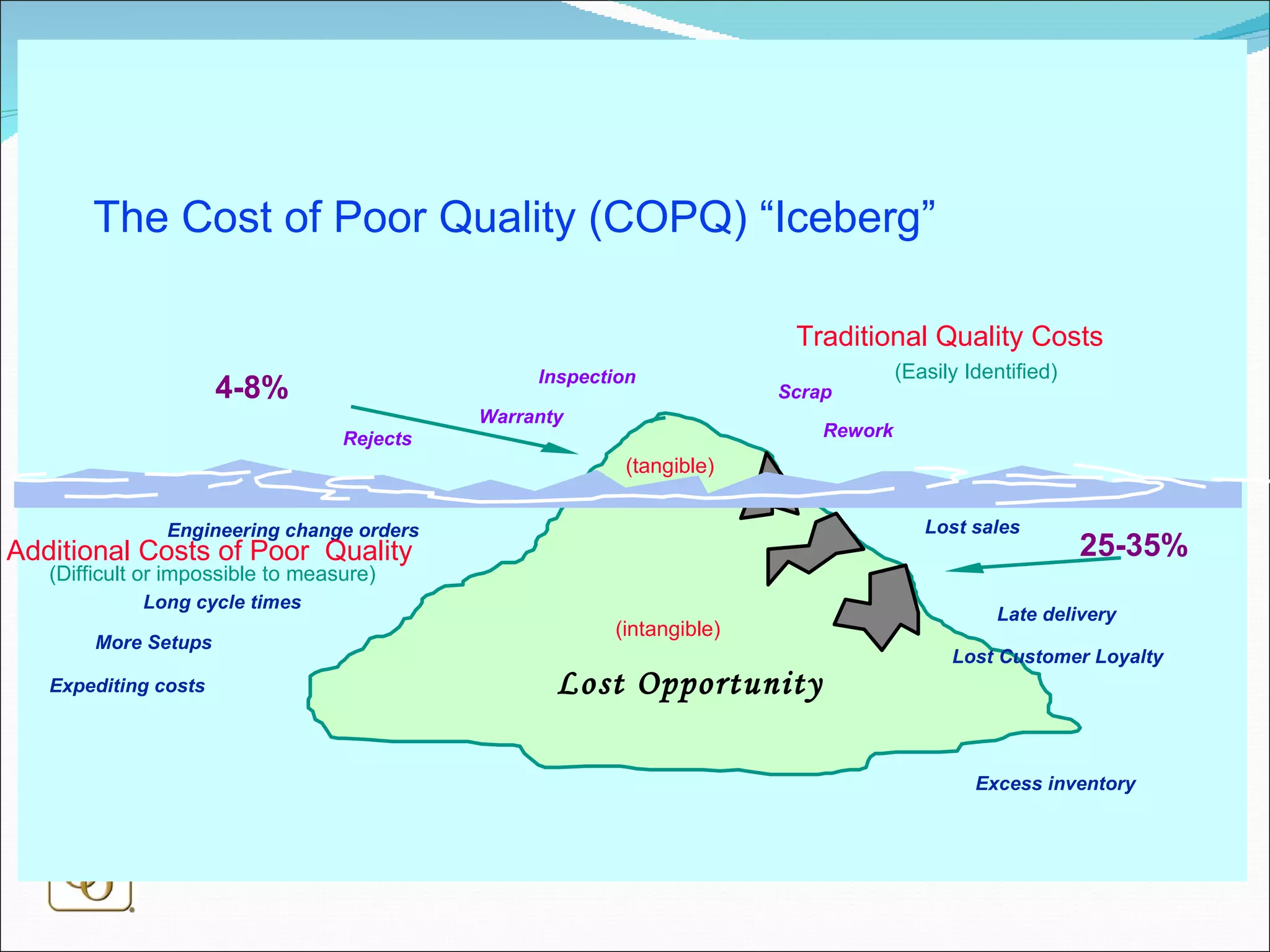
Lost Opportunity Scrap Rework Inspection Warranty Rejects Lost sales Late delivery Engineering change orders Long cycle times Expediting costs Excess inventory The Cost of Poor Quality (COPQ) “Iceberg” Traditional Quality Costs Additional Costs of Poor  Quality (intangible) (tangible) 4-8% 25-35% (Easily Identified) (Difficult or impossible to measure) Lost Customer Loyalty More Setups
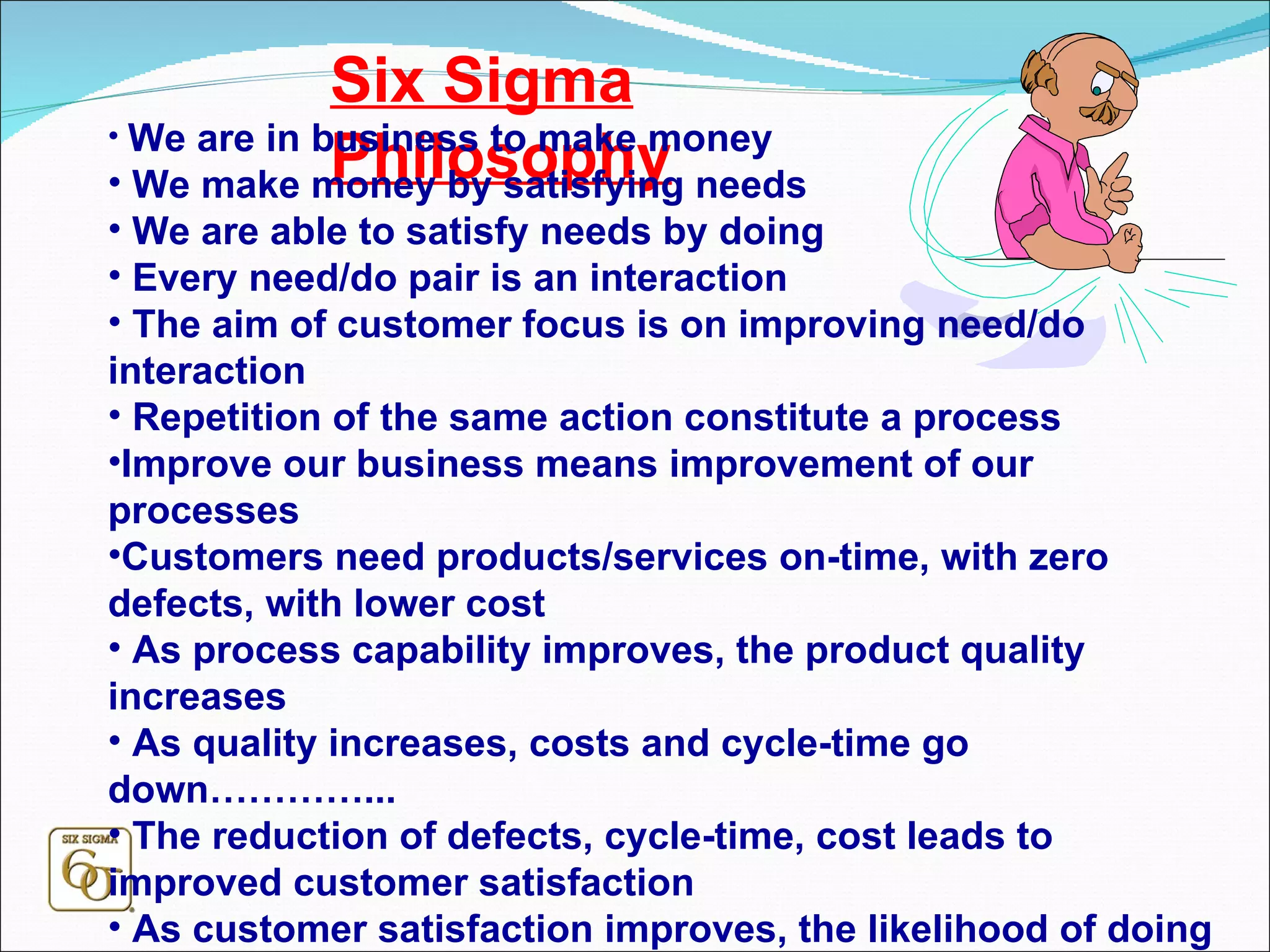
Six Sigma Philosophy We are in business to make money We make money by satisfying needs We are able to satisfy needs by doing Every need/do pair is an interaction The aim of customer focus is on improving need/do interaction Repetition of the same action constitute a process Improve our business means improvement of our processes Customers need products/services on-time, with zero defects, with lower cost As process capability improves, the product quality increases As quality increases, costs and cycle-time go down…………... The reduction of defects, cycle-time, cost leads to improved customer satisfaction As customer satisfaction improves, the likelihood of doing business increases As business increases, we (as individual and society) grow and prosper
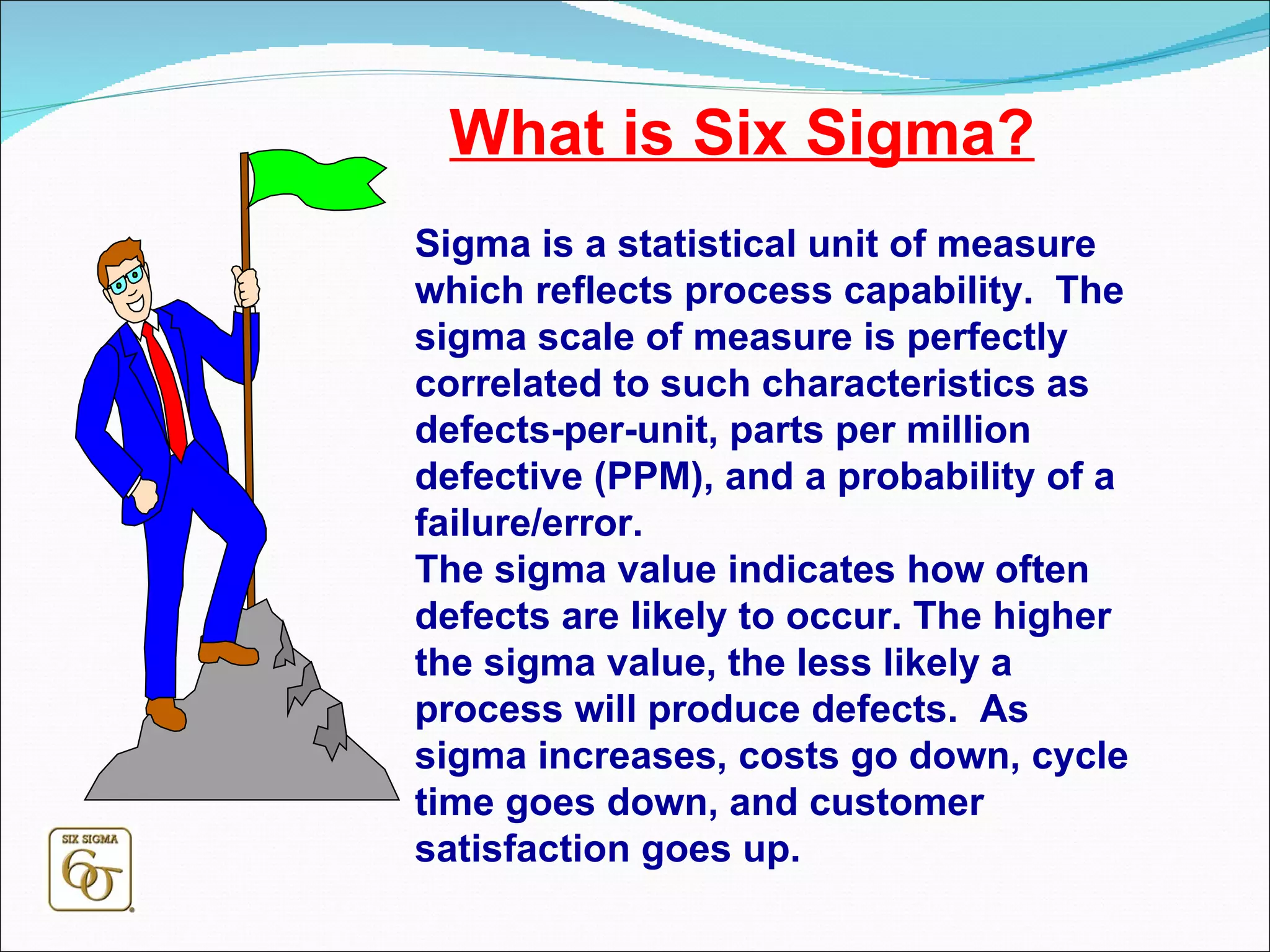
What is Six Sigma? Sigma is a statistical unit of measure which reflects process capability.  The sigma scale of measure is perfectly correlated to such characteristics as defects-per-unit, parts per million defective (PPM), and a probability of a failure/error.  The sigma value indicates how often defects are likely to occur. The higher the sigma value, the less likely a process will produce defects.  As sigma increases, costs go down, cycle time goes down, and customer satisfaction goes up.
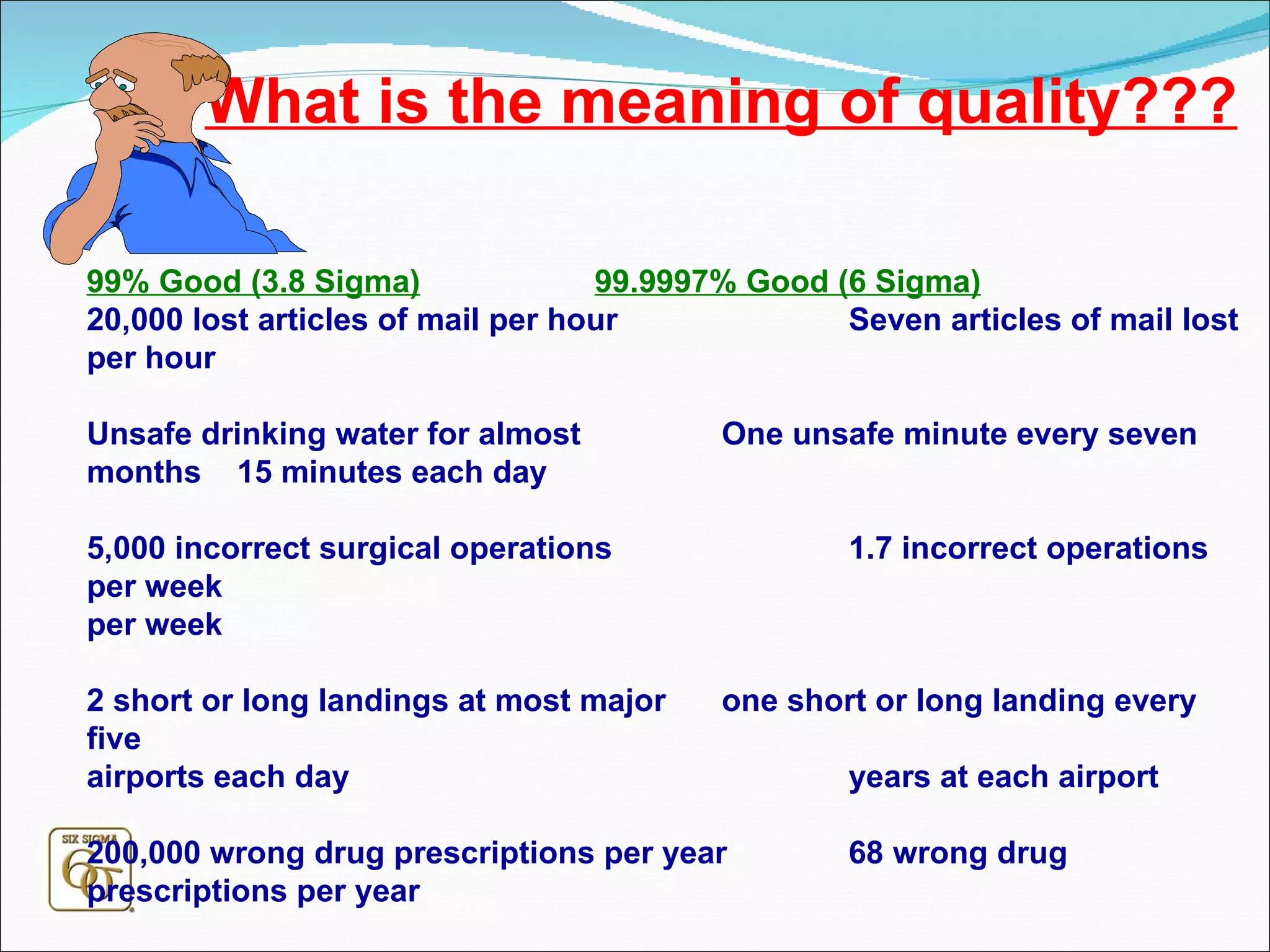
What is the meaning of quality??? 99% Good (3.8 Sigma) 99.9997% Good (6 Sigma) 20,000 lost articles of mail per hour Seven articles of mail lost per hour Unsafe drinking water for almost One unsafe minute every seven months  15 minutes each day 5,000 incorrect surgical operations  1.7 incorrect operations per week per week 2 short or long landings at most major one short or long landing every five airports each day years at each airport 200,000 wrong drug prescriptions per year 68 wrong drug prescriptions per year No electricity for seven hours each month One hour without electricity every 34 years
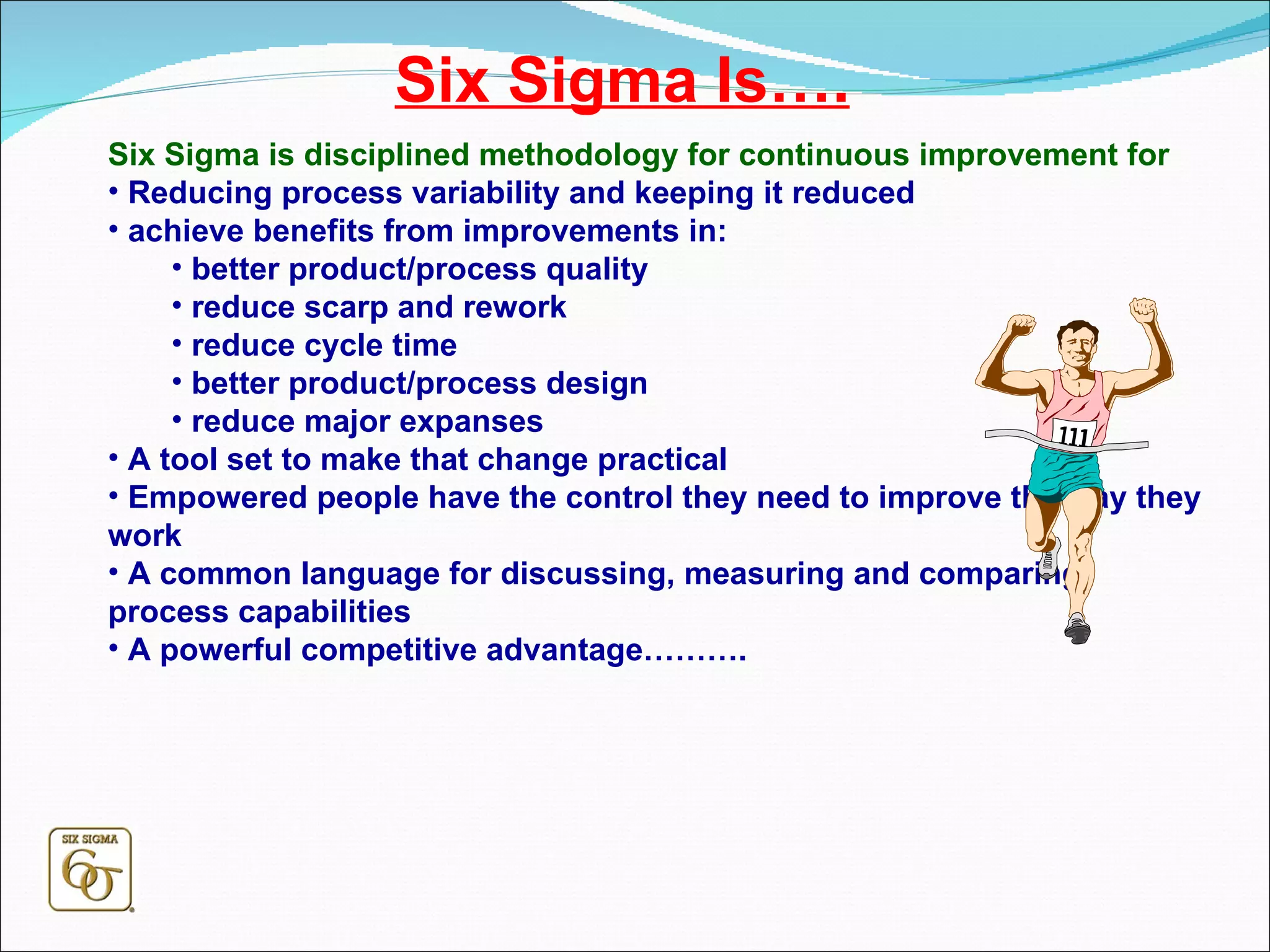
Six Sigma Is…. Six Sigma is disciplined methodology for continuous improvement for Reducing process variability and keeping it reduced achieve benefits from improvements in: better product/process quality reduce scarp and rework reduce cycle time better product/process design reduce major expanses A tool set to make that change practical Empowered people have the control they need to improve the way they work A common language for discussing, measuring and comparing process capabilities A powerful competitive advantage……….
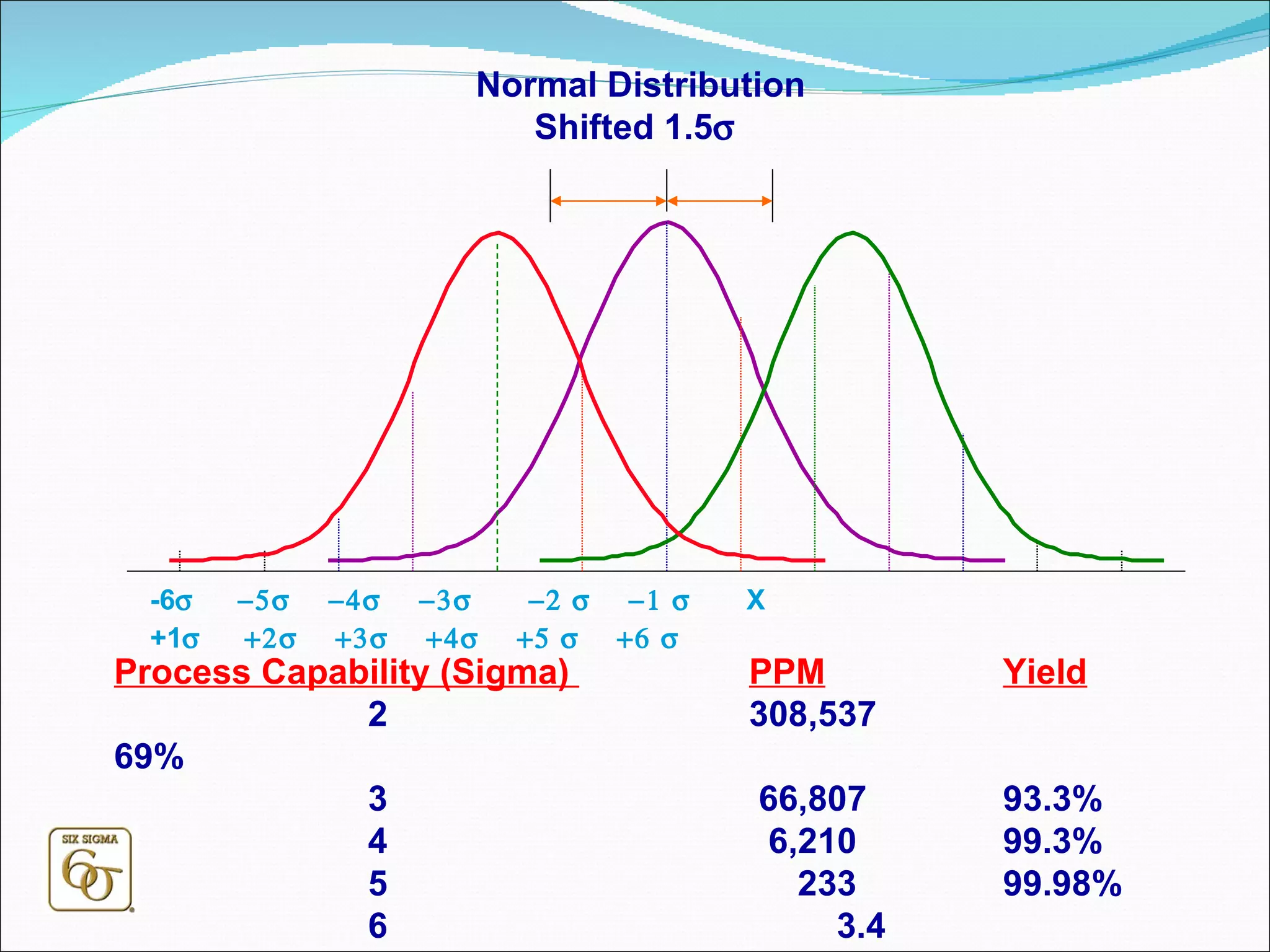
-6      X  +1    Normal Distribution Shifted 1.5    Process Capability (Sigma)  PPM Yield 2 308,537 69% 3   66,807 93.3% 4   6,210 99.3% 5   233 99.98% 6   3.4 99.9997%
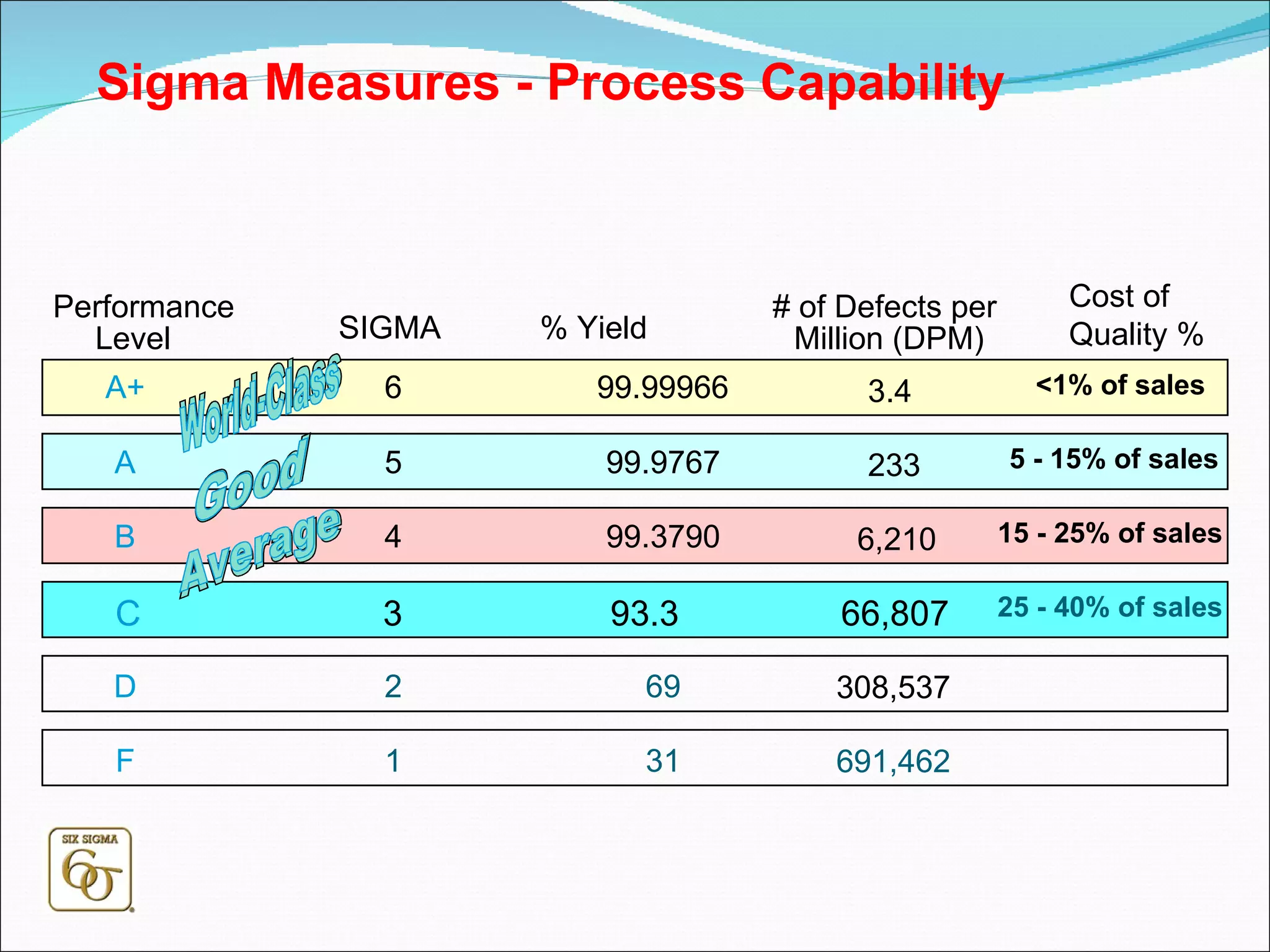
Sigma Measures - Process   Capability Performance Level SIGMA % Yield # of Defects per Million (DPM) A+ 6 99.99966 3.4 A 5 99.9767 233 B 4 99.3790 6,210 C 3 93.3 66,807 D 2 69 308,537 F 1 31 691,462 Cost of Quality % <1% of sales 5 - 15% of sales 15 - 25% of sales 25 - 40% of sales C 93.3 66,807 3 Good World-Class Average Good World-Class Average
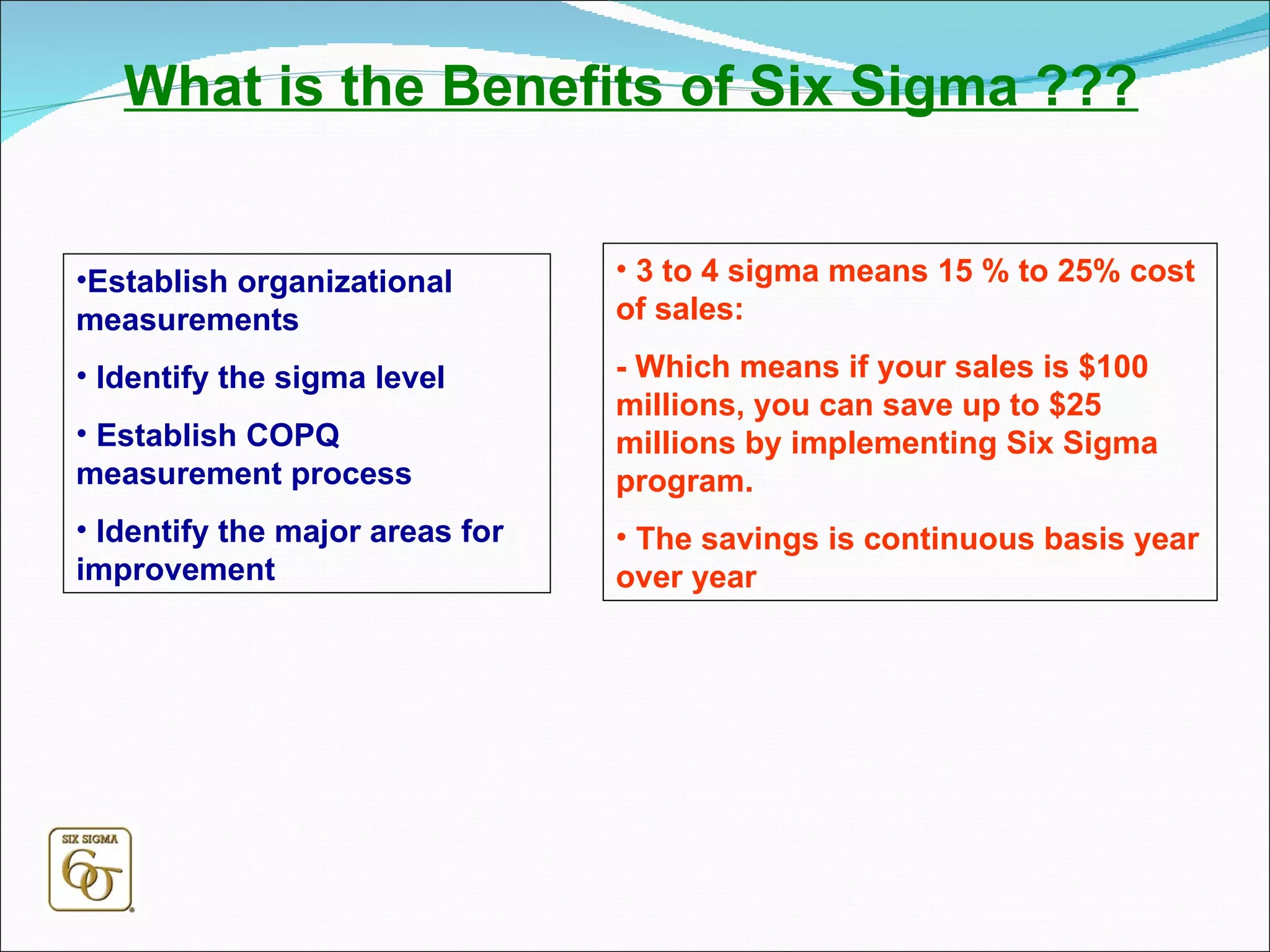
Establish organizational measurements Identify the sigma level Establish COPQ measurement process Identify the major areas for improvement 3 to 4 sigma means 15 % to 25% cost of sales:  - Which means if your sales is $100 millions, you can save up to $25 millions by implementing Six Sigma program. The savings is continuous basis year over year  What is the Benefits of Six Sigma ???
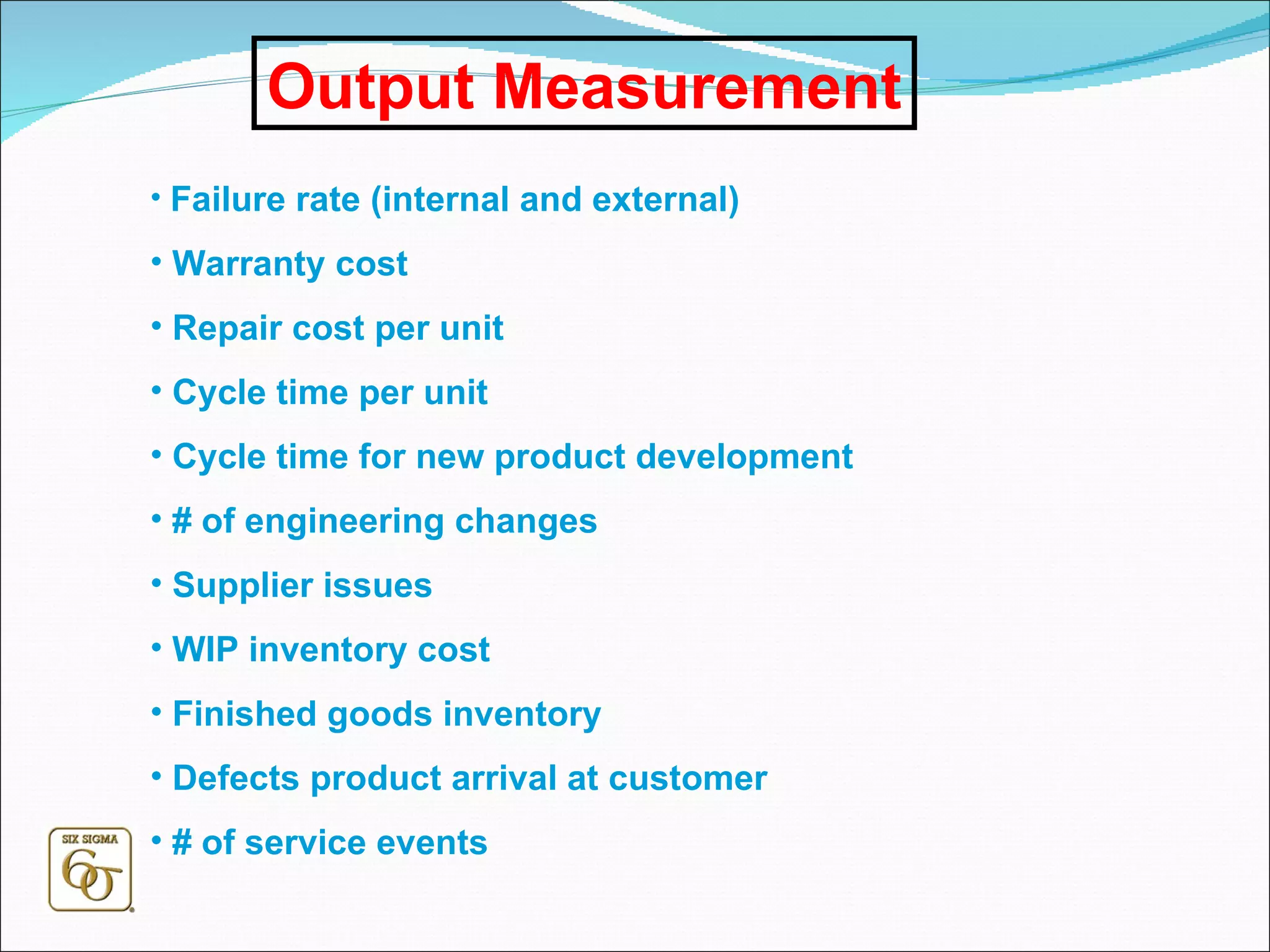
Output Measurement Failure rate (internal and external) Warranty cost Repair cost per unit Cycle time per unit Cycle time for new product development # of engineering changes Supplier issues WIP inventory cost Finished goods inventory Defects product arrival at customer # of service events
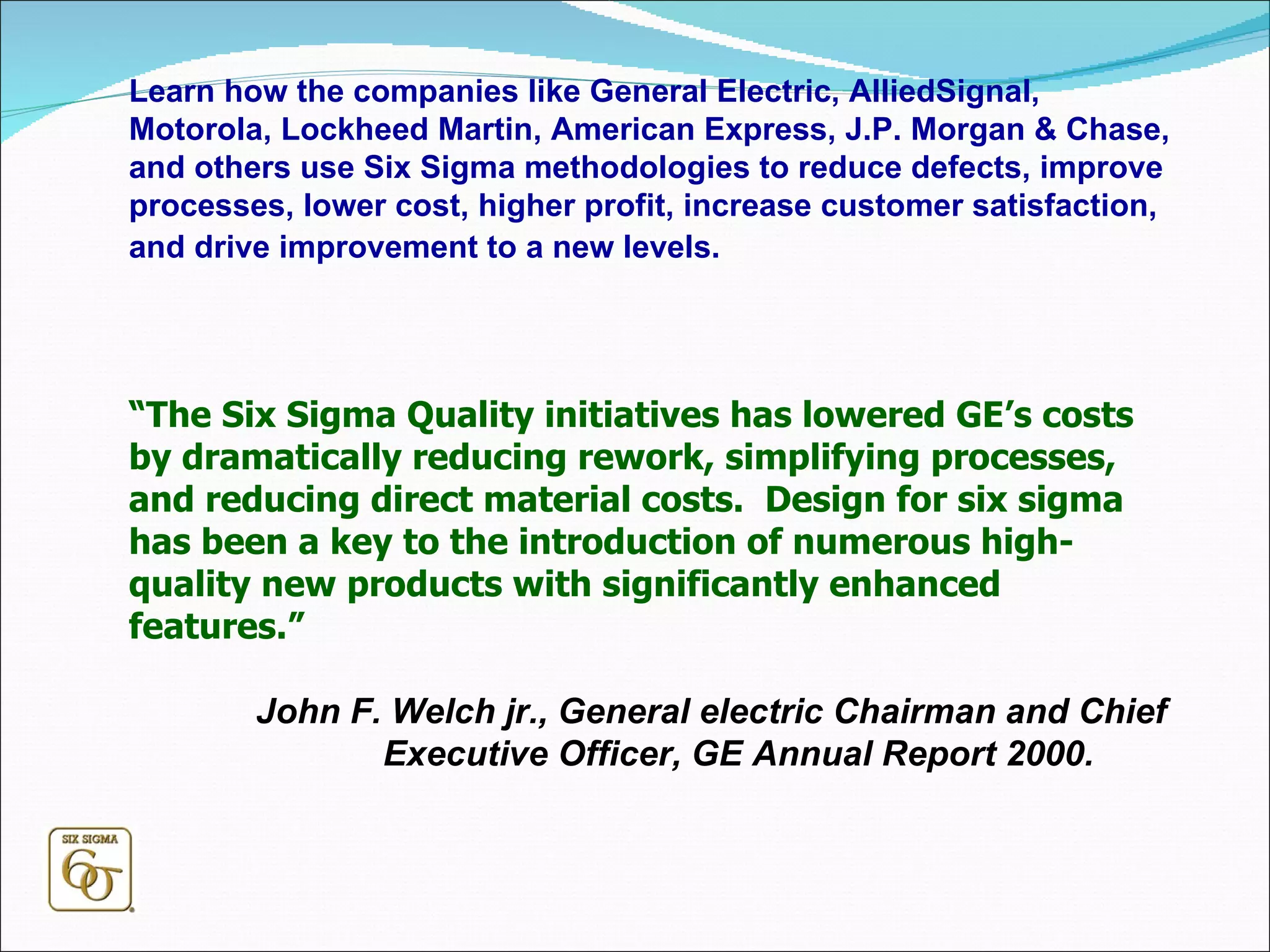
Learn how the companies like General Electric, AlliedSignal, Motorola, Lockheed Martin, American Express, J.P. Morgan & Chase, and others use Six Sigma methodologies to reduce defects, improve processes, lower cost, higher profit, increase customer satisfaction, and drive improvement to a new levels.   “ The Six Sigma Quality initiatives has lowered GE’s costs by dramatically reducing rework, simplifying processes, and reducing direct material costs.  Design for six sigma has been a key to the introduction of numerous high-quality new products with significantly enhanced features.” John F. Welch jr., General electric Chairman and Chief Executive Officer, GE Annual Report 2000.
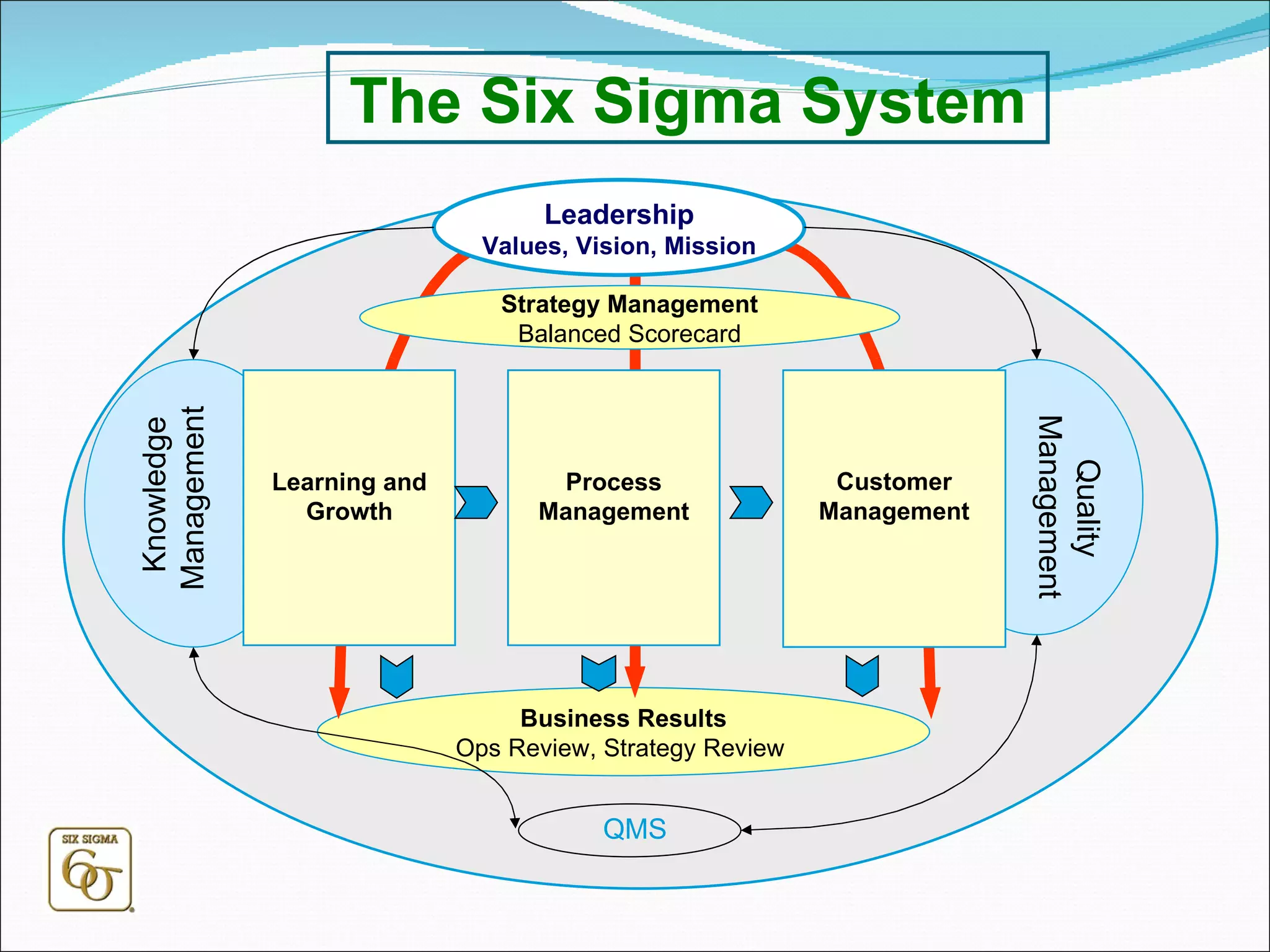
b Knowledge Management Knowledge Management b Business Results Ops Review, Strategy Review  Leadership Values, Vision, Mission Learning and Growth Strategy Management Balanced Scorecard Process Management Customer Management Knowledge Management Quality Management QMS The Six Sigma System
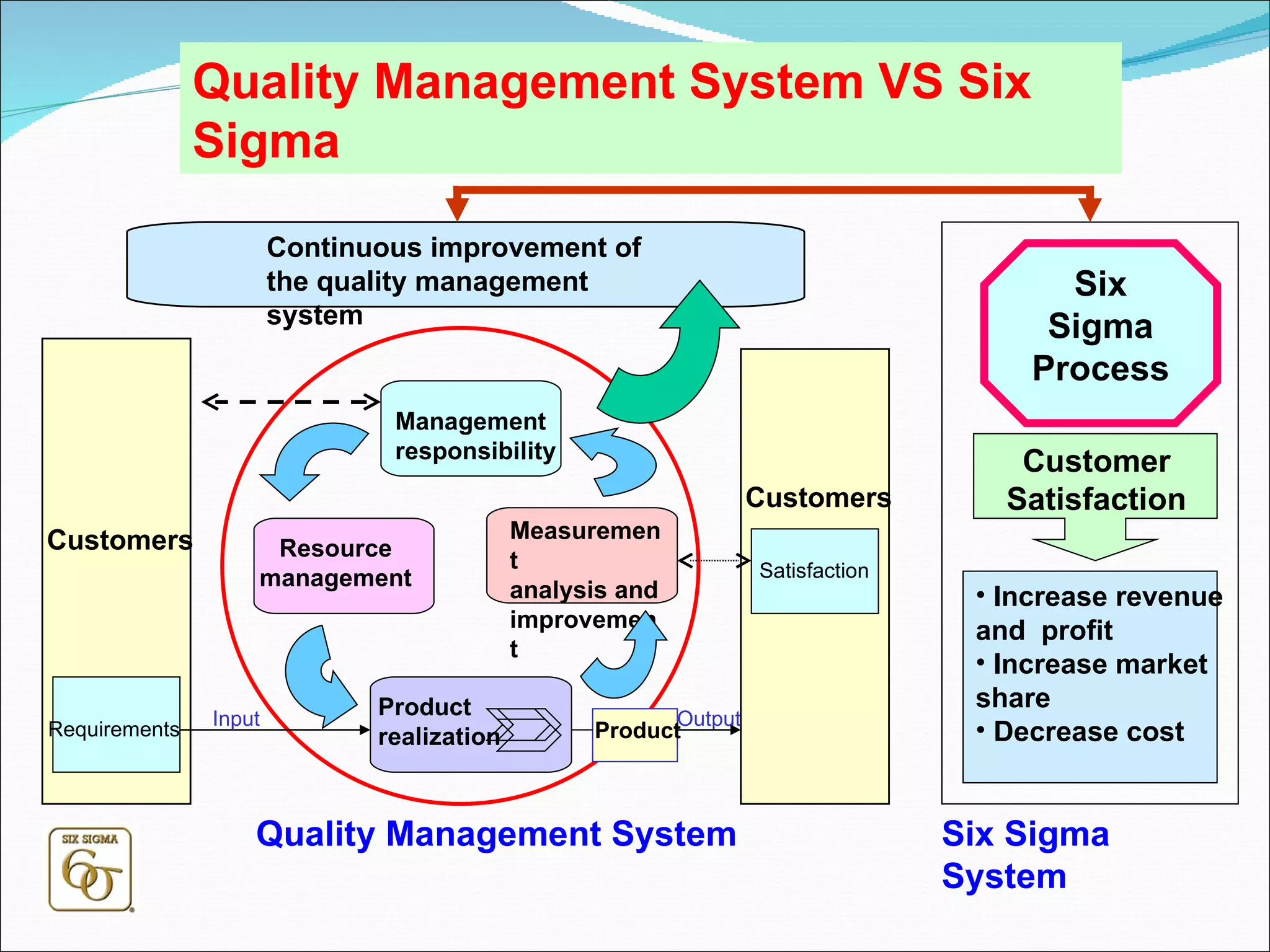
Customers Requirements Satisfaction Customers Continuous improvement of the quality management system Management responsibility Resource management Product realization Measurement  analysis and  improvement Product Input Output Six Sigma Process Customer Satisfaction Increase revenue  and  profit Increase market share Decrease cost Quality Management System VS Six Sigma Quality Management System Six Sigma System
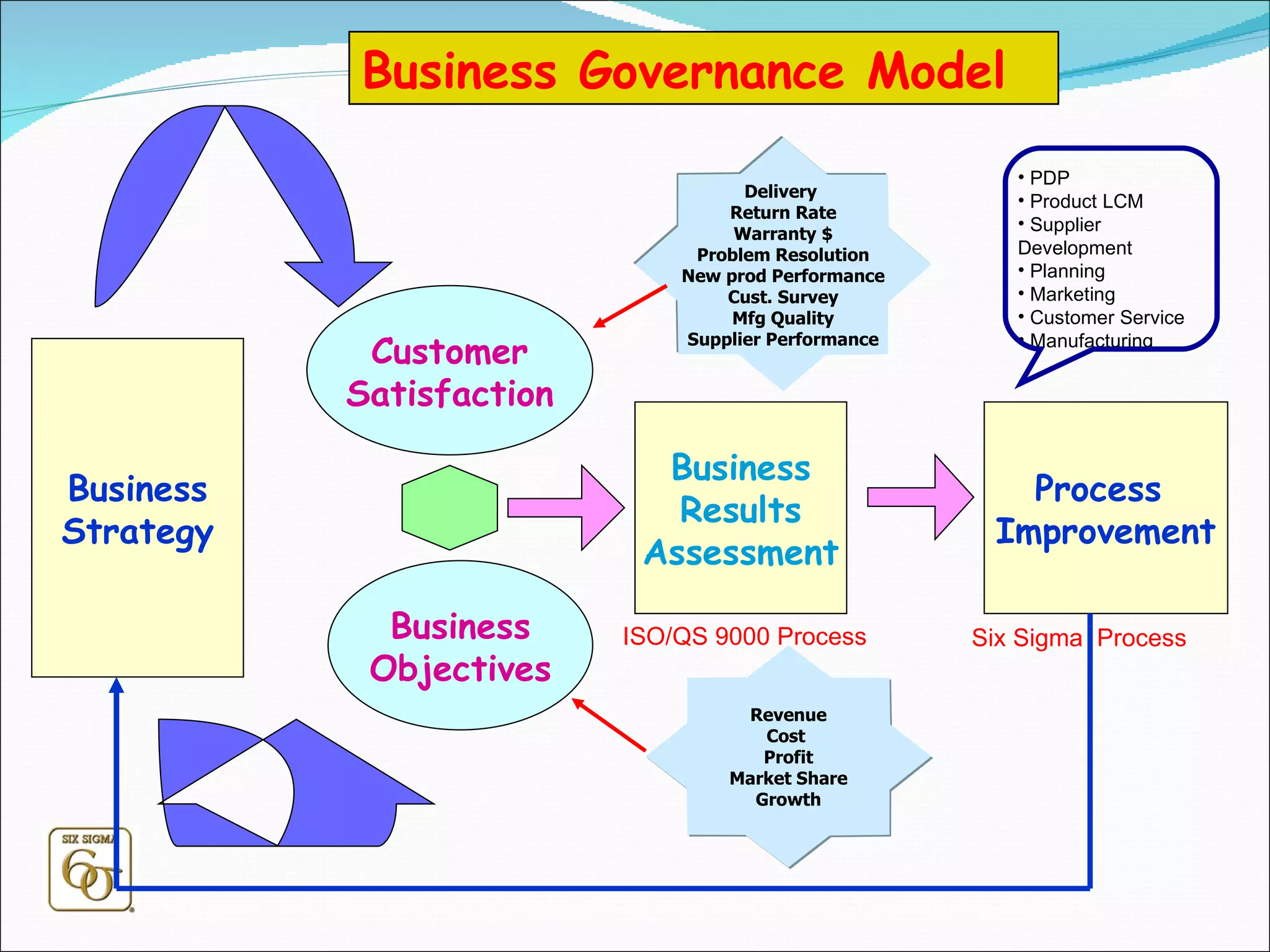
Customer Satisfaction Business Objectives Business Strategy Process  Improvement Business Governance Model Delivery  Return Rate Warranty $ Problem Resolution New prod Performance Cust. Survey Mfg Quality Supplier Performance Revenue Cost  Profit Market Share Growth Business Results Assessment PDP Product LCM Supplier Development Planning Marketing Customer Service Manufacturing ISO/QS 9000 Process Six Sigma  Process
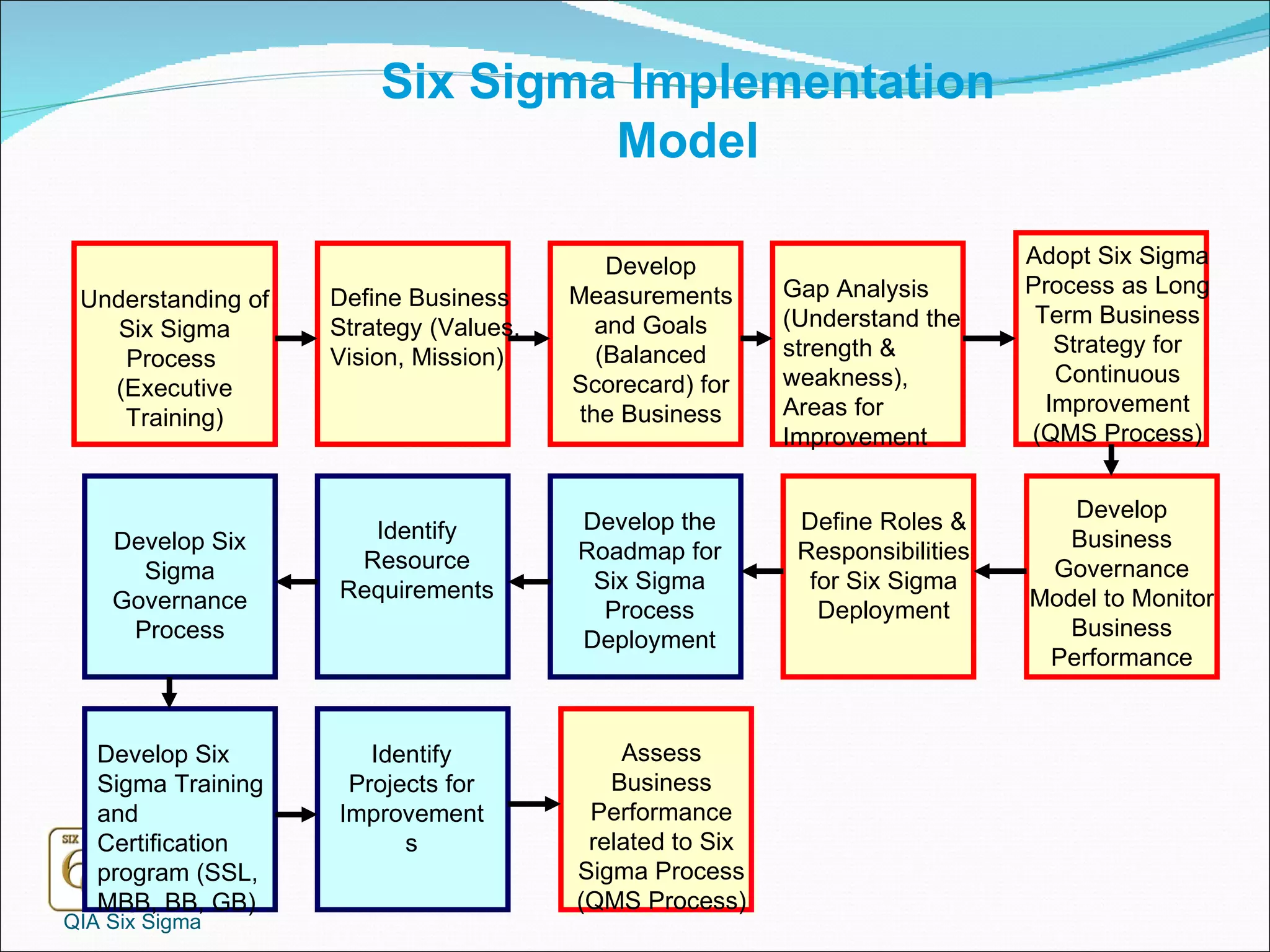
QIA Six Sigma Six Sigma Implementation Model Understanding of Six Sigma Process  (Executive Training) Define Business Strategy (Values, Vision, Mission) Adopt Six Sigma Process as Long Term Business Strategy for Continuous Improvement (QMS Process) Develop Measurements and Goals (Balanced Scorecard) for the Business Gap Analysis (Understand the strength & weakness), Areas for Improvement Develop Business Governance Model to Monitor Business Performance Define Roles & Responsibilities for Six Sigma Deployment Develop the Roadmap for Six Sigma Process Deployment Identify Resource Requirements Develop Six Sigma Governance Process Develop Six Sigma Training and Certification program (SSL, MBB, BB, GB) Identify Projects for Improvements Assess Business Performance related to Six Sigma Process (QMS Process)
Six Sigma Continuous Improvement  Priorities Overall focus will : Dramatically reduce the Cost of Quality by improving: process improvement product and service improvement design improvement supplier improvement training Develop and implement a systematic approach to drive performance improvements throughout the business Make Customer Satisfaction a driving force in all business decisions Implement a balanced score card that measures the success of our efforts
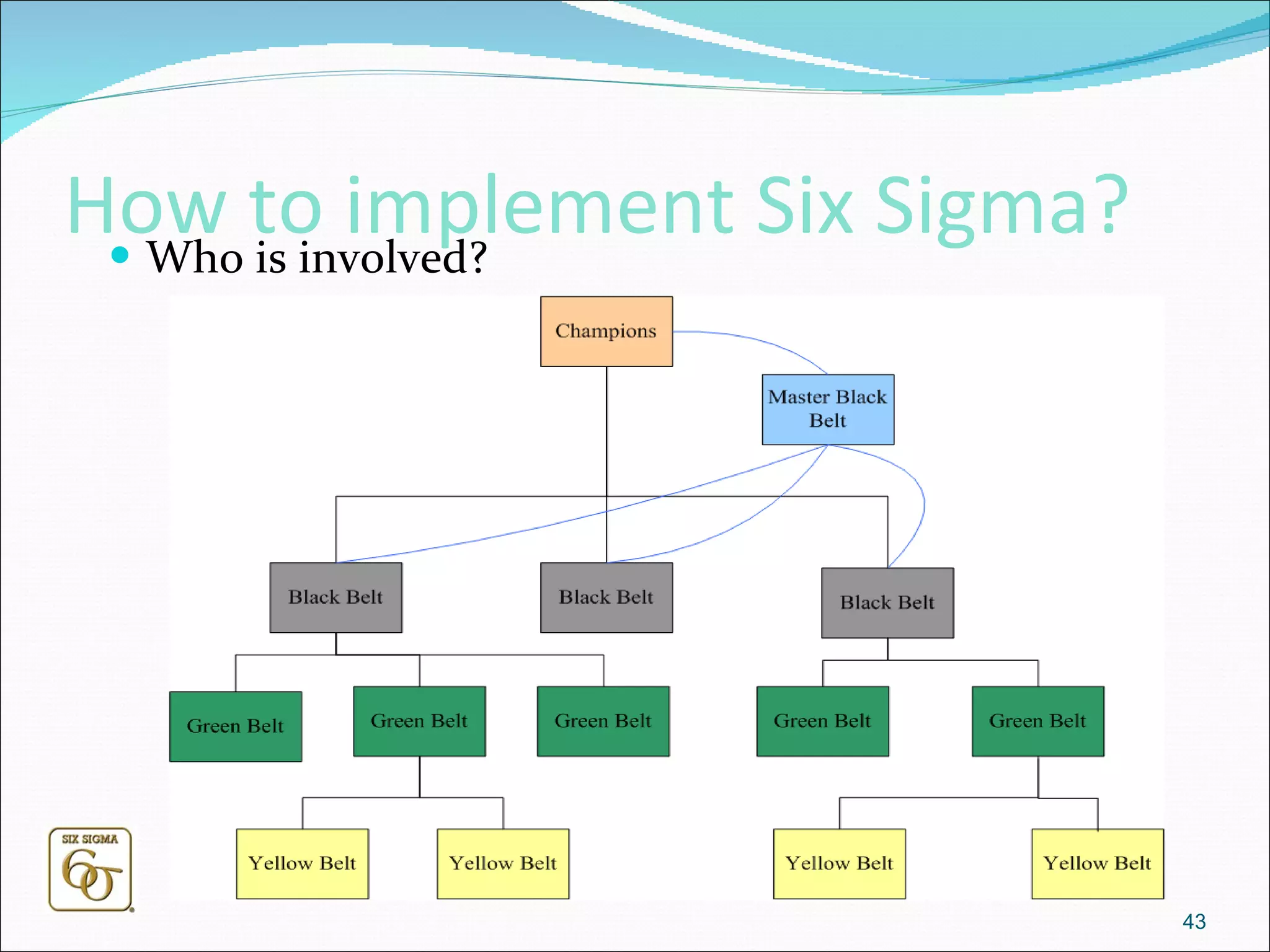
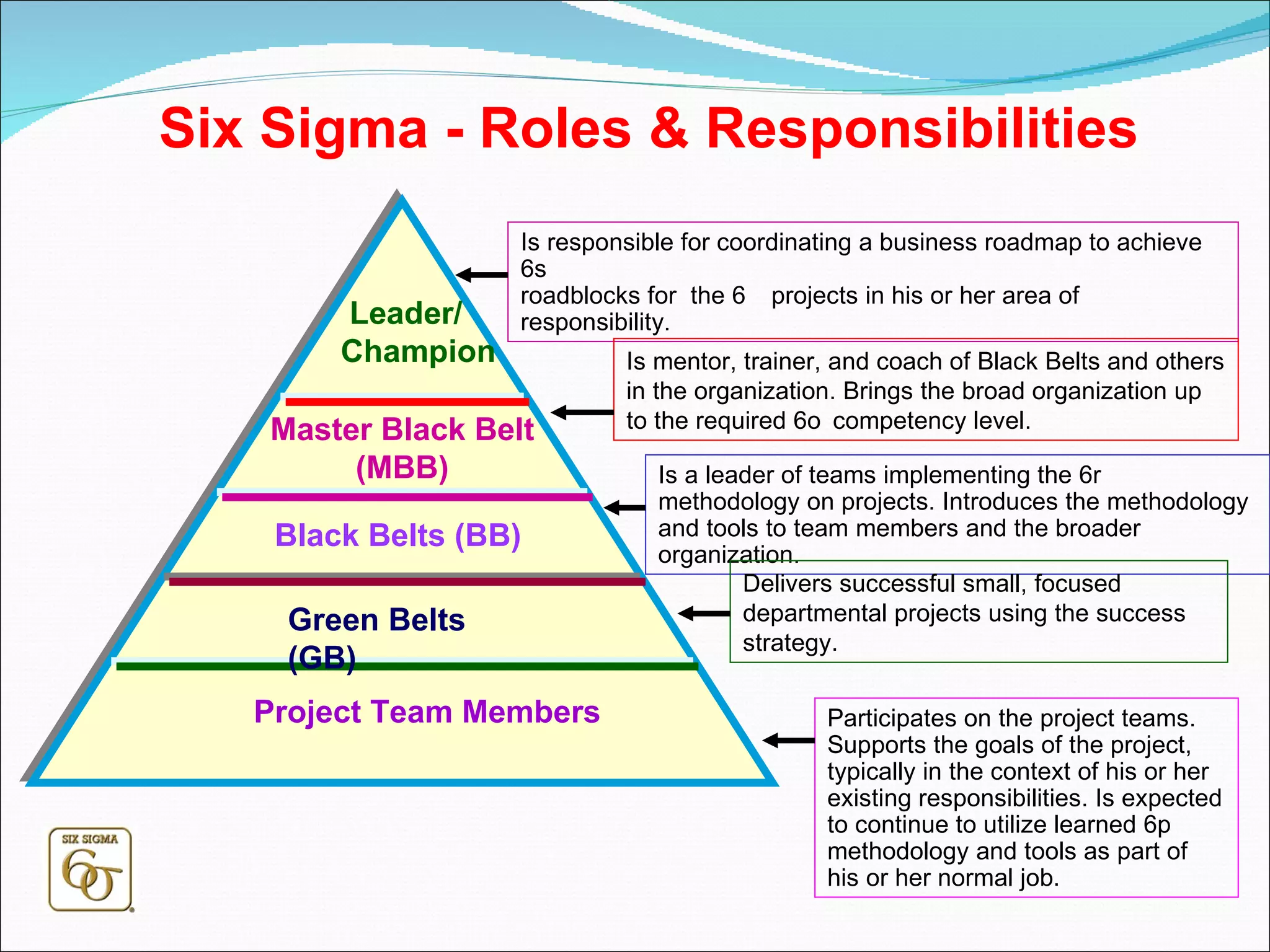
Leader/ Champion Master Black Belt (MBB) Black Belts (BB) Green Belts (GB) Project Team Members Six Sigma - Roles & Responsibilities Is responsible for coordinating a business roadmap to achieve 6. Selects projects, executes control, and alleviates roadblocks for  the 6 projects in his or her area of responsibility. Is mentor, trainer, and coach of Black Belts and others in the organization. Brings the broad organization up to the required 6 competency level. Is a leader of teams implementing the 6 methodology on projects. Introduces the methodology and tools to team members and the broader organization. Delivers successful small, focused departmental projects using the success strategy. Participates on the project teams. Supports the goals of the project, typically in the context of his or her existing responsibilities. Is expected to continue to utilize learned 6 methodology and tools as part of his or her normal job.
We can help you to grow your business by introducing you a world class business strategy by combining your existing Quality Management System (QMS) with Six Sigma continuous improvement process.  This strategy helps you to provide best quality products and services to your customer, which will help you to significantly improve customer satisfaction, business growth, lower cost and higher profits. WHAT WE CAN DO FOR YOU!!!
Our Six Sigma Training & Certification Program An Executive Overview of Six Sigma Program Six Sigma Leader/Champion Master Black Belt Black Belt Green Belt
What is Next? Six Sigma executive training Adopt Six Sigma process as long term business strategy  Business gap analysis (identify strengths and weaknesses) Benchmark Develop business strategy and governance model Develop measurement processes Develop roadmap for Six Sigma deployment  Identify resource requirements Identify training roadmap for Six Sigma Develop six sigma training program Identify improvement projects Assess business success…………….
One case  :  Costs/Benefits to GE
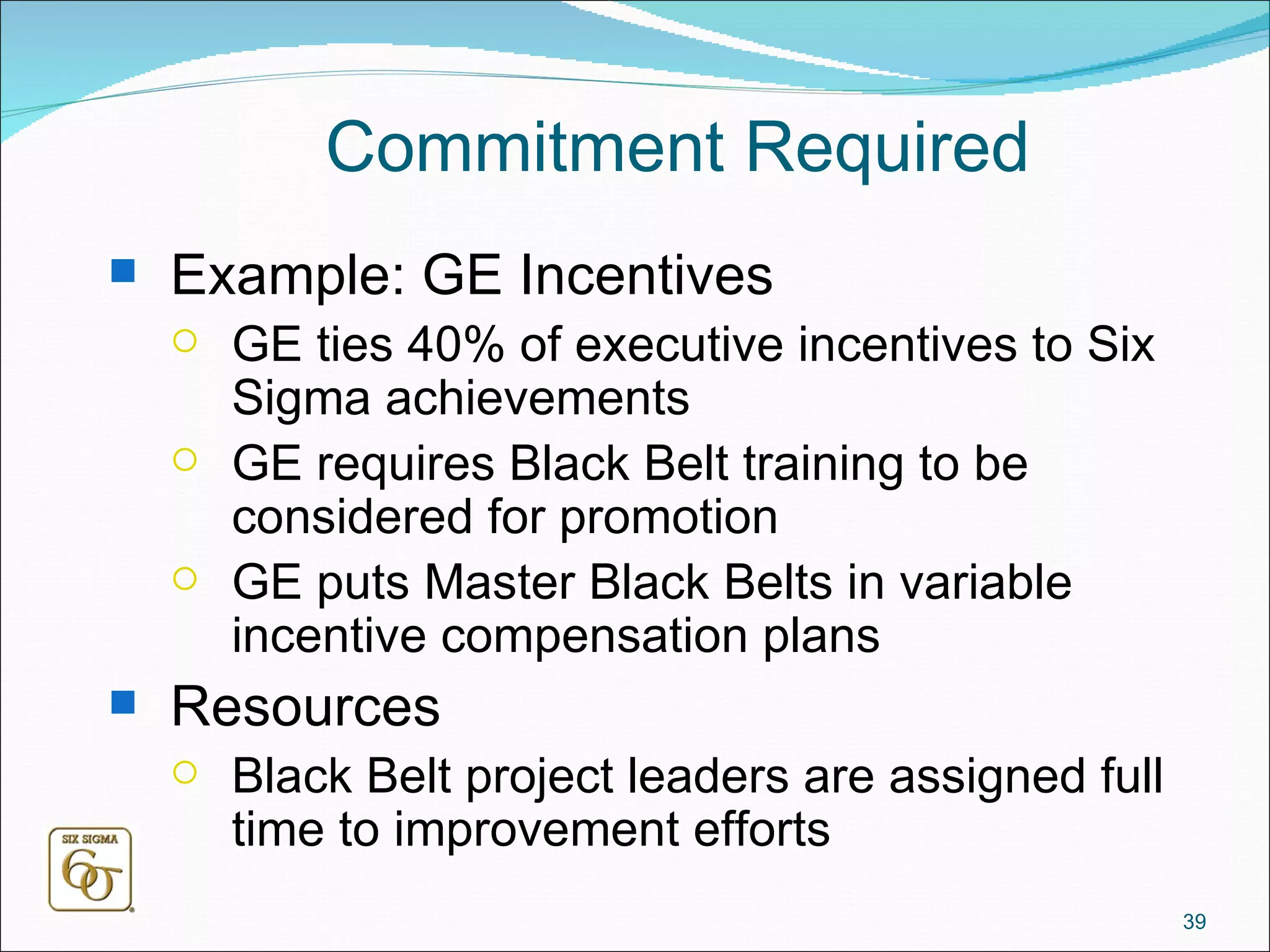
Commitment Required Example: GE Incentives GE ties 40% of executive incentives to Six Sigma achievements GE requires Black Belt training to be considered for promotion GE puts Master Black Belts in variable incentive compensation plans Resources Black Belt project leaders are assigned full time to improvement efforts
………… ..
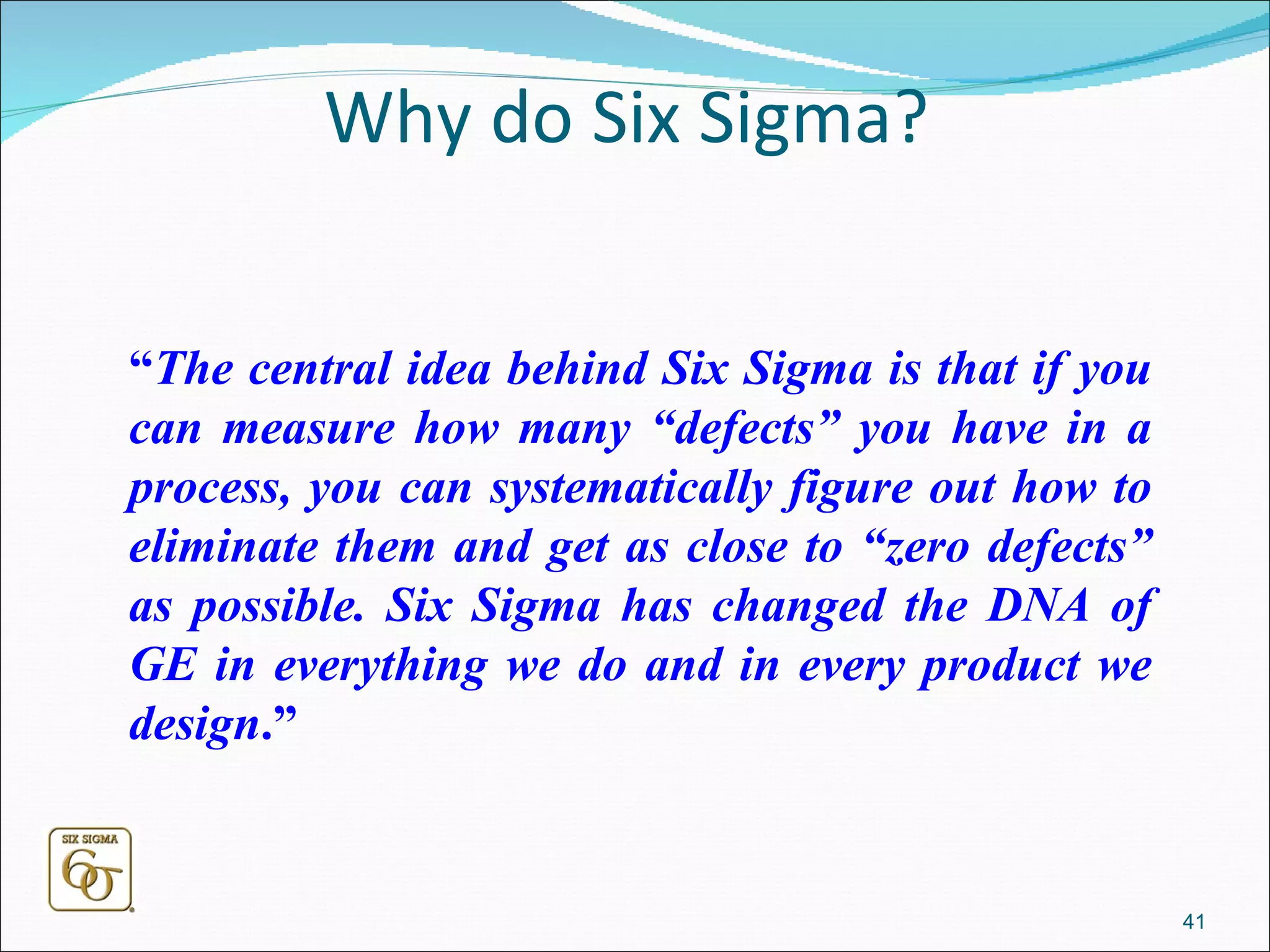
Why do Six Sigma? “ The central idea behind Six Sigma is that if you can measure how many “defects” you have in a process, you can systematically figure out how to eliminate them and get as close to “zero defects” as possible. Six Sigma has changed the DNA of GE in everything we do and in every product we design .”
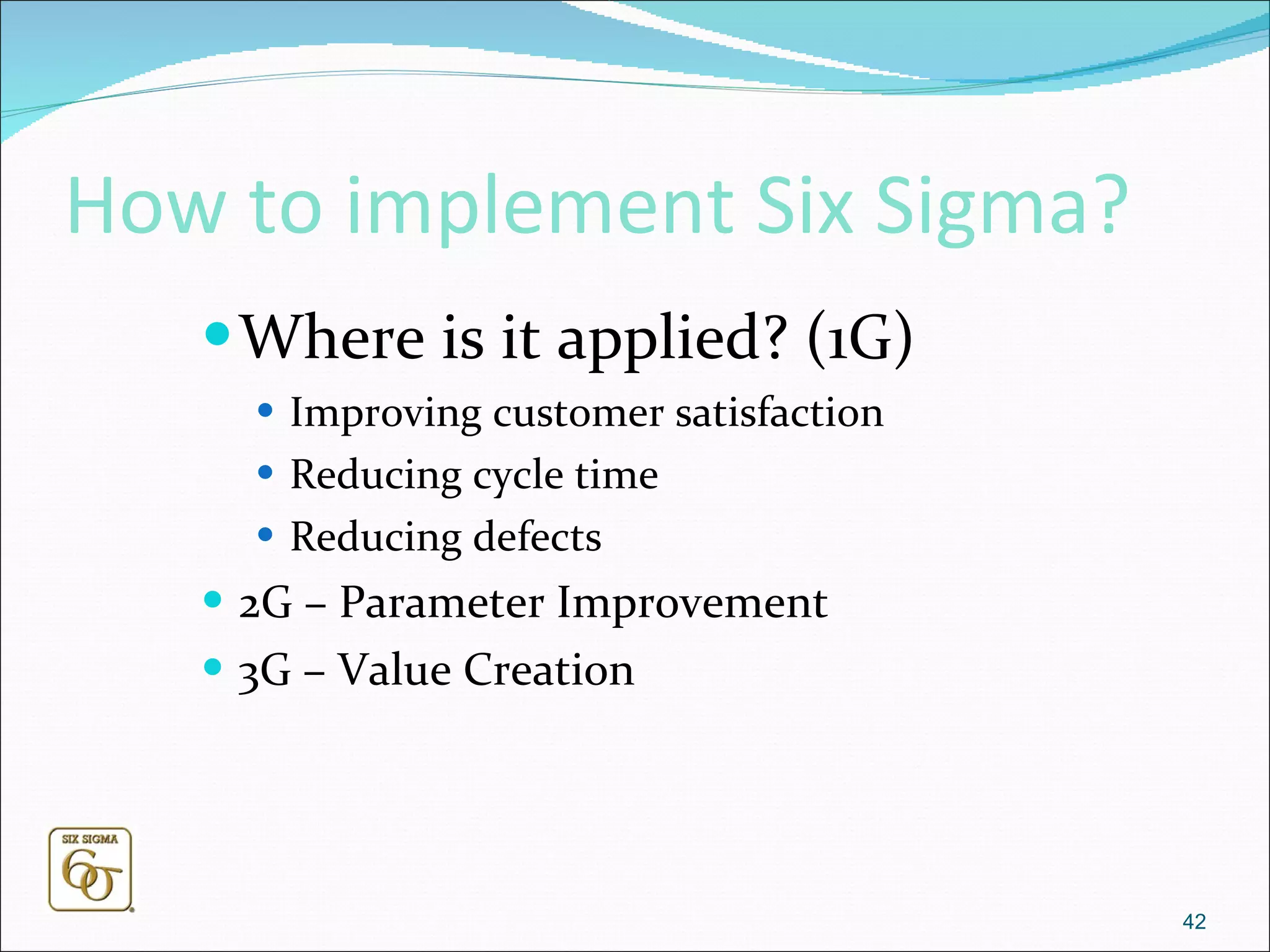
How to implement Six Sigma? Where is it applied? (1G) Improving customer satisfaction  Reducing cycle time  Reducing defects 2G – Parameter Improvement 3G – Value Creation
How to implement Six Sigma? Who is involved?
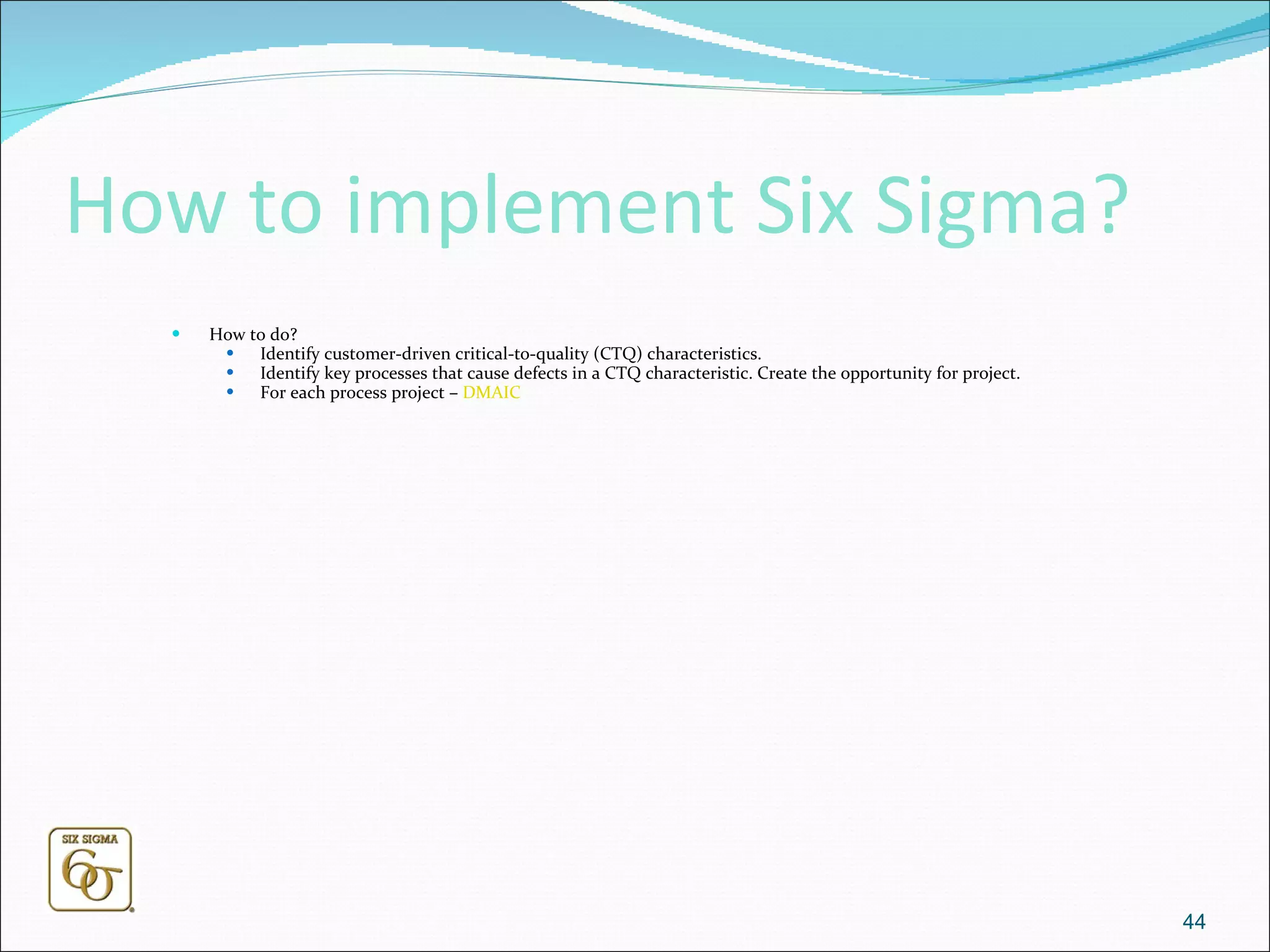
How to implement Six Sigma? How to do? Identify customer-driven critical-to-quality (CTQ) characteristics.  Identify key processes that cause defects in a CTQ characteristic. Create the opportunity for project. For each process project –  DMAIC
How to implement Six Sigma? DMAIC D efine numerical definition of project scope, objectives, resources and constraints M easure capability of current process performance, comparing with the benchmark --critical customer requirements  A nalyze the problems to find out root causes  I mprove… identify potential solutions and begin to implement them C ontrol the performance to continue to achieve higher results
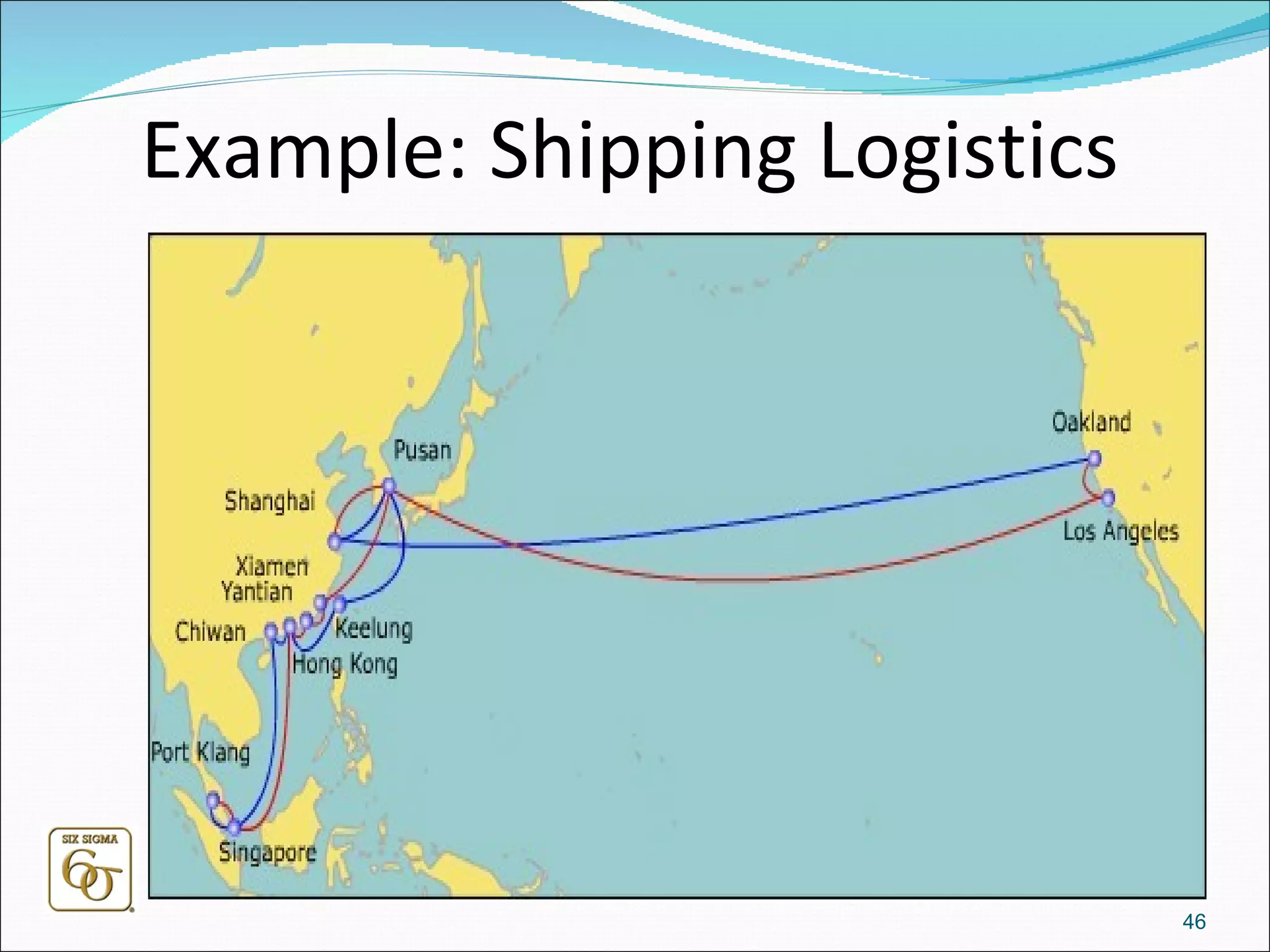
Example: Shipping Logistics Situation: GE Appliance products, such as microwave ovens and air conditioners, are being produced in Asia and shipped to US customers, such as Wal-Mart Delivery performance is very erratic and the average on-time delivery is about 85%
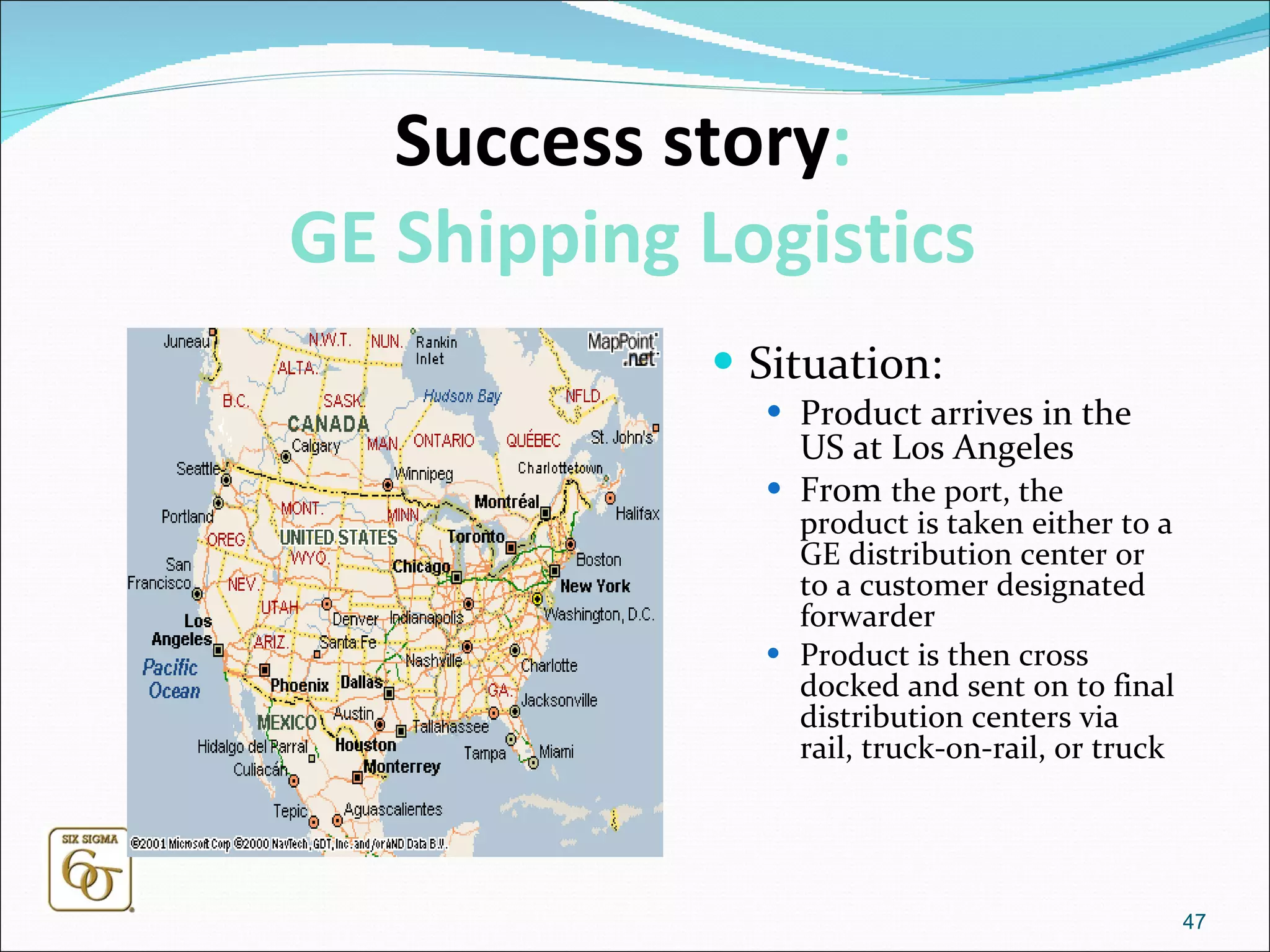
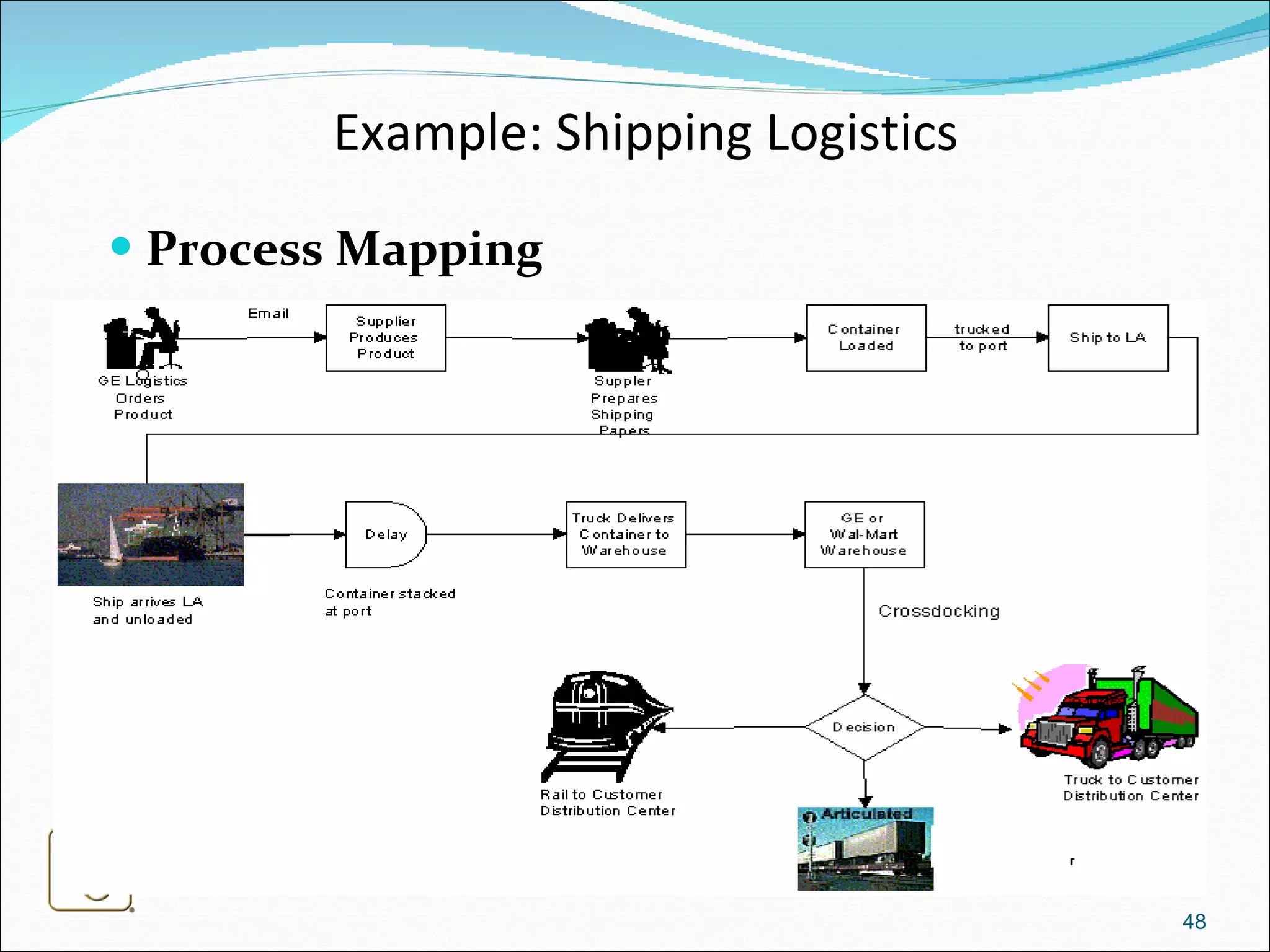
Success story :  GE Shipping Logistics Situation: Product arrives in the US at Los Angeles From  the port, the product is taken either to a GE distribution center or to a customer designated forwarder Product is then cross docked and sent on to final distribution centers via rail, truck-on-rail, or truck
Example: Shipping Logistics Process Mapping
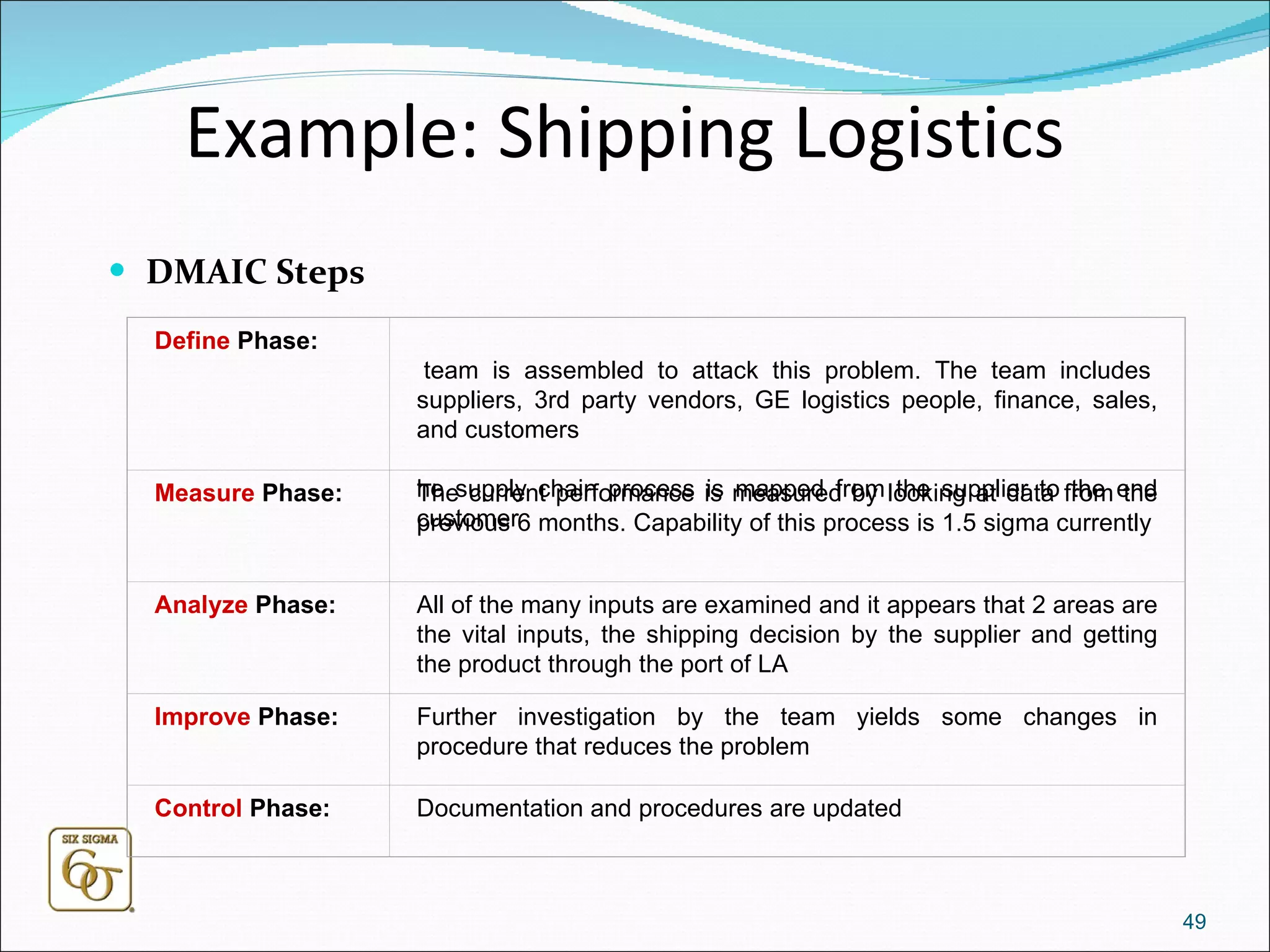
Example: Shipping Logistics DMAIC Steps Define  Phase: A team is assembled to attack this problem. The team includes suppliers, 3rd party vendors, GE logistics people, finance, sales, and customers The supply chain process is mapped from the supplier to the end customer Measure  Phase: The current performance is measured by looking at data from the previous 6 months. Capability of this process is 1.5 sigma currently Analyze  Phase: All of the many inputs are examined and it appears that 2 areas are the vital inputs, the shipping decision by the supplier and getting the product through the port of LA Improve  Phase: Further investigation by the team yields some changes in procedure that reduces the problem Control  Phase: Documentation and procedures are updated
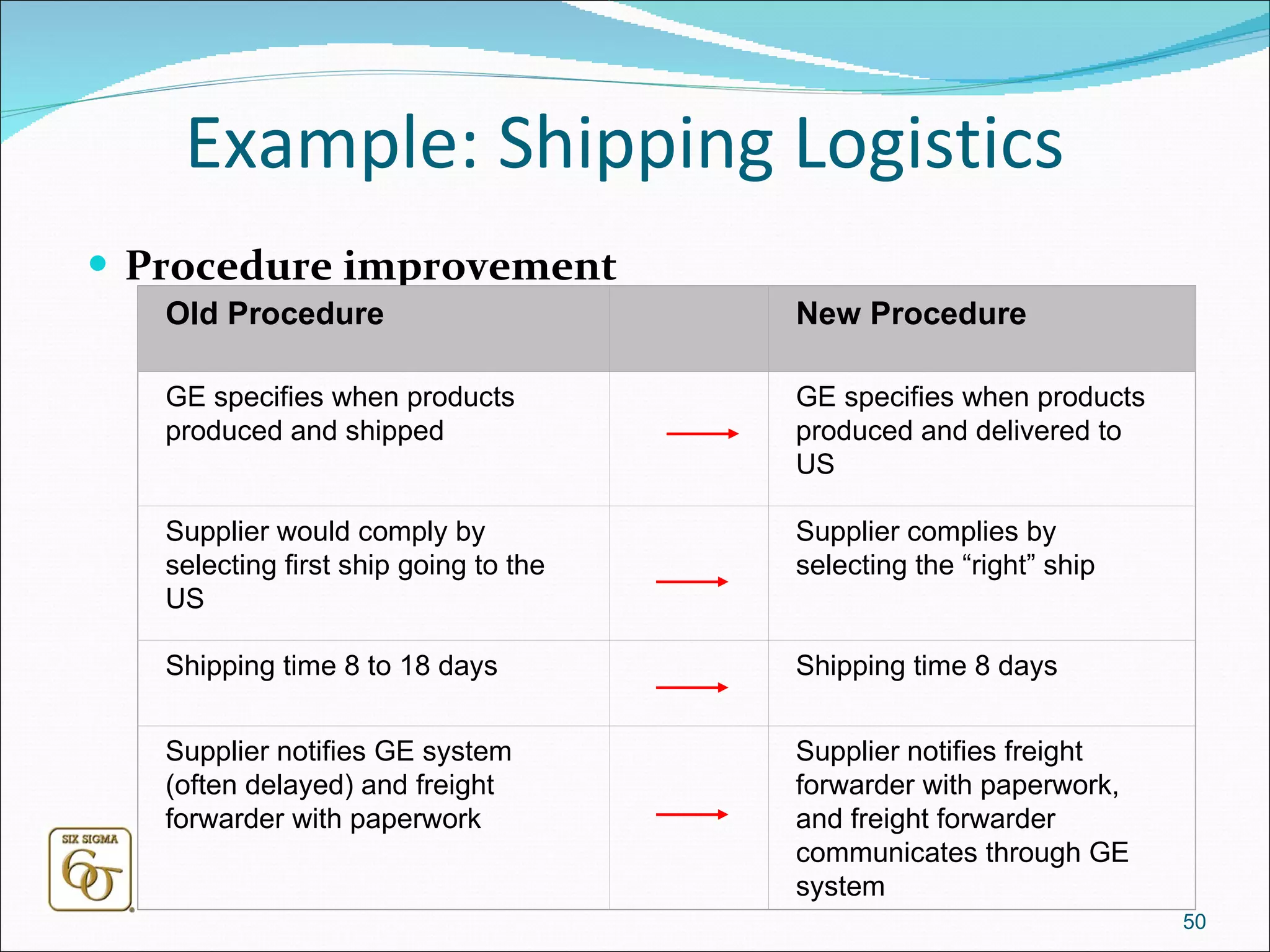
Example: Shipping Logistics Procedure improvement  Old Procedure   New Procedure GE specifies when products produced and shipped GE specifies when products produced and delivered to US Supplier would comply by selecting first ship going to the US Supplier complies by selecting the “right” ship Shipping time 8 to 18 days Shipping time 8 days Supplier notifies GE system (often delayed) and freight forwarder with paperwork Supplier notifies freight forwarder with paperwork, and freight forwarder communicates through GE system
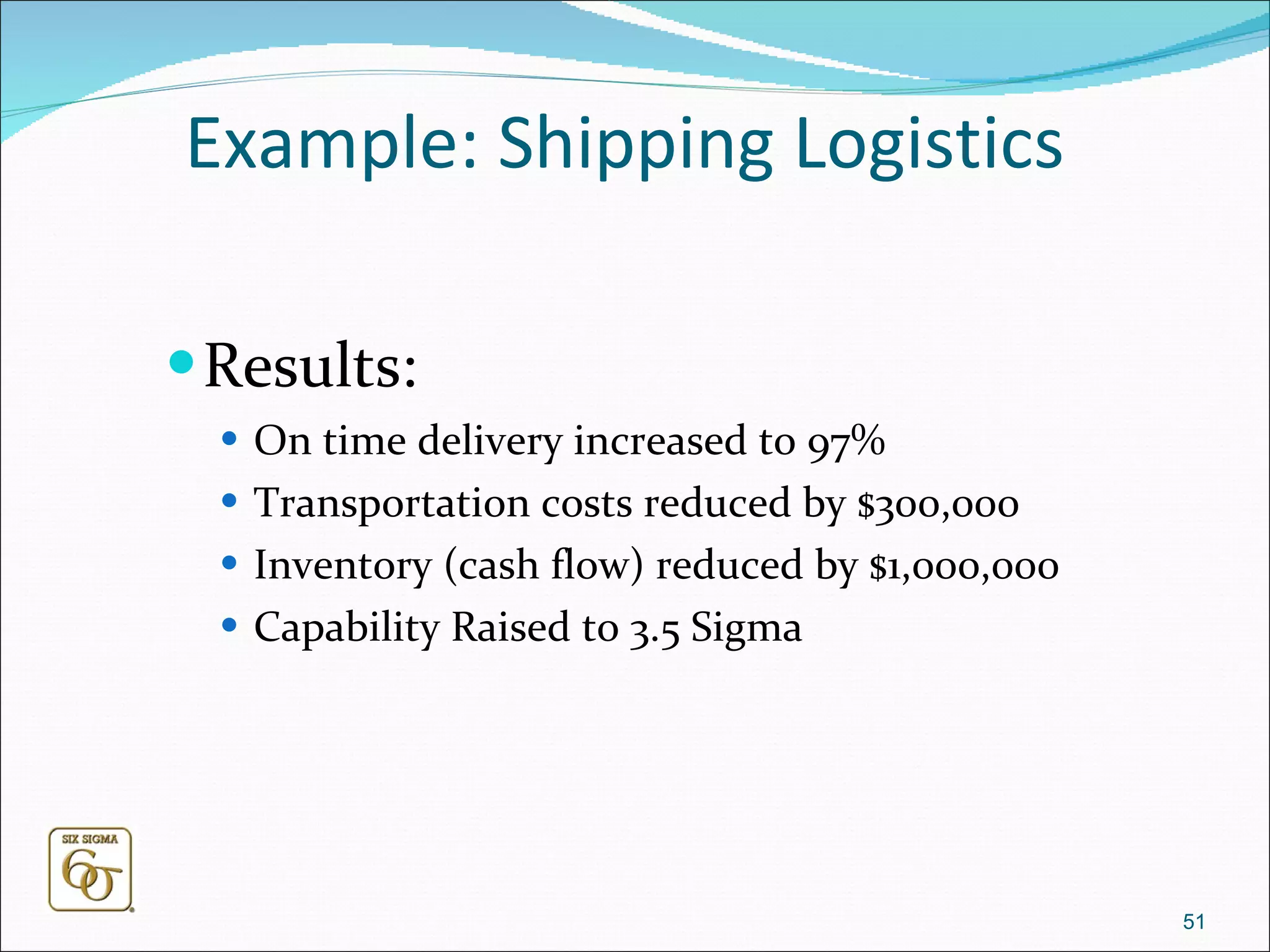
Example: Shipping Logistics Results: On time delivery increased to 97% Transportation costs reduced by $300,000 Inventory (cash flow) reduced by $1,000,000 Capability Raised to 3.5 Sigma
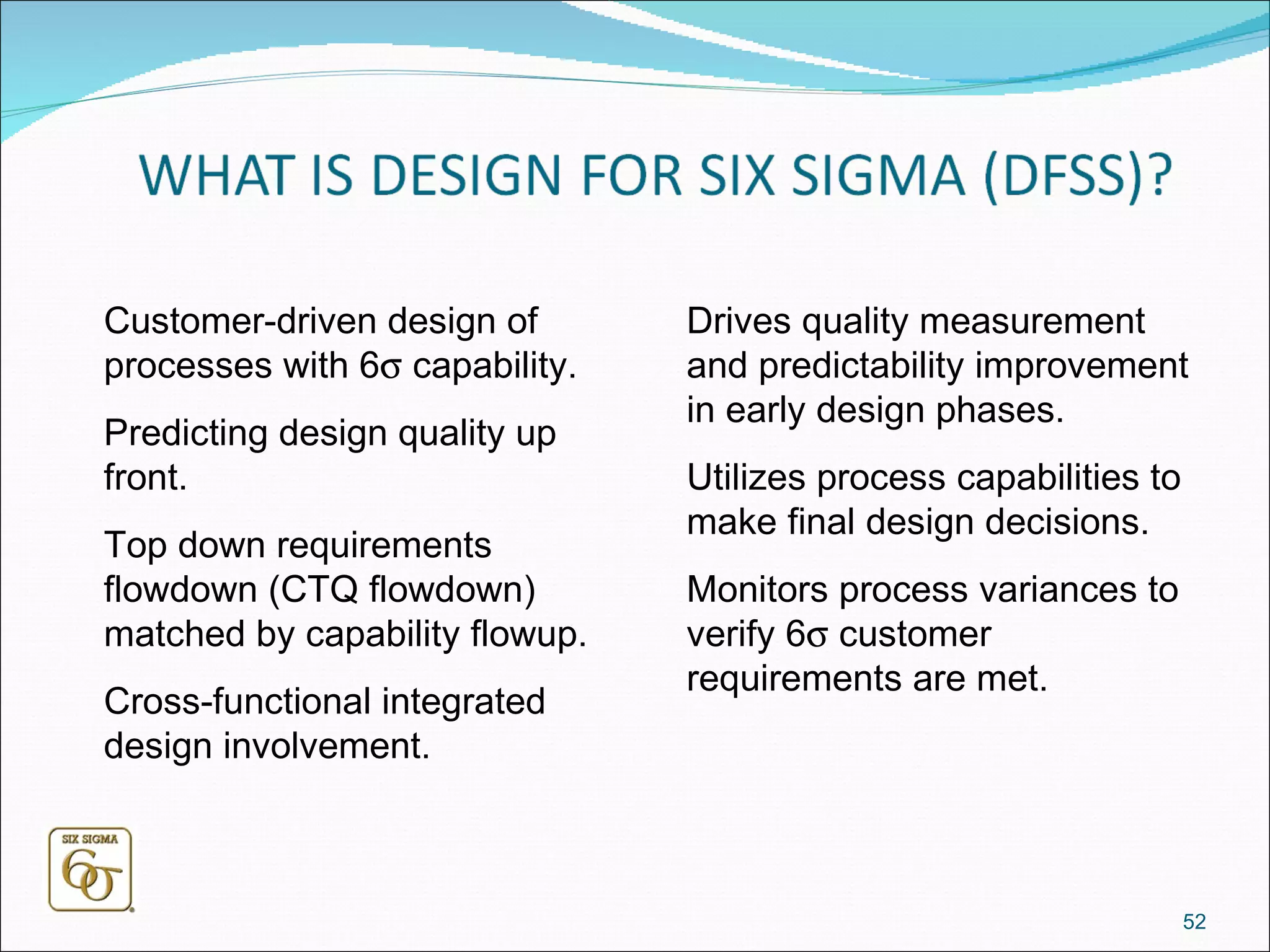
Customer-driven design of processes with 6   capability. Predicting design quality up front. Top down requirements flowdown (CTQ flowdown) matched by capability flowup. Cross-functional integrated design involvement. Drives quality measurement and predictability improvement in early design phases. Utilizes process capabilities to make final design decisions. Monitors process variances to verify 6   customer requirements are met.
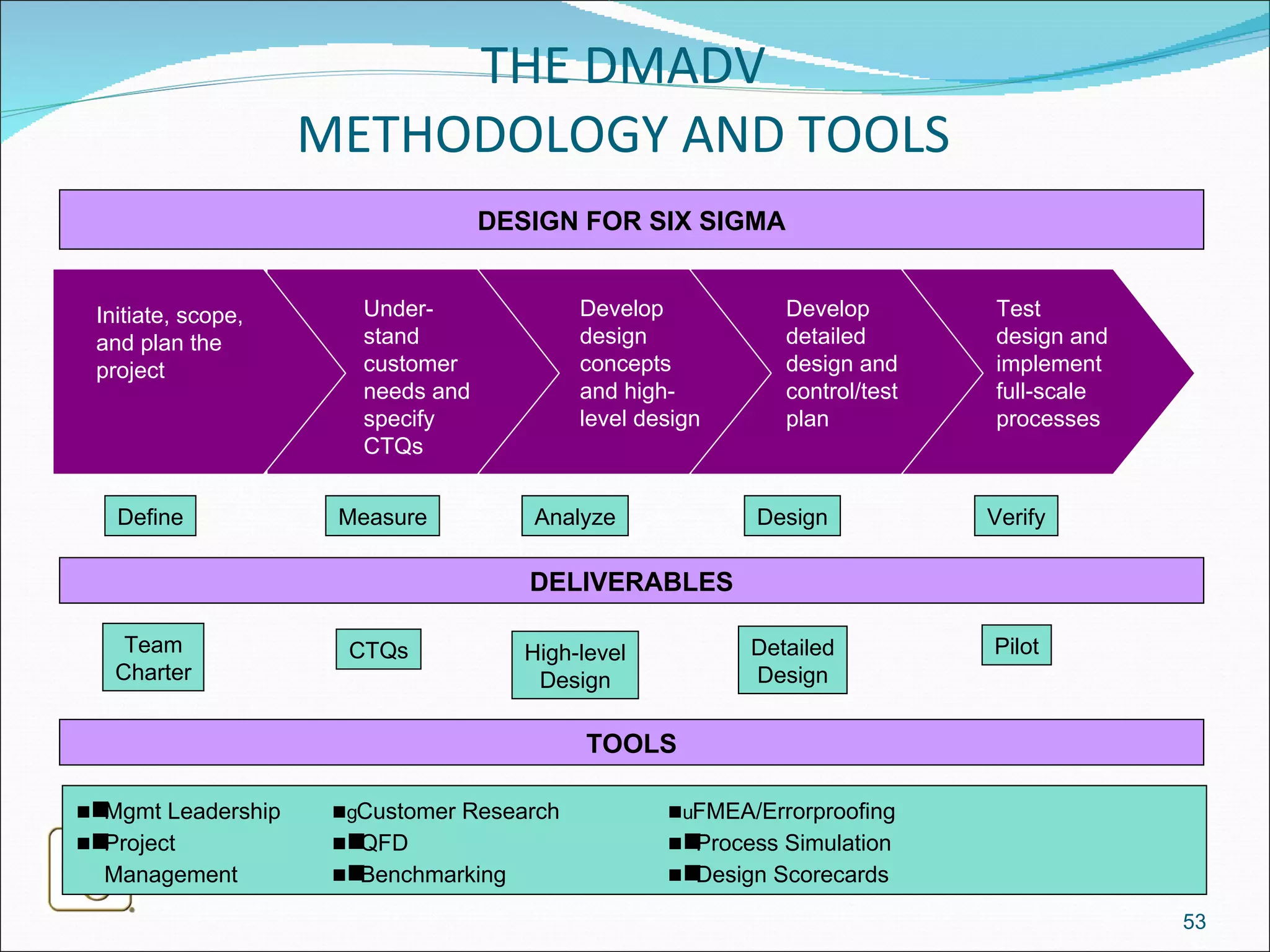
THE DMADV METHODOLOGY AND TOOLS Define Measure Analyze Design Verify Under- stand customer needs and specify CTQs Develop design concepts and high- level design Develop detailed design and control/test plan Test design and implement full-scale processes Initiate, scope, and plan the project DESIGN FOR SIX SIGMA DELIVERABLES Team Charter CTQs High-level Design Detailed Design Pilot TOOLS   Mgmt Leadership  Customer Research  FMEA/Errorproofing   Project    QFD   Process Simulation Management   Benchmarking   Design Scorecards
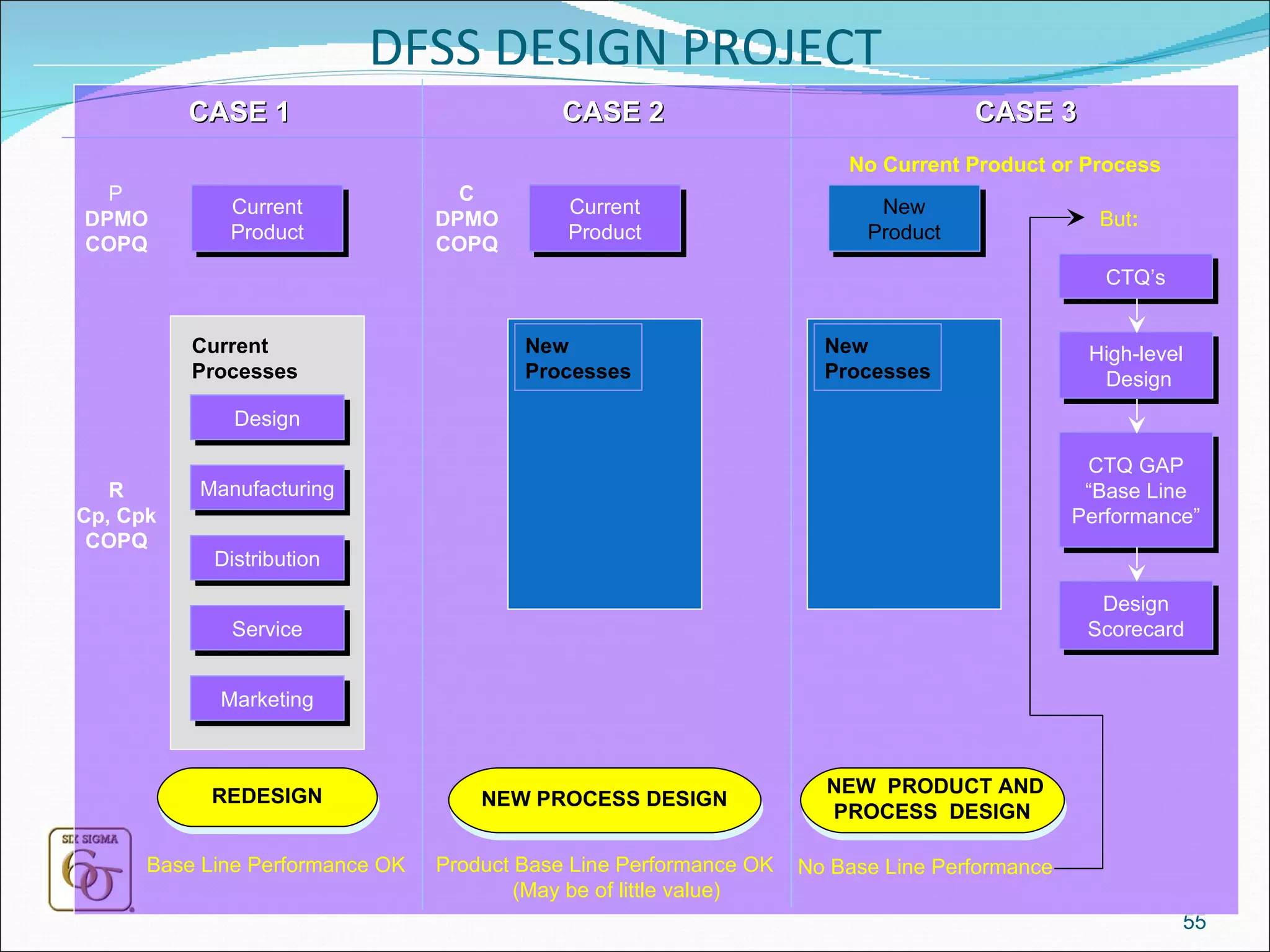
DFSS DESIGN PROJECT CASE 1 CASE 2 CASE 3 Base Line Performance OK Current Product  DPMO COPQ Design Current Processes Manufacturing Distribution Service Marketing REDESIGN  Cp, Cpk COPQ  DPMO COPQ Current Product NEW PROCESS DESIGN Product Base Line Performance OK (May be of little value) New Product NEW  PRODUCT AND PROCESS  DESIGN No Base Line Performance CTQ’s High-level  Design CTQ GAP “Base Line Performance” Design Scorecard But : No Current Product or Process Design New Processes New Processes
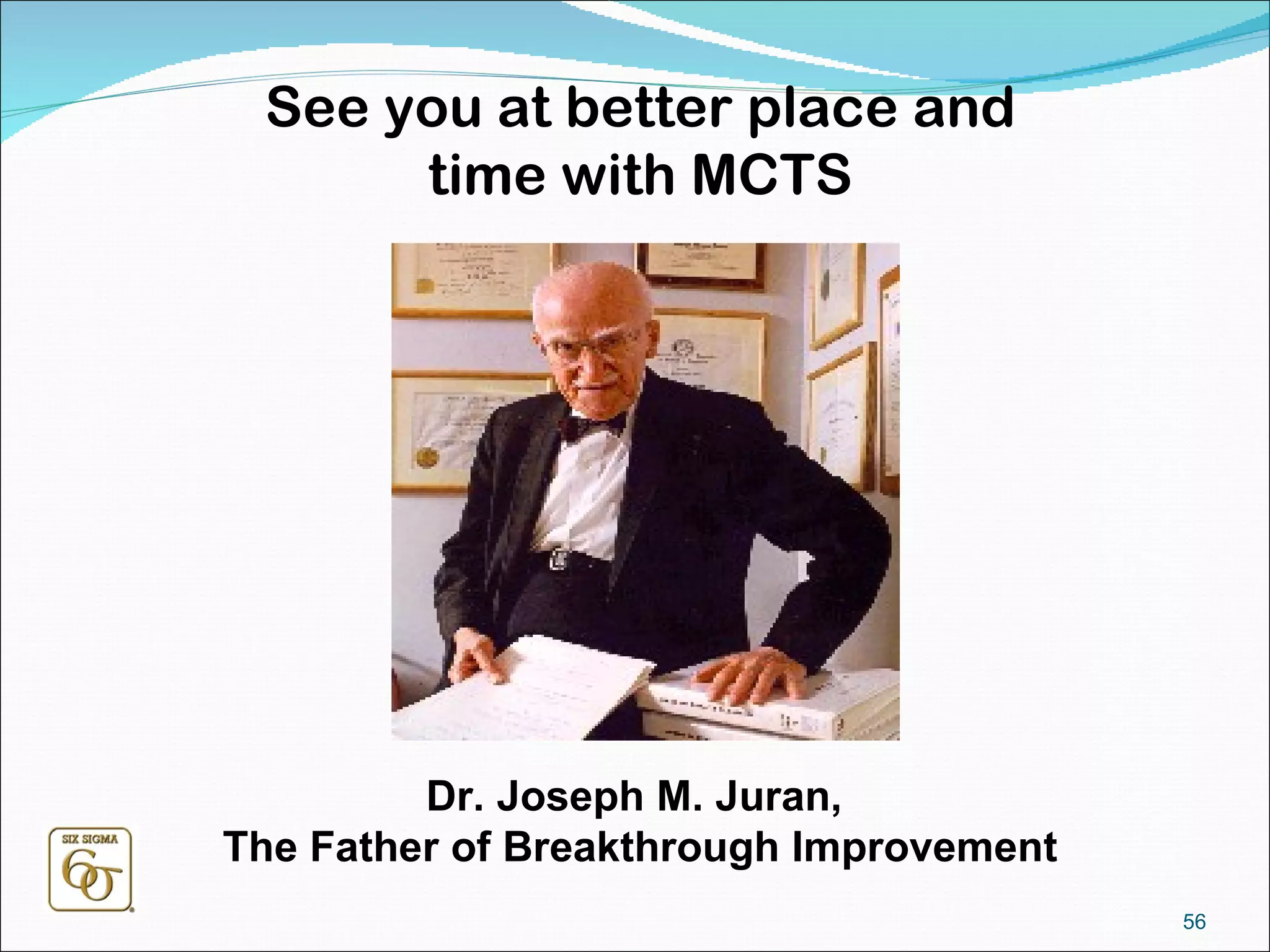
See you at better place and time with MCTS Dr. Joseph M. Juran,  The Father of Breakthrough Improvement
QUESTIONS PLEASE ?

Six sigma for beginner

  • 1.
    By Bambang MurtjahjantoThe Senior Consulting Engineer
  • 2.
    Origins of SixSigma 1987 Motorola Develops Six Sigma Raised Quality Standards Other Companies Adopt Six Sigma GE Promotions, Profit Sharing (Stock Options), etc. directly tied to Six Sigma training Dow Chemical, DuPont, Honeywell, Whirlpool
  • 3.
    What is SixSigma? Normal distribution Mean (  ) Standard deviation (σ)
  • 4.
    What is SixSigma? Standard Normal distribution
  • 5.
    What is SixSigma? Standard Normal distribution
  • 6.
    What is SixSigma? Assumes 1.5 sigma process drift Defect levels decrease exponentially as sigma levels increase from one value to the next Six sigma is 3.4 defects per million
  • 7.
  • 8.
    Six Sigma Challenge20,000 lost articles of mail per hour Unsafe drinking water for almost 15 minutes each day 5,000 incorrect surgical operation per week Two short or long landing at most major airports each day 200,000 wrong drug prescriptions each year No electricity for almost seven hours each month 99% Good (3.8 σ ) Seven articles lost per hour One unsafe minute every seven month 1.7 incorrect surgical operation per week One short or long landing at most major airports every 5 year 68 wrong drug prescriptions each year One hour no electricity for almost every 34 years 99.99966% Good (6 σ )
  • 9.
    Sigma Significance Sigma Defects numbers per million 1.5  500,000 2.0  308,300 2.5  158,650 3.0  67,000 3.5  22,700 4.0  6,220 4.5  1,350 5.0  233 5.5  32 6.0  3.4
  • 10.
    How to Countdefects: Unit : Unit declarations, parts, etc Defect : Any Non Conformities in investigated area Opportunity: Anything you can possible measure or test
  • 11.
    How to calculatesix sigma Calculate defect per unit (DPU) Calculate defect per million opportunities for error (DPMO): DPU = Total # defects Total # of Units DPMO = DPU X 1,000,000 # of Opportunity per Units
  • 12.
    Assume that theproduct in question is a television which contain 800 opportunities for error. Total production 2,500 units, found 450 defects. What is six sigma level? DPU calculation = Total # of Defect Total # of Units = 450 2,500 = 0.18 Thus, DPU X 1,000,000 Opportunity for Error = 0.18 X 1,000,000 800 = 225 DPMO = From the next table, found that sigma level : 5 < σ < 6
  • 13.
    Sigma ( σ) conversion Table: If your yield is: Your DPMO is: Your Sigma is: 30.9% 690,000 1.0 62.9% 308,000 2.0 93.3 66,800 3.0 99.4 6,210 4.0 99.98 320 5.0 99.9997 3.4 6.0
  • 14.
    Six Sigma Elements(Tools) Basic Tools (Green Belts) Process Mapping - Putting ideas on paper. (QFD) Quality Function Deployment- Matrix of features & competitor offerings. (FMEA) Failure Mode and Effects Analysis - mapping of failures, likelihood & severity More Advanced (Black Belts) (DOE) Design of Experiment - Method for designing experience to determine the influential factors in a process.
  • 15.
    Six Sigma Elements(Tools) Statistical Techniques Weibul distribution Control Charts Graphical Techniques Affinity Diagram Fishbone Diagram Pareto Group Conceptual Tools Brain Storming Creativity / Thinking Out Of The Box
  • 16.
    Six Sigma Elements(Tools) Effective Tools (processes) Work Out Process Balanced Score Card Benchmarking DMAIC DFSS/DMADV Kaizen Lean Manufacturing Taguchi - Robust Really need a good tool for decision making.
  • 17.
    Improve QualityReduce Cost Productivity Improves Capture Market Provides jobs and more jobs Models of the relationships affecting quality and business performance Deming’s Model: less rework, less scrap Increase cycle time, increase throughput better quality, lower price Overall society benefits
  • 18.
    COST OF POORQUALITY (COPQ) External Failure Costs Warranty Adjustments Repairs Customer Service Returned Goods Returned Repaired Goods Product Recalls Product Liability Suits Opportunity Costs…………… Internal Failure Costs Scrap Rework RE-INSPECTION of Rework Downgrading Because of Defects Losses Caused by Vendor Scrap Downtime Caused by Defects Failure Analysis…………….. Appraisal Costs Receiving Inspection In-process Inspection Laboratory Inspection Outside Laboratory Endorsements Setup for Testing Maintenance of Test Equipment Quality Audits Calibration of Quality Equipment……….. Prevention Costs Quality Engineering Design and Development of Quality Equipment Design Verification and Review to Evaluate the Quality of New Products Quality Training Quality Improvement Projects Quality Data Gathering Analysis and Reporting Other Process Control Activities Used to Prevent Defects………………
  • 19.
    Lost Opportunity ScrapRework Inspection Warranty Rejects Lost sales Late delivery Engineering change orders Long cycle times Expediting costs Excess inventory The Cost of Poor Quality (COPQ) “Iceberg” Traditional Quality Costs Additional Costs of Poor Quality (intangible) (tangible) 4-8% 25-35% (Easily Identified) (Difficult or impossible to measure) Lost Customer Loyalty More Setups
  • 20.
    Six Sigma PhilosophyWe are in business to make money We make money by satisfying needs We are able to satisfy needs by doing Every need/do pair is an interaction The aim of customer focus is on improving need/do interaction Repetition of the same action constitute a process Improve our business means improvement of our processes Customers need products/services on-time, with zero defects, with lower cost As process capability improves, the product quality increases As quality increases, costs and cycle-time go down…………... The reduction of defects, cycle-time, cost leads to improved customer satisfaction As customer satisfaction improves, the likelihood of doing business increases As business increases, we (as individual and society) grow and prosper
  • 21.
    What is SixSigma? Sigma is a statistical unit of measure which reflects process capability. The sigma scale of measure is perfectly correlated to such characteristics as defects-per-unit, parts per million defective (PPM), and a probability of a failure/error. The sigma value indicates how often defects are likely to occur. The higher the sigma value, the less likely a process will produce defects. As sigma increases, costs go down, cycle time goes down, and customer satisfaction goes up.
  • 22.
    What is themeaning of quality??? 99% Good (3.8 Sigma) 99.9997% Good (6 Sigma) 20,000 lost articles of mail per hour Seven articles of mail lost per hour Unsafe drinking water for almost One unsafe minute every seven months 15 minutes each day 5,000 incorrect surgical operations 1.7 incorrect operations per week per week 2 short or long landings at most major one short or long landing every five airports each day years at each airport 200,000 wrong drug prescriptions per year 68 wrong drug prescriptions per year No electricity for seven hours each month One hour without electricity every 34 years
  • 23.
    Six Sigma Is….Six Sigma is disciplined methodology for continuous improvement for Reducing process variability and keeping it reduced achieve benefits from improvements in: better product/process quality reduce scarp and rework reduce cycle time better product/process design reduce major expanses A tool set to make that change practical Empowered people have the control they need to improve the way they work A common language for discussing, measuring and comparing process capabilities A powerful competitive advantage……….
  • 24.
    -6   X +1    Normal Distribution Shifted 1.5  Process Capability (Sigma) PPM Yield 2 308,537 69% 3 66,807 93.3% 4 6,210 99.3% 5 233 99.98% 6 3.4 99.9997%
  • 25.
    Sigma Measures -Process Capability Performance Level SIGMA % Yield # of Defects per Million (DPM) A+ 6 99.99966 3.4 A 5 99.9767 233 B 4 99.3790 6,210 C 3 93.3 66,807 D 2 69 308,537 F 1 31 691,462 Cost of Quality % <1% of sales 5 - 15% of sales 15 - 25% of sales 25 - 40% of sales C 93.3 66,807 3 Good World-Class Average Good World-Class Average
  • 26.
    Establish organizational measurementsIdentify the sigma level Establish COPQ measurement process Identify the major areas for improvement 3 to 4 sigma means 15 % to 25% cost of sales: - Which means if your sales is $100 millions, you can save up to $25 millions by implementing Six Sigma program. The savings is continuous basis year over year What is the Benefits of Six Sigma ???
  • 27.
    Output Measurement Failurerate (internal and external) Warranty cost Repair cost per unit Cycle time per unit Cycle time for new product development # of engineering changes Supplier issues WIP inventory cost Finished goods inventory Defects product arrival at customer # of service events
  • 28.
    Learn how thecompanies like General Electric, AlliedSignal, Motorola, Lockheed Martin, American Express, J.P. Morgan & Chase, and others use Six Sigma methodologies to reduce defects, improve processes, lower cost, higher profit, increase customer satisfaction, and drive improvement to a new levels. “ The Six Sigma Quality initiatives has lowered GE’s costs by dramatically reducing rework, simplifying processes, and reducing direct material costs. Design for six sigma has been a key to the introduction of numerous high-quality new products with significantly enhanced features.” John F. Welch jr., General electric Chairman and Chief Executive Officer, GE Annual Report 2000.
  • 29.
    b Knowledge ManagementKnowledge Management b Business Results Ops Review, Strategy Review Leadership Values, Vision, Mission Learning and Growth Strategy Management Balanced Scorecard Process Management Customer Management Knowledge Management Quality Management QMS The Six Sigma System
  • 30.
    Customers Requirements SatisfactionCustomers Continuous improvement of the quality management system Management responsibility Resource management Product realization Measurement analysis and improvement Product Input Output Six Sigma Process Customer Satisfaction Increase revenue and profit Increase market share Decrease cost Quality Management System VS Six Sigma Quality Management System Six Sigma System
  • 31.
    Customer Satisfaction BusinessObjectives Business Strategy Process Improvement Business Governance Model Delivery Return Rate Warranty $ Problem Resolution New prod Performance Cust. Survey Mfg Quality Supplier Performance Revenue Cost Profit Market Share Growth Business Results Assessment PDP Product LCM Supplier Development Planning Marketing Customer Service Manufacturing ISO/QS 9000 Process Six Sigma Process
  • 32.
    QIA Six SigmaSix Sigma Implementation Model Understanding of Six Sigma Process (Executive Training) Define Business Strategy (Values, Vision, Mission) Adopt Six Sigma Process as Long Term Business Strategy for Continuous Improvement (QMS Process) Develop Measurements and Goals (Balanced Scorecard) for the Business Gap Analysis (Understand the strength & weakness), Areas for Improvement Develop Business Governance Model to Monitor Business Performance Define Roles & Responsibilities for Six Sigma Deployment Develop the Roadmap for Six Sigma Process Deployment Identify Resource Requirements Develop Six Sigma Governance Process Develop Six Sigma Training and Certification program (SSL, MBB, BB, GB) Identify Projects for Improvements Assess Business Performance related to Six Sigma Process (QMS Process)
  • 33.
    Six Sigma ContinuousImprovement Priorities Overall focus will : Dramatically reduce the Cost of Quality by improving: process improvement product and service improvement design improvement supplier improvement training Develop and implement a systematic approach to drive performance improvements throughout the business Make Customer Satisfaction a driving force in all business decisions Implement a balanced score card that measures the success of our efforts
  • 34.
    Leader/ Champion MasterBlack Belt (MBB) Black Belts (BB) Green Belts (GB) Project Team Members Six Sigma - Roles & Responsibilities Is responsible for coordinating a business roadmap to achieve 6. Selects projects, executes control, and alleviates roadblocks for the 6 projects in his or her area of responsibility. Is mentor, trainer, and coach of Black Belts and others in the organization. Brings the broad organization up to the required 6 competency level. Is a leader of teams implementing the 6 methodology on projects. Introduces the methodology and tools to team members and the broader organization. Delivers successful small, focused departmental projects using the success strategy. Participates on the project teams. Supports the goals of the project, typically in the context of his or her existing responsibilities. Is expected to continue to utilize learned 6 methodology and tools as part of his or her normal job.
  • 35.
    We can helpyou to grow your business by introducing you a world class business strategy by combining your existing Quality Management System (QMS) with Six Sigma continuous improvement process. This strategy helps you to provide best quality products and services to your customer, which will help you to significantly improve customer satisfaction, business growth, lower cost and higher profits. WHAT WE CAN DO FOR YOU!!!
  • 36.
    Our Six SigmaTraining & Certification Program An Executive Overview of Six Sigma Program Six Sigma Leader/Champion Master Black Belt Black Belt Green Belt
  • 37.
    What is Next?Six Sigma executive training Adopt Six Sigma process as long term business strategy Business gap analysis (identify strengths and weaknesses) Benchmark Develop business strategy and governance model Develop measurement processes Develop roadmap for Six Sigma deployment Identify resource requirements Identify training roadmap for Six Sigma Develop six sigma training program Identify improvement projects Assess business success…………….
  • 38.
    One case : Costs/Benefits to GE
  • 39.
    Commitment Required Example:GE Incentives GE ties 40% of executive incentives to Six Sigma achievements GE requires Black Belt training to be considered for promotion GE puts Master Black Belts in variable incentive compensation plans Resources Black Belt project leaders are assigned full time to improvement efforts
  • 40.
  • 41.
    Why do SixSigma? “ The central idea behind Six Sigma is that if you can measure how many “defects” you have in a process, you can systematically figure out how to eliminate them and get as close to “zero defects” as possible. Six Sigma has changed the DNA of GE in everything we do and in every product we design .”
  • 42.
    How to implementSix Sigma? Where is it applied? (1G) Improving customer satisfaction Reducing cycle time Reducing defects 2G – Parameter Improvement 3G – Value Creation
  • 43.
    How to implementSix Sigma? Who is involved?
  • 44.
    How to implementSix Sigma? How to do? Identify customer-driven critical-to-quality (CTQ) characteristics. Identify key processes that cause defects in a CTQ characteristic. Create the opportunity for project. For each process project – DMAIC
  • 45.
    How to implementSix Sigma? DMAIC D efine numerical definition of project scope, objectives, resources and constraints M easure capability of current process performance, comparing with the benchmark --critical customer requirements A nalyze the problems to find out root causes I mprove… identify potential solutions and begin to implement them C ontrol the performance to continue to achieve higher results
  • 46.
    Example: Shipping LogisticsSituation: GE Appliance products, such as microwave ovens and air conditioners, are being produced in Asia and shipped to US customers, such as Wal-Mart Delivery performance is very erratic and the average on-time delivery is about 85%
  • 47.
    Success story : GE Shipping Logistics Situation: Product arrives in the US at Los Angeles From the port, the product is taken either to a GE distribution center or to a customer designated forwarder Product is then cross docked and sent on to final distribution centers via rail, truck-on-rail, or truck
  • 48.
  • 49.
    Example: Shipping LogisticsDMAIC Steps Define Phase: A team is assembled to attack this problem. The team includes suppliers, 3rd party vendors, GE logistics people, finance, sales, and customers The supply chain process is mapped from the supplier to the end customer Measure Phase: The current performance is measured by looking at data from the previous 6 months. Capability of this process is 1.5 sigma currently Analyze Phase: All of the many inputs are examined and it appears that 2 areas are the vital inputs, the shipping decision by the supplier and getting the product through the port of LA Improve Phase: Further investigation by the team yields some changes in procedure that reduces the problem Control Phase: Documentation and procedures are updated
  • 50.
    Example: Shipping LogisticsProcedure improvement Old Procedure   New Procedure GE specifies when products produced and shipped GE specifies when products produced and delivered to US Supplier would comply by selecting first ship going to the US Supplier complies by selecting the “right” ship Shipping time 8 to 18 days Shipping time 8 days Supplier notifies GE system (often delayed) and freight forwarder with paperwork Supplier notifies freight forwarder with paperwork, and freight forwarder communicates through GE system
  • 51.
    Example: Shipping LogisticsResults: On time delivery increased to 97% Transportation costs reduced by $300,000 Inventory (cash flow) reduced by $1,000,000 Capability Raised to 3.5 Sigma
  • 52.
    Customer-driven design ofprocesses with 6  capability. Predicting design quality up front. Top down requirements flowdown (CTQ flowdown) matched by capability flowup. Cross-functional integrated design involvement. Drives quality measurement and predictability improvement in early design phases. Utilizes process capabilities to make final design decisions. Monitors process variances to verify 6  customer requirements are met.
  • 53.
    THE DMADV METHODOLOGYAND TOOLS Define Measure Analyze Design Verify Under- stand customer needs and specify CTQs Develop design concepts and high- level design Develop detailed design and control/test plan Test design and implement full-scale processes Initiate, scope, and plan the project DESIGN FOR SIX SIGMA DELIVERABLES Team Charter CTQs High-level Design Detailed Design Pilot TOOLS   Mgmt Leadership  Customer Research  FMEA/Errorproofing   Project   QFD   Process Simulation Management   Benchmarking   Design Scorecards
  • 55.
    DFSS DESIGN PROJECTCASE 1 CASE 2 CASE 3 Base Line Performance OK Current Product  DPMO COPQ Design Current Processes Manufacturing Distribution Service Marketing REDESIGN  Cp, Cpk COPQ  DPMO COPQ Current Product NEW PROCESS DESIGN Product Base Line Performance OK (May be of little value) New Product NEW PRODUCT AND PROCESS DESIGN No Base Line Performance CTQ’s High-level Design CTQ GAP “Base Line Performance” Design Scorecard But : No Current Product or Process Design New Processes New Processes
  • 56.
    See you atbetter place and time with MCTS Dr. Joseph M. Juran, The Father of Breakthrough Improvement
  • 57.

Editor's Notes

  • #14 Conversion table from: The Six Sigma Way How GE, Motorola, and Other Top Companies are Honing their Performance , pg 29 .